

ISO 21127:2023
(Main)Information and documentation — A reference ontology for the interchange of cultural heritage information
General Information
- Abstract
This document gives a curated, factual knowledge about the past at a human scale. It specifies all information required for the exchange and integration of heterogeneous scientific and scholarly documentation about the past at a human scale and the available documented and empirical evidence for this. A more detailed and useful definition can be articulated by defining both the intended scope, a broad and maximally-inclusive definition of general application principles, and the practical scope, which is expressed by the overall scope of a growing reference set of specific, identifiable documentation standards and practices that this document aims to semantically describe, restricted, always, in its details to the limitations of the intended scope. The practical scope of this document is expressed in terms of the set of reference standards and de facto standards for documenting factual knowledge. This document covers the same domain of discourse as the union of these reference standards; this means that for data correctly encoded according to these documentation formats there can be an ISO 21127-compatible expression that conveys the same meaning.
- Status
- Published
- Publication Date
- 10-Oct-2023
- Technical Committee
- ISO/TC 46/SC 4 - Technical interoperability
- Drafting Committee
- ISO/TC 46/SC 4 - Technical interoperability
- Current Stage
- 6060 - International Standard published
- Start Date
- 11-Oct-2023
- Due Date
- 13-May-2024
- Completion Date
- 11-Oct-2023



Overview
ISO 21127:2023 (ISO 21127:2023) defines a reference ontology for the interchange of cultural heritage information. Developed from the CIDOC Conceptual Reference Model (CIDOC CRM), it provides a curated, factual model of the past “at a human scale” and specifies the information needed to exchange and integrate heterogeneous scientific and scholarly documentation and the documented or empirical evidence that supports it. The standard’s goal is semantic interoperability across museums, archives, libraries, and other cultural heritage institutions.
Key topics and technical requirements
- Reference ontology & conceptual model: A formal schema of core classes and properties (the ontology) used to represent cultural heritage information consistently.
- Scope and practical coverage: Covers the union of reference and de facto documentation standards so data encoded in those formats can be expressed in an ISO 21127–compatible form.
- Modeling principles: Guidance on minimality, monotonicity, open-world assumptions, disjointness, and authorship of knowledge bases.
- Applied form and syntax rules: Naming conventions, inheritance, transitivity, logical expressions, property quantifiers, and shortcuts to support machine-processable exchange.
- Spatiotemporal and event modeling: Built-in constructs for events, spatial, temporal and spatiotemporal relations, including fuzzy temporal boundaries.
- Class and property declarations: Comprehensive definitions enabling automatic inference and generation of full property hierarchies.
- Compatibility and extensions: Mechanisms for aligning with geospatial standards (updates in the third edition added properties/subclasses for geospatial alignment) and for extending the model while maintaining interoperability.
Practical applications and users
ISO 21127 is used to achieve semantic interoperability, including:
- Data exchange & integration between museums, archives, libraries and research projects.
- Data migration from legacy systems to modern platforms without loss of meaning.
- Automated transformations and mapping algorithms between heterogeneous metadata schemas.
- Federated and associative queries across integrated cultural heritage resources.
- Conceptual modelling guidance for developers, cataloguers, collection managers, digital humanities researchers, and GIS specialists working with heritage data.
Typical users:
- Museum and archive IT teams, collection managers, metadata specialists, librarians, digital preservation professionals, software developers building aggregation platforms, and researchers in cultural heritage informatics.
Related standards and resources
- CIDOC Conceptual Reference Model (CIDOC CRM) - the originating community model that ISO 21127 formalizes.
- References to geospatial alignment (noted in the third edition) with OCG-related geospatial standards.
- Scope and implementation guidance available on the CIDOC CRM website and the ISO Online Browsing Platform.
Keywords: ISO 21127, CIDOC CRM, cultural heritage information, reference ontology, semantic interoperability, metadata mapping, data integration, heritage collections.
Relations
- Effective Date
- 06-Jun-2022
Get Certified
Connect with accredited certification bodies for this standard

BSI Group
BSI (British Standards Institution) is the business standards company that helps organizations make excellence a habit.

NYCE
Mexican standards and certification body.
Sponsored listings
Frequently Asked Questions
ISO 21127:2023 is a standard published by the International Organization for Standardization (ISO). Its full title is "Information and documentation — A reference ontology for the interchange of cultural heritage information". This standard covers: This document gives a curated, factual knowledge about the past at a human scale. It specifies all information required for the exchange and integration of heterogeneous scientific and scholarly documentation about the past at a human scale and the available documented and empirical evidence for this. A more detailed and useful definition can be articulated by defining both the intended scope, a broad and maximally-inclusive definition of general application principles, and the practical scope, which is expressed by the overall scope of a growing reference set of specific, identifiable documentation standards and practices that this document aims to semantically describe, restricted, always, in its details to the limitations of the intended scope. The practical scope of this document is expressed in terms of the set of reference standards and de facto standards for documenting factual knowledge. This document covers the same domain of discourse as the union of these reference standards; this means that for data correctly encoded according to these documentation formats there can be an ISO 21127-compatible expression that conveys the same meaning.
This document gives a curated, factual knowledge about the past at a human scale. It specifies all information required for the exchange and integration of heterogeneous scientific and scholarly documentation about the past at a human scale and the available documented and empirical evidence for this. A more detailed and useful definition can be articulated by defining both the intended scope, a broad and maximally-inclusive definition of general application principles, and the practical scope, which is expressed by the overall scope of a growing reference set of specific, identifiable documentation standards and practices that this document aims to semantically describe, restricted, always, in its details to the limitations of the intended scope. The practical scope of this document is expressed in terms of the set of reference standards and de facto standards for documenting factual knowledge. This document covers the same domain of discourse as the union of these reference standards; this means that for data correctly encoded according to these documentation formats there can be an ISO 21127-compatible expression that conveys the same meaning.
ISO 21127:2023 is classified under the following ICS (International Classification for Standards) categories: 35.240.30 - IT applications in information, documentation and publishing. The ICS classification helps identify the subject area and facilitates finding related standards.
ISO 21127:2023 has the following relationships with other standards: It is inter standard links to ISO 21127:2014. Understanding these relationships helps ensure you are using the most current and applicable version of the standard.
ISO 21127:2023 is available in PDF format for immediate download after purchase. The document can be added to your cart and obtained through the secure checkout process. Digital delivery ensures instant access to the complete standard document.
Standards Content (Sample)
SLOVENSKI STANDARD
01-november-2024
Informatika in dokumentacija - Referenčna ontologija za izmenjavo informacij o
kulturni dediščini
Information and documentation — A reference ontology for the interchange of cultural
heritage information
Information et documentation — Une ontologie de référence pour l'échange
d'informations du patrimoine culturel
Ta slovenski standard je istoveten z: ISO 21127:2023
ICS:
35.240.99 Uporabniške rešitve IT na IT applications in other fields
drugih področjih
97.195 Umetniški in obrtniški izdelki. Items of art and handicrafts.
Kulturne dobrine in kulturna Cultural property and
dediščina heritage
2003-01.Slovenski inštitut za standardizacijo. Razmnoževanje celote ali delov tega standarda ni dovoljeno.
INTERNATIONAL ISO
STANDARD 21127
Third edition
2023-10
Information and documentation — A
reference ontology for the interchange
of cultural heritage information
Information et documentation — Une ontologie de référence pour
l'échange d'informations du patrimoine culturel
Reference number
© ISO 2023
All rights reserved. Unless otherwise specified, or required in the context of its implementation, no part of this publication may
be reproduced or utilized otherwise in any form or by any means, electronic or mechanical, including photocopying, or posting on
the internet or an intranet, without prior written permission. Permission can be requested from either ISO at the address below
or ISO’s member body in the country of the requester.
ISO copyright office
CP 401 • Ch. de Blandonnet 8
CH-1214 Vernier, Geneva
Phone: +41 22 749 01 11
Email: copyright@iso.org
Website: www.iso.org
Published in Switzerland
ii
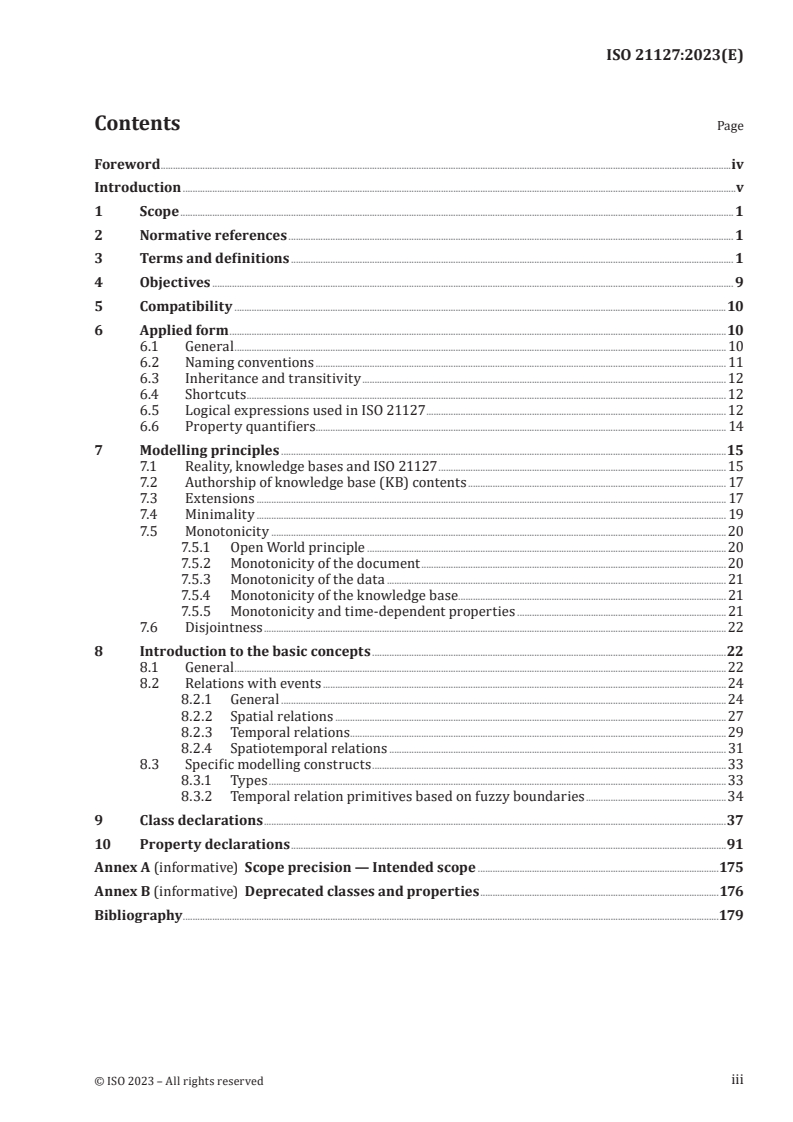
Contents Page
Foreword .iv
Introduction .v
1 Scope . 1
2 Normative references . 1
3 Terms and definitions . 1
4 Objectives . 9
5 Compatibility .10
6 Applied form .10
6.1 General . 10
6.2 Naming conventions . 11
6.3 Inheritance and transitivity . 12
6.4 Shortcuts . 12
6.5 Logical expressions used in ISO 21127 .12
6.6 Property quantifiers. 14
7 Modelling principles .15
7.1 Reality, knowledge bases and ISO 21127 . 15
7.2 Authorship of knowledge base (KB) contents . 17
7.3 Extensions . 17
7.4 Minimality . 19
7.5 Monotonicity . 20
7.5.1 Open World principle .20
7.5.2 Monotonicity of the document . 20
7.5.3 Monotonicity of the data . 21
7.5.4 Monotonicity of the knowledge base . . 21
7.5.5 Monotonicity and time-dependent properties . 21
7.6 Disjointness .22
8 Introduction to the basic concepts .22
8.1 General .22
8.2 Relations with events . 24
8.2.1 General . 24
8.2.2 Spatial relations . 27
8.2.3 Temporal relations.29
8.2.4 Spatiotemporal relations . 31
8.3 Specific modelling constructs .33
8.3.1 Types . 33
8.3.2 Temporal relation primitives based on fuzzy boundaries .34
9 Class declarations .37
10 Property declarations .91
Annex A (informative) Scope precision — Intended scope .175
Annex B (informative) Deprecated classes and properties .176
Bibliography .179
iii
Foreword
ISO (the International Organization for Standardization) is a worldwide federation of national standards
bodies (ISO member bodies). The work of preparing International Standards is normally carried out
through ISO technical committees. Each member body interested in a subject for which a technical
committee has been established has the right to be represented on that committee. International
organizations, governmental and non-governmental, in liaison with ISO, also take part in the work.
ISO collaborates closely with the International Electrotechnical Commission (IEC) on all matters of
electrotechnical standardization.
The procedures used to develop this document and those intended for its further maintenance are
described in the ISO/IEC Directives, Part 1. In particular, the different approval criteria needed for the
different types of ISO document should be noted. This document was drafted in accordance with the
editorial rules of the ISO/IEC Directives, Part 2 (see www.iso.org/directives).
ISO draws attention to the possibility that the implementation of this document may involve the use
of (a) patent(s). ISO takes no position concerning the evidence, validity or applicability of any claimed
patent rights in respect thereof. As of the date of publication of this document, ISO had not received
notice of (a) patent(s) which may be required to implement this document. However, implementers are
cautioned that this may not represent the latest information, which may be obtained from the patent
database available at www.iso.org/patents. ISO shall not be held responsible for identifying any or all
such patent rights.
Any trade name used in this document is information given for the convenience of users and does not
constitute an endorsement.
For an explanation of the voluntary nature of standards, the meaning of ISO specific terms and
expressions related to conformity assessment, as well as information about ISO's adherence to
the World Trade Organization (WTO) principles in the Technical Barriers to Trade (TBT), see
www.iso.org/iso/foreword.html.
This document was prepared by Technical Committee ISO/TC 46, Information and documentation,
Subcommittee SC 4, Technical interoperability, in collaboration with the International Committee for
Documentation (CIDOC).
This third edition cancels and replaces the second edition (ISO 21127:2014), which has been technically
revised.
The main changes are as follows:
— deprecated 13 overspecialised classes and 15 overspecialized properties;
— added 8 properties to replace 8 deprecated properties in order to support chronological reasoning;
— added 4 (sub)classes and 17 properties to align with OCG standards for geospatial data;
— added 4 (sub)classes and 12 properties for more detailed conceptualizations of existing concepts;
— provided further clarification of concepts through the addition real-life examples, references, and
first order logic axioms;
— extended explanatory introductory sections to clarify the standard and its maintained scope.
Any feedback or questions on this document should be directed to the user’s national standards body. A
complete listing of these bodies can be found at www.iso.org/members.html.
iv
Introduction
This document is the culmination of more than a decade of standards development work by the
International Committee for Documentation (CIDOC) of the International Council of Museums (ICOM).
Work on this document began in 1996 under the auspices of the ICOM-CIDOC Documentation Standards
1)
Working Group. The document provided by CIDOC formed the basis for ISO 21127 which was first
published in 2006. While the initial impetus for the work came from the museum community, it
has since spread to encompass other types of cultural heritage institution. This document has been
appropriated and extended to meet the needs of other institutions dealing with cultural heritage.
The primary purpose of this document is to offer a conceptual basis for the integration, mediation,
and exchange of information between cultural heritage organizations such as museums, libraries,
and archives. This document aims to provide a common reference point against which divergent and
incompatible sources of information can be compared and, ultimately, harmonized.
2)
ISO 21127 is an ontology for cultural heritage information: a formal representation of the conceptual
scheme, or “world view”, underlying the database applications and documentation systems that are
used by cultural heritage institutions. It is important to note that this document aims to clarify the logic
of what cultural heritage institutions do in fact document; it is not intended as a normative specification
of what they should document. The primary role of this document is to enable information exchange
and integration between heterogeneous sources of cultural heritage information. It aims to provide the
semantic definitions and clarifications needed to transform disparate, localized information sources
into a coherent global resource, be it within an institution, an intranet, or on the Internet.
The specific aims of this document are to:
— serve as a common language for domain experts and IT developers when formulating requirements;
— serve as a formal language for the identification of common information contents in different data
formats; in particular to support the implementation of automatic data transformation algorithms
from local to global data structures without loss of meaning. These transformation algorithms are
useful for data exchange, data migration from legacy systems, data information integration, and
mediation of heterogeneous sources;
— support associative queries against integrated resources by providing a global model of the basic
classes and their associations to formulate such queries; and
— provide developers of information systems with a guide to good practice in conceptual modelling.
The ISO 21127 ontology is expressed as a series of interrelated concepts with definitions. This
presentation is similar to that used for a thesaurus. However, the ontology is not intended as a
terminology standard and does not set out to define the terms that are typically used as data in cultural
heritage documentation. Although the presentation provided here is complete, it is an intentionally
compact and concise presentation of the ontology's 81 classes and 160 unique properties. It does
not attempt to articulate the inheritance of properties by subclasses throughout the class hierarchy.
However, this definition does contain all the information needed to infer and automatically generate a
3)
full declaration of all properties, including inherited properties.
1) The CIDOC CRM Special Interest Group continues to maintain a version of this original document, usually known
[15]
as the “CIDOC Conceptual Reference Model” or CIDOC CRM .
2) In the sense used in computer science, i.e. it describes in a formal language the relevant explicit and implicit
concepts and the relationships between them.
3) A class and property reference hierarchy can be found in Reference [15].
v
INTERNATIONAL STANDARD ISO 21127:2023(E)
Information and documentation — A reference ontology
for the interchange of cultural heritage information
1 Scope
This document gives a curated, factual knowledge about the past at a human scale. It specifies all
information required for the exchange and integration of heterogeneous scientific and scholarly
documentation about the past at a human scale and the available documented and empirical evidence
4)
for this.
A more detailed and useful definition can be articulated by defining both the intended scope, a broad
and maximally-inclusive definition of general application principles, and the practical scope, which
is expressed by the overall scope of a growing reference set of specific, identifiable documentation
standards and practices that this document aims to semantically describe, restricted, always, in its
details to the limitations of the intended scope.
5)
The practical scope of this document is expressed in terms of the set of reference standards and
de facto standards for documenting factual knowledge. This document covers the same domain
of discourse as the union of these reference standards; this means that for data correctly encoded
according to these documentation formats there can be an ISO 21127-compatible expression that
conveys the same meaning.
2 Normative references
There are no normative references in this document.
3 Terms and definitions
For the purposes of this document, the following terms and definitions apply.
ISO and IEC maintain terminology databases for use in standardization at the following addresses:
— ISO Online browsing platform: available at https:// www .iso .org/ obp
— IEC Electropedia: available at https:// www .electropedia .org/
4) Annex A elaborates on this definition.
5) The practical scope of ISO 21127, including a list of the relevant museum documentation standards, is discussed
in more detail on the CIDOC CRM website at < https:// cidoc -crm .org/ scope >.
3.1
class
category of items that share one or more common traits serving as criteria to identify the items
belonging to the class
Note 1 to entry: These properties need not be explicitly formulated in logical terms, but may be described in a
text (here called a scope note) that refers to a common conceptualisation of domain experts. The sum of these
traits is called the intension of the class. A class may be the domain or range of none, one or more properties
formally defined in a model. The formally defined properties need not be part of the intension of their domains
or ranges: such properties are optional. An item that belongs to a class is called an instance of this class. A class
is associated with an open set of real-life instances, known as the extension of the class. Here “open” is used in
the sense that it is generally beyond our capabilities to know all instances of a class in the world and indeed that
the future may bring new instances about at any time (Open World). Therefore, a class cannot be defined by
enumerating its instances. A class plays a role analogous to a grammatical noun, and can be completely defined
without reference to any other construct (unlike properties, which shall have an unambiguously defined domain
and range). In some contexts, the terms individual class, entity or node are used synonymously with class. For
example, “Person” is a class. To be a “Person” may actually be determined by DNA characteristics, but everyone
knows what a “Person” is. A “Person” may have the property of being a member of a “Group”, but it is not necessary
to be member of a “Group” in order to be a “Person”. It is impossible to know all the "Persons" of the past. There
will be more “Person” in the future.
3.2
complement
set of all instances of B that are not instances of A
Note 1 to entry: Formally, it is the set-theoretic difference of the extension of B minus the extension of A.
Compatible extensions of the CIDOC CRM should not declare any class with the intension of them being the
complement of one or more other classes. To do so will normally violate the desire to describe an Open World. For
example, for all possible cases of human gender, male should not be declared as the complement of female or vice
versa. What if someone is both or even of another kind?
3.3
disjoint
having no common instances (3.8) in any possible world
Note 1 to entry: Classes are disjoint if the intersection of their extensions is an empty set.
3.4
domain
class (3.1) for which a property is formally defined
Note 1 to entry: This means that instances of the property are applicable to instances of its domain class. A
property shall have exactly one domain, although the domain class may always contain instances for which the
property is not instantiated. The domain class is analogous to the grammatical subject of the phrase for which
the property is analogous to the verb. It is arbitrary which class is selected as the domain and which as the range,
just as the choice between active and passive voice in grammar is arbitrary. Property names in this document are
designed to be semantically meaningful and grammatically correct when read from domain to range. In addition,
the inverse property name, normally given in parentheses, is also designed to be semantically meaningful and
grammatically correct when read from range to domain.
3.5
endurant
entities which are wholly present at any time they are present
Note 1 to entry: See Reference [87], pp. 166-181.
3.6
extension
set of all real-life instances belonging to the class that fulfil the criteria of its intension (3.9)
Note 1 to entry: The extension of a class is “open” in the sense that it is generally beyond our capabilities to know
all instances of a class in the world and indeed that the future may bring new instances about at any time (Open
World). An information system may at any point in time refer to some instances of a class, which form a subset of
its extension.
3.7
inheritance
duplication of properties from a class to its subclasses
Note 1 to entry: Inheritance of properties from superclasses to subclasses means that if an item x is an instance
of a class A, then all properties that shall hold for the instances of any of the superclasses of A shall also hold for
item x, and that all optional properties that may hold for the instances of any of the superclasses of A may also
hold for item x.
3.8
instance
items having properties that meet the criteria of the intension (3.9) of the classes
Note 1 to entry: The number of instances declared for a class in an information system is typically less than
the total in the real world. For example, the reader is an instance of Person, but they are not mentioned in all
information systems describing Persons.
Note 2 to entry: For example, the painting known as the “The Mona Lisa” is an instance of the class E22 Human-
Made Object. An instance of a property is a factual relation between an instance of the domain and an instance of
the range of the property that matches the criteria of the intension of the property. For example, “The Mona Lisa”
has former or current owner. The Louvre is an instance of the property P51 has former or current owner (is former
or current owner of).
3.9
intension
intended meaning of a class
Note 1 to entry: The intension of a class consists of one or more common traits shared by all instances of the class
or property. These traits need not be explicitly formulated in logical terms, but may just be described in a text
(here called a scope note) that refers to a conceptualisation common to domain experts.
3.10
interoperability
capability of different information systems to communicate some of their contents
Note 1 to entry: Interoperability may mean that two systems can exchange information, and/or that multiple
systems can be accessed with a single method.
Note 2 to entry: Generally, syntactic interoperability is distinguished from semantic interoperability. Syntactic
interoperability means that the information encoding of the involved systems and the access protocols are
compatible, so that information can be processed as described above without error. However, this does not mean
that each system processes the data in a manner consistent with the intended meaning. For example, one system
may use a table called “Actor” and another one called “Agent”. With syntactic interoperability, data from both
tables may only be retrieved as distinct, even though they may have exactly the same meaning. To overcome this
situation, semantic interoperability has to be added. This document relies on existing syntactic interoperability
and is concerned only with adding semantic interoperability (3.24).
3.11
inverse of
reinterpretation of a property from range to domain without more general or more specific meaning
Note 1 to entry: The inverse of a property is similar to the choice between active and passive voice in some
languages. In contrast to some knowledge representation languages, such as RDF and OWL, this document
regards that the inverse of a property is not a property in its own right that needs an explicit declaration of
being inverse of another, but an interpretation implicitly existing for any property. The inverse of the inverse of
a property is identical to the property itself, i.e. its primary sense of direction. For example, “Entity is depicted by
Physical Human-Made Thing” is the inverse of “Physical Human-Made Thing depicts Entity”.
3.12
knowledge creation event
organized transfer of knowledge of a group of domain experts into an information system under
preservation of the relationship between those regarding the created content as representing their
knowledge and the knowledge itself
Note 1 to entry: All knowledge contained in an information system must have been introduced into that system
by some human agent, either directly or indirectly. Despite this fact, many, if not most, statements within such a
system will lack specific attribution of authority. That being said, in the domain of cultural heritage, it is common
practice that, for the processes of collection documentation and management, there are clearly and explicitly
elaborated systems of responsibility outlining by whom and how knowledge can be added and or modified in the
system. Ideally these systems are specified in institutional policy and protocol documents. Thus, it is reasonable
to hold that all such statements that lack explicit authority attribution within the information system can, in
fact, be read as the official view of the administrating institution of that system. Such a position does not mean
to imply that an information system represents at any particular moment a completed phase of knowledge that
the institution promotes. Rather, it means to underline that, in a CH context, a managed set of data, at any state
of elaboration, will in fact embody an adherence to some explicit code of standards which guarantees the validity
of that data within the scope of said standards and all practical limitations. So long as the information is under
active management it remains continuously open to revision and improvement as further research reveals
further understanding surrounding the objects of concern. A distinct exception to this rule is represented by
information in the data set that carries with it an explicit statement of responsibility.
Note 2 to entry: In this document, such statements of responsibility are expressed through knowledge creation
events such as E13 Attribute Assignment and its relevant subclasses. Any information in a model using this
document that is based on an explicit creation event for that piece of information, where the creator’s identity
has been given, is attributed to the authority and assigned to the responsibility of the actor identified as causal
in that event. For any information in the system connected to knowledge creation events that do not explicitly
reference their creator, as well as any information not connected to creation events, the responsibility falls back
to the institution responsible for the database/knowledge graph. That means that for information only expressed
through shortcuts such as P2 has type, where no knowledge creation event has been explicitly specified, the
originating creation event cannot be deduced and the responsibility for the information can never be any other
body than the institution responsible for the whole information system. In the case of an institution taking over
stewardship of a database transferred into their custody, two relations of responsibility for the knowledge
therein can be envisioned. If the institution accepts the dataset and undertakes to maintain and update it, then
they take on responsibility for that information and become the default authority behind its statements as
described above. If, on the other hand, the institution accepts the data set and stores it without change as a closed
resource, then it can be considered that the default authority remains the original steward.
3.13
monotonic
having a set of conclusions derived through inference rules that does not reduce,
irrespective of whatever additional propositions can be inserted
Note 1 to entry: Monotonic reasoning is a term from knowledge representation. A reasoning form is monotonic if
an addition to the set of propositions making up the knowledge base never determines a decrement in the set of
conclusions that may be derived from the knowledge base via inference rules. In practical terms, if experts enter
subsequently correct statements to an information system, the system should not regard any results from those
statements as invalid, when a new one is entered. The ISO 21127 ontology is designed for monotonic reasoning
and so enables conflict-free merging of huge stores of knowledge.
3.14
multiple inheritance
possibility for a class to have more than one immediate superclass
Note 1 to entry: The extension of a class with multiple immediate superclasses is a subset of the intersection
of all extensions of its superclasses. The intension of a class with multiple immediate superclasses extends
the intensions of all its superclasses, i.e. its traits are more restrictive than any of its superclasses. If multiple
inheritance is used, the resulting “class hierarchy” is a directed graph and not a tree structure. If it is represented
as an indented list, there are necessarily repetitions of the same class at different positions in the list. For
example, Person is both an Actor and a Biological Object.
3.15
multiple instantiation
case that an instance of class A is also regarded as an instance of one or more other classes B1.n
Note 1 to entry: When multiple instantiation is used, it has the effect that the properties of all these classes
become available to describe this instance. For instance, some particular cases of destruction may also be
activities (e.g. Herostratos’ deed), but not all destructions are activities (e.g. destruction of Herculaneum). In
comparison, multiple inheritance describes the case that all instances of a class A are implicitly instances of all
superclasses of A, by virtue of the definition of the class A, whereas the combination of classes used for multiple
instantiation is a characteristic of particular instances only. It is important to note that multiple instantiation is
not allowed using combinations of disjoint classes.
3.16
open world
assumption that the information stored in a knowledge base is incomplete with respect to the universe
of discourse it aims to describe
Note 1 to entry: The “open world assumption” is a term from knowledge base systems. This incompleteness may
be due to the inability of the maintainer to provide sufficient information or due to more fundamental problems of
cognition in the system’s domain. Such problems are characteristic of cultural information systems. Our records
about the past are necessarily incomplete. In addition, there may be items that cannot be clearly assigned to a
given class. In particular, absence of a certain property for an item described in the system does not mean that
this item does not have this property. For example, if one item is described as Biological Object and another as
Physical Object, this does not imply that the latter may not be a Biological Object as well. For example, one cannot
list “all Physical Objects known to the system that are not Biological Objects in the real world”, but one may of
course list “all items known to the system as Physical Objects but that are not known to the system as Biological
Objects”. Therefore, complements of a class with respect to a superclass cannot be concluded in general from an
information system using the open world assumption.
3.17
perdurant
entities which extend in time
Note 1 to entry: “The difference between enduring and perduring entities (referred to in this document as
endurants (3.5) and perdurants (3.17)) is related to their behaviour in time. Endurants are wholly present (i.e. all
their proper parts are present) at any time they are present. Perdurants, on the other hand, just extend in time
by accumulating different temporal parts, so that, at any time they are present, they are only partially present,
in the sense that some of their proper temporal parts (e.g. their previous or future phases) may be not present.
For example, the piece of paper the reader is reading now is wholly present, while some temporal parts of their
reading are not present any more. Philosophers say that endurants are entities that are in time, while lacking
however temporal parts (so to speak, all their parts flow with them in time). Perdurants, on the other hand, are
entities that happen in time, and can have temporal parts (all their parts are fixed in time).” (Reference [87], pp.
166-181).
3.18
property
named characteristic of a class to which values can be assigned
Note 1 to entry: A property serves to define a relationship of a specific kind between two classes. The property
is characterized by an intension, which is conveyed by a scope note. A property plays a role analogous to a
grammatical verb, in that it shall be defined with reference to both its domain and range, which are analogous
to the subject and object in grammar (unlike classes, which can be defined independently). It is arbitrary, which
class is selected as the domain, just as the choice between active and passive voice in grammar is arbitrary. In
other words, a property can be interpreted in both directions, with two distinct, but related interpretations.
Properties may themselves have properties that relate to other classes (This feature is used in this model only
in order to describe dynamic subtyping of properties). Properties can also be specialized in the same manner
as classes, resulting in IsA relationships between subproperties and their superproperties. In some contexts,
the terms attribute, reference, link, role or slot are used synonymously with property. For example, “Physical
Human-Made Thing depicts Entity” is equivalent to “Entity is depicted by Physical Human-Made Thing”.
3.19
property quantifier
declaration of the allowed number of instances (3.8) of a certain property (3.18) that can refer to a
particular instance of the range class or the domain class of that property
Note 1 to entry: Property quantifier declarations are ontological, i.e. they refer to the nature of the real world
described and not to our current knowledge. For example, each person has exactly one father, but collected
knowledge may refer to none, one or many.
3.20
query
request for information from an information system expressed so that the response can be calculated
automatically
3.21
range
class that comprises all potential values of a property
Note 1 to entry: That means that instances of the property can link only to instances of its range class. A property
shall have exactly one range, although the range class may always contain instances that are not the value of the
property. The range class is analogous to the grammatical object of a phrase for which the property is analogous
to the verb. It is arbitrary which class is selected as domain and which as range, just as the choice between
active and passive voice in grammar is arbitrary. Property names in ISO 21127 are designed to be semantically
meaningful and grammatically correct when read from domain to range. In addition, the inverse property name,
normally given in parentheses, is also designed to be semantically meaningful and grammatically correct when
read from range to domain.
3.22
reflexivity
binary relation on a set X that relates every element of X to itself
Note 1 to entry: Reflexivity is defined in the standard way found in mathematics or logic: A property P is reflexive
if the domain and range are the same class and for all instances x, of this class the following is the case: x is
related by P to itself. The intention of a property as described in the scope note will decide whether a property is
reflexive or not. An example of a reflexive property is E53 Place. P89 falls within (contains): E53 Place.
3.23
scope note
textual description of the intension (3.9) of a class or property
Note 1 to entry: Scope notes are not formal modelling constructs, but are provided to help explain the intended
meaning and application of ISO 21127’s classes and properties. Basically, they refer to a conceptualisation
common to domain experts and disambiguate between different possible interpretations. Illustrative example
instances of classes and properties are also regularly provided in the scope notes for explanatory purposes.
3.24
semantic interoperability
capability of different information systems to communicate information consistent with the intended
meaning
Note 1 to entry: In more detail, the intended meaning encompasses the data structure elements involved, the
terminology appearing as data, and the identifiers used in the data for factual items such as places, people,
objects, etc. Obviously, communication about data structure must be resolved first. In this case, consistent
communication means that data can be transferred between data structure elements with the same intended
meaning or that data from elements with the same intended meaning can be merged. In practice, the different
levels of generalization in different systems do not allow the achievement of this ideal. Therefore, semantic
interoperability is regarded as achieved if elements can be found that provide a reasonably close generalization
for the transfer or merge. This document is only concerned with semantic interoperability on the level of data
structure elements.
3.25
shortcut
formally defined single property that represents a deduction or join of a data path in the ontology
Note 1 to entry: The scope notes of all properties characterized as shortcuts describe in words the equivalent
deduction. Shortcuts are introduced for the cases where common documentation practice refers only to the
deduction rather than to the fully developed path. For example, museums often only record the dimension of an
object without documenting the Measurement that observed it. This document declares shortcuts explicitly as
single properties in order to allow the user to describe cases in which he has less detailed knowledge than the
full data path would need to be described. For each shortcut, this document contains in its schema the properties
of the full data path explaining the shortcut.
3.26
strict inheritance
property inheritance (3.7) that allows no exceptions
Note 1 to entry: Some systems may declare that elephants are grey and regard a white elephant as an exception.
Under strict inheritance it would hold that: if all elephants were grey, then a white elephant could not be an
elephant. Obviously, not all elephants are grey; to be grey is not part of the intension of the concept elephant but
an optional property. This document applies strict inheritance as a normalization principle.
3.27
subclass
specialization of another class (3.1), i.e. the superclass
Note 1 to entry: Specialization or the IsA relationship means that all instances of the subclass are also instances
of its superclass, that the intension of the subclass extends the intension of its superclass, i.e. its traits are more
restrictive than that of its superclass, and that the subclass inherits the definition of all of the properties declared
for its superclass without exceptions (strict inheritance), in addition to having none, one or more properties of its
own. A subclass can have more than one immediate superclass and consequently inherits the properties of all of
its superclasses (multiple inheritance). The IsA relationship or specialization between two or more classes gives
rise to a structure known as a class hierarchy. The IsA relationship is transitive and may not be cyclic. In some
contexts (e.g. the programming language C++) the term derived class is used synonymously with subclass. For
example, every Person IsA Biological Object, or Person is a subclass of Biological Object. Also, every Person IsA
Actor. A Person may die. However, other kinds of Actors, such as companies, don’t die. Every Biological Object IsA
Physical Object. A Physical Object can be moved. Hence, a Person can be moved also.
3.28
subproperty
specialization of another property (3.18), i.e. the superproperty
Note 1 to entry: Specialization or IsA relationship means that all instances of the subproperty are also instances
of its superproperty, that the intension of the subproperty extends the intension of the superproperty, i.e. its
traits are more restrictive than that of its superproperty, that the domain of the subproperty is the same as the
domain of its superproperty or a subclass of that domain, that the range of the subproperty is the same as the
range of its superproperty or a subclass of that range, and that the subproperty inherits the definition of all
of the properties declared for its superproperty without exceptions (strict inheritance), in addition to having
none,
...
INTERNATIONAL ISO
STANDARD 21127
Third edition
2023-10
Information and documentation — A
reference ontology for the interchange
of cultural heritage information
Information et documentation — Une ontologie de référence pour
l'échange d'informations du patrimoine culturel
Reference number
© ISO 2023
All rights reserved. Unless otherwise specified, or required in the context of its implementation, no part of this publication may
be reproduced or utilized otherwise in any form or by any means, electronic or mechanical, including photocopying, or posting on
the internet or an intranet, without prior written permission. Permission can be requested from either ISO at the address below
or ISO’s member body in the country of the requester.
ISO copyright office
CP 401 • Ch. de Blandonnet 8
CH-1214 Vernier, Geneva
Phone: +41 22 749 01 11
Email: copyright@iso.org
Website: www.iso.org
Published in Switzerland
ii
Contents Page
Foreword .iv
Introduction .v
1 Scope . 1
2 Normative references . 1
3 Terms and definitions . 1
4 Objectives . 9
5 Compatibility .10
6 Applied form .10
6.1 General . 10
6.2 Naming conventions . 11
6.3 Inheritance and transitivity . 12
6.4 Shortcuts . 12
6.5 Logical expressions used in ISO 21127 .12
6.6 Property quantifiers. 14
7 Modelling principles .15
7.1 Reality, knowledge bases and ISO 21127 . 15
7.2 Authorship of knowledge base (KB) contents . 17
7.3 Extensions . 17
7.4 Minimality . 19
7.5 Monotonicity . 20
7.5.1 Open World principle .20
7.5.2 Monotonicity of the document . 20
7.5.3 Monotonicity of the data . 21
7.5.4 Monotonicity of the knowledge base . . 21
7.5.5 Monotonicity and time-dependent properties . 21
7.6 Disjointness .22
8 Introduction to the basic concepts .22
8.1 General .22
8.2 Relations with events . 24
8.2.1 General . 24
8.2.2 Spatial relations . 27
8.2.3 Temporal relations.29
8.2.4 Spatiotemporal relations . 31
8.3 Specific modelling constructs .33
8.3.1 Types . 33
8.3.2 Temporal relation primitives based on fuzzy boundaries .34
9 Class declarations .37
10 Property declarations .91
Annex A (informative) Scope precision — Intended scope .175
Annex B (informative) Deprecated classes and properties .176
Bibliography .179
iii
Foreword
ISO (the International Organization for Standardization) is a worldwide federation of national standards
bodies (ISO member bodies). The work of preparing International Standards is normally carried out
through ISO technical committees. Each member body interested in a subject for which a technical
committee has been established has the right to be represented on that committee. International
organizations, governmental and non-governmental, in liaison with ISO, also take part in the work.
ISO collaborates closely with the International Electrotechnical Commission (IEC) on all matters of
electrotechnical standardization.
The procedures used to develop this document and those intended for its further maintenance are
described in the ISO/IEC Directives, Part 1. In particular, the different approval criteria needed for the
different types of ISO document should be noted. This document was drafted in accordance with the
editorial rules of the ISO/IEC Directives, Part 2 (see www.iso.org/directives).
ISO draws attention to the possibility that the implementation of this document may involve the use
of (a) patent(s). ISO takes no position concerning the evidence, validity or applicability of any claimed
patent rights in respect thereof. As of the date of publication of this document, ISO had not received
notice of (a) patent(s) which may be required to implement this document. However, implementers are
cautioned that this may not represent the latest information, which may be obtained from the patent
database available at www.iso.org/patents. ISO shall not be held responsible for identifying any or all
such patent rights.
Any trade name used in this document is information given for the convenience of users and does not
constitute an endorsement.
For an explanation of the voluntary nature of standards, the meaning of ISO specific terms and
expressions related to conformity assessment, as well as information about ISO's adherence to
the World Trade Organization (WTO) principles in the Technical Barriers to Trade (TBT), see
www.iso.org/iso/foreword.html.
This document was prepared by Technical Committee ISO/TC 46, Information and documentation,
Subcommittee SC 4, Technical interoperability, in collaboration with the International Committee for
Documentation (CIDOC).
This third edition cancels and replaces the second edition (ISO 21127:2014), which has been technically
revised.
The main changes are as follows:
— deprecated 13 overspecialised classes and 15 overspecialized properties;
— added 8 properties to replace 8 deprecated properties in order to support chronological reasoning;
— added 4 (sub)classes and 17 properties to align with OCG standards for geospatial data;
— added 4 (sub)classes and 12 properties for more detailed conceptualizations of existing concepts;
— provided further clarification of concepts through the addition real-life examples, references, and
first order logic axioms;
— extended explanatory introductory sections to clarify the standard and its maintained scope.
Any feedback or questions on this document should be directed to the user’s national standards body. A
complete listing of these bodies can be found at www.iso.org/members.html.
iv
Introduction
This document is the culmination of more than a decade of standards development work by the
International Committee for Documentation (CIDOC) of the International Council of Museums (ICOM).
Work on this document began in 1996 under the auspices of the ICOM-CIDOC Documentation Standards
1)
Working Group. The document provided by CIDOC formed the basis for ISO 21127 which was first
published in 2006. While the initial impetus for the work came from the museum community, it
has since spread to encompass other types of cultural heritage institution. This document has been
appropriated and extended to meet the needs of other institutions dealing with cultural heritage.
The primary purpose of this document is to offer a conceptual basis for the integration, mediation,
and exchange of information between cultural heritage organizations such as museums, libraries,
and archives. This document aims to provide a common reference point against which divergent and
incompatible sources of information can be compared and, ultimately, harmonized.
2)
ISO 21127 is an ontology for cultural heritage information: a formal representation of the conceptual
scheme, or “world view”, underlying the database applications and documentation systems that are
used by cultural heritage institutions. It is important to note that this document aims to clarify the logic
of what cultural heritage institutions do in fact document; it is not intended as a normative specification
of what they should document. The primary role of this document is to enable information exchange
and integration between heterogeneous sources of cultural heritage information. It aims to provide the
semantic definitions and clarifications needed to transform disparate, localized information sources
into a coherent global resource, be it within an institution, an intranet, or on the Internet.
The specific aims of this document are to:
— serve as a common language for domain experts and IT developers when formulating requirements;
— serve as a formal language for the identification of common information contents in different data
formats; in particular to support the implementation of automatic data transformation algorithms
from local to global data structures without loss of meaning. These transformation algorithms are
useful for data exchange, data migration from legacy systems, data information integration, and
mediation of heterogeneous sources;
— support associative queries against integrated resources by providing a global model of the basic
classes and their associations to formulate such queries; and
— provide developers of information systems with a guide to good practice in conceptual modelling.
The ISO 21127 ontology is expressed as a series of interrelated concepts with definitions. This
presentation is similar to that used for a thesaurus. However, the ontology is not intended as a
terminology standard and does not set out to define the terms that are typically used as data in cultural
heritage documentation. Although the presentation provided here is complete, it is an intentionally
compact and concise presentation of the ontology's 81 classes and 160 unique properties. It does
not attempt to articulate the inheritance of properties by subclasses throughout the class hierarchy.
However, this definition does contain all the information needed to infer and automatically generate a
3)
full declaration of all properties, including inherited properties.
1) The CIDOC CRM Special Interest Group continues to maintain a version of this original document, usually known
[15]
as the “CIDOC Conceptual Reference Model” or CIDOC CRM .
2) In the sense used in computer science, i.e. it describes in a formal language the relevant explicit and implicit
concepts and the relationships between them.
3) A class and property reference hierarchy can be found in Reference [15].
v
INTERNATIONAL STANDARD ISO 21127:2023(E)
Information and documentation — A reference ontology
for the interchange of cultural heritage information
1 Scope
This document gives a curated, factual knowledge about the past at a human scale. It specifies all
information required for the exchange and integration of heterogeneous scientific and scholarly
documentation about the past at a human scale and the available documented and empirical evidence
4)
for this.
A more detailed and useful definition can be articulated by defining both the intended scope, a broad
and maximally-inclusive definition of general application principles, and the practical scope, which
is expressed by the overall scope of a growing reference set of specific, identifiable documentation
standards and practices that this document aims to semantically describe, restricted, always, in its
details to the limitations of the intended scope.
5)
The practical scope of this document is expressed in terms of the set of reference standards and
de facto standards for documenting factual knowledge. This document covers the same domain
of discourse as the union of these reference standards; this means that for data correctly encoded
according to these documentation formats there can be an ISO 21127-compatible expression that
conveys the same meaning.
2 Normative references
There are no normative references in this document.
3 Terms and definitions
For the purposes of this document, the following terms and definitions apply.
ISO and IEC maintain terminology databases for use in standardization at the following addresses:
— ISO Online browsing platform: available at https:// www .iso .org/ obp
— IEC Electropedia: available at https:// www .electropedia .org/
4) Annex A elaborates on this definition.
5) The practical scope of ISO 21127, including a list of the relevant museum documentation standards, is discussed
in more detail on the CIDOC CRM website at < https:// cidoc -crm .org/ scope >.
3.1
class
category of items that share one or more common traits serving as criteria to identify the items
belonging to the class
Note 1 to entry: These properties need not be explicitly formulated in logical terms, but may be described in a
text (here called a scope note) that refers to a common conceptualisation of domain experts. The sum of these
traits is called the intension of the class. A class may be the domain or range of none, one or more properties
formally defined in a model. The formally defined properties need not be part of the intension of their domains
or ranges: such properties are optional. An item that belongs to a class is called an instance of this class. A class
is associated with an open set of real-life instances, known as the extension of the class. Here “open” is used in
the sense that it is generally beyond our capabilities to know all instances of a class in the world and indeed that
the future may bring new instances about at any time (Open World). Therefore, a class cannot be defined by
enumerating its instances. A class plays a role analogous to a grammatical noun, and can be completely defined
without reference to any other construct (unlike properties, which shall have an unambiguously defined domain
and range). In some contexts, the terms individual class, entity or node are used synonymously with class. For
example, “Person” is a class. To be a “Person” may actually be determined by DNA characteristics, but everyone
knows what a “Person” is. A “Person” may have the property of being a member of a “Group”, but it is not necessary
to be member of a “Group” in order to be a “Person”. It is impossible to know all the "Persons" of the past. There
will be more “Person” in the future.
3.2
complement
set of all instances of B that are not instances of A
Note 1 to entry: Formally, it is the set-theoretic difference of the extension of B minus the extension of A.
Compatible extensions of the CIDOC CRM should not declare any class with the intension of them being the
complement of one or more other classes. To do so will normally violate the desire to describe an Open World. For
example, for all possible cases of human gender, male should not be declared as the complement of female or vice
versa. What if someone is both or even of another kind?
3.3
disjoint
having no common instances (3.8) in any possible world
Note 1 to entry: Classes are disjoint if the intersection of their extensions is an empty set.
3.4
domain
class (3.1) for which a property is formally defined
Note 1 to entry: This means that instances of the property are applicable to instances of its domain class. A
property shall have exactly one domain, although the domain class may always contain instances for which the
property is not instantiated. The domain class is analogous to the grammatical subject of the phrase for which
the property is analogous to the verb. It is arbitrary which class is selected as the domain and which as the range,
just as the choice between active and passive voice in grammar is arbitrary. Property names in this document are
designed to be semantically meaningful and grammatically correct when read from domain to range. In addition,
the inverse property name, normally given in parentheses, is also designed to be semantically meaningful and
grammatically correct when read from range to domain.
3.5
endurant
entities which are wholly present at any time they are present
Note 1 to entry: See Reference [87], pp. 166-181.
3.6
extension
set of all real-life instances belonging to the class that fulfil the criteria of its intension (3.9)
Note 1 to entry: The extension of a class is “open” in the sense that it is generally beyond our capabilities to know
all instances of a class in the world and indeed that the future may bring new instances about at any time (Open
World). An information system may at any point in time refer to some instances of a class, which form a subset of
its extension.
3.7
inheritance
duplication of properties from a class to its subclasses
Note 1 to entry: Inheritance of properties from superclasses to subclasses means that if an item x is an instance
of a class A, then all properties that shall hold for the instances of any of the superclasses of A shall also hold for
item x, and that all optional properties that may hold for the instances of any of the superclasses of A may also
hold for item x.
3.8
instance
items having properties that meet the criteria of the intension (3.9) of the classes
Note 1 to entry: The number of instances declared for a class in an information system is typically less than
the total in the real world. For example, the reader is an instance of Person, but they are not mentioned in all
information systems describing Persons.
Note 2 to entry: For example, the painting known as the “The Mona Lisa” is an instance of the class E22 Human-
Made Object. An instance of a property is a factual relation between an instance of the domain and an instance of
the range of the property that matches the criteria of the intension of the property. For example, “The Mona Lisa”
has former or current owner. The Louvre is an instance of the property P51 has former or current owner (is former
or current owner of).
3.9
intension
intended meaning of a class
Note 1 to entry: The intension of a class consists of one or more common traits shared by all instances of the class
or property. These traits need not be explicitly formulated in logical terms, but may just be described in a text
(here called a scope note) that refers to a conceptualisation common to domain experts.
3.10
interoperability
capability of different information systems to communicate some of their contents
Note 1 to entry: Interoperability may mean that two systems can exchange information, and/or that multiple
systems can be accessed with a single method.
Note 2 to entry: Generally, syntactic interoperability is distinguished from semantic interoperability. Syntactic
interoperability means that the information encoding of the involved systems and the access protocols are
compatible, so that information can be processed as described above without error. However, this does not mean
that each system processes the data in a manner consistent with the intended meaning. For example, one system
may use a table called “Actor” and another one called “Agent”. With syntactic interoperability, data from both
tables may only be retrieved as distinct, even though they may have exactly the same meaning. To overcome this
situation, semantic interoperability has to be added. This document relies on existing syntactic interoperability
and is concerned only with adding semantic interoperability (3.24).
3.11
inverse of
reinterpretation of a property from range to domain without more general or more specific meaning
Note 1 to entry: The inverse of a property is similar to the choice between active and passive voice in some
languages. In contrast to some knowledge representation languages, such as RDF and OWL, this document
regards that the inverse of a property is not a property in its own right that needs an explicit declaration of
being inverse of another, but an interpretation implicitly existing for any property. The inverse of the inverse of
a property is identical to the property itself, i.e. its primary sense of direction. For example, “Entity is depicted by
Physical Human-Made Thing” is the inverse of “Physical Human-Made Thing depicts Entity”.
3.12
knowledge creation event
organized transfer of knowledge of a group of domain experts into an information system under
preservation of the relationship between those regarding the created content as representing their
knowledge and the knowledge itself
Note 1 to entry: All knowledge contained in an information system must have been introduced into that system
by some human agent, either directly or indirectly. Despite this fact, many, if not most, statements within such a
system will lack specific attribution of authority. That being said, in the domain of cultural heritage, it is common
practice that, for the processes of collection documentation and management, there are clearly and explicitly
elaborated systems of responsibility outlining by whom and how knowledge can be added and or modified in the
system. Ideally these systems are specified in institutional policy and protocol documents. Thus, it is reasonable
to hold that all such statements that lack explicit authority attribution within the information system can, in
fact, be read as the official view of the administrating institution of that system. Such a position does not mean
to imply that an information system represents at any particular moment a completed phase of knowledge that
the institution promotes. Rather, it means to underline that, in a CH context, a managed set of data, at any state
of elaboration, will in fact embody an adherence to some explicit code of standards which guarantees the validity
of that data within the scope of said standards and all practical limitations. So long as the information is under
active management it remains continuously open to revision and improvement as further research reveals
further understanding surrounding the objects of concern. A distinct exception to this rule is represented by
information in the data set that carries with it an explicit statement of responsibility.
Note 2 to entry: In this document, such statements of responsibility are expressed through knowledge creation
events such as E13 Attribute Assignment and its relevant subclasses. Any information in a model using this
document that is based on an explicit creation event for that piece of information, where the creator’s identity
has been given, is attributed to the authority and assigned to the responsibility of the actor identified as causal
in that event. For any information in the system connected to knowledge creation events that do not explicitly
reference their creator, as well as any information not connected to creation events, the responsibility falls back
to the institution responsible for the database/knowledge graph. That means that for information only expressed
through shortcuts such as P2 has type, where no knowledge creation event has been explicitly specified, the
originating creation event cannot be deduced and the responsibility for the information can never be any other
body than the institution responsible for the whole information system. In the case of an institution taking over
stewardship of a database transferred into their custody, two relations of responsibility for the knowledge
therein can be envisioned. If the institution accepts the dataset and undertakes to maintain and update it, then
they take on responsibility for that information and become the default authority behind its statements as
described above. If, on the other hand, the institution accepts the data set and stores it without change as a closed
resource, then it can be considered that the default authority remains the original steward.
3.13
monotonic
having a set of conclusions derived through inference rules that does not reduce,
irrespective of whatever additional propositions can be inserted
Note 1 to entry: Monotonic reasoning is a term from knowledge representation. A reasoning form is monotonic if
an addition to the set of propositions making up the knowledge base never determines a decrement in the set of
conclusions that may be derived from the knowledge base via inference rules. In practical terms, if experts enter
subsequently correct statements to an information system, the system should not regard any results from those
statements as invalid, when a new one is entered. The ISO 21127 ontology is designed for monotonic reasoning
and so enables conflict-free merging of huge stores of knowledge.
3.14
multiple inheritance
possibility for a class to have more than one immediate superclass
Note 1 to entry: The extension of a class with multiple immediate superclasses is a subset of the intersection
of all extensions of its superclasses. The intension of a class with multiple immediate superclasses extends
the intensions of all its superclasses, i.e. its traits are more restrictive than any of its superclasses. If multiple
inheritance is used, the resulting “class hierarchy” is a directed graph and not a tree structure. If it is represented
as an indented list, there are necessarily repetitions of the same class at different positions in the list. For
example, Person is both an Actor and a Biological Object.
3.15
multiple instantiation
case that an instance of class A is also regarded as an instance of one or more other classes B1.n
Note 1 to entry: When multiple instantiation is used, it has the effect that the properties of all these classes
become available to describe this instance. For instance, some particular cases of destruction may also be
activities (e.g. Herostratos’ deed), but not all destructions are activities (e.g. destruction of Herculaneum). In
comparison, multiple inheritance describes the case that all instances of a class A are implicitly instances of all
superclasses of A, by virtue of the definition of the class A, whereas the combination of classes used for multiple
instantiation is a characteristic of particular instances only. It is important to note that multiple instantiation is
not allowed using combinations of disjoint classes.
3.16
open world
assumption that the information stored in a knowledge base is incomplete with respect to the universe
of discourse it aims to describe
Note 1 to entry: The “open world assumption” is a term from knowledge base systems. This incompleteness may
be due to the inability of the maintainer to provide sufficient information or due to more fundamental problems of
cognition in the system’s domain. Such problems are characteristic of cultural information systems. Our records
about the past are necessarily incomplete. In addition, there may be items that cannot be clearly assigned to a
given class. In particular, absence of a certain property for an item described in the system does not mean that
this item does not have this property. For example, if one item is described as Biological Object and another as
Physical Object, this does not imply that the latter may not be a Biological Object as well. For example, one cannot
list “all Physical Objects known to the system that are not Biological Objects in the real world”, but one may of
course list “all items known to the system as Physical Objects but that are not known to the system as Biological
Objects”. Therefore, complements of a class with respect to a superclass cannot be concluded in general from an
information system using the open world assumption.
3.17
perdurant
entities which extend in time
Note 1 to entry: “The difference between enduring and perduring entities (referred to in this document as
endurants (3.5) and perdurants (3.17)) is related to their behaviour in time. Endurants are wholly present (i.e. all
their proper parts are present) at any time they are present. Perdurants, on the other hand, just extend in time
by accumulating different temporal parts, so that, at any time they are present, they are only partially present,
in the sense that some of their proper temporal parts (e.g. their previous or future phases) may be not present.
For example, the piece of paper the reader is reading now is wholly present, while some temporal parts of their
reading are not present any more. Philosophers say that endurants are entities that are in time, while lacking
however temporal parts (so to speak, all their parts flow with them in time). Perdurants, on the other hand, are
entities that happen in time, and can have temporal parts (all their parts are fixed in time).” (Reference [87], pp.
166-181).
3.18
property
named characteristic of a class to which values can be assigned
Note 1 to entry: A property serves to define a relationship of a specific kind between two classes. The property
is characterized by an intension, which is conveyed by a scope note. A property plays a role analogous to a
grammatical verb, in that it shall be defined with reference to both its domain and range, which are analogous
to the subject and object in grammar (unlike classes, which can be defined independently). It is arbitrary, which
class is selected as the domain, just as the choice between active and passive voice in grammar is arbitrary. In
other words, a property can be interpreted in both directions, with two distinct, but related interpretations.
Properties may themselves have properties that relate to other classes (This feature is used in this model only
in order to describe dynamic subtyping of properties). Properties can also be specialized in the same manner
as classes, resulting in IsA relationships between subproperties and their superproperties. In some contexts,
the terms attribute, reference, link, role or slot are used synonymously with property. For example, “Physical
Human-Made Thing depicts Entity” is equivalent to “Entity is depicted by Physical Human-Made Thing”.
3.19
property quantifier
declaration of the allowed number of instances (3.8) of a certain property (3.18) that can refer to a
particular instance of the range class or the domain class of that property
Note 1 to entry: Property quantifier declarations are ontological, i.e. they refer to the nature of the real world
described and not to our current knowledge. For example, each person has exactly one father, but collected
knowledge may refer to none, one or many.
3.20
query
request for information from an information system expressed so that the response can be calculated
automatically
3.21
range
class that comprises all potential values of a property
Note 1 to entry: That means that instances of the property can link only to instances of its range class. A property
shall have exactly one range, although the range class may always contain instances that are not the value of the
property. The range class is analogous to the grammatical object of a phrase for which the property is analogous
to the verb. It is arbitrary which class is selected as domain and which as range, just as the choice between
active and passive voice in grammar is arbitrary. Property names in ISO 21127 are designed to be semantically
meaningful and grammatically correct when read from domain to range. In addition, the inverse property name,
normally given in parentheses, is also designed to be semantically meaningful and grammatically correct when
read from range to domain.
3.22
reflexivity
binary relation on a set X that relates every element of X to itself
Note 1 to entry: Reflexivity is defined in the standard way found in mathematics or logic: A property P is reflexive
if the domain and range are the same class and for all instances x, of this class the following is the case: x is
related by P to itself. The intention of a property as described in the scope note will decide whether a property is
reflexive or not. An example of a reflexive property is E53 Place. P89 falls within (contains): E53 Place.
3.23
scope note
textual description of the intension (3.9) of a class or property
Note 1 to entry: Scope notes are not formal modelling constructs, but are provided to help explain the intended
meaning and application of ISO 21127’s classes and properties. Basically, they refer to a conceptualisation
common to domain experts and disambiguate between different possible interpretations. Illustrative example
instances of classes and properties are also regularly provided in the scope notes for explanatory purposes.
3.24
semantic interoperability
capability of different information systems to communicate information consistent with the intended
meaning
Note 1 to entry: In more detail, the intended meaning encompasses the data structure elements involved, the
terminology appearing as data, and the identifiers used in the data for factual items such as places, people,
objects, etc. Obviously, communication about data structure must be resolved first. In this case, consistent
communication means that data can be transferred between data structure elements with the same intended
meaning or that data from elements with the same intended meaning can be merged. In practice, the different
levels of generalization in different systems do not allow the achievement of this ideal. Therefore, semantic
interoperability is regarded as achieved if elements can be found that provide a reasonably close generalization
for the transfer or merge. This document is only concerned with semantic interoperability on the level of data
structure elements.
3.25
shortcut
formally defined single property that represents a deduction or join of a data path in the ontology
Note 1 to entry: The scope notes of all properties characterized as shortcuts describe in words the equivalent
deduction. Shortcuts are introduced for the cases where common documentation practice refers only to the
deduction rather than to the fully developed path. For example, museums often only record the dimension of an
object without documenting the Measurement that observed it. This document declares shortcuts explicitly as
single properties in order to allow the user to describe cases in which he has less detailed knowledge than the
full data path would need to be described. For each shortcut, this document contains in its schema the properties
of the full data path explaining the shortcut.
3.26
strict inheritance
property inheritance (3.7) that allows no exceptions
Note 1 to entry: Some systems may declare that elephants are grey and regard a white elephant as an exception.
Under strict inheritance it would hold that: if all elephants were grey, then a white elephant could not be an
elephant. Obviously, not all elephants are grey; to be grey is not part of the intension of the concept elephant but
an optional property. This document applies strict inheritance as a normalization principle.
3.27
subclass
specialization of another class (3.1), i.e. the superclass
Note 1 to entry: Specialization or the IsA relationship means that all instances of the subclass are also instances
of its superclass, that the intension of the subclass extends the intension of its superclass, i.e. its traits are more
restrictive than that of its superclass, and that the subclass inherits the definition of all of the properties declared
for its superclass without exceptions (strict inheritance), in addition to having none, one or more properties of its
own. A subclass can have more than one immediate superclass and consequently inherits the properties of all of
its superclasses (multiple inheritance). The IsA relationship or specialization between two or more classes gives
rise to a structure known as a class hierarchy. The IsA relationship is transitive and may not be cyclic. In some
contexts (e.g. the programming language C++) the term derived class is used synonymously with subclass. For
example, every Person IsA Biological Object, or Person is a subclass of Biological Object. Also, every Person IsA
Actor. A Person may die. However, other kinds of Actors, such as companies, don’t die. Every Biological Object IsA
Physical Object. A Physical Object can be moved. Hence, a Person can be moved also.
3.28
subproperty
specialization of another property (3.18), i.e. the superproperty
Note 1 to entry: Specialization or IsA relationship means that all instances of the subproperty are also instances
of its superproperty, that the intension of the subproperty extends the intension of the superproperty, i.e. its
traits are more restrictive than that of its superproperty, that the domain of the subproperty is the same as the
domain of its superproperty or a subclass of that domain, that the range of the subproperty is the same as the
range of its superproperty or a subclass of that range, and that the subproperty inherits the definition of all
of the properties declared for its superproperty without exceptions (strict inheritance), in addition to having
none, one or more properties of its own. A subproperty can have more than one immediate superproperty and
consequently inherits the properties of all of its superproperties (multiple inheritance). The IsA relationship or
specialization between two or more properties gives rise to the structure called a property hierarchy. The IsA
relationship is transitive and may not be cyclic. Some object-oriented programming languages, such as C++, do
not contain constructs that allow for the expression of the specialization of properties as sub-properties.
Note 2 to entry: Alternatively, a property may be subproperty of the inverse of another property, i.e. reading the
property from range to domain. In that case all instances of the subproperty are also instances of the inverse of
the other property, the intension of the subproperty extends the intension of the inverse of the other property,
i.e. its traits are more restrictive than that of the inverse of the other property, the domain of the subproperty is
the same as the range of the other property or a subclass of that range, and the range of the subproperty is the
same as the domain of the other property or a subclass of that domain. The subproperty inherits the definition of
all of the properties decl
...