

ISO/IEC 11179-31:2023
(Main)Information technology — Metadata registries (MDR) — Part 31: Metamodel for data specification registration
General Information
- Abstract
This document provides a specification for an extension to a Metadata Registry (MDR), as specified in ISO/IEC 11179-3, in which metadata that describes data elements and associated concepts, such as “data element concepts”, “conceptual domains” and “value domains” can be registered. The specification in this document, together with the relevant clauses of the specification in ISO/IEC 11179-3, provides the ability to record metadata about: a) data elements, units of measure and derivation rules; b) data element concepts and associated object classes and properties; c) conceptual domains, conceptual domain subsets and value meanings; d) value domains, value domain subsets, datatypes and permissible values. This document is applicable to the formulation of data representations, concepts, meanings and relationships to be shared among people and machines, independent of the organization that produces the data. It is not applicable to the physical representation of data as bits and bytes at the machine level.
- Status
- Published
- Publication Date
- 15-Jan-2023
- Technical Committee
- ISO/IEC JTC 1/SC 32 - Data management and interchange
- Drafting Committee
- ISO/IEC JTC 1/SC 32/WG 2 - MetaData
- Current Stage
- 6060 - International Standard published
- Start Date
- 16-Jan-2023
- Due Date
- 03-Jul-2023
- Completion Date
- 16-Jan-2023

Overview
ISO/IEC 11179-31:2023 - part of the ISO/IEC 11179 family - specifies a metamodel for data specification registration in a Metadata Registry (MDR). It extends ISO/IEC 11179‑3 to define how metadata describing data elements, data element concepts, conceptual domains, value domains, datatypes, units of measure, and derivation rules can be recorded and managed. The standard supports sharing of data representations, concepts and meanings among people and machines, independent of any single organization. It is explicitly not concerned with the physical (bits-and-bytes) representation of data.
Key technical topics and requirements
- Metamodel structure and regions: detailed UML-based metamodel regions such as High-level Data Specification, Data Element Concept, Conceptual Domain & Value Domain, Measurement, Data Element, Composite Data Elements & Datatypes, and Subset regions.
- Registration scope: ability to register data elements, units of measure, derivation rules, data element concepts, conceptual domains, conceptual domain subsets, value meanings, value domains, value domain subsets, datatypes, and permissible values.
- Conformance and profiles: degrees of conformance (strict vs. conforming), conformance by feature, registry conformance profiles, conformance labels, and the Implementation Conformance Statement (ICS) mechanism.
- UML and specification style: use of UML class diagrams plus textual descriptions to specify classes, associations, constraints and package dependencies.
- Constraints and association classes: formal constraints (Constraint_Set and subclasses), association classes for linking value meanings, permissible values, and subsets.
- Examples and annexes: informative annexes include a consolidated class hierarchy, example (e.g., Address as composite datatype/data element), and a partial consolidated metamodel to aid implementation.
Practical applications and users
Who uses ISO/IEC 11179‑31:2023:
- Data architects and metadata managers designing or operating Metadata Registries (MDRs).
- Enterprise data governance teams standardizing data definitions, permissible values, and semantics across systems.
- System integrators and solution vendors implementing MDR software, data catalogs or semantic registries.
- Standards bodies and public sector agencies seeking interoperable definitions for exchange and reporting.
Practical benefits:
- Enables semantic interoperability and consistent data interpretation across organizations.
- Supports automated tooling for metadata registration, validation and reuse.
- Facilitates reuse of datatypes, permissible values and derivation rules to reduce ambiguity and integration cost.
Related standards
- ISO/IEC 11179‑3 (referenced) - core MDR specification that ISO/IEC 11179‑31 extends.
- Other parts of the ISO/IEC 11179 series dealing with metadata registry principles and registration practice.
Keywords: ISO/IEC 11179-31:2023, metadata registry (MDR), metamodel, data specification registration, data element, conceptual domain, value domain, datatypes, permissible values, data governance, semantic interoperability.
Get Certified
Connect with accredited certification bodies for this standard

BSI Group
BSI (British Standards Institution) is the business standards company that helps organizations make excellence a habit.

NYCE
Mexican standards and certification body.
Sponsored listings
Frequently Asked Questions
ISO/IEC 11179-31:2023 is a standard published by the International Organization for Standardization (ISO). Its full title is "Information technology — Metadata registries (MDR) — Part 31: Metamodel for data specification registration". This standard covers: This document provides a specification for an extension to a Metadata Registry (MDR), as specified in ISO/IEC 11179-3, in which metadata that describes data elements and associated concepts, such as “data element concepts”, “conceptual domains” and “value domains” can be registered. The specification in this document, together with the relevant clauses of the specification in ISO/IEC 11179-3, provides the ability to record metadata about: a) data elements, units of measure and derivation rules; b) data element concepts and associated object classes and properties; c) conceptual domains, conceptual domain subsets and value meanings; d) value domains, value domain subsets, datatypes and permissible values. This document is applicable to the formulation of data representations, concepts, meanings and relationships to be shared among people and machines, independent of the organization that produces the data. It is not applicable to the physical representation of data as bits and bytes at the machine level.
This document provides a specification for an extension to a Metadata Registry (MDR), as specified in ISO/IEC 11179-3, in which metadata that describes data elements and associated concepts, such as “data element concepts”, “conceptual domains” and “value domains” can be registered. The specification in this document, together with the relevant clauses of the specification in ISO/IEC 11179-3, provides the ability to record metadata about: a) data elements, units of measure and derivation rules; b) data element concepts and associated object classes and properties; c) conceptual domains, conceptual domain subsets and value meanings; d) value domains, value domain subsets, datatypes and permissible values. This document is applicable to the formulation of data representations, concepts, meanings and relationships to be shared among people and machines, independent of the organization that produces the data. It is not applicable to the physical representation of data as bits and bytes at the machine level.
ISO/IEC 11179-31:2023 is classified under the following ICS (International Classification for Standards) categories: 35.040.50 - Automatic identification and data capture techniques. The ICS classification helps identify the subject area and facilitates finding related standards.
ISO/IEC 11179-31:2023 is available in PDF format for immediate download after purchase. The document can be added to your cart and obtained through the secure checkout process. Digital delivery ensures instant access to the complete standard document.
Standards Content (Sample)
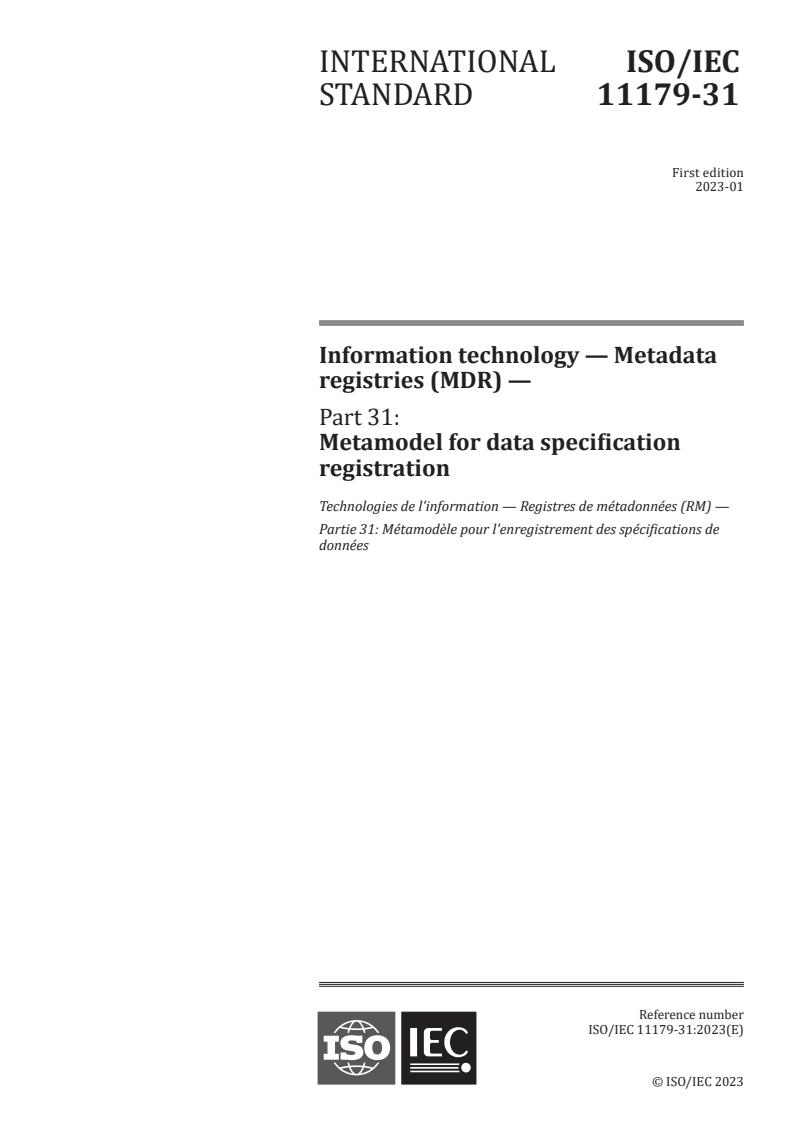
INTERNATIONAL ISO/IEC
STANDARD 11179-31
First edition
2023-01
Information technology — Metadata
registries (MDR) —
Part 31:
Metamodel for data specification
registration
Technologies de l'information — Registres de métadonnées (RM) —
Partie 31: Métamodèle pour l'enregistrement des spécifications de
données
Reference number
© ISO/IEC 2023
© ISO/IEC 2023
All rights reserved. Unless otherwise specified, or required in the context of its implementation, no part of this publication may
be reproduced or utilized otherwise in any form or by any means, electronic or mechanical, including photocopying, or posting on
the internet or an intranet, without prior written permission. Permission can be requested from either ISO at the address below
or ISO’s member body in the country of the requester.
ISO copyright office
CP 401 • Ch. de Blandonnet 8
CH-1214 Vernier, Geneva
Phone: +41 22 749 01 11
Email: copyright@iso.org
Website: www.iso.org
Published in Switzerland
ii
© ISO/IEC 2023 – All rights reserved
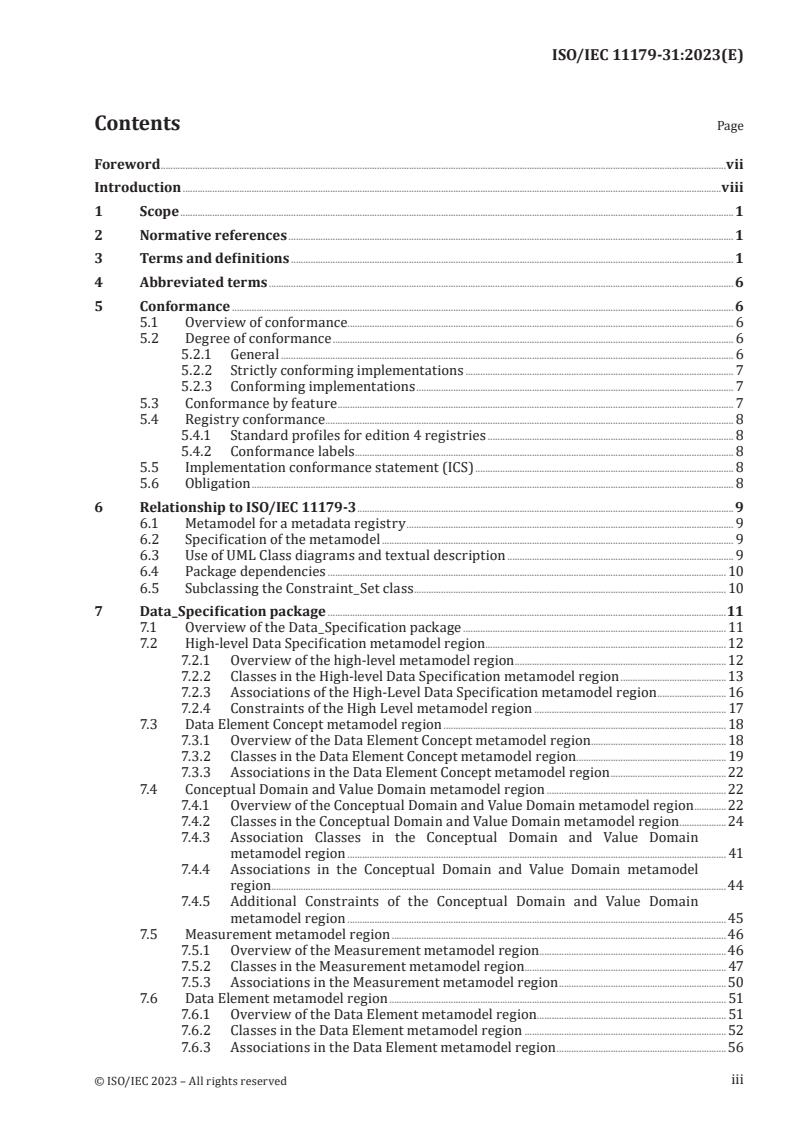
Contents Page
Foreword .vii
Introduction .viii
1 Scope . 1
2 Normative references . 1
3 Terms and definitions . 1
4 Abbreviated terms . 6
5 Conformance . 6
5.1 Overview of conformance . . 6
5.2 Degree of conformance . 6
5.2.1 General . 6
5.2.2 Strictly conforming implementations . 7
5.2.3 Conforming implementations . 7
5.3 Conformance by feature . 7
5.4 Registry conformance . . 8
5.4.1 Standard profiles for edition 4 registries . 8
5.4.2 Conformance labels . . 8
5.5 Implementation conformance statement (ICS) . 8
5.6 Obligation . 8
6 Relationship to ISO/IEC 11179-3 .9
6.1 Metamodel for a metadata registry . 9
6.2 Specification of the metamodel . 9
6.3 Use of UML Class diagrams and textual description . 9
6.4 Package dependencies . 10
6.5 Subclassing the Constraint_Set class . 10
7 Data_Specification package .11
7.1 Overview of the Data_Specification package . 11
7.2 High-level Data Specification metamodel region .12
7.2.1 Overview of the high-level metamodel region .12
7.2.2 Classes in the High-level Data Specification metamodel region .13
7.2.3 Associations of the High-Level Data Specification metamodel region . 16
7.2.4 Constraints of the High Level metamodel region . 17
7.3 Data Element Concept metamodel region . 18
7.3.1 Overview of the Data Element Concept metamodel region . . 18
7.3.2 Classes in the Data Element Concept metamodel region. 19
7.3.3 Associations in the Data Element Concept metamodel region .22
7.4 Conceptual Domain and Value Domain metamodel region .22
7.4.1 Overview of the Conceptual Domain and Value Domain metamodel region .22
7.4.2 Classes in the Conceptual Domain and Value Domain metamodel region . 24
7.4.3 Association Classes in the Conceptual Domain and Value Domain
metamodel region . 41
7.4.4 Associations in the Conceptual Domain and Value Domain metamodel
region .44
7.4.5 Additional Constraints of the Conceptual Domain and Value Domain
metamodel region . 45
7.5 Measurement metamodel region .46
7.5.1 Overview of the Measurement metamodel region .46
7.5.2 Classes in the Measurement metamodel region. 47
7.5.3 Associations in the Measurement metamodel region .50
7.6 Data Element metamodel region . 51
7.6.1 Overview of the Data Element metamodel region. 51
7.6.2 Classes in the Data Element metamodel region . 52
7.6.3 Associations in the Data Element metamodel region .56
iii
© ISO/IEC 2023 – All rights reserved
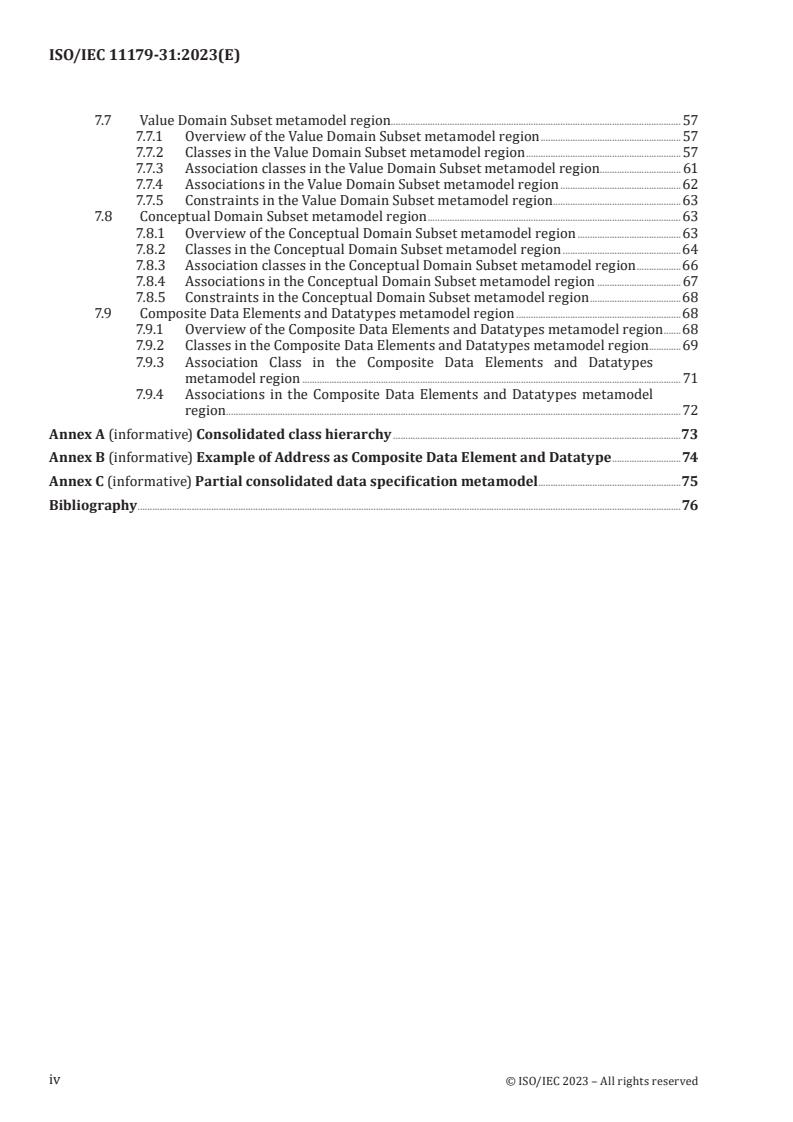
7.7 Value Domain Subset metamodel region. 57
7.7.1 Overview of the Value Domain Subset metamodel region . 57
7.7.2 Classes in the Value Domain Subset metamodel region . 57
7.7.3 Association classes in the Value Domain Subset metamodel region. 61
7.7.4 Associations in the Value Domain Subset metamodel region . 62
7.7.5 Constraints in the Value Domain Subset metamodel region . .63
7.8 Conceptual Domain Subset metamodel region .63
7.8.1 Overview of the Conceptual Domain Subset metamodel region .63
7.8.2 Classes in the Conceptual Domain Subset metamodel region .64
7.8.3 Association classes in the Conceptual Domain Subset metamodel region .66
7.8.4 Associations in the Conceptual Domain Subset metamodel region . 67
7.8.5 Constraints in the Conceptual Domain Subset metamodel region .68
7.9 Composite Data Elements and Datatypes metamodel region .68
7.9.1 Overview of the Composite Data Elements and Datatypes metamodel region .68
7.9.2 Classes in the Composite Data Elements and Datatypes metamodel region .69
7.9.3 Association Class in the Composite Data Elements and Datatypes
metamodel region . 71
7.9.4 Associations in the Composite Data Elements and Datatypes metamodel
region .72
Annex A (informative) Consolidated class hierarchy .73
Annex B (informative) Example of Address as Composite Data Element and Datatype .74
Annex C (informative) Partial consolidated data specification metamodel .75
Bibliography .76
iv
© ISO/IEC 2023 – All rights reserved
List of Figures
Figure 1 — Package dependencies .10
Figure 2 — Subclasses of Constraint_Set .11
Figure 3 — High-level Data Specification metamodel .12
Figure 4 — Data Element Concept metamodel region .18
Figure 5 — Conceptual Domain and Value Domain metamodel region .23
Figure 6 — Measurement metamodel region .46
Figure 7 — Data Element metamodel region .51
Figure 8 — Value Domain Subset metamodel region .57
Figure 9 — Conceptual Domain Subset metamodel region .63
Figure 10 — Composite Data Elements and Datatypes metamodel region .69
Figure A.1 — Consolidated Class Hierarchy .73
Figure B.1 — Object diagram of Address as Composite Datatype and Data Element .74
Figure C.1 — Partial Consolidated Data Specification metamodel .75
v
© ISO/IEC 2023 – All rights reserved
List of Tables
Table 1 — Attributes of Data_Element_Concept_Constraint_Set class .21
Table 2 — Attributes of Conceptual_Domain class .24
Table 3 — Attributes of Enumerated_Conceptual_Domain class .26
Table 4 — Attributes of Enumerated_Conceptual_Domain_Definition class .29
Table 5 — Attributes of Value_Domain class .30
Table 6 — Attributes of Permissible_Value class .33
Table 7 — Attributes of Reference_Enumerated_Value_Domain class .34
Table 8 — Attributes of Datatype class .35
Table 9 — Example 1 of Datatype class .35
Table 10 — Example 2 of Datatype class.35
Table 11 — Attributes of Datatype_Scheme class .36
Table 12 — Attributes of Reference_Enumerated_CD_Constraint_Set class.37
Table 13 — Attributes of Local_Enumerated_CD_Constraint_Set class .38
Table 14 — Attributes of Value_Domain_Constraint_Set class .38
Table 15 — Attributes of Described_Value_Domain_Constraint_Set class .39
Table 16 — Attributes of Reference_Enumerated_VD_Constraint_Set class.40
Table 17 — Attributes of Local_Enumerated_VD_Constraint_Set class .40
Table 18 — Attributes of Permissible_Value_Constraint_Set class .41
Table 19 — Attributes of Value_Meaning_Set association class.42
Table 20 — Attributes of Permissible_Value_Meaning association class .43
Table 21 — Attributes of Permissible_Value_Set association class . 44
Table 22 — Attributes of Dimensionality class .50
Table 23 — Attributes of Data_Element class .52
Table 24 — Attributes of Data_Element_Example class .53
Table 25 — Attributes of Data_Element_Derivation_Rule class .54
Table 26 — Attributes of Data_Element_Constraint_Set class .55
Table 27 — Attributes of Local_Enumerated_Value_Domain_Subset class .60
Table 28 — Attributes of Local_Enumerated_VD_Subset_Constraint_Set class .61
Table 29 — Attributes of Subset_Values association class .62
Table 30 — Attributes of Local_Enumerated_Conceptual_Domain_Subset class .65
Table 31 — Attributes of Local_Enumerated_CD_Subset_Constraint_Set class .66
Table 32 — Attributes of Subset_Value_Meanings association class .67
Table 33 — Attributes of Data_Element_Collection class .70
Table 34 — Attributes of Data_Element_Sequence association class .71
vi
© ISO/IEC 2023 – All rights reserved
Foreword
ISO (the International Organization for Standardization) and IEC (the International Electrotechnical
Commission) form the specialized system for worldwide standardization. National bodies that are
members of ISO or IEC participate in the development of International Standards through technical
committees established by the respective organization to deal with particular fields of technical
activity. ISO and IEC technical committees collaborate in fields of mutual interest. Other international
organizations, governmental and non-governmental, in liaison with ISO and IEC, also take part in the
work.
The procedures used to develop this document and those intended for its further maintenance
are described in the ISO/IEC Directives, Part 1. In particular, the different approval criteria
needed for the different types of document should be noted. This document was drafted in
accordance with the editorial rules of the ISO/IEC Directives, Part 2 (see www.iso.org/directives or
www.iec.ch/members_experts/refdocs).
Attention is drawn to the possibility that some of the elements of this document may be the subject
of patent rights. ISO and IEC shall not be held responsible for identifying any or all such patent
rights. Details of any patent rights identified during the development of the document will be in the
Introduction and/or on the ISO list of patent declarations received (see www.iso.org/patents) or the IEC
list of patent declarations received (see https://patents.iec.ch).
Any trade name used in this document is information given for the convenience of users and does not
constitute an endorsement.
For an explanation of the voluntary nature of standards, the meaning of ISO specific terms and
expressions related to conformity assessment, as well as information about ISO's adherence to
the World Trade Organization (WTO) principles in the Technical Barriers to Trade (TBT) see
www.iso.org/iso/foreword.html. In the IEC, see www.iec.ch/understanding-standards.
This document was prepared by Joint Technical Committee ISO/IEC/JTC 1, Information technology,
Subcommittee SC 32, Data management and interchange.
A list of all parts in the ISO/IEC 11179 series can be found on the ISO and IEC websites.
Any feedback or questions on this document should be directed to the user’s national standards
body. A complete listing of these bodies can be found at www.iso.org/members.html and
www.iec.ch/national-committees.
vii
© ISO/IEC 2023 – All rights reserved
Introduction
In ISO/IEC 11179-3, the structure of a Metadata Registry is specified in the form of a conceptual data
model. ISO/IEC 11179-3 specifies a metamodel for “registry common facilities”, which is intended to be
extended by other parts of ISO/IEC 11179 for specific purposes.
This document provides a specification of the extensions to the registry metamodel specified in
ISO/IEC 11179-3 to enable the registration of metadata about data elements and associated concepts,
such as “data element concepts”, “conceptual domains” and “value domains”. Generically, these are
all referred to as “metadata items”. Such metadata are necessary to clearly describe, record, analyse,
classify and administer data.
th
This document is part of the 4 edition modularization of the ISO/IEC 11179 series. It extracts the Data
Description package from ISO/IEC 11179-3:2013 to make it more accessible and renames it “Metamodel
for data specification registration”. At the same time, some enhancements have been made as follows:
— support for externally defined “reference enumerated conceptual domains” (7.4.2.6) and “reference
enumerated value domains” (7.4.2.13);
— support for sub-setting of value domains (7.7) and conceptual domains (7.8) within a specified
context;
— support for composite data elements and data types (7.9);
— finer-grained conformance options (see 5.3);
— relaxation of some constraints in the standard, while giving registration authorities the ability to
enforce them if they wish (see 6.5).
From Clause 5 onwards, this document uses:
— bold font to highlight terms which represent metadata objects specified by the metamodel;
— normal font for terms which represent concepts defined in Clause 3.
EXAMPLE Conceptual_Domain (7.2.2.2) is a class each instance of which models a conceptual domain.
viii
© ISO/IEC 2023 – All rights reserved
INTERNATIONAL STANDARD ISO/IEC 11179-31:2023(E)
Information technology — Metadata registries (MDR) —
Part 31:
Metamodel for data specification registration
1 Scope
This document provides a specification for an extension to a Metadata Registry (MDR), as specified
in ISO/IEC 11179-3, in which metadata that describes data elements and associated concepts, such as
“data element concepts”, “conceptual domains” and “value domains” can be registered.
The specification in this document, together with the relevant clauses of the specification in
ISO/IEC 11179-3, provides the ability to record metadata about:
a) data elements, units of measure and derivation rules;
b) data element concepts and associated object classes and properties;
c) conceptual domains, conceptual domain subsets and value meanings;
d) value domains, value domain subsets, datatypes and permissible values.
This document is applicable to the formulation of data representations, concepts, meanings and
relationships to be shared among people and machines, independent of the organization that produces
the data. It is not applicable to the physical representation of data as bits and bytes at the machine level.
2 Normative references
The following documents are referred to in the text in such a way that some or all of their content
constitutes requirements of this document. For dated references, only the edition cited applies. For
undated references, the latest edition of the referenced document (including any amendments) applies.
ISO/IEC 11179-3:2023, Information technology — Metadata registries (MDR) — Part 3: Metamodel for
registry common facilities
3 Terms and definitions
For the purposes of this document, the terms and definitions given in ISO/IEC 11179-3 and the following
apply.
ISO and IEC maintain terminology databases for use in standardization at the following addresses:
— ISO Online browsing platform: available at https:// www .iso .org/ obp
— IEC Electropedia: available at https:// www .electropedia .org/
3.1
object class
set of ideas, abstractions or things in the real world that are identified with explicit boundaries and
meaning and whose properties and behaviour follow the same rules
3.2
property
quality common to all members of an object class (3.1)
© ISO/IEC 2023 – All rights reserved
3.3
characteristic
abstraction of a property (3.2)
EXAMPLE 'Having a cable for connecting with a computer' as a characteristic of the concept 'cord mouse'.
Note 1 to entry: Characteristics are used for describing concepts (3.4).
[SOURCE: ISO 1087:2019, 3.2.1]
3.4
concept
unit of knowledge created by a unique combination of characteristics (3.3)
Note 1 to entry: Concepts are not necessarily bound to particular natural languages. They are, however,
influenced by the social or cultural background which often leads to different categorizations.
Note 2 to entry: A concept is independent of its representation.
[SOURCE: ISO 1087:2019, 3.2.7, modified — Note 2 to entry changed.]
3.5
conceptual domain
CD
concept (3.4) whose meaning is expressed as an enumerated set, a description of subordinate concepts
or both, which are value meanings (3.10)
3.6
described conceptual domain
conceptual domain (3.5) that is specified by a description or specification, such as a rule, a procedure or
a range (i.e. interval)
3.7
enumerated conceptual domain
conceptual domain (3.5) that is specified by a list of all its value meanings (3.10)
Note 1 to entry: No ordering of the value meanings is implied.
3.8
local enumerated conceptual domain
enumerated conceptual domain (3.7) whose value meanings (3.10) are enumerated locally within the
registry
Note 1 to entry: c.f. reference enumerated conceptual domain (3.11).
3.9
local enumerated conceptual domain subset
subset of the value meanings (3.10) in a local enumerated conceptual domain (3.8) used to restrict the
value meanings a data element concept (3.25) can assume in a particular context
3.10
value meaning
semantic content of a value
Note 1 to entry: The representation of value meanings in a registry (3.36) shall be independent of (and shall not
constrain) their representation in any corresponding value domain (3.13).
3.11
reference enumerated conceptual domain
enumerated conceptual domain (3.7) that is specified by a formal definition
Note 1 to entry: The definition may reference externally enumerated value meanings (3.10).
© ISO/IEC 2023 – All rights reserved
3.12
enumerated conceptual domain definition
formal definition of an enumerated conceptual domain (3.7)
Note 1 to entry: The definition may reference externally enumerated value meanings (3.10).
3.13
value domain
VD
set of permissible values (3.19)
Note 1 to entry: The value domain provides representation but has no implication as to what data element concept
(3.25) the values are associated with nor what the values mean.
Note 2 to entry: The permissible values can either be enumerated, expressed via a description, or a combination
of the two.
3.14
described value domain
value domain (3.13) that is specified by a description or specification, such as a rule, a procedure or a
range (i.e. interval)
3.15
enumerated value domain
value domain (3.13) that is specified by a list of all its permissible values (3.19)
Note 1 to entry: No ordering of the permissible values is implied.
3.16
local enumerated value domain
enumerated value domain (3.15) whose permissible values (3.19) are stored within the registry
Note 1 to entry: c.f. reference enumerated value domain (3.18).
3.17
local enumerated value domain subset
subset of the permissible values (3.19) in a local enumerated value domain (3.16) used to restrict the
value meanings a data element (3.23) can assume in a particular context
3.18
reference enumerated value domain
enumerated value domain (3.15) that is specified by reference to an external specification, including
externally enumerated permissible values (3.19)
3.19
permissible value
designation of a value meaning (3.10)
Note 1 to entry: Permissible values may be specified either as part of a value domain (3.13) or only associated
with a value meaning (3.10).
Note 2 to entry: Within a value domain, permissible values can either be enumerated, expressed via a description,
or a combination of the two.
Note 3 to entry: Explicit mapping of a single permissible value to a single value meaning is possible only when
both the value meaning and permissible value are enumerated, e.g. for code sets. For described permissible
values, it is possible for the described meaning to be associated with a range of values, e.g. weight in kilograms.
© ISO/IEC 2023 – All rights reserved
3.20
data
re-interpretable representation of information in a formalized manner suitable for communication,
interpretation or processing
Note 1 to entry: Data can be processed by humans or by automatic means.
[SOURCE: ISO/IEC 2382:2015, 2121272, modified — Notes to entry 2 and 3 deleted.]
3.21
datatype
set of distinct values, characterized by properties of those values and by operations on those values
[SOURCE: ISO/IEC 11404:2007, 3.12]
3.22
datatype scheme
source of the specification of one or more datatypes (3.21)
[SOURCE: ISO/IEC 11404:2007, 3.12]
3.23
data element
〈organization of data〉 unit of data (3.20) that is considered in context to be indivisible
Note 1 to entry: The definition states that a data element is “indivisible” in some context. This means that it is
possible that a data element considered indivisible in one context (e.g. telephone number) may be divisible in
another context, (e.g. country code, area code, local number).
EXAMPLE The data element “age of a person” with values consisting of all combinations of 3 decimal digits.
[SOURCE: ISO/IEC 2382:2015, 2121599, modified — Example moved to the end without the Note to
entry prefix. Other Notes to entry have been replaced.]
3.24
data element collection
one or more data elements (3.23) that may be unordered or ordered
Note 1 to entry: Examples of unordered collections are a set or a bag (or multiset). An example of an ordered
collection is a list.
3.25
data element concept
concept (3.4) that can be represented in the form of a data element (3.23), described independently of
any particular representation
Note 1 to entry: A data element concept is implicitly associated with both the property and the object class whose
combination it expresses.
Note 2 to entry: A data element concept may also be associated with zero, one or more conceptual domains (3.5)
each of which expresses its value meanings (3.10).
Note 3 to entry: A data element concept may also be associated with zero, one or more data elements (3.23) each
of which provide representation for the data element concept via its associated value domain (3.13).
3.26
data element derivation
application of a data element derivation rule (3.28) to one or more input data elements (3.23) to derive
one or more output data elements
3.27
data element example
representative illustration of a data element (3.23)
© ISO/IEC 2023 – All rights reserved
3.28
data element derivation rule
logical, mathematical, other operations or some combination specifying derivation
3.29
dimensionality
set of equivalent units of measure (3.33)
Note 1 to entry: Equivalence between two units of measure is determined by the existence of a quantity
preserving one-to-one correspondence between values measured in one unit of measure and values measured in
the other unit of measure, independent of context, and where characterizing operations are the same.
Note 2 to entry: The equivalence defined here forms an equivalence relation on the set of all units of measure. Each
equivalence class corresponds to a dimensionality. The units of measure "temperature in degrees Fahrenheit"
and "temperature in degrees Celsius" have the same dimensionality, because:
a) given a value measured in degrees Fahrenheit there is a value measured in degrees Celsius with the same
quantity, and vice-versa, by the well-known correspondences ºC = (5/9)*(ºF - 32) and ºF = (9/5)*(ºC) + 32.
b) the same operations can be performed on both values.
Note 3 to entry: The units of measure "temperature in degrees Celsius" and "temperature in kelvins" do not
belong to the same dimensionality. Even though it is easy to convert quantities from one unit of measure to the
other (°C = K - 273,15 and K = °C + 273,15), the characterizing operations in kelvins include taking ratios, whereas
this is not the case for degrees Celsius. For instance, 20 K is twice as warm as 10 K, but 20 °C is not twice as warm
as 10 °C.
Note 4 to entry: Units of measure are not limited to physical categories. Examples of physical categories are:
linear measure, area, volume, mass, velocity, time duration. Examples of non-physical categories are: currency,
quality indicator, colour intensity.
Note 5 to entry: Quantities may be grouped together into categories of quantities which are mutually comparable.
Lengths, diameters, distances, heights, wavelengths and so on would constitute such a category. Mutually
[13]
comparable quantities have the same dimensionality. ISO 80000-1 calls these “quantities of the same kind”.
Note 6 to entry: ISO 80000-1 specifies physical dimensions (e.g. length, mass, velocity). This document also
permits non-physical dimensions (e.g. value dimensions such as: currency, quality indicator). The present concept
of dimensionality equates to what ISO 80000-1 calls Dimensional Product, rather than to Dimension.
3.30
measure class
set of equivalent units of measure (3.33) for association with one or more dimensionalities (3.29)
3.31
coordinate
measurement from the origin of a frame of reference
3.32
notation
formal syntax and associated semantics
EXAMPLE UML, MOF, OCL, OWL/RDF, SKOS, CGIF, XCL, XTM or ISO/IEC 11404
Note 1 to entry: Formal syntax is often intended for machine processing.
[SOURCE: ISO/IEC 11179-3:2023, 3.2.36]
3.33
unit of measure
〈value domain〉 actual units in which the associated values are measured
[13]
Note 1 to entry: ISO 80000-1 specifies a system of physical measurement (the International System of Units,
SI). Physical measurement is only one type of measurement. Value measurement is another type of measurement.
This document permits the use of any appropriate system of measurement.
© ISO/IEC 2023 – All rights reserved
Note 2 to entry: The dimensionality (3.29) of the associated conceptual domain (3.5) shall be appropriate for the
specified unit of measure.
3.34
unit of measure dimensionality
dimensionality (3.29) that specifies the equivalence relation that applies to all values representing a
particular unit
3.35
quantity
value associated with a unit of measure (3.33)
Note 1 to entry: 32º Fahrenheit and 0º Celsius are quantities, and they are equivalent values in different
measuring systems.
3.36
registry
information system for registration (3.37)
[SOURCE: ISO/IEC 11179-1:2023, 3.2.34]
3.37
registration
set of rules, operations and procedures for inclusion of an item in a registry (3.36)
Note 1 to entry: A detailed description of registration as it applies in ISO/IEC 11179 is found in ISO/IEC 11179-6.
[SOURCE: ISO/IEC 11179-1:2023, 3.2.88]
4 Abbreviated terms
CD conceptual domain
DE data element
DEC data element concept
UML Unified Modeling Language
URI Universal Resource Identifier
VD value domain
XML eXtensible Markup Language
5 Conformance
5.1 Overview of conformance
Conformance rules for a metadata registry are specified in ISO/IEC 11179-3:2023, Clause 4. The
subclause “Degree of conformance” is repeated here for convenience. The subsequent subclauses extend
the rules from ISO/IEC 11179-3.
5.2 Degree of conformance
5.2.1 General
The distinction between “strictly conforming” and “conforming” implementations is necessary
to address the simultaneous needs for interoperability and extensions. This document describes
© ISO/IEC 2023 – All rights reserved
specifications that promote interoperability. Extensions are motivated by needs of users, vendors,
institutions and industries, and:
a) are not directly specified by this document;
b) are specified and agreed to outside this document;
c) may serve as trial usage for future editions of this document.
A strictly conforming implementation can be limited in usefulness but is maximally interoperable with
respect to this document. A conforming implementation can be more useful but can be less interoperable
with respect to this document.
5.2.2 Strictly conforming implementations
A strictly conforming implementation:
a) shall support all mandatory, optional and conditional classes, attributes, datatypes and
associations;
b) shall not use, test, access or probe for any extension features nor extensions to classes, attributes,
datatypes, associations or any combination thereof;
c) shall not recognize, nor act on, nor allow the production of classes, attributes, datatypes,
associations or any combination thereof that are dependent on any unspecified, undefined or
implementation-defined behaviour.
NOTE The use of extensions to the metamodel can cause undefined behaviour.
5.2.3 Conforming implementations
A conforming implementation:
a) shall support all mandatory, optional and conditional classes, attributes, datatypes and
associations;
b) as permitted by the implementation, may use, test, access or probe for extension features or
extensions to classes, attributes, datatypes, associations or any combination thereof;
c) may recognize, act on or allow the production of classes, attributes, datatypes, associations or any
combination thereof that are dependent on implementation-defined behaviour.
NOTE 1 All strictly conforming implementations are also conforming implementations.
NOTE 2 The use of extensions to the metamodel can cause undefined behaviour.
5.3 Conformance by feature
Conformance claims may be made to the whole of Clause 7 or to specific features within that clause.
Clause 7 is dependent upon one or more clauses of ISO/IEC 11179-3, so conformance to all or part of
Clause 7 shall be understood to imply conformance also to relevant provisions specified in one or more
of the clauses in ISO/IEC 11179-3.
A conformance statement shall specify exactly the features supported and not supported.
© ISO/IEC 2023 – All rights reserved
5.4 Registry conformance
5.4.1 Standard profiles for edition 4 registries
This document specifies the following standard profiles in addition to those specified in
ISO/IEC 11179-3:2023, 4.4.2.
— Data Specification Registry: Implements Clause 7 of this document, in addition to all provisions of
the “Basic Registry” profile of ISO/IEC 11179-3:2023, 4.4.2.
— Data Specification Registry with mapping: Implements Clause 7 of this document, in addition to
all provisions of the “Basic Registry with mapping” profile of ISO/IEC 11179-3:2023, 4.4.2.
— Conceptual and Value Domain Registry: Implements 7.3 of this document, in addition to all the
provisions of the “Basic Registry” profile of ISO/IEC 11179-3:2023, 4.4.2.
— Conceptual and Value Domain Registry with mapping: Implements 7.3 of this document, in
addition to all the provisions of the “Basic Registry with mapping” profile of ISO/IEC 11179-3:2023,
4.4.2.
5.4.2 Conformance labels
Conformance to the profiles specified in 5.4.1 may be claimed using the following labels, respectively:
— ISO/IEC 11179-31:2023 Data Specification Registry
— ISO/IEC 11179-31:2023 Data Specification Registry with mapping
— ISO/IEC 11179-31:2023 Conceptual and Value Domain Registry
— ISO/IEC 11179-31:2023 Conceptual and Value Domain Registry with mapping.
5.5 Implementation conformance statement (ICS)
An implementation claiming conformance to this document shall include an Implementation
Conformance Statement stating:
— whether it conforms or strictly conforms;
— which clauses are or are not supported;
— what extensions, if any, are supported or used.
A standard profile may be referenced, if applicable.
EXAMPLE Product Y conforms to ISO/IEC 11179-31:2023 Data Specification Registry with Mapping,
except that it relies on the Item Mapping facility of ISO/IEC 11179-3:2023 in place of implementing the
5.6 Obligation
Properties and relationships specified in this document are one of: “mandatory”, “conditional” or
“optional”. The obligation is not explicitly stated but is to be inferred from the multiplicity of the property
or relationship, and the presence or absence of a condition. In addition, a registration authority can
specify additional constraints to be applied to particular Administered_Items (ISO/IEC 11179-3:2023,
9.4.2), using Constraint_Sets (ISO/IEC 11179-3:2023, 9.4.5). (See 6.5.)
For the purpose of conformance:
a) mandatory properties and relationships shall exist and shall conform to the provisions of this
document;
© ISO/IEC 2023 – All rights reserved
b) anything specified as Conditional within this document shall be treated as Mandatory if the
associated condition is satisfied and shall otherwise be not present;
c) optional properties and relationships are not required to exist, but if they do exist, they shall
conform to the provisions of this document.
Such obligation is enforced if and only if the Registration_Status of the associated registry items is
“Recorded” or higher (see ISO/IEC 11179-3:2023, 3.2.70 and 9.4.4.3; and ISO/IEC 11179-6:2023, 4.3.2).
6 Relationship to ISO/IEC 11179-3
6.1 Metamodel for
...