

ISO/TR 22038:2020
(Main)Information and documentation — Description and presentation of rights information
General Information
- Abstract
This document provides an effective presentation of rights information in digital collections to end-users. Digital collection, in this document, is mainly focused on digital collections in libraries, museums, archives or other organizations that offer similar resources to their patrons. This document deals with the human-readable aspects of the rights presentation. Technical aspects of the storage and management of rights expression information, such as, metadata schemas, interoperability of machine-readable expressions and user interfaces are out of scope of this document.
- Status
- Published
- Publication Date
- 22-Jun-2020
- Technical Committee
- ISO/TC 46/SC 9 - Identification and description
- Drafting Committee
- ISO/TC 46/SC 9 - Identification and description
- Current Stage
- 6060 - International Standard published
- Start Date
- 23-Jun-2020
- Completion Date
- 23-Jun-2020
Buy Documents



ISO/TR 22038:2020 - Information and documentation — Description and presentation of rights information Released:6/23/2020
ISO/TR 22038:2020 - Information and documentation — Description and presentation of rights information/23/2020
Overview
ISO/TR 22038:2020 - Information and documentation: Description and presentation of rights information - is a technical report that guides how to present human-readable rights information in digital collections. It focuses on clarity and accessibility for end users of library, museum, archive and similar cultural heritage services. The report addresses where and how rights statements should appear on service pages (top, search, browsing, resource information, download, presentation, information, authentication and permission form pages) but explicitly excludes technical details of metadata schemas, machine-readable rights expressions and backend storage.
Key topics and requirements
- Human-readable rights presentation: Emphasize clear statements of what users are allowed and prohibited from doing with a digital resource.
- Rights information elements: Present the type of rights; rights-holder identification (identifier, name, contact); legal basis and jurisdiction; relevant dates (copyright year, term); and permissions/licenses (permitted actions, prohibitions, conditions, license names/links).
- Page-level guidance: Specifies which service pages should display rights information or links (e.g., resource download pages should provide rights info for each downloadable item). Search pages normally don’t display rights statements but may include rights conditions in queries.
- Synchronization with embedded rights: When resources contain machine-readable rights metadata, the human-readable presentation should be synchronized with that embedded information.
- Community-supported expressions: Recommends adopting widely used, community-supported formats for expressing rights (see Annex A for examples).
- International and jurisdictional sensitivity: Avoid assuming a single legal jurisdiction when presenting rights information; make legal bases and jurisdictions explicit where applicable.
Practical applications
- Designing and improving public-facing digital library, museum and archive websites to make rights clear and discoverable.
- Creating resource-level metadata displays, download interfaces and image/text viewers that include explicit, synchronized rights statements.
- Developing policies and workflows for collection digitization projects to ensure consistent, user-focused rights presentation.
- Helping patrons, researchers and educators quickly determine permissible uses and licensing conditions.
Who should use this standard
- Digital collection service developers and UX designers
- Librarians, archivists and museum curators managing digitized collections
- IT teams implementing online repositories and content delivery systems
- Legal or rights management staff defining access and licensing information
Related standards
Consult ISO/TC 46 (Information and documentation) outputs and standards on metadata, identifiers and rights expression for complementary technical guidance. Annex A of ISO/TR 22038:2020 points to community-supported formats to adopt for consistent rights expression.
Buy Documents
ISO/TR 22038:2020 - Information and documentation — Description and presentation of rights information Released:6/23/2020
ISO/TR 22038:2020 - Information and documentation — Description and presentation of rights information/23/2020
Get Certified
Connect with accredited certification bodies for this standard

Great Wall Tianjin Quality Assurance Center
Established 1993, first batch to receive national accreditation with IAF recognition.
Hong Kong Quality Assurance Agency (HKQAA)
Hong Kong's leading certification body.

Innovative Quality Certifications Pvt. Ltd. (IQCPL)
Known for integrity, providing ethical & impartial Assessment & Certification. CMMI Institute Partner.
Sponsored listings
Frequently Asked Questions
ISO/TR 22038:2020 is a technical report published by the International Organization for Standardization (ISO). Its full title is "Information and documentation — Description and presentation of rights information". This standard covers: This document provides an effective presentation of rights information in digital collections to end-users. Digital collection, in this document, is mainly focused on digital collections in libraries, museums, archives or other organizations that offer similar resources to their patrons. This document deals with the human-readable aspects of the rights presentation. Technical aspects of the storage and management of rights expression information, such as, metadata schemas, interoperability of machine-readable expressions and user interfaces are out of scope of this document.
This document provides an effective presentation of rights information in digital collections to end-users. Digital collection, in this document, is mainly focused on digital collections in libraries, museums, archives or other organizations that offer similar resources to their patrons. This document deals with the human-readable aspects of the rights presentation. Technical aspects of the storage and management of rights expression information, such as, metadata schemas, interoperability of machine-readable expressions and user interfaces are out of scope of this document.
ISO/TR 22038:2020 is classified under the following ICS (International Classification for Standards) categories: 01.140.20 - Information sciences; 03.140 - Patents. Intellectual property. The ICS classification helps identify the subject area and facilitates finding related standards.
ISO/TR 22038:2020 is available in PDF format for immediate download after purchase. The document can be added to your cart and obtained through the secure checkout process. Digital delivery ensures instant access to the complete standard document.
Standards Content (Sample)
SLOVENSKI STANDARD
01-marec-2021
Informatika in dokumentacija - Opis in predstavitev informacij o pravicah
Information and documentation -- Description and presentation of rights information
Information et documentation -- Description et présentation de l'information relative aux
droits
Ta slovenski standard je istoveten z: ISO/TR 22038:2020
ICS:
01.140.20 Informacijske vede Information sciences
03.140 Patenti. Intelektualna lastnina Patents. Intellectual property
2003-01.Slovenski inštitut za standardizacijo. Razmnoževanje celote ali delov tega standarda ni dovoljeno.
TECHNICAL ISO/TR
REPORT 22038
First edition
2020-06
Information and documentation —
Description and presentation of rights
information
Information et documentation — Description et présentation de
l'information relative aux droits
Reference number
©
ISO 2020
© ISO 2020
All rights reserved. Unless otherwise specified, or required in the context of its implementation, no part of this publication may
be reproduced or utilized otherwise in any form or by any means, electronic or mechanical, including photocopying, or posting
on the internet or an intranet, without prior written permission. Permission can be requested from either ISO at the address
below or ISO’s member body in the country of the requester.
ISO copyright office
CP 401 • Ch. de Blandonnet 8
CH-1214 Vernier, Geneva
Phone: +41 22 749 01 11
Fax: +41 22 749 09 47
Email: copyright@iso.org
Website: www.iso.org
Published in Switzerland
ii © ISO 2020 – All rights reserved
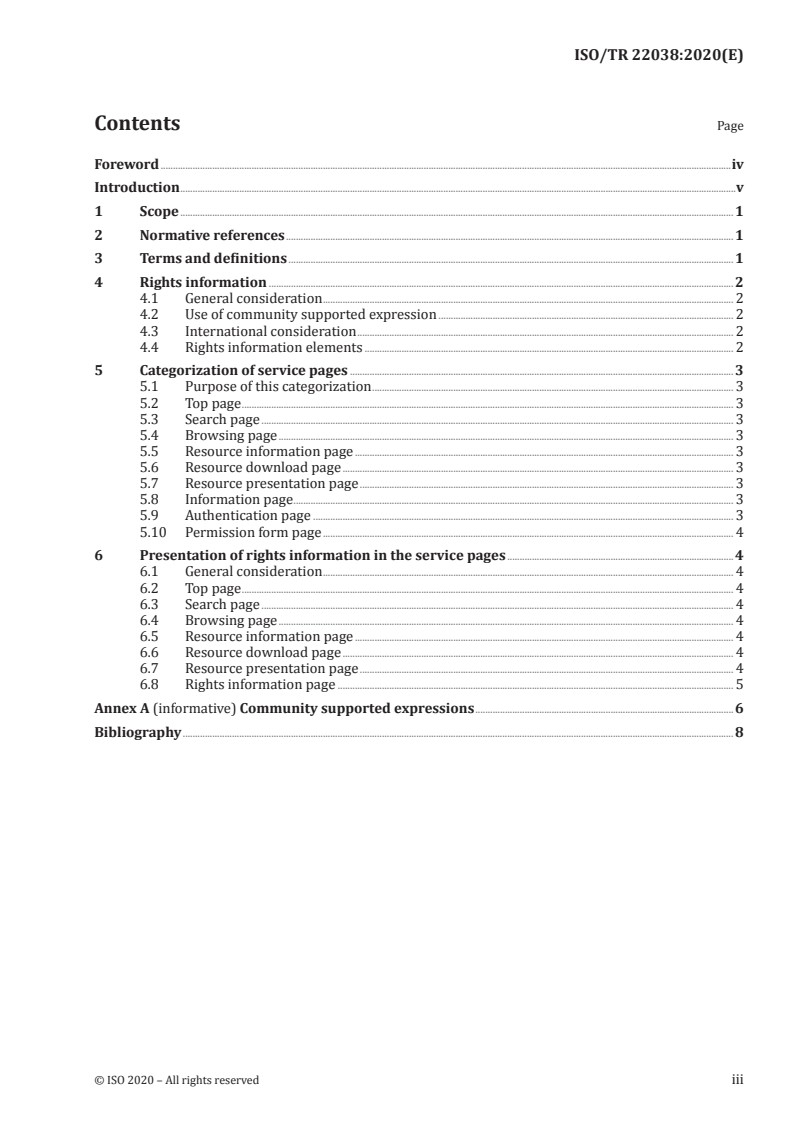
Contents Page
Foreword .iv
Introduction .v
1 Scope . 1
2 Normative references . 1
3 Terms and definitions . 1
4 Rights information . 2
4.1 General consideration . 2
4.2 Use of community supported expression . 2
4.3 International consideration . 2
4.4 Rights information elements . 2
5 Categorization of service pages . 3
5.1 Purpose of this categorization . 3
5.2 Top page . 3
5.3 Search page . 3
5.4 Browsing page . 3
5.5 Resource information page . 3
5.6 Resource download page . 3
5.7 Resource presentation page . 3
5.8 Information page . 3
5.9 Authentication page . 3
5.10 Permission form page . 4
6 Presentation of rights information in the service pages . 4
6.1 General consideration . 4
6.2 Top page . 4
6.3 Search page . 4
6.4 Browsing page . 4
6.5 Resource information page . 4
6.6 Resource download page . 4
6.7 Resource presentation page . 4
6.8 Rights information page . 5
Annex A (informative) Community supported expressions . 6
Bibliography . 8
Foreword
ISO (the International Organization for Standardization) is a worldwide federation of national standards
bodies (ISO member bodies). The work of preparing International Standards is normally carried out
through ISO technical committees. Each member body interested in a subject for which a technical
committee has been established has the right to be represented on that committee. International
organizations, governmental and non-governmental, in liaison with ISO, also take part in the work.
ISO collaborates closely with the International Electrotechnical Commission (IEC) on all matters of
electrotechnical standardization.
The procedures used to develop this document and those intended for its further maintenance are
described in the ISO/IEC Directives, Part 1. In particular, the different approval criteria needed for the
different types of ISO documents should be noted. This document was drafted in accordance with the
editorial rules of the ISO/IEC Directives, Part 2 (see www .iso .org/ directives).
Attention is drawn to the possibility that some of the elements of this document may be the subject of
patent rights. ISO shall not be held responsible for identifying any or all such patent rights. Details of
any patent rights identified during the development of the document will be in the Introduction and/or
on the ISO list of patent declarations received (see www .iso .org/ patents).
Any trade name used in this document is information given for the convenience of users and does not
constitute an endorsement.
For an explanation of the voluntary nature of standards, the meaning of ISO specific terms and
expressions related to conformity assessment, as well as information about ISO's adherence to the
World Trade Organization (WTO) principles in the Technical Barriers to Trade (TBT), see www .iso .org/
iso/ foreword .html.
This document was prepared by Technical Committee ISO/TC 46, Information and documentation,
Subcommittee SC 9, Identification and description.
Any feedback or questions on this document should be directed to the user’s national standards body. A
complete listing of these bodies can be found at www .iso .org/ members .html.
iv © ISO 2020 – All rights reserved
Introduction
Many libraries, museums and archives are digitizing their collections to provide them for the public
through the network. In addition, there are many services on the network that supply similar digital
resources to the public. These digital collections are invaluable sources for cultural activities. But the
digital resources provided by these collections may have some restriction for the usage. Intellectual
rights and terms of use concerning the provided resource have to be respected.
Most digital collections present such rights information somewhere in their services. In many cases,
however, it is hard for ordinary users to find correct information. There are many ways to present rights
information. This document provides a guideline to present rights information in an easily accessible
way. It will ease the work involved in seeking proper rights information and promote usage of digital
collections.
This document is intended to provide guidelines for digital collection service developers to design
systems that can effectively present rights information to the end-users. Digital collection providers
(e.g. libraries, museums, etc.) can refer to this document when they commission their service systems.
This document does not provide the guidelines for the entire design of a service system. References to
search page or browsing page, for example, does not mean that they are recommended. Only the parts
concerning the presentation of rights information are the recommendations of this document.
TECHNICAL REPORT ISO/TR 22038:2020(E)
Information and documentation — Description and
presentation of rights information
1 Scope
This document provides an effective presentation of rights information in digital collections to end-
users. Digital collection, in this document, is mainly focused on digital collections in libraries, museums,
archives or other organizations that offer
...
TECHNICAL ISO/TR
REPORT 22038
First edition
2020-06
Information and documentation —
Description and presentation of rights
information
Information et documentation — Description et présentation de
l'information relative aux droits
Reference number
©
ISO 2020
© ISO 2020
All rights reserved. Unless otherwise specified, or required in the context of its implementation, no part of this publication may
be reproduced or utilized otherwise in any form or by any means, electronic or mechanical, including photocopying, or posting
on the internet or an intranet, without prior written permission. Permission can be requested from either ISO at the address
below or ISO’s member body in the country of the requester.
ISO copyright office
CP 401 • Ch. de Blandonnet 8
CH-1214 Vernier, Geneva
Phone: +41 22 749 01 11
Fax: +41 22 749 09 47
Email: copyright@iso.org
Website: www.iso.org
Published in Switzerland
ii © ISO 2020 – All rights reserved
Contents Page
Foreword .iv
Introduction .v
1 Scope . 1
2 Normative references . 1
3 Terms and definitions . 1
4 Rights information . 2
4.1 General consideration . 2
4.2 Use of community supported expression . 2
4.3 International consideration . 2
4.4 Rights information elements . 2
5 Categorization of service pages . 3
5.1 Purpose of this categorization . 3
5.2 Top page . 3
5.3 Search page . 3
5.4 Browsing page . 3
5.5 Resource information page . 3
5.6 Resource download page . 3
5.7 Resource presentation page . 3
5.8 Information page . 3
5.9 Authentication page . 3
5.10 Permission form page . 4
6 Presentation of rights information in the service pages . 4
6.1 General consideration . 4
6.2 Top page . 4
6.3 Search page . 4
6.4 Browsing page . 4
6.5 Resource information page . 4
6.6 Resource download page . 4
6.7 Resource presentation page . 4
6.8 Rights information page . 5
Annex A (informative) Community supported expressions . 6
Bibliography . 8
Foreword
ISO (the International Organization for Standardization) is a worldwide federation of national standards
bodies (ISO member bodies). The work of preparing International Standards is normally carried out
through ISO technical committees. Each member body interested in a subject for which a technical
committee has been established has the right to be represented on that committee. International
organizations, governmental and non-governmental, in liaison with ISO, also take part in the work.
ISO collaborates closely with the International Electrotechnical Commission (IEC) on all matters of
electrotechnical standardization.
The procedures used to develop this document and those intended for its further maintenance are
described in the ISO/IEC Directives, Part 1. In particular, the different approval criteria needed for the
different types of ISO documents should be noted. This document was drafted in accordance with the
editorial rules of the ISO/IEC Directives, Part 2 (see www .iso .org/ directives).
Attention is drawn to the possibility that some of the elements of this document may be the subject of
patent rights. ISO shall not be held responsible for identifying any or all such patent rights. Details of
any patent rights identified during the development of the document will be in the Introduction and/or
on the ISO list of patent declarations received (see www .iso .org/ patents).
Any trade name used in this document is information given for the convenience of users and does not
constitute an endorsement.
For an explanation of the voluntary nature of standards, the meaning of ISO specific terms and
expressions related to conformity assessment, as well as information about ISO's adherence to the
World Trade Organization (WTO) principles in the Technical Barriers to Trade (TBT), see www .iso .org/
iso/ foreword .html.
This document was prepared by Technical Committee ISO/TC 46, Information and documentation,
Subcommittee SC 9, Identification and description.
Any feedback or questions on this document should be directed to the user’s national standards body. A
complete listing of these bodies can be found at www .iso .org/ members .html.
iv © ISO 2020 – All rights reserved
Introduction
Many libraries, museums and archives are digitizing their collections to provide them for the public
through the network. In addition, there are many services on the network that supply similar digital
resources to the public. These digital collections are invaluable sources for cultural activities. But the
digital resources provided by these collections may have some restriction for the usage. Intellectual
rights and terms of use concerning the provided resource have to be respected.
Most digital collections present such rights information somewhere in their services. In many cases,
however, it is hard for ordinary users to find correct information. There are many ways to present rights
information. This document provides a guideline to present rights information in an easily accessible
way. It will ease the work involved in seeking proper rights information and promote usage of digital
collections.
This document is intended to provide guidelines for digital collection service developers to design
systems that can effectively present rights information to the end-users. Digital collection providers
(e.g. libraries, museums, etc.) can refer to this document when they commission their service systems.
This document does not provide the guidelines for the entire design of a service system. References to
search page or browsing page, for example, does not mean that they are recommended. Only the parts
concerning the presentation of rights information are the recommendations of this document.
TECHNICAL REPORT ISO/TR 22038:2020(E)
Information and documentation — Description and
presentation of rights information
1 Scope
This document provides an effective presentation of rights information in digital collections to end-
users. Digital collection, in this document, is mainly focused on digital collections in libraries, museums,
archives or other organizations that offer similar resources to their patrons.
This document deals with the human-readable aspects of the rights presentation. Technical aspects
of the storage and management of rights expression information, such as, metadata schemas,
interoperability of machine-readable expressions and user interfaces are out of scope of this document.
2 Normative references
There are no normative references in this document.
3 Terms and definitions
For the purposes of this document, the following terms and defi
...
TECHNICAL ISO/TR
REPORT 22038
First edition
2020-06
Information and documentation —
Description and presentation of rights
information
Information et documentation — Description et présentation de
l'information relative aux droits
Reference number
©
ISO 2020
© ISO 2020
All rights reserved. Unless otherwise specified, or required in the context of its implementation, no part of this publication may
be reproduced or utilized otherwise in any form or by any means, electronic or mechanical, including photocopying, or posting
on the internet or an intranet, without prior written permission. Permission can be requested from either ISO at the address
below or ISO’s member body in the country of the requester.
ISO copyright office
CP 401 • Ch. de Blandonnet 8
CH-1214 Vernier, Geneva
Phone: +41 22 749 01 11
Fax: +41 22 749 09 47
Email: copyright@iso.org
Website: www.iso.org
Published in Switzerland
ii © ISO 2020 – All rights reserved
Contents Page
Foreword .iv
Introduction .v
1 Scope . 1
2 Normative references . 1
3 Terms and definitions . 1
4 Rights information . 2
4.1 General consideration . 2
4.2 Use of community supported expression . 2
4.3 International consideration . 2
4.4 Rights information elements . 2
5 Categorization of service pages . 3
5.1 Purpose of this categorization . 3
5.2 Top page . 3
5.3 Search page . 3
5.4 Browsing page . 3
5.5 Resource information page . 3
5.6 Resource download page . 3
5.7 Resource presentation page . 3
5.8 Information page . 3
5.9 Authentication page . 3
5.10 Permission form page . 4
6 Presentation of rights information in the service pages . 4
6.1 General consideration . 4
6.2 Top page . 4
6.3 Search page . 4
6.4 Browsing page . 4
6.5 Resource information page . 4
6.6 Resource download page . 4
6.7 Resource presentation page . 4
6.8 Rights information page . 5
Annex A (informative) Community supported expressions . 6
Bibliography . 8
Foreword
ISO (the International Organization for Standardization) is a worldwide federation of national standards
bodies (ISO member bodies). The work of preparing International Standards is normally carried out
through ISO technical committees. Each member body interested in a subject for which a technical
committee has been established has the right to be represented on that committee. International
organizations, governmental and non-governmental, in liaison with ISO, also take part in the work.
ISO collaborates closely with the International Electrotechnical Commission (IEC) on all matters of
electrotechnical standardization.
The procedures used to develop this document and those intended for its further maintenance are
described in the ISO/IEC Directives, Part 1. In particular, the different approval criteria needed for the
different types of ISO documents should be noted. This document was drafted in accordance with the
editorial rules of the ISO/IEC Directives, Part 2 (see www .iso .org/ directives).
Attention is drawn to the possibility that some of the elements of this document may be the subject of
patent rights. ISO shall not be held responsible for identifying any or all such patent rights. Details of
any patent rights identified during the development of the document will be in the Introduction and/or
on the ISO list of patent declarations received (see www .iso .org/ patents).
Any trade name used in this document is information given for the convenience of users and does not
constitute an endorsement.
For an explanation of the voluntary nature of standards, the meaning of ISO specific terms and
expressions related to conformity assessment, as well as information about ISO's adherence to the
World Trade Organization (WTO) principles in the Technical Barriers to Trade (TBT), see www .iso .org/
iso/ foreword .html.
This document was prepared by Technical Committee ISO/TC 46, Information and documentation,
Subcommittee SC 9, Identification and description.
Any feedback or questions on this document should be directed to the user’s national standards body. A
complete listing of these bodies can be found at www .iso .org/ members .html.
iv © ISO 2020 – All rights reserved
Introduction
Many libraries, museums and archives are digitizing their collections to provide them for the public
through the network. In addition, there are many services on the network that supply similar digital
resources to the public. These digital collections are invaluable sources for cultural activities. But the
digital resources provided by these collections may have some restriction for the usage. Intellectual
rights and terms of use concerning the provided resource have to be respected.
Most digital collections present such rights information somewhere in their services. In many cases,
however, it is hard for ordinary users to find correct information. There are many ways to present rights
information. This document provides a guideline to present rights information in an easily accessible
way. It will ease the work involved in seeking proper rights information and promote usage of digital
collections.
This document is intended to provide guidelines for digital collection service developers to design
systems that can effectively present rights information to the end-users. Digital collection providers
(e.g. libraries, museums, etc.) can refer to this document when they commission their service systems.
This document does not provide the guidelines for the entire design of a service system. References to
search page or browsing page, for example, does not mean that they are recommended. Only the parts
concerning the presentation of rights information are the recommendations of this document.
TECHNICAL REPORT ISO/TR 22038:2020(E)
Information and documentation — Description and
presentation of rights information
1 Scope
This document provides an effective presentation of rights information in digital collections to end-
users. Digital collection, in this document, is mainly focused on digital collections in libraries, museums,
archives or other organizations that offer similar resources to their patrons.
This document deals with the human-readable aspects of the rights presentation. Technical aspects
of the storage and management of rights expression information, such as, metadata schemas,
interoperability of machine-readable expressions and user interfaces are out of scope of this document.
2 Normative references
There are no normative references in this document.
3 Terms and definitions
For the purposes of this document, the following terms and defi
...