

ISO 6835:1981
(Main)Surface active agents — Washing powders — Determination of total boron content — Titrimetric method
General Information
- Abstract
From an aqueous aolution of a sample the phosphates are removed by passing the solution over an ion-exchange resin. Then a boric acid mannitol complex is formed and titrated.
- Status
- Published
- Publication Date
- 31-Mar-1981
- Technical Committee
- ISO/TC 91 - Surface active agents
- Drafting Committee
- ISO/TC 91 - Surface active agents
- Current Stage
- 9093 - International Standard confirmed
- Start Date
- 01-Nov-2024
- Completion Date
- 29-Aug-2026
Buy Documents
ISO 6835:1981 - Surface active agents — Washing powders — Determination of total boron content — Titrimetric method Released:4/1/1981
ISO 6835:1981 - Agents de surface — Poudres a laver — Dosage du bore total — Méthode titrimétrique Released:4/1/1981
ISO 6835:1981 - Agents de surface — Poudres a laver — Dosage du bore total — Méthode titrimétrique Released:4/1/1981
Overview
ISO 6835:1981 specifies a titrimetric method for the rapid determination of total boron in commercial washing powders (surface‑active agents/detergents). The procedure eliminates phosphate interference by passing an aqueous sample extract through an anion‑exchange resin, converts boron to a boric‑acid–mannitol complex, and determines boron by titration with a standardized sodium hydroxide solution. The standard was prepared by ISO/TC 91 and approved by IUPAC.
Key topics and technical requirements
- Sample preparation
- Dissolve a defined test portion of the laboratory sample in water (35–40 °C) and remove coarse insolubles by filtration.
- Phosphate removal
- Use a strongly basic anion‑exchange resin (quaternary ammonium, Cl– form; 4% divinylbenzene reticulation; 150–300 µm particle size).
- Load filtrate (specified aliquot), pass at 1.0–1.5 ml/min, collect eluate and washings; regenerate the resin with diluted HCl (1 + 4) and water rinses.
- Complex formation and titration
- Adjust eluate pH to ~5.8, add D‑mannitol (to form the boric‑acid–mannitol complex), then titrate with standardized NaOH (c = 0.05 mol/L) to pH 5.80 ± 0.05.
- Standardize NaOH against a known boric acid solution before analysis.
- Control points
- pH control at key stages: pH 3.0 ± 0.1 before loading onto resin; pH 5.80 ± 0.05 for titration endpoint.
- Use calibrated volumetric glassware, burettes and a pH‑meter with glass and reference electrodes.
- Calculation and precision
- Boron (as B2O3) is calculated from the titration volume, NaOH concentration and sample mass.
- Inter‑laboratory precision data are provided (example SDs: repeatability ≈ 0.05–0.08; reproducibility ≈ 0.08–0.14 for typical B2O3 levels).
Applications and users
- Routine quality control and batch testing of commercial washing powders/detergents.
- Regulatory or environmental testing where total boron content is relevant (product labeling, discharge limits).
- Analytical and R&D laboratories in detergent manufacturers, contract testing labs, and standards bodies implementing or verifying boron determinations.
- Useful when sequestrants or complexing agents are present because the method removes phosphate interference.
Related standards
- ISO 607 - Surface active agents and detergents: sample division and storage
- ISO 648 - Laboratory glassware: one‑mark pipettes
- ISO 1042 - Laboratory glassware: one‑mark volumetric flasks
- ISO/R 385 - Burettes
Keywords: ISO 6835, boron content, washing powders, titrimetric method, boric acid‑mannitol complex, anion‑exchange resin, detergent analysis, surface active agents.
Relations
- Consolidated By
ISO 7459:2004 - Glass containers — Thermal shock resistance and thermal shock endurance — Test methods - Effective Date
- 06-Jun-2022
Buy Documents
ISO 6835:1981 - Surface active agents — Washing powders — Determination of total boron content — Titrimetric method Released:4/1/1981
ISO 6835:1981 - Agents de surface — Poudres a laver — Dosage du bore total — Méthode titrimétrique Released:4/1/1981
ISO 6835:1981 - Agents de surface — Poudres a laver — Dosage du bore total — Méthode titrimétrique Released:4/1/1981
Get Certified
Connect with accredited certification bodies for this standard

ECOCERT
Organic and sustainability certification.

Eurofins Food Testing Global
Global leader in food, environment, and pharmaceutical product testing.

Intertek Bangladesh
Intertek certification and testing services in Bangladesh.
Sponsored listings
Frequently Asked Questions
ISO 6835:1981 is a standard published by the International Organization for Standardization (ISO). Its full title is "Surface active agents — Washing powders — Determination of total boron content — Titrimetric method". This standard covers: From an aqueous aolution of a sample the phosphates are removed by passing the solution over an ion-exchange resin. Then a boric acid mannitol complex is formed and titrated.
From an aqueous aolution of a sample the phosphates are removed by passing the solution over an ion-exchange resin. Then a boric acid mannitol complex is formed and titrated.
ISO 6835:1981 is classified under the following ICS (International Classification for Standards) categories: 71.100.40 - Surface active agents. The ICS classification helps identify the subject area and facilitates finding related standards.
ISO 6835:1981 has the following relationships with other standards: It is inter standard links to ISO 7459:2004. Understanding these relationships helps ensure you are using the most current and applicable version of the standard.
ISO 6835:1981 is available in PDF format for immediate download after purchase. The document can be added to your cart and obtained through the secure checkout process. Digital delivery ensures instant access to the complete standard document.
Standards Content (Sample)
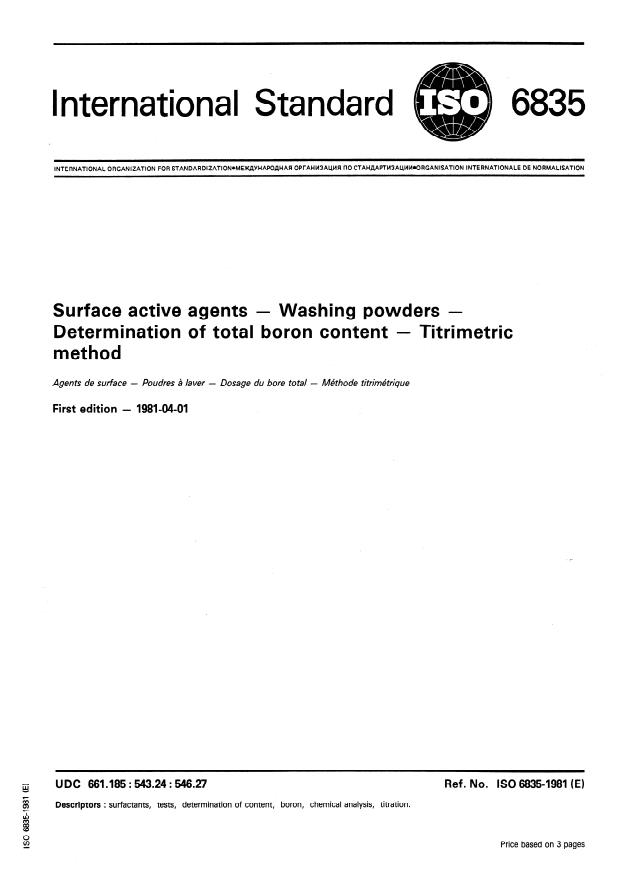
International Standard
INTERNATIONAL ORGANIZATION FOR STANDARDIZATION.MEIK,QYHAPO~HAR OPTAHM3ALWlR fl0 CTAH~APTM3ALWlM~RGANISATION INTERNATIONALE DE NORMALISATION
Surface active agents - Washing powders -
Determination of total boron content - Titrimetric
method
Agents de surface - Poudres 6 laver - Dosage du bore total - Mkthode titrimktrique
First edition - 1981-04-01
UDC 661.185 : 543.24: 546.27
Ref. No. ISO 6835-1981 (E)
Descriptors : sutfactants, tests, determination of content, boron, Chemical analysis, titration.
Price based on 3 pages
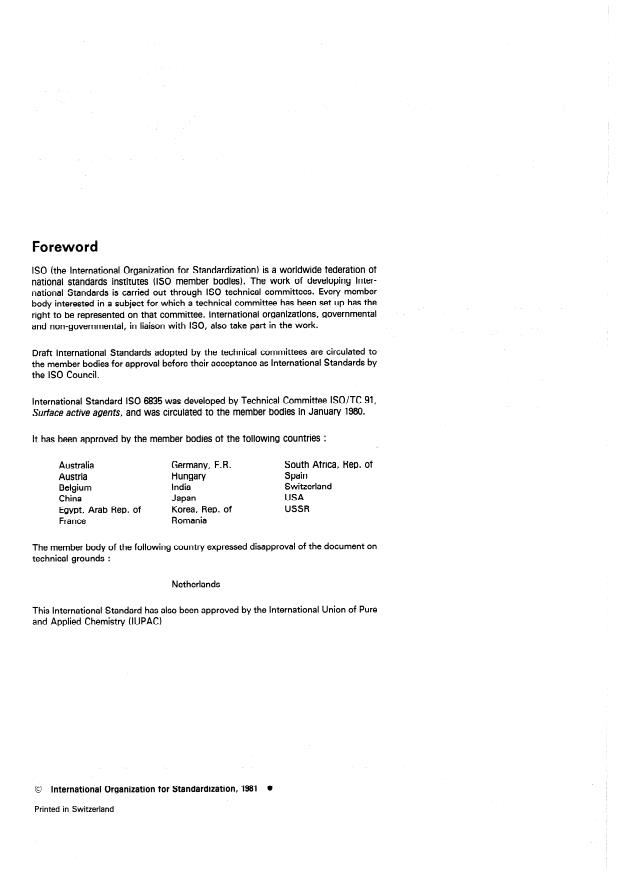
Foreword
ISO (the International Organization for Standardization) is a worldwide federation of
national Standards institutes (ISO member bodies). The work of developing Inter-
national Standards is carried out through ISO technical committees. Every member
body interested in a subject for which a technical committee has been set up has the
, .
right to be represented on that committee. International organizations, governmental
and non-governmental, in liaison with ISO, also take part in the work.
Draft International Standards adopted by the technical committees are circulated to
the member bodies for approval before their acceptance as International Standards by
the ISO Council.
International Standard ISO 6835 was developed by Technical Committee ISO/TC 91,
SuPface active agents, and was circulated to the member bodies in January 1980.
lt has been approved by the member bodies of the following countries :
Australia Germany, F. R. South Africa, Rep. of
Spain
Austria Hungary
India Switzerland
Belgium
China Japan USA
USSR
Egypt, Arab Rep. of Korea, Rep. of
France Romania
of the document on
The member body of the following country expressed disapproval
technical grounds
Netherlands
This International Standard has also been approved by the International Union of Pure
and Applied Chemistry (IUPAC)
0 International Organkation for Standardkation, 1981
Printed in Switzerland
ISO 68351981 (E)
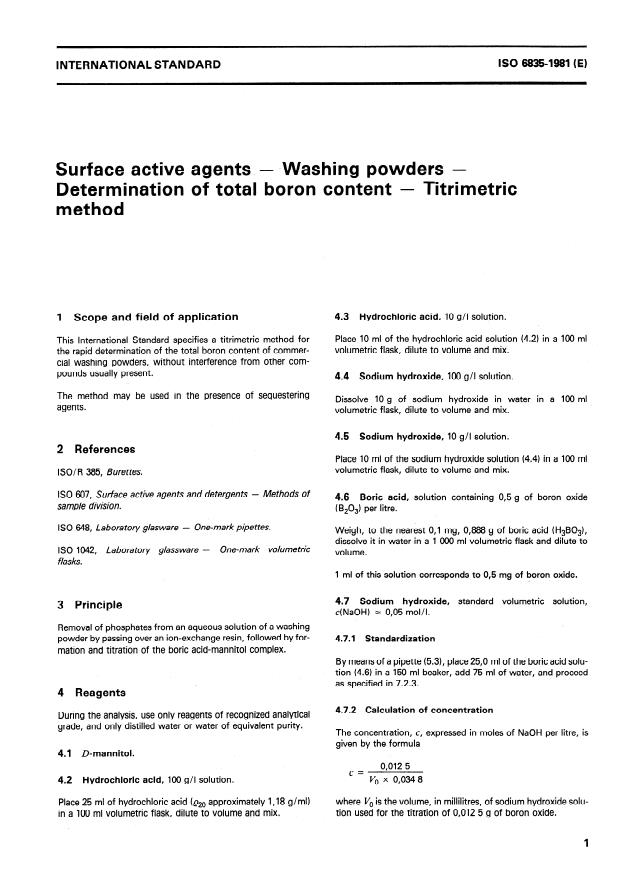
INTERNATIONAL STANDARD
Surface active agents. - Washing powders -
Determination of total boron content - Titrimetric
method
4.3 Hydrochlorit acid, 10 g/l Solution.
1 Scope and field of application
Place 10 ml of the hydrochloric acid Solution (4.2) in a 100 ml
This International Standard specifies a titrimetric method for
volumetric flask, dilute to volume and mix.
the rapid determination of the total boron content of commer-
cial washing powders, without interference from other com-
pounds usually present.
4.4 Sodium hydroxide, 100 g/l solution.
The method may be used in the presence of sequestering
Dissolve 10 g of sodium hydroxide in water in a 100 ml
agents.
volumetric flask, dilute to volume and mix.
4.5 Sodium hydroxide, 10 g/l Solution.
2 References
Place 10 ml of the sodium hydroxide Solution (4.4) in a 100 ml
volumetric flask, dilute to volume and mix.
ISO/R 385, Burettes.
ISO 607, Surface active agents and detergents - Methods of
4.6 Boric acid, Solution containing 0,5 g of boron Oxide
Sample division.
(B203) per litre.
ISO 648, Laboratory glasware - One-mark pipettes.
Weigh, to the nearest 0,l mg, 0,888 g of boric acid (H,BO+,
dissolve it in water in a 1 000 ml volumetric flask and dilute to
ISO 1042, Laboratory glassware - One-mark volumetric
volume.
flasks.
1 ml of this Solution corresponds to 0,5 mg of boron Oxide.
4.7 Sodium hydroxide, Standard volumetric Solution,
3 Principle
c(NaOH) = 0,05 mol/l.
Removal of Phosphates from an aqueous Solution of a washing
powder by passing over an ion-exchange resin, followed by for- 4.7.1 Standardization
mation and titration of the boric acid-mannitol complex.
By means of a pipette (5.31, place 25,0 ml of the boric acid solu-
tion (4.6) in a 150 ml beaker, add 75 ml of water, and proceed
as specified in 7.2.3.
4 Reagents
4.7.2 Calculation of concentration
During the analysis, use only reagents of recognized analytical
grade, and only distilled water or water of equivalent purity.
The concentration, c, expressed in moles of NaOH per litre, is
given by the formula
4.1 D-mannitol.
0,012 5
C
= V. x 0,034 8
4.2 Hydrochlorit acid, 100 g/l solution.
Place 25 ml of hydrochloric acid (eZO approximately 1,18 g/ml) where V0 is the volume, in millilitres, of sodium hydroxide solu-
tion used for the titration of 0,012 5 g of boron Oxide.
in a 100 ml volumetric flask, dilute to volume and mix.
ISO 68354981 (E)
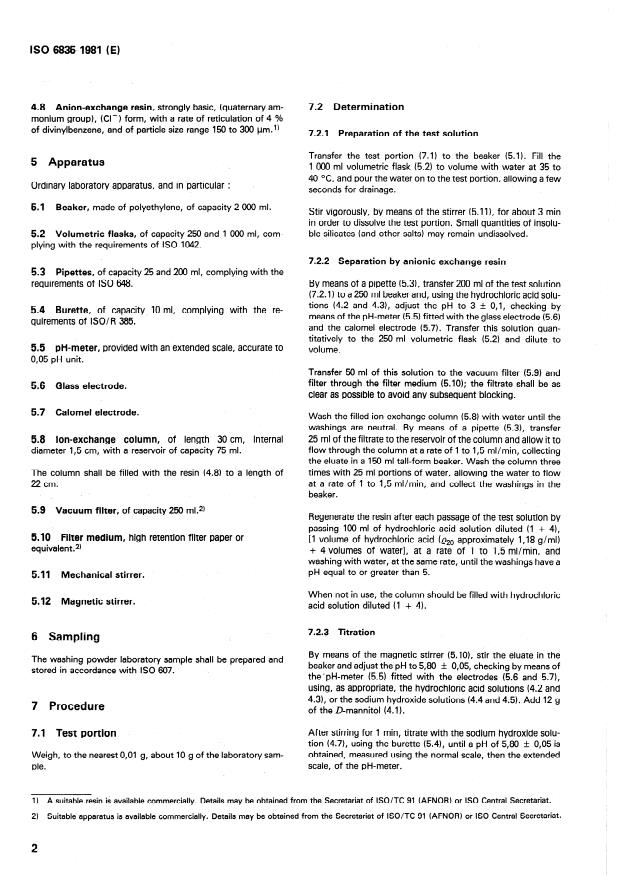
7.2 Determination
4.8 Anion-exchange resin, strongly basic, (quaternary am-
monium group), (Cl-) form, with a rate of reticulation of 4 %
of divinylbenzene, and of particle size range 150 to 300 prn.1)
7.2.1 Preparation of the test Solution
Transfer the test Portion (7.1) to the beaker (5.1). Fill the
5 Apparatus
1 000 ml volumetric flask (5.2) to volume with water at 35 to
40 OC, and pour the water on to the test Portion, allowing a few
Ordinary laboratory apparatus, and in particular :
seconds for drainage.
5.1 Beaker, made of polyethylene, of capacity 2 000 ml.
Stir vigorously, by means of the stirrer (5.111, for about 3 min
in Order to dissolve the test Portion. Small quantities of insolu-
ble silicates (and other salts) may remain undissolved.
5.2 Volumetric flasks, of capacity 250 and 1 000 ml, com-
plying with the requirements of ISO 1042.
7.2.2 Separation by anionic exc
...
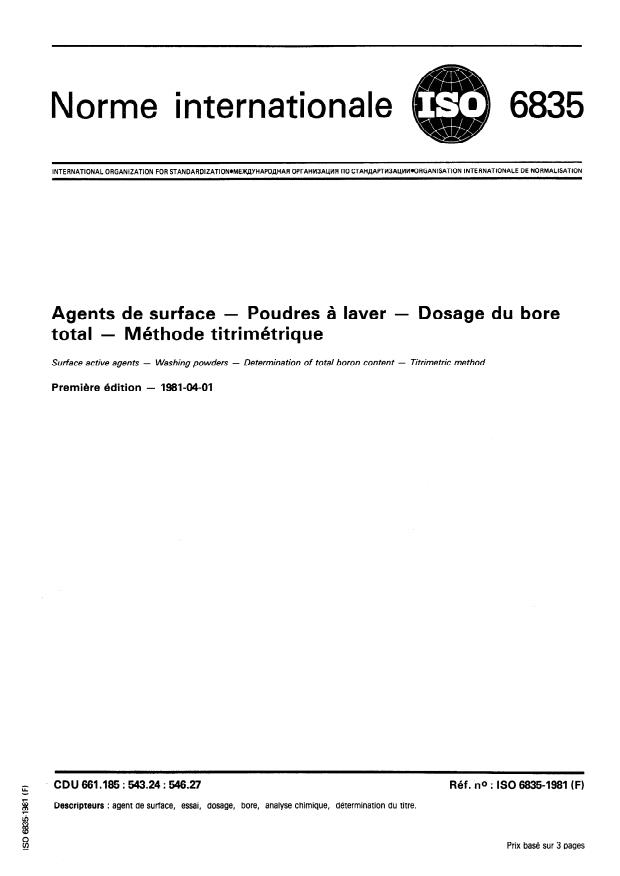
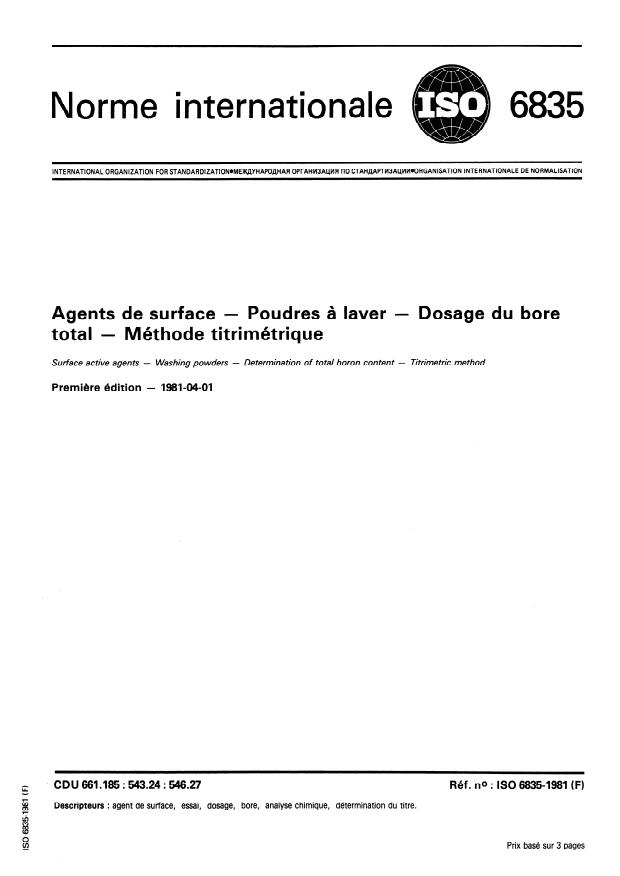
Norme internationale
INTERNATIONAL ORGANIZATION FOR STANDARDIZATIONWlE~YHAPO~HAF OPt-AHMSAL&lR fl0 CTAH~APTH3A~MM.ORGANISATION INTERNATIONALE DE NORMALISATION
Agents de surface - Poudres à laver - Dosage du bore
- Méthode titrimétrique
total
Surface active agents - Washing powders - Determination of total boron content - Titrime trie me thod
Première édition - 1981-04-01
* CDU 661.185 : 543.24 : 546.27
Réf. ‘no : ISO 6835-1981 (F)
G:
Y
F
Descripteurs : agent de surface, essai, dosage, bore, analyse chimique, détermination du titre.
%I
lh
I!ii
Prix basé sur 3 pages
v)
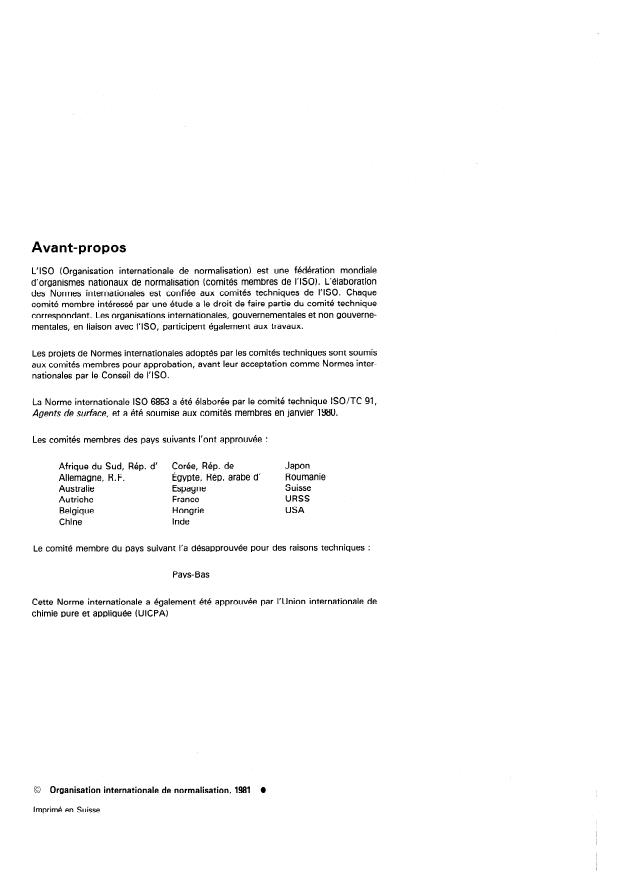
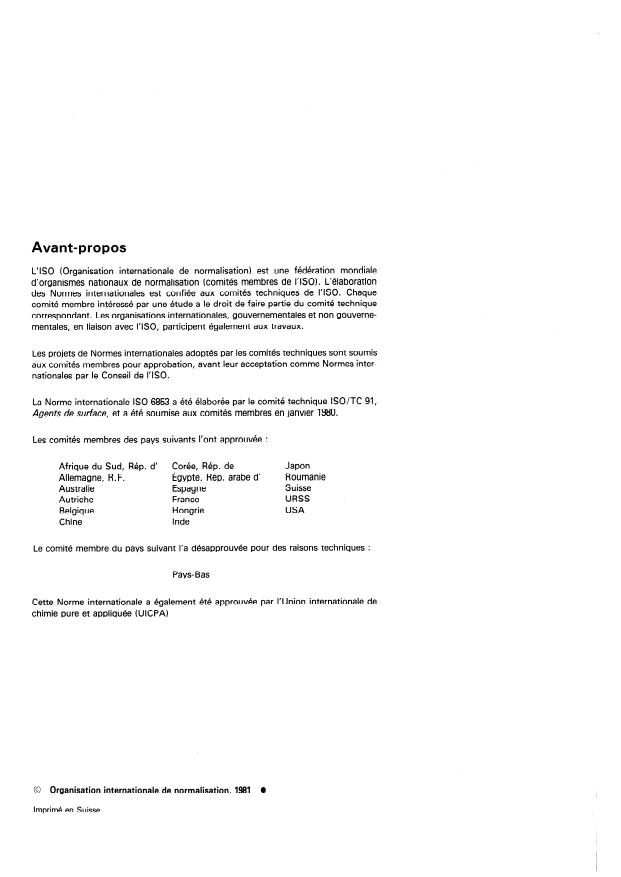
Avant-propos
L’ISO (Organisation internationale de normalisation) est une fédération mondiale
d’organismes nationaux de normalisation (comités membres de I’ISO). L’élaboration
des Normes internationales est confiée aux comités techniques de I’ISO. Chaque
comité membre intéressé par une étude a le droit de faire partie du comité technique
correspondant. Les organisations internationales, gouvernementales et non gouverne-
mentales, en liaison avec I’ISO, participent également aux travaux.
Les projets de Normes internationales adoptés par les comités techniques sont soumis
aux comités membres pour approbation, avant leur acceptation comme Normes inter-
nationales par le Conseil de I’ISO.
La Norme internationale ISO 6853 a été élaborée par le comité technique ISO/TC 91,
Agents de surface, et a été soumise aux comités membres en janvier 1980.
Les comités membres des pays suivants l’ont approuvée :
Afrique du Sud, Rép. d’ Corée, Rép. de Japon
Allemagne, R. F. Egypte, Rép. arabe d’ Roumanie
Suisse
Australie Espagne
Autriche France URSS
Belgique Hongrie USA
Chine Inde
Le comité membre du pays suivant l’a désapprouvée pour des raisons techniques :
Pays-Bas
Cette Norme internationale a également été approuvée par l’Union internationale de
chimie pure et appliquée (UICPA)
0 Organisation internationale de normalisation, 1981
Imprimé en Suisse
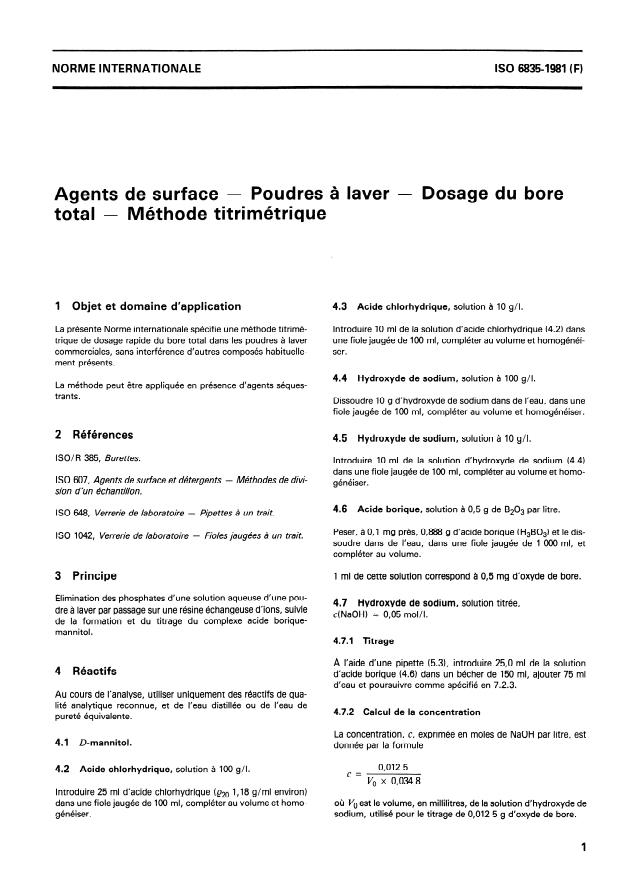
NORME INTERNATIONALE ISO 6835-1981 (F)
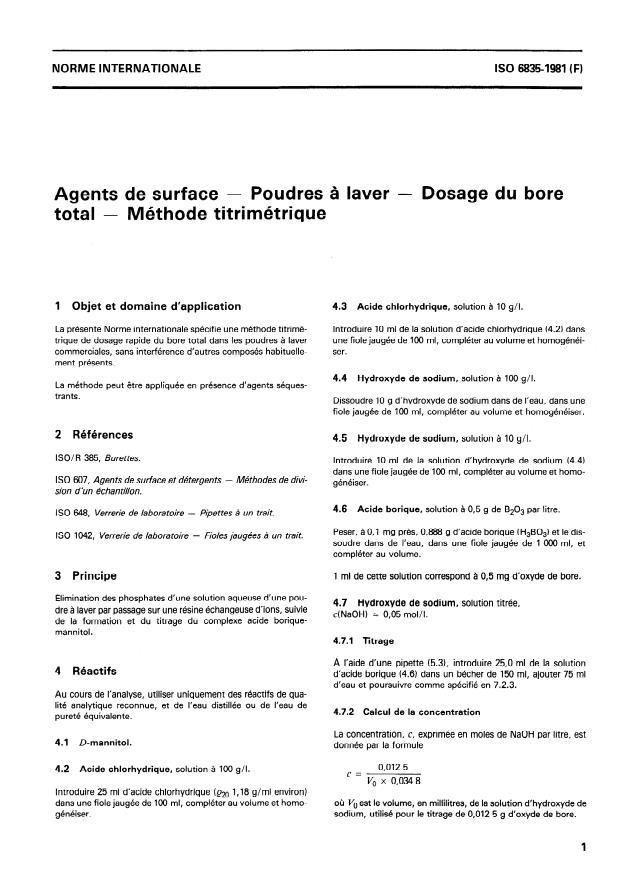
Agents de surface - Poudres à laver - Dosage du bore
total - Méthode titrimétrique
4.3 Acide chlorhydrique, solution à 10 g/l.
1 Objet et domaine d’application
La présente Norme internationale spécifie une méthode titrimé- Introduire 10 ml de la solution d’acide chlorhydrique (4.2) dans
trique de dosage rapide du bore total dans les poudres à laver une fiole jaugée de 100 ml, compléter au volume et homogénéi-
ser.
commerciales, sans interférence d’autres composés habituelle-
ment présents.
4.4 Hydroxyde de sodium, solution à 100 g/l.
La méthode peut être appliquée en présence d’agents séques-
trants.
Dissoudre 10 g d’hydroxyde de sodium dans de l’eau, dans une
fiole jaugée de 100 ml, compléter au volume et homogénéiser.
2 Références
4.5 Hydroxyde de sodium, solution à 10 g/l.
ISO/R 385, Burettes.
Introduire 10 ml de la solution d’hydroxyde de sodium (4.4)
dans une fiole jaugée de 100 ml, compléter au volume et homo-
ISO 607, Agents de surface et détergents - Méthodes de divi-
généiser .
sion d’un échan ti/fon.
4.6 Acide borique, solution à 0,5 g de B203 par litre.
ISO 648, Verrerie de laboratoire - Pipettes à un trait.
Peser, à 0,l mg près, 0,888 g d’acide borique (H,BO,) et le dis-
I SO 1042, Verrerie de laboratoire - Fioles jaugées à un trait.
soudre dans de l’eau, dans une fiole jaugée de 1 000 ml, et
compléter au volume.
3 Principe 1 ml de cette solution correspond à 0,5 mg d’oxyde de bore.
Élimination des phosphates d’une solution aqueuse d’une pou-
4.7 Hydroxyde de sodium, solution titrée,
dre à laver par passage sur une résine échangeuse d’ions, suivie
c(NaOH) = 0,05 mol/l.
de la formation et du titrage du complexe acide borique-
mannitol.
4.7.1 Titrage
À l’aide d’une pipette (5.31, introduire 25,0 ml de la solution
4 Réactifs
d’acide borique (4.6) dans un bécher de 150 ml, ajouter 75 ml
d’eau et poursuivre comme spécifié en 7.2.3.
Au cours de l’analyse, utiliser uniquement des réactifs de qua-
lité analytique reconnue, et de l’eau distillée ou de l’eau de
4.7.2 Calcul de la concentration
pureté équivalente.
La concentration, c, exprimée en moles de NaOH par litre, est
4.1 D-mannitol.
donnée par la formule
0,012 5
4.2 Acide chlorhydrique, solution à 100 g/l.
C
= Vo x 0,034 8
Introduire 25 ml d’acide chlorhydrique lez0 1,18 g/ml environ)
dans une fiole jaugée de 100 ml, compléter au volume et homo- où Vo est le volume, en millilitres, de la solution d’hydroxyde de
généiser . sodium, utilisé pour le titrage de 0,012 5 g d’oxyde de bore.
ISO 6835-1981 (F)
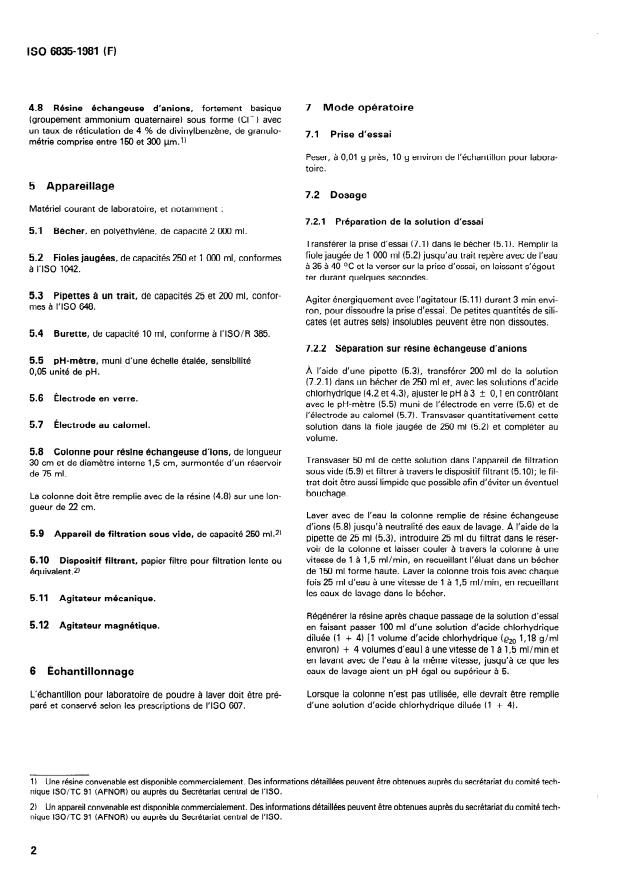
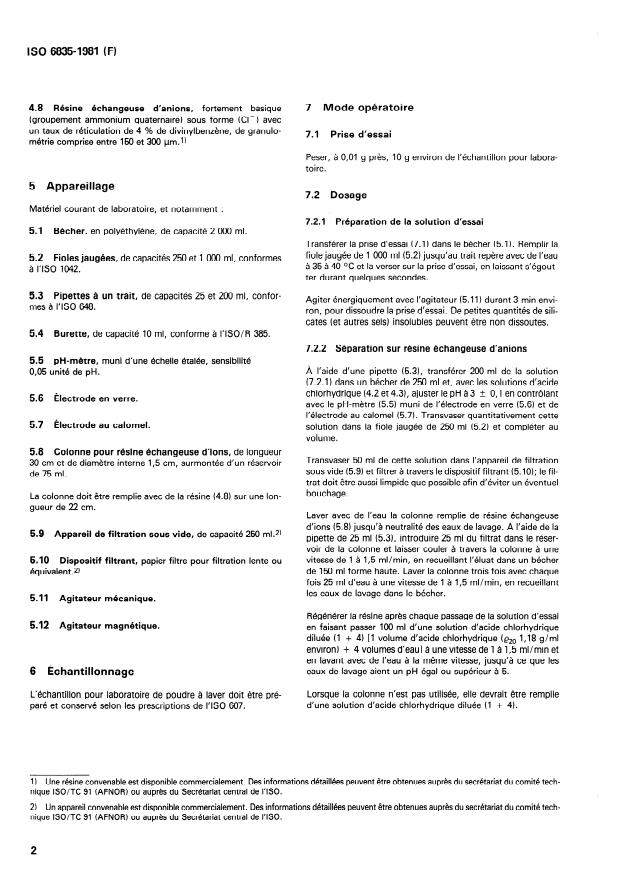
4.8 Résine echangeuse d’anions, fortement basique 7 Mode opératoire
(groupement ammonium quaternaire) sous forme (Cl- ) avec
un taux de réticulation de 4 % de divinylbenzéne, de granulo-
7.1 Prise d’essai
métrie comprise entre 150 et 300 prn.1)
Peser, à 0,Ol g près, 10 g environ de l’échantillon pour labora-
toire.
5 Appareillage
7.2 Dosage
Matériel courant de laboratoire, et notamment :
7.2.1 Préparation de la solution d’essai
5.1 Bécher, en polyéthylène, de capacité 2 000 ml.
Transférer la prise d’essai (7.1) dans le bécher (5.1). Remplir la
fiole jaugée de 1 000 ml (5.2) jusqu’au trait repère avec de l’eau
5.2 Fioles jaugées, de capacités 250 et 1 000 ml, conformes
à 35 à 40 OC et la verser sur la prise d’essai, en laissant s’égout-
à I’ISO 1042.
ter durant quelques secondes.
5.3 Pipettes à un trait, de capacités 25 et 200 ml, confor-
Agiter énergiquement avec l’agitateur (5. II) durant 3 min envi-
mes à I’ISO 648.
ron, pour dissoudre la prise d’essai. De petites quantités de sili-
cates (et autres sels) insolubles peuvent être non dissoutes.
...
Norme internationale
INTERNATIONAL ORGANIZATION FOR STANDARDIZATIONWlE~YHAPO~HAF OPt-AHMSAL&lR fl0 CTAH~APTH3A~MM.ORGANISATION INTERNATIONALE DE NORMALISATION
Agents de surface - Poudres à laver - Dosage du bore
- Méthode titrimétrique
total
Surface active agents - Washing powders - Determination of total boron content - Titrime trie me thod
Première édition - 1981-04-01
* CDU 661.185 : 543.24 : 546.27
Réf. ‘no : ISO 6835-1981 (F)
G:
Y
F
Descripteurs : agent de surface, essai, dosage, bore, analyse chimique, détermination du titre.
%I
lh
I!ii
Prix basé sur 3 pages
v)
Avant-propos
L’ISO (Organisation internationale de normalisation) est une fédération mondiale
d’organismes nationaux de normalisation (comités membres de I’ISO). L’élaboration
des Normes internationales est confiée aux comités techniques de I’ISO. Chaque
comité membre intéressé par une étude a le droit de faire partie du comité technique
correspondant. Les organisations internationales, gouvernementales et non gouverne-
mentales, en liaison avec I’ISO, participent également aux travaux.
Les projets de Normes internationales adoptés par les comités techniques sont soumis
aux comités membres pour approbation, avant leur acceptation comme Normes inter-
nationales par le Conseil de I’ISO.
La Norme internationale ISO 6853 a été élaborée par le comité technique ISO/TC 91,
Agents de surface, et a été soumise aux comités membres en janvier 1980.
Les comités membres des pays suivants l’ont approuvée :
Afrique du Sud, Rép. d’ Corée, Rép. de Japon
Allemagne, R. F. Egypte, Rép. arabe d’ Roumanie
Suisse
Australie Espagne
Autriche France URSS
Belgique Hongrie USA
Chine Inde
Le comité membre du pays suivant l’a désapprouvée pour des raisons techniques :
Pays-Bas
Cette Norme internationale a également été approuvée par l’Union internationale de
chimie pure et appliquée (UICPA)
0 Organisation internationale de normalisation, 1981
Imprimé en Suisse
NORME INTERNATIONALE ISO 6835-1981 (F)
Agents de surface - Poudres à laver - Dosage du bore
total - Méthode titrimétrique
4.3 Acide chlorhydrique, solution à 10 g/l.
1 Objet et domaine d’application
La présente Norme internationale spécifie une méthode titrimé- Introduire 10 ml de la solution d’acide chlorhydrique (4.2) dans
trique de dosage rapide du bore total dans les poudres à laver une fiole jaugée de 100 ml, compléter au volume et homogénéi-
ser.
commerciales, sans interférence d’autres composés habituelle-
ment présents.
4.4 Hydroxyde de sodium, solution à 100 g/l.
La méthode peut être appliquée en présence d’agents séques-
trants.
Dissoudre 10 g d’hydroxyde de sodium dans de l’eau, dans une
fiole jaugée de 100 ml, compléter au volume et homogénéiser.
2 Références
4.5 Hydroxyde de sodium, solution à 10 g/l.
ISO/R 385, Burettes.
Introduire 10 ml de la solution d’hydroxyde de sodium (4.4)
dans une fiole jaugée de 100 ml, compléter au volume et homo-
ISO 607, Agents de surface et détergents - Méthodes de divi-
généiser .
sion d’un échan ti/fon.
4.6 Acide borique, solution à 0,5 g de B203 par litre.
ISO 648, Verrerie de laboratoire - Pipettes à un trait.
Peser, à 0,l mg près, 0,888 g d’acide borique (H,BO,) et le dis-
I SO 1042, Verrerie de laboratoire - Fioles jaugées à un trait.
soudre dans de l’eau, dans une fiole jaugée de 1 000 ml, et
compléter au volume.
3 Principe 1 ml de cette solution correspond à 0,5 mg d’oxyde de bore.
Élimination des phosphates d’une solution aqueuse d’une pou-
4.7 Hydroxyde de sodium, solution titrée,
dre à laver par passage sur une résine échangeuse d’ions, suivie
c(NaOH) = 0,05 mol/l.
de la formation et du titrage du complexe acide borique-
mannitol.
4.7.1 Titrage
À l’aide d’une pipette (5.31, introduire 25,0 ml de la solution
4 Réactifs
d’acide borique (4.6) dans un bécher de 150 ml, ajouter 75 ml
d’eau et poursuivre comme spécifié en 7.2.3.
Au cours de l’analyse, utiliser uniquement des réactifs de qua-
lité analytique reconnue, et de l’eau distillée ou de l’eau de
4.7.2 Calcul de la concentration
pureté équivalente.
La concentration, c, exprimée en moles de NaOH par litre, est
4.1 D-mannitol.
donnée par la formule
0,012 5
4.2 Acide chlorhydrique, solution à 100 g/l.
C
= Vo x 0,034 8
Introduire 25 ml d’acide chlorhydrique lez0 1,18 g/ml environ)
dans une fiole jaugée de 100 ml, compléter au volume et homo- où Vo est le volume, en millilitres, de la solution d’hydroxyde de
généiser . sodium, utilisé pour le titrage de 0,012 5 g d’oxyde de bore.
ISO 6835-1981 (F)
4.8 Résine echangeuse d’anions, fortement basique 7 Mode opératoire
(groupement ammonium quaternaire) sous forme (Cl- ) avec
un taux de réticulation de 4 % de divinylbenzéne, de granulo-
7.1 Prise d’essai
métrie comprise entre 150 et 300 prn.1)
Peser, à 0,Ol g près, 10 g environ de l’échantillon pour labora-
toire.
5 Appareillage
7.2 Dosage
Matériel courant de laboratoire, et notamment :
7.2.1 Préparation de la solution d’essai
5.1 Bécher, en polyéthylène, de capacité 2 000 ml.
Transférer la prise d’essai (7.1) dans le bécher (5.1). Remplir la
fiole jaugée de 1 000 ml (5.2) jusqu’au trait repère avec de l’eau
5.2 Fioles jaugées, de capacités 250 et 1 000 ml, conformes
à 35 à 40 OC et la verser sur la prise d’essai, en laissant s’égout-
à I’ISO 1042.
ter durant quelques secondes.
5.3 Pipettes à un trait, de capacités 25 et 200 ml, confor-
Agiter énergiquement avec l’agitateur (5. II) durant 3 min envi-
mes à I’ISO 648.
ron, pour dissoudre la prise d’essai. De petites quantités de sili-
cates (et autres sels) insolubles peuvent être non dissoutes.
...