

ISO 23555-1:2022
(Main)Gas pressure safety and control devices for use in gas transmission, distribution and installations for inlet pressures up to and including 10 MPa — Part 1: General requirements
General Information
- Abstract
This document specifies generic safety, constructional, performance, testing and documentation requirements for high pressure controls for use in gas transmission, distribution and installations (hereafter referred to as controls). This document is applicable to controls with operating pressures greater than 500 kPa (5 bar) and up to and including 10 MPa (100 bar) and nominal size up to DN 400 for use with fuel gases as natural gas, manufactured gas, biomethane or liquefied petroleum gas (LPG) in commercial, industrial installations, including fuel gas infrastructures. The test methods given in this document are intended for product type test, routine tests and batch surveillance tests. This document is not applicable to: — controls upstream from/on/in domestic gas-consuming appliances which are installed downstream of domestic gas meters; — controls designed with declared maximum capacity ≤200 m3/h (normal conditions) and declared maximum inlet pressure ≤500 kPa (5 bar), to be incorporated into pressure control systems used in service lines (pipework from the main pipework in a gas infrastructure to the point of delivery of the gas); — industrial process control valves, such as IEC 60534; — controls used in aggressive/sour gas environments (gas environments containing water and H2S are considered sour) or severely corrosive conditions; — controls in service conditions with renewables (e.g. H2NG with hydrogen more than 10 %) and/or waste gases (e.g. biogas, etc.), if additional information is not provided (e.g. contaminant, liquid, etc.).
- Status
- Published
- Publication Date
- 10-Jan-2022
- Technical Committee
- ISO/TC 161 - Controls and protective devices for gas and/or oil
- Drafting Committee
- ISO/TC 161/WG 5 - High pressure controls
- Current Stage
- 9092 - International Standard to be revised
- Start Date
- 17-Apr-2026
- Completion Date
- 29-Aug-2026
Buy Documents


ISO 23555-1:2022 - Gas pressure safety and control devices for use in gas transmission, distribution and installations for inlet pressures up to and including 10 MPa — Part 1: General requirements Released:1/11/2022
Overview
ISO 23555-1:2022 - "Gas pressure safety and control devices for use in gas transmission, distribution and installations for inlet pressures up to and including 10 MPa - Part 1: General requirements" defines generic safety, constructional, performance, testing and documentation requirements for high‑pressure gas controls. It applies to controls with operating pressures > 500 kPa (5 bar) and ≤ 10 MPa (100 bar) and nominal sizes up to DN 400, intended for fuel gases such as natural gas, manufactured gas, biomethane and LPG in commercial, industrial and fuel‑gas infrastructure applications. Test methods cover product type tests, routine tests and batch surveillance.
Key topics and technical requirements
- Scope and exclusions: Excludes controls for domestic gas appliances downstream of domestic meters, small-capacity service‑line controls (≤ 200 m3/h and ≤ 500 kPa), industrial process control valves (e.g., IEC 60534), equipment for sour/aggressive or severely corrosive gas environments, and renewable/waste gas mixtures (e.g., H2 blends > 10%) unless supplemental data are provided.
- Classification: Temperature classes, strength types and nominal sizes for selection and conformity assessment.
- Materials: Requirements and validation for metallic and non‑metallic materials, material inspection documentation, and non‑destructive testing for steel bodies.
- Design and strength: Design approach, hazard identification, end connections, flange ratings, face‑to‑face dimensions, sealing, safety factors, springs, diaphragms and welding requirements.
- Performance & testing: Test rig specifications, shell strength, internal/external tightness, antistatic properties, sound emission, corrosion resistance, and stable production test regimes.
- Quality control & documentation: Type test reports, batch surveillance documentation, routine test records, marking, packaging and transport requirements.
Practical applications and users
Who uses ISO 23555-1:2022:
- Manufacturers and designers of pressure controls and safety devices for gas transmission and distribution
- Testing laboratories and certification bodies performing type testing, routine testing and batch surveillance
- Gas utilities, EPC contractors and system integrators specifying compliant devices for commercial and industrial installations
- Procurement, compliance and regulatory teams ensuring products meet safety and documentation requirements
Practical benefits:
- Ensures consistent safety and performance of high‑pressure gas controls
- Provides a baseline for product development, conformity assessment and procurement
- Supports safer integration into gas transmission and distribution networks
Related standards
- This is Part 1 (General requirements) - other parts may specify device‑specific requirements and test methods.
- Cross‑references include standards for industrial control valves (e.g., IEC 60534) and material/manufacturing standards commonly cited for pressure equipment.
Keywords: ISO 23555-1:2022, gas pressure safety and control devices, high pressure controls, gas transmission, gas distribution, DN 400, natural gas, biomethane, LPG, testing, type test, batch surveillance, materials, design, certification.
Buy Documents
ISO 23555-1:2022 - Gas pressure safety and control devices for use in gas transmission, distribution and installations for inlet pressures up to and including 10 MPa — Part 1: General requirements Released:1/11/2022
Get Certified
Connect with accredited certification bodies for this standard

DNV
DNV is an independent assurance and risk management provider.

Lloyd's Register
Lloyd's Register is a global professional services organisation specialising in engineering and technology.

DIBt (Deutsches Institut für Bautechnik)
German Institute for Building Technology.
Sponsored listings
Frequently Asked Questions
ISO 23555-1:2022 is a standard published by the International Organization for Standardization (ISO). Its full title is "Gas pressure safety and control devices for use in gas transmission, distribution and installations for inlet pressures up to and including 10 MPa — Part 1: General requirements". This standard covers: This document specifies generic safety, constructional, performance, testing and documentation requirements for high pressure controls for use in gas transmission, distribution and installations (hereafter referred to as controls). This document is applicable to controls with operating pressures greater than 500 kPa (5 bar) and up to and including 10 MPa (100 bar) and nominal size up to DN 400 for use with fuel gases as natural gas, manufactured gas, biomethane or liquefied petroleum gas (LPG) in commercial, industrial installations, including fuel gas infrastructures. The test methods given in this document are intended for product type test, routine tests and batch surveillance tests. This document is not applicable to: — controls upstream from/on/in domestic gas-consuming appliances which are installed downstream of domestic gas meters; — controls designed with declared maximum capacity ≤200 m3/h (normal conditions) and declared maximum inlet pressure ≤500 kPa (5 bar), to be incorporated into pressure control systems used in service lines (pipework from the main pipework in a gas infrastructure to the point of delivery of the gas); — industrial process control valves, such as IEC 60534; — controls used in aggressive/sour gas environments (gas environments containing water and H2S are considered sour) or severely corrosive conditions; — controls in service conditions with renewables (e.g. H2NG with hydrogen more than 10 %) and/or waste gases (e.g. biogas, etc.), if additional information is not provided (e.g. contaminant, liquid, etc.).
This document specifies generic safety, constructional, performance, testing and documentation requirements for high pressure controls for use in gas transmission, distribution and installations (hereafter referred to as controls). This document is applicable to controls with operating pressures greater than 500 kPa (5 bar) and up to and including 10 MPa (100 bar) and nominal size up to DN 400 for use with fuel gases as natural gas, manufactured gas, biomethane or liquefied petroleum gas (LPG) in commercial, industrial installations, including fuel gas infrastructures. The test methods given in this document are intended for product type test, routine tests and batch surveillance tests. This document is not applicable to: — controls upstream from/on/in domestic gas-consuming appliances which are installed downstream of domestic gas meters; — controls designed with declared maximum capacity ≤200 m3/h (normal conditions) and declared maximum inlet pressure ≤500 kPa (5 bar), to be incorporated into pressure control systems used in service lines (pipework from the main pipework in a gas infrastructure to the point of delivery of the gas); — industrial process control valves, such as IEC 60534; — controls used in aggressive/sour gas environments (gas environments containing water and H2S are considered sour) or severely corrosive conditions; — controls in service conditions with renewables (e.g. H2NG with hydrogen more than 10 %) and/or waste gases (e.g. biogas, etc.), if additional information is not provided (e.g. contaminant, liquid, etc.).
ISO 23555-1:2022 is classified under the following ICS (International Classification for Standards) categories: 23.060.40 - Pressure regulators; 27.060.20 - Gas fuel burners; 91.140.40 - Gas supply systems. The ICS classification helps identify the subject area and facilitates finding related standards.
ISO 23555-1:2022 is available in PDF format for immediate download after purchase. The document can be added to your cart and obtained through the secure checkout process. Digital delivery ensures instant access to the complete standard document.
Standards Content (Sample)
INTERNATIONAL ISO
STANDARD 23555-1
First edition
2022-01
Gas pressure safety and control
devices for use in gas transmission,
distribution and installations for
inlet pressures up to and including 10
MPa —
Part 1:
General requirements
Reference number
© ISO 2022
All rights reserved. Unless otherwise specified, or required in the context of its implementation, no part of this publication may
be reproduced or utilized otherwise in any form or by any means, electronic or mechanical, including photocopying, or posting on
the internet or an intranet, without prior written permission. Permission can be requested from either ISO at the address below
or ISO’s member body in the country of the requester.
ISO copyright office
CP 401 • Ch. de Blandonnet 8
CH-1214 Vernier, Geneva
Phone: +41 22 749 01 11
Email: copyright@iso.org
Website: www.iso.org
Published in Switzerland
ii
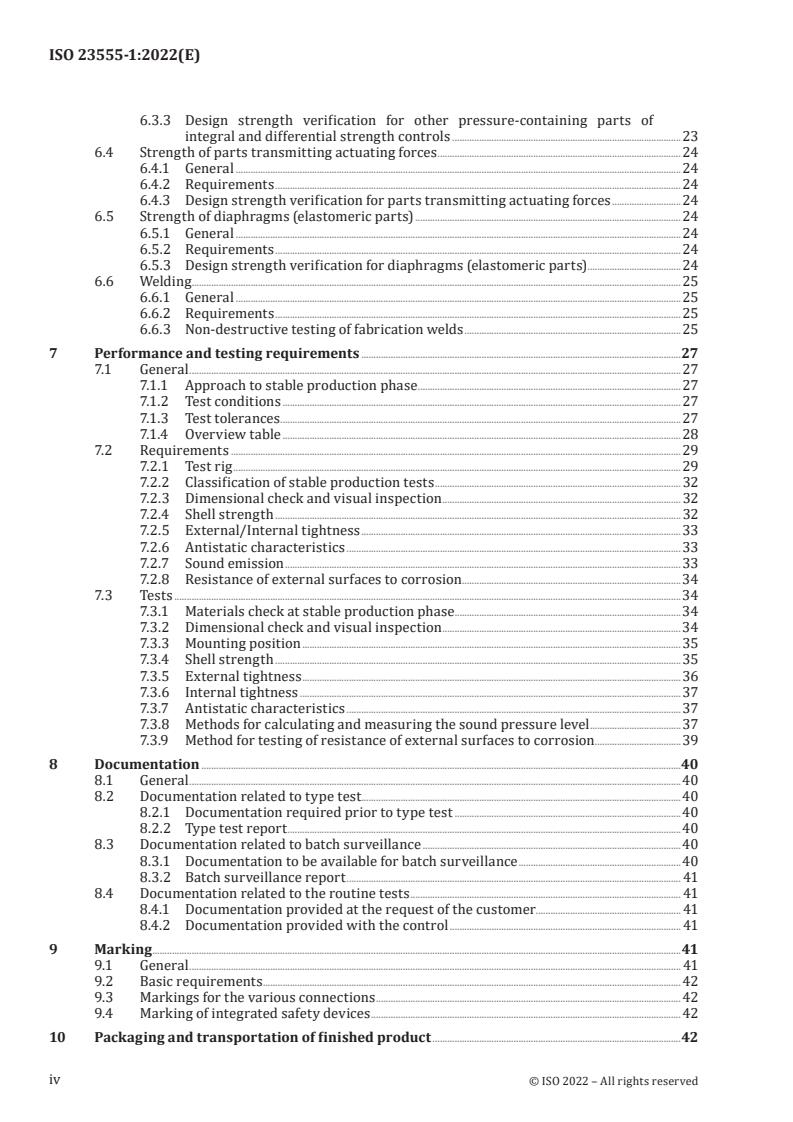
Contents Page
Foreword . vi
Introduction .vii
1 Scope . 1
2 Normative references . 1
3 Terms, definitions, symbols and abbreviated terms . 3
3.1 Terms and definitions . 3
3.1.1 General terms . 3
3.1.2 Terms related to components . 5
3.1.3 Terms related to components of functional performance. 6
3.1.4 Terms related to design and tests . 8
3.2 Symbols and abbreviated terms . 9
4 Classification .10
4.1 General . 10
4.2 Temperature classes . 10
4.3 Strength types . 11
5 Materials .11
5.1 General . 11
5.2 Requirements . 11
5.2.1 Requirements for metallic materials . 11
5.2.2 Requirements for non-metallic materials . 13
5.3 Validation and test of materials .13
5.3.1 Material inspection documents of metallic pressure-containing parts and
inner metallic partition walls . 13
5.3.2 Material inspection documents of threaded sealing plugs, integral process
and sensing lines, connectors and metallic fasteners . 14
5.3.3 Material inspection documents of non-metallic functional parts. 14
5.3.4 Non-destructive testing for steel bodies . 14
6 Design .14
6.1 General . 14
6.1.1 Design approach . 14
6.1.2 Basic requirements . 15
6.1.3 Hazard identification and residual risks . 15
6.1.4 End connections . 15
6.1.5 Flange ratings . 16
6.1.6 Nominal sizes and face-to-face dimensions . 16
6.1.7 Sealing of the adjusting device . 18
6.1.8 Replaceable parts that can be affected by erosion or abrasion . 18
6.1.9 Integral strength pressure controls . 18
6.1.10 Differential strength pressure controls . 18
6.1.11 Metallic flanges . 18
6.1.12 Minimum values of safety factor . 19
6.1.13 Springs requirements . 19
6.2 Strength of metallic body and its inner metallic partition walls . 19
6.2.1 General . 19
6.2.2 Requirements . 19
6.2.3 Design strength verification for metallic body and its inner metallic
partition walls . 20
6.3 Other pressure-containing metallic parts of integral and differential strength
controls. 22
6.3.1 General .22
6.3.2 Requirements . 22
iii
6.3.3 Design strength verification for other pressure-containing parts of
integral and differential strength controls . 23
6.4 Strength of parts transmitting actuating forces . 24
6.4.1 General . 24
6.4.2 Requirements . 24
6.4.3 Design strength verification for parts transmitting actuating forces . 24
6.5 Strength of diaphragms (elastomeric parts) . 24
6.5.1 General . 24
6.5.2 Requirements . 24
6.5.3 Design strength verification for diaphragms (elastomeric parts) . 24
6.6 Welding . . 25
6.6.1 General . 25
6.6.2 Requirements . 25
6.6.3 Non-destructive testing of fabrication welds . 25
7 Performance and testing requirements .27
7.1 General . 27
7.1.1 Approach to stable production phase . 27
7.1.2 Test conditions . 27
7.1.3 Test tolerances . . . 27
7.1.4 Overview table .28
7.2 Requirements .29
7.2.1 Test rig .29
7.2.2 Classification of stable production tests . 32
7.2.3 Dimensional check and visual inspection . 32
7.2.4 Shell strength . 32
7.2.5 External/Internal tightness . 33
7.2.6 Antistatic characteristics . 33
7.2.7 Sound emission . 33
7.2.8 Resistance of external surfaces to corrosion .34
7.3 Tests .34
7.3.1 Materials check at stable production phase.34
7.3.2 Dimensional check and visual inspection .34
7.3.3 Mounting position . 35
7.3.4 Shell strength . 35
7.3.5 External tightness .36
7.3.6 Internal tightness . 37
7.3.7 Antistatic characteristics . 37
7.3.8 Methods for calculating and measuring the sound pressure level . 37
7.3.9 Method for testing of resistance of external surfaces to corrosion .39
8 Documentation .40
8.1 General .40
8.2 Documentation related to type test.40
8.2.1 Documentation required prior to type test .40
8.2.2 Type test report .40
8.3 Documentation related to batch surveillance .40
8.3.1 Documentation to be available for batch surveillance .40
8.3.2 Batch surveillance report . 41
8.4 Documentation related to the routine tests . 41
8.4.1 Documentation provided at the request of the customer . 41
8.4.2 Documentation provided with the control . 41
9 Marking . .41
9.1 General . 41
9.2 Basic requirements . 42
9.3 Markings for the various connections . 42
9.4 Marking of integrated safety devices . 42
10 Packaging and transportation of finished product .42
iv
10.1 General . 42
10.2 Requirements . 43
10.3 Test . 43
Annex A (informative) List of materials . 44
Annex B (normative) Elastomeric material .60
Annex C (normative) Vent limiter .62
Annex D (normative) Compliance evaluation .66
Annex E (informative) Specific regional requirements in Japan .68
Bibliography .69
v
Foreword
ISO (the International Organization for Standardization) is a worldwide federation of national standards
bodies (ISO member bodies). The work of preparing International Standards is normally carried out
through ISO technical committees. Each member body interested in a subject for which a technical
committee has been established has the right to be represented on that committee. International
organizations, governmental and non-governmental, in liaison with ISO, also take part in the work.
ISO collaborates closely with the International Electrotechnical Commission (IEC) on all matters of
electrotechnical standardization.
The procedures used to develop this document and those intended for its further maintenance are
described in the ISO/IEC Directives, Part 1. In particular, the different approval criteria needed for the
different types of ISO documents should be noted. This document was drafted in accordance with the
editorial rules of the ISO/IEC Directives, Part 2 (see www.iso.org/directives).
Attention is drawn to the possibility that some of the elements of this document may be the subject of
patent rights. ISO shall not be held responsible for identifying any or all such patent rights. Details of
any patent rights identified during the development of the document will be in the Introduction and/or
on the ISO list of patent declarations received (see www.iso.org/patents).
Any trade name used in this document is information given for the convenience of users and does not
constitute an endorsement.
For an explanation of the voluntary nature of standards, the meaning of ISO specific terms and
expressions related to conformity assessment, as well as information about ISO's adherence to
the World Trade Organization (WTO) principles in the Technical Barriers to Trade (TBT), see
www.iso.org/iso/foreword.html.
This document was prepared by Technical Committee ISO/TC 161, Controls and protective devices for
gas and/or oil.
A list of all parts in the ISO 23555 series can be found on the ISO website.
Any feedback or questions on this document should be directed to the user’s national standards body. A
complete listing of these bodies can be found at www.iso.org/members.html.
vi
Introduction
This document provides general requirements for controls and protective devices and is intended to
be used in conjunction with ISO 23555-2 and ISO 23555-3 for specific types of controls and protective
devices or for controls for specific applications.
This document can also be applied, so far as reasonable, to controls not mentioned in a specific standard
and to controls designed on new principles, in which case additional requirements can be necessary.
When no specific International Standard for a control exists, the control can be tested according to this
document and further tests which take into account the intended use.
Controls and safety devices used with gases need to withstand the type of gas which is specified. Other
ISO Technical Committees, such as ISO/TC 28, Petroleum products and lubricants, and ISO/TC 193,
Natural gas, deal with the testing and properties of fuel gases.
Note that due to the differing properties of gas depending on its source/region of origin, certain
differences in regulations exist at present in different regions, some of which are presented in Annex E.
This document intends to provide a basic framework of requirements until these differences can be
harmonized.
vii
INTERNATIONAL STANDARD ISO 23555-1:2022(E)
Gas pressure safety and control devices for use in gas
transmission, distribution and installations for inlet
pressures up to and including 10 MPa —
Part 1:
General requirements
1 Scope
This document specifies generic safety, constructional, performance, testing and documentation
requirements for high pressure controls for use in gas transmission, distribution and installations
(hereafter referred to as controls).
This document is applicable to controls with operating pressures greater than 500 kPa (5 bar) and up
to and including 10 MPa (100 bar) and nominal size up to DN 400 for use with fuel gases as natural gas,
manufactured gas, biomethane or liquefied petroleum gas (LPG) in commercial, industrial installations,
including fuel gas infrastructures.
The test methods given in this document are intended for product type test, routine tests and batch
surveillance tests.
This document is not applicable to:
— controls upstream from/on/in domestic gas-consuming appliances which are installed downstream
of domestic gas meters;
— controls designed with declared maximum capacity ≤200 m /h (normal conditions) and declared
maximum inlet pressure ≤500 kPa (5 bar), to be incorporated into pressure control systems used
in service lines (pipework from the main pipework in a gas infrastructure to the point of delivery of
the gas);
— industrial process control valves, such as IEC 60534;
— controls used in aggressive/sour gas environments (gas environments containing water and H S
are considered sour) or severely corrosive conditions;
— controls in service conditions with renewables (e.g. H NG with hydrogen more than 10 %) and/or
waste gases (e.g. biogas, etc.), if additional information is not provided (e.g. contaminant, liquid,
etc.).
2 Normative references
The following documents are referred to in the text in such a way that some or all of their content
constitutes requirements of this document. For dated references, only the edition cited applies. For
undated references, the latest edition of the referenced document (including amendments) applies.
ISO 148-1, Metallic materials — Charpy pendulum impact test — Part 1: Test method
ISO 175, Plastics — Methods of test for the determination of the effects of immersion in liquid chemicals
ISO 1817, Rubber, vulcanized – Determination of the effect of liquids
ISO 3419, Non-alloy and alloy steel butt-welding fittings
ISO 7005 (all parts),Pipe flanges
ISO 9606-1, Qualification testing of welders — Fusion welding — Part 1: Steels
ISO 9606-2, Qualification test of welders — Fusion welding — Part 2: Aluminium and aluminium alloys
ISO 9606-3, Approval testing of welders — Fusion welding — Part 3: Copper and copper alloys
ISO 9606-4, Approval testing of welders — Fusion welding — Part 4: Nickel and nickel alloys
ISO 9712, Non-destructive testing — Qualification and certification of NDT personnel
ISO 10474:2013, Steel and steel products — Inspection documents
ISO 14732, Welding personnel — Qualification testing of welding operators and weld setters for mechanized
and automatic welding of metallic materials
ISO 15607, Specification and qualification of welding procedures for metallic materials — General rules
ISO 15609-1, Specification and qualification of welding procedures for metallic materials — Welding
procedure specification — Part 1: Arc welding
ISO 15610, Specification and qualification of welding procedures for metallic materials — Qualification
based on tested welding consumables
ISO 15611, Specification and qualification of welding procedures for metallic materials — Qualification
based on previous welding experience
ISO 15612, Specification and qualification of welding procedures for metallic materials — Qualification by
adoption of a standard welding procedure specification
ISO 15613, Specification and qualification of welding procedures for metallic materials — Qualification
based on pre-production welding test
ISO 15614-1, Specification and qualification of welding procedures for metallic materials — Welding
procedure test — Part 1: Arc and gas welding of steels and arc welding of nickel and nickel alloys
ISO 15614-2, Specification and qualification of welding procedures for metallic materials — Welding
procedure test — Part 2: Arc welding of aluminium and its alloys
ISO 17637, Non-destructive testing of welds — Visual testing of fusion-welded joints
ISO/IEC 17025:2017, General requirements for the competence of testing and calibration laboratories
IEC 60534-2-3, Industrial-process control valves — Part 2-3: Flow capacity — Test procedures
IEC 60534-4:2006, Industrial-process control valves — Part 4: Inspection and routine testing
EN 437, Test gases — Test pressures — Appliance categories
EN 549:2019, Rubber materials for seals and diaphragms for gas appliances and gas equipment
EN 12516-1:2014, Industrial valves — Shell design strength — Part 1: Tabulation method for steel valves
shells
EN 13445-4, Unfired pressure vessels — Part 4: Fabrication
EN 16129:2013, Pressure regulators, automatic change-over devices, having a maximum regulated
pressure of 4 bar, with a maximum capacity of 150 kg/h, associated safety devices and adaptors for butane,
propane, and their mixtures
MSS SP 55, Quality standard for steel castings for valves, flanges and fittings and other piping components
(Visual method)
3 Terms, definitions, symbols and abbreviated terms
3.1 Terms and definitions
For the purposes of this document, the following terms and definitions apply.
ISO and IEC maintain terminology databases for use in standardization at the following addresses:
— ISO Online browsing platform: available at https:// www .iso .org/ obp
— IEC Electropedia: available at https:// www .electropedia .org/
3.1.1 General terms
3.1.1.1
biomethane
methane-rich gas with the properties similar to natural gas derived from biogas produced by anaerobic
digestion or gasification or from power to gas by upgrading
[SOURCE: ISO 20675:2018, 3.12]
3.1.1.2
failure
termination of the ability of a functional unit to provide a required function or operation
[SOURCE: IEC 60050-192:2015, 192-03-01]
3.1.1.3
finite element analysis
FEA
examination of a phenomenon with the finite element method (3.1.1.4)
Note 1 to entry: FEA as applied in engineering is a computational tool for performing engineering analysis. It
includes the use of mesh generation techniques for dividing a complex problem into small elements, as well as the
use of software program coded with FEM algorithm.
3.1.1.4
finite element method
FEM
numerical method for solving problems of engineering and mathematical physics
Note 1 to entry: FEM is best understood from its practical application, known as finite element analysis (3.1.1.3).
3.1.1.5
differential strength type
DS
control device which includes pressure-containing parts (3.1.2.7) with different design pressure (3.1.4.3)
3.1.1.6
gas infrastructure
pipeline systems including pipework and their associated stations or plants for the transmission and
distribution of gas
Note 1 to entry: Natural gas infrastructure is a highly integrated system of transmission and distribution
pipelines (including regulating, measuring and compression stations), and storage facilities.
[SOURCE: ISO 20675:2018, 3.26, modified — Note 1 to entry has been added.]
3.1.1.7
high pressure control
device which directly or indirectly controls the gas pressure/flow and/or provides a safety function
3.1.1.8
integral strength type
IS
control device which includes all pressure-containing parts (3.1.2.7) with the same design pressure
(3.1.4.3)
3.1.1.9
manufactured gas
synthetic gas
gas which has been treated and may contain components that are not typical of natural gas
Note 1 to entry: Manufactured (synthetic) gases may contain substantial amounts of chemical species that are
not typical of natural gases or common species found in atypical proportions as in the case of wet and sour gases.
Note 2 to entry: Manufactured gases fall into two distinct categories, as follows:
a) those that are intended as synthetic or substitute natural gases, and that closely match true natural gases in
both composition and properties;
b) those that, whether or not intended to replace or enhance natural gas in service, do not closely match natural
gases in composition.
Case b) includes gases such as town gas, (undiluted) coke oven gas, and LPG/air mixtures, none of which
is compositionally similar to a true natural gas (even though, in the latter case, it may be operationally
interchangeable with natural gas).
[SOURCE: ISO 14532:2014, 2.1.1.4]
3.1.1.10
natural gas
NG
complex gaseous mixture of hydrocarbons, primarily methane, but generally also including ethane,
propane and higher hydrocarbons in much smaller amounts and some non-combustible gases, such as
nitrogen and carbon dioxide
[SOURCE: ISO 14532:2014, 2.1.1.1]
3.1.1.11
non-destructive testing
NDT
wide group of analysis techniques used in science and technology industry to evaluate the properties of
a material, component or system without causing damage
3.1.1.12
shell
pressure-containing envelope of the control
3.1.1.13
control nominal size
DN
alphanumeric designation of size for components of a pipework system, which is used for reference
purposes, comprising the letters DN followed by a dimensionless whole number which is indirectly
related to the physical size, in millimetres, of the bore or outside diameter of the end connections
Note 1 to entry: The number following the letters DN does not represent a measurable value and should not be
used for calculation purposes except where specified in the relevant standard.
Note 2 to entry: In standards which use the DN designation system, any relationship between DN and component
dimensions should be given, e.g. DN/OD or DN/ID.
[SOURCE: ISO 23550:2018, 3.17]
3.1.1.14
series of controls
controls with the same design concept, but differing only in size
3.1.2 Terms related to components
3.1.2.1
main component
part including control member (3.1.2.2), control body (3.1.2.3), actuator, casing of actuator, controller,
pilot (only in pilot-controlled controls)
Note 1 to entry: The control can include additional devices such as a relief device and other auxiliary devices
(3.1.2.12).
3.1.2.2
control member
movable part of the control which is positioned in the flow path to restrict or to shut down the flow
through the control
Note 1 to entry: A control member can be a plug, ball, disk, vane, gate, diaphragm (3.1.2.6), etc.
3.1.2.3
body
main pressure-containing envelop which provides the fluid flow passageway and the pipe end
connections
Note 1 to entry: The body is part of the shell.
3.1.2.4
valve seat
corresponding sealing surface within a control which make full contact only when the control member
(3.1.2.2), is in the closed position
[SOURCE: IEC 60534-1:2005, 3.2.4.1]
3.1.2.5
seat ring
part assembled in a component of the control to provide a replaceable seat
3.1.2.6
diaphragm
flexible member used as main diaphragm and diaphragm used to separate one chamber subjected to
pressure into two parts with different pressure (e.g. balancing diaphragm)
3.1.2.7
pressure-containing part
part whose failure to function results in a release of the retained fuel gas to the atmosphere
Note 1 to entry: These include bodies, control member (3.1.2.2), bonnets, the casing of the actuator, blind flanges
and pipes for process and sensing lines (3.1.2.9) but exclude compression fittings, diaphragms (3.1.2.6), bolts and
other fasteners.
3.1.2.8
inner metallic partition wall
metallic wall that separates a chamber into two individual pressure-containing chambers at different
pressures under normal operating conditions
3.1.2.9
process and sensing line
line which connects sensing points to the control
Note 1 to entry: Sensing point is the point from which the monitored variable is fed to the control.
Note 2 to entry: Sensing and process lines can be integrated into the control or external to the control. Lines with
no internal flow are called "sensing lines" and those with internal flow are called "process lines".
3.1.2.10
breather line
line connecting the atmosphere side of the pressure detector element to atmosphere
3.1.2.11
exhaust line
line connecting the control or its fixtures to atmosphere for the safe exhausting of gas in the event of
failure of any part
3.1.2.12
auxiliary device
any device [e.g. throttle devices, creep devices, vent limiter (3.1.2.13), etc.] functionally connected to the
main components (3.1.2.1) of the control
3.1.2.13
vent limiter
unit with an automatic valve reacting on gas flow and/or pressure
3.1.3 Terms related to components of functional performance
3.1.3.1
inlet pressure
p
u
gas pressure at the inlet of the control
Note 1 to entry: All pressures specified in this document are static gauge pressures unless otherwise stated.
-6 -5
Note 2 to entry: Pressure is expressed in Pa, unless otherwise stated. 1 Pa = 0,001 kPa = 10 MPa = 10 bar =
0,1 mbar.
5 2 5 -1
Note 3 to entry: For pressure expressed in bar: 1 bar = 1 000 mbar = 10 N/m = 10 Pa = 10 MPa.
3.1.3.2
outlet pressure
p
d
gas pressure at the outlet of the control
Note 1 to entry: All pressures specified in this document are static gauge pressures unless otherwise stated.
-6 -5
Note 2 to entry: Pressure is expressed in Pa, unless otherwise stated. 1 Pa = 0,001 kPa = 10 MPa = 10 bar =
0,1 mbar.
5 2 5 -1
Note 3 to entry: For pressure expressed in bar: 1 bar = 1 000 mbar = 10 N/m = 10 Pa = 10 MPa.
3.1.3.3
differential pressure
Δp
difference between two values of pressure at two different points
Note 1 to entry: All pressures specified in this document are static gauge pressures unless otherwise stated.
-6 -5
Note 2 to entry: Pressure is expressed in Pa, unless otherwise stated. 1 Pa = 0,001 kPa = 10 MPa = 10 bar =
0,1 mbar.
5 2 5 -1
Note 3 to entry: For pressure expressed in bar: 1 bar = 1 000 mbar = 10 N/m = 10 Pa = 10 MPa.
3.1.3.4
atmospheric pressure
p
b
local static atmospheric absolute pressure in Pa (bar)
Note 1 to entry: All pressures specified in this document are static gauge pressures unless otherwise stated.
-6 -5
Note 2 to entry: Pressure is expressed in Pa, unless otherwise stated. 1 Pa = 0,001 kPa = 10 MPa = 10 bar =
0,1 mbar.
5 2 5 -1
Note 3 to entry: For pressure expressed in bar: 1 bar = 1 000 mbar = 10 N/m = 10 Pa = 10 MPa.
3.1.3.5
normal conditions
situation where absolute pressure, p , is 101,325 kPa (1 013,25 mbar) and temperature, T , is 0 °C (t of
n n n
273,15 K)
Note 1 to entry: For calculation purposes, a value of 273 K is used in this document.
3.1.3.6
standard conditions
situation where absolute pressure, p , is 101,325 kPa (1013,25 mbar) and temperature, T , is 15 °C (t of
n n n
288,15 K)
Note 1 to entry: For calculation purposes, a value of 288 K is used in this document.
3.1.3.7
volumetric flow rate
Q
n
volume of gas which flows through the control per unit of time, re-calculated to normal conditions
(3.1.3.5)
Note 1 to entry: Volumetric flow rate is expressed in m /h at normal conditions.
3.1.3.8
vented flow rate
Q
v
flow rate vented to atmosphere via the vent limiter (3.1.2.13) with any value of expected pressure inside
the chamber at atmosphere side (in normal operating conditions) of the pressure detecting element
Note 1 to entry: The vented flow rate is expressed as air flow rate in l/h under normal conditions (3.1.3.5).
3.1.3.9
vented flow rate limit
Q
vl
maximum flow rate limited by the vent limiter (3.1.2.13) with any value of expected pressure inside the
chamber at atmosphere side (in normal operating conditions) of the pressure detecting element
Note 1 to entry: The maximum vented flow rate (3.1.3.8) is expressed as air flow rate in l/h under normal
conditions (3.1.3.5).
3.1.3.10
sound pressure level
L
pA
logarithmic measure of the effective pressure of a sound relative to a reference value and A-weighting,
expressed in decibels (dB)
Note 1 to entry: ‘A’ frequency weighting is the standard weighting of the audible frequencies and reflects the
response of the human ear to noise.
Note 2 to entry: All pressures specified in this document are static gauge pressures unless otherwise stated.
-6 -5
Note 3 to entry: Pressure is expressed in Pa, unless otherwise stated. 1 Pa = 0,001 kPa = 10 MPa = 10 bar =
0,1 mbar.
5 2 5 -1
Note 4 to entry: For pressure expressed in bar: 1 bar = 1 000 mbar = 10 N/m = 10 Pa = 10 MPa.
[SOURCE: IEC 61672:2013, 3.2 and 3.3]
3.1.4 Terms related to design and tests
3.1.4.1
component operating pressure
p
gas pressure occurring in any part of a control during operation
3.1.4.2
maximum component operating pressure
p
max
highest operating pressure at which a component of a control continuously operates within specified
conditions
3.1.4.3
design pressure
DP
pressure on which design calculation are based
Note 1 to entry: In particular, maximum pressure for which the body (3.1.2.3), its inner metallic partition walls
(3.1.2.8) and some other pressure-containing parts (3.1.2.7) are designed in accordance with the strength
requirements in this document.
3.1.4.4
specific design pressure
DPD
pressure for which some pressure-containing parts (3.1.2.7) of differential strength controls are
designed where DPD < DP
3.1.4.5
test pressure
PT
pressure applied to a section of the control for a limited period of time in order to prove certain
characteristics
3.1.4.6
limit pressure
p
l
pressure at which yielding becomes apparent in any component of the control or its fixtures
3.1.4.7
safety factors
ratio of the limit pressure (3.1.4.6), p , to the maximum allowable design pressure (3.1.4.3), DP, or to the
l
maximum allowable specific design pressure (3.1.4.4), DPD, applied to:
— the control body (3.1.2.3), S ;
b
— the other pressure-containing parts (3.1.2.7) of the control, S.
3.1.4.8
maximum inlet pressure
p
umax
highest inlet pressure (3.1.3.1) at which the control can continuously operate within specified conditions
3.1.4.9
maximum differential pressure
Δp
max
highest value of allowable pressure difference between two parts of the control
3.1.4.10
nominal pressure
PN
alpha-numerical designation relating to pressure that is a convenient round number for reference
purposes.
Note 1 to entry: It is intended that all equipment of the same nominal size (DN) designated by the same PN
number shall have the same mating dimensions appropriate to the type of end connections.
Note 2 to entry: The permissible working pressure depends upon materials, design and working temperature
and has to be selected from the pressure/temperature rating tables in corresponding standards.
Note 3 to entry: It comprises the letters PN fo
...