

ISO 16079-1:2017
(Main)Condition monitoring and diagnostics of wind turbines — Part 1: General guidelines
General Information
- Abstract
ISO 16079-1:2017 gives guidelines which provide the basis for choosing condition monitoring methods used for failure mode detection, diagnostics and prognostics of wind power plant components.
- Status
- Withdrawn
- Publication Date
- 02-Nov-2017
- Technical Committee
- ISO/TC 108/SC 5 - Condition monitoring and diagnostics of machine systems
- Current Stage
- 9599 - Withdrawal of International Standard
- Start Date
- 02-Jun-2026
- Completion Date
- 29-Aug-2026
Buy Documents
REDLINE ISO 16079-1:2017 - Condition monitoring and diagnostics of wind turbines — Part 1: General guidelines Released:11/3/2017


ISO 16079-1:2017 - Condition monitoring and diagnostics of wind turbines — Part 1: General guidelines Released:11/3/2017
ISO 16079-1:2017 - Surveillance et diagnostic d'état des éoliennes de production d'électricité — Partie 1: Lignes directrices générales Released:11/3/2017
Overview
ISO 16079-1:2017 - Condition monitoring and diagnostics of wind turbines - Part 1: General guidelines - provides a structured, machine-specific framework for selecting and implementing condition monitoring, diagnostic and prognostic methods for wind power plant components. It defines terminology (descriptors, anomaly, ETTF, etc.), explains implementation challenges unique to wind turbines, and gives a methodology to prioritize which components and failure modes to monitor to achieve cost‑effective, reliable maintenance.
Key topics and requirements
- Scope and purpose: Guidelines to choose condition monitoring methods for failure mode detection, diagnostics and prognostics of wind turbine components. Not intended for safety systems.
- Terminology and descriptors: Defines key terms (alarm, anomaly, descriptor, failure mode, ETTF, RUL) to harmonize communication across manufacturers, operators and monitoring vendors.
- FMECA-driven prioritization: Uses FMECA (failure modes, effects and criticality analysis) to identify critical components, assign failure-mode priority factors and compute a monitoring priority number to focus monitoring resources.
- Diagnosis and prognosis basics: Emphasizes reliable alarms, estimated time to failure (ETTF), remaining useful life (RUL) concepts and the P–F interval for planning corrective action.
- Measurement and diagnostics considerations: Notes special challenges-nacelle access limitations, variable loading, structural self‑excitation, harsh environments and remote connectivity-that influence sensor choice and data quality.
- System reliability: Stresses detection of faulty monitoring equipment and robustness of descriptor measurements as prerequisites for trustworthy condition monitoring.
- Conservative, proven methods: Recommends well‑documented, time‑proven techniques; leaves out immature methods until validated.
Practical applications
ISO 16079-1 supports:
- Prioritizing which components (gearbox, bearings, generator, etc.) and failure modes should be monitored to optimize cost vs detection coverage.
- Defining descriptor types and alarm criteria used in condition monitoring systems.
- Integrating diagnostics and prognostics into maintenance planning (spare part logistics, crane scheduling, outage planning) using ETTF/RUL estimates.
- Improving asset performance and predictability of power production to reduce penalties and maintain investor confidence.
Who should use this standard
- Wind turbine OEMs and component manufacturers
- Wind farm operators and asset managers
- Condition monitoring system vendors and monitoring bodies
- Reliability engineers and maintenance planners
- Certification bodies and consultants evaluating CM system capabilities
Related standards
- ISO 17359, ISO 13373, ISO 13374, ISO 13379 - generic condition monitoring guidance and techniques
- ISO 10816-21 - vibration measurement for wind turbines
- IEC 61400-25-6 - data models and descriptor organization for wind power plant condition monitoring
- DNV·GL guidelines and ISO 55000 series - asset management and CM certification context
Keywords: condition monitoring, wind turbines, diagnostics, prognostics, FMECA, ETTF, P‑F interval, RUL, ISO 16079-1.
Relations
- Effective Date
- 04-Nov-2023
Buy Documents
REDLINE ISO 16079-1:2017 - Condition monitoring and diagnostics of wind turbines — Part 1: General guidelines Released:11/3/2017
ISO 16079-1:2017 - Condition monitoring and diagnostics of wind turbines — Part 1: General guidelines Released:11/3/2017
ISO 16079-1:2017 - Surveillance et diagnostic d'état des éoliennes de production d'électricité — Partie 1: Lignes directrices générales Released:11/3/2017
Get Certified
Connect with accredited certification bodies for this standard

DNV
DNV is an independent assurance and risk management provider.

Lloyd's Register
Lloyd's Register is a global professional services organisation specialising in engineering and technology.
DNV Energy Systems
Energy and renewable energy certification.
Sponsored listings
Frequently Asked Questions
ISO 16079-1:2017 is a standard published by the International Organization for Standardization (ISO). Its full title is "Condition monitoring and diagnostics of wind turbines — Part 1: General guidelines". This standard covers: ISO 16079-1:2017 gives guidelines which provide the basis for choosing condition monitoring methods used for failure mode detection, diagnostics and prognostics of wind power plant components.
ISO 16079-1:2017 gives guidelines which provide the basis for choosing condition monitoring methods used for failure mode detection, diagnostics and prognostics of wind power plant components.
ISO 16079-1:2017 is classified under the following ICS (International Classification for Standards) categories: 27.180 - Wind turbine energy systems. The ICS classification helps identify the subject area and facilitates finding related standards.
ISO 16079-1:2017 has the following relationships with other standards: It is inter standard links to ISO 16079-1:2026. Understanding these relationships helps ensure you are using the most current and applicable version of the standard.
ISO 16079-1:2017 is available in PDF format for immediate download after purchase. The document can be added to your cart and obtained through the secure checkout process. Digital delivery ensures instant access to the complete standard document.
Standards Content (Sample)
ISO/TC 108/SC 5
Deleted: 2016-09-29
Date: 2017-10
Deleted: /DIS
Deleted: 2016
ISO/TC 108/SC 5/WG
Secretariat: SA
Condition monitoring and diagnostics of wind turbines —
Part 1: General guidelines
Surveillance et diagnostic d'état des éoliennes de production d'électricité —
Partie 1: Lignes directrices générales
i
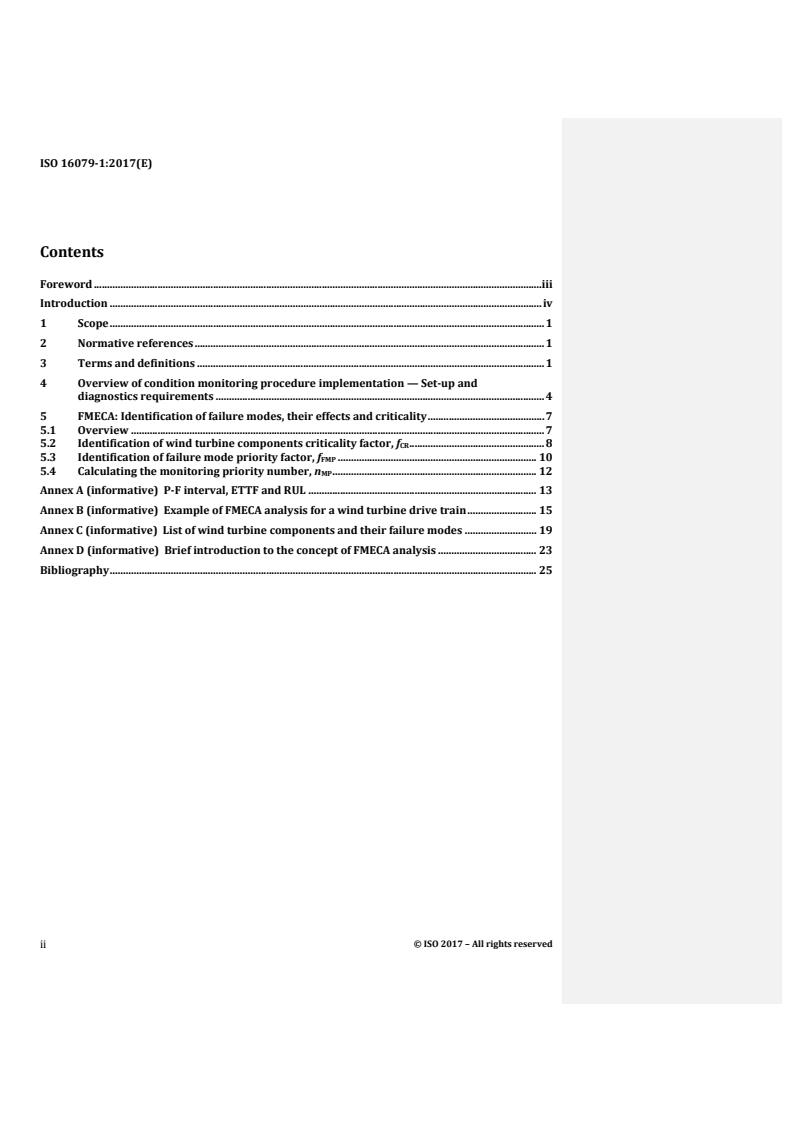
Contents
Foreword .iii
Introduction . iv
1 Scope . 1
2 Normative references . 1
3 Terms and definitions . 1
4 Overview of condition monitoring procedure implementation — Set-up and
diagnostics requirements . 4
5 FMECA: Identification of failure modes, their effects and criticality . 7
5.1 Overview . 7
5.2 Identification of wind turbine components criticality factor, f . 8
CR
5.3 Identification of failure mode priority factor, f . 10
FMP
5.4 Calculating the monitoring priority number, nMP . 12
Annex A (informative) P-F interval, ETTF and RUL . 13
Annex B (informative) Example of FMECA analysis for a wind turbine drive train . 15
Annex C (informative) List of wind turbine components and their failure modes . 19
Annex D (informative) Brief introduction to the concept of FMECA analysis . 23
Bibliography . 25
ii
Foreword
ISO (the International Organization for Standardization) is a worldwide federation of national
standards bodies (ISO member bodies). The work of preparing International Standards is normally
carried out through ISO technical committees. Each member body interested in a subject for which a
technical committee has been established has the right to be represented on that committee.
International organizations, governmental and non‐governmental, in liaison with ISO, also take part in
the work. ISO collaborates closely with the International Electrotechnical Commission (IEC) on all
matters of electrotechnical standardization.
The procedures used to develop this document and those intended for its further maintenance are
described in the ISO/IEC Directives, Part 1. In particular the different approval criteria needed for the
different types of ISO documents should be noted. This document was drafted in accordance with the
editorial rules of the ISO/IEC Directives, Part 2 (see www.iso.org/directives).
Attention is drawn to the possibility that some of the elements of this document may be the subject of
patent rights. ISO shall not be held responsible for identifying any or all such patent rights. Details of
any patent rights identified during the development of the document will be in the Introduction and/or
on the ISO list of patent declarations received (see www.iso.org/patents).
Any trade name used in this document is information given for the convenience of users and does not
constitute an endorsement.
For an explanation on the voluntary nature of standards, the meaning of ISO specific terms and
expressions related to conformity assessment, as well as information about ISO's adherence to the
World Trade Organization (WTO) principles in the Technical Barriers to Trade (TBT) see the following
URL: www.iso.org/iso/foreword.html.
This document was prepared by Technical Committee ISO/TC 108, Mechanical vibration, shock and
condition monitoring, Subcommittee SC 5, Condition monitoring and diagnostics of machine systems.
A list of all parts in the ISO 16079 series can be found on the ISO website.
iii
Introduction
General
This document is the first in a series of International Standards covering the application of condition
monitoring to wind turbines. It is an application of the recommendations and best practices described
in the generic standards developed under ISO/TC 108.
Background
Power production from wind turbines is growing exponentially on the global energy market. As a
consequence, predictability of the production from wind power plants has become as crucial as
predictability of power production from conventional power plants. As for conventional power plants,
an efficient maintenance programme for wind power plants adds significant value to the reliability and
predictability of the supply of energy. An efficient condition monitoring system is an important part of
such a programme in order to achieve the following:
a) obtain predictability in power production, thus avoiding penalties from grid authorities if the
quoted amount of power is not delivered;
b) maintain the confidence of investors by providing a stable power production, thus motivating
future investments;
c) lower turbine maintenance costs by
1) avoiding development of failures to a serious state,
2) avoiding consequential or subsequent failures, and
3) being able to plan service months ahead;
d) reduce the through life cost by
1) avoiding loss of availability,
2) allowing continued operations under fault conditions (perhaps with appropriate restrictions),
and
3) supporting failure investigations to prevent repetitive events.
Condition monitoring, in general, requires: Deleted: has the following requirements.
— Reliable alarms. An alarm is triggered only when the confidence level of the diagnosis and
prognosis is high. Wind turbines are placed in remote locations and many wind turbines are located
offshore where access is limited and costly.
— An estimated time to failure. This is for supporting efficient maintenance planning and utilization of Deleted: Estimated
cranes, staff, ordering of spare parts, etc.
— Reliable descriptor measurements. In addition to self‐excited forces, a wind turbine is also subject
to environmental occurrences. The compact structure can cause measurement readings from one
machine part to be affected by other machine parts.
iv
— Detection of faulty monitoring. A working data acquisition system is the basis of a reliable
monitoring systems. Any equipment can fail. It is essential that faulty equipment is detected to
ensure a reliable condition monitoring process.
— Complex IT landscape. A monitoring system is required to monitor thousands of wind turbines
connected to a central server via complex worldwide data networks. (This requirement is outside
the scope of this document.)
Condition monitoring of wind turbines presents some challenges compared to condition monitoring of
other machinery.
— Access to the nacelle is difficult and potentially dangerous and in many countries is not allowed Deleted: ,
during operation, so online systems are likely to be required for measurements which have
traditionally used hand‐held methods.
— Wind turbine loading varies significantly with time and cannot be influenced; some extra measures
need to be taken to ensure repeatability of measurements.
— Self‐excitation of the structures, extremes of ambient temperature and the likelihood of lightning
strikes present a severe test of the robustness of all systems.
— Since wind turbines are often in remote locations, the monitoring systems need to be able to
function in the face of loss of network connectivity.
Aims of the ISO 16079 series
This document and subsequent documents in the ISO 16079 series have the following aims:
a) to allow manufacturers of wind turbines, operators of wind turbines and manufacturers of
condition monitoring systems for wind turbines to share common concepts and terminology;
b) to provide a methodology whereby users of this document can prioritize and select which
components shall be monitored and which failure modes shall be detected, in order to obtain the
most efficient condition monitoring system with regard to
1) cost,
2) detection capability,
3) complexity of monitoring system and methods, and
4) available resources and skill level of staff in the monitoring body.
It is NOT the intention of this document or subsequent documents in the ISO 16079 series to cover any
aspects of safety monitoring systems.
Time-proven experience
The monitoring strategies presented in the ISO 16079 series are based on time‐proven experience. Only
conservative, well‐proven methods and best practices are applied. This means that detection of certain
failure modes may be left out if the behaviour of the failure modes and their related symptoms are not
well‐documented. As new monitoring techniques mature, this document will be updated accordingly.
v
Relation to the generic standards of ISO/TC 108
ISO 17359 is a parent standard of this document. It presents an overview of a generic procedure
recommended to be used when implementing a condition monitoring programme and provides further
details on the key steps to be followed. It introduces the concept of directing condition monitoring
activities towards root cause failure modes and describes the generic approach to setting alarm criteria,
carrying out diagnosis and prognosis and improving confidence in diagnosis and prognosis, which are
developed further in other documents. Particular techniques of condition monitoring are introduced
briefly.
The concept of condition monitoring itself and the measurement techniques involved are presented in
other generalized condition monitoring guidelines such as ISO 13373 (all parts), ISO 13374 (all parts)
and ISO 13379‐1. Those guidelines are considered as foundations of this document. Figure 1 illustrates
how this machine‐specific document is linked to other generic guidelines of condition monitoring and
measurement techniques.
Figure 1 — Links between the machine-specific International Standards and the generic
International Standards
Other documents and guidelines for wind turbines
The documents and guidelines listed here are not within the scope of this document. However, a brief
introduction is relevant as they are often referenced.
[1]
— ISO 10816‐21 specifies broadband measurements to be applied for the evaluation of mechanical
vibrations of wind turbine using zone boundaries. Examples of zone boundaries for onshore wind
turbines below 3MW are provided in an annex. The aim of ISO 10816‐21 is to standardize vibration
measurements, to assist in their evaluation and to make possible a comparative evaluation of the
vibration measured in wind turbines and their components. For long‐term condition monitoring
and diagnostics, more advanced techniques are required which are outside the scope of
ISO 10816‐21.
vi
[10]
— IEC 61400‐25‐6 in the IEC 61400‐25 series specifies the information models related to condition
monitoring for wind power plants and the information exchange of data values related to these
models. The purpose of the ISO 16079 series is to define the descriptors for detection of various
Deleted: this document (
failure modes. IEC 61400‐25‐6 complements this document by specifying how to organize these
Deleted: )
descriptors in a data model.
Deleted: compliments
A data model organizes data elements and standardizes how the data elements relate to one
another. The data model allows a single computer program to retrieve wind turbine data from
several different condition monitoring systems where the data model is implemented.
IEC 61400‐25‐6 describes notation for identifying sensors and sensor locations, sensor types,
operational states and proposes a systematic naming of descriptor types.
[11]
— The DNV·GL guideline specifies requirements for the certification of condition monitoring
systems for wind turbines and the associated monitoring bodies. The guideline specifies
requirements to the documentation of the condition monitoring system and requirements to
associated procedures which are applied by the staff of the monitoring body. The guideline
specifies sensor location and required frequency ranges as well as requirements to the presence of
certain analysis procedures. The guideline does not propose any requirements to which failure
modes shall be detected, nor to the capability of measuring related descriptor types.
vii
Relation to the ISO 55000 series
The requirement of the ISO 55000 series is straightforward and has a direct link to condition
monitoring. An organization, a company, a wind power plant, etc. has a portfolio of assets. It has a
corporate strategy that provides overall objectives for the entire organization. Those assets are
intended to deliver part of those objectives. Effective control and governance of assets by organizations
is essential to realize value through managing risk and opportunity, in order to achieve the desired
balance of cost, risk and performance.
For a wind power plant, condition monitoring is a key risk‐handling element of the asset management
program by avoiding that wind turbines fail unexpectedly, keeping the cost of operation under control
and ensuring a high performance.
viii
Condition monitoring and diagnostics of wind turbines —
Part 1: General guidelines
1 Scope
This document gives guidelines for choosing the condition monitoring methods used for failure mode
detection, diagnostics and prognostics of wind power plant components.
2 Normative references
The following documents are referred to in the text in such a way that some or all of their content
constitutes requirements of this document. For dated references, only the edition cited applies. For
undated references, the latest edition of the referenced document (including any amendments) applies.
ISO 2041, Mechanical vibration, shock and condition monitoring – Vocabulary
ISO 13372:2012, Condition monitoring and diagnostics of machines — Vocabulary
ISO 13379‐1:2012, Condition monitoring and diagnostics of machines — Data interpretation and
diagnostics techniques — Part 1: General guidelines
3 Terms and definitions
For the purposes of this document, the terms and definitions given in ISO 2041 and ISO 13372 and the
following apply.
ISO and IEC maintain terminological databases for use in standardization at the following addresses:
— IEC Electropedia: available at http://www.electropedia.org/
— ISO Online browsing platform: available at http://www.iso.org/obp
3.1
alarm
operational signal or message designed to notify personnel when a selected anomaly (3.2) or a logical
combination of anomalies, which requires a corrective action is encountered
[SOURCE: ISO 13372:2012, 4.2, modified — “requiring” has been replaced by “which requires”.]
3.2
anomaly
irregularity or abnormality in a system
[SOURCE: ISO 13372:2012, 4.4]
3.3
component
sub-component
component part
part of a geared wind turbine, typically the main bearing, gearbox and generator
Note 1 to entry: Each of these components in the strictest sense of the definition can also contain several sub‐
components or component parts such as a generator bearing or a planet gear.
3.4
consequential damage
phenomena whereby degradation of one component (3.3) can cause failures (3.7) in other components Deleted: may
Note 1 to entry: This is also often referred to as secondary damage or subsequent damage.
3.5
descriptor
data item derived from raw or processed parameters or external observation
Note 1 to entry: Descriptors are used to express symptoms (3.15) and anomalies (3.2). The descriptors used for
Deleted: 14
monitoring and diagnostics are generally those obtained from condition monitoring systems. However,
operational parameters, like any other measurement, can be considered as descriptors.
Note 2 to entry: Descriptors are also referred to as “condition monitoring descriptors”.
[SOURCE: ISO 13372:2012, 6.2, modified — the admitted term "feature" has been deleted and the Notes
to entry have been added.]
3.6
estimated time to failure
ETTF
lead time
estimation of the period from the current point in time to the point in time where the monitored
machine has a functional failure (3.8) Deleted: 7
[SOURCE: ISO 13381‐1:2015, 3.8, modified — the term "lead time" has been added.]
3.7
failure
termination of the ability of a component (3.3) or a machine to perform a required function
Note 1 to entry: Failure is an event as distinguished from fault (3.10), which is a state.
Deleted: 9
[SOURCE: ISO 13372:2012, 1.7, modified — “item” has been replaced with "component" and
“machine”.]
3.8
functional failure
F
point in time when the machine stops performing its required function
Deleted: where
Deleted: terminates to perform
3.9
failure mode
manner in which an equipment or machine failure (3.7) can occur
Deleted: 6
Note 1 to entry: A machine can have several failure modes such as rubbing, spalling, unbalance, electrical
Deleted: (3.8)
discharge damage, looseness, etc. A failure mode produces symptoms (3.15) indicating the presence of a fault
(3.10).
Deleted: 9
3.10
fault
occurs when one of its components (3.3) or assembly
degrades or exhibits abnormal behaviour, which can lead to functional failure (3.8) of the machine Deleted: may
Deleted: 7
Note 1 to entry: See also potential failure (3.12).
Deleted: 11
Note 2 to entry: Fault can be the result of a failure (3.7), but can exist without a failure.
Deleted: 6
Deleted: may
[SOURCE: ISO 13372:2012, 1.8, modified — the scope of application has been added, "failure" has been
replaced by "functional failure" and the Notes to entry have been changed.]
3.11
P-F interval
estimate of the period from the detection of a fault (3.10) [potential failure, P (3.12)] and functional
failure (F) (3.8)
Note 1 to entry: ETTF/lead time (3.6) is equal to or less than the P‐F interval.
Deleted: 5
Note 2 to entry: See also estimated time to failure (3.6).
Note 3 to entry: For efficient planning of a maintenance action, it is useful to know the P‐F interval of a specific
failure mode (3.9). Refer to Annex A for further explanation of P‐F interval, ETTF/lead time (3.6) and RUL (3.13).
Deleted: 8
Deleted: 5
3.12
Deleted: 12
potential failure
P
point in time when a fault (3.10) becomes detectable Deleted: 9
Note 1 to entry: This is sometimes also called “potential for failure”.
3.13
remaining useful life
RUL
remaining time before system health falls below a failure threshold defined by the confidence level of
the ETTF (3.6) and the acceptable risk Deleted: 5
Note 1 to entry: The capability to predict RUL is the goal of the prognostic process.
Note 2 to entry: Refer to Annex A for further explanation of P-F interval (3.11), ETTF/lead time (3.6) and RUL.
Deleted: 10
Deleted: 5
3.14
root cause
set of conditions and/or actions that occur at the beginning of a sequence of events that result in the
initiation of a failure mode (3.9) Deleted: 8
[SOURCE: ISO 13372:2012, 8.9, modified — the term “and” has been added.]
3.15
symptom
perception, made by means of human observations and measurements [descriptors (3.5)],
Deleted: 4
which can indicate the presence of one or more faults (3.10) with a certain probability
Deleted: may
Deleted: 9
[SOURCE: ISO 13372:2012, 9.4, modified — the scope of application has been added and the term “with
a certain probability” has been added.]
4 Overview of condition monitoring procedure implementation — Set-up and
diagnostics requirements
In order to implement condition monitoring and diagnostic procedures according to the faults that can
occur in the wind turbine, this guideline recommends following the V‐model as illustrated in ISO 13379‐ Deleted: to follow
1.
An overview of this procedure is shown in Figure 2. The left branch corresponds to the preliminary
study which prepares the necessary data for condition monitoring and diagnostics for a particular
machine. The right branch of the diagram corresponds to the condition monitoring and diagnostics
activities that are normally undertaken after the machine has been commissioned. Data reduction is a
big issue for condition monitoring systems. Note that the data reduction process starts in the phase of
the preliminary study as an outcome of the analysis process where it is prioritized which kind of failure
modes it is relevant to monitor. The scopes of this document and subsequent documents such as
ISO 16079‐2 are indicated in Figure 2.
NOTE Source: ISO 13379‐1:2012, Figure 1.
Figure 2 — Condition monitoring and diagnostics (CM and D) cycle: Design and use of the
application on a machine
In accordance with ISO 13379‐1, it is recommended that the preliminary study is carried out using the
following, see Figure 3.
a) A FMECA (failure modes, their effects and criticality analysis) procedure. The purpose of this
document is to facilitate this FMECA procedure.
b) A FMSA (failure mode and symptoms analysis) procedure, which shall be facilitated in subsequent
Deleted: An
component specific standards such as ISO 16079‐2.
Figure 3 — Necessity of using FMECA before FMSA
The steps in this document’s FMECA are as follows.
a) List the major wind turbine components.
b) Determine the criticality factor for each component, taking into account how critical the component
is for the process, the ease of repair, availability and cost of spares, repair time, the risk of
consequential damage, the location of the turbine and the failure rate of the component if such
knowledge is available.
c) Identify the failure modes for each component. Prioritization of each failure mode to be monitored
for, with respect to detectability and lead time.
d) Decide which failure modes shall be detected and diagnosed by taking into account the criticality of
the component and the cost efficiency of monitoring for the different failure modes.
NOTE Annex D provides a brief introduction to the concept of FMECA analysis.
Steps in the FMSA such as described in ISO 16079‐2 are as follows.
a) Decide under which operating conditions the different faults can be best observed and specify
reference conditions.
b) Identify the symptoms that can serve in assessing the condition of the machine and that will be
used for diagnostics.
c) List the descriptors that will be used to evaluate (recognize) the different symptoms.
d) Identify the necessary measurements and transducers from which the descriptors will be derived
or computed.
Figure 4 shows the relation between this document and a subsequent guideline such as ISO 16079‐2.
NOTE The output of the FMECA analysis is used as an input to the FMSA analysis.
Figure 4 — Relationship between this document and ISO 16079-2
5 FMECA: Identification of failure modes, their effects and criticality
5.1 Overview
The purpose of this clause is to provide an overview of the FMECA procedure. The result of the FMECA
is a monitoring priority number (n ) for each of the wind turbine components. The n allows the
MP MP
users of this document to focus their condition monitoring effort where it is most cost beneficial and by
combining it with a FMSA analysis for each turbine component, use the results to specify requirements Deleted: an
for the wind turbine condition monitoring system.
The monitoring priority number is defined as shown by Formula (1):
n = f × f (1)
MP CR FMP
where
n is the monitoring priority number;
MP
f is the criticality factor, i.e. the criticality of each wind turbine component;
CR
f is the failure mode priority factor, i.e. the prioritization of each failure mode with respect to
FMP
detectability and lead time.
In order to have a uniform reference for the FMECA assessment and to guide the procedure, f and f
CR FMP
shall be assessed using criteria specified in two tables:
a) Table 1;
b) Table 2.
Using these two tables, the procedure for the FMECA is as follows.
a) List the components to be included in the FMECA.
b) Use Table 1 to identify the criticality factor, f , for each component.
CR
c) Use Table 2 to identify the failure mode priority factor, f , for the failure modes of each
FMP Deleted: mode
component.
d) Finalize the FMECA by combining f with f into the monitoring priority number, n .
CR FMP MP
Figure 5 presents the proce
...
INTERNATIONAL ISO
STANDARD 16079-1
First edition
2017-11
Condition monitoring and diagnostics
of wind turbines —
Part 1:
General guidelines
Surveillance et diagnostic d'état des éoliennes de production
d'électricité —
Partie 1: Lignes directrices générales
Reference number
©
ISO 2017
© ISO 2017, Published in Switzerland
All rights reserved. Unless otherwise specified, no part of this publication may be reproduced or utilized otherwise in any form
or by any means, electronic or mechanical, including photocopying, or posting on the internet or an intranet, without prior
written permission. Permission can be requested from either ISO at the address below or ISO’s member body in the country of
the requester.
ISO copyright office
Ch. de Blandonnet 8 • CP 401
CH-1214 Vernier, Geneva, Switzerland
Tel. +41 22 749 01 11
Fax +41 22 749 09 47
copyright@iso.org
www.iso.org
ii © ISO 2017 – All rights reserved
Contents Page
Foreword .iv
Introduction .v
1 Scope . 1
2 Normative references . 1
3 Terms and definitions . 1
4 Overview of condition monitoring procedure implementation — Set-up and
diagnostics requirements . 3
5 FMECA: Identification of failure modes, their effects and criticality .6
5.1 Overview . 6
5.2 Identification of wind turbine components criticality factor, f . 7
CR
5.3 Identification of failure mode priority factor, f . 9
FMP
5.4 Calculating the monitoring priority number, n .10
MP
Annex A (informative) P-F interval, ETTF and RUL .12
Annex B (informative) Example of FMECA analysis for a wind turbine drive train .15
Annex C (informative) List of wind turbine components and their failure modes .18
Annex D (informative) Brief introduction to the concept of FMECA analysis .21
Bibliography .23
Foreword
ISO (the International Organization for Standardization) is a worldwide federation of national standards
bodies (ISO member bodies). The work of preparing International Standards is normally carried out
through ISO technical committees. Each member body interested in a subject for which a technical
committee has been established has the right to be represented on that committee. International
organizations, governmental and non-governmental, in liaison with ISO, also take part in the work.
ISO collaborates closely with the International Electrotechnical Commission (IEC) on all matters of
electrotechnical standardization.
The procedures used to develop this document and those intended for its further maintenance are
described in the ISO/IEC Directives, Part 1. In particular the different approval criteria needed for the
different types of ISO documents should be noted. This document was drafted in accordance with the
editorial rules of the ISO/IEC Directives, Part 2 (see www.iso.org/directives).
Attention is drawn to the possibility that some of the elements of this document may be the subject of
patent rights. ISO shall not be held responsible for identifying any or all such patent rights. Details of
any patent rights identified during the development of the document will be in the Introduction and/or
on the ISO list of patent declarations received (see www.iso.org/patents).
Any trade name used in this document is information given for the convenience of users and does not
constitute an endorsement.
For an explanation on the voluntary nature of standards, the meaning of ISO specific terms and
expressions related to conformity assessment, as well as information about ISO's adherence to the
World Trade Organization (WTO) principles in the Technical Barriers to Trade (TBT) see the following
URL: www.iso.org/iso/foreword.html.
This document was prepared by Technical Committee ISO/TC 108, Mechanical vibration, shock and
condition monitoring, Subcommittee SC 5, Condition monitoring and diagnostics of machine systems.
A list of all parts in the ISO 16079 series can be found on the ISO website.
iv © ISO 2017 – All rights reserved
Introduction
General
This document is the first in a series of International Standards covering the application of condition
monitoring to wind turbines. It is an application of the recommendations and best practices described
in the generic standards developed under ISO/TC 108.
Background
Power production from wind turbines is growing exponentially on the global energy market. As
a consequence, predictability of the production from wind power plants has become as crucial as
predictability of power production from conventional power plants. As for conventional power plants,
an efficient maintenance programme for wind power plants adds significant value to the reliability and
predictability of the supply of energy. An efficient condition monitoring system is an important part of
such a programme in order to achieve the following:
a) obtain predictability in power production, thus avoiding penalties from grid authorities if the
quoted amount of power is not delivered;
b) maintain the confidence of investors by providing a stable power production, thus motivating
future investments;
c) lower turbine maintenance costs by
1) avoiding development of failures to a serious state,
2) avoiding consequential or subsequent failures, and
3) being able to plan service months ahead;
d) reduce the through life cost by
1) avoiding loss of availability,
2) allowing continued operations under fault conditions (perhaps with appropriate
restrictions), and
3) supporting failure investigations to prevent repetitive events.
Condition monitoring, in general, requires:
— Reliable alarms. An alarm is triggered only when the confidence level of the diagnosis and prognosis
is high. Wind turbines are placed in remote locations and many wind turbines are located offshore
where access is limited and costly.
— An estimated time to failure. This is for supporting efficient maintenance planning and utilization
of cranes, staff, ordering of spare parts, etc.
— Reliable descriptor measurements. In addition to self-excited forces, a wind turbine is also subject
to environmental occurrences. The compact structure can cause measurement readings from one
machine part to be affected by other machine parts.
— Detection of faulty monitoring. A working data acquisition system is the basis of a reliable monitoring
systems. Any equipment can fail. It is essential that faulty equipment is detected to ensure a reliable
condition monitoring process.
— Complex IT landscape. A monitoring system is required to monitor thousands of wind turbines
connected to a central server via complex worldwide data networks. (This requirement is outside
the scope of this document.)
Condition monitoring of wind turbines presents some challenges compared to condition monitoring of
other machinery.
— Access to the nacelle is difficult and potentially dangerous and in many countries is not allowed
during operation, so online systems are likely to be required for measurements which have
traditionally used hand-held methods.
— Wind turbine loading varies significantly with time and cannot be influenced; some extra measures
need to be taken to ensure repeatability of measurements.
— Self-excitation of the structures, extremes of ambient temperature and the likelihood of lightning
strikes present a severe test of the robustness of all systems.
— Since wind turbines are often in remote locations, the monitoring systems need to be able to function
in the face of loss of network connectivity.
Aims of the ISO 16079 series
This document and subsequent documents in the ISO 16079 series have the following aims:
a) to allow manufacturers of wind turbines, operators of wind turbines and manufacturers of
condition monitoring systems for wind turbines to share common concepts and terminology;
b) to provide a methodology whereby users of this document can prioritize and select which
components shall be monitored and which failure modes shall be detected, in order to obtain the
most efficient condition monitoring system with regard to
1) cost,
2) detection capability,
3) complexity of monitoring system and methods, and
4) available resources and skill level of staff in the monitoring body.
It is NOT the intention of this document or subsequent documents in the ISO 16079 series to cover any
aspects of safety monitoring systems.
Time-proven experience
The monitoring strategies presented in the ISO 16079 series are based on time-proven experience. Only
conservative, well-proven methods and best practices are applied. This means that detection of certain
failure modes may be left out if the behaviour of the failure modes and their related symptoms are not
well-documented. As new monitoring techniques mature, this document will be updated accordingly.
Relation to the generic standards of ISO/TC 108
ISO 17359 is a parent standard of this document. It presents an overview of a generic procedure
recommended to be used when implementing a condition monitoring programme and provides further
details on the key steps to be followed. It introduces the concept of directing condition monitoring
activities towards root cause failure modes and describes the generic approach to setting alarm criteria,
carrying out diagnosis and prognosis and improving confidence in diagnosis and prognosis, which are
developed further in other documents. Particular techniques of condition monitoring are introduced
briefly.
The concept of condition monitoring itself and the measurement techniques involved are presented in
other generalized condition monitoring guidelines such as ISO 13373 (all parts), ISO 13374 (all parts)
and ISO 13379-1. Those guidelines are considered as foundations of this document. Figure 1 illustrates
how this machine-specific document is linked to other generic guidelines of condition monitoring and
measurement techniques.
vi © ISO 2017 – All rights reserved
Figure 1 — Links between the machine-specific International Standards and the generic
International Standards
Other documents and guidelines for wind turbines
The documents and guidelines listed here are not within the scope of this document. However, a brief
introduction is relevant as they are often referenced.
[1]
— ISO 10816-21 specifies broadband measurements to be applied for the evaluation of mechanical
vibrations of wind turbine using zone boundaries. Examples of zone boundaries for onshore wind
turbines below 3MW are provided in an annex. The aim of ISO 10816-21 is to standardize vibration
measurements, to assist in their evaluation and to make possible a comparative evaluation of the
vibration measured in wind turbines and their components. For long-term condition monitoring and
diagnostics, more advanced techniques are required which are outside the scope of ISO 10816-21.
[10]
— IEC 61400-25-6 in the IEC 61400-25 series specifies the information models related to condition
monitoring for wind power plants and the information exchange of data values related to these
models. The purpose of the ISO 16079 series is to define the descriptors for detection of various
failure modes. IEC 61400-25-6 complements this document by specifying how to organize these
descriptors in a data model.
A data model organizes data elements and standardizes how the data elements relate to one
another. The data model allows a single computer program to retrieve wind turbine data from
several different condition monitoring systems where the data model is implemented. IEC 61400-
25-6 describes notation for identifying sensors and sensor locations, sensor types, operational
states and proposes a systematic naming of descriptor types.
[11]
— The DNV·GL guideline specifies requirements for the certification of condition monitoring systems
for wind turbines and the associated monitoring bodies. The guideline specifies requirements to
the documentation of the condition monitoring system and requirements to associated procedures
which are applied by the staff of the monitoring body. The guideline specifies sensor location and
required frequency ranges as well as requirements to the presence of certain analysis procedures.
The guideline does not propose any requirements to which failure modes shall be detected, nor to
the capability of measuring related descriptor types.
Relation to the ISO 55000 series
The requirement of the ISO 55000 series is straightforward and has a direct link to condition monitoring.
An organization, a company, a wind power plant, etc. has a portfolio of assets. It has a corporate strategy
that provides overall objectives for the entire organization. Those assets are intended to deliver part
of those objectives. Effective control and governance of assets by organizations is essential to realize
value through managing risk and opportunity, in order to achieve the desired balance of cost, risk and
performance.
For a wind power plant, condition monitoring is a key risk-handling element of the asset management
program by avoiding that wind turbines fail unexpectedly, keeping the cost of operation under control
and ensuring a high performance.
viii © ISO 2017 – All rights reserved
INTERNATIONAL STANDARD ISO 16079-1:2017(E)
Condition monitoring and diagnostics of wind turbines —
Part 1:
General guidelines
1 Scope
This document gives guidelines which provide the basis for choosing condition monitoring methods
used for failure mode detection, diagnostics and prognostics of wind power plant components.
2 Normative references
The following documents are referred to in the text in such a way that some or all of their content
constitutes requirements of this document. For dated references, only the edition cited applies. For
undated references, the latest edition of the referenced document (including any amendments) applies.
ISO 2041, Mechanical vibration, shock and condition monitoring – Vocabulary
ISO 13372:2012, Condition monitoring and diagnostics of machines — Vocabulary
ISO 13379-1:2012, Condition monitoring and diagnostics of machines — Data interpretation and
diagnostics techniques — Part 1: General guidelines
3 Terms and definitions
For the purposes of this document, the terms and definitions given in ISO 2041 and ISO 13372 and the
following apply.
ISO and IEC maintain terminological databases for use in standardization at the following addresses:
— IEC Electropedia: available at http://www.electropedia.org/
— ISO Online browsing platform: available at http://www.iso.org/obp
3.1
alarm
operational signal or message designed to notify personnel when a selected anomaly (3.2) or a logical
combination of anomalies, which requires a corrective action is encountered
[SOURCE: ISO 13372:2012, 4.2, modified — “requiring” has been replaced by “which requires”.]
3.2
anomaly
irregularity or abnormality in a system
[SOURCE: ISO 13372:2012, 4.4]
3.3
component
sub-component
component part
part of a geared wind turbine, typically the main bearing, gearbox and generator
Note 1 to entry: Each of these components in the strictest sense of the definition can also contain several sub-
components or component parts such as a generator bearing or a planet gear.
3.4
consequential damage
phenomena whereby degradation of one component (3.3) can cause failures (3.7) in other components
Note 1 to entry: This is also often referred to as secondary damage or subsequent damage.
3.5
descriptor
data item derived from raw or processed parameters or external observation
Note 1 to entry: Descriptors are used to express symptoms (3.15) and anomalies (3.2). The descriptors used
for monitoring and diagnostics are generally those obtained from condition monitoring systems. However,
operational parameters, like any other measurement, can be considered as descriptors.
Note 2 to entry: Descriptors are also referred to as “condition monitoring descriptors”.
[SOURCE: ISO 13372:2012, 6.2, modified — the admitted term "feature" has been deleted and the Notes
to entry have been added.]
3.6
estimated time to failure
ETTF
lead time
estimation of the period from the current point in time to the point in time where the monitored
machine has a functional failure (3.8)
[SOURCE: ISO 13381-1:2015, 3.8, modified — the term "lead time" has been added.]
3.7
failure
termination of the ability of a component (3.3) or a machine to perform a required function
Note 1 to entry: Failure is an event as distinguished from fault (3.10), which is a state.
[SOURCE: ISO 13372:2012, 1.7, modified — “item” has been replaced with "component" and “machine”.]
3.8
functional failure
F
point in time when the machine stops performing its required function
3.9
failure mode
manner in which an equipment or machine failure (3.7) can occur
Note 1 to entry: A machine can have several failure modes such as rubbing, spalling, unbalance, electrical discharge
damage, looseness, etc. A failure mode produces symptoms (3.15) indicating the presence of a fault (3.10).
3.10
fault
occurs when one of its components (3.3) or assembly
degrades or exhibits abnormal behaviour, which can lead to functional failure (3.8) of the machine
Note 1 to entry: See also potential failure (3.12).
2 © ISO 2017 – All rights reserved
Note 2 to entry: Fault can be the result of a failure (3.7), but can exist without a failure.
[SOURCE: ISO 13372:2012, 1.8, modified — the scope of application has been added, "failure" has been
replaced by "functional failure" and the Notes to entry have been changed.]
3.11
P-F interval
estimate of the period from the detection of a fault (3.10) [potential failure, P (3.12)] and functional
failure (F) (3.8)
Note 1 to entry: ETTF/lead time (3.6) is equal to or less than the P-F interval.
Note 2 to entry: See also estimated time to failure (3.6).
Note 3 to entry: For efficient planning of a maintenance action, it is useful to know the P-F interval of a specific
failure mode (3.9). Refer to Annex A for further explanation of P-F interval, ETTF/lead time (3.6) and RUL (3.13).
3.12
potential failure
P
point in time when a fault (3.10) becomes detectable
Note 1 to entry: This is sometimes also called “potential for failure”.
3.13
remaining useful life
RUL
remaining time before system health falls below a failure threshold defined by the confidence level of
the ETTF (3.6) and the acceptable risk
Note 1 to entry: The capability to predict RUL is the goal of the prognostic process.
Note 2 to entry: Refer to Annex A for further explanation of P-F interval (3.11), ETTF/lead time (3.6) and RUL.
3.14
root cause
set of conditions and/or actions that occur at the beginning of a sequence of events that result in the
initiation of a failure mode (3.9)
[SOURCE: ISO 13372:2012, 8.9, modified — the term “and” has been added.]
3.15
symptom
perception, made by means of human observations and measurements [descriptors (3.5)],
which can indicate the presence of one or more faults (3.10) with a certain probability
[SOURCE: ISO 13372:2012, 9.4, modified — the scope of application has been added and the term “with
a certain probability” has been added.]
4 Overview of condition monitoring procedure implementation — Set-up and
diagnostics requirements
In order to implement condition monitoring and diagnostic procedures according to the faults that
can occur in the wind turbine, this guideline recommends following the V-model as illustrated in
ISO 13379-1.
An overview of this procedure is shown in Figure 2. The left branch corresponds to the preliminary
study which prepares the necessary data for condition monitoring and diagnostics for a particular
machine. The right branch of the diagram corresponds to the condition monitoring and diagnostics
activities that are normally undertaken after the machine has been commissioned. Data reduction is
a big issue for condition monitoring systems. Note that the data reduction process starts in the phase
of the preliminary study as an outcome of the analysis process where it is prioritized which kind of
failure modes it is relevant to monitor. The scopes of this document and subsequent documents such as
ISO 16079-2 are indicated in Figure 2.
NOTE Source: ISO 13379-1:2012, Figure 1.
Figure 2 — Condition monitoring and diagnostics (CM and D) cycle: Design and use of the
application on a machine
In accordance with ISO 13379-1, it is recommended that the preliminary study is carried out using the
following, see Figure 3.
a) A FMECA (failure modes, their effects and criticality analysis) procedure. The purpose of this
document is to facilitate this FMECA procedure.
b) A FMSA (failure mode and symptoms analysis) procedure, which shall be facilitated in subsequent
component specific standards such as ISO 16079-2.
Figure 3 — Necessity of using FMECA before FMSA
4 © ISO 2017 – All rights reserved
The steps in this document’s FMECA are as follows.
a) List the major wind turbine components.
b) Determine the criticality factor for each component, taking into account how critical the
component is for the process, the ease of repair, availability and cost of spares, repair time, the risk
of consequential damage, the location of the turbine and the failure rate of the component if such
knowledge is available.
c) Identify the failure modes for each component. Prioritization of each failure mode to be monitored
for, with respect to detectability and lead time.
d) Decide which failure modes shall be detected and diagnosed by taking into account the criticality
of the component and the cost efficiency of monitoring for the different failure modes.
NOTE Annex D provides a brief introduction to the concept of FMECA analysis.
Steps in the FMSA such as described in ISO 16079-2 are as follows.
a) Decide under which operating conditions the different faults can be best observed and specify
reference conditions.
b) Identify the symptoms that can serve in assessing the condition of the machine and that will be
used for diagnostics.
c) List the descriptors that will be used to evaluate (recognize) the different symptoms.
d) Identify the necessary measurements and transducers from which the descriptors will be derived
or computed.
Figure 4 shows the relation between this document and a subsequent guideline such as ISO 16079-2.
NOTE The output of the FMECA analysis is used as an input to the FMSA analysis.
Figure 4 — Relationship between this document and ISO 16079-2
5 FMECA: Identification of failure modes, their effects and criticality
5.1 Overview
The purpose of this clause is to provide an overview of the FMECA procedure. The result of the FMECA
is a monitoring priority number (n ) for each of the wind turbine components. The n allows the
MP MP
users of this document to focus their condition monitoring effort where it is most cost beneficial and by
combining it with a FMSA analysis for each turbine component, use the results to specify requirements
for the wind turbine condition monitoring system.
The monitoring priority number is defined as shown by Formula (1):
n = f × f (1)
MP CR FMP
where
n is the monitoring priority number;
MP
f is the criticality factor, i.e. the criticality of each wind turbine component;
CR
f is the failure mode priority factor, i.e. the prioritizat
...
NORME ISO
INTERNATIONALE 16079-1
Première édition
2017-11
Surveillance et diagnostic d'état
des éoliennes de production
d'électricité —
Partie 1:
Lignes directrices générales
Condition monitoring and diagnostics of wind turbines —
Part 1: General guidelines
Numéro de référence
©
ISO 2017
DOCUMENT PROTÉGÉ PAR COPYRIGHT
© ISO 2017, Publié en Suisse
Droits de reproduction réservés. Sauf indication contraire, aucune partie de cette publication ne peut être reproduite ni utilisée
sous quelque forme que ce soit et par aucun procédé, électronique ou mécanique, y compris la photocopie, l’affichage sur
l’internet ou sur un Intranet, sans autorisation écrite préalable. Les demandes d’autorisation peuvent être adressées à l’ISO à
l’adresse ci-après ou au comité membre de l’ISO dans le pays du demandeur.
ISO copyright office
Ch. de Blandonnet 8 • CP 401
CH-1214 Vernier, Geneva, Switzerland
Tel. +41 22 749 01 11
Fax +41 22 749 09 47
copyright@iso.org
www.iso.org
ii © ISO 2017 – Tous droits réservés
Sommaire Page
Avant-propos .iv
Introduction .v
1 Domaine d’application . 1
2 Références normatives . 1
3 Termes et définitions . 1
4 Aperçu de la mise en œuvre d’une procédure de surveillance d’état — Exigences
relatives à la préparation et au diagnostic . 4
5 AMDEC: Identification des modes de défaillance, de leurs effets et de leur criticité .6
5.1 Aperçu général . 6
5.2 Détermination du facteur de criticité, f , des composants de l’éolienne . 8
FC
5.3 Détermination du facteur de priorité du mode de défaillance, f .
PMD 9
5.4 Calcul de l’ordre de priorité de la surveillance, n .
OPS 11
Annexe A (informative) Intervalle P-F, DEFAD et DVUR .12
Annexe B (informative) Exemple d’analyse AMDEC de la transmission d’une éolienne.15
Annexe C (informative) Liste des composants d’une éolienne et de leurs modes de défaillance .18
Annexe D (informative) Brève présentation du concept d’analyse AMDEC .21
Bibliographie .23
Avant-propos
L'ISO (Organisation internationale de normalisation) est une fédération mondiale d'organismes
nationaux de normalisation (comités membres de l'ISO). L'élaboration des Normes internationales est
en général confiée aux comités techniques de l'ISO. Chaque comité membre intéressé par une étude
a le droit de faire partie du comité technique créé à cet effet. Les organisations internationales,
gouvernementales et non gouvernementales, en liaison avec l'ISO participent également aux travaux.
L'ISO collabore étroitement avec la Commission électrotechnique internationale (IEC) en ce qui
concerne la normalisation électrotechnique.
Les procédures utilisées pour élaborer le présent document et celles destinées à sa mise à jour sont
décrites dans les Directives ISO/IEC, Partie 1. Il convient, en particulier de prendre note des différents
critères d'approbation requis pour les différents types de documents ISO. Le présent document a été
rédigé conformément aux règles de rédaction données dans les Directives ISO/IEC, Partie 2 (voir www.
iso.org/directives).
L'attention est attirée sur le fait que certains des éléments du présent document peuvent faire l'objet de
droits de propriété intellectuelle ou de droits analogues. L'ISO ne saurait être tenue pour responsable
de ne pas avoir identifié de tels droits de propriété et averti de leur existence. Les détails concernant
les références aux droits de propriété intellectuelle ou autres droits analogues identifiés lors de
l'élaboration du document sont indiqués dans l'Introduction et/ou dans la liste des déclarations de
brevets reçues par l'ISO (voir www.iso.org/brevets).
Les appellations commerciales éventuellement mentionnées dans le présent document sont données
pour information, par souci de commodité, à l’intention des utilisateurs et ne sauraient constituer un
engagement.
Pour une explication de la nature volontaire des normes, la signification des termes et expressions
spécifiques de l'ISO liés à l'évaluation de la conformité, ou pour toute information au sujet de l'adhésion
de l'ISO aux principes de l’Organisation mondiale du commerce (OMC) concernant les obstacles
techniques au commerce (OTC), voir le lien suivant: www.iso.org/avant-propos.
Le présent document a été élaboré par le comité technique ISO/TC 108, Vibrations et chocs mécaniques,
et leur surveillance, sous-comité SC 5, Surveillance et diagnostic des systèmes de machines.
Une liste de toutes les parties de la série ISO 16079 se trouve sur le site Web de l’ISO.
iv © ISO 2017 – Tous droits réservés
Introduction
Généralités
Le présent document est le premier d’une série de Normes internationales couvrant l’application d’une
surveillance d’état aux éoliennes de production d’électricité. Il s’agit de l’application des recommandations
et des bonnes pratiques décrites dans les normes génériques élaborées par l’ISO/TC 108.
Contexte
La production d’énergie par des éoliennes augmente de façon exponentielle sur le marché mondial de
l’énergie. En conséquence, la prévisibilité de la production de ces centrales éoliennes est devenue aussi
cruciale que la prévisibilité de la production d’énergie des centrales conventionnelles. Comme pour les
centrales conventionnelles, un programme de maintenance efficace des centrales éoliennes apporte
une valeur ajoutée significative à la fiabilité et à la prévisibilité de la fourniture d’énergie. Un système
efficace de surveillance d’état constitue une partie importante d’un tel programme visant à atteindre
les objectifs suivants:
a) obtenir une prévision de la production d’énergie, évitant ainsi des pénalités des gestionnaires du
réseau si la quantité d’énergie annoncée n’est pas fournie;
b) conserver la confiance des investisseurs en ce qui concerne la fourniture d’une production d’énergie
stable, les motivant ainsi pour de futurs investissements;
c) réduire les coûts de maintenance des turbines en:
1) évitant que les défaillances n’atteignent un état grave;
2) évitant les défaillances consécutives ou ultérieures; et
3) étant en mesure de planifier l’entretien plusieurs mois à l’avance;
d) réduire le coût du cycle de vie en:
1) évitant une perte de disponibilité;
2) permettant la poursuite des opérations dans des conditions de défaut (éventuellement avec des
restrictions appropriées); et
3) facilitant l’analyse des défaillances afin d’empêcher leur répétition.
En général, la surveillance d’état est associée aux exigences suivantes:
— des alarmes fiables. Une alarme n’est déclenchée que si le niveau de confiance du diagnostic et du
pronostic est élevé. Les éoliennes sont installées dans des lieux éloignés et de nombreuses éoliennes
sont situées en mer où l’accès est limité et coûteux;
— une durée estimée de fonctionnement avant défaillance. Elle permet de planifier efficacement
la maintenance, d’utiliser efficacement les grues et le personnel, de commander des pièces de
rechange, etc.;
— des mesurages fiables des descripteurs. Outre les forces auto-excitées, une éolienne est également
soumise à des événements environnementaux. Du fait de sa structure compacte, les valeurs de
mesure d’une partie de la machine peuvent être affectées par d’autres parties de la machine;
— la détection d’une surveillance défectueuse. Un système d’acquisition de données en fonctionnement
est la base d’un système de surveillance fiable. Tout équipement est sujet à défaillance. Il est essentiel
qu’un équipement défectueux soit détecté pour assurer un processus fiable de surveillance de l’état;
— un environnement informatique complexe. Un système de surveillance doit surveiller des milliers
d’éoliennes connectées à un serveur central via des réseaux de données mondiaux complexes. (Cette
exigence ne relève pas du domaine d’application du présent document.)
La surveillance de l’état des éoliennes présente certaines difficultés par rapport à la surveillance de
l’état des autres machines:
— l’accès à la nacelle étant difficile, potentiellement dangereux et non autorisé en cours d’exploitation
dans de nombreux pays, des systèmes en ligne sont le plus souvent nécessaires pour des mesurages
habituellement réalisés à l’aide de dispositifs portatifs;
— la charge des éoliennes variant de façon significative dans le temps et ne pouvant pas être influencée,
des mesures supplémentaires doivent être prises pour assurer la répétabilité des mesurages;
— l’auto-excitation des structures, les valeurs extrêmes de la température ambiante et la probabilité
de foudroiement mettent durement à l’épreuve la robustesse de tous les systèmes;
— étant donné que les éoliennes sont souvent installées dans des lieux éloignés, les systèmes de
surveillance doivent être capables de fonctionner en cas de perte de connectivité du réseau.
Objectifs de la série de normes ISO 16079
Le présent document et les documents suivants de la série de normes ISO 16079 ont les objectifs
suivants:
a) permettre aux fabricants d’éoliennes, aux exploitants d’éoliennes et aux fabricants de systèmes de
surveillance de l’état des éoliennes de partager des concepts et une terminologie communs;
b) fournir une méthodologie permettant aux utilisateurs du présent document de hiérarchiser et de
sélectionner les composants devant être surveillés et les modes de défaillance devant être détectés,
afin d’obtenir le système de surveillance d’état le plus efficace en termes de:
1) coût;
2) capacité de détection;
3) complexité du système et des méthodes de surveillance; et
4) ressources disponibles et niveau de compétence du personnel de l’organisme de surveillance.
Le présent document et les documents suivants de la série de normes ISO 16079 N’ONT PAS pour
objectif de traiter de tous les aspects des systèmes de surveillance de sécurité.
Longue expérience
Les stratégies de surveillance présentées dans la série de normes ISO 16079 sont fondées sur une longue
expérience. Seules des méthodes conservatives éprouvées et les meilleures pratiques sont appliquées.
Cela signifie que la détection de certains modes de défaillance peut être délaissée si le comportement des
modes de défaillance et leurs symptômes associés ne sont pas bien documentés. Lorsque de nouvelles
techniques de surveillance seront développées, le présent document sera mis à jour en conséquence.
Relation avec les normes génériques de l’ISO/TC 108
L’ISO 17359 est une norme mère du présent document. Elle présente une vue d’ensemble d’une
procédure générique recommandée pour la mise en œuvre d’un programme de surveillance et fournit
de plus amples détails relatifs aux principales étapes à suivre. Elle introduit le concept d’orientation
des activités de surveillance vers les origines des modes de défaillance et décrit l’approche générique
pour déterminer des critères d’alarme, pour réaliser des diagnostics d’état et des pronostics et pour
améliorer la confiance dans ces diagnostics d’état et pronostics, développés plus en détail dans d’autres
documents. Les techniques particulières de surveillance de l’état ne sont présentées que succinctement.
Le concept de surveillance de l’état lui-même, mais aussi les techniques de mesure impliquées, sont
présentés dans d’autres lignes directrices générales de surveillance de l’état, telles que l’ISO 13373
(toutes les parties), l’ISO 13374 (toutes les parties) et l’ISO 13379-1. Ces lignes directrices sont
considérées comme le fondement du présent document. La Figure 1 montre la relation entre le présent
vi © ISO 2017 – Tous droits réservés
document spécifique à une machine et d’autres lignes directrices génériques relatives aux techniques
de mesure et de surveillance de l’état.
Figure 1 — Relation entre les Normes internationales spécifiques à une machine et les Normes
internationales génériques
Autres documents et lignes directrices relatives aux éoliennes
Les documents et les lignes directrices énumérées ici ne relèvent pas du domaine d’application du
présent document. Toutefois, une brève description est pertinente car ils sont souvent mentionnés.
[1]
— L’10816-21 spécifie les mesurages à large bande à appliquer pour l’évaluation des vibrations
mécaniques des éoliennes en utilisant des limites de zones. Des exemples de limites de zones pour
les éoliennes terrestres de moins de 3 MW sont fournis dans une annexe. L’objectif de l’ISO 10816-21
est de normaliser les mesurages des vibrations, de faciliter leur évaluation et de permettre une
évaluation comparative des vibrations mesurées dans les éoliennes et leurs composants. Pour la
surveillance de l’état à long terme et le diagnostic, des techniques plus avancées ne relevant pas du
domaine d’application de l’ISO 10816-21 sont requises.
[10]
— L’IEC 61400-25-6, dans la série de normes IEC 61400-25, spécifie les modèles d’information
associés à la surveillance d’état des centrales éoliennes et l’échange d’informations concernant les
valeurs des données associées à ces modèles. L’objectif du présent document (ISO 16079) est de
définir les descripteurs pour la détection des différents modes de défaillance. L’IEC 61400-25-6
complète le présent document en spécifiant la façon d’organiser ces descripteurs dans un modèle de
données.
Un modèle de données organise les éléments de données et normalise leurs relations. Le modèle de
données permet à un seul programme informatique d’extraire les données relatives aux éoliennes
à partir de plusieurs systèmes de surveillance d’état dans lesquels le modèle de données est mis en
œuvre. L’IEC 61400-25-6 décrit la notation permettant d’identifier les capteurs et les emplacements
de capteurs, les types de capteur, les états de fonctionnement et propose une dénomination
systématique des types de descripteur.
[11]
— Les lignes directrices DNV GL spécifient les exigences relatives à la certification des systèmes de
surveillance d’état des éoliennes et des organismes de surveillance associés. Les lignes directrices
spécifient les exigences relatives à la documentation du système de surveillance d’état et les
exigences relatives aux procédures associées qui sont appliquées par le personnel de l’organisme
de surveillance. Les lignes directrices spécifient l’emplacement des capteurs et les gammes de
fréquences requises ainsi que les exigences relatives à la présence de certaines procédures d’analyse.
Les lignes directrices ne proposent pas d’exigence concernant les modes de défaillance devant être
détectés, ni la capacité de mesurage des types de descripteurs associés.
Relation avec la série de normes ISO 55000
L’exigence de la série de normes ISO 55000 est simple et a une relation directe avec la surveillance
d’état. Une organisation, une société, ou une centrale éolienne, etc. détient un portefeuille d’actifs. Elle
a mis en place une stratégie d’entreprise permettant d’atteindre les objectifs généraux de l’ensemble de
l’organisation. Ces actifs sont destinés à réaliser une partie de ces objectifs. Le contrôle et la gouvernance
efficaces d’actifs par des organisations sont essentiels pour créer de la valeur par la gestion du risque et
de l’opportunité, afin d’atteindre l’équilibre souhaité entre coût, risque et performance.
Pour une centrale éolienne, la surveillance d’état est un élément essentiel du traitement des risques
du programme de gestion d’actifs, en évitant une défaillance inopinée des éoliennes, en maîtrisant les
coûts d’exploitation et en assurant des performances élevées
viii © ISO 2017 – Tous droits réservés
NORME INTERNATIONALE ISO 16079-1:2017(F)
Surveillance et diagnostic d'état des éoliennes de
production d'électricité —
Partie 1:
Lignes directrices générales
1 Domaine d’application
Le présent document fournit des lignes directrices qui servent de base pour choisir les méthodes de
surveillance d’état utilisées pour la détection des modes de défaillance, le diagnostic et le pronostic des
composants des centrales éoliennes.
2 Références normatives
Les documents suivants cités dans le texte constituent, pour tout ou partie de leur contenu, des
exigences du présent document. Pour les références datées, seule l’édition citée s’applique. Pour les
références non datées, la dernière édition du document de référence s’applique (y compris les éventuels
amendements).
ISO 2041, Vibrations et chocs mécaniques, et leur surveillance — Vocabulaire
ISO 13372:2012, Surveillance et diagnostic de l’état des machines — Vocabulaire
ISO 13379-1:2012, Surveillance et diagnostic d’état des machines — Interprétation des données et
techniques de diagnostic — Partie 1: Lignes directrices générales
3 Termes et définitions
Pour les besoins du présent document, les termes et définitions donnés dans l’ISO 2041 et l’ISO 13372
ainsi que les suivants s’appliquent.
L’ISO et l’IEC tiennent à jour des bases de données terminologiques destinées à être utilisées en
normalisation, consultables aux adresses suivantes:
— IEC Electropedia: disponible à l’adresse http://www.electropedia.org/
— ISO Online browsing platform: disponible à l’adresse https://www.iso.org/obp
3.1
alarme
signal ou message destiné à avertir le personnel en cas d’anomalie (3.2) ou de combinaison logique
d’anomalies, qui nécessite une action corrective
[SOURCE: ISO 13372:2012, 4.2, modifié — «nécessitant» a été remplacé par «qui nécessite».]
3.2
anomalie
irrégularité ou état anormal d’un système
[SOURCE: ISO 13372:2012, 4.4]
3.3
composant
sous-composant
partie de composant
partie d’une éolienne à engrenages, généralement palier principal, multiplicateur et génératrice
Note 1 à l'article: Au sens le plus strict de la définition, chacun de ces composants peut également contenir
plusieurs sous-composants ou parties de composants tels qu’un palier de génératrice ou une roue satellite.
3.4
dommage consécutif
phénomènes par lesquels la dégradation d’un composant (3.3) peut provoquer des défaillances (3.7) dans
d’autres composants
Note 1 à l'article: Il est aussi souvent appelé dommage secondaire ou dommage subséquent.
3.5
descripteur
attribut provenant de paramètres bruts ou calculés ou d’une observation externe
Note 1 à l'article: Les descripteurs sont utilisés pour exprimer des symptômes (3.14) et des anomalies (3.2). Les
descripteurs utilisés pour la surveillance et le diagnostic sont généralement ceux obtenus à partir des systèmes
de surveillance d’état. Toutefois, les paramètres de fonctionnement, comme toute autre mesure, peuvent être
considérés comme des descripteurs.
Note 2 à l'article: Les descripteurs sont également appelés « descripteurs de surveillance d’état ».
[SOURCE: ISO 13372:2012, 6.2, modifié — le terme admis «indicateur» a été supprimé et les Notes à
l’article ont été ajoutées.]
3.6
durée estimée de fonctionnement avant défaillance
DEFAD
durée de fonctionnement
estimation du temps écoulé entre l’instant actuel et le moment où la machine surveillée présente une
défaillance fonctionnelle (3.7)
[SOURCE: ISO 13381-1:2015, 3.8, modifié — le terme «durée de fonctionnement» a été ajouté.]
3.7
défaillance
cessation de l’aptitude d’un composant (3.3) ou d’une machine à effectuer la fonction requise
Note 1 à l'article: Une défaillance est un événement, à la différence d’un défaut (3.9), qui est un état.
[SOURCE: ISO 13372:2012, 1.7, modifié — «élément» a été remplacé par «composant» et «machine».]
3.8
défaillance fonctionnelle
F
moment où la machine cesse d’effectuer sa fonction requise
3.9
mode de défaillance
manière dont peut se produire la défaillance (3.6) d’un équipement ou d’une machine
Note 1 à l'article: Une machine peut avoir plusieurs modes de défaillance (3.8) tels que frottement, écaillage,
déséquilibre, dommages par décharge électrique, desserrage, etc. Un mode de défaillance produit des
symptômes (3.15) indiquant la présence d’un défaut (3.9).
2 © ISO 2017 – Tous droits réservés
3.10
défaut
état d’une machine en cas de dégradation ou
de comportement anormal de l’un de ses composants (3.3) ou assemblages, pouvant entraîner une
défaillance fonctionnelle (3.7) de la machine
Note 1 à l'article: Voir également défaillance potentielle (3.11).
Note 2 à l'article: Un défaut peut être le résultat d’une défaillance (3.6), mais il peut exister en l’absence de
défaillance.
[SOURCE: ISO 13372:2012, 1.8, modifié — le domaine d’application a été ajouté, le terme «défaillance» a
été remplacé par le terme «défaillance fonctionnelle» et les Notes à l’article ont été modifiées.]
3.11
intervalle P-F
estimation du temps qui s’écoule entre la détection d’un défaut (3.10) [défaillance potentielle, P (3.12)] et
une défaillance fonctionnelle (F) (3.8)
Note 1 à l'article: La DEFAD/durée de fonctionnement (3.5) est inférieure ou égale à l’intervalle P-F.
Note 2 à l'article: Voir également durée estimée de fonctionnement avant défaillance (3.6).
Note 3 à l'article: Pour une planification efficace d’une action de maintenance, il est utile de connaître
l’intervalle P-F d’un mode de défaillance (3.8) spécifique. Se reporter à l’Annexe A pour une explication plus
précise de l’intervalle P-F, de la DEFAD/durée de fonctionnement (3.5) et de la DVUR (3.12).
3.12
défaillance potentielle
P
moment où un défaut (3.9) devient détectable
Note 1 à l'article: Elle est aussi parfois appelée « potentiel de défaillance ».
3.13
durée de vie utile restante
DVUR
temps restant avant que l’état du système ne descende au-dessous d’un seuil défini par le niveau de
confiance de la DEFAD (3.5) et le risque acceptable
Note 1 à l'article: La capacité de prédire la DVUR est l’objectif du processus de pronostic.
Note 2 à l'article: Se reporter à l’Annexe A pour une explication plus précise de l’intervalle P-F (3.10), de
la DEFAD/durée de fonctionnement (3.5) et de la DVUR.
3.14
cause originelle
série de conditions et/ou d’actions qui interviennent au début d’une série d’événements qui ont pour
conséquence le déclenchement d’un mode de défaillance (3.8)
[SOURCE: ISO 13372:2012, 8.9, modifié — le terme «et» a été ajouté.]
3.15
symptôme
perception, par observation humaine et par mesurages [descripteurs (3.4)], pouvant
indiquer la présence d’un ou plusieurs défauts (3.9) avec une probabilité donnée
[SOURCE: ISO 13372:2012, 9.4, modifié — le champ d’application a été ajouté et l’expression «avec une
probabilité donnée» a été ajoutée.]
4 Aperçu de la mise en œuvre d’une procédure de surveillance d’état —
Exigences relatives à la préparation et au diagnostic
Afin de mettre en œuvre les procédures de surveillance d’état et de diagnostic en fonction des défauts
pouvant survenir dans l’éolienne, les présentes lignes directrices recommandent de suivre le modèle V
illustré dans l’ISO 13379-1.
Un aperçu de cette procédure est présenté à la Figure 2. La branche de gauche correspond à l’étude
préliminaire qui prépare les données nécessaires à la surveillance d’état et au diagnostic d’une machine
particulière. La branche de droite correspond aux activités de surveillance d’état et de diagnostic qui
sont normalement réalisées après la mise en service de la machine. La réduction des données est une
question importante pour les systèmes de surveillance d’état. Noter que le processus de réduction
des données commence dès la phase d’étude préliminaire en tant que résultat du processus d’analyse
lorsqu’il existe un ordre de priorité pour les types de modes de défaillance à surveiller. Les domaines
d’application du présent document et des documents ultérieurs, tels que l’ISO 16079-2, sont indiqués à
la Figure 2.
NOTE Source: ISO 13379-1:2012, Figure 1.
Figure 2 — Cycle de surveillance d’état et de diagnostic (SE et D): conception et utilisation de
l’application sur une machine
Conformément à l’ISO 13379-1, il est recommandé d’effectuer l’étude préliminaire en appliquant les
procédures suivantes, voir Figure 3.
a) Une procédure AMDEC (analyse des modes de défaillance, de leurs effets et de leur criticité).
L’objectif du présent document est de faciliter la procédure AMDEC.
b) Une procédure AMDS (analyse des modes de défaillance et des symptômes), qui doit être facilitée
par les normes ultérieures spécifiques aux composants, telles que l’ISO 16079-2.
4 © ISO 2017 – Tous droits réservés
Figure 3 — Nécessité d’effectuer une AMDEC avant une AMDS
Dans le présent document, l’AMDEC comprend les étapes suivantes:
a) Établir la liste des principaux composants de l’éolienne.
b) Déterminer le facteur de criticité de chaque composant, en tenant compte de la criticité du
composant pour le processus, de la facilité de réparation, de la disponibilité et du coût des pièces de
rechange, du temps de réparation, du risque de dommage consécutif, de l’emplacement de l’éolienne
et du taux de défaillance du composant, si ces informations sont disponibles.
c) Identifier les modes de défaillance pour chaque composant. Hiérarchiser chaque mode de défaillance
à surveiller en fonction de la détectabilité et de la durée de fonctionnement avant défaillance.
d) Décider des modes de défaillance devant être surveillés et diagnostiqués en tenant compte de
la criticité du composant et du rapport coût-efficacité de la surveillance des différents modes de
défaillance.
NOTE L’Annexe D fournit une brève présentation du concept d’analyse AMDEC.
Selon l’ISO 16079-2, l’AMDS comprend les étapes suivantes:
a) Déterminer dans quelles conditions de fonctionnement les différents défauts peuvent être le mieux
observés et définir les conditions de référence.
b) Identifier les symptômes pouvant servir à évaluer l’état de la machine et qui seront utilisés pour le
diagnostic.
c) Établir la liste des descripteurs qui seront utilisés pour évaluer (reconnaître) les différents
symptômes.
d) Identifier les mesures et capteurs nécessaires à partir desquels seront dérivés ou calculés les
descripteurs.
La Figure 4 montre la relation entre le présent document et les lignes directrices ultérieures données
dans des normes telles que l’ISO 16079-2.
NOTE les données de sortie de l’analyse AMDEC servent de données d’entrée pour l’analyse AMDS.
Figure 4 — Relation entre le présent document et l’ISO 16079-2
5 AMDEC: Identification des modes de défaillance, de leurs effets et de leur
criticité
5.1 Aperçu général
Le présent article a pour objet de donner un aperçu général de la procédure AMDEC. Le résultat de
l’AMDEC est un ordre de priorité de la surveillance (n ) pour chacun des composants de l’éolienne. Le
OPS
n permet aux utilisateurs du présent document de concentrer les efforts de surveillance d’état là où
OPS
ils sont les plus rentables et, associé à une analyse AMDS de chaque composant de l’éolienne, d’utiliser
les résultats pour spécifier des exigences relatives au système de surveillance de l’état de l’éolienne.
L’ordre de priorité de la surveillance est défini selon la Formule (1):
n = f × f (1)
OPS FC PMD
où
n est l’ordre de priorité de la surveillance;
OPS
f est le facteur de criticité, c’est-à-dire la criticité de chaque composant de l’éolienne;
FC
f est le facteur de priorité du mode de défaillance, c’est-à-dire la hiérarchisation de chaque mode
PMD
de défaillance en fonction de la détectabilité et de la durée de fonctionnement avant défaillance.
6 © ISO 2017 – Tous droits réservés
Pour disposer d’une référence uniforme pour l’évaluation de l’AMDEC et pour guider la procédure, le f
FC
et le f doivent être évalués en utilisant les critères spécifiés dans deux tableaux:
PMD
a) Tableau 1;
b) Tableau 2.
En utilisant ces deux tableaux, la procédure de l’AMDEC est la suivante:
a) Établir la liste des composants à inclure dans l’AMDEC.
b) Utiliser le Tableau 1 pour identifier le facteur de criticité, f , de chaque composant.
FC
c) Utiliser le Tableau 2 pour identifier le facteur de priorité du mode de défaillance, f , du mode de
PMD
défaillance de chaque composant.
d) Terminer l’AMD
...