

ISO 13165-3:2024
(Main)Water quality — Radium-226 — Part 3: Test method using coprecipitation and gamma-ray spectrometry
General Information
- Abstract
This document specifies a method to determine radium-226 (226Ra) activity concentration in all types of water by coprecipitation followed by gamma-ray spectrometry (see ISO 20042[7]). The method covers the measurement of soluble 226Ra activity concentrations greater than 0,002 Bq·l−1 using a sample volume of up to 100 l of any water type. For water samples with a volume of less than a volume of 1 l, direct gamma-ray spectrometry can be performed following ISO 10703 but with a higher detection limit. The typical detection limit for samples of 1 l to 5 l is in the range of 0,002 to 0,000 40 Bq·l−1[8]. NOTE This test method can be adapted to determine other naturally occurring isotopes of radium, such as 223Ra, 224Ra and 228Ra, if the respective ingrowth periods are taken into account.
- Status
- Published
- Publication Date
- 03-Dec-2024
- Technical Committee
- ISO/TC 147/SC 3 - Radioactivity measurements
- Drafting Committee
- ISO/TC 147/SC 3 - Radioactivity measurements
- Current Stage
- 6060 - International Standard published
- Start Date
- 04-Dec-2024
- Due Date
- 23-Nov-2024
- Completion Date
- 04-Dec-2024
Buy Documents

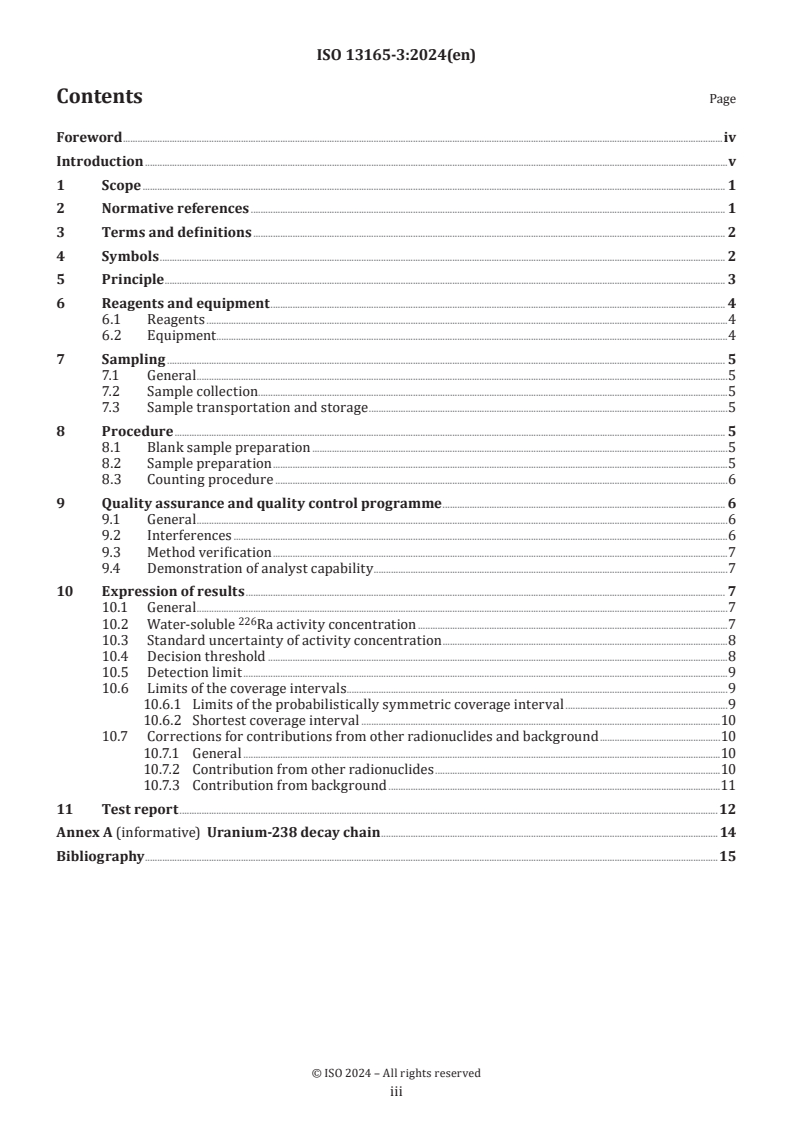

ISO 13165-3:2024 - Water quality — Radium-226 — Part 3: Test method using coprecipitation and gamma-ray spectrometry Released:12/4/2024

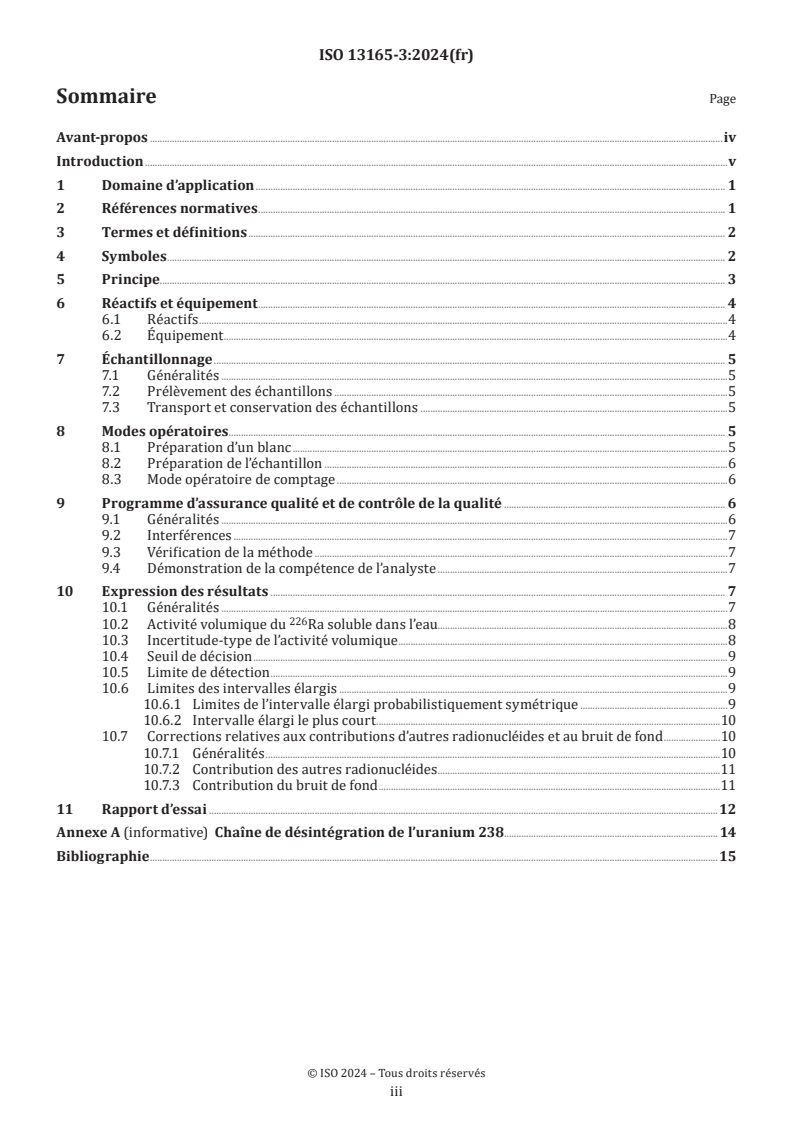

ISO 13165-3:2024 - Qualité de l'eau — Radium-226 — Partie 3: Méthode d’essai par coprécipitation et spectrométrie gamma Released:12/4/2024
Overview
ISO 13165-3:2024 - Water quality - Radium-226 - Part 3: Test method using coprecipitation and gamma‑ray spectrometry specifies a laboratory method to measure radium‑226 (226Ra) activity concentration in all types of water. The method uses coprecipitation to concentrate soluble radium from sample volumes of up to 100 L, followed by high‑resolution gamma‑ray spectrometry for quantification. It is suitable for measuring soluble 226Ra above about 0.002 Bq·L−1, with typical detection limits for 1–5 L samples in the range 0.00040 to 0.002 Bq·L−1. For samples under 1 L, direct gamma spectrometry per ISO 10703 is possible but has a higher detection limit.
Key topics and technical requirements
- Scope and applicability: All water types (surface, ground, drinking, seawater); adaptable to other naturally occurring radium isotopes (223Ra, 224Ra, 228Ra) if ingrowth times are considered.
- Principle: Coprecipitation of radium from water to produce a measurable counting source, followed by gamma‑ray spectrometric measurement (see links to ISO 20042 and ISO 10703).
- Sample volumes and detection limits: Up to 100 L sample volume; soluble 226Ra > 0.002 Bq·L−1 target; typical 1–5 L detection limits 0.00040–0.002 Bq·L−1.
- Procedure elements: Blank preparation, sample preparation, and counting procedures (clause structure in the standard).
- Quality assurance / quality control: Requirements for method verification, demonstration of analyst capability, handling interferences, and instrument performance checks.
- Data reporting and uncertainty: Rules for expressing results, estimating standard uncertainties, decision thresholds, detection limits and coverage intervals (referencing ISO 11929 series), and corrections for background and contributions from other radionuclides.
- Sampling and handling: References to ISO 5667‑3 for preservation and handling of water samples; transportation and storage considerations are covered.
Practical applications and users
- Who uses it: Environmental laboratories, public health authorities, water utilities, mining and mineral-processing laboratories, regulatory agencies, and research institutions monitoring radionuclides in water.
- Typical applications:
- Routine monitoring of drinking water and source waters for regulatory compliance and public health (WHO guidance referenced).
- Environmental surveillance around nuclear, mining, oil & gas or phosphate fertilizer sites.
- Emergency response sampling where lower detection limits and reliable results are needed.
- Research on radium geochemical behavior and isotope partitioning in aquatic systems.
Related standards
- ISO 20042 (coprecipitation/gamma procedures context)
- ISO 10703 (direct gamma‑ray spectrometry for small-volume samples)
- ISO 11929 (characteristic limits: decision threshold, detection limit)
- ISO 5667‑3 (sampling preservation/handling)
- ISO/IEC 17025 (laboratory competence)
Keywords: ISO 13165-3:2024, radium-226, water quality, coprecipitation, gamma‑ray spectrometry, detection limit, water monitoring, radionuclide analysis.
Relations
- Effective Date
- 12-Feb-2026
- Effective Date
- 06-Jun-2022
- Effective Date
- 06-Jun-2022
Buy Documents
ISO 13165-3:2024 - Water quality — Radium-226 — Part 3: Test method using coprecipitation and gamma-ray spectrometry Released:12/4/2024
ISO 13165-3:2024 - Qualité de l'eau — Radium-226 — Partie 3: Méthode d’essai par coprécipitation et spectrométrie gamma Released:12/4/2024
Get Certified
Connect with accredited certification bodies for this standard

BSMI (Bureau of Standards, Metrology and Inspection)
Taiwan's standards and inspection authority.
CIS Institut d.o.o.
Personal Protective Equipment (PPE) certification body. Notified Body NB-2890 for EU Regulation 2016/425 PPE.

Kiwa BDA Testing
Building and construction product certification.
Sponsored listings
Frequently Asked Questions
ISO 13165-3:2024 is a standard published by the International Organization for Standardization (ISO). Its full title is "Water quality — Radium-226 — Part 3: Test method using coprecipitation and gamma-ray spectrometry". This standard covers: This document specifies a method to determine radium-226 (226Ra) activity concentration in all types of water by coprecipitation followed by gamma-ray spectrometry (see ISO 20042[7]). The method covers the measurement of soluble 226Ra activity concentrations greater than 0,002 Bq·l−1 using a sample volume of up to 100 l of any water type. For water samples with a volume of less than a volume of 1 l, direct gamma-ray spectrometry can be performed following ISO 10703 but with a higher detection limit. The typical detection limit for samples of 1 l to 5 l is in the range of 0,002 to 0,000 40 Bq·l−1[8]. NOTE This test method can be adapted to determine other naturally occurring isotopes of radium, such as 223Ra, 224Ra and 228Ra, if the respective ingrowth periods are taken into account.
This document specifies a method to determine radium-226 (226Ra) activity concentration in all types of water by coprecipitation followed by gamma-ray spectrometry (see ISO 20042[7]). The method covers the measurement of soluble 226Ra activity concentrations greater than 0,002 Bq·l−1 using a sample volume of up to 100 l of any water type. For water samples with a volume of less than a volume of 1 l, direct gamma-ray spectrometry can be performed following ISO 10703 but with a higher detection limit. The typical detection limit for samples of 1 l to 5 l is in the range of 0,002 to 0,000 40 Bq·l−1[8]. NOTE This test method can be adapted to determine other naturally occurring isotopes of radium, such as 223Ra, 224Ra and 228Ra, if the respective ingrowth periods are taken into account.
ISO 13165-3:2024 is classified under the following ICS (International Classification for Standards) categories: 13.060.60 - Examination of physical properties of water; 17.240 - Radiation measurements. The ICS classification helps identify the subject area and facilitates finding related standards.
ISO 13165-3:2024 has the following relationships with other standards: It is inter standard links to EN ISO 13165-3:2024, ISO 9938:2022, ISO 13165-3:2016. Understanding these relationships helps ensure you are using the most current and applicable version of the standard.
ISO 13165-3:2024 is available in PDF format for immediate download after purchase. The document can be added to your cart and obtained through the secure checkout process. Digital delivery ensures instant access to the complete standard document.
Standards Content (Sample)
International
Standard
ISO 13165-3
Second edition
Water quality — Radium-226 —
2024-12
Part 3:
Test method using coprecipitation
and gamma-ray spectrometry
Qualité de l'eau — Radium-226 —
Partie 3: Méthode d’essai par coprécipitation et
spectrométrie gamma
Reference number
© ISO 2024
All rights reserved. Unless otherwise specified, or required in the context of its implementation, no part of this publication may
be reproduced or utilized otherwise in any form or by any means, electronic or mechanical, including photocopying, or posting on
the internet or an intranet, without prior written permission. Permission can be requested from either ISO at the address below
or ISO’s member body in the country of the requester.
ISO copyright office
CP 401 • Ch. de Blandonnet 8
CH-1214 Vernier, Geneva
Phone: +41 22 749 01 11
Email: copyright@iso.org
Website: www.iso.org
Published in Switzerland
ii
Contents Page
Foreword .iv
Introduction .v
1 Scope . 1
2 Normative references . 1
3 Terms and definitions . 2
4 Symbols . 2
5 Principle . 3
6 Reagents and equipment . 4
6.1 Reagents .4
6.2 Equipment .4
7 Sampling . 5
7.1 General .5
7.2 Sample collection . . .5
7.3 Sample transportation and storage .5
8 Procedure . 5
8.1 Blank sample preparation .5
8.2 Sample preparation .5
8.3 Counting procedure .6
9 Quality assurance and quality control programme . 6
9.1 General .6
9.2 Interferences .6
9.3 Method verification .7
9.4 Demonstration of analyst capability . .7
10 Expression of results . 7
10.1 General .7
10.2 Water-soluble Ra activity concentration .7
10.3 Standard uncertainty of activity concentration .8
10.4 Decision threshold .8
10.5 Detection limit .9
10.6 Limits of the coverage intervals . .9
10.6.1 Limits of the probabilistically symmetric coverage interval .9
10.6.2 Shortest coverage interval .10
10.7 Corrections for contributions from other radionuclides and background .10
10.7.1 General .10
10.7.2 Contribution from other radionuclides .10
10.7.3 Contribution from background .11
11 Test report .12
Annex A (informative) Uranium-238 decay chain . 14
Bibliography .15
iii
Foreword
ISO (the International Organization for Standardization) is a worldwide federation of national standards
bodies (ISO member bodies). The work of preparing International Standards is normally carried out through
ISO technical committees. Each member body interested in a subject for which a technical committee
has been established has the right to be represented on that committee. International organizations,
governmental and non-governmental, in liaison with ISO, also take part in the work. ISO collaborates closely
with the International Electrotechnical Commission (IEC) on all matters of electrotechnical standardization.
The procedures used to develop this document and those intended for its further maintenance are described
in the ISO/IEC Directives, Part 1. In particular, the different approval criteria needed for the different types
of ISO document should be noted. This document was drafted in accordance with the editorial rules of the
ISO/IEC Directives, Part 2 (see www.iso.org/directives).
ISO draws attention to the possibility that the implementation of this document may involve the use of (a)
patent(s). ISO takes no position concerning the evidence, validity or applicability of any claimed patent
rights in respect thereof. As of the date of publication of this document, ISO had not received notice of (a)
patent(s) which may be required to implement this document. However, implementers are cautioned that
this may not represent the latest information, which may be obtained from the patent database available at
www.iso.org/patents. ISO shall not be held responsible for identifying any or all such patent rights.
Any trade name used in this document is information given for the convenience of users and does not
constitute an endorsement.
For an explanation of the voluntary nature of standards, the meaning of ISO specific terms and expressions
related to conformity assessment, as well as information about ISO's adherence to the World Trade
Organization (WTO) principles in the Technical Barriers to Trade (TBT), see www.iso.org/iso/foreword.html.
This document was prepared by Technical Committee ISO/TC 147, Water quality, Subcommittee SC 3,
Radioactivity measurements, in collaboration with the European Committee for Standardization (CEN)
Technical Committee CEN/TC 230, Water analysis, in accordance with the Agreement on technical
cooperation between ISO and CEN (Vienna Agreement).
This second edition cancels and replaces the first edition (ISO 13165-3:2016), which has been technically
revised.
The main changes are as follows:
— the introduction has been completely revised;
— the principal of measurement in Clause 5 has been expanded;
— the instrument verification subclause (formerly 9.3) has been deleted;
— formulae for the coverage intervals according to ISO 11929 series have been updated;
— requirements of the test report have been updated.
A list of all parts in the ISO 13165 series can be found on the ISO website.
Any feedback or questions on this document should be directed to the user’s national standards body. A
complete listing of these bodies can be found at www.iso.org/members.html.
iv
Introduction
Radionuclides are present throughout the environment; thus, water bodies (e.g. surface waters, ground
waters, sea waters) contain radionuclides, which can be of either natural or anthropogenic origin.
3 14 40
— Naturally-occurring radionuclides, including H, C, K, and those originating from the thorium and
210 210 222 226 228 227 231 234
uranium decay series (see Annex A), in particular Pb, Po, Rn, Ra, Ra, Ac, Pa, U, and
U, can be found in water bodies due to either natural processes (e.g. desorption from the soil, runoff by
rain water) or released from technological processes involving naturally occurring radioactive materials
(e.g. mining, mineral processing, oil, gas and coal production, water treatment, and the production and
use of phosphate fertilisers).
55 59 63 90 99
— Anthropogenic radionuclides, such as Fe, Ni, Ni, Sr, Tc, transuranic elements (e.g. Np, Pu, Am,
60 137
Cm) and some gamma emitting radionuclides, such as Co, Cs, can also be found in natural waters.
Small quantities of anthropogenic radionuclides can be discharged from nuclear facilities to the
environment as a result of authorized routine releases. The radionuclides present in liquid effluents are
[1]
usually controlled before being discharged into the environment and water bodies. Anthropogenic
radionuclides used in medical and industrial applications can be released to the environment after use.
Anthropogenic radionuclides are also found in waters due to contamination from fallout resulting from
above-ground nuclear detonations and accidents such as those that have occurred at the Chornobyl and
Fukushima nuclear facilities.
Radionuclide activity concentrations in water bodies can vary according to local geological characteristics
and climatic conditions and can be locally and temporally enhanced by releases from nuclear facilities
[2],[3]
during planned, existing and emergency exposure situations . Some drinking water sources can thus
contain radionuclides at activity concentrations that can present a human health risk. The World Health
[4]
Organization (WHO) recommends to routinely monitor radioactivity in drinking waters and to take
proper actions when needed to minimize the health risk.
National regulations usually specify the activity concentration limits that are authorized in drinking waters,
water bodies and liquid effluents to be discharged to the environment. These limits can vary for planned,
existing and emergency exposure situations. As an example, during either a planned or existing situation,
226 −1
the WHO guidance level for Ra in drinking water is 1 Bq·l , see NOTE. Compliance with these limits is
assessed by measuring radioactivity in water samples and by comparing the results obtained, with their
[5] [6]
associated uncertainties, as specified by ISO/IEC Guide 98-3 and ISO 5667-20 .
−1
NOTE The guidance level calculated in Reference [4] is the activity concentration that, with an intake of 2 l·d of
−1
drinking water for one year, results in an effective dose of 0,1 mSv·a to members of the public. This is an effective
dose that represents a very low level of risk to human health and which is not expected to give rise to any detectable
[4]
adverse health effects .
This document contains method(s) to support laboratories, which need to determine Ra in water samples.
The method described in this document can be used for various types of waters (see Clause 1). Minor
modifications to, for example, the sample volume and the counting time, can be made if needed to ensure
that the characteristic limit, decision threshold, detection limit and uncertainties are below the required
limits. This can be done for several reasons such as emergency situations, lower national guidance limits
and operational requirements.
This document deals with the measurement of the activity concentration of radionuclides in water samples.
v
International Standard ISO 13165-3:2024(en)
Water quality — Radium-226 —
Part 3:
Test method using coprecipitation and gamma-ray
spectrometry
WARNING — Persons using this document should be familiar with normal laboratory practices. This
document does not purport to address all of the safety problems, if any, associated with its use. It is
the responsibility of the user to establish appropriate safety and health practices and to determine
the applicability of any other restrictions.
IMPORTANT — It is absolutely essential that tests conducted according to this document are carried
out by suitably trained staff.
1 Scope
This document specifies a method to determine radium-226 ( Ra) activity concentration in all types of
[7]
water by coprecipitation followed by gamma-ray spectrometry (see ISO 20042 ).
226 −1
The method covers the measurement of soluble Ra activity concentrations greater than 0,002 Bq·l using
a sample volume of up to 100 l of any water type.
For water samples with a volume of less than a volume of 1 l, direct gamma-ray spectrometry can be
performed following ISO 10703 but with a higher detection limit. The typical detection limit for samples of
−1[8]
1 l to 5 l is in the range of 0,002 to 0,000 40 Bq·l .
NOTE This test method can be adapted to determine other naturally occurring isotopes of radium, such as Ra,
224 228
Ra and Ra, if the respective ingrowth periods are taken into account.
2 Normative references
The following documents are referred to in the text in such a way that some or all of their content constitutes
requirements of this document. For dated references, only the edition cited applies. For undated references,
the latest edition of the referenced document (including any amendments) applies.
ISO 5667-3, Water quality — Sampling — Part 3: Preservation and handling of water samples
ISO 10703, Water quality — Gamma-ray emitting radionuclides — Test method using high resolution gamma-
ray spectrometry
ISO 11929 (all parts), Determination of the characteristic limits (decision threshold, detection limit and limits of
the coverage interval) for measurements of ionizing radiation
ISO 12749-1, Nuclear energy — Vocabulary — Part 1: General terminology
ISO 12749-2, Nuclear energy, nuclear technologies, and radiological protection — Vocabulary — Part 2:
Radiological protection
ISO 12749-3, Nuclear energy, nuclear technologies, and radiological protection — Vocabulary — Part 3: Nuclear
installations, processes and technologies
ISO 12749-4, Nuclear energy, nuclear technologies, and radiological protection — Vocabulary — Part 4:
Dosimetry for radiation processing
ISO 12749-5, Nuclear energy, nuclear technologies, and radiological protection — Vocabulary — Part 5: Nuclear
reactors
ISO 12749-6, Nuclear energy, nuclear technologies, and radiological protection — Vocabulary — Part 6: Nuclear
medicine
ISO/IEC 17025, General requirements for the competence of testing and calibration laboratories
ISO 80000-10, Quantities and units — Part 10: Atomic and nuclear physics
3 Terms and definitions
For the purposes of this document, the terms and definitions given in ISO 12749-1, ISO 12749-2, ISO 12749-3,
ISO 12749-4, ISO 12749-5, ISO 12749-6, ISO 80000-10 and the following apply.
ISO and IEC maintain terminology databases for use in standardization at the following addresses:
— ISO Online browsing platform: available at https:// www .iso .org/ obp
— IEC Electropedia: available at https:// www .electropedia .org/
3.1
activity
number of spontaneous nuclear disintegrations occurring in a given quantity of material during a suitably
small interval of time divided by that interval of time
4 Symbols
For the purposes of this document, the following symbols apply.
A Activity of each radionuclide in calibration source, at the time of calibration Bq
226 −1
c Activity concentration of Ra, without and with corrections Bq·l
A
* −1
Decision threshold, without and with corrections Bq·l
c
A
#
−1
Detection limit, without and with corrections Bq·l
c
A
−1
c Possible or assumed true quantity values of the measurand Bq·l
A
−1
c Lower limit of the probabilistically symmetric coverage interval of the measurand Bq·l
A
−1
Upper limit of the probabilistically symmetric coverage interval of the measurand Bq·l
c
A
< −1
Lower limit of the shortest coverage interval of the measurand Bq·l
c
A
>
−1
Upper limit of the shortest coverage interval of the measurand Bq·l
c
A
ε Detection efficiency at energy, E, at actual measurement geometry —
E
f Correction factor considering all necessary corrections —
E
Quantiles of the standardised normal distribution for the probabilities p (for instance
k —
p
p=−1 α , p=−1 β or p=−12γ / )
Quantiles of the standardised normal distribution for the probabilities q (for instance
k —
q
q=−1 α , q=−1 β or q=−12γ / )
m
car-
Mass of barium carbonate g
bonate
m Mass of barium nitrate g
nitrate
m Mass of barium sulfate g
sulfate
n Number of counts in the background of the peak considered, at energy E, in the sample —
b,E
Number of counts in the background of the peak considered, at energy E, in the back-
n —
b0,E
ground
n Number of counts in the background of the peak considered, at energy E, in the standard —
bs,E
n Number of counts in the gross area of the peak considered, at energy E, in the sample —
g,E
n Number of counts in the gross area of the peak considered, at energy E, in the background —
g0,E
n Number of counts in the gross area of the peak considered, at energy E, in the standard —
gs,E
n Number of counts in the net area of the peak considered, at energy E, in the sample —
N,E
n Number of counts in the net area of the peak considered, at energy E, in the background —
N0,E
n Number of counts in the net area of the peak considered, at energy E, in the standard —
Ns,E
P Probability of the emission of a gamma-ray with energy E of each radionuclide, per decay —
E
R Chemical yield —
c
t Background spectrum counting time s
t Sample spectrum counting time s
g
t Standard spectrum counting time s
s
−1
U Expanded uncertainty calculated with k = 2 Bq·l
−1
u(c ) Standard uncertainty associated with the measurement result Bq·l
A
Standard uncertainty of the estimator c as a function of an assumed true value c of the
A
A
−1
uc() Bq·l
A
measurand
−1
u(fit) Standard uncertainty associated with fitting efficiency curve Bq·l
V Volume of the test sample l
Φ
Distribution function of the standardized normal distribution —
w Estimated value for the calibration factor —
ω Auxiliary quantity —
5 Principle
Measurement of Ra activity concentration in water is carried out in two separate steps: a sample
[9],[10]
preparation step, followed by a measurement using gamma-ray spectrometry .
After filtration and acidification of the water sample (see ISO 5667-3), to ensure that only the soluble fraction
226 226
of the Ra is measured, the Ra is coprecipitated as its sulfate salt using a barium carrier. Radium and
barium sulfates are then washed, dried and weighed. The chemical yield is obtained gravimetrically.
For water samples that can have an existing concentration of soluble barium, another tracer should be used
to avoid a chemical yield above 100 %.
When a radiometric tracer, such as Ba is used as an internal standard, the recovery yield is used instead
of the chemical yield, R , in Formulae (2) and (5). A correction of counting losses due to coincidence is then
c
required for the determination of Ba.
The Ra activity concentration of the precipitate is measured by gamma-ray spectrometry using a high
purity germanium detector.
222 226 214
Secular equilibrium between Rn and its progenies is a prerequisite when measuring Ra using Bi
and Pb gamma rays. The equilibrium is reached four weeks after the last coprecipitation step. The sample
container sha
...
Norme
internationale
ISO 13165-3
Deuxième édition
Qualité de l'eau — Radium-226 —
2024-12
Partie 3:
Méthode d’essai par coprécipitation
et spectrométrie gamma
Water quality — Radium-226 —
Part 3: Test method using coprecipitation and gamma-ray
spectrometry
Numéro de référence
DOCUMENT PROTÉGÉ PAR COPYRIGHT
© ISO 2024
Tous droits réservés. Sauf prescription différente ou nécessité dans le contexte de sa mise en œuvre, aucune partie de cette
publication ne peut être reproduite ni utilisée sous quelque forme que ce soit et par aucun procédé, électronique ou mécanique,
y compris la photocopie, ou la diffusion sur l’internet ou sur un intranet, sans autorisation écrite préalable. Une autorisation peut
être demandée à l’ISO à l’adresse ci-après ou au comité membre de l’ISO dans le pays du demandeur.
ISO copyright office
Case postale 401 • Ch. de Blandonnet 8
CH-1214 Vernier, Genève
Tél.: +41 22 749 01 11
E-mail: copyright@iso.org
Web: www.iso.org
Publié en Suisse
ii
Sommaire Page
Avant-propos .iv
Introduction .v
1 Domaine d’application . 1
2 Références normatives . 1
3 Termes et définitions . 2
4 Symboles . 2
5 Principe. 3
6 Réactifs et équipement . 4
6.1 Réactifs .4
6.2 Équipement .4
7 Échantillonnage . 5
7.1 Généralités .5
7.2 Prélèvement des échantillons .5
7.3 Transport et conservation des échantillons .5
8 Modes opératoires . . 5
8.1 Préparation d’un blanc .5
8.2 Préparation de l’échantillon .6
8.3 Mode opératoire de comptage .6
9 Programme d’assurance qualité et de contrôle de la qualité . 6
9.1 Généralités .6
9.2 Interférences .7
9.3 Vérification de la méthode .7
9.4 Démonstration de la compétence de l’analyste .7
10 Expression des résultats . 7
10.1 Généralités .7
10.2 Activité volumique du Ra soluble dans l’eau.8
10.3 Incertitude-type de l’activité volumique .8
10.4 Seuil de décision .9
10.5 Limite de détection .9
10.6 Limites des intervalles élargis .9
10.6.1 Limites de l’intervalle élargi probabilistiquement symétrique .9
10.6.2 Intervalle élargi le plus court .10
10.7 Corrections relatives aux contributions d’autres radionucléides et au bruit de fond .10
10.7.1 Généralités .10
10.7.2 Contribution des autres radionucléides .11
10.7.3 Contribution du bruit de fond .11
11 Rapport d’essai .12
Annexe A (informative) Chaîne de désintégration de l’uranium 238 . 14
Bibliographie .15
iii
Avant-propos
L’ISO (Organisation internationale de normalisation) est une fédération mondiale d’organismes nationaux
de normalisation (comités membres de l’ISO). L’élaboration des Normes internationales est en général
confiée aux comités techniques de l’ISO. Chaque comité membre intéressé par une étude a le droit de faire
partie du comité technique créé à cet effet. Les organisations internationales, gouvernementales et non
gouvernementales, en liaison avec l’ISO participent également aux travaux. L’ISO collabore étroitement avec
la Commission électrotechnique internationale (IEC) en ce qui concerne la normalisation électrotechnique.
Les procédures utilisées pour élaborer le présent document et celles destinées à sa mise à jour sont
décrites dans les Directives ISO/IEC, Partie 1. Il convient, en particulier de prendre note des différents
critères d’approbation requis pour les différents types de documents ISO. Le présent document
a été rédigé conformément aux règles de rédaction données dans les Directives ISO/IEC, Partie 2
(voir www.iso.org/directives).
L’ISO attire l’attention sur le fait que la mise en application du présent document peut entraîner l’utilisation
d’un ou de plusieurs brevets. L’ISO ne prend pas position quant à la preuve, à la validité et à l’applicabilité
de tout droit de propriété revendiqué à cet égard. À la date de publication du présent document, l’ISO
n'avait pas reçu notification qu’un ou plusieurs brevets pouvaient être nécessaires à sa mise en application.
Toutefois, il y a lieu d’avertir les responsables de la mise en application du présent document que des
informations plus récentes sont susceptibles de figurer dans la base de données de brevets, disponible à
l'adresse www.iso.org/brevets. L’ISO ne saurait être tenue pour responsable de ne pas avoir identifié tout ou
partie de tels droits de brevet.
Les appellations commerciales éventuellement mentionnées dans le présent document sont données pour
information, par souci de commodité, à l’intention des utilisateurs et ne sauraient constituer un engagement.
Pour une explication de la nature volontaire des normes, la signification des termes et expressions
spécifiques de l’ISO liés à l’évaluation de la conformité, ou pour toute information au sujet de l’adhésion de
l’ISO aux principes de l’Organisation mondiale du commerce (OMC) concernant les obstacles techniques au
commerce (OTC), voir www.iso.org/avant-propos.
Le présent document a été élaboré par le comité technique ISO/TC 147, Qualité de l’eau, sous-comité SC 3,
Mesurages de la radioactivité, en collaboration avec le comité technique CEN/TC 230, Analyse de l'eau, du
Comité européen de normalisation (CEN) conformément à l’Accord de coopération technique entre l’ISO et le
CEN (Accord de Vienne).
Cette édition annule et remplace la première édition (ISO 13165-3:2016), qui a fait l’objet d’une révision
technique.
Les principales modifications sont les suivantes:
— remaniement de l’Introduction;
— élargissement du champ de l’Article 5 relatif au principe de mesurage;
— suppression du paragraphe 9.3 relative à la vérification de l’instrument;
— mise à jour des formules concernant l’intervalle élargi suivant la série ISO 11929;
— mise à jour des exigences relatives au rapport d'essai.
Une liste de toutes les parties de la série ISO 13165 se trouve sur le site web de l’ISO.
Il convient que l’utilisateur adresse tout retour d’information ou toute question concernant le présent
document à l’organisme national de normalisation de son pays. Une liste exhaustive desdits organismes se
trouve à l’adresse www.iso.org/fr/members.html.
iv
Introduction
Les radionucléides sont présents partout dans l’environnement. Dès lors, les masses d’eau (par exemple les
eaux de surface, les eaux souterraines, les eaux de mer) contiennent des radionucléides d’origine naturelle
ou anthropique:
3 14 40
— les radionucléides naturels, y compris le H, le C, le K et ceux provenant des chaînes de désintégration
210 210 222 226 228 227 231 234
du thorium et de l’uranium, notamment le Pb, le Po, le Rn, le Ra, le Ra, le Ac, le Pa, l’ U
ou l’ U peuvent se trouver dans l’eau en raison de processus naturels (par exemple, la désorption par le
sol ou le lessivage par les eaux pluviales) ou bien ils peuvent être libérés par des procédés technologiques
mettant en œuvre des matières radioactives existant à l’état naturel (par exemple, l’extraction minière,
le traitement de sables minéraux, la production de carburant, de gaz ou de charbon, le traitement des
eaux et la production et l’utilisation d’engrais phosphatés);
55 59 63 90 99
— les radionucléides engendrés par l'activité humaine, tels que le Fe, le Ni, le Ni, le Sr, le Tc, mais
aussi des éléments transuraniens (américium, plutonium, neptunium, curium) et certains radionucléides
60 137
émetteurs gamma tels que le Co et le Cs peuvent également être présents dans les eaux naturelles.
De petites quantités de ces radionucléides sont rejetées dans l’environnement par les installations du
cycle du combustible lors des rejets périodiques autorisés. Les radionucléides dans les effluents liquides
[1]
font généralement l’objet de contrôles avant d’être rejetés dans l’environnement et les masses d’eau.
Des radionucléides, utilisés dans le cadre d’applications médicales et industrielles, sont également libérés
dans l’environnement après usage. Les radionucléides d’origine anthropiques sont aussi présents dans
les eaux du fait de contaminations par retombées d’éléments radioactifs rejetés dans l’atmosphère lors
de l’explosion de dispositifs nucléaires ou lors d’accidents nucléaires, tels que ceux de Tchernobyl et de
Fukushima.
L’activité volumique des radionucléides dans les masses d’eau peut varier selon les caractéristiques
géologiques et des conditions climatiques locales, et peut être renforcée localement et dans le temps par
les rejets d’installations nucléaires dans des situations d’exposition planifiée, d’exposition d’urgence et
[2][3]
d’exposition existante. L’eau potable peut alors de contenir des radionucléides à des valeurs d’activité
volumique qui pourraient présenter un risque sanitaire. L’Organisation mondiale de la santé (OMS)
[4]
recommande une surveillance régulière de la radioactivité des eaux potables et la mise en place d’actions
adéquates si besoin est afin de limiter le plus possible le risque pour la santé humaine.
Les législations nationales spécifient généralement les limites autorisées d’activité volumique dans les eaux
potables, les masses d’eau et les effluents liquides rejetés dans l’environnement. Ces limites sont susceptibles
de varier dans le cas de situations d’exposition planifiée, existante ou d’urgence. À titre d'exemple, lors
d’une situation planifiée ou existante, la limite indicative donnée par l'OMS pour le Ra dans l'eau potable
est de 1, voir la NOTE. La conformité à ces limites peut être évaluée à partir des résultats de mesure
[5]
d’échantillons d’eau et des incertitudes qui y sont associées, tel que précisé par le Guide 98-3 de l’ISO/IEC
[6]
et l’ISO 5667-20 .
NOTE La limite indicative calculée par la Référence [4] correspond à l’activité volumique pour une consommation
−1 −1
de 2 l·j d’eau potable pendant un an, aboutissant à une dose effective de 0,1 mSv·a pour un individu moyen. Cette
dose effective présente un niveau de risque très faible qui ne devrait pas entraîner d’effets indésirables et détectables
[4]
pour la santé .
Le présent document offre une ou des méthodes pour répondre aux besoins des laboratoires qui déterminent
le Ra dans des échantillons d’eau.
La méthode décrite dans le présent document est applicable à divers types d’eaux (voir l’Article 1). Il est
possible d’apporter des modifications mineures, par exemple au volume d’un échantillon ou à la durée de
comptage, afin de s’assurer que la limite caractéristique, le seuil de décision, la limite de détection et les
incertitudes sont inférieures aux limites requises. Ces modifications peuvent être effectuées dans le cadre
d’une situation d’urgence, de limites indicatives nationales inférieures et d’obligations opérationnelles, etc.
Le présent document traite du mesurage de l’activité volumique des radionucléides dans des échantillons d’eau.
v
Norme internationale ISO 13165-3:2024(fr)
Qualité de l'eau — Radium-226 —
Partie 3:
Méthode d’essai par coprécipitation et spectrométrie gamma
AVERTISSEMENT — Il convient que l’utilisateur du présent document connaisse bien les pratiques
courantes de laboratoire. Le présent document n'a pas pour but de traiter tous les problèmes de
sécurité qui sont, le cas échéant, liés à son utilisation. Il incombe à l’utilisateur de la présente norme
d’établir des pratiques appropriées en matière d’hygiène et de sécurité, et de déterminer si toute
autre restriction est applicable.
IMPORTANT — Il est absolument essentiel que les essais réalisés conformément au présent document
soient effectués par du personnel qualifié.
1 Domaine d’application
Le présent document spécifie une méthode de détermination de l’activité volumique du radium-226 ( Ra),
[7]
dans tous les types d’eau, par coprécipitation suivie d’une spectrométrie gamma (voir l’ISO 20042 ).
La méthode couvre la mesure de l’activité volumique du Ra soluble lorsque cette activité est supérieure à
−1
0,002 Bq⋅l pour un volume d’échantillon, de tout type d’eau, ne dépassant pas 100 l.
Pour des échantillons d’eau dont le volume est inférieur à 1 l, la spectrométrie gamma directe peut être
effectuée en suivant l’ISO 10703 mais avec une limite de détection plus élevée. Pour des échantillons de 1 l à
−1 −1[8]
5 l, la limite de détection la plus courante est comprise entre 0,002 Bq·l et 0,000 40 Bq·l .
NOTE Cette méthode d’essai permet également le mesurage d’autres isotopes de radium d’origine naturelle, tels
223 224 228
que le Ra, le Ra, et le Ra, si leur période de mise à l’équilibre respective est prise en compte.
2 Références normatives
Les documents suivants sont cités dans le texte de sorte qu’ils constituent, pour tout ou partie de leur
contenu, des exigences du présent document. Pour les références datées, seule l’édition citée s’applique. Pour
les références non datées, la dernière édition du document de référence s'applique (y compris les éventuels
amendements).
ISO 5667-3, Qualité de l'eau — Échantillonnage — Partie 3: Conservation et manipulation des échantillons d'eau
ISO 10703, Qualité de l'eau — Radionucléides émetteurs gamma — Méthode d’essai par spectrométrie gamma à
haute résolution
ISO 11929 (toutes les parties), Détermination des limites caractéristiques (seuil de décision, limite de détection
et extrémités de l’intervalle élargi) pour le mesurage des rayonnements ionisants
ISO 12749-1, Énergie nucléaire — Vocabulaire — Partie 1: Terminologie générale
ISO 12749-2, Énergie nucléaire, technologies nucléaires et protection radiologique — Vocabulaire — Partie 2:
Radioprotection
ISO 12749-3, Énergie nucléaire, technologies nucléaires et protection radiologique — Vocabulaire — Partie 3:
Installations nucléaires, procédés et technologies
ISO 12749-4, Energie nucleaire, technologies nucleaires, et protection radiologique — Vocabulaire — Partie 4:
Dosimétrie pour processus de radiation
ISO 12749-5, Énergie nucléaire, technologies nucléaires, et radioprotection — Vocabulaire — Partie 5: Réacteurs
nucléaires
ISO 12749-6, Énergie nucléaire, technologies nucléaires et protection radiologique — Vocabulaire — Partie 6:
Médecine nucléaire
ISO/IEC 17025, Exigences générales concernant la compétence des laboratoires d'étalonnages et d'essais
ISO 80000-10, Grandeurs et unités — Partie 10: Physique atomique et nucléaire
3 Termes et définitions
Pour les besoins du présent document, les termes et définitions donnés dans l’ISO 12749-1, l’ISO 12749-2,
l’ISO 12749-3, l’ISO 12749-4, l’ISO 12749-5 et l’ISO 12749-6 et l’ISO 80000-10, ainsi que les suivants
s'appliquent.
L’ISO et l’IEC tiennent à jour des bases de données terminologiques destinées à être utilisées en normalisation,
consultables aux adresses suivantes:
— ISO Online browsing platform: disponible à l’adresse https:// www .iso .org/ obp
— IEC Electropedia: disponible à l’adresse https:// www .electropedia .org/
3.1
activité
nombre de désintégrations nucléaires spontanées qui se produisent dans une quantité donnée de matière
pendant un intervalle de temps convenablement petit, divisé par cet intervalle de temps
4 Symboles
Pour les besoins du présent document, les symboles suivants s’appliquent:
A Activité de chaque radionucléide de la source d’étalonnage, à la date de l’étalonnage Bq
226 −1
c Activité volumique du Ra, avec et sans corrections Bq·l
A
*
−1
Seuil de décision, avec et sans corrections Bq·l
c
A
#
−1
Limite de détection, avec et sans corrections Bq·l
c
A
−1
c Valeurs vraies possibles ou présumées du mesurande Bq·l
A
−1
Limite supérieure de l’intervalle élargi probabilistiquement symétrique du mesurande Bq·l
c
A
−1
Limite inférieure de l’intervalle élargi probabilistiquement symétrique du mesurande Bq·l
c
A
<
−1
Limite supérieure de l’intervalle élargi le plus court du mesurande Bq·l
c
A
>
−1
Limite inférieure de l’intervalle élargi le plus court du mesurande Bq·l
c
A
ε Efficacité de détection à l’énergie E avec la géométrie de comptage utilisée —
E
f Facteur de correction prenant en compte toutes les corrections nécessaires —
E
Quantiles de la loi normale centrée réduite pour les probabilités p (par exemple, p=−1 α
—
k
p
, p=−1 β ou p=−12γ / )
Quantiles de la loi normale centrée réduite pour les probabilités q (par exemple, q=−1 α
—
k
q
, q=−1 β ou q=−12γ / )
m Masse de carbonate de baryum g
carbonate
m Masse de nitrate de baryum g
nitrate
m Masse de sulfate de baryum g
sulfate
n Nombre de coups dans le bruit de fond du pic considéré, à l’énergie E, dans l’échantillon —
b,E
Nombre de coups dans le bruit de fond du pic considéré, à l’énergie E, dans le bruit de —
n
b0,E
fond
n Nombre de coups dans le bruit de fond du pic considéré, à l’énergie E, dans l’étalon —
bs,E
n Nombre de coups dans l’aire brute du pic considéré, à l’énergie E, dans l’échantillon —
g,E
n Nombre de coups dans l’aire brute du pic considéré, à l’énergie E, dans le bruit de fond —
g0,E
n Nombre de coups dans l’aire brute du pic considéré, à l’énergie E, dans l’étalon —
gs,E
n Nombre de coups dans l’aire nette du pic considéré, à l’énergie E, dans l’échantillon —
N,E
n Nombre de coups dans l’aire nette du pic considéré, à l’énergie E, dans le bruit de fond —
N0,E
n Nombre de coups dans l’aire nette du pic considéré, à l’énergie E, dans l’étalon —
Ns,E
Probabilité d’émission d’un rayon gamma d’énergie, E, de chaque radionucléide, par —
P
E
désintégration,
R Rendement chimique —
C
t Temps de comptage du spectre du bruit de fond s
t Temps de comptage du spectre de l’échantillon s
g
t Temps de comptage du spectre de l’étalon s
s
−1
U Incertitude élargie calculée pour k = 2 Bq·l
−1
u(c ) Incertitude-type associée au résultat de mesure Bq·l
A
−1
uc() Incertitude-type de l’estimateur c en fonction de la valeur vraie estimée du mesurande Bq·l
A A
−1
u(fit) Incertitude-type associée avec une courbe d'efficacité d'ajustement Bq·l
V Volume de l’échantillon pour essai l
Φ
Fonction de répartition de la distribution normale réduite —
w Valeur estimée du facteur d’étalonnage —
ω Grandeur auxiliaire —
5 Principe
Le mesurage de l’activité volumique du Ra dans l’eau s’effectue en deux étapes distinctes: d’abord la
[9][10]
préparation de l’échantillon, puis le mesurage par spectrométrie gamma .
Après la filtration et l’acidification de l’échantillon d’eau (voir l’ISO 5667-3), qui garantissent que seule
226 226
l’activité volumique de la fraction soluble du Ra est mesurée, Ra est coprécipité en sel de sulfate
avec un entraîneur de baryum. Les sulfates de radium et de baryum sont ensuite lavés, séchés et pesés. Le
rendement chimique est obtenu par gravimétrie.
Pour les échantillons d’eau qui peuvent présenter une concentration initiale en baryum soluble, il convient
d’utiliser un autre élément traceur pour éviter un rendement chimique supérieur à 100 %.
Lorsqu’un traceur radiométrique, tel que le Ba, est utilisé comme étalon interne, ce rendement de
récupération remplace le rendement chimique R dans les Formules (2) et (5). Une correction des pertes de
c
comptage dues aux coïncidences est alors nécessaire pour la détermination du Ba.
L’activité volumique en Ra du précipité est mesurée par spectrométrie gamma à l’aide d’un détecteur au
germanium hyper pur.
222 226
L’équilibre séculaire entre le Rn et ses descendants est un prérequis pour mesurer le Ra avec les énergies
214 214
gamma de Bi et Pb. Cet état est atteint quatre semaines après la dernière étape de coprécipitation. Le
contenant doit être hermétique afin d’atteindre les
...