

ISO/TR 7179:2023
(Main)Service excellence — Practices for achieving service excellence
General Information
- Abstract
This document provides practices for achieving service excellence. This document can be used when applying ISO 23592 and ISO/TS 24082.
- Status
- Published
- Publication Date
- 30-Oct-2023
- Technical Committee
- ISO/TC 312 - Excellence in service
- Drafting Committee
- ISO/TC 312 - Excellence in service
- Current Stage
- 6060 - International Standard published
- Start Date
- 31-Oct-2023
- Completion Date
- 31-Oct-2023


Overview
ISO/TR 7179:2023 - Service excellence - Practices for achieving service excellence is a Technical Report that gathers practical, real‑world practices for delivering outstanding customer experiences. Intended as a companion to ISO 23592 (principles and model of service excellence) and ISO/TS 24082 (designing excellent service), ISO/TR 7179 synthesizes lessons from ten highly regarded organizations across five countries to show how service excellence can be implemented in practice.
Key features:
- Practical case studies mapped to the ISO 23592 service excellence model
- A survey framework and template (Annex A) to analyse and improve service excellence
- Gap analysis identifying potential areas for further standardization
Key topics and requirements
ISO/TR 7179 does not introduce normative requirements on its own but highlights practices related to the following technical topics:
- Leadership and strategy for service excellence: vision, mission, management responsibilities, and leader roles that embed customer centricity and humanistic care across the service ecosystem.
- Service excellence culture and employee engagement: building cultural values, co‑creation, blended learning and service academies, recognition systems, and mechanisms for sustaining employee engagement.
- Creating outstanding customer experiences: customer listening, touchpoint management, customer‑experience platforms, uncovering latent needs, service promise and standards, service recovery, co‑design and customer care training.
- Service innovation and operational excellence: structured innovation processes, valuing frontline ideas, personalization strategies, technology and partnerships for customer‑experience delivery.
- Monitoring and measurement: use of key performance indicators (KPIs), measurement tools, and causal relationships linking activities to service excellence outcomes.
Practical applications and users
ISO/TR 7179 is practical guidance for organizations that want to implement or scale service excellence programs and to apply ISO 23592 and ISO/TS 24082. Typical users include:
- Service and customer experience (CX) managers
- Quality, operations and process leaders
- HR and learning & development professionals (service academies)
- Senior leaders defining strategy and culture
- Service designers and innovation teams
- Consultants, auditors and standards practitioners seeking benchmarking examples
Use cases:
- Designing a service excellence roadmap aligned to ISO 23592
- Creating employee engagement and training programs to sustain customer centricity
- Deploying touchpoint management and customer feedback loops
- Structuring KPIs and measurement systems to monitor service outcomes
- Adapting service design practices from validated case studies
Related standards
- ISO 23592 - Service excellence: principles and model (normative companion)
- ISO/TS 24082 - Service excellence: designing excellent service (design guidance)
ISO/TR 7179 is a practical, SEO‑friendly resource for organizations aiming to elevate customer experience, implement service excellence frameworks, and align practice with ISO standards. Keywords: service excellence, customer experience, ISO/TR 7179, ISO 23592, ISO/TS 24082, employee engagement, service innovation, touchpoint management, KPIs.
Get Certified
Connect with accredited certification bodies for this standard

Great Wall Tianjin Quality Assurance Center
Established 1993, first batch to receive national accreditation with IAF recognition.
Hong Kong Quality Assurance Agency (HKQAA)
Hong Kong's leading certification body.

Innovative Quality Certifications Pvt. Ltd. (IQCPL)
Known for integrity, providing ethical & impartial Assessment & Certification. CMMI Institute Partner.
Sponsored listings
Frequently Asked Questions
ISO/TR 7179:2023 is a technical report published by the International Organization for Standardization (ISO). Its full title is "Service excellence — Practices for achieving service excellence". This standard covers: This document provides practices for achieving service excellence. This document can be used when applying ISO 23592 and ISO/TS 24082.
This document provides practices for achieving service excellence. This document can be used when applying ISO 23592 and ISO/TS 24082.
ISO/TR 7179:2023 is classified under the following ICS (International Classification for Standards) categories: 03.080.01 - Services in general. The ICS classification helps identify the subject area and facilitates finding related standards.
ISO/TR 7179:2023 is available in PDF format for immediate download after purchase. The document can be added to your cart and obtained through the secure checkout process. Digital delivery ensures instant access to the complete standard document.
Standards Content (Sample)
TECHNICAL ISO/TR
REPORT 7179
First edition
2023-10
Service excellence — Practices for
achieving service excellence
Excellence de service — Actions permettant d'atteindre l'excellence de
service
Reference number
© ISO 2023
All rights reserved. Unless otherwise specified, or required in the context of its implementation, no part of this publication may
be reproduced or utilized otherwise in any form or by any means, electronic or mechanical, including photocopying, or posting on
the internet or an intranet, without prior written permission. Permission can be requested from either ISO at the address below
or ISO’s member body in the country of the requester.
ISO copyright office
CP 401 • Ch. de Blandonnet 8
CH-1214 Vernier, Geneva
Phone: +41 22 749 01 11
Email: copyright@iso.org
Website: www.iso.org
Published in Switzerland
ii
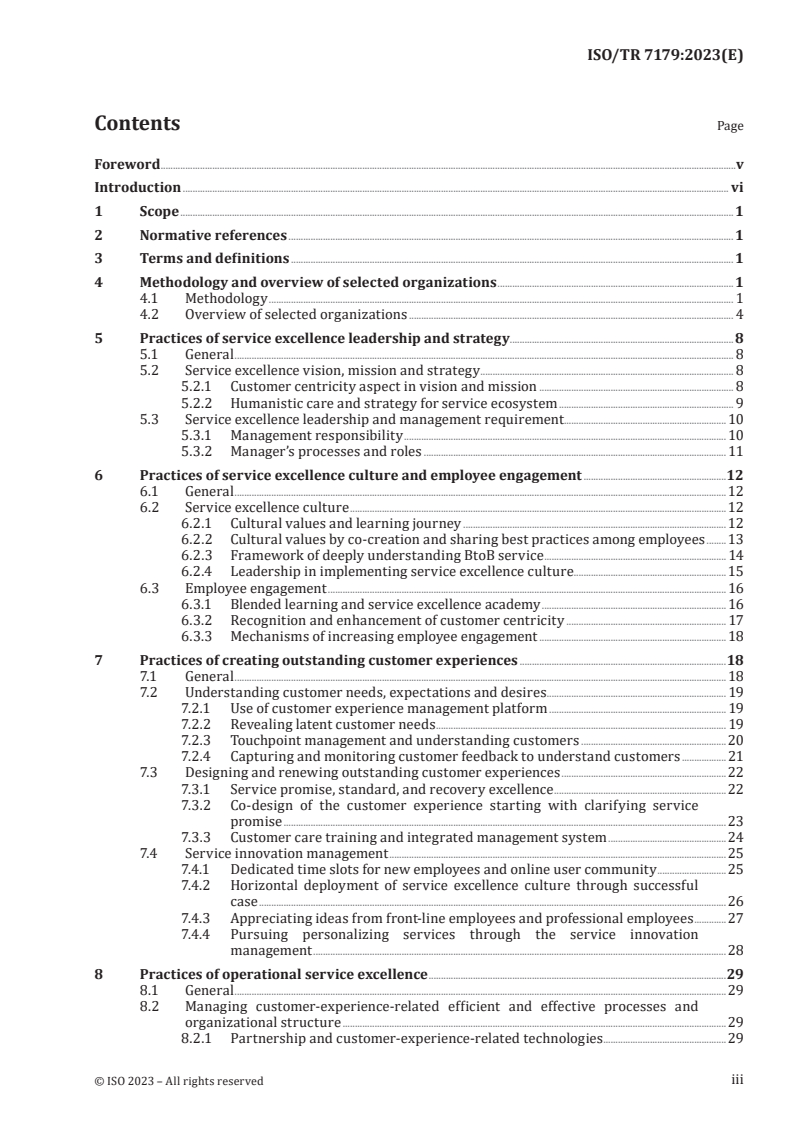
Contents Page
Foreword .v
Introduction . vi
1 Scope . 1
2 Normative references . 1
3 Terms and definitions . 1
4 Methodology and overview of selected organizations . 1
4.1 Methodology . 1
4.2 Overview of selected organizations . 4
5 Practices of service excellence leadership and strategy . 8
5.1 General . 8
5.2 Service excellence vision, mission and strategy . 8
5.2.1 Customer centricity aspect in vision and mission . 8
5.2.2 Humanistic care and strategy for service ecosystem . 9
5.3 Service excellence leadership and management requirement. 10
5.3.1 Management responsibility . 10
5.3.2 Manager’s processes and roles . 11
6 Practices of service excellence culture and employee engagement .12
6.1 General .12
6.2 Service excellence culture .12
6.2.1 Cultural values and learning journey .12
6.2.2 Cultural values by co-creation and sharing best practices among employees .13
6.2.3 Framework of deeply understanding BtoB service . 14
6.2.4 Leadership in implementing service excellence culture.15
6.3 Employee engagement . 16
6.3.1 Blended learning and service excellence academy . 16
6.3.2 Recognition and enhancement of customer centricity . 17
6.3.3 Mechanisms of increasing employee engagement . 18
7 Practices of creating outstanding customer experiences .18
7.1 General . 18
7.2 Understanding customer needs, expectations and desires . 19
7.2.1 Use of customer experience management platform . 19
7.2.2 Revealing latent customer needs . 19
7.2.3 Touchpoint management and understanding customers .20
7.2.4 Capturing and monitoring customer feedback to understand customers . 21
7.3 Designing and renewing outstanding customer experiences .22
7.3.1 Service promise, standard, and recovery excellence .22
7.3.2 Co-design of the customer experience starting with clarifying service
promise . 23
7.3.3 Customer care training and integrated management system . 24
7.4 Service innovation management . 25
7.4.1 Dedicated time slots for new employees and online user community .25
7.4.2 Horizontal deployment of service excellence culture through successful
case . 26
7.4.3 Appreciating ideas from front-line employees and professional employees . 27
7.4.4 Pursuing personalizing services through the service innovation
management .28
8 Practices of operational service excellence .29
8.1 General .29
8.2 Managing customer-experience-related efficient and effective processes and
organizational structure .29
8.2.1 Partnership and customer-experience-related technologies .29
iii
8.2.2 Compatibility of operational excellence and excellent service .30
8.3 Monitoring service excellence activities and results . 31
8.3.1 Use of key performance indicators . 31
8.3.2 Use of various measurement tools . 32
8.3.3 Causal relationship relevant to service excellence effect chain .33
Annex A (informative) Template of practices for the best possible implementation of
service excellence .37
iv
Foreword
ISO (the International Organization for Standardization) is a worldwide federation of national standards
bodies (ISO member bodies). The work of preparing International Standards is normally carried out
through ISO technical committees. Each member body interested in a subject for which a technical
committee has been established has the right to be represented on that committee. International
organizations, governmental and non-governmental, in liaison with ISO, also take part in the work.
ISO collaborates closely with the International Electrotechnical Commission (IEC) on all matters of
electrotechnical standardization.
The procedures used to develop this document and those intended for its further maintenance are
described in the ISO/IEC Directives, Part 1. In particular, the different approval criteria needed for the
different types of ISO document should be noted. This document was drafted in accordance with the
editorial rules of the ISO/IEC Directives, Part 2 (see www.iso.org/directives).
ISO draws attention to the possibility that the implementation of this document may involve the use
of (a) patent(s). ISO takes no position concerning the evidence, validity or applicability of any claimed
patent rights in respect thereof. As of the date of publication of this document, ISO had not received
notice of (a) patent(s) which may be required to implement this document. However, implementers are
cautioned that this may not represent the latest information, which may be obtained from the patent
database available at www.iso.org/patents. ISO shall not be held responsible for identifying any or all
such patent rights.
Any trade name used in this document is information given for the convenience of users and does not
constitute an endorsement.
For an explanation of the voluntary nature of standards, the meaning of ISO specific terms and
expressions related to conformity assessment, as well as information about ISO's adherence to
the World Trade Organization (WTO) principles in the Technical Barriers to Trade (TBT), see
www.iso.org/iso/foreword.html.
This document was prepared by Technical Committee ISO/TC 312, Excellence in service.
Any feedback or questions on this document should be directed to the user’s national standards body. A
complete listing of these bodies can be found at www.iso.org/members.html.
v
Introduction
Today’s organizations, regardless of industries, often aim to build customer loyalty by fulfilling
customer expectations, which is customer satisfaction. However, just achieving customer satisfaction
may not be enough to strengthen customer loyalty continuously. ISO 23592 says that outstanding
customer experiences by individual and surprising excellent service provision resulting in delighted
customers lead to strong customer loyalty. ISO 23592 provides principles and a model of service
excellence to achieve it. Capabilities of organizations to consistently deliver excellent services are
specified in the model. ISO/TS 24082 specifies how to design excellent service.
The purpose of this document is to support all stakeholders to understand how to apply ISO 23592
and ISO/TS 24082 through case studies of highly acclaimed organizations. 10 organizations from five
countries contributed to providing practices that led to high general recognition. ISO/TC 312 studied
how these practices are related to ISO 23592 and ISO/TS 24082.
In addition, this document indicates potential standardization areas including revisions as a result of a
gap analysis between practices covered and not covered by the existing documents.
The survey framework developed in this document can be helpful for organizations who wish to analyse
and improve their service excellence.
vi
TECHNICAL REPORT ISO/TR 7179:2023(E)
Service excellence — Practices for achieving service
excellence
1 Scope
This document provides practices for achieving service excellence. This document can be used when
applying ISO 23592 and ISO/TS 24082.
2 Normative references
The following documents are referred to in the text in such a way that some or all of their content
constitutes requirements of this document. For dated references, only the edition cited applies. For
undated references, the latest edition of the referenced document (including any amendments) applies.
ISO 23592, Service excellence — Principles and model
ISO/TS 24082, Service excellence — Designing excellent service to achieve outstanding customer
experiences
3 Terms and definitions
For the purposes of this document, the terms and definitions given in ISO 23592 and ISO/TS 24082
apply.
ISO and IEC maintain terminology databases for use in standardization at the following addresses:
— ISO Online browsing platform: available at https:// www .iso .org/ obp
— IEC Electropedia: available at https:// www .electropedia .org/
4 Methodology and overview of selected organizations
4.1 Methodology
This document contains suggested practices for the best possible realization of service excellence
gleaned from ten organizations in five different countries. The practices of these highly acclaimed
organizations, which span diverse industries, were collected using the template in Annex A to determine
their relevance to each element of the ISO 23592 standard. The selected practices were identified based
on various combinations of the following criteria:
— Best-in-class rating or high reputation in the industry.
— Implementing practices related to all or one of the elements of the ISO 23592 service excellence model
and having a high rating on service excellence-related metrics, e.g. service excellence reputation.
As a result of this survey, the linkages between the practices and each element of ISO 23592 are
identified in Table 1.
Table 1 — Relationship between each element and each organization
Elements and sub-elements of service Org A Org B Org C Org D Org E Org F O r g O r g Org I Org J
excellence model G H
1 - Service excellence leadership and
strategy
1.1 Service excellence vision, mission
and strategy
a) Service excellence vision A-1 B-1
b) Service excellence mission A-1 B-1
c) Service excellence strategy A-1 B-1
1.2 Leadership and management
requirements
a) Leadership A-2 I-1
b) Sharing efforts, defined A-2
responsibilities and objectives
c) Employee empowerment and I-1
engagement
2 - Service excellence culture and
employee engagement
2.1 Service excellence culture
a) Defining the service excel- A-3 C-1
lence culture
b) Communicating the service A-3 J-1
excellence culture
c) Implementing the service A-3 C-1 D-1 J-1
excellence culture
2.2 Employee engagement
a) Recruitment and induction of E-1
new employees
b) Continuous learning and E-1
development of employees
c) Feedback of customers at an D-2
employee or team level
d) Evaluation and assessment of D-2
employees
e) Recognition or D-2 I-2
acknowledgement system
f) Employee feedback I-2
mechanism
3 - Creating outstanding customer
experiences
3.1 Understanding customer needs,
expectations and desires
a) Scope and depth of listening I-3 J-2
to customers
b) Organization of data acquisi- F-1 J-2
tion and use
c) Adapting to customer needs, C-2 F-1 J-2
expectations and desires
Note: The notation such as A-1 refers to index of the subset of corresponding organizations’ practices. Each subset is
described in Clause 5 to Clause 8.
TTabablele 1 1 ((ccoonnttiinnueuedd))
Elements and sub-elements of service Org A Org B Org C Org D Org E Org F O r g O r g Org I Org J
excellence model G H
3.2 Designing and renewing out-
standing customer experiences
a) Designing and documenting F-2
the customer experience
b) Setting organizational ser- C-3 F-2
vice standards and delivering the
service promise
c) Deployment of the customer
experience concept throughout
the organization
d) Service recovery excellence C-3 I-4
3.3 Service innovation management
a) Innovation culture C-4 G-1 H-1 J-3
b) Structured innovation C-4 H-1 J-3
process
4 - Operational service excellence
4.1 Managing customer-experi-
ence-related efficient and effec-
tive processes and organizational
structure
a) Managing customer-experi- G-2
ence-related processes
b) Deploying customer-expe- B-2
rience-related technologies and
techniques
c) Management of B-2 G-2
organizational structures and
partnerships
4.2 Monitoring service excellence
activities and results
a) Causal relationships A-4 H-2
b) Use of performance A-4
indicators
c) Use of measurement tools B-3 H-2
d) Use of metrics on operational, H-2
tactical and strategic levels
Note: The notation such as A-1 refers to index of the subset of corresponding organizations’ practices. Each subset is
described in Clause 5 to Clause 8.
4.2 Overview of selected organizations
Overview of selected organizations and their services are shown in Table 2. Table 2 includes both
business to business (BtoB) and business to customer (BtoC) services.
Table 2 — Overview of organizations and services
Org No. Business National Overview
A Credit Germany Org A has been part of the cooperative financial network since 2003 and is the
services expert for consumer finance within the group of cooperative banks in Germany.
Org A’s instalment loan service is fast, convenient, and simple. Org A wants to
(BtoB and
make the loan process as easy and relaxed as possible, without unnecessary
BtoC)
hurdles. The second product is the simplest instalment purchase in Germany
and is uniformly designed for e-commerce, point of sale (PoS), and direct sales.
B Airport China Org B’s airport was officially opened in 2019. Adhering to the “People’s Aviation
service Serving for the People” culture, the airport actively creates a safe, smooth,
convenient, efficient, intimate, and pleasant service experience, intending to
(BtoC)
achieve “departure and arrival with happiness”.
Regarding its services, Org B wants to become the most popular internation-
al aviation hub in the world, and provides safe, collaborative, and efficient
services. Meanwhile, Org B integrates the requirement of service excellence
into its corporate strategy and culture and continues to implement it. It builds
a humanistic airport construction model covering concept, product, and
management systems. Org B also completes the 2025 service strategy with
a “foundation”, “improvement”, and “excellence”. Align with annual service
targets transformed from the service strategy, the targets of departmental
services and performance evaluation have been established year by year. These
actions guaranteed the airport’s excellent services, corporate development
direction, and brand formation.
Org B focuses on passenger experience and launches a series of excellent ser-
vice products regarding four aspects. 1) The excellent travel experience: Org B
improves its travel service quality by integrating multimodal transportation,
simplified transfer procedures, full-process paperless travel, improved bag-
gage tracking services, one-stop contactless passenger service platform, and
simplified passenger security inspection services. 2) The excellent shopping
experience: Org B improves the passengers’ shopping experience with the
collaboration of plenty partners signed. Together with its partners, cultural
and creative products are developed. 3) The excellent culture: The airport
strengthens its cultural and emotional connection with passengers. 4) The
excellent passenger care services: The airport provides customized services
and improves airport barrier-free construction and humanistic care.
TTabablele 2 2 ((ccoonnttiinnueuedd))
Org No. Business National Overview
C E-com- China Org C deploys a mobile application for e-commerce. This application is designed
merce for young people who are fashion conscious, like to buy fashion shoes, clothes,
service accessories, and other items online, and are keen to share with the Internet
community. Relying on the strict product selection and quality standards,
(BtoC)
excellent service design, professional identification of product authenticity,
and prompt standardized delivery, Org C has grown into the world’s leading
trendy e-commerce company.
The mission of this organization is to meet young people’s aspirations for a
better life. Its vision is to become the most trusted trendy online shopping
community in the world. Its core strategy consists of four parts. The first is
the selection of trendy products. According to the mission, company selects
trendy products that meet the needs of young people. The second is customer
experience. Provide users with an outstanding service experience and set
the benchmark for the excellent service. The third is innovation promotion.
Continue to strengthen the construction of the company’s digitalization and
standardization system to create leading technical specifications for China
and even the world. The fourth is cultural guidance. Help customers to build
cultural confidence and cultivate international trendy brands.
With years of accumulation and precipitation in the field of sports shoes,
clothing and fashion equipment, the company embeds “quality inspection”
and “authenticity identification” when selling goods to ensure good customer
experience. Org C has created the SQC (Supplier Quality Customer) quality
management system and realize the shopping process of “authenticated
before shipped”. The company has also created a 24-hour online authentica-
tion service for all customers (including non-platform buyers) in a variety of
categories. Org C launched an online communication community, welcoming
users to introduce the latest fashion goods, the guides on fashion goods, and
the stories behind them.
With the unique SQC quality management system, Org C is committed to op-
eration of excellent service.
D ICT-based Japan To address the recent social problem in Japan of a shortage of care workers,
care Org D developed and operates care support solutions that improve workflows
support of nursing care facilities. This solution uses an NIR camera and sensors that
solution detect minute movements to recognize residents’ behaviour. Those detection
service instruments send notifications and footage to the smartphones of care staff.
This improves work efficiency significantly, such as allowing care staff to assess
(BtoB)
the situation before making decisions on how to respond. They can also share
information with other staff in real time. Org D’s employees with specialized
skills in ICT care continue to support each customer until the operation using
the ICT system is fully established at the nursing care facility.
As an electronic manufacturing company, Org D is working to transform itself
into a “digital company with insight into implicit challenges” that actively
incorporates cutting-edge technologies and digital input/output technologies
that the organization specialized in for social value creation.
Org D’s executive management has demonstrated strong leadership in build-
ing an organizational culture by regularly and actively communicating top
management’s views to the organization. Through the penetration of the or-
ganization’s philosophy and exhaustive efforts to incorporate it into systems,
they have established customer-oriented structures in which customer infor-
mation, including value consensus, can be shared in real time, and individual
departments can take actions that focus on customers.
With the aim of solving social issues, the company is making efforts to imple-
ment those solutions in the community, with executive management playing a
central role in various initiatives, such as engaging the government for reforms
of the insurance system through communication with various organizations
(care facilities for elderly people, community leaders, etc.).
TTabablele 2 2 ((ccoonnttiinnueuedd))
Org No. Business National Overview
E Technical Germany Org E was founded in 2017. Org E is a global and vendor-independent service
service and Swit- company offering complete managed service solutions and consulting services
zerland for life science, diagnostics, and medical devices. It addresses the emerging
(BtoB)
trend and needs of outsourcing technical services. Org E's leadership team is
comprised of industry experts who have served global corporations, regional
and local companies, and government agencies with consulting, learning,
business process, and outsourcing services for long years.
Important to Org E’s business model is to think outside the box for individual
customers, to tailor service solutions, and to meet the fundamental needs of
any business - whether the customer wants to expand its reach and coverage,
add to its service offerings, provide dedicated or shared technical support,
or serve customers anywhere and on any device. Org E enables customers to
deliver cost-effective service with the highest quality standards. From there,
Org E focuses on implementing a cost-efficient service excellence strategy.
As a strategic and long-term partner, Org E supports the fundamental em-
ployee, customer, and partner relationships that drive customers’ business.
This requires the deployment of service specialists who see themselves as
problem-solvers rather than mere fitters. With the perfect blend of technical
and social-communication skills, Org E specialists handle the most difficult
situations, complicated issues, and hectic days with a smile to ensure their
company’s reputation for delivering superior quality.
Org E currently employs more than 70 people worldwide. From the very be-
ginning, one of the central focuses of Org E has been the implementation of
service excellence. This is explicitly expressed within the corporate strategy
in both the vision and the mission. Accordingly, the company's mission is to
redefine service excellence with best-in-class services. It is essential to instill
this self-image in the employees and to enthuse them for service excellence,
which can be done exceptionally well during the onboarding phase.
F Gas station Japan With the gas station business at its core, Org F has adopted a divisional struc-
with spe- ture for other specialized car care services, in which individual outlets operate
cialized as service stations consisting of fuel sales plus only one other business (e.g.,
services vehicle maintenance division (mandatory inspections and regular servicing);
regarding coatings and car wash division, and car rentals division).
mobility
While customers’ image of gas stations is that they can handle anything to do
(BtoC) with cars, many customers think that it would be better to rely on specialists for
certain services such as vehicle maintenance and coatings. With this analysis
as its starting point, Org F takes the approach of “Open and Aboveboard” found
in its corporate philosophy and provides division-based specialized services
that go beyond customers’ expectations, to eliminate mediocre services that
would result in a disappointing customer experience.
Org F’s strong point is its thorough customer-centred approach, in which it
strives to break away completely from the self-centred approach that is pe-
culiar to this industry by eliminating touchpoints and environments that are
designed for high-pressure selling (e.g., displaying leaflets in the customer
waiting room). Based on a “three-point thinking” approach, in which customers
and employees talk about cars, Org F has established a collaborative structure
in which service providers and customers team up to discuss and resolve
customers’ problems, challenges, and wishes. Services designed by the team
are delivered to customers at the promised time. As a result, repeat customer
rates continue to increase. Org F’s employees are highly qualified and engaged,
which makes working together with customers possible. Employee turnover
rate is 9,5 %, and in the past five years or more, only one or two employees of
more than ten years’ service have left the company each year.
TTabablele 2 2 ((ccoonnttiinnueuedd))
Org No. Business National Overview
G Parcel Japan Org G is one of leading logistics companies in Japan and transports over a
delivery billion domestic parcels per year. With the help of Org G’s service, customers
can send parcels, merchandise (even cold-chain items) as well as bulky goods
(BtoC)
and luggage to nearly any address in Japan, including hotels and airports.
Org G started offering a specialized parcel delivery service for e-commerce
market. Its basic transportation function is the same as that of conventional
parcel service, but more real-time oriented. By using inter-communication via
digital data, the recipient can change the time period, the place, and the way
they receive deliveries until just before the delivery personnel (i.e. driver)
arrives (e.g. via mobile app).
Establishing an e-commerce ecosystem is one of the pillars of Org G’s mid-
term strategy. The new service contributes to this as the “last one mile” of
EC ecosystem. Providing customer experience in the last one mile will lead
to increased value not only for the organization but also for the customers of
e-commerce players (parcel senders).
H Facility Germany With around 30 000 employees, the company is one of the largest employers in
services the German facility services market. The facility management industry has an
enormous economic significance in Germany that is still underestimated. With
(BtoB)
around 135 billion euros in gross value added (GVA), facility management is
one of Germany’s top six economic sectors, ranking just behind the automotive
industry and even ahead of mechanical engineering.
The core business of Org H is technical and infrastructural services for com-
mercial, infrastructure and residential properties and health and social care
facilities. The portfolio is divided into the areas: Facility Management, Building
Services, Cleaning, Security and Service, Catering, Gardening and Landscape
Maintenance, and Consulting and Management.
Since their foundation in the mid-1960s, the various group companies offered
all infrastructural and technical services for buildings, albeit separately. In-
creasingly, there was a desire on the part of customers for more integrated and
bundled services. In 1993, all individual companies in the group were brought
together under the umbrella of Org H; in 1996, the facility management divi-
sion was launched. Over the years, Org H has developed into one of the leading
multi-service providers in Germany, divided into three independent business
units: Aviation Service, Facility Service and Industrial Service.
I Document SEE (South- Organisation I is the global leader for storage and information management
man- ern and services. Trusted by more than 225,000 organisations around the world, and
agement Eastern with a real estate network of more than 85 million square feet across more
services Europe) than 1,400 facilities in over 50 countries, Org I stores and protects billions of
valued assets, including critical business information, highly sensitive data,
(BtoB)
and cultural and historical artefacts. Providing solutions that include digital
transformation, secure storage, secure destruction, Org I helps customers
lower cost and risk, comply with regulations, recover from disaster, and enable
a more digital way of working.
TTabablele 2 2 ((ccoonnttiinnueuedd))
Org No. Business National Overview
J Hotel Barbados Organization J is a family run hotel offering rooms, suites, villas and res-
service taurant services to its wide range of international customers. The customer
demographics are varied consisting of families, couples, corporate travelers
(BtoC)
and individuals.
Org J’s vision is to be the best hotel in the industry. The organization has shared
its mission for delivering personalized service with its staff and its customers
through its online advertising portals. Org J boasts one of the highest ratings
among the local hotels. It has achieved a “2022 Traveller’s Choice” award and
a 5-star rating on the popular travel community site used by millions of trav-
ellers for gaining over 1 700 excellent reviews. It has also been highly rated
on various other booking sites. Org J is also a favourite with customers due
to the competence and friendly service of its staff. In order to maintain and
improve its ratings and achieve its vision of offering the best hotel services in
the industry, Org J offers its customers exceptional personalized services, a
wide variety of property amenities, breath taking ocean views, and well-main-
tained facilities and gardens.
Visitors can take advantage of pre-arrival services, airport pick-ups, round-
trip transfers, concierge services, enjoy poolside dining experiences, choose
from a selection of four pools, access spa and salon services, on-site gym
access, a wide range of holiday activities, and delicious meals available at its
restaurant and café. Org J offers its customers the opportunity to select their
desired hotel services and amenities and works towards delivering a highly
personalized and exceptional customer experience.
5 Practices of service excellence leadership and strategy
5.1 General
ISO 23592:2021, 7.1 specifies requirements and recommendations for vision, mission and strategy for
service excellence. This clause presents practices from three organizations (A, B, I) on communication
methods for vision and mission of service excellence and the process of strategy development.
5.2 Service excellence vision, mission and strategy
5.2.1 Customer centricity aspect in vision and mission
Org A has a practice that relates to ISO 23592:2021, 7.1.1 (see Table 3).
This practice describes their vision, mission, and its concept of service excellence. It shows how their
vision and mission align with their strategy at various levels by applying their customer-oriented and
customer-centric approach.
Table 3 — Org A’s practice regarding service excellence vision, mission and strategy (A-1)
Customer centricity aspect in vision and mission
Customer Service excellence is seen and lived as an integral part of the overall strategy.
centricity as-
However, a customer-centric attitude that manifests in the culture does not emerge overnight.
pect in vision
Nor is it sufficient to campaign with customer orientation and merely aim for it in the short
and mission
and medium-term. Org A’s sustainable customer-centric performance mainly depends on
whether this attitude is reflected throughout the entire company - from the vision and mission
to the business strategy to the management logic.
Together with its values (see 6.2.1), which represent the basic paradigm of their daily actions,
their vision and mission form the guardrail of their strategic orientation.
— The vision:
“Our extensive liquidity management contributes to a carefree life for our customers.”
— The mission:
“With cutting-edge technology and an outstanding team we delight our customers and con-
tribute to the profitable growth of the Cooperative Financial Network.”
The quality policy of Org A is derived from the vision and mission, which describes the frame-
work of its quality aspirations (e.g., understanding customer needs, compliance with service
standards, and the highest possible processing quality contribute to a carefree life for their
customers).
At Org A, the customer is the core of the vision. It describes the common image of the desired
future. Ambitious but also realistic, it provides internal orientation as a clearly formulated
goal and acts as a guideline for action - "to contribute to the carefree lives of our customers."
Complementing the vision, the mission shows what Org A stands for and answers the question,
"What would the world be missing if our company did not exist?". It says, "With future-proof
technology and an outstanding team, we delight our customers .".
By simultaneously anchoring it in the strategy through to operationalization, the service con-
cept is also considered in functions that do not have direct customer contact. This process has
been ongoing for many years, consistently integrating a relentless focus on customers - from
product development, consulting and sales activities to after-sales services. Moreover, it is a
process that need to be taken seriously and practiced at all company levels. Consequently, it
is an essential part of the management philosophy - only in this way does it transfer into the
culture of a company and become part of its DNA.
5.2.2 Humanistic care and strategy for service ecosystem
Org B has practices that relate to ISO 23592:2021, 7.1.1 a), b) and c) (see Table 4).
This practice focuses on human centric vision and mission such as “departure and arrivals with
happiness” for passengers. In addition, the practice describes examples of methods and policies to
achieve their vision and mission as strategies for forming a service ecosystem. Therefore, humanistic
care and strategy for service ecosystem of Org B are actual and concrete expressions of a service
excellence vision and mission.
Table 4 — Org B’s practices regarding service excellence vision, mission and strategy (B-1)
Humanistic care and strategy for service ecosystem
With the development of China’s modern society, the idea of “serving the people” has become
the central guiding ideology of the country’s service industries. Therefore, Org B wants
to become a humanistic airport serving the people, and its vision is an interpretation of
the humanistic spirit in Chinese traditional culture. Org B formulates a “six-point scheme”
Service excellence
towards customer service experience based on the service excellence vision. The scheme
vision - humanistic
highlighted the six points of “cherishing human lives, protecting human rights, pursuing
care
human happiness, taking care of human emotions, supporting human development, and
cherishing human creations.” Their service excellence vision with humanistic care takes
care of customers with differentiated needs for pursuing a qualified life, emotional be-
longing, and self-realization.
TTabablele 4 4 ((ccoonnttiinnueuedd))
Humanistic care and strategy for service ecosystem
Establishing a healthy service ecosystem is an effective way and a powerful guarantee to
support the continuous improvement and sustainable development of the construction of
humanistic airports. Org B draws on the construction experience of the safety management
Service excellence
system (SMS), adheres to the service management concept of “customer-centric” and “doing
mission - departure
things right at the first time”, builds a customer service management system (CSMS), and
and arrival with
strives to achieve a benign service ecosystem cycle. Org B aims to continuously enhance
happiness
passengers’ satisfaction and sense of gain in airport services, to achieve the service excel-
lence mission of “love others as yourself, love yourself and others” regarding employees
and “departure and arrival with happiness” regarding passengers.
In the operation of the entire service ecosystem, Org B designs and implements an excel-
lent quality management system and a service product system that accurately matches
customers’ needs through a multi-channel, multi-dimensional, and multi-perspective
collection and a scientific, refined, and intelligent analysis and management. Through
Service excellence the refinement, cultivation, and guidance of service culture, an active workforce, and a
strategy service platform across organizational boundaries, Org B achieves strategically the service
excellence mission. Through the continuous cyclical upgrading of this closed-loop service
system, a virtuous cycle and dynamic improvement service ecosystem will be gradually
formed. The corporation strategy, mission and vision from meeting the needs of passen-
gers to exceeding the expectations of passengers will be gradually realized (see Figure 1).
Figure 1 — Continuous cycle of Service Excellence Strategy in Org B
5.3 Service excellence leadership and management requirement
5.3.1 Management responsibility
Org A has a practice that relates to ISO 23592:2021, 7.1.2 b) (see Table 5).
This practice describes the use of performance indicators and external audits related to service
excellence as a management responsibility. They are reflected in the daily actions of the manager and
align to the organization’s vision, mission and strategy (see 5.2.1).
These practices show how the organization performs the following:
— establishes and communicates targets;
— communicates with stakeholders;
— develops service excellence governance.
Table 5 — Org A’s practice regarding service excellence leadership and management
requirement (A-2)
Management responsibility
Management Top management is actively responsible for service excellence. This is demonstrated by
...