

ISO/DTR 21260
(Main)Safety of machinery — Mechanical limit determination for physical contacts from moving parts of machinery to persons
General Information
- Abstract
- Status
- Not Published
- Technical Committee
- ISO/TC 199 - Safety of machinery
- Drafting Committee
- ISO/TC 199/WG 12 - Human-machine-interactions
- Current Stage
- 5092 - FDIS referred back to TC or SC
- Start Date
- 06-Oct-2025
- Completion Date
- 29-Aug-2026
Buy Documents
ISO/DTR 21260 - Safety of machinery — Mechanical limit determination for physical contacts from moving parts of machinery to persons Released:24. 07. 2025
REDLINE ISO/DTR 21260 - Safety of machinery — Mechanical limit determination for physical contacts from moving parts of machinery to persons Released:24. 07. 2025
Overview
ISO/DTR 21260:2025 (Draft Technical Report) addresses the safety of machinery by defining mechanical limits for physical contacts between moving machine parts and people. It provides force-, pressure- and energy-related limits for foreseeable contacts (intended use and misuse) with body regions up to and including the shoulders. The document is a draft (WD/CD/DIS stage) and not yet a finalized ISO International Standard - recipients are invited to review and comment.
Key topics and technical requirements
- Contact classification: Five groups classify contacts by type and frequency:
- G1, G2 - Impulsive contacts (low to higher impulsive force/energy)
- G3, G4 - Quasi‑static contacts (sustained or trapping contacts)
- G5 - Sliding contacts (normal + shear components)
- Quantified limits (examples from the draft):
- Minimum contact area for evaluation: 0.8 cm²
- Impulsive (Table 2):
- G1: supplied energy ≤ 0.18 J/cm², max impulsive force 44 N, max impulsive pressure 56 N/cm²
- G2: supplied energy ≤ 1.0 J/cm², max impulsive force 120 N, max impulsive pressure 150 N/cm²
- Quasi‑static (Table 3):
- G3: max force 22 N, max pressure 28 N/cm²
- G4: max force 43 N, max pressure 54 N/cm²
- Methodology: Stepwise procedure to identify contacts, classify group, determine contact conditions and minimum contact area, compare against relevant limits, and iterate design until limits are met.
- Scope limitations & exclusions: excludes contacts above the shoulders, extreme temperatures, electrical hazards, sharp edges/corners, and secondary risks after initial contact.
- Supporting material: informative annexes with usage examples, contact surface characteristics, slight‑injury limits and human body segment weights.
Applications and who would use this standard
ISO/DTR 21260 is intended for stakeholders involved in machine safety and risk reduction:
- Machine manufacturers (design and safety validation)
- Safety engineers and risk assessors (integrating limits into ISO 12100 risk assessment)
- Regulators, market surveillance and occupational safety bodies
- Maintenance and service providers, employers and end users concerned with human–machine interaction Practical uses include designing guards and controls, evaluating residual contact risks, specifying safe clearances and protective measures, and documenting risk-reduction decisions.
Related standards
- ISO 12100 - Safety of machinery: general principles for design, risk assessment and risk reduction (referenced)
- ISO/TR 14121‑2 - Guidance on risk estimation (referenced in the draft)
For implementation, consult the final published text when available and coordinate with your national standards body for updates and patent declarations.
Buy Documents
ISO/DTR 21260 - Safety of machinery — Mechanical limit determination for physical contacts from moving parts of machinery to persons Released:24. 07. 2025
REDLINE ISO/DTR 21260 - Safety of machinery — Mechanical limit determination for physical contacts from moving parts of machinery to persons Released:24. 07. 2025
Get Certified
Connect with accredited certification bodies for this standard

CIS Institut d.o.o.
Personal Protective Equipment (PPE) certification body. Notified Body NB-2890 for EU Regulation 2016/425 PPE.

Kiwa BDA Testing
Building and construction product certification.
Kmetijski inštitut Slovenije
Agricultural Institute of Slovenia. Soil testing, plant health, agricultural product analysis.
Sponsored listings
Frequently Asked Questions
ISO/DTR 21260 is a draft published by the International Organization for Standardization (ISO). Its full title is "Safety of machinery — Mechanical limit determination for physical contacts from moving parts of machinery to persons". This standard covers: Safety of machinery — Mechanical limit determination for physical contacts from moving parts of machinery to persons
Safety of machinery — Mechanical limit determination for physical contacts from moving parts of machinery to persons
ISO/DTR 21260 is classified under the following ICS (International Classification for Standards) categories: 13.110 - Safety of machinery. The ICS classification helps identify the subject area and facilitates finding related standards.
ISO/DTR 21260 is available in PDF format for immediate download after purchase. The document can be added to your cart and obtained through the secure checkout process. Digital delivery ensures instant access to the complete standard document.
Standards Content (Sample)
FINAL DRAFT
Technical
Report
ISO/TC 199
Safety of machinery — Mechanical
Secretariat: DIN
limit determination for physical
Voting begins on:
contacts from moving parts of
2025-07-24
machinery to persons
Voting terminates on:
2025-09-18
RECIPIENTS OF THIS DRAFT ARE INVITED TO SUBMIT,
WITH THEIR COMMENTS, NOTIFICATION OF ANY
RELEVANT PATENT RIGHTS OF WHICH THEY ARE AWARE
AND TO PROVIDE SUPPOR TING DOCUMENTATION.
IN ADDITION TO THEIR EVALUATION AS
BEING ACCEPTABLE FOR INDUSTRIAL, TECHNO
LOGICAL, COMMERCIAL AND USER PURPOSES, DRAFT
INTERNATIONAL STANDARDS MAY ON OCCASION HAVE
TO BE CONSIDERED IN THE LIGHT OF THEIR POTENTIAL
TO BECOME STAN DARDS TO WHICH REFERENCE MAY BE
MADE IN NATIONAL REGULATIONS.
Reference number
FINAL DRAFT
Technical
Report
ISO/TC 199
Safety of machinery — Mechanical
Secretariat: DIN
limit determination for physical
Voting begins on:
contacts from moving parts of
machinery to persons
Voting terminates on:
RECIPIENTS OF THIS DRAFT ARE INVITED TO SUBMIT,
WITH THEIR COMMENTS, NOTIFICATION OF ANY
RELEVANT PATENT RIGHTS OF WHICH THEY ARE AWARE
AND TO PROVIDE SUPPOR TING DOCUMENTATION.
© ISO 2025
IN ADDITION TO THEIR EVALUATION AS
All rights reserved. Unless otherwise specified, or required in the context of its implementation, no part of this publication may
BEING ACCEPTABLE FOR INDUSTRIAL, TECHNO
LOGICAL, COMMERCIAL AND USER PURPOSES, DRAFT
be reproduced or utilized otherwise in any form or by any means, electronic or mechanical, including photocopying, or posting on
INTERNATIONAL STANDARDS MAY ON OCCASION HAVE
the internet or an intranet, without prior written permission. Permission can be requested from either ISO at the address below
TO BE CONSIDERED IN THE LIGHT OF THEIR POTENTIAL
or ISO’s member body in the country of the requester.
TO BECOME STAN DARDS TO WHICH REFERENCE MAY BE
MADE IN NATIONAL REGULATIONS.
ISO copyright office
CP 401 • Ch. de Blandonnet 8
CH-1214 Vernier, Geneva
Phone: +41 22 749 01 11
Email: copyright@iso.org
Website: www.iso.org
Published in Switzerland Reference number
ii
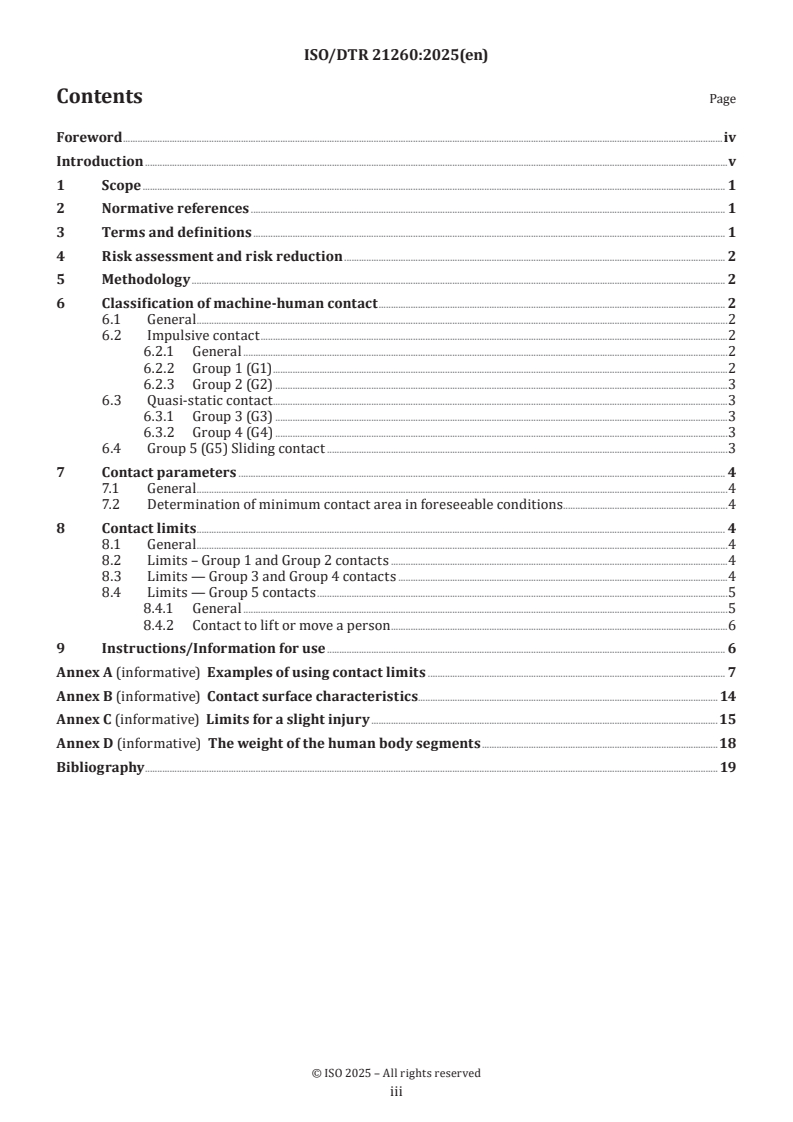
Contents Page
Foreword .iv
Introduction .v
1 Scope . 1
2 Normative references . 1
3 Terms and definitions . 1
4 Risk assessment and risk reduction . 2
5 Methodology . 2
6 Classification of machine-human contact . 2
6.1 General .2
6.2 Impulsive contact .2
6.2.1 General .2
6.2.2 Group 1 (G1) .2
6.2.3 Group 2 (G2) .3
6.3 Quasi-static contact .3
6.3.1 Group 3 (G3) .3
6.3.2 Group 4 (G4) .3
6.4 Group 5 (G5) Sliding contact .3
7 Contact parameters . 4
7.1 General .4
7.2 Determination of minimum contact area in foreseeable conditions.4
8 Contact limits . 4
8.1 General .4
8.2 Limits – Group 1 and Group 2 contacts .4
8.3 Limits — Group 3 and Group 4 contacts .4
8.4 Limits — Group 5 contacts .5
8.4.1 General .5
8.4.2 Contact to lift or move a person .6
9 Instructions/Information for use . 6
Annex A (informative) Examples of using contact limits . 7
Annex B (informative) Contact surface characteristics . 14
Annex C (informative) Limits for a slight injury .15
Annex D (informative) The weight of the human body segments .18
Bibliography . 19
iii
Foreword
ISO (the International Organization for Standardization) is a worldwide federation of national standards
bodies (ISO member bodies). The work of preparing International Standards is normally carried out through
ISO technical committees. Each member body interested in a subject for which a technical committee
has been established has the right to be represented on that committee. International organizations,
governmental and non-governmental, in liaison with ISO, also take part in the work. ISO collaborates closely
with the International Electrotechnical Commission (IEC) on all matters of electrotechnical standardization.
The procedures used to develop this document and those intended for its further maintenance are described
in the ISO/IEC Directives, Part 1. In particular, the different approval criteria needed for the different types
of ISO document should be noted. This document was drafted in accordance with the editorial rules of the
ISO/IEC Directives, Part 2 (see www.iso.org/directives).
ISO draws attention to the possibility that the implementation of this document may involve the use of (a)
patent(s). ISO takes no position concerning the evidence, validity or applicability of any claimed patent
rights in respect thereof. As of the date of publication of this document, ISO had not received notice of (a)
patent(s) which may be required to implement this document. However, implementers are cautioned that
this may not represent the latest information, which may be obtained from the patent database available at
www.iso.org/patents. ISO shall not be held responsible for identifying any or all such patent rights.
Any trade name used in this document is information given for the convenience of users and does not
constitute an endorsement.
For an explanation of the voluntary nature of standards, the meaning of ISO specific terms and expressions
related to conformity assessment, as well as information about ISO's adherence to the World Trade
Organization (WTO) principles in the Technical Barriers to Trade (TBT), see www.iso.org/iso/foreword.html.
This document was prepared by Technical Committee ISO/TC 199, Safety of machinery.
Any feedback or questions on this document should be directed to the user’s national standards body. A
complete listing of these bodies can be found at www.iso.org/members.html.
iv
Introduction
This document is of relevance, in particular, for the following stakeholder groups representing the market
players with regard to machinery safety:
— machine manufacturers (small, medium, and large enterprises);
— health and safety bodies (regulators, accident prevention organizations, market surveillance, etc.),
Others can be affected by the level of machinery safety achieved with the means of the document by the
above-mentioned stakeholder groups:
a) machine users/employers (small, medium, and large enterprises);
b) machine users/employees (e.g. trade unions, organizations for people with special needs);
c) service providers, e.g. for maintenance (small, medium, and large enterprises);
d) consumers (in case of machinery intended for use by consumers).
The above-mentioned stakeholder groups have been given the possibility to participate in the drafting
process of this document.
Machines with moving parts often operate close to people, such as machine tools. In most cases, the moving
parts of the machine do not contact people, and efforts are taken to prevent contact. However, in some
instances, parts of the machine can contact an operator.
This document is based on published studies, including those on measured pain limit. Certain individuals
can experience minor injuries (e.g. bruising) due to these contacts.
The document introduces the concept of groups to address the complexity of conditions that arise when
machines and people operate in close proximity.
v
FINAL DRAFT Technical Report ISO/DTR 21260:2025(en)
Safety of machinery — Mechanical limit determination for
physical contacts from moving parts of machinery to persons
1 Scope
This document provides force-related limits for physical contacts between moving parts of machinery and
people during intended use or foreseeable misuse.
This document deals with contacts that are due to both intentional and unintentional interactions.
This document defines limits to prevent harm from physical contact with all parts of the body, excluding
contacts above the shoulders.
This document focuses on limits for adults and does not cover contact situations beyond those outlined
above. The following situations are excluded from the document:
— when contact surfaces are outside of moderate temperatures (see ISO 13732-1 and ISO 13732-3);
— contact with electrical hazards;
— contact with sharp surfaces (e.g. sharp edges, sharp corner protrusions);
— subsequent risks after the initial contact (e.g. injuries due to falling or a heart attack after the contact).
2 Normative references
The following documents are referred to in the text in such a way that some or all of their content constitutes
requirements of this document. For dated references, only the edition cited applies. For undated references,
the latest edition of the referenced document (including any amendments) applies.
ISO 12100, Safety of machinery — General principles for design — Risk assessment and risk reduction
3 Terms and definitions
For the purposes of this document, the terms and definitions given in ISO 12100 and the following apply.
ISO and IEC maintain terminology databases for use in standardization at the following addresses:
— ISO Online browsing platform: available at https:// www .iso .org/ obp
— IEC Electropedia: available at https:// www .electropedia .org/
3.1
contact area
effective area over which the force is transmitted by the machine to a person during contact
3.2
impulsive contact
contact where the force quickly peaks and then diminishes due to the momentum transfer from the
machinery to humans
3.3
quasi-static contact
contact with a human involving the moving parts of a machine, where a body part can be trapped between a
moving part and another fixed or moving machine part, with a continuously applied force
3.4
sliding contact
contact in which the forces of the normal and shear components are included
3.5
supplied energy
kinetic energy supplied from a moving part of a machine to a person (human body part) at contact
4 Risk assessment and risk reduction
This document supports the risk assessment and reduction process of ISO 12100 by providing force- related
limits in which reasonably foreseeable contact with a human can occur.
Further guidance on risk estimation is provided in ISO/TR 14121-2:2012, Clause 6.
5 Methodology
For each contact identified by the risk assessment, the following steps are followed:
a) Identify contact by moving part of the machine;
b) Contact above the shoulder is be prevented or eliminated; (see Clause 7);
c) For other contacts, determine the contact classification group (see Clause 6);
d) Determine the contact condition for a contact;
e) Determine contact conditions with the maximum limits for the type of contact (see Clause 8);
f) If the determined contact condition exceeds the maximum limit for the type of contact, revise the design
until the contact condition is less than the maximum limit;
g) Repeat the process for each contact including foreseeable use and misuse conditions.
6 Classification of machine-human contact
6.1 General
The acceptability of contact by a moving machine or its parts varies depending on the circumstances of the
contact. They are divided into the following five groups (Table 1).
The choice of the group is based on the type and frequency of contact.
6.2 Impulsive contact
6.2.1 General
Impulsive contact occurs when the moving part of the machine first touches the person. Two contact levels
were defined and differentiated according to the frequency of contact.
6.2.2 Group 1 (G1)
Group 1 impulsive contacts involve force or energy that are lower than the limits of pain regardless of the
frequency.
6.2.3 Group 2 (G2)
Group 2 impulsive contacts are higher than the limits of pain in magnitude of force or energy compared to
Group 1 and are restricted to contacts that can occur to the same individual not more than once per day.
There is an increased risk when compared to G1 of slight injuries (e.g. minor bruising).
6.3 Quasi-static contact
6.3.1 Group 3 (G3)
Following the impulsive contact categorised in G1, if a machine or part of the machine remains in contact
with a person, then there is a quasi-static element to the contact.
In Group 3 quasi-static contacts, the contact force is applied to generate a quasi-static force profile after the
impulsive contact.
Group 3 contacts involve forces lower than the limit that causes pain regardless of frequency.
6.3.2 Group 4 (G4)
Group 4 quasi-static contacts are greater in magnitude than Group 3 and are restricted to contacts that can
occur to the same individual not more than once per day.
6.4 Group 5 (G5) Sliding contact
A sliding contact is any contact in which the direction of motion includes a component tangential to the
contact location.
Table 1 — Contact groups
Magnitude
Type of contact Group Contact description
of force
Group 1 impulsive contacts involve force or energy that are lower
G1 Low
than the limits of pain regardless of the frequency.
Group 2 impulsive contacts are higher than the limits of pain in
magnitude of force or energy compared to Group 1 and are restrict-
ed to contacts that can occur to the same individual not more than
Impulsive
once per day.
Higher than
G2
G1 G2 contacts remain at an acceptable level. However, there is an in-
creased risk when compared to G1, in terms of slight injuries (e.g.
minor bruising).
See Annex C.
Following the impulsive contact categorised in G1, if a machine or
part of the machine remains in contact with a person, then there is
a quasi-static element to the contact.
G3 Very low In Group 3 quasi-static contacts, the contact force is applied to gen-
erate a quasi-static force profile after the impulsive contact.
Quasi-static
Group 3 contacts involve forces lower than the limit that causes pain
regardless of frequency.
Group 4 quasi-static contacts are greater in magnitude than Group 3
Higher than
G4 and are restricted to contacts that can occur to the same individual
G3
not more than once per day.
A sliding contact is any contact in which the direction of motion
Sliding G5
includes a component tangential to the contact location.
7 Contact parameters
7.1 General
The following parameters can be used to determine the contact limits with any part of the body up to and
including the shoulders. See Clause 8 for detailed limits.
7.2 Determination of minimum contact area in foreseeable conditions
To determine the minimum contact area, which is the area to be used in the evaluation, complete the
following:
a) Determine the size of the area of the moving part that can contact the human body part.
b) Determine the human body part(s) exposed to the
...
© ISO #### – All rights reserved
N
ISO/TC 199/SC /WG 12
2025-05-05
Secretariat: BSI DIN
Date:
Safety of machinery — Mechanical limit determination for
physical contacts from moving parts of machinery to persons
WD/CD/DIS/FDIS stage
Warning for WDs and CDs
This document is not an ISO International Standard. It is distributed for review and comment. It is subject to
change without notice and not be referred to as an International Standard.
Recipients of this draft are invited to submit, with their comments, notification of any relevant patent rights
of which they are aware and to provide supporting documentation.
To help you, this guide on writing standards was produced by the ISO/TMB and is available at
A model manuscript of a draft International Standard (known as “The Rice Model”) is available at
ISO #####-#:####(X)
2 © ISO #### – All rights reserved
All rights reserved. Unless otherwise specified, or required in the context of its implementation, no part of this publication
may be reproduced or utilized otherwise in any form or by any means, electronic or mechanical, including photocopying,
or posting on the internet or an intranet, without prior written permission. Permission can be requested from either ISO
at the address below or ISO’s member body in the country of the requester.
ISO copyright office
CP 401 • Ch. de Blandonnet 8
CH-1214 Vernier, Geneva
Phone: + 41 22 749 01 11
Fax: +41 22 749 09 47
EmailE-mail: copyright@iso.org
Website: www.iso.orgwww.iso.org
Published in Switzerland
iii
Contents
Foreword . v
Introduction . vi
1 Scope . 1
2 Normative references . 1
3 Terms and definitions . 1
4 Risk assessment and risk reduction . 2
5 Methodology . 2
6 Classification of machine-human contact . 2
6.1 General . 2
6.2 Impulsive contact . 3
6.3 Quasi-static contact . 3
6.4 Group 5 (G5) Sliding contact . 3
7 Contact parameters . 4
7.1 General . 4
7.2 Determination of minimum contact area in foreseeable conditions . 4
8 Contact limits . 4
8.1 General . 4
8.2 Limits – Group 1 and Group 2 contacts . 4
8.3 Limits — Group 3 and Group 4 contacts . 5
8.4 Limits — Group 5 contacts . 5
9 Instructions/Information for use . 7
Annex A (informative) Examples of using contact limits . 8
Annex B (informative) Contact surface characteristics . 18
Annex C (informative) Limits for a slight injury . 19
Annex D (informative) The weight of the human body segments . 23
Bibliography . 24
iv
Foreword
ISO (the International Organization for Standardization) is a worldwide federation of national standards
bodies (ISO member bodies). The work of preparing International Standards is normally carried out through
ISO technical committees. Each member body interested in a subject for which a technical committee has been
established has the right to be represented on that committee. International organizations, governmental and
non-governmental, in liaison with ISO, also take part in the work. ISO collaborates closely with the
International Electrotechnical Commission (IEC) on all matters of electrotechnical standardization.
The procedures used to develop this document and those intended for its further maintenance are described
in the ISO/IEC Directives, Part 1. In particular, the different approval criteria needed for the different types of
ISO documentsdocument should be noted. This document was drafted in accordance with the editorial rules
of the ISO/IEC Directives, Part 2 (see www.iso.org/directives).
Attention is drawnISO draws attention to the possibility that some of the elementsimplementation of this
document can bemay involve the subjectuse of (a) patent(s). ISO takes no position concerning the evidence,
validity or applicability of any claimed patent rights in respect thereof. As of the date of publication of this
document, ISO had not received notice of (a) patent(s) which may be required to implement this document.
However, implementers are cautioned that this may not represent the latest information, which may be
obtained from the patent database available at www.iso.org/patents. ISO shall not be held responsible for
identifying any or all such patent rights. Details of any patent rights identified during the development of the
document will be in the Introduction and/or on the ISO list of patent declarations received (see ).
Any trade name used in this document is information given for the convenience of users and does not
constitute an endorsement.
For an explanation of the voluntary nature of standards, the meaning of ISO specific terms and expressions
related to conformity assessment, as well as information about ISO's adherence to the World Trade
Organization (WTO) principles in the Technical Barriers to Trade (TBT), see www.iso.org/iso/foreword.html.
This document was prepared by Technical Committee ISO/TC 199, Safety of machinery.
Any feedback or questions on this document should be directed to the user’s national standards body. A
complete listing of these bodies can be found at www.iso.org/members.html.
v
Introduction
This document is of relevance, in particular, for the following stakeholder groups representing the market
players with regard to machinery safety:
— machine manufacturers (small, medium, and large enterprises),);
— health and safety bodies (regulators, accident prevention organizations, market surveillance, etc.),
Others can be affected by the level of machinery safety achieved with the means of the document by the above-
mentioned stakeholder groups:
a) machine users/employers (small, medium, and large enterprises),);
b) machine users/employees (e.g. trade unions, organizations for people with special needs),);
c) service providers, e.g. for maintenance (small, medium, and large enterprises),);
d) consumers (in case of machinery intended for use by consumers).
The above-mentioned stakeholder groups have been given the possibility to participate in the drafting process
of this document.
Machines with moving parts often operate close to people, such as machine tools. In most cases, the moving
parts of the machine do not contact people, and efforts are taken to prevent contact. However, in some
instances, parts of the machine can contact an operator.
This document is based on published studies, including those on measured pain limit. Certain individuals
couldcan experience minor injuries (e.g. bruising) due to these contacts.
The document introduces the concept of groups to address the complexity of conditions that arise when
machines and people operate in close proximity.
vi
Safety of machinery - — Mechanical limit determination for physical
contacts from moving parts of machinery to persons
1 Scope
This document provides force-related limits for physical contacts between moving parts of machinery and
people during intended use or foreseeable misuse.
This document deals with contacts that are due to both intentional and unintentional interactions.
The scope of thisThis document is to definedefines limits to prevent harm from physical contact with all parts
of the body, excluding contacts above the shoulders.
This document focuses on limits for adults and does not cover contact situations beyond those outlined above.
The following situations are excluded from the document:
- when contact surfaces are outside of moderate temperatures,
— NOTE See (see ISO 13732 part -1 and ISO 13732-3.);
— contact with electrical hazards,;
— contact with sharp surfaces (e.g. sharp edges, sharp corner protrusions),);
— subsequent risks after the initial contact (e.g. injuries due to falling or a heart attack after the contact).
2 Normative references
The following documents are referred to in the text in such a way that some or all of their content constitutes
requirements of this document. For dated references, only the edition cited applies. For undated references,
the latest edition of the referenced document (including any amendments) applies.
ISO 12100, Safety of machinery — General principles for design — Risk assessment and risk reduction
23 Terms and definitions
TheFor the purposes of this document, the terms and definitions given in ISO 12100 and the following apply
to this document.
ISO and IEC maintain terminologicalterminology databases for standard use in standardization at the following
addresses:
— - ISO Online browsing platform: available at https://www.iso.org/obp,
— IEC Electropedia: available at https://www.electropedia.org/.
2.13.1 2.1
contact area
effective area over which the force is transmitted by the machine to a person during contact
2.23.2 2.2
impulsive contact
contact where the force quickly peaks and then diminishes due to the momentum transfer from the machinery
to humans
2.33.3 2.3
quasi-static contact
contact with a human involving the moving parts of a machine, where a body part can be trapped between a
moving part and another fixed or moving machine part, with a continuously applied force
2.43.4
2.4
sliding contact
contact in which the forces of the normal and shear components are included
2.53.5 2.5
supplied energy
kinetic energy supplied from a moving part of a machine to a person (human body part) at contact
34 Risk assessment and risk reduction
This document supports the risk assessment and reduction process of ISO 12100 by providing force- related
limits in which reasonably foreseeable contact with a human can occur.
Further guidance on risk estimation is provided in ISO/TR 14121-2:2012, Clause 6[1].
45 Methodology
For each contact identified by the risk assessment, the following steps are followed:
a) Identify contact by moving part of the machine,;
b) Contact above the shoulder is be prevented or eliminated; (see Clause 7Clause 6),);
c) For other contacts, determine the contact classification group (see Clause 6Clause 5),);
d) Determine the contact condition for a contact,;
e) Determine contact conditions with the maximum limits for the type of contact (see Clause 8Clause 7),);
f) If the determined contact condition exceeds the maximum limit for the type of contact, revise the design
until the contact condition is less than the maximum limit,;
g) Repeat the process for each contact including foreseeable use and misuse conditions.
56 Classification of machine-human contact
5.16.1 General
The acceptability of contact by a moving machine or its parts varies depending on the circumstances of the
contact. They are divided into the following five groups (Table 1(Table 1).).
The choice of the group is based on the type and frequency of contact.
5.26.2 Impulsive contact
6.2.1 General
Impulsive contact occurs when the moving part of the machine first touches the person. Two contact levels
were defined and differentiated according to the frequency of contact.
5.2.16.2.2 Group 1 (G1)
Group 1 impulsive contacts involve force or energy that are lower than the limits of pain regardless of the
frequency.
5.2.26.2.3 Group 2 (G2)
Group 2 impulsive contacts are higher than the limits of pain in magnitude of force or energy compared to
Group 1 and are restricted to contacts that can occur to the same individual not more than once per day.
There is an increased risk when compared to G1 of slight injuries (e.g. minor bruising).
5.36.3 Quasi-static contact
5.3.16.3.1 Group 3 (G3)
Following the impulsive contact categorised in G1, if a machine or part of the machine remains in contact with
a person, then there is a quasi-static element to the contact.
In Group 3 quasi-static contacts, the contact force is applied to generate a quasi-static force profile after the
impulsive contact.
Group 3 contacts involve forces lower than the limit that causes pain regardless of frequency.
5.3.26.3.2 Group 4 (G4)
Group 4 quasi-static contacts are greater in magnitude than Group 3 and are restricted to contacts that can
occur to the same individual not more than once per day.
5.46.4 Group 5 (G5) Sliding contact
A sliding contact is any contact in which the direction of motion includes a component tangential to the contact
location.
Table 1 — Contact groups
Type of Magnitude
Group Contact description
contact of force
Group 1 impulsive contacts involve force or energy that are lower
G1 Low
than the limits of pain regardless of the frequency.
Group 2 impulsive contacts are higher than the limits of pain in
magnitude of force or energy compared to Group 1 and are
restricted to contacts that can occur to the same individual not
Impulsive
more than once per day.
Higher than
G2
G1 G2 contacts remain at an acceptable level. However, there is an
increased risk when compared to G1, in terms of slight injuries
(e.g. minor bruising).
See Annex CAnnex C.
Type of Magnitude
Group Contact description
contact of force
Following the impulsive contact categorised in G1, if a machine or
part of the machine remains in contact with a person, then there
is a quasi-static element to the contact.
G3 Very low In Group 3 quasi-static contacts, the contact force is applied to
generate a quasi-static force profile after the impulsive contact.
Quasi-static
Group 3 contacts involve forces lower than the limit that causes
pain regardless of frequency.
Group 4 quasi-static contacts are greater in magnitude than
Higher than
G4 Group 3 and are restricted to contacts that can occur to the same
G3
individual not more than once per day.
A sliding contact is any contact in which the direction of motion
Sliding G5
includes a component tangential to the contact location.
67 Contact parameters
6.17.1 General
The following parameters can be used to determine the contact limits with any part of the body up to and
including the shoulders. See Clause 8Clause 7 for detailed limits.
6.27.2 Determination of minimum contact area in foreseeable conditions
To determine the minimum contact area, which is the area to be used in the evaluation, complete the following:
a) Determine the size of the area of the moving part that can contact the human body part.
b) Determine the human body part(s) exposed to the potential contact from the moving part.
c) Overlay the area values determined above to define the minimum contact area.
For G1, G2, G3, or G4 contacts, the contact surface is to have no sharp edges or hazardous projections with a
radius less than 0,3 mm or corners with a radius less than 4 mm. (See Annex BAnnex B for additional
information on the contact surfaces).
78 Contact limits
G.1.0A.1.1 General
8.1 General
Clauses 8.2, 8.3Clauses 7.2, 7.3,, and 8.47.4 specify the limits for each of the previously defined contact groups.
Annex AAnnex A provides examples for using some of the limits.
7.28.2 Limits – Group 1 and Group 2 contacts
The limits for an impulsive contact are listed in Table 2Table 2.
Table 2 — Impulsive limits
Contact condition G1 G2
2 2
Minimum contact area 0,8 cm 0,8 cm
2 2 a
Maximum supplied energy per unit area 0,18 J/cm 1,0 J/cm
Maximum impulsive contact force generated by the above energy 44 N 120 N
2 2 b
Maximum impulsive contact pressure generated by the above energy 56 N/cm 150 N/cm
[10 ]
a The limit is derived from a study reported in [10]. .
[9 ]
b The limit is derived from a study reported in [9]. .
7.38.3 Limits — Group 3 and Group 4 contacts
The limits for quasi-static contact are listed in Table 3Table 3.
Table 3 — Quasi-static limits
Contact condition G3 G4
2 2
Minimum contact area 0,8 cm 0,8 cm
Maximum quasi-static contact force (except for lifting) 22 N 43 N
2 a 2 b
Maximum quasi-static contact pressure 28 N/cm 54 N/cm
[2 ]
a The limit is derived from a study reported in [2]. .
[12 ]
b The limit is derived from a study reported in [12]. .
7.48.4 Limits — Group 5 contacts
8.4.1 General
The limits for sliding contact are listed in Table 4Table 4 (including Figure 1Figure 1).).
Table 4 — Limits for sliding contact up to one time per second
Contact condition G5
2 a
Maximum shear stress (one-time sliding contact) 5 N/cm
Maximum shear stress for sliding contacts up to 30 min See Figure 1Figure
2 a
Maximum shear stress for sliding contacts longer than 30 min 2,5 N/cm
a [4 ]
The limits are derived from a study reported in [4]. .
Key
X duration in seconds of continuous repeated sliding contact (rubbing), where each
contact is one second long with no delay between contacts
maximum shear stress, in N/cm .
Y
X duration in seconds of continuous repeated sliding contact (rubbing), where each contact is one second long with no delay
between contacts
Y maximum shear stress, in N/cm .
Figure 1 — Maximum shear stress
NOTE 1 Sliding contact occurs when the machine movement is parallel to the surface of the body at the point of
contact. For example, a moving object brushes over a person.
[4 ]
NOTE 2 Detailed information can be found in [4] for higher Y values (X<200).
7.4.18.4.2 Contact to lift or move a person
G5 contact is used for lifting or moving a person who is in contact with the machine, and the contact force is
the force necessary to perform the lift or movement. This force can be applied progressively.
To ensure a stable and secure lift, lifting contact can only be applied to
...