

ISO 18758-2:2018
(Main)Mining and earth-moving machinery — Rock drill rigs and rock reinforcement rigs — Part 2: Safety requirements
General Information
- Abstract
This document specifies the safety requirements for rock drill rigs and rock reinforcement rigs designed for the following underground or surface operations: a) blast hole drilling; b) rock reinforcement; c) drilling for secondary breaking; d) dimensional stone drilling; e) mineral prospecting, e.g. utilizing core drilling or reverse circulation; f) water and methane drainage drilling; g) raise boring. NOTE Rigs can be designed for more than one of the operations above. See ISO 18758-1 for vocabulary. This document is also applicable to earth-moving machinery as defined in ISO 6165, modified to become a rock drill rig or rock reinforcement rig. This document is not applicable to the following machines: drill rigs for soil and rock mixture; (geothermal drill rigs, water well drill rigs, water jet drill rigs, micro pile drill rigs; surface horizontal directional drill rigs (HDD) as defined in ISO 21467), kelly drill rigs (and casing drivers); cable tool drill rigs; pre-armouring machines; sonic drill rigs; shaft sinking drill rigs; crane attached drill rigs; drill rigs on derricks; scaling machines. This document deals with the significant hazards, hazardous situations or hazardous events, as listed in Annex E, relevant to rock drill rigs and rock reinforcement rigs (see ISO 18758‑1), when they are used as intended and under the conditions of misuse which are reasonably foreseeable by the manufacturer. This document is not applicable to rigs manufactured before the date of its publication.
- Status
- Published
- Publication Date
- 29-May-2018
- Technical Committee
- ISO/TC 82 - Mining
- Drafting Committee
- ISO/TC 82/JWG 1 - Joint ISO/TC 82 - ISO/TC 127 WG: Rock drill rigs
- Current Stage
- 9092 - International Standard to be revised
- Start Date
- 05-Sep-2023
- Completion Date
- 29-Aug-2026
Buy Documents

ISO 18758-2:2018 - Mining and earth-moving machinery -- Rock drill rigs and rock reinforcement rigs
ISO 18758-2:2018 - Mining and earth-moving machinery — Rock drill rigs and rock reinforcement rigs — Part 2: Safety requirements/30/2018
Overview
ISO 18758-2:2018 - "Mining and earth-moving machinery - Rock drill rigs and rock reinforcement rigs - Part 2: Safety requirements" specifies the safety requirements for rock drill rigs and rock reinforcement rigs used in underground and surface operations (blast hole drilling, rock reinforcement, secondary breaking, dimensional stone drilling, mineral prospecting, water/methane drainage drilling, raise boring). The document addresses significant hazards and reasonably foreseeable misuse for rigs designed after its publication date. It complements ISO 18758-1 (vocabulary) and aligns with earth-moving machinery definitions in ISO 6165.
Key topics and technical requirements
The standard organizes safety requirements across systems and machine life-cycle stages. Major areas covered include:
- General safety and ergonomics: operator access, hot/cold surfaces, sharp edges, and handling of rig parts.
- Operator positions and visibility: driver/tramming controls, cab/canopy design, operator protective structures.
- Controls, start/stop and emergency systems: starting, normal stopping, power-failure response, emergency stop, remote-control safety.
- Braking, steering and stability: service/secondary/parking brakes (wheel and crawler rigs), steering controls, stability assessment.
- Power systems and installations: diesel engines, electrical installations, battery safety, electromagnetic compatibility (EMC).
- Fluid and pressure systems: hydraulic systems (including load-holding), pneumatic installations, hoses and fittings under pressure, fuel systems and ventilation.
- Protection against hazards from moving parts: guards for feed beams, masts, chains, winches, ropes and sheaves.
- Environmental and occupational hazards: noise and vibration controls, dust suppression, lighting, fire protection and suppression measures.
- Maintenance, verification and testing: brake and system verification, test conditions and reporting, maintenance access and instructions.
- Information for use and marking: operator manuals, safety signs, rig data plates, symbols, transport and assembly instructions.
Practical applications and target users
ISO 18758-2 is intended for:
- Manufacturers and OEMs designing rock drill rigs and rock reinforcement rigs to meet safety and compliance requirements.
- Design engineers and safety specialists integrating ergonomic, mechanical and electrical safety measures.
- Procurement and fleet managers evaluating equipment for safe operation in mining and drilling applications.
- Inspectors, certification bodies and regulators verifying that new rigs meet recognized safety standards.
- Maintenance teams and operators for guidance on safe use, servicing, testing and labeling.
Note: the standard is not applicable to rigs manufactured before its publication and excludes specific rig types (e.g., sonic rigs, kelly rigs, HDD as defined in ISO 21467).
Related standards
- ISO 18758-1 - vocabulary for rock drill rigs and rock reinforcement rigs.
- ISO 6165 - earth-moving machinery - terms, definitions and commercial specifications.
- ISO 21467 - referenced for exclusion of surface horizontal directional drill rigs (HDD).
Relations
- Effective Date
- 03-Dec-2022
Buy Documents
ISO 18758-2:2018 - Mining and earth-moving machinery -- Rock drill rigs and rock reinforcement rigs
ISO 18758-2:2018 - Mining and earth-moving machinery — Rock drill rigs and rock reinforcement rigs — Part 2: Safety requirements/30/2018
Get Certified
Connect with accredited certification bodies for this standard

Bureau Veritas Chile
Bureau Veritas certification services in Chile.
Bureau Veritas Peru
Bureau Veritas certification services in Peru.
BVQI Peru
Bureau Veritas certification in Peru.
Sponsored listings
Frequently Asked Questions
ISO 18758-2:2018 is a standard published by the International Organization for Standardization (ISO). Its full title is "Mining and earth-moving machinery — Rock drill rigs and rock reinforcement rigs — Part 2: Safety requirements". This standard covers: This document specifies the safety requirements for rock drill rigs and rock reinforcement rigs designed for the following underground or surface operations: a) blast hole drilling; b) rock reinforcement; c) drilling for secondary breaking; d) dimensional stone drilling; e) mineral prospecting, e.g. utilizing core drilling or reverse circulation; f) water and methane drainage drilling; g) raise boring. NOTE Rigs can be designed for more than one of the operations above. See ISO 18758-1 for vocabulary. This document is also applicable to earth-moving machinery as defined in ISO 6165, modified to become a rock drill rig or rock reinforcement rig. This document is not applicable to the following machines: drill rigs for soil and rock mixture; (geothermal drill rigs, water well drill rigs, water jet drill rigs, micro pile drill rigs; surface horizontal directional drill rigs (HDD) as defined in ISO 21467), kelly drill rigs (and casing drivers); cable tool drill rigs; pre-armouring machines; sonic drill rigs; shaft sinking drill rigs; crane attached drill rigs; drill rigs on derricks; scaling machines. This document deals with the significant hazards, hazardous situations or hazardous events, as listed in Annex E, relevant to rock drill rigs and rock reinforcement rigs (see ISO 18758‑1), when they are used as intended and under the conditions of misuse which are reasonably foreseeable by the manufacturer. This document is not applicable to rigs manufactured before the date of its publication.
This document specifies the safety requirements for rock drill rigs and rock reinforcement rigs designed for the following underground or surface operations: a) blast hole drilling; b) rock reinforcement; c) drilling for secondary breaking; d) dimensional stone drilling; e) mineral prospecting, e.g. utilizing core drilling or reverse circulation; f) water and methane drainage drilling; g) raise boring. NOTE Rigs can be designed for more than one of the operations above. See ISO 18758-1 for vocabulary. This document is also applicable to earth-moving machinery as defined in ISO 6165, modified to become a rock drill rig or rock reinforcement rig. This document is not applicable to the following machines: drill rigs for soil and rock mixture; (geothermal drill rigs, water well drill rigs, water jet drill rigs, micro pile drill rigs; surface horizontal directional drill rigs (HDD) as defined in ISO 21467), kelly drill rigs (and casing drivers); cable tool drill rigs; pre-armouring machines; sonic drill rigs; shaft sinking drill rigs; crane attached drill rigs; drill rigs on derricks; scaling machines. This document deals with the significant hazards, hazardous situations or hazardous events, as listed in Annex E, relevant to rock drill rigs and rock reinforcement rigs (see ISO 18758‑1), when they are used as intended and under the conditions of misuse which are reasonably foreseeable by the manufacturer. This document is not applicable to rigs manufactured before the date of its publication.
ISO 18758-2:2018 is classified under the following ICS (International Classification for Standards) categories: 53.100 - Earth-moving machinery; 73.100.30 - Equipment for drilling and mine excavation. The ICS classification helps identify the subject area and facilitates finding related standards.
ISO 18758-2:2018 has the following relationships with other standards: It is inter standard links to ISO/FDIS 18758. Understanding these relationships helps ensure you are using the most current and applicable version of the standard.
ISO 18758-2:2018 is available in PDF format for immediate download after purchase. The document can be added to your cart and obtained through the secure checkout process. Digital delivery ensures instant access to the complete standard document.
Standards Content (Sample)
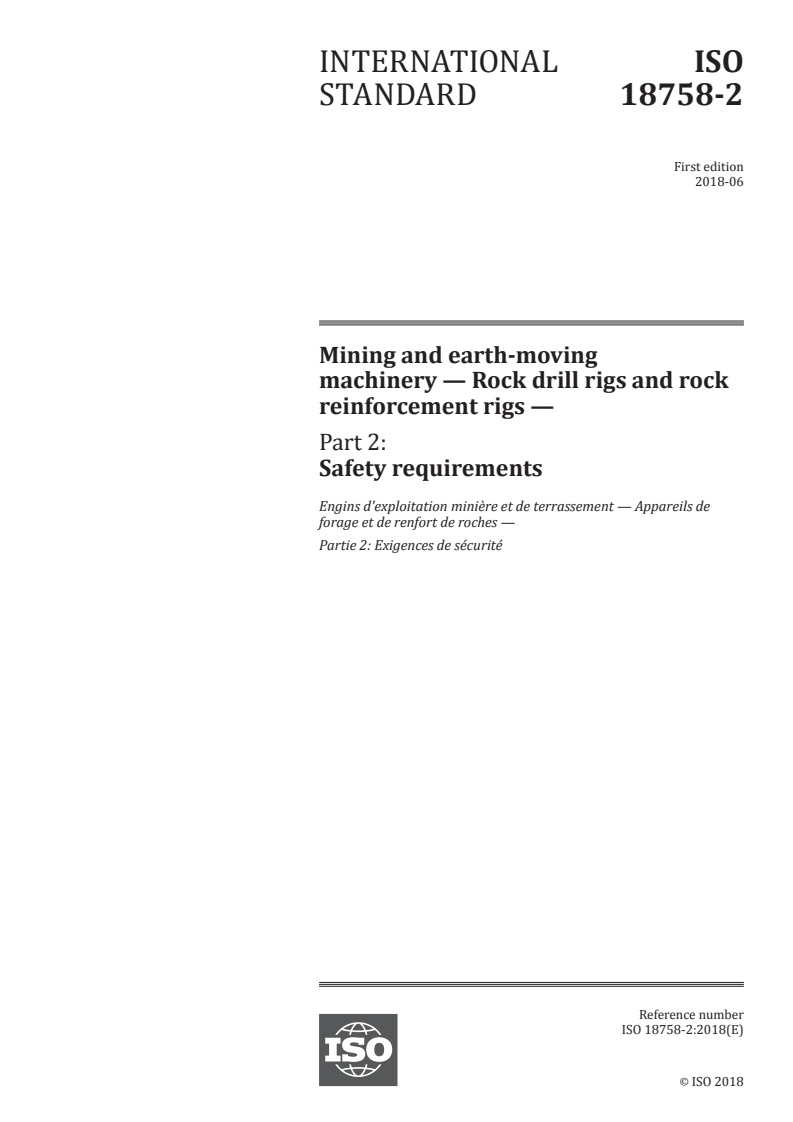
INTERNATIONAL ISO
STANDARD 18758-2
First edition
2018-06
Mining and earth-moving
machinery — Rock drill rigs and rock
reinforcement rigs —
Part 2:
Safety requirements
Engins d'exploitation minière et de terrassement — Appareils de
forage et de renfort de roches —
Partie 2: Exigences de sécurité
Reference number
©
ISO 2018
© ISO 2018
All rights reserved. Unless otherwise specified, or required in the context of its implementation, no part of this publication may
be reproduced or utilized otherwise in any form or by any means, electronic or mechanical, including photocopying, or posting
on the internet or an intranet, without prior written permission. Permission can be requested from either ISO at the address
below or ISO’s member body in the country of the requester.
ISO copyright office
CP 401 • Ch. de Blandonnet 8
CH-1214 Vernier, Geneva
Phone: +41 22 749 01 11
Fax: +41 22 749 09 47
Email: copyright@iso.org
Website: www.iso.org
Published in Switzerland
ii © ISO 2018 – All rights reserved
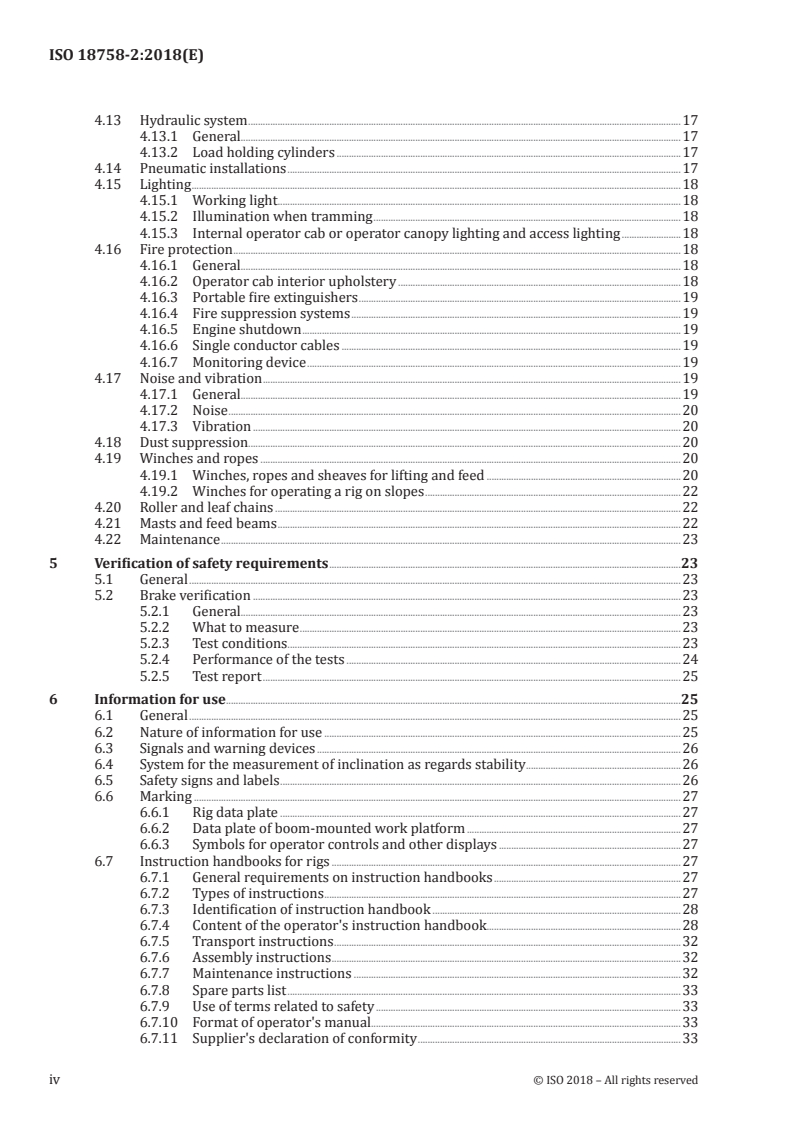
Contents Page
Foreword .vi
Introduction .vii
1 Scope . 1
2 Normative references . 1
3 Terms and definitions . 4
4 Safety requirements . 4
4.1 General requirements . 4
4.1.1 General. 4
4.1.2 Ergonomics . 5
4.1.3 Hot and cold surfaces and sharp edges . 5
4.1.4 Hoses, pipes and fittings under pressure . 5
4.1.5 Handling of the rig and its parts . 5
4.1.6 Access to operating positions and servicing points . 5
4.1.7 Isolation of external electrical energy sources . 6
4.1.8 Prevention of unexpected start-up . 6
4.2 Driving, tramming and operating position . 6
4.2.1 General. 6
4.2.2 Operator's position . 6
4.2.3 Visibility. 9
4.2.4 Operator protective structures . 9
4.3 Controls, functions and systems .10
4.3.1 General.10
4.3.2 Starting .10
4.3.3 Stopping – Normal stopping .10
4.3.4 Failure of the power supply .10
4.4 Control devices .10
4.4.1 General.10
4.4.2 Control system of remote controlled and automated rigs .11
4.4.3 Emergency stop and safety devices .11
4.4.4 Operating instrumentation .12
4.5 Stability .12
4.6 Steering .12
4.7 Carrier brakes .12
4.7.1 General.12
4.7.2 General requirements for wheel-mounted rigs .12
4.7.3 Service braking system for wheel-mounted rigs.13
4.7.4 Secondary braking system for wheel-mounted rigs .13
4.7.5 Parking braking system for wheel-mounted rigs .13
4.7.6 Braking systems for crawler-mounted rigs .13
4.7.7 Braking systems for "skid steer" wheel-mounted rigs .13
4.8 Tyres and rims .13
4.9 Protection against moving parts .14
4.9.1 General.14
4.9.2 Moving parts involved in the working process .14
4.10 Electrical installations .15
4.10.1 Electric power installation .15
4.10.2 Electromagnetic compatibility (EMC) .15
4.10.3 Battery installation .16
4.11 Machines powered by diesel engine .16
4.12 Fuel systems .16
4.12.1 Fuel tanks .16
4.12.2 Fuel tank filler inlet .17
4.12.3 Fuel tank vent system .17
4.13 Hydraulic system .17
4.13.1 General.17
4.13.2 Load holding cylinders .17
4.14 Pneumatic installations .17
4.15 Lighting .18
4.15.1 Working light .18
4.15.2 Illumination when tramming .18
4.15.3 Internal operator cab or operator canopy lighting and access lighting .18
4.16 Fire protection .18
4.16.1 General.18
4.16.2 Operator cab interior upholstery .18
4.16.3 Portable fire extinguishers .19
4.16.4 Fire suppression systems .19
4.16.5 Engine shutdown .19
4.16.6 Single conductor cables .19
4.16.7 Monitoring device .19
4.17 Noise and vibration .19
4.17.1 General.19
4.17.2 Noise .20
4.17.3 Vibration .20
4.18 Dust suppression.20
4.19 Winches and ropes .20
4.19.1 Winches, ropes and sheaves for lifting and feed .20
4.19.2 Winches for operating a rig on slopes .22
4.20 Roller and leaf chains .22
4.21 Masts and feed beams .22
4.22 Maintenance .23
5 Verification of safety requirements .23
5.1 General .23
5.2 Brake verification .23
5.2.1 General.23
5.2.2 What to measure .23
5.2.3 Test conditions.23
5.2.4 Performance of the tests .24
5.2.5 Test report .25
6 Information for use .25
6.1 General .25
6.2 Nature of information for use .25
6.3 Signals and warning devices .26
6.4 System for the measurement of inclination as regards stability .26
6.5 Safety signs and labels .26
6.6 Marking .27
6.6.1 Rig data plate .27
6.6.2 Data plate of boom-mounted work platform .27
6.6.3 Symbols for operator controls and other displays .27
6.7 Instruction handbooks for rigs .27
6.7.1 General requirements on instruction handbooks .27
6.7.2 Types of instructions .27
6.7.3 Identification of instruction handbook .28
6.7.4 Content of the operator's instruction handbook.28
6.7.5 Transport instructions .32
6.7.6 Assembly instructions .32
6.7.7 Maintenance instructions .32
6.7.8 Spare parts list .33
6.7.9 Use of terms related to safety .33
6.7.10 Format of operator's manual .33
6.7.11 Supplier's declaration of conformity .33
iv © ISO 2018 – All rights reserved
6.8 Training manual .33
Annex A (normative) Temporary roof support (TRS) systems.34
Annex B (normative) Stability .35
Annex C (normative) Noise test code .43
Annex D (normative) Whole-body and hand-arm vibration test .50
Annex E (informative) List of significant hazards .52
Bibliography .55
Foreword
ISO (the International Organization for Standardization) is a worldwide federation of national standards
bodies (ISO member bodies). The work of preparing International Standards is normally carried out
through ISO technical committees. Each member body interested in a subject for which a technical
committee has been established has the right to be represented on that committee. International
organizations, governmental and non-governmental, in liaison with ISO, also take part in the work.
ISO collaborates closely with the International Electrotechnical Commission (IEC) on all matters of
electrotechnical standardization.
The procedures used to develop this document and those intended for its further maintenance are
described in the ISO/IEC Directives, Part 1. In particular, the different approval criteria needed for the
different types of ISO documents should be noted. This document was drafted in accordance with the
editorial rules of the ISO/IEC Directives, Part 2 (see www .iso .org/directives).
Attention is drawn to the possibility that some of the elements of this document may be the subject of
patent rights. ISO shall not be held responsible for identifying any or all such patent rights. Details of
any patent rights identified during the development of the document will be in the Introduction and/or
on the ISO list of patent declarations received (see www .iso .org/patents).
Any trade name used in this document is information given for the convenience of users and does not
constitute an endorsement.
For an explanation of the voluntary nature of standards, the meaning of ISO specific terms and
expressions related to conformity assessment, as well as information about ISO's adherence to the
World Trade Organization (WTO) principles in the Technical Barriers to Trade (TBT), see www .iso
.org/iso/foreword .html.
This document was prepared by Technical Committee ISO/TC 82, Mining, in cooperation with Technical
Committee ISO/TC 127, Earth-moving machinery.
A list of all parts in the ISO 18758 series can be found on the ISO website.
Any feedback or questions on this document should be directed to the user’s national standards body. A
complete listing of these bodies can be found at www .iso .org/members .html.
vi © ISO 2018 – All rights reserved
Introduction
This document is a type C standard as stated in ISO 12100.
This document is of relevance, in particular, for the following stakeholder groups representing the
market players with regard to machinery safety:
— machine manufacturers;
— mining companies;
— health and safety bodies (regulators, accident prevention organisations, market surveillance, etc.).
Others that can be affected by the level of machinery safety achieved with the means of the document
by the above-mentioned stakeholder groups are:
— machine operators;
— service providers, e.g. for maintenance;
— third party system and technology providers.
The above-mentioned stakeholder groups have been given the possibility to participate at the drafting
process of this document.
The machinery concerned and the extent to which hazards, hazardous situations or hazardous events
are covered are indicated in the scope of this document.
When requirements of this type C standard are different from those which are stated in type A or B
standards, the requirements of this type C standard take precedence over the requirements of the other
standards, for rock drill rigs and rock reinforcement rigs that have been designed and built according
to the requirements of this type C standard.
The following assumptions were made in writing this document:
a) the operators of the machines are well trained professionals and aware of potential risks of the
working environment (see ISO/IEC GUIDE 51:2014, 6.1 a);
b) the machines are operated according to the instructions given by the manufacturer, such as
operator's instructions (see ISO/IEC GUIDE 51:2014, 7.4.2.2);
c) administrative controls are in place for preventing unauthorized entry of persons to the area where
machines are working (see ISO/IEC GUIDE 51:2014, 6.2.2 and note).
For increased readability of this document, rock drill rigs and rock reinforcement rigs are called rigs.
INTERNATIONAL STANDARD ISO 18758-2:2018(E)
Mining and earth-moving machinery — Rock drill rigs and
rock reinforcement rigs —
Part 2:
Safety requirements
1 Scope
This document specifies the safety requirements for rock drill rigs and rock reinforcement rigs designed
for the following underground or surface operations:
a) blast hole drilling;
b) rock reinforcement;
c) drilling for secondary breaking;
d) dimensional stone drilling;
e) mineral prospecting, e.g. utilizing core drilling or reverse circulation;
f) water and methane drainage drilling;
g) raise boring.
NOTE Rigs can be designed for more than one of the operations above. See ISO 18758-1 for vocabulary.
This document is also applicable to earth-moving machinery as defined in ISO 6165, modified to become
a rock drill rig or rock reinforcement rig.
This document is not applicable to the following machines: drill rigs for soil and rock mixture;
(geothermal drill rigs, water well drill rigs, water jet drill rigs, micro pile drill rigs; surface horizontal
directional drill rigs (HDD) as defined in ISO 21467), kelly drill rigs (and casing drivers); cable tool drill
rigs; pre-armouring machines; sonic drill rigs; shaft sinking drill rigs; crane attached drill rigs; drill
rigs on derricks; scaling machines.
This document deals with the significant hazards, hazardous situations or hazardous events, as listed
in Annex E, relevant to rock drill rigs and rock reinforcement rigs (see ISO 18758-1), when they are used
as intended and under the conditions of misuse which are reasonably foreseeable by the manufacturer.
This document is not applicable to rigs manufactured before the date of its publication.
2 Normative references
The following documents are referred to in the text in such a way that some or all of their content
constitutes requirements of this document. For dated references, only the edition cited applies. For
undated references, the latest edition of the referenced document (including any amendments) applies.
ISO 2631-1, Mechanical vibration and shock — Evaluation of human exposure to whole-body vibration —
Part 1: General requirements
ISO 2867, Earth-moving machinery — Access systems
ISO 3449, Earth-moving machinery — Falling-object protective structures — Laboratory tests and
performance requirements
ISO 3450:2011, Earth-moving machinery — Wheeled or high-speed rubber-tracked machines —
Performance requirements and test procedures for brake systems
ISO 3457:2003, Earth–moving machinery — Guards — Definitions and requirements
ISO 3795, Road vehicles, and tractors and machinery for agriculture and forestry — Determination of
burning behaviour of interior materials
ISO 3864-2, Graphical symbols — Safety colours and safety signs — Part 2: Design principles for product
safety labels
ISO 4302:2016, Cranes — Wind load assessment
ISO 4309, Cranes — Wire ropes — Care and maintenance, inspection and discard
ISO 4413, Hydraulic fluid power — General rules and safety requirements for systems and their components
ISO 4414, Pneumatic fluid power — General rules and safety requirements for systems and their components
ISO 4871, Acoustics — Declaration and verification of noise emission values of machinery and equipment
ISO 5006:2017, Earth–moving machinery — Operator’s field of view — Test method and performance
criteria
ISO 5010, Earth-moving machinery — Rubber-tyred machines — Steering requirements
ISO 6405-1, Earth-moving machinery — Symbols for operator controls and other displays — Part 1:
Common symbols
ISO 6405-2, Earth-moving machinery — Symbols for operator controls and other displays — Part 2:
Symbols for specific machines, equipment and accessories
ISO 6682, Earth-moving machinery — Zones of comfort and reach for controls
ISO 6683, Earth-moving machinery — Seat belts and seat belt anchorages — Performance requirements
and tests
ISO 6750:2005, Earth-moving machinery — Operator’s manual — Content and format
ISO 7731, Ergonomics — Danger signals for public and work areas — Auditory danger signals
ISO 9244, Earth-moving machinery — Machine safety labels — General principles
ISO 9533, Earth-moving machinery — Machine-mounted audible travel alarms and forward horns — Test
methods and performance criteria
ISO 10262, Earth-moving machinery — Hydraulic excavators — Laboratory tests and performance
requirements for operator protective guards
ISO 10263-1, Earth-moving machinery — Operator enclosure environment — Part 1: Terms and definitions
ISO 10263-2, Earth-moving machinery — Operator enclosure environment — Part 2: Air filter element
test method
ISO 10263-3, Earth-moving machinery — Operator enclosure environment — Part 3: Pressurization
test method
ISO 10263-4, Earth-moving machinery — Operator enclosure environment — Part 4: Heating, ventilating
and air conditioning (HVAC) test method and performance
ISO 10263-5, Earth-moving machinery — Operator enclosure environment — Part 5: Windscreen defrosting
system test method
2 © ISO 2018 – All rights reserved
ISO 10263-6, Earth-moving machinery — Operator enclosure environment — Part 6: Determination of
effect of solar heating
ISO 10264, Earth-moving machinery — Key-locked starting systems
ISO 10265, Earth-moving machinery — Crawler machines — Performance requirements and test
procedures for braking systems
ISO 10532, Earth-moving machinery — Machine-mounted retrieval device — Performance requirements
ISO 10570, Earth-moving machinery — Articulated frame lock — Performance requirements
ISO 10968, Earth-moving machinery — Operator’s controls
ISO 11201:2010, Acoustics — Noise emitted by machinery and equipment — Determination of emission
sound pressure levels at a work station and at other specified positions in an essentially free field over a
reflecting plane with negligible environmental corrections
ISO 11203, Acoustics — Noise emitted by machinery and equipment — Determination of emission sound
pressure levels at a work station and at other specified positions from the sound power level
ISO 12100:2010, Safety of machinery — General principles for design — Risk assessment and risk reduction
ISO 12508, Earth-moving machinery — Operator station and maintenance areas — Bluntness of edges
ISO 13333:1994, Earth-moving machinery — Dumper body support and operator’s cab tilt support devices
ISO 13732-1, Ergonomics of the thermal environment — Methods for the assessment of human responses to
contact with surfaces — Part 1: Hot surfaces
ISO/TS 13732-2, Ergonomics of the thermal environment — Methods for the assessment of human responses
to contact with surfaces — Part 2: Human contact with surfaces at moderate temperature
ISO 13732-3, Ergonomics of the thermal environment — Methods for the assessment of human responses to
contact with surfaces — Part 3: Cold surfaces
ISO 13766, Earth-moving machinery — Electromagnetic compatibility
ISO 13849-1, Safety of machinery — Safety-related parts of control systems — Part 1: General principles
for design
ISO 13850, Safety of machinery — Emergency stop function — Principles for design
ISO 13851, Safety of machinery — Two-hand control devices — Functional aspects and design principles
ISO 13856-1, Safety of machinery — Pressure-sensitive protective devices — Part 1: General principles for
design and testing of pressure-sensitive mats and pressure-sensitive floors
ISO 13856-2, Safety of machinery — Pressure-sensitive protective devices — Part 2: General principles for
design and testing of pressure-sensitive edges and pressure-sensitive bars
ISO 13856-3, Safety of machinery — Pressure-sensitive protective devices — Part 3: General principles for
design and testing of pressure-sensitive bumpers, plates, wires and similar devices
ISO 14118, Safety of machinery — Prevention of unexpected start–up
ISO 14567, Personal protective equipment for protection against falls from a height — Single-point
anchor devices
ISO 14990-1, Earth-moving machinery — Electrical safety of machines utilizing electric drives and related
components and systems — Part 1: General requirements
ISO 14990-2, Earth-moving machinery — Electrical safety of machines utilizing electric drives and related
components and systems — Part 2: Particular requirements for externally-powered machines
ISO 14990-3, Earth-moving machinery — Electrical safety of machines utilizing electric drives and related
components and systems — Part 3: Particular requirements for self-powered machines
ISO 15817, Earth-moving machinery — Safety requirements for remote operator control systems
ISO 15818, Earth-moving machinery — Lifting and tying-down attachment points — Performance
requirements
ISO 16001, Earth–moving machinery — Hazard detection systems and visual aids — Performance
requirements and tests
ISO 16368, Mobile elevating work platforms — Design, calculations, safety requirements and test methods
ISO 16528-1, Boilers and pressure vessels — Part 1: Performance requirements
ISO 16528-2, Boilers and pressure vessels — Part 2: Procedures for fulfilling the requirements of ISO 16528-1
ISO 20381, Mobile elevating work platforms — Symbols for operator controls and other displays
IEC 60073, Basic and Safety Principles for Man–Machine Interface, Maring and Identification — Coding
Principles for Indication Devices and Actuators
IEC 60204-1:2006, Safety of machinery — Electrical equipment of machines — Part 1: General requirements
IEC 61000-6–2, Electromagnetic compatibility (EMC) — Part 6–2: Generic standards — Immunity for
industrial environments
IEC 61000-6–4, Electromagnetic compatibility (EMC) — Part 6–4: Generic standards — Emission standard
for industrial environments
IEC 61310-1, Safety of machinery — Indication, marking and actuation — Part 1: Requirements for visual,
acoustic and tactile signals
IEC 61310-2, Safety of machinery — Indication, marking and actuation — Part 2: Requirements for marking
IEC 61310-3, Safety of machinery — Indication, marking and actuation — Part 3: Requirements for the
location and operation of actuators
EN 14492-1, Cranes — Power driven winches and hoists — Part 1: Power driven winches
3 Terms and definitions
For the purpose of this document, the terms and definitions given in ISO 4309, ISO 6682, ISO 6750,
ISO 10968, ISO 12100 and ISO 18758-1 apply.
ISO and IEC maintain terminological databases for use in standardization at the following addresses:
— IEC Electropedia: available at http: //www .electropedia .org/
— ISO Online browsing platform: available at http: //www .iso .org/obp
4 Safety requirements
4.1 General requirements
4.1.1 General
Machinery shall comply with the safety requirements of this document. In addition, the machine shall
be designed according to the principles of ISO 12100 for hazards which are not dealt with by this
document.
4 © ISO 2018 – All rights reserved
4.1.2 Ergonomics
The rig shall be designed according to ergonomic principles to minimise fatigue and stress on the
operator. Consideration shall be given to the fact that operators can wear heavy gloves, footwear and
other personal protective equipment.
4.1.3 Hot and cold surfaces and sharp edges
Where there is a risk of human contact with hot or cold surfaces, such surfaces shall be protected by
guards or covers in accordance with Clause 8 of ISO 3457:2003 after being evaluated using ISO 13732-1,
ISO/TS 13732-2 and ISO 13732-3. Surfaces and edges shall meet the requirements of ISO 12508.
4.1.4 Hoses, pipes and fittings under pressure
a) Pipes, hoses and fittings shall be able to withstand the stresses from the pressure. The hoses shall be
marked with the rated working pressure. The requirements of ISO 4413 and ISO 4414 shall be met.
b) Where there is a risk that a rupture of a hose or pipe at the operator's position could cause hazard
to the operator, the hoses and pipes in this area shall be provided with protective guards in
accordance with ISO 3457:2003, Clause 9, or, in the case of compressible substance, with a means of
restraining the hose from whipping.
c) Hoses meant to have an open end (e.g. air, grout and mud) shall have means to be restrained against
freeing themselves when they are not in use.
4.1.5 Handling of the rig and its parts
a) There shall be defined lifting points or devices for lifting the whole rig or parts of it. The lifting
points may also be used for holding and securing the machine during transport. Lifting points on
the machine shall be in accordance with ISO 15818.
b) Components and parts of a rig which require to be manually handled shall be designed in such a
way as to allow safe manual handling. If the weight or forms of components prevent safe manual
handling, they shall be so designed that lifting accessories can be safely used.
c) On articulated carriers there shall be a mechanical locking device for locking the articulation joint
during maintenance, lifting and transport. The articulation frame lock shall comply with ISO 10570.
d) Retrieving points (hooks, ears, etc.) shall be provided on the machine. They shall comply with
ISO 10532.
4.1.6 Access to operating positions and servicing points
a) Access systems shall be provided to the operator's station and to routine maintenance points.
Access systems shall comply with ISO 2867.
b) Minimum access dimensions shall comply with ISO 2860.
c) When doors, windows and flaps are designed to open and close freely, and can be blown or
unintentionally fall closed creating a hazard, it shall be possible to secure them in both closed and
open positions. For surface applications, wind force while drilling, as presented in Annex B, should
be considered.
d) The maintainability guidelines of ISO 12510 should be used.
e) If provided, anchor devices for personal fall protection equipment shall comply with ISO 14567.
4.1.7 Isolation of external electrical energy sources
a) Rigs supplied with external electrical energy shall be fitted with means to isolate them from all
energy sources. Such devices shall be clearly identified and it shall be possible to lock them if
reconnection could endanger exposed persons. The requirements of ISO 14118 and IEC 60204-1
shall be met.
b) After the energy is shut off, it shall be possible to dissipate any energy remaining or stored in the
circuits of the rig without risk to exposed persons.
c) As an exception from the above requirements, certain circuits may remain connected to their
energy sources, e.g. to hold parts in position, to protect information, to provide interior lighting.
These circuits shall be clearly identified in the instruction handbook. They shall have permanent
warning labels.
4.1.8 Prevention of unexpected start-up
Rigs shall comply with ISO 14118.
4.2 Driving, tramming and operating position
4.2.1 General
The driving, tramming and operator positions shall be designed so that all manoeuvres necessary for
moving and operating the rig can be performed by the operator minimising risk to himself or to other
persons.
To protect the operator from noise, dust and environmental conditions, an enclosed operator cab should
be provided on machines with an on-board operator station.
There are types of rigs or operating conditions where it is not appropriate or possible to provide an
operator cab. Examples of such situations include:
a) a small size of the machine, e.g. for restricted access applications;
b) the size or layout of the machine prevents an operator cab from being mounted on the machine in a
position from which the operator can view the operations;
c) the controls for driving, tramming and travelling may be located in a different position than the
drilling controls.
4.2.2 Operator's position
4.2.2.1 Operator cab (operator enclosure)
If the machine is fitted with an operator cab, the following applies:
a) there shall be an operator protective structure in accordance with 4.2.4.1;
b) required space, leg room, etc. should be in accordance with ISO 3411 and ISO 6682;
c) if there is a seated operator’s position, seatbelts shall be provided that shall be in accordance with
ISO 6683;
d) a seat, unless the operator has to work in a standing position, shall provide the operator with a
comfortable and stable working position and shall be easily adaptable to operators of different
weight and height. ISO 11112 should be used for guidance. The seat shall be designed to reduce
vibrations transmitted to the operator to the lowest level that can be reasonably achieved, in
accordance with 4.17.3;
6 © ISO 2018 – All rights reserved
e) for determining the seat index point, ISO 5353 should be used for guidance;
f) the material of the interior of the operator cab shall be in accordance with the requirements of
4.16.1 and 4.16.2;
g) there shall be either an emergency exit in accordance with ISO 2867, on a different side of the
operator cab from that where the normal exit is situated, e.g. in the form of knock-out windows or
knock-out panels, or tools shall be provided for breaking the window unless normal exit/entrance
is for both sides of the machine;
h) there shall be an isolation against vibration of the floor in accordance with 4.17.3;
i) there shall be a protection against noise in accordance with 4.17.2;
j) operator enclosure environment shall be designed using ISO 10263 (all parts) as applicable to the
surrounding environmental conditions;
k) windows shall be made of safety glass or other material that provides similar safety performance.
The glaz
...
INTERNATIONAL ISO
STANDARD 18758-2
First edition
2018-06
Mining and earth-moving
machinery — Rock drill rigs and rock
reinforcement rigs —
Part 2:
Safety requirements
Engins d'exploitation minière et de terrassement — Appareils de
forage et de renfort de roches —
Partie 2: Exigences de sécurité
Reference number
©
ISO 2018
© ISO 2018
All rights reserved. Unless otherwise specified, or required in the context of its implementation, no part of this publication may
be reproduced or utilized otherwise in any form or by any means, electronic or mechanical, including photocopying, or posting
on the internet or an intranet, without prior written permission. Permission can be requested from either ISO at the address
below or ISO’s member body in the country of the requester.
ISO copyright office
CP 401 • Ch. de Blandonnet 8
CH-1214 Vernier, Geneva
Phone: +41 22 749 01 11
Fax: +41 22 749 09 47
Email: copyright@iso.org
Website: www.iso.org
Published in Switzerland
ii © ISO 2018 – All rights reserved
Contents Page
Foreword .vi
Introduction .vii
1 Scope . 1
2 Normative references . 1
3 Terms and definitions . 4
4 Safety requirements . 4
4.1 General requirements . 4
4.1.1 General. 4
4.1.2 Ergonomics . 5
4.1.3 Hot and cold surfaces and sharp edges . 5
4.1.4 Hoses, pipes and fittings under pressure . 5
4.1.5 Handling of the rig and its parts . 5
4.1.6 Access to operating positions and servicing points . 5
4.1.7 Isolation of external electrical energy sources . 6
4.1.8 Prevention of unexpected start-up . 6
4.2 Driving, tramming and operating position . 6
4.2.1 General. 6
4.2.2 Operator's position . 6
4.2.3 Visibility. 9
4.2.4 Operator protective structures . 9
4.3 Controls, functions and systems .10
4.3.1 General.10
4.3.2 Starting .10
4.3.3 Stopping – Normal stopping .10
4.3.4 Failure of the power supply .10
4.4 Control devices .10
4.4.1 General.10
4.4.2 Control system of remote controlled and automated rigs .11
4.4.3 Emergency stop and safety devices .11
4.4.4 Operating instrumentation .12
4.5 Stability .12
4.6 Steering .12
4.7 Carrier brakes .12
4.7.1 General.12
4.7.2 General requirements for wheel-mounted rigs .12
4.7.3 Service braking system for wheel-mounted rigs.13
4.7.4 Secondary braking system for wheel-mounted rigs .13
4.7.5 Parking braking system for wheel-mounted rigs .13
4.7.6 Braking systems for crawler-mounted rigs .13
4.7.7 Braking systems for "skid steer" wheel-mounted rigs .13
4.8 Tyres and rims .13
4.9 Protection against moving parts .14
4.9.1 General.14
4.9.2 Moving parts involved in the working process .14
4.10 Electrical installations .15
4.10.1 Electric power installation .15
4.10.2 Electromagnetic compatibility (EMC) .15
4.10.3 Battery installation .16
4.11 Machines powered by diesel engine .16
4.12 Fuel systems .16
4.12.1 Fuel tanks .16
4.12.2 Fuel tank filler inlet .17
4.12.3 Fuel tank vent system .17
4.13 Hydraulic system .17
4.13.1 General.17
4.13.2 Load holding cylinders .17
4.14 Pneumatic installations .17
4.15 Lighting .18
4.15.1 Working light .18
4.15.2 Illumination when tramming .18
4.15.3 Internal operator cab or operator canopy lighting and access lighting .18
4.16 Fire protection .18
4.16.1 General.18
4.16.2 Operator cab interior upholstery .18
4.16.3 Portable fire extinguishers .19
4.16.4 Fire suppression systems .19
4.16.5 Engine shutdown .19
4.16.6 Single conductor cables .19
4.16.7 Monitoring device .19
4.17 Noise and vibration .19
4.17.1 General.19
4.17.2 Noise .20
4.17.3 Vibration .20
4.18 Dust suppression.20
4.19 Winches and ropes .20
4.19.1 Winches, ropes and sheaves for lifting and feed .20
4.19.2 Winches for operating a rig on slopes .22
4.20 Roller and leaf chains .22
4.21 Masts and feed beams .22
4.22 Maintenance .23
5 Verification of safety requirements .23
5.1 General .23
5.2 Brake verification .23
5.2.1 General.23
5.2.2 What to measure .23
5.2.3 Test conditions.23
5.2.4 Performance of the tests .24
5.2.5 Test report .25
6 Information for use .25
6.1 General .25
6.2 Nature of information for use .25
6.3 Signals and warning devices .26
6.4 System for the measurement of inclination as regards stability .26
6.5 Safety signs and labels .26
6.6 Marking .27
6.6.1 Rig data plate .27
6.6.2 Data plate of boom-mounted work platform .27
6.6.3 Symbols for operator controls and other displays .27
6.7 Instruction handbooks for rigs .27
6.7.1 General requirements on instruction handbooks .27
6.7.2 Types of instructions .27
6.7.3 Identification of instruction handbook .28
6.7.4 Content of the operator's instruction handbook.28
6.7.5 Transport instructions .32
6.7.6 Assembly instructions .32
6.7.7 Maintenance instructions .32
6.7.8 Spare parts list .33
6.7.9 Use of terms related to safety .33
6.7.10 Format of operator's manual .33
6.7.11 Supplier's declaration of conformity .33
iv © ISO 2018 – All rights reserved
6.8 Training manual .33
Annex A (normative) Temporary roof support (TRS) systems.34
Annex B (normative) Stability .35
Annex C (normative) Noise test code .43
Annex D (normative) Whole-body and hand-arm vibration test .50
Annex E (informative) List of significant hazards .52
Bibliography .55
Foreword
ISO (the International Organization for Standardization) is a worldwide federation of national standards
bodies (ISO member bodies). The work of preparing International Standards is normally carried out
through ISO technical committees. Each member body interested in a subject for which a technical
committee has been established has the right to be represented on that committee. International
organizations, governmental and non-governmental, in liaison with ISO, also take part in the work.
ISO collaborates closely with the International Electrotechnical Commission (IEC) on all matters of
electrotechnical standardization.
The procedures used to develop this document and those intended for its further maintenance are
described in the ISO/IEC Directives, Part 1. In particular, the different approval criteria needed for the
different types of ISO documents should be noted. This document was drafted in accordance with the
editorial rules of the ISO/IEC Directives, Part 2 (see www .iso .org/directives).
Attention is drawn to the possibility that some of the elements of this document may be the subject of
patent rights. ISO shall not be held responsible for identifying any or all such patent rights. Details of
any patent rights identified during the development of the document will be in the Introduction and/or
on the ISO list of patent declarations received (see www .iso .org/patents).
Any trade name used in this document is information given for the convenience of users and does not
constitute an endorsement.
For an explanation of the voluntary nature of standards, the meaning of ISO specific terms and
expressions related to conformity assessment, as well as information about ISO's adherence to the
World Trade Organization (WTO) principles in the Technical Barriers to Trade (TBT), see www .iso
.org/iso/foreword .html.
This document was prepared by Technical Committee ISO/TC 82, Mining, in cooperation with Technical
Committee ISO/TC 127, Earth-moving machinery.
A list of all parts in the ISO 18758 series can be found on the ISO website.
Any feedback or questions on this document should be directed to the user’s national standards body. A
complete listing of these bodies can be found at www .iso .org/members .html.
vi © ISO 2018 – All rights reserved
Introduction
This document is a type C standard as stated in ISO 12100.
This document is of relevance, in particular, for the following stakeholder groups representing the
market players with regard to machinery safety:
— machine manufacturers;
— mining companies;
— health and safety bodies (regulators, accident prevention organisations, market surveillance, etc.).
Others that can be affected by the level of machinery safety achieved with the means of the document
by the above-mentioned stakeholder groups are:
— machine operators;
— service providers, e.g. for maintenance;
— third party system and technology providers.
The above-mentioned stakeholder groups have been given the possibility to participate at the drafting
process of this document.
The machinery concerned and the extent to which hazards, hazardous situations or hazardous events
are covered are indicated in the scope of this document.
When requirements of this type C standard are different from those which are stated in type A or B
standards, the requirements of this type C standard take precedence over the requirements of the other
standards, for rock drill rigs and rock reinforcement rigs that have been designed and built according
to the requirements of this type C standard.
The following assumptions were made in writing this document:
a) the operators of the machines are well trained professionals and aware of potential risks of the
working environment (see ISO/IEC GUIDE 51:2014, 6.1 a);
b) the machines are operated according to the instructions given by the manufacturer, such as
operator's instructions (see ISO/IEC GUIDE 51:2014, 7.4.2.2);
c) administrative controls are in place for preventing unauthorized entry of persons to the area where
machines are working (see ISO/IEC GUIDE 51:2014, 6.2.2 and note).
For increased readability of this document, rock drill rigs and rock reinforcement rigs are called rigs.
INTERNATIONAL STANDARD ISO 18758-2:2018(E)
Mining and earth-moving machinery — Rock drill rigs and
rock reinforcement rigs —
Part 2:
Safety requirements
1 Scope
This document specifies the safety requirements for rock drill rigs and rock reinforcement rigs designed
for the following underground or surface operations:
a) blast hole drilling;
b) rock reinforcement;
c) drilling for secondary breaking;
d) dimensional stone drilling;
e) mineral prospecting, e.g. utilizing core drilling or reverse circulation;
f) water and methane drainage drilling;
g) raise boring.
NOTE Rigs can be designed for more than one of the operations above. See ISO 18758-1 for vocabulary.
This document is also applicable to earth-moving machinery as defined in ISO 6165, modified to become
a rock drill rig or rock reinforcement rig.
This document is not applicable to the following machines: drill rigs for soil and rock mixture;
(geothermal drill rigs, water well drill rigs, water jet drill rigs, micro pile drill rigs; surface horizontal
directional drill rigs (HDD) as defined in ISO 21467), kelly drill rigs (and casing drivers); cable tool drill
rigs; pre-armouring machines; sonic drill rigs; shaft sinking drill rigs; crane attached drill rigs; drill
rigs on derricks; scaling machines.
This document deals with the significant hazards, hazardous situations or hazardous events, as listed
in Annex E, relevant to rock drill rigs and rock reinforcement rigs (see ISO 18758-1), when they are used
as intended and under the conditions of misuse which are reasonably foreseeable by the manufacturer.
This document is not applicable to rigs manufactured before the date of its publication.
2 Normative references
The following documents are referred to in the text in such a way that some or all of their content
constitutes requirements of this document. For dated references, only the edition cited applies. For
undated references, the latest edition of the referenced document (including any amendments) applies.
ISO 2631-1, Mechanical vibration and shock — Evaluation of human exposure to whole-body vibration —
Part 1: General requirements
ISO 2867, Earth-moving machinery — Access systems
ISO 3449, Earth-moving machinery — Falling-object protective structures — Laboratory tests and
performance requirements
ISO 3450:2011, Earth-moving machinery — Wheeled or high-speed rubber-tracked machines —
Performance requirements and test procedures for brake systems
ISO 3457:2003, Earth–moving machinery — Guards — Definitions and requirements
ISO 3795, Road vehicles, and tractors and machinery for agriculture and forestry — Determination of
burning behaviour of interior materials
ISO 3864-2, Graphical symbols — Safety colours and safety signs — Part 2: Design principles for product
safety labels
ISO 4302:2016, Cranes — Wind load assessment
ISO 4309, Cranes — Wire ropes — Care and maintenance, inspection and discard
ISO 4413, Hydraulic fluid power — General rules and safety requirements for systems and their components
ISO 4414, Pneumatic fluid power — General rules and safety requirements for systems and their components
ISO 4871, Acoustics — Declaration and verification of noise emission values of machinery and equipment
ISO 5006:2017, Earth–moving machinery — Operator’s field of view — Test method and performance
criteria
ISO 5010, Earth-moving machinery — Rubber-tyred machines — Steering requirements
ISO 6405-1, Earth-moving machinery — Symbols for operator controls and other displays — Part 1:
Common symbols
ISO 6405-2, Earth-moving machinery — Symbols for operator controls and other displays — Part 2:
Symbols for specific machines, equipment and accessories
ISO 6682, Earth-moving machinery — Zones of comfort and reach for controls
ISO 6683, Earth-moving machinery — Seat belts and seat belt anchorages — Performance requirements
and tests
ISO 6750:2005, Earth-moving machinery — Operator’s manual — Content and format
ISO 7731, Ergonomics — Danger signals for public and work areas — Auditory danger signals
ISO 9244, Earth-moving machinery — Machine safety labels — General principles
ISO 9533, Earth-moving machinery — Machine-mounted audible travel alarms and forward horns — Test
methods and performance criteria
ISO 10262, Earth-moving machinery — Hydraulic excavators — Laboratory tests and performance
requirements for operator protective guards
ISO 10263-1, Earth-moving machinery — Operator enclosure environment — Part 1: Terms and definitions
ISO 10263-2, Earth-moving machinery — Operator enclosure environment — Part 2: Air filter element
test method
ISO 10263-3, Earth-moving machinery — Operator enclosure environment — Part 3: Pressurization
test method
ISO 10263-4, Earth-moving machinery — Operator enclosure environment — Part 4: Heating, ventilating
and air conditioning (HVAC) test method and performance
ISO 10263-5, Earth-moving machinery — Operator enclosure environment — Part 5: Windscreen defrosting
system test method
2 © ISO 2018 – All rights reserved
ISO 10263-6, Earth-moving machinery — Operator enclosure environment — Part 6: Determination of
effect of solar heating
ISO 10264, Earth-moving machinery — Key-locked starting systems
ISO 10265, Earth-moving machinery — Crawler machines — Performance requirements and test
procedures for braking systems
ISO 10532, Earth-moving machinery — Machine-mounted retrieval device — Performance requirements
ISO 10570, Earth-moving machinery — Articulated frame lock — Performance requirements
ISO 10968, Earth-moving machinery — Operator’s controls
ISO 11201:2010, Acoustics — Noise emitted by machinery and equipment — Determination of emission
sound pressure levels at a work station and at other specified positions in an essentially free field over a
reflecting plane with negligible environmental corrections
ISO 11203, Acoustics — Noise emitted by machinery and equipment — Determination of emission sound
pressure levels at a work station and at other specified positions from the sound power level
ISO 12100:2010, Safety of machinery — General principles for design — Risk assessment and risk reduction
ISO 12508, Earth-moving machinery — Operator station and maintenance areas — Bluntness of edges
ISO 13333:1994, Earth-moving machinery — Dumper body support and operator’s cab tilt support devices
ISO 13732-1, Ergonomics of the thermal environment — Methods for the assessment of human responses to
contact with surfaces — Part 1: Hot surfaces
ISO/TS 13732-2, Ergonomics of the thermal environment — Methods for the assessment of human responses
to contact with surfaces — Part 2: Human contact with surfaces at moderate temperature
ISO 13732-3, Ergonomics of the thermal environment — Methods for the assessment of human responses to
contact with surfaces — Part 3: Cold surfaces
ISO 13766, Earth-moving machinery — Electromagnetic compatibility
ISO 13849-1, Safety of machinery — Safety-related parts of control systems — Part 1: General principles
for design
ISO 13850, Safety of machinery — Emergency stop function — Principles for design
ISO 13851, Safety of machinery — Two-hand control devices — Functional aspects and design principles
ISO 13856-1, Safety of machinery — Pressure-sensitive protective devices — Part 1: General principles for
design and testing of pressure-sensitive mats and pressure-sensitive floors
ISO 13856-2, Safety of machinery — Pressure-sensitive protective devices — Part 2: General principles for
design and testing of pressure-sensitive edges and pressure-sensitive bars
ISO 13856-3, Safety of machinery — Pressure-sensitive protective devices — Part 3: General principles for
design and testing of pressure-sensitive bumpers, plates, wires and similar devices
ISO 14118, Safety of machinery — Prevention of unexpected start–up
ISO 14567, Personal protective equipment for protection against falls from a height — Single-point
anchor devices
ISO 14990-1, Earth-moving machinery — Electrical safety of machines utilizing electric drives and related
components and systems — Part 1: General requirements
ISO 14990-2, Earth-moving machinery — Electrical safety of machines utilizing electric drives and related
components and systems — Part 2: Particular requirements for externally-powered machines
ISO 14990-3, Earth-moving machinery — Electrical safety of machines utilizing electric drives and related
components and systems — Part 3: Particular requirements for self-powered machines
ISO 15817, Earth-moving machinery — Safety requirements for remote operator control systems
ISO 15818, Earth-moving machinery — Lifting and tying-down attachment points — Performance
requirements
ISO 16001, Earth–moving machinery — Hazard detection systems and visual aids — Performance
requirements and tests
ISO 16368, Mobile elevating work platforms — Design, calculations, safety requirements and test methods
ISO 16528-1, Boilers and pressure vessels — Part 1: Performance requirements
ISO 16528-2, Boilers and pressure vessels — Part 2: Procedures for fulfilling the requirements of ISO 16528-1
ISO 20381, Mobile elevating work platforms — Symbols for operator controls and other displays
IEC 60073, Basic and Safety Principles for Man–Machine Interface, Maring and Identification — Coding
Principles for Indication Devices and Actuators
IEC 60204-1:2006, Safety of machinery — Electrical equipment of machines — Part 1: General requirements
IEC 61000-6–2, Electromagnetic compatibility (EMC) — Part 6–2: Generic standards — Immunity for
industrial environments
IEC 61000-6–4, Electromagnetic compatibility (EMC) — Part 6–4: Generic standards — Emission standard
for industrial environments
IEC 61310-1, Safety of machinery — Indication, marking and actuation — Part 1: Requirements for visual,
acoustic and tactile signals
IEC 61310-2, Safety of machinery — Indication, marking and actuation — Part 2: Requirements for marking
IEC 61310-3, Safety of machinery — Indication, marking and actuation — Part 3: Requirements for the
location and operation of actuators
EN 14492-1, Cranes — Power driven winches and hoists — Part 1: Power driven winches
3 Terms and definitions
For the purpose of this document, the terms and definitions given in ISO 4309, ISO 6682, ISO 6750,
ISO 10968, ISO 12100 and ISO 18758-1 apply.
ISO and IEC maintain terminological databases for use in standardization at the following addresses:
— IEC Electropedia: available at http: //www .electropedia .org/
— ISO Online browsing platform: available at http: //www .iso .org/obp
4 Safety requirements
4.1 General requirements
4.1.1 General
Machinery shall comply with the safety requirements of this document. In addition, the machine shall
be designed according to the principles of ISO 12100 for hazards which are not dealt with by this
document.
4 © ISO 2018 – All rights reserved
4.1.2 Ergonomics
The rig shall be designed according to ergonomic principles to minimise fatigue and stress on the
operator. Consideration shall be given to the fact that operators can wear heavy gloves, footwear and
other personal protective equipment.
4.1.3 Hot and cold surfaces and sharp edges
Where there is a risk of human contact with hot or cold surfaces, such surfaces shall be protected by
guards or covers in accordance with Clause 8 of ISO 3457:2003 after being evaluated using ISO 13732-1,
ISO/TS 13732-2 and ISO 13732-3. Surfaces and edges shall meet the requirements of ISO 12508.
4.1.4 Hoses, pipes and fittings under pressure
a) Pipes, hoses and fittings shall be able to withstand the stresses from the pressure. The hoses shall be
marked with the rated working pressure. The requirements of ISO 4413 and ISO 4414 shall be met.
b) Where there is a risk that a rupture of a hose or pipe at the operator's position could cause hazard
to the operator, the hoses and pipes in this area shall be provided with protective guards in
accordance with ISO 3457:2003, Clause 9, or, in the case of compressible substance, with a means of
restraining the hose from whipping.
c) Hoses meant to have an open end (e.g. air, grout and mud) shall have means to be restrained against
freeing themselves when they are not in use.
4.1.5 Handling of the rig and its parts
a) There shall be defined lifting points or devices for lifting the whole rig or parts of it. The lifting
points may also be used for holding and securing the machine during transport. Lifting points on
the machine shall be in accordance with ISO 15818.
b) Components and parts of a rig which require to be manually handled shall be designed in such a
way as to allow safe manual handling. If the weight or forms of components prevent safe manual
handling, they shall be so designed that lifting accessories can be safely used.
c) On articulated carriers there shall be a mechanical locking device for locking the articulation joint
during maintenance, lifting and transport. The articulation frame lock shall comply with ISO 10570.
d) Retrieving points (hooks, ears, etc.) shall be provided on the machine. They shall comply with
ISO 10532.
4.1.6 Access to operating positions and servicing points
a) Access systems shall be provided to the operator's station and to routine maintenance points.
Access systems shall comply with ISO 2867.
b) Minimum access dimensions shall comply with ISO 2860.
c) When doors, windows and flaps are designed to open and close freely, and can be blown or
unintentionally fall closed creating a hazard, it shall be possible to secure them in both closed and
open positions. For surface applications, wind force while drilling, as presented in Annex B, should
be considered.
d) The maintainability guidelines of ISO 12510 should be used.
e) If provided, anchor devices for personal fall protection equipment shall comply with ISO 14567.
4.1.7 Isolation of external electrical energy sources
a) Rigs supplied with external electrical energy shall be fitted with means to isolate them from all
energy sources. Such devices shall be clearly identified and it shall be possible to lock them if
reconnection could endanger exposed persons. The requirements of ISO 14118 and IEC 60204-1
shall be met.
b) After the energy is shut off, it shall be possible to dissipate any energy remaining or stored in the
circuits of the rig without risk to exposed persons.
c) As an exception from the above requirements, certain circuits may remain connected to their
energy sources, e.g. to hold parts in position, to protect information, to provide interior lighting.
These circuits shall be clearly identified in the instruction handbook. They shall have permanent
warning labels.
4.1.8 Prevention of unexpected start-up
Rigs shall comply with ISO 14118.
4.2 Driving, tramming and operating position
4.2.1 General
The driving, tramming and operator positions shall be designed so that all manoeuvres necessary for
moving and operating the rig can be performed by the operator minimising risk to himself or to other
persons.
To protect the operator from noise, dust and environmental conditions, an enclosed operator cab should
be provided on machines with an on-board operator station.
There are types of rigs or operating conditions where it is not appropriate or possible to provide an
operator cab. Examples of such situations include:
a) a small size of the machine, e.g. for restricted access applications;
b) the size or layout of the machine prevents an operator cab from being mounted on the machine in a
position from which the operator can view the operations;
c) the controls for driving, tramming and travelling may be located in a different position than the
drilling controls.
4.2.2 Operator's position
4.2.2.1 Operator cab (operator enclosure)
If the machine is fitted with an operator cab, the following applies:
a) there shall be an operator protective structure in accordance with 4.2.4.1;
b) required space, leg room, etc. should be in accordance with ISO 3411 and ISO 6682;
c) if there is a seated operator’s position, seatbelts shall be provided that shall be in accordance with
ISO 6683;
d) a seat, unless the operator has to work in a standing position, shall provide the operator with a
comfortable and stable working position and shall be easily adaptable to operators of different
weight and height. ISO 11112 should be used for guidance. The seat shall be designed to reduce
vibrations transmitted to the operator to the lowest level that can be reasonably achieved, in
accordance with 4.17.3;
6 © ISO 2018 – All rights reserved
e) for determining the seat index point, ISO 5353 should be used for guidance;
f) the material of the interior of the operator cab shall be in accordance with the requirements of
4.16.1 and 4.16.2;
g) there shall be either an emergency exit in accordance with ISO 2867, on a different side of the
operator cab from that where the normal exit is situated, e.g. in the form of knock-out windows or
knock-out panels, or tools shall be provided for breaking the window unless normal exit/entrance
is for both sides of the machine;
h) there shall be an isolation against vibration of the floor in accordance with 4.17.3;
i) there shall be a protection against noise in accordance with 4.17.2;
j) operator enclosure environment shall be designed using ISO 10263 (all parts) as applicable to the
surrounding environmental conditions;
k) windows shall be made of safety glass or other material that provides similar safety performance.
The glaz
...