

IEC 82474-1:2025
(Main)Material declaration — Part 1: General requirements
General Information
- Abstract
IEC/ISO dual logo IEC 82474-1:2025 specifies the requirements and guidance for the content, format and exchange relating to material declarations for products. The main intended use of this document is to provide data up and down the supply chain that: - allows organizations to assess products against material and substance requirements, - allows organizations to assess process chemical substances used in manufacturing and other stages of the product life, - allows organizations to use this information in their activities related to environmentally conscious design process and across all product life cycle stages, - allows organisations to obtain information about material efficiency and circularity of their products. This document specifies mandatory declaration requirements and also provides optional declaration requirements. This document does not suggest any specific software solution to capture material declaration data in the supply chain. However, it provides a data format used to transfer information within the supply chain. Organizations can determine the most appropriate method to capture material declaration data without compromising data utility and quality. This document is intended to allow declaration based on engineering judgement, responder (supplier) material declarations, and/or sampling and testing. This document has the status of a horizontal publication in accordance with IEC Guide 123. This edition includes the following technical changes with respect to IEC 62474:2018 (edition 2): a) Definitions were sharpened to fulfil needs from sectors other than electrical and electronic products and systems and new terms have been added that support new topics introduced such as webservice methods, material efficiency and circularity, and new reference list types. b) A new subclause (4.6) covering process chemical declaration was included. This subclause covers requirements related to the information required about process chemical substances, the applicable processes where they are used, and the respective product life cycle phase(s). c) A new clause (8) covering web services on material declaration was included. This clause covers requirements related to topics such as machine-machine communication, authentication service, and data representation. d) Requirements and guidance for the development of reference lists such as query list (QL), and application/exemption lists (AL/EL) were included. This document has been given the status of a horizontal document in accordance with ISO/IEC Directives, Part 1. It is published as a double logo standard.
- Status
- Published
- Publication Date
- 26-May-2025
- Technical Committee
- ISO/TC 207/SC 1 - Environmental management systems
- Drafting Committee
- ISO/TC 207/SC 1 - Environmental management systems
- Current Stage
- 6060 - International Standard published
- Start Date
- 27-May-2025
- Due Date
- 15-Aug-2025
- Completion Date
- 27-May-2025
Overview
IEC/ISO 82474-1:2025 - Material declaration - Part 1: General requirements is the new horizontal standard that defines requirements and guidance for material declarations across supply chains. Published as a dual-logo IEC/ISO standard (Edition 1.0, 2025), it specifies what information suppliers and manufacturers should provide about materials, substances and process chemicals, how that information can be formatted and exchanged, and how it supports material efficiency and circularity objectives.
Key topics and technical requirements
- Scope and intent: Enables data flow up and down the supply chain to assess products against substance restrictions, support environmentally conscious design, and inform circularity and material-efficiency decisions.
- Mandatory and optional declarations: Defines both required declaration elements and optional data to increase transparency (e.g., composition, compliance and process chemical declarations).
- Composition and substance declarations: Provides models and requirements for composition declarations, including Full Material Declaration (FMD) and Full Substance Declaration (FSD) possibilities.
- Process chemical declaration (new): Clause 4.6 introduces requirements for declaring process chemical substances, their applicable manufacturing processes and life-cycle phases.
- Data exchange format (DXF): Specifies a data exchange format to transfer material declaration data (file formats, one-way/two-way exchanges) while allowing organizations to choose their own capture methods.
- Web services for machine-to-machine exchange: Clause 8 describes requirements for web services (authentication, data representation, machine-to-machine communication).
- Reference lists and maintenance: Requirements and guidance for reference lists such as Declarable Substance Lists (DSL), Query Lists (QL), Material Class Lists (MCL), Application/Exemption Lists (AL/EL) and their change‑management.
- Horizontal status & updates: Adopted as a horizontal publication (IEC Guide 123 / ISO/IEC Directives) and includes updates from IEC 62474:2018 (sharpened definitions, new webservice and circularity topics).
Practical applications and who uses it
This standard is practical for:
- Manufacturers and suppliers providing product material information to customers.
- Compliance, EHS and regulatory teams assessing conformity to substance restrictions and reporting obligations.
- Product designers and sustainability teams integrating material-efficiency and circularity data into design decisions.
- Supply‑chain software vendors and data integrators implementing DXF and web services for automated exchange.
- Standardization bodies and reference-list maintainers setting DSL, MCL, QL and AL/EL governance.
Related standards and keywords
Related references include earlier IEC 62474:2018 and ISO/IEC directives for horizontal publications. SEO keywords: material declaration, IEC 82474-1:2025, material efficiency, circularity, process chemical declaration, data exchange format (DXF), web services, declarable substance list, material class list, supply chain transparency, environmentally conscious design.
Get Certified
Connect with accredited certification bodies for this standard

BSI Group
BSI (British Standards Institution) is the business standards company that helps organizations make excellence a habit.

Bureau Veritas
Bureau Veritas is a world leader in laboratory testing, inspection and certification services.

DNV
DNV is an independent assurance and risk management provider.
Sponsored listings
Frequently Asked Questions
IEC 82474-1:2025 is a standard published by the International Organization for Standardization (ISO). Its full title is "Material declaration — Part 1: General requirements". This standard covers: IEC/ISO dual logo IEC 82474-1:2025 specifies the requirements and guidance for the content, format and exchange relating to material declarations for products. The main intended use of this document is to provide data up and down the supply chain that: - allows organizations to assess products against material and substance requirements, - allows organizations to assess process chemical substances used in manufacturing and other stages of the product life, - allows organizations to use this information in their activities related to environmentally conscious design process and across all product life cycle stages, - allows organisations to obtain information about material efficiency and circularity of their products. This document specifies mandatory declaration requirements and also provides optional declaration requirements. This document does not suggest any specific software solution to capture material declaration data in the supply chain. However, it provides a data format used to transfer information within the supply chain. Organizations can determine the most appropriate method to capture material declaration data without compromising data utility and quality. This document is intended to allow declaration based on engineering judgement, responder (supplier) material declarations, and/or sampling and testing. This document has the status of a horizontal publication in accordance with IEC Guide 123. This edition includes the following technical changes with respect to IEC 62474:2018 (edition 2): a) Definitions were sharpened to fulfil needs from sectors other than electrical and electronic products and systems and new terms have been added that support new topics introduced such as webservice methods, material efficiency and circularity, and new reference list types. b) A new subclause (4.6) covering process chemical declaration was included. This subclause covers requirements related to the information required about process chemical substances, the applicable processes where they are used, and the respective product life cycle phase(s). c) A new clause (8) covering web services on material declaration was included. This clause covers requirements related to topics such as machine-machine communication, authentication service, and data representation. d) Requirements and guidance for the development of reference lists such as query list (QL), and application/exemption lists (AL/EL) were included. This document has been given the status of a horizontal document in accordance with ISO/IEC Directives, Part 1. It is published as a double logo standard.
IEC/ISO dual logo IEC 82474-1:2025 specifies the requirements and guidance for the content, format and exchange relating to material declarations for products. The main intended use of this document is to provide data up and down the supply chain that: - allows organizations to assess products against material and substance requirements, - allows organizations to assess process chemical substances used in manufacturing and other stages of the product life, - allows organizations to use this information in their activities related to environmentally conscious design process and across all product life cycle stages, - allows organisations to obtain information about material efficiency and circularity of their products. This document specifies mandatory declaration requirements and also provides optional declaration requirements. This document does not suggest any specific software solution to capture material declaration data in the supply chain. However, it provides a data format used to transfer information within the supply chain. Organizations can determine the most appropriate method to capture material declaration data without compromising data utility and quality. This document is intended to allow declaration based on engineering judgement, responder (supplier) material declarations, and/or sampling and testing. This document has the status of a horizontal publication in accordance with IEC Guide 123. This edition includes the following technical changes with respect to IEC 62474:2018 (edition 2): a) Definitions were sharpened to fulfil needs from sectors other than electrical and electronic products and systems and new terms have been added that support new topics introduced such as webservice methods, material efficiency and circularity, and new reference list types. b) A new subclause (4.6) covering process chemical declaration was included. This subclause covers requirements related to the information required about process chemical substances, the applicable processes where they are used, and the respective product life cycle phase(s). c) A new clause (8) covering web services on material declaration was included. This clause covers requirements related to topics such as machine-machine communication, authentication service, and data representation. d) Requirements and guidance for the development of reference lists such as query list (QL), and application/exemption lists (AL/EL) were included. This document has been given the status of a horizontal document in accordance with ISO/IEC Directives, Part 1. It is published as a double logo standard.
IEC 82474-1:2025 is classified under the following ICS (International Classification for Standards) categories: 01.110 - Technical product documentation; 13.020.01 - Environment and environmental protection in general; 29.020 - Electrical engineering in general. The ICS classification helps identify the subject area and facilitates finding related standards.
IEC 82474-1:2025 is available in PDF format for immediate download after purchase. The document can be added to your cart and obtained through the secure checkout process. Digital delivery ensures instant access to the complete standard document.
Standards Content (Sample)
IEC 82474-1
Edition 1.0 2025-05
INTERNATIONAL
STANDARD
NORME
INTERNATIONALE
HORIZONTAL PUBLICATION
PUBLICATION HORIZONTALE
Material declaration –
Part 1: General requirements
Déclaration de matières –
Partie 1 : Exigences générales
ICS 01.110, 13.020.01 ISBN 978-2-8327-0227-7
All rights reserved. Unless otherwise specified, no part of this publication may be reproduced or utilized in any form or
by any means, electronic or mechanical, including photocopying and microfilm, without permission in writing from either
IEC or IEC's member National Committee in the country of the requester. If you have any questions about IEC copyright
or have an enquiry about obtaining additional rights to this publication, please contact the address below or your local
IEC member National Committee for further information.
Droits de reproduction réservés. Sauf indication contraire, aucune partie de cette publication ne peut être reproduite ni
utilisée sous quelque forme que ce soit et par aucun procédé, électronique ou mécanique, y compris la photocopie et
les microfilms, sans l'accord écrit de l'IEC ou du Comité national de l'IEC du pays du demandeur. Si vous avez des
questions sur le copyright de l'IEC ou si vous désirez obtenir des droits supplémentaires sur cette publication, utilisez
les coordonnées ci-après ou contactez le Comité national de l'IEC de votre pays de résidence.
IEC Secretariat Tel.: +41 22 919 02 11
3, rue de Varembé info@iec.ch
CH-1211 Geneva 20 www.iec.ch
Switzerland
About the IEC
The International Electrotechnical Commission (IEC) is the leading global organization that prepares and publishes
International Standards for all electrical, electronic and related technologies.
About IEC publications
The technical content of IEC publications is kept under constant review by the IEC. Please make sure that you have the
latest edition, a corrigendum or an amendment might have been published.
IEC publications search - IEC Products & Services Portal - products.iec.ch
webstore.iec.ch/advsearchform Discover our powerful search engine and read freely all the
The advanced search enables to find IEC publications by a publications previews, graphical symbols and the glossary.
variety of criteria (reference number, text, technical With a subscription you will always have access to up to date
committee, …). It also gives information on projects, content tailored to your needs.
replaced and withdrawn publications.
Electropedia - www.electropedia.org
IEC Just Published - webstore.iec.ch/justpublished The world's leading online dictionary on electrotechnology,
Stay up to date on all new IEC publications. Just Published containing more than 22 500 terminological entries in English
details all new publications released. Available online and and French, with equivalent terms in 25 additional languages.
once a month by email. Also known as the International Electrotechnical Vocabulary
(IEV) online.
IEC Customer Service Centre - webstore.iec.ch/csc
If you wish to give us your feedback on this publication or
need further assistance, please contact the Customer
Service Centre: sales@iec.ch.
A propos de l'IEC
La Commission Electrotechnique Internationale (IEC) est la première organisation mondiale qui élabore et publie des
Normes internationales pour tout ce qui a trait à l'électricité, à l'électronique et aux technologies apparentées.
A propos des publications IEC
Le contenu technique des publications IEC est constamment revu. Veuillez vous assurer que vous possédez l’édition la
plus récente, un corrigendum ou amendement peut avoir été publié.
Recherche de publications IEC - IEC Products & Services Portal - products.iec.ch
webstore.iec.ch/advsearchform Découvrez notre puissant moteur de recherche et consultez
La recherche avancée permet de trouver des publications gratuitement tous les aperçus des publications, symboles
IEC en utilisant différents critères (numéro de référence, graphiques et le glossaire. Avec un abonnement, vous aurez
texte, comité d’études, …). Elle donne aussi des toujours accès à un contenu à jour adapté à vos besoins.
informations sur les projets et les publications remplacées
ou retirées. Electropedia - www.electropedia.org
Le premier dictionnaire d'électrotechnologie en ligne au
IEC Just Published - webstore.iec.ch/justpublished monde, avec plus de 22 500 articles terminologiques en
Restez informé sur les nouvelles publications IEC. Just anglais et en français, ainsi que les termes équivalents
Published détaille les nouvelles publications parues. dans 25 langues additionnelles. Egalement appelé
Disponible en ligne et une fois par mois par email. Vocabulaire Electrotechnique International (IEV) en ligne.
Service Clients - webstore.iec.ch/csc
Si vous désirez nous donner des commentaires sur cette
publication ou si vous avez des questions contactez-
nous: sales@iec.ch.
– 2 – IEC 82474-1:2025 © IEC 2025
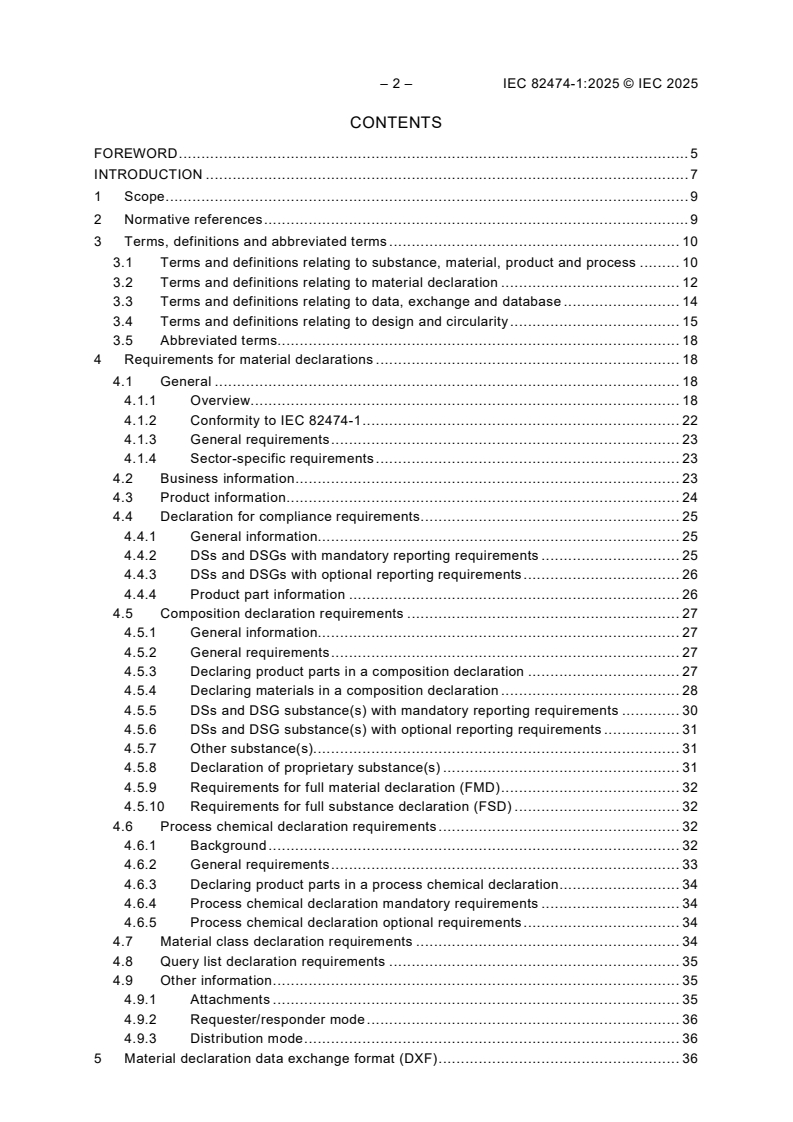
CONTENTS
FOREWORD . 5
INTRODUCTION . 7
1 Scope . 9
2 Normative references . 9
3 Terms, definitions and abbreviated terms . 10
3.1 Terms and definitions relating to substance, material, product and process . 10
3.2 Terms and definitions relating to material declaration . 12
3.3 Terms and definitions relating to data, exchange and database . 14
3.4 Terms and definitions relating to design and circularity . 15
3.5 Abbreviated terms. 18
4 Requirements for material declarations . 18
4.1 General . 18
4.1.1 Overview . 18
4.1.2 Conformity to IEC 82474-1 . 22
4.1.3 General requirements . 23
4.1.4 Sector-specific requirements . 23
4.2 Business information . 23
4.3 Product information . 24
4.4 Declaration for compliance requirements . 25
4.4.1 General information. 25
4.4.2 DSs and DSGs with mandatory reporting requirements . 25
4.4.3 DSs and DSGs with optional reporting requirements . 26
4.4.4 Product part information . 26
4.5 Composition declaration requirements . 27
4.5.1 General information. 27
4.5.2 General requirements . 27
4.5.3 Declaring product parts in a composition declaration . 27
4.5.4 Declaring materials in a composition declaration . 28
4.5.5 DSs and DSG substance(s) with mandatory reporting requirements . 30
4.5.6 DSs and DSG substance(s) with optional reporting requirements . 31
4.5.7 Other substance(s). 31
4.5.8 Declaration of proprietary substance(s) . 31
4.5.9 Requirements for full material declaration (FMD) . 32
4.5.10 Requirements for full substance declaration (FSD) . 32
4.6 Process chemical declaration requirements . 32
4.6.1 Background . 32
4.6.2 General requirements . 33
4.6.3 Declaring product parts in a process chemical declaration . 34
4.6.4 Process chemical declaration mandatory requirements . 34
4.6.5 Process chemical declaration optional requirements . 34
4.7 Material class declaration requirements . 34
4.8 Query list declaration requirements . 35
4.9 Other information . 35
4.9.1 Attachments . 35
4.9.2 Requester/responder mode . 36
4.9.3 Distribution mode . 36
5 Material declaration data exchange format (DXF) . 36
5.1 General . 36
5.2 Data exchange format (DXF). 37
5.3 Data exchange . 37
5.3.1 Two-way and one-way data exchange . 37
5.3.2 Data exchange specification in the IEC/ISO 82474 SDB . 37
5.3.3 Additional data exchange requirements . 38
5.3.4 Material declaration file . 38
5.4 Criteria for the maintenance of data exchange format . 39
6 Requirements and guidance for developing reference lists for declarations . 39
6.1 General . 39
6.2 Material declarations and their reference lists . 39
6.3 Reference lists development and maintenance . 41
6.4 Additional reference lists . 41
7 Cross-sector material class list content . 42
7.1 General . 42
7.2 Material class criteria . 42
7.3 Material classification structure . 42
8 IEC/ISO 82474 web services for data exchange communication . 43
8.1 General . 43
8.2 Reference forum standards . 44
8.3 Information exchange service . 45
9 IEC/ISO 82474 SDB content and maintenance . 45
9.1 General . 45
9.2 IEC/ISO 82474 SDB update process . 46
9.3 Maintenance of material declaration data exchange format (DXF) . 46
9.4 Maintenance of reference list exchange formats (RLXF) . 47
9.5 Maintenance of IEC/ISO 82474 web services . 47
9.6 Maintenance of IEC/ISO 82474 CBI substance identification list . 47
9.7 Common data dictionary (CDD) update . 48
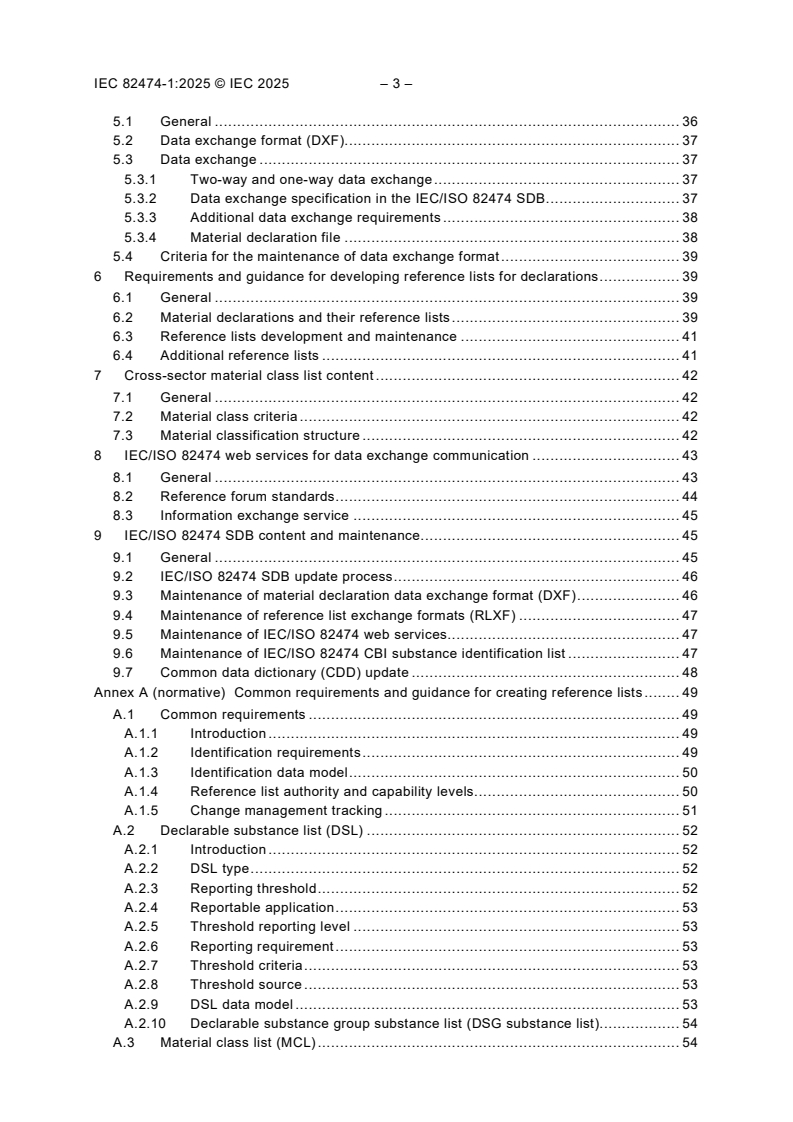
Annex A (normative) Common requirements and guidance for creating reference lists . 49
A.1 Common requirements . 49
A.1.1 Introduction . 49
A.1.2 Identification requirements . 49
A.1.3 Identification data model . 50
A.1.4 Reference list authority and capability levels . 50
A.1.5 Change management tracking . 51
A.2 Declarable substance list (DSL) . 52
A.2.1 Introduction . 52
A.2.2 DSL type . 52
A.2.3 Reporting threshold . 52
A.2.4 Reportable application . 53
A.2.5 Threshold reporting level . 53
A.2.6 Reporting requirement . 53
A.2.7 Threshold criteria . 53
A.2.8 Threshold source . 53
A.2.9 DSL data model . 53
A.2.10 Declarable substance group substance list (DSG substance list). 54
A.3 Material class list (MCL) . 54
– 4 – IEC 82474-1:2025 © IEC 2025
A.3.1 General. 54
A.3.2 MCL data model . 55
A.4 Query list (QL). 56
A.4.1 General. 56
A.4.2 QL data model . 56
A.5 Product category list (PCL) . 56
A.6 Exemption list (EL) . 57
A.7 Application list (AL) . 57
A.8 Use descriptor list (UDL) . 57
Bibliography . 58
Figure 1 – IEC 82474-1 material declaration structure and process. 8
Figure 2 – Concept diagram of a reused part . 17
Figure 3 – Material declaration capabilities . 19
Figure 4 – Requirements for declaration for compliance versus composition declaration . 20
Figure 5 – Conceptual diagram of the data model for a declaration for compliance . 20
Figure 6 – Conceptual diagram of the data model for a composition declaration . 21
Figure 7 – Conceptual diagram of the data model for a process chemical declaration . 21
Figure 8 – Conceptual diagram of the data model for a material class declaration . 22
Figure 9 – Conceptual diagram of the data model for a query list declaration . 22
Figure 10 – Abstract from developer's table for the "response" data element . 38
Figure 11 – XML schema for the "Response" data element . 38
Figure 12 – UML representation of material declaration and its reference lists . 41
Figure 13 – Material classification structure. 43
Figure A.1 – Identification data model . 50
Figure A.2 – Authority data model . 51
Figure A.3 – Change management data model . 52
Figure A.4 – DSL data model . 54
Figure A.5 – MCL data model . 55
Figure A.6 – QL data model . 56
INTERNATIONAL ELECTROTECHNICAL COMMISSION
____________
MATERIAL DECLARATION –
Part 1: General requirements
FOREWORD
1) The International Electrotechnical Commission (IEC) is a worldwide organization for standardization comprising
all national electrotechnical committees (IEC National Committees). The object of IEC is to promote international
co-operation on all questions concerning standardization in the electrical and electronic fields. To this end and
in addition to other activities, IEC publishes International Standards, Technical Specifications, Technical Reports,
Publicly Available Specifications (PAS) and Guides (hereafter referred to as "IEC Publication(s)"). Their
preparation is entrusted to technical committees; any IEC National Committee interested in the subject dealt with
may participate in this preparatory work. International, governmental and non-governmental organizations liaising
with the IEC also participate in this preparation. IEC collaborates closely with the International Organization for
Standardization (ISO) in accordance with conditions determined by agreement between the two organizations.
2) The formal decisions or agreements of IEC on technical matters express, as nearly as possible, an international
consensus of opinion on the relevant subjects since each technical committee has representation from all
interested IEC National Committees.
3) IEC Publications have the form of recommendations for international use and are accepted by IEC National
Committees in that sense. While all reasonable efforts are made to ensure that the technical content of IEC
Publications is accurate, IEC cannot be held responsible for the way in which they are used or for any
misinterpretation by any end user.
4) In order to promote international uniformity, IEC National Committees undertake to apply IEC Publications
transparently to the maximum extent possible in their national and regional publications. Any divergence between
any IEC Publication and the corresponding national or regional publication shall be clearly indicated in the latter.
5) IEC itself does not provide any attestation of conformity. Independent certification bodies provide conformity
assessment services and, in some areas, access to IEC marks of conformity. IEC is not responsible for any
services carried out by independent certification bodies.
6) All users should ensure that they have the latest edition of this publication.
7) No liability shall attach to IEC or its directors, employees, servants or agents including individual experts and
members of its technical committees and IEC National Committees for any personal injury, property damage or
other damage of any nature whatsoever, whether direct or indirect, or for costs (including legal fees) and
expenses arising out of the publication, use of, or reliance upon, this IEC Publication or any other IEC
Publications.
8) Attention is drawn to the Normative references cited in this publication. Use of the referenced publications is
indispensable for the correct application of this publication.
9) IEC draws attention to the possibility that the implementation of this document may involve the use of (a)
patent(s). IEC takes no position concerning the evidence, validity or applicability of any claimed patent rights in
respect thereof. As of the date of publication of this document, IEC had not received notice of (a) patent(s), which
may be required to implement this document. However, implementers are cautioned that this may not represent
the latest information, which may be obtained from the patent database available at https://patents.iec.ch. IEC
shall not be held responsible for identifying any or all such patent rights.
IEC 82474-1 has been prepared by IEC technical committee 111, Environmental
standardization for electrical and electronic products and systems, and Subcommittee 1:
Environmental management systems, of ISO Technical Committee 207: Environmental
management. It is an International Standard.
This first edition leverages previous work done in IEC 62474 (Material declaration for products
of and for the electrotechnical industry), extending the application of the material declaration
standard across all products of any industry sector that falls under the ISO and IEC scopes.
This edition includes the following technical changes with respect to IEC 62474:2018 (edition 2):
a) Definitions were sharpened to fulfil needs from sectors other than electrical and electronic
products and systems and new terms have been added that support new topics introduced
such as webservice methods, material efficiency and circularity, and new reference list
types.
– 6 – IEC 82474-1:2025 © IEC 2025
b) A new subclause (4.6) covering process chemical declaration was included. This subclause
covers requirements related to the information required about process chemical substances,
the applicable processes where they are used, and the respective product life cycle
phase(s).
c) A new clause (8) covering web services on material declaration was included. This clause
covers requirements related to topics such as machine-machine communication,
authentication service, and data representation.
d) Requirements and guidance for the development of reference lists such as query list (QL),
and application/exemption lists (AL/EL) were included.
This document has been given the status of a horizontal document in accordance with ISO/IEC
Directives, Part 1.
The text of this International Standard is based on the following documents:
Draft Report on voting
111/778/FDIS 111/807/RVD
Full information on the voting for its approval can be found in the report on voting indicated in
the above table.
The language used for the development of this International Standard is English.
This document was drafted in accordance with ISO/IEC Directives, Part 2, and developed in
accordance with ISO/IEC Directives, Part 1 and ISO/IEC Directives, IEC Supplement, available
at www.iec.ch/members_experts/refdocs. The main document types developed by IEC are
described in greater detail at www.iec.ch/publications.
A list of all parts in the IEC 82474 series, published under the general title Material declaration,
can be found on the IEC website.
The committee has decided that the contents of this document will remain unchanged until the
stability date indicated on the IEC website under webstore.iec.ch in the data related to the
specific document. At this date, the document will be
• reconfirmed,
• withdrawn, or
• revised.
INTRODUCTION
This document benefits all industries by establishing requirements for reporting of
– substances and materials in products,
– material efficiency and circularity data,
– substances used in manufacturing and other stages of the product life cycle,
and by standardizing protocols, and facilitating the transfer, and processing of such data.
Material declarations are used by many industries to track and declare specific product
information used for compliance, the preparation of product (digital) passports and/or
environmentally conscious design (ECD) considerations. To simplify requirements across the
supply chain and to improve economic efficiencies, it is important to standardize the exchange
of product, product part, material, substance and process chemical data (including material
efficiency and circularity) and provide requirements within material declarations.
IEC 82474-1 consists of two parts: this document, which defines requirements for material
declarations, and a standard as database (SDB) which is a managed collection of information
containing the schema for data exchange format, the accompanying developer's table and other
useful information.
This document provides requirements and recommendations for the following material
declaration types:
1) Declaration for compliance – a summary declaration with reference to the declarable
substances and declarable substance groups within the declarable substance list (DSL).
The declaration for compliance provides aggregated data at the product level.
2) Composition declaration – a detailed declaration of individual materials and substances
contained in the product and product parts.
3) Process chemical declaration – a declaration of substances within a declarable substance
list used during manufacture or other product life cycle stages.
4) Material class declaration – a declaration of the types of materials (material classes) that
are present in a product.
5) Query list declaration – a declaration providing predetermined statements (queries) with
responses that are selected from a pre-defined set of choices (e.g. "True" and "False").
NOTE For the purpose of this document, product is the object of the declaration and can be a substance, material,
mixture, article or combination thereof.
IEC 82474-1 also contains requirements and guidance for the format of reference lists, such as
declarable substances lists.
IEC 82474-1 allows lists from different authorities to be used with the IEC/ISO 82474 data
exchange format.
EXAMPLE IEC 62474 DSL, automotive GADSL, aerospace AD-DSL.
The IEC/ISO 82474 SDB is maintained by a database maintenance team or SDB team (called
SDBT 82474 here) which updates information in the IEC/ISO 82474 SDB based on
requirements specified in the IEC 82474-1 standard. Other list authorities may have their own
maintenance teams, based on the rules of the specific list authority.
By fulfilling the requirements of IEC 82474-1 and based on the information from the
IEC/ISO 82474 SDB, five types of declarations can be created as mentioned above and as
shown in Figure 1.
– 8 – IEC 82474-1:2025 © IEC 2025
The transmission of information in the supply chain can be done in two modes (see Figure 1):
– Requester/responder mode: The requester's specific product information is included before
the material declaration request is sent to the responder. Requester determines the type of
material declaration(s) the responder will provide.
– Distribution mode: The responder provides material declaration data about their product(s)
to a recipient.
Figure 1 – IEC 82474-1 material declaration structure and process
The IEC 82474-1 declaration requirements and guidance are described in the following clauses:
– Clause 4 specifies requirements for material declarations.
– Clause 5 together with the IEC/ISO 82474 SDB specify the material declaration data
exchange format and requirements.
– Clause 6 specifies requirements and provides guidance for developing reference lists.
Additional specifications are given in Annex A.
– Clause 7 specifies requirements and provides guidance for developing cross-sector material
class list (MCL).
– Clause 8 specifies the web services on material declarations with additional specifications
in the IEC/ISO 82474 SDB.
– Clause 9 specifies the IEC/ISO 82474 SDB maintenance process.
MATERIAL DECLARATION –
Part 1: General requirements
1 Scope
This part of IEC 82474 specifies the requirements and guidance for the content, format and
exchange relating to material declarations for products.
The main intended use of this document is to provide data up and down the supply chain that:
– allows organizations to assess products against material and substance requirements,
– allows organizations to assess process chemical substances used in manufacturing and
other stages of the product life,
– allows organizations to use this information in their activities related to environmentally
conscious design process and across all product life cycle stages,
– allows organizations to obtain information about material efficiency and circularity of their
products.
This document specifies mandatory declaration requirements and also provides optional
declaration requirements.
This document does not suggest any specific software solution to capture material declaration
data in the supply chain. However, it provides a data format used to transfer information within
the supply chain. Organizations can determine the most appropriate method to capture material
declaration data without compromising data utility and quality. This document is intended to
allow declaration based on engineering judgement, responder (supplier) material declarations,
and/or sampling and testing.
This document has the status of a horizontal publication in accordance with IEC Guide 123:2025.
2 Normative references
The following documents are referred to in the text in such a way that some or all of their content
constitutes requirements of this document. For dated references, only the edition cited applies.
For undated references, the latest edition of the referenced document (including any
amendments) applies.
IEC/ISO 82474 SDB (standard as database)
OASIS webservice security policy (version 1.2) (http://docs.oasis-open.org/ws-sx/ws-
securitypolicy/200702)
W3C XML schema (http://www.w3.org/2001/xmlschema)
W3C webservice policy (http://www.w3.org/ns/ws-policy)
WSDL schema (http://schemas.xmlsoap.org/wsdl)
– 10 – IEC 82474-1:2025 © IEC 2025
3 Terms, definitions and abbreviated terms
For the purposes of this document, the following terms, definitions and abbreviated terms apply.
ISO and IEC maintain terminology databases for use in standardization at the following
addresses:
• IEC Electropedia: available at https://www.electropedia.org/
• ISO Online browsing platform: available at https://www.iso.org/obp
3.1 Terms and definitions relating to substance, material, product and process
3.1.1
formulation
mixture of ingredients prepared according to a formula
3.1.2
mixture
combination of two or more substances
[SOURCE: ISO/TS 23303:2020, 3.2.20, modified – the term "different" was removed from the
definition]
3.1.3
substance
chemical elements and their compounds in the natural state or obtained by any production
process, including any additive necessary to preserve the stability of the product and any
impurities deriving from the process used, but excluding any solvent which can be separated
without affecting the stability of the substance or changing its composition
[SOURCE: Globally Harmonized System of Classification and Labelling (GHS):2017, Chapter
1.2, definitions and abbreviations, modified – in the definition, the term "may" was replaced by
"can"]
3.1.4
intentionally added substance
substance used in one or more product life cycle stage(s) intended to give a particular property,
reaction or quality
Note 1 to entry: This does not include impurities, or unreacted residual substances.
3.1.5
substance group
two or more substances, that share at least one chemical sub-structure, or chemical or physical
property under a generic name
[SOURCE: IEC 60050-904:2014, 904-02-04, modified – in the definition "one or more" has been
replaced with "two or more" and "where in the case of multiple substances they" has been
replaced with "that"]
3.1.6
exemption
allowance for the use of regulated declarable substances or declarable substance groups above
their threshold(s) as defined in laws or regulations
3.1.7
material
matter of which an object is composed
3.1.8
homogeneous material
material of uniform composition throughout or a material, consisting of a combination of
materials, that cannot be disjointed or separated into different materials by mechanical actions
such as unscrewing, cutting, crushing, grinding and abrasive processes
[SOURCE: EU RoHS Directive 2011/65/EU, Article 3, modified – the term 'one' was removed
from the definition]
3.1.9
material class
material category
defined classification of materials that are established for purposes of inventorying aspects of
a product, such that no two classes contain the same material
Note 1 to entry: If a material falls under multiple material classes, such as copper zinc alloy which can fall under
copper and its alloys or zinc and its alloys, the substance with the largest mass within the material should take
precedence.
3.1.10
product
goods, service, or combination thereof
Note 1 to entry: For the purpose of this document, product is the object of the declaration and can be a substance,
material, mixture, article or combination thereof.
[SOURCE: ISO 14050:2020, 3.5.12, modified – in the definition, the term "any" was removed,
the term "combination thereof" was included, and Note 1 to entry was included]
3.1.11
product part
sub-unit of a product
Note 1 to entry: A product part can be a sub-unit of another product part.
Note 2 to entry: A product part can be a cable of 1 m length.
3.1.12
product family
group of products each of which contains the same substances or materials at a similar
concentration level
Note 1 to entry: A common case is products of the same material content that have different electrical values, such
as a capacitor, resistor, inductor or an integrated circuit.
3.1.13
article
object which during production is given a special shape, surface or design which determines its
function to a greater degree than does its chemical composition
[SOURCE: EU REACH Regulation (EC) No.1907/2006, Article 3]
– 12 – IEC 82474-1:2025 © IEC 2025
3.1.14
process chemical
chemical used in any process to make, maintain, or extend the life of a product
Note 1 to entry: Processes intended to make, maintain, or extend the life of a product include, but are not limited
to, manufacturing, installation, maintenance, repair, refurbishment, remanufacturing, and decommissioning.
Note 2 to entry: Process chemicals can be, for instance, monomers, intermediates, catalysts, reactants, mixtures,
or formulations.
Note 3 to entry: Chemicals used for non-product processes such as facility maintenance are not considered as
process chemicals.
Note 4 to entry: Product can include product parts.
3.1.15
process chemical substance
substance or substances within a process chemical
3.1.16
process name
name of a process within one or more stages of the product life cycle that
uses the process chemical object of the declaration
EXAMPLE 1 Examples of processes are cleaning, lubrication, corrosion protection treatment, etc.
EXAMPLE 2 Examples of a process used in multiple product life cycle stages is cleaning in manufacturing and
repair.
3.2 Terms and definitions relating to material declaration
3.2.1
declarable substance
DS
substance that meets specified criteria for reporting
Note 1 to entry: An example of criteria for declarable substances is specified in IEC 62474:2018, Clause 5.
3.2.2
declarable substance group
DSG
substance group that meets specified criteria for reporting
EXAMPLE Chromium (VI) compounds.
3.2.3
declarable substance list
DSL
list of declarable substances and/or declarable substance groups, each with a reporting
threshold for a reportable application(s), which has a mandatory or optional reporting
requirement when contained at or above its maximum threshold value within a product, product
part or material
3.2.4
declarable product part
product part that contains a declarable substance or declarable substance group for which a
requirement exists to identify the product part in which it is contained
3.2.5
DSG substance
substance included in a declarable substance group
3.2.6
DSG substance list
list of substances included in a declarable substance group
Note 1 to entry: The list of substances in the DSG substance list for a declarable substance group may or may not
be a complete or exhaustive list.
3.2.7
declaration hierarchy
tree-like structure containing one or more branches that represents the relationship between
product, product part(s), material(s) and/or substance(s) within a material declaration
EXAMPLE Figure 5 to Figure 9 are examples of declaration hierarchy.
3.2.8
material declaration
declaration of information related to substances and/or materials contained in a product, or
used in any process to make, maintain or extend the life of a product
Note 1 to entry: Processes intended to make, maintain or extend the life of a product include, but are not limited
to, manufacturing, repair, maintenance, refurbishment, remanufacturing and decommissioning.
Note 2 to entry: A material declaration includes other relevant information associated with the product (e.g. product
name).
Note 3 to entry: A material declaration includes information associated with the exchange of the material declaration
(e.g. business information such as responder contact information).
Note 4 to entry: Product can include product parts.
3.2.9
full material declaration
FMD
composition declaration whereby all materials are declared and all substances are declared or
otherwise represented by an anonymous identification
Note 1 to entry: Substances anonymously identified can be proprietary substances the responder retains as
confidential business information (CBI). The mass of all substances including those that are identified as anonymous
adds up to 100 % of the mass of the product.
3.2.10
full substance declaration
FSD
composition declaration whereby all substances and materials are declared and identified
Note 1 to entry: FSD is an FMD that does not include any anonymous identification of substances in the declaration.
3.2.11
declaration for compliance
declaration regarding the presence or absence of declarable substances and declarable
substance groups with mandatory reporting requirements in the declarable substance list
Note 1 to entry: The declaration is relative to a reporting threshold level for a defined reportable application.
3.2.12
composition declaration
quantitative declaration of substances contained within a product
3.2.13
process chemical declaration
declaration of information related to process chemicals
– 14 – IEC 82474-1:2025 © IEC 2025
3.2.14
material class declaration
quantitative declaration of information about the material classes associated with materials in
the product
3.2.15
query list declaration
qualitative declaration of responses to predetermined text statements in a query list
3.2.16
reportable application
intended use of a declarable substance or declarable substance group which determines its
relevance for disclosure
Note 1 to entry: The use of reportable applications can be applicable to declarable substances, declarable
substance groups, product parts and materials. Examples of product parts and materials are batteries, textiles, and
wood.
Note 2 to entry: As legislations have different scopes for some declarable substances, declarable substance
groups, product parts or materials, more than one reportable application may be provided in the DSL
3.2.17
reporting threshold level
concentration limit at or above which the presence of a declarable substance or declarable
substance group is declared
[SOURCE: IEC 60050-904:2014, 904-02-08, modified – in the definition the term "substance"
was replaced by "declarable substance or declarable substance group", and the terms "in a
product or product part" and sentence "if declaration of the substance is mandatory according
to the IEC 62474 database, or if it is agreed on to be declared" have been removed]
3.3 Terms and definitions relating to data, exchange and database
3.3.1
requester
organization or individual that requests a material declaration
3.3.2
responder
organization or individual that provides a material declaration
3.3.3
data dictionary
set of terms with respective identifiers formulated in a canonical syntax and with commonly
accepted definitions designed to yield a lexical or taxonomical framework for knowledge
representation in a computer interpretable form, which can be shared by different information
systems and communities
[SOURCE: IEC 62656-1:2014, 3.10]
3.3.4
data exchange format
DXF
data elements and attributes specified in a digital format represented by a schema and
developer's table to support a material declaration exchange
Note 1 to entry: Examples of digital formats are XML (defined by W3C) and JSON (specified in IETF RFC 7159).
3.3.5
list authority
designated owner of a list
Note 1 to entry: The list authority is used in conjunction with the list identity and list version.
3.3.6
list identity
parameter used to identify a specific list
Note 1 to entry: The list identity is used in conjunction with the list authority and list version.
3.3.7
list version
parameter used to identify a specific version of a list
Note 1 to entry: The list version is used in conjunction with the list authority and list identity.
3.3.8
SDB
standard as database
standard for which a valid form of publication is a database
Note 1 to entry: A standard as database can contain, in addition to the concepts (SK.3.1.2), non-normative
eq
...