

ISO 17607-5:2023
(Main)Steel structures — Execution of structural steelwork — Part 5: Welding
General Information
- Abstract
This document defines the general requirements for welding in the execution of structural steelwork as structures or as manufactured components in conjunction with ISO 17607-1. Additional requirements to be addressed in the execution of structural steelwork, as structures or as fabricated components, can be found in other parts of the ISO 17607 series.
- Status
- Published
- Publication Date
- 07-Dec-2023
- Technical Committee
- ISO/TC 167 - Steel and aluminium structures
- Drafting Committee
- ISO/TC 167/WG 3 - Execution of steel structures
- Current Stage
- 6060 - International Standard published
- Start Date
- 08-Dec-2023
- Due Date
- 11-Feb-2023
- Completion Date
- 08-Dec-2023

Overview
ISO 17607-5:2023 - "Steel structures - Execution of structural steelwork - Part 5: Welding" defines the general requirements for welding when executing structural steelwork, either as in-situ structures or as manufactured components, in conjunction with ISO 17607-1. It standardizes expectations for welding plans, processes, qualifications, execution, inspection and documentation to ensure safety, quality and interchangeability for projects built without a governing national/regional code.
Key topics and requirements
- Welding plan and documentation: requirements for preparing and recording a welding plan (content and implementation) and documents required to claim conformity.
- Welding processes and consumables: classification and appropriate use of welding consumables (electrodes, wires, fluxes, shielding gases) and covered processes including stud welding.
- Qualification: qualification of welding procedures and of welding personnel (welders, welding operators) and roles for welding coordination.
- Joint preparation and execution: joint design, tack welding, fillet and butt welds, branch connections in hollow sections, slot/plug welds, temporary attachments, preheating and post-weld heat treatment.
- Special materials and cases: welding of improved atmospheric corrosion-resistant steels, dissimilar steels, and bridge orthotropic decks.
- Inspection, testing and acceptance: inspection after welding, non-destructive testing (NDT) methods, production tests, acceptance criteria including routine, seismic and fatigue considerations, and nonconformity assessment.
- Conformity and execution levels: requirements for declarations of conformity and annexed guidance on execution levels, welded joints in hollow sections, and selection of weld inspection classes.
Applications and practical value
- Ensures consistent, auditable welding quality across fabrication shops and construction sites.
- Reduces trade barriers by offering a common framework for projects lacking a national standard.
- Guides specification writers, engineers and contractors in preparing welding plans, selecting welding procedures and assessing inspection regimes.
- Supports quality assurance and compliance for structural steelwork used in buildings, bridges, industrial structures and prefabricated steel components.
Who uses this standard
- Structural engineers, fabricators and erectors
- Welding coordinators, welding supervisors and certified welders
- Quality managers, inspectors and NDT personnel
- Project owners, procurement teams and certification bodies
Related standards (select)
- ISO 17607-1 to ISO 17607-6 (series on structural steelwork execution)
- ISO 3834 (quality requirements for fusion welding)
- ISO 5817 (weld quality levels)
- ISO 9606-1 (welder qualification)
- ISO 14731 (welding coordination)
- ISO 9712 (NDT personnel certification)
Keywords: ISO 17607-5:2023, welding standard, structural steelwork, welding plan, welding qualification, NDT inspection, welding consumables, weld acceptance criteria.
Relations
- Effective Date
- 16-Oct-2025
- Effective Date
- 24-Dec-2022
Get Certified
Connect with accredited certification bodies for this standard

DIBt (Deutsches Institut für Bautechnik)
German Institute for Building Technology.
DIN CERTCO
DIN Group product certification.
DVS-ZERT GmbH
German welding certification society.
Sponsored listings
Frequently Asked Questions
ISO 17607-5:2023 is a standard published by the International Organization for Standardization (ISO). Its full title is "Steel structures — Execution of structural steelwork — Part 5: Welding". This standard covers: This document defines the general requirements for welding in the execution of structural steelwork as structures or as manufactured components in conjunction with ISO 17607-1. Additional requirements to be addressed in the execution of structural steelwork, as structures or as fabricated components, can be found in other parts of the ISO 17607 series.
This document defines the general requirements for welding in the execution of structural steelwork as structures or as manufactured components in conjunction with ISO 17607-1. Additional requirements to be addressed in the execution of structural steelwork, as structures or as fabricated components, can be found in other parts of the ISO 17607 series.
ISO 17607-5:2023 is classified under the following ICS (International Classification for Standards) categories: 25.160.01 - Welding, brazing and soldering in general; 91.080.13 - Steel structures. The ICS classification helps identify the subject area and facilitates finding related standards.
ISO 17607-5:2023 has the following relationships with other standards: It is inter standard links to ISO 10721-2:1999/Cor 1:1999, ISO 10721-2:1999. Understanding these relationships helps ensure you are using the most current and applicable version of the standard.
ISO 17607-5:2023 is available in PDF format for immediate download after purchase. The document can be added to your cart and obtained through the secure checkout process. Digital delivery ensures instant access to the complete standard document.
Standards Content (Sample)
INTERNATIONAL ISO
STANDARD 17607-5
First edition
2023-12
Steel structures — Execution of
structural steelwork —
Part 5:
Welding
Structures en acier – Exécution des charpentes et ossatures en
acier —
Partie 5: Soudage
Reference number
© ISO 2023
All rights reserved. Unless otherwise specified, or required in the context of its implementation, no part of this publication may
be reproduced or utilized otherwise in any form or by any means, electronic or mechanical, including photocopying, or posting on
the internet or an intranet, without prior written permission. Permission can be requested from either ISO at the address below
or ISO’s member body in the country of the requester.
ISO copyright office
CP 401 • Ch. de Blandonnet 8
CH-1214 Vernier, Geneva
Phone: +41 22 749 01 11
Email: copyright@iso.org
Website: www.iso.org
Published in Switzerland
ii
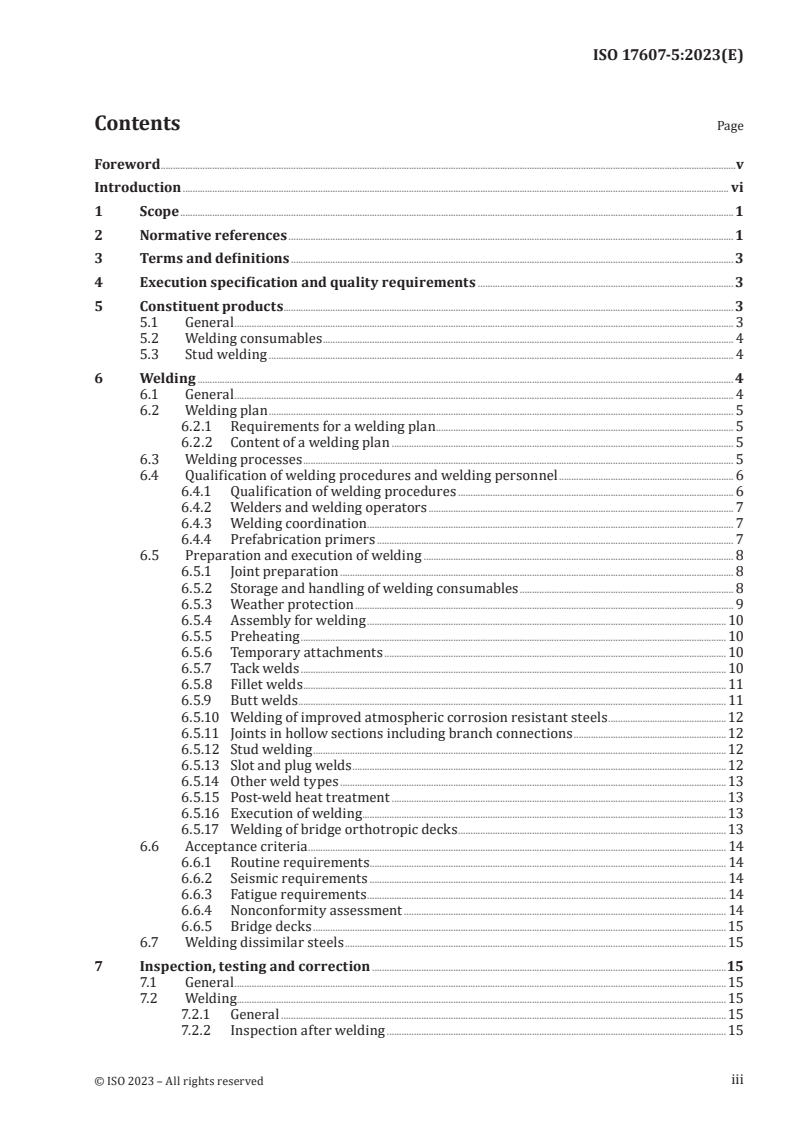
Contents Page
Foreword .v
Introduction . vi
1 Scope . 1
2 Normative references . 1
3 Terms and definitions . 3
4 Execution specification and quality requirements . 3
5 Constituent products . 3
5.1 General . 3
5.2 Welding consumables . 4
5.3 Stud welding . 4
6 Welding . 4
6.1 General . 4
6.2 Welding plan . 5
6.2.1 Requirements for a welding plan . 5
6.2.2 Content of a welding plan . 5
6.3 Welding processes . 5
6.4 Qualification of welding procedures and welding personnel . 6
6.4.1 Qualification of welding procedures . 6
6.4.2 Welders and welding operators . 7
6.4.3 Welding coordination . 7
6.4.4 Prefabrication primers . 7
6.5 Preparation and execution of welding . 8
6.5.1 Joint preparation . 8
6.5.2 Storage and handling of welding consumables . 8
6.5.3 Weather protection . 9
6.5.4 Assembly for welding . 10
6.5.5 Preheating . 10
6.5.6 Temporary attachments . 10
6.5.7 Tack welds . 10
6.5.8 Fillet welds . 11
6.5.9 Butt welds . 11
6.5.10 Welding of improved atmospheric corrosion resistant steels .12
6.5.11 Joints in hollow sections including branch connections .12
6.5.12 Stud welding .12
6.5.13 Slot and plug welds .12
6.5.14 Other weld types .13
6.5.15 Post-weld heat treatment . 13
6.5.16 Execution of welding . .13
6.5.17 Welding of bridge orthotropic decks . 13
6.6 Acceptance criteria . 14
6.6.1 Routine requirements . 14
6.6.2 Seismic requirements . 14
6.6.3 Fatigue requirements . 14
6.6.4 Nonconformity assessment . 14
6.6.5 Bridge decks . 15
6.7 Welding dissimilar steels .15
7 Inspection, testing and correction .15
7.1 General . 15
7.2 Welding . . 15
7.2.1 General .15
7.2.2 Inspection after welding . 15
iii
7.2.3 Inspection and testing of welded shear studs for composite steel and
concrete structures . 19
7.2.4 Inspection and testing of welding of reinforcing steel . 19
7.2.5 Production tests on welding . 19
8 Documents required to claim conformity to this document .20
8.1 General . 20
8.2 Declaration of conformity . 20
Annex A (normative) Additional information, list of options and requirements related to
the execution levels.21
Annex B (informative) Welded joints in hollow sections.25
Annex C (informative) Guidance on the selection of weld inspection classes (WICs) .37
Annex D (informative) Minimum ambient temperatures for the welding of field joints of
building structures (Russian Federation) .40
Bibliography .41
iv
Foreword
ISO (the International Organization for Standardization) is a worldwide federation of national standards
bodies (ISO member bodies). The work of preparing International Standards is normally carried out
through ISO technical committees. Each member body interested in a subject for which a technical
committee has been established has the right to be represented on that committee. International
organizations, governmental and non-governmental, in liaison with ISO, also take part in the work.
ISO collaborates closely with the International Electrotechnical Commission (IEC) on all matters of
electrotechnical standardization.
The procedures used to develop this document and those intended for its further maintenance are
described in the ISO/IEC Directives, Part 1. In particular, the different approval criteria needed for the
different types of ISO documents should be noted. This document was drafted in accordance with the
editorial rules of the ISO/IEC Directives, Part 2 (see www.iso.org/directives).
ISO draws attention to the possibility that the implementation of this document may involve the use
of (a) patent(s). ISO takes no position concerning the evidence, validity or applicability of any claimed
patent rights in respect thereof. As of the date of publication of this document, ISO had not received
notice of (a) patent(s) which may be required to implement this document. However, implementers are
cautioned that this may not represent the latest information, which may be obtained from the patent
database available at www.iso.org/patents. ISO shall not be held responsible for identifying any or all
such patent rights.
Any trade name used in this document is information given for the convenience of users and does not
constitute an endorsement.
For an explanation of the voluntary nature of standards, the meaning of ISO specific terms and
expressions related to conformity assessment, as well as information about ISO's adherence to
the World Trade Organization (WTO) principles in the Technical Barriers to Trade (TBT), see
www.iso.org/iso/foreword.html.
This document was prepared by Technical Committee ISO/TC 167, Steel and aluminium structures.
This first edition cancels and replaces ISO 10721-2:1999, which has been technically revised.
A list of all parts in the ISO 17607 series can be found on the ISO website.
Any feedback or questions on this document should be directed to the user’s national standards body. A
complete listing of these bodies can be found at www.iso.org/members.html.
v
Introduction
Specific requirements for the achievement of structures that are optimal with respect to safety, the
state of the economy, development and general values of a nation are given in the appropriate regional
or national standards, if they exist.
Many nations do not have their own standards for structural steelwork. Some reference other national
or regional standards. Some permit the project’s standard to be selected by the owner, designer or
constructor of the structure. Some do not require any standards to be followed.
The ISO 17607 series of standards on the execution of structural steelwork was developed to serve
as a means to provide a set of requirements and guidance for projects that are constructed without a
governing regional or national standard. The ISO 17607 series can also serve to reduce trade barriers.
Additional requirements to be addressed in the execution of structural steelwork, as structures or as
fabricated components, can be found in the other parts of the series:
— ISO 17607-1 (General requirements and terms and definitions);
— ISO 17607-2 (Steels);
— ISO 17607-3 (Fabrication);
— ISO 17607-4 (Erection);
— ISO 17607-6 (Bolting).
vi
INTERNATIONAL STANDARD ISO 17607-5:2023(E)
Steel structures — Execution of structural steelwork —
Part 5:
Welding
1 Scope
This document defines the general requirements for welding in the execution of structural steelwork as
structures or as manufactured components in conjunction with ISO 17607-1.
Additional requirements to be addressed in the execution of structural steelwork, as structures or as
fabricated components, can be found in other parts of the ISO 17607 series.
2 Normative references
The following documents are referred to in the text in such a way that some or all of their content
constitutes requirements of this document. For dated references, only the edition cited applies. For
undated references, the latest edition of the referenced document (including any amendments) applies.
ISO 636, Welding consumables — Rods, wires and deposits for tungsten inert gas welding of non-alloy and
fine-grain steels — Classification
ISO 2560, Welding consumables — Covered electrodes for manual metal arc welding of non-alloy and fine
grain steels — Classification
ISO 3452-1, Non-destructive testing — Penetrant testing — Part 1: General principles
ISO 3834 (all parts), Quality requirements for fusion welding of metallic materials
ISO 4063, Welding, brazing, soldering and cutting — Nomenclature of processes and reference numbers
ISO 5817:2023, Welding — Fusion-welded joints in steel, nickel, titanium and their alloys (beam welding
excluded) — Quality levels for imperfections
ISO 6520-1, Welding and allied processes — Classification of geometric imperfections in metallic materials
— Part 1: Fusion welding
ISO 9606-1, Qualification testing of welders — Fusion welding — Part 1: Steels
ISO 9712, Non-destructive testing — Qualification and certification of NDT personnel
ISO 10474, Steel and steel products — Inspection documents
ISO 13588, Non-destructive testing of welds — Ultrasonic testing — Use of automated phased array
technology
ISO 13916, Welding — Measurement of preheating temperature, interpass temperature and preheat
maintenance temperature
ISO 13918, Welding — Studs and ceramic ferrules for arc stud welding
ISO 14171, Welding consumables — Solid wire electrodes, tubular cored electrodes and electrode/flux
combinations for submerged arc welding of non alloy and fine grain steels — Classification
ISO 14174, Welding consumables — Fluxes for submerged arc welding and electroslag welding —
Classification
ISO 14175, Welding consumables — Gases and gas mixtures for fusion welding and allied processes
ISO 14341, Welding consumables — Wire electrodes and weld deposits for gas shielded metal arc welding of
non alloy and fine grain steels — Classification
ISO 14555, Welding — Arc stud welding of metallic materials
ISO 14731, Welding coordination — Tasks and responsibilities
ISO 14732, Welding personnel — Qualification testing of welding operators and weld setters for mechanized
and automatic welding of metallic materials
ISO 15607, Specification and qualification of welding procedures for metallic materials — General rules
ISO 15610, Specification and qualification of welding procedures for metallic materials — Qualification
based on tested welding consumables
ISO 15611, Specification and qualification of welding procedures for metallic materials — Qualification
based on previous welding experience
ISO 15612, Specification and qualification of welding procedures for metallic materials — Qualification by
adoption of a standard welding procedure specification
ISO 15613, Specification and qualification of welding procedures for metallic materials — Qualification
based on pre-production welding test
ISO 15614-1, Specification and qualification of welding procedures for metallic materials — Welding
procedure test — Part 1: Arc and gas welding of steels and arc welding of nickel and nickel alloys
ISO 16371-1, Non-destructive testing — Industrial computed radiography with storage phosphor imaging
plates — Part 1: Classification of systems
ISO 16371-2, Non-destructive testing — Industrial computed radiography with storage phosphor imaging
plates — Part 2: General principles for testing of metallic materials using X-rays and gamma rays
ISO 16834, Welding consumables — Wire electrodes, wires, rods and deposits for gas shielded arc welding
of high strength steels — Classification
ISO 17607-1, Steel structures — Execution of structural steelwork— Part 1: General requirements and
vocabulary
ISO 17660-1, Welding — Welding of reinforcing steel — Part 1: Load-bearing welded joints
ISO 17660-2, Welding — Welding of reinforcing steel — Part 2: Non load-bearing welded joints
ISO 17632, Welding consumables — Tubular cored electrodes for gas shielded and non-gas shielded metal
arc welding of non-alloy and fine grain steels — Classification
ISO 17635:2016, Non-destructive testing of welds — General rules for metallic materials
ISO 17637, Non-destructive testing of welds — Visual testing of fusion-welded joints
ISO 17638, Non-destructive testing of welds — Magnetic particle testing
ISO 17640, Non-destructive testing of welds — Ultrasonic testing — Techniques, testing levels, and
assessment
ISO 17652-1, Welding — Test for shop primers in relation to welding and allied processes — Part 1: General
requirements
ISO 17652-2, Welding — Test for shop primers in relation to welding and allied processes — Part 2: Welding
properties of shop primers
ISO 18275, Welding consumables — Covered electrodes for manual metal arc welding of high-strength
steels — Classification
ISO 18276, Welding consumables — Tubular cored electrodes for gas-shielded and non-gas-shielded metal
arc welding of high strength steels — Classification
ISO 23279, Non-destructive testing of welds — Ultrasonic testing — Characterization of discontinuities in
welds
ISO 26304, Welding consumables — Solid wire electrodes, tubular cored electrodes and electrode-flux
combinations for submerged arc welding of high strength steels — Classification
IIW-2259-15, Recommendations for Fatigue Design of Welded Joints and Components
3 Terms and definitions
For the purposes of this document, the terms and definitions given in ISO 17607-1 apply.
ISO and IEC maintain terminology databases for use in standardization at the following addresses:
— ISO Online browsing platform: available at https:// www .iso .org/ obp
— IEC Electropedia: available at https:// www .electropedia .org/
4 Execution specification and quality requirements
National standards and documents that provide technically equivalent conditions may be used, in
whole or in part, in place of referenced ISO standards or requirements of this document. In these cases,
the technically equivalent national standards and documents, and deviations from the requirements of
this document, shall be referenced in the execution specification.
The necessary information and technical requirements for execution of each part of the structural
steelwork shall be agreed upon and complete before commencement of execution of that part of the
structural steelwork. There shall be procedures for making alterations to a previously agreed execution
specification.
The execution specification shall consider the following items in Annex A as relevant:
a) additional information, see A.1;
b) options, see A.2;
c) requirements related to execution levels (EXL), see A.3;
5 Constituent products
5.1 General
See ISO 17607-1.
The inspection documents for welding consumables, except for shielding gases, shall be Type 2.2 in
accordance with ISO 10474.
For shielding gases, the inspection document shall be a document issued by the manufacturer declaring
that the products supplied conform with the specified requirements of the order, without test results.
5.2 Welding consumables
Welding consumables shall be in accordance with Table 1, or, if applicable, the requirements of the
national standard or documents.
The type of welding consumables shall be appropriate to the welding process, the material to be welded
and the welding procedure.
When welding improved atmospheric corrosion resistant steel, welding consumables shall be selected
that will produce welds with atmospheric corrosion resistance at least equivalent to the parent metal.
The execution specification shall specify if colour matching is required.
NOTE Selection of welding consumables can be based on welding consumable manufacturer
recommendations, steel manufacturer recommendations or the appropriate product standard.
Table 1 — Standards for welding consumables
Welding consumables Product standard
Shielding gases for arc welding and cutting ISO 14175
Wire electrodes and deposits for gas-shielded metal arc welding of non-alloy and fine ISO 14341
grain steels
Solid wires, solid wire-flux and tubular cored electrode-flux combinations for sub- ISO 14171
merged arc welding of non-alloy and fine grain steels.
Covered electrodes for manual arc welding of high strength steels ISO 18275
Tubular cored electrodes for metal arc welding with and without gas shield of non-alloy ISO 17632
and fine grain steels
Fluxes for submerged arc welding ISO 14174
Rods, wires and deposits for tungsten inert gas welding of non-alloy and fine grain steels ISO 636
Covered electrodes for manual arc welding of non-alloy and fine grain steels ISO 2560
Wire electrodes, wires, rods and deposits for gas-shielded arc welding of high strength ISO 16834
steels
Wire and tubular cored electrodes and electrode-flux combinations for submerged arc ISO 26304
welding of high strength steels
Tubular cored electrodes for gas shielded metal arc welding of high strength steels ISO 18276
5.3 Stud welding
Studs and ceramic ferrules shall be in accordance with ISO 13918.
The inspection documents for studs shall be Type 3.1 in accordance with ISO 10474.
6 Welding
6.1 General
Welding shall be undertaken in accordance with the relevant part of the ISO 3834 series or, if applicable,
the requirements of the national standard or documents.
NOTE Guidelines for implementation of the ISO 3834 series on quality requirements for fusion welding of
metallic materials are given in ISO/TR 3834-6.
The welding of reinforcing steel to structural steel shall be performed in accordance with the
recommendations given in ISO 17660-1 and ISO 17660-2.
In accordance with the execution level (EXL), the following parts of the ISO 3834 series apply:
— EXL1: ISO 3834-4, Elementary quality requirements;
— EXL2: ISO 3834-3, Standard quality requirements;
— EXL3 and EXL4: ISO 3834-2, Comprehensive quality requirements.
NOTE See ISO 17607-1 for information on execution levels.
6.2 Welding plan
6.2.1 Requirements for a welding plan
A welding plan shall be provided as part of the production planning required by the relevant part of the
ISO 3834 series.
6.2.2 Content of a welding plan
For EXL1, the welding plan shall be in accordance with ISO 3834-4.
For EXL2, EXL3 and EXL4, the welding plan shall include as relevant:
a) the welding procedure specifications;
b) measures to be taken to minimize distortion during and after welding, including details of
restraints to be applied;
c) the sequence of welding with any restrictions or acceptable locations for start and stop positions,
including intermediate stop and start positions where joint geometry is such that welding cannot
be executed continuously;
d) requirements for intermediate checking of the welding activities;
e) turning of components in the welding process, in connection with the sequence of welding;
f) measures to control heat input and prevent local hardness issues;
g) measures to be taken to avoid lamellar tearing;
h) treatment and handling of welding consumables (storage, low hydrogen, conditioning);
i) requirements for acceptance criteria of welds in accordance with 6.6;
j) requirements for inspection and test plan in accordance with 7.2;
k) requirements for weld identification;
l) requirements for welding through coatings.
If welding or assembly overlaps or masks previous welds, special consideration shall be given
concerning which welds are to be executed first and the possible need to inspect or test a weld before
the second weld is executed or before masking components are assembled.
If there are welding requirements related to fatigue or seismic detail categories, these shall be included
in the execution specification.
If there are specific requirements related to the inspection, maintenance, and repair of welding
equipment, these shall be included in the execution specification.
6.3 Welding processes
Welding shall be performed using the welding processes as defined in ISO 4063, or as permitted by the
execution specification.
6.4 Qualification of welding procedures and welding personnel
6.4.1 Qualification of welding procedures
6.4.1.1 General
Welding shall be carried out using qualified welding procedure specifications (WPS) in accordance
with Table 2. The method of qualification of the WPS depends on the execution level, the parent metal
and the degree of mechanization.
The specification and qualification of welding procedures shall be in accordance with ISO 15607.
Although there are no specific requirements for welding procedure specifications to ISO 15607 in
ISO 3834-4, the execution specification may specify that, for EXL1, appropriate work instructions that
specify the welding process, consumables and welding parameters to be used shall be provided.
Specific conditions for tack welds shall be included in the WPS.
For joints in hollow section lattice structures, the WPS shall define the start and stop zones and the
method to be used to address locations where the welds change from a fillet weld to butt around a joint.
6.4.1.2 Qualification to ISO 15613 or ISO 15614-1
The following conditions apply when qualifying WPSs are in accordance with ISO 15613 or ISO 15614-1
(see also Table 2):
a) If impact tests are specified, they shall be carried out at the lowest temperature required for impact
testing of the material qualities being joined.
b) For quenched and tempered steels, one specimen for micro-examination is necessary. Photographs
of weld metal, fusion line zone and HAZ shall be recorded. Microcracks are not permitted.
NOTE Information on microcracks can be found in ISO 5817.
c) If welding on prefabrication primers, tests shall be carried out on the maximum (nominal +
tolerance) accepted layer thickness.
Table 2 — Methods of qualification of welding procedures
Method of qualification ISO standard EXL2 EXL3 EXL4
ISO 15614-1
ISO 14555
Welding procedure test X X X
ISO 17660-1
ISO 17660-2
ISO 15613
ISO 14555
Pre-production welding test X X X
ISO 17660-1
ISO 17660-2
a a
Standard welding procedure ISO 15612 X X X
ISO 15611
Previous welding experience
X – –
ISO 14555
Tested welding consumables ISO 15610
TTabablele 2 2 ((ccoonnttiinnueuedd))
Method of qualification ISO standard EXL2 EXL3 EXL4
Key
X = Permitted
A dash (–) = Not permitted
a
If permitted by the execution specification.
6.4.1.3 Validity of a welding procedure qualification
The validity of a welding procedure depends on the requirements of the standard used for the
qualification.
6.4.2 Welders and welding operators
Welders (including personnel undertaking tack welding) shall be qualified in accordance with
ISO 9606-1 and welding operators in accordance with ISO 14732 or other standards that provide
equivalent technical conditions.
Welders of reinforcing steel shall be qualified in accordance with ISO 17660-1 or ISO 17660-2.
Welders of a hollow section branch connection with angles less than 60° shall be qualified in accordance
with ISO 9606-1, or other standards that provide equivalent technical conditions, and as follows, unless
otherwise specified:
a) test piece dimensions, weld details and welding positions shall be typical of those used in
production;
b) for welding of circular onto circular hollow sections, test pieces for examination shall be taken
from each of the four positions A, B, C and D shown in Figures B.2 and B.3 in Annex B;
Records of all welder and welding operator qualification tests shall be retained.
6.4.3 Welding coordination
For EXL2, EXL3 and EXL4, welding coordination shall be maintained during the execution of welding by
welding coordination personnel suitably qualified for and experienced in the welding operations they
supervise as specified in ISO 14731.
The technical knowledge of welding coordination personnel for welding reinforcement steel shall be in
accordance with ISO 17660-1.
6.4.4 Prefabrication primers
Prefabrication primers shall demonstrate their weldability according to ISO 17652-1 and ISO 17652-2.
The welding procedure is qualified if the imperfections in the test piece are within the specified limits
of quality level B according to ISO 5817 except for porosity which shall be as follows:
a) no linear porosity (cluster of porosity with distance between pores ≤ diameter of pores);
b) 8 % maximum as required in ISO 5817:2023, Annex A for components generally, or 4 % maximum
for components specified as being subject to fatigue.
6.5 Preparation and execution of welding
6.5.1 Joint preparation
6.5.1.1 General
The joint preparation shall be appropriate for the welding process. Tolerances for joint preparations
and fit-up shall be given in the WPSs.
If cope holes are provided to ensure accessibility, they shall have a minimum radius of 40 mm unless
otherwise specified.
NOTE 1 ISO 9692-1 and ISO 9692-2 provide some recommended weld preparation details.
The joint preparation shall be free from visible cracks. For steel grades with yield strengths higher than
460 MPa, cut areas shall be descaled by grinding, and verified to be free from cracks by VT, PT or MT.
Visible cracks shall be removed by grinding and the joint geometry, corrected, as necessary.
If large notches or other errors in joint geometry are corrected by welding, a qualified procedure shall
be used, and the area shall be subsequently ground smooth and feathered into the adjacent surface
without abrupt changes in contour.
All surfaces to be welded shall be free from material (e.g. rust, organic material, galvanizing) that would
adversely affect the quality of the welds or impede the process of welding.
Prefabrication primers may be left on the fusion faces only if they do not adversely affect the welding
process. For EXL2, EXL3 and EXL4, prefabrication primers shall not be left on the fusion faces, unless
welding procedure tests in accordance with ISO 15614-1 or ISO 15613 have been completed using such
prefabrication primers.
NOTE 2 ISO 17652-2 describes tests for assessing the influence of prefabrication and shop primers on
weldability.
6.5.1.2 Hollow sections
For hollow sections being used as branch components in welded joints, the fit-up of the joint geometry
shall suit the requirements of the WPS. Branch joints between circular hollow sections may be cut in
straight segments to prepare them for interconnection at saddle joints.
Annex B illustrates branch joints between circular hollow sections.
For branch connections in hollow section lattice structures, any adjustment for lack of fit by a welded
surface deposit shall be covered by a suitable welding procedure.
6.5.2 Storage and handling of welding consumables
6.5.2.1 General
Welding consumables shall be stored, handled and used in accordance with the manufacturer’s
recommendations. See also 6.5.2.2.
After consumables have been removed from their original packages, they shall be protected or stored
in accordance with the manufacturer’s recommendations so that their specified properties and welding
characteristics are not adversely affected.
Consumables that have not been stored in dry conditions, kept free from rust, oil, grease or other
foreign materials or that have been wet shall be discarded.
Welding consumables showing signs of damage or deterioration shall be discarded.
If electrodes and fluxes need to be dried and stored, appropriate temperature levels and times shall be
fulfilled in accordance with the manufacturer’s recommendations.
NOTE Examples of damage or deterioration include cracked or flaked coatings on covered electrodes, rusty
or dirty electrode wires and electrode wires with flaked or damaged copper coatings.
6.5.2.2 Coated electrodes for manual metal arc welding and fluxes with specific controlled
hydrogen properties
Coated electrodes for manual metal arc welding (ISO 4063 process 111) and fluxes with specific
controlled hydrogen properties shall be stored in accordance with the welding consumable
manufacturer’s recommendations.
If no recommendations are available for welding electrodes, baking and storage shall be in accordance
with Table 3.
Table 3 — Temperature and time for baking and storage of coated electrodes
(ISO 4063 process 111)
Condition Temperature level
Time
T
t
°C
260 < T ≤ 370 2 h min.
a
Baking
370 < T ≤ 430 1 h min.
a
Storage ≥ 150 prior to welding
b
Storage ≥ 100 during welding
a
Fixed oven.
b
Portable quiver.
Immediately after being removed from their original packages, coated electrodes shall be stored in
ovens in accordance with the electrode manufacturer’s recommendations.
If the original packaging shows evidence of damage, electrodes shall be baked in accordance with the
electrode manufacturer’s recommendations.
Consumables remaining unused at the end of the welding shift shall be baked in accordance with the
electrode manufacturer’s recommendations.
For coated electrodes, baking shall be carried out no more than twice. Unused coated consumables that
have been baked twice shall be discarded if unused at the end of the welding shift.
6.5.3 Weather protection
The welder, the consumables and the working area shall be adequately protected against the effects of
wind, rain and snow.
Gas shielded welding processes are particularly sensitive to wind effects. Typically, wind velocity in the
vicinity of the weld should be a maximum of 2 m/s (8 km/h).
Surfaces to be welded shall be maintained dry and free from condensation.
When the base metal temperature is below 0 °C, the base metal shall be preheated to at least 10 °C and
this minimum temperature maintained during welding.
Welding shall not be done when the ambient temperature is lower than –20 °C, except with the express
consent of the constructor’s welding coordinator.
NOTE Alternative minimum ambient temperatures for field welding are described in Annex D.
6.5.4 Assembly for welding
Components to be welded shall be brought into alignment and held in position by tack welds or external
devices and maintained during initial welding. Assembly shall be carried out such that the fit-up of
joints and the final dimensions of the components are all within the specified tolerances. Suitable
allowances shall be made for distortion and shrinkage.
The components to be welded shall be assembled and held in position such that the joints to be welded
are readily accessible and easily visible to the welder and inspection personnel.
Assembly of hollow section components to be welded should be in accordance with the guidance given
in Annex B, as either appropriate or unless specified in the execution specification, or both.
Changes to the welding details or the addition of welds not shown on the fabrication drawing shall
be approved prior to welding. Methods of locally strengthening a welded joint in a hollow section
lattice structure should facilitate the testing of the integrity of the as-welded joint. The alternative of
thickening the component should also be considered.
6.5.5 Preheating
Preheating shall be carried out in accordance with ISO 13916 and ISO/TR 17671-2.
Preheat shall be undertaken in accordance with applicable WPS and applied during welding, including
tack welding and the welding of temporary attachments.
6.5.6 Temporary attachments
If the assembly or erection procedure requires the use of components temporarily attached by welds,
they shall be positioned such that they can easily be removed without damage to the permanent
steelwork. All welds for temporary attachments shall be made in accordance with an established WPS.
Any areas where welding of temporary attachments is not permitted shall be specified.
Any restrictions on the use of temporary attachments for EXL3 and EXL4 shall be specified in the
execution specification.
The removal of temporary welded attachments by cutting, gouging or chipping shall be carried out in
such a way that the parent metal is not damaged and shall subsequently be carefully ground smooth
without abrupt changes in contour.
The removal locations shall be visually inspected and, for steel grades with yield strengths greater
than or equal to 355 MPa, the locations shall be subjected to visually enhanced NDT, i.e. MT or PT.
Chipping and gouging are not permitted on steel grades with yield strengths greater than or equal to
460 MPa or on components subject to fatigue, unless otherwise specified.
6.5.7 Tack welds
For EXL2, EXL3 and EXL4, tack welds shall be made using a qualified welding procedure. The minimum
length of the tack shall be the lesser of four times the thickness of the thicker part or 50 mm, unless a
shorter length can be demonstrated as satisfactory by test.
Tack welds that are incorporated into the final weld shall have a suitable shape and be free from defects
and be cleaned thoroughly before final welding.
Tack welds that are not incorporated into final welds shall be removed unless otherwise specified in
the execution specification.
Tack welds containing defects, including cracks, shall be removed.
6.5.8 Fillet welds
Fillet welds, as deposited, shall not be less than the specified dimensions for either throat thickness or
leg length, or both, as appropriate, taking into account that:
a) the specified throat thickness is achievable using WPSs for deep or partial penetration welding
processes;
The control of heat input is critical and should be considered in developing the WPS.
b) if the gap, h, exceeds the imperfection limit, it may be compensated for by an increase in the throat
thickness a = a + 0,7h, where a is the specified nominal throat thickness. For incorrect fit
nom nom
up ISO 6520-1 (item 617) quality levels apply provided that the throat thickness is maintained in
accordance with ISO 6520-1 (item 5213);
c) for bridge orthotropic decks, particular manufacturing requirements apply (e.g. for throat
thickness of fillet welds), see 6.5.17.
6.5.9 Butt welds
6.5.9.1 General
The execution specification (shop drawing) shall specify the location of butt welds used as splices to
accommodate available lengths of constituent products.
The ends of butt welds shall be terminated in a manner that ensures sound welds with full penetration.
For all welds where a run-on/run-off plate is not
...