


ISO 12460-2:2018
(Main)Wood-based panels — Determination of formaldehyde release — Part 2: Small-scale chamber method
Wood-based panels — Determination of formaldehyde release — Part 2: Small-scale chamber method
This document specifies a test method to measure the formaldehyde concentrations in air from wood products under defined test conditions of temperature and relative humidity. Results obtained from this small-scale chamber test method are often used for quality assurance and can be comparable to, or can provide useful correlations to, results obtained from testing larger product samples in larger chamber test methods for wood products, such as the 1 m3 chamber method specified in ISO 12460-1. NOTE 1 This document is based on the general principles and methods of ASTM D 6007. NOTE 2 ISO 12460-1 for the 1 m3 chamber is the reference method for the determination of formaldehyde release. For factory production control the derived test methods according to this document, ISO 12460-3, ISO 12460-4 and ISO 12460-5 are used.
Panneaux à base de bois — Détermination du dégagement de formaldéhyde — Partie 2: Méthode à la petite chambre
General Information
- Status
- Withdrawn
- Publication Date
- 04-Sep-2018
- Technical Committee
- ISO/TC 89 - Wood-based panels
- Drafting Committee
- ISO/TC 89 - Wood-based panels
- Current Stage
- 9599 - Withdrawal of International Standard
- Start Date
- 02-Feb-2024
- Completion Date
- 12-Feb-2026
Relations
- Effective Date
- 06-Jun-2022
Get Certified
Connect with accredited certification bodies for this standard

Gozdarski inštitut Slovenije
Slovenian Forestry Institute. Forest management certification support, timber testing.
Sponsored listings
Frequently Asked Questions
ISO 12460-2:2018 is a standard published by the International Organization for Standardization (ISO). Its full title is "Wood-based panels — Determination of formaldehyde release — Part 2: Small-scale chamber method". This standard covers: This document specifies a test method to measure the formaldehyde concentrations in air from wood products under defined test conditions of temperature and relative humidity. Results obtained from this small-scale chamber test method are often used for quality assurance and can be comparable to, or can provide useful correlations to, results obtained from testing larger product samples in larger chamber test methods for wood products, such as the 1 m3 chamber method specified in ISO 12460-1. NOTE 1 This document is based on the general principles and methods of ASTM D 6007. NOTE 2 ISO 12460-1 for the 1 m3 chamber is the reference method for the determination of formaldehyde release. For factory production control the derived test methods according to this document, ISO 12460-3, ISO 12460-4 and ISO 12460-5 are used.
This document specifies a test method to measure the formaldehyde concentrations in air from wood products under defined test conditions of temperature and relative humidity. Results obtained from this small-scale chamber test method are often used for quality assurance and can be comparable to, or can provide useful correlations to, results obtained from testing larger product samples in larger chamber test methods for wood products, such as the 1 m3 chamber method specified in ISO 12460-1. NOTE 1 This document is based on the general principles and methods of ASTM D 6007. NOTE 2 ISO 12460-1 for the 1 m3 chamber is the reference method for the determination of formaldehyde release. For factory production control the derived test methods according to this document, ISO 12460-3, ISO 12460-4 and ISO 12460-5 are used.
ISO 12460-2:2018 is classified under the following ICS (International Classification for Standards) categories: 79.060.01 - Wood-based panels in general. The ICS classification helps identify the subject area and facilitates finding related standards.
ISO 12460-2:2018 has the following relationships with other standards: It is inter standard links to ISO 12460-2:2024. Understanding these relationships helps ensure you are using the most current and applicable version of the standard.
ISO 12460-2:2018 is available in PDF format for immediate download after purchase. The document can be added to your cart and obtained through the secure checkout process. Digital delivery ensures instant access to the complete standard document.
Standards Content (Sample)
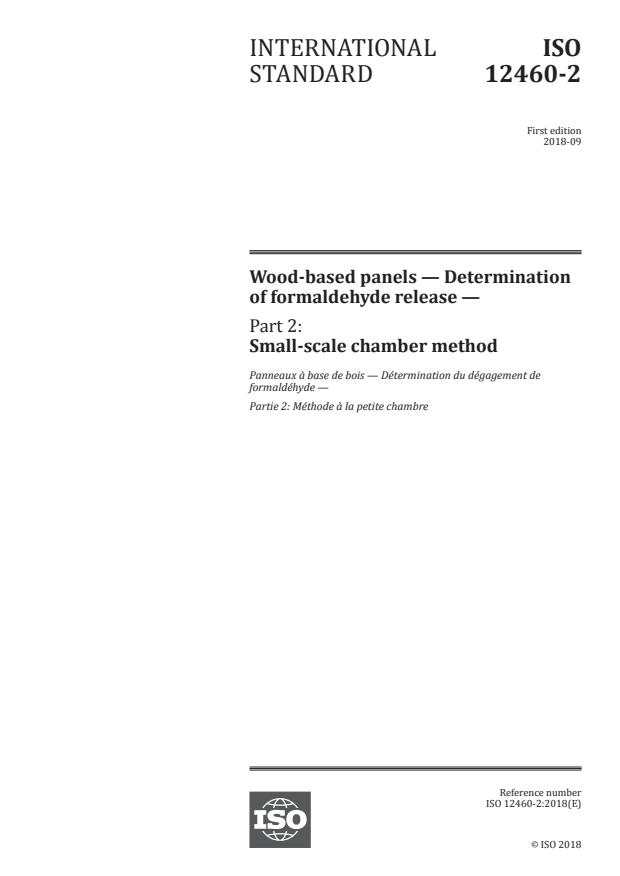
INTERNATIONAL ISO
STANDARD 12460-2
First edition
2018-09
Wood-based panels — Determination
of formaldehyde release —
Part 2:
Small-scale chamber method
Panneaux à base de bois — Détermination du dégagement de
formaldéhyde —
Partie 2: Méthode à la petite chambre
Reference number
©
ISO 2018
© ISO 2018
All rights reserved. Unless otherwise specified, or required in the context of its implementation, no part of this publication may
be reproduced or utilized otherwise in any form or by any means, electronic or mechanical, including photocopying, or posting
on the internet or an intranet, without prior written permission. Permission can be requested from either ISO at the address
below or ISO’s member body in the country of the requester.
ISO copyright office
CP 401 • Ch. de Blandonnet 8
CH-1214 Vernier, Geneva
Phone: +41 22 749 01 11
Fax: +41 22 749 09 47
Email: copyright@iso.org
Website: www.iso.org
Published in Switzerland
ii © ISO 2018 – All rights reserved
Contents Page
Foreword .iv
1 Scope . 1
2 Normative references . 1
3 Terms and definitions . 1
4 General . 2
5 Significance and use . 2
6 Interferences . 3
7 Apparatus . 3
7.1 Test chamber . 3
7.2 Make-up air . 3
7.2.1 General. 3
7.2.2 Air circulation . 3
7.2.3 Air sampling port . 4
8 Hazards . 4
8.1 Chromotropic acid reagent treatment . 4
8.2 Cleaning chemicals for glassware . 4
9 Test specimens. 4
9.1 Standard loading ratio . 4
9.2 Number of test pieces . 4
9.3 Nonstandard sample configuration testing products with single surface exposed . 4
10 Sample material handling and specimen conditioning . 4
10.1 Handling. 4
10.2 Conditioning . 4
11 Procedure. 5
11.1 Test procedure for materials . 5
11.2 Air sampling . 5
11.3 Analysis of air samples . 5
11.4 Absorbance readings . 6
12 Calculation . 6
13 Report . 7
Annex A (normative) Conversion factors for formaldehyde, standard solutions, calibration curve .9
Bibliography .15
Foreword
ISO (the International Organization for Standardization) is a worldwide federation of national standards
bodies (ISO member bodies). The work of preparing International Standards is normally carried out
through ISO technical committees. Each member body interested in a subject for which a technical
committee has been established has the right to be represented on that committee. International
organizations, governmental and non-governmental, in liaison with ISO, also take part in the work.
ISO collaborates closely with the International Electrotechnical Commission (IEC) on all matters of
electrotechnical standardization.
The procedures used to develop this document and those intended for its further maintenance are
described in the ISO/IEC Directives, Part 1. In particular the different approval criteria needed for the
different types of ISO documents should be noted. This document was drafted in accordance with the
editorial rules of the ISO/IEC Directives, Part 2 (see www .iso .org/directives).
Attention is drawn to the possibility that some of the elements of this document may be the subject of
patent rights. ISO shall not be held responsible for identifying any or all such patent rights. Details of
any patent rights identified during the development of the document will be in the Introduction and/or
on the ISO list of patent declarations received (see www .iso .org/patents).
Any trade name used in this document is information given for the convenience of users and does not
constitute an endorsement.
For an explanation of the voluntary nature of standards, the meaning of ISO specific terms and
expressions related to conformity assessment, as well as information about ISO's adherence to the
World Trade Organization (WTO) principles in the Technical Barriers to Trade (TBT) see: www .iso
.org/iso/foreword .html.
The committee responsible for this document is ISO/TC 89, Wood-based panels.
A list of all the parts in the ISO 12460 series can be found on the ISO website.
Any feedback or questions on this document should be directed to the user’s national standards body. A
complete listing of these bodies can be found at www .iso .org/members .html.
iv © ISO 2018 – All rights reserved
INTERNATIONAL STANDARD ISO 12460-2:2018(E)
Wood-based panels — Determination of formaldehyde
release —
Part 2:
Small-scale chamber method
1 Scope
This document specifies a test method to measure the formaldehyde concentrations in air from wood
products under defined test conditions of temperature and relative humidity. Results obtained from
this small-scale chamber test method are often used for quality assurance and can be comparable to,
or can provide useful correlations to, results obtained from testing larger product samples in larger
chamber test methods for wood products, such as the 1 m chamber method specified in ISO 12460-1.
NOTE 1 This document is based on the general principles and methods of ASTM D 6007.
NOTE 2 ISO 12460-1 for the 1 m chamber is the reference method for the determination of formaldehyde
release. For factory production control the derived test methods according to this document, ISO 12460-3,
ISO 12460-4 and ISO 12460-5 are used.
2 Normative references
The following documents are referred to in the text in such a way that some or all of their content
constitutes requirements of this document. For dated references, only the edition cited applies. For
undated references, the latest edition of the referenced document (including any amendments) applies.
ISO 12460-1, Wood-based panels — Determination of formaldehyde release — Part 1: Formaldehyde
emission by the 1-cubic-metre chamber method
3 Terms and definitions
For the purposes of this document, the following terms and definitions apply.
ISO and IEC maintain terminological databases for use in standardization at the following addresses:
— IEC Electropedia: available at http: //www .electropedia .org/
— ISO Online browsing platform: available at http: //www .iso .org/obp
3.1
air change rate
N
ratio of conditioned and filtered air, Q, that enters or is replaced in the small chamber in one hour
divided by the interior volume of the small chamber, V, air changes per hour (ACH)
3.2
loading ratio
L
total exposed surface area, A, excluding panel edges, of the product being tested divided by the test
2 3
chamber’s interior volume, V, in m /m
Note 1 to entry: L is equal to A/V.
3.3
make-up airflow
Q
quantity of conditioned and filtered air fed into the chamber per unit time, in m /h
3.4
Q/A ratio
ratio of air flow through the chamber (Q) to sample surface area (A), in m/h
3.5
sample surface area
A
total area of all sample faces exposed in the chamber, in m
3.6
measured concentration
C
formaldehyde concentration (expressed in mg/m ) under the defined environmental test parameters
of this method
3.7
volume of closed system
V
interior volume of the test chamber, in m
4 General
This method measures the quantity of formaldehyde in an air sample from a small chamber as
determined by a modification of the National Institute for Occupational Safety and Health (NIOSH)
3500 chromotropic acid test procedure (see Bibliography). Other analytical procedures may be used to
determine the quantity of formaldehyde in the air sample provided that such methods give comparable
results. The test report shall include full description of the analytical procedure employed.
This test method specifies testing at the loading rate and air exchange rate used in ISO 12460-1. The
test results and test report shall be properly qualified and shall specify the make-up air flow, sample
surface area, and chamber volume.
Ideal candidates for small-scale chamber testing are products relatively homogeneous in the
formaldehyde release characteristics. Still, product inhomogeneities shall be considered when selecting
and preparing samples for small-scale chamber testing.
The values stated in SI units are the standard values. Any values given in parentheses are for
information only.
NOTE This document does not purport to address all of the safety concerns, if any, associated with its
use. It is the responsibility of the user to establish appropriate safety and health practices and determine the
applicability of regulatory limitations prior to use.
5 Significance and use
5.1 Various national and regional regulations on formaldehyde emission levels have been established
for wood panels. This international test method was adapted from the small chamber test method
specified in ASTM D6007 where its use has been well established as part of monitoring mill compliance
[1]
to formaldehyde regulations of the U.S. Department of Housing and Urban development (HUD) . This
test method provides a means of testing smaller samples and reduces the time required for testing.
2 © ISO 2018 – All rights reserved
5.2 Formaldehyde concentration levels obtained by this small-scale method can differ from expected
in full-scale indoor environments. Variations in product loading, temperature, relative humidity, and air
exchange will affect formaldehyde emission rates and thus likely indoor air formaldehyde concentrations.
3 3
5.3 This test method requires the use of a chamber of 0,02 m to 1 m in volume to evaluate the
formaldehyde concentration in air using the following controlled conditions which are defined within
this standard method:
a) conditioning of specimens prior to testing;
b) exposed surface area of the specimens in the test chamber;
c) test chamber temperature and relative humidity;
d) the Q/A ratio;
e) air circulation within the chamber.
6 Interferences
The NIOSH 3500 analytical method lists phenols as a negative interference when present at an 8:1
excess over formaldehyde. Modification in the analytical procedure shall be made when relatively high
[8]
phenol to formaldehyde concentrations (8:1) are anticipated (see Hakes paper and Tech Bulletin
[9]
415 ). Interferences of other analytical methods should be determined by reference to other applicable
standard test methods.
7 Apparatus
7.1 Test chamber
3 3
The interior volume of the small chamber shall be from 0,02 m to 1 m . The interior of the test
chamber shall be free of refrigeration coils that condense water and items such as humidifiers with
water reservoirs since water has the potential for collecting formaldehyde and thus influencing test
results. The interior surfaces of the small chamber, including any sample support system, shall be a non-
absorbent material. Stainless steel, aluminium, and polytetrafluoroethylene (PTFE) have been found
appropriate as chamber lining materials. All joints except for doors used for loading and unloading
specimens should be sealed. Doors shall be self-sealing.
7.2 Make-up air
7.2.1 General
The make-up air shall come from a filtered dust-free environment and contain no more than 0,006 mg/
m of formaldehyde. This can be accomplished by passing make-up air through a filter bed of activated
carbon, activated alumina impregnated with potassium permanganate, or other materials capable of
absorbing, or oxidizing formaldehyde.
Make-up air for the chamber shall pass through a calibrated air flow measuring device.
7.2.2 Air circulation
Low speed mixing fans or multi-port inlet and outlet diffusers are two techniques that have been used
successfully to ensure mixing of the chamber air over all sample surfaces.
7.2.3 Air sampling port
The exhaust flow (that is, chamber outlet) is normally used as the sampling point, although separate
sampling ports in the chamber can be used. The sampling system shall be constructed of a material to
minimize absorption (for example, glass stainless steel), and the system should be maintained at the
same temperature as the test chambers.
8 Hazards
8.1 Chromotropic acid reagent treatment
During this hazardous operation, the operator must wear rubber gloves, apron, and a full face mask
or be protected from splashing by a transparent shield such as a hood window. The solution becomes
extremely hot during addition of sulfuric acid. If acid is not added slowly, some loss of sample could
occur due to splattering (see 11.3.4 and 11.3.5).
8.2 Cleaning chemicals for glassware
Use appropriate precautions if cleaning chemicals are considered to be hazardous.
9 Test specimens
9.1 Standard loading ratio
(L or A/V) is defined as the total exposed specimen surface area, excluding edge area, divided by the
2 3
chamber volume. The loading ratio, L, shall be (1,0 ± 0,02) m /m .
9.2 Number of test pieces
Two square test pieces, sized to meet the loading ratio specified in 9.1, shall be cut.
9.3 Nonstandard sample configuration testing products with single surface exposed
Some products have significantly different formaldehyde release characteristics for each surface. In
those cases, panels may be tested back-to-back with edges taped together. The panels shall be identified
as tested in the back-to-back mode.
10 Sample material handling and specimen conditioning
10.1 Handling
Materials selected for testing shall be wrapped in polyethylene plastic having a minimum thickness
of 0,15 mm (6 mil) until sample conditioning is initiated. When testing wood products that are not
newly manufactured such as after original application, installation or use, the method of packaging
and shipping the products for testing shall be fully described. Information on the age and history of the
product shall be detailed in the test report.
10.2 Conditioning
Condition test specimens with a minimum distance of 0,15 m (6 in.) between each specimen
for 2 h ± 15 min at the conditions of (24 ± 3) °C (75 ± 5) °F and (50 ± 5) % relative humidity. The
formaldehyde concentration in the air within 0,3 m (12 in.) of where panels are conditioned shall be
not more than 0,01 mg/m during the conditioning period. Alternative conditioning intervals can
give better correlation to larger chamber test methods, such as 7 days ± 3 h conditioning or 15 days
conditioning that parallels ISO 12460-1.
4 © ISO 2018 – All rights reserved
The air exchange ratio (Q/V ratio) shall be (1,0 ± 0,05)/h.
10.3 Sealing of test piece edges
After conditioning, test piece edges shall be partly sealed using self-adhesive aluminium tape to give a
constant ratio of the length, U, of the open (unsealed) edges to the surface area, A, so that U/A = 1,5 m/m .
NOTE As a result of the constant ratio U/A = 1,5 m/m , the percentage of open edges area related to the
surface area depends on the thickness of the test piece, as shown in the following examples.
Panel thickness Percentage of open edges area
10 mm 1,5 %
19 mm 2,8 %
32 mm 4,8 %
11 Procedure
11.1 Test procedure for materials
11.1.1 Purge the chamber by running empty or with the use of filters designed to reduce the
formaldehyde background concentration in air, or both. The formaldehyde background concentration in
air of the empty operating chamber shall not exceed 0,006 mg/m . Clean chamber surfaces with water or
suitable solvent if formaldehyde background concentrations approach 0,005 mg/ .
2 3
11.1.2 Load specimens to obtain a loading rate, L, of 1, m /m . Locate the specimens in the chamber so
that the conditioned air stream circulates over all panel surfaces.
11.1.3 Operate the chamber at (25 ± 1) °C (77 ± 2) °F and (50 ± 4) % relative humidity. Record the
temperature, relative humidity, and barometric pressure during the test
...
Questions, Comments and Discussion
Ask us and Technical Secretary will try to provide an answer. You can facilitate discussion about the standard in here.
Loading comments...