

ISO 3601-2:2025
(Main)Fluid power systems — O-rings — Part 2: Housing dimensions for general applications
General Information
- Abstract
This document specifies the housing dimensions for class A O-rings for general industrial applications conforming to ISO 3601-1, as well as housing dimensions for class B O-rings used on selected metric-dimensioned hardware, e.g. fluid power cylinder bores and piston rods. These O-rings are for use in general hydraulic and pneumatic applications without and with anti-extrusion rings (back-up rings). The dimensions of the O-rings (d1 and d2), size codes (SC) and tolerances conform to ISO 3601-1. This document also addresses different design approaches in industry, and this is reflected in the table structures for hardware dimensions. Using the O-ring as a starting point to design the optimal hardware dimensions is reflected in REF Table_tab_3 \r \h Tables 3 08D0C9EA79F9BACE118C8200AA004BA90B02000000080000000C0000005400610062006C0065005F007400610062005F0033000000 , REF Table_tab_5 \r \h 5 08D0C9EA79F9BACE118C8200AA004BA90B02000000080000000C0000005400610062006C0065005F007400610062005F0035000000 , and REF Table_tab_8 \r \h 8 08D0C9EA79F9BACE118C8200AA004BA90B02000000080000000C0000005400610062006C0065005F007400610062005F0038000000 . Using fixed hardware dimensions (i.e. bore/rod) and choosing the most appropriate O-ring to fit is reflected in REF Table_tab_4 \r \h Tables 4 08D0C9EA79F9BACE118C8200AA004BA90B02000000080000000C0000005400610062006C0065005F007400610062005F0034000000 and REF Table_tab_6 \r \h 6 08D0C9EA79F9BACE118C8200AA004BA90B02000000080000000C0000005400610062006C0065005F007400610062005F0036000000 . Housing dimensions for the O-rings intended for aerospace applications that are specified in ISO 3601-1 are addressed in REF Annex_sec_A \r \h Annex A 08D0C9EA79F9BACE118C8200AA004BA90B02000000080000000C00000041006E006E00650078005F007300650063005F0041000000 . NOTE 1 It is expected that O-ring housing dimensions for special applications be agreed upon between the O-ring manufacturer and the user. NOTE 2 The term “housing”, in this document, is used to describe the groove or cavity, into which the O-ring is fitted, and the mating surface, which between them confine the O-ring.
- Status
- Published
- Publication Date
- 25-Nov-2025
- Technical Committee
- ISO/TC 131/SC 7 - Sealing devices
- Drafting Committee
- ISO/TC 131/SC 7 - Sealing devices
- Current Stage
- 6060 - International Standard published
- Start Date
- 26-Nov-2025
- Due Date
- 18-Apr-2026
- Completion Date
- 26-Nov-2025


Overview
ISO 3601-2:2025 - Fluid power systems - O-rings - Part 2: Housing dimensions for general applications specifies recommended groove and mating-surface dimensions for class A O‑rings (general industrial) and selected class B O‑rings for metric hardware (e.g., cylinder bores and piston rods). It applies to hydraulic and pneumatic systems, for configurations with and without anti‑extrusion (back‑up) rings, and aligns O‑ring dimensions (d1, d2), size codes (SC) and tolerances with ISO 3601-1.
The standard provides tabulated housing dimensions and two design approaches:
- Design hardware around a chosen O‑ring (Tables 3, 5, 8).
- Select an O‑ring to fit fixed hardware (Tables 4, 6).
Annex A covers aerospace correlations and Annex B gives volumetric methods for calculating housing fill.
Key Topics
- Groove geometry and symbols: definitions for housing width, groove depth, radial depth, gaps, chamfers and edge radii.
- Surface roughness and finish: specified roughness parameters, material ratio guidance (Rmr) and prohibition of defects (scratches, nicks, spiral marks) that reduce seal life.
- Anti‑extrusion (back‑up) rings: housing widths and layout for no, one or two back‑up rings; reference to ISO 3601‑4 for detailed recommendations.
- Design methods: tabular guidance for O‑ring-first vs hardware‑first design; calculation of effective compression, diametral stretch and volumetric housing fill (Annex B).
- Tolerancing and run‑out: tolerancing per ISO 8015 and run‑out limits for different diameters.
- Application types: dynamic piston and rod seals, static axial/face seals, and relevant dimension variants.
- Environmental/operational considerations: housing fill, temperature effects and need to agree special dimensions with O‑ring manufacturers.
Applications and Users
ISO 3601-2:2025 is essential for:
- Seal designers and OEMs specifying groove geometry for hydraulic/pneumatic cylinders and valves.
- Mechanical engineers designing piston/rod assemblies and face seals.
- Seal manufacturers and suppliers choosing or recommending O‑ring sizes for metric hardware.
- Maintenance, procurement and quality teams ensuring correct housing tolerances and surface finishes.
- Aerospace designers referencing Annex A for aerospace‑grade O‑ring housings.
Using this standard helps prevent extrusion, reduce leakage risk, improve seal life and streamline component interoperability in fluid power systems.
Related Standards
- ISO 3601‑1 - O‑ring sizes, cross‑sections and codes (normative reference)
- ISO 3601‑4 - Use of anti‑extrusion rings (back‑up rings)
- ISO 5598 - Fluid power vocabulary
- ISO 21920‑2 - Surface roughness/material ratio guidance
- ISO 8015 - General tolerancing principles
Keywords: ISO 3601-2:2025, O‑ring housing dimensions, fluid power systems, hydraulic seals, pneumatic seals, anti‑extrusion rings, groove design, surface roughness, housing fill.
Relations
- Effective Date
- 29-Oct-2022
Get Certified
Connect with accredited certification bodies for this standard

DIN CERTCO
DIN Group product certification.
Institut za varilstvo d.o.o. (Welding Institute)
Slovenia's leading welding institute since 1952. ISO 3834, EN 1090, pressure equipment certification, NDT personnel, welder qualification. Only IIW Au

Smithers Quality Assessments
US management systems and product certification.
Sponsored listings
Frequently Asked Questions
ISO 3601-2:2025 is a standard published by the International Organization for Standardization (ISO). Its full title is "Fluid power systems — O-rings — Part 2: Housing dimensions for general applications". This standard covers: This document specifies the housing dimensions for class A O-rings for general industrial applications conforming to ISO 3601-1, as well as housing dimensions for class B O-rings used on selected metric-dimensioned hardware, e.g. fluid power cylinder bores and piston rods. These O-rings are for use in general hydraulic and pneumatic applications without and with anti-extrusion rings (back-up rings). The dimensions of the O-rings (d1 and d2), size codes (SC) and tolerances conform to ISO 3601-1. This document also addresses different design approaches in industry, and this is reflected in the table structures for hardware dimensions. Using the O-ring as a starting point to design the optimal hardware dimensions is reflected in REF Table_tab_3 \r \h Tables 3 08D0C9EA79F9BACE118C8200AA004BA90B02000000080000000C0000005400610062006C0065005F007400610062005F0033000000 , REF Table_tab_5 \r \h 5 08D0C9EA79F9BACE118C8200AA004BA90B02000000080000000C0000005400610062006C0065005F007400610062005F0035000000 , and REF Table_tab_8 \r \h 8 08D0C9EA79F9BACE118C8200AA004BA90B02000000080000000C0000005400610062006C0065005F007400610062005F0038000000 . Using fixed hardware dimensions (i.e. bore/rod) and choosing the most appropriate O-ring to fit is reflected in REF Table_tab_4 \r \h Tables 4 08D0C9EA79F9BACE118C8200AA004BA90B02000000080000000C0000005400610062006C0065005F007400610062005F0034000000 and REF Table_tab_6 \r \h 6 08D0C9EA79F9BACE118C8200AA004BA90B02000000080000000C0000005400610062006C0065005F007400610062005F0036000000 . Housing dimensions for the O-rings intended for aerospace applications that are specified in ISO 3601-1 are addressed in REF Annex_sec_A \r \h Annex A 08D0C9EA79F9BACE118C8200AA004BA90B02000000080000000C00000041006E006E00650078005F007300650063005F0041000000 . NOTE 1 It is expected that O-ring housing dimensions for special applications be agreed upon between the O-ring manufacturer and the user. NOTE 2 The term “housing”, in this document, is used to describe the groove or cavity, into which the O-ring is fitted, and the mating surface, which between them confine the O-ring.
This document specifies the housing dimensions for class A O-rings for general industrial applications conforming to ISO 3601-1, as well as housing dimensions for class B O-rings used on selected metric-dimensioned hardware, e.g. fluid power cylinder bores and piston rods. These O-rings are for use in general hydraulic and pneumatic applications without and with anti-extrusion rings (back-up rings). The dimensions of the O-rings (d1 and d2), size codes (SC) and tolerances conform to ISO 3601-1. This document also addresses different design approaches in industry, and this is reflected in the table structures for hardware dimensions. Using the O-ring as a starting point to design the optimal hardware dimensions is reflected in REF Table_tab_3 \r \h Tables 3 08D0C9EA79F9BACE118C8200AA004BA90B02000000080000000C0000005400610062006C0065005F007400610062005F0033000000 , REF Table_tab_5 \r \h 5 08D0C9EA79F9BACE118C8200AA004BA90B02000000080000000C0000005400610062006C0065005F007400610062005F0035000000 , and REF Table_tab_8 \r \h 8 08D0C9EA79F9BACE118C8200AA004BA90B02000000080000000C0000005400610062006C0065005F007400610062005F0038000000 . Using fixed hardware dimensions (i.e. bore/rod) and choosing the most appropriate O-ring to fit is reflected in REF Table_tab_4 \r \h Tables 4 08D0C9EA79F9BACE118C8200AA004BA90B02000000080000000C0000005400610062006C0065005F007400610062005F0034000000 and REF Table_tab_6 \r \h 6 08D0C9EA79F9BACE118C8200AA004BA90B02000000080000000C0000005400610062006C0065005F007400610062005F0036000000 . Housing dimensions for the O-rings intended for aerospace applications that are specified in ISO 3601-1 are addressed in REF Annex_sec_A \r \h Annex A 08D0C9EA79F9BACE118C8200AA004BA90B02000000080000000C00000041006E006E00650078005F007300650063005F0041000000 . NOTE 1 It is expected that O-ring housing dimensions for special applications be agreed upon between the O-ring manufacturer and the user. NOTE 2 The term “housing”, in this document, is used to describe the groove or cavity, into which the O-ring is fitted, and the mating surface, which between them confine the O-ring.
ISO 3601-2:2025 is classified under the following ICS (International Classification for Standards) categories: 23.100.60 - Filters, seals and contamination of fluids; 83.140.50 - Seals. The ICS classification helps identify the subject area and facilitates finding related standards.
ISO 3601-2:2025 has the following relationships with other standards: It is inter standard links to ISO 3601-2:2016. Understanding these relationships helps ensure you are using the most current and applicable version of the standard.
ISO 3601-2:2025 is available in PDF format for immediate download after purchase. The document can be added to your cart and obtained through the secure checkout process. Digital delivery ensures instant access to the complete standard document.
Standards Content (Sample)
International
Standard
ISO 3601-2
Third edition
Fluid power systems — O-rings —
2025-11
Part 2:
Housing dimensions for general
applications
Transmissions hydrauliques et pneumatiques — Joints
toriques —
Partie 2: Dimensions des logements pour applications générales
Reference number
© ISO 2025
All rights reserved. Unless otherwise specified, or required in the context of its implementation, no part of this publication may
be reproduced or utilized otherwise in any form or by any means, electronic or mechanical, including photocopying, or posting on
the internet or an intranet, without prior written permission. Permission can be requested from either ISO at the address below
or ISO’s member body in the country of the requester.
ISO copyright office
CP 401 • Ch. de Blandonnet 8
CH-1214 Vernier, Geneva
Phone: +41 22 749 01 11
Email: copyright@iso.org
Website: www.iso.org
Published in Switzerland
ii
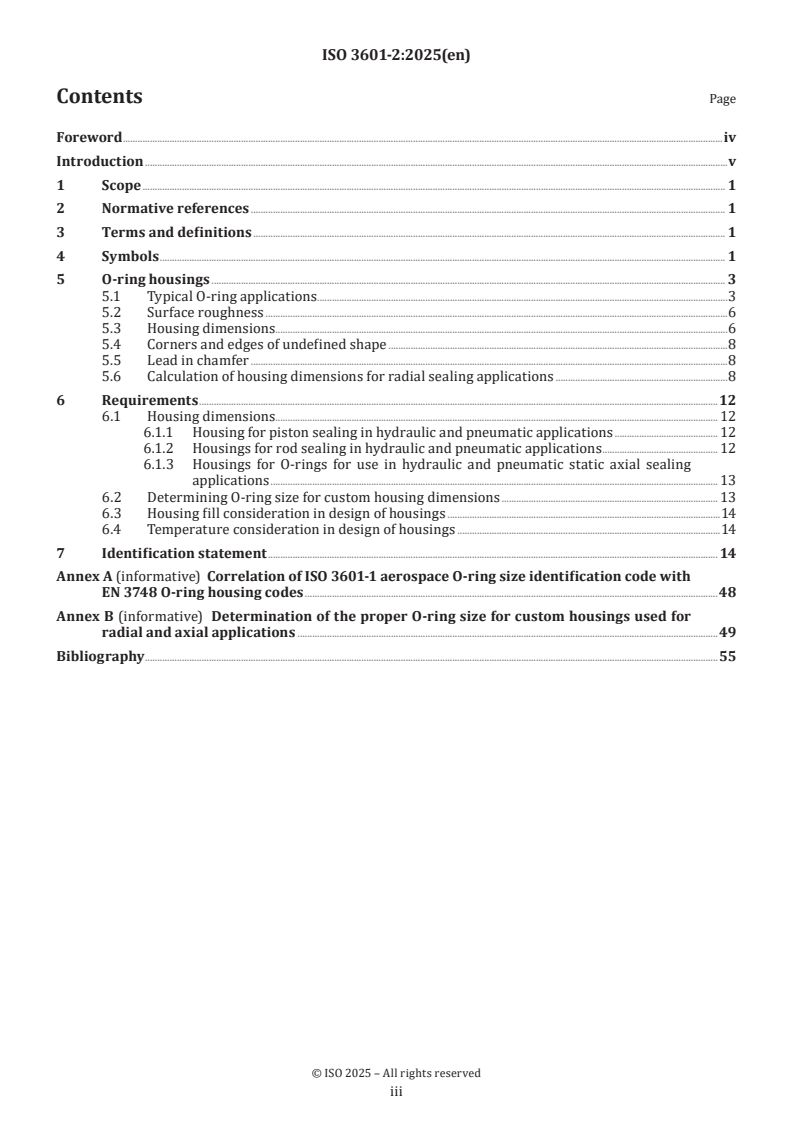
Contents Page
Foreword .iv
Introduction .v
1 Scope . 1
2 Normative references . 1
3 Terms and definitions . 1
4 Symbols . 1
5 O-ring housings . 3
5.1 Typical O-ring applications . .3
5.2 Surface roughness .6
5.3 Housing dimensions . .6
5.4 Corners and edges of undefined shape .8
5.5 Lead in chamfer .8
5.6 Calculation of housing dimensions for radial sealing applications .8
6 Requirements .12
6.1 Housing dimensions . . 12
6.1.1 Housing for piston sealing in hydraulic and pneumatic applications . 12
6.1.2 Housings for rod sealing in hydraulic and pneumatic applications . 12
6.1.3 Housings for O-rings for use in hydraulic and pneumatic static axial sealing
applications . 13
6.2 Determining O-ring size for custom housing dimensions . 13
6.3 Housing fill consideration in design of housings .14
6.4 Temperature consideration in design of housings .14
7 Identification statement . 14
Annex A (informative) Correlation of ISO 3601-1 aerospace O-ring size identification code with
EN 3748 O-ring housing codes .48
Annex B (informative) Determination of the proper O-ring size for custom housings used for
radial and axial applications .49
Bibliography .55
iii
Foreword
ISO (the International Organization for Standardization) is a worldwide federation of national standards
bodies (ISO member bodies). The work of preparing International Standards is normally carried out through
ISO technical committees. Each member body interested in a subject for which a technical committee
has been established has the right to be represented on that committee. International organizations,
governmental and non-governmental, in liaison with ISO, also take part in the work. ISO collaborates closely
with the International Electrotechnical Commission (IEC) on all matters of electrotechnical standardization.
The procedures used to develop this document and those intended for its further maintenance are described
in the ISO/IEC Directives, Part 1. In particular, the different approval criteria needed for the different types
of ISO document should be noted. This document was drafted in accordance with the editorial rules of the
ISO/IEC Directives, Part 2 (see www.iso.org/directives).
ISO draws attention to the possibility that the implementation of this document may involve the use of (a)
patent(s). ISO takes no position concerning the evidence, validity or applicability of any claimed patent
rights in respect thereof. As of the date of publication of this document, ISO had not received notice of (a)
patent(s) which may be required to implement this document. However, implementers are cautioned that
this may not represent the latest information, which may be obtained from the patent database available at
www.iso.org/patents. ISO shall not be held responsible for identifying any or all such patent rights.
Any trade name used in this document is information given for the convenience of users and does not
constitute an endorsement.
For an explanation of the voluntary nature of standards, the meaning of ISO specific terms and expressions
related to conformity assessment, as well as information about ISO's adherence to the World Trade
Organization (WTO) principles in the Technical Barriers to Trade (TBT), see www.iso.org/iso/foreword.html.
This document was prepared by Technical Committee ISO/TC 131, Fluid power systems, Subcommittee SC 7,
Sealing devices.
This third edition cancels and replaces the second edition (ISO 3601-2:2016), which has been technically
revised.
The main changes are as follows:
— comprehensive extension of listed housing dimensions for metric bore sizes (Tables 4 and 6);
— volumetric calculation of housing fill instead of calculation with cross-sectional areas (Annex B);
— correction in calculation of the cross-sectional reduction for the effective compression (5.6.2).
A list of all parts in the ISO 3601 series can be found on the ISO website.
Any feedback or questions on this document should be directed to the user’s national standards body. A
complete listing of these bodies can be found at www.iso.org/members.html.
iv
Introduction
In fluid power systems, power is transmitted and controlled through a fluid (liquid or gas) under pressure
within an enclosed circuit. To avoid leakage or to seal different chambers of a component from each other
sealing devices are used. O-rings are one type of sealing devices. To seal properly, an O-ring has to be used in
an appropriate housing for the application.
v
International Standard ISO 3601-2:2025(en)
Fluid power systems — O-rings —
Part 2:
Housing dimensions for general applications
1 Scope
This document specifies the housing dimensions for class A O-rings for general industrial applications
conforming to ISO 3601-1, as well as housing dimensions for class B O-rings used on selected metric-
dimensioned hardware, e.g. fluid power cylinder bores and piston rods. These O-rings are for use in general
hydraulic and pneumatic applications without and with anti-extrusion rings (back-up rings). The dimensions
of the O-rings (d and d ), size codes (SC) and tolerances conform to ISO 3601-1.
1 2
This document also addresses different design approaches in industry, and this is reflected in the table
structures for hardware dimensions. Using the O-ring as a starting point to design the optimal hardware
dimensions is reflected in Tables 3, 5, and 8. Using fixed hardware dimensions (i.e. bore/rod) and choosing
the most appropriate O-ring to fit is reflected in Tables 4 and 6.
Housing dimensions for the O-rings intended for aerospace applications that are specified in ISO 3601-1 are
addressed in Annex A.
NOTE 1 It is expected that O-ring housing dimensions for special applications be agreed upon between the O-ring
manufacturer and the user.
NOTE 2 The term “housing”, in this document, is used to describe the groove or cavity, into which the O-ring is
fitted, and the mating surface, which between them confine the O-ring.
2 Normative references
The following documents are referred to in the text in such a way that some or all of their content constitutes
requirements of this document. For dated references, only the edition cited applies. For undated references,
the latest edition of the referenced document (including any amendments) applies.
ISO 3601-1, Fluid power systems — O-rings — Part 1: Inside diameters, cross-sections, tolerances and
designation codes
ISO 5598, Fluid power systems and components — Vocabulary
3 Terms and definitions
For the purposes of this document, the terms and definitions given in ISO 5598 apply.
ISO and IEC maintain terminology databases for use in standardization at the following addresses:
— ISO Online browsing platform: available at https:// www .iso .org/ obp
— IEC Electropedia: available at https:// www .electropedia .org/
4 Symbols
The following letter symbols are used in this document.
Table 1 — Symbols and definitions
Symbol Definition
b width of the O-ring housing
x
b width of the O-ring housing without an anti-extrusion ring (back-up ring)
b width of the O-ring housing with one anti-extrusion ring (back-up ring)
b width of the O-ring housing with two anti-extrusion rings (back-up rings)
b width of the O-ring axial (face seal) housing
C percentage of effective O-ring cross-section compression
d O-ring inside diameter
d O-ring cross-section diameter
*
effective cross-section of installed O-ring
d
d housing inside diameter for piston application
d bore diameter for piston application
d rod diameter
d housing outside diameter for rod application
d outside diameter of housing for axial (face) sealing
d inside diameter of housing for axial (face) sealing
d piston diameter
d bore diameter for rod application
F percentage of housing fill
f housing radius (also known as edges of undefined shape)
g extrusion gap or radial gap
h depth of seal groove
j length from piston chamfer to seal groove edge
k length from housing chamfer to seal groove edge
m roughness of the side surface of the O-ring housing
n surface roughness of the O-ring housing base
p roughness of the mating surface of the O-ring
q surface roughness of lead-in chamfer
R percentage of O-ring cross-sectional reduction resulting from diametral stretch
Ra arithmetic mean height of the surface roughness profile
R relative material ratio of the surface roughness profile
mr
Rz maximum height of the surface roughness profile
S percentage of inside diameter stretch
SC O-ring size code from ISO 3601-1
t total radial housing depth
t approximate radial housing depth
x
V volume of O-ring housing
H
V volume of the O-ring
OR
Y maximum run-out tolerance
z length of lead-in chamfer
Ø diameter
5 O-ring housings
5.1 Typical O-ring applications
Figure 1 shows a typical O-ring as presented in ISO 3601-1.
Figure 1 — Typical O-ring configuration
Figure 2 shows the features of an O-ring housing for use in dynamic rod and piston applications.
Figure 2 — Features of housings for dynamic rod and piston applications
Figure 3 shows the features of O-ring housings used in static rod and piston applications. It also shows an
example of a face (axial) seal.
Figure 3 — Features of housings for static rod and piston applications
5.1.4 O-ring housings for face seal applications have different dimensional requirements depending upon
whether the pressure is internal or external to the system. See Figure 4 for illustrations.
Dimensions in millimetres
Key
m, n surface roughness; see Table 7
b housing width; see Table 7
f housing radius; see Table 7
a
Direction of pressure.
NOTE Tolerancing is in accordance with ISO 8015.
Figure 4 — Illustrations of housings for face seal applications
Figure 5 shows examples of widths of O-ring housings for use with or without anti-extrusion rings (back-up
rings). Recommendations for the use of anti-extrusion rings are given in ISO 3601-4.
a) Without anti-extrusion rings b) With one anti-extrusion ring c) With two anti-extrusion rings
a
Pressure acting in one direction.
b
Pressure acting in alternating directions.
Figure 5 — Widths of O-ring housings, for use with or without anti-extrusion rings (back-up rings)
5.2 Surface roughness
5.2.1 The surface roughness of the O-ring housing and any mating part has a significant impact on the life
and sealing performance of the O-ring.
5.2.2 Unless otherwise agreed, surface roughness values shall be in accordance with Table 2. Surface
roughness values of the housings for the O-rings intended for aerospace applications that are specified in
ISO 3601-1 are addressed in Annex A.
5.2.3 All surfaces against which a seal operates should be free from scratches, burrs, gouges, scores, nicks,
tool chatter, spiral machining marks (circumferential marks), or other defects along the operating axis of the
seal as these may reduce sealing efficiency and the life of the seal.
5.2.4 The latest International Standards for surface roughness measurement require new statements for
roughness requirements. Because of the short measuring length, an exact roughness is not measurable. In
these cases, a visual inspection using master parts is permitted.
5.2.5 Unless otherwise agreed the material ratio, R (p,d ), of housing surfaces that are in mating contact
mr c
with the seal should be between 50 % and 80 % at a profile depth (d ) of 25 % of Rz from a reference material
c
ratio p = 5 % (in accordance with ISO 21920-2).
5.3 Housing dimensions
Figure 6 shows a cross-section of a typical piston housing, illustrating the housing width, b , seal groove
x
depth, h, the total distance between the sealing surface and the radial housing depth, t, the radial gap,
g, between the piston, d , and the bore, d , the edges of undefined shape, f, and the surfaces for which
9 4
surface roughness requirements are specified. All of these features have different values depending on the
application.
Dimensions in millimetres
Key
1 bore
2 piston
m, n, p, q surface roughness; see Table 2
f housing radius; see Table 2
b width of O-ring housing
x
a
No burrs are permitted in this area; the edge shall be rounded.
b
Housing diameter d ≤ 50: maximum run-out tolerance Y = 0,025;
housing diameter d > 50: maximum run-out tolerance Y = 0,05.
NOTE Tolerancing is in accordance with ISO 8015.
The length from the piston chamfer to the seal groove edge, j, should be greater than the length of the lead-in chamfer, z.
Figure 6 — Dimensions of piston seal housings
Figure 7 shows a cross-section of a typical rod housing, illustrating the housing width, b , seal groove
x
depth, h, the total distance between the sealing surface and the radial housing depth, t, the radial gap, g,
between the rod, d and bore, d , edges of undefined shape, f, and the surfaces for which surface roughness
5 10
requirements are specified. All these features have different values depending on the application.
Dimensions in millimetres
Key
1 rod
2 bore
m, n, p, q surface roughness; see Table 2
f housing radius; see Table 2
b width of O-ring housing
x
a
No burrs are permitted in this area; the edge shall be rounded.
b
Housing diameter d ≤ 50: maximum run-out tolerance Y = 0,025;
housing diameter d > 50: maximum run-out tolerance Y = 0,05.
NOTE Tolerancing is in accordance with ISO 8015.
The length from the housing chamfer to the seal groove edge, k, should be greater than the length of the lead-in chamfer, z.
Figure 7 — Dimensions of rod seal housings
5.4 Corners and edges of undefined shape
Values for inside corner edge, f, that depend on the cross-sections of housings and rods are specified in
Table 2. Values for the undefined edge of the housing outside corner are specified in Figures 6 and 7.
5.5 Lead in chamfer
5.5.1 A lead-in chamfer with an angle of 15° to 20° shall be used to prevent damage to the O-ring by either
the rod or the piston upon assembly into the cylinder bore. Chamfer edges shall be rounded. Figures 6 and 7
illustrate lead-in chamfers for piston and rod housings, respectively.
5.5.2 Values for the lengths of lead-in chamfers, dimension z, for the cross-sections of housings and rods
are specified in Table 2.
5.6 Calculation of housing dimensions for radial sealing applications
5.6.1 For the basic dimensions of housings for O-rings, see Tables 3 through 6. Dimensions d (for
piston sealing applications) and d (for rod sealing applications) and the depth of the housing apply if the
percentage of effective O-ring cross-sectional compression is within the limits given in Figure 8, depending
on the application and O-ring cross-section.
a) Hydraulic dynamic applications
b) Pneumatic dynamic applications
c) Static radial and axial applications
Key
d O-ring cross-section, expressed in millimetres
C compression, expressed in percent
1 minimum value
2 maximum value
Figure 8 — Limits of compression for ISO 3601-1 O-rings
5.6.2 Percent effective compression,C
5.6.2.1 When an O-ring is stretched, as occurs when installed in the housing, its cross-section, d , is
reduced, flattened, and is no longer circular. This affects the effective compression, C, of the installed O-ring.
The minimum effective compression, C , of the installed O-ring is represented by the difference between
min
*
the minimum effective cross-section of the installed O-ring, d , and the maximum total radial housing
2,min
depth, t . The maximum effective compression, C , of the installed O-ring is represented by the
max max
*
difference between the maximum effective cross-section of the installed O-ring, d , and the minimum
2,max
total radial housing depth, t .
min
5.6.2.2 The percentage that d is reduced depends on the percentage that the O-ring’s inside diameter, d ,
2 1
*
is stretched, S. S needs to be calculated to determine the effective, or installed, cross-section, d . For piston
applications, S is calculated in accordance with Formulae (1) and (2):
dd−
3,max1,max
S = ×100% Use this value for R , and hence C (1)
1 1 max
d
1,max
dd−
3,min1,min
S = ×100% Use this value for R , and hence C (2)
2 2 min
d
1,min
For rod applications, S is calculated in accordance with Formulae (3) and (4):
dd−
5,max1,max
S = ×100% Use this value for R , and hence C (3)
1 1 max
d
1,max
dd−
5,min1,min
S = ×100% Use this value for R , and hence C (4)
2 2 min
d
1,min
5.6.2.3 The percent of cross-sectional reduction resulting from diametral stretch, R, for an O-ring whose
inside diameter is stretched 0 % to 3 % (inclusive) is calculated in accordance with Formula (5):
R = 0,01 + 1,06(S) − 0,1(S) (5)
NOTE Formulae (5) and (6) are also given in SAE MAP 3440.
EXAMPLE For an O-ring whose inside diameter is stretched 2,5 %, the percent of cross-sectional reduction is
R = 0,01 + 1,06(2,5) − 0,1(6,25)
= 2,04 %
5.6.2.4 The percent of cross-sectional reduction resulting from diametral stretch, R, for an O-ring whose
inside diameter is stretched more than 3 % but less than 25 % is calculated in accordance with Formula (6):
R = 0,56 + 0,59(S) − 0,004 6(S) (6)
*
5.6.2.5 The effective cross-section, d , range for the stretched O-ring is in accordance with Formulae (7)
and (8):
R
* 2
dd=− ×d (7)
22,minm,,in 2 min
where R is calculated according to Formula (5) or Formula (6) using S .
2 2
R
*
dd=− ×d (8)
22,maxm,,ax 2 max
where R is calculated according to Formula (5) or Formula (6) using S .
1 1
The range in the percent effective compression, C, is in accordance with Formulae (9) and (10):
*
dt−
()
2,minmax
C = ×100% (9)
min
*
d
2,min
*
dt−
()
2,maxmin
C = ×100% (10)
max
*
d
2,max
NOTE Percent effective compression has been considered in the development of this document. Eccentricity can
affect effective compression.
6 Requirements
6.1 Housing dimensions
6.1.1 Housing for piston sealing in hydraulic and pneumatic applications
6.1.1.1 The nominal O-ring inside diameter, d , should be stretched between 2 % and 5 % for dynamic
applications and 2 % and 8 % for static applications. For O-rings with a diameter d smaller than 20 mm,
this is not always possible, which can result in a wider range of stretch. To minimize this range and the
maximum stretch, it is necessary to minimize the tolerances of the housing diameter, d , and have a less
stringent requirement for the minimum O-ring stretch. Ideally, the stretch of the maximum value of d by
the diameter d should be at least 2 %.
In dynamic applications, it is important to keep the maximum stretch to 5 % or less to avoid detrimental
effects on sealing performance.
NOTE Some static applications can require higher stretch (e.g. for assembly issues). In this case the O-ring and the
stretch are to be agreed upon between the O-ring manufacturer and the user.
6.1.1.2 The general housing dimensions and tolerances and housing diameter tolerances are given in
Tables 3 and 4. The depth of the housing, t, can be calculated in accordance with Formulae (11) and (12):
dd−
4,min3,max
t = Use for C (11)
min max
dd−
4,max3,min
t = Use for C (12)
max min
6.1.1.3 For the key dimensions related to piston sealing, see Figure 6.
6.1.1.4 Actual housing dimensions for the standard O-rings specified in ISO 3601-1 are given in Table 3.
Housing dimensions for selected metric bore sizes are given in Table 4 along with the suggested standard
O-rings. For other metric bore sizes not given in Table 4, Annex B should be used for guidance to calculate
hardware dimensions.
6.1.1.5 After an O-ring is installed in the housing, sufficient time should be given for it to relax and recover
back to size before assembling the piston into the bore to avoid damaging the O-ring during installation.
6.1.1.6 To avoid situations where the O-ring inside diameter, d , has to be stretched more than 50 % during
installation into the housing, which can potentially damage the seal, consideration should be given to the
use of split housing and / or use of a suitable O-ring material compound with sufficient minimum elongation
at break for the installation.
6.1.2 Housings for rod sealing in hydraulic and pneumatic applications
6.1.2.1 The O-ring outside diameter (d + 2d ) shall be at least equal to or larger than the housing outside
1 2
diameter, d , to give interference on the outside diameter. The O-ring outside diameter shall not exceed the
housing outside diameter by more than 3 % for O-rings with a diameter d greater than 250 mm, or 5 % for
O-rings with a diameter d smaller than 250 mm. For O-rings with a diameter d smaller than 20 mm, this is
1 1
not always possible due to tolerance issues, which can result in a greater outside diameter interference.
NOTE The calculation is based on the minimum O-ring outside diameter and the maximum housing diameter, d .
The general housing dimensions and tolerances, and housing diameter tolerances, are given in Tables 5 and
6. The depth of the housing, t, can be calculated in accordance with Formulae (13) and (14):
dd−
6,min5,max
t = Use for C (13)
min max
dd−
6,max5,min
t = Use for C (14)
max min
6.1.2.2 For the key dimensions related to rod sealing, see Figure 7.
6.1.2.3 Actual rod housing dimensions for standard O-rings specified in ISO 3601-1 are given in Table 5.
These values are calculated with the requirements that the rod diameter, d , stretches the O-ring inside
diameter, and that the minimum O-ring outside diameter should be equal to or greater than the maximum
housing diameter, d . This limits the maximum rod diameter that can be specified to 128,50 mm.
Housing dimensions for selected standard round number sized metric rods are given in Table 6. Here, only
the requirement that the minimum O-ring outside diameter should be equal to or greater than the maximum
housing diameter, d , is applied, enabling housings for much larger rod sizes to be specified than in Table 5.
For other metric rod sizes not given in Table 6, Annex B should be used for guidance to calculate hardware
dimensions.
6.1.3 Housings for O-rings for use in hydraulic and pneumatic static axial sealing applications
6.1.3.1 General
In static axial sealing applications, an O-ring is compressed in the axial direction. The housings addressed
in 6.1.3 are depicted in Figure 4. This design minimizes the number of gaps through which the O-ring can
extrude and reduces the potential damage to the O-ring during assembly. Placement of the O-ring within the
housing depends on the direction from which pressure is applied. If the O-ring is pressurized from an internal
source, the housing shall be designed so that, prior to the pressure being applied, the O-ring is in contact
with the housing wall that is away from the side that is pressurized. The major diameter of this internal
pressure housing is designated by d . If the O-ring is pressurized from an external source, the housing shall
be designed so that, prior to pressure being applied, the O-ring is in contact with the housing wall away from
the side that is pressurized. The major diameter of this internal pressure housing is designated by d . The
minor diameter for the housing shall then be determined by adding or subtracting the appropriate housing
width to or from the major diameter.
NOTE Considering the allowed tolerances of O-ring and housing diameters, a remaining gap between d and
the O-ring outside diameter or d and the O-ring inside diameter, d , is possible. The axial compression of the finally
8 1
installed O-ring will reduce the inner diameter and increase the outer diameter which will reduce or close this gap.
The housing width is determined by the type of fluid to be sealed. The housing widths are specified in
Table 7, which also specifies the other detail dimensions for the housings.
6.1.3.2 Actual housing dimensions for axial sealing applications
Actual housing dimensions for the O-rings specified in ISO 3601-1 and used in axial sealing applications for
internal pressure and external pressure applications are given in Table 8.
6.2 Determining O-ring size for custom housing dimensions
For hardware dimensions not listed in the previously mentioned tables, Annex B provides a procedure for
identifying the proper O-ring for use in housings for specific hardware.
6.3 Housing fill consideration in design of housings
It is important to consider the housing fill or occupancy of the installed O-ring to avoid detrimental effects
on sealing performance. Housing fill of the installed O-ring should not be more than 85 % to allow for
possible O-ring thermal expansion and volume swell due to fluid exposure. Housing fill of installed O-rings
was considered during the design of the housings listed in this document.
6.4 Temperature consideration in design of housings
It is important to note there are significant differences in the coefficients of thermal expansion and
contraction between the O-ring material and the housing materials. Elastomers can have coefficients of
expansion several times higher than that of metals, such as steel. The calculations used in this document,
included in Annex B, have been based upon an ambient temperature of approximately 24 °C.
7 Identification statement
It is strongly recommended to manufacturers who have chosen to conform to this document that the
following statement be used in test reports, catalogues and sales literature:
“Dimensions and tolerances for O-ring housings selected in accordance with ISO 3601-2, Fluid power
systems — O-rings — Part 2: Housing dimensions for general applications.”
Table 2 — General dimensions and surface roughness requirements for piston and rod housings for
a
use in dynamic and static hydraulic and pneumatic applications
Dimensions in millimetres unless otherwise noted
d, e, f
b
Surface roughness values in micrometers
z z
c
d for for
Chamfer Side surface Housing bore or Static mating Dynamic mating
g g g
15° 20°
housing groove surface surface
nom. min. min. f q m n p p
1,78 1,1 0,9
+0,4
+0,2
2,62 1,5 1,1
3,53 1,8 1,4 Ra 1,6 Ra 1,6 Ra 1,6 Ra 1,6 Ra 0,4
+0,8
Rz 6,3 Rz 6,3 Rz 6,3 Rz 6,3 Rz 1,6
+0,4
5,33 2,7 2,1
+1,2
6,99 3,6 2,8
+0,8
a
See also Figures 6 and 7. See ISO 13715 for design of edges and undefined shapes.
b
Larger values for z (smaller angle) are better for mounting the parts together.
c
Shorter chamfers are recommended for dry assembly; for assembly using lubrication, longer lead-in chamfers can be utilized.
d
Indication of surface roughness in accordance with ISO 21920-1.
e
In accordance with ISO 21920-3, the setting class Sc3 applies to the above specified roughness values. With small d , the
available measuring length of the side, housing or chamfer surface is too short for the required five section lengths. In this
case, the maximum possible number of sections shall be measured. If it is not possible to measure one complete section length
including run-in and run-out, the inspection shall be carried out visually.
f
Special applications can require different surface roughness values.
g
Visual surface imperfections are not allowed on surfaces n and p (see ISO 8785).
Table 3 — Basic dimensions of housings for O-rings used in dynamic and static pneumatic and
hydraulic piston sealing applications (see Figure 6)
Dimensions in millimetres
Size Pneumatic dynamic Hydraulic dynamic Static Housing width O-ring dimensions
code
Bore ø/ Housing Bore ø/ Housing Bore ø/ Housing +0,25 Inside ø Cross
(SC)
piston ø inside ø Piston ø inside ø piston ø inside ø section ø
d /d d d /d d d /d d b b b d d
4 9 3 4 9 3 4 9 3 1 2 3 1 2
(H8/f7) (H8/f7) (H8/f7)
nom. nom. tol. nom. nom. tol. nom. nom. tol. nom. nom. nom. nom. nom.
004 — — — — — — 4,52 1,93 h6 2,8 4,2 5,6 1,78 1,78
005 — — — — — — 5,31 2,72 h6 2,8 4,2 5,6 2,57 1,78
006 5,85 3,05 h6 5,74 3,05 h6 5,65 3,05 h6 2,8 4,2 5,6 2,90 1,78
007 6,63 3,84 h6 6,52 3,83 h6 6,43 3,84 h6 2,8 4,2 5,6 3,68 1,78
008 7,42 4,63 h6 7,31 4,62 h6 7,22 4,63 h6 2,8 4,2 5,6 4,47 1,78
009 8,24 5,45 h6 8,14 5,45 h6 8,04 5,45 h6 2,8 4,2 5,6 5,28 1,78
010 9,06 6,27 h6 8,93 6,24 h6 8,83 6,24 h6 2,8 4,2 5,6 6,07 1,78
011 10,66 7,87 h6 10,56 7,87 h6 10,42 7,83 h6 2,8 4,2 5,6 7,65 1,78
012 12,27 9,5 h8 12,22 9,54 h8 12,17 9,59 h8 2,8 4,2 5,6 9,25 1,78
013 — — — — — — 13,77 11,2 h8 2,8 4,2 5,6 10,82 1,78
014 — — — — — — 15,40 12,83 h8 2,8 4,2 5,6 12,42 1,78
015 — — — — — — 17,06 14,49 h8 2,8 4,2 5,6 14,00 1,78
016 — — — — — — 18,75 16,17 h8 2,8 4,2 5,6 15,60 1,78
017 — — — — — — 20,35 17,78 h8 2,8 4,2 5,6 17,17 1,78
018 — — — — — — 21,98 19,41 h8 2,8 4,2 5,6 18,77 1,78
019 — — — — — — 23,59 21,12 h9 2,8 4,2 5,6 20,35 1,78
020 — — — — — — 25,22 22,75 h9 2,8 4,2 5,6 21,95 1,78
021 — — — — — — 26,83 24,36 h9 2,8 4,2 5,6 23,52 1,78
022 — — — — — — 28,48 26,01 h9 2,8 4,2 5,6 25,12 1,78
023 — — — — — — 30,08 27,62 h9 2,8 4,2 5,6 26,70 1,78
024 — — — — — — 31,72 29,25 h9 2,8 4,2 5,6 28,30 1,78
025 — — — — — — 33,35 30,91 h9 2,8 4,2 5,6 29,87 1,78
026 — — — — — — 34,99 32,55 h9 2,8 4,2 5,6 31,47 1,78
027 — — — — — — 36,60 34,16 h9 2,8 4,2 5,6 33,05 1,78
028 — — — — — — 38,28 35,84 h9 2,8 4,2 5,6 34,65 1,78
029 — — — — — — 41,51 39,07 h9 2,8 4,2 5,6 37,82 1,78
030 — — — — — — 44,76 42,32 h9 2,8 4,2 5,6 41,00 1,78
031 — — — — — — 48,04 45,6 h9 2,8 4,2 5,6 44,17 1,78
032 — — — — — — 51,28 48,84 h9 2,8 4,2 5,6 47,35 1,78
033 — — — — — — 54,60 52,19 h9 2,8 4,2 5,6 50,52 1,78
034 — — — — — — 57,84 55,43 h9 2,8 4,2 5,6 53,70 1,78
035 — — — — — — 61,08 58,67 h9 2,8 4,2 5,6 56,87 1,78
036 — — — — — — 64,32 61,91 h9 2,8 4,2 5,6 60,05 1,78
037 — — — — — — 67,55 65,14 h9 2,8 4,2 5,6 63,22 1,78
038 — — — — — — 70,85 68,44 h9 2,8 4,2 5,6 66,40 1,78
039 — — — — — — 74,08 71,67 h9 2,8 4,2 5,6 69,57 1,78
040 — — — — — — 77,33 74,92 h9 2,8 4,2 5,6 72,75 1,78
041 — — — — — — 80,66 78,25 h9 2,8 4,2 5,6 75,92 1,78
TTabablele 3 3 ((ccoonnttiinnueuedd))
Size Pneumatic dynamic Hydraulic dynamic Static Housing width O-ring dimensions
code
Bore ø/ Housing Bore ø/ Housing Bore ø/ Housing +0,25 Inside ø Cross
(SC)
piston ø inside ø Piston ø inside ø piston ø inside ø section ø
d /d d d /d d d /d d b b b d d
4 9 3 4 9 3 4 9 3 1 2 3 1 2
(H8/f7) (H8/f7) (H8/f7)
nom. nom. tol. nom. nom. tol. nom. nom. tol. nom. nom. nom. nom. nom.
042 — — — — — — 87,14 84,76 h9 2,8 4,2 5,6 82,27 1,78
043 — — — — — — 93,61 91,23 h9 2,8 4,2 5,6 88,62 1,78
044 — — — — — — 100,17 97,79 h9 2,8 4,2 5,6 94,97 1,78
045 — — — — — — 106,65 104,27 h9 2,8 4,2 5,6 101,32 1,78
046 — — — — — — 113,20 110,82 h9 2,8 4,2 5,6 107,67 1,78
047 — — — — — — 119,68 117,3 h9 2,8 4,2 5,6 114,02 1,78
048 — — — — — — 126,15 123,8 h9 2,8 4,2 5,6 120,37 1,78
049 — — — — — — 132,81 130,46 h9 2,8 4,2 5,6 126,72 1,78
050 — — — — — — 139,29 136,94 h9 2,8 4,2 5,6 133,07 1,78
102 — — — — — — 5,38 1,38 h6 3,8 5,2 6,6 1,24 2,62
103 — — — — — — 6,20 2,21 h6 3,8 5,2 6,6 2,06 2,62
104 7,28 2,99 h6 7,08 2,99 h6 6,98 2,99 h6 3,8 5,2 6,6 2,84 2,62
105 8,08 3,79 h6 7,87 3,78 h6 7,78 3,79 h6 3,8 5,2 6,6 3,63 2,62
106 8,87 4,58 h6 8,66 4,57 h6 8,57 4,58 h6 3,8 5,2 6,6 4,42 2,62
107 9,69 5,39 h6 9,47 5,38 h6 9,39 5,39 h6 3,8 5,2 6,6 5,23 2,62
108 10,51 6,22 h6 10,27 6,17 h6 10,18 6,19 h6 3,8 5,2 6,6 6,02 2,62
109 12,10 7,82 h8 11,84 7,76 h8 11,80 7,82 h8 3,8 5,2 6,6 7,59 2,62
110 13,71 9,44 h8 13,56 9,48 h8 13,41 9,44 h8 3,8 5,2 6,6 9,19 2,62
111 15,31 11,04 h8 15,16 11,09 h8 15,12 11,14 h8 3,8 5,2 6,6 10,77 2,62
112 16,93 12,65 h8 16,79 12,71 h8 16,75 12,77 h8 3,8 5,2 6,6 12,37 2,62
113 18,56 14,29 h8 18,43 14,36 h8 18,40 14,42 h8 3,8 5,2 6,6 13,94 2,62
114 20,23 15,95 h8 20,11 16,03 h8 20,09 16,1 h8 3,8 5,2 6,6 15,54 2,62
115 21,82 17,55 h8 21,71 17,64 h8 21,7 17,72 h8 3,8 5,2 6,6 17,12 2,62
116 23,44 19,17 h8 23,33 19,27 h8 23,33 19,35 h8 3,8 5,2 6,6 18,72 2,62
117 — — — — — — 24,95 20,97 h8 3,8 5,2 6,6 20,29 2,62
118 — — — — — — 26,58 22,71 h9 3,8 5,2 6,6 21,89 2,62
119 — — — — — — 28,19 24,32 h9 3,8 5,2 6,6 23,47 2,62
120 — — — — — — 29,83 25,96 h9 3,8 5,2 6,6 25,07 2,62
121 — — — — — — 31,43 27,56 h9 3,8 5,2 6,6 26,64 2,62
122 — — — — — — 33,06 29,19 h9 3,8 5,2 6,6 28,24 2,62
123 — — — — — — 34,72 30,88 h9 3,8 5,2 6,6 29,82 2,62
124 — — — — — — 36,35 32,51 h9 3,8 5,2 6,6 31,42 2,62
125 — — — — — — 37,96 34,12 h9 3,8 5,2 6,6 32,99 2,62
126 — — — — — — 39,59 35,75 h9 3,8 5,2 6,6 34,59 2,62
127 — — — — — — 41,20 37,36 h9 3,8 5,2 6,6 36,17 2,62
128 — — — — — — 42,83 38,99 h9 3,8 5,2 6,6 37,77 2,62
129 — — — — — — 44,51 40,67 h9 3,8 5,2 6,6 39,34 2,62
130 — — — — — — 46,15 42,31 h9 3,8 5,2 6,6 40,94 2,62
131 — — — — — — 47,76 43,92 h9 3,8 5,2 6,6 42,52 2,62
132 — — — — — — 49,39 45,55 h9 3,8 5,2 6,6 44,12 2,62
TTabablele 3 3 ((ccoonnttiinnueuedd))
Size Pneumatic dynamic Hydraulic dynamic Static Housing width O-ring dimensions
code
Bore ø/ Housing Bore ø/ Housing Bore ø/ Housing +0,25 Inside ø Cross
(SC)
piston ø inside ø Piston ø inside ø piston ø inside ø section ø
d /d d d /d d d /d d b b b d d
4 9 3 4 9 3 4 9 3 1 2 3 1 2
(H8/f7) (H8/f7) (H8/f7)
nom. nom. tol. nom. nom. tol. nom. nom. tol. nom. nom. nom. nom. nom.
133 — — — — — — 50,99 47,15 h9 3,8 5,2 6,6 45,69 2,62
134 — — — — — — 52,62 48,78 h9 3,8 5,2 6,6 47,29 2,62
135 — — — — — — 54,32 50,51 h9 3,8 5,2 6,6 48,90 2,62
136 — — — — — — 55,92 52,11 h9 3,8 5,2 6,6 50,47 2,62
137 — — — — — — 57,55 53,74 h9 3,8 5,2 6,6 52,07 2,62
138 — — — — — — 59,15 55,34 h9 3,8 5,2 6,6 53,64 2,62
139 — — — — — — 60,79 56,98 h9 3,8 5,2 6,6 55,25 2,62
140 — — — — — — 62,40 58,59 h9 3,8 5,2 6,6 56,82 2,62
141 — — — — — — 64,11 60,30 h9 3,8 5,2 6,6 58,42 2,62
142 — — — — — — 65,71 61,90 h9 3,8 5,2 6,6 59,99 2,62
143 — — — — — — 67,35 63,54 h9 3,8 5,2 6,6 61,60 2,62
144 — — — — — — 68,95 65,14 h9 3,8 5,2 6,6 63,17 2,62
145 — — — — — — 70,59 66,78 h9 3,8 5,2 6,6 64,77 2,62
146 — — — — — — 72,19 68,38 h9 3,8 5,2 6,6 66,34 2,62
147 — — — — — — 73,88 70,07 h9 3,8 5,2 6,6 67,95 2,62
148 — — — — — — 75,48 71,67 h9 3,8 5,2 6,6 69,52 2,62
149 — — — — — — 77,11 73,30 h9 3,8 5,2 6,6 71,12 2,62
150 — — — — — — 78,72 74,91 h9 3,8 5,2 6,6 72,69 2,62
151 — — — — — — 82,01 78,20 h9 3,8 5,2 6,6 75,87 2,62
152 — — — — — — 88,49 84,71 h9 3,8 5,2 6,6 82,22 2,62
153 — — — — — — 94,96 91,18 h9 3,8 5,2 6,6 88,57 2,62
154 — — — — — — 101,54 97,76 h9 3,8 5,2 6,6 94,92 2,62
155 — — — — — — 108,02 104,24 h9 3,8 5,2 6,6 101,27 2,62
156 — — — — — — 114,55 110,77 h9 3,8 5,2 6,6 107,62 2,62
157 — — — — — — 121,02 117,24 h9 3,8 5,2 6,6 113,97 2,62
158 — — — — — — 127,50 123,75 h9 3,8 5,2 6,6 120,32 2,62
159 — — — — — — 134,11 130,36 h9 3,8 5,2 6,6 126,67 2,62
160 — — — — — — 140,59 136,84 h9 3,8 5,2 6,6 133,02 2,62
161 — — — — — — 147,07 143,32 h9 3,8 5,2 6,6 139,37 2,62
162 — — — — — — 153,54 149,79 h9 3,8 5,2 6,6 145,72 2,62
163 — — — — — — 160,02 156,27 h9 3,8 5,2 6,6 152,07 2,62
164 — — — — — — 166,63 162,88 h9 3,8 5,2 6,6 158,42 2,62
165 — — — — — — 173,11 169,36 h9 3,8 5,2 6,6 164,77 2,62
166 — — — — — — 179,58 175,83 h9 3,8 5,2 6,6 171,12 2,62
167 — — — — — — 186,06 182,35 h9 3,8 5,2 6,6 177,47 2,62
168 — — — — — — 192,66 188,95 h9 3,8 5,2 6,6 183,82 2,62
169 — — — — — — 199,14 195,43 h9 3,8 5,2 6,6 190,17 2,62
170 — — — — — — 205,61 201,9 h9 3,8 5,2 6,6 196,52 2,62
171 — — — — — — 212,09 208,38 h9 3,8 5,2 6,6 202,87 2,62
172 — — — — — — 218,70 214,99 h9 3,8 5,2 6,6 209,22 2,62
TTabablele 3 3 ((ccoonnttiinnueuedd))
Size Pneumatic dynamic Hydraulic dynamic Static Housing width O-ring dimensions
code
Bore ø/ Housing Bore ø/ Housing Bore ø/ Housing +0,25 Inside ø Cross
(SC)
piston ø inside ø Piston ø inside ø piston ø inside ø section ø
d /d d d /d d d /d d b b b d d
4 9 3 4 9 3 4 9 3 1 2 3 1 2
(H8/f7) (H8/f7) (H8/f7)
nom. nom. tol. nom. nom. tol. nom. nom. tol. nom. nom. nom. nom. nom.
173 — — — — — — 225,18 221,47 h9 3,8 5,2 6,6 215,57 2,62
174 — — — — — — 231,65 227,94 h9 3,8 5,2 6,6 221,92 2,62
175 — — — — — — 238,13 234,42 h9 3,8 5,2 6,6 228,27 2,62
176 — — — — — — 244,74 241,03 h9 3,8 5,2 6,6 234,62 2,62
177 — — — — — — 251,22 247,51 h9 3,8 5,2 6,6 240,97 2,62
178 — — — — — — 257,69 254,01 h9 3,8 5,2 6,6 247,32 2,62
201 — — — — — — 9,91 4,53 h9 5,0 6,4 7,8 4,34 3,53
202 — — — — — — 11,53 6,17 h9 5,0 6,4 7,8 5,94 3,53
203 — — — — — — 13,13 7,76 h9 5,0 6,4 7,8 7,52 3,53
204 — — — — — — 14,74 9,38 h9 5,0 6,4 7,8 9,12 3,53
205 — — — — — — 16,44 11,08 h9 5,0 6,4 7,8 10,69 3,53
206 — — — — — — 18,07 12,71 h9 5,0 6,4 7,8 12,29 3,53
207 — — — — — — 19,73 14,37 h9 5,0 6,4 7,8 13,87 3,53
208 — — — — — — 21,41 16,06 h9 5,0 6,4 7,8 15,47 3,53
209 — — — — — — 23,02 17,66 h9 5,0 6,4 7,8 17,04 3,53
210 25,17 19,32 h9 24,97 19,32 h9 24,67 19,32 h9 5,0 6,4 7,8 18,64 3,53
211 26,78 20,93 h9 26,56 20,93 h9 26,28 20,93 h9 5,0 6,4 7,8 20,22 3,53
212 28,41 22,64 h9 28,21 22,64 h9 27,91 22,64 h9 5,0 6,4 7,8 21,82 3,53
213 30,01 24,24 h9 29,81 24,24 h9 29,51 24,24 h9 5,0 6,4 7,8 23,39 3,53
214 31,64 25,87 h9 31,44 25,87 h9 31,14 25,87 h9 5,0 6,4 7,8 24,99 3,53
215 33,26 27,49 h9 33,06 27,49 h9 32,76 27,49 h9 5,0 6,4 7,8 26,57 3,53
216 34,94 29,17 h9 34,74 29,17 h9 34,44 29,17 h9 5,0 6,4 7,8 28,17 3,53
217 36,54 30,8 h9 36,34 30,8 h9 36,04 30,8 h9 5,0 6,4 7,8 29,74 3,53
218 38,17 32,43 h9 37,97 32,43 h9 37,67 32,43 h9 5,0 6,4 7,8 31,34 3,53
219 39,78 34,04 h9 39,58 34,04 h9 39,28 34,04 h9 5,0 6,4 7,8 32,92 3,53
220 41,42 35,68 h9 41,22 35,68 h9 40,92 35,68 h9 5,0 6,4 7,8 34,52 3,53
221 43,02 37,2
...