

ISO 24647:2023
(Main)Non-destructive testing — Robotic ultrasonic test systems — General requirements
General Information
- Abstract
This document specifies the necessary system hardware components, the characteristics, the component requirements and conditions for the application of robotic ultrasonic test systems. This document specifies the general requirements and acceptance criteria for robotic ultrasonic test systems. This document is applicable to robotic ultrasonic test systems composed of one or more robot(s). Some of the characteristics of a robot ultrasonic testing system can be application-specific. This document is applicable to conventional straight-beam probes and immersion technique. This document is also applicable for phased array equipment, but additional tests can be necessary.
- Status
- Published
- Publication Date
- 21-Feb-2023
- Technical Committee
- ISO/TC 135/SC 3 - Ultrasonic testing
- Drafting Committee
- ISO/TC 135/SC 3/WG 5 - Ultrasonic test equipment
- Current Stage
- 6060 - International Standard published
- Start Date
- 22-Feb-2023
- Due Date
- 14-Jan-2023
- Completion Date
- 22-Feb-2023

Overview - ISO 24647:2023 (Robotic ultrasonic test systems)
ISO 24647:2023 defines general requirements and acceptance criteria for robotic ultrasonic test systems used in non‑destructive testing (NDT). The standard covers the necessary hardware components, system characteristics, component requirements and application conditions for automated ultrasonic inspection systems that use one or more robots. It applies to conventional straight‑beam probes, immersion techniques, and is applicable to phased‑array equipment (with additional tests potentially required).
Keywords: ISO 24647:2023, robotic ultrasonic test systems, NDT, ultrasonic testing, robotic scanning, phased array.
Key topics and technical requirements
- System composition: Robots, ultrasonic instrument(s), probe(s), coupling medium (fluid, gas or contact) and end‑effectors.
- Test techniques supported: Pulse‑echo and through‑transmission; single‑pulse or tone‑burst excitation; 2D/3D imaging.
- Design principles: Maintain constant probe-to-surface distance, minimize electrical/mechanical interference, and design for application‑specific ambient conditions.
- Robots and motion control: Requirements for single‑robot and twin‑robot configurations, trajectory/scan path planning, cartesian vs. articulated robots, and end‑effector/tool coordinate systems.
- Synchronization: Minimum and optional requirements for synchronizing ultrasonic acquisition with robot position data to ensure accurate imaging and defect localization.
- Verification and acceptance: System‑level verification procedures including instrument and probe checks, robot performance, synchronization, and combined system tests - e.g., signal‑to‑noise ratio, image distortion, and detection sensitivity.
- Personnel: Verification personnel must be qualified (see ISO 9712) and familiar with robotic ultrasonic scanning and motion control.
- Documentation: Requirements for documenting verification results; informative annexes cover trajectory planning and example verification reports.
Practical applications
ISO 24647:2023 is intended for industries using automated ultrasonic inspection, including:
- Aerospace and aviation component inspection
- Automotive manufacturing and weld inspection
- Oil & gas (pipe, pressure vessel and offshore structure inspection)
- Shipbuilding and heavy fabrication
- Composite material inspection and production QA
The standard supports integration of robotic manipulators with ultrasonic instrumentation for production‑scale, repeatable, high‑throughput NDT and for inspecting complex geometries.
Who should use this standard
- NDT engineers and inspectors implementing robotic ultrasonic systems
- Robotics integrators and system designers
- Quality assurance managers and manufacturing engineers
- Equipment manufacturers and test laboratories
- Certification bodies and technical procurement teams
Related standards
Relevant cross‑references include ISO 22232 (ultrasonic equipment verification), ISO 9712 (NDT personnel qualification), ISO 9283 / ISO 230 series (robot/machine accuracy), ISO 5577 (NDT vocabulary) and ISO 8373 (robotics vocabulary). These should be consulted alongside ISO 24647 for comprehensive compliance and implementation.
Get Certified
Connect with accredited certification bodies for this standard

IMP NDT d.o.o.
Non-destructive testing services. Radiography, ultrasonic, magnetic particle, penetrant, visual inspection.
Inštitut za kovinske materiale in tehnologije
Institute of Metals and Technology. Materials testing, metallurgical analysis, NDT.
Q Techna d.o.o.
NDT and quality assurance specialist. 30+ years experience. NDT personnel certification per ISO 9712, nuclear and thermal power plant inspections, QA/
Sponsored listings
Frequently Asked Questions
ISO 24647:2023 is a standard published by the International Organization for Standardization (ISO). Its full title is "Non-destructive testing — Robotic ultrasonic test systems — General requirements". This standard covers: This document specifies the necessary system hardware components, the characteristics, the component requirements and conditions for the application of robotic ultrasonic test systems. This document specifies the general requirements and acceptance criteria for robotic ultrasonic test systems. This document is applicable to robotic ultrasonic test systems composed of one or more robot(s). Some of the characteristics of a robot ultrasonic testing system can be application-specific. This document is applicable to conventional straight-beam probes and immersion technique. This document is also applicable for phased array equipment, but additional tests can be necessary.
This document specifies the necessary system hardware components, the characteristics, the component requirements and conditions for the application of robotic ultrasonic test systems. This document specifies the general requirements and acceptance criteria for robotic ultrasonic test systems. This document is applicable to robotic ultrasonic test systems composed of one or more robot(s). Some of the characteristics of a robot ultrasonic testing system can be application-specific. This document is applicable to conventional straight-beam probes and immersion technique. This document is also applicable for phased array equipment, but additional tests can be necessary.
ISO 24647:2023 is classified under the following ICS (International Classification for Standards) categories: 19.100 - Non-destructive testing. The ICS classification helps identify the subject area and facilitates finding related standards.
ISO 24647:2023 is available in PDF format for immediate download after purchase. The document can be added to your cart and obtained through the secure checkout process. Digital delivery ensures instant access to the complete standard document.
Standards Content (Sample)
INTERNATIONAL ISO
STANDARD 24647
First edition
2023-02
Non-destructive testing — Robotic
ultrasonic test systems — General
requirements
Essais non destructifs — Systèmes robotisés de contrôle par ultrasons
— Exigences générales
Reference number
© ISO 2023
All rights reserved. Unless otherwise specified, or required in the context of its implementation, no part of this publication may
be reproduced or utilized otherwise in any form or by any means, electronic or mechanical, including photocopying, or posting on
the internet or an intranet, without prior written permission. Permission can be requested from either ISO at the address below
or ISO’s member body in the country of the requester.
ISO copyright office
CP 401 • Ch. de Blandonnet 8
CH-1214 Vernier, Geneva
Phone: +41 22 749 01 11
Email: copyright@iso.org
Website: www.iso.org
Published in Switzerland
ii
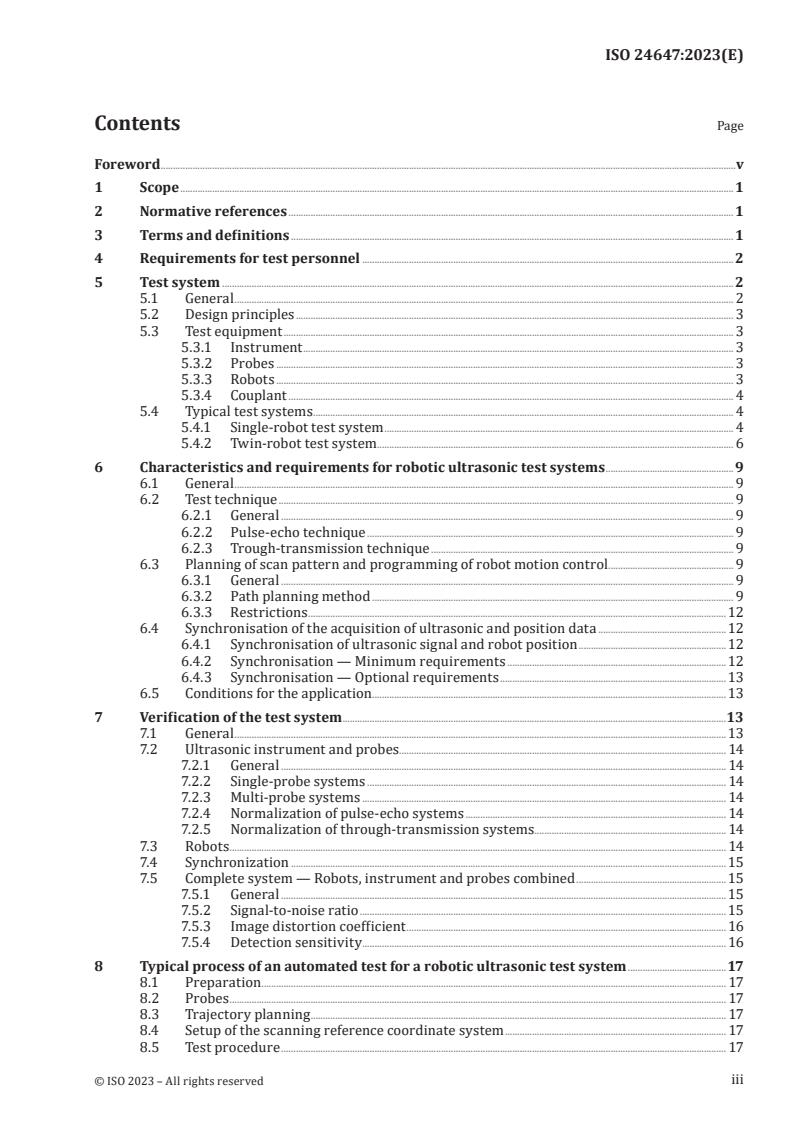
Contents Page
Foreword .v
1 Scope . 1
2 Normative references . 1
3 Terms and definitions . 1
4 Requirements for test personnel .2
5 Test system .2
5.1 General . 2
5.2 Design principles . 3
5.3 Test equipment . 3
5.3.1 Instrument . 3
5.3.2 Probes . 3
5.3.3 Robots . 3
5.3.4 Couplant . 4
5.4 Typical test systems . . 4
5.4.1 Single-robot test system . 4
5.4.2 Twin-robot test system . 6
6 Characteristics and requirements for robotic ultrasonic test systems .9
6.1 General . 9
6.2 Test technique . 9
6.2.1 General . 9
6.2.2 Pulse-echo technique . 9
6.2.3 Trough-transmission technique . 9
6.3 Planning of scan pattern and programming of robot motion control . 9
6.3.1 General . 9
6.3.2 Path planning method . 9
6.3.3 Restrictions . 12
6.4 Synchronisation of the acquisition of ultrasonic and position data .12
6.4.1 Synchronisation of ultrasonic signal and robot position .12
6.4.2 Synchronisation — Minimum requirements .12
6.4.3 Synchronisation — Optional requirements .13
6.5 Conditions for the application . 13
7 Verification of the test system .13
7.1 General .13
7.2 Ultrasonic instrument and probes . . 14
7.2.1 General . 14
7.2.2 Single-probe systems . 14
7.2.3 Multi-probe systems . 14
7.2.4 Normalization of pulse-echo systems . 14
7.2.5 Normalization of through-transmission systems . 14
7.3 Robots . 14
7.4 Synchronization . 15
7.5 Complete system — Robots, instrument and probes combined . 15
7.5.1 General .15
7.5.2 Signal-to-noise ratio . 15
7.5.3 Image distortion coefficient . 16
7.5.4 Detection sensitivity . 16
8 Typical process of an automated test for a robotic ultrasonic test system .17
8.1 Preparation . 17
8.2 Probes . 17
8.3 Trajectory planning . 17
8.4 Setup of the scanning reference coordinate system . 17
8.5 Test procedure . 17
iii
9 Documentation of the verification results .18
Annex A (informative) Trajectory planning .19
Annex B (informative) Example of a verification report .30
Bibliography .34
iv
Foreword
ISO (the International Organization for Standardization) is a worldwide federation of national standards
bodies (ISO member bodies). The work of preparing International Standards is normally carried out
through ISO technical committees. Each member body interested in a subject for which a technical
committee has been established has the right to be represented on that committee. International
organizations, governmental and non-governmental, in liaison with ISO, also take part in the work.
ISO collaborates closely with the International Electrotechnical Commission (IEC) on all matters of
electrotechnical standardization.
The procedures used to develop this document and those intended for its further maintenance are
described in the ISO/IEC Directives, Part 1. In particular, the different approval criteria needed for the
different types of ISO documents should be noted. This document was drafted in accordance with the
editorial rules of the ISO/IEC Directives, Part 2 (see www.iso.org/directives).
Attention is drawn to the possibility that some of the elements of this document may be the subject of
patent rights. ISO shall not be held responsible for identifying any or all such patent rights. Details of
any patent rights identified during the development of the document will be in the Introduction and/or
on the ISO list of patent declarations received (see www.iso.org/patents).
Any trade name used in this document is information given for the convenience of users and does not
constitute an endorsement.
For an explanation of the voluntary nature of standards, the meaning of ISO specific terms and
expressions related to conformity assessment, as well as information about ISO's adherence to
the World Trade Organization (WTO) principles in the Technical Barriers to Trade (TBT), see
www.iso.org/iso/foreword.html.
This document was prepared by Technical Committee ISO/TC 135, Non-destructive testing,
Subcommittee SC 3, Ultrasonic testing.
Any feedback or questions on this document should be directed to the user’s national standards body. A
complete listing of these bodies can be found at www.iso.org/members.html.
v
INTERNATIONAL STANDARD ISO 24647:2023(E)
Non-destructive testing — Robotic ultrasonic test systems
— General requirements
1 Scope
This document specifies the necessary system hardware components, the characteristics, the
component requirements and conditions for the application of robotic ultrasonic test systems.
This document specifies the general requirements and acceptance criteria for robotic ultrasonic test
systems.
This document is applicable to robotic ultrasonic test systems composed of one or more robot(s). Some
of the characteristics of a robot ultrasonic testing system can be application-specific.
This document is applicable to conventional straight-beam probes and immersion technique.
This document is also applicable for phased array equipment, but additional tests can be necessary.
2 Normative references
The following documents are referred to in the text in such a way that some or all of their content
constitutes requirements of this document. For dated references, only the edition cited applies. For
undated references, the latest edition of the referenced document (including any amendments) applies.
ISO 230-1, Test code for machine tools — Part 1: Geometric accuracy of machines operating under no-load
or quasi-static conditions
ISO 230-2, Test code for machine tools — Part 2: Determination of accuracy and repeatability of positioning
of numerically controlled axes
ISO 5577, Non-destructive testing — Ultrasonic testing — Vocabulary
ISO 8373, Robotics — Vocabulary
ISO 9283, Manipulating industrial robots — Performance criteria and related test methods
ISO 9712, Non-destructive testing — Qualification and certification of NDT personnel
ISO 22232 (all parts), Non-destructive testing — Characterization and verification of ultrasonic test
equipment
3 Terms and definitions
For the purposes of this document, the terms and definitions given in ISO 5577, ISO 8373, ISO 9283,
ISO 22232 (all parts) and the following apply.
ISO and IEC maintain terminology databases for use in standardization at the following addresses:
— ISO Online browsing platform: available at https:// www .iso .org/ obp
— IEC Electropedia: available at https:// www .electropedia .org/
3.1
robotic ultrasonic test system
automatic scanning ultrasonic test system, controlled by computer program, with the scanning motion
implemented by one or multiple robots
3.2
joint robot
robot fitted with rotary joints
Note 1 to entry: Rotary joints allow a full range of motion, as they rotate through multiple planes, and they
increase the manipulating capabilities of the robot considerably. An articulated robot can have one or more
rotary joints, and other types of joints may be used as well, depending on the design of the robot and its intended
function.
3.3
scan path
motion trajectory of the probe relative to the test object when the robot is executing the ultrasonic
scanning with the probe or the test object held by the end effector (3.5) of the robot
3.4
Cartesian robot
robot whose arm has three prismatic joints, whose axes are coincident with a Cartesian coordinate
system
3.5
end effector
device specifically designed for attachment to the robot’s mechanical interface to enable the robot to
perform its task
3.6
tool coordinate system
coordinate system referenced to the tool (probe or test piece) or to the end effector (3.5) attached to the
mechanical interface
4 Requirements for test personnel
a) Personnel to perform verification tests using this document shall be qualified in accordance with
ISO 9712 or equivalent.
b) The personnel shall be familiar with the robotic ultrasonic scanning equipment and robot motion
control technique.
c) The personnel shall be authorized by the employer or his/her agent.
5 Test system
5.1 General
Robotic ultrasonic test systems are automated high-performance ultrasonic test systems.
They are equipped with robotic manipulating technology and ultrasonic testing technology.
A robotic ultrasonic test system is mainly composed of one or more robot(s), with one or more ultrasonic
probe(s), an ultrasonic instrument and a fluid, gas or contact coupling system.
Single-pulse excitation or tone burst excitation is used.
Ultrasonic reflection or through-transmission technique may be implemented.
Two-dimensional or three-dimensional images may be used to display the test results to show the
shape and the position of the detected imperfections.
5.2 Design principles
a) The design of the test system shall meet the requirements of the application for the objects to be
tested.
b) The ambient conditions and the requirements of the test method shall be taken into account.
c) The distance between the surface of the test objects and the probes shall be kept constant during
ultrasonic scanning.
d) Electrical or mechanical interferences shall be reduced to a minimum by design.
5.3 Test equipment
5.3.1 Instrument
a) The ultrasonic instrument shall meet the requirements of ISO 22232-1 where applicable.
b) The ultrasonic instrument shall be selected according to the application.
c) The ultrasonic instrument shall support ultrasonic pulse-echo and/or ultrasonic through-
transmission mode.
d) The ultrasonic instrument shall have signal conditioning circuits for the excitation and the
reception of ultrasonic pulses.
e) The technical properties such as transmitter pulse voltage, transmitter pulse width, repetition
frequency, gain range, filtering bandwidth, digitizing frequency, digitizing dynamic range (A/D
converter bits) and crosstalk shall be specified in accordance with ISO 22232-1 and shall satisfy the
requirements of the application.
f) The technical properties of the ultrasonic instrument shall be determined according to the
application (e.g. material characteristics and the sensitivity requirements).
5.3.2 Probes
a) The ultrasonic probes shall be selected according to the test procedure.
b) The ultrasonic probes shall meet the requirements of ISO 22232-2.
c) The technical parameters of the ultrasonic probes, such as frequency, beam diameter, focal distance
and relative bandwidth, shall be specified in accordance with ISO 22232-2 and shall satisfy the
requirements of the application.
d) The cable length between the probes and the instrument shall be reduced to a minimum to reduce
cable attenuation and electrical noise. The housing shall be electrically grounded.
5.3.3 Robots
a) The robots shall be selected according to the requirements of the test procedure.
b) The robots shall conform to the requirements for the scan pattern and the scan speed.
c) The robots may be joint robots or Cartesian robots.
d) The technical properties such as freedom of mechanical movement, range for manipulation,
maximum moving speed, motion accuracy and positioning repetition accuracy shall be specified
and shall satisfy the requirements of the application.
e) The end effector of the robots shall provide a flange for the attachment of an ultrasonic probe and/
or the test object as well as a coupling supply squirter if necessary.
f) The position and orientation of the probe’s coordinate system or the coordinate system of the
test object relative to the coordinate system of the robots end effector flange or the coordinate
system of the robot base shall be provided to express tested point position in different geometrical
coordinate systems.
5.3.4 Couplant
a) Dependent on the application, gas or liquid may be used as couplant with a robotic ultrasonic test
system.
b) For liquid coupling, a squirter or immersion device and a circulation system for the couplant shall
be provided.
5.4 Typical test systems
5.4.1 Single-robot test system
5.4.1.1 System components
Figure 1 shows the composition of a robotic ultrasonic test system based on one robot. The system
setup is mainly composed of an ultrasonic instrument, an ultrasonic probe, a robot and its control
system including software and a couplant circulation system. The system shall be arranged in a way
that either the probe or the test object is moved by the robot.
a) Computer and robot controller shall be connected for control command and trajectory data
transfer.
b) Computer and ultrasonic instrument shall be connected for control command and ultrasonic data
transfer.
Key
1 test object
2 probe
3 robot
4 ultrasonic instrument
5 robot controller
6 computer and software
sound path
electrical connection
mechanical connection
Figure 1 — Single-robot ultrasonic test system
5.4.1.2 Scan modes
5.4.1.2.1 Scan mode with movement of the probe
The robot moves the probe while the test object is fixed, as shown in Figure 2.
This mode shall be used when the test object is too large or too heavy to be held by a robot.
It is suitable when the size of the test object is large and/or the acoustic attenuation is low so that the
back-wall echo can be evaluated.
Usually, the ultrasonic probe is of little weight so that the robot can hold it without overload.
Key
1 robot controller
2 robot
3 circulatory system for couplant
4 couplant supply
5 test object
6 probe
7 ultrasonic instrument
8 couplant (e.g. water)
Figure 2 — Scan mode with movement of the probe (example for squirter technique)
5.4.1.2.2 Scan mode with movement of the test object
The robot moves the test object while the probe is fixed, as shown in Figure 3.
This scan mode shall be used when the test object has a small size and complex profile.
It is suitable for the case when the size of the test object is small and the acoustic attenuation is low so
that the back-wall echo can be received.
The weight of the test object is limited by the robot’s load ability.
Key
1 robot controller
2 robot
3 ultrasonic instrument
4 probe
5 test object
6 couplant (e.g. water)
Figure 3 — Scan mode with movement of the test object (example for immersion technique)
5.4.2 Twin-robot test system
5.4.2.1 System components
Figure 4 shows twin-robots ultrasonic test systems.
The system setup is mainly composed of one or two ultrasonic probes, one ultrasonic instrument, two
robots and their control systems, including software and a couplant circulation system.
The software shall be able to send robot control commands, to transfer scan pattern data, to send
commands to the ultrasonic instrument and to transfer ultrasonic signal data.
a) Setup with two robots and two probes
b) Setup with two robots and one single probe
Key
1 robot 1 7 ultrasonic instrument
2 probe 1 8 robot controller 2
3 test object 9 computer and software
4 probe 2 sound path
5 robot 2 electrical connection
6 robot controller 1 mechanical connections
Figure 4 — Twin-robots ultrasonic test systems
5.4.2.2 Scan modes
5.4.2.2.1 Each robot moves a probe
Each robot moves a probe simultaneously while the test object is fixed, as shown in Figure 5.
This scan mode is suitable for the case when the size of the test object is large and/or the acoustic
attenuation is high so that the back-wall echo cannot be received and evaluated by reflection method.
Usually, the ultrasonic probes are of little weight so that the robot can hold them without overload.
The ultrasonic transmission technique requires that both beam axes be aligned to each other and be
consistent with the normal vector to the surface of the test object at the test point.
Key
1 robot 1
2 probe 1
3 probe 2
4 test object
5 robot 2
Figure 5 — Each robot moves a probe (example gas couplant)
5.4.2.2.2 One robot moves the probe and another robot moves the test object
One robot moves the probe and another robot moves the test object, as shown in Figure 6.
This scan mode shall be used when the size of the test object is small and/or the acoustic attenuation is
low so that the back-wall echo can be evaluated. In this case, the weight of the test object is limited by
the robot’s load ability.
Key
1 robot 1
2 test object
3 couplant (e.g. water)
4 probe
5 robot 2
Figure 6 — One robot moves the probe and another robot moves the test object
6 Characteristics and requirements for robotic ultrasonic test systems
6.1 General
Robotic ultrasonic test systems are mainly used for automated scanning of test objects with complex
geometries.
In order to obtain reliable test results, proper planning of the scan pattern and synchronized acquisition
of ultrasonic and position data are important.
6.2 Test technique
6.2.1 General
A robotic ultrasonic test system shall be able to carry out the pulse-echo technique or the through-
transmission technique.
6.2.2 Pulse-echo technique
The pulse-echo technique is an ultrasonic reflection technique with the probe or the test object being
attached to the robot as shown in Figure 2, Figure 3 and Figure 6, where the single probe transmits and
receives ultrasonic pulses.
The test results may be presented as A-scan images, B-scan images or C-scan images.
Information on amplitude, time of flight and position is available for evaluation.
6.2.3 Trough-transmission technique
The through-transmission technique uses two probes, one for transmitting ultrasonic waves, the other
for receiving, as shown in Figure 5.
The test result may be presented as A-scan images, B-scan images or C-scan images.
Information on amplitude and position is available for evaluation.
6.3 Planning of scan pattern and programming of robot motion control
6.3.1 General
A suited scan path planning method and/or software tool shall be provided to create the robot motion
control program for a robotic ultrasonic test system.
6.3.2 Path planning method
6.3.2.1 General
This subclause describes the scan path calculation and the post-processing.
The result of the scan path calculation gives the position and the orientation normal to the surface
for each discrete test point on the scanning trajectory expressed in the coordinate system of the test
object.
The post-processing converts the position and the orientation normal to the surface of scan points
expressed in the coordinate system of the test object into the position and orientation of the robot end
effector expressed in the robot base coordinate system.
Another task of the post-processing is to form the motion control program (with the converted scan
point data) that the particular robot controller accepts.
The discrete scan path point is usually described by the position and the orientation normal to the
surface relative to the coordinate system of the test object. It is often mathematically expressed as a
vector P (p , p , p , I, J, K) in test object coordinate system. Where (p , p , p ) gives the position of the
x y z x y z
scan point and (I, J, K) gives the cosine of the orientation normal to the surface relative to the X, Y, Z axes
of the coordinate system of test object.
Normally, the movement of the robot end effector is described for robot controller by the position
and orientation of a coordinate system fixed on the end effector [often called tool centre point (TCP)]
relative to the base coordinate system of the robot.
The position and orientation of the tool coordinate system is often mathematically expressed as a
type of vector P (x, y, z, α, β, γ). where, (x, y, z) gives the position of the origin of the tool coordinate
system, (α, β, γ) represents three angles that rotate the tool coordinate system around its axes X, Y and
Z successively or the rotation of the tool coordinate system around the robot base coordinate system
axes X, Y and Z successively.
In robotics the vector P (x, y, z, α, β, γ) is often expressed as a homogenous matrix T = [Trans(x, y, z)
Rot(x, α,) Rot(y, β) Rot(z, γ)].
Since the rotating sequence of the tool coordinate system may be different for different robots, thus the
matrix T may be different for different robots.
For example, if the rotation sequence is X, Y and Z successively relative to the tool coordinate system,
the matrix T is as given in Formula (1).
T = TransR(,xy ,)zxot(,αβ)(RotRyz,) ot(,γ )
10 0 x 10 00 cosβββ00sin cosγ −sinγ 00
01 0 y 00cossαα− in 01 00 sincγ ossγ 00 (1)
=
00 1 z 00sincααos −sincββ00os 00 10
000 1 00 01 00 01 00 01
The position and orientation vector of the tool coordinate system of type P (x, y, z, α, β, γ) is used to
create control commands to a robot, or to create an equivalent homogenous matrix T.
In order to generate the robot motion control program, path data conversion from the coordinate
system of the test object with the format P (p , p , p , I, J, K) to position and orientation of the tool
x y z
coordinate system relative to the base coordinate system of the robot in format P (x, y, z, α, β, γ) is
needed in path planning. This work is often called post-processing of scan path planning.
The conversion algorithms may be different for different scan modes (see Annex A).
All the path discrete point data with the format P (x, y, z, α, β, γ) together with the scan velocity and
acceleration information will form the scan motion control program executable by the robot controller.
a) If the CAD (computer-aided design) model of a test object can be obtained easily, method 6.3.2.3 or
6.3.2.4 shall be used.
b) If it is too hard to obtain the CAD model of a test object, method 6.3.2.2 shall be used.
NOTE For CAM (computer-aided manufacturing) software, the main parameter settings are the known
and constant relations between the coordinate systems. Settings are different for different scan modes.
c) If the scan mode according to Figure 2 is used, the position and orientation of the test object
coordinate system relative to the base coordinate system of the robot and the position and
orientation of the probes coordinate system relative to the tool coordinate system of the robot are
known and constant and shall be set for the CAM software.
d) If the scan mode according to Figure 3 is used, the position and orientation of the probes coordinate
system relative to the base coordinate system of the robot and the position and orientation of
coordinate system of the test object relative to the tool coordinate system of the robot are known
and constant and shall be set for the CAM software.
For all probes, position and orientation of the probe coordinate system always describe the probe beam
origin and beam orientation.
6.3.2.2 Manual teaching method
There are two main steps to get scan path data and create the robot motion control program.
— Step 1: Teach the robot how to move and records the scan path data by physically moving the robot
or moving the robot by its control panel box.
— Step 2: Create the robot motion control program using the recorded scan path data following the
particular robot programming rules provided by the robot manufacturer.
6.3.2.3 Method using CAD model and CNC-oriented CAM tools
With this method a CAD model of the test object and a CNC (computer numerical control) machine-tool-
oriented CAM software are applied.
There are three main steps to get the scan path data and to form the robot motion control program.
— Step 1: Get the scan path discrete point data in the format that expresses the scan point position and
orientation normal to the surface in the coordinate system of the test object by the CAM software.
— Step 2: Convert each discrete point data into the format that expresses the scan point position and
orientation normal to the surface in the coordinate system of the test object to the format that
expresses the scan point position and Euler angles of the robot tool coordinate system in the robot
base coordinate system.
This shall be done by the operator of the robot test system. Annex A gives an example of the
procedure.
— Step 3: Create the robot motion control program in a way that the particular robot controller can
accept the data format that expresses the scan point position and Euler angles of the robot tool
coordinate system in the robot base coordinate system.
This shall be done by the robot test system operator. An example is given in Annex A.
NOTE The work of step 2 and step 3 is often called post-processing of scan path planning (see Annex A).
6.3.2.4 Method using CAD model and robot-oriented CAM tool
With this method, a CAD model of the test object and robot-oriented CAM software are applied.
There are three main steps to get the scan path data and to create the robot motion control program.
— Step 1: Same as step 1 given in 6.3.2.3;
— Step 2: Convert each discrete point data in the format that expresses the scan point position and the
orientation normal to the surface in the coordinate system of the test object into the format that
expresses the scan point position and Euler angles of the robot tool coordinate system within the
robot base coordinate system.
This may be done with a robot-oriented CAM software.
— Step 3: Create the robot motion control program in a way that the particular robot controller can
accept the data format that expresses the scan point position and Euler angles of the robot tool
coordinate system in the robot base coordinate system.
This may be done by the robot-oriented CAM software.
6.3.3 Restrictions
When implementing scan path planning, the following restrictions shall apply.
a) The scanning point step or distance between adjacent test points shall be less than two-thirds of
the diameter of the ultrasonic beam at these points.
b) The scanning line step or distance between adjacent scan lines shall be less than two-thirds of the
diameter of the ultrasonic beam at these lines.
c) To ensure a constant ultrasonic beam incidence angle, the beam axis of the probe shall always keep
a particular angle to the normal of the surface of the test object at each discrete test point of the
path.
In other words, the beam axis shall be consistent with the normal vector at each discrete point along
the scan path.
6.4 Synchronisation of the acquisition of ultrasonic and position data
6.4.1 Synchronisation of ultrasonic signal and robot position
In order to be able to display and evaluate mechanically recorded ultrasonic test data, the relationship
between position data and ultrasonic test data shall be known.
The robot system and the ultrasonic test system shall be synchronized for the correct assignment of
ultrasonic data to positional data.
The aim of synchronization is to ensure that the position information for each recorded A-scan in the
data record is known and can be assigned accordingly.
If possible, the position data shall be stored together with the A-scans.
Since the ultrasonic test system and the robot system are typically two independent systems, they shall
be synchronized via interfaces.
In the simplest case, this interface consists of signal lines that directly control the systems in real time.
In addition, the position and/or the cycle number can be transmitted as a value via a software interface,
e.g. via a serial data connection or a network connection.
6.4.2 Synchronisation — Minimum requirements
In the simplest case, the hardware-based interface consists of two signal lines, for a trigger signal and
for a reset/enable signal. These signals trigger an immediate reaction in the systems.
NOTE “reset/enable” means “reset” when logically 1, “enable” when logically 0, or vice versa.
At least one trigger signal counter shall be present in the robotic ultrasonic test system.
It is recommended to use TTL-compatible signals.
6.4.3 Synchronisation — Optional requirements
In addition to the minimum synchronization requirements, the current position data from the robot
system to the ultrasonic test system and/or the current cycle number from the ultrasonic test system
to the robot system can be transmitted via a serial or network connection link and a software interface.
If a trigger signal counter is implemented in the ultrasonic instrument and the robot, the data
transmitted via the software interface can be uniquely assigned in the ultrasonic instrument and the
robot via the reference to the trigger signal counter and encoder outputs, when used.
6.5 Conditions for the application
a) A robotic ultrasonic test system is mostly used for automated scanning of test objects with complex
geometry.
b) Particular test techniques shall be implemented according to the type and distribution of the
imperfections in the test object which shall be detected.
c) The ultrasonic test system shall be earthed.
d) In a laboratory environment, the following apply.
The test shall be carried out at room temperature. If water is used as the couplant, the test object
can be completely immersed in water; or a water jet system at the front of the probe can be used to
provide a stable water stream.
The water path shall be kept constant during ultrasonic scanning.
e) In a workshop environment, the following apply.
The connecting cables should be insulated shielded cables.
The external interference by vibrations and electromagnetic disturbances shall be minimized.
7 Verification of the test system
7.1 General
Ultrasonic robotic test systems are typically designed for a specific task. For the verification process
the planned task or application shall be taken into account. This means that in certain cases verification
can be application-specific.
a) For all components of the test system, a verification plan shall be made.
b) It is recommended to appoint periodical checks for the instrument, probes and robots. A time
interval for a periodical re-check shall be stated.
c) The results of the verification shall be documented.
d) The following acceptance criteria shall be defined:
1) discontinuities and artificial reflectors which shall be detected;
2) maximum percentage of false negative events;
3) maximum percentage of false positive events.
7.2 Ultrasonic instrument and probes
7.2.1 General
a) The functional ability and performance characteristics of the ultrasonic instrument shall be
verified by tests.
b) Characteristic parameters to be tested shall be specified by the manufacturer and the user of the
robotic ultrasonic test system.
c) Test procedures and acceptance criteria for the instrument, the probes and the combined system
may refer to the ISO 22232 series.
7.2.2 Single-probe systems
a) When single-probe systems are used, sensitivity shall be verified.
b) Signal saturation shall be avoided.
7.2.3 Multi-probe systems
a) Where multi-probe systems are used, a normalization of the probes shall be applied; and the
homogenous sensitivity shall be verified.
b) All probes shall be operated under the same conditions using the same test block.
7.2.4 Normalization of pulse-echo systems
a) Prepare a test block with a thickness equal to 1/3, 1/2 and 2/3 of a reference thickness. The length
and width of the test block should be 2 to 3 times larger than the probe beam diameter. Carry out a
pulse-echo test on the test block with each probe channel.
b) For the 1/2 reference thickness of the test block, the normalization of all channels shall be
performed to bring the back-wall amplitudes to the same level within a tolerance of ±1 dB.
c) For the 1/3 and 2/3 reference thickness of the test block, the back-wall amplitudes shall not vary by
more than 2 dB.
d) Signal saturation shall be avoided.
7.2.5 Normalization of through-transmission systems
a) At a specified sound path, the normalization of all channels shall be performed to bring the
amplitudes to the same level within a tolerance of ±1 dB.
b) Signal saturation shall be avoided.
7.3 Robots
a) The robots in a robotic ultrasonic test system shall be verified by tests.
b) Characteristic parameters to be tested shall be specified by the manufacturer and the user of the
robotic ultrasonic test system. At least the manipulating space and repetition positioning accuracy
shall be tested.
c) The test procedure and acceptance criteria shall be consistent with ISO 9283.
d) When additional axes are used to extend the kinematic of the robot itself (e.g. a rail axis), the
additional axes shall be verified. At least the measurement travel, motion or positioning error shall
be tested.
e) If applicable, linearity error of a linear axis and roundness error of a rotary axis shall be tested.
f) The test procedure and acceptance criteria shall be consistent with ISO 230-1 and ISO 230-2.
7.4 Synchronization
a) The synchronization between the ultrasonic instrument and the robots shall be checked.
b) The achieved accuracy of the axes shall be recorded.
7.5 Complete system — Robots, instrument and probes combined
7.5.1 General
a) The functional ability and the performance characteristics of a robotic ultrasonic test system shall
be verified by tests.
b) Characteristic parameters to be tested shall be specified by the manufacturer and the user of the
robotic ultrasonic test system.
c) At least the following aspects shall be tested for the C-scan performance of the system:
1) the signal-to-noise ratio S for a specified reflector or discontinuity;
R
2) the image distortion coefficient k;
3) the detection sensitivity.
7.5.2 Signal-to-noise ratio
7.5.2.1 Procedure
a) Perform a scan of a reference object with spherical surface containing flat-bottomed holes and
produce a C-scan image.
b) The diameter of the flat-bottomed holes shall correspond to the specified sensitivity (may be
frequency dependent).
c) The increment of scanning points and increment of scan lines shall be less than half the beam
diameter.
d) Note the maximum echo amplitude A of the flat-bottomed holes and note the maximum noise
...