

ISO 3651-2:1998
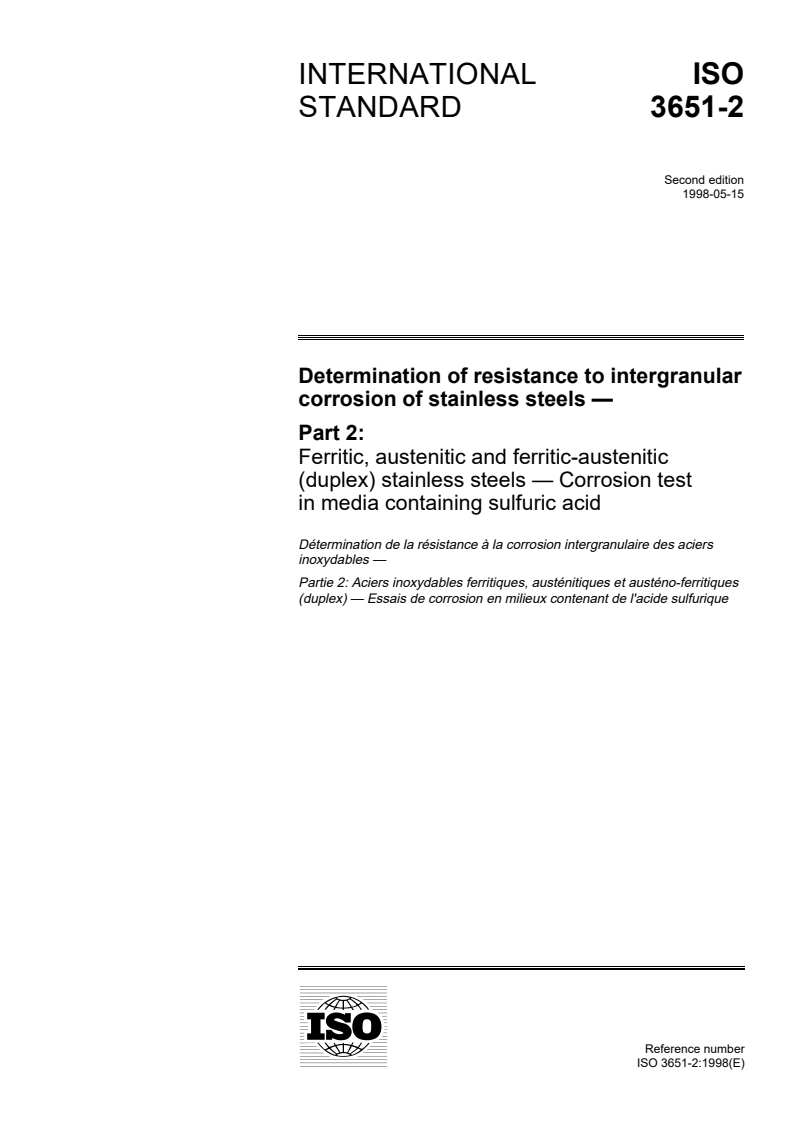
(Main)Determination of resistance to intergranular corrosion of stainless steels — Part 2: Ferritic,austenitic and ferritic-austenitic (duplex) stainless steels — Corrosion test in media containing sulfuric acid
General Information
- Abstract
- Status
- Published
- Publication Date
- 13-May-1998
- Current Stage
- 9092 - International Standard to be revised
- Start Date
- 08-Jul-2025
- Completion Date
- 29-Aug-2026
Buy Documents
ISO 3651-2:1998 - Determination of resistance to intergranular corrosion of stainless steels
ISO 3651-2:1998 - Determination of resistance to intergranular corrosion of stainless steels — Part 2: Ferritic,austenitic and ferritic-austenitic (duplex) stainless steels — Corrosion test in media containing sulfuric acid/14/1998
ISO 3651-2:1998 - Détermination de la résistance a la corrosion intergranulaire des aciers inoxydables
ISO 3651-2:1998 - Détermination de la résistance à la corrosion intergranulaire des aciers inoxydables — Partie 2: Aciers ferritiques, austénitiques et austéno-ferritiques (duplex) — Essais de corrosion en milieux contenant de l'acide sulfurique/14/1998
Overview
ISO 3651-2:1998 specifies standardized laboratory methods to determine resistance to intergranular corrosion of stainless steels - specifically ferritic, austenitic and ferritic‑austenitic (duplex) grades - using corrosion tests in media containing sulfuric acid. The standard defines test purposes, specimen preparation, sensitization treatments (heat or welding), three corrosive test methods (A, B and C), and post‑test evaluation (bend or flattening tests). It applies to cast, rolled, forged products and tubes intended for mildly oxidizing acid environments (for example, sulfuric or phosphoric acid).
Key Topics and Requirements
- Purpose of the test
- Verification of intrinsic resistance for low‑carbon (C < 0.03 %) or stabilized steels after a sensitization cycle.
- Inspection of solution‑treatment effectiveness for thin products in the as‑delivered condition.
- Sensitization
- Heat treatments defined for austenitic and duplex steels: T1 = 700 °C ±10 °C for 30 min (water quench) or T2 = 650 °C ±10 °C for 10 min (water quench).
- Sensitization may alternatively be produced by welding; as‑welded specimens are tested without further heat treatment.
- Test methods (choose by agreement)
- Method A (16% H2SO4 + CuSO4) - Monypenny/Strauss test. Solution recipe and copper filings used; specimen immersed cold, then boiled for 20 h (±5 h).
- Method B (35% H2SO4 + CuSO4) - higher acid concentration; similar procedure, solution may be reused under conditions.
- Method C (40% H2SO4 + Fe2(SO4)3) - ferric sulfate based; solution single‑use.
- Specimen preparation
- Mechanical descaling (iron‑free abrasives) or controlled chemical descaling; degreasing before test.
- Test piece surface area requirement (15–35 cm²); thickness limits (max 6 mm) and dimensional guidance for bending apparatus.
- Evaluation
- After boiling exposure, specimens undergo a bend test (≥90°) or flattening test for small tubes; inspect for intergranular cracking under low magnification. Metallography or comparative unexposed bends can confirm ambiguous results.
Applications and Users
- Intended for corrosion testing laboratories, materials engineers, quality assurance teams, welding inspectors, and producers/end‑users of stainless steel components (tubes, forgings, plates) who need to:
- Verify alloy susceptibility to intergranular corrosion after heat exposure or welding.
- Validate solution annealing and fabrication practices.
- Support product standards, procurement specifications and failure investigations for components used in acidic or mildly oxidizing environments.
Related Standards
- ISO 3651-1 - Huey test: nitric acid mass‑loss method for austenitic and duplex steels.
- Annexes A and B of ISO 3651-2 provide application examples and comparisons with national standards (informative).
Keywords: intergranular corrosion, stainless steels, sulfuric acid test, Strauss test, Monypenny Strauss, ferritic, austenitic, duplex stainless steel, sensitization, bend test, flattening test, copper sulfate, ferric sulfate.
Relations
- Effective Date
- 25-Aug-2026
- Effective Date
- 25-Aug-2026
- Effective Date
- 25-Aug-2026
- Effective Date
- 25-Aug-2026
- Effective Date
- 25-Aug-2026
- Effective Date
- 25-Aug-2026
- Effective Date
- 11-Mar-2026
- Effective Date
- 12-Feb-2026
- Effective Date
- 06-Jun-2022
- Effective Date
- 15-Apr-2008
Buy Documents
ISO 3651-2:1998 - Determination of resistance to intergranular corrosion of stainless steels
ISO 3651-2:1998 - Determination of resistance to intergranular corrosion of stainless steels — Part 2: Ferritic,austenitic and ferritic-austenitic (duplex) stainless steels — Corrosion test in media containing sulfuric acid/14/1998
ISO 3651-2:1998 - Détermination de la résistance a la corrosion intergranulaire des aciers inoxydables
ISO 3651-2:1998 - Détermination de la résistance à la corrosion intergranulaire des aciers inoxydables — Partie 2: Aciers ferritiques, austénitiques et austéno-ferritiques (duplex) — Essais de corrosion en milieux contenant de l'acide sulfurique/14/1998
Get Certified
Connect with accredited certification bodies for this standard

Element Materials Technology
Materials testing and product certification.

Inštitut za kovinske materiale in tehnologije
Institute of Metals and Technology. Materials testing, metallurgical analysis, NDT.
Sponsored listings
Frequently Asked Questions
ISO 3651-2:1998 is a standard published by the International Organization for Standardization (ISO). Its full title is "Determination of resistance to intergranular corrosion of stainless steels — Part 2: Ferritic,austenitic and ferritic-austenitic (duplex) stainless steels — Corrosion test in media containing sulfuric acid". This standard covers: Determination of resistance to intergranular corrosion of stainless steels — Part 2: Ferritic,austenitic and ferritic-austenitic (duplex) stainless steels — Corrosion test in media containing sulfuric acid
Determination of resistance to intergranular corrosion of stainless steels — Part 2: Ferritic,austenitic and ferritic-austenitic (duplex) stainless steels — Corrosion test in media containing sulfuric acid
ISO 3651-2:1998 is classified under the following ICS (International Classification for Standards) categories: 77.060 - Corrosion of metals. The ICS classification helps identify the subject area and facilitates finding related standards.
ISO 3651-2:1998 has the following relationships with other standards: It is inter standard links to EN ISO 11118:2015, EN ISO 3506-2:2009, EN ISO 3506-1:2009, EN ISO 11118:2025, EN ISO 3506-3:2009, EN ISO 3506-4:2009, EN ISO 9809-4:2022, EN ISO 3651-2:1998, ISO/TR 11688-2:1998, ISO 3651-2:1976. Understanding these relationships helps ensure you are using the most current and applicable version of the standard.
ISO 3651-2:1998 is available in PDF format for immediate download after purchase. The document can be added to your cart and obtained through the secure checkout process. Digital delivery ensures instant access to the complete standard document.
Standards Content (Sample)
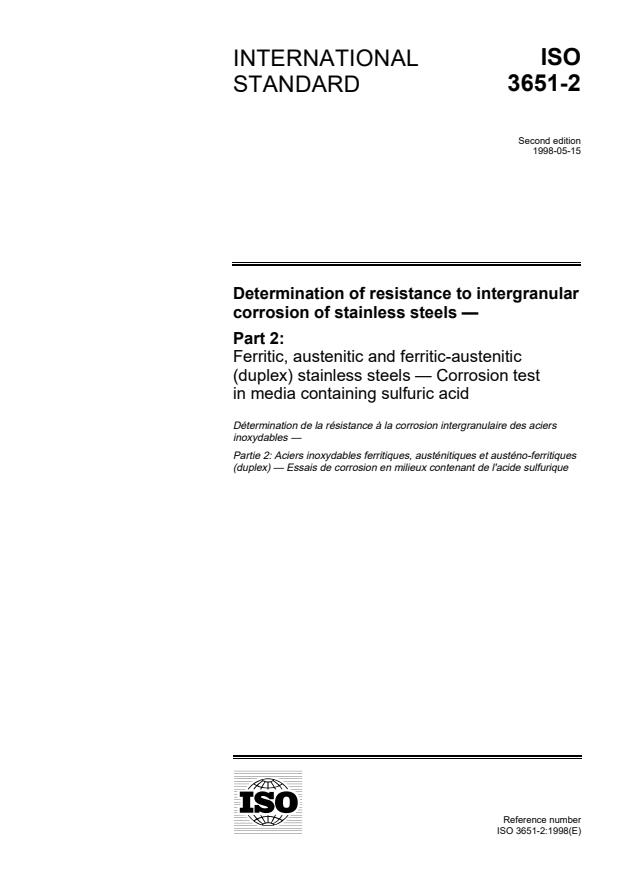
INTERNATIONAL ISO
STANDARD 3651-2
Second edition
1998-05-15
Determination of resistance to intergranular
corrosion of stainless steels —
Part 2:
Ferritic, austenitic and ferritic-austenitic
(duplex) stainless steels — Corrosion test
in media containing sulfuric acid
Détermination de la résistance à la corrosion intergranulaire des aciers
inoxydables —
Partie 2: Aciers inoxydables ferritiques, austénitiques et austéno-ferritiques
(duplex) — Essais de corrosion en milieux contenant de l'acide sulfurique
A
Reference number
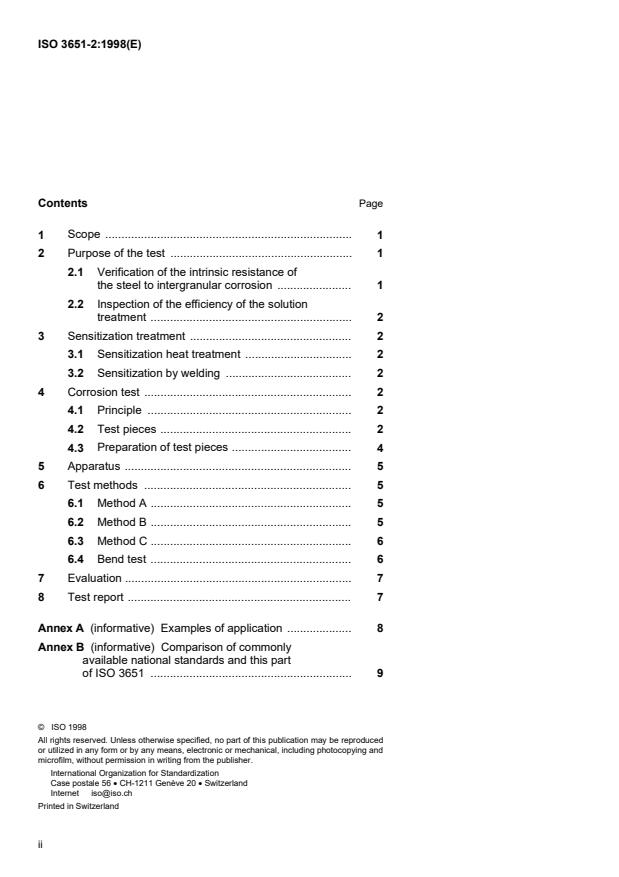
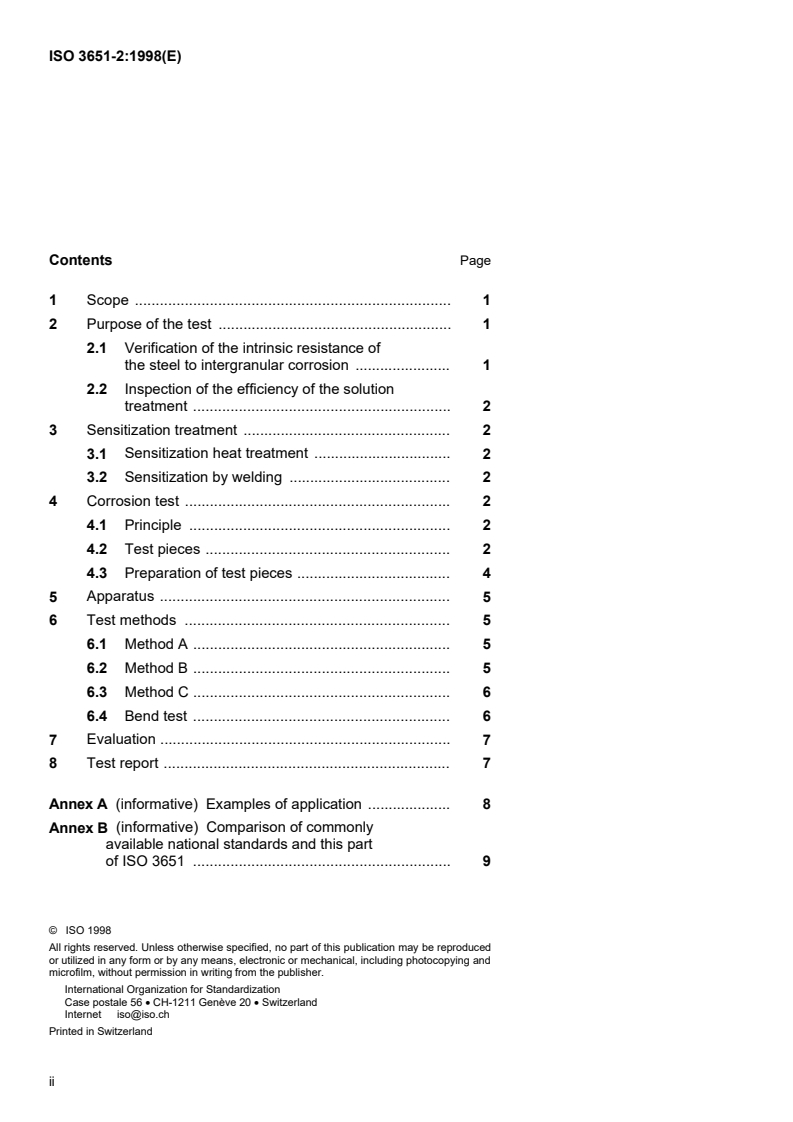
Contents Page
Scope .
1 1
2 Purpose of the test . 1
2.1 Verification of the intrinsic resistance of
the steel to intergranular corrosion . 1
2.2 Inspection of the efficiency of the solution
treatment . 2
3 Sensitization treatment . 2
3.1 Sensitization heat treatment . 2
Sensitization by welding .
3.2 2
4 Corrosion test . 2
4.1 Principle . 2
4.2 Test pieces . 2
4.3 Preparation of test pieces . 4
5 Apparatus . 5
6 Test methods . 5
6.1 Method A . 5
6.2 Method B . 5
6.3 Method C . 6
6.4 Bend test . 6
7 Evaluation . 7
8 Test report . 7
Annex A (informative) Examples of application . 8
Annex B (informative) Comparison of commonly
available national standards and this part
of ISO 3651 . 9
© ISO 1998
All rights reserved. Unless otherwise specified, no part of this publication may be reproduced
or utilized in any form or by any means, electronic or mechanical, including photocopying and
microfilm, without permission in writing from the publisher.
International Organization for Standardization
Case postale 56 • CH-1211 Genève 20 • Switzerland
Internet iso@iso.ch
Printed in Switzerland
ii
©
ISO ISO 3651-2:1998(E)
Foreword
ISO (the International Organization for Standardization) is a
worldwide federation of national standards bodies (ISO member
bodies). The work of preparing International Standards is normally
carried out through ISO technical committees. Each member body
interested in a subject for which a technical committee has been
established has the right to be represented on that committee.
International organizations, governmental and non-governmental, in
liaison with ISO, also take part in the work. ISO collaborates closely
with the International Electrotechnical Commission (IEC) on all
matters of electrotechnical standardization.
Draft International Standards adopted by the technical committees
are circulated to the member bodies for voting. Publication as an
International Standard requires approval by at least 75 % of the
member bodies casting a vote.
International Standard ISO 3651-2 was prepared by Technical
Committee ISO/TC 17, Steel, Subcommittee SC 7, Methods of
testing (other than mechanical tests and chemical analysis)
.
This second edition cancels and replaces the first edition
(ISO 3651-2:1976), which has been technically revised.
ISO 3651 consists of the following parts, under the general title
Determination of resistance to intergranular corrosion of stainless
steels:
— Part 1: Austenitic and ferritic-austenitic (duplex) stainless steels
— Corrosion test in nitric acid medium by measurement of loss
in mass (Huey test)
— Part 2: Ferritic, austenitic and ferritic-austenitic (duplex) stainless
steels — Corrosion test in media containing sulfuric acid
Annexes A and B of this part of ISO 3651 are for information only.
iii
©
Introduction
The term "intergranular corrosion test" denotes the corrosion test
carried out by means of preferential attack of the grain boundaries.
Ferritic, austenitic and ferritic-austenitic (duplex) stainless steels
may be subject to such an attack when they are held at a
temperature between about 500 °C and 1 000 °C. This heat cycle,
which may provoke sensitization to intergranular corrosion, may
occur during hot-forming (forging, rolling) as the result of incorrect
solution treatment or during a welding operation.
NOTE — In the field of application of this test, intergranular corrosion may be
connected with the presence along the grain boundaries of a chromium-depleted
region due to precipitation of chromium carbides, sigma phase or other
intermetallic phases.
iv
©
INTERNATIONAL STANDARD ISO ISO 3651-2:1998(E)
Determination of resistance to intergranular corrosion of stainless
steels —
Part 2:
Ferritic, austenitic and ferritic-austenitic (duplex) stainless steels —
Corrosion test in media containing sulfuric acid
1 Scope
This part of ISO 3651 specifies methods for the determination of the resistance to intergranular
corrosion of ferritic, austenitic and ferritic-austenitic (duplex) stainless steels in media containing sulfuric
acid. It also specifies the purposes which may be assigned to the test. The test methods included are:
— the 16 % sulfuric acid/copper sulfate test (Monypenny Strauss test);
method A:
— method B: the 35 % sulfuric acid/copper sulfate test;
— method C: the 40 % sulfuric acid/ferric sulfate test.
The methods are applicable to stainless steels supplied in the form of cast, rolled or forged products
and tubes and intended for use in a mildly oxidizing acid medium (for example, sulfuric acid, phosphoric
acid).
Unless specified in the product standard, the method to be used, A, B or C, shall form the subject of an
agreement between the interested parties.
Annex A gives examples of application of the three methods on stainless steels.
NOTE — It is important to note that the result of the corrosion test is only strictly valid for the corrosive medium used in the
test. It constitutes a basis for estimating the resistance to intergranular corrosion but may not be used to check resistance to
other forms of corrosion (general corrosion, pitting, stress corrosion, etc.). It is necessary for the user to adapt the specified
corrosion test to the use which will be made of the alloy. These test should, in no case, be considered as an absolute criterion
of the quality of the metal.
2 Purpose of the test
This intergranular corrosion test may have either of the purposes given in 2.1 and 2.2.
2.1 Verification of the intrinsic resistance of the steel to intergranular corrosion
This verification applies only to low carbon steels (C < 0,03 %) and stabilized steels specified for
resistance to intergranular corrosion. The metal is inspected after having undergone a heat treatment
for sensitization which can be a heat treatment or welding for sensitization (see clause 3).
©
ISO
2.2 Inspection of the efficiency of the solution treatment
This inspection is only carried out on thin products for which the cooling speed may be made sufficiently
rapid. It is only of interest for the steels which are not defined in 2.1. The metal is inspected in the state
in which it is delivered to the user, without heat treatment for sensitization.
3 Sensitization treatment
3.1 Sensitization heat treatment
In order to verify the intrinsic resistance to intergranular corrosion (see 2.1), it is necessary to carry out
a heat treatment for sensitization for stabilized steels and steels with low carbon content.
The sensitization heat treatment can be:
— T1: heating the specimen at 700 °C ± 10 °C for 30 minutes followed by water cooling;
— T2: heating the specimen at 650 °C ± 10 °C for 10 minutes followed by water cooling.
The above defined treatments only apply to austenitic and duplex steels.
The type of sensitization heat treatment shall be defined in the product standard or in the order. If not
specified, heat treatment T1 shall be applied.
3.2 Sensitization by welding
Sensitization by the preparation of welded test pieces may be used as an alternative to 3.1, by
agreement between the interested parties. Test pieces which are not solution annealed after welding
shall be tested in the as-welded condition. No additional sensitization heat treatment shall be performed.
Sensitization by welding applies to all the stainless steels covered by this part of ISO 3651.
4 Corrosion test
4.1 Principle
A test piece, prepared as specified in 4.2 and 4.3, is immersed in a solution according to method A, B
or C for a specified time. The test piece is then subjected to a bend test. The convex surface of the test
piece is examined after bending in order to reveal any cracks caused by intergranular corrosion.
For small diameter tubes, up to 60 mm (tube diameter shall be compatible with the aperture of the flask
containing the solution), a flattening test is used instead of the bend test.
4.2 Test pieces
4.2.1 Dimensions
The test piece shall have a total surface area of 15 cm² to 35 cm². In the case of sheets with a thickness
greater than 6 mm, the test piece shall have a maximum thickness of 6 mm and one of the rolled
surfaces shall be retained.
©
ISO
The test pieces are selected from the product as defined in the product standard. In case of dispute, a
flat test piece, when possible, shall be used having the following dimensions. These dimensions should
be used in relation to the available bending apparati:
— thickness between 2 mm and 6 mm;
— width at least 10 mm;
— length at least 50 mm.
4.2.2 Welded test pieces
Welded test pieces are prepared as follows.
For flat products, two pieces about 100 mm long and about 50 mm wide are welded together and the
test piece is cut according to figure 1.
For tubes with a circumferential weld, the test piece is cut according to figure 2.
When four pieces are welded together to form a cross weld, the first-laid weld bead shall be in the
longitudinal direction of the test piece as shown in figure 3.
If the thickness of the material i
...
INTERNATIONAL ISO
STANDARD 3651-2
Second edition
1998-05-15
Determination of resistance to intergranular
corrosion of stainless steels —
Part 2:
Ferritic, austenitic and ferritic-austenitic
(duplex) stainless steels — Corrosion test
in media containing sulfuric acid
Détermination de la résistance à la corrosion intergranulaire des aciers
inoxydables —
Partie 2: Aciers inoxydables ferritiques, austénitiques et austéno-ferritiques
(duplex) — Essais de corrosion en milieux contenant de l'acide sulfurique
A
Reference number
Contents Page
Scope .
1 1
2 Purpose of the test . 1
2.1 Verification of the intrinsic resistance of
the steel to intergranular corrosion . 1
2.2 Inspection of the efficiency of the solution
treatment . 2
3 Sensitization treatment . 2
3.1 Sensitization heat treatment . 2
Sensitization by welding .
3.2 2
4 Corrosion test . 2
4.1 Principle . 2
4.2 Test pieces . 2
4.3 Preparation of test pieces . 4
5 Apparatus . 5
6 Test methods . 5
6.1 Method A . 5
6.2 Method B . 5
6.3 Method C . 6
6.4 Bend test . 6
7 Evaluation . 7
8 Test report . 7
Annex A (informative) Examples of application . 8
Annex B (informative) Comparison of commonly
available national standards and this part
of ISO 3651 . 9
© ISO 1998
All rights reserved. Unless otherwise specified, no part of this publication may be reproduced
or utilized in any form or by any means, electronic or mechanical, including photocopying and
microfilm, without permission in writing from the publisher.
International Organization for Standardization
Case postale 56 • CH-1211 Genève 20 • Switzerland
Internet iso@iso.ch
Printed in Switzerland
ii
©
ISO ISO 3651-2:1998(E)
Foreword
ISO (the International Organization for Standardization) is a
worldwide federation of national standards bodies (ISO member
bodies). The work of preparing International Standards is normally
carried out through ISO technical committees. Each member body
interested in a subject for which a technical committee has been
established has the right to be represented on that committee.
International organizations, governmental and non-governmental, in
liaison with ISO, also take part in the work. ISO collaborates closely
with the International Electrotechnical Commission (IEC) on all
matters of electrotechnical standardization.
Draft International Standards adopted by the technical committees
are circulated to the member bodies for voting. Publication as an
International Standard requires approval by at least 75 % of the
member bodies casting a vote.
International Standard ISO 3651-2 was prepared by Technical
Committee ISO/TC 17, Steel, Subcommittee SC 7, Methods of
testing (other than mechanical tests and chemical analysis)
.
This second edition cancels and replaces the first edition
(ISO 3651-2:1976), which has been technically revised.
ISO 3651 consists of the following parts, under the general title
Determination of resistance to intergranular corrosion of stainless
steels:
— Part 1: Austenitic and ferritic-austenitic (duplex) stainless steels
— Corrosion test in nitric acid medium by measurement of loss
in mass (Huey test)
— Part 2: Ferritic, austenitic and ferritic-austenitic (duplex) stainless
steels — Corrosion test in media containing sulfuric acid
Annexes A and B of this part of ISO 3651 are for information only.
iii
©
Introduction
The term "intergranular corrosion test" denotes the corrosion test
carried out by means of preferential attack of the grain boundaries.
Ferritic, austenitic and ferritic-austenitic (duplex) stainless steels
may be subject to such an attack when they are held at a
temperature between about 500 °C and 1 000 °C. This heat cycle,
which may provoke sensitization to intergranular corrosion, may
occur during hot-forming (forging, rolling) as the result of incorrect
solution treatment or during a welding operation.
NOTE — In the field of application of this test, intergranular corrosion may be
connected with the presence along the grain boundaries of a chromium-depleted
region due to precipitation of chromium carbides, sigma phase or other
intermetallic phases.
iv
©
INTERNATIONAL STANDARD ISO ISO 3651-2:1998(E)
Determination of resistance to intergranular corrosion of stainless
steels —
Part 2:
Ferritic, austenitic and ferritic-austenitic (duplex) stainless steels —
Corrosion test in media containing sulfuric acid
1 Scope
This part of ISO 3651 specifies methods for the determination of the resistance to intergranular
corrosion of ferritic, austenitic and ferritic-austenitic (duplex) stainless steels in media containing sulfuric
acid. It also specifies the purposes which may be assigned to the test. The test methods included are:
— the 16 % sulfuric acid/copper sulfate test (Monypenny Strauss test);
method A:
— method B: the 35 % sulfuric acid/copper sulfate test;
— method C: the 40 % sulfuric acid/ferric sulfate test.
The methods are applicable to stainless steels supplied in the form of cast, rolled or forged products
and tubes and intended for use in a mildly oxidizing acid medium (for example, sulfuric acid, phosphoric
acid).
Unless specified in the product standard, the method to be used, A, B or C, shall form the subject of an
agreement between the interested parties.
Annex A gives examples of application of the three methods on stainless steels.
NOTE — It is important to note that the result of the corrosion test is only strictly valid for the corrosive medium used in the
test. It constitutes a basis for estimating the resistance to intergranular corrosion but may not be used to check resistance to
other forms of corrosion (general corrosion, pitting, stress corrosion, etc.). It is necessary for the user to adapt the specified
corrosion test to the use which will be made of the alloy. These test should, in no case, be considered as an absolute criterion
of the quality of the metal.
2 Purpose of the test
This intergranular corrosion test may have either of the purposes given in 2.1 and 2.2.
2.1 Verification of the intrinsic resistance of the steel to intergranular corrosion
This verification applies only to low carbon steels (C < 0,03 %) and stabilized steels specified for
resistance to intergranular corrosion. The metal is inspected after having undergone a heat treatment
for sensitization which can be a heat treatment or welding for sensitization (see clause 3).
©
ISO
2.2 Inspection of the efficiency of the solution treatment
This inspection is only carried out on thin products for which the cooling speed may be made sufficiently
rapid. It is only of interest for the steels which are not defined in 2.1. The metal is inspected in the state
in which it is delivered to the user, without heat treatment for sensitization.
3 Sensitization treatment
3.1 Sensitization heat treatment
In order to verify the intrinsic resistance to intergranular corrosion (see 2.1), it is necessary to carry out
a heat treatment for sensitization for stabilized steels and steels with low carbon content.
The sensitization heat treatment can be:
— T1: heating the specimen at 700 °C ± 10 °C for 30 minutes followed by water cooling;
— T2: heating the specimen at 650 °C ± 10 °C for 10 minutes followed by water cooling.
The above defined treatments only apply to austenitic and duplex steels.
The type of sensitization heat treatment shall be defined in the product standard or in the order. If not
specified, heat treatment T1 shall be applied.
3.2 Sensitization by welding
Sensitization by the preparation of welded test pieces may be used as an alternative to 3.1, by
agreement between the interested parties. Test pieces which are not solution annealed after welding
shall be tested in the as-welded condition. No additional sensitization heat treatment shall be performed.
Sensitization by welding applies to all the stainless steels covered by this part of ISO 3651.
4 Corrosion test
4.1 Principle
A test piece, prepared as specified in 4.2 and 4.3, is immersed in a solution according to method A, B
or C for a specified time. The test piece is then subjected to a bend test. The convex surface of the test
piece is examined after bending in order to reveal any cracks caused by intergranular corrosion.
For small diameter tubes, up to 60 mm (tube diameter shall be compatible with the aperture of the flask
containing the solution), a flattening test is used instead of the bend test.
4.2 Test pieces
4.2.1 Dimensions
The test piece shall have a total surface area of 15 cm² to 35 cm². In the case of sheets with a thickness
greater than 6 mm, the test piece shall have a maximum thickness of 6 mm and one of the rolled
surfaces shall be retained.
©
ISO
The test pieces are selected from the product as defined in the product standard. In case of dispute, a
flat test piece, when possible, shall be used having the following dimensions. These dimensions should
be used in relation to the available bending apparati:
— thickness between 2 mm and 6 mm;
— width at least 10 mm;
— length at least 50 mm.
4.2.2 Welded test pieces
Welded test pieces are prepared as follows.
For flat products, two pieces about 100 mm long and about 50 mm wide are welded together and the
test piece is cut according to figure 1.
For tubes with a circumferential weld, the test piece is cut according to figure 2.
When four pieces are welded together to form a cross weld, the first-laid weld bead shall be in the
longitudinal direction of the test piece as shown in figure 3.
If the thickness of the material i
...
NORME ISO
INTERNATIONALE 3651-2
Deuxième édition
1998-05-15
Détermination de la résistance
à la corrosion intergranulaire des aciers
inoxydables —
Partie 2:
Aciers inoxydables ferritiques, austénitiques et
austéno-ferritiques (duplex) — Essais de
corrosion en milieux contenant de l'acide
sulfurique
Determination of resistance to intergranular corrosion of stainless steels —
Part 2: Ferritic, austenitic and ferritic-austenitic (duplex) stainless steels —
Corrosion test in media containing sulfuric acid
A
Numéro de référence
Sommaire Page
Domaine d'application .
1 1
2 Objectif de l'essai . 1
2.1 Vérification de la résistance intrinsèque de
l’acier à la corrosion intergranulaire . 1
2.2 Contrôle de l'efficacité du traitement
d'hypertrempe . 2
3 Traitement de sensibilisation . 2
Traitement thermique de sensibilisation .
3.1 2
3.2 Sensibilisation par soudage . 2
4 Essai de corrosion . 2
4.1 Principe . 2
4.2 Éprouvettes . 3
4.3 Préparation des éprouvettes . 5
5 Appareillage . 5
6 Méthodes d'essai . 6
Méthode A .
6.1 6
6.2 Méthode B . 6
6.3 Méthode C . 7
6.4 Essai de pliage . 7
7 Évaluation . 8
8 Rapport d'essai . 8
Annexe A (informative) Exemples d'application . 9
Annexe B (informative) Comparaison entre la présente
partie de l'ISO 3651 et les normes nationales
habituellement utilisées . 10
© ISO 1998
Droits de reproduction réservés. Sauf prescription différente, aucune partie de cette publi-
cation ne peut être reproduite ni utilisée sous quelque forme que ce soit et par aucun pro-
cédé, électronique ou mécanique, y compris la photocopie et les microfilms, sans l'accord
écrit de l'éditeur.
Organisation internationale de normalisation
Case postale 56 • CH-1211 Genève 20 • Suisse
Internet iso@iso.ch
Imprimé en Suisse
ii
©
ISO ISO 3651-2:1998(F)
Avant-propos
L'ISO (Organisation internationale de normalisation) est une
fédération mondiale d'organismes nationaux de normalisation
(comités membres de l'ISO). L'élaboration des Normes interna-
tionales est en général confiée aux comités techniques de l'ISO.
Chaque comité membre intéressé par une étude a le droit de faire
partie du comité technique créé à cet effet. Les organisations
internationales, gouvernementales et non gouvernementales, en
liaison avec l'ISO, participent également aux travaux. L'ISO
collabore étroitement avec la Commission électrotechnique interna-
tionale (CEI) en ce qui concerne la normalisation électrotechnique.
Les projets de Normes internationales adoptés par les comités
techniques sont soumis aux comités membres pour vote. Leur
publication comme Normes internationales requiert l'approbation de
75 % au moins des comités membres votants.
La Norme internationale ISO 3651-2 a été élaborée par le comité
technique ISO/TC 17, Acier, sous-comité SC 7, Méthodes d'essais
(autres que les essais mécaniques et les analyses chimiques).
Cette deuxième édition annule et remplace la première édition
(ISO 3651-2:1976), dont elle constitue une révision technique.
L'ISO 3651 comprend les parties suivantes, présentées sous le titre
Détermination de la résistance à la corrosion inter-
général
granulaire des aciers inoxydables:
— Partie 1: Aciers inoxydables austénitiques et austéno-ferritiques
(duplex) — Essai de corrosion en milieu acide nitrique par
mesurage de la perte de masse (essai de Huey)
— Partie 2: Aciers inoxydables ferritiques, austénitiques et
austéno-ferritiques (duplex) — Essais de corrosion en milieux
contenant de l'acide sulfurique
Les annexes A et B de la présente partie de l'ISO 3651 sont
données uniquement à titre d'information.
iii
©
Introduction
L'expression «essai de corrosion intergranulaire» désigne un essai
de corrosion effectué par attaque préférentielle des joints de grains.
Les aciers inoxydables ferritiques, austénitiques et austéno-
ferritiques (duplex) maintenus à une température comprise entre
500 °C et 1 000 °C peuvent être soumis à ce genre d'attaque. Le
cycle thermique correspondant, qui peut provoquer une sen-
sibilisation à la corrosion intergranulaire, peut intervenir lors d'une
transformation à chaud (forgeage ou laminage), par suite d'une
hypertrempe incorrecte ou durant le soudage.
NOTE — Dans le domaine d'application de cet essai, la corrosion intergranulaire
peut être liée à la présence, le long des joints de grains, d'une zone déchromée
résultant de la précipitation de carbures de chrome, de la phase sigma ou d'autres
phases intermétalliques.
iv
©
NORME INTERNATIONALE ISO ISO 3651-2:1998(F)
Détermination de la résistance à la corrosion intergranulaire
des aciers inoxydables —
Partie 2:
Aciers inoxydables ferritiques, austénitiques et austéno-ferritiques
(duplex) — Essais de corrosion en milieux contenant de l'acide
sulfurique
1 Domaine d'application
La présente partie de l'ISO 3651 spécifie des méthodes d'essai pour déterminer la résistance à la
corrosion intergranulaire des aciers inoxydables ferritiques, austénitiques et austéno-ferritiques (duplex)
en milieux contenant de l'acide sulfurique. Elle spécifie également les objectifs qui peuvent être
assignés à l'essai. Les méthodes d'essai en question sont les suivantes:
— méthode A: essai en milieu sulfate de cuivre/acide sulfurique à 16 % (essai de Monypenny
Strauss);
— méthode B: essai en milieu sulfate de cuivre/acide sulfurique à 35 %;
— méthode C: essai en milieu sulfate de fer/acide sulfurique à 40 %.
Les méthodes sont applicables aux aciers inoxydables livrés sous forme de produits moulés, laminés ou
forgés, et de tubes, destinés à être utilisés dans un milieu acide faiblement oxydant (par exemple acide
sulfurique ou acide phosphorique).
La méthode A, B ou C à utiliser doit faire l'objet d'un accord entre les parties intéressées si elle n'est pas
spécifiée dans la norme de produit.
L'annexe A donne des exemples d'application de ces trois méthodes aux aciers inoxydables.
NOTE — Il est important de noter que le résultat de l'essai de corrosion n'est strictement valable que pour le milieu corrosif
utilisé dans l'essai. Il constitue une base d'estimation de la résistance à la corrosion intergranulaire, mais ne peut pas servir à
vérifier la résistance à d'autres formes de corrosion (corrosion générale, corrosion par piqûres, corrosion sous contrainte, etc.).
L'utilisateur devra nécessairement adapter l'essai de corrosion spécifié à l'usage qu'il désire faire de l’acier. Il ne faut en aucun
cas considérer ces essais comme des critères absolus de la qualité du métal.
2 Objectif de l'essai
Le présent essai de corrosion intergranulaire peut avoir l'un des objectifs énoncés en 2.1 et 2.2.
2.1 Vérification de la résistance intrinsèque de l’acier à la corrosion intergranulaire
<
Cette vérification s'applique aux aciers à bas carbone (C 0,03 %) et aux aciers stabilisés
spécialement élaborés pour résister à la corrosion intergranulaire. Le métal est contrôlé après avoir subi
un traitement de sensibilisation qui peut être un traitement thermique ou une sensibilisation par soudage
(voir 3).
©
ISO
2.2 Contrôle de l'efficacité du traitement d'hypertrempe
Ce contrôle ne s'effectue que sur les produits minces dont la vitesse de refroidissement peut être
rendue suffisamment rapide. Il n'a d'intérêt que pour les aciers non définis en 2.1. Le métal est contrôlé
à l'état de livraison à l'utilisateur, sans traitement de sensibilisation.
3 Traitement de sensibilisation
3.1 Traitement thermique de sensibilisation
Pour pouvoir vérifier la résistance intrinsèque à la corrosion intergranulaire (voir 2.1), un traitement
thermique de sensibilisation doit être effectué pour les aciers stabilisés et les aciers à basse teneur en
carbone.
Ce traitement de sensibilisation peut se faire par:
— T1: maintien de l'éprouvette durant 30 min à une température de 700 °C – 10 °C, suivi d'un refroi-
dissement à l'eau; ou
–
— T2: maintien de l'éprouvette durant 10 min à une température de 650 °C 10 °C, suivi d'un refroi-
dissement à l'eau.
Les traitements définis ci-dessus ne s'appliquent qu'aux aciers austénitiques et duplex.
Le type de traitement thermique de sensibilisation doit être défini dans la norme de produit ou dans la
commande. S'il n'est pas spécifié, le traitement T1 doit être appliqué.
3.2 Sensibilisation par soudage
La sensibilisation par préparation d'éprouvettes soudées peut être utilisée en variante du traitement
décrit en 3.1 par accord entre les parties intéressées. Les éprouvettes qui ne sont pas hypertrempées
après soudage doivent être essayées à l'état brut de soudage. Aucun traitement thermique de
sensibilisation ne doit être effectué en complément.
La sensibilisation par soudage s'applique à tous les aciers austénitiques couverts par la présente partie
de l'ISO 3651.
4 Essai de corrosion
4.1 Principe
Une éprouvette préparée de la manière indiquée en 4.2 et 4.3 est immergée pendant une durée
spécifiée dans la solution correspondant à la méthode A, B ou C (voir 5.3). Cette éprouvette est ensuite
soumise à un essai de pliage. Après pliage, la surface convexe de l'éprouvette est examinée pour y
détecter les fissures éventuelles causées par la corrosion intergranulaire.
Pour les tubes de faible diamètre (inférieur ou égal à 60 mm) un essai d'aplatissement peut remplacer
l'essai de pliage (le diamètre du tube doit être compatible avec l'ouverture du récipient contenant la
solution).
©
ISO
4.2 Éprouvettes
4.2.1 Dimensions
L'éprouvette doit avoir une surface totale comprise entre 15 cm² et 35 cm². Pour les tôles ayant une
épaisseur supérieure à 6 mm, l'éprouvette doit avoir une épaisseur maximale de 6 mm et conserver
l'une des faces laminées de la tôle.
Les éprouvettes doivent être prélevées dans le produit tel que défini dans la norme de produit. En cas
de litige, on doit, dans la mesure du possible, utiliser une éprouvette plate ayant les dimensions
suivantes, choisies en fonction de l'appareillage de pliage disponible:
— épaisseur comprise entre 2 mm et 6 mm;
— largeur d'au moins 10 mm;
— longueur d'au moins 50 mm.
4.2.2 Éprouvettes soudées
Les éprouvettes soudées sont confectionnées de la manière suivante.
Lorsqu'il s'agit de produits plats, souder ensemble deux pièces d'environ 100 mm de long et d'environ
50 mm de large et y découper une éprouvette conforme à la figure 1.
Lorsqu'il s'agit de tubes à soudure circonférentielle, découper l'éprouvette de la manière indiquée à la
figure 2.
Lorsque quatre pièces sont soudées ensemble pour former une soudure en croix, le premier cordon de
soudure doit être déposé dans le sens longitudinal de l'éprouvette de la manière indiquée à la figure 3.
Si le matériau a une épaisseur supérieure à 6 mm, l'éprouvette doit être usinée à partir d'une des faces,
jusqu'à l'obtention d'une épaisseur de 6
...
NORME ISO
INTERNATIONALE 3651-2
Deuxième édition
1998-05-15
Détermination de la résistance
à la corrosion intergranulaire des aciers
inoxydables —
Partie 2:
Aciers inoxydables ferritiques, austénitiques et
austéno-ferritiques (duplex) — Essais de
corrosion en milieux contenant de l'acide
sulfurique
Determination of resistance to intergranular corrosion of stainless steels —
Part 2: Ferritic, austenitic and ferritic-austenitic (duplex) stainless steels —
Corrosion test in media containing sulfuric acid
A
Numéro de référence
Sommaire Page
Domaine d'application .
1 1
2 Objectif de l'essai . 1
2.1 Vérification de la résistance intrinsèque de
l’acier à la corrosion intergranulaire . 1
2.2 Contrôle de l'efficacité du traitement
d'hypertrempe . 2
3 Traitement de sensibilisation . 2
Traitement thermique de sensibilisation .
3.1 2
3.2 Sensibilisation par soudage . 2
4 Essai de corrosion . 2
4.1 Principe . 2
4.2 Éprouvettes . 3
4.3 Préparation des éprouvettes . 5
5 Appareillage . 5
6 Méthodes d'essai . 6
Méthode A .
6.1 6
6.2 Méthode B . 6
6.3 Méthode C . 7
6.4 Essai de pliage . 7
7 Évaluation . 8
8 Rapport d'essai . 8
Annexe A (informative) Exemples d'application . 9
Annexe B (informative) Comparaison entre la présente
partie de l'ISO 3651 et les normes nationales
habituellement utilisées . 10
© ISO 1998
Droits de reproduction réservés. Sauf prescription différente, aucune partie de cette publi-
cation ne peut être reproduite ni utilisée sous quelque forme que ce soit et par aucun pro-
cédé, électronique ou mécanique, y compris la photocopie et les microfilms, sans l'accord
écrit de l'éditeur.
Organisation internationale de normalisation
Case postale 56 • CH-1211 Genève 20 • Suisse
Internet iso@iso.ch
Imprimé en Suisse
ii
©
ISO ISO 3651-2:1998(F)
Avant-propos
L'ISO (Organisation internationale de normalisation) est une
fédération mondiale d'organismes nationaux de normalisation
(comités membres de l'ISO). L'élaboration des Normes interna-
tionales est en général confiée aux comités techniques de l'ISO.
Chaque comité membre intéressé par une étude a le droit de faire
partie du comité technique créé à cet effet. Les organisations
internationales, gouvernementales et non gouvernementales, en
liaison avec l'ISO, participent également aux travaux. L'ISO
collabore étroitement avec la Commission électrotechnique interna-
tionale (CEI) en ce qui concerne la normalisation électrotechnique.
Les projets de Normes internationales adoptés par les comités
techniques sont soumis aux comités membres pour vote. Leur
publication comme Normes internationales requiert l'approbation de
75 % au moins des comités membres votants.
La Norme internationale ISO 3651-2 a été élaborée par le comité
technique ISO/TC 17, Acier, sous-comité SC 7, Méthodes d'essais
(autres que les essais mécaniques et les analyses chimiques).
Cette deuxième édition annule et remplace la première édition
(ISO 3651-2:1976), dont elle constitue une révision technique.
L'ISO 3651 comprend les parties suivantes, présentées sous le titre
Détermination de la résistance à la corrosion inter-
général
granulaire des aciers inoxydables:
— Partie 1: Aciers inoxydables austénitiques et austéno-ferritiques
(duplex) — Essai de corrosion en milieu acide nitrique par
mesurage de la perte de masse (essai de Huey)
— Partie 2: Aciers inoxydables ferritiques, austénitiques et
austéno-ferritiques (duplex) — Essais de corrosion en milieux
contenant de l'acide sulfurique
Les annexes A et B de la présente partie de l'ISO 3651 sont
données uniquement à titre d'information.
iii
©
Introduction
L'expression «essai de corrosion intergranulaire» désigne un essai
de corrosion effectué par attaque préférentielle des joints de grains.
Les aciers inoxydables ferritiques, austénitiques et austéno-
ferritiques (duplex) maintenus à une température comprise entre
500 °C et 1 000 °C peuvent être soumis à ce genre d'attaque. Le
cycle thermique correspondant, qui peut provoquer une sen-
sibilisation à la corrosion intergranulaire, peut intervenir lors d'une
transformation à chaud (forgeage ou laminage), par suite d'une
hypertrempe incorrecte ou durant le soudage.
NOTE — Dans le domaine d'application de cet essai, la corrosion intergranulaire
peut être liée à la présence, le long des joints de grains, d'une zone déchromée
résultant de la précipitation de carbures de chrome, de la phase sigma ou d'autres
phases intermétalliques.
iv
©
NORME INTERNATIONALE ISO ISO 3651-2:1998(F)
Détermination de la résistance à la corrosion intergranulaire
des aciers inoxydables —
Partie 2:
Aciers inoxydables ferritiques, austénitiques et austéno-ferritiques
(duplex) — Essais de corrosion en milieux contenant de l'acide
sulfurique
1 Domaine d'application
La présente partie de l'ISO 3651 spécifie des méthodes d'essai pour déterminer la résistance à la
corrosion intergranulaire des aciers inoxydables ferritiques, austénitiques et austéno-ferritiques (duplex)
en milieux contenant de l'acide sulfurique. Elle spécifie également les objectifs qui peuvent être
assignés à l'essai. Les méthodes d'essai en question sont les suivantes:
— méthode A: essai en milieu sulfate de cuivre/acide sulfurique à 16 % (essai de Monypenny
Strauss);
— méthode B: essai en milieu sulfate de cuivre/acide sulfurique à 35 %;
— méthode C: essai en milieu sulfate de fer/acide sulfurique à 40 %.
Les méthodes sont applicables aux aciers inoxydables livrés sous forme de produits moulés, laminés ou
forgés, et de tubes, destinés à être utilisés dans un milieu acide faiblement oxydant (par exemple acide
sulfurique ou acide phosphorique).
La méthode A, B ou C à utiliser doit faire l'objet d'un accord entre les parties intéressées si elle n'est pas
spécifiée dans la norme de produit.
L'annexe A donne des exemples d'application de ces trois méthodes aux aciers inoxydables.
NOTE — Il est important de noter que le résultat de l'essai de corrosion n'est strictement valable que pour le milieu corrosif
utilisé dans l'essai. Il constitue une base d'estimation de la résistance à la corrosion intergranulaire, mais ne peut pas servir à
vérifier la résistance à d'autres formes de corrosion (corrosion générale, corrosion par piqûres, corrosion sous contrainte, etc.).
L'utilisateur devra nécessairement adapter l'essai de corrosion spécifié à l'usage qu'il désire faire de l’acier. Il ne faut en aucun
cas considérer ces essais comme des critères absolus de la qualité du métal.
2 Objectif de l'essai
Le présent essai de corrosion intergranulaire peut avoir l'un des objectifs énoncés en 2.1 et 2.2.
2.1 Vérification de la résistance intrinsèque de l’acier à la corrosion intergranulaire
<
Cette vérification s'applique aux aciers à bas carbone (C 0,03 %) et aux aciers stabilisés
spécialement élaborés pour résister à la corrosion intergranulaire. Le métal est contrôlé après avoir subi
un traitement de sensibilisation qui peut être un traitement thermique ou une sensibilisation par soudage
(voir 3).
©
ISO
2.2 Contrôle de l'efficacité du traitement d'hypertrempe
Ce contrôle ne s'effectue que sur les produits minces dont la vitesse de refroidissement peut être
rendue suffisamment rapide. Il n'a d'intérêt que pour les aciers non définis en 2.1. Le métal est contrôlé
à l'état de livraison à l'utilisateur, sans traitement de sensibilisation.
3 Traitement de sensibilisation
3.1 Traitement thermique de sensibilisation
Pour pouvoir vérifier la résistance intrinsèque à la corrosion intergranulaire (voir 2.1), un traitement
thermique de sensibilisation doit être effectué pour les aciers stabilisés et les aciers à basse teneur en
carbone.
Ce traitement de sensibilisation peut se faire par:
— T1: maintien de l'éprouvette durant 30 min à une température de 700 °C – 10 °C, suivi d'un refroi-
dissement à l'eau; ou
–
— T2: maintien de l'éprouvette durant 10 min à une température de 650 °C 10 °C, suivi d'un refroi-
dissement à l'eau.
Les traitements définis ci-dessus ne s'appliquent qu'aux aciers austénitiques et duplex.
Le type de traitement thermique de sensibilisation doit être défini dans la norme de produit ou dans la
commande. S'il n'est pas spécifié, le traitement T1 doit être appliqué.
3.2 Sensibilisation par soudage
La sensibilisation par préparation d'éprouvettes soudées peut être utilisée en variante du traitement
décrit en 3.1 par accord entre les parties intéressées. Les éprouvettes qui ne sont pas hypertrempées
après soudage doivent être essayées à l'état brut de soudage. Aucun traitement thermique de
sensibilisation ne doit être effectué en complément.
La sensibilisation par soudage s'applique à tous les aciers austénitiques couverts par la présente partie
de l'ISO 3651.
4 Essai de corrosion
4.1 Principe
Une éprouvette préparée de la manière indiquée en 4.2 et 4.3 est immergée pendant une durée
spécifiée dans la solution correspondant à la méthode A, B ou C (voir 5.3). Cette éprouvette est ensuite
soumise à un essai de pliage. Après pliage, la surface convexe de l'éprouvette est examinée pour y
détecter les fissures éventuelles causées par la corrosion intergranulaire.
Pour les tubes de faible diamètre (inférieur ou égal à 60 mm) un essai d'aplatissement peut remplacer
l'essai de pliage (le diamètre du tube doit être compatible avec l'ouverture du récipient contenant la
solution).
©
ISO
4.2 Éprouvettes
4.2.1 Dimensions
L'éprouvette doit avoir une surface totale comprise entre 15 cm² et 35 cm². Pour les tôles ayant une
épaisseur supérieure à 6 mm, l'éprouvette doit avoir une épaisseur maximale de 6 mm et conserver
l'une des faces laminées de la tôle.
Les éprouvettes doivent être prélevées dans le produit tel que défini dans la norme de produit. En cas
de litige, on doit, dans la mesure du possible, utiliser une éprouvette plate ayant les dimensions
suivantes, choisies en fonction de l'appareillage de pliage disponible:
— épaisseur comprise entre 2 mm et 6 mm;
— largeur d'au moins 10 mm;
— longueur d'au moins 50 mm.
4.2.2 Éprouvettes soudées
Les éprouvettes soudées sont confectionnées de la manière suivante.
Lorsqu'il s'agit de produits plats, souder ensemble deux pièces d'environ 100 mm de long et d'environ
50 mm de large et y découper une éprouvette conforme à la figure 1.
Lorsqu'il s'agit de tubes à soudure circonférentielle, découper l'éprouvette de la manière indiquée à la
figure 2.
Lorsque quatre pièces sont soudées ensemble pour former une soudure en croix, le premier cordon de
soudure doit être déposé dans le sens longitudinal de l'éprouvette de la manière indiquée à la figure 3.
Si le matériau a une épaisseur supérieure à 6 mm, l'éprouvette doit être usinée à partir d'une des faces,
jusqu'à l'obtention d'une épaisseur de 6
...