

ISO 16004:2017
(Main)Aircraft ground equipment — Passenger boarding bridge or transfer vehicle — Interface requirements with aircraft doors
General Information
- Abstract
ISO 16004:2017 specifies dimensional interface and unobstructed space requirements applicable to the aircraft mating section of either a) passenger boarding bridges, or b) passenger transfer vehicles used at airports for boarding and disembarkation of passengers on the types of civil transport aircraft which have been listed hereafter. These types of aircraft have a door sill height greater than 2,0 m (80 in) over the ground. Lower aircraft usually do not require such means of access, and have not been taken into account.
- Status
- Published
- Publication Date
- 08-Jan-2017
- Technical Committee
- ISO/TC 20/SC 9 - Air cargo and ground equipment
- Drafting Committee
- ISO/TC 20/SC 9 - Air cargo and ground equipment
- Current Stage
- 9093 - International Standard confirmed
- Start Date
- 07-Jun-2024
- Completion Date
- 29-Aug-2026
Buy Documents


ISO 16004:2017 - Aircraft ground equipment -- Passenger boarding bridge or transfer vehicle -- Interface requirements with aircraft doors
ISO 16004:2017 - Aircraft ground equipment — Passenger boarding bridge or transfer vehicle — Interface requirements with aircraft doors/9/2017
Overview
ISO 16004:2017 - Aircraft ground equipment - Passenger boarding bridge or transfer vehicle - Interface requirements with aircraft doors - defines the dimensional interface and unobstructed space requirements for the aircraft mating section of passenger boarding bridges and passenger transfer vehicles. It applies to civil transport aircraft with a door sill height greater than 2.0 m (80 in) above ground and documents how boarding equipment must avoid contact with critical aircraft items (pitots, probes, sensors, strakes, etc.). ISO 16004:2017 does not prescribe aircraft design; instead it ensures compatibility between aircraft ground equipment and existing aircraft door environs.
Key topics and technical requirements
- Reference planes
- Vertical reference plane: perpendicular to the local aircraft skin through the forward edge of the door (with a defined 0.915 m offset for inward-opening doors).
- Horizontal reference plane: the aircraft door sill plane.
- Critical areas
- Specific hatched zones around passenger doors (left/right symmetrical) that must remain clear to prevent damage to exposed devices.
- Minimum clearance and positioning
- The mating section shall guarantee absence of interference with critical areas while in contact with the aircraft skin, accounting for padding flexibility.
- Designs shall allow a reasonable longitudinal positioning accuracy (a positioning accuracy of ±100 mm / 4 in or more is suggested).
- Automatic levelling and back-up systems
- Passenger boarding bridges shall include an automatic levelling system (per IATA AHM 922) and an approved back-up method (e.g., platform cut-outs) to prevent aircraft damage if levelling fails.
- Safety and operating requirements
- Compliance with ISO 6966-1/ISO 6966-2 safety principles.
- Regular briefing of staff on critical device locations, positioning/removal procedures, and visual inspections for interference.
Applications and who uses it
ISO 16004:2017 is used by:
- GSE manufacturers designing passenger boarding bridges and transfer vehicles
- Airport operators and ground handlers managing safe positioning and operation
- Aircraft OEMs and maintainers checking compatibility with door environs
- Regulators and safety engineers responsible for ground-aircraft interface risk mitigation
Practical benefits include reduced risk of damage to flight‑critical probes and sensors, improved interoperability between boarding equipment and multiple aircraft families (Airbus, Boeing, Lockheed, McDonnell Douglas listed), and safer turnaround operations.
Related standards
- ISO 6966-1 / ISO 6966-2 (basic GSE requirements)
- ISO 7718-1 / ISO 7718-2 (aircraft door interface requirements)
- IATA AHM 922 (automatic levelling and back-up guidance)
- EN 12312-4 (passenger boarding bridge safety requirements)
Keywords: ISO 16004:2017, passenger boarding bridge, transfer vehicle, aircraft door interface, aircraft ground equipment, automatic levelling, critical areas.
Relations
- Effective Date
- 09-Feb-2026
- Effective Date
- 28-May-2016
Buy Documents
ISO 16004:2017 - Aircraft ground equipment -- Passenger boarding bridge or transfer vehicle -- Interface requirements with aircraft doors
ISO 16004:2017 - Aircraft ground equipment — Passenger boarding bridge or transfer vehicle — Interface requirements with aircraft doors/9/2017
Get Certified
Connect with accredited certification bodies for this standard

BUREAU VERITAS Certification Germany
Bureau Veritas certification in Germany.

Element Materials Technology
Materials testing and product certification.

AQMS Ltd.
AQMS provides ISO certification to SMEs across the UK.
Sponsored listings
Frequently Asked Questions
ISO 16004:2017 is a standard published by the International Organization for Standardization (ISO). Its full title is "Aircraft ground equipment — Passenger boarding bridge or transfer vehicle — Interface requirements with aircraft doors". This standard covers: ISO 16004:2017 specifies dimensional interface and unobstructed space requirements applicable to the aircraft mating section of either a) passenger boarding bridges, or b) passenger transfer vehicles used at airports for boarding and disembarkation of passengers on the types of civil transport aircraft which have been listed hereafter. These types of aircraft have a door sill height greater than 2,0 m (80 in) over the ground. Lower aircraft usually do not require such means of access, and have not been taken into account.
ISO 16004:2017 specifies dimensional interface and unobstructed space requirements applicable to the aircraft mating section of either a) passenger boarding bridges, or b) passenger transfer vehicles used at airports for boarding and disembarkation of passengers on the types of civil transport aircraft which have been listed hereafter. These types of aircraft have a door sill height greater than 2,0 m (80 in) over the ground. Lower aircraft usually do not require such means of access, and have not been taken into account.
ISO 16004:2017 is classified under the following ICS (International Classification for Standards) categories: 49.100 - Ground service and maintenance equipment. The ICS classification helps identify the subject area and facilitates finding related standards.
ISO 16004:2017 has the following relationships with other standards: It is inter standard links to EN 12312-4:2024, ISO 16004:2005. Understanding these relationships helps ensure you are using the most current and applicable version of the standard.
ISO 16004:2017 is available in PDF format for immediate download after purchase. The document can be added to your cart and obtained through the secure checkout process. Digital delivery ensures instant access to the complete standard document.
Standards Content (Sample)
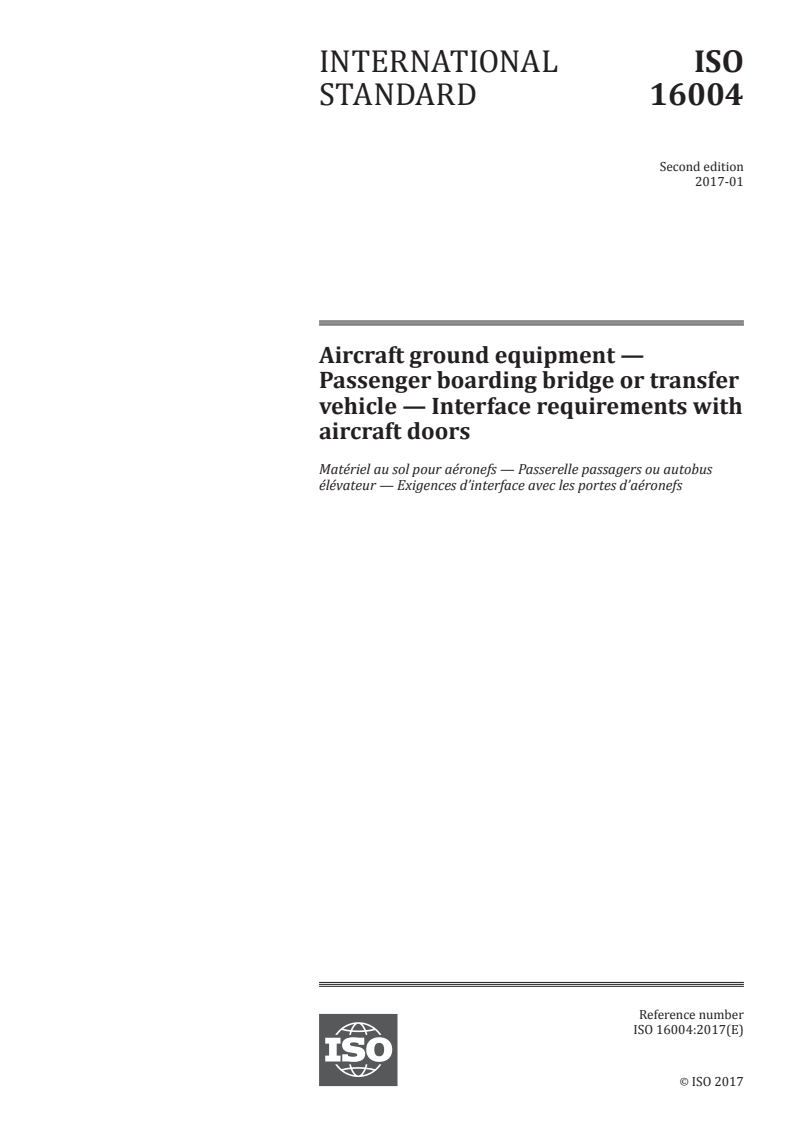
INTERNATIONAL ISO
STANDARD 16004
Second edition
2017-01
Aircraft ground equipment —
Passenger boarding bridge or transfer
vehicle — Interface requirements with
aircraft doors
Matériel au sol pour aéronefs — Passerelle passagers ou autobus
élévateur — Exigences d’interface avec les portes d’aéronefs
Reference number
©
ISO 2017
© ISO 2017, Published in Switzerland
All rights reserved. Unless otherwise specified, no part of this publication may be reproduced or utilized otherwise in any form
or by any means, electronic or mechanical, including photocopying, or posting on the internet or an intranet, without prior
written permission. Permission can be requested from either ISO at the address below or ISO’s member body in the country of
the requester.
ISO copyright office
Ch. de Blandonnet 8 • CP 401
CH-1214 Vernier, Geneva, Switzerland
Tel. +41 22 749 01 11
Fax +41 22 749 09 47
copyright@iso.org
www.iso.org
ii © ISO 2017 – All rights reserved
Contents Page
Foreword .iv
Introduction .v
1 Scope . 1
2 Normative references . 2
3 Terms and definitions . 2
4 General safety requirements . 2
5 Equipment requirements for interface with aircraft . 2
5.1 Reference planes . 2
5.2 Critical areas . 3
5.3 Minimum requirements . 3
5.4 Automatic levelling . 3
5.5 Back-up system . 3
6 Operating requirements . 3
Bibliography . 6
Foreword
ISO (the International Organization for Standardization) is a worldwide federation of national standards
bodies (ISO member bodies). The work of preparing International Standards is normally carried out
through ISO technical committees. Each member body interested in a subject for which a technical
committee has been established has the right to be represented on that committee. International
organizations, governmental and non-governmental, in liaison with ISO, also take part in the work.
ISO collaborates closely with the International Electrotechnical Commission (IEC) on all matters of
electrotechnical standardization.
The procedures used to develop this document and those intended for its further maintenance are
described in the ISO/IEC Directives, Part 1. In particular the different approval criteria needed for the
different types of ISO documents should be noted. This document was drafted in accordance with the
editorial rules of the ISO/IEC Directives, Part 2 (see www .iso .org/ directives).
Attention is drawn to the possibility that some of the elements of this document may be the subject of
patent rights. ISO shall not be held responsible for identifying any or all such patent rights. Details of
any patent rights identified during the development of the document will be in the Introduction and/or
on the ISO list of patent declarations received (see www .iso .org/ patents).
Any trade name used in this document is information given for the convenience of users and does not
constitute an endorsement.
For an explanation on the meaning of ISO specific terms and expressions related to conformity assessment,
as well as information about ISO’s adherence to the World Trade Organization (WTO) principles in the
Technical Barriers to Trade (TBT) see the following URL: www . i so .org/ iso/ foreword .html.
The committee responsible for this document it ISO/TC 20, Aircraft and space vehicle, Subcommittee
SC 9, Air cargo and ground equipment.
This second edition cancels and replaces the first (ISO 16004:2005), which constitutes a minor revision
and includes the following changes:
— clarification of the scope;
— normative references have been updated;
— table of contents has been added; and
— bibliography has been updated.
iv © ISO 2017 – All rights reserved
Introduction
Many aircraft types include, in the vicinity of the main deck doors used for passenger access, a variety of
protruding items such as pitots, probes, sensors, strakes, etc. which are exposed to inadvertent damage
and have been known to suffer from inappropriate design and/or positioning of passenger boarding
bridges or passenger transfer vehicles. Since perfect condition of these items is generally essential to
flight safety, it is the intent of this document to specify minimum interface requirements on passenger
boarding bridges or passenger transfer vehicles such that systematic or inadvertent contact with one of
them is avoided.
This document accordingly specifies the minimum interface requirements to be met by the aircraft
mating section of either a passenger boarding bridge or a passenger transfer vehicle, in order to allow
compatibility with aircraft passenger doors and their surroundings without interference with or risk of
damage to these protruding items.
Throughout this document, the minimum essential criteria are identified by the use of the keyword
“shall”. Recommended criteria are identified by the use of the keyword “should” and, while not
mandatory, are considered to be of primary importance in providing safe passenger boarding bridge
or passenger transfer vehicles and minimizing the risk of inadvertent damage to vital aircraft parts.
Deviation from recommended criteria should only occur if positively required by basic passenger
boarding bridge or passenger transfer vehicle design factors with a significant cost impact, and
after careful consideration, extensive testing, and thorough service evaluation have shown alternate
methods to be satisfactory.
INTERNATIONAL STANDARD ISO 16004:2017(E)
Aircraft ground equipment — Passenger boarding bridge
or transfer vehicle — Interface requirements with
aircraft doors
WARNING — Passenger boarding bridge or passenger transfer vehicle compliance with the
provisions of this document will only ensure protection of the exposed devices on the indicated
existing aircraft types. As to other potential circumstances:
— where a passenger boarding bridge or passenger transfer vehicle is to be operated on another
existing aircraft type, the responsible design or operating body should check the nature and
location of any items protruding in the vicinity of the passenger door(s) used, in order to
check if the aircraft is protected against interference or if particular positioning precautions
are required, and
— features specific to one aircraft type or sub-type have been identified. Passenger boarding
bridge design may not take them into account where bridge and/or aircraft stand
characteristics preclude handling of the particular aircraft type concerned. Passenger
transfer vehicles shall take them into account, inasmuch as the vehicle is capable of reaching
the aircraft type’s door sill height.
1 Scope
This document specifies dimensional interface and unobstructed space requirements applicable to the
aircraft mating section of either
a) passenger boarding bridges, or
b) passenger transfer vehicles
used at airports for boarding and disembarkation of passengers on the types of civil transport aircraft
which h
...
INTERNATIONAL ISO
STANDARD 16004
Second edition
2017-01
Aircraft ground equipment —
Passenger boarding bridge or transfer
vehicle — Interface requirements with
aircraft doors
Matériel au sol pour aéronefs — Passerelle passagers ou autobus
élévateur — Exigences d’interface avec les portes d’aéronefs
Reference number
©
ISO 2017
© ISO 2017, Published in Switzerland
All rights reserved. Unless otherwise specified, no part of this publication may be reproduced or utilized otherwise in any form
or by any means, electronic or mechanical, including photocopying, or posting on the internet or an intranet, without prior
written permission. Permission can be requested from either ISO at the address below or ISO’s member body in the country of
the requester.
ISO copyright office
Ch. de Blandonnet 8 • CP 401
CH-1214 Vernier, Geneva, Switzerland
Tel. +41 22 749 01 11
Fax +41 22 749 09 47
copyright@iso.org
www.iso.org
ii © ISO 2017 – All rights reserved
Contents Page
Foreword .iv
Introduction .v
1 Scope . 1
2 Normative references . 2
3 Terms and definitions . 2
4 General safety requirements . 2
5 Equipment requirements for interface with aircraft . 2
5.1 Reference planes . 2
5.2 Critical areas . 3
5.3 Minimum requirements . 3
5.4 Automatic levelling . 3
5.5 Back-up system . 3
6 Operating requirements . 3
Bibliography . 6
Foreword
ISO (the International Organization for Standardization) is a worldwide federation of national standards
bodies (ISO member bodies). The work of preparing International Standards is normally carried out
through ISO technical committees. Each member body interested in a subject for which a technical
committee has been established has the right to be represented on that committee. International
organizations, governmental and non-governmental, in liaison with ISO, also take part in the work.
ISO collaborates closely with the International Electrotechnical Commission (IEC) on all matters of
electrotechnical standardization.
The procedures used to develop this document and those intended for its further maintenance are
described in the ISO/IEC Directives, Part 1. In particular the different approval criteria needed for the
different types of ISO documents should be noted. This document was drafted in accordance with the
editorial rules of the ISO/IEC Directives, Part 2 (see www .iso .org/ directives).
Attention is drawn to the possibility that some of the elements of this document may be the subject of
patent rights. ISO shall not be held responsible for identifying any or all such patent rights. Details of
any patent rights identified during the development of the document will be in the Introduction and/or
on the ISO list of patent declarations received (see www .iso .org/ patents).
Any trade name used in this document is information given for the convenience of users and does not
constitute an endorsement.
For an explanation on the meaning of ISO specific terms and expressions related to conformity assessment,
as well as information about ISO’s adherence to the World Trade Organization (WTO) principles in the
Technical Barriers to Trade (TBT) see the following URL: www . i so .org/ iso/ foreword .html.
The committee responsible for this document it ISO/TC 20, Aircraft and space vehicle, Subcommittee
SC 9, Air cargo and ground equipment.
This second edition cancels and replaces the first (ISO 16004:2005), which constitutes a minor revision
and includes the following changes:
— clarification of the scope;
— normative references have been updated;
— table of contents has been added; and
— bibliography has been updated.
iv © ISO 2017 – All rights reserved
Introduction
Many aircraft types include, in the vicinity of the main deck doors used for passenger access, a variety of
protruding items such as pitots, probes, sensors, strakes, etc. which are exposed to inadvertent damage
and have been known to suffer from inappropriate design and/or positioning of passenger boarding
bridges or passenger transfer vehicles. Since perfect condition of these items is generally essential to
flight safety, it is the intent of this document to specify minimum interface requirements on passenger
boarding bridges or passenger transfer vehicles such that systematic or inadvertent contact with one of
them is avoided.
This document accordingly specifies the minimum interface requirements to be met by the aircraft
mating section of either a passenger boarding bridge or a passenger transfer vehicle, in order to allow
compatibility with aircraft passenger doors and their surroundings without interference with or risk of
damage to these protruding items.
Throughout this document, the minimum essential criteria are identified by the use of the keyword
“shall”. Recommended criteria are identified by the use of the keyword “should” and, while not
mandatory, are considered to be of primary importance in providing safe passenger boarding bridge
or passenger transfer vehicles and minimizing the risk of inadvertent damage to vital aircraft parts.
Deviation from recommended criteria should only occur if positively required by basic passenger
boarding bridge or passenger transfer vehicle design factors with a significant cost impact, and
after careful consideration, extensive testing, and thorough service evaluation have shown alternate
methods to be satisfactory.
INTERNATIONAL STANDARD ISO 16004:2017(E)
Aircraft ground equipment — Passenger boarding bridge
or transfer vehicle — Interface requirements with
aircraft doors
WARNING — Passenger boarding bridge or passenger transfer vehicle compliance with the
provisions of this document will only ensure protection of the exposed devices on the indicated
existing aircraft types. As to other potential circumstances:
— where a passenger boarding bridge or passenger transfer vehicle is to be operated on another
existing aircraft type, the responsible design or operating body should check the nature and
location of any items protruding in the vicinity of the passenger door(s) used, in order to
check if the aircraft is protected against interference or if particular positioning precautions
are required, and
— features specific to one aircraft type or sub-type have been identified. Passenger boarding
bridge design may not take them into account where bridge and/or aircraft stand
characteristics preclude handling of the particular aircraft type concerned. Passenger
transfer vehicles shall take them into account, inasmuch as the vehicle is capable of reaching
the aircraft type’s door sill height.
1 Scope
This document specifies dimensional interface and unobstructed space requirements applicable to the
aircraft mating section of either
a) passenger boarding bridges, or
b) passenger transfer vehicles
used at airports for boarding and disembarkation of passengers on the types of civil transport aircraft
which h
...