

ISO 1841-2:1996
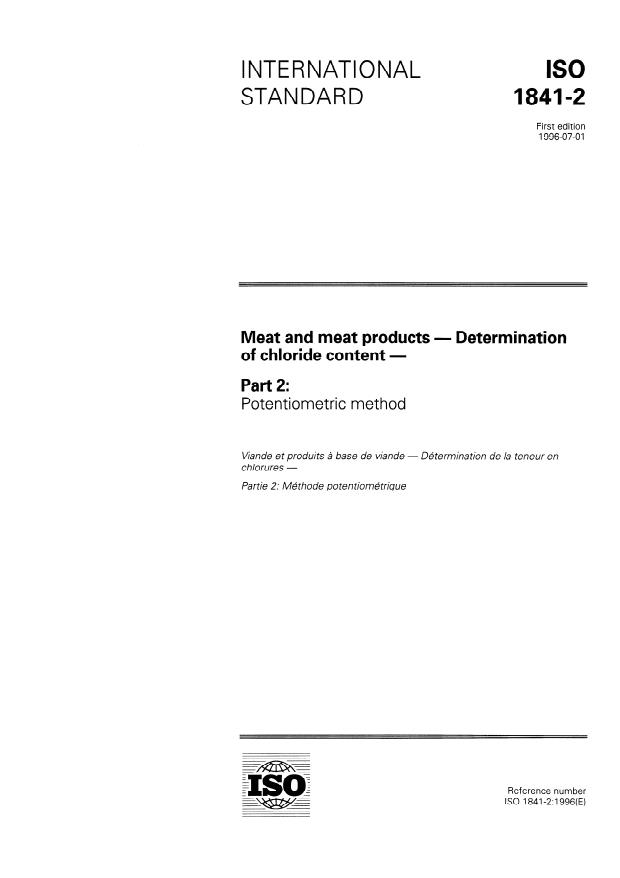
(Main)Meat and meat products — Determination of chloride content — Part 2: Potentiometric method
General Information
- Abstract
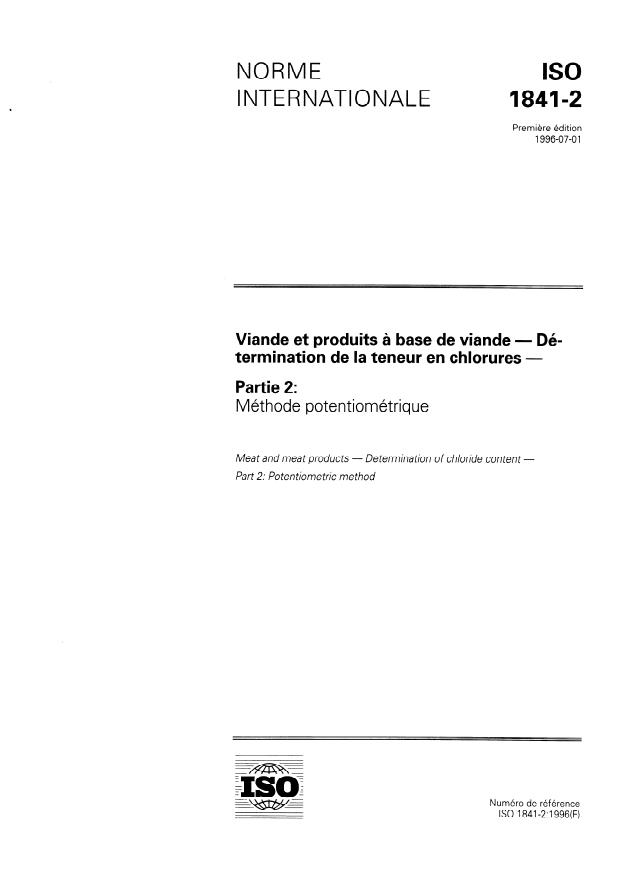
Gives a method for the determination of the chloride content of meat and meat products, including poultry, with sodium chloride contents equal to or greater than 0,25 % (m/m).
- Status
- Published
- Publication Date
- 26-Jun-1996
- Technical Committee
- ISO/TC 34/SC 6 - Meat, poultry, fish, eggs and their products
- Drafting Committee
- ISO/TC 34/SC 6 - Meat, poultry, fish, eggs and their products
- Current Stage
- 9093 - International Standard confirmed
- Start Date
- 20-Feb-2024
- Completion Date
- 29-Aug-2026
Buy Documents
ISO 1841-2:1996 - Meat and meat products — Determination of chloride content — Part 2: Potentiometric method Released:6/27/1996
ISO 1841-2:1996 - Viande et produits a base de viande — Détermination de la teneur en chlorures — Partie 2: Méthode potentiométrique Released:6/27/1996
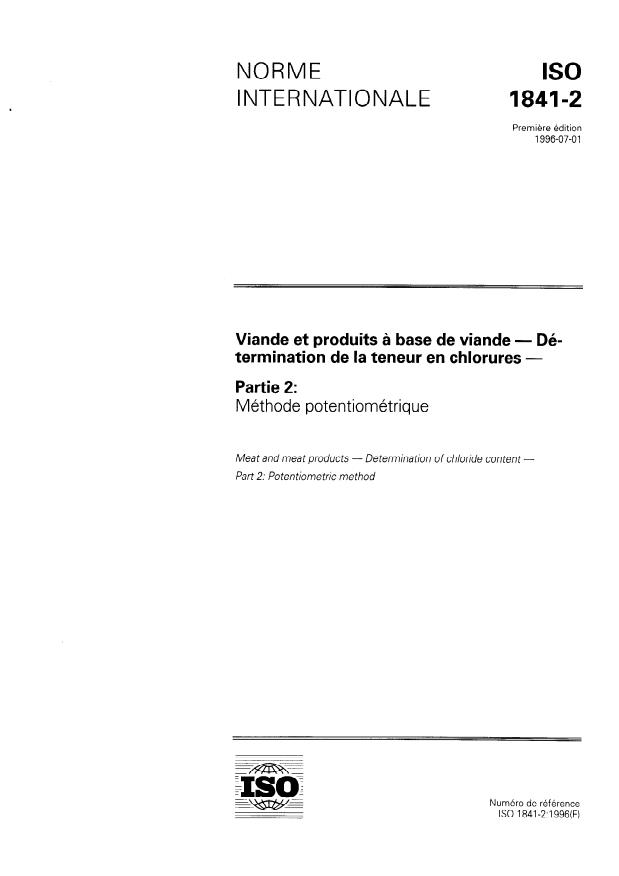
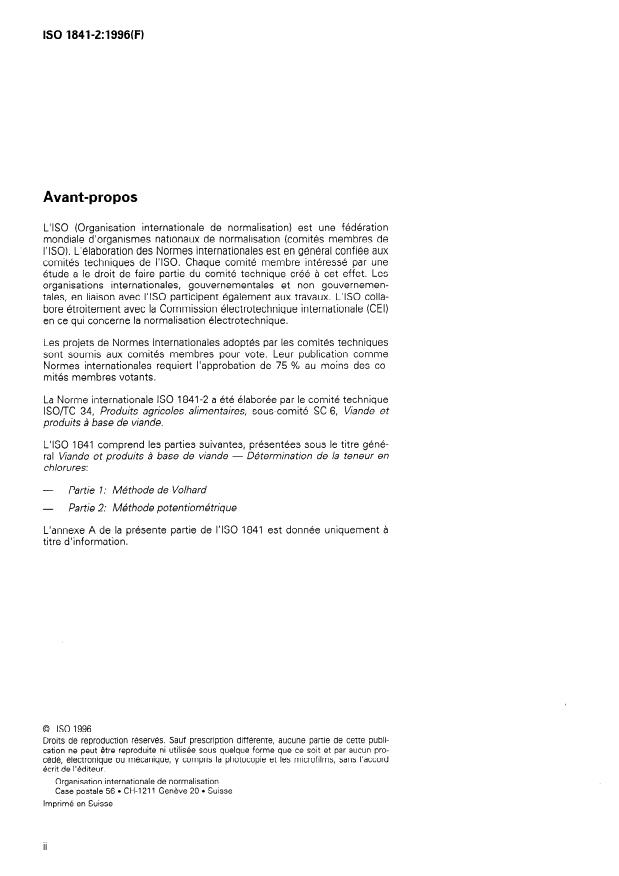
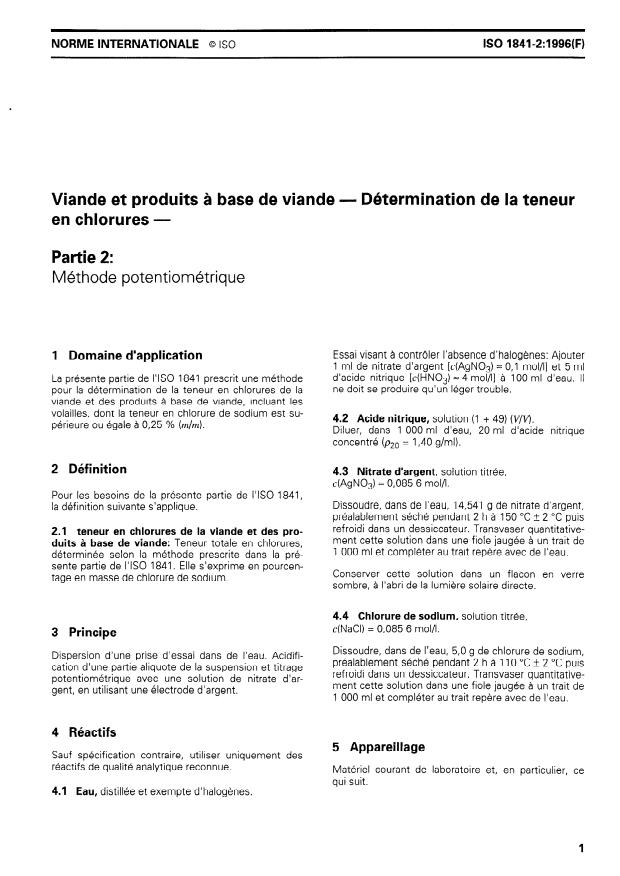
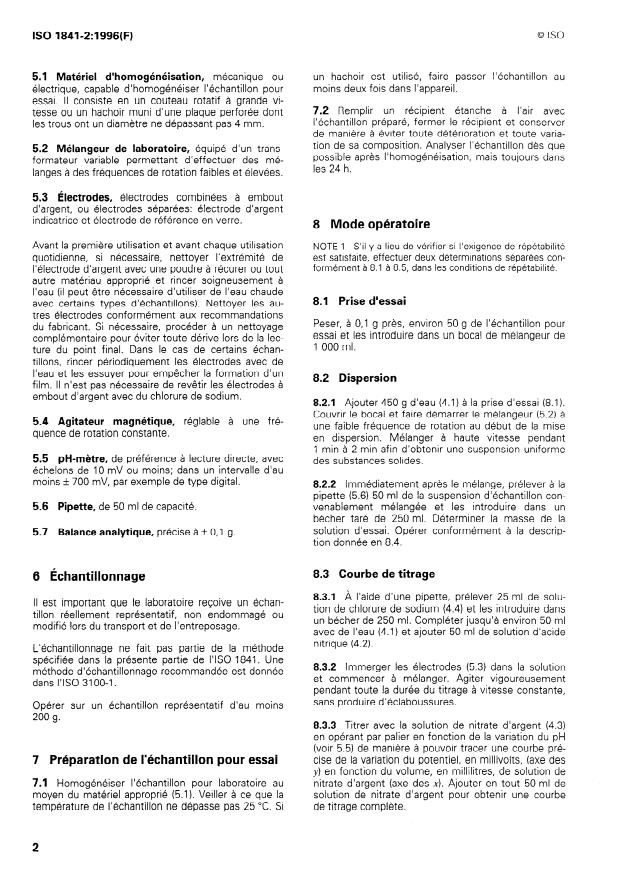
ISO 1841-2:1996 - Viande et produits a base de viande — Détermination de la teneur en chlorures — Partie 2: Méthode potentiométrique Released:6/27/1996
Overview
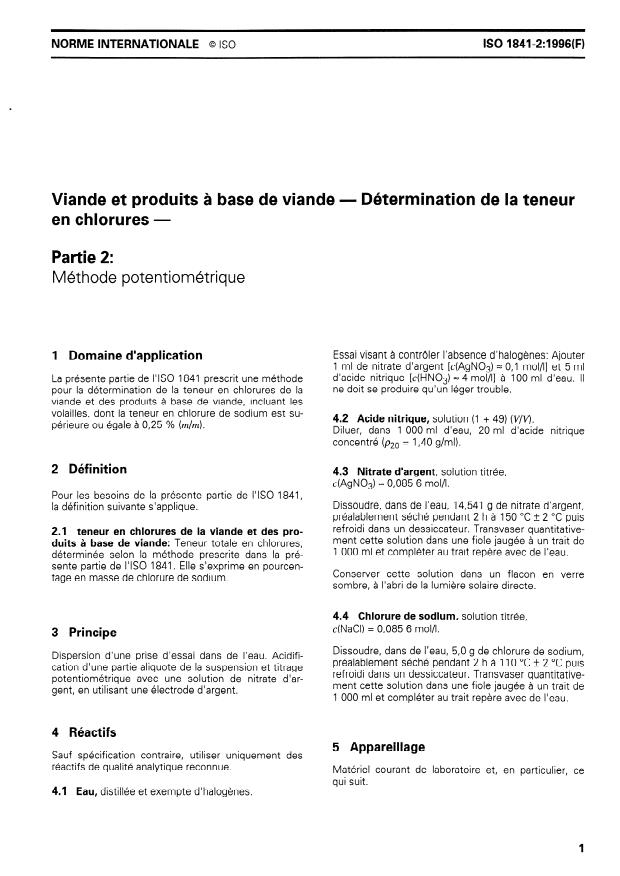
ISO 1841-2:1996 specifies a potentiometric method for determining the total chloride content of meat and meat products (including poultry) where sodium chloride is ≥ 0.25% (m/m). The standard describes sample preparation, required reagents and apparatus, titration procedure using a silver electrode, calculation of chloride expressed as sodium chloride (% m/m), and reporting requirements. Precision was established by an interlaboratory study in accordance with ISO 5725.
Key topics and requirements
- Scope: Applicable to meat and meat products with NaCl ≥ 0.25% (m/m).
- Principle: Dispersion of a homogenized test portion in water, acidification, and potentiometric titration with standard silver nitrate using a silver electrode to detect the endpoint.
- Reagents (examples given in the standard):
- Distilled, halogen-free water
- Nitric acid (1 + 49 V/V)
- Silver nitrate standard volumetric solution c(AgNO3) = 0.0856 mol · L−1
- Sodium chloride standard volumetric solution c(NaCl) = 0.0856 mol · L−1
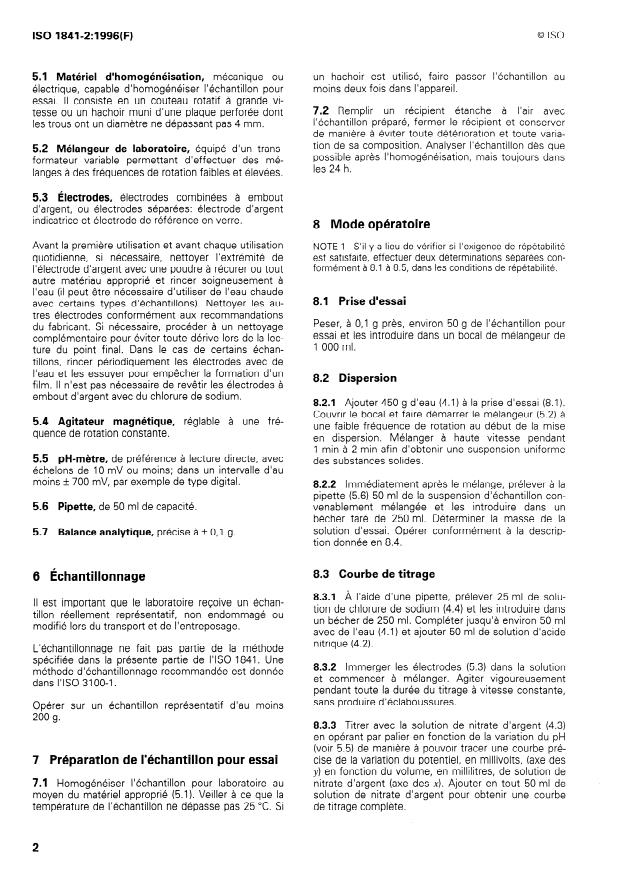
- Apparatus: Homogenizer/mincer, laboratory blender, magnetic stirrer, silver (Ag) electrode or Ag/AgCl combination electrode, reference electrode, pH/mV meter, pipettes and analytical balance.
- Procedure highlights:
- Homogenize representative sample (laboratory sample ≥ 200 g recommended).
- Blend sample with water, pipette aliquot, add dilute nitric acid, titrate with AgNO3 while recording potential to build a titration curve.
- Determine endpoint by finding the inflection point (intersection of tangents at points of greatest curvature) on the potentiometric titration curve.
- Run a blank and calculate chloride content expressed as NaCl % (m/m). Report results to the nearest 0.1% (m/m).
- Precision: Repeatability and reproducibility limits are given in the standard, based on an interlaboratory collaborative study (ISO 5725).
Applications and who uses it
- Food testing laboratories: Routine quantitative analysis of chloride/salt in meat products for compliance and labeling.
- Meat processors and QC teams: Monitoring product formulation, process control, and verification of sodium-reduction efforts.
- Regulatory and inspection bodies: Enforcement of composition and labeling regulations.
- Research and development: Evaluating effects of salt on product quality, safety, and shelf-life. Practical benefits include accurate salt quantification for nutrition labeling, quality control, and consistency across product batches.
Related standards
- ISO 1841-1: Meat and meat products - Determination of chloride content - Part 1: Volhard method
- ISO 3100-1: Sampling and preparation of test samples (sampling guidance referenced)
- ISO 5725: Precision of measurement methods - determination of repeatability and reproducibility
- Codex and FAO/WHO working documents referenced in Annex A
Keywords: ISO 1841-2:1996, potentiometric method, chloride determination, meat testing, silver nitrate titration, sodium chloride content, food laboratory, analytical method.
Buy Documents
ISO 1841-2:1996 - Meat and meat products — Determination of chloride content — Part 2: Potentiometric method Released:6/27/1996
ISO 1841-2:1996 - Viande et produits a base de viande — Détermination de la teneur en chlorures — Partie 2: Méthode potentiométrique Released:6/27/1996
ISO 1841-2:1996 - Viande et produits a base de viande — Détermination de la teneur en chlorures — Partie 2: Méthode potentiométrique Released:6/27/1996
Get Certified
Connect with accredited certification bodies for this standard

BSI Group
BSI (British Standards Institution) is the business standards company that helps organizations make excellence a habit.

Bureau Veritas
Bureau Veritas is a world leader in laboratory testing, inspection and certification services.

DNV
DNV is an independent assurance and risk management provider.
Sponsored listings
Frequently Asked Questions
ISO 1841-2:1996 is a standard published by the International Organization for Standardization (ISO). Its full title is "Meat and meat products — Determination of chloride content — Part 2: Potentiometric method". This standard covers: Gives a method for the determination of the chloride content of meat and meat products, including poultry, with sodium chloride contents equal to or greater than 0,25 % (m/m).
Gives a method for the determination of the chloride content of meat and meat products, including poultry, with sodium chloride contents equal to or greater than 0,25 % (m/m).
ISO 1841-2:1996 is classified under the following ICS (International Classification for Standards) categories: 67.120.10 - Meat and meat products. The ICS classification helps identify the subject area and facilitates finding related standards.
ISO 1841-2:1996 is available in PDF format for immediate download after purchase. The document can be added to your cart and obtained through the secure checkout process. Digital delivery ensures instant access to the complete standard document.
Standards Content (Sample)
INTERNATIONAL IS0
STANDARD 1841-2
First edition
1996-07-01
Meat and meat products - Determination
of chloride content -
Part 2:
Potentiometric method
Viande et produits 2 base de viande - D&termination de la teneur en
chlorures -
Partie 2: Mkthode potentiomgtrique
Reference number
IS0 1841-2:1996(E)
IS0 1841=2:1996(E)
Foreword
IS0 (the International Organization for Standardization) is a worldwide fed-
eration of national standards bodies (IS0 member bodies). The work of
preparing International Standards is normally carried out through IS0
technical committees. Each member body interested in a subject for
which a technical committee has been established has the right to be rep-
resented on that committee. International organizations, governmental and
non-governmental, in liaison with ISO, also take part in the work. IS0 col-
laborates closely with the International Electrotechnical Commission (IEC)
on all matters of electrotechnical standardization.
Draft International Standards adopted by the technical committees are cir-
culated to the member bodies for voting. Publication as an International
Standard requires approval by at least 75 % of the member bodies casting
a vote.
International Standard IS0 1841-Z was prepared by Technical Committee
lSO/TC 34, Agricultural food products, Subcommittee SC 6, Meat and
meat products.
IS0 1841 consists of the following parts, under the general title Meat and
meat products - Determination of chloride con tent :
- Part I: Volhard method
- Part 2: Poten tiometrk method
Annex A of this part of IS0 1841 is for information only.
0 IS0 1996
All rights reserved. Unless otherwise specified, no part of this publication may be repro-
duced or utilized in any form or by any means, electronic or mechanical, Including photo-
copying and microfilm, without permission in writing from the publisher”
International Organization for Standardization
Case Postale 56 l Ckl-1211 Geneve 20 l Switzerland
Printed in Switzerland
IS0 1841=2:1996(E)
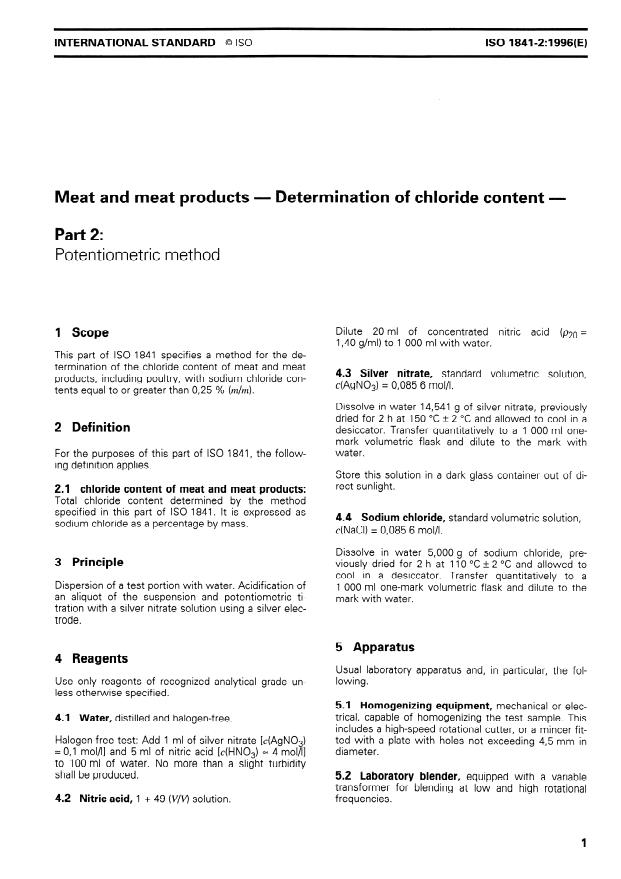
INTERNATIONAL STANDARD @ IS0
Determination of chloride content -
Meat and meat products -
Part 2:
Potentiometric method
Dilute 20 ml of concentrated nitric acid (pzo =
1 Scope
I,40 g/ml) to 1 000 ml with water.
This part of IS0 1841 specifies a method for the de-
termination of the chloride content of meat and meat
4.3 Silver nitrate, standard volumetric solution,
products, including poultry, with sodium chloride con-
c(AgN03) = 0,085 6 mol/l.
tents equal to or greater than 0,25 % (m/m).
Dissolve in water 14,541 g of silver nitrate, previously
dried for 2 h at 150 “C + 2 “C and allowed to cool in a
2 Definition
desiccator. Transfer quantitatively to a 1 000 ml one-
mark volumetric flask and dilute to the mark with
water.
For the purposes of this part of IS0 1841, the follow-
ing definition applies.
Store this solution in a dark glass container out of di-
rect sunlight.
2.1 chloride content of meat and meat products:
Total chloride content determined by the method
specified in this part of IS0 1841. It is expressed as
4.4 Sodium chloride, standard volumetric solution,
sodium chloride as a percentage by mass.
c(NaCI) = 0,085 6 mol/l.
Dissolve in water 5,000 g of sodium chloride, pre-
3 Principle viously dried for 2 h at 110 “C + 2 “C and allowed to
cool in a desiccator. Transfer quantitatively to a
Dispersion of a test portion with water. Acidification of 1 000 ml one-mark volumetric flask and dilute to the
an aliquot of the suspension and potentiometric ti- mark with water.
tration with a silver nitrate solution using a silver elec-
trode.
5 Apparatus
4 Reagents
Usual laboratory apparatus and, in particular, the fol-
lowing.
Use only reagents of recognized analytical grade un-
less otherwise specified.
5.1 Homogenizing equipment, mechanical or elec-
trical, capable of homogenizing the test sample. This
4.1 Water, distilled and halogen-free.
includes a high-speed rotational cutter, or a mincer fit-
ted with a plate with holes not exceeding 4,5 m
Halogen-free test: Add 1 ml of silver nitrate [c(AgN03) n in
diameter.
= 0,l mol/l] and 5 ml of r litric acid [c(HN03) = 4 mol/l]
to 100 ml of water. No more than a slight turbidity
shall be produced. 5.2 ILaboratory blender, equipped with a var
i able
transformer for blending at low and high rotat
onal
4.2 Nitric acid, 1 + 49 ( V/V) solution. frequencies.
@ IS0
IS0 1841=2:1996(E)
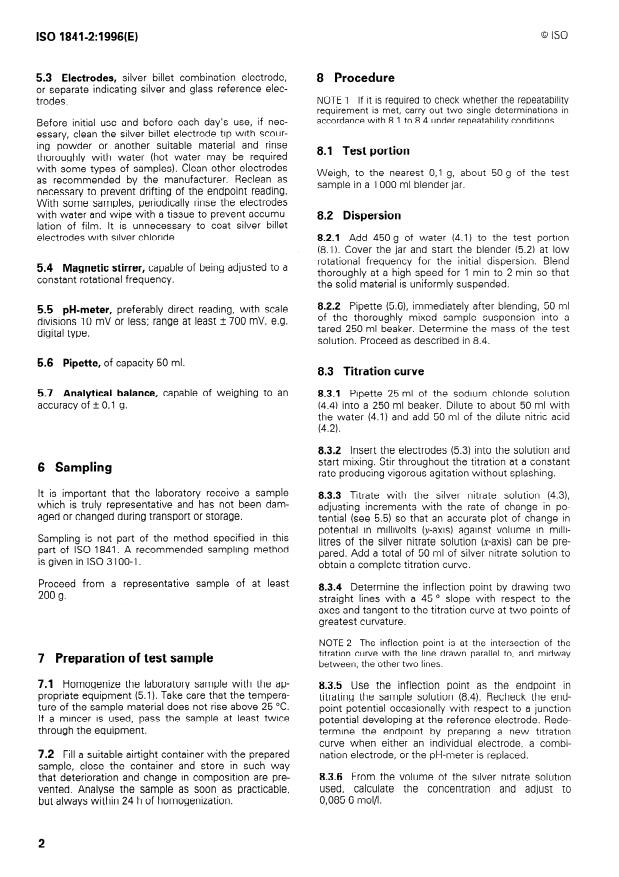
5.3 Electrodes, silver billet combination electrode, 8 Procedure
or separate indicating silver and glass reference elec-
NOTE 1 If it is required to check whether the repeatability
trodes.
requirement is met, carry out two single determinations in
accordance with 8.1 to 8.4 under repeatability conditions.
Before initial use and before each day’s use, if nec-
essary, clean the silver billet electrode tip with scour-
ing powder or another suitable material and rinse
8.1 Test portion
thoroughly with water (hot water may be required
with some types of samples). Clean other electrodes
Weigh, to the nearest 0,l g, about 50 g of the test
as recommended by the manufacturer. Reclean as
sample in a 1000 ml blender jar.
necessary to prevent drifting of the endpoint reading.
With some samples, periodically rinse the electrodes
with water and wipe with a tissue to prevent accumu-
8.2 Dispersion
lation of film. It is unnecessary to coat silver billet
electrodes with silver chloride. 8.21 Add 450 g of water (4.1) to the test portion
(8.1). Cover the jar and start the blender (5.2) at low
rotational frequency for the initial dispersion. Blend
54 Magnetic stirrer, capable of being adjusted to a
thoroughly at a high speed for 1 min to 2 min so that
con stant rotatio nal frequency.
the solid material is uniformly suspended.
8.2.2 Pipette (5.6) immediately after blending, 50 ml
5.5 pH-meter, preferably direct reading, with scale
of the thoroughly mixed sample suspension into a
divisions 10 mV or less; range at least + 700 mV, e.g.
tared 250 ml beaker. Determine the mass of the test
digital type.
solution. Proceed as described in 8.4.
5.6 Pipette, o If capacity 50 ml.
8.3 Titration curve
5.7 Analytica I balance, capable of weighing to an
8.3.1 Pipette 25 ml of the sodium chloride solution
accuracy of & 0, ,I g. (4.4) into a 250 ml beaker. Dilute to about 50 ml with
the water (4.1) and add 50 ml of the dilute nitric acid
(4.2).
8.3.2 Insert the electrodes (5.3) into the solution and
start mixing. Stir throughout the titration at a constant
6 Sampling
...
NORME
ISO
INTERNATIONALE
1841-2
Première édition
1996-07-01
Viande et produits à base de viande - Dé-
termination de la teneur en chlorures -
Partie 2:
Méthode potentiométrique
Meat and meat products -
Determination of chloride content -
Part 2: Potentiometric method
Numéro de référence
Avant-propos
L’ISO (Organisation internationale de normalisation) est une fédération
mondiale d’organismes nationaux de normalisation (comités membres de
I’ISO). L’élaboration des Normes internationales est en général confiée aux
comités techniques de I’ISO. Chaque comité membre intéressé par une
étude a le droit de faire partie du comité technique créé à cet effet. Les
organisations internationales, gouvernementales et non gouvernemen-
tales, en liaison avec I’ISO participent également aux travaux. L’ISO colla-
bore étroitement avec la Commission électrotechnique internationale (CEI)
en ce qui concerne la normalisation électrotechnique.
Les projets de Normes internationales adoptés par les comités techniques
sont soumis aux comités membres pour vote. Leur publication comme
Normes internationales requiert l’approbation de 75 % au moins des co-
mités membres votants.
La Norme internationale ISO 1841-Z a été élaborée par le comité technique
ISO/TC 34, Produits agricoles alimentaires, sous-comité SC 6, Viande et
produits à base de viande.
L’ISO 1841 comprend les parties suivantes, présentées sous le titre géné-
ral Viande et produits à base de viande - Détermination de la teneur en
chlorures:
- Partie 1: Méthode de Volhard
- Partie 2: Méthode potentiométrique
L’annexe A de la présente partie de I’ISO 1841 est donnée uniquement à
titre d’information.
0 ISO 1996
Droits de reproduction réservés. Sauf prescription différente, aucune partie de cette publi-
cation ne peut être reproduite ni utilisée sous quelque forme que ce soit et par aucun pro-
cédé, électronique ou mécanique, y compris la photocopie et les microfilms, sans l’accord
écrit de l’éditeur.
Organisation internationale de normalisation
Case postale 56 l CH-l 211 Genève 20 l Suisse
Imprimé en Suisse
ii
NORME INTERNATIONALE o Iso
Viande et produits à base de viande - Détermination de la teneur
en chlorures -
Partie 2:
Méthode potentiométrique
Essai visant à contrôler l’absence d’halogènes: Ajouter
1 Domaine d’application
1 ml de nitrate d’argent [c(AgN03) = 0,l mol/l] et 5 ml
d’acide nitrique [c(HN03) = 4 mol/l] à 100 ml d’eau. II
La présente partie de I’ISO 1841 prescrit une méthode
ne doit se produire qu’un léger trouble.
pour la détermination de la teneur en chlorures de la
viande et des produits à base de viande, incluant les
volailles, dont la teneur en chlorure de sodium est su-
4.2 Acide nitrique, solution (1 + 49) (V/V).
périeure ou égale à 025 % (II&~).
Diluer, dans 1 000 ml d’eau, 20 ml d’acide nitrique
concentré (~20 = 1,40 g/mI).
2 Définition
4.3 Nitrate d’argent, solution titrée,
c(AgNO$ = 0,085 6 mol/l.
Pour les besoins de la présente partie de I’ISO 1841,
Dissoudre, dans de l’eau, 14,541 g de nitrate d’argent,
la définition suivante s’applique.
préalablement séché pendant 2 h à 150 “C + 2 “C puis
refroidi dans un dessiccateur. Transvaser quantitative-
2.1 teneur en chlorures de la viande et des pro-
ment cette solution dans une fiole jaugée à un trait de
duits à base de viande: Teneur totale en chlorures,
1 000 ml et compléter au trait repère avec de l’eau.
déterminée selon la méthode prescrite dans la pré-
sente partie de I’ISO 1841. Elle s’exprime en pourcen-
Conserver cette solution dans un flacon en verre
tage en masse de chlorure de sodium.
sombre, à l’abri de la lumière solaire directe.
4.4 Chlorure de sodium, solution titrée,
c(NaCI) = 0,085 6 mol/l.
3 Principe
Dissoudre, dans de l’eau, 5,0 g de chlorure de sodium,
Dispersion d’une prise d’essai dans de l’eau. Acidifi-
préalablement séché pendant 2 h à 110 “C + 2 OC puis
cation d’une partie aliquote de la suspension et titrage
refroidi dans un dessiccateur. Transvaser quantitative-
potentiométrique avec une solution de nitrate d’ar-
ment cette solution dans une fiole jaugée à un trait de
gent, en utilisant une électrode d’argent.
1 000 ml et compléter au trait repère avec de l’eau.
4 Réactifs
5 Appareillage
Sauf spécification contraire, utiliser uniquement des
réactifs de qualité analytique reconnue.
Matériel courant de laboratoire et, en particulier, ce
qui suit.
4.1 Eau, distillée et exempte d’halogènes.
@ ISO
ISO 1841=2:1996(F)
un hachoir est utilisé, faire passer l’échantillon au
5.1 Matériel d’homogénéisation, mécanique ou
moins deux fois dans l’appareil.
électrique, capable d’homogénéiser l’échantillon pour
essai. II consiste en un couteau rotatif à grande vi-
récipient étanche à l’air avec
7.2 Remplir un
tesse ou un hachoir muni d’une plaque perforée dont
l’échantillon préparé, fermer le récipient et conserver
les trous ont un diamètre ne dépassant pas 4 mm.
de manière à éviter toute détérioration et toute varia-
tion de sa composition. Analyser l’échantillon dès que
5.2 Mélangeur de laboratoire, équipe d’un trans-
possible après l’homogénéisation, mais toujours dans
formateur variable permettant d’effectuer des mé-
les 24 h.
langes à des fréquences de rotation faibles et élevées.
5.3 Électrodes, électrodes combinées à embout
d’argent, ou électrodes séparées: électrode d’argent
indicatrice et électrode de référence en verre.
8 Mode opératoire
Avant la première utilisation et avant chaque utilisation NOTE 1 S’il y a lieu de vérifier si l’exigence de répétabilité
est satisfaite, effectuer deux déterminations séparées con-
quotidienne, si nécessaire, nettoyer l’extrémité de
formément à 8.1 à 8.5, dans les conditions de répétabilité.
l’électrode d’argent avec une poudre à récurer ou tout
autre matériau approprié et rincer soigneusement à
l’eau (il peut être nécessaire d’utiliser de l’eau chaude
8.1 Prise d’essai
avec certains types d’échantillons). Nettoyer les au-
tres électrodes conformément aux recommandations
Peser, à 0,l g près, environ 50 g de l’échantillon pour
du fabricant. Si nécessaire, procéder à un nettoyage
essai et les introduire dans un bocal de mélangeur de
complémentaire pour éviter toute dérive lors de la lec-
1 000 ml.
ture du point final. Dans le cas de certains échan-
tillons, rincer périodiquement les électrodes avec de
l’eau et les essuyer pour empêcher la formation d’un
8.2 Dispersion
film. II n’est pas nécessaire de revêtir les électrodes à
embout d’argent avec du chlorure de sodium.
8.2.1 Ajouter 450 g d’eau (4.1) à la prise d’essai (8.1).
Couvrir le bocal et faire démarrer le mélangeur (5.2) à
5.4 Agitateur magnétique, réglable à une fré-
une faible fréquence de rotation au début de la mise
quence de rotation constante.
en dispersion. Mélanger à haute vitesse pendant
1 min a 2 min afin d’obtenir une suspension uniforme
5.5 pH-mètre, de préférence à lecture directe, avec
des substances solides.
échelons de 10 mV ou moins; dans un intervalle d’au
moins + 700 mV, par exemple de type digital.
8.2.2 Immédiatement après le mélange, prélever à la
pipette (5.6) 50 ml de la suspension d’échantillon con-
5.6 Pipette, de 50 ml de capacité, venablement mélangée et les introduire dans un
bécher taré de 250 ml. Détermin
...
NORME
ISO
INTERNATIONALE
1841-2
Première édition
1996-07-01
Viande et produits à base de viande - Dé-
termination de la teneur en chlorures -
Partie 2:
Méthode potentiométrique
Meat and meat products -
Determination of chloride content -
Part 2: Potentiometric method
Numéro de référence
Avant-propos
L’ISO (Organisation internationale de normalisation) est une fédération
mondiale d’organismes nationaux de normalisation (comités membres de
I’ISO). L’élaboration des Normes internationales est en général confiée aux
comités techniques de I’ISO. Chaque comité membre intéressé par une
étude a le droit de faire partie du comité technique créé à cet effet. Les
organisations internationales, gouvernementales et non gouvernemen-
tales, en liaison avec I’ISO participent également aux travaux. L’ISO colla-
bore étroitement avec la Commission électrotechnique internationale (CEI)
en ce qui concerne la normalisation électrotechnique.
Les projets de Normes internationales adoptés par les comités techniques
sont soumis aux comités membres pour vote. Leur publication comme
Normes internationales requiert l’approbation de 75 % au moins des co-
mités membres votants.
La Norme internationale ISO 1841-Z a été élaborée par le comité technique
ISO/TC 34, Produits agricoles alimentaires, sous-comité SC 6, Viande et
produits à base de viande.
L’ISO 1841 comprend les parties suivantes, présentées sous le titre géné-
ral Viande et produits à base de viande - Détermination de la teneur en
chlorures:
- Partie 1: Méthode de Volhard
- Partie 2: Méthode potentiométrique
L’annexe A de la présente partie de I’ISO 1841 est donnée uniquement à
titre d’information.
0 ISO 1996
Droits de reproduction réservés. Sauf prescription différente, aucune partie de cette publi-
cation ne peut être reproduite ni utilisée sous quelque forme que ce soit et par aucun pro-
cédé, électronique ou mécanique, y compris la photocopie et les microfilms, sans l’accord
écrit de l’éditeur.
Organisation internationale de normalisation
Case postale 56 l CH-l 211 Genève 20 l Suisse
Imprimé en Suisse
ii
NORME INTERNATIONALE o Iso
Viande et produits à base de viande - Détermination de la teneur
en chlorures -
Partie 2:
Méthode potentiométrique
Essai visant à contrôler l’absence d’halogènes: Ajouter
1 Domaine d’application
1 ml de nitrate d’argent [c(AgN03) = 0,l mol/l] et 5 ml
d’acide nitrique [c(HN03) = 4 mol/l] à 100 ml d’eau. II
La présente partie de I’ISO 1841 prescrit une méthode
ne doit se produire qu’un léger trouble.
pour la détermination de la teneur en chlorures de la
viande et des produits à base de viande, incluant les
volailles, dont la teneur en chlorure de sodium est su-
4.2 Acide nitrique, solution (1 + 49) (V/V).
périeure ou égale à 025 % (II&~).
Diluer, dans 1 000 ml d’eau, 20 ml d’acide nitrique
concentré (~20 = 1,40 g/mI).
2 Définition
4.3 Nitrate d’argent, solution titrée,
c(AgNO$ = 0,085 6 mol/l.
Pour les besoins de la présente partie de I’ISO 1841,
Dissoudre, dans de l’eau, 14,541 g de nitrate d’argent,
la définition suivante s’applique.
préalablement séché pendant 2 h à 150 “C + 2 “C puis
refroidi dans un dessiccateur. Transvaser quantitative-
2.1 teneur en chlorures de la viande et des pro-
ment cette solution dans une fiole jaugée à un trait de
duits à base de viande: Teneur totale en chlorures,
1 000 ml et compléter au trait repère avec de l’eau.
déterminée selon la méthode prescrite dans la pré-
sente partie de I’ISO 1841. Elle s’exprime en pourcen-
Conserver cette solution dans un flacon en verre
tage en masse de chlorure de sodium.
sombre, à l’abri de la lumière solaire directe.
4.4 Chlorure de sodium, solution titrée,
c(NaCI) = 0,085 6 mol/l.
3 Principe
Dissoudre, dans de l’eau, 5,0 g de chlorure de sodium,
Dispersion d’une prise d’essai dans de l’eau. Acidifi-
préalablement séché pendant 2 h à 110 “C + 2 OC puis
cation d’une partie aliquote de la suspension et titrage
refroidi dans un dessiccateur. Transvaser quantitative-
potentiométrique avec une solution de nitrate d’ar-
ment cette solution dans une fiole jaugée à un trait de
gent, en utilisant une électrode d’argent.
1 000 ml et compléter au trait repère avec de l’eau.
4 Réactifs
5 Appareillage
Sauf spécification contraire, utiliser uniquement des
réactifs de qualité analytique reconnue.
Matériel courant de laboratoire et, en particulier, ce
qui suit.
4.1 Eau, distillée et exempte d’halogènes.
@ ISO
ISO 1841=2:1996(F)
un hachoir est utilisé, faire passer l’échantillon au
5.1 Matériel d’homogénéisation, mécanique ou
moins deux fois dans l’appareil.
électrique, capable d’homogénéiser l’échantillon pour
essai. II consiste en un couteau rotatif à grande vi-
récipient étanche à l’air avec
7.2 Remplir un
tesse ou un hachoir muni d’une plaque perforée dont
l’échantillon préparé, fermer le récipient et conserver
les trous ont un diamètre ne dépassant pas 4 mm.
de manière à éviter toute détérioration et toute varia-
tion de sa composition. Analyser l’échantillon dès que
5.2 Mélangeur de laboratoire, équipe d’un trans-
possible après l’homogénéisation, mais toujours dans
formateur variable permettant d’effectuer des mé-
les 24 h.
langes à des fréquences de rotation faibles et élevées.
5.3 Électrodes, électrodes combinées à embout
d’argent, ou électrodes séparées: électrode d’argent
indicatrice et électrode de référence en verre.
8 Mode opératoire
Avant la première utilisation et avant chaque utilisation NOTE 1 S’il y a lieu de vérifier si l’exigence de répétabilité
est satisfaite, effectuer deux déterminations séparées con-
quotidienne, si nécessaire, nettoyer l’extrémité de
formément à 8.1 à 8.5, dans les conditions de répétabilité.
l’électrode d’argent avec une poudre à récurer ou tout
autre matériau approprié et rincer soigneusement à
l’eau (il peut être nécessaire d’utiliser de l’eau chaude
8.1 Prise d’essai
avec certains types d’échantillons). Nettoyer les au-
tres électrodes conformément aux recommandations
Peser, à 0,l g près, environ 50 g de l’échantillon pour
du fabricant. Si nécessaire, procéder à un nettoyage
essai et les introduire dans un bocal de mélangeur de
complémentaire pour éviter toute dérive lors de la lec-
1 000 ml.
ture du point final. Dans le cas de certains échan-
tillons, rincer périodiquement les électrodes avec de
l’eau et les essuyer pour empêcher la formation d’un
8.2 Dispersion
film. II n’est pas nécessaire de revêtir les électrodes à
embout d’argent avec du chlorure de sodium.
8.2.1 Ajouter 450 g d’eau (4.1) à la prise d’essai (8.1).
Couvrir le bocal et faire démarrer le mélangeur (5.2) à
5.4 Agitateur magnétique, réglable à une fré-
une faible fréquence de rotation au début de la mise
quence de rotation constante.
en dispersion. Mélanger à haute vitesse pendant
1 min a 2 min afin d’obtenir une suspension uniforme
5.5 pH-mètre, de préférence à lecture directe, avec
des substances solides.
échelons de 10 mV ou moins; dans un intervalle d’au
moins + 700 mV, par exemple de type digital.
8.2.2 Immédiatement après le mélange, prélever à la
pipette (5.6) 50 ml de la suspension d’échantillon con-
5.6 Pipette, de 50 ml de capacité, venablement mélangée et les introduire dans un
bécher taré de 250 ml. Détermin
...