

ISO 16437:2012
(Main)Ships and marine technology - Lifesaving and fire protection — Atmospheric oil mist detectors for ships
General Information
- Abstract
1.1 This International Standard specifies requirements, test methods and performance criteria for resettable oil mist detectors for use in fire hazard alarm systems installed on marine vessels. Oil mist detectors may be installed where an identified risk of fire caused by ignition of flammable liquids, such as hydraulic, fuel and lubricating oil systems, exists. 1.2 This International Standard specifies requirements for the following detectors: — point type detectors employing a point aspirating sampling device or relying on dispersion of oil mist; — aspirating detectors, whereby the sampling point is separated from the sensing unit(s) and uses a pipe network for carrying the sampling air to the sensing unit(s); — open path or beam type detectors, whereby the concept of the point detector is expanded to a sampling path which can be 20 m or more, as opposed to a few centimeters in the point type detector. 1.3 For the testing of other types of detector working on different principles, this International Standard is only for guidance. Detectors with special characteristics and developed for specific risks, as well as those
- Status
- Published
- Publication Date
- 28-Jun-2012
- Technical Committee
- ISO/TC 8/SC 1 - Maritime safety
- Drafting Committee
- ISO/TC 8/SC 1/WG 3 - Fire protection
- Current Stage
- 9093 - International Standard confirmed
- Start Date
- 05-Feb-2024
- Completion Date
- 29-Aug-2026

Overview
ISO 16437:2012 - "Ships and marine technology - Lifesaving and fire protection - Atmospheric oil mist detectors for ships" specifies requirements, performance criteria and test methods for resettable oil mist detectors used in marine fire hazard alarm systems. The standard targets detectors installed where ignition of flammable liquids (fuel, lubricating and hydraulic oils) may generate oil mist and create an early-stage fire risk. It is intended for marine vessels and similar fixed/floating offshore installations.
Key topics and technical requirements
- Detector types covered
- Point type detectors (point aspirating or relying on dispersion)
- Aspirating detectors (separate sampling point with pipe network)
- Open-path / beam detectors (sampling paths of 20 m or more)
- Performance and functionality
- Reliable measurement of oil mist concentration and generation of alarm signals
- Resettable operation, clear alarm and fault indications, individual detector indicators
- Independence of zero-point and gain adjustments; clear marking of measuring ranges
- Operational and environmental tests
- Environmental conditioning: dry heat, cold, damp heat, vibration
- EMC and electrical immunity: electrostatic discharge, radiated/ conducted RF immunity, surge, transient/burst tests
- Power-supply variation and failure behaviour, insulation resistance, high-voltage tests
- Calibration and verification
- Requirements for detector calibration, repeatability, transport time and minimum flow rates (aspirating systems)
- Annexes include calibration procedures, example test methods and oil mist generator guidance
- Installation, maintenance and data
- Requirements for accessibility, cleaning alarms, manufacturer/site sensitivity adjustments, instruction manuals and non-volatile memory for site-specific data
- Scope limits
- Guidance only for detectors not based on the covered principles; detectors for explosive atmospheres or specially developed for specific risks are excluded.
- Safety note
- The lower explosive limit (LEL) for oil mist is referenced (approx. 50 mg/l), underlining the need for early detection.
Applications
- Early warning detection in marine machinery spaces such as:
- Engine rooms, oil purifying rooms, hydraulic pump rooms
- Fixed and floating offshore hydrocarbon platforms
- Integration into shipboard fire alarm and protective systems (automatic shutdowns, valve closures, alarms)
- Useful for manufacturers designing marine oil mist detectors, shipyards specifying fire safety equipment, and maritime safety engineers.
Who should use this standard
- Marine safety engineers, ship designers and shipyards
- Detector and fire-protection equipment manufacturers
- Flag state surveyors, classification societies and ship operators
- Offshore platform safety managers
Related standards
- ISO 7240 series (fire detection and alarm systems - control & power equipment)
- IEC 60068 series (environmental testing)
- IEC 61000 series (EMC testing)
Keywords: ISO 16437, oil mist detectors, maritime fire protection, ships, aspirating detectors, open-path detectors, engine room safety, detector calibration, EMC testing.
Get Certified
Connect with accredited certification bodies for this standard

DNV
DNV is an independent assurance and risk management provider.

Lloyd's Register
Lloyd's Register is a global professional services organisation specialising in engineering and technology.

FSC International
Forest Stewardship Council certification.
Sponsored listings
Frequently Asked Questions
ISO 16437:2012 is a standard published by the International Organization for Standardization (ISO). Its full title is "Ships and marine technology - Lifesaving and fire protection — Atmospheric oil mist detectors for ships". This standard covers: 1.1 This International Standard specifies requirements, test methods and performance criteria for resettable oil mist detectors for use in fire hazard alarm systems installed on marine vessels. Oil mist detectors may be installed where an identified risk of fire caused by ignition of flammable liquids, such as hydraulic, fuel and lubricating oil systems, exists. 1.2 This International Standard specifies requirements for the following detectors: — point type detectors employing a point aspirating sampling device or relying on dispersion of oil mist; — aspirating detectors, whereby the sampling point is separated from the sensing unit(s) and uses a pipe network for carrying the sampling air to the sensing unit(s); — open path or beam type detectors, whereby the concept of the point detector is expanded to a sampling path which can be 20 m or more, as opposed to a few centimeters in the point type detector. 1.3 For the testing of other types of detector working on different principles, this International Standard is only for guidance. Detectors with special characteristics and developed for specific risks, as well as those
1.1 This International Standard specifies requirements, test methods and performance criteria for resettable oil mist detectors for use in fire hazard alarm systems installed on marine vessels. Oil mist detectors may be installed where an identified risk of fire caused by ignition of flammable liquids, such as hydraulic, fuel and lubricating oil systems, exists. 1.2 This International Standard specifies requirements for the following detectors: — point type detectors employing a point aspirating sampling device or relying on dispersion of oil mist; — aspirating detectors, whereby the sampling point is separated from the sensing unit(s) and uses a pipe network for carrying the sampling air to the sensing unit(s); — open path or beam type detectors, whereby the concept of the point detector is expanded to a sampling path which can be 20 m or more, as opposed to a few centimeters in the point type detector. 1.3 For the testing of other types of detector working on different principles, this International Standard is only for guidance. Detectors with special characteristics and developed for specific risks, as well as those
ISO 16437:2012 is classified under the following ICS (International Classification for Standards) categories: 13.220.20 - Fire protection; 47.020.01 - General standards related to shipbuilding and marine structures. The ICS classification helps identify the subject area and facilitates finding related standards.
ISO 16437:2012 is available in PDF format for immediate download after purchase. The document can be added to your cart and obtained through the secure checkout process. Digital delivery ensures instant access to the complete standard document.
Standards Content (Sample)
INTERNATIONAL ISO
STANDARD 16437
First edition
2012-07-01
Ships and marine technology —
Lifesaving and fire protection —
Atmospheric oil mist detectors for ships
Navires et technologie maritime — Sauvetage et protection contre le
feu — Détecteurs de brouillard d’huile atmosphériques pour navires
Reference number
©
ISO 2012
All rights reserved. Unless otherwise specified, no part of this publication may be reproduced or utilized in any form or by any means,
electronic or mechanical, including photocopying and microfilm, without permission in writing from either ISO at the address below or ISO’s
member body in the country of the requester.
ISO copyright office
Case postale 56 • CH-1211 Geneva 20
Tel. + 41 22 749 01 11
Fax + 41 22 749 09 47
E-mail copyright@iso.org
Web www.iso.org
Published in Switzerland
ii © ISO 2012 – All rights reserved
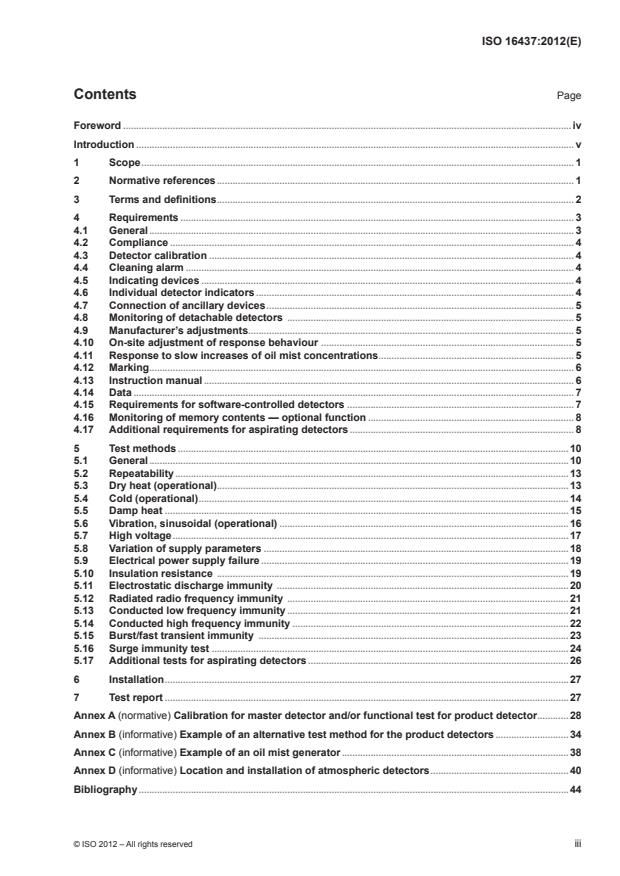
Contents Page
Foreword .iv
Introduction . v
1 Scope . 1
2 Normative references . 1
3 Terms and definitions . 2
4 Requirements . 3
4.1 General . 3
4.2 Compliance . 4
4.3 Detector calibration . 4
4.4 Cleaning alarm . 4
4.5 Indicating devices . 4
4.6 Individual detector indicators . 4
4.7 Connection of ancillary devices . 5
4.8 Monitoring of detachable detectors . 5
4.9 Manufacturer’s adjustments . 5
4.10 On-site adjustment of response behaviour . 5
4.11 Response to slow increases of oil mist concentrations . 5
4.12 Marking . 6
4.13 Instruction manual . 6
4.14 Data . 7
4.15 Requirements for software-controlled detectors . 7
4.16 Monitoring of memory contents — optional function . 8
4.17 Additional requirements for aspirating detectors . 8
5 Test methods .10
5.1 General .10
5.2 Repeatability .13
5.3 Dry heat (operational) .13
5.4 Cold (operational) .14
5.5 Damp heat .15
5.6 Vibration, sinusoidal (operational) .16
5.7 High voltage .17
5.8 Variation of supply parameters .18
5.9 Electrical power supply failure .19
5.10 Insulation resistance .19
5.11 Electrostatic discharge immunity .20
5.12 Radiated radio frequency immunity .21
5.13 Conducted low frequency immunity .21
5.14 Conducted high frequency immunity .22
5.15 Burst/fast transient immunity .23
5.16 Surge immunity test .24
5.17 Additional tests for aspirating detectors .26
6 Installation .27
7 Test report .27
Annex A (normative) Calibration for master detector and/or functional test for product detector .28
Annex B (informative) Example of an alternative test method for the product detectors .34
Annex C (informative) Example of an oil mist generator .38
Annex D (informative) Location and installation of atmospheric detectors .40
Bibliography .44
Foreword
ISO (the International Organization for Standardization) is a worldwide federation of national standards bodies
(ISO member bodies). The work of preparing International Standards is normally carried out through ISO
technical committees. Each member body interested in a subject for which a technical committee has been
established has the right to be represented on that committee. International organizations, governmental and
non-governmental, in liaison with ISO, also take part in the work. ISO collaborates closely with the International
Electrotechnical Commission (IEC) on all matters of electrotechnical standardization.
International Standards are drafted in accordance with the rules given in the ISO/IEC Directives, Part 2.
The main task of technical committees is to prepare International Standards. Draft International Standards
adopted by the technical committees are circulated to the member bodies for voting. Publication as an
International Standard requires approval by at least 75 % of the member bodies casting a vote.
Attention is drawn to the possibility that some of the elements of this document may be the subject of patent
rights. ISO shall not be held responsible for identifying any or all such patent rights.
ISO 16437 was prepared by Technical Committee ISO/TC 8, Ships and marine technology, Subcommittee
SC 1, Lifesaving and fire protection.
iv © ISO 2012 – All rights reserved
Introduction
The majority of fires which have occurred in engine rooms are generally caused by a leak or fracture from a
flammable liquid system. Most engine room fires begin as a result of the ignition of oil mist. The mist can be
formed in one of two ways:
— when oil mist is generated through minute leaks in oil lines which, under pressure, give off a very fine
atomized spray: and,
— when oil hits a hot surface and boils, generating a mist.
Detection at this stage could therefore provide a pre-alarm warning to the risk of fire.
Oil mist detection systems are available to continuously monitor the machinery space atmosphere. They can
give early warning of a dangerous onset of oil mist accumulation and can be incorporated in arrangements to
automatically shut down valves, machinery, etc., to prevent the outbreak of fire.
For this purpose, atmospheric oil mist detection systems should be installed where an identified risk of fire
hazard exists from the potential generation of oil mist from flammable liquids such as hydraulic, fuel and
lubricating oil systems. Oil mist detection systems are particularly useful in engine rooms, oil purifying rooms,
and hydraulic pump rooms on board ships, as well as fixed and floating offshore hydrocarbon platforms.
This International Standard has been developed for oil mist detectors on board ships and specifies the
requirements for detectors used to detect volatile mist that can result in a fire. It is based on the document
Guidelines for the manufacture and installation of oil mist detectors prepared by the International Maritime
Organization (IMO) sub-committee on fire protection (FP).
INTERNATIONAL STANDARD ISO 16437:2012(E)
Ships and marine technology — Lifesaving and fire
protection — Atmospheric oil mist detectors for ships
1 Scope
1.1 This International Standard specifies requirements, test methods and performance criteria for resettable
oil mist detectors for use in fire hazard alarm systems installed on marine vessels. Oil mist detectors may be
installed where an identified risk of fire caused by ignition of flammable liquids, such as hydraulic, fuel and
lubricating oil systems, exists.
1.2 This International Standard specifies requirements for the following detectors:
— point type detectors employing a point aspirating sampling device or relying on dispersion of oil mist;
— aspirating detectors, whereby the sampling point is separated from the sensing unit(s) and uses a pipe
network for carrying the sampling air to the sensing unit(s);
— open path or beam type detectors, whereby the concept of the point detector is expanded to a sampling
path which can be 20 m or more, as opposed to a few centimetres in the point type detector.
1.3 For the testing of other types of detector working on different principles, this International Standard is only
for guidance. Detectors with special characteristics and developed for specific risks, as well as those designed
for use in explosive atmospheres, are not covered by this International Standard.
2 Normative references
The following referenced documents are indispensable for the application of this document. For dated
references, only the edition cited applies. For undated references, the latest edition of the referenced document
(including any amendments) applies.
ISO 7240-2, Fire detection and alarm systems — Part 2: Control and indicating equipment
ISO 7240-4, Fire detection and alarm systems — Part 4: Power supply equipment
IEC 60068-1, Environmental testing — Part 1: General and guidance
IEC 60068-2-1, Environmental testing — Part 2-1: Tests — Test A: Cold
IEC 60068-2-2, Environmental testing — Part 2-2: Tests — Test B: Dry heat
IEC 60068-2-6, Environmental testing — Part 2-6: Tests — Test Fc: Vibration (sinusoidal)
IEC 60068-2-30, Environmental testing — Part 2-30: Tests — Test Db: Damp heat, cyclic (12 h + 12 h cycle)
IEC 61000-4-2, Electromagnetic compatibility (EMC) — Part 4-2: Testing and measurement techniques —
Electrostatic discharge immunity test
IEC 61000-4-4, Electromagnetic compatibility (EMC) — Part 4-4: Testing and measurement techniques —
Electrical fast transient/burst immunity test
IEC 61000-4-5, Electromagnetic compatibility (EMC) — Part 4-5: Testing and measurement techniques —
Surge immunity test
IEC 61000-4-6, Electromagnetic compatibility (EMC) — Part 4-6: Testing and measurement techniques —
Immunity to conducted disturbances, induced by radio-frequency fields
EN 50086-1:1994, Specification for conduit systems for cable management — Part 1: General requirements
3 Terms and definitions
For the purposes of this document, the following terms and definitions apply.
3.1
alarm set point(s)
oil mist density in the proximity of the specimen at the moment that it generates an alarm signal, when tested
as specified in 5.1.6
3.2
aspirating detector
sampling device which consists of a pipe network and sampling point which is separated from the sensing unit(s)
NOTE Sampling air and aerosols are drawn through the sampling device, using the pipe network, and carried to one
or more sensing elements by an integral aspirator (e.g. fan or pump). Each sensing element may contain more than one
sensor exposed to the same air.
3.3
conditioning
exposure of a specimen to environmental conditions to determine the effect of such conditions on the specimen
3.4
fault indication
audible, visible or other type of output different from an alarm signal conveying, directly or indirectly, a warning
or indication that the detector is not working satisfactorily
3.5
gravimetric deterministic method
process where the difference in weight of a 0,8 µm pore size membrane filter is ascertained from weighing the
filter before and after drawing one litre of oil mist from the test chamber
3.6
lower explosive limit
volume concentration of oil mist, flammable gas or vapour in air, below which the mixture is not explosive
NOTE 1 Also referred to as the lower flammable limit (LFL).
NOTE 2 The lower explosive limit corresponds to an oil mist concentration of approximately 50 mg/l.
3.7
minimum flow rate
minimum flow rate claimed by the manufacturer as meeting the requirements of this International Standard
3.8
non-volatile memory
memory elements which do not require the presence of an energy source for the retention of their contents
3.9
point type detector
point sampling device, sensor type, which operates by aspirating or relying on dispersion of oil mist
3.10
recovery
treatment of a specimen, after conditioning, so that the properties of the specimen can be stabilized before
measurement of the said property as required by this International Standard
2 © ISO 2012 – All rights reserved
3.11
repeatability
closeness of agreements between the results of successive measurements of the same value of the same
quantity carried out by the same method, with the same measuring instruments, by the same observer, in the
same laboratory within a quite short interval of time in unchanged conditions
3.12
sampling device
component or series of components or dedicated device (e.g. a pipe network, dedicated duct, probe or hood)
which transfers samples of air to the oil mist sensing element(s)
3.13
sampling point
point at which an air sample is drawn into the sampling device
3.14
sensitivity adjustment
adjustment during or after commissioning which leads to a change in the response to oil mist density
3.15
site-specific detector data
alterable data required for the detector to operate in a defined detector configuration
3.16
transport time
time for aerosols to transfer from a sampling point to the oil mist sensing element
4 Requirements
4.1 General
4.1.1 The detector shall reliably measure the oil mist concentration under the stated application conditions,
produce an alarm signal and, if applicable, shall be able to initiate external alarm and protective actions,
whenever the level exceeds or falls below a pre-selected alarm concentration.
4.1.2 Detector parts shall be able to withstand the stresses due to vibration, dust, corrosive media and climatic
influences during normal use.
4.1.3 Materials and components shall be used within the ratings or limits specified by the material or
component manufacturer, unless otherwise specified by appropriate safety standards taking into account the
limits of specific operating conditions.
4.1.4 Materials that come into contact with the oil mist shall not affect the measured value in milligrams per
litre for the oil mist.
4.1.5 Detectors shall be constructed to
— facilitate easy access for regular function checks and calibration, and
— allow periodic maintenance of serviceable parts and cleaning of sensing surfaces.
4.1.6 The oil mist path of the detector, including any filter and sampling device, shall not be affected by gases
expected to be present in the environment.
4.1.7 Any zero-point and gain adjustments shall be independent of each other.
4.1.8 Detectors with more than one measuring range shall clearly identify the selected range.
4.1.9 This International Standard is drafted on the basis of functions which are required to be provided on
all oil mist detectors, and optional functions with requirements which may be provided. It is intended that the
options will be used for specific applications, as recommended in application guidelines.
4.1.10 Each optional function is included as a separate entity with its own set of associated requirements
in order to permit oil mist detectors on board ships with different combinations of functions to conform to this
International Standard. If an option is taken, all the corresponding requirements shall be met.
4.1.11 Other functions associated with fire detection and fire alarm may also be provided, even if not specified
in this International Standard. However, such options shall not contradict any requirements of this International
Standard and must not, in case of a fault, jeopardize any function required by this International Standard.
4.2 Compliance
In order to comply with this International Standard, the detector shall meet the requirements of this clause,
which shall be verified by visual inspection or engineering assessment, shall be tested as specified in Clause 5
and shall meet the requirements of the tests.
4.3 Detector calibration
Detectors should have at least two calibrated set points, one at the lowest detection point or zero concentration
and the other at the highest detection point determined by the manufacturer, which must be at least 2,0 mg/l or 4 %
of the lower explosive limit (LEL). For this reason the measuring system should indicate up to at least 4 % of LEL.
4.4 Cleaning alarm
Detectors must be able to indicate that sensors need cleaning to stop false alarms.
4.5 Indicating devices
An indication shall be provided to show that the detector is switched on. For alarm-only detectors, the
manufacturer shall identify suitable points for connecting indicating or recording devices for the purpose of
testing. If the apparatus has more than one measuring range, the range selected shall be clearly identified.
4.6 Individual detector indicators
4.6.1 The monitors or individual detector indicators should indicate a maximum reading, e.g. 2,0 mg/l or
4 % of the LEL.
4.6.2 Each detector shall be provided with an integral visual indicator or indicators, by which the individual
detector which created an alarm can be identified until the alarm condition is reset. Where other conditions of
the detector can be visually indicated, these shall be clearly distinguishable from the alarm indication, except
when the detector is switched into a service mode. For detachable detectors, the indicator may be integral with
the base or the detector head.
4.6.3 Each detector shall be provided with a fault indication in the event of
— failure of power to the detector,
— loss of continuity or short circuit in one or more of the wires to the detector,
— loss of electrical continuity within the detector, or
— need for cleaning of the sensor.
4.6.4 Where other conditions of the status of the detector are indicated visually, the following colours shall be used:
4 © ISO 2012 – All rights reserved
— red, for indication of a percentage of a potentially high oil mist level;
— green, for power supply normal.
4.6.5 Each indicator shall be labelled to show its function.
4.7 Connection of ancillary devices
The detector may provide for connections to ancillary devices (remote indicators, control relays, etc.), but open-
or short-circuit failures of these connections shall not prevent the correct operation of the detector.
4.8 Monitoring of detachable detectors
For detachable detectors, a means shall be provided for a remote monitoring system (e.g. the control and
indicating equipment) to detect the removal of the head from the base, in order to give a fault signal.
4.9 Manufacturer’s adjustments
It shall not be possible to change the manufacturer’s settings except by special means, e.g. with the use of a
special code or tool, or by breaking or removing a seal.
4.10 On-site adjustment of response behaviour
4.10.1 If there is provision for on-site adjustment of the response behaviour of the detector, then:
a) for all of the settings at which the manufacturer claims compliance with this International Standard, the detector
shall comply with the requirements of this International Standard and access to the adjustment means shall
only be possible by the use of a code or special tool or by removing the detector from its base or mounting;
b) any setting(s) at which the manufacturer does not claim compliance with this International Standard shall
only be accessible by the use of a code or special tool, and it shall be clearly marked on the detector or in the
associated data that if these setting(s) are used, the detector does not comply with this International Standard.
4.10.2 These adjustments may be carried out at the detector or at the control and indicating equipment.
4.11 Response to slow increases of oil mist concentrations
4.11.1 Compensation may be used to mitigate changes in sensitivity due to the build-up of dust and other
contaminants on the sensing surfaces.
4.11.2 The provision of drift compensation and/or the provision of algorithms to match a detector to its
environment shall not lead to a significant reduction in the sensitivity of the detector to slow increases in the
concentration levels of oil mist.
4.11.3 The detector shall cause either a fault or alarm signal at the limit of compensation for the effect of a
slowly changing signal response.
4.11.4 Since it is not practical to make tests with very slow increases in the concentration levels of oil mist, an
assessment of the response of the detector to slow increases in the concentration levels of oil mist shall be made
by analysis of the circuit/software, and/or physical tests and simulations. Where such algorithms are used, the
detector shall be deemed to meet the requirements of this clause if the documentation and assessment shows:
a) how and why a sensor drifts;
b) how the compensation technique modifies the detector response to compensate for the drift;
c) that suitable limits to the compensation are in place to prevent the algorithms/means being applied
outside the known limitations of the sensor and to ensure ongoing compliance with the clauses of this
International Standard;
d) for any rate of increase in oil mist concentration, R, which is greater than A/4 per hour (where A is the
detector’s initial uncompensated alarm set point), the time for the detector to give an alarm does not
exceed 1,6 A/R by more than 100 s;
e) the range of compensation is limited such that, throughout this range, the compensation does not cause
the alarm set point of the detector to exceed its initial value by a factor greater than 1,6.
4.12 Marking
4.12.1 Each detector shall be clearly marked with the following information:
a) the number of this International Standard (i.e. ISO 16437);
b) the name or trademark of the manufacturer or supplier;
c) some mark(s) or code(s) (e.g. serial number or batch code), by which the manufacturer can identify, at
least, the model designation (type or number), the date or batch and place of manufacture, and the version
number(s) of any software contained within the detector.
4.12.2 Where any marking on the device uses symbols or abbreviations not in common use, these should be
explained in the data supplied with the device.
4.12.3 The markings shall be visible after installation of the detector.
4.12.4 The markings shall not be placed on screws or other easily removable parts.
4.13 Instruction manual
Each detector shall be accompanied by an instruction manual. It shall include the following information:
1) intended use;
2) operational limitations (e.g. ambient temperature, humidity, pressure, flow rate, supply voltage);
3) tests and certificates;
4) measuring principles;
5) indication of alarms;
6) mechanical structure and diagram of apparatus;
7) description of apparatus function;
8) technical data;
9) start-up procedure;
10) calibration and adjustment procedure;
11) service and maintenance;
12) measure to be taken in case of malfunctions;
13) accessories and replacement parts.
6 © ISO 2012 – All rights reserved
4.14 Data
4.14.1 Detectors shall be supplied with sufficient technical, installation and maintenance data to enable their
correct installation and operation. To enable correct operation of the detectors, this data should describe the
requirements for the correct processing of the signals from the detector. This may be in the form of a full technical
specification of these signals, a reference to the appropriate signalling protocol or a reference to suitable types
of control and indicating equipment.
4.14.2 Installation and maintenance data shall include reference to an in situ test method to ensure that
detectors operate correctly when installed.
NOTE Additional information may be required by organizations certifying that detectors produced by a manufacturer
conform to the requirements of this International Standard.
4.15 Requirements for software-controlled detectors
4.15.1 General
The requirements of 4.15.2, 4.15.3 and 4.15.4 shall be met for detectors which rely on software control in order
to fulfil the requirements of this International Standard.
4.15.2 Software documentation
4.15.2.1 The manufacturer shall have documentation available for inspection which gives an overview of the
software design, and provide it to the testing authority if required. This documentation shall be in sufficient detail for
the design to be inspected for compliance with this International Standard and shall include at least the following:
a) a functional description of the main program flow (e.g. as a flow diagram or structogram) including:
1) a brief description of the modules and the functions that they perform,
2) the way in which the modules interact,
3) the overall hierarchy of the program,
4) the way in which the software interacts with the hardware of the detector,
5) the way in which the modules are called, including any interrupt processing;
b) a description of which areas of memory are used for the various purposes (e.g. the program, site-specific
data and running data);
c) a designation, by which the software and its version can be uniquely identified.
4.15.2.2 The manufacturer shall have available detailed design documentation, which only needs to be provided
if required by the testing authority. It shall comprise at least the following:
a) an overview of the whole system configuration, including all software and hardware components;
b) a description of each module of the program, containing at least:
1) the name of the module,
2) a description of the tasks performed,
3) a description of the interfaces, including the type of data transfer, the valid data range and the checking
for valid data;
c) full source code listings, as hard copy or in machine-readable form (e.g. ASCII-code), including all global and
local variables, constants and labels used, and sufficient comment for the program flow to be recognized;
d) details of any software tools used in the design and implementation phase (e.g. CASE-Tools, Compilers, etc.).
4.15.3 Software design
In order to ensure the reliability of the detector, the following requirements for software design apply.
a) The software shall have a modular structure.
b) The design of the interfaces for manually and automatically generated data shall not permit invalid data to
cause error in the program operation.
c) The software shall be designed to avoid the occurrence of deadlock of the program flow.
4.15.4 The storage of programs and data
4.15.4.1 The program necessary to comply with this International Standard and any preset data, such as
manufacturer’s settings, shall be held in non-volatile memory. Writing to areas of memory containing this
program and data shall only be possible by the use of some special tool or code, and shall not be possible
during normal operation of the detector.
4.15.4.2 Site-specific data shall be held in memory which will retain data for at least two weeks without external
power to the detector, unless provision is made for the automatic renewal of such data, following loss of power,
within 1 h of power being restored.
4.16 Monitoring of memory contents — optional function
Means may be provided for detecting the loss of site-specific data. If such a loss occurs, a signal shall be made
available to the control and indicating equipment within a time limit specified by the manufacturer.
4.17 Additional requirements for aspirating detectors
4.17.1 General
Where the detector includes an aspirating device, the additional requirements of 4.17 apply.
4.17.2 Mechanical strength of the pipework
4.17.2.1 The sampling pipes and fittings shall have adequate mechanical strength and temperature resistance.
4.17.2.2 The minimum requirement shall be pipes classified in accordance with EN 50086-1 to at least
Class 1131 (for the definition of “1131” see Table 1).
Table 1 — Mechanical requirements for sampling pipes
Property Class Severity
Resistance to compression 1 125 N
Resistance to impact 1 0,5 kg, 100 mm height to fall
Temperature range 31 -15 °C to +60 °C
4.17.2.3 Pipes which are not so classified by the manufacturer of the pipe shall either be tested in accordance
with the tests in Table 2 for the above classes or the manufacturer shall provide evidence that the requirements
of this clause are met.
8 © ISO 2012 – All rights reserved
Table 2 — Mechanical tests
Test EN 50086-1 Clause
Compression test 10.2
a
Impact test 10.3
b
Resistance to heat 12.2
a
Conduct the impact test at the minimum of the temperature range (i.e. -15 °C).
b
The pipe is deemed to have passed the resistance to heat test if any crushing of the pipe does
not reduce the internal diameter to less than 80 % of its original value.
4.17.2.4 Where the manufacturer of the aspirating detector does not supply the pipe for the sampling device,
the product documentation shall specify that the requirements of this clause shall be met.
4.17.3 Hardware components and additional sensing elements in the sampling device
4.17.3.1 Components, including optional components (box, filter, sensor, valve, etc.) in the sampling device
shall be described in the documentation. The aspirating detector, including the hardware components listed,
shall meet the requirements of this International Standard.
4.17.3.2 If the component incorporates a sensing element which participates in the signal output of the
aspirating detector (e.g. for localization information) then the performance of the aspirating detector, including
these sensing elements, shall meet the requirements of this International Standard.
4.17.4 Alarm outputs providing localization information
When the aspirating detector is designed to provide several alarm outputs within a single zone, where each
output relates to a subdivision within the area protected by the aspirating detector, then it shall be clearly
indicated in the product documentation that the several alarm outputs are reported as alarm information within
one zone at the control and indicating equipment.
4.17.5 Airflow monitoring
4.17.5.1 The airflow through the aspirating oil mist detector shall be monitored to detect leakage or obstruction
of the sampling device or sampling point(s). A fault shall be indicated when the leakage or obstruction results in
an increase or decrease in the volumetric airflow of 20 % or greater.
4.17.5.2 Where the aspirating detector incorporates technology which provides for constant, or near constant,
volumetric flow rate which is largely independent of the sampling device (e.g. incorporates speed control of the
fan or uses a positive displacement pump), then equivalent requirements for the flow monitoring device shall be
agreed between the manufacturer and testing authority to verify the flow monitoring to detect loss of sampling
points (caused by blockage or breakage in the sampling device).
4.17.5.3 Where an aspirating detector has a facility to memorize the “normal” flow (present when the detector
is installed or serviced) and thereafter monitor for deviations from this normal flow, the action of setting the
memorized “normal” flow shall be a voluntary action under access level 3 (as defined in ISO 7240-2).
4.17.5.4 Electrical power supply failure to the aspirating detector shall not result in a change to the
memorized normal flow.
4.17.6 Power supplies
The power for the aspirating detector shall be supplied by a power supply conforming to ISO 7240-4.
5 Test methods
5.1 General
5.1.1 Atmospheric conditions for tests
5.1.1.1 Unless otherwise stated in a test procedure, the testing shall be carried out after the test specimen has
been allowed to stabilize in the standard atmospheric conditions for testing, as specified in IEC 60068-1 as follows:
Temperature: (15 to 45) °C
Relative humidity: (30 to 90) %
Air pressure: (86 to 106) kPa
5.1.1.2 The temperature and humidity shall be substantially constant for each environmental test where the
standard atmospheric conditions are applied.
5.1.2 Operating conditions for tests
5.1.2.1 If a test method requires a specimen to be operational, then the specimen shall be connected to
suitable supply and monitoring equipment with characteristics as required by the manufacturer’s data. Unless
otherwise specified in the test method, the supply parameters applied to the specimen shall be set within
the manufacturer’s specified range(s) and shall remain substantially constant throughout the tests. The value
chosen for each parameter shall normally be the nominal value, or the mean of the specified range. If a test
procedure requires a specimen to be monitored to detect any alarm or fault signals, then connections shall be
made to any necessary ancillary devices (e.g. through wiring to an end-of-line device) to allow a fault signal to
be recognized.
5.1.2.2 The details of the supply and monitoring equipment and the alarm criteria used shall be given in the
test report (Clause 7).
5.1.3 Mounting arrangements
The specimen shall be mounted by its normal means of attachment in accordance with the manufacturer’s
instructions. If these instructions describe more than one method of mounting, then the method considered to
be most unfavourable shall be chosen for each test.
5.1.4 Tolerances
5.1.4.1 Unless otherwise stated, the tolerances for the environmental test parameters shall be as given in the
basic reference standards for the test (e.g. the relevant part of IEC 60068).
5.1.4.2 If a specific tolerance or deviation limit is not specified in a requirement or test procedure, then a
deviation limit of ± 5 % shall be applied.
5.1.5 Test classification
5.1.5.1 General
The purpose of the environmental tests is to demonstrate that a detector can operate correctly in its service
environment and that it will continue to do so for a reasonable time. The tests are intended to demonstrate
failures due to realistic service environments; however, some significant failure mechanisms are brought about
by changes which occur slowly under these realistic service conditions. In order to make tests within a practical
and economic time-scale, it is sometimes necessary to accelerate these changes by intensifying the conditions
10 © ISO 2012 – All rights reserved
(e.g. by increasing the level of an environmental parameter or by increasing the frequency of its application).
The tests are divided into two classes.
5.1.5.2 Operational tests
5.1.5.2.1 The test specimen is subjected to test conditions which correspond to the service environment. The
object of these tests is to demonstrate the ability of the equipment to withstand and operate correctly in the normal
service environment and/or to demonstrate the immunity of the equipment to certain aspects of that environment.
5.1.5.2.2 The specimen is therefore operational, its condition is monitored and it may be functionally tested
during the tests.
5.1.5.3 Endurance tests
The test specimen may be subjected to conditions more severe than the normal service environment in order to
accelerate the effects of the normal service environment. The object of these tests is to demonstrate the ability
of the equipment to withstand the long-term effects of the service environment. Since the tests are intended
to study the residual rather than the immediate effects, the specimens are normally not supplied with power or
monitored during the conditioning period. However, if by reason of the design of the specimen it is necessary
for a power supply to be connected, any signal generated during the test shall be ignored.
5.1.6 Measurement of alarm set point
5.1.6.1 Typical measurement procedure
5.1.6.1.1 Install the sampling device in the oil mist test chamber, specified in Annex A or Annex B, in its normal
operating position, by its normal means of attachment.
5.1.6.1.2 Before commencing each measurement, purge the oil mist chamber with clean air to ensure that the
chamber and the specimen are free from the oil mist.
5.1.6.1.3 Unless otherwise specified in the test procedure, the air temperature in the oil mist chamber shall be
23 °C and shall not vary by more than 5 °C for all the measurements on a particular detector type.
5.1.6.1.4 Connect the specimen to its supply and monitoring equipment as specified in 5.1.2, and allow it to
stabilize for a period of at least 15 min, unless otherwise specified by the manufacturer.
5.1.6.1.5 Maintain the minimum airflow through the detector as specified by the manufacturer.
5.1.6.1.6 Perform the oil mist test specified in Annex A. An alternative test method to Annex A can be found in
Annex B. An example of an oil mist generator is illustrated in Annex C.
5.1.6.1.7 Measure the aerosol density in the proximity of the specimen.
5.1.6.1.8 The alarm set point M shall be not less than 4 % of the lower explosive limit or 2,0 mg/l.
NOTE The lower explosive limit corresponds to an oil mist concentration of approximately 50 mg/l (13 % oil–air mixture).
5.1.6.2 General for aspirating detectors
Since there are a number of different types of aspirating detectors available operating on quite different
principles, which have very different ranges of sensitivity, various methods can be used to establish the alarm
set point. The object of any method chosen shall be to determine a measure of the aerosol concentration
which, when passing through the detector, just causes an alarm to be raised. This can generally be achieved by
introducing oil mist into the test chamber so that the detector is subjected to a slowly increasing concentration,
and recording the concentration at the moment when an alarm is generated.
5.1.6.3 Flow rate for aspirating detectors
The flow rate of oil mist through the detector shall conform to specifications of the manufacturer.
5.1.7 Provision for tests
For testing compliance with this International Standard, the following apply:
a) The data required in 4.14 shall be provided.
b) The specimens submitted shall be deemed representative of the manufacturer’s normal production with
regard to their construction and calibration
NOTE Detachable detectors comprise at least two parts; for example a base (socket) and a head (body). If the
specimens are detachable detectors, then the two, or more, parts together are regarded as a complete detector.
5.1.8 Test schedule
The specimens shall be tested in accordance with Table 3.
5.1.9 Test report
The test results shall be reported in accordance with Clause 7.
Table 3 — Test schedule
Test Subclause
Repeatability 5.2
Dry heat (operational) 5.3
Cold (operational) 5.4
Damp heat 5.5
Vibration, sinusoidal (operational) 5.6
High voltage 5.7
Variation of supply parameters 5.8
Electrical power supply failure 5.9
a
Insulation resistance 5.10
Electrostatic discharge immunity 5.11
Radiated radio frequency immunity 5.12
Conducted low frequency immunity 5.13
Conducted high frequency immunity 5.14
Burst/fast response transient immunity 5.15
Surge immunity 5.16
Additional tests for aspirating detectors 5.17
Air leakage 5.17.2
Airflow fault (operational) 5.17.3
Airflow monitoring facility 5.17.4
a
Measurements shall be performed before and after the relevant environmental tests.
12 © ISO 2012 – A
...