

ISO 23872:2021
(Main)Mining structures — Underground structures
General Information
- Abstract
This document specifies the design loads and the design procedures for the design of structures used in underground mines. It covers all steel and concrete structures used in underground mines, irrespective of the depth of the mine or the product being mined. This document adopts a limit states design philosophy. Typical underground structures covered by this document include, but are not limited to: — box front structures at the bottom of rock passes; — conveyor gantry and transfer structures; — chairlift support structures; — crusher support structures; — fan support structures; — fixed or retractable arresting structures for ramps (see ISO 19426-5); — foundations for pumps, fans, winches and underground winders; — high-pressure bulkheads; — monorails; — overhead crane gantries for workshops, pump stations and sub shaft winder chambers; — settler structures; — silo bulkhead structures; — silo structures; — structures supporting loose rock; — tip structures, including dump structures; — underground head frames; — ventilation control doors and other ventilation structures; — walls and floors for safety bays, refuge stations and sub-stations; — water control doors; — water retaining structures. This document does not cover matters of operational safety or layout of the underground structures.
- Status
- Published
- Publication Date
- 16-Dec-2021
- Technical Committee
- ISO/TC 82 - Mining
- Drafting Committee
- ISO/TC 82/WG 4 - Structures for mine shafts
- Parallel Committee
- ISO/TC 127 - Earth-moving machinery
- Current Stage
- 6060 - International Standard published
- Start Date
- 17-Dec-2021
- Due Date
- 15-Nov-2021
- Completion Date
- 17-Dec-2021
Buy Documents

ISO 23872:2021 - Mining structures -- Underground structures

ISO 23872:2021 - Mining structures — Underground structures/17/2021
Overview
ISO 23872:2021 - Mining structures - Underground structures specifies design loads and design procedures for steel and concrete structures used in underground mines. Adopted globally through ISO/TC 82, the standard uses a limit states design philosophy and applies irrespective of mine depth or commodity. It focuses on the structural engineering requirements specific to underground environments and does not cover operational safety or underground layout.
Key topics and technical requirements
ISO 23872 organizes technical content around materials, loads, design procedures and construction requirements. Key topics include:
- Scope of application: all steel and concrete underground structures (e.g., gantries, conveyor supports, crushers, fan and pump foundations, monorails, silo and bulkhead structures, head frames, ventilation doors, refuge station walls/floors).
- Materials: guidance for concrete and steel use underground, including durability and underground-specific recommendations.
- Nominal loads: comprehensive load categories such as:
- Operating loads (spillage, air pressure, thermal effects, liquid pressure)
- Ground displacement loads (initial relaxation, long-term and sudden displacement)
- Seismic loads
- Emergency loads (explosion, air blast, mud-rush, vehicle and rock impact)
- Design procedure: risk assessment, partial safety factors, provisions for excavation variation, and specific design rules for high-pressure bulkheads and underground head frames.
- Construction requirements: transport/storage, bearing against ground, excavation tolerances, and anchoring methods (chemical/cementitious grouted anchors, mechanical anchors) including anchor testing and shear load considerations.
- Informative annexes: additional guidance on transportation, concrete use underground, and design of parallel-sided high-pressure bulkheads.
Practical applications and users
ISO 23872 is practical for those involved in the engineering, procurement and construction of underground mine infrastructure:
- Mining and geotechnical engineers
- Structural and mechanical engineers designing underground supports and equipment foundations
- Design consultants and engineering firms producing mine designs
- Contractors and site construction managers installing underground structures
- Regulators and owners seeking consistent, internationally recognized design criteria
Use cases include design of conveyor gantries, crusher and fan supports, high-pressure bulkheads and water-retaining structures, monorail supports, and refuge station walls.
Related standards
- ISO 19426-5 (referenced for fixed or retractable ramp arresting structures)
- Refer to regional building and structural design standards for complementary structural detailing and design methods.
Keywords: ISO 23872, underground structures, mining structures, design loads, limit states design, high-pressure bulkheads, anchors, seismic loads, ground displacement.
Relations
- Consolidated By
ISO 17268-1:2025 - Gaseous hydrogen land vehicle refuelling connection devices — Part 1: Flow capacities up to and including 120 g/s - Effective Date
- 31-Dec-2022
Buy Documents
ISO 23872:2021 - Mining structures -- Underground structures
ISO 23872:2021 - Mining structures — Underground structures/17/2021
Get Certified
Connect with accredited certification bodies for this standard

Bureau Veritas Chile
Bureau Veritas certification services in Chile.
Bureau Veritas Peru
Bureau Veritas certification services in Peru.
BVQI Peru
Bureau Veritas certification in Peru.
Sponsored listings
Frequently Asked Questions
ISO 23872:2021 is a standard published by the International Organization for Standardization (ISO). Its full title is "Mining structures — Underground structures". This standard covers: This document specifies the design loads and the design procedures for the design of structures used in underground mines. It covers all steel and concrete structures used in underground mines, irrespective of the depth of the mine or the product being mined. This document adopts a limit states design philosophy. Typical underground structures covered by this document include, but are not limited to: — box front structures at the bottom of rock passes; — conveyor gantry and transfer structures; — chairlift support structures; — crusher support structures; — fan support structures; — fixed or retractable arresting structures for ramps (see ISO 19426-5); — foundations for pumps, fans, winches and underground winders; — high-pressure bulkheads; — monorails; — overhead crane gantries for workshops, pump stations and sub shaft winder chambers; — settler structures; — silo bulkhead structures; — silo structures; — structures supporting loose rock; — tip structures, including dump structures; — underground head frames; — ventilation control doors and other ventilation structures; — walls and floors for safety bays, refuge stations and sub-stations; — water control doors; — water retaining structures. This document does not cover matters of operational safety or layout of the underground structures.
This document specifies the design loads and the design procedures for the design of structures used in underground mines. It covers all steel and concrete structures used in underground mines, irrespective of the depth of the mine or the product being mined. This document adopts a limit states design philosophy. Typical underground structures covered by this document include, but are not limited to: — box front structures at the bottom of rock passes; — conveyor gantry and transfer structures; — chairlift support structures; — crusher support structures; — fan support structures; — fixed or retractable arresting structures for ramps (see ISO 19426-5); — foundations for pumps, fans, winches and underground winders; — high-pressure bulkheads; — monorails; — overhead crane gantries for workshops, pump stations and sub shaft winder chambers; — settler structures; — silo bulkhead structures; — silo structures; — structures supporting loose rock; — tip structures, including dump structures; — underground head frames; — ventilation control doors and other ventilation structures; — walls and floors for safety bays, refuge stations and sub-stations; — water control doors; — water retaining structures. This document does not cover matters of operational safety or layout of the underground structures.
ISO 23872:2021 is classified under the following ICS (International Classification for Standards) categories: 73.020 - Mining and quarrying. The ICS classification helps identify the subject area and facilitates finding related standards.
ISO 23872:2021 has the following relationships with other standards: It is inter standard links to ISO 17268-1:2025. Understanding these relationships helps ensure you are using the most current and applicable version of the standard.
ISO 23872:2021 is available in PDF format for immediate download after purchase. The document can be added to your cart and obtained through the secure checkout process. Digital delivery ensures instant access to the complete standard document.
Standards Content (Sample)
INTERNATIONAL ISO
STANDARD 23872
First edition
2021-12
Mining structures — Underground
structures
Structures minières — Structures souterraines
Reference number
© ISO 2021
All rights reserved. Unless otherwise specified, or required in the context of its implementation, no part of this publication may
be reproduced or utilized otherwise in any form or by any means, electronic or mechanical, including photocopying, or posting on
the internet or an intranet, without prior written permission. Permission can be requested from either ISO at the address below
or ISO’s member body in the country of the requester.
ISO copyright office
CP 401 • Ch. de Blandonnet 8
CH-1214 Vernier, Geneva
Phone: +41 22 749 01 11
Email: copyright@iso.org
Website: www.iso.org
Published in Switzerland
ii
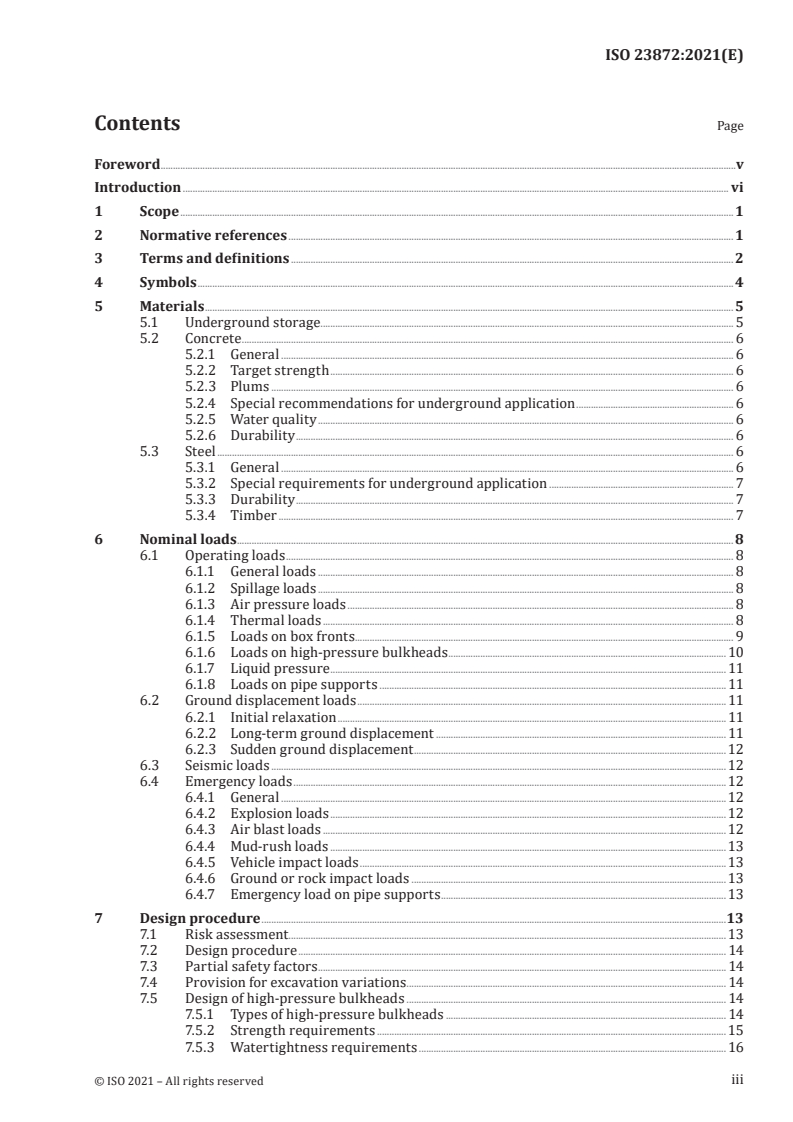
Contents Page
Foreword .v
Introduction . vi
1 Scope . 1
2 Normative references . 1
3 Terms and definitions . 2
4 Symbols . 4
5 Materials . 5
5.1 Underground storage . . 5
5.2 Concrete . 6
5.2.1 General . 6
5.2.2 Target strength . 6
5.2.3 Plums . 6
5.2.4 Special recommendations for underground application . 6
5.2.5 Water quality . 6
5.2.6 Durability . 6
5.3 Steel . 6
5.3.1 General . 6
5.3.2 Special requirements for underground application . 7
5.3.3 Durability . 7
5.3.4 Timber . 7
6 Nominal loads . . 8
6.1 Operating loads . 8
6.1.1 General loads . 8
6.1.2 Spillage loads . 8
6.1.3 Air pressure loads . 8
6.1.4 Thermal loads . 8
6.1.5 Loads on box fronts. 9
6.1.6 Loads on high-pressure bulkheads . 10
6.1.7 Liquid pressure . 11
6.1.8 Loads on pipe supports . 11
6.2 Ground displacement loads . 11
6.2.1 Initial relaxation . 11
6.2.2 Long-term ground displacement . 11
6.2.3 Sudden ground displacement .12
6.3 Seismic loads .12
6.4 Emergency loads .12
6.4.1 General .12
6.4.2 Explosion loads . 12
6.4.3 Air blast loads .12
6.4.4 Mud-rush loads . 13
6.4.5 Vehicle impact loads .13
6.4.6 Ground or rock impact loads . 13
6.4.7 Emergency load on pipe supports . 13
7 Design procedure .13
7.1 Risk assessment . 13
7.2 Design procedure . 14
7.3 Partial safety factors . 14
7.4 Provision for excavation variations . 14
7.5 Design of high-pressure bulkheads . 14
7.5.1 Types of high-pressure bulkheads . 14
7.5.2 Strength requirements . 15
7.5.3 Watertightness requirements . 16
iii
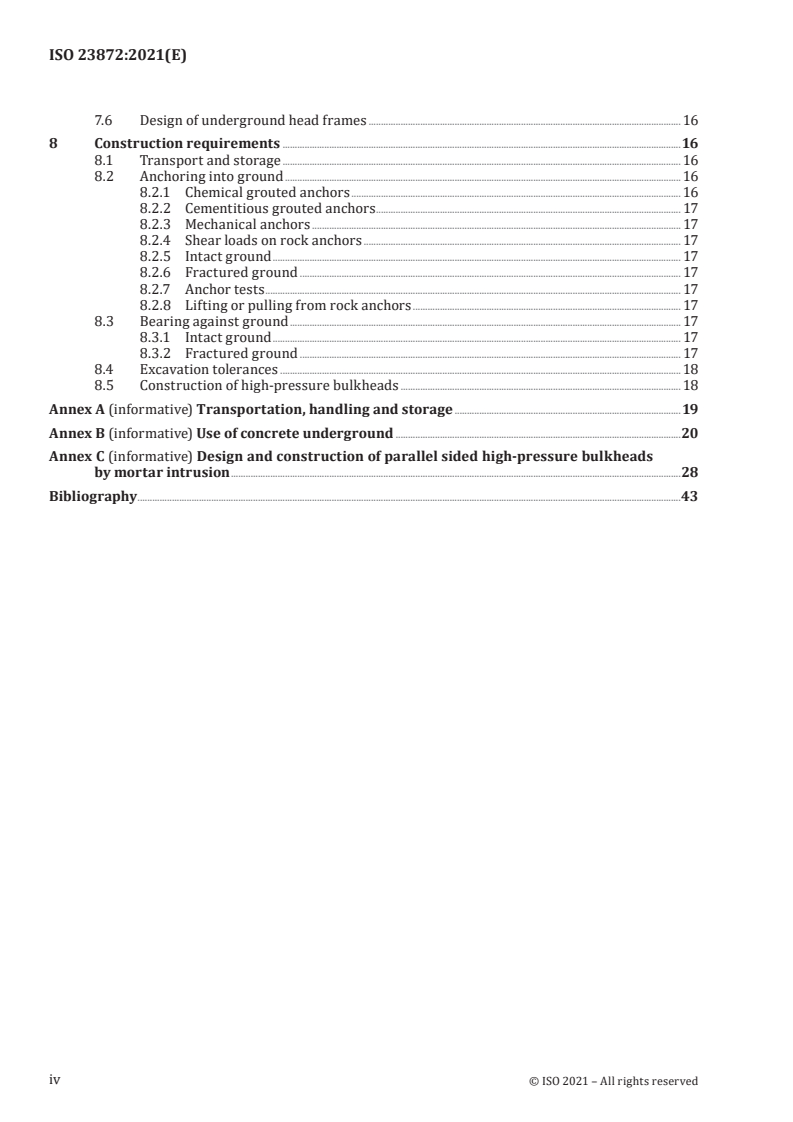
7.6 Design of underground head frames . 16
8 Construction requirements .16
8.1 Transport and storage . 16
8.2 Anchoring into ground . 16
8.2.1 Chemical grouted anchors . 16
8.2.2 Cementitious grouted anchors . 17
8.2.3 Mechanical anchors . 17
8.2.4 Shear loads on rock anchors . 17
8.2.5 Intact ground . 17
8.2.6 Fractured ground . 17
8.2.7 Anchor tests . 17
8.2.8 Lifting or pulling from rock anchors . 17
8.3 Bearing against ground . 17
8.3.1 Intact ground . 17
8.3.2 Fractured ground . 17
8.4 Excavation tolerances . 18
8.5 Construction of high-pressure bulkheads . 18
Annex A (informative) Transportation, handling and storage .19
Annex B (informative) Use of concrete underground .20
Annex C (informative) Design and construction of parallel sided high-pressure bulkheads
by mortar intrusion .28
Bibliography .43
iv
Foreword
ISO (the International Organization for Standardization) is a worldwide federation of national standards
bodies (ISO member bodies). The work of preparing International Standards is normally carried out
through ISO technical committees. Each member body interested in a subject for which a technical
committee has been established has the right to be represented on that committee. International
organizations, governmental and non-governmental, in liaison with ISO, also take part in the work.
ISO collaborates closely with the International Electrotechnical Commission (IEC) on all matters of
electrotechnical standardization.
The procedures used to develop this document and those intended for its further maintenance are
described in the ISO/IEC Directives, Part 1. In particular, the different approval criteria needed for the
different types of ISO documents should be noted. This document was drafted in accordance with the
editorial rules of the ISO/IEC Directives, Part 2 (see www.iso.org/directives).
Attention is drawn to the possibility that some of the elements of this document may be the subject of
patent rights. ISO shall not be held responsible for identifying any or all such patent rights. Details of
any patent rights identified during the development of the document will be in the Introduction and/or
on the ISO list of patent declarations received (see www.iso.org/patents).
Any trade name used in this document is information given for the convenience of users and does not
constitute an endorsement.
For an explanation of the voluntary nature of standards, the meaning of ISO specific terms and
expressions related to conformity assessment, as well as information about ISO's adherence to
the World Trade Organization (WTO) principles in the Technical Barriers to Trade (TBT), see
www.iso.org/iso/foreword.html.
This document was prepared by Technical Committee ISO/TC 82, Mining.
Any feedback or questions on this document should be directed to the user’s national standards body. A
complete listing of these bodies can be found at www.iso.org/members.html.
v
Introduction
Many mining companies, and many of the engineering companies that provide designs for mines,
operate globally, therefore this document was developed in response to a desire for a unified global
approach to the design of safe and reliable structures used in underground mines. The characteristics
of ore bodies, such as their depth and shape, and the geotechnical parameters, vary in different areas so
different design approaches have been developed and proven with use over time in different countries.
Bringing these approaches together in this document will facilitate improved safety and operational
reliability.
There are many reasons, based on mining processes, mining equipment, technical, timing, and cost
factors why certain structures can be constructed underground for a particular application rather
than on surface, and these are carefully assessed at feasibility stage of any mining project. While
this document is not meant to provide comments or recommendations regarding the advantages and
disadvantages of using any type of structure underground, it covers specific design aspects that need
be considered when using structures in underground mines. It is thus primarily intended to provide
the technical information necessary to ensure good engineering of structures where their construction
and use underground is the chosen solution.
The majority of the material in this document deals with the loads to be applied in the design of
structures used in underground mines. Many of the loads and design considerations for underground
structures are identical to the loads and design considerations for similar structures on surface.
However, the underground context introduces some specific differences and challenges that must be
addressed in order to achieve safe and cost-effective structures. This document deals with those issues
and concepts that are specific to structures used in underground mines.
Some principles for structural design are given, but for the most part it is assumed that local standards
will be used for the structural design.
vi
INTERNATIONAL STANDARD ISO 23872:2021(E)
Mining structures — Underground structures
1 Scope
This document specifies the design loads and the design procedures for the design of structures used in
underground mines. It covers all steel and concrete structures used in underground mines, irrespective
of the depth of the mine or the product being mined.
This document adopts a limit states design philosophy.
Typical underground structures covered by this document include, but are not limited to:
— box front structures at the bottom of rock passes;
— conveyor gantry and transfer structures;
— chairlift support structures;
— crusher support structures;
— fan support structures;
— fixed or retractable arresting structures for ramps (see ISO 19426-5);
— foundations for pumps, fans, winches and underground winders;
— high-pressure bulkheads;
— monorails;
— overhead crane gantries for workshops, pump stations and sub shaft winder chambers;
— settler structures;
— silo bulkhead structures;
— silo structures;
— structures supporting loose rock;
— tip structures, including dump structures;
— underground head frames;
— ventilation control doors and other ventilation structures;
— walls and floors for safety bays, refuge stations and sub-stations;
— water control doors;
— water retaining structures.
This document does not cover matters of operational safety or layout of the underground structures.
2 Normative references
The following documents are referred to in the text in such a way that some or all of their content
constitutes requirements of this document. For dated references, only the edition cited applies. For
undated references, the latest edition of the referenced document (including any amendments) applies.
ISO 2394, General principles on reliability for structures
ISO 3010, Bases for design of structures — Seismic actions on structures
ISO 4354, Wind actions on structures
ISO 10721-1, Steel structures — Part 1: Materials and design
ISO 12122, Timber structures — Determination of characteristic values
ISO 19338, Performance and assessment requirements for design standards on structural concrete
ISO 19426-1, Structures for mine shafts — Part 1: Vocabulary
ISO 19426-2, Structures for mine shafts — Part 2: Headframe structures
ISO 19426-5, Structures for mine shafts — Part 5: Shaft system structures
ISO 22111, Bases for design of structures — General requirements
EN 1997-1, Eurocode 7: Geotechnical design – Part 1: General rules
3 Terms and definitions
For the purposes of this document, the terms and definitions given in ISO 19426-1 and the following
apply.
ISO and IEC maintain terminology databases for use in standardization at the following addresses:
— ISO Online browsing platform: available at https:// www .iso .org/ obp
— IEC Electropedia: available at https:// www .electropedia .org/
3.1
arresting structure
structure installed in a ramp or inclined roadway to arrest the motion of a runaway vehicle, or installed
in a roadway approaching a vertical or decline shaft to prevent vehicles inadvertently entering the shaft
Note 1 to entry: See emergency arresting dropset in ISO 19426-1.
3.2
bagcrete
required dry ingredients to prepare a specified strength of concrete, put into a bag with the cement in a
smaller waterproof bag inside the larger bag and sealed
3.3 Bulkheads
3.3.1
high-pressure bulkhead
liquid-retaining structure constructed in underground excavations, primarily designed to prevent
water or other liquid from entering a working area of a mine or to prevent compressed air from
escaping, and where the pressure exceeds 70 m head of water
3.3.2
silo bulkhead
structure at the bottom of an underground silo that contains the weight of material in the silo
3.4
development
tunnel excavated through ground (3.7) to gain access and provide a ventilation airway to the orebody
and infrastructure required to mine the orebody
3.5
dump structure
structure installed at the top of a rock pass to receive rock into the rock pass
Note 1 to entry: A dump structure is often constructed of concrete lined with steel plates, and can be equipped
with a rock sizing mechanism.
3.6
floor
ground (3.7) across the bottom of an underground excavation
3.7
ground
surrounding rock
natural material (hard or soft) surrounding an excavation or underground workings in a mine
3.8
initial relaxation
strain in the ground (3.7) that occurs when an underground excavation is made due to reduction or
redistribution of the ground stress at the excavation from some higher value to zero
3.9
injection
process of introducing injection grout (3.9.1) at pressure into the ground-mortar contact area or into
fractured or fissured ground (3.7)
3.9.1
injection grout
mixture of cement and water, that can include chemicals, injected into the ground-bulkhead contact
area and the surrounding ground (3.7) under pressure to meet the designed hydraulic gradient
requirements around the bulkhead
Note 1 to entry: In the context of this document, this refers to bulkhead constructions.
3.10
intrusion
process of introducing intrusion mortar (3.10.1) into previously placed aggregate, such that the pressure
at the mortar outlet pipe is no more than is just required to introduce the mortar over the full area of
the placed aggregate
3.10.1
intrusion mortar
mix of fine aggregate, cement and water, that can include chemicals, intruded into the entire volume
of the high-pressure bulkhead (3.3.1) once placement of the plums (3.11) and coarse aggregate has been
completed
Note 1 to entry: In the context of this document, this refers to bulkhead constructions.
3.10.2
intrusion pipes
small bore pipes in the high-pressure bulkhead (3.3.1) structure, placed to facilitate an even placement
of intrusion mortar (3.10.1) within previously placed aggregate and plums (3.11)
3.11
plum
cobble
piece of rock larger than standard aggregate, that can be added to concrete in specified circumstances
3.12
return airway
tunnel, or development (3.4), used to exhaust the air from the working areas of the mine
3.13
roof
hanging wall
back
ground (3.7) across the top of an underground excavation
3.14
deflector plate
shedder plate
plate placed over equipment and inclined in such manner as to deflect any spillage away from the
equipment
3.15
side wall
ground (3.7) at the side of an underground excavation
3.16
slick line
pipe installed in a shaft or a borehole (normally during sinking) to convey wet concrete from the batch
plant to the point of use
3.17
slinging
operation of suspending equipment or materials below a conveyance for transport in the mine shaft
3.18
tightening
high-pressure injection (3.9) of grout around the perimeter of the mortar intrusion (3.10) high-pressure
bulkhead (3.3.1) in order to seal the interface between the bulkhead and the surrounding ground (3.7)
and render the bulkhead watertight
3.18.1
tightening pipe
pipe of a suitable diameter in the high-pressure bulkhead (3.3.1) structure to allow re-drilling in the
bulkhead structure to enable the sealing [tightening (3.18)] of the mortar-ground interface and
surrounding ground (3.7) fractures
4 Symbols
a seismic acceleration (m/s )
n
A area of bearing between the high-pressure bulkhead and the surrounding ground (m )
B
A surface area of the high-pressure bulkhead (m )
H
b bearing strength of the surrounding ground (N/m )
l
B bearing resistance of the interface between the high-pressure bulkhead and the surrounding
l
ground (N/m )
d deformation of the relevant structural component (m)
i
F design load, or load effect (N, Nm)
F additional permanent load due to water head (N)
H
F factored parallel sided high-pressure bulkhead design strength (N)
R
F ultimate parallel sided high-pressure bulkhead design load (N)
U
g acceleration due to gravity (m/s )
G permanent load or effect (N, Nm)
h design height of the rock pass (m)
b
h height through which the rock falls; to be taken as the depth of the rock pass (m)
d
H maximum height of liquid above the centre of the high-pressure bulkhead (m)
i hydraulic gradient
L length of the high-pressure bulkhead (m)
m mass of the largest rock (kg)
r
p reference pressure (Pa)
h
q water pressure (Pa)
q additional hydraulic pressure due to seismic action (Pa)
n
R relative density of the liquid
D
R single rock impact load on the box front (N)
i
v shear strength of the surrounding ground (N/m )
I
V shear resistance of the interface between the high-pressure bulkhead and the surrounding ground
I
(N)
Z impact energy of the falling rock (J)
i
α proportion of potential energy transferred into impact energy on the box front
i
γ unit weight of water (N/m )
ρ density of the liquid (kg/m )
L
ρ density of the rock pass contents (kg/m )
φ load factor for the additional permanent water head load
H
ϕ resistance factor for the shear resistance between the high-pressure bulkhead and the surround-
H
ing ground
5 Materials
5.1 Underground storage
The owner of the mine shall specify the storage location and conditions for underground storage of
construction materials, bearing in mind the adverse environment, the length of time for storage and
possible rough handling.
Specific requirements for storage are made in 5.2 and 5.3, and further recommendations for
underground storage are made in Annexes A, B and C.
5.2 Concrete
5.2.1 General
The materials used in the construction of concrete structures for underground mines structural
concrete shall comply with ISO 19338. The design strength of the concrete to be used shall be specified
on the structural drawings, using the common designation for “cylinder strength “or ”cube strength”.
5.2.2 Target strength
The target strength of the concrete to be used shall be defined in order to ensure that the specified
design strength is achieved. Annex B provides guidance.
5.2.3 Plums
Plums can be used in high-pressure bulkheads, and can be used in other large structures with the
approval of the design engineer.
Plums shall be brushed and washed to remove all contamination and fines immediately prior to
placement.
Plums should consist of hard, intact rock. Any rock that is friable, fractured or subject to deterioration
on contact with oxygen should not be used.
Plums should consist of sizes with a mass not exceeding what can be handled by one person.
5.2.4 Special recommendations for underground application
Annex B provides general guidance on the use of concrete underground.
Annex C provides guidance for high-pressure bulkheads constructed by mortar intrusion.
5.2.5 Water quality
Some water present in underground mines (e.g. hyper saline and containing sulphates and chlorides)
can be very deleterious to concrete structures. Where water other than potable water is used, samples
should be tested and the owner of the mine should provide the results to the designer of concrete
structures.
5.2.6 Durability
The designer shall specify any specific concrete mix design criteria required to ensure the required
durability of the completed concrete structure.
When a structure is constructed in any area containing exhaust air, or other contaminated air, the
durability of the structure shall take this into account.
Annex B provides guidance.
5.3 Steel
5.3.1 General
The materials used in the construction of steel structures for underground mines shall be structural
steel complying with ISO 10721-1. The material used shall be specified on the structural drawings.
5.3.2 Special requirements for underground application
5.3.2.1 Corrosion protection
The owner of the mine shall specify the corrosion protection of steel for underground use. Steel
structures underground are susceptible to dust build-up or ore spillage on horizontal surfaces. Some
ores, when oxidized and in the presence of moisture, create corrosive products. Mine water used for
wash-down can also be corrosive in nature. Careful detailing of structures is required to minimise
surface build up or pockets for water collection. This can be achieved by means of appropriately
positioned deflector plates, coatings or drain holes.
5.3.2.2 Storage
Where it is necessary to store steel underground, the following precautions should be observed:
— the storage area should be well ventilated by clean air;
— the storage area should be dry, so that steel is not exposed to seepage from the roof or the side walls,
or to drain water;
— stacked steel sections should be supported in such a manner that the weight of overlying steel does
not damage underlying steel;
— stacked steel sections should not be nested in direct contact with underlying steel sections, but
should be separated using a porous material.
Where it is not possible to achieve one or more of these precautions, specification of the corrosion
protection should take this into account.
If any steel is stored underground for a period exceeding the period anticipated during design by
more than three months, then that steel and corrosion protection shall be thoroughly inspected for
deterioration prior to its installation. An inspection report shall be kept together with all construction
documentation.
5.3.3 Durability
An adequate corrosion protection system shall be applied to all steelwork to provide the durability
required. Where the life of the corrosion protection system is anticipated to be less than the life of the
mine, an inspection and repair strategy should be recommended to the owner of the mine.
The owner of the mine shall provide the following information for the specific excavation to guide
selection of the appropriate corrosion protection system:
— temperature range;
— humidity range;
— air quality and gas content of the air;
— chemical analysis of ground water;
— chemical analysis of mine water;
— rock properties and their propensity to produce corrosive substances when oxidized or in the
presence of moisture.
5.3.4 Timber
The materials used in the construction of timber structures for underground mines shall be designed
using characteristic strength as determined in ISO 12122. The material used shall be specified on the
structural drawings.
6 Nominal loads
6.1 Operating loads
6.1.1 General loads
The general loads shall be those specified by ISO 22111.
6.1.2 Spillage loads
Due to the potential for dust or rock spillage build-up on underground structures, in combination with
infrequent clean-up, consideration should be given to increasing the imposed spillage loads.
6.1.3 Air pressure loads
Structures underground are not subjected to wind loads. However, many underground excavations
have ventilation air circulating and air blast loads caused by the mining method. There can be various
causes of air pressure applied to underground structures in different locations.
a) Underground structures can be constructed in an air way.
The air velocity loads shall be determined in accordance with ISO 4354, where the site wind speed
shall be taken as equal to the nominal velocity of ventilation air past the structure.
Where the velocity of ventilation air does not exceed 6 m/s, the loads due to air velocity are small
and can be omitted.
The velocity of ventilation air is constant, and structures in underground mines are typically not
slender. Wind dynamic effects can thus be omitted, provided the risk assessment concludes that
this is acceptable.
b) Walls or door structures can be used to separate ventilation zones or to separate intake and
exhaust air ways.
Where an underground structure separates ventilation zones or intake and exhaust air ways, the
ventilation air flow causes differential pressures on the two sides of the structure. The nominal
differential pressure can be treated as a static load on the structure, unless the risk assessment
and/or a ventilation flow analysis shows that there is potential for a significant increase in pressure
due to some unintended event, such as failure of a fan, unblocking of an ore pass or sudden blockage
of an air way.
c) Structures subjected to air blast loads from mining methods shall be designed to resist such loads.
d) Walls or gates can be used to contain compressed air. Where any wall or gate contains accumulated
compressed air, the pressure shall be taken as the maximum pressure in the compressed air
system.
6.1.4 Thermal loads
Thermal loads shall be considered, unless specific provision is made to detail the structure in such a
manner that expansion can take place freely.
The owner of the mine shall specify the temperature range to be considered.
6.1.5 Loads on box fronts
The loads on box fronts shall be taken as the most severe of a pressure (a), or a concentrated load (b).
These two loads shall be assumed to act independently and not in combination in the following way.
a) If it can be shown that dry, granular rock conditions can exist in the rock pass, rational analyses
may be used to assess the loads on box fronts. If not, the load applied to box fronts shall be based on
reference pressure, p , using the following formula:
h
pg=⋅ρ ⋅h (1)
hb
where
ρ is the density of the rock pass contents, expressed in kilograms per cubic metre (kg/m );
g is the acceleration due to gravity, expressed in metres per square second (m/s );
h is the design height of the rock pass, expressed in metres (m).
b
The design height of the rock pass may be taken as the height of the rock pass for heights of up to 30 m,
or equal to 30 m for rock passes of height in excess of 30 m. This 30 m limit is based on rock passes
having a hydraulic radius of 2 m to 3 m.
This pressure shall be applied to all components of box fronts, including concrete in-fill areas, chutes
and radial gates.
b) All main structural components of box fronts shall be designed to resist a single rock impact load
on the box front, R , which shall be based on energy considerations. The impact energy Z shall be
i i
taken as:
Zh=⋅α ⋅⋅gm (2)
ii dr
where
Z is the impact energy of the falling rock, expressed in joules (J);
i
α is the proportion of potential energy transferred into impact energy on the box front;
i
h is the height through which the rock falls; to be taken as the depth of the rock pass, expressed
d
in metres (m);
g is the acceleration due to gravity, expressed in metres per square second (m/s );
m is the mass of the largest rock, expressed in kilograms (kg).
r
The proportion of potential energy transferred into impact energy on the box front, α , shall be based
i
on a rational assessment of energy losses in the rock pass, or it may be taken as:
1) 0,8, when the rock pass is inclined at more than 70° to the horizontal;
2) 0,6, when the rock pass is inclined at less than 70° to the horizontal; and
3) 0,3, when there is a dogleg in the rock pass not more than 15 m above the box front.
The impact load shall be calculated assuming plastic deformation of the structural components of the
box front, but shall be taken as not less than 100 000 N, and need not be taken as more than the point
load strength of the rock. The impact load is given, using the following formula:
Z
i
R = (3)
i
d
i
where
R is a single rock impact load on the box front, expressed in newtons (N);
i
Z is the impact energy of the falling rock, expressed in joules (J);
i
d is the deformation of the relevant structural component, expressed in metres (m).
i
This load shall be taken as acting in a direction parallel to the axis of the ore pass.
The mass of the rock may be based on a rock size limited by the physical constraints of the rock handling
system, but the rock size shall not be taken as less than 0,02 m .
The plastic deformation of the relevant structural component, d , shall be taken as being in the range
i
from 2 % to 5 % of the span of the relevant structural component.
The structural members surrounding the chute and the door of the box front can be designed using
plastic design methods. The columns and other main structural components shall be designed to
remain elastic.
NOTE The main structural components include the columns, struts, beams and anchors, but exclude the
chute and doors.
6.1.6 Loads on high-pressure bulkheads
6.1.6.1 Additional permanent loads
The additional permanent load due to the head of liquid behind the high-pressure bulkhead shall be
based on the height of liquid, from the centre of the high-pressure bulkhead to the highest liquid surface
level, multiplied by the relative density of the liquid and the cross-sectional area of the high-pressure
bulkhead. Thus:
FA=⋅ρ ⋅⋅gH (4)
HH L
where
A is the cross-sectional area of the high-pressure bulkhead (m );
H
ρ is the density of the liquid (kg/m );
L
g is the acceleration due to gravity (m/s );
H is the maximum height of liquid above the centre of the high-pressure bulkhead (m).
The relative density of the liquid shall be determined from site conditions.
The height of liquid, from the centre of the high-pressure bulkhead to the highest liquid surface level,
shall be determined from site conditions.
6.1.6.2 Seismic load
The additional hydraulic load on high-pressure bulkheads due to seismic action, Q , can be taken as:
n
a
n
QA=⋅ ⋅⋅ρ g⋅H (5)
nH L
g
where
A is the cross-sectional area of the high-pressure bulkhead (m );
H
a is the peak ground acceleration with a 10 % probability of being exceeded in a return period
n
to be specified by the owner of the mine (m/s );
ρ is the density of the liquid (kg/m );
L
g is the acceleration due to gravity (m/s );
H is the maximum height of liquid above the centre of the high-pressure bulkhead (m).
6.1.7 Liquid pressure
The pressure due to a contained body of liquid shall be the hydrostatic pressure based on the depth of
the liquid and the relative density.
6.1.8 Loads on pipe supports
The loads on pipe supports shall be as specified in ISO 19426-5.
6.2 Ground displacement loads
Structures constructed underground can be attached to one, or both, side walls and they are often
founded on the floor and connected to the roof. Due to mining activities, the ground surrounding any
mining excavation always experiences some amount of strain. Where any structure in an underground
mine is attached to side walls or the roof, ground strain can induce loads into the structure. The risk
assessment shall consider the severity and likelihood of consequences that can occur.
6.2.1 Initial relaxation
Initial relaxation in ground cannot be reversed, but it usually occurs before any structure can be
constructed. The strain to which a structure in an underground mine is exposed can be taken as the
nominal strain due to mining activities, less the initial relaxation.
6.2.2 Long-term ground displacement
Ground strain can occur over a long time period when the ground strains as mining progresses through
the ore body. Long-term displacement of the ground surrounding the structure shall be determined
from stress analysis of the ground at each progressive mining step.
Where this long-term displacement of the ground can induce loads in the structure, provision shall be
made to:
— either design the structure to withstand these loads, or a portion of these loads;
— or ensure that the displacement is monitored and the structure is modified as necessary to be able
to cater for these loads.
6.2.3 Sudden ground displacement
Ground strain can occur over a short time period when the ground slips along a fault or other
discontinuity. The sudden displacement shall not be taken as less than 25 % of the maximum long-term
displacement that can occur in any 12-month period.
Where this sudden displacement of the ground can induce loads in the structure, provision shall be
made to:
— either design the structure to withstand these loads;
— or ensure that the structure can deform safely as the ground displaces.
6.3 Seismic loads
Where structures in underground mines are supported at the base only, seismic design shall comply
with the requirements of ISO 3010. Underground structures are usually low structures with substantial
members, so they typically have high fundamental frequencies, and in most cases seismic loads can
thus be neglected.
Where structures in underground mines are supported at the base and on any other wal
...
INTERNATIONAL ISO
STANDARD 23872
First edition
2021-12
Mining structures — Underground
structures
Structures minières — Structures souterraines
Reference number
© ISO 2021
All rights reserved. Unless otherwise specified, or required in the context of its implementation, no part of this publication may
be reproduced or utilized otherwise in any form or by any means, electronic or mechanical, including photocopying, or posting on
the internet or an intranet, without prior written permission. Permission can be requested from either ISO at the address below
or ISO’s member body in the country of the requester.
ISO copyright office
CP 401 • Ch. de Blandonnet 8
CH-1214 Vernier, Geneva
Phone: +41 22 749 01 11
Email: copyright@iso.org
Website: www.iso.org
Published in Switzerland
ii
Contents Page
Foreword .v
Introduction . vi
1 Scope . 1
2 Normative references . 1
3 Terms and definitions . 2
4 Symbols . 4
5 Materials . 5
5.1 Underground storage . . 5
5.2 Concrete . 6
5.2.1 General . 6
5.2.2 Target strength . 6
5.2.3 Plums . 6
5.2.4 Special recommendations for underground application . 6
5.2.5 Water quality . 6
5.2.6 Durability . 6
5.3 Steel . 6
5.3.1 General . 6
5.3.2 Special requirements for underground application . 7
5.3.3 Durability . 7
5.3.4 Timber . 7
6 Nominal loads . . 8
6.1 Operating loads . 8
6.1.1 General loads . 8
6.1.2 Spillage loads . 8
6.1.3 Air pressure loads . 8
6.1.4 Thermal loads . 8
6.1.5 Loads on box fronts. 9
6.1.6 Loads on high-pressure bulkheads . 10
6.1.7 Liquid pressure . 11
6.1.8 Loads on pipe supports . 11
6.2 Ground displacement loads . 11
6.2.1 Initial relaxation . 11
6.2.2 Long-term ground displacement . 11
6.2.3 Sudden ground displacement .12
6.3 Seismic loads .12
6.4 Emergency loads .12
6.4.1 General .12
6.4.2 Explosion loads . 12
6.4.3 Air blast loads .12
6.4.4 Mud-rush loads . 13
6.4.5 Vehicle impact loads .13
6.4.6 Ground or rock impact loads . 13
6.4.7 Emergency load on pipe supports . 13
7 Design procedure .13
7.1 Risk assessment . 13
7.2 Design procedure . 14
7.3 Partial safety factors . 14
7.4 Provision for excavation variations . 14
7.5 Design of high-pressure bulkheads . 14
7.5.1 Types of high-pressure bulkheads . 14
7.5.2 Strength requirements . 15
7.5.3 Watertightness requirements . 16
iii
7.6 Design of underground head frames . 16
8 Construction requirements .16
8.1 Transport and storage . 16
8.2 Anchoring into ground . 16
8.2.1 Chemical grouted anchors . 16
8.2.2 Cementitious grouted anchors . 17
8.2.3 Mechanical anchors . 17
8.2.4 Shear loads on rock anchors . 17
8.2.5 Intact ground . 17
8.2.6 Fractured ground . 17
8.2.7 Anchor tests . 17
8.2.8 Lifting or pulling from rock anchors . 17
8.3 Bearing against ground . 17
8.3.1 Intact ground . 17
8.3.2 Fractured ground . 17
8.4 Excavation tolerances . 18
8.5 Construction of high-pressure bulkheads . 18
Annex A (informative) Transportation, handling and storage .19
Annex B (informative) Use of concrete underground .20
Annex C (informative) Design and construction of parallel sided high-pressure bulkheads
by mortar intrusion .28
Bibliography .43
iv
Foreword
ISO (the International Organization for Standardization) is a worldwide federation of national standards
bodies (ISO member bodies). The work of preparing International Standards is normally carried out
through ISO technical committees. Each member body interested in a subject for which a technical
committee has been established has the right to be represented on that committee. International
organizations, governmental and non-governmental, in liaison with ISO, also take part in the work.
ISO collaborates closely with the International Electrotechnical Commission (IEC) on all matters of
electrotechnical standardization.
The procedures used to develop this document and those intended for its further maintenance are
described in the ISO/IEC Directives, Part 1. In particular, the different approval criteria needed for the
different types of ISO documents should be noted. This document was drafted in accordance with the
editorial rules of the ISO/IEC Directives, Part 2 (see www.iso.org/directives).
Attention is drawn to the possibility that some of the elements of this document may be the subject of
patent rights. ISO shall not be held responsible for identifying any or all such patent rights. Details of
any patent rights identified during the development of the document will be in the Introduction and/or
on the ISO list of patent declarations received (see www.iso.org/patents).
Any trade name used in this document is information given for the convenience of users and does not
constitute an endorsement.
For an explanation of the voluntary nature of standards, the meaning of ISO specific terms and
expressions related to conformity assessment, as well as information about ISO's adherence to
the World Trade Organization (WTO) principles in the Technical Barriers to Trade (TBT), see
www.iso.org/iso/foreword.html.
This document was prepared by Technical Committee ISO/TC 82, Mining.
Any feedback or questions on this document should be directed to the user’s national standards body. A
complete listing of these bodies can be found at www.iso.org/members.html.
v
Introduction
Many mining companies, and many of the engineering companies that provide designs for mines,
operate globally, therefore this document was developed in response to a desire for a unified global
approach to the design of safe and reliable structures used in underground mines. The characteristics
of ore bodies, such as their depth and shape, and the geotechnical parameters, vary in different areas so
different design approaches have been developed and proven with use over time in different countries.
Bringing these approaches together in this document will facilitate improved safety and operational
reliability.
There are many reasons, based on mining processes, mining equipment, technical, timing, and cost
factors why certain structures can be constructed underground for a particular application rather
than on surface, and these are carefully assessed at feasibility stage of any mining project. While
this document is not meant to provide comments or recommendations regarding the advantages and
disadvantages of using any type of structure underground, it covers specific design aspects that need
be considered when using structures in underground mines. It is thus primarily intended to provide
the technical information necessary to ensure good engineering of structures where their construction
and use underground is the chosen solution.
The majority of the material in this document deals with the loads to be applied in the design of
structures used in underground mines. Many of the loads and design considerations for underground
structures are identical to the loads and design considerations for similar structures on surface.
However, the underground context introduces some specific differences and challenges that must be
addressed in order to achieve safe and cost-effective structures. This document deals with those issues
and concepts that are specific to structures used in underground mines.
Some principles for structural design are given, but for the most part it is assumed that local standards
will be used for the structural design.
vi
INTERNATIONAL STANDARD ISO 23872:2021(E)
Mining structures — Underground structures
1 Scope
This document specifies the design loads and the design procedures for the design of structures used in
underground mines. It covers all steel and concrete structures used in underground mines, irrespective
of the depth of the mine or the product being mined.
This document adopts a limit states design philosophy.
Typical underground structures covered by this document include, but are not limited to:
— box front structures at the bottom of rock passes;
— conveyor gantry and transfer structures;
— chairlift support structures;
— crusher support structures;
— fan support structures;
— fixed or retractable arresting structures for ramps (see ISO 19426-5);
— foundations for pumps, fans, winches and underground winders;
— high-pressure bulkheads;
— monorails;
— overhead crane gantries for workshops, pump stations and sub shaft winder chambers;
— settler structures;
— silo bulkhead structures;
— silo structures;
— structures supporting loose rock;
— tip structures, including dump structures;
— underground head frames;
— ventilation control doors and other ventilation structures;
— walls and floors for safety bays, refuge stations and sub-stations;
— water control doors;
— water retaining structures.
This document does not cover matters of operational safety or layout of the underground structures.
2 Normative references
The following documents are referred to in the text in such a way that some or all of their content
constitutes requirements of this document. For dated references, only the edition cited applies. For
undated references, the latest edition of the referenced document (including any amendments) applies.
ISO 2394, General principles on reliability for structures
ISO 3010, Bases for design of structures — Seismic actions on structures
ISO 4354, Wind actions on structures
ISO 10721-1, Steel structures — Part 1: Materials and design
ISO 12122, Timber structures — Determination of characteristic values
ISO 19338, Performance and assessment requirements for design standards on structural concrete
ISO 19426-1, Structures for mine shafts — Part 1: Vocabulary
ISO 19426-2, Structures for mine shafts — Part 2: Headframe structures
ISO 19426-5, Structures for mine shafts — Part 5: Shaft system structures
ISO 22111, Bases for design of structures — General requirements
EN 1997-1, Eurocode 7: Geotechnical design – Part 1: General rules
3 Terms and definitions
For the purposes of this document, the terms and definitions given in ISO 19426-1 and the following
apply.
ISO and IEC maintain terminology databases for use in standardization at the following addresses:
— ISO Online browsing platform: available at https:// www .iso .org/ obp
— IEC Electropedia: available at https:// www .electropedia .org/
3.1
arresting structure
structure installed in a ramp or inclined roadway to arrest the motion of a runaway vehicle, or installed
in a roadway approaching a vertical or decline shaft to prevent vehicles inadvertently entering the shaft
Note 1 to entry: See emergency arresting dropset in ISO 19426-1.
3.2
bagcrete
required dry ingredients to prepare a specified strength of concrete, put into a bag with the cement in a
smaller waterproof bag inside the larger bag and sealed
3.3 Bulkheads
3.3.1
high-pressure bulkhead
liquid-retaining structure constructed in underground excavations, primarily designed to prevent
water or other liquid from entering a working area of a mine or to prevent compressed air from
escaping, and where the pressure exceeds 70 m head of water
3.3.2
silo bulkhead
structure at the bottom of an underground silo that contains the weight of material in the silo
3.4
development
tunnel excavated through ground (3.7) to gain access and provide a ventilation airway to the orebody
and infrastructure required to mine the orebody
3.5
dump structure
structure installed at the top of a rock pass to receive rock into the rock pass
Note 1 to entry: A dump structure is often constructed of concrete lined with steel plates, and can be equipped
with a rock sizing mechanism.
3.6
floor
ground (3.7) across the bottom of an underground excavation
3.7
ground
surrounding rock
natural material (hard or soft) surrounding an excavation or underground workings in a mine
3.8
initial relaxation
strain in the ground (3.7) that occurs when an underground excavation is made due to reduction or
redistribution of the ground stress at the excavation from some higher value to zero
3.9
injection
process of introducing injection grout (3.9.1) at pressure into the ground-mortar contact area or into
fractured or fissured ground (3.7)
3.9.1
injection grout
mixture of cement and water, that can include chemicals, injected into the ground-bulkhead contact
area and the surrounding ground (3.7) under pressure to meet the designed hydraulic gradient
requirements around the bulkhead
Note 1 to entry: In the context of this document, this refers to bulkhead constructions.
3.10
intrusion
process of introducing intrusion mortar (3.10.1) into previously placed aggregate, such that the pressure
at the mortar outlet pipe is no more than is just required to introduce the mortar over the full area of
the placed aggregate
3.10.1
intrusion mortar
mix of fine aggregate, cement and water, that can include chemicals, intruded into the entire volume
of the high-pressure bulkhead (3.3.1) once placement of the plums (3.11) and coarse aggregate has been
completed
Note 1 to entry: In the context of this document, this refers to bulkhead constructions.
3.10.2
intrusion pipes
small bore pipes in the high-pressure bulkhead (3.3.1) structure, placed to facilitate an even placement
of intrusion mortar (3.10.1) within previously placed aggregate and plums (3.11)
3.11
plum
cobble
piece of rock larger than standard aggregate, that can be added to concrete in specified circumstances
3.12
return airway
tunnel, or development (3.4), used to exhaust the air from the working areas of the mine
3.13
roof
hanging wall
back
ground (3.7) across the top of an underground excavation
3.14
deflector plate
shedder plate
plate placed over equipment and inclined in such manner as to deflect any spillage away from the
equipment
3.15
side wall
ground (3.7) at the side of an underground excavation
3.16
slick line
pipe installed in a shaft or a borehole (normally during sinking) to convey wet concrete from the batch
plant to the point of use
3.17
slinging
operation of suspending equipment or materials below a conveyance for transport in the mine shaft
3.18
tightening
high-pressure injection (3.9) of grout around the perimeter of the mortar intrusion (3.10) high-pressure
bulkhead (3.3.1) in order to seal the interface between the bulkhead and the surrounding ground (3.7)
and render the bulkhead watertight
3.18.1
tightening pipe
pipe of a suitable diameter in the high-pressure bulkhead (3.3.1) structure to allow re-drilling in the
bulkhead structure to enable the sealing [tightening (3.18)] of the mortar-ground interface and
surrounding ground (3.7) fractures
4 Symbols
a seismic acceleration (m/s )
n
A area of bearing between the high-pressure bulkhead and the surrounding ground (m )
B
A surface area of the high-pressure bulkhead (m )
H
b bearing strength of the surrounding ground (N/m )
l
B bearing resistance of the interface between the high-pressure bulkhead and the surrounding
l
ground (N/m )
d deformation of the relevant structural component (m)
i
F design load, or load effect (N, Nm)
F additional permanent load due to water head (N)
H
F factored parallel sided high-pressure bulkhead design strength (N)
R
F ultimate parallel sided high-pressure bulkhead design load (N)
U
g acceleration due to gravity (m/s )
G permanent load or effect (N, Nm)
h design height of the rock pass (m)
b
h height through which the rock falls; to be taken as the depth of the rock pass (m)
d
H maximum height of liquid above the centre of the high-pressure bulkhead (m)
i hydraulic gradient
L length of the high-pressure bulkhead (m)
m mass of the largest rock (kg)
r
p reference pressure (Pa)
h
q water pressure (Pa)
q additional hydraulic pressure due to seismic action (Pa)
n
R relative density of the liquid
D
R single rock impact load on the box front (N)
i
v shear strength of the surrounding ground (N/m )
I
V shear resistance of the interface between the high-pressure bulkhead and the surrounding ground
I
(N)
Z impact energy of the falling rock (J)
i
α proportion of potential energy transferred into impact energy on the box front
i
γ unit weight of water (N/m )
ρ density of the liquid (kg/m )
L
ρ density of the rock pass contents (kg/m )
φ load factor for the additional permanent water head load
H
ϕ resistance factor for the shear resistance between the high-pressure bulkhead and the surround-
H
ing ground
5 Materials
5.1 Underground storage
The owner of the mine shall specify the storage location and conditions for underground storage of
construction materials, bearing in mind the adverse environment, the length of time for storage and
possible rough handling.
Specific requirements for storage are made in 5.2 and 5.3, and further recommendations for
underground storage are made in Annexes A, B and C.
5.2 Concrete
5.2.1 General
The materials used in the construction of concrete structures for underground mines structural
concrete shall comply with ISO 19338. The design strength of the concrete to be used shall be specified
on the structural drawings, using the common designation for “cylinder strength “or ”cube strength”.
5.2.2 Target strength
The target strength of the concrete to be used shall be defined in order to ensure that the specified
design strength is achieved. Annex B provides guidance.
5.2.3 Plums
Plums can be used in high-pressure bulkheads, and can be used in other large structures with the
approval of the design engineer.
Plums shall be brushed and washed to remove all contamination and fines immediately prior to
placement.
Plums should consist of hard, intact rock. Any rock that is friable, fractured or subject to deterioration
on contact with oxygen should not be used.
Plums should consist of sizes with a mass not exceeding what can be handled by one person.
5.2.4 Special recommendations for underground application
Annex B provides general guidance on the use of concrete underground.
Annex C provides guidance for high-pressure bulkheads constructed by mortar intrusion.
5.2.5 Water quality
Some water present in underground mines (e.g. hyper saline and containing sulphates and chlorides)
can be very deleterious to concrete structures. Where water other than potable water is used, samples
should be tested and the owner of the mine should provide the results to the designer of concrete
structures.
5.2.6 Durability
The designer shall specify any specific concrete mix design criteria required to ensure the required
durability of the completed concrete structure.
When a structure is constructed in any area containing exhaust air, or other contaminated air, the
durability of the structure shall take this into account.
Annex B provides guidance.
5.3 Steel
5.3.1 General
The materials used in the construction of steel structures for underground mines shall be structural
steel complying with ISO 10721-1. The material used shall be specified on the structural drawings.
5.3.2 Special requirements for underground application
5.3.2.1 Corrosion protection
The owner of the mine shall specify the corrosion protection of steel for underground use. Steel
structures underground are susceptible to dust build-up or ore spillage on horizontal surfaces. Some
ores, when oxidized and in the presence of moisture, create corrosive products. Mine water used for
wash-down can also be corrosive in nature. Careful detailing of structures is required to minimise
surface build up or pockets for water collection. This can be achieved by means of appropriately
positioned deflector plates, coatings or drain holes.
5.3.2.2 Storage
Where it is necessary to store steel underground, the following precautions should be observed:
— the storage area should be well ventilated by clean air;
— the storage area should be dry, so that steel is not exposed to seepage from the roof or the side walls,
or to drain water;
— stacked steel sections should be supported in such a manner that the weight of overlying steel does
not damage underlying steel;
— stacked steel sections should not be nested in direct contact with underlying steel sections, but
should be separated using a porous material.
Where it is not possible to achieve one or more of these precautions, specification of the corrosion
protection should take this into account.
If any steel is stored underground for a period exceeding the period anticipated during design by
more than three months, then that steel and corrosion protection shall be thoroughly inspected for
deterioration prior to its installation. An inspection report shall be kept together with all construction
documentation.
5.3.3 Durability
An adequate corrosion protection system shall be applied to all steelwork to provide the durability
required. Where the life of the corrosion protection system is anticipated to be less than the life of the
mine, an inspection and repair strategy should be recommended to the owner of the mine.
The owner of the mine shall provide the following information for the specific excavation to guide
selection of the appropriate corrosion protection system:
— temperature range;
— humidity range;
— air quality and gas content of the air;
— chemical analysis of ground water;
— chemical analysis of mine water;
— rock properties and their propensity to produce corrosive substances when oxidized or in the
presence of moisture.
5.3.4 Timber
The materials used in the construction of timber structures for underground mines shall be designed
using characteristic strength as determined in ISO 12122. The material used shall be specified on the
structural drawings.
6 Nominal loads
6.1 Operating loads
6.1.1 General loads
The general loads shall be those specified by ISO 22111.
6.1.2 Spillage loads
Due to the potential for dust or rock spillage build-up on underground structures, in combination with
infrequent clean-up, consideration should be given to increasing the imposed spillage loads.
6.1.3 Air pressure loads
Structures underground are not subjected to wind loads. However, many underground excavations
have ventilation air circulating and air blast loads caused by the mining method. There can be various
causes of air pressure applied to underground structures in different locations.
a) Underground structures can be constructed in an air way.
The air velocity loads shall be determined in accordance with ISO 4354, where the site wind speed
shall be taken as equal to the nominal velocity of ventilation air past the structure.
Where the velocity of ventilation air does not exceed 6 m/s, the loads due to air velocity are small
and can be omitted.
The velocity of ventilation air is constant, and structures in underground mines are typically not
slender. Wind dynamic effects can thus be omitted, provided the risk assessment concludes that
this is acceptable.
b) Walls or door structures can be used to separate ventilation zones or to separate intake and
exhaust air ways.
Where an underground structure separates ventilation zones or intake and exhaust air ways, the
ventilation air flow causes differential pressures on the two sides of the structure. The nominal
differential pressure can be treated as a static load on the structure, unless the risk assessment
and/or a ventilation flow analysis shows that there is potential for a significant increase in pressure
due to some unintended event, such as failure of a fan, unblocking of an ore pass or sudden blockage
of an air way.
c) Structures subjected to air blast loads from mining methods shall be designed to resist such loads.
d) Walls or gates can be used to contain compressed air. Where any wall or gate contains accumulated
compressed air, the pressure shall be taken as the maximum pressure in the compressed air
system.
6.1.4 Thermal loads
Thermal loads shall be considered, unless specific provision is made to detail the structure in such a
manner that expansion can take place freely.
The owner of the mine shall specify the temperature range to be considered.
6.1.5 Loads on box fronts
The loads on box fronts shall be taken as the most severe of a pressure (a), or a concentrated load (b).
These two loads shall be assumed to act independently and not in combination in the following way.
a) If it can be shown that dry, granular rock conditions can exist in the rock pass, rational analyses
may be used to assess the loads on box fronts. If not, the load applied to box fronts shall be based on
reference pressure, p , using the following formula:
h
pg=⋅ρ ⋅h (1)
hb
where
ρ is the density of the rock pass contents, expressed in kilograms per cubic metre (kg/m );
g is the acceleration due to gravity, expressed in metres per square second (m/s );
h is the design height of the rock pass, expressed in metres (m).
b
The design height of the rock pass may be taken as the height of the rock pass for heights of up to 30 m,
or equal to 30 m for rock passes of height in excess of 30 m. This 30 m limit is based on rock passes
having a hydraulic radius of 2 m to 3 m.
This pressure shall be applied to all components of box fronts, including concrete in-fill areas, chutes
and radial gates.
b) All main structural components of box fronts shall be designed to resist a single rock impact load
on the box front, R , which shall be based on energy considerations. The impact energy Z shall be
i i
taken as:
Zh=⋅α ⋅⋅gm (2)
ii dr
where
Z is the impact energy of the falling rock, expressed in joules (J);
i
α is the proportion of potential energy transferred into impact energy on the box front;
i
h is the height through which the rock falls; to be taken as the depth of the rock pass, expressed
d
in metres (m);
g is the acceleration due to gravity, expressed in metres per square second (m/s );
m is the mass of the largest rock, expressed in kilograms (kg).
r
The proportion of potential energy transferred into impact energy on the box front, α , shall be based
i
on a rational assessment of energy losses in the rock pass, or it may be taken as:
1) 0,8, when the rock pass is inclined at more than 70° to the horizontal;
2) 0,6, when the rock pass is inclined at less than 70° to the horizontal; and
3) 0,3, when there is a dogleg in the rock pass not more than 15 m above the box front.
The impact load shall be calculated assuming plastic deformation of the structural components of the
box front, but shall be taken as not less than 100 000 N, and need not be taken as more than the point
load strength of the rock. The impact load is given, using the following formula:
Z
i
R = (3)
i
d
i
where
R is a single rock impact load on the box front, expressed in newtons (N);
i
Z is the impact energy of the falling rock, expressed in joules (J);
i
d is the deformation of the relevant structural component, expressed in metres (m).
i
This load shall be taken as acting in a direction parallel to the axis of the ore pass.
The mass of the rock may be based on a rock size limited by the physical constraints of the rock handling
system, but the rock size shall not be taken as less than 0,02 m .
The plastic deformation of the relevant structural component, d , shall be taken as being in the range
i
from 2 % to 5 % of the span of the relevant structural component.
The structural members surrounding the chute and the door of the box front can be designed using
plastic design methods. The columns and other main structural components shall be designed to
remain elastic.
NOTE The main structural components include the columns, struts, beams and anchors, but exclude the
chute and doors.
6.1.6 Loads on high-pressure bulkheads
6.1.6.1 Additional permanent loads
The additional permanent load due to the head of liquid behind the high-pressure bulkhead shall be
based on the height of liquid, from the centre of the high-pressure bulkhead to the highest liquid surface
level, multiplied by the relative density of the liquid and the cross-sectional area of the high-pressure
bulkhead. Thus:
FA=⋅ρ ⋅⋅gH (4)
HH L
where
A is the cross-sectional area of the high-pressure bulkhead (m );
H
ρ is the density of the liquid (kg/m );
L
g is the acceleration due to gravity (m/s );
H is the maximum height of liquid above the centre of the high-pressure bulkhead (m).
The relative density of the liquid shall be determined from site conditions.
The height of liquid, from the centre of the high-pressure bulkhead to the highest liquid surface level,
shall be determined from site conditions.
6.1.6.2 Seismic load
The additional hydraulic load on high-pressure bulkheads due to seismic action, Q , can be taken as:
n
a
n
QA=⋅ ⋅⋅ρ g⋅H (5)
nH L
g
where
A is the cross-sectional area of the high-pressure bulkhead (m );
H
a is the peak ground acceleration with a 10 % probability of being exceeded in a return period
n
to be specified by the owner of the mine (m/s );
ρ is the density of the liquid (kg/m );
L
g is the acceleration due to gravity (m/s );
H is the maximum height of liquid above the centre of the high-pressure bulkhead (m).
6.1.7 Liquid pressure
The pressure due to a contained body of liquid shall be the hydrostatic pressure based on the depth of
the liquid and the relative density.
6.1.8 Loads on pipe supports
The loads on pipe supports shall be as specified in ISO 19426-5.
6.2 Ground displacement loads
Structures constructed underground can be attached to one, or both, side walls and they are often
founded on the floor and connected to the roof. Due to mining activities, the ground surrounding any
mining excavation always experiences some amount of strain. Where any structure in an underground
mine is attached to side walls or the roof, ground strain can induce loads into the structure. The risk
assessment shall consider the severity and likelihood of consequences that can occur.
6.2.1 Initial relaxation
Initial relaxation in ground cannot be reversed, but it usually occurs before any structure can be
constructed. The strain to which a structure in an underground mine is exposed can be taken as the
nominal strain due to mining activities, less the initial relaxation.
6.2.2 Long-term ground displacement
Ground strain can occur over a long time period when the ground strains as mining progresses through
the ore body. Long-term displacement of the ground surrounding the structure shall be determined
from stress analysis of the ground at each progressive mining step.
Where this long-term displacement of the ground can induce loads in the structure, provision shall be
made to:
— either design the structure to withstand these loads, or a portion of these loads;
— or ensure that the displacement is monitored and the structure is modified as necessary to be able
to cater for these loads.
6.2.3 Sudden ground displacement
Ground strain can occur over a short time period when the ground slips along a fault or other
discontinuity. The sudden displacement shall not be taken as less than 25 % of the maximum long-term
displacement that can occur in any 12-month period.
Where this sudden displacement of the ground can induce loads in the structure, provision shall be
made to:
— either design the structure to withstand these loads;
— or ensure that the structure can deform safely as the ground displaces.
6.3 Seismic loads
Where structures in underground mines are supported at the base only, seismic design shall comply
with the requirements of ISO 3010. Underground structures are usually low structures with substantial
members, so they typically have high fundamental frequencies, and in most cases seismic loads can
thus be neglected.
Where structures in underground mines are supported at the base and on any other wal
...