

ISO/TS 16975-1:2016
(Main)Respiratory protective devices — Selection, use and maintenance — Part 1: Establishing and implementing a respiratory protective device programme
General Information
- Abstract
ISO/TS 16975-1:2016 specifies detailed information to assist persons responsible for establishing and implementing a programme for respiratory protective devices (RPD) that meet the performance requirements of the performance standards. It does not apply to RPD programmes for RPD used exclusively under water, for use in aircraft, and medical life support respirators and resuscitators. NOTE The information contained in this part of ISO 16975 can be used to assist in the preparation of national or local regulations; however, this part of ISO 16975 does not supersede national or local regulations. WARNING ? Failure to select, use and maintain RPD correctly can result in injury, illness or death.
- Status
- Published
- Publication Date
- 08-Jun-2016
- Technical Committee
- ISO/TC 94/SC 15 - Respiratory protective devices
- Drafting Committee
- ISO/TC 94/SC 15/WG 6 - Selection and use
- Current Stage
- 9060 - Close of review
- Completion Date
- 04-Mar-2027
Buy Documents


ISO/TS 16975-1:2016 - Respiratory protective devices — Selection, use and maintenance — Part 1: Establishing and implementing a respiratory protective device programme Released:6/9/2016



ISO/TS 16975-1:2016 - Appareils de protection respiratoire — Choix, utilisation et entretien — Partie 1: Élaboration et mise en oeuvre d'un programme pour les appareils de protection respiratoire Released:11/21/2016
Overview
ISO/TS 16975-1:2016 - Respiratory protective devices - Selection, use and maintenance - Part 1: Establishing and implementing a respiratory protective device programme - is a Technical Specification (first edition, 2016) that provides detailed guidance for establishing and running an effective RPD programme. It describes the processes, roles and records needed so respiratory protective devices (RPD) meet applicable performance standards. The document excludes RPD used exclusively underwater, for aircraft use, and medical life‑support respirators and resuscitators. WARNING: incorrect selection, use or maintenance of RPD can cause injury, illness or death.
Key topics and requirements
ISO/TS 16975-1 covers the full lifecycle of RPD within a workplace programme. Major technical topics include:
- RPD programme elements and roles - responsibilities for employers, programme administrators, competent persons and wearers.
- Risk assessment and RPD selection - hazard assessment, adequacy and suitability assessments, protection classes (PC1–PC6) and assigned protection factor (APF).
- Selection procedure - documented flows/decision steps and selection record forms.
- Fit testing - requirements and references to Part 3 (fit testing procedures) for ensuring proper facepiece fit.
- Training and competence - user training programme elements and refresher requirements.
- Use and pre‑use checks - including filter change schedules for filtering RPD and breathable gas quality for supplied‑air devices.
- Maintenance, storage and escape devices - maintenance procedures, storage guidance and special considerations for escape respirators.
- Programme review, records and record‑keeping - ongoing review, inspection and documentation practices.
- Informative annexes - types/components, hazard assessment templates, adequacy/suitability guidance, compressed air quality, maintenance, bioaerosol selection and example forms.
Practical applications and users
ISO/TS 16975-1 is intended for organizations that must implement occupational respiratory protection programmes. Typical users include:
- Employers and safety managers developing or improving RPD programmes
- Occupational health professionals and hygienists conducting hazard and adequacy assessments
- RPD programme administrators and competent persons responsible for selection, fit testing, training and maintenance
- PPE suppliers and procurement teams specifying devices by protection class, APF and work‑rate class
- Regulators and standards bodies using the guidance to inform national/local regulations (note: it does not supersede local law)
Practical outputs facilitated by the standard: selection records, training curricula, fit‑test protocols, maintenance schedules, and documented programme reviews.
Related standards
- ISO 16972 (terms & definitions)
- ISO 16900‑1 (inward leakage test)
- ISO/TS 16975‑2 (condensed guide)
- ISO 16975‑3 (fit testing procedures)
- ISO 17420‑3 (thread connections)
Keywords: ISO/TS 16975-1:2016, respiratory protective devices, RPD programme, risk assessment, fit testing, APF, protection class, PPE, occupational safety.
Buy Documents
ISO/TS 16975-1:2016 - Respiratory protective devices — Selection, use and maintenance — Part 1: Establishing and implementing a respiratory protective device programme Released:6/9/2016
ISO/TS 16975-1:2016 - Appareils de protection respiratoire — Choix, utilisation et entretien — Partie 1: Élaboration et mise en oeuvre d'un programme pour les appareils de protection respiratoire Released:11/21/2016
Get Certified
Connect with accredited certification bodies for this standard

CIS Institut d.o.o.
Personal Protective Equipment (PPE) certification body. Notified Body NB-2890 for EU Regulation 2016/425 PPE.

Kiwa BDA Testing
Building and construction product certification.
Kmetijski inštitut Slovenije
Agricultural Institute of Slovenia. Soil testing, plant health, agricultural product analysis.
Sponsored listings
Frequently Asked Questions
ISO/TS 16975-1:2016 is a technical specification published by the International Organization for Standardization (ISO). Its full title is "Respiratory protective devices — Selection, use and maintenance — Part 1: Establishing and implementing a respiratory protective device programme". This standard covers: ISO/TS 16975-1:2016 specifies detailed information to assist persons responsible for establishing and implementing a programme for respiratory protective devices (RPD) that meet the performance requirements of the performance standards. It does not apply to RPD programmes for RPD used exclusively under water, for use in aircraft, and medical life support respirators and resuscitators. NOTE The information contained in this part of ISO 16975 can be used to assist in the preparation of national or local regulations; however, this part of ISO 16975 does not supersede national or local regulations. WARNING ? Failure to select, use and maintain RPD correctly can result in injury, illness or death.
ISO/TS 16975-1:2016 specifies detailed information to assist persons responsible for establishing and implementing a programme for respiratory protective devices (RPD) that meet the performance requirements of the performance standards. It does not apply to RPD programmes for RPD used exclusively under water, for use in aircraft, and medical life support respirators and resuscitators. NOTE The information contained in this part of ISO 16975 can be used to assist in the preparation of national or local regulations; however, this part of ISO 16975 does not supersede national or local regulations. WARNING ? Failure to select, use and maintain RPD correctly can result in injury, illness or death.
ISO/TS 16975-1:2016 is classified under the following ICS (International Classification for Standards) categories: 13.340.30 - Respiratory protective devices. The ICS classification helps identify the subject area and facilitates finding related standards.
ISO/TS 16975-1:2016 is available in PDF format for immediate download after purchase. The document can be added to your cart and obtained through the secure checkout process. Digital delivery ensures instant access to the complete standard document.
Standards Content (Sample)
TECHNICAL ISO/TS
SPECIFICATION 16975-1
First edition
2016-06-15
Respiratory protective devices —
Selection, use and maintenance —
Part 1:
Establishing and implementing
a respiratory protective device
programme
Appareils de protection respiratoire — Choix, utilisation et
entretien —
Partie 1: Élaboration et mise en oeuvre d’un programme pour les
appareils de protection respiratoire
Reference number
©
ISO 2016
© ISO 2016, Published in Switzerland
All rights reserved. Unless otherwise specified, no part of this publication may be reproduced or utilized otherwise in any form
or by any means, electronic or mechanical, including photocopying, or posting on the internet or an intranet, without prior
written permission. Permission can be requested from either ISO at the address below or ISO’s member body in the country of
the requester.
ISO copyright office
Ch. de Blandonnet 8 • CP 401
CH-1214 Vernier, Geneva, Switzerland
Tel. +41 22 749 01 11
Fax +41 22 749 09 47
copyright@iso.org
www.iso.org
ii © ISO 2016 – All rights reserved
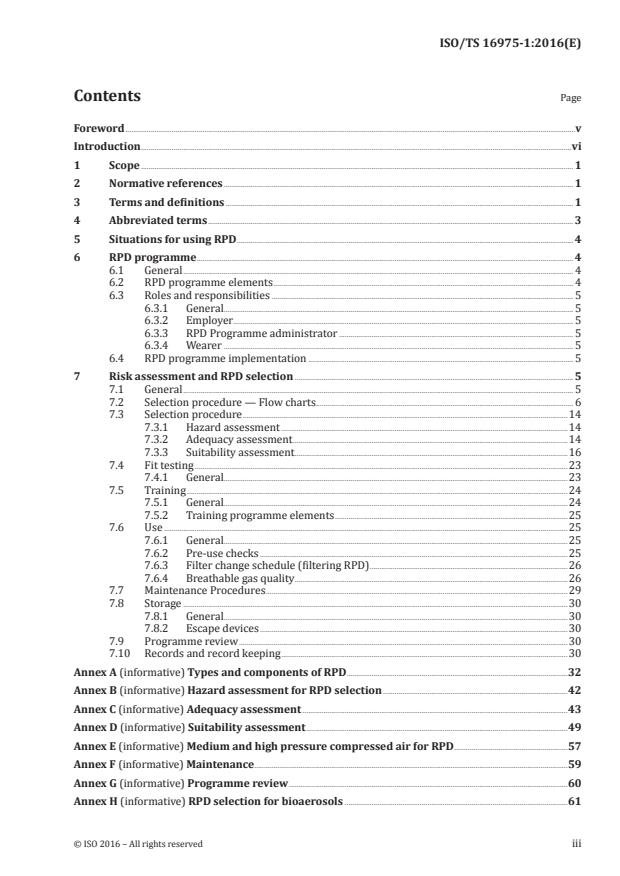
Contents Page
Foreword .v
Introduction .vi
1 Scope . 1
2 Normative references . 1
3 Terms and definitions . 1
4 Abbreviated terms . 3
5 Situations for using RPD . 4
6 RPD programme . 4
6.1 General . 4
6.2 RPD programme elements . 4
6.3 Roles and responsibilities . 5
6.3.1 General. 5
6.3.2 Employer. 5
6.3.3 RPD Programme administrator . 5
6.3.4 Wearer . 5
6.4 RPD programme implementation . 5
7 Risk assessment and RPD selection . 5
7.1 General . 5
7.2 Selection procedure — Flow charts . 6
7.3 Selection procedure .14
7.3.1 Hazard assessment .14
7.3.2 Adequacy assessment . .14
7.3.3 Suitability assessment . .16
7.4 Fit testing .23
7.4.1 General.23
7.5 Training .24
7.5.1 General.24
7.5.2 Training programme elements .25
7.6 Use .25
7.6.1 General.25
7.6.2 Pre-use checks .25
7.6.3 Filter change schedule (filtering RPD) .26
7.6.4 Breathable gas quality . .26
7.7 Maintenance Procedures .29
7.8 Storage .30
7.8.1 General.30
7.8.2 Escape devices .30
7.9 Programme review .30
7.10 Records and record keeping .30
Annex A (informative) Types and components of RPD .32
Annex B (informative) Hazard assessment for RPD selection .42
Annex C (informative) Adequacy assessment .43
Annex D (informative) Suitability assessment .49
Annex E (informative) Medium and high pressure compressed air for RPD .57
Annex F (informative) Maintenance .59
Annex G (informative) Programme review .60
Annex H (informative) RPD selection for bioaerosols .61
Annex I (informative) Classification overview .62
Annex J (informative) Example of Selection Record Form .65
Annex K (informative) Transition from TIL to Protection Level: Safety Factor
derivation rationale .70
Bibliography .74
iv © ISO 2016 – All rights reserved
Foreword
ISO (the International Organization for Standardization) is a worldwide federation of national standards
bodies (ISO member bodies). The work of preparing International Standards is normally carried out
through ISO technical committees. Each member body interested in a subject for which a technical
committee has been established has the right to be represented on that committee. International
organizations, governmental and non-governmental, in liaison with ISO, also take part in the work.
ISO collaborates closely with the International Electrotechnical Commission (IEC) on all matters of
electrotechnical standardization.
The procedures used to develop this document and those intended for its further maintenance are
described in the ISO/IEC Directives, Part 1. In particular the different approval criteria needed for the
different types of ISO documents should be noted. This document was drafted in accordance with the
editorial rules of the ISO/IEC Directives, Part 2 (see www.iso.org/directives).
Attention is drawn to the possibility that some of the elements of this document may be the subject of
patent rights. ISO shall not be held responsible for identifying any or all such patent rights. Details of
any patent rights identified during the development of the document will be in the Introduction and/or
on the ISO list of patent declarations received (see www.iso.org/patents).
Any trade name used in this document is information given for the convenience of users and does not
constitute an endorsement.
For an explanation on the meaning of ISO specific terms and expressions related to conformity assessment,
as well as information about ISO’s adherence to the World Trade Organization (WTO) principles in the
Technical Barriers to Trade (TBT) see the following URL: www.iso.org/iso/foreword.html.
The committee responsible for this document is ISO/TC 94, Personal safety — Protective clothing and
equipment, Subcommittee SC 15, Respiratory protective devices.
ISO 16975 consists of the following parts, under the general title Respiratory protective devices —
Selection, use and maintenance:
— Part 1: Establishing and implementing a respiratory protective device programme [Technical
Specification]
— Part 2: Condensed guide to establishing and implementing a respiratory protective device programme
[Technical Specification]
— Part 3: Fit testing procedures
Introduction
This part of ISO 16975 contains the essential requirements for establishing and implementing a
complete respiratory protective device (RPD) programme for respiratory protective devices that meet
the requirements of the performance standards. It contains information on risk assessment, selection
procedure, training, use and maintenance.
Informative Annexes provide additional guidance on how to implement such a programme.
vi © ISO 2016 – All rights reserved
TECHNICAL SPECIFICATION ISO/TS 16975-1:2016(E)
Respiratory protective devices — Selection, use and
maintenance —
Part 1:
Establishing and implementing a respiratory protective
device programme
1 Scope
This part of ISO 16975 specifies detailed information to assist persons responsible for establishing
and implementing a programme for respiratory protective devices (RPD) that meet the performance
requirements of the performance standards.
This part of ISO 16975 does not apply to RPD programmes for RPD used exclusively under water, for use
in aircraft, and medical life support respirators and resuscitators.
NOTE The information contained in this part of ISO 16975 can be used to assist in the preparation of national
or local regulations; however, this part of ISO 16975 does not supersede national or local regulations.
WARNING — Failure to select, use and maintain RPD correctly can result in injury, illness or death.
2 Normative references
The following documents, in whole or in part, are normatively referenced in this document and are
indispensable for its application. For dated references, only the edition cited applies. For undated
references, the latest edition of the referenced document (including any amendments) applies.
ISO 16900-1, Respiratory protective devices — Methods of test and test equipment — Part 1: Determination
of inward leakage
ISO 16972, Respiratory protective devices — Terms, definitions, graphical symbols and units of
measurement
ISO/TS 16975-2, Respiratory protective devices — Selection, use and maintenance — Part 2: Condensed
guide to establishing and implementing a respiratory protective device programme
1)
ISO 16975-3 , Respiratory protective devices — Selection, use and maintenance — Part 3: Fit testing
procedures
ISO 17420-3, Respiratory protective devices — Performance requirements — Part 3: Thread connection
3 Terms and definitions
For the purposes of this document, the terms and definitions given in ISO 16972 and the following apply.
3.1
adequate RPD
RPD (3.8) capable of reducing the inhalation exposure to an acceptable level
1) To be published.
3.2
assigned protection factor
APF
anticipated level of respiratory protection that would be provided by a properly functioning RPD (3.8)
or class of RPD within an effective RPD programme (3.10)
3.3
competent person
person with suitable and sufficient experience and with practical and theoretical knowledge of the
elements of an RPD programme (3.10) for which (s)he is responsible
3.4
hazardous substance
substance that presents a potential to cause injury or ill health if it is inhaled, ingested or comes into
contact with, or absorbed through, the skin.
Note 1 to entry: A hazardous substance may be a pure substance or generated as by-products during work
activities; for example, wood dust and stone dust welding fume.
Note 2 to entry: Hazardous substances can be present in the atmosphere in a number of physical states as
a) gases, such as ammonia and chlorine,
b) vapours, such as from solvents, and
c) particles, such as dust, mist, smoke, fumes, fibres, fog and bioaerosols.
3.5
hazardous atmospheres
atmosphere that is oxygen-deficient and/or the level of substances in the atmosphere is at a
concentration deemed to be hazardous
3.6
protection class
PC
numerical designation from PC1 to PC6 allocated to individual RPD (3.8) based upon laboratory testing
indicating its relative protection
3.7
protection level
degree of respiratory protection allocated to an RPD (3.8) for the purposes of selection and use that is
expected to be provided to wearers when used within an effective RPD programme (3.10)
3.8
respiratory protective device
RPD
personal protective equipment designed to protect the wearer’s respiratory tract against inhalation of
hazardous atmospheres (3.5)
3.9
risk assessment
process of hazard, adequacy and suitability assessments relating to the selection of RPD (3.8)
3.10
RPD programme
process of selecting, using and maintaining RPD (3.8) to ensure adequate protection to the wearer
3.11
suitable RPD
RPD (3.8) that is adequate and is matched to the requirements of the wearer, the task and the working
environment
2 © ISO 2016 – All rights reserved
3.12
work rate class
numerical designation from W1 to W4 allocated to individual RPD (3.8) based upon laboratory testing
indicating its relative ability to meet the wearer’s demand for breathable gas at different activity levels
Note 1 to entry: Further information on work rate is given in 7.3.3.4.
3.13
immediately dangerous to life or health
IDLH
atmosphere that poses an immediate threat to life, would cause irreversible adverse health effects, or
would impair an individual’s ability to escape from a dangerous atmosphere
4 Abbreviated terms
AB Abrasive Blasting (Special Application Class)
ADE ASM Adequacy Assessment
APF Assigned Protection Factor
CBRN Chemical, Biological, Radiological, and Nuclear (Special Application Class)
ES Escape (Special Application Class)
FF FireFighting (Special Application Class)
HAZ-ASM Hazard Assessment
HHG Health Hazard Group
HR Hazard Ratio
IDLH Immediately Dangerous to Life or Health
MA Marine (Special Application Class)
MN Mining (Special Application Class)
NPF Nominal Protection Factor
OEL Occupational Exposure Level
OEL-TWA Occupational Exposure Level-Time Weighted Average
PC Protection Class
PL Protection Level
PPE Personal Protective Equipment
QLFT Qualitative Fit Test
QNFF Quantitative fit factor
QNFT Quantitative Fit Test
RFF Required Fit Factor
RI Respiratory interface
RPD Respiratory Protective Devices
S Breathable gas capacity
SU ASM Suitability Assessment
SY Breathable gas capacity Class of airline supplied RPD
W Work rate Class
WE Welding (Special Application Class)
5 Situations for using RPD
RPD is considered to be at the bottom of the hierarchy of control measures and should only be used
after an acceptable case for its use has been established by way of an appropriate risk assessment. RPDs
are used to further reduce inhalation exposures to hazardous atmospheres:
— when sufficient engineering and administrative controls are lacking;
— when these controls are not reasonably practical (maintenance, escape or rescue work);
— prior to implementing or improving a control measure.
6 RPD programme
6.1 General
The RPD programme includes processes for selecting, using and maintaining RPD to ensure adequate
protection to the wearer.
Prior to using RPD, it is essential to establish a written RPD programme. The RPD programme needs to
be understood by all persons within the organization, as appropriate.
6.2 RPD programme elements
The RPD programme consists of the following elements:
a) roles and responsibilities (see 6.3);
b) RPD programme implementation (see 6.4);
c) risk assessment (see Clause 7);
d) selection procedures (see Clause 7);
e) medical assessment (see 7.3.3.2);
f) fit testing (see 7.4);
g) training (see 7.5);
h) use (see 7.6);
i) maintenance procedures (see 7.7);
j) storage (see 7.8);
k) programme review (see 7.9);
l) records and record keeping (see 7.10).
4 © ISO 2016 – All rights reserved
6.3 Roles and responsibilities
6.3.1 General
All persons involved in the respiratory protection programme shall be competent in their area of
responsibility within the RPD programme and maintain the appropriate knowledge, experience and
training to effectively carry out their duties.
6.3.2 Employer
The employer shall
— be responsible for the entire RPD programme,
— define, implement and document the RPD programme,
— provide adequate resources and organization to ensure the programme’s continued effectiveness, and
— assign an RPD programme administrator.
The employer and the programme administrator may be the same person.
6.3.3 RPD Programme administrator
The programme administrator shall be responsible for effective management of the entire RPD
programme.
6.3.4 Wearer
The wearer shall be responsible for
— using the RPD in accordance with the instructions and training received,
— reporting of any damage, defects or non-function of the RPD provided, and
— reporting any physical or medical limitations or changes that can impact their ability to wear and
use the RPD correctly.
6.4 RPD programme implementation
The RPD programme shall be implemented, evaluated and updated as necessary to reflect those
changes in workplace conditions that affect RPD use.
7 Risk assessment and RPD selection
7.1 General
A risk assessment is essential for the correct selection and use of RPD. It shall be conducted by a
competent person before RPD is used for routine work, emergency work, rescue (including response to
catastrophic incidents) or escape.
The risk assessment shall be conducted
— prior to the start of all new work processes,
— if the work conditions change,
— for new wearers, not covered by the existing suitability assessments, and
— periodically thereafter, at least annually or in accordance with national or local regulations.
The RPD selection procedure, shown in the following flow charts in 7.2 and described in 7.3, uses the
information gathered from the risk assessment which shall include the following.
a) The Hazard Assessment flow charts identify the nature of the hazard, e.g. oxygen deficiency,
contaminant level, Immediately Dangerous to Life or Health (IDLH).
b) The Adequacy Assessment flow chart determines the protection level required for the hazard.
c) The Suitability Assessment flow charts identify the factors to consider when selecting the RPD that
meets the needs of the wearer and is appropriate for the task and the environment.
d) The special application flow chart identifies the minimum work rates and the minimum protection
classes of the various classes within the special applications.
This is an example of a navigation marker. These navigation markers precede text and are cross
referenced in the flow charts. All markers are listed sequentially in 7.3. In addition, a flow chart may
contain markers out of sequence. Follow the flow charts in the order given above and always begin at
the top block. Read the contents of each block in sequence and follow the decision logic.
The diamond shape indicates that a decision shall be made in order to proceed. Answer each with
a “Yes” or “No” response and follow the arrow to the next block.
The rhomboid shape provides data that leads to the final specification and class of suitable RPD.
The “wave shape” is an instruction to document the output of the suitability assessment.
The irregular pentagon is an instruction to go to the next flow chart.
The cylinder is an indication of the mode of operation.
Record the outcome of the selection procedure in accordance with ISO/TS 16975-2. The example of
the selection record sheet can be used (see Annex J). Where the table in Annex J recommends seeking
professional advice RPD manufacturers/suppliers and safety consultants are a good source of
information.
7.2 Selection procedure — Flow charts
Figure 1 — Chart A Hazard assessment (HAZ-ASM)
6 © ISO 2016 – All rights reserved
an RPD is
Figure 2 — Hazard ASM — Chart B for oxygen-sufficient atmospheres
Figure 3 — Hazard ASM — Chart C for oxygen-deficient atmospheres
8 © ISO 2016 – All rights reserved
go to C.1.2
Figure 4 — Adequacy assessment
Figure 5 — Suitability assessment — Wearer/task
10 © ISO 2016 – All rights reserved
Figure 6 — Suitability assessment — Work rate, mode of operation, filter assessment, filter
exchange programme, breathable gas supply assessment
Figure 7 — Suitability assessment — Intended work, mode of operation, filter assessment and
change schedule
12 © ISO 2016 – All rights reserved
Figure 8 — Special application assessments
7.3 Selection procedure
7.3.1 Hazard assessment
7.3.1.1 General
The hazard assessment shall identify the nature of the hazard(s) present for which respiratory
protection may be required.
7.3.1.1.1 Oxygen deficiency
The potential for oxygen deficiencies shall be considered. When national or local regulations that
relate to oxygen deficiency levels exist, these should be followed.
7.3.1.1.2 Identification of contaminants
The contaminant(s) likely to be present as gas, vapour or particle shall be identified.
All materials used, produced or stored, including raw materials, end products, by-products and wastes,
should be reviewed by assessing the work process and by referring to the safety data sheets (SDS).
From this review, the contaminant(s) that may be present in the workplace shall be identified.
National or local regulations that relate to specific contaminants (e.g. asbestos, lead, benzene) shall be
followed. If the contaminant is unknown and if there is a national or industry guidance document that
is specific to the task, then the assigned protection factors (APF) or the recommended Protection Level
shall be chosen.
When the contaminants cannot be identified and no guidance is available, the hazard is considered
unknown and the atmospheres shall be considered IDLH, and only breathable gas supplying RPD with
the highest APF or protection class shall be selected.
The foreseeable worst-case airborne exposure concentrations of contaminants in the atmosphere
shall be determined. If the contaminant concentration is unknown and if there is a national or industry
guidance document that is specific to the task, then the assigned protection factors (APF) or the
recommended Protection Level shall be chosen.
The occupational exposure limits or the safe exposure levels shall be identified for contaminants
where available. Where no OEL is published for the contaminant and there are no national or local
regulations that relate to the contaminant, then control-banding method may offer a solution; see C.1.3.
If the control banding method cannot be used, then select an RPD with the highest protection class.
Does the potential for IDLH conditions exist? An IDLH atmosphere is one that poses an immediate
threat to life, would cause irreversible adverse health effects, or would impair an individual’s ability to
escape. It is an atmosphere where the potential exists where one could not escape without the aid of an
RPD. Selection of RPD for work in IDLH atmospheres shall consider the method of escape in the event
that the primary RPD mode fails, including level during the escape. IDLH levels may be established by
national or local regulations or published by professional bodies. If there is uncertainty whether the
concentration is above or below IDLH, the atmosphere shall be considered to be IDLH.
7.3.2 Adequacy assessment
7.3.2.1 General
The adequacy assessment determines the minimum protection required from the RPD for adequate
protection against the identified hazardous substance and/or oxygen deficiency.
14 © ISO 2016 – All rights reserved
7.3.2.2 Methods for determining the protection required:
The required protection shall be determined by one of the following methods:
a) following national or local regulations that specify the type of RPD, APF or protection class for
specific contaminants;
b) following national or local regulations for hazardous substances that are classified as
carcinogens or mutagens, or are a potential cause of occupational asthma. These may require that
exposure be reduced to as low as is reasonably practicable or technically feasible and to below any
control or exposure levels/limits;
c) calculating the hazard ratio using the determined foreseeable worst-case airborne
concentration (see C.1.2) and the relevant occupational exposure limit values;
The hazard ratio (HR) can be calculated using Formula (1):
CC
out
HR= (1)
PC
in
where
CC is the contaminant concentration outside the RPD;
out
PC is the permissible concentration allowed inside the respiratory interface, i.e. OEL.
in
d) using the “control banding method”. The control banding method utilizes the hazard
statements associated with the hazardous substance(s) being used or generated, combined with
the potential for inhalation exposure based on the amount of substance used and its dustiness or
volatility. See C.1.3.
7.3.2.3 Use of Assigned Protection Factors (APF)
Where nationally accepted APF are used, an RPD having an APF higher than the hazard ratio (HR)
shall be selected.
APF relate to the protection provided by specific design types and classes of RPD and these will be
different than the ISO RPD classifications. RPD complying with the performance standards are
classified based on laboratory performance measured in accordance with ISO 16900-1, and therefore,
RPD of the same basic design can have different laboratory performance and can therefore fall into a
different protection class (PC).
National or local regulations can require that RPD be selected using APF or equivalent. In this case, the
adequacy assessment and related flow chart (see Figure 4) provide a method for using APF.
7.3.2.4 Use of ISO Protection Classes (PC) and Protection Levels (PL)
The PC is the class of respiratory protection allocated to an RPD as a result of laboratory testing. The
PL is the level of protection associated with the PC that is expected to be provided to wearers when the
RPD is used within an effective RPD programme as described in this part of ISO 16975. The PL is used
in the selection process. These can be found in the Selection Record Form; see Annex J.
For oxygen-deficient atmospheres, a supplied breathable gas RPD of class SY ES or class S shall be
selected. The PC needed depends upon the concentration of any hazardous substance(s) present.
For working in IDLH atmospheres, only supplied breathable gas RPD shall be selected. The
minimum PL shall be determined by the hazard ratio in the adequacy assessment (See C.1). When class
SY RPD, e.g. airline RPD, is selected, it shall be combined with a class ES (escape only RPD) or class S
RPD, e.g. self-contained breathing apparatus.
For oxygen-deficient atmospheres, a supplied breathable gas RPD with a protection class of at least PC4
shall be selected.
For escape from oxygen-sufficient IDLH atmosphere, an RPD of class ES with the minimum PL
determined by the hazard ratio in the adequacy assessment shall be selected.
For escape from oxygen-deficient IDLH atmospheres, only a supplied breathable gas RPD of class SY ES
or class S with a protection class of at least PC4 shall be selected.
When class SY RPD, e.g. airline device, is selected, it shall be combined with a class ES, (escape only
device) or class S RPD, e.g. self-contained breathing apparatus. A higher PC can be needed depending
upon the concentration of any hazardous substance(s) present.
7.3.3 Suitability assessment
7.3.3.1 General
The suitability assessment shall consider the following:
— wearer;
— task;
— work rate;
— environment;
— any special application.
7.3.3.2 Wearer
The suitability assessment for the wearer shall consider the following factors.
a) Medical limitations. The programme administrator shall arrange for appropriate medical
assessment, in accordance with national or local regulations, to ensure that the individual is free
from any condition that may preclude or limit the use of RPD.
NOTE Further information is given in D.2.1.
b) Facial characteristics. The RPD selected shall accommodate the facial characteristics of the
wearer, such as deep scars or grooves. Where these facial characteristics prevent a good fit,
consider the use of a loose-fitting respiratory interface, which does not rely on a tight seal in this
region. Body jewellery which affects the fit shall be removed while wearing the RPD, or a different
type of RI may be considered.
NOTE Further information is given in D.2.2.
c) Hair. No hair comes between the sealing surfaces of a tight-fitting respiratory interface and the
wearer’s skin, or interferes with the function of the RPD, e.g. interference with the operation of
valves shall not be permitted. Where any hair comes between the sealing surface, the use of loose-
fitting respiratory interface, which do not rely on a tight seal in this region may be considered.
d) Corrective lenses. The RPD shall be able to accommodate corrective lenses (spectacles or contact
lenses) if needed.
NOTE Further information is given in D.2.3.
16 © ISO 2016 – All rights reserved
e) Communication. The RPD shall permit communication to the level needed for the task (e.g.
speaking, hearing and visual communications).
NOTE Further information is given in D.2.4.
f) Compatibility with other PPE. Different items of PPE shall not interfere with the RPD during use,
preventing one or more of the components from working correctly. Where possible, RPD, where the
different forms of protection required are integrally combined, (e.g. RPD providing eye, face, head
and respiratory protection) should be considered.
NOTE Further information is given in D.2.5.
7.3.3.3 Task
Suitability assessment for the task shall consider the following factors.
a) Vision. Special needs for vision, e.g. magnification, clarity or wide field of view, shall be considered.
NOTE Further information is given in D.3.1.
b) Mobility. Mobility requirements demanded by the task and location can limit the type of RPD
that can be used safely. Confined spaces require special considerations. RPD that does not impede
mobility shall be selected.
NOTE Further information is given in D.3.2.
c) Communications. Communication requirements shall be taken into consideration especially
for confined spaces and IDLH atmospheres. RPD with speech transmitters and RPD models
incorporating voice amplifiers or radios should be considered to aid communications.
NOTE Further information is given in D.3.3.
d) Tools. Use of tools (e.g. welding equipment, equipment used during spraying operations and power
tools) can influence the performance of RPD and shall be considered. RPD compatible with the
tools shall be selected. If the RPD and air-powered tools are connected to the same air supply, it
shall be ensured that the compressor can supply enough air for both at the same time and that
the air supplied to the RPD remains of breathable quality (see 7.6.3.2). This practice can result in
excess oil in the breathable gas. Some types of RPD, e.g. compressed breathable gas supplied RPD,
are equipped with an air take-off for air-powered tools. Preferably, the RPD air supply and other air
sources should be kept separated. Any national or local regulations prohibiting the supply of both
RPD and tool from the same air source shall be followed.
NOTE Further information is given in D.3.4.
e) Duration. Task duration (including any preparation, entry, exit and decontamination time) shall
be considered in order to establish the requirements for the service life of the RPD. Depending
upon the type of RPD, this shall include consideration of breathable gas capacity, battery life, filter
service life and a filter change schedule.
NOTE Further information is given in D.3.5.
f) Wear time. This is the length of time the RPD has to be worn continuously to perform the task. For
some types of RPD, the maximum possible wear time and frequency of use may be limited due to
wearer comfort and physical burden. Using assisted RPD can help minimize fatigue and discomfort.
Any national or local regulations concerning wear time shall be followed.
7.3.3.4 Work rate
The expected work rate shall be determined in order to select RPD with the appropriate work
rate class.
Four work rate classes, W1, W2, W3 and W4, are designated for RPD; however, those with standardized
connector according to ISO 17420-3 are limited up to work rate W2.
To determine the required work rate class, the highest class according to the descriptions in Table 1
shall be selected.
NOTE Further information on work rates and work activities is given in ISO/TS 16976-1.
Table 1 — Work rates and examples of corresponding activities
Work rate class Work Examples of work and activities
Average for full work shifts including breaks
Sitting at ease: light manual work (writing, typing, drawing, sewing,
bookkeeping); hand and arm work (small bench tools, inspection, assembly
or sorting of light materials); arm and leg work [driving vehicle in normal
conditions, operating foot switch or pedal, standing drilling (small parts),
milling machine (small parts), coil winding, small armature winding,
machining with low power tools]
W1 Light to moderate
To:
Sustained hand and arm work (hammering in nails, filing); arm and leg
work (off-road operation of lorries, tractors or construction equipment);
arm and trunk work (work with pneumatic hammer, tractor assembly,
plastering, intermittent handling of moderately heavy material, weeding,
hoeing, picking fruits or vegetables, pushing or pulling light-weight carts
or wheelbarrows, forging); walking at a speed of up to 5,5 km/h
Average for full work shifts including breaks
Intense arm and trunk work (carrying heavy material, shovelling,
sledgehammer work, sawing, planing or chiselling hard wood, hand mowing,
digging, pushing or pulling heavily loaded hand carts or wheelbarrows,
Heavy to very
chipping castings, concrete block laying)
W2
heavy
To:
Very intense activity at fast pace; working with an axe; intense shovelling
or digging; climbing stairs, ramp or ladder; walking quickly with small
forms; running; walking at a speed greater than 5,5 km/h
Continuous work for up to 2 h without breaks
Safety and rescue work with heavy equipment and/or personal
protective equipment; fit individuals pacing themselves at 50 % to 60 % of
their maximal aerobic capacity; walking quickly or running with protective
equipment and/or tools and goods; walking at 5 km/h and 10 % elevation
Very, very heavy to To:
W3
extremely heavy
Continuous work for up to 15 min without breaks.
Rescue and fire-fighting work at high intensity; fit and well-trained
individuals pacing themselves at 70 % to 80 % of their maximal aerobic
capacity; searching contaminated spaces; crawling under and climbing
over obstacles; removing debris; carrying a hose; walking at 5 km/h and
15 % elevation
Continuous work for less than 5 min without breaks
Rescue and firefighting work at maximal intensity; fit and well-trained
W4 Maximal
individuals pacing themselves at 80 % to 90 % of their maximal physical
work capacity; climbing stairs and ladders at high speed; removing and
carrying victims; walking at 5 km/h and 20 % elevation
7.3.3.5 Mode of operation
The mode of operation gives the primary means of supplying the wearer with breathable gas, i.e.
filtration or breathable gas supply.
18 © ISO 2016 – All rights reserved
National or local regulations can exist (e.g. asbestos, lead, benzene) that mandate the use of supplied
breathable gas RPD.
Where the hazard assessment indicates that either filtering RPD or supplied breathable gas RPD could
be used, the choice of RPD mode of operation most suited to the task should depend on the output of the
suitability assessment and the limitations of the RPD. Further information is given in A.2 and A.3.
7.3.3.6 Filter assessment
Where the risk assessment indicates that a particle filtering RPD is suitable, the selection of the
appropriate particle filtering RPD shall be determined by the required PL and work rate.
Where the risk assessment indicates that a gas/vapour or combination filtering RPD is suitable, the
selection of the appropriate type and class of filter will depend on many workplace factors. These
include contaminant(s), their concentration(s), work rate, task duration, temperature and humidity.
Users should seek guidance from the gas filter manufacturer about the filter classification to be used
and whether the contaminant can be removed by filtration at all.
NOTE Further information is given in A.2.3.3, A.2.3.4, A.3.3 and Annex I.
7.3.3.7 Filter change schedule
A filter change schedule shall be established, so that the filters are changed prior to their end of
service life. Filters marked for single shift use only or that have time limitations shall be replaced in
accordance with the manufacturer’s instructions for use.
NOTE Further information is given in A.3.3 and B.2.1.
Filter(s) shall be replaced with new filter(s) of the same type and class. When more than one filter is
used on an RPD, all filters shall be replaced at the same time.
7.3.3.8 Calculation of breathable gas volume needed for the task
Supplied breathable gas RPD that have a fixed volume of breathable gas (self-contained) are
classified by the volume of breathable gas available, and are designated by the letter S followed by the
volume in litres.
The minimum volume of the breathab
...
SPÉCIFICATION ISO/TS
TECHNIQUE 16975-1
Première édition
2016-06-15
Appareils de protection
respiratoire — Choix, utilisation et
entretien —
Partie 1:
Élaboration et mise en oeuvre d’un
programme pour les appareils de
protection respiratoire
Respiratory protective devices — Selection, use and maintenance —
Part 1: Establishing and implementing a respiratory protective device
programme
Numéro de référence
©
ISO 2016
DOCUMENT PROTÉGÉ PAR COPYRIGHT
© ISO 2016, Publié en Suisse
Droits de reproduction réservés. Sauf indication contraire, aucune partie de cette publication ne peut être reproduite ni utilisée
sous quelque forme que ce soit et par aucun procédé, électronique ou mécanique, y compris la photocopie, l’affichage sur
l’internet ou sur un Intranet, sans autorisation écrite préalable. Les demandes d’autorisation peuvent être adressées à l’ISO à
l’adresse ci-après ou au comité membre de l’ISO dans le pays du demandeur.
ISO copyright office
Ch. de Blandonnet 8 • CP 401
CH-1214 Vernier, Geneva, Switzerland
Tel. +41 22 749 01 11
Fax +41 22 749 09 47
copyright@iso.org
www.iso.org
ii © ISO 2016 – Tous droits réservés
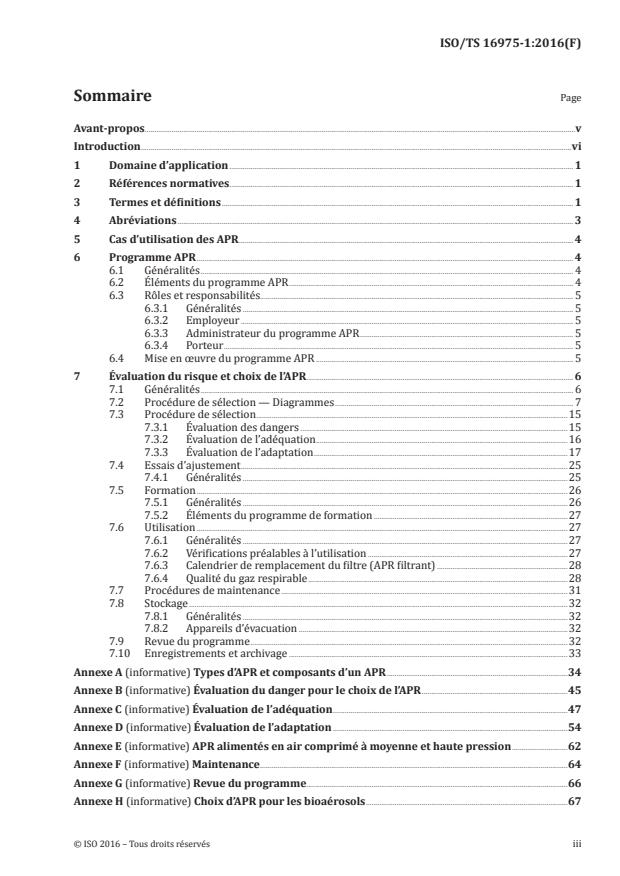
Sommaire Page
Avant-propos .v
Introduction .vi
1 Domaine d’application . 1
2 Références normatives . 1
3 Termes et définitions . 1
4 Abréviations . 3
5 Cas d’utilisation des APR . 4
6 Programme APR . 4
6.1 Généralités . 4
6.2 Éléments du programme APR . 4
6.3 Rôles et responsabilités . . 5
6.3.1 Généralités . 5
6.3.2 Employeur . 5
6.3.3 Administrateur du programme APR . 5
6.3.4 Porteur . 5
6.4 Mise en œuvre du programme APR . 5
7 Évaluation du risque et choix de l’APR . 6
7.1 Généralités . 6
7.2 Procédure de sélection — Diagrammes . 7
7.3 Procédure de sélection .15
7.3.1 Évaluation des dangers .15
7.3.2 Évaluation de l’adéquation .16
7.3.3 Évaluation de l’adaptation .17
7.4 Essais d’ajustement .25
7.4.1 Généralités .25
7.5 Formation .26
7.5.1 Généralités .26
7.5.2 Éléments du programme de formation .27
7.6 Utilisation .27
7.6.1 Généralités .27
7.6.2 Vérifications préalables à l’utilisation .27
7.6.3 Calendrier de remplacement du filtre (APR filtrant) .28
7.6.4 Qualité du gaz respirable .28
7.7 Procédures de maintenance .31
7.8 Stockage .32
7.8.1 Généralités .32
7.8.2 Appareils d’évacuation .32
7.9 Revue du programme .32
7.10 Enregistrements et archivage .33
Annexe A (informative) Types d’APR et composants d’un APR .34
Annexe B (informative) Évaluation du danger pour le choix de l’APR .45
Annexe C (informative) Évaluation de l’adéquation .47
Annexe D (informative) Évaluation de l’adaptation .54
Annexe E (informative) APR alimentés en air comprimé à moyenne et haute pression .62
Annexe F (informative) Maintenance .64
Annexe G (informative) Revue du programme.66
Annexe H (informative) Choix d’APR pour les bioaérosols .67
Annexe I (informative) Présentation des classifications .68
Annexe J (informative) Exemple de fiche de sélection .72
Annexe K (informative) Correspondance entre la fuite totale vers l’intérieur (TIL) et le
niveau de protection (PL): Raisonnement suivi pour le calcul des coefficients
de sécurité .78
Bibliographie .82
iv © ISO 2016 – Tous droits réservés
Avant-propos
L’ISO (Organisation internationale de normalisation) est une fédération mondiale d’organismes
nationaux de normalisation (comités membres de l’ISO). L’élaboration des Normes internationales est
en général confiée aux comités techniques de l’ISO. Chaque comité membre intéressé par une étude
a le droit de faire partie du comité technique créé à cet effet. Les organisations internationales,
gouvernementales et non gouvernementales, en liaison avec l’ISO participent également aux travaux.
L’ISO collabore étroitement avec la Commission électrotechnique internationale (IEC) en ce qui
concerne la normalisation électrotechnique.
Les procédures utilisées pour élaborer le présent document et celles destinées à sa mise à jour sont
décrites dans les Directives ISO/IEC, Partie 1. Il convient, en particulier de prendre note des différents
critères d’approbation requis pour les différents types de documents ISO. Le présent document a été
rédigé conformément aux règles de rédaction données dans les Directives ISO/IEC, Partie 2 (voir www.
iso.org/directives).
L’attention est appelée sur le fait que certains des éléments du présent document peuvent faire l’objet de
droits de propriété intellectuelle ou de droits analogues. L’ISO ne saurait être tenue pour responsable
de ne pas avoir identifié de tels droits de propriété et averti de leur existence. Les détails concernant
les références aux droits de propriété intellectuelle ou autres droits analogues identifiés lors de
l’élaboration du document sont indiqués dans l’Introduction et/ou dans la liste des déclarations de
brevets reçues par l’ISO (voir www.iso.org/brevets).
Les appellations commerciales éventuellement mentionnées dans le présent document sont données
pour information, par souci de commodité, à l’intention des utilisateurs et ne sauraient constituer un
engagement.
Pour une explication de la signification des termes et expressions spécifiques de l’ISO liés à l’évaluation
de la conformité, ou pour toute information au sujet de l’adhésion de l’ISO aux principes de l’Organisation
mondiale du commerce (OMC) concernant les obstacles techniques au commerce (OTC), voir le lien
suivant: www.iso.org/iso/fr/avant-propos.html
Le comité chargé de l’élaboration du présent document est l’ISO/TC 94, Sécurité individuelle — Vêtements
et équipements de protection, sous-comité SC 15, Appareils de protection respiratoire.
L’ISO 16975 comprend les parties suivantes, présentées sous le titre général Appareils de protection
respiratoire — Choix, utilisation et maintenance:
— Partie 1: Élaboration et mise en œuvre d’un programme pour les appareils de protection respiratoire
[Spécification technique]
— Partie 2: Guide condensé pour l’élaboration et la mise en œuvre d’un programme pour les appareils de
protection respiratoire [Spécification technique]
— Partie 3: Modes opératoires d’essais d’ajustement
Introduction
La présente partie de l’ISO 16975 définit les exigences fondamentales applicables à l’élaboration et à la
mise en œuvre d’un programme complet pour les appareils de protection respiratoire (APR) satisfaisant
aux exigences des normes de performance. Elle fournit des informations relatives à l’évaluation du
risque, à la procédure de sélection, à la formation, à l’utilisation et à la maintenance.
Des annexes informatives fournissent des recommandations supplémentaires sur la mise en œuvre
d’un tel programme.
vi © ISO 2016 – Tous droits réservés
SPÉCIFICATION TECHNIQUE ISO/TS 16975-1:2016(F)
Appareils de protection respiratoire — Choix, utilisation et
entretien —
Partie 1:
Élaboration et mise en oeuvre d’un programme pour les
appareils de protection respiratoire
1 Domaine d’application
La présente partie de l’ISO 16975 contient des informations détaillées visant à aider les personnes
responsables de l’élaboration et de la mise en œuvre d’un programme pour les appareils de protection
respiratoire (APR) conformes aux exigences des normes de performance.
La présente partie de l’ISO 16975 ne s’applique pas aux programmes destinés aux APR utilisés
exclusivement sous l’eau, utilisés à bord des aéronefs et aux appareils d’assistance respiratoire et de
réanimation employés à des fins médicales.
NOTE Les informations contenues dans la présente partie de l’ISO 16975 peuvent être exploitées afin
de faciliter la préparation de réglementations nationales ou locales; cette partie ne saurait, en revanche, se
substituer à aucune réglementation nationale ou locale.
AVERTISSEMENT — Un choix, une utilisation et une maintenance inappropriés des APR peuvent
entraîner des blessures, des maladies ou la mort.
2 Références normatives
Les documents ci-après, dans leur intégralité ou non, sont des références normatives indispensables à
l’application du présent document. Pour les références datées, seule l’édition citée s’applique. Pour les
références non datées, la dernière édition du document de référence s’applique (y compris les éventuels
amendements).
ISO 16900-1, Appareils de protection respiratoire — Méthodes d’essai et équipement d’essai — Partie 1:
Détermination des fuites vers l’intérieur
ISO 16972, Appareils de protection respiratoire — Termes, définitions, symboles graphiques et unités
de mesure
ISO/TS 16975-2, Appareils de protection respiratoire — Choix, utilisation et entretien — Partie 2:
Directives condensées pour l’élaboration et la mise en œuvre d’un programme pour les appareils de
protection respiratoire
1)
ISO 16975-3 , Appareils de protection respiratoire — Choix, utilisation et maintenance — Partie 3: Modes
opératoires d’essais d’ajustement
ISO 17420-3, Appareils de protection respiratoire — Exigences de performances — Partie 3: Raccord
normalisé
3 Termes et définitions
Pour les besoins du présent document, les termes et définitions donnés dans l’ISO 16972, ainsi que les
suivants s’appliquent.
1) À publier.
3.1
APR adéquat
APR (3.8) capable de réduire l’exposition par inhalation jusqu’à un niveau acceptable
3.2
facteur de protection assigné
FPA
niveau prévu de protection respiratoire qui serait fourni par un APR (3.8) ou par une classe d’APR
fonctionnant correctement dans le cadre d’un programme APR (3.10) efficace
3.3
personne compétente
personne possédant une expérience appropriée et suffisante, et des connaissances pratiques et
théoriques des éléments d’un programme APR (3.10) dont elle est responsable
3.4
substance dangereuse
substance susceptible d’occasionner des blessures ou des maladies en cas d’inhalation, d’ingestion, ou
de contact ou absorption cutanés
Note 1 à l’article: Une substance dangereuse peut être une substance pure ou une substance émise lors
d’opérations de travail, par exemple poussières de bois et poussières de pierre, fumées de soudage.
Note 2 à l’article: Les substances dangereuses peuvent être présentes dans l’atmosphère sous plusieurs états
physiques, notamment sous forme de:
a) gaz, tels que l’ammoniac et le chlore;
b) vapeurs, telles que vapeurs de solvants; et
c) particules, telles que poussières, gouttelettes, fumées, fibres, brouillard et bioaérosols.
3.5
atmosphère dangereuse
atmosphère qui est appauvrie en oxygène et/ou qui contient des substances dans des concentrations
jugées dangereuses
3.6
classe de protection
PC
désignation numérique allant de PC1 à PC6 attribuée à un APR (3.8) compte tenu de la protection
relative déterminée lors d’essais en laboratoire
3.7
niveau de protection
degré de protection respiratoire, attribué à un APR (3.8) pour les objectifs de sélection et d’utilisation,
qui serait procuré aux porteurs utilisant cet APR dans le cadre d’un programme APR (3.10) efficace
3.8
appareil de protection respiratoire
APR
équipement de protection individuelle conçu pour protéger les voies respiratoires du porteur contre
l’inhalation d’atmosphères dangereuses (3.5)
3.9
évaluation du risque
procédé d’évaluation des dangers, de l’adéquation et de l’adaptation concernant la sélection d’un
APR (3.8)
2 © ISO 2016 – Tous droits réservés
3.10
Programme APR
processus de sélection, d’utilisation et de maintenance d’un APR (3.8) permettant de garantir une
protection appropriée du porteur
3.11
APR approprié
APR (3.8) adéquat et adapté aux exigences liées au porteur, à la tâche et à l’environnement de travail
3.12
classe de rythme de travail
désignation numérique allant de W1 à W4 attribuée à un APR (3.8), compte tenu d’essais en laboratoire
indiquant son aptitude relative à répondre aux besoins en gaz respirable du porteur à différents niveaux
d’activité
Note 1 à l’article: Voir 7.3.3.4 pour plus d’informations sur le rythme de travail.
3.13
présentant un danger immédiat pour la vie ou la santé (immediately dangerous to life or health)
IDLH
atmosphère présentant une menace immédiate pour la vie, qui aurait des effets dommageables
irréversibles pour la santé ou diminuerait la capacité d’une personne à fuir une atmosphère dangereuse
4 Abréviations
AB projection d’abrasifs (Abrasive Blasting) (classe d’application particulière)
ADE ASM évaluation de l’adéquation (Adequacy Assessment)
FPA facteur de protection assigné (Assigned Protection Factor)
CBRN chimique, biologique, radiologique et nucléaire (classe d’application particulière)
ES évacuation (Escape) (classe d’application particulière)
FF lutte contre l’incendie (FireFighting) (classe d’application particulière)
HAZ-ASM évaluation du danger (Hazard Assessment)
HHG groupe de danger pour la santé (Health Hazard Group)
HR coefficient de risque (Hazard Ratio)
IDLH présentant un danger immédiat pour la vie ou la santé (Immediately Dangerous to Life
or Health)
MA applications maritimes (classe d’application particulière)
MN applications minières (classe d’application particulière)
FPN facteur de protection nominal (Nominal Protection Factor)
OEL niveau d’exposition professionnelle (Occupational Exposure Level)
OEL-TWA niveau d’exposition professionnelle – moyenne pondérée dans le temps (Occupational
Exposure Level – Time Weighted Average)
PC classe de protection (Protection Class)
PL niveau de protection (Protection Level)
EPI équipement de protection individuelle
QLFT essai d’ajustement qualitatif (Qualitative Fit Test)
QNFF coefficient d’ajustement quantitatif (Quantitative fit factor)
QNFT essai d’ajustement quantitatif (Quantitative Fit Test)
RFF coefficient d’ajustement requis (Required Fit Factor)
RI Interface respiratoire (Respiratory interface)
APR appareil de protection respiratoire
S capacité de gaz respirable
SU ASM évaluation de l’adaptation (Suitability Assessment)
SY classe de capacité des APR à adduction d’air
W classe de rythme de travail
WE soudage (Welding) (classe d’application particulière)
5 Cas d’utilisation des APR
L’APR se situe à la dernière place de la hiérarchie des mesures de prévention. Il convient de ne l’utiliser
qu’une fois son emploi dûment justifié au moyen d’une évaluation de risque appropriée. Les APR sont
utilisés pour réduire au minimum les expositions par inhalation dans des atmosphères dangereuses,
par exemple:
— en l’absence de mesures de prévention techniques et administratives suffisantes;
— lorsque ces mesures de prévention ne sont pas raisonnablement possibles (travaux de maintenance,
d’évacuation, de sauvetage);
— avant la mise en œuvre ou l’amélioration d’une mesure de prévention.
6 Programme APR
6.1 Généralités
Le programme APR comporte des processus de sélection, d’utilisation et de maintenance des APR visant
à garantir au porteur une protection adéquate.
L’utilisation d’APR requiert l’élaboration préalable d’un programme APR écrit. Ce programme doit être
compris de tous les membres concernés de l’organisation.
6.2 Éléments du programme APR
Le programme APR est structuré comme suit:
a) rôles et responsabilités (voir 6.3);
b) mise en œuvre du programme APR (voir 6.4);
c) évaluation du risque (voir Article 7);
d) procédures de sélection (voir Article 7);
4 © ISO 2016 – Tous droits réservés
e) visite médicale (voir 7.3.3.2);
f) essais d’ajustement (voir 7.4);
g) formation (voir 7.5);
h) utilisation (voir 7.6);
i) procédures de maintenance (voir 7.7);
j) stockage (voir 7.8);
k) revue du programme (voir 7.9);
l) enregistrements et archivage (voir 7.10).
6.3 Rôles et responsabilités
6.3.1 Généralités
Toutes les personnes impliquées dans le programme de protection respiratoire doivent être
compétentes dans leur domaine de responsabilité, tel que le définit le programme APR, et maintenir le
niveau de connaissances, d’expérience et de formation nécessaire pour mener à bien leur mission.
6.3.2 Employeur
L’employeur doit:
— assurer la responsabilité de l’intégralité du programme APR;
— définir, mettre en œuvre et documenter le programme APR;
— fournir les ressources et l’organisation adéquates pour garantir l’efficacité durable du programme; et
— désigner un administrateur de programme APR.
L’employeur peut assurer lui-même le rôle d’administrateur du programme.
6.3.3 Administrateur du programme APR
L’administrateur du programme doit assurer la responsabilité de la gestion efficace de l’ensemble du
programme APR.
6.3.4 Porteur
Le porteur doit être tenu:
— d’utiliser l’APR conformément aux instructions et à la formation qu’il a reçues;
— de signaler tout dommage, défaut ou dysfonctionnement de l’APR fourni; et
— de signaler toute contre-indication ou modification sur le plan physique ou médical pouvant affecter
sa capacité à porter et utiliser correctement l’APR.
6.4 Mise en œuvre du programme APR
Le programme APR doit être mis en œuvre, évalué et mis à jour chaque fois que nécessaire afin de
refléter les changements intervenant sur le lieu de travail et affectant l’utilisation de l’APR.
7 Évaluation du risque et choix de l’APR
7.1 Généralités
Une évaluation de risque est indispensable pour garantir un choix et une utilisation appropriés de
l’APR. Cette évaluation doit être menée par une personne compétente avant que l’APR ne soit utilisé
dans le cadre d’activités courantes ou d’interventions d’urgence, de sauvetage (y compris en réponse à
des événements catastrophiques) ou d’évacuation.
L’évaluation du risque doit être effectuée:
— avant le démarrage de tout nouveau procédé de travail;
— en cas de changement des conditions de travail;
— dans le cas de nouveaux porteurs non couverts par les évaluations d’adaptation existantes; et
— périodiquement ensuite, au moins à une fréquence annuelle ou selon les réglementations nationales
ou locales applicables.
La procédure de sélection d’APR, illustrée dans les diagrammes du paragraphe 7.2 ci-après et décrite
en 7.3, s’appuie sur les informations recueillies à l’issue de l’évaluation du risque, qui doit couvrir les
points suivants:
a) Les diagrammes d’évaluation du danger identifient la nature du danger, par exemple,
appauvrissement en oxygène, niveau de contaminant, danger immédiat pour la vie ou la
santé (IDLH).
b) Le diagramme d’évaluation de l’adéquation détermine le niveau de protection requis en fonction
du danger.
c) Les diagrammes d’évaluation de l’adaptation identifient les facteurs à prendre en compte lors du
choix d’un APR capable de répondre aux besoins du porteur tout en étant approprié à la tâche et à
l’environnement.
d) Le diagramme des applications particulières identifie les rythmes de travail minimaux et les
classes de protection minimales des différentes classes d’applications particulières.
Ce symbole constitue un exemple de marqueur de navigation. Ces marqueurs de navigation
précèdent le texte et sont référencés dans les diagrammes. Tous les marqueurs sont décrits, par
séquence, au paragraphe 7.3. De plus, un diagramme peut contenir des marqueurs hors séquence.
Suivre les diagrammes dans l’ordre indiqué ci-dessus veillant toujours à commencer par le haut. Lire le
contenu de chaque bloc dans l’ordre en suivant la logique décisionnelle.
Le losange indique qu’une décision doit être prise avant de poursuivre. Répondre par «Oui» ou par
«Non» et suivre la flèche jusqu’au bloc suivant.
Le parallélogramme fournit des données qui conduisent à la spécification finale et à la classe de
l’APR approprié.
La forme «ondulée» indique qu’il faut documenter le résultat de l’évaluation de l’adaptation.
Les pentagones irréguliers indiquent qu’il faut passer au diagramme suivant.
Le cylindre est une indication du mode de fonctionnement.
Enregistrer le résultat de la procédure de sélection conformément à l’ISO/TS 16975-2. Il est possible
d’utiliser pour cela l’exemple de fiche de sélection (voir Annexe J). Si le tableau de l’Annexe J recommande
6 © ISO 2016 – Tous droits réservés
de demander l’avis d’un spécialiste, les fabricants/fournisseurs d’APR et les conseillers en santé et
sécurité constituent une bonne source d’information.
7.2 Procédure de sélection — Diagrammes
Figure 1 — Diagramme A — Évaluation du danger (HAZ-ASM)
Figure 2 — Évaluation du danger — Diagramme B pour les atmosphères à teneur suffisante
en oxygène
8 © ISO 2016 – Tous droits réservés
Figure 3 — Évaluation du danger — Diagramme C pour les atmosphères à teneur insuffisante
en oxygène
Figure 4 — Évaluation de l’adéquation
10 © ISO 2016 – Tous droits réservés
Figure 5 — Évaluation de l’adaptation — Porteur/tâche
Figure 6 — Évaluation de l’adaptation — Rythme de travail, mode de fonctionnement,
évaluation du filtre, programme de remplacement du filtre, évaluation de l’alimentation en gaz
respirable
12 © ISO 2016 – Tous droits réservés
Figure 7 — Évaluation de l’adaptation — Tâche prévue, mode de fonctionnement, évaluation du
filtre et calendrier de remplacement
Figure 8 — Évaluations d’applications particulières
14 © ISO 2016 – Tous droits réservés
7.3 Procédure de sélection
7.3.1 Évaluation des dangers
7.3.1.1 Généralités
L’évaluation des dangers doit identifier la nature du ou des dangers présents pouvant requérir une
protection respiratoire.
7.3.1.1.1 Appauvrissement en oxygène
L’éventualité d’un appauvrissement en oxygène doit être prise en compte. Lorsqu’il existe des
réglementations nationales ou locales relatives aux niveaux appauvris en oxygène, il convient de les
respecter.
7.3.1.1.2 Identification des contaminants
Le(s) contaminant(s) susceptible(s) d’être présent(s) à l’état de gaz, de vapeur ou de particules,
doit/doivent être identifié(s).
Il convient que tous les matériaux utilisés, produits ou stockés, y compris les matières premières,
produits finis, sous-produits et déchets, soient repérés en évaluant le procédé de travail et en se référant
aux fiches de données de sécurité (FDS) correspondantes. À partir de cet examen, le(s) contaminant(s)
pouvant être présent(s) sur le lieu de travail doi(ven)t être identifié(s).
Les réglementations nationales ou locales relatives à des contaminants spécifiques (par exemple,
amiante, plomb, benzène) doivent être respectées. Si le contaminant est inconnu et s’il existe une
directive nationale ou sectorielle spécifique à la tâche concernée, alors les facteurs de protection
assignés (FPA) ou le niveau de protection recommandé doivent être sélectionnés.
Lorsque l’identification des contaminants est impossible et qu’aucune directive n’est disponible, le
danger est considéré comme inconnu et les atmosphères doivent être considérées comme présentant
un danger immédiat pour la vie ou la santé (IDLH); en conséquence, seuls des APR alimentés en gaz
respirable associés au FPA ou à la classe de niveau de protection les plus élevés doivent être sélectionnés.
Les pires concentrations prévisibles de contaminants atmosphériques présentant un risque
d’exposition dans l’air doivent être déterminées. Si la concentration de contaminant est inconnue et
s’il existe une directive nationale ou sectorielle spécifique à la tâche concernée, alors les facteurs de
protection assignés (FPA) ou le niveau de protection recommandés doivent être sélectionnés.
Les limites d’exposition professionnelle ou les niveaux d’exposition sans risque doivent être
identifiés pour les contaminants, le cas échéant. Lorsqu’aucune limite d’exposition professionnelle n’est
publiée pour le contaminant et que ce dernier n’est régi par aucune réglementation nationale ou locale,
la méthode d’analyse par bandes de danger peut apporter une solution acceptable; voir C.1.3. Si cette
méthode ne peut être utilisée, choisir un APR présentant la classe de protection la plus élevée.
Existe-t-il un risque de danger immédiat pour la vie ou la santé (IDLH)? Une atmosphère IDLH,
qui constitue une menace immédiate pour la vie, aurait des effets dommageables irréversibles pour
la santé ou diminuerait la capacité d’une personne à fuir. Il s’agit d’une atmosphère dans laquelle une
personne risque vraisemblablement de ne pas pouvoir s’enfuir sans le recours à un APR. Le choix
des APR destinés à être utilisés lors de travaux en atmosphère IDLH doit tenir compte de la méthode
d’évacuation en cas de défaillance du mode d’APR primaire, y compris du niveau pendant l’évacuation.
Les niveaux IDLH peuvent être définis par des réglementations nationales ou locales ou être publiés
par des organismes professionnels. S’il est impossible d’établir avec certitude que la concentration est
supérieure ou inférieure au seuil IDLH, l’atmosphère doit être considérée comme étant IDLH.
7.3.2 Évaluation de l’adéquation
7.3.2.1 Généralités
L’évaluation de l’adéquation détermine la protection minimale que l’on attend de l’APR pour garantir
une protection adéquate contre la substance dangereuse et/ou l’appauvrissement en oxygène identifiés.
7.3.2.2 Méthodes de détermination de la protection requise
La protection requise doit être déterminée par l’une des méthodes suivantes:
a) en respectant les réglementations nationales ou locales qui spécifient le type d’APR, le FPA ou
la classe de protection associés à des contaminants spécifiques;
b) en respectant les réglementations nationales ou locales applicables aux substances
dangereuses classées comme cancérigènes ou mutagènes, ou considérées comme une cause
potentielle d’asthme professionnel. Ces réglementations peuvent imposer de ramener l’exposition
au niveau le plus bas raisonnablement ou techniquement possible et au-dessous des niveaux/
valeurs limites de contrôle ou d’exposition;
c) en calculant le coefficient de risque sur la base de la pire concentration prévisible de
contaminants atmosphériques déterminée (voir C.1.2) et en tenant compte des valeurs limites
d’exposition professionnelle applicables;
Le coefficient de risque (HR) peut être calculé à l’aide de la Formule (1):
CC
out
HR= (1)
PC
in
où
CC désigne la concentration du contaminant à l’extérieur de l’APR;
out
PC désigne la concentration admissible autorisée à l’intérieur de l’interface respiratoire, c’est-à-
in
dire l’OEL.
d) en utilisant la «méthode d’analyse par bandes de danger». La méthode d’analyse par bandes de
danger s’appuie à la fois sur les mentions de danger associées aux substances dangereuses utilisées
ou produites et sur le risque d’exposition par inhalation compte tenu de la quantité de substance
utilisée ainsi que de la capacité à émettre des poussières ou de la volatilité associées. Voir C.1.3.
7.3.2.3 Utilisation des facteurs de protection assignés (FPA)
Lorsque des FPA reconnus au plan national sont utilisés, un APR ayant un FPA supérieur au
coefficient de risque (HR) doit être choisi.
Le FPA correspond à la protection fournie par des types de conception et des classes spécifiques d’APR,
qui peuvent différer des classifications ISO d’APR. Les APR conformes aux normes de performance
sont classés sur la base de performances évaluées en laboratoire selon l’ISO 16900-1. Par conséquent,
des APR présentant la même conception de base peuvent afficher des performances en laboratoire
différentes et donc être affectés à une classe de protection (PC) différente.
Les réglementations nationales ou locales peuvent imposer de choisir un APR sur la base d’un FPA ou
d’une mesure équivalente. Dans ce cas, l’évaluation de l’adéquation et le diagramme correspondant
(voir Figure 4) définissent une méthode d’utilisation des FPA.
16 © ISO 2016 – Tous droits réservés
7.3.2.4 Utilisation des classes de protection (PC) et niveaux de protection (PL) ISO
La PC est la classe de protection respiratoire affectée à un APR compte tenu des résultats des essais
en laboratoire. Le PL est le niveau de protection associé à la PC dont le porteur peut raisonnablement
bénéficier lorsqu’il utilise l’APR dans le cadre d’un programme APR efficace tel que décrit dans la
présente partie de l’ISO 16975. Le PL est utilisé dans le processus de sélection. Ces processus sont
détaillés dans le formulaire de sélection; voir Annexe J.
Pour les atmosphères appauvries en oxygène, un APR alimenté en gaz respirable de classe SY ES
ou de classe S doit être sélectionné. La PC nécessaire dépend de la concentration de toute substance
dangereuse présente.
Pour tout travail en atmosphère IDLH, il est nécessaire de choisir uniquement des APR alimentés en
gaz respirable. Le PL minimal doit être fonction du coefficient de risque calculé au cours de l’évaluation
de l’adéquation (voir C.1). Lorsqu’un APR de classe SY (par exemple, un APR à adduction d’air) est choisi,
il doit être associé à un APR de classe ES (APR d’évacuation uniquement) ou de classe S (par exemple, un
appareil respiratoire autonome).
Pour les atmosphères appauvries en oxygène, un APR alimenté en gaz respirable au minimal de classe
de protection PC4 doit être sélectionné.
Pour les évacuations en atmosphère IDLH à teneur suffisante en oxygène, un APR de classe ES avec
le PL minimal déterminé par le coefficient de risque identifié au cours de l’évaluation de l’adéquation
doit être choisi.
Pour les évacuations en atmosphères IDLH appauvries en oxygène, seul un APR alimenté en gaz
respirable de classe SY ES ou de classe S au minimum de classe de protection PC4 doit être sélectionné.
Lorsqu’un APR de classe SY (par exemple, un appareil à adduction d’air) est choisi, il doit être associé
à un APR de classe ES (appareil d’évacuation uniquement) ou de classe S (par exemple, un appareil
respiratoire autonome). Une PC supérieure peut être nécessaire, selon la concentration de substance(s)
dangereuse(s) présente(s).
7.3.3 Évaluation de l’adaptation
7.3.3.1 Généralités
L’évaluation de l’adaptation doit prendre en compte les points suivants:
— le porteur;
— la tâche;
— le rythme de travail;
— l’environnement;
— toute application particulière.
7.3.3.2 Porteur
Pour le porteur, l’évaluation de l’adaptation doit tenir compte des facteurs ci-après.
a) Contre-indications médicales. L’administrateur du programme doit organiser une visite médicale
appropriée, conformément aux réglementations nationales ou locales en vigueur, afin de garantir
que l’état de santé de la personne ne peut exclure ou limiter l’utilisation d’un APR.
NOTE Voir D.2.1 pour plus d’informations.
b) Caractéristiques faciales. L’APR choisi doit s’adapter aux caractéristiques faciales du porteur,
notamment aux cicatrices ou sillons profonds. Lorsque ces caractéristiques faciales ne permettent
pas un bon ajustement, envisager l’emploi d’une interface respiratoire à ajustement lâche, qui ne
repose pas fermement sur la zone concernée. Les bijoux corporels qui gênent l’ajustement doivent
être retirés lors de l’utilisation de l’APR, ou un type différent de RI peut être envisagé.
NOTE Voir D.2.2 pour plus d’informations.
c) Pilosité. Aucun cheveu ou poil ne doit se trouver dans les zones d’étanchéité entre une interface
respiratoire à ajustement serré et la peau du porteur, ni perturber le bon fonctionnement de l’APR,
en gênant par exemple le fonctionnement des soupapes. Dans le cas où des cheveux ou poils se
trouveraient dans la zone d’étanchéité, l’emploi d’une interface respiratoire à ajustement lâche, qui
ne repose pas fermement sur la zone concernée, peut être envisagé.
d) Verres correcteurs. L’APR doit pouvoir s’adapter, si besoin, à des verres correcteurs (lunettes ou
lentilles de contact).
NOTE Voir D.2.3 pour plus d’informations.
e) Communication. L’APR doit permettre une communication au niveau requis pour la tâche (par
exemple, communications orales et visuelles).
NOTE Voir D.2.4 pour plus d’informations.
f) Compatibilité avec les autres EPI. Les différents types d’EPI ne doivent pas interférer avec l’APR
pendant l’utilisation, au point de nuire au bon fonctionnement d’un ou de plusieurs composants.
Lorsque cela est possible, il convient d’envisager des APR intégrant les différentes formes de
protection requises (par exemple, APR offrant une protection des yeux, du visage, de la tête et des
voies respiratoires).
NOTE Voir D.2.5 pour plus d’informations.
7.3.3.3 Tâche
Pour la tâche, l’évaluation de l’adaptation doit tenir compte des facteurs ci-après.
a) Vision. Il est nécessaire de prendre en compte les besoins visuels particuliers, par exemple,
grossissement, clarté ou large champ de vision.
NOTE Voir D.3.1 pour plus d’informations.
b) Mobilité. La mobilité requise par la tâche et le lieu peut limiter le type d’APR pouvant être utilisé en
toute sécurité. Les espaces confinés nécessitent une attention particulière. Le choix doit porter sur
un APR qui ne limite pas la mobilité.
NOTE Voir D.3.2 pour plus d’informations.
c) Communications. Les besoins en communication doivent être pris en compte, en particulier
pour les espaces confinés et les atmosphères IDLH. Il convient d’envisager des APR équipés de
transmetteurs vocaux et des modèles d’APR intégrant des amplificateurs vocaux ou des radios afin
de faciliter la communication.
NOTE Voir D.3.3 pour plus d’informations.
d) Outils. L’utilisation d’outils (par exemple, équipement de soudage, équipement utilisé lors des
opérations de projection et outils électriques) peut influencer les performances d’un APR et doit
par conséquent être prise en compte. Le choix doit porter sur un APR compatible avec les outils. Si
l’APR est branché sur la même alimentation en air que des outils pneumatiques, il faut veiller à ce
que le compresseur puisse suffisamment alimenter les deux éléments en même temps et à ce que
l’air qui alimente l’APR conserve une qualité respirable (voir 7.6.3.2). Cette pratique peut entraîner
un excès d’huile dans le gaz respirable. Certains types d’APR (par exemple, APR alimentés en
18 © ISO 2016 – Tous droits réservés
gaz respirable comprimé) sont équipés d’une prise d’air destinée aux outils pneumatiques. Il est
recommandé que l’alimentation en air de l’APR soit, de préférence, séparée des autres sources d’air.
Toute réglementation nationale ou locale interdisant l’alimentation d’un APR et d’un outil à partir
d’une même source d’air doit être respectée.
NOTE Voir D.3.4 pour plus d’informations.
e) Durée. La durée de la tâche (y compris le temps de préparation, d’entrée, de sortie et de
décontamination) doit être prise en compte afin de définir les exigences de durée de vie de l’APR.
Selon le type d’APR, il doit être tenu compte de la capacité de gaz respirable, de l’autonomie de
batterie, de la durée de vie du filtre et du calendrier de remplacement du filtre.
NOTE Voir D.3.5 pour plus d’informations.
f) Temps de port. Durée pendant laquelle l’APR doit être porté en continu pour l’exécution de
la tâche. Pour certains types d’APR, le temps de port et la fréquence d’utilisation maximaux
possibles peuvent être limités pour des questions de confort et de charge physique. L’emploi d’APR
à ventilation assistée peut contribuer à minimiser la fatigue et l’inconfort. Toute réglementation
nationale ou locale en vigueur relative au temps de port doit être respectée.
7.3.3.4 Rythme de travail
Le rythme
...