

ISO/IEC TR 2375:2024
(Main)Information technology – Registered escape sequences and coded character sets
General Information
- Abstract
This document provides the escape sequences and coded character sets that were registered and published by the former registration authority in ISO/IEC 2375 (the previous edition of this document).
- Status
- Published
- Publication Date
- 04-Jul-2024
- Technical Committee
- ISO/IEC JTC 1/SC 2 - Coded character sets
- Drafting Committee
- ISO/IEC JTC 1/SC 2 - Coded character sets
- Current Stage
- 6060 - International Standard published
- Start Date
- 05-Jul-2024
- Due Date
- 24-Jun-2025
- Completion Date
- 05-Jul-2024
Overview
ISO/IEC TR 2375:2024 is a Technical Report that archives the registered escape sequences and coded character sets formerly maintained by the ISO/IEC International Register. This first-edition TR replaces ISO/IEC 2375:2003 (registration procedure removed) and consolidates the registered data published by the former Registration Authority to preserve interoperability with legacy ISO/IEC 2022-encoded digital data.
- Title: Information technology – Registered escape sequences and coded character sets
- Type: Technical Report (first edition, 2024)
- Purpose: Provide the escape sequences, coded character sets, and related registration metadata as an archival International Register (electronic attachments and catalogue)
Key topics and technical requirements
ISO/IEC TR 2375:2024 documents the structure, contents and maintenance records of the archived International Register, including:
- International Register contents: cover pages, code tables, lists of character names, and descriptive text for coding systems not conformant with ISO/IEC 2022.
- Escape sequences: registered ISO/IEC 2022 escape sequences (including ESC F sequences and the standard return sequence) that control code extension procedures.
- Catalogue structure: classification of registered sets into graphic character types (94‑char, 96‑char, multiple‑byte and subtypes) and control character sets.
- Registration metadata: registration numbers, sponsoring authority, origin, copyright and mapping tables.
- Machine readability: notes on which registered materials are machine‑readable (e.g., ISO/IEC 10646 mapping tables) and which are preserved as scanned images.
- Supervisory and maintenance records: editorial maintenance, corrections, revisions, mapping updates to ISO/IEC 10646, and withdrawal history.
- Annexes: detailed registrations, special considerations, criteria for ESC F allocation, code table layouts, and example mapping tables.
Applications and who uses it
ISO/IEC TR 2375:2024 is valuable for practitioners working with legacy and archival text encodings:
- Software developers and systems engineers implementing or maintaining ISO/IEC 2022 code extension handling.
- Data archivists and digital preservation specialists preserving or migrating historical text encoded with ISO/IEC 2022 escape sequences.
- Localization and font engineers needing code tables and character-name references for legacy encodings.
- Standards bodies, implementers of ISO/IEC 10646 (Unicode) mapping, and interoperability testers reconciling registered character sets.
- Libraries and national archive systems ensuring consistent interpretation of archived text files.
Practical use cases include decoding legacy message streams, building converters to Unicode (ISO/IEC 10646), validating archived documents, and documenting encoding provenance.
Related standards
- ISO/IEC 2022 (code extension and escape sequences)
- ISO/IEC 10646 (Universal Character Set mapping)
- ISO/IEC 6937, ISO/IEC 646 (referenced character set behavior)
- Former edition: ISO/IEC 2375:2003
For the archived register and electronic attachments, see the ISO online entry: https://standards.iso.org/iso-iec/tr/2375/ed-1/en
Relations
- Effective Date
- 02-Jul-2022
Get Certified
Connect with accredited certification bodies for this standard

BSI Group
BSI (British Standards Institution) is the business standards company that helps organizations make excellence a habit.

NYCE
Mexican standards and certification body.
Sponsored listings
Frequently Asked Questions
ISO/IEC TR 2375:2024 is a technical report published by the International Organization for Standardization (ISO). Its full title is "Information technology – Registered escape sequences and coded character sets". This standard covers: This document provides the escape sequences and coded character sets that were registered and published by the former registration authority in ISO/IEC 2375 (the previous edition of this document).
This document provides the escape sequences and coded character sets that were registered and published by the former registration authority in ISO/IEC 2375 (the previous edition of this document).
ISO/IEC TR 2375:2024 is classified under the following ICS (International Classification for Standards) categories: 35.040.10 - Coding of character sets. The ICS classification helps identify the subject area and facilitates finding related standards.
ISO/IEC TR 2375:2024 has the following relationships with other standards: It is inter standard links to ISO/IEC 2375:2003. Understanding these relationships helps ensure you are using the most current and applicable version of the standard.
ISO/IEC TR 2375:2024 is available in PDF format for immediate download after purchase. The document can be added to your cart and obtained through the secure checkout process. Digital delivery ensures instant access to the complete standard document.
Standards Content (Sample)
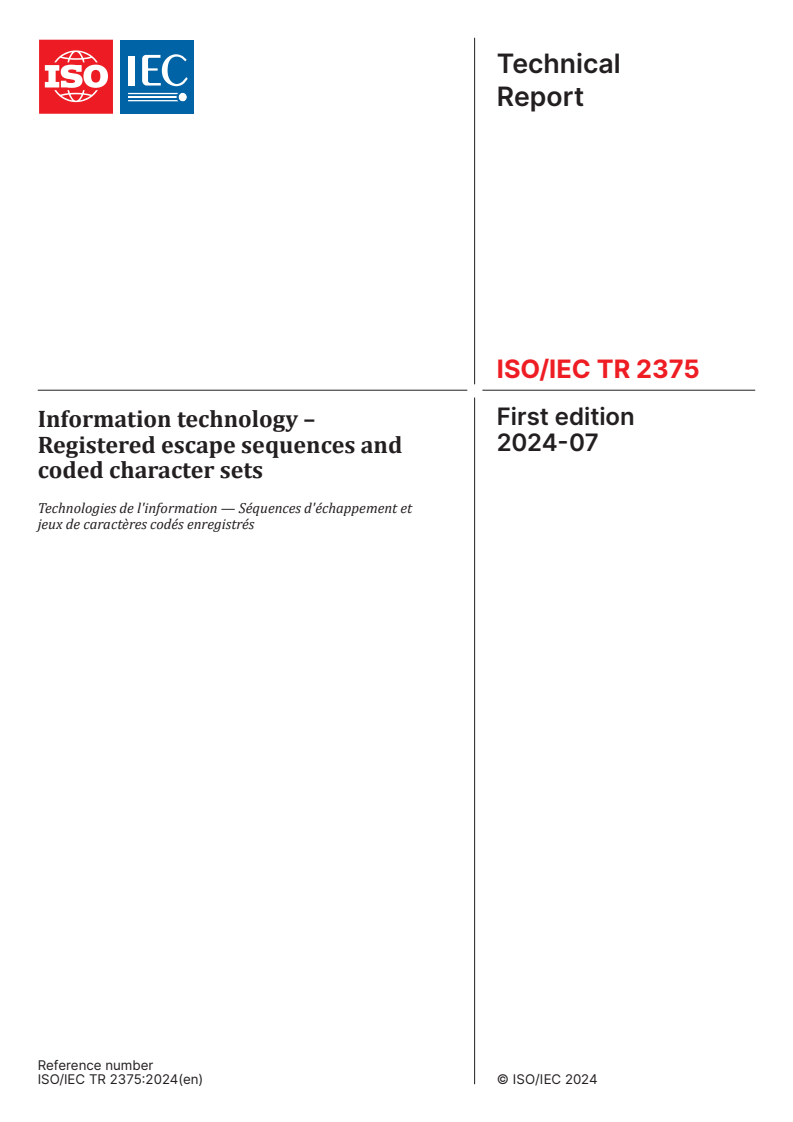
Technical
Report
ISO/IEC TR 2375
First edition
Information technology –
2024-07
Registered escape sequences and
coded character sets
Technologies de l'information — Séquences d'échappement et
jeux de caractères codés enregistrés
Reference number
© ISO/IEC 2024
All rights reserved. Unless otherwise specified, or required in the context of its implementation, no part of this publication may
be reproduced or utilized otherwise in any form or by any means, electronic or mechanical, including photocopying, or posting on
the internet or an intranet, without prior written permission. Permission can be requested from either ISO at the address below
or ISO’s member body in the country of the requester.
ISO copyright office
CP 401 • Ch. de Blandonnet 8
CH-1214 Vernier, Geneva
Phone: +41 22 749 01 11
Email: copyright@iso.org
Website: www.iso.org
Published in Switzerland
© ISO/IEC 2024 – All rights reserved
ii
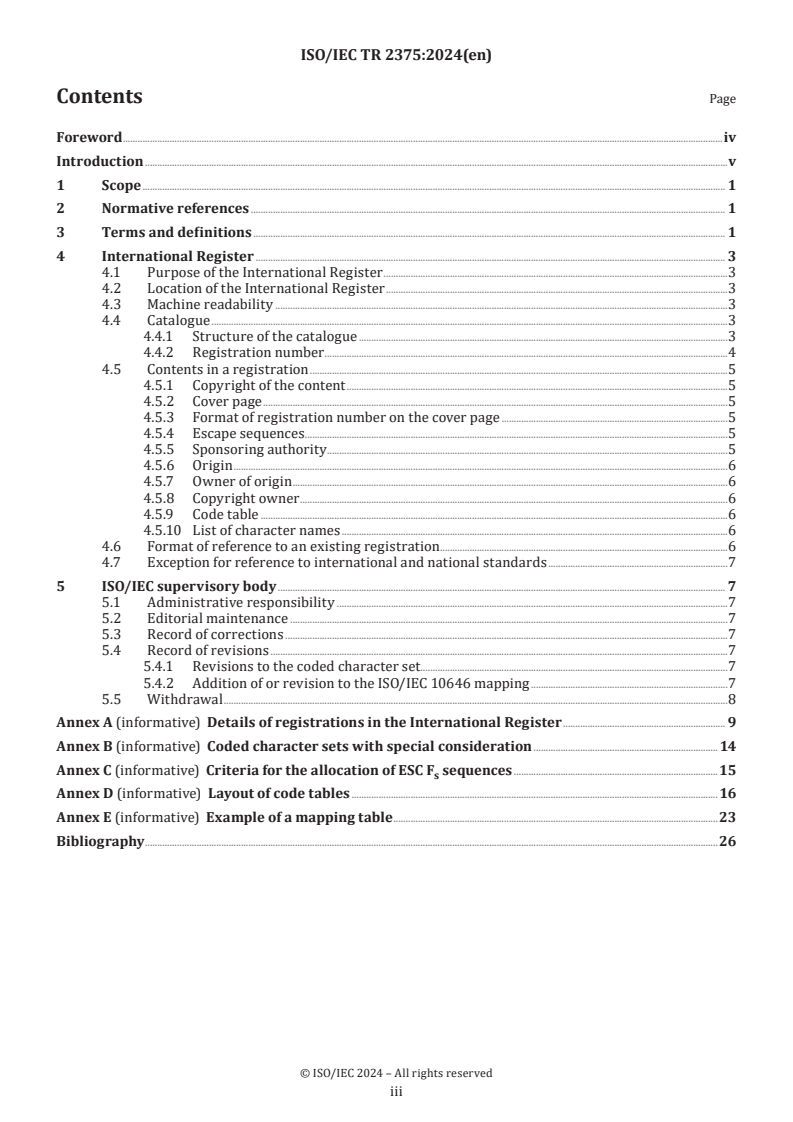
Contents Page
Foreword .iv
Introduction .v
1 Scope . 1
2 Normative references . 1
3 Terms and definitions . 1
4 International Register . 3
4.1 Purpose of the International Register .3
4.2 Location of the International Register .3
4.3 Machine readability .3
4.4 Catalogue .3
4.4.1 Structure of the catalogue .3
4.4.2 Registration number .4
4.5 Contents in a registration .5
4.5.1 Copyright of the content .5
4.5.2 Cover page .5
4.5.3 Format of registration number on the cover page .5
4.5.4 Escape sequences .5
4.5.5 Sponsoring authority . .5
4.5.6 Origin .6
4.5.7 Owner of origin .6
4.5.8 Copyright owner .6
4.5.9 Code table .6
4.5.10 List of character names .6
4.6 Format of reference to an existing registration .6
4.7 Exception for reference to international and national standards .7
5 ISO/IEC supervisory body . 7
5.1 Administrative responsibility .7
5.2 Editorial maintenance .7
5.3 Record of corrections .7
5.4 Record of revisions .7
5.4.1 Revisions to the coded character set.7
5.4.2 Addition of or revision to the ISO/IEC 10646 mapping .7
5.5 Withdrawal .8
Annex A (informative) Details of registrations in the International Register . 9
Annex B (informative) Coded character sets with special consideration . 14
Annex C (informative) Criteria for the allocation of ESC F sequences .15
s
Annex D (informative) Layout of code tables .16
Annex E (informative) Example of a mapping table .23
Bibliography .26
© ISO/IEC 2024 – All rights reserved
iii
Foreword
ISO (the International Organization for Standardization) and IEC (the International Electrotechnical
Commission) form the specialized system for worldwide standardization. National bodies that are
members of ISO or IEC participate in the development of International Standards through technical
committees established by the respective organization to deal with particular fields of technical activity.
ISO and IEC technical committees collaborate in fields of mutual interest. Other international organizations,
governmental and non-governmental, in liaison with ISO and IEC, also take part in the work.
The procedures used to develop this document and those intended for its further maintenance are described
in the ISO/IEC Directives, Part 1. In particular, the different approval criteria needed for the different types
of document should be noted. This document was drafted in accordance with the editorial rules of the ISO/
IEC Directives, Part 2 (see www.iso.org/directives or www.iec.ch/members_experts/refdocs).
ISO and IEC draw attention to the possibility that the implementation of this document may involve the
use of (a) patent(s). ISO and IEC take no position concerning the evidence, validity or applicability of any
claimed patent rights in respect thereof. As of the date of publication of this document, ISO and IEC had not
received notice of (a) patent(s) which may be required to implement this document. However, implementers
are cautioned that this may not represent the latest information, which may be obtained from the patent
database available at www.iso.org/patents and https://patents.iec.ch. ISO and IEC shall not be held
responsible for identifying any or all such patent rights.
Any trade name used in this document is information given for the convenience of users and does not
constitute an endorsement.
For an explanation of the voluntary nature of standards, the meaning of ISO specific terms and expressions
related to conformity assessment, as well as information about ISO's adherence to the World Trade
Organization (WTO) principles in the Technical Barriers to Trade (TBT) see www.iso.org/iso/foreword.html.
In the IEC, see www.iec.ch/understanding-standards.
This document was prepared by Joint Technical Committee ISO/IEC JTC 1, Information technology,
Subcommittee SC 2, Coded character sets.
This first edition cancels and replaces ISO/IEC 2375:2003, which has been technically revised.
The main changes are as follows:
— removal of the registration procedure specification due to the cancellation of the Registration Authority;
— inclusion of the registered data published by the former Registration Authority.
Any feedback or questions on this document should be directed to the user’s national standards
body. A complete listing of these bodies can be found at www.iso.org/members.html and
www.iec.ch/national-committees.
© ISO/IEC 2024 – All rights reserved
iv
Introduction
ISO/IEC 2022 uses the escape sequence to control the code extension procedures. The International Register
defined by ISO/IEC 2375 (previous edition of this document) provided the escape sequences and character sets.
Since no new escape sequences have been registered since 2004, and no new organization was found to
take over the registration authority as of 2020, ISO/IEC JTC1 / SC2 decided to replace ISO/IEC 2375 with
ISO/IEC TR 2375 (this document), which contains the data provided by the former registration authority, to
ensure interoperability with archival digital data encoded by ISO/IEC 2022. This document and electronic
attachments replace the International Register.
© ISO/IEC 2024 – All rights reserved
v
Technical Report ISO/IEC TR 2375:2024(en)
Information technology – Registered escape sequences and
coded character sets
1 Scope
This document provides the escape sequences and coded character sets that were registered and published
by the former registration authority in ISO/IEC 2375 (the previous edition of this document).
2 Normative references
There are no normative references in this document.
3 Terms and definitions
For the purposes of this document, the following terms and definitions apply.
ISO and IEC maintain terminology databases for use in standardization at the following addresses:
— ISO Online browsing platform: available at https:// www .iso .org/ obp
— IEC Electropedia: available at https:// www .electropedia .org/
3.1
bit combination
ordered set of bits used for the representation of characters
3.2
byte
bit string that is operated upon as a unit
3.3
catalogue
list of the registrations and supplementary data, with reference to their locations
3.4
character
member of a set of elements used for the organization, control, or representation of data
3.5
coded character set
set of unambiguous rules that establishes a character set and the relationship between the characters of the
set and their coded representation
3.6
code position
part of a code table identified by its column and row coordinates
3.7
code table
table showing the characters allocated to each bit combination in a code
3.8
combining character
member of an identified subset of the coded character set intended for combination either
© ISO/IEC 2024 – All rights reserved
a) with the preceding non-combining graphic character, or with a sequence of combining characters
preceded by a non-combining character (as presented in ISO/IEC 10646), or
b) with the following non-combining graphic character, or with a sequence of combining characters
followed by a non-combining character (as presented in ISO/IEC 6937)
3.9
combining sequence
sequence of graphic characters consisting of either
a) a non-combining character followed by one or more combining characters (as presented in
ISO/IEC 10646), or
b) a non-combining character preceded by one or more combining characters (as presented in
ISO/IEC 6937)
3.10
control function
action that affects the recording, processing, transmission, or interpretation of data, and that has a coded
representation consisting of one or more bit-combinations
3.11
escape sequence
string of bit combinations that is used for control purposes in code extension procedures
Note 1 to entry: The first of these bit combinations represents the control function ESCAPE.
3.12
ESC F sequence
s
escape sequence with the second bit combination in the range 6/0 to 7/14
Note 1 to entry: ESC Fs sequences are used for the standardized single control functions.
3.13
former registration authority
organization designated by ISO that ensured the maintenance of the registry of the escape sequence,
character set, and the mapping tables defined by ISO/IEC 2375:2003 (the previous edition of this document)
3.14
graphic character
character, other than a control function, that has a visual representation normally handwritten, printed, or
displayed, and that has a coded representation consisting of one or more bit-combinations
3.15
International Register
register of the coded character sets and the escape sequences in ISO/IEC 2022
Note 1 to entry: In this document, this International Register means the archive of the former International Register
(from ISO/IEC 2375, now withdrawn and for which the registration mechanism is no longer available), which is now
provided in electronic attachment in this document.
3.16
octet
ordered sequence of eight bits considered as a unit
3.17
repertoire
specified set of characters that are each represented by one or more bit-combinations of a coded character set
Note 1 to entry: A registration does not specify the repertoire of the sequences obtained by combining the characters
(see A.3).
© ISO/IEC 2024 – All rights reserved
3.18
standard return
escape sequence to switch the coding system to the ISO/IEC 646 character set under the ISO/IEC 2022
coding system, i.e. “ESC 2/5 4/0”
Note 1 to entry: Standard return fits the DESIGNATE OTHER CODING SYSTEM specified in ISO/IEC 2022:1994, 15.4.
4 International Register
4.1 Purpose of the International Register
The International Register provides the catalogue of the registered character set standards with their
registration numbers, the names of the character set standards, and their final bytes (for the definition of
final bytes, see ISO/IEC 2022:1994, 4.14). The catalogue includes hyperlinks to the electronic document for
each registration, which is preserved in the International Register.
Registration of the graphic character sets and the control character sets consists of three parts: a cover
page, a code table, and a list of character names. Registration of the coding systems not in conformance with
ISO/IEC 2022 has a cover page, and a description text of the coding system, but can lack both a code table
and a list of character names.
4.2 Location of the International Register
The International Register can be found at
https:// standards .iso .org/ iso -iec/ tr/ 2375/ ed -1/ en
4.3 Machine readability
The electronic data in the International Register were primarily produced for printing, while some data
were based on scanned images which were image data and not machine-readable text. In the case that
registration has the mapping table to ISO/IEC 10646, it is in machine-readable format (see an example in
Annex E).
4.4 Catalogue
4.4.1 Structure of the catalogue
The catalogue classifies the registered character set standards into nine types under three main categories.
The top category is determined by the types of the character defined by ISO/IEC 2022 the graphic character
(see ISO/IEC 2022:1994, 4.15), the control character (see ISO/IEC 2022:1994, 4.9), and the coding systems
not in conformance with ISO/IEC 2022 (see B.1).
a) Graphic character sets
ISO/IEC 2022 specifies three types of coded graphic character sets (see ISO/IEC 2022:1994, 6.3.1):
— “94-character set”;
— “96-character set”;
— “multiple-byte set”.
The International Register has two subtypes under “94-character graphic character set”, which are
distinguished by the length of their intermediate bytes (see ISO/IEC 2022:1994, 4.14):
— “94-character graphic character sets” with one intermediate byte;
— “94-character graphic character sets” with two intermediate bytes.
© ISO/IEC 2024 – All rights reserved
Hence, the graphic character sets in the International Register fall into four types:
— 94-character graphic character sets with one intermediate byte;
— 94-character graphic character sets with two intermediate bytes;
— 96-character graphic character sets;
NOTE 1 The escape sequences for this type use one intermediate byte.
— multiple byte graphic character sets.
NOTE 2 The escape sequences for this type use two intermediate bytes.
b) Control character sets
ISO/IEC 2022 specifies two types of “sets of control functions”:
— the primary sets of coded control functions (CO) (see ISO/IEC 2022:1994, 6.4.1 and 6.4.4);
— the supplementary sets of coded control functions (CI) (see ISO/IEC 2022:1994, 6.4.2 and 6.4.4);
In addition to these two types, ISO/IEC 2022 specifies the “coded single additional control functions” (see
ISO/IEC 2022:1994, 6.5). Hence, the International Register has three types of character sets for C0, C1,
and single control functions. The former registration authority considered the criteria in Annex C for the
registration of ESC Fs (standardized single control function, defined in ISO/IEC 2022:1994, 13.2.1).
— C0-Control Character Sets
— C1-Control Character Sets
— Single Control Functions
NOTE The escape sequences for all three of these types use no intermediate bytes.
c) Coding Systems not in conformance with ISO/IEC 2022
The International Register includes some registrations of coding systems not in conformance with
ISO/IEC 2022. The registrations are classified into two types according to whether or not the coding system
can be switched to the ISO/IEC 2022 coding system by standard return:
— Coding systems with standard return;
— Coding systems without standard return.
NOTE The escape sequences for these two types use two intermediate bytes.
4.4.2 Registration number
A registration number was assigned by the former registration authority to each application for registration
in the form of a single positive integer (e.g. 1, 2, 4) or two positive integers concatenated by a hyphen (e.g.
8-1, 8-2) in the case that the registration consists of multiple sets (see B.3).
In the case that an application was withdrawn or rejected, the registration number was not reused for other
applications. Consequently, there are some numbers in the International Register that were never registered
(e.g. 210 to 225).
© ISO/IEC 2024 – All rights reserved
4.5 Contents in a registration
4.5.1 Copyright of the content
In some registrations, the code table or the list of character names were reproduced from copyrighted
material. The registrations in the archive are reproduced from the former registration authority, which
obtained the copyrights to reproduce them through the sponsoring authority.
4.5.2 Cover page
The cover page contains the following information:
— the type of the character set (4.4);
— the registration number (4.4.2);
— the date of registration;
— the escape sequences (4.5.4);
— the name of the character set;
— the description of the character set;
— the sponsoring authority (4.5.5);
— the origin of the character set (4.5.6).
In addition, the cover page can contain the following information:
— the owner of origin (4.5.7);
— the copyright owner (4.5.8);
— the field of utilization.
Whether each information was provided by the sponsoring authority or the former registration authority is
described in A.1.
4.5.3 Format of registration number on the cover page
On the cover page, the registration number is shown by three digits with zero padding. In the case that the
registration number consists of two numbers, the first major number is shown by three digits with zero
padding, but the second number is shown without zero padding.
4.5.4 Escape sequences
The escape sequences were assigned by the former registration authority. After the assignment of the
escape sequence, it was never reallocated for another registration, even when the original registration was
withdrawn.
4.5.5 Sponsoring authority
The sponsoring authority was the organization that submitted applications concerning the meanings
of escape sequences to the former registration authority. The sponsoring authority obtained copyright
permission from the copyright owner so that the former registration authority reproduced the publication
that specified the coded character set in the International Register. If the registration was intended for
a particular application, the sponsoring authority obtained the endorsement of the developer of that
application to register the coded character set.
© ISO/IEC 2024 – All rights reserved
4.5.6 Origin
The origin is a name for a coded character standard of the registration (e.g. an ISO, IEC, or ITU standard, a
national standard, or a character set defined by an organization).
4.5.7 Owner of origin
The owner of origin was the organization or individual responsible for the development of a coded character
set in the registration. The owner of origin had ultimate authority over the content of its coded character
set. Where a sponsoring authority was not the owner of origin, the owner of origin was given separately on
the cover page.
4.5.8 Copyright owner
The copyright owner was the organization or individual holding the copyright for the publication that
specified a coded character set in the registration. Where a sponsoring authority was not the copyright
owner, the copyright owner was given separately on the cover page.
4.5.9 Code table
4.5.9.1 Purpose of the code table
As a description of the coded character set, the registration of a graphic character set or the control functions
includes the code table. The format of the code table is determined by the type of the character set, the
details are defined in A.1.2.2. The layouts are defined in Annex D.
4.5.9.2 Exceptional registration without code table
Registration of a coding system not in conformance with ISO/IEC 2022 can refer to external documents
which define the registered coding system rather than include a code table.
4.5.10 List of character names
4.5.10.1 Purpose of the list of character names
As a description of the coded character set, registration of a graphic character set or the control functions
includes the list of character names. The format of the list of character names is determined by the type of
the character set; details are defined in A.1.2.3.
4.5.10.2 Registration without a list of character names
Registration of a multiple byte set can lack a list of character names because it contains too many characters
to assign names adequately representing their nature.
NOTE In the case of ISO/IEC 10646, some ideographic characters have the names assigned by their code positions.
Registration of a coding system not in conformance with ISO/IEC 2022 can refer to external documents
which define the registered coding system rather than include a list of character names.
4.6 Format of reference to an existing registration
A reference to an existing registration in the International Register is made by using the prefix “ISO-IR”
followed by a SPACE and the registration number.
EXAMPLES
ISO-IR 16
identifies the particular version of ISO/IEC 646 for the Portuguese language registered on 1976-12-30, while
© ISO/IEC 2024 – All rights reserved
ISO-IR 48
identifies the set of control functions registered on 1981-07-15.
4.7 Exception for reference to international and national standards
Reference to an international or national standard in the International Register is made by using the
identifier assigned by for example, ISO, IEC or ITU (for international standards) or the national body (for
national standards). Some registrations were based on international or national standards. However,
...