

ISO 14285:2014
(Main)Rubber and plastics gloves for food services — Limits for extractable substances
General Information
- Abstract
ISO 14285:2014 specifies limits for extractable chemical substances for single-use gloves made from natural rubber, synthetic rubber, or plastic materials that are intended for use in food preparation, food handling, and related application in food service industry. ISO 14285:2014 does not cover the specification for extractable biological substances and physical requirements of the gloves. It is not applicable to gloves used under extreme conditions such as those having pH less than 4,5 and/or temperature above 40 °C. It does not cover gloves being exposed to fat and oil foods.
- Status
- Published
- Publication Date
- 06-Feb-2014
- Technical Committee
- ISO/TC 45/SC 4 - Products (other than hoses)
- Drafting Committee
- ISO/TC 45/SC 4/WG 5 - Gloves and other latex products
- Current Stage
- 9093 - International Standard confirmed
- Start Date
- 12-Jun-2024
- Completion Date
- 29-Aug-2026

Overview
ISO 14285:2014 - "Rubber and plastics gloves for food services - Limits for extractable substances" defines chemical safety limits and test procedures for single‑use food‑service gloves made from natural rubber, synthetic rubber or plastics (PVC, PE, PP). The standard focuses on extractable chemical substances (not biological contaminants or general physical performance) and sets maximum allowable levels, specified test methods, and sample‑preparation conditions for routine conformity testing.
Key topics and requirements
- Scope and exclusions
- Applies to single‑use gloves for food preparation and handling; does not cover extractable biological substances, general physical requirements, gloves used under extreme conditions (pH < 4.5 or temperature > 40 °C), gloves exposed to fats/oils, or blended‑polymer gloves.
- Glove types covered
- Type 1: Natural rubber latex
- Type 2: Synthetic latex
- Type 3: Polyvinyl chloride (PVC)
- Type 4: Polyethylene (PE)
- Type 5: Polypropylene (PP)
- Chemical limits
- Heavy metals (µg/ml) - limits when tested per Annex A (ICP‑OES):
- Arsenic (As) ≤ 0.05
- Cadmium (Cd) ≤ 0.05
- Chromium (Cr) ≤ 0.5
- Lead (Pb) ≤ 0.5
- Zinc (Zn) ≤ 15.0
- Potassium permanganate consumption ≤ 10 µg/ml (Annex B)
- Evaporation residue ≤ 100 µg/ml for both distilled water and 10% ethanol extracts (Annex C)
- Phthalates: total phthalate content for Type 3 (PVC) gloves ≤ 0.1% (m/m); measured per Annex D or EN 14372
- Heavy metals (µg/ml) - limits when tested per Annex A (ICP‑OES):
- Test & sample preparation
- Typical extraction: cut 5 cm × 5 cm test pieces (50 cm² each); use two pieces (100 cm²) for some tests.
- Extraction conditions: 40 ± 1 °C for 10 ± 1 min; media vary by test (4% acetic acid for heavy metals; distilled water for KMnO4 and residue; 10% ethanol for residue).
- Labelling & use
- Single‑use only; manufacturers must provide usage guidance. Natural rubber latex gloves require an allergy warning label.
Applications and users
ISO 14285:2014 is used by:
- Glove manufacturers for product development and compliance testing
- Quality control and analytical laboratories (ICP‑OES testing, titration, gravimetric residue)
- Foodservice operators and procurement teams seeking compliant single‑use gloves
- Regulators and conformity assessment bodies assessing chemical safety of food‑contact gloves
Practical benefits include harmonized test methods, clear chemical limits to reduce consumer exposure, and guidance for lab sampling and labelling.
Related standards
- ISO 11193‑1 and ISO 11193‑2 - physical requirements for gloves (referenced as related)
- EN 14372 - referenced for phthalate determination and related procedures
Keywords: ISO 14285:2014, food service gloves, extractable substances, heavy metals, phthalates, potassium permanganate consumption, evaporation residue, single‑use gloves, PVC, latex, ICP‑OES.
Get Certified
Connect with accredited certification bodies for this standard

BSI Group
BSI (British Standards Institution) is the business standards company that helps organizations make excellence a habit.

Bureau Veritas
Bureau Veritas is a world leader in laboratory testing, inspection and certification services.

DNV
DNV is an independent assurance and risk management provider.
Sponsored listings
Frequently Asked Questions
ISO 14285:2014 is a standard published by the International Organization for Standardization (ISO). Its full title is "Rubber and plastics gloves for food services — Limits for extractable substances". This standard covers: ISO 14285:2014 specifies limits for extractable chemical substances for single-use gloves made from natural rubber, synthetic rubber, or plastic materials that are intended for use in food preparation, food handling, and related application in food service industry. ISO 14285:2014 does not cover the specification for extractable biological substances and physical requirements of the gloves. It is not applicable to gloves used under extreme conditions such as those having pH less than 4,5 and/or temperature above 40 °C. It does not cover gloves being exposed to fat and oil foods.
ISO 14285:2014 specifies limits for extractable chemical substances for single-use gloves made from natural rubber, synthetic rubber, or plastic materials that are intended for use in food preparation, food handling, and related application in food service industry. ISO 14285:2014 does not cover the specification for extractable biological substances and physical requirements of the gloves. It is not applicable to gloves used under extreme conditions such as those having pH less than 4,5 and/or temperature above 40 °C. It does not cover gloves being exposed to fat and oil foods.
ISO 14285:2014 is classified under the following ICS (International Classification for Standards) categories: 67.250 - Materials and articles in contact with foodstuffs; 83.140.99 - Other rubber and plastics products. The ICS classification helps identify the subject area and facilitates finding related standards.
ISO 14285:2014 is available in PDF format for immediate download after purchase. The document can be added to your cart and obtained through the secure checkout process. Digital delivery ensures instant access to the complete standard document.
Standards Content (Sample)
INTERNATIONAL ISO
STANDARD 14285
First edition
2014-02-15
Rubber and plastics gloves for food
services — Limits for extractable
substances
Gants en caoutchouc et en plastique pour les services alimentaires —
Limites pour les substances extractibles
Reference number
©
ISO 2014
© ISO 2014
All rights reserved. Unless otherwise specified, no part of this publication may be reproduced or utilized otherwise in any form
or by any means, electronic or mechanical, including photocopying, or posting on the internet or an intranet, without prior
written permission. Permission can be requested from either ISO at the address below or ISO’s member body in the country of
the requester.
ISO copyright office
Case postale 56 • CH-1211 Geneva 20
Tel. + 41 22 749 01 11
Fax + 41 22 749 09 47
E-mail copyright@iso.org
Web www.iso.org
Published in Switzerland
ii © ISO 2014 – All rights reserved
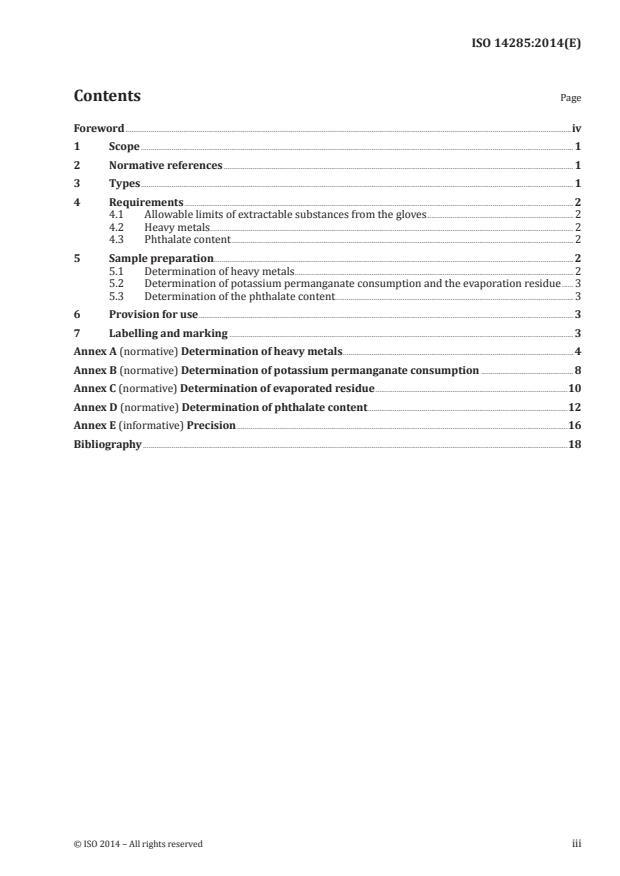
Contents Page
Foreword .iv
1 Scope . 1
2 Normative references . 1
3 Types . 1
4 Requirements . 2
4.1 Allowable limits of extractable substances from the gloves . 2
4.2 Heavy metals . 2
4.3 Phthalate content . 2
5 Sample preparation . 2
5.1 Determination of heavy metals . 2
5.2 Determination of potassium permanganate consumption and the evaporation residue . 3
5.3 Determination of the phthalate content. 3
6 Provision for use . 3
7 Labelling and marking . 3
Annex A (normative) Determination of heavy metals . 4
Annex B (normative) Determination of potassium permanganate consumption .8
Annex C (normative) Determination of evaporated residue .10
Annex D (normative) Determination of phthalate content .12
Annex E (informative) Precision .16
Bibliography .18
Foreword
ISO (the International Organization for Standardization) is a worldwide federation of national standards
bodies (ISO member bodies). The work of preparing International Standards is normally carried out
through ISO technical committees. Each member body interested in a subject for which a technical
committee has been established has the right to be represented on that committee. International
organizations, governmental and non-governmental, in liaison with ISO, also take part in the work.
ISO collaborates closely with the International Electrotechnical Commission (IEC) on all matters of
electrotechnical standardization.
The procedures used to develop this document and those intended for its further maintenance are
described in the ISO/IEC Directives, Part 1. In particular the different approval criteria needed for the
different types of ISO documents should be noted. This document was drafted in accordance with the
editorial rules of the ISO/IEC Directives, Part 2 (see www.iso.org/directives).
Attention is drawn to the possibility that some of the elements of this document may be the subject of
patent rights. ISO shall not be held responsible for identifying any or all such patent rights. Details of
any patent rights identified during the development of the document will be in the Introduction and/or
on the ISO list of patent declarations received (see www.iso.org/patents).
Any trade name used in this document is information given for the convenience of users and does not
constitute an endorsement.
For an explanation on the meaning of ISO specific terms and expressions related to conformity
assessment, as well as information about ISO’s adherence to the WTO principles in the Technical Barriers
to Trade (TBT) see the following URL: Foreword - Supplementary information
The committee responsible for this document is ISO/TC 45, Rubber and rubber products, Subcommittee
SC 4, Products (other than hoses).
iv © ISO 2014 – All rights reserved
INTERNATIONAL STANDARD ISO 14285:2014(E)
Rubber and plastics gloves for food services — Limits for
extractable substances
WARNING — Persons using this International Standard should be familiar with normal laboratory
practice. This International Standard does not purport to address all of the safety problems, if
any, associated with its use. It is the responsibility of the user to establish appropriate safety and
health practices and to ensure compliance with any national regulatory conditions.
1 Scope
This International Standard specifies limits for extractable chemical substances for single-use gloves
made from natural rubber, synthetic rubber, or plastic materials that are intended for use in food
preparation, food handling, and related application in food service industry.
This International Standard does not cover the specification for extractable biological substances and
physical requirements of the gloves. It is not applicable to gloves used under extreme conditions such
as those having pH less than 4,5 and/or temperature above 40 °C. This International Standard does not
cover gloves being exposed to fat and oil foods.
NOTE The physical requirements specified for gloves could be found in related International Standards, for
example, ISO 11193-1 and ISO 11193-2.
This International Standard does not cover safe and proper application of the gloves with subsequent
handling, packaging, and storage procedures.
2 Normative references
The following documents, in whole or in part, are normatively referenced in this document and are
indispensable for its application. For dated references, only the edition cited applies. For undated
references, the latest edition of the referenced document (including any amendments) applies.
EN 14372:2004, Child use and care articles – Cutlery and feeding utensils – Safety requirements and tests
3 Types
Gloves are classified into the following types:
a) type 1: natural rubber latex;
b) type 2: synthetic latex;
c) type 3: polyvinyl chloride (PVC);
d) type 4: polyethylene (PE);
e) type 5: polypropylene (PP).
NOTE Gloves made from blend polymer are not covered in this International Standard.
4 Requirements
4.1 Allowable limits of extractable substances from the gloves
The allowable extractable substances for all types of glove shall not exceed the limits presented in
Table 1.
Determination of the extractable substances shall be carried out according to the test methods given in
Table 1.
Table 1 — Maximum limits for allowable extractable substances from food-contact gloves
Parameters Maximum limit Test methods
Heavy metals, μg/ml See Table 2 Annex A
Potassium permanganate
≤10 Annex B
consumption, µg/ml
Evaporation residue, µg/ml
Distilled water ≤100 Annex C
10 % ethanol ≤100
4.2 Heavy metals
The heavy metals shall not exceed the limits given in Table 2 when tested in accordance with Annex A.
Table 2 — Limits of heavy metals
Maximum limit
Element
μg/ml
Arsenic, As 0,05
Cadmium, Cd 0,05
Chromium, Cr 0,5
Lead, Pb 0,5
Zinc, Zn 15,0
4.3 Phthalate content
The total content of phthalate for Type 3 glove shall not exceed 0,1 % (m/m). The determination of
phthalate content shall be carried out as described in Annex D, or in 6.3.2 of EN 14372.
5 Sample preparation
5.1 Determination of heavy metals
Cut one piece of 5 cm × 5 cm test sample to provide a surface area of 50 cm taken from the palm or the
back of a glove.
The extraction is done by immersing the test piece in a container of 100 ml of the recommended extraction
medium. Use water bath to control the temperature, according to the condition given in Table 3.
After extraction, remove the test piece from the container and keep the solution for the determination
of heavy metals.
2 © ISO 2014 – All rights reserved
Table 3 — Conditions for sample preparation
Parameters Extraction medium Conditions
Heavy metals 4 % acetic acid (40 ± 1) °C for (10 ± 1) min
Potassium permanganate consumption Distilled water (40 ± 1) °C for (10 ± 1) min
Distilled water
Evaporation residue (40 ± 1) °C for (10 ± 1) min
10 % ethanol
5.2 Determination of potassium permanganate consumption and the evaporation resi-
due
Cut two pieces of 5 cm × 5 cm from the palm or the back of gloves to provide a total surface area of
100 cm . Wash the test samples with distilled water to remove any lubricant or powder used to prevent
the gloves from sticking together.
The extraction is done by immersing the test pieces in a container of 200 ml of the recommended
extraction medium. Use water bath to control the temperature, according to the condition given in
Table 3.
After extraction, remove the test pieces from the container and keep the solution for the determination
of potassium permanganate consumption and the evaporation residue.
5.3 Determination of the phthalate content
The extraction procedure is as described in Annex D, or in EN 14372.
6 Provision for use
6.1 The manufacturer shall provide information on the provision of the gloves for application in wet or
dry conditions.
6.2 The glove should remain intact after exposure to wet surfaces throughout the food preparation or
handling processes as recommended by the manufacturer.
6.3 The glove shall be used only once.
7 Labelling and marking
7.1 The language used for labelling and marking shall be as agreed upon between the interested parties.
7.2 Information provided shall be at the box or packaging container.
7.3 Appropriate labelling for food service gloves shall include instructions for use that identify materials
or conditions with which contact should be avoided.
7.4 Gloves made of natural rubber latex shall be provided with the following label: “Natural rubber
latex, which may cause an allergic reaction has been used in the manufacturing of this product”, or words
to that effect.
Annex A
(normative)
Determination of heavy metals
A.1 Principle
This test procedure describes the method for the determination of an individual heavy metal element
extracted from gloves using inductively coupled plasma optical emission spectroscopy (ICP-OES). The
basis of the method is the measurement of emission of light by an optical spectroscopic technique. The
sample solutions are nebulized and the aerosol that is produced is transported to the plasma torch where
the excitation occurs. Characteristic emission spectra are produced by radio frequency inductively
coupled plasma (ICP). The spectra are dispersed by a grating spectrometer and the intensities of the
lines are monitored by a detector. The signals from the detector(s) are processed and controlled by
a computer system. A suitable background correction technique is used to compensate for variable
background contributions to the determination of trace elements.
A.2 Apparatus
Use usual laboratory apparatus and, in particular, the following.
A.2.1 ICP-OES, equipment consisting of sample holder, plasma torch, spray chamber, nebulizer, optical
unit, detector, system control, and data output device.
NOTE Detailed operating instructions is not provided due to the differences between various makers and
models.
A.2.2 Analytical balance, capable of measuring accurately up to 0,0001 g.
A.2.3 Containers, for storage of standard solution and calibrant.
NOTE All containers shall be cleaned with 10 % (v/v) nitric acid before use.
A.2.4 Glassware, all glassware shall be soaked with 10 % (v/v) nitric acid at least 24 h before use.
A.2.4.1 Glass beakers, of suitable capacity.
A.2.4.2 Volumetric flasks, of suitable size.
A.2.4.3 Erlenmeyer flask.
A.2.4.4 Pipette.
A.2.4.5 Funnel.
A.2.5 Micropipettes.
4 © ISO 2014 – All rights reserved
A.3 Reagents
A.3.1 Argon gas, gas with purity of over 99,99 % (v/v).
A.3.2 Nitrogen gas, gas with purity of over 99,99 % (v/v).
A.3.3 Nitric acid, ρ(HNO ) = 1,4 g/ml [w(HNO ) = 650 g/kg].
3 3
A.3.4 Deionised water.
A.3.5 Nitric acid solution 5 % (v/v), prepare by adding 50 ml of nitric acid (A.3.3) to deionised water
(A.3.4) and bring the volume to 1 000 ml of volumetric flask (A.2.4.2).
A.3.6 Standard stock solutions, 100 mg/l of arsenic (As), cadmium (Cd), chromium (Cr), lead (Pb),
and zinc (Zn).
NOTE Standard stock solutions of other concentrations can be used. The standard stock solutions can be
purchased or prepared from high purity grade chemicals or metals. Traceable standard solutions might be
preferred.
A.4 Standard solutions
The following standard solutions for the five elements, i.e. arsenic (As), cadmium (Cd), chromium (Cr),
lead (Pb), and zinc (Zn) shall be prepared.
A.4.1 Standard solution of 100 μg/l
Pipette 50 μl of standard stock solution of the element standard (A.3.6) in a 50 ml volumetric flask. Add
5 % nitric acid solution (A.3.5) to bring the total volume of 50 ml.
A.4.2 Standard solution of 500 μg/l
Pipette 250 μl of standard stock solution of the element standard (A.3.6) in a 50 ml volumetric flask. Add
5 % nitric acid solution (A.3.5) to bring the total volume of 50 ml.
A.4.3 Standard solution of 1 000 μg/l
Pipette 500 μl of standard stock solution of the element standard (A.3.6) in a 50 ml volumetric flask. Add
5 % nitric acid solution (A.3.5) to bring the total volume of 50 ml.
A.5 Laboratory reagent blank
The procedure is identical to that of sample solution preparation and is carried out concurrently but
without the sample.
A.6 Determination
A.6.1 General
A.6.1.1 Set up the instrument with proper operating parameters established from the manufacturer’s
instruction manual. Allow the instrument to achieve thermal stability before beginning. Instructions
provided by the manufacturer should be followed.
A.6.1.2 Initiate the appropriate operating configuration of the computer.
A.6.1.3 Profile and calibrate the instrument according to the manufacturer’s recommended proce-
dures using the standard solutions (A.4).
A.6.1.4 Begin the sample run by flushing the system with the reagent blank (A.5) between each sam-
ple.
A.6.2 Recommended wavelengths and important spectral interferences
Table A.1 lists the recommended wavelengths and the important spectral interferences.
Table A.1 — Recommended wavelengths and the important spectral interferences
Element Wavelength Interfering elements
nm
As 188,979 Al, Cr, Fe, Ti
193,696 Al, Co, Fe, W, V
197,197 Al, Co, Fe, Pb, Ti
Cd 214,441 As, Cr, Fe, Sc, Sb
226,502 As, Co, Fe, Ni
228,802 As, Co, Sc
Cr 205,559 Be, Fe, Mo, Ni, Ti
267,719 Mn, P, V
283,563 Fe, Mo, V, W
...