

ISO 4280:1977
(Main)Cryolite, natural and artificial, and aluminium fluoride for industrial use — Determination of sulphate content — Barium sulphate gravimetric method
General Information
- Abstract
Applicable to products having a content, expressed as sulphur trioxide, equal to or more than 0.1 % (m/m). Bases on alkaline fusion of a test portion with a mixture of sodium carbonate and boric acid. Extraction of the fused mass with perchloric acid solution and precipitation of the sulphate ions with barium chloride in an acidified medium. Filtration on a fine-texture, ashless filter paper (pore diameter approximately 0.4 to 1.0 m). Calcination after drying in an electric oven at (850 20) °C. Weighing of the residue.
- Status
- Published
- Publication Date
- 31-Oct-1977
- Technical Committee
- ISO/TC 226 - Materials for the production of primary aluminium
- Drafting Committee
- ISO/TC 226 - Materials for the production of primary aluminium
- Current Stage
- 9060 - Close of review
- Completion Date
- 04-Jun-2031
Buy Documents
ISO 4280:1977 - Cryolite, natural and artificial, and aluminium fluoride for industrial use — Determination of sulphate content — Barium sulphate gravimetric method Released:11/1/1977
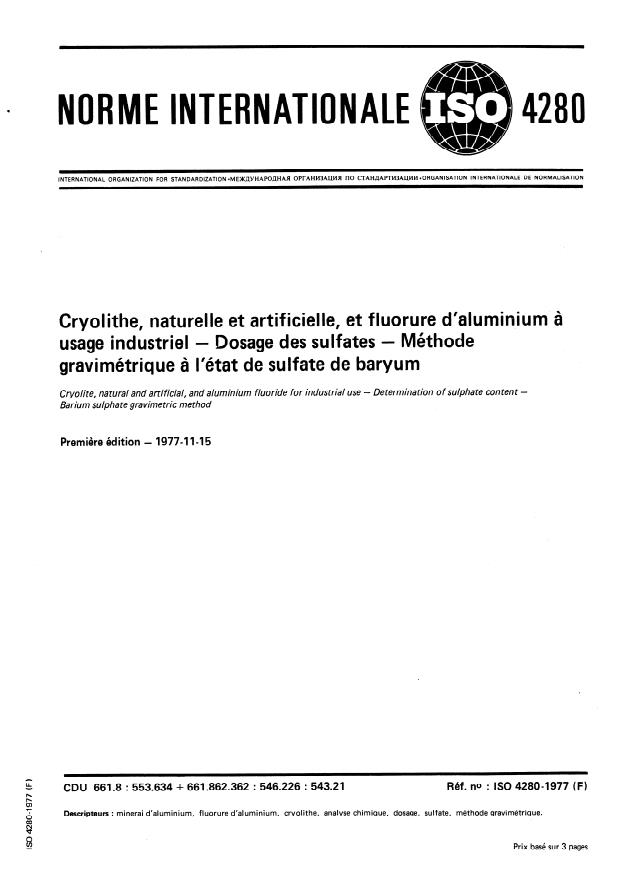
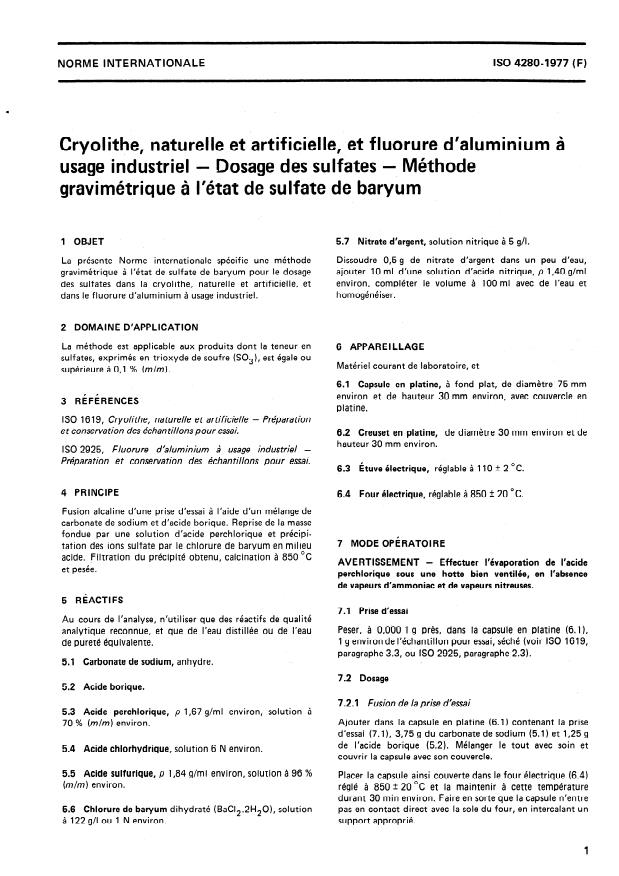
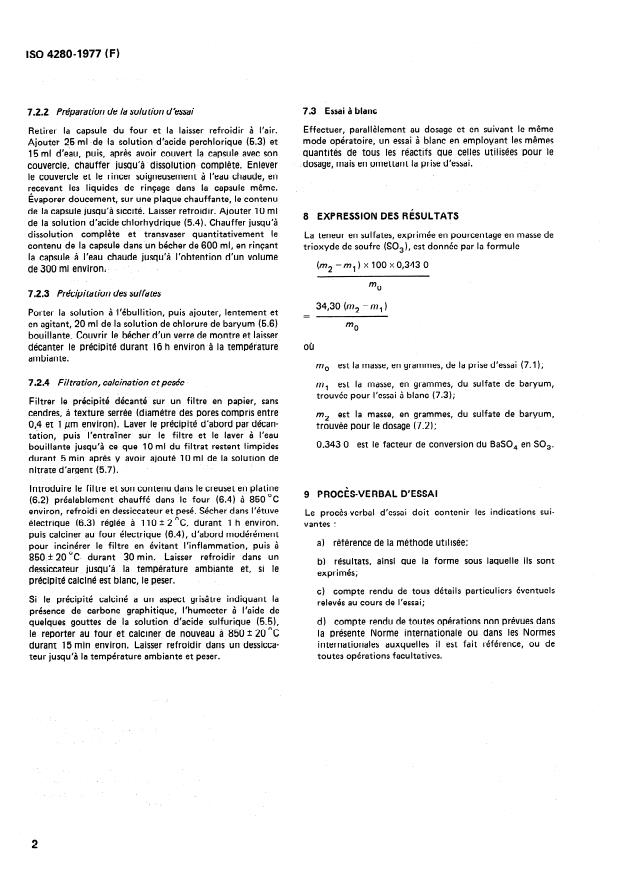
ISO 4280:1977 - Cryolithe, naturelle et artificielle, et fluorure d'aluminium a usage industriel — Dosage des sulfates — Méthode gravimétrique a l'état de sulfate de baryum
Overview
ISO 4280:1977 specifies a barium sulphate gravimetric method for determining the sulphate content of cryolite (natural and artificial) and aluminium fluoride intended for industrial use. The procedure applies to materials with sulphate levels expressed as sulphur trioxide (SO3) of 0.1% (m/m) or greater. The method is a classical gravimetric analysis combining alkaline fusion, acid extraction and precipitation of sulphate as BaSO4, followed by calcination and weighing.
Key topics and technical requirements
- Scope and applicability: Intended for cryolite and aluminium fluoride for industrial applications with SO3 ≥ 0.1% m/m.
- Analytical principle: Alkaline fusion of a test portion with sodium carbonate and boric acid → extraction with perchloric acid → precipitation of sulphate as barium sulphate (BaSO4) using barium chloride → filtration, drying, calcination and weighing.
- Sample size and reagents: Typical test portion ~1 g of dried sample; fusion reagents include anhydrous sodium carbonate (3.75 g) and boric acid (1.25 g). Key reagents: perchloric acid (≈70%), HCl (~6 N), BaCl2·2H2O solution, AgNO3 titration check for completeness.
- Apparatus and conditions:
- Platinum dish and crucible for fusion and residue handling.
- Electric furnace for fusion and calcination at 850 ± 20 °C.
- Electric oven for drying at 110 ± 2 °C.
- Filtration on fine-texture, ashless filter paper (pore diameter ≈ 0.4–1.0 µm).
- Calculation: The mass of BaSO4 recovered (blank-corrected) is converted to SO3 using the specified conversion factor (BaSO4 → SO3).
- Safety note: Evaporation of perchloric acid must be done in a well‑ventilated fume hood and away from ammonia or nitrous vapours.
Practical applications and users
- Quality control and analytical laboratories in the aluminium industry and suppliers of cryolite and aluminium fluoride.
- Product certification, incoming material inspection, and process control where accurate quantification of sulphate impurities is required.
- Useful for regulatory compliance, formulation control, and troubleshooting contamination issues in industries using cryolite or aluminium fluoride.
Related standards
- ISO 1619 and ISO 2925 - preparation and storage of test samples for cryolite and aluminium fluoride.
- Other ISO test methods listed in the standard’s annex, e.g., ISO methods for fluorine, aluminium, sodium, silica and moisture determinations, which support complementary chemical analyses in industrial quality control.
Keywords: ISO 4280:1977, cryolite sulphate determination, aluminium fluoride analysis, barium sulphate gravimetric method, SO3 determination, gravimetric analysis, alkaline fusion, perchloric acid extraction.
Buy Documents
ISO 4280:1977 - Cryolite, natural and artificial, and aluminium fluoride for industrial use — Determination of sulphate content — Barium sulphate gravimetric method Released:11/1/1977
ISO 4280:1977 - Cryolithe, naturelle et artificielle, et fluorure d'aluminium a usage industriel — Dosage des sulfates — Méthode gravimétrique a l'état de sulfate de baryum
Get Certified
Connect with accredited certification bodies for this standard

ECOCERT
Organic and sustainability certification.

Eurofins Food Testing Global
Global leader in food, environment, and pharmaceutical product testing.

Intertek Bangladesh
Intertek certification and testing services in Bangladesh.
Sponsored listings
Frequently Asked Questions
ISO 4280:1977 is a standard published by the International Organization for Standardization (ISO). Its full title is "Cryolite, natural and artificial, and aluminium fluoride for industrial use — Determination of sulphate content — Barium sulphate gravimetric method". This standard covers: Applicable to products having a content, expressed as sulphur trioxide, equal to or more than 0.1 % (m/m). Bases on alkaline fusion of a test portion with a mixture of sodium carbonate and boric acid. Extraction of the fused mass with perchloric acid solution and precipitation of the sulphate ions with barium chloride in an acidified medium. Filtration on a fine-texture, ashless filter paper (pore diameter approximately 0.4 to 1.0 m). Calcination after drying in an electric oven at (850 20) °C. Weighing of the residue.
Applicable to products having a content, expressed as sulphur trioxide, equal to or more than 0.1 % (m/m). Bases on alkaline fusion of a test portion with a mixture of sodium carbonate and boric acid. Extraction of the fused mass with perchloric acid solution and precipitation of the sulphate ions with barium chloride in an acidified medium. Filtration on a fine-texture, ashless filter paper (pore diameter approximately 0.4 to 1.0 m). Calcination after drying in an electric oven at (850 20) °C. Weighing of the residue.
ISO 4280:1977 is classified under the following ICS (International Classification for Standards) categories: 71.060.50 - Salts. The ICS classification helps identify the subject area and facilitates finding related standards.
ISO 4280:1977 is available in PDF format for immediate download after purchase. The document can be added to your cart and obtained through the secure checkout process. Digital delivery ensures instant access to the complete standard document.
Standards Content (Sample)
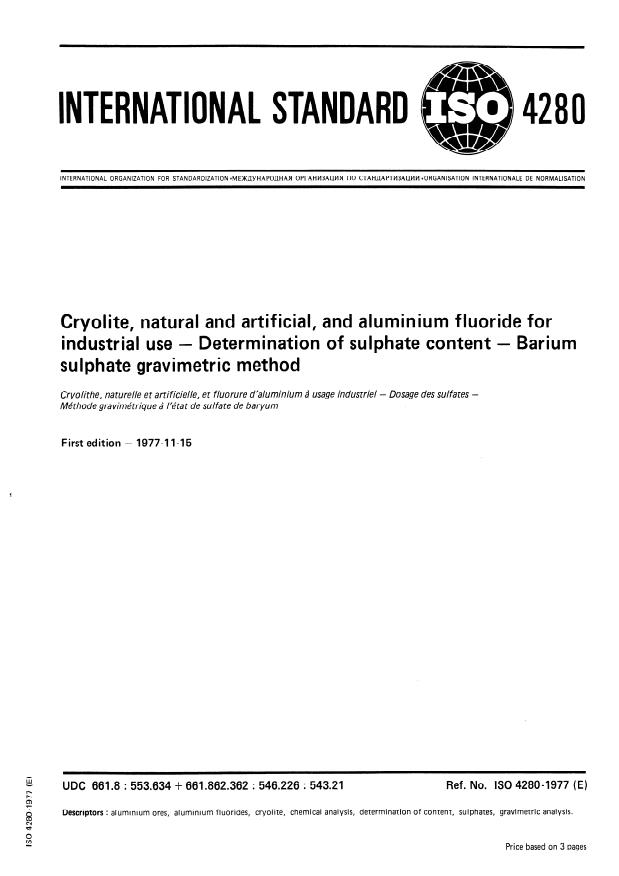
INTERNATIONAL STANDARD.
INTERNATIONAL ORGANIZATION FOR STANDARDIZATION l MEXAYHAPOflHAR OPl-AHM3AWW l-IO CTAHAAPTM3AUMM *ORGANISATION INTERNATIONALE DE NORMALISATION
Cryolite, natura1 and artificial, and aluminium fluoride for
- Determination of sulphate content - Barium
industrial use
sulphate gravimetric method
Cryolithe, naturelle et artificielle, et fluorure d’aluminium 2 usage industriel - Dosage des sulfates -
AMhode gravimktrique 6 l’e’tat de sulfate de baryum
First edition - 1977-11-15
Ref. No. ISO 4280-1977 (E)
UDC 661.8 : 553.634 + 661.862.362 : 546.226 : 543.21
sufphates, gravimetric analysis.
Descriptors : aluminium ores, aluminium fluorides, cryolite, Chemical analysis, determination of content,
Price based on 3 pages
FOREWORD
ISO (the International Organization for Standardization) is a worldwide federation
of national Standards institutes (ISO member bodies). The work of developing
International Standards is carried out through ISO technical committees. Every
member body interested in a subject for which a technical committee has been set
up has the right to be represented on that committee. International organizations,
governmental and non-governmental, in Iiaison with ISO, also take part in the work.
Draft International Standards adopted by the technical committees are circulated
to the member bodies for approval before their acceptance as International
Standards by the ISO Council.
International Standard ISO 4280 was developed by Technical Committee
ISO/TC 47, Chemistry, and was circulated to the member bodies in March 1975.
lt has been approved by the member bodies of the following countries :
Austria
India Sweden
Belgium
Israel Switzerland
Brazil Thailand
I taly
Bulgaria Mexico Turkey
Egypt, Arab Rep. of Poland United Kingdom
France Romania U.S.A.
Germany South Africa, Rep. of U.S.S. R.
Hungary Spain
No member body expressed disapproval of the document.
@ International Organization for Standardkation, 1977 l
Printed in Switzerland
INTERNATIONAL STANDARD ISO 428001977(E)
Cryolite, natura1 and artificial, and aluminium fluoride for
industrial use - Determination of sulphate content - Barium
sulphate gravimetric method
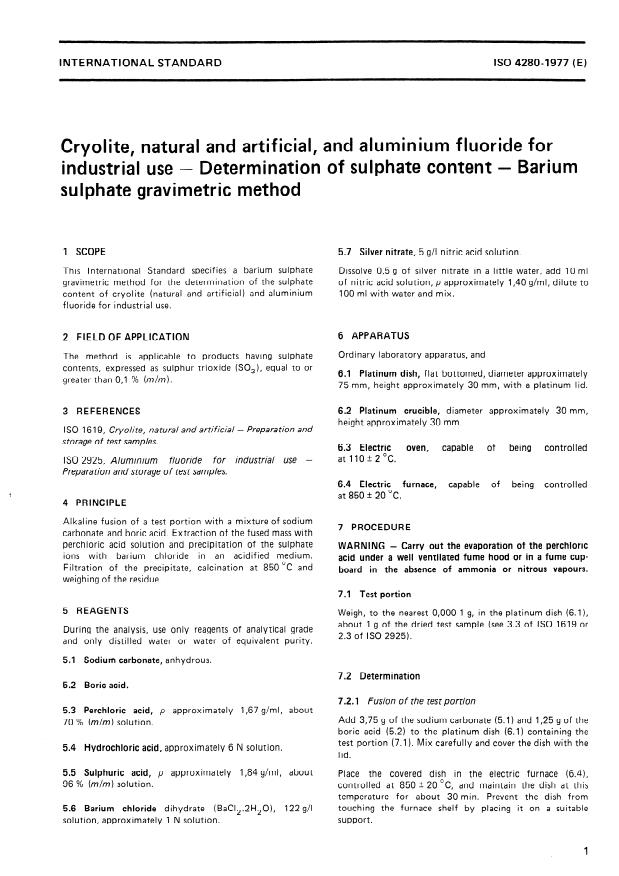
1 SCOPE 5.7 Silver nitrate, 5 g/l nitric acid Solution.
This International Standard specifies a barium sulphate Dissolve 0,5 g of silver nitrate in a little water, add IO ml
gravimetric method for the determination of the sulphate of nitric acid Solution, p approximately 1,40 g/ml, dilute to
content of cryolite (natura1 and artificial) and aluminium 100 ml with water and mix.
fluoride for industrial use.
6 APPARATUS
2 FIELD OF APPLICATION
Ordinary laboratory apparatus, and
The method is applicable to products having sulphate
contents, expressed as sulphur trioxide (SO,), equal to or
6.1 Platinum dish, flat bottomed, diameter approximately
greater than 0,l % (mlm).
75 mm, height approximately 30 mm, with a platinum lid.
3 REFERENCES 6.2 Platinum crucible, diameter approximately 30 mm,
height approximately 30 mm.
I SO 16 19, Cryolite, natura1 and artificial - Preparation and
s torage 0 f tes t samples.
6.3 Electric oven, capable of being controlled
at 110*2”C.
ISO 2925, Aluminium fluoride for industrial use -
Prepara tion and storage o f test samples.
6.4 Electric furnace, capable of being controlled
at 850 k 20 “C.
4 PRINCIPLE
Alkaline fusion of a test Portion with a mixture of sodium
7 PROCEDURE
carbonate and boric acid. Extraction of the fused mass with
perchloric acid Solution and precipitation of the sulphate
WARNING - Carry out the evaporation of the perchloric
ions with barium chloride in an acidified medium.
acid under a weil ventilated fume hood or in a fume cup-
Filtration of the precipitate, calcination at 850 “C and
board in the absence of ammonia or nitrous vapours.
weighing of the residue.
7.1 Test Portion
5 REAGENTS
Weigh, to the nearest 0,000 1 g, in the platinum dish (6. l),
about 1 g of the dried test Sample (see 3.3 of ISO 1619 or
During the analysis, use only reagents of analytical grade
2.3 of ISO 2925).
and only distilled water or water of equivalent purity.
5.1 Sodium carbonate, anhydrous.
7.2 Determination
5.2 Boric acid.
7.2.1 Fusion of the test Portion
5.3 Perchlorit acid, p approximately 1,67 g/ml, about
Add 3,75 g of the sodium carbonate (5.1) and 1,25 g of the
70 % (mlm) solution.
boric acid (5.2) to the platinum dish (6.1) containing the
test Portion (7.1). Mix carefully and cover the dish with the
5.4 Hydrochlorit acid, approximately 6 N Solution.
lid.
5.5 Sulphuric acid, p approximately 1,84 g/ml, about
Place the covered dish in the electric furnace (6.4),
96 % (mlm) Solution.
controlled at 850 + 20 ‘C, and maintain the dish at this
temperature for about 30 min. Prevent the dish from
touching the furnace shelf by placing it on a suitable
5.6 Barium chloride dihydrate (BaCl,.2H,O), 122 g/l
support.
Solution, approximately 1 N solution.
ISO 4280-1977 (E)
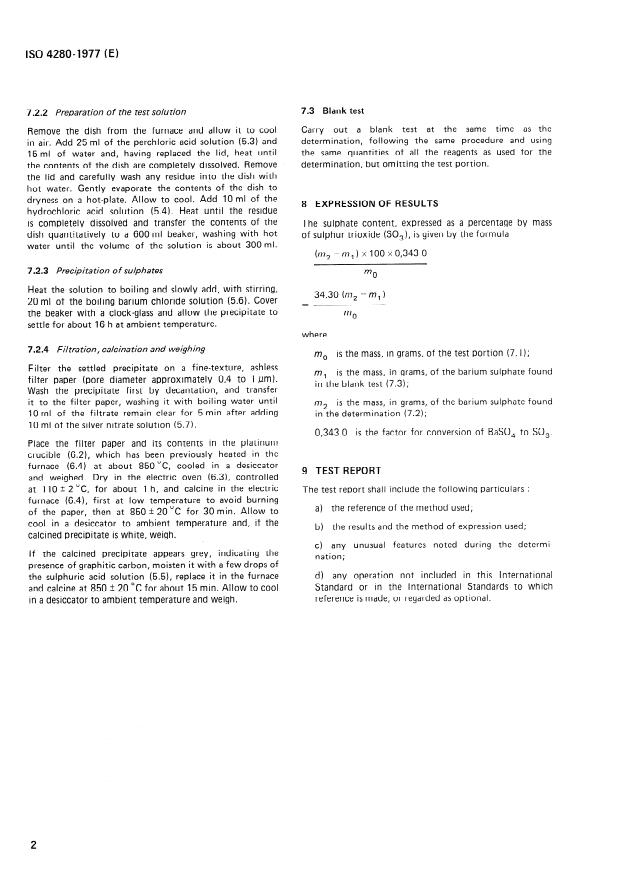
7.3 Blank test
7.2.2 Preparation of the test Solution
Carry out a blank test at the Same time as the
Remove the dish from the furnace and allow it to cool
determination, following the Same procedure and using
in air. Add 25 ml of the perchloric acid Solution (5.3) and
15 ml of water and, having replaced the lid, heat until the same quantities of all the reagents as used for the
determination, but omitting the test Portion.
the contents of the dish are completely dissolved. Remove
the lid and carefully wash any residue into the dish with
hot water. Gently evaporate the contents of the dish to
dryne
...
NORME INTERNATIONALE
INTERNATIONAL ORGANIZATION FOR STANDARDIZATION l MEXAYHAPOAHA(I OPI-AHM3AUMJI l-I0 CTAHflAPTM3ALUiM.ORGANISATION INTERNATIONALE DE NORMALISATION
Cryolithe, naturelle et artificielle, et fluorure d’aluminium à
usage industriel - Dosage des sulfates - Méthode
gravimétrique à l’état de sulfate de baryum
Determination of sulphate content -
Cryolite, natural and artificial, and aluminium fluoride for industrial use -
Barium sulphate gravimetric method
Première édition - 1977-11-15
CDU 661.8 : 553.634 + 661.862.362 : 546.226 : 543.21 Réf. no : ISO 4280-1977 (F)
Descripteurs : minerai d’aluminium, fluorure d’aluminium, cryolithe, analyse chimique, dosage, sulfate, méthode gravimétrique.
Prix basé sur 3 pages
AVANT-PROPOS
L’ISO (Organisation internationale de normalisation) est une fédération mondiale
d’organismes nationaux de normalisation (comités membres de I’ISO). L’élaboration
des Normes internationales est confiée aux comités techniques de I’ISO. Chaque
comité membre intéressé par une étude a le droit de faire partie du comité technique
correspondant. Les organisations internationales, gouvernementales et non
gouvernementales, en liaison avec I’ISO, participent également aux travaux.
Les projets de Normes internationales adoptés par les comités techniques sont
soumis aux comités membres pour approbation, avant leur acceptation comme
Normes internationales par le Conseil de I’ISO.
La Norme internationale ISO 4280 a été élaborée par le comité technique
ISO/TC 47, Chimie, et a été soumise aux comités membres en mars 1975.
Les comités membres des pays suivants l’ont approuvée :
Royaume-Uni
Afrique du Sud, Rép. d’ France
Hongrie Suède
Allemagne
Inde Suisse
Australie
Belgique Israël Thaïlande
Brésil Italie Turquie
Bulgarie Mexique U.R.S.S.
Égypte, Rép. arabe d’ Pologne U.S.A.
Espagne Roumanie
Aucun comité membre ne l’a désapprouvée.
0 Organisation internationale de normalisation, 1977 l
Imprimé en Suisse
NORME INTERNATIONALE ISO4280-1977(F)
Cryolithe, naturelle et artificielle, et fluorure d’aluminium à
Dosage des sulfates - Méthode
usage industriel -
gravimétrique à l’état de sulfate de baryum
1 OBJET 5.7 Nitrate d’argent, solution nitrique à 5 g/l.
Dissoudre 0,5 g de nitrate d’argent dans un peu d’eau,
La présente Norme internationale spécifie une méthode
ajouter 10 ml d’une solution d’acide nitrique, p 1,40 g/ml
gravimétrique à l’état de sulfate de baryum pour le dosage
environ, compléter le volume à 100 ml avec de l’eau et
des sulfates dans la cryolithe, naturelle et artificielle, et
homogénéiser.
dans le fluorure d’aluminium à usage industriel.
2 DOMAINE D’APPLICATION
La méthode est applicable aux produits dont la teneur en
6 APPAREILLAGE
sulfates, exprimés en trioxyde de soufre (SO,), est égale ou
Matériel courant de laboratoire, et
supérieure à 0,l % (mim).
6.1 Capsule en platine, à fond plat, de diamètre‘ 75 mm
environ et de hauteur 30 mm environ, avec couvercle en
3 RÉFÉRENCES
platine.
ISO 16 19, Cryolithe, naturelle et artificielle - Préparation
et conservation des échantillons pour essai.
6.2 Creuset en platine, de diamètre 30 mm environ et de
hauteur 30 mm environ.
ISO 2925, Fluorure d’aluminium à usage industriel -
Préparation et conservation des échantillons pour essai.
6.3 Étuve électrique, réglable à 110 k 2 OC.
4 PRINCIPE
6.4 Four électrique, réglable à 850 rt 20 “C.
Fusion alcaline d’une prise d’essai à l’aide d’un mélange de
carbonate de sodium et d’acide borique. Reprise de la masse
fondue par une solution d’acide perchlorique et précipi-
7 MODE OPÉRATOIRE
tation des ions sulfate par le chlorure de baryum en milieu
acide. Filtration du précipité obtenu, calcination à 850 OC
AVERTISSEMENT - Effectuer l’évaporation de l’acide
et pesée.
perchlorique sous une hotte bien ventilée, en l’absence
de vapeurs d’ammoniac et de vapeurs nitreuses.
5 RÉACTIFS
7.1 Prise d’essai
Au cours de l’analyse, n’utiliser que des réactifs de qualité
Peser, à 0,000 1 g près, dans la capsule en platine (6.1),
analytique reconnue, et que de l’eau distillée ou de l’eau
1 g environ de l’échantillon pour essai, séché (voir ISO 1619,
de pureté équivalente.
paragraphe 3.3, ou ISO 2925, paragraphe 2.3).
5.1 Carbonate de sodium, anhydre.
7.2 Dosage .
5.2 Acide borique.
7.2.1 Fusion de la prise d’essai
5.3 Acide perchlorique, p 1,67 g/ml environ, solution à
Ajouter dans la capsule en platine (6.1) contenant la prise
70 % (mlm) environ.
d’essai (7. l), 3,75 g du carbonate de sodium (5.1) et 1,25 g
de l’acide borique (5.2). Mélanger le tout avec soin et
5.4 Acide chlorhydrique, solution 6 N environ.
couvrir la capsule avec son couvercle.
5.5 Acide sulfurique, p 1,84 g/ml environ, solution à 96 %
Placer la capsule ainsi couverte dans le four électrique (6.4)
(mlm) environ.
réglé à 850 k 20 OC et la maintenir à cette température
durant 30 min environ. Faire en sorte que la capsule n’entre
5.6 Chlorure de baryum dihydraté (BaCl,.2H,O), solution pas en contact direct avec la sole du four, en intercalant un
à 122 g/l ou 1 N environ. support approprié.
ISO4280-1977(F)
7.3 Essai à blanc
7.2.2 Préparation de la solution d’essai
Effectuer, parallèlement au dosage et en suivant le même
Retirer la capsule du four et la laisser refroidir à l’air.
mode opératoire, un essai à blanc en employant les mêmes
Ajouter 25 ml (de la solut.ion d’acide perchlorique (5.3) et
quantités de tous les réactifs que celles utilisées pour le
...