

ISO 16159:2012
(Main)Space systems — Launch pad and integration site — Facility, system and equipment failure analysis
General Information
- Abstract
ISO 16159:2012 establishes procedures for the analysis of failures that occur during the acceptance testing or operation of launch pad and integration site facilities, systems and equipment. The procedures define the processes for investigating, analysing and identifying the probable causes of failures, and for developing corrective actions to preclude future failures. The purpose of ISO 16159:2012 is to provide rules for investigating, analysing and identifying the causes of failures, sufficient information so that corrective action may be implemented to prevent failure recurrence, and a uniform method for maintaining records of the findings of all failure causes so as to provide information for other failure investigations.
- Status
- Withdrawn
- Publication Date
- 06-Aug-2012
- Technical Committee
- ISO/TC 20/SC 14 - Space systems and operations
- Drafting Committee
- ISO/TC 20/SC 14 - Space systems and operations
- Current Stage
- 9599 - Withdrawal of International Standard
- Start Date
- 07-Oct-2025
- Completion Date
- 29-Aug-2026

Overview
ISO 16159:2012 - Space systems: Launch pad and integration site - Facility, system and equipment failure analysis defines standardized procedures for investigating failures that occur during acceptance testing or operation of launch pads and integration sites. The standard establishes a uniform method to identify probable causes, document findings, recommend corrective actions and implement preventive measures to avoid recurrence. Key objectives include root‑cause identification, verifiable corrective actions, and consistent record keeping for future investigations.
Key topics and technical requirements
- Scope and purpose: Procedures for failure analysis of facilities, systems and equipment used in launch pad and integration site operations.
- Terminology: Defines critical terms such as failure, root cause, discrepant component, primary failed component, functional track and failure precondition.
- Team composition and responsibilities: Failure analysis must be conducted by a multidisciplinary team including developer/manufacturer representatives, operators, component suppliers, QA and customer stakeholders. Team leader assignment depends on whether failure occurred during testing or operations.
- Failure analysis methods: A systematic process including:
- information gathering (operational state, environmental conditions, service history),
- site survey and documentation of indicators,
- selection and review of design/production/normative documentation,
- identification of functional tracks and failure preconditions,
- step‑by‑step disassembly and component examination,
- determination of probable and root causes,
- definition of corrective and preventive actions.
- Reporting and traceability: Final reports must include team composition, detailed failure circumstances, analysis work products (documentation lists, disassembly records, parameter comparisons), probable/root causes and recommended corrective/preventive actions. Reports require signatures, approval by developer/manufacturer (and operator for in‑service failures) and distribution to all affected parties.
- Corrective and preventive actions: Actions must be specific, measurable and verifiable (e.g., inspection intervals, design or manufacturing changes). Implementation is coordinated and approved per the standard.
Applications and users
ISO 16159:2012 is practical for:
- launch site and integration site operators and safety engineers,
- aerospace system developers, manufacturers and suppliers,
- quality assurance and maintenance organizations,
- customers and program managers overseeing acceptance testing or operations. Use cases include post‑failure investigations, acceptance test anomalies, pre‑launch incident reviews, and continuous improvement programs for ground support equipment.
Related standards
ISO 16159 references and aligns terminology with other ISO documents cited within the standard, for example:
- ISO 26870 (complex launch pad or integration site definitions),
- ISO 14620‑2 (failure definitions),
- ISO/TR 17400 (integration site and launch pad definitions).
Keywords: ISO 16159:2012, failure analysis, launch pad, integration site, space systems, root cause, corrective actions, preventive actions, failure investigation, functional track.
Relations
- Effective Date
- 15-Jun-2024
Get Certified
Connect with accredited certification bodies for this standard

BUREAU VERITAS Certification Germany
Bureau Veritas certification in Germany.

Element Materials Technology
Materials testing and product certification.

AQMS Ltd.
AQMS provides ISO certification to SMEs across the UK.
Sponsored listings
Frequently Asked Questions
ISO 16159:2012 is a standard published by the International Organization for Standardization (ISO). Its full title is "Space systems — Launch pad and integration site — Facility, system and equipment failure analysis". This standard covers: ISO 16159:2012 establishes procedures for the analysis of failures that occur during the acceptance testing or operation of launch pad and integration site facilities, systems and equipment. The procedures define the processes for investigating, analysing and identifying the probable causes of failures, and for developing corrective actions to preclude future failures. The purpose of ISO 16159:2012 is to provide rules for investigating, analysing and identifying the causes of failures, sufficient information so that corrective action may be implemented to prevent failure recurrence, and a uniform method for maintaining records of the findings of all failure causes so as to provide information for other failure investigations.
ISO 16159:2012 establishes procedures for the analysis of failures that occur during the acceptance testing or operation of launch pad and integration site facilities, systems and equipment. The procedures define the processes for investigating, analysing and identifying the probable causes of failures, and for developing corrective actions to preclude future failures. The purpose of ISO 16159:2012 is to provide rules for investigating, analysing and identifying the causes of failures, sufficient information so that corrective action may be implemented to prevent failure recurrence, and a uniform method for maintaining records of the findings of all failure causes so as to provide information for other failure investigations.
ISO 16159:2012 is classified under the following ICS (International Classification for Standards) categories: 49.140 - Space systems and operations. The ICS classification helps identify the subject area and facilitates finding related standards.
ISO 16159:2012 has the following relationships with other standards: It is inter standard links to ISO 16159:2025. Understanding these relationships helps ensure you are using the most current and applicable version of the standard.
ISO 16159:2012 is available in PDF format for immediate download after purchase. The document can be added to your cart and obtained through the secure checkout process. Digital delivery ensures instant access to the complete standard document.
Standards Content (Sample)
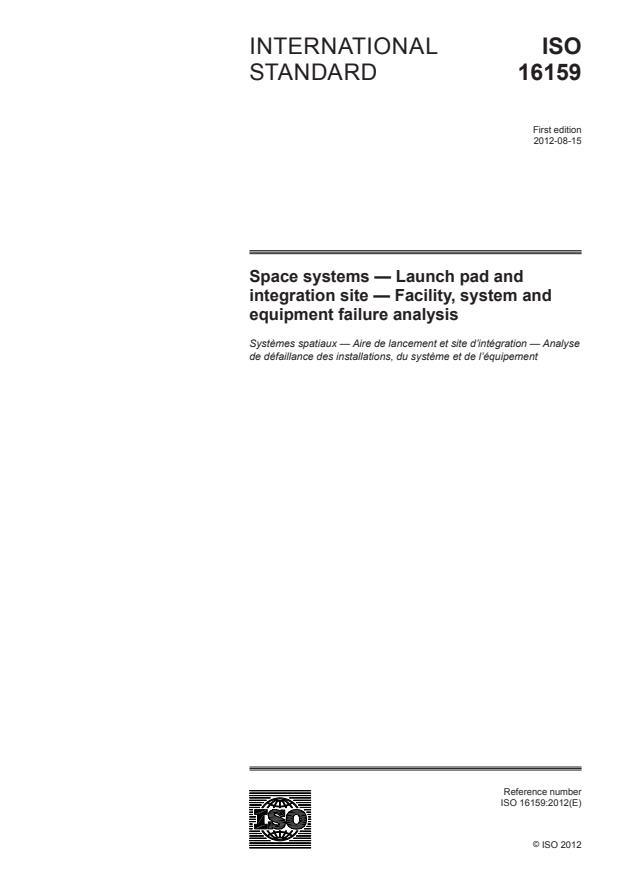
INTERNATIONAL ISO
STANDARD 16159
First edition
2012-08-15
Space systems — Launch pad and
integration site — Facility, system and
equipment failure analysis
Systèmes spatiaux — Aire de lancement et site d’intégration — Analyse
de défaillance des installations, du système et de l’équipement
Reference number
©
ISO 2012
All rights reserved. Unless otherwise specified, no part of this publication may be reproduced or utilized in any form or by any means,
electronic or mechanical, including photocopying and microfilm, without permission in writing from either ISO at the address below or ISO’s
member body in the country of the requester.
ISO copyright office
Case postale 56 • CH-1211 Geneva 20
Tel. + 41 22 749 01 11
Fax + 41 22 749 09 47
E-mail copyright@iso.org
Web www.iso.org
Published in Switzerland
ii © ISO 2012 – All rights reserved
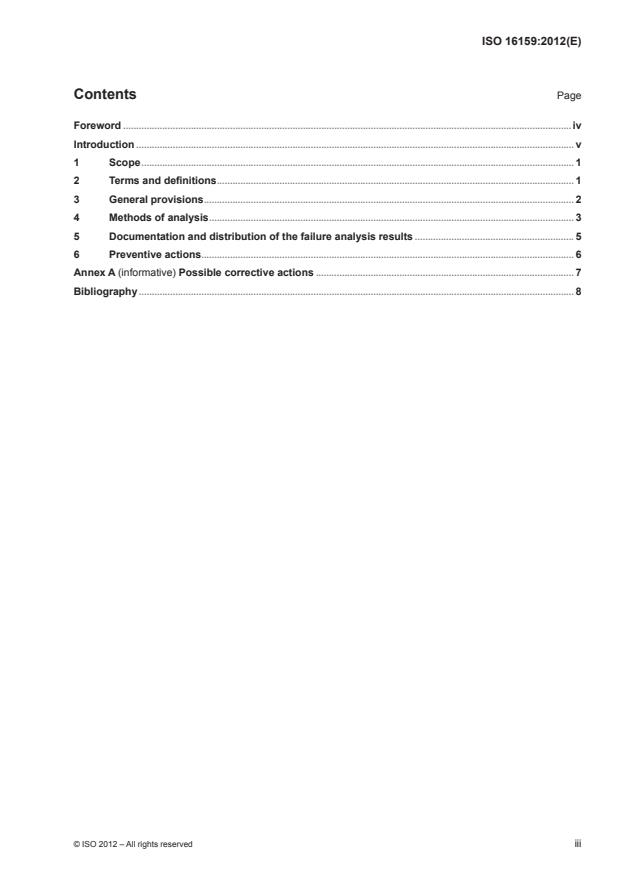
Contents Page
Foreword .iv
Introduction . v
1 Scope . 1
2 Terms and definitions . 1
3 General provisions . 2
4 Methods of analysis . 3
5 Documentation and distribution of the failure analysis results . 5
6 Preventive actions . 6
Annex A (informative) Possible corrective actions . 7
Bibliography . 8
Foreword
ISO (the International Organization for Standardization) is a worldwide federation of national standards bodies
(ISO member bodies). The work of preparing International Standards is normally carried out through ISO
technical committees. Each member body interested in a subject for which a technical committee has been
established has the right to be represented on that committee. International organizations, governmental and
non-governmental, in liaison with ISO, also take part in the work. ISO collaborates closely with the International
Electrotechnical Commission (IEC) on all matters of electrotechnical standardization.
International Standards are drafted in accordance with the rules given in the ISO/IEC Directives, Part 2.
The main task of technical committees is to prepare International Standards. Draft International Standards
adopted by the technical committees are circulated to the member bodies for voting. Publication as an
International Standard requires approval by at least 75 % of the member bodies casting a vote.
Attention is drawn to the possibility that some of the elements of this document may be the subject of patent
rights. ISO shall not be held responsible for identifying any or all such patent rights.
ISO 16159 was prepared by Technical Committee ISO/TC 20, Aircraft and space vehicles, Subcommittee
SC 14, Space systems and operations.
iv © ISO 2012 – All rights reserved
Introduction
Failure of the launch pad or integration site facility, system or equipment during acceptance testing or operation
can be catastrophic. Failure of the facility, systems or equipment can damage flight or ground hardware and
injure personnel. Failures need to be thoroughly investigated in order to prevent future failures, damage
and injuries. In order to investigate failures of launch pad or integration site facilities, systems or equipment,
adequate processes and procedures must be employed to thoroughly analyse and determine the cause of the
failure. Identification of failure causes is necessary to implement changes to the facility, system and equipment
in order to prevent a recurrence of the failure and the resulting damage or injury. This International Standard
establishes procedures for determining the causes of facility, system and equipment failures and preventing
such failures.
INTERNATIONAL STANDARD ISO 16159:2012(E)
Space systems — Launch pad and integration site — Facility,
system and equipment failure analysis
1 Scope
This International Standard establishes procedures for the analysis of failures that occur during the acceptance
testing or operation of launch pad and integration site facilities, systems and equipment. The procedures define
the processes for investigating, analysing and identifying the probable causes of failures, and for developing
corrective actions to preclude future failures.
The purpose of this International Standard is to provide
— rules for investigating, analysing and identifying the causes of failures,
— sufficient information so that corrective action may be implemented to prevent failure recurrence, and
— a uniform method for maintaining records of the findings of all failure causes so as to provide information
for other failure investigations.
2 Terms and definitions
For the purposes of this document, the following terms and definitions apply.
2.1
complex
launch pad or integration site
[ISO 26870:2009, definition 3.2]
2.2
discrepant component
first component of a facility, a system or equipment that manifests failure
NOTE The discrepant component may or may not be the primary or initial component to fail.
2.3
design documentation
documentation created by the developer and containing the requirements for the manufacture, fabrication,
purchase or production of the components of the facility, system or equipment
2.4
failure
termination of the ability of an item to perform the function for which it was designed
[ISO 14620-2:2011, definition 3.5]
2.5
failure analysis
systematic approach to determine, as a minimum, the mode and mechanism of failure via investigative
techniques, in order to identify and assess potential root causes and ultimately arrive at the most probable,
and to identify and assess potential corrective actions and ultimately recommend/implement the most suitable
NOTE Investigative techniques can range from examination in the field to evaluation in the laboratory.
2.6
primary failed component
component, the failure of which resulted in the compromised functionality of the component itself, of additional
components or of the associated facility, system or equipment
2.7
failure precondition
pre-existing conditions and circumstances that predispose a component to failure
NOTE Failure preconditions can include improper design, manufacture or service.
2.8
functional track
sequence of components on which energy (mechanical, electric, or pressure) is transferred from the primary
failed component to the discrepant component
2.9
integration site
equipment and facility designed for launch vehicle storage, assembly, testing, preparation, maintenance,
servicing and preparation for transportation to the launch pad
[ISO/TR 17400:2003, definition 3.1]
2.10
launch pad
equipment and facility designed to provide for the pre-launch and launch operations of spacecraft
[ISO/TR 17400:2003, definition 3.3]
2.11
normative documentation
specifications, standards, rules or instructions, to which adherence is required through citation in the design
documentation or the construction, fabrication, manufacture, purchase or production documentation for the
manufacture and operation of the facility, system or equipment
2.12
production documentation
documentation created by the facility, system or equipment contractor, which establishes the requirements for
construction, fabrication, manufacture or purchase of the facility, system, equipment or component
2.13
root cause
primal condition, event or circumstance, or initiating cause, that is ultimately responsible for the occurrence of
a failure
3 General provisions
3.1 For each component involved in the facility, system or equipment that failed, the following records shall
be evaluated:
— design documentation;
— normative documentation;
— production documentation;
— acceptance test certificates and reports;
— cogent reports, log-books, schedules and certifications.
3.2 The failure analysis shall be carried out by a team of experts.
2 © ISO 2012 – All rights reserved
3.3 The failure analysis team shall be given the task of investigating a failure by
— the facility, system, equipment or component developer or manufacturer, if the failure occurred prior to the
deployment of the facility, system or equipment, or
— the customer, if failure occurred after the facility, system or equipment was deployed.
3.4 The failure analysis team shall include representatives of the facility, system or equipment developer and
manufacturer and typically also includes representatives of
— the operator,
— the component developer,
— the component manufacturer,
— the assem
...