


ISO/IEC 9594-4:2008
(Main)Information technology — Open Systems Interconnection — The Directory: Procedures for distributed operation — Part 4:
Information technology — Open Systems Interconnection — The Directory: Procedures for distributed operation — Part 4:
ISO/IEC 9594-4:2008 specifies the behaviour of DSAs taking part in the distributed Directory application. The allowed behaviour has been designed so as to ensure a consistent service given a wide distribution of the DIB across many DSAs. The Directory is not intended to be a general purpose database system, although it may be built on such systems. It is assumed that there is a considerably higher frequency of queries than of updates.
Technologies de l'information — Interconnexion de systèmes ouverts (OSI) — L'annuaire: Procédures pour le fonctionnement réparti — Partie 4:
General Information
- Status
- Withdrawn
- Publication Date
- 14-Dec-2008
- Withdrawal Date
- 14-Dec-2008
- Current Stage
- 9599 - Withdrawal of International Standard
- Start Date
- 25-Feb-2014
- Completion Date
- 12-Feb-2026
Relations
- Effective Date
- 31-Aug-2013
- Effective Date
- 18-Dec-2008
Get Certified
Connect with accredited certification bodies for this standard

BSI Group
BSI (British Standards Institution) is the business standards company that helps organizations make excellence a habit.

NYCE
Mexican standards and certification body.
Sponsored listings
Frequently Asked Questions
ISO/IEC 9594-4:2008 is a standard published by the International Organization for Standardization (ISO). Its full title is "Information technology — Open Systems Interconnection — The Directory: Procedures for distributed operation — Part 4:". This standard covers: ISO/IEC 9594-4:2008 specifies the behaviour of DSAs taking part in the distributed Directory application. The allowed behaviour has been designed so as to ensure a consistent service given a wide distribution of the DIB across many DSAs. The Directory is not intended to be a general purpose database system, although it may be built on such systems. It is assumed that there is a considerably higher frequency of queries than of updates.
ISO/IEC 9594-4:2008 specifies the behaviour of DSAs taking part in the distributed Directory application. The allowed behaviour has been designed so as to ensure a consistent service given a wide distribution of the DIB across many DSAs. The Directory is not intended to be a general purpose database system, although it may be built on such systems. It is assumed that there is a considerably higher frequency of queries than of updates.
ISO/IEC 9594-4:2008 is classified under the following ICS (International Classification for Standards) categories: 35.100.70 - Application layer. The ICS classification helps identify the subject area and facilitates finding related standards.
ISO/IEC 9594-4:2008 has the following relationships with other standards: It is inter standard links to ISO/IEC 9594-4:2014, ISO/IEC 9594-4:2005. Understanding these relationships helps ensure you are using the most current and applicable version of the standard.
ISO/IEC 9594-4:2008 is available in PDF format for immediate download after purchase. The document can be added to your cart and obtained through the secure checkout process. Digital delivery ensures instant access to the complete standard document.
Standards Content (Sample)
INTERNATIONAL ISO/IEC
STANDARD 9594-4
Sixth edition
2008-12-15
Information technology — Open Systems
Interconnection — The Directory:
Procedures for distributed operation
Technologies de l'information — Interconnexion de systèmes ouverts
(OSI) — L'annuaire: Procédures pour le fonctionnement réparti
Reference number
©
ISO/IEC 2008
PDF disclaimer
This PDF file may contain embedded typefaces. In accordance with Adobe's licensing policy, this file may be printed or viewed but
shall not be edited unless the typefaces which are embedded are licensed to and installed on the computer performing the editing. In
downloading this file, parties accept therein the responsibility of not infringing Adobe's licensing policy. The ISO Central Secretariat
accepts no liability in this area.
Adobe is a trademark of Adobe Systems Incorporated.
Details of the software products used to create this PDF file can be found in the General Info relative to the file; the PDF-creation
parameters were optimized for printing. Every care has been taken to ensure that the file is suitable for use by ISO member bodies. In
the unlikely event that a problem relating to it is found, please inform the Central Secretariat at the address given below.
© ISO/IEC 2008
All rights reserved. Unless otherwise specified, no part of this publication may be reproduced or utilized in any form or by any means,
electronic or mechanical, including photocopying and microfilm, without permission in writing from either ISO at the address below or
ISO's member body in the country of the requester.
ISO copyright office
Case postale 56 • CH-1211 Geneva 20
Tel. + 41 22 749 01 11
Fax + 41 22 749 09 47
E-mail copyright@iso.org
Web www.iso.org
Published by ISO in 2009
Published in Switzerland
ii © ISO/IEC 2008 – All rights reserved
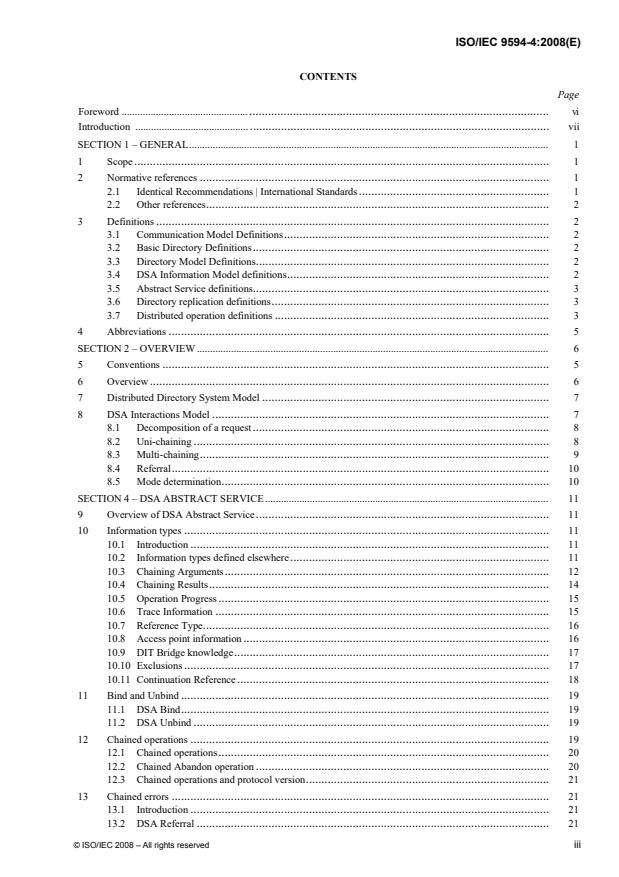
CONTENTS
Page
Foreword . vi
Introduction . vii
SECTION 1 – GENERAL. 1
1 Scope. 1
2 Normative references . 1
2.1 Identical Recommendations | International Standards. 1
2.2 Other references. 2
3 Definitions . 2
3.1 Communication Model Definitions. 2
3.2 Basic Directory Definitions. 2
3.3 Directory Model Definitions. 2
3.4 DSA Information Model definitions. 2
3.5 Abstract Service definitions. 3
3.6 Directory replication definitions. 3
3.7 Distributed operation definitions . 3
4 Abbreviations . 5
SECTION 2 – OVERVIEW . 6
5 Conventions . 5
6 Overview. 6
7 Distributed Directory System Model . 7
8 DSA Interactions Model . 7
8.1 Decomposition of a request. 8
8.2 Uni-chaining . 8
8.3 Multi-chaining. 9
8.4 Referral. 10
8.5 Mode determination. 10
SECTION 4 – DSA ABSTRACT SERVICE . 11
9 Overview of DSA Abstract Service. 11
10 Information types . 11
10.1 Introduction . 11
10.2 Information types defined elsewhere. 11
10.3 Chaining Arguments. 12
10.4 Chaining Results. 14
10.5 Operation Progress . 15
10.6 Trace Information . 15
10.7 Reference Type. 16
10.8 Access point information . 16
10.9 DIT Bridge knowledge. 17
10.10 Exclusions . 17
10.11 Continuation Reference. 18
11 Bind and Unbind . 19
11.1 DSA Bind. 19
11.2 DSA Unbind . 19
12 Chained operations . 19
12.1 Chained operations. 20
12.2 Chained Abandon operation . 20
12.3 Chained operations and protocol version. 21
13 Chained errors . 21
13.1 Introduction . 21
13.2 DSA Referral . 21
© ISO/IEC 2008 – All rights reserved iii
Page
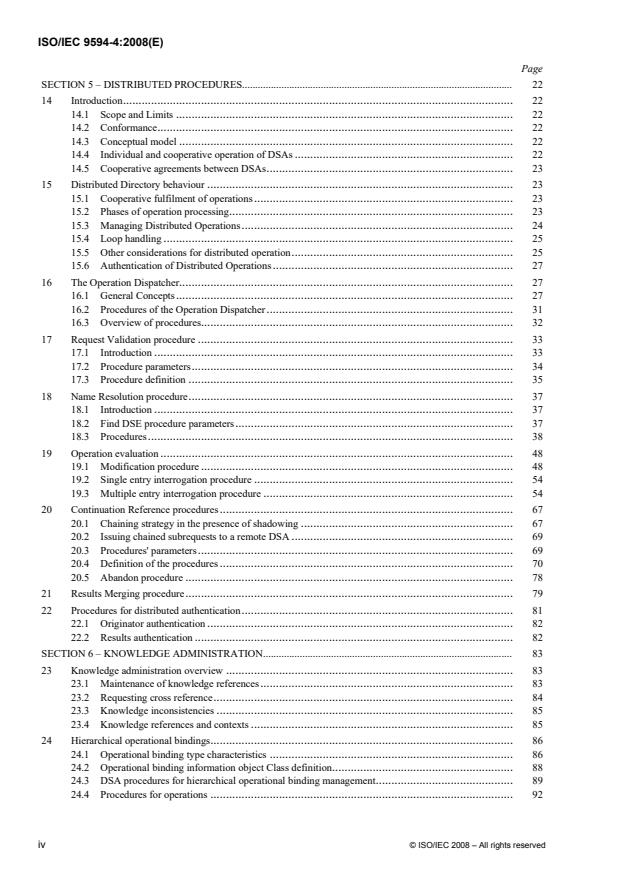
SECTION 5 – DISTRIBUTED PROCEDURES. 22
14 Introduction. 22
14.1 Scope and Limits . 22
14.2 Conformance. 22
14.3 Conceptual model . 22
14.4 Individual and cooperative operation of DSAs . 22
14.5 Cooperative agreements between DSAs. 23
15 Distributed Directory behaviour . 23
15.1 Cooperative fulfilment of operations. 23
15.2 Phases of operation processing. 23
15.3 Managing Distributed Operations. 24
15.4 Loop handling . 25
15.5 Other considerations for distributed operation. 25
15.6 Authentication of Distributed Operations. 27
16 The Operation Dispatcher. 27
16.1 General Concepts. 27
16.2 Procedures of the Operation Dispatcher. 31
16.3 Overview of procedures. 32
17 Request Validation procedure . 33
17.1 Introduction . 33
17.2 Procedure parameters. 34
17.3 Procedure definition . 35
18 Name Resolution procedure. 37
18.1 Introduction . 37
18.2 Find DSE procedure parameters. 37
18.3 Procedures. 38
19 Operation evaluation . 48
19.1 Modification procedure . 48
19.2 Single entry interrogation procedure . 54
19.3 Multiple entry interrogation procedure . 54
20 Continuation Reference procedures. 67
20.1 Chaining strategy in the presence of shadowing . 67
20.2 Issuing chained subrequests to a remote DSA . 69
20.3 Procedures' parameters. 69
20.4 Definition of the procedures . 70
20.5 Abandon procedure . 78
21 Results Merging procedure. 79
22 Procedures for distributed authentication. 81
22.1 Originator authentication . 82
22.2 Results authentication . 82
SECTION 6 – KNOWLEDGE ADMINISTRATION. 83
23 Knowledge administration overview . 83
23.1 Maintenance of knowledge references. 83
23.2 Requesting cross reference. 84
23.3 Knowledge inconsistencies . 85
23.4 Knowledge references and contexts . 85
24 Hierarchical operational bindings. 86
24.1 Operational binding type characteristics . 86
24.2 Operational binding information object Class definition. 88
24.3 DSA procedures for hierarchical operational binding management. 89
24.4 Procedures for operations . 92
iv © ISO/IEC 2008 – All rights reserved
Page
24.5 Use of application contexts . 92
25 Non-specific hierarchical operational binding. 92
25.1 Operational binding type characteristics . 93
25.2 Operational binding information object class definition . 94
25.3 DSA procedures for non-specific hierarchical operational binding management . 94
25.4 Procedures for operations . 96
25.5 Use of application contexts . 96
Annex A – ASN.1 for Distributed Operations. 97
Annex B – Example of distributed name resolution. 100
Annex C – Distributed use of authentication. 102
C.1 Summary. 102
C.2 Distributed protection model . 102
C.3 Signed chained operations. 102
C.4 Encrypted chained operations . 104
C.5 Signed and encrypted distributed operations. 106
Annex D – Specification of hierarchical and non-specific hierarchical operational binding types . 108
Annex E – Knowledge maintenance example . 110
Annex F – Amendments and corrigenda . 113
© ISO/IEC 2008 – All rights reserved v
Foreword
ISO (the International Organization for Standardization) and IEC (the International Electrotechnical
Commission) form the specialized system for worldwide standardization. National bodies that are members of
ISO or IEC participate in the development of International Standards through technical committees
established by the respective organization to deal with particular fields of technical activity. ISO and IEC
technical committees collaborate in fields of mutual interest. Other international organizations, governmental
and non-governmental, in liaison with ISO and IEC, also take part in the work. In the field of information
technology, ISO and IEC have established a joint technical committee, ISO/IEC JTC 1.
International Standards are drafted in accordance with the rules given in the ISO/IEC Directives, Part 2.
The main task of the joint technical committee is to prepare International Standards. Draft International
Standards adopted by the joint technical committee are circulated to national bodies for voting. Publication as
an International Standard requires approval by at least 75 % of the national bodies casting a vote.
Attention is drawn to the possibility that some of the elements of this document may be the subject of patent
rights. ISO and IEC shall not be held responsible for identifying any or all such patent rights.
Subcommittee SC 6, Telecommunications and information exchange between systems, in collaboration with
ITU-T. The identical text is published as ITU-T Rec. X.518 (11/2008).
This sixth edition cancels and replaces the fifth edition (ISO/IEC 9594-4:2005), which has been technically
revised.
ISO/IEC 9594 consists of the following parts, under the general title Information technology — Open Systems
Interconnection — The Directory:
⎯ Part 1: Overview of concepts, models and services
⎯ Part 2: Models
⎯ Part 3: Abstract service definition
⎯ Part 4: Procedures for distributed operation
⎯ Part 5: Protocol specifications
⎯ Part 6: Selected attribute types
⎯ Part 7: Selected object classes
⎯ Part 8: Public-key and attribute certificate frameworks
⎯ Part 9: Replication
⎯ Part 10: Use of systems management for administration of the Directory
vi © ISO/IEC 2008 – All rights reserved
Introduction
This Recommendation | International Standard, together with other Recommendations | International Standards, has
been produced to facilitate the interconnection of information processing systems to provide directory services. A set of
such systems, together with the directory information that they hold, can be viewed as an integrated whole, called the
Directory. The information held by the Directory, collectively known as the Directory Information Base (DIB), is
typically used to facilitate communication between, with or about objects such as application entities, people, terminals
and distribution lists.
The Directory plays a significant role in Open Systems Interconnection, whose aim is to allow, with a minimum of
technical agreement outside of the interconnection standards themselves, the interconnection of information processing
systems:
– from different manufacturers;
– under different managements;
– of different levels of complexity; and
– of different ages.
This Recommendation | International Standard specifies the procedures by which the distributed components of the
Directory interwork in order to provide a consistent service to its users.
This Recommendation | International Standard provides the foundation frameworks upon which industry profiles can be
defined by other standards groups and industry forums. Many of the features defined as optional in these frameworks
may be mandated for use in certain environments through profiles. This sixth edition technically revises and enhances,
but does not replace, the fifth edition of this Recommendation | International Standard. Implementations may still claim
conformance to the fifth edition. However, at some point, the fifth edition will not be supported (i.e., reported defects
will no longer be resolved). It is recommended that implementations conform to this sixth edition as soon as possible.
This sixth edition specifies versions 1 and 2 of the Directory protocols.
The first and second editions specified only version 1. Most of the services and protocols specified in this edition are
designed to function under version 1. However, some enhanced services and protocols, e.g., signed errors, will not
function unless all Directory entities involved in the operation have negotiated version 2. Whichever version has been
negotiated, differences between the services and between the protocols defined in the six editions, except for those
specifically assigned to version 2, are accommodated using the rules of extensibility defined in ITU-T Rec. X.519 |
ISO/IEC 9594-5.
Annex A, which is an integral part of this Recommendation | International Standard, provides the ASN.1 module for
directory distributed operations.
Annex B, which is not an integral part of this Recommendation | International Standard, describes an example of
distributed name resolution.
Annex C, which is not an integral part of this Recommendation | International Standard, describes authentication in the
distributed operations environment.
Annex D, which is an integral part of this Recommendation | International Standard, provides the definitions of the
ASN.1 information object classes introduced in this Directory Specification.
Annex E, which is not an integral part of this Recommendation | International Standard, illustrates knowledge
maintenance.
Annex F, which is not an integral part of this Recommendation | International Standard, lists the amendments and defect
reports that have been incorporated to form this edition of this Recommendation | International Standard.
© ISO/IEC 2008 – All rights reserved vii
INTERNATIONAL STANDARD
ITU-T RECOMMENDATION
Information technology – Open Systems Interconnection –
The Directory: Procedures for distributed operation
SECTION 1 – GENERAL
1 Scope
This Recommendation | International Standard specifies the behaviour of DSAs taking part in the distributed Directory
application. The allowed behaviour has been designed so as to ensure a consistent service given a wide distribution of
the DIB across many DSAs.
The Directory is not intended to be a general purpose database system, although it may be built on such systems. It is
assumed that there is a considerably higher frequency of queries than of updates.
2 Normative references
The following Recommendations and International Standards contain provisions which, through reference in this text,
constitute provisions of this Recommendation | International Standard. At the time of publication, the editions indicated
were valid. All Recommendations and Standards are subject to revision, and parties to agreements based on this
Recommendation | International Standard are encouraged to investigate the possibility of applying the most recent
edition of the Recommendations and Standards listed below. Members of IEC and ISO maintain registers of currently
valid International Standards. The Telecommunication Standardization Bureau of the ITU maintains a list of currently
valid ITU-T Recommendations.
2.1 Identical Recommendations | International Standards
– ITU-T Recommendation X.200 (1994) | ISO/IEC 7498-1:1994, Information technology – Open Systems
Interconnection – Basic Reference Model: The Basic Model.
– ITU-T Recommendation X.500 (2008) | ISO/IEC 9594-1:2008, Information technology – Open Systems
Interconnection – The Directory: Overview of concepts, models and services.
– ITU-T Recommendation X.501 (2008) | ISO/IEC 9594-2:2008, Information technology – Open Systems
Interconnection – The Directory: Models.
– ITU-T Recommendation X.509 (2008) | ISO/IEC 9594-8:2008, Information technology – Open Systems
Interconnection – The Directory: Public-key and attribute certificate frameworks.
– ITU-T Recommendation X.511 (2008) | ISO/IEC 9594-3:2008, Information technology – Open Systems
Interconnection – The Directory: Abstract service definition.
– ITU-T Recommendation X.519 (2008) | ISO/IEC 9594-5:2008, Information technology – Open Systems
Interconnection – The Directory: Protocol specifications.
– ITU-T Recommendation X.520 (2008) | ISO/IEC 9594-6:2008, Information technology – Open Systems
Interconnection – The Directory: Selected attribute types.
– ITU-T Recommendation X.521 (2008) | ISO/IEC 9594-7:2008, Information technology – Open Systems
Interconnection – The Directory: Selected object classes.
– ITU-T Recommendation X.525 (2008) | ISO/IEC 9594-9:2008, Information technology – Open Systems
Interconnection – The Directory: Replication.
– ITU-T Recommendation X.530 (2008) | ISO/IEC 9594-10:2008, Information technology – Open Systems
Interconnection – The Directory: Use of systems management for administration of the Directory.
– ITU-T Recommendation X.680 (2008) | ISO/IEC 8824-1:2008, Information technology – Abstract
Syntax Notation One (ASN.1): Specification of basic notation.
ITU-T Rec. X.518 (11/2008) 1
– ITU-T Recommendation X.681 (2008) | ISO/IEC 8824-2:2008, Information technology – Abstract
Syntax Notation One (ASN.1): Information object specification.
– ITU-T Recommendation X.682 (2008) | ISO/IEC 8824-3:2008, Information technology – Abstract
Syntax Notation One (ASN.1): Constraint specification.
– ITU-T Recommendation X.683 (2008) | ISO/IEC 8824-4:2008, Information technology – Abstract
Syntax Notation One (ASN.1): Parameterization of ASN.1 specifications.
2.2 Other references
– IETF RFC 4510 (2006), Lightweight Directory Access Protocol (LDAP): Technical Specification Road
Map.
– IETF RFC 4511 (2006), Lightweight Directory Access Protocol (LDAP): The protocol.
3 Definitions
For the purposes of this Recommendation | International Standard, the following definitions apply:
3.1 Communication Model Definitions
The following term is defined in ITU-T Rec. X.519 | ISO/IEC 9594-5:
a) application-entity-title.
3.2 Basic Directory Definitions
The following terms are defined in ITU-T Rec. X.500 | ISO/IEC 9594-1:
a) (the) Directory;
b) Directory Information Base.
3.3 Directory Model Definitions
The following terms are defined in ITU-T Rec. X.501 | ISO/IEC 9594-2:
a) access point;
b) alias;
c) distinguished name;
d) Directory Information Tree;
e) Directory System Agent (DSA);
f) Directory User Agent (DUA);
g) relative distinguished name.
3.4 DSA Information Model definitions
The following terms are defined in ITU-T Rec. X.501 | ISO/IEC 9594-2:
a) category;
b) commonly usable;
c) context prefix;
d) cross reference;
e) DIB fragment;
f) DSA information tree;
g) DSA-Specific Entry (DSE);
h) DSE type;
i) immediate superior reference;
j) knowledge information;
k) knowledge reference category;
2 ITU-T Rec. X.518 (11/2008)
l) knowledge reference type;
m) naming context;
n) non-specific knowledge;
o) non-specific subordinate reference;
p) operational attribute;
q) reference path;
r) specific knowledge;
s) subordinate reference;
t) superior reference.
3.5 Abstract Service definitions
The following term is defined in ITU-T Rec. X.511 | ISO/IEC 9594-3:
a) streamed result.
3.6 Directory replication definitions
The following terms are defined in ITU-T Rec. X.525 | ISO/IEC 9594-9:
a) attribute completeness;
b) shadowing operational binding;
c) subordinate completeness;
d) unit of replication.
3.7 Distributed operation definitions
The following terms are defined in this Recommendation | International Standard:
3.7.1 base object: The object or alias entry that is the target for an operation as issued by the originator.
3.7.2 bound DSA: The DSA to which the requesting DUA has bound by having performed a Bind operation with
that DSA.
3.7.3 bound-DSA paged results: The paging is performed entirely by the DSA to which the DUA is bound.
NOTE – This is the only mode of paging supported by systems conforming to editions prior to the fifth edition.
3.7.4 chaining: The generic term for uni-chaining or multi-chaining.
3.7.5 context prefix information: Operational and user information supplied by the superior DSA to the
subordinate DSA in a RHOB regarding DIT vertices superior to the subordinate context prefix.
3.7.6 distributed name resolution: The process by which name resolution is performed in more than one DSA.
3.7.7 DSP paged results: The DSP protocol provisions when performing DSA is different from bound DSA,
whereby paged results by the initial performer is accomplished.
3.7.8 error: Information sent from the performer to the requester conveying a negative outcome of a previously
received request.
3.7.9 hard error: A definite error which indicates that the operation cannot currently be performed without
external intervention.
3.7.10 hierarchical operational binding (HOB): Relationship between two master DSAs holding naming contexts,
one of which is immediately subordinate to the other, in which the superior DSA holds a subordinate reference to the
subordinate DSA.
3.7.11 initial performer: The first DSA to start performing on an operation, i.e., the first DSA to enter the
evaluation phase of the operation.
3.7.12 modification operations: These are the Directory Modify Operations, i.e., Modify Entry, Add Entry, Remove
Entry and Modify DN.
3.7.13 multi-chaining: A mode of interaction in which a DSA processing a request itself sends multiple requests
either in parallel or sequentially to a set of other DSAs.
ITU-T Rec. X.518 (11/2008) 3
3.7.14 multiple entry interrogation operations: These are the Directory Search Operations, i.e., List and Search.
3.7.15 name resolution: The process of locating an entry by sequentially matching each RDN in a purported name
to a vertex of the DIT.
3.7.16 non-specific hierarchical operational binding (NHOB): Relationship between two master DSAs holding
naming contexts, one of which is immediately subordinate to the other, in which the superior DSA holds a non-specific
subordinate reference to the subordinate DSA.
3.7.17 NSSR decomposition: Decomposition of non-specific knowledge references into subrequests for other DSAs
to pursue; these subrequests may be either chained to these DSAs by the DSA performing the decomposition, or a
continuation reference identifying the DSAs may be returned to the requester for it to pursue, or the decomposing DSA
may pursue some of the subrequests, leaving others unexplored for the requester to pursue.
3.7.18 operation progress: A set of values which denotes the extent to which name resolution has taken place.
3.7.19 originator: The DUA that has initiated a specific (distributed) operation.
3.7.20 paging: A search or list result is returned piecewise in form of one or more pages that are comprised by a
limited number of entries.
3.7.21 performer: DSA receiving a request (i.e., to perform an operation).
NOTE – The performer is also the initial performer except possibly for operations that involve more than one DSA for their
evaluation.
3.7.22 procedure: An (informal) specification of how a DSA maps a given set of input arguments and its DSA
information tree into a result.
NOTE – Input arguments and results may correspond to information received in a requested operation and information sent in a
reply, or they may represent intermediate stages in the computation of a reply from a requested operation. In 14.2, the former
variety of input arguments and results are termed external.
3.7.23 relevant hierarchical operational binding (RHOB): Either a HOB or a NHOB, depending on the context.
3.7.24 referral: An outcome which can be returned by a DSA which cannot perform an operation itself, and which
identifies one or more other DSAs more able to perform the operation.
3.7.25 reply: A result or an error.
3.7.26 request: Information consisting of an operation code and associated arguments to convey a directory
operation from a requester to a performer.
3.7.27 request decomposition: Decomposition of a request into subrequests for other DSAs to pursue; these
subrequests may be either chained to these DSAs by the DSA performing the decomposition, or continuation references
identifying the DSAs may be returned to the requester for it to pursue, or the decomposing DSA may pursue some of
the subrequests, leaving others unexplored for the requester to pursue.
3.7.28 requester: A DUA or DSA sending a request to perform (i.e., invoke) an operation.
3.7.29 single entry interrogation operations: These are the Directory Read Operations, i.e., Read and Compare.
3.7.30 soft error: An error which may be transient, or which may indicate a localized problem, in which case the use
of a different knowledge reference or access point may enable a result or hard error to be obtained.
3.7.31 subordinate DSA: Of the two DSAs sharing a HOB or a NHOB, the DSA holding the subordinate naming
context.
3.7.32 subrequest: A request generated by request decomposition.
3.7.33 superior DSA: Of the two DSAs sharing a HOB or a NHOB, the DSA holding the superior naming context.
3.7.34 superior, subordinate DSA: Two master DSAs holding naming contexts, one of which is immediately
subordinate to the other; the relationship between the two DSAs is managed explicitly via a HOB (or NHOB), or exists
implicitly by virtue of the superior DSA holding a subordinate (or non-specific subordinate) reference to the
subordinate DSA.
3.7.35 target object name: The name of an entry either to which the operation is to be directed at a particular stage
of name resolution, or which is involved in the evaluation of the operation.
3.7.36 uni-chaining: A mode of interaction optionally used by a DSA which cannot perform an operation itself. The
DSA chains by invoking an operation of another DSA and then relaying the outcome to the original requester.
4 ITU-T Rec. X.518 (11/2008)
4 Abbreviations
For the purposes of this Recommendation | International Standard, the following abbreviations apply:
ASN.1 Abstract Syntax Notation One
DISP Directory Information Shadowing Protocol
DMD Directory Management Domain
DOP Directory Operational Binding Management Protocol
DSE DSA-Specific Entry
HOB Hierarchical Operational Binding
NHOB Non-specific Hierarchical Operational Binding
NSSR Non-specific Subordinate Reference
RHOB Relevant Hierarchical Operational Binding
5 Conventions
The term "Directory Specification" (as in "this Directory Specification") shall be taken to mean ITU-T Rec. X.518 |
ISO/IEC 9594-4. The term "Directory Specifications" shall be taken to mean the X.500-series Recommendations and all
parts of ISO/IEC 9594.
This Directory Specification uses the term first edition systems to refer to systems conforming to the first edition of the
Directory Specifications, i.e., the 1988 edition of the series of CCITT X.500 Recommendations and the
ISO/IEC 9594:1990 edition.
This Directory Specification uses the term second edition systems to refer to systems conforming to the second edition
of the Directory Specifications, i.e., the 1993 edition of the series of ITU-T X.500 Recommendations and the
ISO/IEC 9594:1995 edition.
This Directory Specification uses the term third edition systems to refer to systems conforming to the third edition of the
Directory Specifications, i.e., the 1997 edition of the series of ITU-T X.500 Recommendations and the
ISO/IEC 9594:1998 edition.
This Directory Specification uses the term fourth edition systems to refer to systems conforming to the fourth edition of
the Directory Specifications, i.e., the 2001 editions of ITU-T Recs X.500, X.501, X.511, X.518, X.519, X.520, X.521,
X.525, and X.530, the 2000 edition of ITU-T Rec. X.509, and parts 1-10 of the ISO/IEC 9594:2001 edition.
This Directory Specification uses the term fifth edition systems to refer to systems conforming to the fifth edition of the
Directory Specifications, i.e., the 2005 edition of the series of ITU-T X.500 Recommendations and the
ISO/IEC 9594:2005 edition.
This Directory Specification uses the term sixth edition systems to refer to systems conforming to the sixth edition of the
Directory Specifications, i.e., the 2008 edition of the series of ITU-T X.500 Recommendations and the
ISO/IEC 9594:2008 edition.
This Directory Specification presents ASN.1 notation in the bold Helvetica typeface. When ASN.1 types and values are
referenced in normal text, they are differentiated from normal text by presenting them in the bold Helvetica typeface.
The names of procedures, typically referenced when specifying the semantics of processing, are differentiated from
normal text by displaying them in bold Times. Access control permissions are presented in italicized Times.
If the items in a list are numbered (as opposed to using "–" or letters), then the items shall be considered steps in a
procedure.
ITU-T Rec. X.518 (11/2008) 5
SECTION 2 – OVERVIEW
6 Overview
The Directory Abstract Service allows the interrogation, retrieval and modification of Directory information in the DIB.
This service is described in terms of the abstract Directory object as specified in ITU-T Rec. X.511 | ISO/IEC 9594-3.
Similarly, the Lightweight Directory Access Protocol (LDAP) allows the interrogation, retrieval and modification of
Directory information in the DIB. This protocol and the services it enables are specified in IETF RFC 4511.
Necessarily, the specification of the abstract Directory object does not in any way address the physical realization of the
Directory: in particular it does not address the specification of Directory System Agents (DSA) within which the DIB is
stored and managed, and through which the service is provided. Furthermore, it does not consider whether the DIB is
centralized, i.e., contained within a single DSA, or distributed over a number of DSAs. Consequently, the requirements
for DSAs to have knowledge of, navigate to, and cooperate with other DSAs, in order to support the abstract service in
a distributed environment is also not covered by the service description.
This Directory Specification specifies the refinement of the abstract Directory object, the refinement being expressed in
terms of a set of one or more DSA objects which collectively constitute the distributed directory service.
In addition, this Directory Specification specifies the permissible ways in which the DIB may be distributed over one or
more DSAs. For the limiting case where the DIB is contained within a single DSA, the Directory is in fact centralized;
for the case where the DIB is distributed over two or more DSAs, knowledge and navigation mechanisms are specified
which ensure that the whole of the DIB is potentially accessible from all DSAs that hold constituent entries.
Portions of the DIB may also be replicated in multiple DSAs. The protocols described in this Directory Specification
allow the use of replicated information to improve the availability, performance and efficiency of the distributed
directory service. The use of replicated information is, to some extent, under the user's control, through the use of
service control options. The procedures described in this Directory Specification also indicate some of the opportunities
for design optimizations when using the replicated information.
Additionally, request handling interactions are specified that enable particular operational characteristics of the
Directory to be controlled by its users. In particular, the user has control over whether a DSA, responding to a directory
inquiry pertaining to information held in other DSA(s), has the option of interrogating the other DSA(s) directly
(chaining) or, whether it should respond with information about other DSA(s) which could further progress the inquiry
(referral).
Generally, the decision by a DSA to chain or refer is determined by the service controls set by the user, and by the
DSA's own administrative, operational or technical circumstances.
Recognizing that, in general, the Directory will be distributed, and that directory inquiries will be satisfied by an
arbitrary number of cooperating DSAs which may arbitrarily chain or refer according to the above criteria, this
Directory Specification specifies the appropriate procedures to be effected by DSAs in responding to distributed
directory inquiries. These procedures will ensure that users of the distributed Directory service perceive it to be both
user-friendly and consistent.
6 ITU-T Rec. X.518 (11/2008)
SECTION 3 – DISTRIBUTED DIRECTORY MODELS
7 Distributed Directory System Model
The Directory abstract service, as defined in ITU-T Rec. X.511 | ISO/IEC 9594-3, models the Directory as an object
which provides a set of directory services to its users. Users of the Directory access its services through an access point.
The Directory may have one or more access points and each access point is characterized by the services it provides and
the mode of interaction used to provide these services.
Figure 1 illustrates the distributed directory model which will be used as the basis for specifying the distributed aspects
of the directory. It illustrates the Directory as comprising a set of one or more DSAs.
Figure 1 – Objects of the distributed Directory model
DSAs are specified in detail in the subsequent clauses of this Directory Specification. This clause merely states a
number of their characteristics in order to serve as an introduction and to establish the relationship between this
Directory Specification and the other Directory Specifications.
DSAs are
...
Questions, Comments and Discussion
Ask us and Technical Secretary will try to provide an answer. You can facilitate discussion about the standard in here.
Loading comments...