

ISO 1496-5:2018
(Main)Series 1 freight containers — Specification and testing — Part 5: Platform and platform-based containers
General Information
- Abstract
This document specifies the basic specifications and testing requirements for ISO series 1 freight containers of the platform and platform-based types designated 1AAA, 1AA, 1A, 1AX, 1BBB, 1BB, 1B, 1BX, 1CC, 1C and 1CX which are suitable for international exchange and for conveyance by road, rail and sea, including interchange between these forms of transport, with certain limitations (for example, when loaded, platforms cannot be stacked or top lifted by means of conventional spreaders).
- Status
- Published
- Publication Date
- 14-Nov-2018
- Technical Committee
- ISO/TC 104/SC 2 - Specific purpose containers
- Drafting Committee
- ISO/TC 104/SC 2 - Specific purpose containers
- Current Stage
- 9093 - International Standard confirmed
- Start Date
- 17-Apr-2024
- Completion Date
- 29-Aug-2026
Buy Documents
ISO 1496-5:2018 - Series 1 freight containers -- Specification and testing
ISO 1496-5:2018 - Series 1 freight containers — Specification and testing — Part 5: Platform and platform-based containers/15/2018
Overview
ISO 1496-5:2018 - "Series 1 freight containers - Specification and testing - Part 5: Platform and platform-based containers" defines the core specifications and test requirements for ISO Series 1 platform and platform-based freight containers (type codes 1AAA, 1AA, 1A, 1AX, 1BBB, 1BB, 1B, 1BX, 1CC, 1C and 1CX). The standard covers dimensional limits, structural design requirements, corner fittings and base structures, optional features (for example fork‑lift pockets), and mandatory testing protocols to ensure containers are suitable for international exchange and intermodal transport by road, rail and sea - with certain operational limitations (e.g., loaded platforms cannot be stacked or top‑lifted using conventional spreaders).
Key Topics and Requirements
- Scope and container types: Defines platform and platform‑based container classifications and intended use for intermodal transport.
- Dimensions and ratings: External/internal dimensions and rated capacities consistent with Series 1 container family.
- Design requirements: Corner fittings, base and end structures, side structures, walls, securing devices, door openings and optional fork‑lift pocket details.
- Testing regime: A series of standardized tests including:
- Stacking tests (Test No. 1)
- Lifting tests from top and bottom corner fittings (Tests No. 2 and No. 3)
- External longitudinal restraint (Test No. 4)
- Strength of end walls and roof (Tests No. 5 & 6, where provided)
- Floor strength (Test No. 7) - note: floor strength test load updated in the 2018 edition
- Rigidity (transverse and longitudinal) where applicable (Tests No. 8 & No. 9)
- Fork‑lift pocket lifting (Test No. 10), weatherproofness (Test No. 11)
- Additional tests for folded or interlocked piles (Tests No. 12–14) for specific foldable platform types
- Normative annexes: Diagrammatic capabilities, fork‑lift pocket dimensions, cargo‑securing systems and guidance for multi‑modal small container carriage.
Applications
ISO 1496-5:2018 is used by:
- Container manufacturers and designers to ensure new platform/container‑based designs meet international structural and testing requirements.
- Shipping lines, intermodal operators and freight forwarders to verify equipment suitability for road, rail and sea transport and international interchange.
- Port and terminal operators and container leasing companies for acceptance, inspection and maintenance criteria.
- Testing laboratories and certification bodies performing stacking, lifting and strength tests to ISO procedures.
- Regulators and procurement teams specifying compliant containers for safe, interoperable intermodal logistics.
Related Standards
- ISO 1496 series (other parts) - for general container specifications and testing across different container types.
- ISO 1496-1:2013 - referenced for stacking test load updates and Series 1 family alignment.
- Applicable national and transport authority standards for road, rail and maritime carriage and handling.
Keywords: ISO 1496-5:2018, platform containers, platform-based containers, freight container testing, container specifications, intermodal container standard, container stacking test, corner fittings.
Relations
- Effective Date
- 02-Aug-2014
- Effective Date
- 02-Aug-2014
- Effective Date
- 02-Aug-2014
Buy Documents
ISO 1496-5:2018 - Series 1 freight containers -- Specification and testing
ISO 1496-5:2018 - Series 1 freight containers — Specification and testing — Part 5: Platform and platform-based containers/15/2018
Get Certified
Connect with accredited certification bodies for this standard

BRCGS (Brand Reputation Compliance Global Standards)
Global food safety and quality standards owner.
Sponsored listings
Frequently Asked Questions
ISO 1496-5:2018 is a standard published by the International Organization for Standardization (ISO). Its full title is "Series 1 freight containers — Specification and testing — Part 5: Platform and platform-based containers". This standard covers: This document specifies the basic specifications and testing requirements for ISO series 1 freight containers of the platform and platform-based types designated 1AAA, 1AA, 1A, 1AX, 1BBB, 1BB, 1B, 1BX, 1CC, 1C and 1CX which are suitable for international exchange and for conveyance by road, rail and sea, including interchange between these forms of transport, with certain limitations (for example, when loaded, platforms cannot be stacked or top lifted by means of conventional spreaders).
This document specifies the basic specifications and testing requirements for ISO series 1 freight containers of the platform and platform-based types designated 1AAA, 1AA, 1A, 1AX, 1BBB, 1BB, 1B, 1BX, 1CC, 1C and 1CX which are suitable for international exchange and for conveyance by road, rail and sea, including interchange between these forms of transport, with certain limitations (for example, when loaded, platforms cannot be stacked or top lifted by means of conventional spreaders).
ISO 1496-5:2018 is classified under the following ICS (International Classification for Standards) categories: 55.180.10 - General purpose containers. The ICS classification helps identify the subject area and facilitates finding related standards.
ISO 1496-5:2018 has the following relationships with other standards: It is inter standard links to ISO 1496-5:1991, ISO 1496-5:1991/Amd 1:1993, ISO 1496-5:1991/Amd 2:1994. Understanding these relationships helps ensure you are using the most current and applicable version of the standard.
ISO 1496-5:2018 is associated with the following European legislation: EU Directives/Regulations: 2018-01-1387. When a standard is cited in the Official Journal of the European Union, products manufactured in conformity with it benefit from a presumption of conformity with the essential requirements of the corresponding EU directive or regulation.
ISO 1496-5:2018 is available in PDF format for immediate download after purchase. The document can be added to your cart and obtained through the secure checkout process. Digital delivery ensures instant access to the complete standard document.
Standards Content (Sample)
INTERNATIONAL ISO
STANDARD 1496-5
Third edition
2018-11
Series 1 freight containers —
Specification and testing —
Part 5:
Platform and platform-based
containers
Conteneurs de la série 1 — Spécifications et essais —
Partie 5: Conteneurs plates-formes et type plate-forme
Reference number
©
ISO 2018
© ISO 2018
All rights reserved. Unless otherwise specified, or required in the context of its implementation, no part of this publication may
be reproduced or utilized otherwise in any form or by any means, electronic or mechanical, including photocopying, or posting
on the internet or an intranet, without prior written permission. Permission can be requested from either ISO at the address
below or ISO’s member body in the country of the requester.
ISO copyright office
CP 401 • Ch. de Blandonnet 8
CH-1214 Vernier, Geneva
Phone: +41 22 749 01 11
Fax: +41 22 749 09 47
Email: copyright@iso.org
Website: www.iso.org
Published in Switzerland
ii © ISO 2018 – All rights reserved
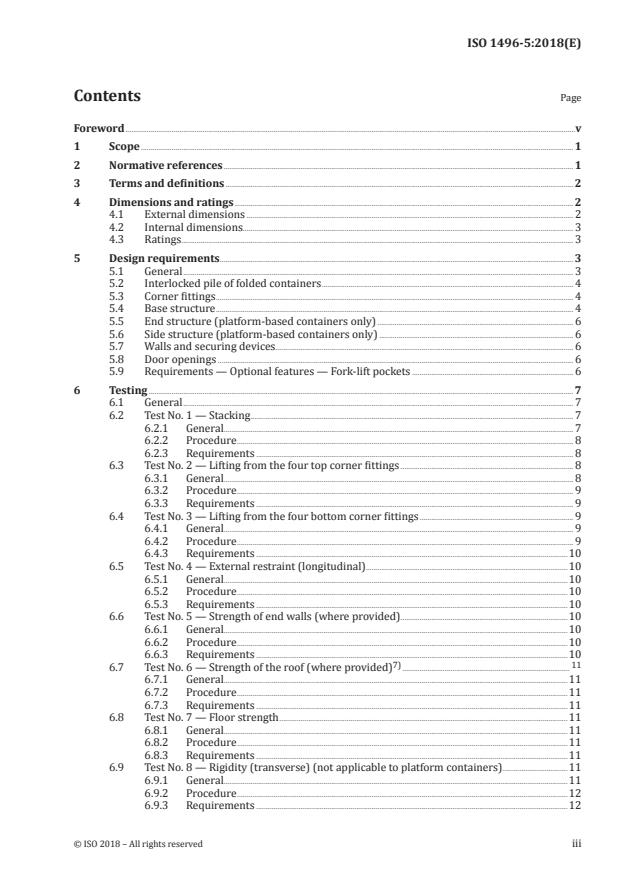
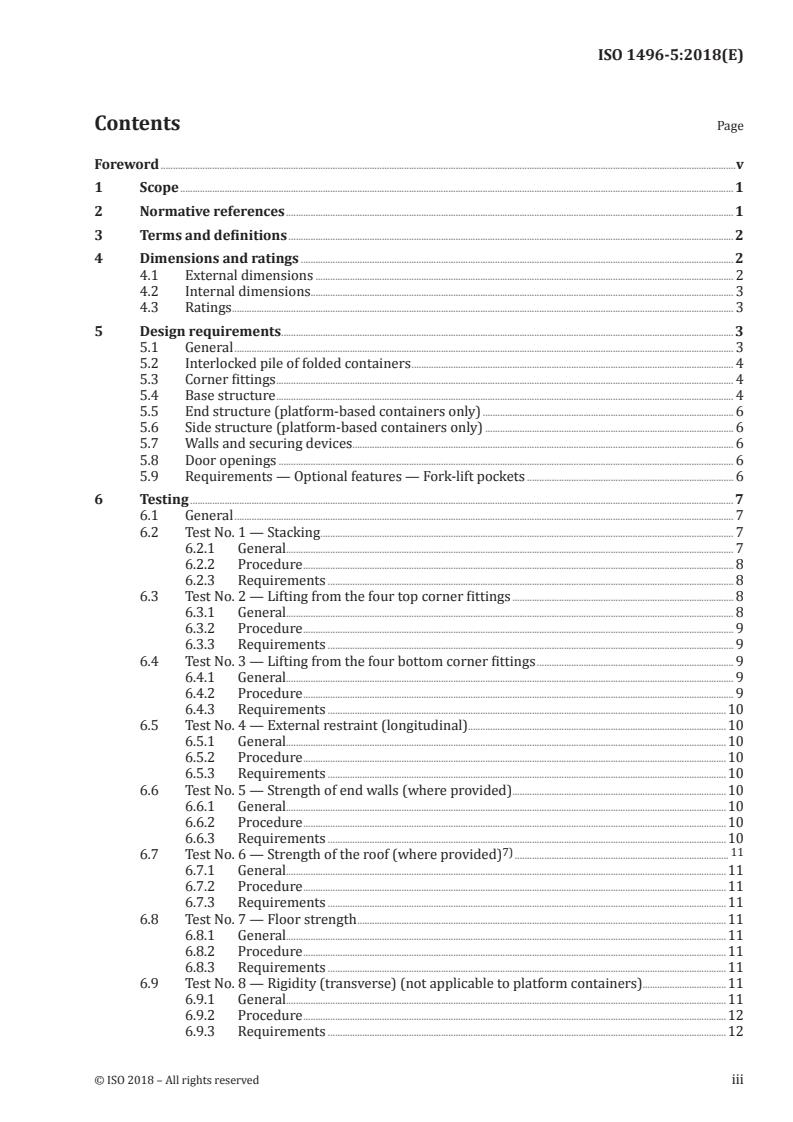
Contents Page
Foreword .v
1 Scope . 1
2 Normative references . 1
3 Terms and definitions . 2
4 Dimensions and ratings . 2
4.1 External dimensions . 2
4.2 Internal dimensions. 3
4.3 Ratings . 3
5 Design requirements . 3
5.1 General . 3
5.2 Interlocked pile of folded containers . 4
5.3 Corner fittings . 4
5.4 Base structure . 4
5.5 End structure (platform-based containers only) . 6
5.6 Side structure (platform-based containers only) . 6
5.7 Walls and securing devices . 6
5.8 Door openings . 6
5.9 Requirements — Optional features — Fork-lift pockets . 6
6 Testing . 7
6.1 General . 7
6.2 Test No. 1 — Stacking . 7
6.2.1 General. 7
6.2.2 Procedure . 8
6.2.3 Requirements . 8
6.3 Test No. 2 — Lifting from the four top corner fittings . 8
6.3.1 General. 8
6.3.2 Procedure . 9
6.3.3 Requirements . 9
6.4 Test No. 3 — Lifting from the four bottom corner fittings . 9
6.4.1 General. 9
6.4.2 Procedure . 9
6.4.3 Requirements .10
6.5 Test No. 4 — External restraint (longitudinal) .10
6.5.1 General.10
6.5.2 Procedure .10
6.5.3 Requirements .10
6.6 Test No. 5 — Strength of end walls (where provided) . .10
6.6.1 General.10
6.6.2 Procedure .10
6.6.3 Requirements .10
7) 11
6.7 Test No. 6 — Strength of the roof (where provided) .
6.7.1 General.11
6.7.2 Procedure .11
6.7.3 Requirements .11
6.8 Test No. 7 — Floor strength .11
6.8.1 General.11
6.8.2 Procedure .11
6.8.3 Requirements .11
6.9 Test No. 8 — Rigidity (transverse) (not applicable to platform containers).11
6.9.1 General.11
6.9.2 Procedure .12
6.9.3 Requirements .12
6.10 Test No. 9 — Rigidity (longitudinal) (not applicable to platform containers).12
6.10.1 General.12
6.10.2 Procedure .12
6.10.3 Requirements .13
6.11 Test No. 10 — Lifting from fork-lift pockets (where provided) .13
6.11.1 General.13
6.11.2 Procedure .13
6.11.3 Requirements .13
6.12 Test No. 11 — Weatherproofness (where appropriate) .14
6.12.1 Procedure .14
6.12.2 Requirements .14
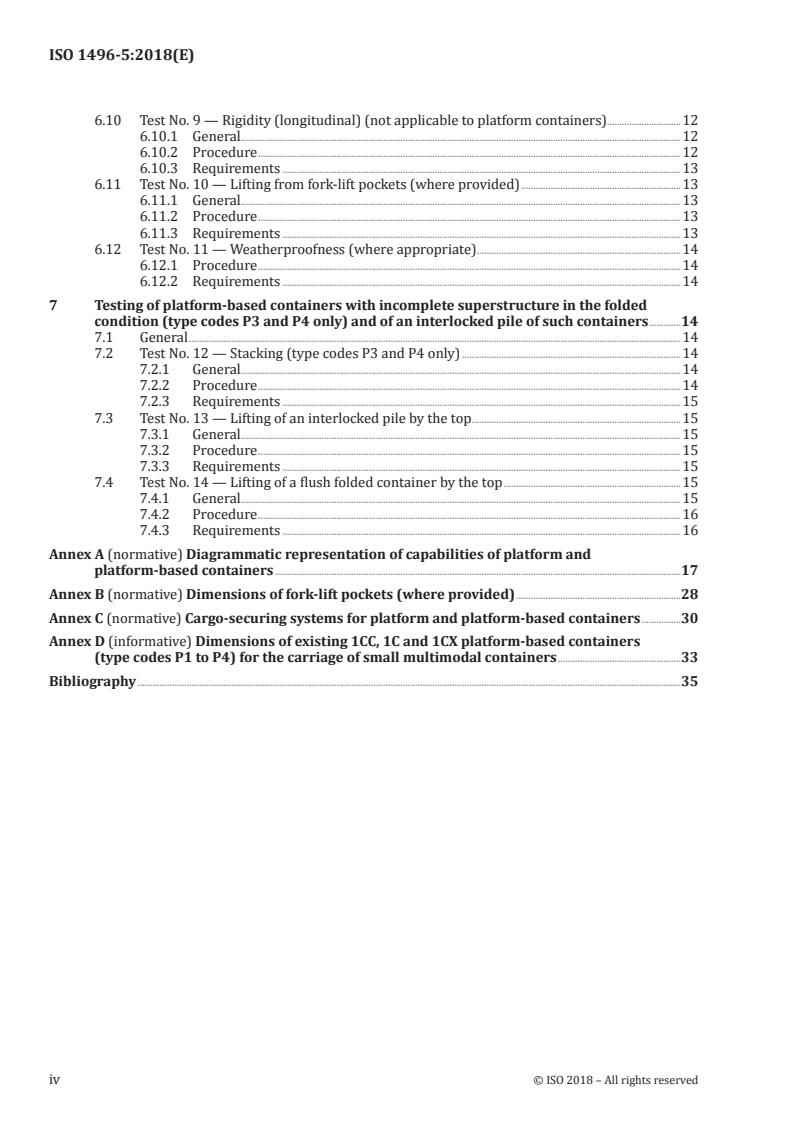
7 Testing of platform-based containers with incomplete superstructure in the folded
condition (type codes P3 and P4 only) and of an interlocked pile of such containers .14
7.1 General .14
7.2 Test No. 12 — Stacking (type codes P3 and P4 only) .14
7.2.1 General.14
7.2.2 Procedure .14
7.2.3 Requirements .15
7.3 Test No. 13 — Lifting of an interlocked pile by the top .15
7.3.1 General.15
7.3.2 Procedure .15
7.3.3 Requirements .15
7.4 Test No. 14 — Lifting of a flush folded container by the top .15
7.4.1 General.15
7.4.2 Procedure .16
7.4.3 Requirements .16
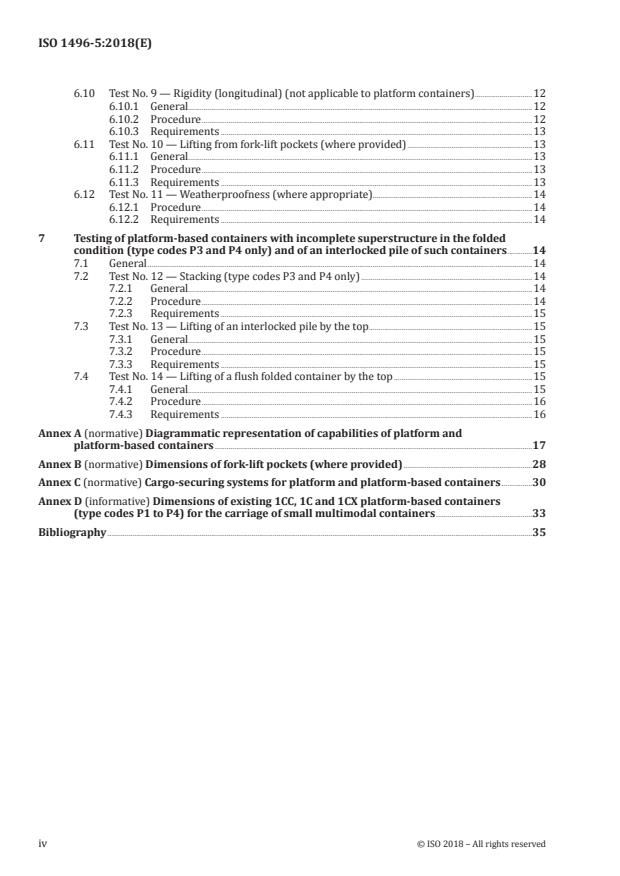
Annex A (normative) Diagrammatic representation of capabilities of platform and
platform-based containers .17
Annex B (normative) Dimensions of fork-lift pockets (where provided) .28
Annex C (normative) Cargo-securing systems for platform and platform-based containers .30
Annex D (informative) Dimensions of existing 1CC, 1C and 1CX platform-based containers
(type codes P1 to P4) for the carriage of small multimodal containers .33
Bibliography .35
iv © ISO 2018 – All rights reserved
Foreword
ISO (the International Organization for Standardization) is a worldwide federation of national standards
bodies (ISO member bodies). The work of preparing International Standards is normally carried out
through ISO technical committees. Each member body interested in a subject for which a technical
committee has been established has the right to be represented on that committee. International
organizations, governmental and non-governmental, in liaison with ISO, also take part in the work.
ISO collaborates closely with the International Electrotechnical Commission (IEC) on all matters of
electrotechnical standardization.
The procedures used to develop this document and those intended for its further maintenance are
described in the ISO/IEC Directives, Part 1. In particular, the different approval criteria needed for the
different types of ISO documents should be noted. This document was drafted in accordance with the
editorial rules of the ISO/IEC Directives, Part 2 (see www .iso .org/directives).
Attention is drawn to the possibility that some of the elements of this document may be the subject of
patent rights. ISO shall not be held responsible for identifying any or all such patent rights. Details of
any patent rights identified during the development of the document will be in the Introduction and/or
on the ISO list of patent declarations received (see www .iso .org/patents).
Any trade name used in this document is information given for the convenience of users and does not
constitute an endorsement.
For an explanation of the voluntary nature of standards, the meaning of ISO specific terms and
expressions related to conformity assessment, as well as information about ISO's adherence to the
World Trade Organization (WTO) principles in the Technical Barriers to Trade (TBT) see www .iso
.org/iso/foreword .html.
This document was prepared by Technical Committee ISO/TC 104, Freight containers, Subcommittee
SC 2, Specific purpose containers.
Any feedback or questions on this document should be directed to the user’s national standards body. A
complete listing of these bodies can be found at www .iso .org/members .html.
This third edition cancels and replaces the second edition (ISO 1496-5:1991), which has been technically
revised. It also incorporates the Amendments ISO 1496-5:1991/Amd 1:1993 and ISO 1496-5:1991/
Amd 2:1994. The main changes compared to the previous edition are as follows:
— in 5.9.1, “1CC, 1C and 1CX” have been deleted;
— old subclauses 5.9.2, 5.9.3 and 6.12 have been deleted and new subclause 7.4 added;
— in Table 3, the stacking test loads have been changed according to ISO 1496-1:2013;
— in 6.8.2, the floor strength test load has been changed from 5 460 kg to 7 260 kg;
— old Annexes B, D and E have been deleted;
A list of all parts in the ISO 1496 series can be found on the ISO website.
INTERNATIONAL STANDARD ISO 1496-5:2018(E)
Series 1 freight containers — Specification and testing —
Part 5:
Platform and platform-based containers
1 Scope
This document specifies the basic specifications and testing requirements for ISO series 1 freight
containers of the platform and platform-based types designated 1AAA, 1AA, 1A, 1AX, 1BBB, 1BB, 1B,
1BX, 1CC, 1C and 1CX which are suitable for international exchange and for conveyance by road, rail
and sea, including interchange between these forms of transport, with certain limitations (for example,
when loaded, platforms cannot be stacked or top lifted by means of conventional spreaders).
The container types covered by this document are given in Table 1.
Table 1 — Container types (in accordance with ISO 6346:1995/Amd 3:2012, Table E.1)
Code Type designation Type Main characteristics Detailed
group type code
code
P Platform (container) PL Platform (container) P0
P Platform-based container with
incomplete superstructure:
P -- Fixed PF -- Two complete and fixed ends P1
P -- Fixed posts, either free- P2
standing or with removable
top member
P -- Folding (collapsible) PC -- Folding complete end struc- P3
ture
-- Folding posts, either free-
P standing or with removable P4
top member
P Platform-based container with PS -- Open top, open ends (skeletal) P5
complete superstructure
P -- Platform-based container for PT -- Ship’s gear carrier P6
named cargo
P -- Car carrier P7
P -- Timber/pipe carrier P8
P -- Coil carrier P9
2 Normative references
The following documents are referred to in the text in such a way that some or all of their content
constitutes requirements of this document. For dated references, only the edition cited applies. For
undated references, the latest edition of the referenced document (including any amendments) applies.
ISO 668, Series 1 freight containers — Classification, dimensions and ratings
ISO 830, Freight containers — Vocabulary
ISO 1161, Series 1 freight containers — Corner and intermediate fittings — Specifications
3 Terms and definitions
For the purposes of this document, the terms and definitions given in ISO 830 and the following apply.
ISO and IEC maintain terminological databases for use in standardization at the following addresses:
— ISO Online browsing platform: available at https: //www .iso .org/obp
— IEC Electropedia: available at http: //www .electropedia .org/
3.1
platform
flat structure having no superstructure
Note 1 to entry: The equipment covered by this document is defined as a loadable platform having no
superstructure whatsoever but having the same length and width as the base of series 1 containers, and equipped
with top and bottom corner fittings, located in plan view as on other series 1 containers, so that some securing
and lifting devices used on other series 1 containers of the same length can also be used on platforms.
3.2
platform-based container
container which has no side walls but has a base similar to that of a platform container
3.3
incomplete superstructure
superstructure lacking any permanently fixed longitudinal load-carrying structure between the ends
other than at the base
3.4
interlocked pile
number of platform containers or folding platform-based containers (3.2), with ends folded down, which
are interlocked to form a unit (module)
Note 1 to entry: See 4.1.3.
4 Dimensions and ratings
4.1 External dimensions
4.1.1 The overall external dimensions and tolerances of the freight containers covered by this
document shall be those established in ISO 668, except that the requirements for the overall top lengths,
L, of platform-based containers with incomplete superstructure may be relaxed to the extreme limits
specified in Table 2.
Table 2 — Overall top dimension, L
Overall top dimension in tare Overall top dimension when
condition T loaded to R
Container designation
L L
max min
mm mm
1AAA, 1AA, 1A and 1AX 12 202 12 172
1BBB, 1BB, 1B and 1BX 9 135 9 105
1CC, 1C and 1CX 6 068 6 042
Any movement of the corner posts resulting from the change from the empty to the fully loaded
condition of the container should, as far as practicable, be equally disposed about the mean of the values
of L and L .
max min
2 © ISO 2018 – All rights reserved
Taking into account the fact that the mechanism of the folding end structures may introduce natural
play, the values of L and L specified in Table 2 shall be met. Failure to comply with this requirement
max min
is liable to lead to handling difficulties.
4.1.2 No part of the platform or platform-based container shall project beyond the envelope defined
by the overall external dimensions specified in:
— ISO 668 for the plan dimensions of the base structure of all containers, the plan dimensions of the
top part of container with complete superstructure, or the overall maximum height of all containers
which may also be of reduced dimensions; or
— Table 2 for the plan dimensions of the top part of containers with incomplete superstructure.
4.1.3 An interlocked pile of either platform or folded platform-based containers shall have the plan
1)
dimensions specified in ISO 668 and a pile height not exceeding 2 896 mm .
4.2 Internal dimensions
Internal dimensions are not specified; however, minimum internal dimensions of existing 1CC, 1C and
1CX platform-based containers for the carriage of small containers are given in Annex D. The values are
given as a guide to the design of small intermodal containers.
4.3 Ratings
The values of the rating, R, the maximum gross mass of these containers, shall be those specified in
ISO 668.
5 Design requirements
5.1 General
5.1.1 All containers shall be capable of fulfilling the requirements given in 5.1.2 to 5.1.5.
5.1.2 The strength requirements for containers are given in diagrammatic form in Annex A (these
requirements are applicable to all containers except where otherwise stated). They apply to containers
as complete units, i.e. those removable components in position as required for the intended operating
conditions.
5.1.3 The strength requirements for corner fittings (see also 5.3) are specified in ISO 1161.
5.1.4 All containers, except containers with folding ends (codes P3 and P4) in the folded condition,
shall be capable of withstanding the loads and loadings specified in Clause 6.
Containers with folding ends in the folded condition shall be capable of withstanding the loads and
loadings specified in Clause 7.
As the effects of loads encountered under any dynamic operating condition should only approach, but
not exceed, the effects of the corresponding test loads, it is implicit that the capabilities of containers
indicated in Annex A, and demonstrated by the tests described in Clauses 6 and 7, shall not be exceeded
in any mode of operation.
Containers need not be weatherproof but, if designed to be weatherproof, they shall satisfy test No. 13
(see 7.13).
1) 2 896 mm = 9 ft 6 in.
5.1.5 Any movable part which, if unsecured, could lead to a hazardous situation, shall be provided with
an adequate securing system having external indication of the positive securement of that part in the
appropriate operating position.
5.2 Interlocked pile of folded containers
Horizontal free play shall be limited between individual folded containers forming an interlocked pile
so that the pile is capable of complying with the dimensional requirements of 4.1.3.
The sum of the tare weights of the platform containers forming an interlocked pile, together with any
required securing devices, shall not exceed the maximum gross mass (MGM) specified in ISO 668 for
the size of container in question.
5.3 Corner fittings
5.3.1 All containers shall be equipped with top and bottom corner fittings (see Notes 1 and 2). The
requirements and positioning of the corner fittings are given in ISO 1161, except for the case mentioned
in 4.1.1.
NOTE 1 For 1CX platforms, the top and bottom corner fittings can be combined providing they comply with
ISO 1161.
NOTE 2 Due to greater inherent flexibility of all sizes of platform-based containers with incomplete
superstructure, the top aperture of top corner fittings can be increased by 10 mm in the direction of their end wall.
In such a case, the end aperture should be omitted in order to retain corner fitting strength.
5.3.2 Containers with folding ends shall be equipped with features such that, in the folded condition,
they may be stacked and secured, lifted from the top by means of a spreader equipped with corner
fitting locking devices (e.g. twistlocks), and interlocked with other containers having similar folding end
structures.
The features shall have at least an equivalent to the upper face and internal cavity of the top corner
fitting.
The positioning of the features in the folded condition shall meet the requirements of ISO 1161.
5.3.3 For all containers, including containers with folding ends folded down, the upper faces of the top
corner fittings or equivalent features (performing some of the functions of top corner fittings, see 5.3.2)
2)
shall protrude above the top of the container by a minimum of 6 mm (see 5.4.3). “Top of the container” is
understood as the highest level of any part of the container, for example the level of the top of a soft cover.
However, if reinforced zones or doubler plates are provided to afford protection in the vicinity of the
top corner fittings, such plates and their securements shall not protrude above the upper faces of the
top corner fittings.
2)
These plates shall not extend more than 750 mm from either end of the container but may cover the
full width.
5.4 Base structure
5.4.1 All containers shall be capable of being supported by their bottom corner fittings only.
1 1 1
+5 +31/ 6
2) 6 mm = in; 12,5 mm mm = in; in 250 mm = 10 in; 750 mm = 29 in.
−15, −11/ 6
4 2 2
4 © ISO 2018 – All rights reserved
5.4.2 All containers shall be capable of being supported only by load-transfer areas in their base
structure.
5.4.2.1 Consequently, these containers shall have end transverse members and sufficient intermediate
load-transfer areas (or a flat underside) of sufficient strength to permit vertical load transfer to or from
the longitudinal members of a carrying vehicle. Such longitudinal members are assumed to lie within the
3)
two 375 mm wide zones defined by the broken lines in ISO 668:2013, Figure B.1.
5.4.2.2 The lower faces of the load-transfer areas in the container base structure, including those of
+5
2)
the end transverse members, shall be in one plane located 12,5 mm mm above the plane of the
−15,
lower faces of the bottom corner fittings of the container (base plane), except where camber is provided
(see 5.4.5).
Apart from the bottom corner fittings and bottom side rail, no part of the container shall project below
this plane. However, doubler plates may be provided in the vicinity of the bottom corner fittings to
afford protection to the understructure.
4)
4)
Such plates shall not extend more than 550 mm from the outer end and not more than 470 mm from
4)
the side faces of the bottom corner fittings and their lower faces shall be at least 5 mm above the base
plane of the container.
5.4.2.3 The transfer of load between the underside of the bottom side rails and carrying vehicles is not
envisaged.
The transfer of load between bottom side rails and handling equipment should only occur when
provision has been made in accordance with 5.9.1.
4)
5.4.2.4 Containers having all their intermediate transverse members spaced 1 000 mm apart or less
(or having a flat underside) shall be deemed to comply with the requirements of 5.4.2.1.
4)
5.4.2.5 Requirements for containers not having transverse members spaced 1 000 mm apart or less
(and not having a flat underside) are given in ISO 668:2013, Annex B.
5.4.3 For all containers under dynamic conditions, or the static equivalent of a container having a load
uniformly distributed over the floor in such a way that the combined mass of the container and test load
4)
is equal to 1,8R, no part of the base of the container shall deflect more than 6 mm below the base plane
of the container.
5.4.4 The base structure shall be designed to withstand all forces, particularly lateral forces, induced
by the cargo in service (see also 5.7.3, 5.7.4 and Figure A.7 and Figure A.8). This is particularly important
where provisions are made for securement of cargo to the base structure of the container.
5.4.5 Camber may be provided with respect to the end transverse members, which shall be located at
the height specified in 5.4.2.2.
When determining camber of a platform-based container, note should be taken of the relationship
between the base deflections which occur under load and the longitudinal movement which is permitted
at the top of the corner posts (for which the limit is specified in 4.1.1).
When a container with camber is loaded to its rating R, the base should be approximately horizontal to
facilitate the transport of the container when it is supported by its base structure only.
1 1 1
+5 +31/ 6
3) 6 mm = in; 12,5 mm mm = in; 375 mm = 15 in; 750 mm = 29 in.
−15, −11/ 6
4 2 2
3 3 3 1 3
4) 5 mm = in; 42 mm = 1 in; 60 mm = 2 in; 470 mm = 18 in; 550 mm = 22 in; 1 000 mm = 39 in.
16 4 8 2 8
5.5 End structure (platform-based containers only)
For all platform-based containers, the sideway deflection of the top of the container with respect to the
bottom of the container, at the time it is under full transverse rigidity test conditions, shall not cause
4)
the sum of the changes in length of the two diagonals to exceed 60 mm .
5.6 Side structure (platform-based containers only)
For all platform-based containers, the longitudinal deflection of the top of the container with respect
to the bottom of the container, at the time it is under full longitudinal rigidity test conditions, shall not
4)
exceed 42 mm .
5.7 Walls and securing devices
5.7.1 Where containers are provided with end walls, these shall be able to withstand the effects of test
No. 5, except insofar as is implied in 5.7.3.
5.7.2 Where openings are provided in end walls, the ability of these walls to withstand test No. 5 shall
not be impaired.
5.7.3 Where containers are provided with ends which are not able to withstand test No. 5, means
shall be provided for securing the cargo to the base structure in such a manner that the cargo does not
transmit longitudinal forces to the ends.
5.7.4 Since the containers do not have side walls, adequate means shall be provided to permit the
securing of the cargo against lateral movement.
5.7.5 The design requirements for cargo-securing devices presented in 5.7.3 and 5.7.4 are specified in
Annex C.
5.8 Door openings
Door openings need not be provided.
5.9 Requirements — Optional features — Fork-lift pockets
5.9.1 Fork-lift pockets for handling containers in the loaded or unloaded condition may be provided as
optional features.
5.9.2 Where a set of fork-lift pockets has been fitted as in 5.9.1, a second set of fork-lift pockets may, in
addition, be provided on 1CC, 1C and 1CX containers for empty handling only.
5.9.3 Fork-lift pockets may be provided on 1AAA, 1AA, 1A, 1AX, 1BBB, 1BB, 1B, 1BX containers for
empty handling only, and caution decals shall be applied near the pockets to indicate operators that
these pockets are only for empty handling.
5.9.4 The fork-lift pockets, where provided, shall meet the dimensional requirements specified in
Annex B and shall pass completely through the base structure of the container so that lifting devices may
be inserted from either side. The base of the fork-lift pockets need not be the full width of the container
but shall be provided near each end of the fork-lift pockets.
6 © ISO 2018 – All rights reserved
6 Testing
6.1 General
6.1.1 Unless otherwise stated, containers complying with the design requirements specified in
Clause 5 shall, in addition, be capable of withstanding the tests specified in 6.2 to 6.13, and 7.1 to 7.3,
as applicable. Containers shall be tested in the condition for which they are designed to be operated.
Containers equipped with removable structural items shall be tested with these items in position.
Although the tests are numbered in a certain order, they may be carried out in a different order if
more appropriate to optimize utilization of the testing facilities or interpretation of the test results.
However, the weatherproofness test (test No. 11), where appropriate, shall always be performed after
all structural tests have been completed.
6.1.2 The symbol P denotes the maximum payload of the container to be tested calculated with
Formula (1):
P = R – T (1)
where
R is the rating;
T is the tare.
NOTE R, P and T, by definition, are in units of mass. Where test requirements are based on the gravitational
forces derived from these values, these forces, which are inertial forces, are indicated as follows: R , P , T ; the
g g g
units of which are in newtons or multiples thereof.
The word “load”, when used to describe a physical quantity to which units may be ascribed, implies mass.
The word “loading”, for example as in “internal loading”, implies force.
6.1.3 The test load or loading on the platform or platform-based container shall be uniformly
distributed.
6.1.4 The test loads and loadings specified in all of the following tests are minimum requirements.
6.1.5 The dimensional requirements to which reference is made after each test are those specified in:
a) the dimensional and design requirement clauses of this document, i.e. ISO 1496-5;
b) ISO 668;
c) ISO 1161.
6.2 Test No. 1 — Stacking
6.2.1 General
This test shall be carried out to prove the ability of a fully loaded container to support a superimposed
mass of containers, taking into account conditions aboard ships at sea and the relative eccentricities
between superimposed containers.
Table 3 specifies the force to be applied as a test to each pair of corner fittings and the superimposed
mass that the test force represents.
6.2.2 Procedure
6.2.2.1 Platform container
The container in the tare condition shall be placed on four level pads, one under each bottom corner
fitting or equivalent corner structure. The pads shall be centralized under the fittings, and shall be
substantially of the same plan dimensions as the fittings.
The container shall be subjected to vertical forces applied either to all four corner fittings simultaneously
or to each pair of end fittings, at the appropriate level specified in Table 3.
6.2.2.2 Platform-based container
The container shall be placed on four level pads, one under each bottom corner fitting. The pads shall
be centralized under the fittings, and shall be substantially of the same plan dimensions as the fittings.
The container shall have a load uniformly distributed over the floor in such a way that the combined
mass of the container and test load is equal to 1,8R.
The container shall be subjected to vertical forces applied either to all four corner fittings simultaneously
or to each pair of end fittings, at the appropriate level specified in Table 3.
6.2.2.3 Application of force
For platform or platform-based containers, the forces shall be applied through a test fixture equipped with
corner fittings as specified in ISO 1161, or equivalent fittings which have imprints of the same geometry
(i.e. with the same external dimensions, chamfered aperture and rounded edges) as the lower face of
the bottom corner fitting specified in ISO 1161. If equivalent fittings are used, they shall be designed to
produce the same effect on the container under the test loads as when corner fittings are used.
In all cases, the forces shall be applied in such a manner that rotation of the planes through which the
forces are applied and on which the container is supported is minimized.
5)
Each corner fitting or equivalent fitting shall be offset in the same direction by 25,4 mm laterally and
5)
38 mm longitudinally.
6.2.3 Requirements
On completion of the test, the container shall show neither permanent deformation nor abnormality
which will render it unsuitable for use, and the dimensional requirements affecting handling, securing
and interchange shall be satisfied.
6.3 Test No. 2 — Lifting from the four top corner fittings
6.3.1 General
This test shall be carried out to prove the ability of a container to withstand being lifted from the four
top corner fittings with the lifting forces applied vertically. These are the only recognized ways of
lifting these platform containers by the four top corner fittings.
Loaded platforms should be lifted by means of spreaders with extensions.
This test shall also be regarded as proving the ability of the floor and base structure to withstand the
forces arising from acceleration of the payload in lifting operations.
5) 25,4 mm = 1 in; 38 mm = 1 in.
8 © ISO 2018 – All rights reserved
6.3.2 Procedure
The container shall have a load uniformly distributed over the floor in such a way that the combined
mass of the container and test load is equal to 2R, and it shall be carefully lifted from all four top corners
in such a way that no significant acceleration or deceleration forces are applied.
For all platform containers, the lifting forces shall be applied vertically.
After lifting, the container shall be suspended for 5 min and then lowered to the ground.
6.3.3 Requirements
On completion of the test, the container shall show neither permanent deformation nor abnormality
which will render it unsuitable for use, and the dimensional requirements affecting handling, securing
and interchange shall be satisfied.
Table 3 — Forces to be applied in stacking test
Test force per container Superimposed mass
Test force per pair of
Container designation (all four corners simul- represented by test
end fittings
taneously) force
kN lbf kN lbf kg lb
1AAA, 1AA, 1A and 1AX 3 767 846 854 1 883 423 317 213 360 470 380
1BBB, 1BB, 1B and 1BX 3 767 846 854 1 883 423 317 213 360 470 380
1CC, 1C and 1CX 3 767 846 854 1 883 423 317 213 360 470 380
NOTE The test force of 3 767 kN per container is derived from the superimposed mass of eight-high stacking, i.e. seven
containers stacked on top of one container, all being rated to 30 480 kg, and an acceleration of 1,8 g. [The corner posts of
such containers are known to have been tested to 96 012 kg (211 610 lb)].
6.4 Test No. 3 — Lifting from the four bottom corner fittings
6.4.1 General
This test shall be carried out to prove the ability of a container to withstand being lifted from its four
bottom corner fittings by means of lifting devices bearing on the bottom corner fittings only and
attached to a single transverse central spreader beam above the container.
6.4.2 Procedure
The container shall have a load uniformly distributed over the floor in such a way that the combined
mass of container and test load is equal to 2R, and shall be carefully lifted from the side apertures of
all four bottom corner fittings in such a way that no significant acceleration or deceleration forces are
applied.
Lifting forces shall be applied at an angle of:
— 30° to the horizontal for 1AAA, 1AA, 1A and 1AX containers;
— 37° to the horizontal for 1BBB, 1BB, 1B and 1BX containers;
— 45° to the horizontal for 1CC, 1C and 1CX.
In each case, the line of action of the lifting force and the outer face of the corner fitting shall be no
6)
further apart than 38 mm . The lifting shall be carried out in such a manner that the lifting devices
bear on the four bottom corner fittings only.
After lifting, the container shall be suspended for 5 min and then lowered to the ground.
6) 38 mm = 1 in.
6.4.3 Requirements
On completion of the test, the container shall show neither permanent deformation nor abnormality
which will render it unsuitable for use, and the dimensional requirements affecting handling, securing
and interchange shall be satisfied.
6.5 Test No. 4 — External restraint (longitudinal)
6.5.1 General
This test shall be carried out to prove the ability of a container to withstand longitudinal external
restraint under dynamic conditions of railway operations, which implies acceleration of 2 g.
6.5.2 Procedure
The container shall have a load uniformly distributed over the floor in such a way that the combined
mass of the container and the
...
INTERNATIONAL ISO
STANDARD 1496-5
Third edition
2018-11
Series 1 freight containers —
Specification and testing —
Part 5:
Platform and platform-based
containers
Conteneurs de la série 1 — Spécifications et essais —
Partie 5: Conteneurs plates-formes et type plate-forme
Reference number
©
ISO 2018
© ISO 2018
All rights reserved. Unless otherwise specified, or required in the context of its implementation, no part of this publication may
be reproduced or utilized otherwise in any form or by any means, electronic or mechanical, including photocopying, or posting
on the internet or an intranet, without prior written permission. Permission can be requested from either ISO at the address
below or ISO’s member body in the country of the requester.
ISO copyright office
CP 401 • Ch. de Blandonnet 8
CH-1214 Vernier, Geneva
Phone: +41 22 749 01 11
Fax: +41 22 749 09 47
Email: copyright@iso.org
Website: www.iso.org
Published in Switzerland
ii © ISO 2018 – All rights reserved
Contents Page
Foreword .v
1 Scope . 1
2 Normative references . 1
3 Terms and definitions . 2
4 Dimensions and ratings . 2
4.1 External dimensions . 2
4.2 Internal dimensions. 3
4.3 Ratings . 3
5 Design requirements . 3
5.1 General . 3
5.2 Interlocked pile of folded containers . 4
5.3 Corner fittings . 4
5.4 Base structure . 4
5.5 End structure (platform-based containers only) . 6
5.6 Side structure (platform-based containers only) . 6
5.7 Walls and securing devices . 6
5.8 Door openings . 6
5.9 Requirements — Optional features — Fork-lift pockets . 6
6 Testing . 7
6.1 General . 7
6.2 Test No. 1 — Stacking . 7
6.2.1 General. 7
6.2.2 Procedure . 8
6.2.3 Requirements . 8
6.3 Test No. 2 — Lifting from the four top corner fittings . 8
6.3.1 General. 8
6.3.2 Procedure . 9
6.3.3 Requirements . 9
6.4 Test No. 3 — Lifting from the four bottom corner fittings . 9
6.4.1 General. 9
6.4.2 Procedure . 9
6.4.3 Requirements .10
6.5 Test No. 4 — External restraint (longitudinal) .10
6.5.1 General.10
6.5.2 Procedure .10
6.5.3 Requirements .10
6.6 Test No. 5 — Strength of end walls (where provided) . .10
6.6.1 General.10
6.6.2 Procedure .10
6.6.3 Requirements .10
7) 11
6.7 Test No. 6 — Strength of the roof (where provided) .
6.7.1 General.11
6.7.2 Procedure .11
6.7.3 Requirements .11
6.8 Test No. 7 — Floor strength .11
6.8.1 General.11
6.8.2 Procedure .11
6.8.3 Requirements .11
6.9 Test No. 8 — Rigidity (transverse) (not applicable to platform containers).11
6.9.1 General.11
6.9.2 Procedure .12
6.9.3 Requirements .12
6.10 Test No. 9 — Rigidity (longitudinal) (not applicable to platform containers).12
6.10.1 General.12
6.10.2 Procedure .12
6.10.3 Requirements .13
6.11 Test No. 10 — Lifting from fork-lift pockets (where provided) .13
6.11.1 General.13
6.11.2 Procedure .13
6.11.3 Requirements .13
6.12 Test No. 11 — Weatherproofness (where appropriate) .14
6.12.1 Procedure .14
6.12.2 Requirements .14
7 Testing of platform-based containers with incomplete superstructure in the folded
condition (type codes P3 and P4 only) and of an interlocked pile of such containers .14
7.1 General .14
7.2 Test No. 12 — Stacking (type codes P3 and P4 only) .14
7.2.1 General.14
7.2.2 Procedure .14
7.2.3 Requirements .15
7.3 Test No. 13 — Lifting of an interlocked pile by the top .15
7.3.1 General.15
7.3.2 Procedure .15
7.3.3 Requirements .15
7.4 Test No. 14 — Lifting of a flush folded container by the top .15
7.4.1 General.15
7.4.2 Procedure .16
7.4.3 Requirements .16
Annex A (normative) Diagrammatic representation of capabilities of platform and
platform-based containers .17
Annex B (normative) Dimensions of fork-lift pockets (where provided) .28
Annex C (normative) Cargo-securing systems for platform and platform-based containers .30
Annex D (informative) Dimensions of existing 1CC, 1C and 1CX platform-based containers
(type codes P1 to P4) for the carriage of small multimodal containers .33
Bibliography .35
iv © ISO 2018 – All rights reserved
Foreword
ISO (the International Organization for Standardization) is a worldwide federation of national standards
bodies (ISO member bodies). The work of preparing International Standards is normally carried out
through ISO technical committees. Each member body interested in a subject for which a technical
committee has been established has the right to be represented on that committee. International
organizations, governmental and non-governmental, in liaison with ISO, also take part in the work.
ISO collaborates closely with the International Electrotechnical Commission (IEC) on all matters of
electrotechnical standardization.
The procedures used to develop this document and those intended for its further maintenance are
described in the ISO/IEC Directives, Part 1. In particular, the different approval criteria needed for the
different types of ISO documents should be noted. This document was drafted in accordance with the
editorial rules of the ISO/IEC Directives, Part 2 (see www .iso .org/directives).
Attention is drawn to the possibility that some of the elements of this document may be the subject of
patent rights. ISO shall not be held responsible for identifying any or all such patent rights. Details of
any patent rights identified during the development of the document will be in the Introduction and/or
on the ISO list of patent declarations received (see www .iso .org/patents).
Any trade name used in this document is information given for the convenience of users and does not
constitute an endorsement.
For an explanation of the voluntary nature of standards, the meaning of ISO specific terms and
expressions related to conformity assessment, as well as information about ISO's adherence to the
World Trade Organization (WTO) principles in the Technical Barriers to Trade (TBT) see www .iso
.org/iso/foreword .html.
This document was prepared by Technical Committee ISO/TC 104, Freight containers, Subcommittee
SC 2, Specific purpose containers.
Any feedback or questions on this document should be directed to the user’s national standards body. A
complete listing of these bodies can be found at www .iso .org/members .html.
This third edition cancels and replaces the second edition (ISO 1496-5:1991), which has been technically
revised. It also incorporates the Amendments ISO 1496-5:1991/Amd 1:1993 and ISO 1496-5:1991/
Amd 2:1994. The main changes compared to the previous edition are as follows:
— in 5.9.1, “1CC, 1C and 1CX” have been deleted;
— old subclauses 5.9.2, 5.9.3 and 6.12 have been deleted and new subclause 7.4 added;
— in Table 3, the stacking test loads have been changed according to ISO 1496-1:2013;
— in 6.8.2, the floor strength test load has been changed from 5 460 kg to 7 260 kg;
— old Annexes B, D and E have been deleted;
A list of all parts in the ISO 1496 series can be found on the ISO website.
INTERNATIONAL STANDARD ISO 1496-5:2018(E)
Series 1 freight containers — Specification and testing —
Part 5:
Platform and platform-based containers
1 Scope
This document specifies the basic specifications and testing requirements for ISO series 1 freight
containers of the platform and platform-based types designated 1AAA, 1AA, 1A, 1AX, 1BBB, 1BB, 1B,
1BX, 1CC, 1C and 1CX which are suitable for international exchange and for conveyance by road, rail
and sea, including interchange between these forms of transport, with certain limitations (for example,
when loaded, platforms cannot be stacked or top lifted by means of conventional spreaders).
The container types covered by this document are given in Table 1.
Table 1 — Container types (in accordance with ISO 6346:1995/Amd 3:2012, Table E.1)
Code Type designation Type Main characteristics Detailed
group type code
code
P Platform (container) PL Platform (container) P0
P Platform-based container with
incomplete superstructure:
P -- Fixed PF -- Two complete and fixed ends P1
P -- Fixed posts, either free- P2
standing or with removable
top member
P -- Folding (collapsible) PC -- Folding complete end struc- P3
ture
-- Folding posts, either free-
P standing or with removable P4
top member
P Platform-based container with PS -- Open top, open ends (skeletal) P5
complete superstructure
P -- Platform-based container for PT -- Ship’s gear carrier P6
named cargo
P -- Car carrier P7
P -- Timber/pipe carrier P8
P -- Coil carrier P9
2 Normative references
The following documents are referred to in the text in such a way that some or all of their content
constitutes requirements of this document. For dated references, only the edition cited applies. For
undated references, the latest edition of the referenced document (including any amendments) applies.
ISO 668, Series 1 freight containers — Classification, dimensions and ratings
ISO 830, Freight containers — Vocabulary
ISO 1161, Series 1 freight containers — Corner and intermediate fittings — Specifications
3 Terms and definitions
For the purposes of this document, the terms and definitions given in ISO 830 and the following apply.
ISO and IEC maintain terminological databases for use in standardization at the following addresses:
— ISO Online browsing platform: available at https: //www .iso .org/obp
— IEC Electropedia: available at http: //www .electropedia .org/
3.1
platform
flat structure having no superstructure
Note 1 to entry: The equipment covered by this document is defined as a loadable platform having no
superstructure whatsoever but having the same length and width as the base of series 1 containers, and equipped
with top and bottom corner fittings, located in plan view as on other series 1 containers, so that some securing
and lifting devices used on other series 1 containers of the same length can also be used on platforms.
3.2
platform-based container
container which has no side walls but has a base similar to that of a platform container
3.3
incomplete superstructure
superstructure lacking any permanently fixed longitudinal load-carrying structure between the ends
other than at the base
3.4
interlocked pile
number of platform containers or folding platform-based containers (3.2), with ends folded down, which
are interlocked to form a unit (module)
Note 1 to entry: See 4.1.3.
4 Dimensions and ratings
4.1 External dimensions
4.1.1 The overall external dimensions and tolerances of the freight containers covered by this
document shall be those established in ISO 668, except that the requirements for the overall top lengths,
L, of platform-based containers with incomplete superstructure may be relaxed to the extreme limits
specified in Table 2.
Table 2 — Overall top dimension, L
Overall top dimension in tare Overall top dimension when
condition T loaded to R
Container designation
L L
max min
mm mm
1AAA, 1AA, 1A and 1AX 12 202 12 172
1BBB, 1BB, 1B and 1BX 9 135 9 105
1CC, 1C and 1CX 6 068 6 042
Any movement of the corner posts resulting from the change from the empty to the fully loaded
condition of the container should, as far as practicable, be equally disposed about the mean of the values
of L and L .
max min
2 © ISO 2018 – All rights reserved
Taking into account the fact that the mechanism of the folding end structures may introduce natural
play, the values of L and L specified in Table 2 shall be met. Failure to comply with this requirement
max min
is liable to lead to handling difficulties.
4.1.2 No part of the platform or platform-based container shall project beyond the envelope defined
by the overall external dimensions specified in:
— ISO 668 for the plan dimensions of the base structure of all containers, the plan dimensions of the
top part of container with complete superstructure, or the overall maximum height of all containers
which may also be of reduced dimensions; or
— Table 2 for the plan dimensions of the top part of containers with incomplete superstructure.
4.1.3 An interlocked pile of either platform or folded platform-based containers shall have the plan
1)
dimensions specified in ISO 668 and a pile height not exceeding 2 896 mm .
4.2 Internal dimensions
Internal dimensions are not specified; however, minimum internal dimensions of existing 1CC, 1C and
1CX platform-based containers for the carriage of small containers are given in Annex D. The values are
given as a guide to the design of small intermodal containers.
4.3 Ratings
The values of the rating, R, the maximum gross mass of these containers, shall be those specified in
ISO 668.
5 Design requirements
5.1 General
5.1.1 All containers shall be capable of fulfilling the requirements given in 5.1.2 to 5.1.5.
5.1.2 The strength requirements for containers are given in diagrammatic form in Annex A (these
requirements are applicable to all containers except where otherwise stated). They apply to containers
as complete units, i.e. those removable components in position as required for the intended operating
conditions.
5.1.3 The strength requirements for corner fittings (see also 5.3) are specified in ISO 1161.
5.1.4 All containers, except containers with folding ends (codes P3 and P4) in the folded condition,
shall be capable of withstanding the loads and loadings specified in Clause 6.
Containers with folding ends in the folded condition shall be capable of withstanding the loads and
loadings specified in Clause 7.
As the effects of loads encountered under any dynamic operating condition should only approach, but
not exceed, the effects of the corresponding test loads, it is implicit that the capabilities of containers
indicated in Annex A, and demonstrated by the tests described in Clauses 6 and 7, shall not be exceeded
in any mode of operation.
Containers need not be weatherproof but, if designed to be weatherproof, they shall satisfy test No. 13
(see 7.13).
1) 2 896 mm = 9 ft 6 in.
5.1.5 Any movable part which, if unsecured, could lead to a hazardous situation, shall be provided with
an adequate securing system having external indication of the positive securement of that part in the
appropriate operating position.
5.2 Interlocked pile of folded containers
Horizontal free play shall be limited between individual folded containers forming an interlocked pile
so that the pile is capable of complying with the dimensional requirements of 4.1.3.
The sum of the tare weights of the platform containers forming an interlocked pile, together with any
required securing devices, shall not exceed the maximum gross mass (MGM) specified in ISO 668 for
the size of container in question.
5.3 Corner fittings
5.3.1 All containers shall be equipped with top and bottom corner fittings (see Notes 1 and 2). The
requirements and positioning of the corner fittings are given in ISO 1161, except for the case mentioned
in 4.1.1.
NOTE 1 For 1CX platforms, the top and bottom corner fittings can be combined providing they comply with
ISO 1161.
NOTE 2 Due to greater inherent flexibility of all sizes of platform-based containers with incomplete
superstructure, the top aperture of top corner fittings can be increased by 10 mm in the direction of their end wall.
In such a case, the end aperture should be omitted in order to retain corner fitting strength.
5.3.2 Containers with folding ends shall be equipped with features such that, in the folded condition,
they may be stacked and secured, lifted from the top by means of a spreader equipped with corner
fitting locking devices (e.g. twistlocks), and interlocked with other containers having similar folding end
structures.
The features shall have at least an equivalent to the upper face and internal cavity of the top corner
fitting.
The positioning of the features in the folded condition shall meet the requirements of ISO 1161.
5.3.3 For all containers, including containers with folding ends folded down, the upper faces of the top
corner fittings or equivalent features (performing some of the functions of top corner fittings, see 5.3.2)
2)
shall protrude above the top of the container by a minimum of 6 mm (see 5.4.3). “Top of the container” is
understood as the highest level of any part of the container, for example the level of the top of a soft cover.
However, if reinforced zones or doubler plates are provided to afford protection in the vicinity of the
top corner fittings, such plates and their securements shall not protrude above the upper faces of the
top corner fittings.
2)
These plates shall not extend more than 750 mm from either end of the container but may cover the
full width.
5.4 Base structure
5.4.1 All containers shall be capable of being supported by their bottom corner fittings only.
1 1 1
+5 +31/ 6
2) 6 mm = in; 12,5 mm mm = in; in 250 mm = 10 in; 750 mm = 29 in.
−15, −11/ 6
4 2 2
4 © ISO 2018 – All rights reserved
5.4.2 All containers shall be capable of being supported only by load-transfer areas in their base
structure.
5.4.2.1 Consequently, these containers shall have end transverse members and sufficient intermediate
load-transfer areas (or a flat underside) of sufficient strength to permit vertical load transfer to or from
the longitudinal members of a carrying vehicle. Such longitudinal members are assumed to lie within the
3)
two 375 mm wide zones defined by the broken lines in ISO 668:2013, Figure B.1.
5.4.2.2 The lower faces of the load-transfer areas in the container base structure, including those of
+5
2)
the end transverse members, shall be in one plane located 12,5 mm mm above the plane of the
−15,
lower faces of the bottom corner fittings of the container (base plane), except where camber is provided
(see 5.4.5).
Apart from the bottom corner fittings and bottom side rail, no part of the container shall project below
this plane. However, doubler plates may be provided in the vicinity of the bottom corner fittings to
afford protection to the understructure.
4)
4)
Such plates shall not extend more than 550 mm from the outer end and not more than 470 mm from
4)
the side faces of the bottom corner fittings and their lower faces shall be at least 5 mm above the base
plane of the container.
5.4.2.3 The transfer of load between the underside of the bottom side rails and carrying vehicles is not
envisaged.
The transfer of load between bottom side rails and handling equipment should only occur when
provision has been made in accordance with 5.9.1.
4)
5.4.2.4 Containers having all their intermediate transverse members spaced 1 000 mm apart or less
(or having a flat underside) shall be deemed to comply with the requirements of 5.4.2.1.
4)
5.4.2.5 Requirements for containers not having transverse members spaced 1 000 mm apart or less
(and not having a flat underside) are given in ISO 668:2013, Annex B.
5.4.3 For all containers under dynamic conditions, or the static equivalent of a container having a load
uniformly distributed over the floor in such a way that the combined mass of the container and test load
4)
is equal to 1,8R, no part of the base of the container shall deflect more than 6 mm below the base plane
of the container.
5.4.4 The base structure shall be designed to withstand all forces, particularly lateral forces, induced
by the cargo in service (see also 5.7.3, 5.7.4 and Figure A.7 and Figure A.8). This is particularly important
where provisions are made for securement of cargo to the base structure of the container.
5.4.5 Camber may be provided with respect to the end transverse members, which shall be located at
the height specified in 5.4.2.2.
When determining camber of a platform-based container, note should be taken of the relationship
between the base deflections which occur under load and the longitudinal movement which is permitted
at the top of the corner posts (for which the limit is specified in 4.1.1).
When a container with camber is loaded to its rating R, the base should be approximately horizontal to
facilitate the transport of the container when it is supported by its base structure only.
1 1 1
+5 +31/ 6
3) 6 mm = in; 12,5 mm mm = in; 375 mm = 15 in; 750 mm = 29 in.
−15, −11/ 6
4 2 2
3 3 3 1 3
4) 5 mm = in; 42 mm = 1 in; 60 mm = 2 in; 470 mm = 18 in; 550 mm = 22 in; 1 000 mm = 39 in.
16 4 8 2 8
5.5 End structure (platform-based containers only)
For all platform-based containers, the sideway deflection of the top of the container with respect to the
bottom of the container, at the time it is under full transverse rigidity test conditions, shall not cause
4)
the sum of the changes in length of the two diagonals to exceed 60 mm .
5.6 Side structure (platform-based containers only)
For all platform-based containers, the longitudinal deflection of the top of the container with respect
to the bottom of the container, at the time it is under full longitudinal rigidity test conditions, shall not
4)
exceed 42 mm .
5.7 Walls and securing devices
5.7.1 Where containers are provided with end walls, these shall be able to withstand the effects of test
No. 5, except insofar as is implied in 5.7.3.
5.7.2 Where openings are provided in end walls, the ability of these walls to withstand test No. 5 shall
not be impaired.
5.7.3 Where containers are provided with ends which are not able to withstand test No. 5, means
shall be provided for securing the cargo to the base structure in such a manner that the cargo does not
transmit longitudinal forces to the ends.
5.7.4 Since the containers do not have side walls, adequate means shall be provided to permit the
securing of the cargo against lateral movement.
5.7.5 The design requirements for cargo-securing devices presented in 5.7.3 and 5.7.4 are specified in
Annex C.
5.8 Door openings
Door openings need not be provided.
5.9 Requirements — Optional features — Fork-lift pockets
5.9.1 Fork-lift pockets for handling containers in the loaded or unloaded condition may be provided as
optional features.
5.9.2 Where a set of fork-lift pockets has been fitted as in 5.9.1, a second set of fork-lift pockets may, in
addition, be provided on 1CC, 1C and 1CX containers for empty handling only.
5.9.3 Fork-lift pockets may be provided on 1AAA, 1AA, 1A, 1AX, 1BBB, 1BB, 1B, 1BX containers for
empty handling only, and caution decals shall be applied near the pockets to indicate operators that
these pockets are only for empty handling.
5.9.4 The fork-lift pockets, where provided, shall meet the dimensional requirements specified in
Annex B and shall pass completely through the base structure of the container so that lifting devices may
be inserted from either side. The base of the fork-lift pockets need not be the full width of the container
but shall be provided near each end of the fork-lift pockets.
6 © ISO 2018 – All rights reserved
6 Testing
6.1 General
6.1.1 Unless otherwise stated, containers complying with the design requirements specified in
Clause 5 shall, in addition, be capable of withstanding the tests specified in 6.2 to 6.13, and 7.1 to 7.3,
as applicable. Containers shall be tested in the condition for which they are designed to be operated.
Containers equipped with removable structural items shall be tested with these items in position.
Although the tests are numbered in a certain order, they may be carried out in a different order if
more appropriate to optimize utilization of the testing facilities or interpretation of the test results.
However, the weatherproofness test (test No. 11), where appropriate, shall always be performed after
all structural tests have been completed.
6.1.2 The symbol P denotes the maximum payload of the container to be tested calculated with
Formula (1):
P = R – T (1)
where
R is the rating;
T is the tare.
NOTE R, P and T, by definition, are in units of mass. Where test requirements are based on the gravitational
forces derived from these values, these forces, which are inertial forces, are indicated as follows: R , P , T ; the
g g g
units of which are in newtons or multiples thereof.
The word “load”, when used to describe a physical quantity to which units may be ascribed, implies mass.
The word “loading”, for example as in “internal loading”, implies force.
6.1.3 The test load or loading on the platform or platform-based container shall be uniformly
distributed.
6.1.4 The test loads and loadings specified in all of the following tests are minimum requirements.
6.1.5 The dimensional requirements to which reference is made after each test are those specified in:
a) the dimensional and design requirement clauses of this document, i.e. ISO 1496-5;
b) ISO 668;
c) ISO 1161.
6.2 Test No. 1 — Stacking
6.2.1 General
This test shall be carried out to prove the ability of a fully loaded container to support a superimposed
mass of containers, taking into account conditions aboard ships at sea and the relative eccentricities
between superimposed containers.
Table 3 specifies the force to be applied as a test to each pair of corner fittings and the superimposed
mass that the test force represents.
6.2.2 Procedure
6.2.2.1 Platform container
The container in the tare condition shall be placed on four level pads, one under each bottom corner
fitting or equivalent corner structure. The pads shall be centralized under the fittings, and shall be
substantially of the same plan dimensions as the fittings.
The container shall be subjected to vertical forces applied either to all four corner fittings simultaneously
or to each pair of end fittings, at the appropriate level specified in Table 3.
6.2.2.2 Platform-based container
The container shall be placed on four level pads, one under each bottom corner fitting. The pads shall
be centralized under the fittings, and shall be substantially of the same plan dimensions as the fittings.
The container shall have a load uniformly distributed over the floor in such a way that the combined
mass of the container and test load is equal to 1,8R.
The container shall be subjected to vertical forces applied either to all four corner fittings simultaneously
or to each pair of end fittings, at the appropriate level specified in Table 3.
6.2.2.3 Application of force
For platform or platform-based containers, the forces shall be applied through a test fixture equipped with
corner fittings as specified in ISO 1161, or equivalent fittings which have imprints of the same geometry
(i.e. with the same external dimensions, chamfered aperture and rounded edges) as the lower face of
the bottom corner fitting specified in ISO 1161. If equivalent fittings are used, they shall be designed to
produce the same effect on the container under the test loads as when corner fittings are used.
In all cases, the forces shall be applied in such a manner that rotation of the planes through which the
forces are applied and on which the container is supported is minimized.
5)
Each corner fitting or equivalent fitting shall be offset in the same direction by 25,4 mm laterally and
5)
38 mm longitudinally.
6.2.3 Requirements
On completion of the test, the container shall show neither permanent deformation nor abnormality
which will render it unsuitable for use, and the dimensional requirements affecting handling, securing
and interchange shall be satisfied.
6.3 Test No. 2 — Lifting from the four top corner fittings
6.3.1 General
This test shall be carried out to prove the ability of a container to withstand being lifted from the four
top corner fittings with the lifting forces applied vertically. These are the only recognized ways of
lifting these platform containers by the four top corner fittings.
Loaded platforms should be lifted by means of spreaders with extensions.
This test shall also be regarded as proving the ability of the floor and base structure to withstand the
forces arising from acceleration of the payload in lifting operations.
5) 25,4 mm = 1 in; 38 mm = 1 in.
8 © ISO 2018 – All rights reserved
6.3.2 Procedure
The container shall have a load uniformly distributed over the floor in such a way that the combined
mass of the container and test load is equal to 2R, and it shall be carefully lifted from all four top corners
in such a way that no significant acceleration or deceleration forces are applied.
For all platform containers, the lifting forces shall be applied vertically.
After lifting, the container shall be suspended for 5 min and then lowered to the ground.
6.3.3 Requirements
On completion of the test, the container shall show neither permanent deformation nor abnormality
which will render it unsuitable for use, and the dimensional requirements affecting handling, securing
and interchange shall be satisfied.
Table 3 — Forces to be applied in stacking test
Test force per container Superimposed mass
Test force per pair of
Container designation (all four corners simul- represented by test
end fittings
taneously) force
kN lbf kN lbf kg lb
1AAA, 1AA, 1A and 1AX 3 767 846 854 1 883 423 317 213 360 470 380
1BBB, 1BB, 1B and 1BX 3 767 846 854 1 883 423 317 213 360 470 380
1CC, 1C and 1CX 3 767 846 854 1 883 423 317 213 360 470 380
NOTE The test force of 3 767 kN per container is derived from the superimposed mass of eight-high stacking, i.e. seven
containers stacked on top of one container, all being rated to 30 480 kg, and an acceleration of 1,8 g. [The corner posts of
such containers are known to have been tested to 96 012 kg (211 610 lb)].
6.4 Test No. 3 — Lifting from the four bottom corner fittings
6.4.1 General
This test shall be carried out to prove the ability of a container to withstand being lifted from its four
bottom corner fittings by means of lifting devices bearing on the bottom corner fittings only and
attached to a single transverse central spreader beam above the container.
6.4.2 Procedure
The container shall have a load uniformly distributed over the floor in such a way that the combined
mass of container and test load is equal to 2R, and shall be carefully lifted from the side apertures of
all four bottom corner fittings in such a way that no significant acceleration or deceleration forces are
applied.
Lifting forces shall be applied at an angle of:
— 30° to the horizontal for 1AAA, 1AA, 1A and 1AX containers;
— 37° to the horizontal for 1BBB, 1BB, 1B and 1BX containers;
— 45° to the horizontal for 1CC, 1C and 1CX.
In each case, the line of action of the lifting force and the outer face of the corner fitting shall be no
6)
further apart than 38 mm . The lifting shall be carried out in such a manner that the lifting devices
bear on the four bottom corner fittings only.
After lifting, the container shall be suspended for 5 min and then lowered to the ground.
6) 38 mm = 1 in.
6.4.3 Requirements
On completion of the test, the container shall show neither permanent deformation nor abnormality
which will render it unsuitable for use, and the dimensional requirements affecting handling, securing
and interchange shall be satisfied.
6.5 Test No. 4 — External restraint (longitudinal)
6.5.1 General
This test shall be carried out to prove the ability of a container to withstand longitudinal external
restraint under dynamic conditions of railway operations, which implies acceleration of 2 g.
6.5.2 Procedure
The container shall have a load uniformly distributed over the floor in such a way that the combined
mass of the container and the
...