

ISO 17520:2024
(Main)Space environment (natural and artificial) — Cosmic ray and solar energetic particle penetration inward the magnetosphere — Method of determination of the effective vertical cut-off rigidity
General Information
- Abstract
This document describes the effective vertical cut-off rigidities of charged particles for near-Earth space and establishes principal requirements for their calculation based on different models of Earth’s geomagnetic field.[1] The techniques are useful for determination of penetrating into the Earth's magnetosphere by charged particle fluxes, as well as for test and estimations of the impact on spacecrafts and other equipment in the near-Earth space.
- Status
- Published
- Publication Date
- 05-Mar-2024
- Technical Committee
- ISO/TC 20/SC 14 - Space systems and operations
- Drafting Committee
- ISO/TC 20/SC 14 - Space systems and operations
- Current Stage
- 6060 - International Standard published
- Start Date
- 06-Mar-2024
- Due Date
- 30-Dec-2023
- Completion Date
- 06-Mar-2024
Buy Documents
ISO 17520:2024 - Space environment (natural and artificial) — Cosmic ray and solar energetic particle penetration inward the magnetosphere — Method of determination of the effective vertical cut-off rigidity Released:6. 03. 2024
Overview
ISO 17520:2024 provides a standardized method for determining the effective vertical cut-off rigidity (EVCR) of charged particles (cosmic rays and solar energetic particles) penetrating inward through the Earth's magnetosphere. The standard defines principal requirements and calculation techniques based on models of the geomagnetic field to assess particle access to near‑Earth space for rigidities above 0.2 GV. It is the second edition (revising ISO 17520:2016) and adds basic tables for IGRF epochs including 2015 and 2020.
Key topics and requirements
- Definition of key terms: particle magnetic rigidity, lower/upper cut-off rigidity, penumbra, effective cut-off rigidity, and EVCR (vertical direction).
- Trajectory tracing method: numerical integration of charged‑particle trajectories in combined internal (IGRF) and external (e.g., Tsyganenko) geomagnetic field models to determine allowed/forbidden access.
- Model parameterization: EVCR depends on geographic latitude/longitude, altitude (250 km to 20 000 km), geomagnetic disturbance level (e.g., K-index), and local time.
- Accuracy and validation: calculation techniques should achieve better than 2% accuracy; example results and world grids are provided (Tables B.1–B.4).
- Data generalization and libraries: guidance for building EVCR databases (world grids) and analytic generalization methods to interpolate across disturbance levels, local time and altitude, avoiding infeasibly large tabulations.
- Boundary and acceptance criteria: atmospheric boundary at 20 km (WGS‑84) treated as forbidden; trajectories reaching 15 Earth radii are considered to escape the magnetosphere (allowed).
- Applicability range: for galactic, solar and anomalous charged particle components with rigidity > 0.2 GV.
Applications and users
ISO 17520:2024 is practical for:
- Spacecraft designers and satellite systems engineers assessing radiation penetration and shielding requirements.
- Space weather analysts and mission planners modelling particle access to orbits and manned stations.
- Radiation effects specialists conducting single‑event effect and dose assessments for electronics and materials.
- Researchers building or using cut-off rigidity databases and interpolation software for orbit radiation environment estimation.
- Operators of LEO, MEO and high‑altitude missions requiring standardized input for radiation risk and instrument background analysis.
Benefits include repeatable, validated EVCR calculations that reflect geomagnetic disturbance and local time, enabling consistent assessments of particle penetration and impact on space systems.
Related standards and models
- References to the International Geomagnetic Reference Field (IGRF) and external field models (e.g., Tsyganenko) are integral to ISO 17520:2024.
- The document aligns with work from ISO/TC 20 (Aircraft and space vehicles), SC 14 (Space systems and operations).
- ISO 16695 is cited for internal magnetic field terminology.
Relations
- Effective Date
- 06-Jun-2022
Buy Documents
ISO 17520:2024 - Space environment (natural and artificial) — Cosmic ray and solar energetic particle penetration inward the magnetosphere — Method of determination of the effective vertical cut-off rigidity Released:6. 03. 2024
Get Certified
Connect with accredited certification bodies for this standard

BUREAU VERITAS Certification Germany
Bureau Veritas certification in Germany.

Element Materials Technology
Materials testing and product certification.

AQMS Ltd.
AQMS provides ISO certification to SMEs across the UK.
Sponsored listings
Frequently Asked Questions
ISO 17520:2024 is a standard published by the International Organization for Standardization (ISO). Its full title is "Space environment (natural and artificial) — Cosmic ray and solar energetic particle penetration inward the magnetosphere — Method of determination of the effective vertical cut-off rigidity". This standard covers: This document describes the effective vertical cut-off rigidities of charged particles for near-Earth space and establishes principal requirements for their calculation based on different models of Earth’s geomagnetic field.[1] The techniques are useful for determination of penetrating into the Earth's magnetosphere by charged particle fluxes, as well as for test and estimations of the impact on spacecrafts and other equipment in the near-Earth space.
This document describes the effective vertical cut-off rigidities of charged particles for near-Earth space and establishes principal requirements for their calculation based on different models of Earth’s geomagnetic field.[1] The techniques are useful for determination of penetrating into the Earth's magnetosphere by charged particle fluxes, as well as for test and estimations of the impact on spacecrafts and other equipment in the near-Earth space.
ISO 17520:2024 is classified under the following ICS (International Classification for Standards) categories: 49.140 - Space systems and operations. The ICS classification helps identify the subject area and facilitates finding related standards.
ISO 17520:2024 has the following relationships with other standards: It is inter standard links to ISO 17520:2016. Understanding these relationships helps ensure you are using the most current and applicable version of the standard.
ISO 17520:2024 is available in PDF format for immediate download after purchase. The document can be added to your cart and obtained through the secure checkout process. Digital delivery ensures instant access to the complete standard document.
Standards Content (Sample)
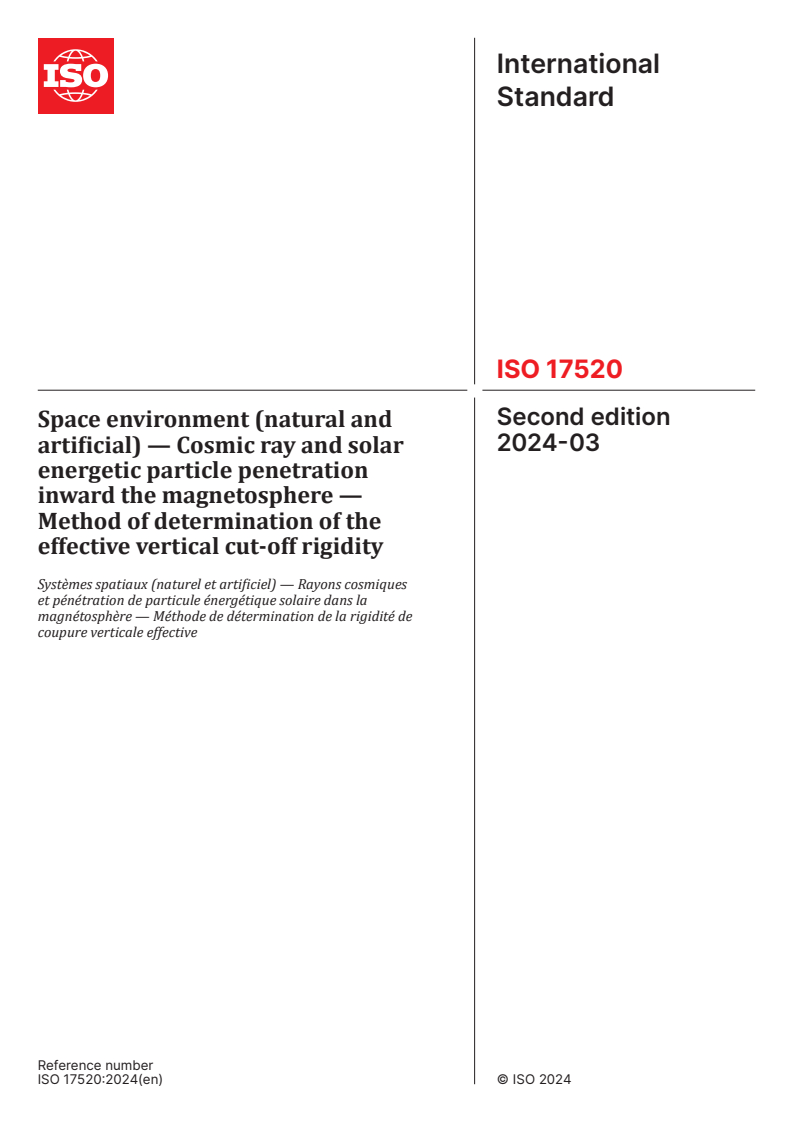
International
Standard
ISO 17520
Second edition
Space environment (natural and
2024-03
artificial) — Cosmic ray and solar
energetic particle penetration
inward the magnetosphere —
Method of determination of the
effective vertical cut-off rigidity
Systèmes spatiaux (naturel et artificiel) — Rayons cosmiques
et pénétration de particule énergétique solaire dans la
magnétosphère — Méthode de détermination de la rigidité de
coupure verticale effective
Reference number
ISO 17520:2024(en)
COPYRIGHT PROTECTED DOCUMENT
© ISO 2024
All rights reserved. Unless otherwise specified, or required in the context of its implementation, no part of this publication may
be reproduced or utilized otherwise in any form or by any means, electronic or mechanical, including photocopying, or posting on
the internet or an intranet, without prior written permission. Permission can be requested from either ISO at the address below
or ISO’s member body in the country of the requester.
ISO copyright office
CP 401 • Ch. de Blandonnet 8
CH-1214 Vernier, Geneva
Phone: +41 22 749 01 11
Email: copyright@iso.org
Website: www.iso.org
Published in Switzerland
ii
ISO 17520:2024(en)
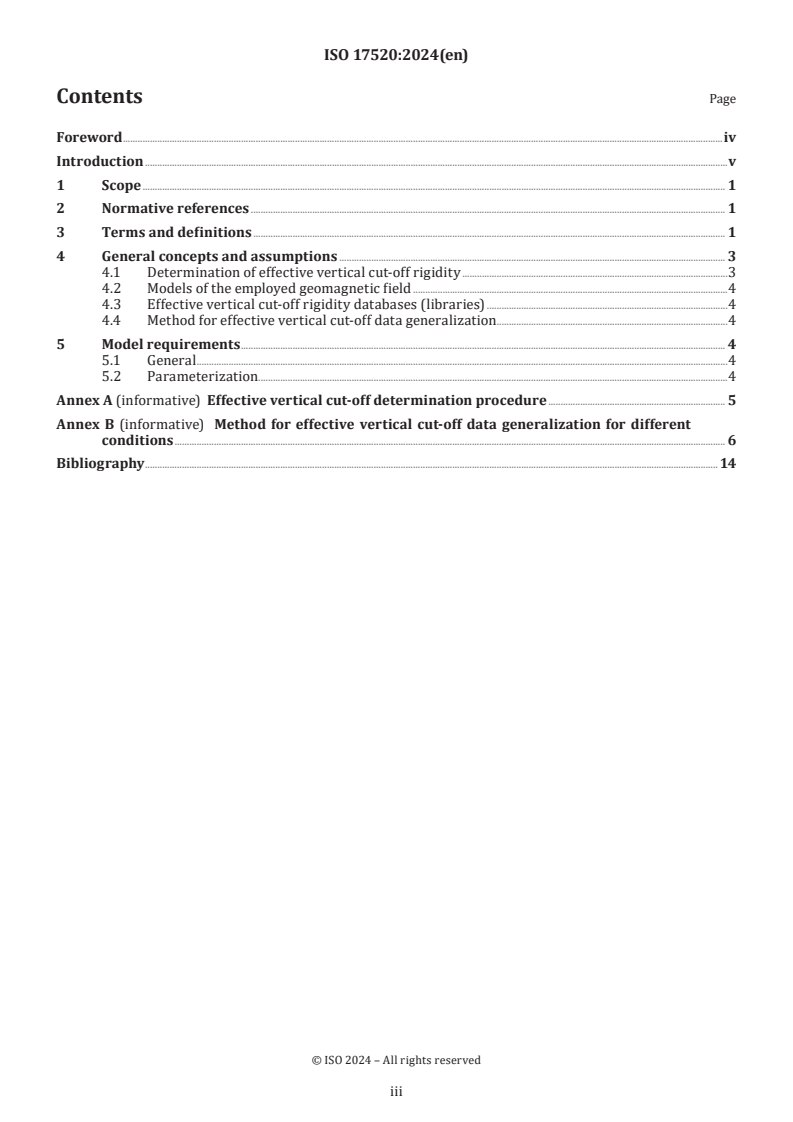
Contents Page
Foreword .iv
Introduction .v
1 Scope . 1
2 Normative references . 1
3 Terms and definitions . 1
4 General concepts and assumptions . 3
4.1 Determination of effective vertical cut-off rigidity .3
4.2 Models of the employed geomagnetic field .4
4.3 Effective vertical cut-off rigidity databases (libraries) .4
4.4 Method for effective vertical cut-off data generalization . .4
5 Model requirements . 4
5.1 General .4
5.2 Parameterization.4
Annex A (informative) Effective vertical cut-off determination procedure . 5
Annex B (informative) Method for effective vertical cut-off data generalization for different
conditions . 6
Bibliography . 14
iii
ISO 17520:2024(en)
Foreword
ISO (the International Organization for Standardization) is a worldwide federation of national standards
bodies (ISO member bodies). The work of preparing International Standards is normally carried out through
ISO technical committees. Each member body interested in a subject for which a technical committee
has been established has the right to be represented on that committee. International organizations,
governmental and non-governmental, in liaison with ISO, also take part in the work. ISO collaborates closely
with the International Electrotechnical Commission (IEC) on all matters of electrotechnical standardization.
The procedures used to develop this document and those intended for its further maintenance are described
in the ISO/IEC Directives, Part 1. In particular, the different approval criteria needed for the different types
of ISO document should be noted. This document was drafted in accordance with the editorial rules of the
ISO/IEC Directives, Part 2 (see www.iso.org/directives).
ISO draws attention to the possibility that the implementation of this document may involve the use of (a)
patent(s). ISO takes no position concerning the evidence, validity or applicability of any claimed patent
rights in respect thereof. As of the date of publication of this document, ISO had not received notice of (a)
patent(s) which may be required to implement this document. However, implementers are cautioned that
this may not represent the latest information, which may be obtained from the patent database available at
www.iso.org/patents. ISO shall not be held responsible for identifying any or all such patent rights.
Any trade name used in this document is information given for the convenience of users and does not
constitute an endorsement.
For an explanation of the voluntary nature of standards, the meaning of ISO specific terms and expressions
related to conformity assessment, as well as information about ISO's adherence to the World Trade
Organization (WTO) principles in the Technical Barriers to Trade (TBT), see www.iso.org/iso/foreword.html.
The committee responsible for this document is ISO/TC 20, Aircraft and space vehicles, and Subcommittee
SC 14, Space systems and operations.
This second edition cancels and replaces the first edition (ISO 17520:2016), which has been technically
revised.
The main changes are as follows:
— basic tables for epoch 2015 and 2020 calculated using IGRF model are added.
Any feedback or questions on this document should be directed to the user’s national standards body. A
complete listing of these bodies can be found at www.iso.org/members.html.
iv
ISO 17520:2024(en)
Introduction
This document describes principal requirements for determination of the effective vertical cut-off rigidity
of penetration of charged particles inward the Earth's magnetosphere. This model provides for calculations
of cut-off rigidity in arbitrary point of the magnetosphere at given local time. The document is applicable for
calculating the particle penetration by any of the component of interplanetary charged particles (galactic,
solar, and anomalous) with rigidities above 0,2 GV. The model satisfying these requirements depending on
geomagnetic disturbances described by the K -index is presented in Annex B. The main goals of the present
p
standardization for the determination of the effective vertical geomagnetic cut-off rigidities are as follows:
— provide an unambiguous procedure for calculation of the cut-off rigidities inside of the Earth’s
magnetosphere reflecting dependences on geomagnetic disturbances and local time;
— provide means of estimation of the impact of charged particle fluxes in interpretation and analysis of
space experiments.
v
International Standard ISO 17520:2024(en)
Space environment (natural and artificial) — Cosmic
ray and solar energetic particle penetration inward the
magnetosphere — Method of determination of the effective
vertical cut-off rigidity
1 Scope
This document describes the effective vertical cut-off rigidities of charged particles for near-Earth space and
establishes principal requirements for their calculation based on different models of Earth’s geomagnetic
[1]
field. The techniques are useful for determination of penetrating into the Earth's magnetosphere by
charged particle fluxes, as well as for test and estimations of the impact on spacecrafts and other equipment
in the near-Earth space.
2 Normative references
There are no normative references in this document.
3 Terms and definitions
For the purposes of this document, the following terms and definitions apply.
ISO and IEC maintain terminology databases for use in standardization at the following addresses:
— ISO Online browsing platform: available at https:// www .iso .org/ obp
— IEC Electropedia: available at https:// www .electropedia .org/
3.1
internal magnetic field
main magnetic field
magnetic field produced by the sources inside the Earth's core
[2]
Note 1 to entry: Internal magnetic field is described in ISO 16695 .
Note 2 to entry: It can be presented by the International Geomagnetic Reference Field (IGRF) model (3.2).
3.2
International Geomagnetic Reference Field model
IGRF model
geomagnetic reference field in the form of a series of spherical harmonic functions
Note 1 to entry: See Reference [3].
Note 2 to entry: The expansion coefficients undergo very slight changes in time.
Note 3 to entry: The International Association of Geomagnetism and Aeronomy (IAGA) is responsible for IGRF model
development and modifications and approves its coefficients every five years. The internal magnetic field is not the
subject of this document.
ISO 17520:2024(en)
3.3
external magnetic field
magnetic field produced by magnetospheric sources
[4]
Note 1 to entry: It can be described by different models, e.g. Tsyganenko-89 and more recent models presented in
References [5], [6], and [7].
3.4
geomagnetic field
sum of internal magnetic field (3.1) and external magnetic field (3.3)
3.5
particle charge
Z
-19
+ne, (n=1, 2, 3….), where e is the value of electron charge (1,60×10 C)
3.6
particle magnetic rigidity
R
value related to a particle’s momentum and its charge, calculated by:
R = pc/Z (1)
where
p is the particle momentum;
c is the speed of light;
Z is the particle charge (3.5)
Note 1 to entry: The magnetic rigidity of protons and nuclei is related to the particle's energy in accordance with
Formula (2).
A
R=+EE()2M (2)
Z
where
E is the kinetic energy in GeV/u;
A is the particle's mass in Dalton (atomic mass unit);
M is the rest mass of proton equal to 0,931 GeV
3.7
cut-off rigidity
location of a transition, in rigidity space, from allowed to forbidden trajectories as rigidity is decreasing
3.8
lower cut-off rigidity
R
L
rigidity value of a particle lower than which access for penetration from outside of the Earth’s magnetic field
is forbidden
Note 1 to entry: R is the calculated lowest cut-off value, i.e. the rigidity value of the lowest allowed/forbidden
L
transition obtained in computer simulations.
ISO 17520:2024(en)
3.9
upper cut-off rigidity
main cut-off rigidity
R
U
rigidity value of a particle higher than which access for penetration from outside of the Earth’s magnetic
field is allowed
Note 1 to entry: R is the rigidity value of the calculated upper cut-off value, i.e. the rigidity value of the highest
U
allowed/forbidden transition obtained in computer simulations.
3.10
penumbra
rigidity range lying between the lower cut-off rigidity (3.8) and the upper cut-off rigidity (3.9)
3.11
effective cut-off rigidity
R
eff
numerical value which specifies the equivalent total accessible cosmic radiation within the penumbra (3.10)
in a specific direction
3.12
effective vertical cut-off rigidity
EVRC
effective cut-off rigidity (3.11) for a particle arriving to a fixed point in the vertical direction (radially to the
centre of the Earth)
Note 1 to entry: The total effect of the penumbra (3.10) structure in a given direction may be represented, for a number
of purposes, by the effective cut-off rigidity.
3.13
K -index
p
three-hour quasi-logarithmic index of geomagnetic activity based on data of from 13 stations distributed
around the world
Note 1 to entry: The K -index is originally derived at GeoForschungsZentrum in Germany (http:// www .gfzpotsdam
p
.de/ en/ research/ organizationalunits/ departments/ department -2/ earthsmagnetic -field). It is also available at www
.swpc .noaa .gov.
Note 2 to entry: The range is from zero to nine.
4 General concepts and assumptions
4.1 Determination of effective vertical cut-off rigidity
The geomagnetic cut-off rigidities are determined by tracing particle trajectories in the geomagnetic field.
For a more detailed description of the method see Annex A and References [8], [9], and [10]. The method
determines the trajectory of negatively charged particles emitted from the given coordinate point in the
vertical direction in an effort to estimate whether the particle escapes the magnetosphere. As a result of
tests of particles with different rigidities, it is possible to determine upper and lower cut-off rigidities for
given magnetospheric conditions. From these data, the effective value of the vertical cut-off rigidity can be
determined.
The calculation technique should be detailed enough to determine the effective cut-off values with an
accuracy better than 2 %. Results of application of this type of calculation technique to IGRF model for a
given set of initial points are presented in Tables B.1 to B.4.
ISO 17520:2024(en)
4.2 Models of the employed geomagnetic field
The models for the geomagnetic field should reflect the changes of the internal magnetic field (IGRF model
for each five-year period) as well as changes of the external magnetic field caused by current flowing in the
[4],[5],[6],[7]
magnetosphere and on its surface. All models available (Tsyganenko or other extensions ) may be used.
4.3 Effective vertical cut-off rigidity databases (libraries)
In addition to direct computation of cut-off rigidities, the world grids of calculated values of vertical cut-off
rigidities can be used to evaluate the radiation conditions for different spacecraft and manned station orbits.
Sometimes, that kind of database is calculated for many different levels of magnetosphere disturbances and
[9],[11]
different local (or universal) time groups. These databases are put together a “library” . That kind of
“library,” together with the associated cut-off rigidity interpolation software, provides a tool for general use
in space physics applications.
4.4 Method for effective vertical cut-off data generalization
In these libraries, the effective vertical cut-off rigidity world grids are tabulated versus the discounted
magnetosphere disturbance levels and local (or universal) time. Spacecraft and manned station orbits are
variable, which means that the disturbance levels are not integers, but are subdivided. The same is true
for the local (or universal) time. Therefore, it is not convenient to tabulate the detailed library needed to
store all this data. The sheer size of the tabulation can make it unusable. However, the content of the library
can be generalized in the form of a unique world grid of effective vertical cut-off rigidities calculated with
the IGRF model for altitude H =450 km, and a set of analytic equations describing the EVCR values as a
function of IGRF rigidity values, altitude, magnetosphere disturbance, and local time. A working example of
the simplest model describing magnetosphere disturbances via the sole parameter, namely the К -index, is
р
presented in Annex B.
5 Model requirements
5.1 General
The model for determination of the effective vertical cut-off (referred to below as "model") presents the
effective vertical rigidity cut-off calculation.
The model determines an effective vertical cut-off at the altitudes from 250 km to 20 000 km over the mean
Earth radius r =6 371,2 km.
E
5.2 Parameterization
The cut-off rigidities depend on the following parameters: geographic latitude (λ) and longitude (φ), altitude
(H) over the Earth radius, the geomagnetic disturbance, and local time T.
ISO 17520:2024(en)
Annex A
(informative)
Effective vertical cut-off determination procedure
A.1 Main prepositions for cut-off rigidity calculation
— The effective vertical cut-off rigidity calculation for each (λ ,φ ) node of a geographic map is performed
i i
by numerical integration of a sampling of charged particle trajectories with opposite charge, ejected in
the local radial direction with the given rigidity.
— The atmospheric boundary is assumed to be at an altitude of 20 km over the International Reference
[12]
Ellipsoid (WGS-84). Particle trajectories falling inside this region during the tracing were considered
as forbidden.
— Particles achieved the distance of 15 r from Earth’s centre were considered to escape the magnetosphere.
E
Such trajectories were considered as allowed.
— Integrating along a particle’s trajectory provided accurate calculations that can be checked using
Tables B.1 to B.4.
A.2 Method for effective cut-off calculation
As a result of the cut-off calculation, the penumbra structure is obtained with concomitant values of R and
L
R , the upper and lower cut-off rigidities, respectively. The EVCR quantity required for the model, R , that
U eff
[13]
characterizes the “transparency” of the penumbra, was calculated according to the standard technique :
R = R + n δR (A.1)
eff L
where
n is the number of points in the interval between R and R , for which the arrival trajectories are for-
L U
bidden, as a result of tracing;
δR is an integration step.
ISO 17520:2024(en)
Annex B
(informative)
Method for effective vertical cut-off data generalization for different
conditions
B.1 General
The effective vertical cut-off data are presented in basic tables calculated for a 5-year period, using
...