

ISO 17440:2014
(Main)Cranes — General design — Limit states and proof of competence of forged steel hooks
General Information
- Abstract
ISO 17440:2014 is intended to be used together with the other relevant International Standards in its series. As such, they specify general conditions, requirements and methods to prevent hazards in hooks as part of all types of cranes. ISO 17440:2014 covers the following parts of hooks and types of hooks: bodies of any type of point hooks made of steel forgings; machined shanks of hooks with a thread/nut suspension. Its principles can be applied to other types of shank hooks and also where stress concentration factors relevant to that shank construction are determined and used. Plate hooks, which are those assembled from one or several parallel parts of rolled steel plates are not covered. ISO 17440:2014 is applicable to hooks from materials with ultimate strength of not more than 800 N/mm2 and yield stress of not more than 600 N/mm2. It is aimed at reducing or eliminating the risks associated with the following hazards: exceeding the limits of strength (yield, ultimate, fatigue); exceeding temperature limits of material; unintentional disengagement of the load from the hook. It is applicable to hook designs in general and to cranes manufactured after the date of its publication, and serves as a reference base for product standards of particular crane types. It deals only with the limit state method in accordance with ISO 8686‑1.
- Status
- Published
- Publication Date
- 13-May-2014
- Technical Committee
- ISO/TC 96/SC 10 - Design principles and requirements
- Drafting Committee
- ISO/TC 96/SC 10 - Design principles and requirements
- Current Stage
- 9093 - International Standard confirmed
- Start Date
- 12-Oct-2021
- Completion Date
- 29-Aug-2026
Buy Documents

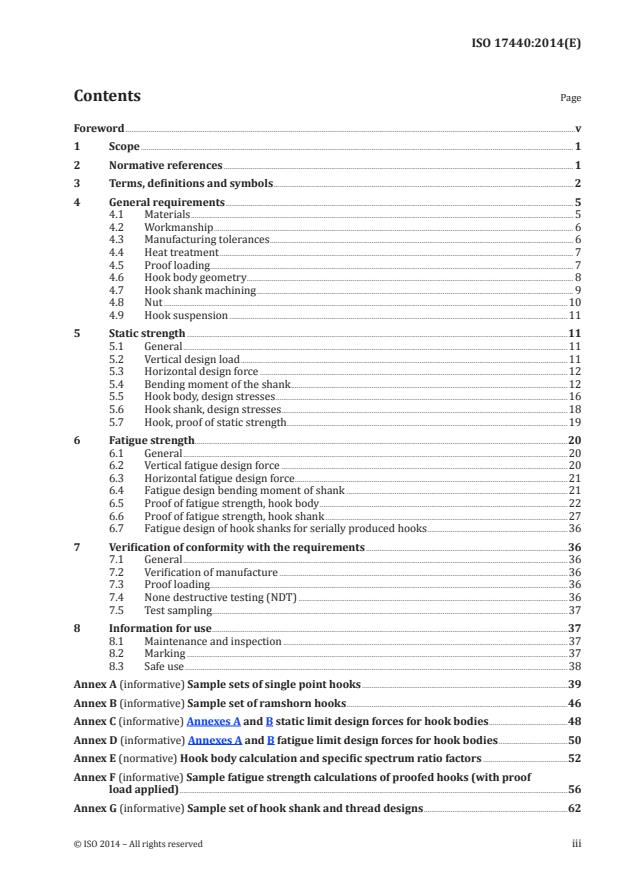
ISO 17440:2014 - Cranes — General design — Limit states and proof of competence of forged steel hooks Released:5/14/2014


ISO 17440:2014 - Appareils de levage a charge suspendue — Conception générale — États limites et vérification d'aptitude des crochets forgés Released:5/19/2015
Overview
ISO 17440:2014 - "Cranes - General design - Limit states and proof of competence of forged steel hooks" provides a harmonized framework for the design, verification and proof-testing of forged steel crane hooks and their machined shanks (thread/nut suspension). Intended to be used with other crane standards, it applies the limit state method (ISO 8686-1) to prevent hazards such as loss of strength (yield, ultimate, fatigue), excessive material temperatures and unintentional load disengagement. The standard covers hook bodies made from steel forgings and machined shanks up to specified material strength limits (ultimate ≤ 800 N/mm², yield ≤ 600 N/mm²) and excludes plate (rolled-plate) hooks.
Key topics and technical requirements
- Scope and definitions: hook body, shank, seat, suspension articulation and symbols for design calculations.
- Materials & workmanship: material property limits, heat treatment and manufacturing tolerances for forged hooks.
- Static strength: vertical and horizontal design forces, shank bending moments and proof of static strength.
- Fatigue strength: fatigue design forces, fatigue proof procedures and cumulative damage (Palmgren–Miner approach).
- Proof loading & testing: proof load requirements, proof of fitness, non-destructive testing (NDT) and sample testing procedures.
- Hook geometry & shank design: dimensional criteria, stress concentration considerations and guidance for shank/thread designs.
- Verification & conformity: manufacture verification, NDT, sampling rules and documentation.
- Information for use: marking, maintenance, inspection and safe-use guidance.
- Annexes: normative and informative annexes with sample hook sets, calculation examples, spectrum factors and suspension tilting resistance.
Practical applications
- Use ISO 17440:2014 for design verification of forged hook bodies and machined shanks in new cranes and lifting appliances.
- Apply it when performing proof load testing, NDT acceptance, or fatigue-life assessments for hooks.
- Reference it when developing product standards for specific crane types, specifying hook selection, inspection intervals and safe-use marking.
- Benefits include improved hook safety, predictable fatigue life, consistent proof testing and reduced risk of load disengagement.
Who should use this standard
- Crane designers and structural engineers
- Hook and forging manufacturers
- Third‑party testing, certification and inspection bodies
- OEMs of cranes and lifting equipment
- Maintenance and safety managers responsible for lifting operations
Related standards
Normative references include ISO 8686-1 (limit state design principles), ISO 12100 (machine safety/risk reduction), Charpy and tensile test standards (ISO 148, ISO 6892-1) and relevant forging/NDT standards. Use ISO 17440 together with these standards for comprehensive crane hook design and verification.
Keywords: ISO 17440:2014, forged steel hooks, crane hook design, limit states, fatigue strength, proof loading, hook shank, hook safety, crane standards.
Relations
- Consolidated By
ISO 7751:2016 - Rubber and plastics hoses and hose assemblies — Ratios of proof and burst pressure to maximum working pressure - Effective Date
- 06-Jun-2022
Buy Documents
ISO 17440:2014 - Cranes — General design — Limit states and proof of competence of forged steel hooks Released:5/14/2014
ISO 17440:2014 - Appareils de levage a charge suspendue — Conception générale — États limites et vérification d'aptitude des crochets forgés Released:5/19/2015
Frequently Asked Questions
ISO 17440:2014 is a standard published by the International Organization for Standardization (ISO). Its full title is "Cranes — General design — Limit states and proof of competence of forged steel hooks". This standard covers: ISO 17440:2014 is intended to be used together with the other relevant International Standards in its series. As such, they specify general conditions, requirements and methods to prevent hazards in hooks as part of all types of cranes. ISO 17440:2014 covers the following parts of hooks and types of hooks: bodies of any type of point hooks made of steel forgings; machined shanks of hooks with a thread/nut suspension. Its principles can be applied to other types of shank hooks and also where stress concentration factors relevant to that shank construction are determined and used. Plate hooks, which are those assembled from one or several parallel parts of rolled steel plates are not covered. ISO 17440:2014 is applicable to hooks from materials with ultimate strength of not more than 800 N/mm2 and yield stress of not more than 600 N/mm2. It is aimed at reducing or eliminating the risks associated with the following hazards: exceeding the limits of strength (yield, ultimate, fatigue); exceeding temperature limits of material; unintentional disengagement of the load from the hook. It is applicable to hook designs in general and to cranes manufactured after the date of its publication, and serves as a reference base for product standards of particular crane types. It deals only with the limit state method in accordance with ISO 8686‑1.
ISO 17440:2014 is intended to be used together with the other relevant International Standards in its series. As such, they specify general conditions, requirements and methods to prevent hazards in hooks as part of all types of cranes. ISO 17440:2014 covers the following parts of hooks and types of hooks: bodies of any type of point hooks made of steel forgings; machined shanks of hooks with a thread/nut suspension. Its principles can be applied to other types of shank hooks and also where stress concentration factors relevant to that shank construction are determined and used. Plate hooks, which are those assembled from one or several parallel parts of rolled steel plates are not covered. ISO 17440:2014 is applicable to hooks from materials with ultimate strength of not more than 800 N/mm2 and yield stress of not more than 600 N/mm2. It is aimed at reducing or eliminating the risks associated with the following hazards: exceeding the limits of strength (yield, ultimate, fatigue); exceeding temperature limits of material; unintentional disengagement of the load from the hook. It is applicable to hook designs in general and to cranes manufactured after the date of its publication, and serves as a reference base for product standards of particular crane types. It deals only with the limit state method in accordance with ISO 8686‑1.
ISO 17440:2014 is classified under the following ICS (International Classification for Standards) categories: 53.020.20 - Cranes. The ICS classification helps identify the subject area and facilitates finding related standards.
ISO 17440:2014 has the following relationships with other standards: It is inter standard links to ISO 7751:2016. Understanding these relationships helps ensure you are using the most current and applicable version of the standard.
ISO 17440:2014 is available in PDF format for immediate download after purchase. The document can be added to your cart and obtained through the secure checkout process. Digital delivery ensures instant access to the complete standard document.
Standards Content (Sample)
INTERNATIONAL ISO
STANDARD 17440
First edition
2014-06-01
Cranes — General design — Limit
states and proof of competence of
forged steel hooks
Appareils de levage à charge suspendue — Conception générale —
États limites et vérification d’aptitude des crochets forgés
Reference number
©
ISO 2014
© ISO 2014
All rights reserved. Unless otherwise specified, no part of this publication may be reproduced or utilized otherwise in any form
or by any means, electronic or mechanical, including photocopying, or posting on the internet or an intranet, without prior
written permission. Permission can be requested from either ISO at the address below or ISO’s member body in the country of
the requester.
ISO copyright office
Case postale 56 • CH-1211 Geneva 20
Tel. + 41 22 749 01 11
Fax + 41 22 749 09 47
E-mail copyright@iso.org
Web www.iso.org
Published in Switzerland
ii © ISO 2014 – All rights reserved
Contents Page
Foreword .v
1 Scope . 1
2 Normative references . 1
3 Terms, definitions and symbols . 2
4 General requirements . 5
4.1 Materials . 5
4.2 Workmanship . 6
4.3 Manufacturing tolerances . 6
4.4 Heat treatment . 7
4.5 Proof loading . 7
4.6 Hook body geometry. 8
4.7 Hook shank machining . 9
4.8 Nut .10
4.9 Hook suspension .11
5 Static strength .11
5.1 General .11
5.2 Vertical design load .11
5.3 Horizontal design force .12
5.4 Bending moment of the shank .12
5.5 Hook body, design stresses .16
5.6 Hook shank, design stresses .18
5.7 Hook, proof of static strength .19
6 Fatigue strength .20
6.1 General .20
6.2 Vertical fatigue design force .20
6.3 Horizontal fatigue design force .21
6.4 Fatigue design bending moment of shank .21
6.5 Proof of fatigue strength, hook body .22
6.6 Proof of fatigue strength, hook shank .27
6.7 Fatigue design of hook shanks for serially produced hooks .36
7 Verification of conformity with the requirements .36
7.1 General .36
7.2 Verification of manufacture .36
7.3 Proof loading .36
7.4 None destructive testing (NDT) .36
7.5 Test sampling . .37
8 Information for use .37
8.1 Maintenance and inspection .37
8.2 Marking .37
8.3 Safe use .38
Annex A (informative) Sample sets of single point hooks .39
Annex B (informative) Sample set of ramshorn hooks .46
Annex C (informative) Annexes A and B static limit design forces for hook bodies .48
Annex D (informative) Annexes A and B fatigue limit design forces for hook bodies .50
Annex E (normative) Hook body calculation and specific spectrum ratio factors .52
Annex F (informative) Sample fatigue strength calculations of proofed hooks (with proof
load applied) .56
Annex G (informative) Sample set of hook shank and thread designs .62
Annex H (normative) Bending of curved beams .68
Annex I (normative) Calculation of hook suspension tilting resistance, articulation by a hinge or
rope reeving system .71
Annex J (informative) Guidance for selection of hook size using Annexes C to E .75
Annex K (normative) Information to be provided by the hook manufacturer .77
Bibliography .78
iv © ISO 2014 – All rights reserved
Foreword
ISO (the International Organization for Standardization) is a worldwide federation of national standards
bodies (ISO member bodies). The work of preparing International Standards is normally carried out
through ISO technical committees. Each member body interested in a subject for which a technical
committee has been established has the right to be represented on that committee. International
organizations, governmental and non-governmental, in liaison with ISO, also take part in the work.
ISO collaborates closely with the International Electrotechnical Commission (IEC) on all matters of
electrotechnical standardization.
The procedures used to develop this document and those intended for its further maintenance are
described in the ISO/IEC Directives, Part 1. In particular the different approval criteria needed for the
different types of ISO documents should be noted. This document was drafted in accordance with the
editorial rules of the ISO/IEC Directives, Part 2. www.iso.org/directives
Attention is drawn to the possibility that some of the elements of this document may be the subject of
patent rights. ISO shall not be held responsible for identifying any or all such patent rights. Details of any
patent rights identified during the development of the document will be in the Introduction and/or on
the ISO list of patent declarations received. www.iso.org/patents
Any trade name used in this document is information given for the convenience of users and does not
constitute an endorsement.
For an explanation on the meaning of ISO specific terms and expressions related to conformity
assessment, as well as information about ISO’s adherence to the WTO principles in the Technical
Barriers to Trade (TBT) see the following URL: Foreword - Supplementary information
The committee responsible for this document is ISO/TC 96, Cranes, Subcommittee SC 8, Jib cranes.
INTERNATIONAL STANDARD ISO 17440:2014(E)
Cranes — General design — Limit states and proof of
competence of forged steel hooks
1 Scope
This International Standard is intended to be used together with the other relevant International
Standards in its series. As such, they specify general conditions, requirements and methods to prevent
hazards in hooks as part of all types of cranes.
This International Standard covers the following parts of hooks and types of hooks:
— bodies of any type of point hooks made of steel forgings;
— machined shanks of hooks with a thread/nut suspension.
NOTE 1 The principles of this International Standard can be applied to other types of shank hooks and also
where stress concentration factors relevant to that shank construction are determined and used. Plate hooks,
which are those assembled from one or several parallel parts of rolled steel plates are not covered in this
International Standard.
This International Standard is applicable to hooks from materials with ultimate strength of not more
2 2
than 800 N/mm and yield stress of not more than 600 N/mm .
The following is a list of significant hazardous situations and hazardous events that could result in risks
to persons during normal use and foreseeable misuse. Clauses 4 to 8 of this document are necessary to
reduce or eliminate the risks associated with the following hazards:
a) exceeding the limits of strength (yield, ultimate, fatigue);
b) exceeding temperature limits of material;
c) unintentional disengagement of the load from the hook.
The requirements of this International Standard are stated in the main body of the document and are
applicable to hook designs in general. The hook body and shank designs listed in Annexes A, B and G are
only examples and should not be referred to as requirements of this International Standard.
This International Standard is applicable to cranes manufactured after the date of its publication, and
serves as a reference base for product standards of particular crane types.
NOTE 2 This International Standard deals only with the limit state method in accordance with ISO 8686-1.
2 Normative references
The following documents, in whole or in part, are normatively referenced in this document and are
indispensable for its application. For dated references, only the edition cited applies. For undated
references, the latest edition of the referenced document (including any amendments) applies.
ISO 148-1, Metallic materials — Charpy pendulum impact test — Part 1: Test method
ISO 148-2, Metallic materials — Charpy pendulum impact test — Part 2: Verification of testing machines
ISO 643, Steels — Micrographic determination of the apparent grain size
ISO 965-1, ISO general purpose metric screw threads — Tolerances — Part 1: Principles and basic data
ISO 4287, Geometrical Product Specifications (GPS) — Surface texture: Profile method — Terms, definitions
and surface texture parameters
ISO 4306-1, Cranes — Vocabulary — Part 1: General
ISO 4301-1, Cranes and lifting appliances — Classification — Part 1: General
ISO 6892-1, Metallic materials — Tensile testing — Part 1: Method of test at room temperature
ISO 8686-1, Cranes — Design principles for loads and load combinations — Part 1: General
ISO 9327-1, Steel forgings and rolled or forged bars for pressure purposes — Technical delivery conditions —
Part 1: General requirements
ISO 7500-1, Metallic materials — Verification of static uniaxial testing machines — Part 1: Tension/compression
testing machines — Verification and calibration of the force-measuring system
ISO 12100, Safety of machinery — General principles for design — Risk assessment and risk reduction
ISO 15579, Metallic materials — Tensile testing at low temperature
EN 10228-3, Non-destructive testing of steel forgings ― Part 3: Ultrasonic testing of ferritic or martensitic
steel forgings
EN 10243-1, Steel die forgings ― Tolerances on dimensions ― Part 1: Drop and vertical press forgings
3 Terms, definitions and symbols
For the purposes of this document, the terms and definitions given in ISO 12100 and ISO 4306-1 and the
following terms, definitions and symbols (see Table 1) apply.
3.1
hook shank
upper part of the hook, from which the hook is suspended to the hoist media of the crane
3.2
hook body
lower, curved part of the hook below the shank
3.3
hook seat
bottom part of the hook body, where the load lifting attachment is resting
3.4
hook suspension articulation
feature of the hook suspension, allowing the hook to tilt along the inclined load line
2 © ISO 2014 – All rights reserved
Table 1 — Symbols
Symbol Description
A Cross section area of the forged, shank
d1
A Cross section area of the critical section of hook shank
d4
A Minimum impact toughness of material
v
a Acceleration
a Seat circle diameter
a Throat opening
a Height of the hook point
b Maximum width in the critical hook body section
max
b Reference width
ref
C Total number of working cycles during the design life of crane
C Relative tilting resistance of the hook suspension
t
c Coefficient for load eccentricity
e
D Cumulative damage in fatigue (Palmgren-Miner hypothesis)
d Diameter of the forged shank
d Principal diameter of thread
d Diameter of the undercut section of the shank
d Thread core diameter
e Distance of the vertical load line from the centre line of the shank
R
F Vertical force
F Vertical force on hook due to occasional or exceptional loads
H
F , F Limit design forces, static / fatigue
Rd,s Rd,f
F Vertical design force for the proof of static strength
Sd,s
F Vertical design force for the proof of fatigue strength
Sd,f
f f , f Factors of further influences
1, 2 3
f Limit design stress
Rd
f Yield stress
y
f Ultimate strength
u
g Acceleration due to gravity, g = 9,81 m/s
H Horizontal design force of hook
Sd,s
H Horizontal design force for the proof of fatigue strength
Sd,f
h , h Section heights of the hook body
1 2
h Vertical distance from the seat bottom of the hook body to the centre of the articulation
h Vertical distance from the seat bottom of the hook body to critical section of hook shank
s
i Index for a lifting cycle or a stress cycle
I Reference moment of inertia for curved beam
I Moment of inertia of the forged shank
d1
I Moment of inertia of the critical section of hook shank
d4
k Conversion factor for stress spectrum and classified duty
C
k ,k Stress spectrum factors
h s
kQ Load spectrum factor, in accordance with ISO 8686-1
Table 1 (continued)
Symbol Description
k *, k * Specific spectrum ratio factors, m = 5 / 6
5 6
lg Log to the base of 10
M , M , M , M Bending moments of hook shank
1 2 3 4
M , M , M Bending moments of hook shank for the proof of fatigue strength, lifting cycle i
1,f,i 2,f,i 3,f,i
M Static design bending moment
Sd,s
m Slope parameter of the characteristic fatigue design curve
m Mass of rated hoist load
RC
m Mass of the hook load in a lifting cycle i
i
N Total number of stress cycles / lifting cycles
N Reference number of stress cycles, ND = 2 × 10
D
p Pitch of thread
p Average number of accelerations related to one lifting cycle
a
R Radius of hook body curvature
R Average depth of surface profile according to ISO 4287
a
R Maximum depth of surface profile according to ISO 4287
z
r Relief radius of the undercut
r Thread bottom radius
th
s Length of undercut
s , s Stress history parameters
h s
s Load history parameter
Q
t Depth of thread
T Operation temperature
u , u Depths of notches
S T
α Angle
α , α Stress concentration factors
S T
β Angle or direction of hook inclination
β , β , β Notch effect factors
n nS nT
ϕ Dynamic factor for hoisting an unrestrained grounded load
ϕ Dynamic factor for changes of acceleration of a movement
γ Risk coefficient
n
γ Partial safety factor
p
γ General resistance coefficient
m
γ Specific resistance coefficient
sm
γ , γ Fatigue strength specific resistance factors
Hf Sf
η Edge distance of a hook body section
ν Factor for load component
νh, νs Relative numbers of stress cycles
μ Factor for mean stress influence
σ Shank stress due to axial force
a
σ Shank stress due to bending moment
b
σ Mean stress in a stress cycle
m
4 © ISO 2014 – All rights reserved
Table 1 (continued)
Symbol Description
σ Stress amplitude in a stress cycle
A
σ Design stress
Sd
σ Basic fatigue strength amplitude, un-notched piece
M
σ Total stress range in a pulsating stress cycle
p
σ Fatigue strength amplitude, notched piece
W
σ , σ , σ Transformed stress amplitudes
Tmax T1 T2
Δσ Characteristic fatigue strength
c
Δσ Limit fatigue design stress
Rd
Δσ Stress range in a lifting cycle i
Sd,i
Δσ Maximum stress range
Sd,max
4 General requirements
4.1 Materials
The hook material in the finished product shall have sufficient ductility to avoid brittle fracture at the
temperature range specified for the use of the hook. Hook material, after forging and heat treatment,
shall have minimum elongation and Charpy-V impact toughness in accordance with Table 2.
Table 2 — Impact test and elongation requirements for hook material
Operation temperature Impact test temperature Minimum elongation, Minimum impact
A toughness, A
5 v
T ≥ - 10 °C 0 °C
T ≥ - 20 °C − 10 °C
15 % 35 J
− 30 °C > T ≥ − 40 °C − 30 °C
− 40 °C > T ≥ − 50 °C − 40 °C
To satisfy the requirements of the operating temperature, the manufacturer shall select an alloyed or
non-alloyed steel, as appropriate, which after suitable heat treatment, shall be consistent with achieving
the chosen mechanical property grade for the selected hook form, taking into account its individual
ruling thickness.
The steel shall be produced by an electric process or by one of the oxygen processes.
The steel shall be fully killed, stabilized against strain age embrittlement and have an austenitic grain
size of 6 or finer when tested in accordance with ISO 643. This shall accomplished, by ensuring that the
steel contains sufficient aluminium (minimum 0,025 %) to permit the manufacture of hooks stabilized
against strain-age-embrittlement during service.
The steel shall contain no more sulfur and phosphorus than the limits given in Table 3.
Table 3 — Sulfur and phosphorus content
Element Maximum mass content as determined by
Cast analysis Check analysis
% %
Sulfur (S) 0,020 0,025
Phosphorus (P) 0,020 0,025
Sum of S + P 0,035 0,045
The mechanical properties ( yield stress, ultimate strength) are dependent upon the thickness of the
forged hook body. As a ruling thickness, either the largest width of the hook seat or the diameter of the
shank shall be used, whichever is greater
For standardization purposes, a classification of material grades for forged hooks is specified in
Table 4. The values of mechanical properties given in Table 4 shall be used as design values and shall be
guaranteed as minimum values by the hook manufacturer.
Table 4 — Material properties for classified material grades
Mechanical properties
Upper yield stress or 0,2 % proof
Material class refer‑
Ultimate strength
stress
ence
f
u
f
y
N/mm
N/mm
M 215 340
P 315 490
S 380 540
T 500 700
V 600 800
All materials selected shall fulfil the following requirement: f /f ≥ 1,2
u y
4.2 Workmanship
The manufacturing process, factory tests and delivery conditions shall meet the requirements of
ISO 9327-1.
Each hook body shall be forged hot in one piece. The macroscopic flow lines of the forging shall follow
the body outline of the hook. Excess metal from the forging operation shall be removed cleanly leaving
the surface free from sharp edges.
Profile cutting from a rolled plate is not permissible for forged hooks.
The surface roughness of the hook seat in the finished product shall be equal to or better than R
z
500 µm. Grinding may be used to reach the required surface quality. Any grinding marks shall be in a
circumferential direction in respect to the seat circle.
After heat treatment, furnace scale shall be removed and the hook body shall be free from harmful
defects, including cracks. Hook forging shall be inspected for defects using appropriate NDT-methods
according to EN 10228-3. Requirements of quality class 1 of EN 10228-3: shall be met.
No welding shall be carried out at any stage of manufacture.
4.3 Manufacturing tolerances
The dimensional tolerances according to EN 10243-1 for forging grade F shall be fulfilled, except as
modified herein.
6 © ISO 2014 – All rights reserved
The seat circle diameter and the throat opening shall be within [0; +7 %] of the nominal dimension. The
point height dimension a shall be within [− 7 %; +7 %] of the nominal dimension.
The centre line of the machined shank shall not deviate from the seat centre more than ± 0,02 a .
The shape of the hook in its own plane shall be such that the centres of the material sections specified by
the two flanks of a section shall fall between two parallel planes with a spacing of 0,05 d .
4.4 Heat treatment
Each forged hook shall either be hardened from a temperature above the AC point and tempered, or
normalized from a temperature above the AC point. The tempering temperature shall be at least 475 °C.
The normalizing or tempering conditions shall be at least as effective as a temperature of 475 °C
maintained for a period of 1 h.
4.5 Proof loading
As part of the manufacturing process, a hook may be proof loaded. This initial proof loading should
be conducted at ambient room temperature and can further assist the Quality Assurance Management
process as well as improve the fatigue performance of the hook in general. If proof loading is applied, the
process of proof loading shall be as follows:
a) Proof loading shall be applied after the complete manufacturing process. (forging, heat treatment
and machining)
b) The proof load force shall be applied between shank suspension nut and either:
i) the base of the hook seat, for a straight line pull, parallel with the vertical axis of the shank, in
the case of a single point hook.
ii) two opposite contact points on the hook bowl surface consistent with a symmetrical 90 degree
sling spread, and with load lines passing thro’ the hook bowl centre(s), in the case of ramshorn
hooks.
c) A relative permanent set due to proof loading measured at the gap opening shall not exceed 0,25 %;
For batch-produced hooks the proof loading shall be applied to each and every hook in the batch;
d) The magnitude of the proof load (F ) should reflect a 1,5f theoretical maximum tensile stress in
PL. y
the body fibres in section B for single point and section A for ramshorn hooks for the chosen material.
The value of this proof load shall be determined as follows relative to either section A(ramshorn) or
B(single point) as the case may be:
Single point hook
15, fM
yhf.
F =
PL,sp
1 000
Ramshorn hook
15, fM
yhf.
F =
PL.rh.
1 000v
where F is expressed in kilonewtons (kN), f is the yield stress of the chosen material, and M is a
PL y hf.
hook factor, i.e. for the hook intradoses of either section A or B, as the case may be, sample data are
depicted within Annex C for individual hooks of their particular family.
vx=05,tanα
for section A of ramshorn hooks, α = 45° (see 5.5.3)
M is derived from the formula
hf.
()1−η /R
I
Rη
()
All definitions are as per Annex H .
e) After proof loading, the hook shall be inspected for defects using appropriate NDT-methods and
found free from harmful flaws, defects and cracks;
f) Proof loaded hook shall be stamped with symbol “PL” adjacent to the hook type marking.
g) The application of proof loading will affect (beneficially) subsequent fatigue performance of the
hook. Calculation methodology of an example in Annex F can be used to quantify this effect.
Steels and in particular high strength steels for hooks due to be subjected to proof loading should
be selected with due attention to the need of their adequate ductility.
NOTE 1 Additional benefits derived from the application of proof loading to the QA Management process
is not addressed within this standard.
NOTE 2 The maximum stressed tensile fibres under F will of course yield and a redistribution of stress
PL
will occur, resulting in a permanent compressive stress in this tensile area when the proof load is removed
4.6 Hook body geometry
Proportions of hook sections shall be such that stresses do not exceed stresses in the critical sections
specified in 5.5.1.
The seat of a hook shall be of circular shape. In a single hook, the centre of curvature shall coincide with
the centreline of the machined shank. In a ramshorn hook, the seat circle shall be tangential in respect
to the outer edge of the forged shank.
A ramshorn hook shall be symmetrical with respect to the centre line of the shank.
Figure 1 — Hook dimensions
8 © ISO 2014 – All rights reserved
The diameter of the forged shank (d ) shall be proportioned to circle diameter (a ) as follows:
1 1
d ≥ 0,55 a
1 1
The bifurcation point between the inner edge and the seat circle (a ) shall be from the horizontal in
minimum as follows: for a single hook α ≥ 60°, for a ramshorn hook α ≥ 90°
The full throat opening (a ), without consideration to a latch shall be proportioned to the seat circle
diameter as follows: a ≤ 0,85 a . The effective throat opening with a latch shall be in minimum a ≥ 0,7
2 1 0
a .
The point height of a hook (a ) shall be in minimum as follows: a ≥ a .
3 3 1
Annexes A and B present example sets of hook body dimensions, which fulfil the requirements of this
clause.
Other hook bodies differing from those shown within Annexes A and B can be technically assessed,
either individually or as national groups to the requirements of this standard, provided dimensional
characteristics shown within this clause and material requirements are fulfilled.
Furthermore, it is expected that other hook body sets in addition to those currently shown can and will
be put forward for inclusion as national groups, within Annexes A and B. in the future.
4.7 Hook shank machining
Figure 2 — Machined dimensions of shank
The length of the threaded portion of the shank shall be not less than 0,8d .
The pitch of the thread (p) shall be proportioned to the principal diameter of the thread (d ) as follows:
0,055d ≤ p ≤ 0,15d
3 3
The depth of the thread (t) shall be proportioned to the pitch of the thread (p) as follows:
0,45p ≤ t ≤ 0,61p
The bottom radius of the thread profile (r ) shall be no less than 0,14p. A thread type, where the bottom
th
radius is not specified, shall not be used.
The shank shall be undercut (with a diameter d ) below the last threads for a length (s) proportioned to
the undercut depth as follows: s ≥ 2 (d − d ). The undercut shall reach deeper than the core diameter of
3 4
the thread profile (d ), in minimum as follows: d ≤ (d − 0,3 mm). The undercut shall be machined with
5 4 5
a form ground tool to a surface finish of R ≤ 3,2 µm and shall be free from machining marks and defects.
a
There shall be a relief radius in a transition from the threaded part to the undercut part. The relief
radius (r ) shall be proportioned to the diameter of the undercut (d ) as follows: r ≥ 0,06 d . The shape
9 4 9 4
of the relief transition need not be a complete quadrant of a circle.
The thinnest section of the machined shank (consequently d ) shall fulfil the condition d ≥ 0,65d ,
4 4 1
where d is the diameter of the forged part of the shank, see Figure 1.
The whole machined section of the shank shall have a radius at each change in diameter. The machined
section shall not reach the curved part of the forged body.
Screwed threads shall conform to the tolerance requirements of ISO 965-1 (coarse series) and be of
medium fit class 6g.
NOTE Annex G presents example sets of machined shank and thread dimensions, which fulfil the geometric
requirements. Other hook shank and thread designs differing from those shown within Annex G can be utilized
and technically assessed to the requirements of this standard, provided dimensional parameters fulfil the
requirements of this clause. Furthermore, it is expected that other hook shank and thread designs in addition to
those currently shown can and will be put forward for inclusion as national groups within Annex G in the future.
4.8 Nut
The material grade of the nut shall be equal to that of the hook
The height of the nut shall be such that the threaded length of the hook shank is fully engaged with the
nut thread.
The nut shall be positively locked to the shank against rotation to prevent the nut from unscrewing.
The locking shall not interfere with the lower two thirds of the nut/shank thread connection. The
locking shall allow relative axial movement between the shank and the nut due to play in the threaded
connection. Alternatively, if the nut is locked by a dowel or other similar fixing media, it is essential
during the locking process that the nut/shank load bearing thread flanks are in direct contact to ensure
resultant unimpaired load transmission.
The nut shall rest on an anti-friction bearing, enabling the hook body to rotate about the vertical axis.
The contact surface of the nut resting on the bearing shall meet the requirements as stipulated by the
related bearing. The height position of the contact surface shall fall within the lower half of the thread
connection.
Screwed threads of the nut shall comply with the tolerance requirements of ISO 965-1 (coarse series)
and be of medium fit class 6H. The bottom radius of the thread profile for the nut shall be not less than
0,07 p, where p is the pitch of the thread. A thread type, where the bottom radius is not specified, shall
not be used.
10 © ISO 2014 – All rights reserved
4.9 Hook suspension
In general, and always for serially produced hook blocks, the hook suspension together with hoist rope
reeving system shall be such that the system allows free tilting of the hook in any inclined direction
of the load line. In cases where this articulation of the hook suspension is not provided, this shall be
specially taken into consideration in the design calculations of the hook. In cases, where by changing the
crane/hook block configuration or position the hook suspension can be brought to a rigid position, this
shall be taken into account in the design calculation of the hook.
The same load actions as specified for the hook shall be taken into account in the design of the hook
suspension.
5 Static strength
5.1 General
The proof of static strength for hooks shall be carried out in accordance with principles of ISO 8686-1.
The general design limit for static strength is yielding of the material.
The proof shall be delivered for the specified critical sections of the hook, taking into account the most
unfavourable load effects from the load combinations A, B or C in accordance with ISO 8686-1. The
relevant partial safety factors γ shall be applied. The risk coefficients γ shall be applied when required
p n
in the specific application or as specified in the relevant European crane type standard.
5.2 Vertical design load
The vertical design force for a hook F when hoisting the rated hook load, shall be calculated as follows:
Sd,s
Fm=×ϕγ××g ×γ (1)
Sd,s RC pn
a
with ϕϕ=+max; 1 ϕ ×
25
g
where
ϕ is the dynamic factor, when hoisting an unrestrained grounded load, see ISO 8686-1
ϕ is the dynamic factor for loads caused by hoist acceleration, see ISO 8686-1
a is the vertical acceleration or deceleration;
m is the mass of the rated hook load;
RC
g is the acceleration due to gravity, g = 9,81 m/s ;
γ is the partial safety factor, see ISO 8686-1:
p
γ = 1,34 for regular loads (load combinations A);
p
γ = 1,22 for occasional loads (load combinations B);
p
γ = 1,10 for exceptional loads (load combinations C);
p
γ is the risk coefficient.
n
Other load actions and combinations of ISO 8686-1 may produce vertical forces on the hook, whose load
actions shall also be analysed. The vertical design force in such cases is expressed in a general format
as follows:
FF=×γγ× (2)
Sd,s Hp n
where
F is a vertical force on hook due to other load action than hoisting a rated load; e.g. a test load or
H
a peak load in an overload condition;
γ is the partial safety factor as above, see ISO 8686-1;
p
γ is the risk coefficient.
n
5.3 Horizontal design force
The Horizontal forces that are most significant for the strength of hooks are those caused by horizontal
accelerations of the crane motions and these shall be taken into account. Other horizontal forces e.g. due
to wind or sideways pull actions shall be taken into account, if significant. The horizontal force shall be
assumed to act at the bottom of the hook seat.
The horizontal design force of hook H due to horizontal accelerations shall be calculated as follows:
Sd,s
ma××ϕγ××γ
RC 5 pn
H =min (3)
Sd,s
CF× h
tSd,s
where
m is the mass of the rated hook load;
RC
a is the acceleration or deceleration of a horizontal motion;
ϕ is the dynamic factor for loads caused by horizontal acceleration, see ISO 8686-1. For hook
suspensions, which are not rigidly connected in horizontal direction to the moving part of the
crane, it shall be set ϕ = 1;
γ is the partial safety factor as for Formula (1);
p
γ is the risk coefficient;
n
C is the relative tilting resistance of the hook suspension in accordance with Annex I;
t
F is the vertical design force in accordance with 5.2, related to the loading condition where H
Sd,s Sd,s
is specified;
h is the vertical distance from the seat bottom of the hook body to the centre of the articulation.
5.4 Bending moment of the shank
5.4.1 General
The following load action shall be taken into consideration, when determining the total bending moment
of the hook shank:
a) horizontal forces, see 5.4.2;
b) inclination of the hook suspension, see 5.4.3;
12 © ISO 2014 – All rights reserved
c) eccentric action of vertical force in the hook seat, see 5.4.4;
a) ramshorn hook, half of the rated load on one prong, see 5.4.5.
The bending moments caused through these load actions shall be addressed to the same load
combinations, which the primary loads or operational conditions causing the bending belong to.
5.4.2 Bending moment due to horizontal force
This clause covers the shank bending moment due to external horizontal forces. The moment M shall be
calculated at the critical hook shank section (see 5.6) due to the horizontal design force H .
Sd,s
MH=×h (4)
1 Sd,s s
where
H is the horizontal design force in accordance with 5.3;
Sd,s
h is the vertical distance from the seat bottom of the hook body to the upper end of the thinnest part
s
of the hook shank. Bending moment due to inclination of hook suspension.
Where the arrangement of the hoist mechanism or hook/hook block is such that the hook suspension
may be brought to an inclined position in a loaded condition, the bending moment at the shank caused by
this inclination shall be considered in the design calculations. Such an inclination may be caused e.g. by:
a) Differences in hoist travel distances between two separate hoist drives carrying a load beam with a
hook, see Figure 3;
b) Tilting of a single rope reeving during hoisting/lowering motion, see Figure 4;
c) Tilting of a crane part, to which a hook is rigidly attached; or
d) Two-blocking of a bottom block in the uppermost hoist position with a crane part, after which this
crane part is tilted.
Figure 3 — Tilting of a hook in case of different hoist travel distances
Due to an inclination, the vertical force has a force component perpendicular to the axis of the hook
shank. This force shall be taken into account in the same way as the horizontal forces. The bending
moment M caused at the critical hook shank section is proportional to the vertical design force as
follows:
MF=×h ×sin(β) (5)
2 Sd,s s
where
F is the vertical design force in accordance with 5.2, related to the condition with a hook inclina-
Sd,s
tion β;
β is the maximum, total inclination in each relevant load combination;
h is the vertical distance from the seat bottom of the hook body to the upper end of the thinnest
s
part of the hook shank.
In a rope balanced hook suspension with multiple rope falls and a single running rope coming from the
drum, the hoisting/lowering movement causes the hook suspension to tilt, see Figure 4. The inclination
is calculated as follows:
β =arctan Ch (6)
()
t
where
C is the relative tilting resistance of the hook suspension in accordance with Annex I;
t
h is the vertical distance from the seat bottom of the hook body to the centre of the articulation.
The maximum inclination, the related vertical force and the consequent moment M shall be calculated
separately for all relevant loading conditions of the crane.
Figure 4 — Tilting of a hook suspension in a single rope reeving system
14 © ISO 2014 – All rights reserved
5.4.3 Bending moment due to eccentricity of vertical force
A hoist load attachment may not always settle in the middle of the hook seat. The deviation of the vertical
load action line from the centre line of the shank causes a bending moment, which shall be calculated as
follows:
Mc=×Fa× (7)
31eSd,s
where
F is the vertical design force in accordance with 5.2;
Sd,s
a is the seat circle diameter of the hook body;
c is a coefficient for the eccentricity (c = 0,05).
e e
NOTE A smaller eccentricity may be used in the design calculations, if a positive, mechanical means is
provided ensuring that the hoist load attachment settles closer to the hook seat centre.
5.4.4 Special case for a ramshorn hook
As a special loading case for ramshorn hooks it shall be assumed, that half of the vertical force acts on
one prong while the other prong is unloaded. This loading case is addressed in the calculations to the
load combination C.
For a ramshorn hook with one-sided loading, the bending moment M caused at the critical hook shank
section shall be calculated as follows:
e
R
MF=×21eh×−(/hh)/+×h min (8)
4 Sd,s Rss
C
t
with
ea=+()d /2
R 11
where
F is the vertical design force in accordance with 5.2 and γ for load combination C;
Sd,s p
d is the diameter of the forged shank;
a is the seat circle diameter of the hook;
e is the distance of the vertical load line fro
...
NORME ISO
INTERNATIONALE 17440
Première édition
2014-06-01
Appareils de levage à charge
suspendue — Conception générale —
États limites et vérification d’aptitude
des crochets forgés
Cranes — General design — Limit states and proof of competence of
forged steel hooks
Numéro de référence
©
ISO 2014
DOCUMENT PROTÉGÉ PAR COPYRIGHT
© ISO 2014
Droits de reproduction réservés. Sauf indication contraire, aucune partie de cette publication ne peut être reproduite ni utilisée
sous quelque forme que ce soit et par aucun procédé, électronique ou mécanique, y compris la photocopie, l’affichage sur
l’internet ou sur un Intranet, sans autorisation écrite préalable. Les demandes d’autorisation peuvent être adressées à l’ISO à
l’adresse ci-après ou au comité membre de l’ISO dans le pays du demandeur.
ISO copyright office
Case postale 56 • CH-1211 Geneva 20
Tel. + 41 22 749 01 11
Fax + 41 22 749 09 47
E-mail copyright@iso.org
Web www.iso.org
Publié en Suisse
ii © ISO 2014 – Tous droits réservés
Sommaire Page
Avant-propos . v
1 Domaine d'application . 1
2 Références normatives . 1
3 Termes, définitions et symboles . 2
4 Prescriptions générales . 5
4.1 Matériaux . 5
4.2 Qualité d’exécution . 7
4.3 Tolérances de fabrication . 7
4.4 Traitement thermique . 8
4.5 Charge d’épreuve . 8
4.6 Géométrie du corps du crochet . 9
4.7 Usinage de la tige du crochet . 11
4.8 Ecrou . 12
4.9 Suspension du crochet . 12
5 Résistance statique . 12
5.1 Généralités . 12
5.2 Force verticale de calcul . 13
5.3 Force horizontale de calcul . 13
5.4 Moment de flexion de la tige . 14
5.5 Corps du crochet, contraintes de calcul . 18
5.6 Tige du crochet, contraintes de calcul . 20
5.7 Crochet, vérification de la résistance statique . 20
6 Résistance à la fatigue . 22
6.1 Généralités . 22
6.2 Force verticale de calcul pour la fatigue . 22
6.3 Force horizontale de calcul pour la fatigue . 22
6.4 Moment de flexion de calcul de la tige pour la fatigue . 23
6.5 Vérification de la résistance à la fatigue, corps du crochet. 24
6.6 Vérification de la résistance à la fatigue, tige du crochet . 29
6.7 Calcul en fatigue des tiges de crochet pour les crochets fabriqués en série. 38
7 Vérification de la conformité aux prescriptions . 38
7.1 Généralités . 38
7.2 Vérification de la fabrication . 38
7.3 Chargement d’épreuve . 39
7.4 Essai non destructif (NDT) . 39
7.5 Echantillonnage d’essai. 39
8 Informations pour l’utilisation . 39
8.1 Entretien et inspection . 39
8.2 Marquage . 40
8.3 Utilisation en toute sécurité . 41
Annexe A (informative) Série d'exemples de crochets simples . 42
Annexe B (informative) Série d’exemples de crochets doubles . 48
Annexe C (informative) Forces statiques limites de calcul des corps de crochet des Annexes A et
B . 50
Annexe D (informative) Forces limites de calcul en fatigue des corps de crochet des Annexes A et
B . 52
Annexe E (normative) Calcul du corps du crochet et facteurs spécifiques de rapport de spectre .54
Annexe F (informative) Echantillon de calculs de résistance à la fatigue de crochets éprouvés
(avec charge d'épreuve appliquée) .58
Annexe G (informative) Série de conceptions de tiges et de filetages de crochet .64
Annexe H (normative) Flexion de poutres courbes .72
Annexe I (normative) Calcul de la résistance au balancement de la suspension du crochet, avec
articulation par charnière ou par mouflage .75
Annexe J (informative) Directives pour la sélection d’une dimension de crochet selon les
Annexes C à E .79
Annexe K (normative) Informations à fournir par le fabricant de crochet .81
Bibliographie .82
iv © ISO 2014 – Tous droits réservés
Avant-propos
L'ISO (Organisation internationale de normalisation) est une fédération mondiale d'organismes nationaux de
normalisation (comités membres de l'ISO). L'élaboration des Normes internationales est en général confiée
aux comités techniques de l'ISO. Chaque comité membre intéressé par une étude a le droit de faire partie du
comité technique créé à cet effet. Les organisations internationales, gouvernementales et non
gouvernementales, en liaison avec l'ISO participent également aux travaux. L'ISO collabore étroitement avec
la Commission électrotechnique internationale (CEI) en ce qui concerne la normalisation électrotechnique.
Les procédures utilisées pour développer ce document and celles prévues pour son entretien complémentaire
sont décrites dans les Directives ISO/CEI, Partie 1. En particulier, les différents critères d’approbation
demandés pour les différents types de documents ISO devraient être notés. Ce document a été rédigé
conformément aux règles rédactionnelles des Directives ISO/CEI, Partie 2.www.iso.org/directives
L'attention est appelée sur le fait que certains des éléments du présent document peuvent faire l'objet de
droits de propriété intellectuelle. L'ISO ne saurait être tenue pour responsable de ne pas avoir identifié de tels
droits de propriété et averti de leur existence. Les détails de tout droit de propriété intellectuelle identifié
pendant le développement de ce document devront être dans l’Introduction et/ou sur la liste ISO des
déclarations de brevet reçues. www.iso.org/patents
Toute appellation commerciale utilisée dans ce document est une information donnée pour la commodité des
utilisateurs et ne constitue pas un endossement.
Pour une explication de la signification de termes ISO spécifiques et d’expressions reliées à la vérification de
conformité, ainsi que de l’information à propos de l’adhésion de l’ISO aux principes de l’OMC concernant les
obstacles techniques aux échanges (TBT), voir l’URL suivant : Avant-propos-Information complémentaire.
L'ISO 17440 a été élaborée par le comité technique responsable de ce document est l’ISO/TC 96, Appareils
de levage à charge suspendue, sous-comité SC 8, Grues à flèche.
NORME INTERNATIONALE ISO 17440:2014(F)
Appareils de levage à charge suspendue — Conception
générale — Etats limites et vérification d'aptitude des crochets
forgés
1 Domaine d'application
Il convient d’utiliser la présente Norme conjointement avec les autres normes internationales appropriées de
sa série. En tant que telles, elles spécifient les conditions générales, prescriptions et méthodes permettant
d’éviter les phénomènes dangereux associés aux crochets faisant partie intégrante de tous les types
d’appareils de levage à charge suspendue.
La présente Norme internationale couvre les composants de crochets et types de crochets suivants :
corps de tout type de crochets à bec en acier forgé ;
tiges usinées de crochets à suspension par vis/écrou.
NOTE 1 Les principes de la présente Norme internationale peuvent s‘appliquer à d’autres types de crochets à tige et
également lorsque les facteurs de concentration des contraintes correspondant à cette construction de tige sont
déterminés et utilisés. Les crochets lamellaires constitués de l’assemblage d’une ou de plusieurs tôles en acier laminé ne
sont pas couverts par la présente Norme internationale.
La présente Norme internationale s’applique aux crochets dont les matériaux présentent une résistance à la
traction inférieure à 800 N/mm² et une limite d’élasticité inférieure à 600 N/mm².
La liste suivante spécifie les situations et les évènements dangereux significatifs susceptibles d’entraîner des
risques pour les personnes lors d’une utilisation normale ou d’une mauvaise utilisation prévisible. Les Articles
4 à 8 du présent document sont nécessaires pour réduire ou éliminer les risques associés aux phénomènes
dangereux suivants :
a) dépassement des limites de résistance (élasticité, rupture, fatigue) ;
b) dépassement des limites de température du matériau ;
c) décrochage intempestif de la charge du crochet.
Les prescriptions de la présente Norme internationale sont spécifiées dans le corps du texte du document et
s’appliquent aux conceptions de crochet en général. Les conceptions de corps et de tige de crochet
énumérées dans les Annexes A, B et G ne sont seulement des exemples et il convient de ne pas les citer
comme des prescriptions de la présente Norme internationale.
La présente Norme internationale s'applique aux appareils de levage à charge suspendue construits après la
date de sa publication, et sert de base de référence pour les normes de produit de types particuliers
d’appareils de levage à charge suspendue.
NOTE 2 La présente Norme Internationale considère uniquement la méthode des états limites selon l’ISO 8686-1.
2 Références normatives
Les documents suivants, en tout ou partie, sont référencés de façon normative dans le présent document et
sont indispensables à son application. Pour les références datées, seule l'édition citée s'applique. Pour les
références non datées, la dernière édition du document de référence s'applique (y compris les éventuels
amendements).
ISO 148-1, Matériaux métalliques — Essai de flexion par choc sur éprouvette Charpy — Partie 1 : Méthode
d'essai
ISO 148-2, Matériaux métalliques — Essai de flexion par choc sur éprouvette Charpy — Partie 2 : Vérification
des machines d'essai (mouton-pendule)
ISO 643, Aciers — Détermination micrographique de la grosseur de grain apparente
ISO 965-1, Filetages métriques ISO pour usages généraux — Tolérances — Partie 1 : Principes et données
fondamentales
ISO 4287, Spécification géométrique des produits (GPS) — État de surface : Méthode du profil — Termes,
définitions et paramètres d'état de surface
ISO 4306-1, Appareils de levage à charge suspendue — Vocabulaire — Partie 1 : Généralités
ISO 4301-1, Grues et appareils de levage — Classification — Partie 1 : Généralités
ISO 6892-1, Matériaux métalliques — Essai de traction — Partie 1 : Méthode d'essai à température ambiante
ISO 8686-1, Appareils de levage à charge suspendue — Principes de calcul des charges et des
combinaisons de charge — Partie 1 : Généralités
ISO 9327-1, Pièces forgées et barres laminées ou forgées en acier pour appareils à pression — Conditions
techniques de livraison — Partie 1 : Exigences générales
ISO 7500-1, Matériaux métalliques — Vérification des machines pour essais statiques uniaxiaux — Partie 1 :
Machines d'essai de traction/compression — Vérification et étalonnage du système de mesure de force
ISO 12100-1, Sécurité des machines — Notions fondamentales, principes généraux de conception — Partie 1
: Terminologie de base, méthodologie
ISO 15579, Matériaux métalliques — Essai de traction à basse température
EN 10228-3, Essais non destructifs des pièces forgées en acier — Partie 3 : Contrôle par ultrasons des
pièces forgées en aciers ferritiques et martensitiques.
EN 10243-1, Pièces forgées par estampage en acier — Tolérances dimensionnelles — Partie 1 : Pièces
exécutées à chaud sur marteaux pilons ou presses verticales
3 Termes, définitions et symboles
Pour les besoins du présent document, les termes et définitions donnés dans l’ISO 12100-1 et l’ISO 4306-1
s’appliquent, ainsi que les termes, définitions et symboles (voir Tableau 1) suivants.
3.1
tige du crochet
partie supérieure du crochet, par laquelle le crochet est suspendu au dispositif de levage de l’appareil de
levage à charge suspendue
3.2
corps du crochet
partie courbe inférieure du crochet située sous la tige
2 © ISO 2014 – Tous droits réservés
3.3
siège du crochet
partie inférieure du corps du crochet, où repose accessoire de levage
3.4
articulation de suspension du crochet
élément de la suspension du crochet, permettant au crochet de basculer le long de la ligne de charge inclinée
Tableau 1 — Symboles
Symboles Description
Section transversale de la tige forgée
A
d1
Section transversale de la section critique de la tige du crochet
A
d4
Energie de rupture minimale du matériau
A
v
Accélération
a
a Diamètre du siège
Ouverture du bec
a
Hauteur réelle du bec
a
Largeur maximale dans la section critique du corps du crochet
b
max
Largeur de référence
b
ref
Nombre total de cycles de travail pendant la durée de vie utile de l’appareil de levage
C
Résistance relative au balancement de la suspension du crochet
C
t
c Coefficient pour l’excentricité de la charge
e
Endommagement cumulé en fatigue (hypothèse de Palmgren-Miner)
D
Diamètre de la tige forgée
d
Diamètre extérieur du filet
d
d Diamètre de la section dégagée de la tige
Diamètre intérieur du filet
d
Distance de la ligne de charge verticale à l’axe de la tige
e
R
F Force verticale
Force verticale exercée sur le crochet due à des charges occasionnelles ou
F
H
exceptionnelles
F , F Forces limites de calcul, statique / fatigue
Rd,s Rd,f
Force verticale de calcul pour la vérification de la résistance statique
F
Sd,s
Force verticale de calcul pour la vérification de la résistance à la fatigue
F
Sd,f
Autres facteurs d’influence
f f , f
1, 2 3
Contrainte limite de calcul
f
Rd
Limite d’élasticité
f
y
Résistance à la traction
f
u
g Accélération due à la pesanteur, g=9.81 m/s
Force horizontale de calcul du crochet
H
Sd,s
Force horizontale de calcul pour la vérification de la résistance à la fatigue
H
Sd,f
Hauteurs de sections du corps du crochet
h , h
1 2
Symboles Description
Distance verticale entre le fond du siège du corps de crochet et le centre de
h
l’articulation
h Distance verticale entre le fond du siège du corps de crochet et la section critique de
s
la tige du crochet
Indice d’un cycle de levage ou d’un cycle de contrainte
i
I Moment d’inertie de référence pour poutre courbe
Moment d’inertie de la tige forgée
I
d1
Moment d’inertie de la section critique de la tige du crochet
I
d4
Facteur de conversion pour spectre de contrainte et service classé
k
C
Facteurs de spectre de contrainte
k , k
h s
Facteur de spectre de charge, conformément à l’ISO 8686-1
kQ
Facteurs spécifiques de rapport de spectre, m = 5 / 6
k *, k *
5 6
lg
Logarithme de base 10
M , M , M , M Moments de flexion de la tige du crochet
1 2 3 4
Moment de flexion de la tige du crochet pour la vérification de la résistance à la
M , M , M
1,f,i 2,f,i 3,f,i
fatigue, cycle de levage i
M Moment de flexion de calcul en statique
Sd,s
Paramètre de la pente de la courbe caractéristique de calcul en fatigue
m
Masse de la charge de levage nominale
m
RC
m Masse de la charge au crochet dans un cycle de levage i
i
N Nombre total de cycles de contrainte / cycles de levage
Nombre de référence de cycles de contrainte, ND = 2 x 10
N
D
Pas du filet
p
p Nombre moyen d’accélérations associé à un cycle de levage
a
R Rayon de courbure du corps du crochet
Ecart moyen de rugosité conformément à l’EN ISO 4287:1998
R
a
Hauteur moyenne de profil de rugosité conformément à l’EN ISO 4287:1998
R
z
r Rayon de dépouille du dégagement
r Rayon à fond de filet
th
Longueur du dégagement
s
Paramètres de l’historique de contrainte
s , s
h s
s Paramètre de l’historique de charge
Q
t Profondeur du filet
Température de fonctionnement
T
Profondeurs des entailles
u , u
S T
Angle
Facteurs de concentration de contrainte
,
S T
4 © ISO 2014 – Tous droits réservés
Symboles Description
Angle ou direction d’inclinaison (balancement) du crochet
Facteurs d’effet d’entaille
, ,
n nS nT
Facteur dynamique pour le levage d’une charge libre au sol
Facteur dynamique pour les changements d’accélération d’un mouvement
Coefficient de risque
n
Facteur partiel de sécurité
p
Coefficient de résistance général
m
Coefficient de résistance spécifique
sm
Facteurs de résistance spécifiques à la fatigue
,
Hf Sf
Distance au bord d’une section de corps de crochet
Facteur pour composante de charge
Nombres relatifs de cycles de contrainte
,
h s
Facteur pour l’influence de la contrainte moyenne
Contrainte dans la tige due à une force axiale
a
Contrainte dans la tige due au moment de flexion
b
Contrainte moyenne dans un cycle de contrainte
m
Amplitude de contrainte dans un cycle de contrainte
A
Contrainte de calcul
Sd
Amplitude de la résistance en fatigue de base, pièce non entaillée
M
Etendue totale de contrainte pour un cycle de contrainte répétée
p
Amplitude de la résistance en fatigue, pièce entaillée
W
Amplitudes de contrainte transformées
, ,
Tmax T1 T2
Résistance caractéristique en fatigue
c
Contrainte limite de calcul en fatigue
Rd
Étendue de contrainte dans un cycle de levage i
Sd,I
Étendue maximale des contraintes
Sd,max
4 Prescriptions générales
4.1 Matériaux
Le matériau du crochet dans le produit fini doit présenter une ductilité suffisante pour éviter la rupture fragile à
la plage de température d’utilisation spécifiée pour le crochet. Le matériau du crochet, après forgeage et
traitement thermique, doit présenter un allongement et une énergie minimale de rupture sur éprouvette
Charpy qui soient conformes au Tableau 2.
Tableau 2 — Prescriptions relatives à l’essai de résistance au choc et à l'allongement du matériau du
crochet
Température de Température d’essai de Allongement Energie de rupture
fonctionnement résistance au choc minimum A minimale A
5 v
T ≥ - 10 °C 0 °C
T ≥ - 20 °C - 10 °C
15 % 35 J
- 30 °C > T ≥ - 40 °C - 30 °C
- 40 °C > T ≥ - 50 °C - 40 °C
Pour satisfaire aux prescriptions de température de fonctionnement, le fabricant doit utiliser un acier allié ou
non allié, selon le cas, qui après un traitement thermique approprié doit permettre d’atteindre la nuance de
propriété mécanique choisie pour la forme de crochet sélectionnée, en tenant compte de son épaisseur de
référence individuelle.
L’acier doit être produit par un procédé électrique ou par un des procédés à l’oxygène.
L’acier doit être totalement calme, protégé contre la fragilisation par écrouissage et avoir une grosseur de
grain austénitique de 6 ou plus fin lors de l’essai conforme à l’ISO 643. Cela doit être accompli en s’assurant
que l’acier contient suffisamment d’aluminium (au minimum 0,025%) pour permettre la fabrication de crochets
protégés contre la fragilisation par écrouissage en service.
L’acier ne doit pas contenir plus de souffre et de phosphore que les limites indiquées dans le Tableau 3.
Tableau 3 — Teneur en soufre et phosphore
Elément Teneur massique maximale déterminée par
Analyse de coulée Analyse de contrôle
% %
Soufre (S) 0,020 0,025
Phosphore (P) 0,020 0,.025
Somme de S + P 0,035 0,.045
Les propriétés mécaniques (limite d’élasticité, résistance à la traction) dépendent de l’épaisseur du corps du
crochet forgé. Une épaisseur de référence doit être utilisée, il peut s’agir de la plus grande largeur du siège du
crochet ou du diamètre de la tige, en retenant la valeur la plus grande.
Pour les besoins de normalisation, le Tableau 4 spécifie une classification des nuances de matériau pour les
crochets forgés. Les valeurs des propriétés mécaniques données dans le Tableau 4 doivent être utilisées
comme les valeurs de calcul et doivent être garanties comme valeurs minimales par le fabricant de crochet.
6 © ISO 2014 – Tous droits réservés
Tableau 4 — Propriétés des matériaux pour des nuances de matériau classés
Propriétés mécaniques
Limite supérieure d’élasticité Résistance à la traction
Référence de classe de
ou limite conventionnelle
f
u
matériau d'élasticité à 0,2 %
N/mm
f
y
N/mm
M 215 340
P 315 490
S 380 540
T 500 700
V 600 800
Tous les matériaux sélectionnés doivent satisfaire la prescription suivante :
f /f ≥ 1,2
u y
4.2 Qualité d’exécution
Le procédé de fabrication, les essais en usine et les conditions de livraison doivent satisfaire les prescriptions
de l’ISO 9327-1.
Chaque corps de crochet doit être forgé à chaud en une seule pièce. Les veines macroscopiques de forgeage
doivent suivre le profil du corps de crochet. Tout métal en excès après l’opération de forgeage doit être retiré
proprement en laissant la surface exempte de toute arête vive.
Le profilage à la fraise à partir de tôles laminées n’est pas admis pour les crochets forgés.
La rugosité de la surface du siège du crochet dans le produit fini doit être inférieure ou égale à R 500 µm. Le
z
meulage peut être utilisé pour atteindre la qualité de surface requise. Toute marque de meulage doit être
circonférentielle par rapport au cercle du siège.
Après le traitement thermique, la calamine doit être retirée et le corps du crochet doit être exempt de défauts
nuisibles, y compris des fissures. Le forgeage du crochet doit être garanti de tout défaut en appliquant les
méthodes d’essais non destructifs appropriées conformément à l’EN 10228-3. Les prescriptions de la classe
de qualité 1 de l’EN 10228-3 doivent être satisfaites.
Aucun soudage ne doit être réalisé à quelque étape de la fabrication que ce soit.
4.3 Tolérances de fabrication
Les tolérances dimensionnelles doivent être satisfaites conformément à l’EN 10243-1 pour la classe de
forgeage F, à l’exception des modifications spécifiées dans le présent document.
Le diamètre du cercle intérieur du siège et l’ouverture du bec doivent s’inscrire dans les tolérances [0 ; +7 %]
de la dimension nominale. La hauteur réelle du bec a doit s’inscrire dans les tolérances [- 7 %; + 7 %] de la
dimension nominale.
L’axe de la tige usinée ne doit pas s’écarter du centre du siège de plus de ± 0,02 a .
La forme du crochet dans son propre plan doit être telle que les centres des sections solides spécifiés par les
deux flancs de la section doivent s’inscrire entre deux plans parallèles dont l’espacement est de 0,05 d .
4.4 Traitement thermique
Chaque crochet forgé doit, soit être trempé à une température supérieure au point AC puis revenu, soit être
soumis à un recuit de normalisation à une température supérieure au point AC . La température de revenu
doit être d’au moins 475 °C.
Les conditions de recuit de normalisation ou de revenu doivent être au moins aussi efficaces qu’à une
température de 475 °C maintenue pendant 1 h.
4.5 Charge d’épreuve
Comme partie intégrante du procédé de fabrication, un crochet peut être soumis à une charge d’épreuve. Il
convient que cette charge d'épreuve initiale soit réalisée à température ambiante et elle peut tout à la fois
compléter la gestion de l’Assurance Qualité et améliorer la résistance à la fatigue du crochet en général. Si la
charge d’épreuve est appliquée, elle doit l’être selon la procédure suivante :
a) La charge d’épreuve doit être appliquée après le processus complet de fabrication (forgeage, traitement
thermique et usinage) ;
b) La force d’épreuve doit être appliquée entre l’écrou de suspension de la tige et:
i) Soit la base du siège du crochet, pour une ligne de traction directe, parallèle à l’axe vertical de la
tige, dans le cas d’un crochet simple.
ii) Soit deux points de contact opposés sur la surface du crochet permettant une répartition des
élingues symétriques à 90 degrés, avec les lignes de chargement traversant le(s) centre(s) des
crochets, dans le cas de crochets doubles.
c) Une déformation permanente relative due à la charge d’épreuve mesurée au niveau de l’ouverture du bec
ne doit pas dépasser 0,25 % ; Pour les crochets produits en petite série, la charge d’épreuve doit être
appliquée pour tous les crochets du lot ;
d) Il convient que l’amplitude de la charge d’épreuve (F ) reflète une contrainte de traction théorique
PL
maximale de 1,5 f dans les fibres de la section B pour un crochet simple et de la section A pour des
y
crochets doubles pour le matériel choisi. La valeur de cette charge d’épreuve doit être déterminée
comme suit soit pour la section A (crochets doubles), soit pour la section B (crochet simple), selon le
cas :
1,5 f M
y hf .
Crochet simple F
PL,sp
1,5 f M
y hf .
Crochet double F
PL,sp
1000
où F est exprimé en kilonewtons (kN), f est la limite d’élasticité pour le matériel choisi et M est un
PL y hf.
acteur du crochet, c’est à dire pour les intrados du crochet de la section A ou B, selon le cas, les données
d’échantillon sont illustrées dans l’Annexe C pour les crochets individuels de chaque famille.
= 0,5 x tan
pour la section A des crochets doubles, α = 45° (voir 5.5.3)
M est calculé à partir de la formule
hf.
8 © ISO 2014 – Tous droits réservés
1- /R
I
R
Toutes les définitions sont les mêmes que pour l’Annexe H.
e) Après la charge d’épreuve, le crochet doit faire l’objet d’une inspection vis à vis des défauts en appliquant
des méthodes d’essais non destructifs appropriées. Il doit être exempt d’anomalie nuisible, de défaut et
de fissure ;
f) Le crochet ayant été soumis à la charge d’épreuve doit être marqué du symbole “PL” adjacent au
marquage du type de crochet ;
g) L’application de la charge d’épreuve affecte (de manière positive) la résistance du crochet à la fatigue. La
méthode de calcul d’un exemple en Annexe F peut être utilisée pour quantifier cet effet.
Il convient de sélectionner avec une attention particulière les aciers et en particulier les aciers à haute
résistance pour les crochets soumis à la charge d’épreuve, en fonction de la ductilité requise.
NOTE 1 Les gains additionnels dans la gestion de l’Assurance Qualité, dus à l’application de la charge d’épreuve,
ne sont pas abordés dans la présente norme.
NOTE 2 Les fibres soumises aux contraintes de traction maximales sous F vont plastifier et une redistribution des
PL
contraintes se produira, résultant en une contrainte de compression permanente dans cette zone de traction lorsque
la charge d’épreuve sera retirée.
4.6 Géométrie du corps du crochet
Les proportions des sections du crochet doivent être telles que les contraintes ne dépassent pas les
contraintes dans les sections critiques spécifiées en 5.5.1.
Le siège d’un crochet doit être de forme circulaire. Pour un crochet simple, le centre de courbure doit
coïncider avec l’axe de la tige usinée. Pour un crochet double, le cercle du siège doit être tangent au bord
extérieur de la tige forgée.
Un crochet double doit être symétrique par rapport à l’axe de la tige.
Figure 1 — Dimensions du crochet
Le diamètre de la tige forgée (d ) doit être proportionnel au diamètre du siège (a ) comme suit :
1 1
d ≥ 0,55 a
1 1
Le point de bifurcation entre le bord intérieur et le diamètre du siège (a ) doit partir de l’horizontale au moins
comme suit : pour un crochet simple ≥ 60 °, pour un crochet double ≥ 90 °.
L’ouverture totale du bec (a ) sans prise en compte du linguet doit être proportionnelle au diamètre du siège
comme suit : a ≤ 0.85 a . L’ouverture effective du bec avec linguet (a ) doit être au minimum : a ≥ 0,7 a .
2 1 0 o 1
La hauteur réelle du bec (a ) doit être au minimum: a ≥ a .
3 3 1
Les Annexes A et B présentent des jeux d’exemples de dimensions de corps de crochet satisfaisant les
prescriptions du présent Article.
D’autres corps de crochets différents de ceux présentés en Annexes A et B peuvent être évalués
techniquement, soit individuellement, soit en tant que groupes nationaux, par rapport aux prescriptions de la
présente norme, tant que les caractéristiques dimensionnelles indiquées dans le présent article et les
prescriptions relatives au matériau sont respectées.
De plus, il est prévu que d’autres jeux de corps de crochets que ceux présentés actuellement peuvent et
seront inclus en tant que groupes Nationaux, dans les Annexes A et B, dans le futur.
10 © ISO 2014 – Tous droits réservés
4.7 Usinage de la tige du crochet
Figure 2 — Dimensions de la tige usinée
La longueur de la partie filetée de la tige ne doit pas être inférieure à 0,8 d .
Le pas du filet (p) doit être proportionnel au diamètre extérieur du filet (d ) comme suit :
0,055 d ≤ p ≤ 0,15 d .
3 3
La profondeur du filet (t) doit être proportionnelle au pas du filet (p) comme suit :
0,45 p ≤ t ≤ 0,61 p.
Le rayon à fond de filet (r ) ne doit pas être inférieur à 0,14 p. Un type de filet dont le rayon de fond n’est pas
th
spécifié, ne doit pas être utilisé.
La tige doit être dégagée (avec un diamètre d ) sous les derniers filets sur une longueur (s) proportionnelle à
la profondeur de dégagement comme suit : s ≥ 2 (d - d ). Le dégagement doit être plus profond que le
3 4
diamètre intérieur du filet (d ), au minimum comme suit : d ≤ (d –0,3 mm). Le dégagement doit être usiné
5 4 5
avec un outil de forme pour obtenir un état de surface de Ra ≤ 3.2 µm et il doit être exempt de toute marque
d’usinage et de tout défaut.
Il doit exister un rayon de dépouille dans la zone de transition entre la partie filetée et la partie dégagée. Le
rayon de dépouille (r ) doit être proportionnel au diamètre du dégagement (d ) comme suit : r ≥ 0,06 d . La
9 4 9 4
forme de la transition de dépouille n’a pas besoin d’être un quadrant complet de cercle.
La partie la plus mince de la tige usinée (par conséquent d ) doit remplir la condition d ≥ 0,65 d , où d est le
4 4 1 1
diamètre de la partie forgée de la tige, voir Figure 1.
La partie totalement usinée de la tige doit présenter un rayon de congé à chaque changement de diamètre. La
partie usinée ne doit pas atteindre la partie courbe du corps forgé.
Les filets de vis doivent être conformes aux prescriptions de tolérance de l’ISO 965-1 (séries grossières) et
correspondre à la classe de qualité moyenne 6g.
NOTE L’Annexe G présente des jeux d’exemples de dimensions de tiges usinées et de filetages satisfaisant les
prescriptions géométriques. Des conceptions de tiges et de filets de crochets différentes de celles présentées dans
l’Annexe G peuvent être utilisées et évaluées techniquement par rapport aux prescriptions de la présente norme, tant que
les paramètres dimensionnels satisfont aux prescriptions du présent article.
4.8 Ecrou
La nuance du matériau de l’écrou doit être égale à celle du crochet.
La hauteur de l’écrou doit être telle que la longueur filetée de la tige du crochet est engagée totalement avec
le filet de l’écrou.
L’écrou doit être bloqué en rotation par rapport à la tige pour l’empêcher de se dévisser. Le verrouillage ne
doit pas interférer avec les deux tiers inférieurs de l’assemblage fileté écrou/tige. Le verrouillage doit
permettre un mouvement axial relatif entre la tige et l’écrou du fait du jeu de l’assemblage fileté. De même, si
l’écrou est verrouillé par une goupille ou par un dispositif de fixation similaire, il est essentiel pendant le
verrouillage que les flancs porteurs de l’ensemble écrou/tige soient en contact direct pour assurer une
transmission résultante et suffisante de la charge.
L’écrou doit reposer sur un roulement, permettant au corps du crochet de tourner autour de l’axe vertical. La
surface de contact de l’écrou reposant sur le roulement doit satisfaire les prescriptions spécifiées pour le
roulement associé. La position en hauteur de la surface de contact doit se situer dans la moitié inférieure de
l’assemblage fileté.
Les filets de l’écrou doivent satisfaire les prescriptions de tolérance de l’ISO 965-1 (séries grossières) et
correspondre à la classe de qualité moyenne 6H. Le rayon à fond de filet de l’écrou doit être supérieur à
0,07 p, où p est le pas du filet. On ne doit pas utiliser un type de filet dont le rayon de fond n’est pas spécifié.
4.9 Suspension du crochet
En règle générale et de manière systématique pour les crochets fixes fabriqués en série, la suspension du
crochet associée au mouflage de câble doit être telle que le mouflage permet au crochet de balancer
librement dans toute direction d’inclinaison de la ligne de charge. Lorsque cette articulation de la suspension
du crochet n’est pas fournie, ceci doit être dûment pris en compte dans les calculs de conception du crochet.
Lorsque le changement de configuration ou de position de l’appareil de levage/moufle à crochet est
susceptible d’amener la suspension du crochet à une position rigide, ceci doit être pris en compte dans le
calcul théorique du crochet.
Les mêmes charges que celles spécifiées pour le crochet doivent être prises en compte pour le calcul de la
suspension du crochet.
5 Résistance statique
5.1 Généralités
La vérification de la résistance statique des crochets doit être réalisée conformément aux principes de
l’ISO 8686-1. La limite générale de calcul pour la résistance statique est la plastification du matériau.
La vérification doit être fournie pour les sections critiques spécifiées du crochet, en tenant compte des effets
de charge les plus défavorables des combinaisons de charges A, B ou C conformément à l’ISO 8686-1. Les
facteurs partiels de sécurité appropriés doivent être appliqués. Les coefficients de risque doivent être
p n
appliqués lorsqu’ils sont requis dans l’application particulière ou comme spécifié dans la norme appropriée
d’un type particulier d’appareil de levage à charge suspendue.
12 © ISO 2014 – Tous droits réservés
5.2 Force verticale de calcul
La force verticale de calcul d’un crochet F lorsqu’il lève la charge nominale au crochet, doit être calculée
Sd,s
comme suit :
F m g (1)
Sd ,s RC p n
a
avec max ;1
2 5
g
où
est le facteur dynamique, pour le levage d’une charge libre au sol, voir l’ISO 8686-1 ;
est le facteur dynamique pour les charges dues à l’accélération, voir l’ISO 8686-1;
a est l’accélération ou décélération verticale ;
m est la masse de la charge nominale au crochet ;
RC
g est l’accélération due à la pesanteur, g = 9,81 m/s ;
est le facteur partiel de sécurité, voir l’ISO 8686-1;
p
= 1,34 pour les charges régulières (combinaisons de charges A) ;
p
= 1,22 pour les charges occasionnelles (combinaisons de charges B) ;
p
= 1,10 pour les charges exceptionnelles (combinaisons de charges C) ;
p
est le coefficient de risque.
n
D’autres actions et combinaisons de charges de l’ISO 8686-1 peuvent générer des forces verticales sur le
crochet, dont les actions de charge doivent également être analysées. La force verticale de calcul de tels cas
est exprimée sous la forme générale suivante :
(2)
F F
Sd ,s H p n
où
F est une force verticale exercée sur le crochet due à une autre action de charge que le levage d’une
H
charge nominale ; par exemple une charge d’essai ou un pic de charge dans un cas de surcharge ;
est le facteur partiel de sécurité, comme ci-dessus, voir l’ISO 8686-1 ;
p
est le coefficient de risque.
n
5.3 Force horizontale de calcul
Les forces horizontales les plus significatives pour la résistance des crochets sont celles dues aux
accélérations horizontales générées par les mouvements de l’appareil de levage et elles doivent être prises
en compte. D’autres forces horizontales, par exemple celles dues au vent ou aux tractions latérales, doivent
être prises en compte, le cas échéant. La force horizontale doit être supposée agir au fond du siège du
crochet.
La force horizontale de calcul du crochet H due aux accélérations horizontales doit être calculée comme
Sd,s
suit :
(3)
m a
RC 5 p n
H min
Sd,s
C F h
t Sd,s
où
m est la masse de la charge nominale au crochet ;
RC
a est l’accélération ou la décélération d’un mouvement horizontal ;
est le facteur dynamique pour les charges dues à une accélération horizontale, voir l’ISO 8686-
1. Pour les suspensions de crochet qui ne sont pas raccordées rigidement dans la direction
horizontale à la partie mobile de l’appareil de levage, il doit être établi à =1 ;
est le facteur partiel de sécurité, selon l’Equation (1) ;
p
est le coefficient de risque ;
n
C est la résistance relative au balancement de la suspension du crochet conformément à
t
l’Annexe I ;
F est la force verticale de calcul conformément à 5.2, liée à la condition de charge où H est
Sd,s Sd,s
spécifiée ;
h est la distance verticale entre le fond du siège du corps du crochet et le centre de l’articulation.
5.4 Moment de flexion de la tige
5.4.1 Généralités
L’action de charge suivante doit être prise en considération pour déterminer le moment de flexion total de la
tige du crochet :
a) Forces horizontales, voir 5.4.2 ;
b) Inclinaison de la suspension du crochet, voir 5.4.3 ;
c) Excentricité de la force verticale dans le siège du crochet, voir 5.4.4 ;
d) Crochet double, moitié de la charge nominale sur un bec, voir 5.4.5.
Les moments de flexion dus à ces actions de charge doivent être considérés selon les mêmes combinaisons
de charges, auxquelles appartiennent les charges primaires ou les conditions de fonctionnement à l’origine de
la flexion.
5.4.2 Moment de flexion dû à la force horizontale
Le présent Article traite du moment de flexion de la tige dû aux forces horizontales extérieures. Le moment M
doit être calculé au niveau de la section critique de la tige du crochet.
dû à la force horizontale de calcul H
Sd,s
14 © ISO 2014 – Tous droits réservés
M H h (4)
1 Sd ,s s
où
H est la force horizontale de calcul, conformément à 5.3 ;
Sd,s
h est la distance verticale entre le fond du siège du corps du crochet et l’extrémité supérieure de la
s
partie la plus mince de la tige du crochet. Moment de flexion dû à l’inclinaison de la suspension
du crochet
Lorsque la disposition du mécanisme de levage ou du crochet/moufle à crochet est telle que la suspension du
crochet en condition de charge peut être amenée en position inclinée, le moment de flexion dans la tige dû à
cette inclinaison doit être pris en compte dans les calculs de conception. Cette inclinaison peut par exemple
être due aux éléments suivants :
a) Différences de courses de levage entre deux mécanismes de levage séparés
...