

ISO/IEC 9234:2025
(Main)Information technology — Information modelling for virtual, augmented and mixed reality based education and training systems
General Information
- Abstract
This document provides requirements and recommendations for developing education and training systems using virtual, augmented and mixed reality (VR/AR/MR) technology. It specifies how to organize the information and data necessary for the development of VR/AR/MR integrated systems for education and training. It includes procedures for the development of VR/AR/MR integrated systems. This document includes several topics for consideration when developing VR/AR/MR based education and training systems, as follows. First, it defines concepts of VR/AR/MR based education and training. Second, it defines an information modelling architecture for the systems. Third, standards based functional components for the systems are specified. Fourth, framework components for implementing the systems are specified. And, finally, use cases for the systems based on the information modelling architecture are included. Device hardware technology for education and training systems is excluded from this document.
- Status
- Published
- Publication Date
- 05-Nov-2025
- Current Stage
- 9092 - International Standard to be revised
- Start Date
- 24-Jun-2026
- Completion Date
- 29-Aug-2026


Overview - ISO/IEC 9234:2025 (Information modelling for VR/AR/MR based education and training systems)
ISO/IEC 9234:2025 defines requirements and recommendations for organizing information and data for virtual, augmented and mixed reality (VR/AR/MR) systems used in education and training. The standard specifies an information modelling architecture, standards‑based functional components, and an implementation framework to support development, integration and conformance of VR/AR/MR education and training systems. Device hardware technology is explicitly excluded.
Keywords: ISO/IEC 9234:2025, information modelling, VR/AR/MR, virtual environments, education and training systems.
Key technical topics and requirements
- Concepts and terminology: Defines VR/AR/MR education and training concepts, terms and abbreviations to ensure consistent semantics across projects.
- Information modelling architecture: Specifies how to organize learning content, 3D scenes, avatars, sensor data and knowledge assets for integrated VR/AR/MR systems.
- Functional components: Describes standards‑based modules for virtual environment representation, simulation interfaces, real‑world sensor integration, information transmission/exchange, and content definition/manipulation.
- Implementation architecture: Framework components and recommended procedures for building interoperable systems across heterogeneous computing environments.
- Use cases and conformance: Includes example use cases and conformance criteria/areas to validate implementations against the information model.
- Data management & security: Emphasizes organization, transfer, storage and secure management of education and training information across platforms.
- Interoperability focus: Support for exchanging information between systems, including interfaces for device sensors and avatars (where applicable).
Practical applications - who uses this standard
ISO/IEC 9234:2025 is relevant to:
- VR/AR/MR system architects and software developers building immersive learning platforms
- Instructional designers and e‑learning teams integrating simulation and interactive scenarios
- Enterprises and public sector training organizations deploying immersive training (medical, military, industrial, transport, safety)
- Systems integrators and middleware vendors implementing sensor-to-virtual‑world pipelines
- Standards committees and QA teams defining conformance testing and interoperability requirements
Practical uses include designing interoperable scene and avatar models, integrating IoT/sensor telemetry into simulations, standardizing content exchange formats, and documenting conformance for procurement or certification.
Related standards
- ISO/IEC 18038:2020 (mixed and augmented reality terminology/components)
- ISO/IEC 19896‑1:2018 (IT‑enhanced learning definitions)
- ISO 16484‑1:2024 and ISO/IEC 2382‑36:2019 (relevant terminology referenced within the standard)
ISO/IEC 9234:2025 helps organizations achieve interoperable, secure and reusable VR/AR/MR education and training systems by providing a common information modelling foundation and practical implementation guidance.
Get Certified
Connect with accredited certification bodies for this standard

BSI Group
BSI (British Standards Institution) is the business standards company that helps organizations make excellence a habit.

NYCE
Mexican standards and certification body.
Sponsored listings
Frequently Asked Questions
ISO/IEC 9234:2025 is a standard published by the International Organization for Standardization (ISO). Its full title is "Information technology — Information modelling for virtual, augmented and mixed reality based education and training systems". This standard covers: This document provides requirements and recommendations for developing education and training systems using virtual, augmented and mixed reality (VR/AR/MR) technology. It specifies how to organize the information and data necessary for the development of VR/AR/MR integrated systems for education and training. It includes procedures for the development of VR/AR/MR integrated systems. This document includes several topics for consideration when developing VR/AR/MR based education and training systems, as follows. First, it defines concepts of VR/AR/MR based education and training. Second, it defines an information modelling architecture for the systems. Third, standards based functional components for the systems are specified. Fourth, framework components for implementing the systems are specified. And, finally, use cases for the systems based on the information modelling architecture are included. Device hardware technology for education and training systems is excluded from this document.
This document provides requirements and recommendations for developing education and training systems using virtual, augmented and mixed reality (VR/AR/MR) technology. It specifies how to organize the information and data necessary for the development of VR/AR/MR integrated systems for education and training. It includes procedures for the development of VR/AR/MR integrated systems. This document includes several topics for consideration when developing VR/AR/MR based education and training systems, as follows. First, it defines concepts of VR/AR/MR based education and training. Second, it defines an information modelling architecture for the systems. Third, standards based functional components for the systems are specified. Fourth, framework components for implementing the systems are specified. And, finally, use cases for the systems based on the information modelling architecture are included. Device hardware technology for education and training systems is excluded from this document.
ISO/IEC 9234:2025 is classified under the following ICS (International Classification for Standards) categories: 35.140 - Computer graphics; 35.240.90 - IT applications in education. The ICS classification helps identify the subject area and facilitates finding related standards.
ISO/IEC 9234:2025 is available in PDF format for immediate download after purchase. The document can be added to your cart and obtained through the secure checkout process. Digital delivery ensures instant access to the complete standard document.
Standards Content (Sample)
International
Standard
ISO/IEC 9234
First edition
Information technology —
2025-11
Information modelling for virtual,
augmented and mixed reality based
education and training systems
Technologies de l'information — Modélisation de l'information
pour les systèmes d'éducation et de formation basés sur la réalité
virtuelle, augmentée et mixte
Reference number
© ISO/IEC 2025
All rights reserved. Unless otherwise specified, or required in the context of its implementation, no part of this publication may
be reproduced or utilized otherwise in any form or by any means, electronic or mechanical, including photocopying, or posting on
the internet or an intranet, without prior written permission. Permission can be requested from either ISO at the address below
or ISO’s member body in the country of the requester.
ISO copyright office
CP 401 • Ch. de Blandonnet 8
CH-1214 Vernier, Geneva
Phone: +41 22 749 01 11
Email: copyright@iso.org
Website: www.iso.org
Published in Switzerland
© ISO/IEC 2025 – All rights reserved
ii
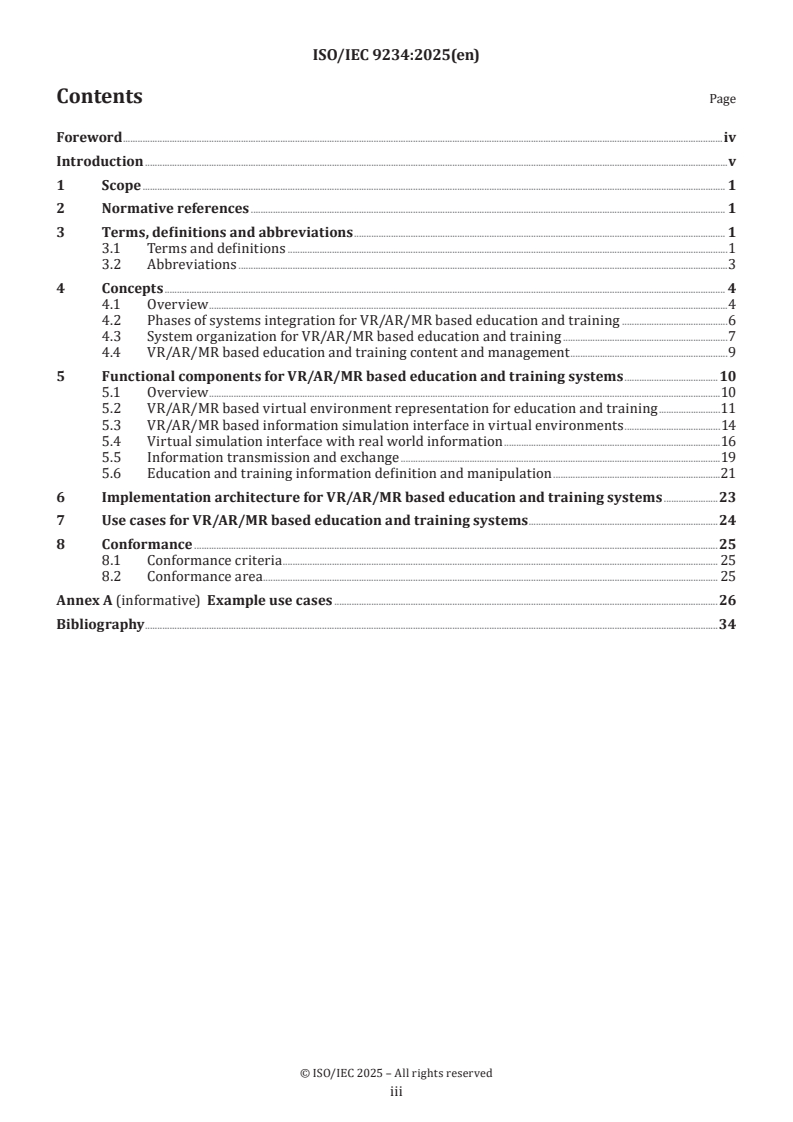
Contents Page
Foreword .iv
Introduction .v
1 Scope . 1
2 Normative references . 1
3 Terms, definitions and abbreviations . 1
3.1 Terms and definitions .1
3.2 Abbreviations .3
4 Concepts . 4
4.1 Overview .4
4.2 Phases of systems integration for VR/AR/MR based education and training .6
4.3 System organization for VR/AR/MR based education and training .7
4.4 VR/AR/MR based education and training content and management .9
5 Functional components for VR/AR/MR based education and training systems .10
5.1 Overview .10
5.2 VR/AR/MR based virtual environment representation for education and training .11
5.3 VR/AR/MR based information simulation interface in virtual environments .14
5.4 Virtual simulation interface with real world information .16
5.5 Information transmission and exchange .19
5.6 Education and training information definition and manipulation .21
6 Implementation architecture for VR/AR/MR based education and training systems .23
7 Use cases for VR/AR/MR based education and training systems .24
8 Conformance .25
8.1 Conformance criteria . 25
8.2 Conformance area . . 25
Annex A (informative) Example use cases .26
Bibliography .34
© ISO/IEC 2025 – All rights reserved
iii
Foreword
ISO (the International Organization for Standardization) and IEC (the International Electrotechnical
Commission) form the specialized system for worldwide standardization. National bodies that are
members of ISO or IEC participate in the development of International Standards through technical
committees established by the respective organization to deal with particular fields of technical activity.
ISO and IEC technical committees collaborate in fields of mutual interest. Other international organizations,
governmental and non-governmental, in liaison with ISO and IEC, also take part in the work.
The procedures used to develop this document and those intended for its further maintenance are described
in the ISO/IEC Directives, Part 1. In particular, the different approval criteria needed for the different types
of documents should be noted. This document was drafted in accordance with the editorial rules of the ISO/
IEC Directives, Part 2 (see www.iso.org/directives or www.iec.ch/members_experts/refdocs).
ISO and IEC draw attention to the possibility that the implementation of this document may involve the
use of (a) patent(s). ISO and IEC take no position concerning the evidence, validity or applicability of any
claimed patent rights in respect thereof. As of the date of publication of this document, ISO and IEC had not
received notice of (a) patent(s) which may be required to implement this document. However, implementers
are cautioned that this may not represent the latest information, which may be obtained from the patent
database available at www.iso.org/patents and https://patents.iec.ch. ISO and IEC shall not be held
responsible for identifying any or all such patent rights.
Any trade name used in this document is information given for the convenience of users and does not
constitute an endorsement.
For an explanation of the voluntary nature of standards, the meaning of ISO specific terms and expressions
related to conformity assessment, as well as information about ISO’s adherence to the World Trade
Organization (WTO) principles in the Technical Barriers to Trade (TBT) see www.iso.org/iso/foreword.html.
In the IEC, see www.iec.ch/understanding-standards.
This document was prepared by Joint Technical Committee ISO/IEC JTC 1, Information technology,
Subcommittee SC 24, Computer graphics, image processing and environmental data representation, in
collaboration with Subcommittees SC 29, Coding of audio, picture, multimedia and hypermedia information,
and SC 36, Information technology for learning, education and training.
Any feedback or questions on this document should be directed to the user’s national standards
body. A complete listing of these bodies can be found at www.iso.org/members.html and
www.iec.ch/national-committees.
© ISO/IEC 2025 – All rights reserved
iv
Introduction
Virtual, augmented, and mixed reality (VR/AR/MR) systems that are used for education and training
require approaches that support systems integration with various industry areas. Because the integration
aspects should include common functionalities, unique information modelling requirements are necessary.
Use cases for education and training have been reviewed to determine education and training technologies
that are in common use and to determine an information model that can be used to support these types of
activities supported by VR/AR/MR technologies. This document includes these use cases.
VR/AR/MR based education and training systems have requirements related to learning and teaching
approaches, representation, exchange, data, and interaction, in the following ways. First, existing learning
and teaching approaches can be integrated with the use of VR/AR/MR technology and form the basis for
user interactions with the systems and its elements. Based on differences in learning and teaching methods
when using VR/AR/MR, requirements that support interaction and simulation should be included. For
example, the use of haptics can be added to support user interaction with the system. Second, visual and
interactive representation should be provided to enhance the effectiveness of education and training.
Simulation can be an important aspect in representing information and in understanding education and
training content. Third, information should be exchangeable over heterogeneous computing environments
so that it is accessible to users to support their education and training activities anytime and anywhere.
Fourth, education and training information and data should be organized, transferred, stored, and managed
securely. Fifth, interfaces for interacting with devices and sensors should be included and should meet the
requirements of users.
This document provides requirements and recommendations for developing VR/AR/MR based education and
training systems to meet the requirements listed above. The requirements and recommendations include
concepts, information modelling architecture, standards based functional components, and implementation
components for VR/AR/MR based education and training.
© ISO/IEC 2025 – All rights reserved
v
International Standard ISO/IEC 9234:2025(en)
Information technology — Information modelling for
virtual, augmented and mixed reality based education and
training systems
1 Scope
This document provides requirements and recommendations for developing education and training systems
using virtual, augmented and mixed reality (VR/AR/MR) technology. It specifies how to organize the
information and data necessary for the development of VR/AR/MR integrated systems for education and
training. It includes procedures for the development of VR/AR/MR integrated systems.
This document includes several topics for consideration when developing VR/AR/MR based education
and training systems, as follows. First, it defines concepts of VR/AR/MR based education and training.
Second, it defines an information modelling architecture for the systems. Third, standards based functional
components for the systems are specified. Fourth, framework components for implementing the systems
are specified. And, finally, use cases for the systems based on the information modelling architecture are
included.
Device hardware technology for education and training systems is excluded from this document.
2 Normative references
There are no normative references in this document.
3 Terms, definitions and abbreviations
For the purposes of this document, the following terms and definitions apply.
ISO and IEC maintain terminology databases for use in standardization at the following addresses:
— ISO Online browsing platform: available at https:// www .iso .org/ obp
— IEC Electropedia: available at https:// www .electropedia .org/
3.1 Terms and definitions
3.1.1
augmented reality
AR
interactive experience whereby virtual objects are superimposed upon or embedded within the physical world
3.1.2
education
process of receiving or giving systematic instruction, especially at a school or university
[SOURCE: ISO/IEC 19896-1:2018, 3.3]
3.1.3
gyro sensor
sensor that measures angular velocity
© ISO/IEC 2025 – All rights reserved
3.1.4
learning
acquisition of knowledge, skills or attitudes
[SOURCE: ISO/IEC 2382-36:2019, 3.1.1]
3.1.5
mixed reality
MR
merging of real and virtual worlds to generate new environments where physical and synthetic objects co-
exist and interact
Note 1 to entry: Augmented reality (AR) (3.1.1) and virtual reality (VR) (3.1.9) are considered to be on the mixed reality
continuum.
[SOURCE: ISO/IEC 18038:2020, 3.14, modified — Note 1 to entry was added.]
3.1.6
physical sensor
internet of things (IoT) sensor which has the functionality of a physical device in a 3D virtual world
[SOURCE: ISO/IEC 18038:2020, 3.20]
3.1.7
system integration
process of bringing together the component sub-systems into one cohesive system to meet specified
requirements
[SOURCE: ISO 16484-1:2024, 3.14]
3.1.8
training
activities designed to facilitate the learning and development of knowledge, skills, and abilities, and to
improve the performance of specific tasks and roles
3.1.9
virtual reality
VR
interactive and immersive technology generated experience taking place in an artificial and simulated
environment
3.1.10
virtual, augmented and mixed reality based education
VR/AR/MR based education
act or process of imparting or acquiring theoretical knowledge during immersive and interactive experiences
using virtual, augmented and mixed environments where real and synthetic objects generated by virtual
reality (VR) (3.1.9), augmented reality (AR) (3.1.1), and mixed reality (MR) (3.1.5) technologies co-exist and
interact
3.1.11
virtual, augmented and mixed reality based training
VR/AR/MR based training
teaching or developing skills, behaviours, or fitness that relate to specific useful competencies using virtual,
augmented and mixed environments where real and synthetic objects generated by virtual reality (VR)
(3.1.9), augmented reality (AR) (3.1.1), and mixed reality (MR) (3.1.5) technologies co-exist and interact
© ISO/IEC 2025 – All rights reserved
3.2 Abbreviations
3D 3-dimensional
AFX animation framework eXtension
AR augmented reality
ARAF augmented reality application format
AVC advanced video coding
BIFS binary format for scenes
DRM data representation model
EDCS environmental data coding specification
EVC essential video coding
G-PCC geometry-based cloud compression
GUI graphical user interface
HDR high dynamic range
HEVC high efficiency video coding
HNSS hybrid natural/synthetic scene
HAnim humanoid animation
ICT information and communications technology
IT information technology
ITLET IT-enhanced learning, education, and training
JPEG joint photographic experts group
LOA level of articulation
MAR mixed and augmented reality
MLR metadata for learning resources
MPEG moving picture experts group
MPEG-A MPEG augmented reality application format
MR mixed reality
OMAF omnidirectional media format
SAI scene access interface
SEDRIS synthetic environment data representation and interchange specification
SRM spatial reference model
STF SEDRIS transmittal format
© ISO/IEC 2025 – All rights reserved
UI user interface
UX user experience
V-DMC video-based dynamic mesh coding
VR virtual reality
VCC versatile video coding
V-PCC video-based point cloud coding
VRML virtual reality modelling language
X3D extensible 3D
XML extensible markup language
4 Concepts
4.1 Overview
This document specifies an information modelling method for organizing a VR/AR/MR based system that
is used for education and training. Such a system includes computer simulated education and training
processes and provides for repetitive and empirical learning in an immersive virtual environment using VR/
AR/MR technologies. It includes 3D virtual environments for education and training locales or scenes, 3D
avatars for users of the system including teachers, learners, students, trainees, etc., interfaces for interaction
with other users and also device sensors, and knowledge data generated or created by systems or educators.
VR/AR/MR based education and training systems can be classified as one of two types depending on whether
or not sensor devices are used. A system without sensors facilitates education via digital information only
based on ICT including VR (Figure 4.1). This type of learning and teaching can be accomplished using
computing devices in the virtual environment. Educators and learners conduct education and training using
digital information in the virtual environment.
© ISO/IEC 2025 – All rights reserved
a) Education classes b) Music education
c) Medical education d) Gas flow visualization
Figure 4.1 — VR/AR/MR based education systems
The second type refers to VR/AR/MR based training systems that make use of real-world sensor devices
along with virtual environments. It is based on MAR virtual environments with training devices, sensor
information, and interactions with sensors (Figure 4.2). Implementation complexities can differ depending
on whether human information as avatars are also included in the virtual environments. Training systems
that include sensors and avatars in virtual environments are the most complex. This document describes an
information modelling architecture that can generate and manage information necessary for these types of
education and training systems.
© ISO/IEC 2025 – All rights reserved
a) Virtual road map training b) Light simulation training
c) Medical training ‒ IEC d) Military training
Figure 4.2 — VR/AR/MR based training systems
4.2 Phases of systems integration for VR/AR/MR based education and training
VR/AR/MR based education and training systems refers to computer integrated systems for education and
training in virtual environments. They include implementation of education and training simulation in 3D
virtual environments. The systems are integrated with education and training procedures and information
with 3D simulation. When simulating education and training information, sensor data from education or
training devices in the real world can be imported to and be represented in the 3D virtual environment. All
education and training systems can have similar functions, so systems integration methods for education
and training can be standardized.
Figure 4.3 shows the phases of systems integration that are necessary when developing education and
training systems in various areas. The first phase represents a process of 3D simulation with VR, AR and MR
based on representing information for education and training. While education and training is one typical
application area amongst many, their systems are all VR/AR/MR applications.
The second phase is where real world sensor information can be included and simulated. For this phase,
sensor-based education and training systems integrate physical sensor devices (or only physical sensors)
and their functionalities in 3D virtual environments. Physical sensor device refers to a physical device
including sensors that can obtain real-world information. The appearance and physical properties of a
physical sensor can be represented in the 3D virtual world. In addition, the physical properties and events
for education and training can be incorporated into, controlled, and managed in the virtual world.
The third phase depicts a step for standardized systems integration with common processes which can be
applied to their relevant industry areas. A general guideline for the integration of VR/AR/MR systems can
be developed to encompass applications in education and training.
The fourth phase depicts a step for organizing standardized systems that includes common processes
for education and training which can then be applied to their relevant industry areas using VR/AR/MR
technologies. To provide this capability, the systems should be able to represent physical sensors as well as
environments for education and training. The systems require the following: representation of educational
© ISO/IEC 2025 – All rights reserved
information and environments, physical sensors, visual and functional properties of each physical sensor,
physical properties of each physical sensor, control of each physical sensor’s data stream, and an interface
for communication between users and systems in a 3D educational environment.
Figure 4.3 — VR/AR/MR based education and training systems integration
4.3 System organization for VR/AR/MR based education and training
VR/AR/MR based education and training systems shall be implemented in a 3D virtual environment
using VR/AR/MR technologies through the systems integration phases described in 4.2. Education occurs
by simulating education processes and information in the 3D virtual environment. Sensor data can be
incorporated in the environment and educators and learners can interact with it. Figure 4.4 shows the
system organization that is required for this type of education and training. It represents the following
functionalities:
— Education knowledge and related information data shall be integrated into the system. This means that
education information flows through the system. For example, meta information or annotations for
education flow through the system and are acted on by educators and learners.
— There shall be three types of entities (or people) involved in the system: 1) educators and 2) learners are
the users of the system, while 3) systems developers implement the system that provides the education
and training methods by integrating education knowledge and processes with the VR/AR/MR systems.
© ISO/IEC 2025 – All rights reserved
Figure 4.4 — VR/AR/MR based education and training system organization
— Education and training information and processes shall be represented and simulated in a VR/AR/MR
environment. This may include communication between educators and learners in a virtual world.
— To facilitate communication between educators and learners, tools to interact with the virtual world can
be provided. Each item or object is controlled and managed in order to transfer education and training
information.
— A virtual world can be a place where educators and learners meet so that they can communicate and
share virtual objects to support education and training. Education and training information may be
integrated into the virtual worlds in different ways. Semantic information for virtual objects to be used
for education and training shall be available. For example, educators and learners could meet in a room
with an assigned name (such as Classroom 1). This means that the 3D object for the room semantically
has a Name property. As another example, in a clinical practice, a trainer could refer to a stomach object
while explaining the health status of a patient. In this case, the virtual object for each internal organ
(such as “stomach”) will have semantic information so that the object can be used to support education
and training.
— VR/AR/MR technologies shall be used to create all objects for a virtual world along with their interactions
with the virtual and real worlds. Virtual objects shall be generated with their semantic information
which can then be used when educators and learners communicate.
— Real world sensor information shall be integrated into virtual worlds using AR and MR technologies.
Sensor information shall be represented and simulated in virtual environments for education and
training.
Figure 4.5 shows a sensor simulated process that accomplishes education and training in a 3D virtual world.
It consists of a sensor simulated virtual world, a spatial mapper, and an event mapper. A simulated sensor
MAR world organizes MAR content with scene composition. It is based on the sensor representation model
defined in ISO/IEC 18038. This can be used as a basis for generating a virtual world that uses sensor devices.
The middle of the figure shows 3D scene information modelling for education and training. Education
knowledge should be able to be integrated into the sensor-based MAR world. On the left in Figure 4.5, a
spatial mapper recognizes location and orientation of avatars representing learners or educators. It also
recognizes location and orientation for sensors to be used in the MAR world. In the lower part of Figure 4.5,
© ISO/IEC 2025 – All rights reserved
an event mapper sends sensor information from educators or learners to the 3D scene. Finally, on the right in
Figure 4.5, MAR education content that consist of MAR and education information is rendered and displayed
in a 3D scene.
Figure 4.5 — Sensor information processing for VR/AR/MR based education and training
4.4 VR/AR/MR based education and training content and management
System components for VR/AR/MR based education and training consist of three parts: an education
system, education and training content, and education and training management. The VR/AR/MR based
education and training system uses many types of technologies such as sensor, haptic, UI/UX, network,
simulator, immersive device, and motion perception based on VR/AR/MR (Figure 4.6). The education and
training content should be simulated via a knowledge database, while the training management includes
communication, simulation control and evaluation.
Content creation and manipulation shall include definition, storage, retrieval, transfer, and interaction
with education and training knowledge. Since education and training technologies will be combined with
knowledge databases of education and training content, guidelines on how to create and manipulate these
databases shall be provided. Information modelling using VR/AR/MR shall be defined and implemented
for the systems so that content in knowledge databases can be simulated and represented in virtual
environments. How to define and represent education and training information using VR/AR/MR should
be specified. Real world representation shall include real world physical objects represented in virtual
environments. Real world objects for education shall be represented and simulated in virtual environments.
Information from real world physical sensors shall be represented for education and training. There shall be
two types of interactions for virtual education and training: interaction with virtual worlds and interaction
with real worlds. Interfaces for these interactions should be provided.
© ISO/IEC 2025 – All rights reserved
Figure 4.6 — VR/AR/MR based education and training content and management
5 Functional components for VR/AR/MR based education and training systems
5.1 Overview
When developing a VR/AR/MR based education and training system using the described system components,
the following functionalities shall be included:
— real world representation:
— environments and humans (avatars);
— visualization and simulation;
— sensor representation;
— interaction with virtual worlds:
— environment and human representation in virtual worlds;
— interaction with real worlds;
— education content creation and manipulation;
— education information modelling.
The above functionalities can be obtained by the following five components required by VR/AR/MR based
education and training systems:
— virtual environment representation for education and training:
— environment and human representation;
— virtual simulation interface with virtual environments;
— virtual simulation with real world environments and sensors;
— information exchange, and interaction;
— education and training information description and manipulation.
© ISO/IEC 2025 – All rights reserved
This clause describes each of these components. Details of the standards are described in each subclause.
First, virtual environments shall be represented with a standardized data model and interface so that they
can be generated for common use and exchanged between applications. Virtual scenes should be created and
managed for education and training locales. Second, an interface shall be defined for simulating education
and training information in virtual environments. The interface should control the virtual environment so
as to represent the change in the scene according to the education and training that is occurring. Third,
real world information from sensors shall be represented in virtual environments. In order to represent
sensor information, it shall be able to be imported, represented and simulated according to education and
training procedures. VR/AR/MR information for education and training shall be able to be transmitted
across heterogeneous computing environments in a seamless manner. The information should be able to
be exchanged and interacted with by learners and teachers. Lastly, knowledge databases for education and
training should be able to be created and manipulated in accordance with education and teaching methods
in virtual environments. Information processing methods shall be integrated into the education and training
systems. Table 5.1 summarizes these five components and their required functions.
Table 5.1 — Basic functional components for VR/AR/MR based education and training systems
Functional component Required functions
VR/AR/MR based education and — Representation methods of virtual environments and humans for VR/
training environment representation AR/MR based education
— Application interfaces for education and training environments
— Virtual environment information file format
VR/AR/MR based education and — Simulating procedures depending on each type of education and
training information simulation training
interface in virtual environments
— Simulating interface for education and training information
VR/AR/MR based education and — Real world simulation in virtual worlds using real world information
training information simulation with
— Interfaces for importing and exporting real world information
real worlds
Education and training information — Education and training information transmission between educators
transmission and exchange and learners
— Education and training information exchange between educators and
learners
Education and training information — Information description and manipulation for education and training
definition and manipulation
— Education and training methods
— Management and evaluation of education and training
5.2 to 5.6 will specify each functional component in detail.
5.2 VR/AR/MR based virtual environment representation for education and training
Virtual environments for education and training shall provide a standardized virtual space that can define
and exchange education and training objects in heterogeneous computing environments. ISO/IEC 19775-1
and ISO/IEC 18023-1 can be used for representing and generating virtual environments in which learning
and training are displayed as 3D scenes, but should be enhanced to include educational information.
ISO/IEC 14772-1 and ISO/IEC 14772-2 can also provide basic concepts including necessary components
and properties for organizing VR environment representation. Semantic information for education should
be integrated into 3D environment representation data. This semantic information should include name,
location, function, operation, and interaction. Virtual environments for education and training shall have
system integration components and functionalities defined in Figure 5.1.
© ISO/IEC 2025 – All rights reserved
Figure 5.1 — VR/AR/MR based education and training environment organization
All semantic information for representing the real world should be defined in relation to the environment.
An environmental data dictionary can be provided in relation to geographical information in virtual
environments as in ISO/IEC 18025 for 3D environment representation for education by integrating education
information into the environment.
3D avatar representation is also necessary to enhance communication between educators and learners
in a virtual environment. Humanoid models should be able to be defined and managed within virtual
environments for education and training. ISO/IEC 19774-1, and ISO/IEC 19774-2 can be used for representing
human models and their motion. Based on the HAnim architecture, semantic information for education and
training can be added.
HAnim specifies the structure and manipulation of HAnim figures. HAnim figures are articulated 3D
representations that depict animated characters. While HAnim figures are intended to represent human-like
characters, they are based on a general concept that is not limited to the same number of limbs, head, and other
body parts that are typical of human beings. A single HAnim figure is called a humanoid. ISO/IEC 19774-1
specifies the architecture of humanoids based on medical terms. ISO/IEC 19774-2 specifies basic concepts
of humanoid animation and an overall procedure for defining humanoid animation using an HAnim model
and motion data. Motion parameters necessary for generating humanoid animation are defined. Humanoid
animation data is organized using these parameters and the geometric data of a humanoid model. Figure 5.2
shows the procedure of generating HAnim based humanoid animation. It specifies three types of humanoid
animation: keyframe animation, algorithm animation, and motion data animation (ISO/IEC 19774-2). These
can be used for representing humanoid animation in virtual environments.
© ISO/IEC 2025 – All rights reserved
Figure 5.2 — Procedure of motion data animation
Table 5.2 summarizes standard functions that shall be provided when representing 3D virtual
environments for VR/AR/MR based education and training. Their partial functions can be obtained using
existing standards. For 3D virtual environments and 3D data exchange format, VRML (ISO/IEC 14772-1
and ISO/IEC 14772-2), and ISO/IEC 19775-1 X3D can be used. These standards can be used to represent 3D
shape and appearance, but are insufficient for representing semantic information simulation for education
and training. ISO/IEC 18023, ISO/IEC 18025, and ISO/IEC 18026 can be used for environmental data
representation, but need additional work for rendering facilities and representing education information
simulation. For humanoid modelling and animation, ISO/IEC 19774-1 and ISO/IEC 19774-2 can be used, but
are insufficient for representing an avatar’s expressions and internal organs that will typically be used in
medical and health education and training. Enhanced functionalities are required to fulfil these needs for
education and training.
© ISO/IEC 2025 – All rights reserved
Table 5.2 — Standard functions for virtual environment representation
Functions necessary for virtual
Capabilities for education and training
environments representation
Virtual environments representation — 3D environment modelling and rendering
— 3D environment animation and simulation
— 3D virtual object representation
— Environmental data representation (space, atmosphere, terrain, ocean,
etc.)
— Real world environment simulation
— Semantic information representation
Humanoid modelling and animation — Human and avatar representation
data representation
— Human motion animation representation
— Semantic information representation
3D data exchange format — 3D virtual environment modelling and animation data format
— 3D humanoid and avatar data format
— Integration of virtual environment and human and avatars
For education and training purposes in virtual environments, the following additional functionalities should
be provided:
— knowledge and semantic information representation for education and training in 3D virtual
environments, such as definition of 3D object and environmental components;
— knowledge and semantic information representation for humans and avatars in 3D virtual environments;
— annotation definition and tools for education and training in 3D virtual environments;
— communication interfaces between educators and learners in 3D virtual environments.
5.3 VR/AR/MR based information simulation interface in virtual environments
In order to educate and train in virtual environments, user interfaces for manipulating and interacting
with virtual environments shall be provided. There are two levels of interfaces, categorized as application
programming interfaces and graphical user interfaces. The former provides system developers with
interfaces so that they can generate various applications with standard data and functions. The latter is
a graphical interactive facility that can be used to manipulate objects in virtual environments directly.
It can be used when visualizing, simulating, and managing virtual environments. When accessing X3D
scenes, ISO/IEC 19775-2 can be used and programming language dependent application interfaces can be
provided by ISO/IEC 19777-1, ISO/IEC 19777-2, ISO/IEC 19777-3, ISO/IEC 19777-4, and ISO/IEC 19777-5
for Java, JavaScript, C, C++, and C#. When accessing SEDRIS scenes, application interfaces are provided by
ISO/IEC 18023-1 and C and C++ language bindings by ISO/IEC 18024-4, ISO/IEC 18041-4, ISO/IEC 18042-4,
ISO/IEC 18041-5, and ISO/IEC 18042-5. SEDRIS C++ language bindings are currently under further
development. Application interface standards should be provided to access 3D virtual environments.
The application interfaces are used to define and manipulate scene graph data for a virtual environment
from either an external application or from inside the scene graph itself. Virtual environments for education
and training can be simulated and manipulated by using the application interfaces. The scene graph
shall include a data structure for storing education and training information in addition to the graphical
information that general 3D scene graphs typically have. In order to represent education information
simulation, semantic information for each object can be defined in the scene graph (Figure 5.3). The figure
shows a scene graph that has been enhanced from the sensor-based scene graph defined in ISO/IEC 18038.
Semantic information includes educational content that is directly related to 3D objects in the scene. All
© ISO/IEC 2025 – All rights reserved
objects should be recognized as meaningful entities in the scene. For a simple example, a table object in a
scene graph for a meeting room should have semantic information such as name and location, as well as
physical and functional properties such as that the desk is made of wood and is used for people to sit at and
hold discussions. Semantic information should also be added to visual information including geometry and
appearance characteristics for the object.
Graphical user interfaces for end users are simulation tools for education and training. All simulation
parameters should be able to be represented and controlled by the tools so that users have direct control
of objects in a virtual environment. Standard graphical interfaces can be obtained by developing them
using application programming interfaces that are able to access the scene graph as well as the semantic
information. In order to facilitate interactions between users and between systems in education and
training, effective transmittal formats shall be supported for virtual environments. The transmittal formats
should include interaction facilities that provide users with the capability to communicate with other users
and systems in common virtual environments through networks and web-based applications. In addition
to the static information that is generated from the scene graph including semantic information, dynamic
knowledge information obtained during communication between educators and learners should be able to
be maintained. Because the dynamic knowledge information shall be able to be controlled and managed in
relation to the scene graph objects, it is necessary to add temporal information to the scene.
Table 5.3 summarizes standard functions that are necessary for accessing, manipulating, and interacting
with 3D virtual scenes.
Figure 5.3 — Scene graph with semantic information for education and training
© ISO/IEC 2025 – All rights reserved
Table 5.3 — Standard functions for manipulating and interacting with 3D virtual objects and
environments
Functions necessary for simulation and
Capabilities for education and training
interaction with virtual environments
3D virtual environments authoring interface — 3D virtual scene access and manipulation with education and
training information
— Application programming interface for designing education
information
3D semantic environment data interface for — Access interface for semantic environment data for education
education and training and training information
— User interfaces to generate and access education and training
semantic information in 3D scenes
3D virtual environments programming interface — Programming language binding for virtual objects and
for education and training environments
— Interfaces for accessing scene data structure and functions
3D compatible data format for exchanging — Interoperability with other languages and systems
education and training information
— 3D data encoding format for exchange
— Transmittal format for virtual environments data
5.4 Virtual simulation interface with real world information
Virtual simulation with real world information including sensors shall be able to be represented in virtual
environments. In addition, standardized interfaces with real word information shall be provided. In order
to represent and manage the functions of sensors in virtual environments, sensor information shall be
processed as functional items necessary for VR/AR/MR based education and training systems. Because there
are many types of sensors, and because they have different data, an abstract data format that can be used for
the sensors shall be provided. Sensor information should be able to be simulated visually and interactively
in virtual environments. Interfaces for managing and controlling sensors for learning and teaching shall
be provided. Some functions can be obtained by using MAR representation standards. Standardized MAR
representation can be obtained with ISO/IEC 18038 and ISO/IEC 18039. Video avatar representation in a 3D
world can be obta
...