

ISO/TR 945-3:2016
(Main)Microstructure of cast irons — Part 3: Matrix structures
General Information
- Abstract
ISO/TR 945-3:2016 gives the designations, descriptions and reference micrographs of the matrix structures of cast irons. It applies to the following types of cast irons: - grey cast irons (Table 4.1); - spheroidal graphite cast irons (Table 4.2); - austenitic cast irons (Table 4.3); - malleable cast irons (Table 4.4); - compacted (vermicular) graphite cast irons (Table 4.5); - ausferritic spheroidal graphite cast irons (Table 4.6); - abrasion-resistant cast irons (Table 4.7). Each matrix structure is defined with explanations and micrographs. Unless otherwise stated in Clause 4, the micrographs shown correspond to samples etched with a solution of 2 % nitric acid in ethanol (Nital).
- Status
- Published
- Publication Date
- 20-Apr-2016
- Technical Committee
- ISO/TC 25 - Cast irons and pig irons
- Drafting Committee
- ISO/TC 25 - Cast irons and pig irons
- Current Stage
- 9093 - International Standard confirmed
- Start Date
- 15-Nov-2018
- Completion Date
- 29-Aug-2026
Buy Documents
ISO/TR 945-3:2016 - Microstructure of cast irons
ISO/TR 945-3:2016 - Microstructure of cast irons — Part 3: Matrix structures/21/2016
Overview
ISO/TR 945-3:2016 - Microstructure of cast irons - Part 3: Matrix structures is a Technical Report that provides standardized designations, descriptive definitions and reference micrographs for the matrix (metallic) structures found in a wide range of cast irons. The report covers grey, spheroidal (ductile), austenitic, malleable, compacted (vermicular), ausferritic spheroidal and abrasion‑resistant cast irons. Reference micrographs are, unless otherwise noted, produced after etching with 2 % nitric acid in ethanol (Nital).
Keywords: ISO/TR 945-3:2016, microstructure of cast irons, matrix structures, Nital, pearlite, ferrite, austenite, spheroidal graphite.
Key topics
- Standardized matrix designations: Consistent names and short descriptions for common matrix constituents such as ferrite, pearlite, austenite, acicular ferrite, ausferrite, bainite, cementite, ledebureite and martensite.
- Reference micrographs: Photomicrographs at representative magnifications illustrating each matrix type to help visual identification and communication between purchaser and manufacturer.
- Scope by cast‑iron type: Tables mapping matrix structures to material designations for:
- Grey cast irons (ISO 185)
- Spheroidal graphite (ductile) cast irons (ISO 1083)
- Austenitic cast irons (ISO 2892)
- Malleable cast irons (ISO 5922)
- Compacted (vermicular) graphite cast irons
- Ausferritic spheroidal graphite cast irons
- Abrasion‑resistant cast irons
- Sampling and sample preparation: Practical guidance on sampling location, sample size and metallographic preparation steps (sectioning, grinding, polishing, etching) - with the requirement that matrix examination be carried out in the etched condition to avoid misinterpretation.
- Informative annexes: Assessment aids such as evaluation of pearlite content in spheroidal graphite cast irons (Annex A) and mapping of ISO to European/national material designations (Annex B).
Applications
- Quality control and acceptance of castings - specifying and verifying matrix structure in procurement and inspection reports.
- Metallography and failure analysis - identifying microstructural causes of service failures, wear or brittleness (pearlite vs. martensite vs. bainite, etc.).
- Process development and heat treatment - guiding austempering and other treatments to achieve desired ausferritic or pearlitic matrices.
- Design and material selection - helping engineers choose cast‑iron grades with matrix structures suited to strength, toughness or abrasion resistance.
- Contract and communication - providing unambiguous, visual reference language between foundries and customers.
Who uses this standard
- Foundry metallurgists and quality inspectors
- Materials engineers and design engineers
- Failure analysis laboratories and research teams
- Purchasers specifying cast‑iron components
Related standards
- ISO 945 series (Parts 1 & 2: graphite classification)
- ISO 185, ISO 1083, ISO 2892, ISO 5922 (material designation standards referenced in the report)
This Technical Report is a practical reference for consistent identification and communication of cast‑iron matrix structures in manufacturing, inspection and materials engineering.
Buy Documents
ISO/TR 945-3:2016 - Microstructure of cast irons
ISO/TR 945-3:2016 - Microstructure of cast irons — Part 3: Matrix structures/21/2016
Get Certified
Connect with accredited certification bodies for this standard

Element Materials Technology
Materials testing and product certification.

Inštitut za kovinske materiale in tehnologije
Institute of Metals and Technology. Materials testing, metallurgical analysis, NDT.
Sponsored listings
Frequently Asked Questions
ISO/TR 945-3:2016 is a technical report published by the International Organization for Standardization (ISO). Its full title is "Microstructure of cast irons — Part 3: Matrix structures". This standard covers: ISO/TR 945-3:2016 gives the designations, descriptions and reference micrographs of the matrix structures of cast irons. It applies to the following types of cast irons: - grey cast irons (Table 4.1); - spheroidal graphite cast irons (Table 4.2); - austenitic cast irons (Table 4.3); - malleable cast irons (Table 4.4); - compacted (vermicular) graphite cast irons (Table 4.5); - ausferritic spheroidal graphite cast irons (Table 4.6); - abrasion-resistant cast irons (Table 4.7). Each matrix structure is defined with explanations and micrographs. Unless otherwise stated in Clause 4, the micrographs shown correspond to samples etched with a solution of 2 % nitric acid in ethanol (Nital).
ISO/TR 945-3:2016 gives the designations, descriptions and reference micrographs of the matrix structures of cast irons. It applies to the following types of cast irons: - grey cast irons (Table 4.1); - spheroidal graphite cast irons (Table 4.2); - austenitic cast irons (Table 4.3); - malleable cast irons (Table 4.4); - compacted (vermicular) graphite cast irons (Table 4.5); - ausferritic spheroidal graphite cast irons (Table 4.6); - abrasion-resistant cast irons (Table 4.7). Each matrix structure is defined with explanations and micrographs. Unless otherwise stated in Clause 4, the micrographs shown correspond to samples etched with a solution of 2 % nitric acid in ethanol (Nital).
ISO/TR 945-3:2016 is classified under the following ICS (International Classification for Standards) categories: 77.080.10 - Irons. The ICS classification helps identify the subject area and facilitates finding related standards.
ISO/TR 945-3:2016 is available in PDF format for immediate download after purchase. The document can be added to your cart and obtained through the secure checkout process. Digital delivery ensures instant access to the complete standard document.
Standards Content (Sample)
TECHNICAL ISO/TR
REPORT 945-3
First edition
2016-05-01
Microstructure of cast irons —
Part 3:
Matrix structures
Microstructure des fontes —
Partie 3: Structures de matrice
Reference number
©
ISO 2016
© ISO 2016, Published in Switzerland
All rights reserved. Unless otherwise specified, no part of this publication may be reproduced or utilized otherwise in any form
or by any means, electronic or mechanical, including photocopying, or posting on the internet or an intranet, without prior
written permission. Permission can be requested from either ISO at the address below or ISO’s member body in the country of
the requester.
ISO copyright office
Ch. de Blandonnet 8 • CP 401
CH-1214 Vernier, Geneva, Switzerland
Tel. +41 22 749 01 11
Fax +41 22 749 09 47
copyright@iso.org
www.iso.org
ii © ISO 2016 – All rights reserved
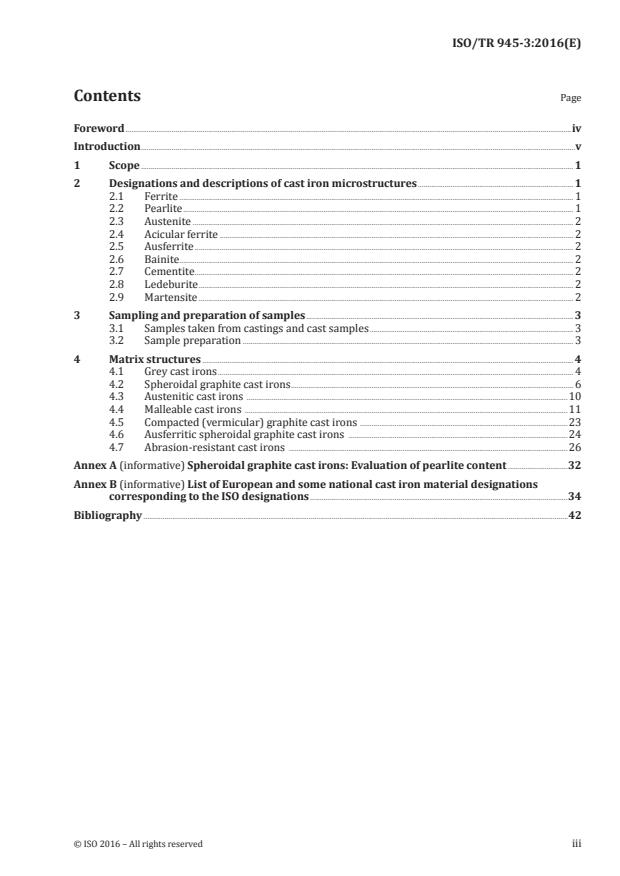
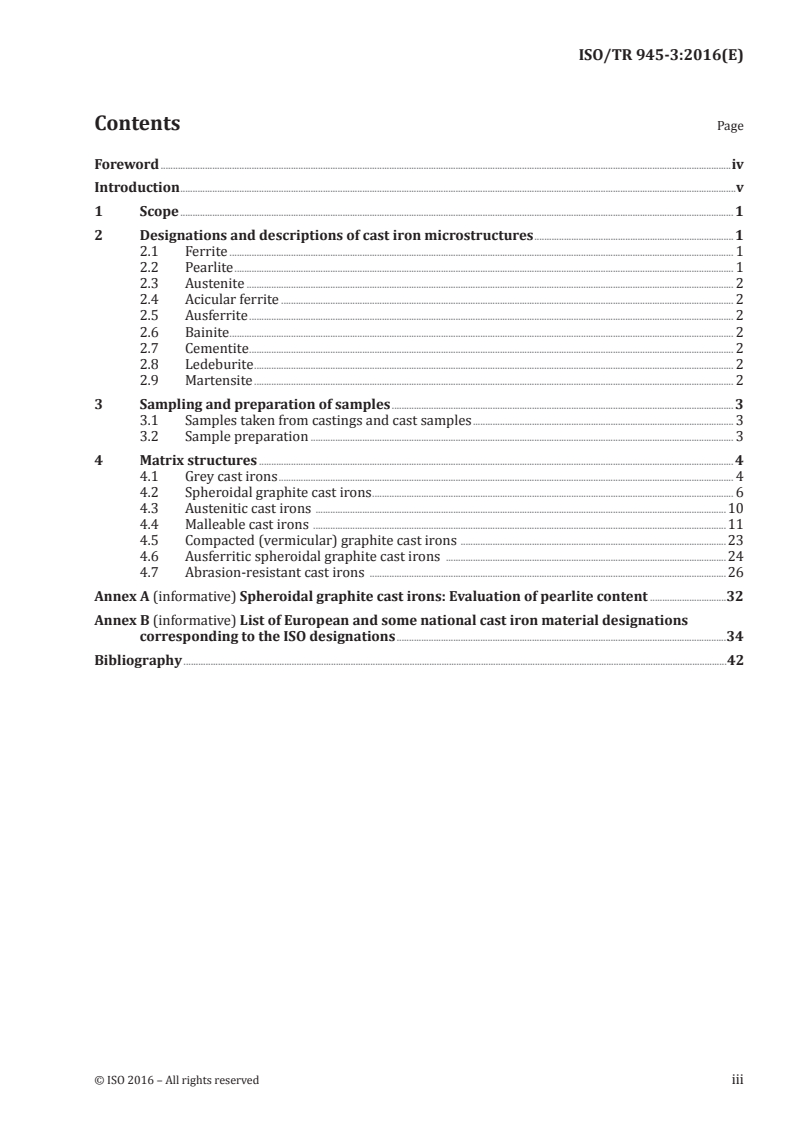
Contents Page
Foreword .iv
Introduction .v
1 Scope . 1
2 Designations and descriptions of cast iron microstructures . 1
2.1 Ferrite . 1
2.2 Pearlite . 1
2.3 Austenite . 2
2.4 Acicular ferrite . 2
2.5 Ausferrite . 2
2.6 Bainite . 2
2.7 Cementite . 2
2.8 Ledeburite . 2
2.9 Martensite . 2
3 Sampling and preparation of samples . 3
3.1 Samples taken from castings and cast samples . 3
3.2 Sample preparation . 3
4 Matrix structures . 4
4.1 Grey cast irons . 4
4.2 Spheroidal graphite cast irons . 6
4.3 Austenitic cast irons .10
4.4 Malleable cast irons .11
4.5 Compacted (vermicular) graphite cast irons .23
4.6 Ausferritic spheroidal graphite cast irons .24
4.7 Abrasion-resistant cast irons .26
Annex A (informative) Spheroidal graphite cast irons: Evaluation of pearlite content .32
Annex B (informative) List of European and some national cast iron material designations
corresponding to the ISO designations .34
Bibliography .42
Foreword
ISO (the International Organization for Standardization) is a worldwide federation of national standards
bodies (ISO member bodies). The work of preparing International Standards is normally carried out
through ISO technical committees. Each member body interested in a subject for which a technical
committee has been established has the right to be represented on that committee. International
organizations, governmental and non-governmental, in liaison with ISO, also take part in the work.
ISO collaborates closely with the International Electrotechnical Commission (IEC) on all matters of
electrotechnical standardization.
The procedures used to develop this document and those intended for its further maintenance are
described in the ISO/IEC Directives, Part 1. In particular the different approval criteria needed for the
different types of ISO documents should be noted. This document was drafted in accordance with the
editorial rules of the ISO/IEC Directives, Part 2 (see www.iso.org/directives).
Attention is drawn to the possibility that some of the elements of this document may be the subject of
patent rights. ISO shall not be held responsible for identifying any or all such patent rights. Details of
any patent rights identified during the development of the document will be in the Introduction and/or
on the ISO list of patent declarations received (see www.iso.org/patents).
Any trade name used in this document is information given for the convenience of users and does not
constitute an endorsement.
For an explanation on the meaning of ISO specific terms and expressions related to conformity
assessment, as well as information about ISO’s adherence to the WTO principles in the Technical
Barriers to Trade (TBT) see the following URL: Foreword - Supplementary information
The committee responsible for this document is ISO/TC 25, Cast irons and pig irons.
ISO 945 consists of the following parts, under the general title Microstructure of cast irons:
— Part 1: Graphite classification by visual analysis
— Part 2: Graphite classification by image analysis [Technical Report]
— Part 3: Matrix structures [Technical Report]
The following parts are under preparation:
— Part 4: Determination of nodularity in spheroidal graphite cast irons
iv © ISO 2016 – All rights reserved
Introduction
The designation of cast iron matrix structures as given in this part of ISO 945 is in conformity with the
[1][2][3] [4]
designations published by several national foundry organisations or other publishers .
This Technical Report aims to
— give the designations, precise descriptions and reference micrographs of the matrix structures of
cast irons, and
— facilitate the discussion and to avoid misunderstanding between manufacturer and purchaser
regarding the identification of matrix structures.
TECHNICAL REPORT ISO/TR 945-3:2016(E)
Microstructure of cast irons —
Part 3:
Matrix structures
1 Scope
This Technical Report gives the designations, descriptions and reference micrographs of the matrix
structures of cast irons.
It applies to the following types of cast irons:
— grey cast irons (Table 4.1);
— spheroidal graphite cast irons (Table 4.2);
— austenitic cast irons (Table 4.3);
— malleable cast irons (Table 4.4);
— compacted (vermicular) graphite cast irons (Table 4.5);
— ausferritic spheroidal graphite cast irons (Table 4.6);
— abrasion-resistant cast irons (Table 4.7).
Each matrix structure is defined with explanations and micrographs.
Unless otherwise stated in Clause 4, the micrographs shown correspond to samples etched with a
solution of 2 % nitric acid in ethanol (Nital).
2 Designations and descriptions of cast iron microstructures
2.1 Ferrite
Ferrite also known as α-ferrite (α-Fe) or alpha iron is a materials science term for iron, or for a solid
solution with iron as the main constituent, with a body-centred cubic crystal structure. It is this
crystalline structure which gives to steels and cast irons their magnetic properties, and is the classic
example of a ferromagnetic material.
Since pearlite has ferrite as a component, any iron-carbon alloy will contain some amount of ferrite if
it is allowed to reach equilibrium at room temperature. The exact amount of ferrite will depend on the
cooling processes the iron-carbon alloy undergoes when it cools from liquid state.
2.2 Pearlite
Pearlite is a two-phased, lamellar (or layered) structure composed of alternating layers of alpha-
ferrite (according thermal dynamical condition 88 % by mass) and cementite (12 % by mass). The
lamellar appearance is misleading since the individual lamellae within a colony are connected in three
dimensions; a single colony is therefore an interpenetrating bicrystal of ferrite and cementite. Pearlite
is a common microstructure occurring in many grades of cast irons.
If cast iron is cooled very slowly or as a result of heat treatment, the cementite can occur in globules
instead of in layers. This structure is designated as globular pearlite.
2.3 Austenite
Austenite, also known as gamma phase iron (γ-Fe), is a non-magnetic allotrope of iron or a solid
solution of iron, stabilized by an alloying element, e.g. nickel. Austenite is the face-centred cubic crystal
structure of iron.
2.4 Acicular ferrite
Acicular ferrite is a microstructure of ferrite that is characterized by needle shaped crystallites or
grains when viewed in two dimensions. The grains, actually three dimensional in shape, have a thin
lenticular shape. This microstructure is advantageous over other microstructures because of its chaotic
ordering, which increases toughness.
2.5 Ausferrite
Ausferrite is a special type of multi-phase microstructure that occurs when cast irons with a silicon
content of about 2 % or higher are austempered.
Austempering consists of rapidly cooling the fully austenitic iron to avoid the formation of pearlite to
a temperature above that of martensite formation and holding for the time necessary to precipitate
the ausferrite matrix. This microstructure consists primarily of acicular ferrite in carbon enriched
austenite.
2.6 Bainite
Bainite is a multi-phase microstructure, consisting of acicular ferrite and cementite that forms in cast
irons during rapid cooling. It is one of the decomposition products that can form when austenite is cooled
rapidly below the eutectoid temperature, but above the martensitic starting (M ) temperature. Bainite
s
can also form from the decomposition of ausferrite upon extended heating above the temperature at
which it was formed.
2.7 Cementite
Cementite, also known as iron carbide, is a compound of iron and carbon, with the formula Fe C.
By mass, it is 6,7 % carbon and 93,3 % iron. Cementite has an orthorhombic crystal structure.
In the iron-carbon system cementite is a common constituent because ferrite contains maximum 0,02 %
by mass of carbon. Therefore, in cast irons that are slowly cooled, a part of these elements is in the form
of cementite. In the case of white cast irons, cementite precipitates directly from the melt. In grey cast
irons or spheroidal graphite cast irons, cementite forms either from austenite during cooling or from
martensite during tempering, or from the decomposition of ausferrite. An intimate mixture of cementite
with ferrite, the other product of austenite, forms a lamellar structure called pearlite (see 2.2).
2.8 Ledeburite
Ledeburite is an eutectic mixture of austenite and cementite and is formed when the melt at least partly
solidifies according the metastable Fe-C-Si system.
2.9 Martensite
Martensite is formed from austenite by rapid cooling (quenching) which traps carbon atoms that do
not have time to diffuse out of the crystal structure. The martensite lattice is body-centred tetragonal
composed of ferrite and carbon. This martensitic reaction begins during cooling when the austenite
reaches the martensite start temperature (M ) and the parent austenite becomes mechanically
s
unstable. At a constant temperature below M , a fraction of the parent austenite transforms rapidly,
s
after which no further transformation occurs. When the temperature is decreased, more of the
austenite transforms to martensite. Finally, when the martensite finish temperature (M ) is reached,
f
2 © ISO 2016 – All rights reserved
the transformation ends. Martensite can also be formed by application of stress in ausferritic spheroidal
graphite cast irons (SITRAM effect: stress induced transformation from austenite to martensite). Thus,
martensite can be thermally induced or stress induced.
3 Sampling and preparation of samples
3.1 Samples taken from castings and cast samples
The location from which samples are taken should be agreed between the manufacturer and purchaser
and should take into account the requirements specified in the appropriate material standard. If an
examination report is required, the location from where the final sample is taken shall be recorded.
The sample should be of sufficient size to provide a true representation of the matrix structure in the
agreed location from which it is taken.
3.2 Sample preparation
Attention should be paid to the careful cutting, grinding, polishing and etching of samples, so that the
matrix structure appears in its original form. Inappropriate preparation can cause alteration of the
microstructure and misinterpretations.
Sample preparation should be carried out in four stages:
1) sectioning;
2) grinding;
3) polishing;
4) etching.
NOTE In some cases mounting of the sample in a polymeric material can be necessary.
The examination of the matrix structure shall be carried out in the etched condition.
4 Matrix structures
4.1 Grey cast irons
[5]
Table 4.1 — Grey cast irons according to ISO 185
Micro-
Material designation Matrix structure
graph
4.1.1 ISO 185/JL/100 Pearlite – ferrite
ISO 185/JL/HBW155 100 x
4.1.2 Pearlite – ferrite
100 x
ISO 185/JL/150
4.1.3 Pearlite – ferrite
ISO 185/JL/HBW175
500 x
4 © ISO 2016 – All rights reserved
Table 4.1 (continued)
Micro-
Material designation Matrix structure
graph
4.1.4 Predominantly
pearlite
100 x
Shown is JL/250
ISO 185/JL/200
ISO 185/JL/225
ISO 185/JL/250
ISO 185/JL/275
4.1.5 Predominantly
pearlite
ISO 185/JL/HBW195
ISO 185/JL/HBW215
500 x
Shown is JL/250
4.1.6 ISO 185/JL/300 (shown) Pearlite
ISO 185/JL/350 100x
ISO 185/JL/HBW235
ISO 185/JL/HBW255
4.2 Spheroidal graphite cast irons
[6]
Table 4.2 — Spheroidal graphite cast irons according to ISO 1083
Micro- Material designation Matrix structure
graph
4.2.1 ISO 1083/JS/350-22 Ferrite
ISO 1083/JS/400-18
100x
ISO 1083/JS/400-15
ISO 1083/JS/500-10
ISO 1083/JS/HBW130
ISO 1083/JS/HBW150
ISO 1083/JS/HBW155
a
4.2.2 ISO 1083/JS/450-10 Predominantly
ferrite
ISO 1083/JS/HBW185
100x
4.2.3 ISO 1083/JS/500-7 Ferrite – pearlite
ISO 1083/JS/550-5
100x
ISO 1083/JS/HBW200
ISO 1083/JS/HBW215
a
The term “predominantly” does not appear in ISO 1083, only “ferrite”.
NOTE Information regarding the evaluation of the pearlite content of the matrix of spheroidal graphite cast iron is given
in Annex A.
6 © ISO 2016 – All rights reserved
Table 4.2 (continued)
Micro- Material designation Matrix structure
graph
4.2.4 ISO 1083/JS/600-3 Pearlite – ferrite
ISO 1083/JS/HBW230 100x
a
4.2.5 Predominantly
pearlite
100x
ISO 1083/JS/700-2
4.2.6 Pearlite
ISO 1083/JS/HBW265
500x
a
The term “predominantly” does not appear in ISO 1083, only “ferrite”.
NOTE Information regarding the evaluation of the pearlite content of the matrix of spheroidal graphite cast iron is given
in Annex A.
Table 4.2 (continued)
Micro- Material designation Matrix structure
graph
4.2.7 Pearlite (shown)
or tempered
martensite
(shown in 4.2.9)
100x
4.2.8 Pearlite
500x
ISO 1083/JS/800-2
ISO 1083/JS/HBW300
4.2.9 Tempered
martensite
100x
a
The term “predominantly” does not appear in ISO 1083, only “ferrite”.
NOTE Information regarding the evaluation of the pearlite content of the matrix of spheroidal graphite cast iron is given
in Annex A.
8 © ISO 2016 – All rights reserved
Table 4.2 (continued)
Micro- Material designation Matrix structure
graph
4.2.10 Bainite-martensite
(shown) or
tempered
martensite
(shown in 4.2.9)
100x
ISO 1083/JS/900-2
4.2.11 Bainite-martensite
ISO 1083/JS/HBW330
1 000x
a
The term “predominantly” does not appear in ISO 1083, only “ferrite”.
NOTE Information regarding the evaluation of the pearlite content of the matrix of spheroidal graphite cast iron is given
in Annex A.
4.3 Austenitic cast irons
[7]
Table 4.3 — Austenitic cast irons according to ISO 2892
Micro- Material designation Matrix structure
graph
4.3.1 ISO 2892/JLA/XNi15Cu6Cr2 Austenite
ISO 2892/JLA/XNi13Mn7
100x
Shown is
JLA/XNi15Cu6Cr2
4.3.2 Austenite
Shown are
JSA/XNi20Cr2
200x
ISO 2892/JSA/XNi20Cr2
ISO 2892/JSA/XNi23Mn4
ISO 2892/JSA/XNi20Cr2Nb
ISO 2892/JSA/XNi22
ISO 2892/JSA/XNi35
ISO 2892/JSA/XNi35Si5Cr2
4.3.3 and
ISO 2892/JSA/XNi13Mn7
JSA/XNi35Cr3
ISO 2892/JSA/XNi30Cr3
ISO 2892/JSA/XNi30Si5Cr5
100x
ISO 2892/JSA/XNi35Cr3
10 © ISO 2016 – All rights reserved
4.4 Malleable cast irons
[8]
Table 4.4 — Malleable cast irons according to ISO 5922
Micro-
Material designation Matrix structure
graph
4.4.1 Ferrite and
pearlite
25x
4.4.2 Surface zone
Predominantly
ferritic
100x
ISO 5922/JMW/350-4
Furnace cooled
4.4.3 Core zone
Pearlite and
ferrite
100x
Table 4.4 (continued)
Micro-
Material designation Matrix structur
...
TECHNICAL ISO/TR
REPORT 945-3
First edition
2016-05-01
Microstructure of cast irons —
Part 3:
Matrix structures
Microstructure des fontes —
Partie 3: Structures de matrice
Reference number
©
ISO 2016
© ISO 2016, Published in Switzerland
All rights reserved. Unless otherwise specified, no part of this publication may be reproduced or utilized otherwise in any form
or by any means, electronic or mechanical, including photocopying, or posting on the internet or an intranet, without prior
written permission. Permission can be requested from either ISO at the address below or ISO’s member body in the country of
the requester.
ISO copyright office
Ch. de Blandonnet 8 • CP 401
CH-1214 Vernier, Geneva, Switzerland
Tel. +41 22 749 01 11
Fax +41 22 749 09 47
copyright@iso.org
www.iso.org
ii © ISO 2016 – All rights reserved
Contents Page
Foreword .iv
Introduction .v
1 Scope . 1
2 Designations and descriptions of cast iron microstructures . 1
2.1 Ferrite . 1
2.2 Pearlite . 1
2.3 Austenite . 2
2.4 Acicular ferrite . 2
2.5 Ausferrite . 2
2.6 Bainite . 2
2.7 Cementite . 2
2.8 Ledeburite . 2
2.9 Martensite . 2
3 Sampling and preparation of samples . 3
3.1 Samples taken from castings and cast samples . 3
3.2 Sample preparation . 3
4 Matrix structures . 4
4.1 Grey cast irons . 4
4.2 Spheroidal graphite cast irons . 6
4.3 Austenitic cast irons .10
4.4 Malleable cast irons .11
4.5 Compacted (vermicular) graphite cast irons .23
4.6 Ausferritic spheroidal graphite cast irons .24
4.7 Abrasion-resistant cast irons .26
Annex A (informative) Spheroidal graphite cast irons: Evaluation of pearlite content .32
Annex B (informative) List of European and some national cast iron material designations
corresponding to the ISO designations .34
Bibliography .42
Foreword
ISO (the International Organization for Standardization) is a worldwide federation of national standards
bodies (ISO member bodies). The work of preparing International Standards is normally carried out
through ISO technical committees. Each member body interested in a subject for which a technical
committee has been established has the right to be represented on that committee. International
organizations, governmental and non-governmental, in liaison with ISO, also take part in the work.
ISO collaborates closely with the International Electrotechnical Commission (IEC) on all matters of
electrotechnical standardization.
The procedures used to develop this document and those intended for its further maintenance are
described in the ISO/IEC Directives, Part 1. In particular the different approval criteria needed for the
different types of ISO documents should be noted. This document was drafted in accordance with the
editorial rules of the ISO/IEC Directives, Part 2 (see www.iso.org/directives).
Attention is drawn to the possibility that some of the elements of this document may be the subject of
patent rights. ISO shall not be held responsible for identifying any or all such patent rights. Details of
any patent rights identified during the development of the document will be in the Introduction and/or
on the ISO list of patent declarations received (see www.iso.org/patents).
Any trade name used in this document is information given for the convenience of users and does not
constitute an endorsement.
For an explanation on the meaning of ISO specific terms and expressions related to conformity
assessment, as well as information about ISO’s adherence to the WTO principles in the Technical
Barriers to Trade (TBT) see the following URL: Foreword - Supplementary information
The committee responsible for this document is ISO/TC 25, Cast irons and pig irons.
ISO 945 consists of the following parts, under the general title Microstructure of cast irons:
— Part 1: Graphite classification by visual analysis
— Part 2: Graphite classification by image analysis [Technical Report]
— Part 3: Matrix structures [Technical Report]
The following parts are under preparation:
— Part 4: Determination of nodularity in spheroidal graphite cast irons
iv © ISO 2016 – All rights reserved
Introduction
The designation of cast iron matrix structures as given in this part of ISO 945 is in conformity with the
[1][2][3] [4]
designations published by several national foundry organisations or other publishers .
This Technical Report aims to
— give the designations, precise descriptions and reference micrographs of the matrix structures of
cast irons, and
— facilitate the discussion and to avoid misunderstanding between manufacturer and purchaser
regarding the identification of matrix structures.
TECHNICAL REPORT ISO/TR 945-3:2016(E)
Microstructure of cast irons —
Part 3:
Matrix structures
1 Scope
This Technical Report gives the designations, descriptions and reference micrographs of the matrix
structures of cast irons.
It applies to the following types of cast irons:
— grey cast irons (Table 4.1);
— spheroidal graphite cast irons (Table 4.2);
— austenitic cast irons (Table 4.3);
— malleable cast irons (Table 4.4);
— compacted (vermicular) graphite cast irons (Table 4.5);
— ausferritic spheroidal graphite cast irons (Table 4.6);
— abrasion-resistant cast irons (Table 4.7).
Each matrix structure is defined with explanations and micrographs.
Unless otherwise stated in Clause 4, the micrographs shown correspond to samples etched with a
solution of 2 % nitric acid in ethanol (Nital).
2 Designations and descriptions of cast iron microstructures
2.1 Ferrite
Ferrite also known as α-ferrite (α-Fe) or alpha iron is a materials science term for iron, or for a solid
solution with iron as the main constituent, with a body-centred cubic crystal structure. It is this
crystalline structure which gives to steels and cast irons their magnetic properties, and is the classic
example of a ferromagnetic material.
Since pearlite has ferrite as a component, any iron-carbon alloy will contain some amount of ferrite if
it is allowed to reach equilibrium at room temperature. The exact amount of ferrite will depend on the
cooling processes the iron-carbon alloy undergoes when it cools from liquid state.
2.2 Pearlite
Pearlite is a two-phased, lamellar (or layered) structure composed of alternating layers of alpha-
ferrite (according thermal dynamical condition 88 % by mass) and cementite (12 % by mass). The
lamellar appearance is misleading since the individual lamellae within a colony are connected in three
dimensions; a single colony is therefore an interpenetrating bicrystal of ferrite and cementite. Pearlite
is a common microstructure occurring in many grades of cast irons.
If cast iron is cooled very slowly or as a result of heat treatment, the cementite can occur in globules
instead of in layers. This structure is designated as globular pearlite.
2.3 Austenite
Austenite, also known as gamma phase iron (γ-Fe), is a non-magnetic allotrope of iron or a solid
solution of iron, stabilized by an alloying element, e.g. nickel. Austenite is the face-centred cubic crystal
structure of iron.
2.4 Acicular ferrite
Acicular ferrite is a microstructure of ferrite that is characterized by needle shaped crystallites or
grains when viewed in two dimensions. The grains, actually three dimensional in shape, have a thin
lenticular shape. This microstructure is advantageous over other microstructures because of its chaotic
ordering, which increases toughness.
2.5 Ausferrite
Ausferrite is a special type of multi-phase microstructure that occurs when cast irons with a silicon
content of about 2 % or higher are austempered.
Austempering consists of rapidly cooling the fully austenitic iron to avoid the formation of pearlite to
a temperature above that of martensite formation and holding for the time necessary to precipitate
the ausferrite matrix. This microstructure consists primarily of acicular ferrite in carbon enriched
austenite.
2.6 Bainite
Bainite is a multi-phase microstructure, consisting of acicular ferrite and cementite that forms in cast
irons during rapid cooling. It is one of the decomposition products that can form when austenite is cooled
rapidly below the eutectoid temperature, but above the martensitic starting (M ) temperature. Bainite
s
can also form from the decomposition of ausferrite upon extended heating above the temperature at
which it was formed.
2.7 Cementite
Cementite, also known as iron carbide, is a compound of iron and carbon, with the formula Fe C.
By mass, it is 6,7 % carbon and 93,3 % iron. Cementite has an orthorhombic crystal structure.
In the iron-carbon system cementite is a common constituent because ferrite contains maximum 0,02 %
by mass of carbon. Therefore, in cast irons that are slowly cooled, a part of these elements is in the form
of cementite. In the case of white cast irons, cementite precipitates directly from the melt. In grey cast
irons or spheroidal graphite cast irons, cementite forms either from austenite during cooling or from
martensite during tempering, or from the decomposition of ausferrite. An intimate mixture of cementite
with ferrite, the other product of austenite, forms a lamellar structure called pearlite (see 2.2).
2.8 Ledeburite
Ledeburite is an eutectic mixture of austenite and cementite and is formed when the melt at least partly
solidifies according the metastable Fe-C-Si system.
2.9 Martensite
Martensite is formed from austenite by rapid cooling (quenching) which traps carbon atoms that do
not have time to diffuse out of the crystal structure. The martensite lattice is body-centred tetragonal
composed of ferrite and carbon. This martensitic reaction begins during cooling when the austenite
reaches the martensite start temperature (M ) and the parent austenite becomes mechanically
s
unstable. At a constant temperature below M , a fraction of the parent austenite transforms rapidly,
s
after which no further transformation occurs. When the temperature is decreased, more of the
austenite transforms to martensite. Finally, when the martensite finish temperature (M ) is reached,
f
2 © ISO 2016 – All rights reserved
the transformation ends. Martensite can also be formed by application of stress in ausferritic spheroidal
graphite cast irons (SITRAM effect: stress induced transformation from austenite to martensite). Thus,
martensite can be thermally induced or stress induced.
3 Sampling and preparation of samples
3.1 Samples taken from castings and cast samples
The location from which samples are taken should be agreed between the manufacturer and purchaser
and should take into account the requirements specified in the appropriate material standard. If an
examination report is required, the location from where the final sample is taken shall be recorded.
The sample should be of sufficient size to provide a true representation of the matrix structure in the
agreed location from which it is taken.
3.2 Sample preparation
Attention should be paid to the careful cutting, grinding, polishing and etching of samples, so that the
matrix structure appears in its original form. Inappropriate preparation can cause alteration of the
microstructure and misinterpretations.
Sample preparation should be carried out in four stages:
1) sectioning;
2) grinding;
3) polishing;
4) etching.
NOTE In some cases mounting of the sample in a polymeric material can be necessary.
The examination of the matrix structure shall be carried out in the etched condition.
4 Matrix structures
4.1 Grey cast irons
[5]
Table 4.1 — Grey cast irons according to ISO 185
Micro-
Material designation Matrix structure
graph
4.1.1 ISO 185/JL/100 Pearlite – ferrite
ISO 185/JL/HBW155 100 x
4.1.2 Pearlite – ferrite
100 x
ISO 185/JL/150
4.1.3 Pearlite – ferrite
ISO 185/JL/HBW175
500 x
4 © ISO 2016 – All rights reserved
Table 4.1 (continued)
Micro-
Material designation Matrix structure
graph
4.1.4 Predominantly
pearlite
100 x
Shown is JL/250
ISO 185/JL/200
ISO 185/JL/225
ISO 185/JL/250
ISO 185/JL/275
4.1.5 Predominantly
pearlite
ISO 185/JL/HBW195
ISO 185/JL/HBW215
500 x
Shown is JL/250
4.1.6 ISO 185/JL/300 (shown) Pearlite
ISO 185/JL/350 100x
ISO 185/JL/HBW235
ISO 185/JL/HBW255
4.2 Spheroidal graphite cast irons
[6]
Table 4.2 — Spheroidal graphite cast irons according to ISO 1083
Micro- Material designation Matrix structure
graph
4.2.1 ISO 1083/JS/350-22 Ferrite
ISO 1083/JS/400-18
100x
ISO 1083/JS/400-15
ISO 1083/JS/500-10
ISO 1083/JS/HBW130
ISO 1083/JS/HBW150
ISO 1083/JS/HBW155
a
4.2.2 ISO 1083/JS/450-10 Predominantly
ferrite
ISO 1083/JS/HBW185
100x
4.2.3 ISO 1083/JS/500-7 Ferrite – pearlite
ISO 1083/JS/550-5
100x
ISO 1083/JS/HBW200
ISO 1083/JS/HBW215
a
The term “predominantly” does not appear in ISO 1083, only “ferrite”.
NOTE Information regarding the evaluation of the pearlite content of the matrix of spheroidal graphite cast iron is given
in Annex A.
6 © ISO 2016 – All rights reserved
Table 4.2 (continued)
Micro- Material designation Matrix structure
graph
4.2.4 ISO 1083/JS/600-3 Pearlite – ferrite
ISO 1083/JS/HBW230 100x
a
4.2.5 Predominantly
pearlite
100x
ISO 1083/JS/700-2
4.2.6 Pearlite
ISO 1083/JS/HBW265
500x
a
The term “predominantly” does not appear in ISO 1083, only “ferrite”.
NOTE Information regarding the evaluation of the pearlite content of the matrix of spheroidal graphite cast iron is given
in Annex A.
Table 4.2 (continued)
Micro- Material designation Matrix structure
graph
4.2.7 Pearlite (shown)
or tempered
martensite
(shown in 4.2.9)
100x
4.2.8 Pearlite
500x
ISO 1083/JS/800-2
ISO 1083/JS/HBW300
4.2.9 Tempered
martensite
100x
a
The term “predominantly” does not appear in ISO 1083, only “ferrite”.
NOTE Information regarding the evaluation of the pearlite content of the matrix of spheroidal graphite cast iron is given
in Annex A.
8 © ISO 2016 – All rights reserved
Table 4.2 (continued)
Micro- Material designation Matrix structure
graph
4.2.10 Bainite-martensite
(shown) or
tempered
martensite
(shown in 4.2.9)
100x
ISO 1083/JS/900-2
4.2.11 Bainite-martensite
ISO 1083/JS/HBW330
1 000x
a
The term “predominantly” does not appear in ISO 1083, only “ferrite”.
NOTE Information regarding the evaluation of the pearlite content of the matrix of spheroidal graphite cast iron is given
in Annex A.
4.3 Austenitic cast irons
[7]
Table 4.3 — Austenitic cast irons according to ISO 2892
Micro- Material designation Matrix structure
graph
4.3.1 ISO 2892/JLA/XNi15Cu6Cr2 Austenite
ISO 2892/JLA/XNi13Mn7
100x
Shown is
JLA/XNi15Cu6Cr2
4.3.2 Austenite
Shown are
JSA/XNi20Cr2
200x
ISO 2892/JSA/XNi20Cr2
ISO 2892/JSA/XNi23Mn4
ISO 2892/JSA/XNi20Cr2Nb
ISO 2892/JSA/XNi22
ISO 2892/JSA/XNi35
ISO 2892/JSA/XNi35Si5Cr2
4.3.3 and
ISO 2892/JSA/XNi13Mn7
JSA/XNi35Cr3
ISO 2892/JSA/XNi30Cr3
ISO 2892/JSA/XNi30Si5Cr5
100x
ISO 2892/JSA/XNi35Cr3
10 © ISO 2016 – All rights reserved
4.4 Malleable cast irons
[8]
Table 4.4 — Malleable cast irons according to ISO 5922
Micro-
Material designation Matrix structure
graph
4.4.1 Ferrite and
pearlite
25x
4.4.2 Surface zone
Predominantly
ferritic
100x
ISO 5922/JMW/350-4
Furnace cooled
4.4.3 Core zone
Pearlite and
ferrite
100x
Table 4.4 (continued)
Micro-
Material designation Matrix structur
...