

ISO 32210:2022
(Main)Sustainable finance — Guidance on the application of sustainability principles for organizations in the financial sector
General Information
- Abstract
This document gives guidance to organizations on the application of overarching sustainability principles, practices and terminology for financing activities. It addresses what is material from the perspective of the organization and of its stakeholders. This document is applicable to all organizations active in the financial sector, including, but not limited to, direct lenders and investors, asset managers and service providers. Beyond financial institutions and intermediaries, this document can be used by other parties in the financial sector such as providers or recipients of sustainable finance, governmental organizations, public and private sector institutions, business entities, industry associations, financial market regulators, and supervisory and control bodies.
- Status
- Published
- Publication Date
- 17-Oct-2022
- Technical Committee
- ISO/TC 322 - Sustainable finance
- Drafting Committee
- ISO/TC 322/WG 1 - Sustainable finance framework
- Current Stage
- 6060 - International Standard published
- Start Date
- 18-Oct-2022
- Due Date
- 28-Oct-2022
- Completion Date
- 18-Oct-2022


Overview
ISO 32210:2022 - Sustainable finance: Guidance on the application of sustainability principles for organizations in the financial sector - provides high-level, practical guidance for integrating sustainability principles into financing activities. Applicable to banks, direct lenders, investors, asset managers, service providers and wider financial-sector participants, the standard helps organizations identify what is material to their business and stakeholders and align strategy, governance and reporting with sustainability objectives.
Key topics
The standard organizes guidance around core sustainability topics and implementation steps, including:
- Governance and culture: governing body accountability, integration of sustainability into organizational culture and performance management.
- Strategy alignment and objectives: development of sustainability statements, benchmarking, transition plans and strategic implementation.
- Risk, opportunity management and impact assessment: organizational, client/asset and portfolio‑level risk evaluation, scenario analysis and mitigation planning.
- Stakeholder engagement: mapping stakeholders, engagement plans and incorporating stakeholder‑identified material impacts.
- Monitoring, metrics and KPIs: selection of measurable metrics, asset management plans (for real assets) and performance monitoring.
- Reporting, transparency and assurance: public disclosures, transparency best practices and encouragement of internal/external assurance.
- Continual improvement: processes to enhance ambition and progressively align with evolving good practice.
These topics reflect the document’s emphasis on environmental, social and governance (ESG) factors, materiality, and practical tools like benchmarking, gap analysis and scenario analysis.
Practical applications
Organizations use ISO 32210 to:
- Create or update a sustainability policy and strategic goals tied to material sustainability impacts.
- Design transition plans and product/service development that reflect sustainability objectives.
- Integrate ESG into risk management, portfolio analysis and credit/investment decision‑making.
- Establish metrics, KPIs and reporting frameworks that support transparency and stakeholder confidence.
- Align executive and governing body accountability, including compensation linked to sustainability performance.
- Prepare disclosures compatible with international initiatives (e.g., UN SDGs, Paris Agreement elements, and to complement TCFD‑aligned reporting).
Who should use it
- Financial institutions: banks, insurers, asset managers, pension funds, direct lenders and intermediaries.
- Service providers and recipients of sustainable finance.
- Public sector bodies, regulators, industry associations and supervisory bodies.
- Consultants and advisers implementing sustainability frameworks in finance.
Related standards and alignment
ISO 32210 is designed to be complementary to other sustainability initiatives and can be implemented alongside frameworks such as TCFD guidance, UN Sustainable Development Goals and national regulatory requirements. For implementation support, consult ISO/TC 322 resources.
Get Certified
Connect with accredited certification bodies for this standard

BSI Group
BSI (British Standards Institution) is the business standards company that helps organizations make excellence a habit.

Bureau Veritas
Bureau Veritas is a world leader in laboratory testing, inspection and certification services.

DNV
DNV is an independent assurance and risk management provider.
Sponsored listings
Frequently Asked Questions
ISO 32210:2022 is a standard published by the International Organization for Standardization (ISO). Its full title is "Sustainable finance — Guidance on the application of sustainability principles for organizations in the financial sector". This standard covers: This document gives guidance to organizations on the application of overarching sustainability principles, practices and terminology for financing activities. It addresses what is material from the perspective of the organization and of its stakeholders. This document is applicable to all organizations active in the financial sector, including, but not limited to, direct lenders and investors, asset managers and service providers. Beyond financial institutions and intermediaries, this document can be used by other parties in the financial sector such as providers or recipients of sustainable finance, governmental organizations, public and private sector institutions, business entities, industry associations, financial market regulators, and supervisory and control bodies.
This document gives guidance to organizations on the application of overarching sustainability principles, practices and terminology for financing activities. It addresses what is material from the perspective of the organization and of its stakeholders. This document is applicable to all organizations active in the financial sector, including, but not limited to, direct lenders and investors, asset managers and service providers. Beyond financial institutions and intermediaries, this document can be used by other parties in the financial sector such as providers or recipients of sustainable finance, governmental organizations, public and private sector institutions, business entities, industry associations, financial market regulators, and supervisory and control bodies.
ISO 32210:2022 is classified under the following ICS (International Classification for Standards) categories: 01.040.03 - Services. Company organization, management and quality. Administration. Transport. Sociology. (Vocabularies); 01.040.13 - Environment. Health protection. Safety (Vocabularies); 03.060 - Finances. Banking. Monetary systems. Insurance; 13.020.20 - Environmental economics. Sustainability. The ICS classification helps identify the subject area and facilitates finding related standards.
ISO 32210:2022 is available in PDF format for immediate download after purchase. The document can be added to your cart and obtained through the secure checkout process. Digital delivery ensures instant access to the complete standard document.
Standards Content (Sample)
INTERNATIONAL ISO
STANDARD 32210
First edition
2022-10
Sustainable finance — Guidance
on the application of sustainability
principles for organizations in the
financial sector
Finance durable — Lignes directrices pour l’application des principes
de durabilité aux organisations dans le domaine financier
Reference number
© ISO 2022
All rights reserved. Unless otherwise specified, or required in the context of its implementation, no part of this publication may
be reproduced or utilized otherwise in any form or by any means, electronic or mechanical, including photocopying, or posting on
the internet or an intranet, without prior written permission. Permission can be requested from either ISO at the address below
or ISO’s member body in the country of the requester.
ISO copyright office
CP 401 • Ch. de Blandonnet 8
CH-1214 Vernier, Geneva
Phone: +41 22 749 01 11
Email: copyright@iso.org
Website: www.iso.org
Published in Switzerland
ii
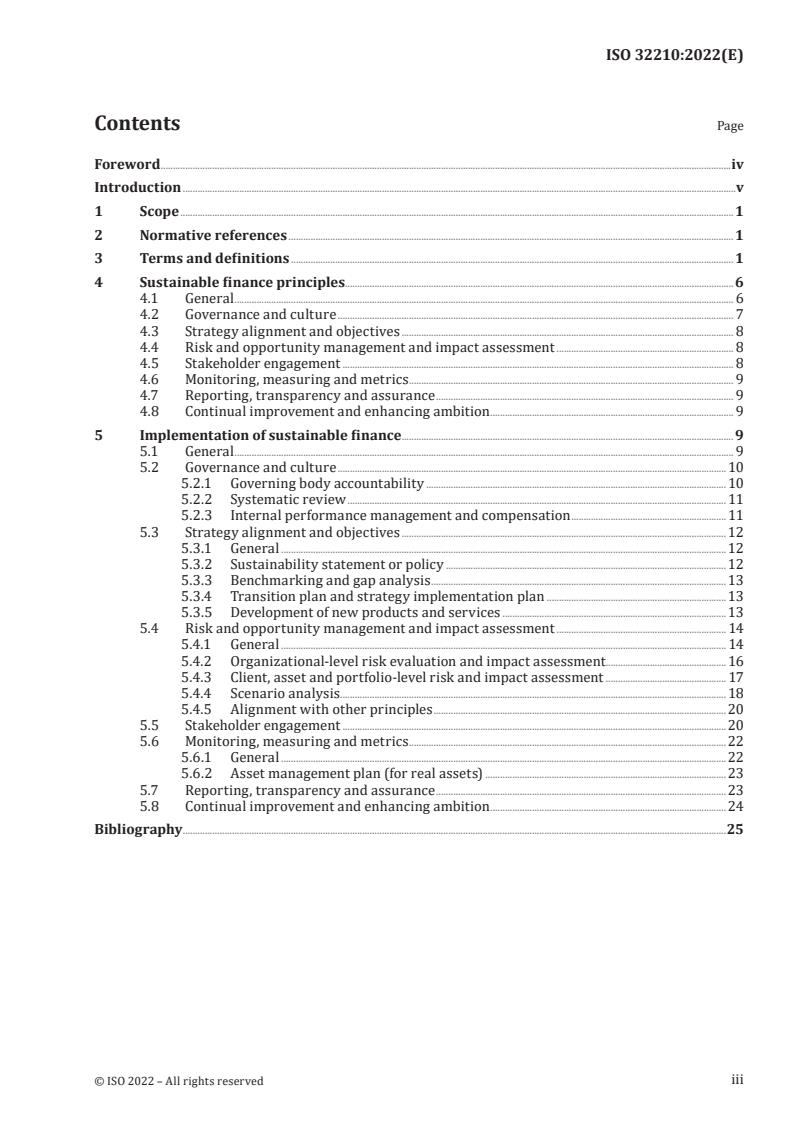
Contents Page
Foreword .iv
Introduction .v
1 Scope . 1
2 Normative references . 1
3 Terms and definitions . 1
4 Sustainable finance principles . .6
4.1 General . 6
4.2 Governance and culture . 7
4.3 Strategy alignment and objectives . 8
4.4 Risk and opportunity management and impact assessment . 8
4.5 Stakeholder engagement . 8
4.6 Monitoring, measuring and metrics . 9
4.7 Reporting, transparency and assurance . 9
4.8 Continual improvement and enhancing ambition . 9
5 Implementation of sustainable finance . 9
5.1 General . 9
5.2 Governance and culture . 10
5.2.1 Governing body accountability . 10
5.2.2 Systematic review . 11
5.2.3 Internal performance management and compensation . 11
5.3 Strategy alignment and objectives .12
5.3.1 General .12
5.3.2 Sustainability statement or policy .12
5.3.3 Benchmarking and gap analysis . 13
5.3.4 Transition plan and strategy implementation plan .13
5.3.5 Development of new products and services .13
5.4 Risk and opportunity management and impact assessment . 14
5.4.1 General . 14
5.4.2 Organizational-level risk evaluation and impact assessment . . 16
5.4.3 Client, asset and portfolio-level risk and impact assessment . 17
5.4.4 Scenario analysis . . 18
5.4.5 Alignment with other principles . 20
5.5 Stakeholder engagement .20
5.6 Monitoring, measuring and metrics . 22
5.6.1 General .22
5.6.2 Asset management plan (for real assets) . 23
5.7 Reporting, transparency and assurance . 23
5.8 Continual improvement and enhancing ambition . 24
Bibliography .25
iii
Foreword
ISO (the International Organization for Standardization) is a worldwide federation of national standards
bodies (ISO member bodies). The work of preparing International Standards is normally carried out
through ISO technical committees. Each member body interested in a subject for which a technical
committee has been established has the right to be represented on that committee. International
organizations, governmental and non-governmental, in liaison with ISO, also take part in the work.
ISO collaborates closely with the International Electrotechnical Commission (IEC) on all matters of
electrotechnical standardization.
The procedures used to develop this document and those intended for its further maintenance are
described in the ISO/IEC Directives, Part 1. In particular, the different approval criteria needed for the
different types of ISO documents should be noted. This document was drafted in accordance with the
editorial rules of the ISO/IEC Directives, Part 2 (see www.iso.org/directives).
Attention is drawn to the possibility that some of the elements of this document may be the subject of
patent rights. ISO shall not be held responsible for identifying any or all such patent rights. Details of
any patent rights identified during the development of the document will be in the Introduction and/or
on the ISO list of patent declarations received (see www.iso.org/patents).
Any trade name used in this document is information given for the convenience of users and does not
constitute an endorsement.
For an explanation of the voluntary nature of standards, the meaning of ISO specific terms and
expressions related to conformity assessment, as well as information about ISO’s adherence to
the World Trade Organization (WTO) principles in the Technical Barriers to Trade (TBT), see
www.iso.org/iso/foreword.html.
This document was prepared by Technical Committee ISO/TC 322, Sustainable finance.
Any feedback or questions on this document should be directed to the user’s national standards body. A
complete listing of these bodies can be found at www.iso.org/members.html.
iv
Introduction
Addressing global environmental and social challenges, and supporting sustainability, including
tackling climate change, cannot be reached without the support of the financial sector. In understanding
and developing an alignment of interest in tackling these challenges, organizations can contribute
toward positive environmental and social outcomes, improve governance, address externalities from
owned and financed assets, mitigate risk, realize opportunity and drive value. Transparent assessment,
management and reporting across all dimensions of sustainability can offer confidence and reassurance
to key stakeholders.
This document is designed to support organizations to integrate key principles of sustainability into
operations and activities, to help achieve these mutually beneficial outcomes.
The term “sustainable finance” has not been defined in this document, enabling organizations
to develop their own approach to the integration of sustainability into operations and activities.
However, this document does provide guidance on how key sustainability principles, including those
related to environmental, social and governance factors, can be integrated at the organizational level
into operations and core business strategy. It can support in mitigating risk, realizing opportunity
and driving value. It is designed to be complementary to, and can be implemented alongside, other
sustainability initiatives and requirements. This document is based on application of principles and
processes within an overarching framework. Components of the framework will already exist, at least
in part, within the organization. However, application of the principles and guidance provided in this
document will support in adapting or enhancing these components, so that integration of sustainability
is more effective, efficient and consistent. This document is designed to demonstrate organizational
alignment with wider environmental and social goals such as the appropriate elements of the United
[33]
Nations Framework Convention on Climate Change’s Paris Agreement and the United Nations
[34]
Sustainable Development Goals . Some elements of this document can also support organizational
[31]
alignment with the Task Force for Climate-related Finance Disclosures , and other international
initiatives and conventions as appropriate.
Although this document is designed primarily for application by organizations, the principles and
guidance can also be applied at the product and service level across a range of markets and instruments
including within debt, equity, risk transfer, blended products and other financial services.
Implementation of the principles and guidance will require interfacing with a number of organizational
departments, roles and stakeholders. This document can be used by personnel within an organization
and those supporting and advising an organization. Typically, these roles would be associated with
managing and promotion of organizational sustainability performance. However, successful integration
of sustainability is supported by engagement with many internal and external stakeholders, including,
but not limited to, those responsible for:
— fulfilling fiduciary responsibilities;
— setting and monitoring progress against strategic goals;
— understanding and monitoring risk and threats;
— business development including developing new products, services and partnerships;
— ensuring compliance;
— approving investments and capital allocation;
— monitoring investment portfolios;
— training and capacity building;
— mapping and analysing sustainability performance;
— engagement with, and reporting to, stakeholders.
v
The document has been designed so that an organization can apply the principles and guidance to
the extent applicable, given the organization’s scale, activities, geographical presence and ambition.
Organizations at different stages of integration of sustainability can apply all or parts of the principles
and guidance, depending on existing components and degree of operational capability and capacity.
The document is designed around promoting transparency, so that the organization’s stakeholders can
consider progress and performance.
Assurance of reported operational performance, whether internal or external, can provide additional
trust and confidence to stakeholders and is strongly encouraged.
Organizations using this document will be able to demonstrate alignment with sustainability principles,
guidance and practices, and internal governance provided in this document through their actions,
including stakeholder engagement, reporting and disclosures.
Continual improvement is a core aspect of the principles and guidance. The progression towards greater
sustainability requires ongoing improvement of operational performance and progress to related
sustainable outcomes. Therefore, an organization should ensure it is using relevant good practice,
leading methods and approaches as appropriate.
Key documents and outputs from implementation of the principles and guidance include:
— a sustainability statement or sustainability policy;
— development of strategic goals on material sustainability issues;
— development of suitable metrics and associated key performance indicators;
— executive and governing body accountability for sustainability matters;
— executive compensation aligned with sustainability performance and outcomes;
— a systematic review of existing organizational processes and resources;
— a stakeholder engagement plan;
— a list or register of material sustainability impacts;
— benchmarking, peer review and gap analysis;
— a transition plan;
— a strategic implementation plan;
— scenario analysis, risk impact assessment and mitigation plan;
— public reporting showing material sustainability impacts and relevant progress, performance and
outcomes;
— external assurance.
Additional resources are available on the website of ISO/TC 322 to support users in the application of
the principles and practices provided in this document, see: https://committee.iso.org/home/tc322.
vi
INTERNATIONAL STANDARD ISO 32210:2022(E)
Sustainable finance — Guidance on the application of
sustainability principles for organizations in the financial
sector
1 Scope
This document gives guidance to organizations on the application of overarching sustainability
principles, practices and terminology for financing activities.
It addresses what is material from the perspective of the organization and of its stakeholders.
This document is applicable to all organizations active in the financial sector, including, but not limited
to, direct lenders and investors, asset managers and service providers.
Beyond financial institutions and intermediaries, this document can be used by other parties in the
financial sector such as providers or recipients of sustainable finance, governmental organizations,
public and private sector institutions, business entities, industry associations, financial market
regulators, and supervisory and control bodies.
2 Normative references
There are no normative references in this document.
3 Terms and definitions
For the purposes of this document, the following terms and definitions apply.
ISO and IEC maintain terminology databases for use in standardization at the following addresses:
— ISO Online browsing platform: available at https:// www .iso .org/ obp
— IEC Electropedia: available at https:// www .electropedia .org/
3.1
sustainability
state of the global system, including environmental, social and economic aspects, in which the needs
of the present are met without compromising the ability of future generations to meet their own needs
[SOURCE: ISO Guide 82:2019, 3.1, modified — Notes to entry deleted.]
3.2
material sustainability impact
impact (3.7) identified either by the organization (3.3) or by the organization’s stakeholders (3.15) as
material, either to the financial performance of that organization, or to the organization’s impact on
sustainability (3.1)
3.3
organization
person or group of people that has its own functions with responsibilities (3.10), authorities and
relationships to achieve its objectives (3.4)
[SOURCE: ISO 37301:2021, 3.1, modified — Notes to entry deleted.]
3.4
objective
result to be achieved
[SOURCE: ISO 37301:2021, 3.6, modified — Notes to entry deleted.]
3.5
strategic plan
document identifying goals and objectives (3.4) to be pursued by an organization (3.3) over a long-term
period in support of its mission and being consistent with its values
[SOURCE: ISO 24516-3:2017, 3.25]
3.6
transformational change
activity resulting from a shift in organizational expectation, awareness or purpose, which results in a
profoundly different organizational culture, governance, structure, performance and outcomes
3.7
impact
past, current or future change, outcome, effect or influence, whether adverse or beneficial
3.8
governance of organizations
human-based system by which an organization (3.3) is directed, overseen and held accountable for
achieving its defined purpose
[SOURCE: ISO 37000:2021, 3.1.1]
3.9
fiduciary responsibility
requirement of fiduciaries to act in the best long-term interests of their clients and beneficiaries
Note 1 to entry: Fundamental fiduciary responsibilities include duty of loyalty and duty of care, to consider all
value and risk drivers including environmental, social and governance factors.
3.10
responsibility
obligation to act and take decisions to achieve intended outcomes
Note 1 to entry: See also accountability (3.13).
[SOURCE: ISO/IEC 38500:2015, 2.22, modified — “intended” replaced “required” in the definition.
Note 1 to entry added.]
3.11
top management
person or group of people who directs and controls an organization (3.3) at the highest level
Note 1 to entry: Top management has the power to delegate authority and provide resources within the
organization.
[SOURCE: ISO 37301:2021, 3.3, modified — Notes 2 and 3 to entry deleted.]
3.12
governing body
person or group of people who have ultimate accountability (3.13) for the whole organization (3.3)
Note 1 to entry: Every organizational entity has one governing body, whether or not it is explicitly established.
When the organization is not an organizational entity, the term governing group is applicable where “governing
body” is used throughout this document.
Note 2 to entry: A governing body can be explicitly established in a number of formats including, but not limited
to, a board of directors, supervisory board, sole director, joint and several directors, or trustees.
Note 3 to entry: ISO management system standards make reference to the term “top management” (3.11) to
describe a role that, depending on the standard and organizational context, reports to, and is held accountable
by, the governing body.
[SOURCE: ISO 37000:2021, 3.3.4]
3.13
accountability
obligation to another for the fulfilment of a responsibility (3.10)
Note 1 to entry: The obligation includes the duty to inform and to explain the manner in which the responsibility
was fulfilled.
Note 2 to entry: The non-fulfilment of a responsibility has consequences that can be enforced on the accountable
party.
[SOURCE: ISO 37000:2021, 3.2.2]
3.14
stakeholder engagement
activity undertaken to create opportunities for dialogue between an organization (3.3) and one or more
of its stakeholders (3.15), with the aim of providing an informed basis for the organization’s decisions
[SOURCE: ISO 26000:2010, 2.21]
3.15
stakeholder
person, interested party or organization (3.3) that can affect, be affected by, or perceive itself to be
affected by a decision or activity
[SOURCE: ISO 44001:2017, 3.2, modified — “interested party” moved from the term into the definition.]
3.16
continual improvement
recurring activity to enhance performance
[SOURCE: ISO 37301:2021, 3.12]
3.17
asset
tangible or intangible item or thing with an actual or potential financial or non-financial value to an
organization (3.3)
[SOURCE: ISO 55000:2014, 3.2.1, modified — “tangible or intangible item or thing with an actual or
potential financial or non-financial” replaced “item, thing or entity that has potential or actual” in the
definition. Notes to entry deleted.]
3.18
liability
present obligation of the organization (3.3) arising from past events, the settlement of which is expected
to result in an out-flow of resources from the organization
[SOURCE: ISO/TS 55010:2019, 3.18]
3.19
risk
effect of uncertainty on objectives (3.4)
Note 1 to entry: An effect is a deviation from the expected. It can be positive, negative or both, and can address,
create or result in opportunities and threats.
Note 2 to entry: Objectives can have different aspects and categories, and can be applied at different levels.
Note 3 to entry: Risk is usually expressed in terms of risk sources, potential events, their consequences and their
likelihood.
Note 4 to entry: Risk can be considered as the likelihood or probability that actual results or outcomes will differ
from expected results or return, representing the effect of uncertainty on investment or lending or insurance
objectives. This effect can be positive or negative, comprising opportunities and threats over varying time
horizons.
[SOURCE: ISO 31000:2018, 3.1, modified — Note 4 to entry added.]
3.20
risk appetite
amount and type of risk (3.19) that an organization (3.3) is willing to pursue or retain
[SOURCE: ISO Guide 73:2009, 3.7.1.2]
3.21
risk control
actions implementing risk-management decisions to mitigate, limit or reduce frequency or severity of
risks (3.19) and negative consequences
Note 1 to entry: Risk control can involve monitoring, re-evaluation and compliance with decisions.
[SOURCE: ISO 13824:2020, 3.13, modified — “to mitigate, limit or reduce frequency or severity of risks
and negative consequences” added to the definition.]
3.22
risk mitigant
measures implemented by which risks (3.19) are reduced to, or maintained within, specified levels
3.23
systemic risk
risk (3.19) leading to potential collapse or failure of an entire market, global economy, or environmental
and socio-political systems with the transmission of shocks leading to broader contagion and further
systemic impacts
3.24
scenario
plausible description of how the future can develop based on a coherent and internally consistent set of
assumptions about key driving forces and relationships
Note 1 to entry: Key driving forces can be, for example, demographics, interest rates, degrees of warming, rate of
technological change or prices.
[29]
[SOURCE: IPCC, 2018, Annex I , modified — The examples of key driving forces moved to Note 1 to
entry and expanded.]
3.25
scenario analysis
process for identifying and assessing the potential implications of a range of plausible future states on
operations, activities, products and services under various conditions
3.26
biodiversity
variability among living organisms from all sources including, inter alia, terrestrial, marine and other
aquatic ecosystems and the ecological complexes of which they are part
Note 1 to entry: This variability includes diversity within species, between species and of ecosystems.
[32]
[SOURCE: United Nations Convention on Biological Diversity, 1992, Article 2 , modified —
“biodiversity” replaced “biological diversity” as the term.]
3.27
circular economy
economy that is restorative and regenerative by design, and which aims to keep products, components
and materials at their highest utility and value at all times, distinguishing between technical and
biological cycles
[SOURCE: ISO 20400:2017, 3.1]
3.28
resilience
ability to absorb and adapt in a changing environment
[SOURCE: ISO 22300:2021, 3.1.206, modified — Note 1 to entry deleted.]
3.29
transition plan
actionable proposal, embedded in organizational strategy, that outlines how an entity will shift from
unsustainable economic activities and operational processes and systems toward sustainable activities
and operational processes and systems
Note 1 to entry: The transition plan can include short-, medium- and long-term targets to achieve net-zero carbon
emissions by 2050 or sooner.
3.30
key performance indicator
KPI
quantifiable level of achieving an objective (3.4)
Note 1 to entry: The KPIs are derived directly from, or through an aggregation function of, physical measurements,
data and/or other KPIs.
[SOURCE: ISO 22400-1:2014, 2.1.5, modified — “critical” deleted before “objective”.]
3.31
metric
defined measurement method and measurement scale that can demonstrate contribution to a key
performance indicator (3.30)
[SOURCE: ISO/TR 37150:2014, 3.5, modified — “that can demonstrate contribution to a key performance
indicator” added to the definition.]
3.32
transparency
open, comprehensive and understandable presentation of information
[SOURCE: ISO 14040:2006, 3.7]
3.33
baseline
agreed reference value or set of values which can be derived from past experience, often used for
comparing with ongoing performance data, values or outcomes
[SOURCE: ISO 37500:2014, 3.1, modified — “or” replaced “and/or” before “outcomes”.]
3.34
benchmarking
comparing attributes, processes or performance between organizations (3.3)
[SOURCE: ISO 30400:2016, 3.17]
3.35
asset management
coordinated activity of an organization (3.3) to realize value from assets (3.17)
[SOURCE: ISO 55000:2014, 3.3.1, modified — Notes to entry deleted.]
3.36
asset management plan
documented information that specifies the activities, resources and timescales required for an
individual asset (3.17), or a grouping of assets, to achieve the organization’s (3.3) asset management
objectives
Note 1 to entry: This includes the organization’s sustainable finance objectives within asset management (3.35).
[SOURCE: ISO 55000:2014, 3.3.3, modified — Notes to entry deleted and a new Note 1 to entry added.]
3.37
business-as-usual scenario
ongoing and unchanging state of affairs
3.38
modern slavery
all work or service which is exacted from any person under the menace of any penalty and for which the
said person has not offered their self voluntarily
[28]
[SOURCE: ILO, Forced Labour Convention, 1930 (No. 29) , modified — “modern slavery” replaced
“forced or compulsory labour” as the term. “their self” replaced “himself” in the definition.]
3.39
climate change adaptation
process of adjustment to actual or expected climate and its effects
Note 1 to entry: In human systems, adaptation seeks to moderate or avoid harm or exploit beneficial opportunities.
Note 2 to entry: In some natural systems, human intervention can facilitate adjustment to expected climate and
its effects.
[SOURCE: ISO 14090:2019, 3.1, modified — “climate change adaptation” replaced the preferred term
“adaptation to climate change”.]
3.40
whistleblower
person who reports suspected or actual wrongdoing, and has reasonable belief that the information is
true at the time of reporting
[SOURCE: ISO 37002:2021, 3.9, modified — Notes to entry deleted.]
3.41
value chain
entire sequence of activities or parties that create or receive value through the provision of a product
or service
[SOURCE: ISO 14050:2020, 3.5.28, modified — “or service” added.]
4 Sustainable finance principles
4.1 General
This clause describes the key sustainable finance principles (hereinafter referred to as “Principles”)
which form the core elements of this document. The Principles outlined in 4.2 to 4.8 are aimed at
supporting organizations in aligning their business strategy and operations with sustainability goals
and objectives that are material to the organization and its stakeholders.
The Principles are overarching yet subject to ongoing interaction with each other, as illustrated in
Figure 1. The concept of material sustainability impact should be considered throughout.
For each Principle, additional guidance on operational implementation, including on conducting a
materiality assessment, is provided in Clause 5.
Figure 1 — Interrelationship between the Principles
This document has been designed for organizations to use regardless of their level of expertise or
capacity. Organizations can begin by addressing key elements of the Principles starting with governance
and culture (see 4.2) and strategy alignment and objectives (see 4.3) initially, and then working
through the other Principles concentrically inwards, noting the periodic key reporting and output
under reporting and transparency (see 4.7). Using the concept of continual improvement and enhancing
ambition (see 4.8), organizations can then use this document to improve sustainability performance
and outcomes. Internal operational performance as well as all activities, products and services should
be considered by the organization. As such, the Principles are not intended to be hierarchical but rather
holistic and interdependent.
4.2 Governance and culture
Effective governance of organizations is required to embed a culture that considers sustainability
across the organization. Responsibility for sustainability matters should be integrated throughout
corporate culture.
To achieve long-term sustainable outcomes, top management should be committed to the organization’s
sustainable business strategy and should be accountable to stakeholders.
The governing body should consider whether organizational processes adequately consider all material
sustainability impacts, to satisfy themselves that the organization is adequately addressing risk,
creating value, inspiring stakeholder confidence and, where applicable, that fiduciary responsibility is
fulfilled. The governing body should identify drivers of value, liability, impact, risk and risk mitigants,
while implementing an agreed-upon strategy into all appropriate processes and activities.
4.3 Strategy alignment and objectives
In many organizations “business as usual” is insufficient to deliver long-term sustainable outcomes
which are aligned with global sustainability goals and expectations of stakeholders. Institutional
transformational change can be required for the organization to reframe its purpose, values and mission
to achieve change at the appropriate pace and scale. At the same time, it should be recognized that
potentially significant capacity building at all levels, across functions and departments can be required
to deliver on sustainability objectives. Effective leadership, commitment and external collaboration are
essential to meet these challenges and deliver value to stakeholders.
In order to articulate alignment with sustainability objectives expressed in relevant regional, national
and international initiatives, the organization should adopt a governing-body-approved sustainability
policy or similar statement. The sustainability statement can include, but not be limited to, any
organizational commitments related to aligning with external objectives, setting associated goals and
expressing how the organization aims to embed its sustainability strategy across any appropriate
operational activities. The organization should, taking into consideration outcomes from stakeholder
engagement (see 4.5), provide additional guidance on the development and implementation of the
sustainability statement.
The organization’s strategic goals should be ambitious, reflect material sustainability impacts relevant
to its activities, consider the maturity of organizational capability, integrate continual improvement
and enhance ambition over time (see 4.8).
4.4 Risk and opportunity management and impact assessment
Achieving global environmental and social goals, including tackling climate change, and supporting
sustainability requires concerted collaboration of public and private sectors, civil society and academia
to effect long-term structural changes and re-orientation of policies, regulations and markets. This
transition will have significant impacts on organizations active in the financial sector. A robust
understanding of material sustainability impacts, risk (threat) and opportunity management across
organizational activities is fundamental. Outputs from stakeholder engagement (see 4.5) should be
used to inform this understanding.
Impacts can be positive or negative, financial and/or non-financial, and internal or external to
organizational stakeholders.
A robust risk management framework should address the key sustainability drivers (inputs) required
to maximize stakeholder value, while factoring in mitigating strategies and the potential for positive
and adverse outcomes (outputs) to stakeholder value. Organizations should strive to effectively track
or model current, emerging and foreseeable sustainability trends, risks and opportunities.
This analysis should include due consideration of the impact of non-diversifiable, nonlinear risks such
as climate change, biodiversity, social inequities, cyber-security and global pandemics.
Environmental, social, economic and governance risks should be considered across the whole
organization, throughout the product and service life cycle. Forecasting will determine the
organization’s exposure to emerging or foreseeable sustainability risks based on assumptions about
the organization’s activities over time.
Conducting scenario analysis can help assess potential future risks and opportunities (see 5.4.4).
4.5 Stakeholder engagement
Adoption of a sustainable finance framework in alignment with the organization’s broader purpose
requires effective engagement with, and due regard to, the views and opinions of various interested
parties and relevant stakeholders. As such, it is fundamental to appropriately identify, communicate
and engage effectively with relevant stakeholders. This should enable the organizations to empower
stakeholders as active contributors to value creation.
Engagement with relevant stakeholders is intended to gain valuable insights, identify various points
of view, promote understanding, mitigate risk so as to do no significant harm, and identify best,
normative and lagging practices. Feedback from stakeholder engagement should be integrated within
an organization’s implementation of the Principles, especially throughout governance and strategy, but
also other aspects.
4.6 Monitoring, measuring and metrics
Strategic goals should be supported with suitable metrics and associated key impact and performance
indicators used to measure progress toward these goals and other material sustainability impacts.
Building on existing organizational monitoring and evaluation processes and procedures, appropriate
metrics and associated key performance indicators should be identified and monitored.
Monitoring and measuring should focus on material sustainability impact, and present a list of
indicators that reflect strategic goals and objectives for the organization.
Where appropriate, indicators and metrics can also be chosen that demonstrate the organization’s
contribution to realize sustainable outcomes and impact, both expected and realized.
Once established, the monitoring and measuring of sustainability outcomes and impact can enable
benchmarking and the measurement of progress toward strategic goals (see 4.3) and the organization’s
impact (see 4.4), as well as the reporting of progress to stakeholders (see 4.7).
4.7 Reporting, transparency and assurance
An organization should, as a minimum, publicly demonstrate the extent of its progress with each of the
Principles. Organizations should aspire to publicly demonstrate progress toward strategic goals and
other material sustainability impact objectives by presenting metrics and associated key performance
indicators (see 4.6).
Application of the Principles is designed to enable a high level of transparency. An external, third-
party review of public disclosures and reporting can facilitate trust and market confidence in these
disclosures. Such a review should be considered as good practice.
4.8 Continual improvement and enhancing ambition
The organization should aim for continual improvement both in terms of sustainability outcomes and
impacts, but also in enhancing ambition towards global environmental and social goals over time.
Therefore, the organization should review its performance, processes and organizational capacity at
planned intervals (preferably at least once a year) to ensure adequate implementation of the Principles,
to determine opportunities for improvement and incorporate learnings to enhance sustainability
outcomes and impacts. Outcomes and impacts can be disclosed in alignment with 4.7.
5 Implementation of sustainable finance
5.1 General
Organizations should embed the Principles outlined in Clause 4 within the organization’s activities as
appropriate. This clause provides selected good practice guidance on how to implement the Principles
at the organizational level. Implementation of the Principles should build on, but not seek to replicate,
existing organization processes.
The examples of good practice provided in this clause can be used to embed the Principles, whether
to augment existing tools, processes and systems, or in the absence of existing practice. Other tools,
processes or systems also can be more appropriate depending on an organization’s market focus,
geographical footprint and operational activities. Therefore, this guidance is non-exhaustive, and each
organization should consider their own operational implementation requirements as is relevant.
To align the Principles with operational activities, the organization should work across operational
functions and understand the interaction between business value creation models and sustainability
impacts, risks and opportunities.
Typically, these roles are associated with managing and promoting sustainability performance.
However, the successful integration of sustainability is supported by engagement and interfacing
with many internal and external stakeholders, including, but not limited to, those responsible for core
activities, operations and practices, such as:
— fulfilling fiduciary responsibilities;
— setting and monitoring progress against strategic goals;
— understanding and monitoring risk;
— business development including developing new products and services;
— ensuring compliance;
— approving investments and capital allocation;
— monitoring investment portfolios;
— training and capacity building;
— mapping and analysing sustainability performance, including operational activities, products and
services;
— engaging with, and reporting to, stakeholders.
5.2 Governance and culture
5.2.1 Governing body accountability
In order to embrace sustainable finance across the organization, the governing body should integrate
sustainability considerations within its existing governance processes by:
— framing sustainability as one of the priorities in the governing body’s charter in alignment with the
organization’s purpose, values and strategy;
— adopting a policy to reflect sustainability as a priority (see 5.3.2);
— acknowledging publicly that the organization’s performance on material sustainability impact, and
its ability to create value and address risk over the long term, is likely to impact the organization’s
stakeholders and the environment;
— assigning responsibility to drive sustainability and ensure that necessary resources are in place
for the organization to meet its long-term sustainable finance objectives, noting that there can
be competing short-term interests to consider, and then to measure performance against those
objectives;
— establishing effective oversight and controls to ensure that sustainability risk is overseen by
an appropriate governing body committee, such as the nominating, audit, risk or governance
committees of the governing body, and that sustainability risk is effectively managed in the
organization’s enterprise risk management processes;
— aligning sustainability priorities with management’s strategic approach and implementation;
— ensuring effective communication and engagement with the organization’s stakeholders;
— ensuring that workforce policies and practices are consistent with organizational values respecting
diversity, inclusion and social equity;
— recognition of the organization’s impact on and contribution towards society.
The organization should ensure that accountability for sustainable finance matters rests with a specific
director (or equivalent), and that collectively the governing body has sufficient expert technical
capability in sustainability matters.
An internal sustainable finance working group, for example, reporting also to the governing body,
comprising key employees from across the organization, should be established to oversee the
implementation of sustainable finance initiatives. Alternatively, the governing body can be advised and
supported by external advisors with expertise in sustainability matters.
The organization should implement mechanisms to allow internal and external stakeholders to express
concerns about relevant aspects for the organization or wider sustainability objectives, in th
...