

ISO 15883-1:2024
(Main)Washer-disinfectors — Part 1: General requirements, terms and definitions and tests
General Information
- Abstract
This document specifies general performance requirements for washer-disinfectors (WD) and washer-disinfector accessories that are intended to be used for cleaning and disinfection of reusable medical devices. It specifies performance requirements for cleaning and disinfection as well as for the accessories that can be required to achieve the necessary performance. The methods and instrumentation required for validation, routine control and monitoring and requalification, periodically and after essential repairs, are also specified. NOTE 1 The requirements can be applied to WD intended for use with other articles used in the context of medical, dental, pharmaceutical and veterinary practice. The requirements for WD intended to process specific loads are specified in ISO 15883-2, ISO 15883-3, ISO 15883-4, ISO 15883-6 and ISO 15883-7. For WD intended to process loads of two or more different types, the requirements of the applicable parts of ISO 15883-2, ISO 15883-3, ISO 15883-4, ISO 15883-6 and ISO 15883-7 apply. This document does not specify requirements intended for machines for use for laundry or general catering purposes. This document does not include requirements for machines which are intended to sterilize the load, or which are designated as “sterilizers” and addressed in other standards. The specified performance requirements of this document do not ensure the inactivation or removal of the causative agent(s) (prion protein) of transmissible spongiform encephalopathies. NOTE 2 Chemicals in some cleaning agents and disinfectants can react with prion protein in a manner that can inhibit its removal or inactivation. If the presence of prion protein is considered a possibility, then this can influence the choice of cleaning agent and disinfectant. NOTE 3 This document can be used by prospective purchasers and manufacturers as the basis of agreement on the specification of a WD. The test methods for demonstration of conformity with the requirements of this document can also be employed by users to demonstrate continued conformity of the installed WD throughout its service life. Guidance on a routine test programme is given in Annex A.
- Status
- Published
- Publication Date
- 03-Oct-2024
- Technical Committee
- ISO/TC 198 - Sterilization of health care products
- Drafting Committee
- ISO/TC 198/WG 13 - Washer-disinfectors
- Current Stage
- 6060 - International Standard published
- Start Date
- 04-Oct-2024
- Due Date
- 06-Dec-2022
- Completion Date
- 04-Oct-2024
Buy Documents

ISO 15883-1:2024 - Washer-disinfectors — Part 1: General requirements, terms and definitions and tests Released:4. 10. 2024
ISO 15883-1:2024 - Laveurs désinfecteurs — Partie 1: Exigences générales, termes et définitions et essais Released:4. 10. 2024
Overview
ISO 15883-1:2024 - Washer-disinfectors - Part 1: General requirements, terms and definitions and tests defines the general performance, testing and validation framework for washer-disinfectors (WD) used to clean and disinfect reusable medical devices. The standard sets out requirements for cleaning and disinfection performance, accessories, instrumentation and methods for validation, routine monitoring and requalification. It applies across medical, dental, pharmaceutical and veterinary contexts (but not laundry, catering machines or sterilizers) and notes limitations regarding prion inactivation.
Key SEO terms: ISO 15883-1:2024, washer-disinfectors, WD, medical device reprocessing, validation, routine testing.
Key Topics
- Scope and terminology: common terms and definitions for washer-disinfector design, operation and testing.
- Performance requirements: criteria for cleaning, rinsing, drying and thermal or chemical disinfection to achieve reproducible results for reusable medical devices.
- Accessories and process chemicals: requirements for dosing systems, detergents and disinfectants and their role in achieving required outcomes.
- Mechanical and safety design: materials, construction, tanks, spray systems, doors/interlocks, load carriers, piping and ventilation.
- Instrumentation and controls: temperature, pressure, flow and timing devices; process verification and recording systems; microprocessor control and fault indication.
- Testing and conformity: validation methods, instrumentation for testing, routine and periodic tests, requalification after repairs, and guidance on implementing a routine test programme (Annex A).
- Water quality and drainage: requirements and tests for final rinse water, water volume per stage and drainage performance.
- Limitations: explicit note that the standard does not ensure prion removal/inactivation and that some chemicals can affect prion behavior.
Applications
ISO 15883-1:2024 is intended for:
- Manufacturers designing and certifying washer-disinfectors and WD accessories.
- Healthcare procurement teams to define purchase specifications and acceptance criteria.
- Sterile services departments, infection prevention teams and biomedical engineers responsible for validation, routine monitoring and requalification of installed WD.
- Regulatory bodies and conformity assessors evaluating compliance with performance and safety requirements. Practical uses include establishing validation protocols, selecting compatible cleaning chemistries, designing preventive maintenance and traceable process-recording workflows for medical device reprocessing.
Related Standards
- ISO 15883 series parts for specific loads: ISO 15883-2, -3, -4, -6, -7 - specify requirements for washer-disinfectors intended to process particular item types.
- Annex A of ISO 15883-1 provides guidance on routine testing programmes.
This standard is essential for ensuring reliable washer-disinfector performance, traceable validation and safe reprocessing of reusable medical devices in clinical and laboratory settings.
Relations
- Effective Date
- 25-Aug-2026
- Effective Date
- 15-Apr-2026
- Effective Date
- 04-Mar-2026
- Effective Date
- 04-Mar-2026
- Effective Date
- 04-Mar-2026
- Effective Date
- 12-Feb-2026
- Effective Date
- 06-Jun-2022
- Effective Date
- 17-Jul-2021
- Effective Date
- 14-Oct-2020
Buy Documents
ISO 15883-1:2024 - Washer-disinfectors — Part 1: General requirements, terms and definitions and tests Released:4. 10. 2024
ISO 15883-1:2024 - Laveurs désinfecteurs — Partie 1: Exigences générales, termes et définitions et essais Released:4. 10. 2024
Get Certified
Connect with accredited certification bodies for this standard

BSI Group
BSI (British Standards Institution) is the business standards company that helps organizations make excellence a habit.

TÜV Rheinland
TÜV Rheinland is a leading international provider of technical services.

TÜV SÜD
TÜV SÜD is a trusted partner of choice for safety, security and sustainability solutions.
Sponsored listings
Frequently Asked Questions
ISO 15883-1:2024 is a standard published by the International Organization for Standardization (ISO). Its full title is "Washer-disinfectors — Part 1: General requirements, terms and definitions and tests". This standard covers: This document specifies general performance requirements for washer-disinfectors (WD) and washer-disinfector accessories that are intended to be used for cleaning and disinfection of reusable medical devices. It specifies performance requirements for cleaning and disinfection as well as for the accessories that can be required to achieve the necessary performance. The methods and instrumentation required for validation, routine control and monitoring and requalification, periodically and after essential repairs, are also specified. NOTE 1 The requirements can be applied to WD intended for use with other articles used in the context of medical, dental, pharmaceutical and veterinary practice. The requirements for WD intended to process specific loads are specified in ISO 15883-2, ISO 15883-3, ISO 15883-4, ISO 15883-6 and ISO 15883-7. For WD intended to process loads of two or more different types, the requirements of the applicable parts of ISO 15883-2, ISO 15883-3, ISO 15883-4, ISO 15883-6 and ISO 15883-7 apply. This document does not specify requirements intended for machines for use for laundry or general catering purposes. This document does not include requirements for machines which are intended to sterilize the load, or which are designated as “sterilizers” and addressed in other standards. The specified performance requirements of this document do not ensure the inactivation or removal of the causative agent(s) (prion protein) of transmissible spongiform encephalopathies. NOTE 2 Chemicals in some cleaning agents and disinfectants can react with prion protein in a manner that can inhibit its removal or inactivation. If the presence of prion protein is considered a possibility, then this can influence the choice of cleaning agent and disinfectant. NOTE 3 This document can be used by prospective purchasers and manufacturers as the basis of agreement on the specification of a WD. The test methods for demonstration of conformity with the requirements of this document can also be employed by users to demonstrate continued conformity of the installed WD throughout its service life. Guidance on a routine test programme is given in Annex A.
This document specifies general performance requirements for washer-disinfectors (WD) and washer-disinfector accessories that are intended to be used for cleaning and disinfection of reusable medical devices. It specifies performance requirements for cleaning and disinfection as well as for the accessories that can be required to achieve the necessary performance. The methods and instrumentation required for validation, routine control and monitoring and requalification, periodically and after essential repairs, are also specified. NOTE 1 The requirements can be applied to WD intended for use with other articles used in the context of medical, dental, pharmaceutical and veterinary practice. The requirements for WD intended to process specific loads are specified in ISO 15883-2, ISO 15883-3, ISO 15883-4, ISO 15883-6 and ISO 15883-7. For WD intended to process loads of two or more different types, the requirements of the applicable parts of ISO 15883-2, ISO 15883-3, ISO 15883-4, ISO 15883-6 and ISO 15883-7 apply. This document does not specify requirements intended for machines for use for laundry or general catering purposes. This document does not include requirements for machines which are intended to sterilize the load, or which are designated as “sterilizers” and addressed in other standards. The specified performance requirements of this document do not ensure the inactivation or removal of the causative agent(s) (prion protein) of transmissible spongiform encephalopathies. NOTE 2 Chemicals in some cleaning agents and disinfectants can react with prion protein in a manner that can inhibit its removal or inactivation. If the presence of prion protein is considered a possibility, then this can influence the choice of cleaning agent and disinfectant. NOTE 3 This document can be used by prospective purchasers and manufacturers as the basis of agreement on the specification of a WD. The test methods for demonstration of conformity with the requirements of this document can also be employed by users to demonstrate continued conformity of the installed WD throughout its service life. Guidance on a routine test programme is given in Annex A.
ISO 15883-1:2024 is classified under the following ICS (International Classification for Standards) categories: 11.080.10 - Sterilizing equipment. The ICS classification helps identify the subject area and facilitates finding related standards.
ISO 15883-1:2024 has the following relationships with other standards: It is inter standard links to EN ISO 15883-5:2021, EN ISO 15883-6:2026, EN ISO 15883-3:2025, EN ISO 15883-2:2025, EN ISO 15883-7:2025, EN ISO 15883-1:2025, ISO/TR 17534-4:2020, ISO 15883-1:2006/Amd 1:2014, ISO 15883-1:2006. Understanding these relationships helps ensure you are using the most current and applicable version of the standard.
ISO 15883-1:2024 is available in PDF format for immediate download after purchase. The document can be added to your cart and obtained through the secure checkout process. Digital delivery ensures instant access to the complete standard document.
Standards Content (Sample)
International
Standard
ISO 15883-1
Second edition
Washer-disinfectors —
2024-10
Part 1:
General requirements, terms and
definitions and tests
Laveurs désinfecteurs —
Partie 1: Exigences générales, termes et définitions et essais
Reference number
© ISO 2024
All rights reserved. Unless otherwise specified, or required in the context of its implementation, no part of this publication may
be reproduced or utilized otherwise in any form or by any means, electronic or mechanical, including photocopying, or posting on
the internet or an intranet, without prior written permission. Permission can be requested from either ISO at the address below
or ISO’s member body in the country of the requester.
ISO copyright office
CP 401 • Ch. de Blandonnet 8
CH-1214 Vernier, Geneva
Phone: +41 22 749 01 11
Email: copyright@iso.org
Website: www.iso.org
Published in Switzerland
ii
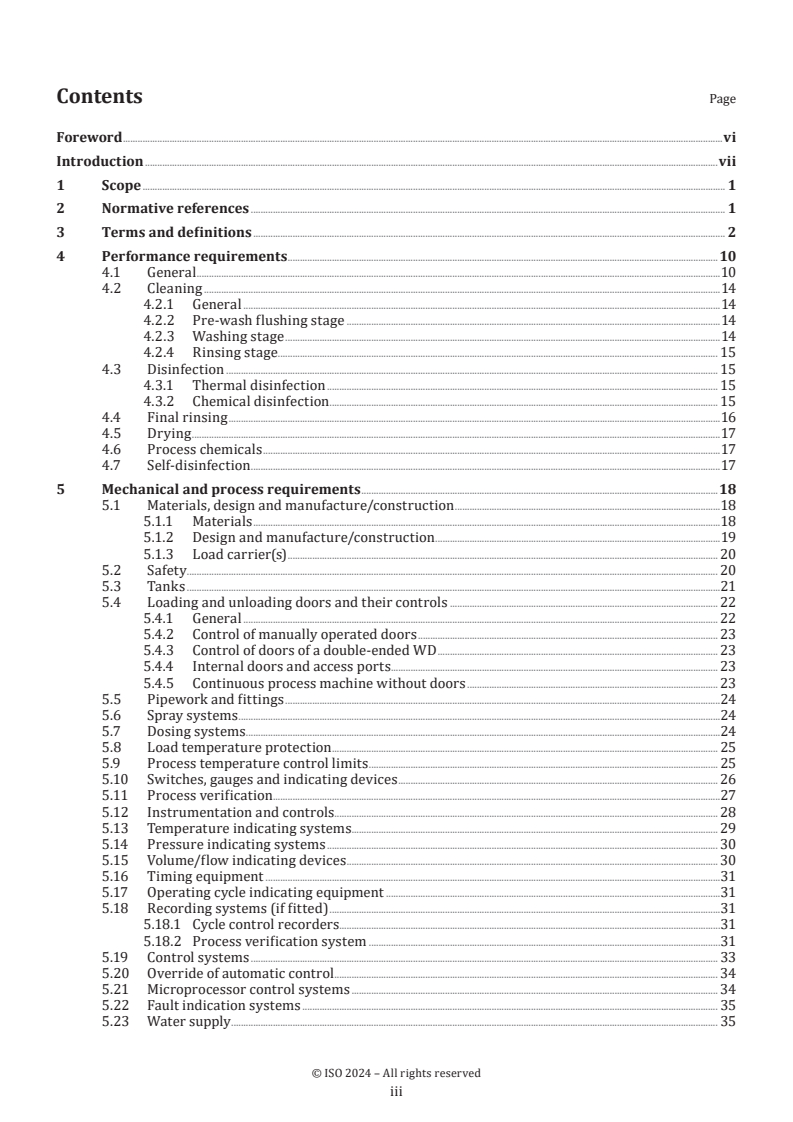
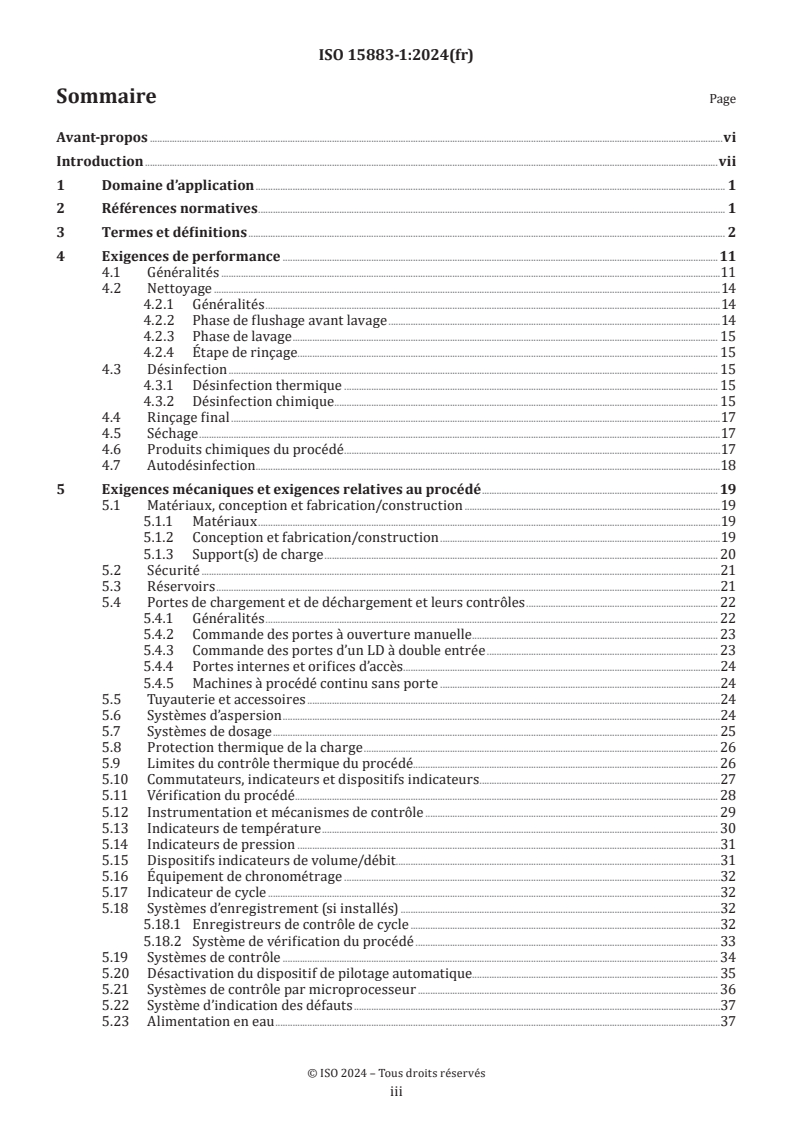
Contents Page
Foreword .vi
Introduction .vii
1 Scope . 1
2 Normative references . 1
3 Terms and definitions . 2
4 Performance requirements . .10
4.1 General .10
4.2 Cleaning .14
4.2.1 General .14
4.2.2 Pre-wash flushing stage .14
4.2.3 Washing stage .14
4.2.4 Rinsing stage. 15
4.3 Disinfection . 15
4.3.1 Thermal disinfection . 15
4.3.2 Chemical disinfection . 15
4.4 Final rinsing .16
4.5 Drying .17
4.6 Process chemicals .17
4.7 Self-disinfection .17
5 Mechanical and process requirements .18
5.1 Materials, design and manufacture/construction .18
5.1.1 Materials .18
5.1.2 Design and manufacture/construction .19
5.1.3 Load carrier(s) . 20
5.2 Safety. 20
5.3 Tanks .21
5.4 Loading and unloading doors and their controls . 22
5.4.1 General . 22
5.4.2 Control of manually operated doors . 23
5.4.3 Control of doors of a double-ended WD . 23
5.4.4 Internal doors and access ports. 23
5.4.5 Continuous process machine without doors . 23
5.5 Pipework and fittings .24
5.6 Spray systems .24
5.7 Dosing systems . .24
5.8 Load temperature protection . 25
5.9 Process temperature control limits . 25
5.10 Switches, gauges and indicating devices . 26
5.11 Process verification .27
5.12 Instrumentation and controls. 28
5.13 Temperature indicating systems . . . 29
5.14 Pressure indicating systems . 30
5.15 Volume/flow indicating devices . 30
5.16 Timing equipment .31
5.17 Operating cycle indicating equipment .31
5.18 Recording systems (if fitted) .31
5.18.1 Cycle control recorders.31
5.18.2 Process verification system .31
5.19 Control systems . 33
5.20 Override of automatic control . 34
5.21 Microprocessor control systems . 34
5.22 Fault indication systems . 35
5.23 Water supply . 35
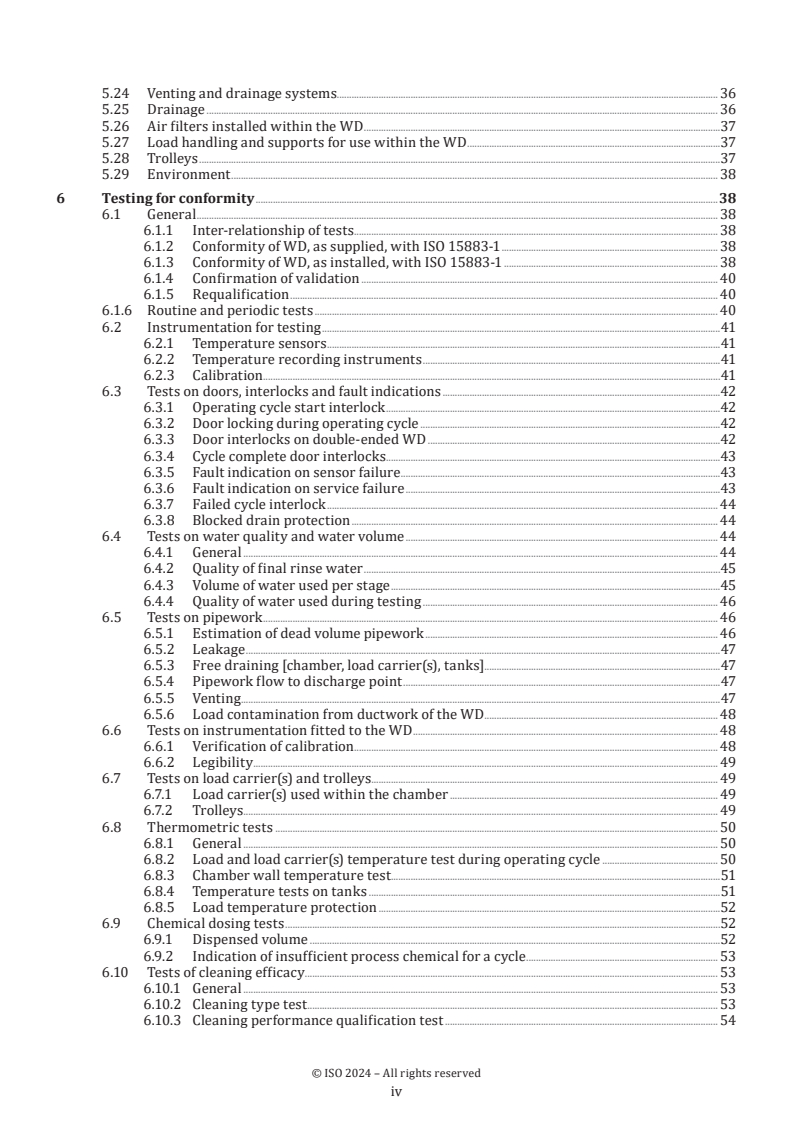
iii
5.24 Venting and drainage systems. 36
5.25 Drainage . 36
5.26 Air filters installed within the WD .37
5.27 Load handling and supports for use within the WD .37
5.28 Trolleys .37
5.29 Environment . 38
6 Testing for conformity .38
6.1 General . 38
6.1.1 Inter-relationship of tests. 38
6.1.2 Conformity of WD, as supplied, with ISO 15883-1 . 38
6.1.3 Conformity of WD, as installed, with ISO 15883-1 . 38
6.1.4 Confirmation of validation . 40
6.1.5 Requalification . 40
6.1.6 Routine and periodic tests . 40
6.2 Instrumentation for testing .41
6.2.1 Temperature sensors .41
6.2.2 Temperature recording instruments .41
6.2.3 Calibration . . .41
6.3 Tests on doors, interlocks and fault indications .42
6.3.1 Operating cycle start interlock .42
6.3.2 Door locking during operating cycle .42
6.3.3 Door interlocks on double-ended WD .42
6.3.4 Cycle complete door interlocks.43
6.3.5 Fault indication on sensor failure .43
6.3.6 Fault indication on service failure .43
6.3.7 Failed cycle interlock . 44
6.3.8 Blocked drain protection . 44
6.4 Tests on water quality and water volume . 44
6.4.1 General . 44
6.4.2 Quality of final rinse water .45
6.4.3 Volume of water used per stage .45
6.4.4 Quality of water used during testing . 46
6.5 Tests on pipework . 46
6.5.1 Estimation of dead volume pipework . 46
6.5.2 Leakage .47
6.5.3 Free draining [chamber, load carrier(s), tanks].47
6.5.4 Pipework flow to discharge point .47
6.5.5 Venting . .47
6.5.6 Load contamination from ductwork of the WD . 48
6.6 Tests on instrumentation fitted to the WD . 48
6.6.1 Verification of calibration . . 48
6.6.2 Legibility . 49
6.7 Tests on load carrier(s) and trolleys. 49
6.7.1 Load carrier(s) used within the chamber . 49
6.7.2 Trolleys . . 49
6.8 Thermometric tests . 50
6.8.1 General . 50
6.8.2 Load and load carrier(s) temperature test during operating cycle . 50
6.8.3 Chamber wall temperature test.51
6.8.4 Temperature tests on tanks .51
6.8.5 Load temperature protection .52
6.9 Chemical dosing tests .52
6.9.1 Dispensed volume .52
6.9.2 Indication of insufficient process chemical for a cycle . 53
6.10 Tests of cleaning efficacy . 53
6.10.1 General . 53
6.10.2 Cleaning type test . 53
6.10.3 Cleaning performance qualification test . 54
iv
6.10.4 Routine process monitoring . 54
6.10.5 Tests for process residuals . 54
6.11 Tests of air quality . 55
6.11.1 General . 55
6.11.2 Procedure . 55
6.11.3 Results . 55
6.12 Test of load dryness . 55
6.12.1 General . 55
6.12.2 Materials . 55
6.12.3 Exterior surface drying . 55
6.12.4 Lumen load drying . 56
6.13 Test of automatic control . 56
6.13.1 General . 56
6.13.2 Procedure . 56
6.13.3 Results .57
7 Documentation .57
8 Information to be supplied .57
8.1 General .57
8.2 Before delivery of the WD and for installation . 58
8.3 At delivery of the WD .59
9 Marking, labelling and packaging .60
9.1 Marking and labelling . 60
9.2 Packaging . 60
10 Information to be requested from the purchaser by the supplier of the WD .60
Annex A (informative) Test programme .62
Annex B (informative) A concept — Comparative lethality of moist heat processes .66
Annex C (normative) Microbiological recovery medium for estimation of bacterial
contamination of water .70
Bibliography .71
v
Foreword
ISO (the International Organization for Standardization) is a worldwide federation of national standards
bodies (ISO member bodies). The work of preparing International Standards is normally carried out through
ISO technical committees. Each member body interested in a subject for which a technical committee
has been established has the right to be represented on that committee. International organizations,
governmental and non-governmental, in liaison with ISO, also take part in the work. ISO collaborates closely
with the International Electrotechnical Commission (IEC) on all matters of electrotechnical standardization.
The procedures used to develop this document and those intended for its further maintenance are described
in the ISO/IEC Directives, Part 1. In particular, the different approval criteria needed for the different types
of ISO documents should be noted. This document was drafted in accordance with the editorial rules of the
ISO/IEC Directives, Part 2 (see www.iso.org/directives).
Attention is drawn to the possibility that some of the elements of this document may be the subject of patent
rights. ISO shall not be held responsible for identifying any or all such patent rights. Details of any patent
rights identified during the development of the document will be in the Introduction and/or on the ISO list of
patent declarations received (see www.iso.org/patents).
Any trade name used in this document is information given for the convenience of users and does not
constitute an endorsement.
For an explanation of the voluntary nature of standards, the meaning of ISO specific terms and expressions
related to conformity assessment, as well as information about ISO's adherence to the World Trade
Organization (WTO) principles in the Technical Barriers to Trade (TBT), see www.iso.org/iso/foreword.html.
This document was prepared by Technical Committee ISO/TC 198, Sterilization of health care products, in
collaboration with the European Committee for Standardization (CEN) Technical Committee CEN/TC 102,
Sterilizers for medical purposes, in accordance with the Agreement on technical cooperation between ISO and
CEN (Vienna Agreement).
This second edition cancels and replaces the first edition (ISO 15883-1:2006), which has been technically
revised. It also incorporates ISO 15883-1:2006/Amd 1:2014.
The main changes are as follows:
— alignment of terms and definitions with ISO 11139:2018 + Amd 1:2024;
— addition of requirements for load carrier(s);
— clarification of water quality requirements;
— elaboration of load dryness tests for external and internal surfaces of load items (see 6.12);
— relocation of former Annex C, Test methods for the detection and assessment of residual proteinaceous
contamination, to ISO 15883-5:2021;
— redesignation of former Annex D, Microbiological recovery medium for estimation of bacterial contamination
of water, as Annex C;
— increase in the minimum temperature limit for thermal disinfection and calculation of A values from
65 °C to 70 °C (see Reference [48]);
— revision of the Bibliography.
A list of all parts in the ISO 15883 series can be found on the ISO website.
Any feedback or questions on this document should be directed to the user’s national standards body. A
complete listing of these bodies can be found at www.iso.org/members.html.
vi
Introduction
This document is the first part of the ISO 15883 series of standards specifying the performance of washer-
disinfectors (WD) and specifies the general requirements for performance applicable to all WD. The
requirements given in this document are applicable to all WD specified in subsequent parts of the ISO 15883
series, except insofar as they are modified or added to by a subsequent part, in which case the requirements
of that particular part apply.
Fields of application within the scope of ISO 15883 series can include laboratory, veterinary, dental and
pharmaceutical applications and other specific applications, such as WD for bedsteads and transport carts
and the disinfection of crockery and cutlery intended for use with immunologically compromised patients.
WD are used only for processing the type of loads specified by the manufacturer of the WD.
In selecting the appropriate WD, references are made both to this document and to the relevant parts of
ISO 15883 series. It is the user’s responsibility to ensure that the choice of type of WD, operating cycle or
quality of services or process chemicals is appropriate for any particular load.
This document has been prepared on the basis that each individual WD is subject to validation tests (e.g.
installation qualification, operational qualification, and performance qualification on first installation) and
that in use continued conformance is established by periodic tests.
NOTE Local or national regulations can apply in respect of the potential adverse effects on the quality of water
intended for human consumption or environmental impacts caused by the WD and its intended use.
vii
International Standard
Washer-disinfectors —
Part 1:
General requirements, terms and definitions and tests
1 Scope
This document specifies general performance requirements for washer-disinfectors (WD) and washer-
disinfector accessories that are intended to be used for cleaning and disinfection of reusable medical
devices. It specifies performance requirements for cleaning and disinfection as well as for the accessories
that can be required to achieve the necessary performance. The methods and instrumentation required for
validation, routine control and monitoring and requalification, periodically and after essential repairs, are
also specified.
NOTE 1 The requirements can be applied to WD intended for use with other articles used in the context of medical,
dental, pharmaceutical and veterinary practice.
The requirements for WD intended to process specific loads are specified in ISO 15883-2, ISO 15883-3, ISO
15883-4, ISO 15883-6 and ISO 15883-7. For WD intended to process loads of two or more different types, the
requirements of the applicable parts of ISO 15883-2, ISO 15883-3, ISO 15883-4, ISO 15883-6 and ISO 15883-
7 apply.
This document does not specify requirements intended for machines for use for laundry or general catering
purposes.
This document does not include requirements for machines which are intended to sterilize the load, or which
are designated as “sterilizers” and addressed in other standards.
The specified performance requirements of this document do not ensure the inactivation or removal of the
causative agent(s) (prion protein) of transmissible spongiform encephalopathies.
NOTE 2 Chemicals in some cleaning agents and disinfectants can react with prion protein in a manner that can
inhibit its removal or inactivation. If the presence of prion protein is considered a possibility, then this can influence
the choice of cleaning agent and disinfectant.
NOTE 3 This document can be used by prospective purchasers and manufacturers as the basis of agreement on
the specification of a WD. The test methods for demonstration of conformity with the requirements of this document
can also be employed by users to demonstrate continued conformity of the installed WD throughout its service life.
Guidance on a routine test programme is given in Annex A.
2 Normative references
The following documents are referred to in the text in such a way that some or all of their content constitutes
requirements of this document. For dated references, only the edition cited applies. For undated references,
the latest edition of the referenced document (including any amendments) applies.
ISO 7000, Graphical symbols for use on equipment — Registered symbols
ISO 10012, Measurement management systems — Requirements for measurement processes and measuring
equipment
ISO 14644-3, Cleanrooms and associated controlled environments — Part 3: Test methods
ISO 14971, Medical devices — Application of risk management to medical devices
1)
ISO 15883-2 , Washer-disinfectors — Part 2: Requirements and tests for washer-disinfectors employing thermal
disinfection for surgical instruments, anaesthetic equipment, bowls, dishes, receivers, utensils, glassware, etc.
ISO 15883-3, Washer-disinfectors — Part 3: Requirements and tests for washer-disinfectors employing thermal
disinfection for human waste containers
ISO 15883-4, Washer-disinfectors — Part 4: Requirements and tests for washer-disinfectors employing chemical
disinfection for thermolabile endoscopes
ISO 15883-5:2021, Washer-disinfectors — Part 5: Performance requirements and test method criteria for
demonstrating cleaning efficacy
ISO 15883-6, Washer-disinfectors — Part 6: Requirements and tests for washer-disinfectors employing thermal
disinfection for non-invasive, non-critical medical devices and healthcare equipment
2)
ISO 15883-7 , Washer-disinfectors — Part 7: Requirements and tests for washer-disinfectors employing
chemical disinfection for non-invasive, non-critical thermolabile medical devices and healthcare equipment
IEC 60417-DB, Graphical symbols for use on equipment
IEC 60584-1:2013, Thermocouples — Part 1: EMF specifications and tolerances
IEC 60751:2008, Industrial platinum resistance thermometer and platinum temperature sensors
IEC 61010-2-040:2020, Safety requirements for electrical equipment for measurement, control and laboratory
use — Part 2-040: Particular requirements for sterilizers and washer-disinfectors used to treat medical materials
IEC 61326-1:2020, Electrical equipment for measurement, control and laboratory use. EMC requirements —
Part 1: General requirements
IEC 80416-1, Basic principles for graphical symbols for use on equipment — Part 1: Creation of graphical symbols
for registration
European Pharmacopoeia, Assays – 2.5.30 Oxidising substances; Biological tests - 2.6.14 Bacterial endotoxins
United States Pharmacopeia, Chemical tests <541> Titrimetry, Oxidation-Reduction (Redox) titrations;
Biological tests <85> Bacterial endotoxins test
3 Terms and definitions
For the purposes of this document, the following terms and definitions apply.
ISO and IEC maintain terminology databases for use in standardization at the following addresses:
— ISO Online browsing platform: available at https:// www .iso .org/ obp
— IEC Electropedia: available at https:// www .electropedia .org/
3.1
A
measure of microbiological lethality delivered by a moist heat disinfection (3.14) process expressed in terms
of the equivalent time in seconds at 80 °C with reference to a microorganism (3.33) with a z value of 10 K
Note 1 to entry: See Annex B.
[SOURCE: ISO 11139:2018, 3.1, modified — Note 1 to entry has been added.]
1) 2006 version title (current version). The second edition title will be: Washer-disinfectors — Part 2: Requirements and
tests for washer-disinfectors employing thermal disinfection for critical and semi-critical medical devices.
2) 2016 version title (current version). The second edition title will be: Washer-disinfectors — Part 7: Requirements and
tests for washer-disinfectors employing chemical disinfection for thermolabile non-critical medical devices and healthcare
equipment.
3.2
automatic controller
device that directs the equipment sequentially through required stages of the cycle in response to
programmed cycle parameters
[SOURCE: ISO 11139:2018, 3.18]
3.3
bedpan washer disinfector
washer-disinfector (3.58) for human waste containers that additionally empties and flushes
[SOURCE: ISO 11139:2018, 3.22]
3.4
bioburden
population of viable microorganisms (3.33) on or in product and/or sterile barrier system
[SOURCE: ISO 11139:2018, 3.23]
3.5
calibration
operation that, under specified conditions, in a first step, establishes a relation between the quantity values
with measurement uncertainties provided by measurement standards and corresponding indications with
associated measurement uncertainties and, in a second step, uses this information to establish a relation for
obtaining a measurement result from an indication
[SOURCE: ISO 11139:2018, 3.31]
3.6
calorifier
closed vessel, at a pressure greater than atmospheric, in which water is indirectly heated by the flow of
heated fluid (3.21) through a heat exchanger
[SOURCE: ISO 11139:2018, 3.32]
3.7
chamber
part of equipment in which a load (3.28) is processed
Note 1 to entry: The chamber does not include steam generators, pipework, e.g. drain and fittings from which it can be
isolated.
[SOURCE: ISO 11139:2018, 3.36, modified — Note 1 to entry has been added.]
3.8
chemical disinfection
disinfection (3.14) achieved by the action of one or more chemicals
[SOURCE: ISO 11139:2018, 3.42]
3.9
cleaning
removal of contaminants to the extent necessary for further processing or for intended use
[SOURCE: ISO 11139:2018, 3.46]
3.10
continuous process machine
equipment that moves one work unit at a time between each step of the process with the product generally
remaining in motion
Note 1 to entry: This is contrasted with batch process equipment, which would expose the entire batch to each step of
the process, one step at a time.
[SOURCE: ISO 11139:2018, 3.62]
3.11
cycle complete
message from the automatic controller that the operating cycle has ended successfully
[SOURCE: ISO 11139:2018, 3.71]
3.12
D value
D value
time or dose required under stated conditions to achieve inactivation of 90% of a population of the test
microorganisms (3.33)
[SOURCE: ISO 11139:2018, 3.75]
3.13
dead volume
enclosed space of pipework which is not purged by the usual flow of liquids during the
operating cycle (3.36)
[SOURCE: ISO 11139:2018, 3.318.2]
3.14
disinfection
process to inactivate viable microorganisms (3.33) to a level previously specified as being appropriate for a
defined purpose
[SOURCE: ISO 11139:2018, 3.84]
3.15
disinfection temperature
minimum temperature on which the evaluation of the disinfection (3.14) efficacy is based
Note 1 to entry: Several disinfection (3.14) temperatures can prevail during the disinfection (3.14) stage.
[SOURCE: ISO 11139:2018, 3.85, modified — Note 1 to entry has been added.]
3.16
disinfection time
period for which the process variable(s) (3.42) is/are maintained at or above that/those specified
Note 1 to entry: Examples of process variables (3.42) include temperature of the load (3.28), disinfectant concentration
in the chamber.
[SOURCE: ISO 11139:2018, 3.86]
3.17
double-ended
having separate doors for loading and unloading in separate areas
[SOURCE: ISO 11139:2018, 3.92]
3.18
endoscope washer-disinfector
washer-disinfector (3.58) intended to clean and disinfect loads (3.28) comprising flexible endoscopes
[SOURCE: ISO 11139:2018, 3.100]
3.19
fail safe
attribute of equipment, or its associated services, that ensures that a malfunction will not give rise to a
hazardous situation
[SOURCE: ISO 11139:2018, 3.115]
3.20
fault
situation in which one or more of the process or cycle parameters is/are outside its/their specified
tolerance(s)
[SOURCE: ISO 11139:2018, 3.116]
3.21
fluid
substance that continually deforms (flows) under applied shear stress
EXAMPLE Liquid, gas, vapour, plasma.
[SOURCE: ISO 11139:2018, 3.120]
3.22
flushing
purging
removing by displacement with a fluid (3.21)
[SOURCE: ISO 11139:2018, 3.121]
3.23
free draining
allowing the unimpeded flow of liquids towards the discharge point under the influence of gravity
[SOURCE: ISO 11139:2018, 3.124]
3.24
holding time
period during which process parameters are maintained, within their specified tolerances
[SOURCE: ISO 11139:2018/Amd1:2024, 3.133]
3.25
human waste
body fluids (3.21) and excretions
EXAMPLE Faeces, urine, blood, pus, vomit, mucus.
[SOURCE: ISO 11139:2018, 3.134]
3.26
human waste container
vessel for holding and transporting human waste (3.25)
[SOURCE: ISO 11139:2018, 3.135
...
Norme
internationale
ISO 15883-1
Deuxième édition
Laveurs désinfecteurs —
2024-10
Partie 1:
Exigences générales, termes et
définitions et essais
Washer-disinfectors —
Part 1: General requirements, terms and definitions and tests
Numéro de référence
DOCUMENT PROTÉGÉ PAR COPYRIGHT
© ISO 2024
Tous droits réservés. Sauf prescription différente ou nécessité dans le contexte de sa mise en œuvre, aucune partie de cette
publication ne peut être reproduite ni utilisée sous quelque forme que ce soit et par aucun procédé, électronique ou mécanique,
y compris la photocopie, ou la diffusion sur l’internet ou sur un intranet, sans autorisation écrite préalable. Une autorisation peut
être demandée à l’ISO à l’adresse ci-après ou au comité membre de l’ISO dans le pays du demandeur.
ISO copyright office
Case postale 401 • Ch. de Blandonnet 8
CH-1214 Vernier, Genève
Tél.: +41 22 749 01 11
E-mail: copyright@iso.org
Web: www.iso.org
Publié en Suisse
ii
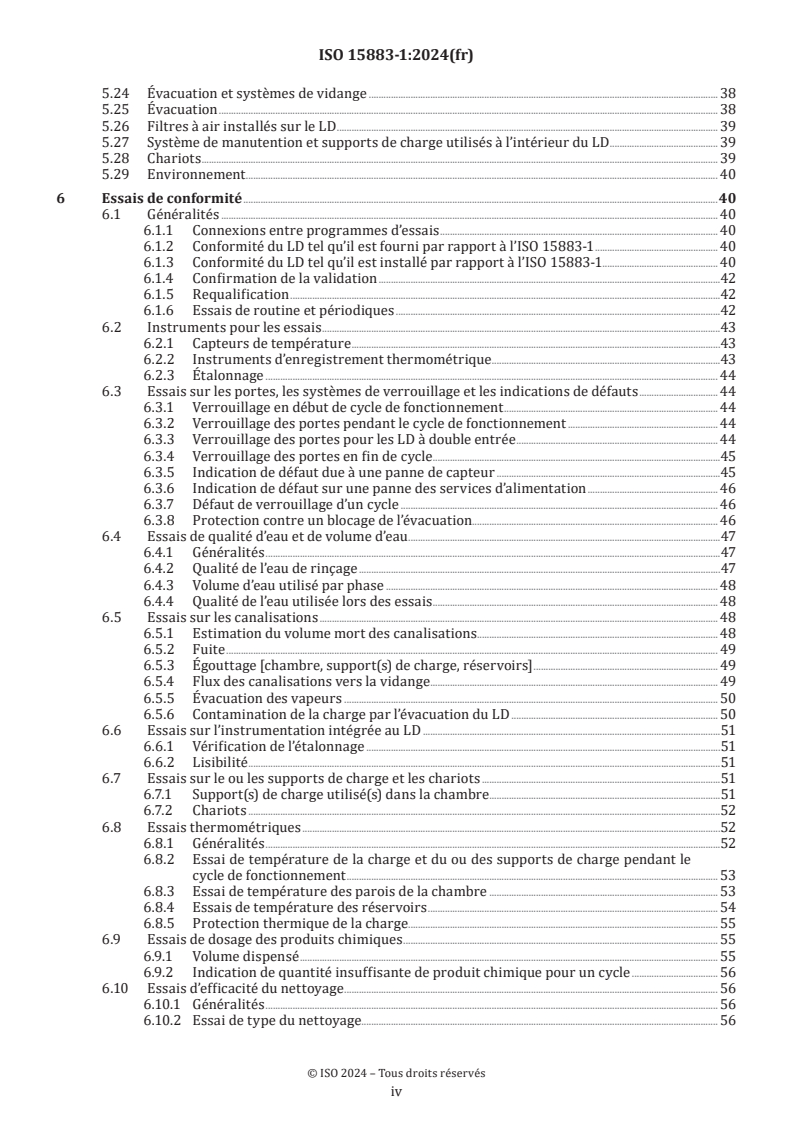
Sommaire Page
Avant-propos .vi
Introduction .vii
1 Domaine d’application . 1
2 Références normatives . 1
3 Termes et définitions . 2
4 Exigences de performance .11
4.1 Généralités .11
4.2 Nettoyage .14
4.2.1 Généralités .14
4.2.2 Phase de flushage avant lavage .14
4.2.3 Phase de lavage . 15
4.2.4 Étape de rinçage. 15
4.3 Désinfection . 15
4.3.1 Désinfection thermique . 15
4.3.2 Désinfection chimique . . 15
4.4 Rinçage final .17
4.5 Séchage .17
4.6 Produits chimiques du procédé .17
4.7 Autodésinfection . .18
5 Exigences mécaniques et exigences relatives au procédé . 19
5.1 Matériaux, conception et fabrication/construction .19
5.1.1 Matériaux .19
5.1.2 Conception et fabrication/construction .19
5.1.3 Support(s) de charge . 20
5.2 Sécurité .21
5.3 Réservoirs .21
5.4 Portes de chargement et de déchargement et leurs contrôles . 22
5.4.1 Généralités . 22
5.4.2 Commande des portes à ouverture manuelle . 23
5.4.3 Commande des portes d’un LD à double entrée . 23
5.4.4 Portes internes et orifices d’accès .24
5.4.5 Machines à procédé continu sans porte .24
5.5 Tuyauterie et accessoires .24
5.6 Systèmes d’aspersion .24
5.7 Systèmes de dosage . 25
5.8 Protection thermique de la charge . 26
5.9 Limites du contrôle thermique du procédé. 26
5.10 Commutateurs, indicateurs et dispositifs indicateurs.27
5.11 Vérification du procédé . . 28
5.12 Instrumentation et mécanismes de contrôle . 29
5.13 Indicateurs de température . 30
5.14 Indicateurs de pression .31
5.15 Dispositifs indicateurs de volume/débit .31
5.16 Équipement de chronométrage .32
5.17 Indicateur de cycle .32
5.18 Systèmes d’enregistrement (si installés) .32
5.18.1 Enregistreurs de contrôle de cycle .32
5.18.2 Système de vérification du procédé . 33
5.19 Systèmes de contrôle . 34
5.20 Désactivation du dispositif de pilotage automatique. 35
5.21 Systèmes de contrôle par microprocesseur . 36
5.22 Système d’indication des défauts .37
5.23 Alimentation en eau .37
iii
5.24 Évacuation et systèmes de vidange . 38
5.25 Évacuation . 38
5.26 Filtres à air installés sur le LD . 39
5.27 Système de manutention et supports de charge utilisés à l’intérieur du LD . 39
5.28 Chariots . 39
5.29 Environnement . 40
6 Essais de conformité .40
6.1 Généralités . 40
6.1.1 Connexions entre programmes d’essais . 40
6.1.2 Conformité du LD tel qu’il est fourni par rapport à l’ISO 15883-1 . 40
6.1.3 Conformité du LD tel qu’il est installé par rapport à l’ISO 15883-1. 40
6.1.4 Confirmation de la validation .42
6.1.5 Requalification .42
6.1.6 Essais de routine et périodiques .42
6.2 Instruments pour les essais .43
6.2.1 Capteurs de température .43
6.2.2 Instruments d’enregistrement thermométrique .43
6.2.3 Étalonnage . 44
6.3 Essais sur les portes, les systèmes de verrouillage et les indications de défauts . 44
6.3.1 Verrouillage en début de cycle de fonctionnement . 44
6.3.2 Verrouillage des portes pendant le cycle de fonctionnement . 44
6.3.3 Verrouillage des portes pour les LD à double entrée . 44
6.3.4 Verrouillage des portes en fin de cycle .45
6.3.5 Indication de défaut due à une panne de capteur .45
6.3.6 Indication de défaut sur une panne des services d’alimentation . 46
6.3.7 Défaut de verrouillage d’un cycle . 46
6.3.8 Protection contre un blocage de l’évacuation. 46
6.4 Essais de qualité d’eau et de volume d’eau .47
6.4.1 Généralités .47
6.4.2 Qualité de l’eau de rinçage .47
6.4.3 Volume d’eau utilisé par phase . 48
6.4.4 Qualité de l’eau utilisée lors des essais . 48
6.5 Essais sur les canalisations . 48
6.5.1 Estimation du volume mort des canalisations. 48
6.5.2 Fuite . 49
6.5.3 Égouttage [chambre, support(s) de charge, réservoirs] . 49
6.5.4 Flux des canalisations vers la vidange . 49
6.5.5 Évacuation des vapeurs . 50
6.5.6 Contamination de la charge par l’évacuation du LD . 50
6.6 Essais sur l’instrumentation intégrée au LD .51
6.6.1 Vérification de l’étalonnage .51
6.6.2 Lisibilité .51
6.7 Essais sur le ou les supports de charge et les chariots .51
6.7.1 Support(s) de charge utilisé(s) dans la chambre .51
6.7.2 Chariots .52
6.8 Essais thermométriques .52
6.8.1 Généralités .52
6.8.2 Essai de température de la charge et du ou des supports de charge pendant le
cycle de fonctionnement . 53
6.8.3 Essai de température des parois de la chambre . 53
6.8.4 Essais de température des réservoirs . 54
6.8.5 Protection thermique de la charge. 55
6.9 Essais de dosage des produits chimiques . 55
6.9.1 Volume dispensé . 55
6.9.2 Indication de quantité insuffisante de produit chimique pour un cycle . 56
6.10 Essais d’efficacité du nettoyage . 56
6.10.1 Généralités . 56
6.10.2 Essai de type du nettoyage. 56
iv
6.10.3 Essai de qualification de performance du nettoyage . 56
6.10.4 Surveillance de routine du procédé .57
6.10.5 Essais pour les résidus du procédé .57
6.11 Essais de la qualité de l’air . 58
6.11.1 Généralités . 58
6.11.2 Mode opératoire . . 58
6.11.3 Résultats . 58
6.12 Essais de séchage de la charge . 58
6.12.1 Généralités . 58
6.12.2 Matériaux . 58
6.12.3 Séchage des surfaces extérieures . . 58
6.12.4 Séchage de la charge des lumières .59
6.13 Essai du dispositif de pilotage automatique .59
6.13.1 Généralités .59
6.13.2 Mode opératoire . .59
6.13.3 Résultats . 60
7 Documentation .60
8 Informations à fournir .60
8.1 Généralités . 60
8.2 Avant la livraison du LD et pour l’installation .61
8.3 À la livraison du LD .62
9 Marquage, étiquetage et emballage.63
9.1 Marquage et étiquetage . 63
9.2 Emballage . 64
10 Informations devant être demandées par le fabricant du LD à l’acheteur .64
Annexe A (informative) Programme d’essais .65
Annexe B (informative) Concept du A — Létalité comparée de procédés de désinfection
par la chaleur humide .70
Annexe C (normative) Milieu de récupération microbiologique pour l’estimation de la
contamination bactérienne de l’eau . 74
Bibliographie .75
v
Avant-propos
L’ISO (Organisation internationale de normalisation) est une fédération mondiale d’organismes nationaux
de normalisation (comités membres de l’ISO). L’élaboration des Normes internationales est en général
confiée aux comités techniques de l’ISO. Chaque comité membre intéressé par une étude a le droit de faire
partie du comité technique créé à cet effet. Les organisations internationales, gouvernementales et non
gouvernementales, en liaison avec l’ISO participent également aux travaux. L’ISO collabore étroitement avec
la Commission électrotechnique internationale (IEC) en ce qui concerne la normalisation électrotechnique.
Les procédures utilisées pour élaborer le présent document et celles destinées à sa mise à jour sont
décrites dans les Directives ISO/IEC, Partie 1. Il convient, en particulier de prendre note des différents
critères d’approbation requis pour les différents types de documents ISO. Le présent document
a été rédigé conformément aux règles de rédaction données dans les Directives ISO/IEC, Partie 2
(voir www.iso.org/directives).
L’attention est attirée sur le fait que certains des éléments du présent document peuvent faire l’objet
de droits de propriété intellectuelle ou de droits analogues. L’ISO ne saurait être tenue pour responsable
de ne pas avoir identifié de tels droits de propriété et averti de leur existence. Les détails concernant les
références aux droits de propriété intellectuelle ou autres droits analogues identifiés lors de l’élaboration du
document sont indiqués dans l’Introduction et/ou dans la liste des déclarations de brevets reçues par l’ISO
(voir www.iso.org/brevets).
Les appellations commerciales éventuellement mentionnées dans le présent document sont données pour
information, par souci de commodité, à l’intention des utilisateurs et ne sauraient constituer un engagement.
Pour une explication de la nature volontaire des normes, la signification des termes et expressions
spécifiques de l’ISO liés à l’évaluation de la conformité, ou pour toute information au sujet de l’adhésion de
l’ISO aux principes de l’Organisation mondiale du commerce (OMC) concernant les obstacles techniques au
commerce (OTC), voir le lien suivant: www.iso.org/iso/fr/avant-propos.html.
Le présent document a été élaboré par le comité technique ISO/TC 198, Stérilisation des produits de santé,
en collaboration avec le comité technique CEN/TC 102, Stérilisateurs et équipements associés pour le
traitement des dispositifs médicaux, du Comité européen de normalisation (CEN), conformément à l’Accord de
coopération technique entre l’ISO et le CEN (Accord de Vienne).
Cette seconde édition annule et remplace la première édition (ISO 15883-1:2006), qui a fait l’objet d’une
révision technique. Elle inclut également l’ISO 15883-1:2006/Amd 1:2014.
Les modifications principales sont les suivantes:
— harmonisation des termes et définitions avec l’ISO 11139:2018;
— ajout des exigences relatives aux supports de charge;
— clarification des exigences en matière de qualité de l’eau;
— déplacement de l’ancienne Annexe C, Méthodes d’essai pour la détection et l’évaluation de souillure
protéinique résiduelle, vers l’ISO 15883-5:2021;
— nouvelle désignation de l’ancienne Annexe D, Milieu de récupération pour l’estimation de la contamination
bactérienne de l’eau, en tant qu’Annexe C;
— augmentation de la limite de température minimale pour la désinfection thermique et le calcul des
valeurs A de 65 °C à 70 °C (voir Référence [48]);
— révision de la Bibliographie.
Une liste de toutes les parties de la série ISO 15883 se trouve sur le site web de l’ISO.
Il convient que l’utilisateur adresse tout retour d’information ou toute question concernant le présent
document à l’organisme national de normalisation de son pays. Une liste exhaustive desdits organismes se
trouve à l’adresse www.iso.org/fr/members.html.
vi
Introduction
Le présent document constitue la première partie de la série de normes ISO 15883 qui spécifie les
performances des laveurs désinfecteurs (LD). Il précise les exigences générales de performances applicables
à tous les LD. Les exigences spécifiées dans le présent document s’appliquent à tout LD auquel il est fait
référence dans les parties subséquentes de la série de normes ISO 15883, sauf dans la mesure où elles
sont modifiées ou ajoutées dans une partie subséquente, auquel cas les exigences de la partie spécifique
s’appliquent.
Les champs d’application inclus dans le domaine d’application de la série de normes ISO 15883 peuvent
comprendre les applications pharmaceutiques, dentaires, vétérinaires et de laboratoire ainsi que d’autres
applications spécifiques, telles que les LD pour les montants de lit, les chariots de transport et la désinfection
de vaisselle et des couverts de table destinés à des patients immunodéficitaires.
Les LD sont uniquement utilisés pour traiter le type de charge spécifié par le fabricant du LD.
Pour sélectionner le LD approprié, il convient de se référer à la fois au présent document et aux parties
applicables de la série de normes ISO 15883. Les choix du type de LD, du cycle standard, de la qualité des
sources d’alimentation ou des produits chimiques du procédé peuvent être inappropriés pour une charge
particulière et les dispositifs permettant de détecter un choix ou une utilisation incorrecte ne sont pas
nécessairement fournis.
Le présent document a été élaboré suivant le principe selon lequel chaque LD est soumis à des essais de
validation (par exemple, qualification de l’installation, qualification opérationnelle et qualification de
performance lors de la première installation) et, lors d’une utilisation, la conformité continue est établie par
des essais périodiques.
En ce qui concerne les éventuels effets indésirables des LD sur la qualité de l’eau destinée à la consommation
humaine ou les impacts environnementaux causés par les laveurs désinfecteurs et leur utilisation prévue,
il est à noter que la série de normes ISO 15883 ne fournit aucune information concernant l’existence de
restrictions d’utilisation pour les LD dans les pays membres de l’ISO.
vii
Norme internationale ISO 15883-1:2024(fr)
Laveurs désinfecteurs —
Partie 1:
Exigences générales, termes et définitions et essais
1 Domaine d’application
Le présent document spécifie les exigences de performances générales relatives aux laveurs désinfecteurs
(LD) et à leurs accessoires qui sont destinés à être utilisés pour le nettoyage et la désinfection de dispositifs
médicaux réutilisables. Il spécifie les exigences de performances pour le nettoyage et la désinfection ainsi que
pour les accessoires qui peuvent être nécessaires pour atteindre les performances requises. Les méthodes
et les instruments nécessaires pour la validation, le contrôle de routine, la surveillance et la requalification,
réalisés périodiquement et après des réparations essentielles, sont aussi spécifiés.
NOTE 1 Les exigences peuvent être appliquées aux LD destinés à une utilisation en association avec d’autres articles
utilisés dans le contexte d’activités médicales, dentaires, pharmaceutiques et vétérinaires.
Les exigences pour les LD destinés à traiter des charges spécifiques sont spécifiées dans l’ISO 15883-2,
l’ISO 15883-3, l’ISO 15883-4, l’ISO 15883-6 et l’ISO 15883-7. Pour les LD destinés à traiter des charges de deux
types différents ou plus, les exigences aux parties applicables de l’ISO 15883-2, l’ISO 15883-3, l’ISO 15883-4,
l’ISO 15883-6 et l’ISO 15883-7 s’appliquent.
Le présent document ne spécifie aucune exigence concernant les laveurs désinfecteurs utilisés en
blanchisserie ou en restauration générale.
Le présent document n’inclut aucune exigence pour les laveurs désinfecteurs destinés à stériliser la charge
ou considérés comme des «stérilisateurs» et traités dans d’autres normes.
Les exigences de performance spécifiées dans le présent document n’assurent pas l’inactivation ou
l’élimination de l’agent ou des agents infectieux (protéine du prion) des encéphalopathies spongiformes
transmissibles.
NOTE 2 Les produits chimiques contenus dans certains agents nettoyants et désinfectants peuvent réagir avec la
protéine du prion d’une manière qui peut inhiber son élimination ou son inactivation. Si la présence de la protéine du
prion est considérée comme une possibilité, cela peut influer sur le choix de l’agent nettoyant et du désinfectant.
NOTE 3 Le présent document peut être utilisé par des acheteurs potentiels et des fabricants sur la base de l’accord
sur la spécification d’un LD. Les méthodes d’essai pour la démonstration de conformité aux exigences du présent
document peuvent également être utilisées par les utilisateurs afin de démontrer une conformité continue du LD
installé au cours de sa durée de vie. Des recommandations relatives à un programme d’essai de routine sont données
dans l’Annexe A.
2 Références normatives
Les documents suivants sont cités dans le texte de sorte qu’ils constituent, pour tout ou partie de leur
contenu, des exigences du présent document. Pour les références datées, seule l’édition citée s’applique. Pour
les références non datées, la dernière édition du document de référence s’applique (y compris les éventuels
amendements).
ISO 7000, Symboles graphiques utilisables sur le matériel — Symboles enregistrés
ISO 10012, Systèmes de management de la mesure — Exigences pour les processus et les équipements de mesure
ISO 14644-3, Salles propres et environnements maîtrisés apparentés — Partie 3: Méthodes d'essai
ISO 14971, Dispositifs médicaux — Application de la gestion des risques aux dispositifs médicaux
1)
ISO 15883-2 , Laveurs désinfecteurs — Partie 2: Exigences et essais pour laveurs désinfecteurs destinés à la
désinfection thermique des instruments chirurgicaux, du matériel d'anesthésie, des bacs, plats, récipients,
ustensiles, de la verrerie, etc.
ISO 15883-3, Laveurs désinfecteurs — Partie 3: Exigences et essais pour laveurs désinfecteurs destinés à la
désinfection thermique de récipients à déjections humaines
ISO 15883-4, Laveurs désinfecteurs — Partie 4: Exigences et essais pour les laveurs désinfecteurs destinés à la
désinfection chimique des endoscopes thermolabiles
ISO 15883-5:2021, Laveurs désinfecteurs — Partie 5: Exigences de performance et critères des méthodes d’essai
pour démontrer l’efficacité du nettoyage
ISO 15883-6, Laveurs désinfecteurs — Partie 6: Exigences et essais pour les laveurs désinfecteurs utilisant une
désinfection thermique pour les dispositifs médicaux non invasifs, non critiques et pour l'équipement de soins de santé
2)
ISO 15883-7 , Laveurs désinfecteurs — Partie 7: Exigences et essais pour les laveurs désinfecteurs destinés à la
désinfection chimique des dispositifs médicaux thermosensibles, non invasifs et non critiques et des équipements
de soins de santé
IEC 60417-DB, Graphical symbols for use on equipment
IEC 60584-1:2013, Couples thermoélectriques — Partie 1: Spécifications et tolérances en matière de FEM
IEC 60751:2008, Thermomètres à résistance de platine industriels et capteurs thermométriques en platine
IEC 61010-2-040:2020, Règles de sécurité pour appareils électriques de mesurage, de régulation et de
laboratoire — Partie 2-040: Exigences particulières pour stérilisateurs et laveurs désinfecteurs utilisés pour
traiter le matériel médical
IEC 61326-1:2020, Matériel électrique de mesure, de commande et de laboratoire — Exigences relatives à la
CEM — Partie 1: Exigences générales
IEC 80416-1, Principes de base pour les symboles graphiques utilisables sur le matériel — Partie 1: Création des
symboles graphiques pour enregistrement
Pharmacopée européenne, Essais — 2.5.30 Substances oxydantes; Essais biologiques — 2.6.14 Endotoxines
bactériennes
Pharmacopée des États-Unis, Chemical tests <541> Titrimetry, Oxidation-Reduction (Redox) titrations;
Biological tests <85> Bacterial endotoxins test
3 Termes et définitions
Pour les besoins du présent document, les termes et définitions suivants s’appliquent.
L’ISO et l’IEC tiennent à jour des bases de données terminologiques destinées à être utilisées en normalisation,
consultables aux adresses suivantes:
— ISO Online browsing platform: disponible à l’adresse https:// www .iso .org/ obp
— IEC Electropedia: disponible à l’adresse https:// www .electropedia .org/
1) Titre de la version 2006 version (version actuelle). Le titre de la deuxième édition sera: Laveurs désinfecteurs —
Partie 2: Exigences et essais pour laveurs désinfecteurs destinés à la désinfection thermique des dispositifs médicaux critiques
et semi-critiques.
2) Titre de la version 2016 (version actuelle). Le titre de la deuxième édition sera: Laveurs désinfecteurs — Partie 7:
Exigences et essais pour les laveurs désinfecteurs destinés à la désinfection chimique des dispositifs médicaux thermosensibles
non critiques et des équipements de soins de santé.
3.1
A
valeur exprimant la létalité microbiologique fournie par un procédé de désinfection (3.14) à la chaleur
humide, exprimée en termes de durée équivalente en secondes à 80 °C, par rapport à un microorganisme
(3.33) pour lequel la valeur z est de 10 K
Note 1 à l'article: Voir Annexe B.
[SOURCE: ISO 11139:2018, 3.1, modifié — la Note 1 à l’article a été ajoutée.]
3.2
dispositif de pilotage automatique
appareil qui, en réponse aux paramètres du cycle programmé, pilote le fonctionnement de l’équipement de
manière séquentielle tout au long des phases requises de ce cycle
[SOURCE: ISO 11139:2018, 3.18]
3.3
lave-bassin
laveur désinfecteur (3.58) de récipients à déjections humaines, permettant en outre de vider et rincer ces
récipients
[SOURCE: ISO 11139:2018, 3.22]
3.4
charge biologique
biocharge
population de microorganismes (3.33) viables sur ou dans un produit et/ou un système de barrière stérile
[SOURCE: ISO 11139:2018, 3.23]
3.5
étalonnage
opération qui, dans des conditions spécifiées, établit en une première étape une relation entre les valeurs
et les incertitudes de mesure associées qui sont fournies par des étalons et les indications correspondantes
avec les incertitudes associées, puis utilise en une seconde étape cette information pour établir une relation
permettant d’obtenir un résultat de mesure à partir d’une indication
[SOURCE: ISO 11139:2018, 3.31]
3.6
calorifère
récipient clos dans lequel, sous une pression supérieure à la pression atmosphérique, l’eau est indirectement
chauffée par le flux d’un fluide (3.21) chauffé par un échangeur de chaleur
[SOURCE: ISO 11139:2018, 3.32]
3.7
chambre
partie de l’équipement dans laquelle une charge (3.28) est traitée
Note 1 à l'article: La chambre n’inclut pas les générateurs de vapeur, les canalisations par exemple les évacuations et
accessoires dont elle peut être isolée.
[SOURCE: ISO 11139:2018, 3.36, modifié — la Note 1 à l’article a été ajoutée.]
3.8
désinfection chimique
désinfection (3.14) réalisée par l’action d’un ou plusieurs produits chimiques
[SOURCE: ISO 11139:2018, 3.42]
3.9
nettoyage
élimination des contaminants jusqu’à obtention de l’état nécessaire à la poursuite du traitement ou jusqu’à
obtention de l’état désiré
[SOURCE: ISO 11139:2018, 3.46]
3.10
machine à procédé continu
équipement qui déplace une unité de travail à la fois entre chaque étape du procédé, le produit restant
généralement en mouvement
Note 1 à l'article: Ce type de machine s’oppose à un équipement à procédé discontinu qui exposerait la totalité du lot à
chaque étape du procédé, une étape à la fois.
[SOURCE: ISO 11139:2018, 3.62]
3.11
cycle terminé
message du dispositif de pilotage automatique indiquant que le cycle de fonctionnement s’est achevé avec succès
[SOURCE: ISO 11139:2018, 3.71]
3.12
valeur D
valeur D
temps ou dose nécessaire pour inactiver 90 % d’une population de microorganismes (3.33) d’essai dans des
conditions établies
[SOURCE: ISO 11139:2018, 3.75]
3.13
volume mort
espace clos d’une canalisation sans contact avec le flux habituel de liquides pendant
le cycle de fonctionnement (3.36)
[SOURCE: ISO 11139:2018, 3.318.2]
3.14
désinfection
procédé visant à inactiver des microorganismes (3.33) viables à un niveau préalablement spécifié comme
approprié pour une utilisation définie
[SOURCE: ISO 11139:2018, 3.84]
3.15
température de désinfection
température minimale sur laquelle l’évaluation de l’efficacité de la désinfection (3.14) est basée
Note 1 à l'article: Plusieurs températures de désinfection (3.14) peuvent prévaloir pendant la phase de désinfection (3.14).
[SOURCE: ISO 11139:2018, 3.85, modifié — la Note 1 à l’article a été ajoutée.]
3.16
durée de désinfection
durée pendant laquelle la (les) variable(s) du procédé
...