

ISO 17420-6:2021
(Main)Respiratory protective devices — Performance requirements — Part 6: Special application escape - Filtering RPD and supplied breathable gas RPD
General Information
- Abstract
This document specifies the requirements for supplied breathable gas RPD and for filtering RPD to be used for special application escape for use in the workplace to protect the wearer.
- Status
- Published
- Publication Date
- 07-Feb-2021
- Technical Committee
- ISO/TC 94/SC 15 - Respiratory protective devices
- Drafting Committee
- ISO/TC 94/SC 15/WG 23 - Filtering and supplied breathable gas RPD
- Parallel Committee
- ISO/TC 94/SC 14 - Firefighters' personal equipment
- Current Stage
- 9060 - Close of review
- Completion Date
- 02-Sep-2031
Buy Documents


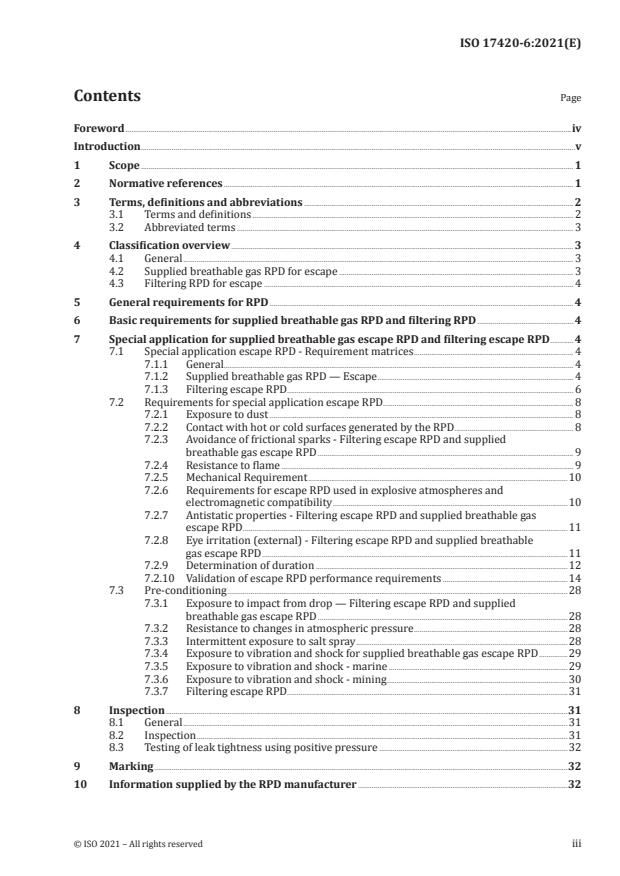

ISO 17420-6:2021 - Respiratory protective devices -- Performance requirements
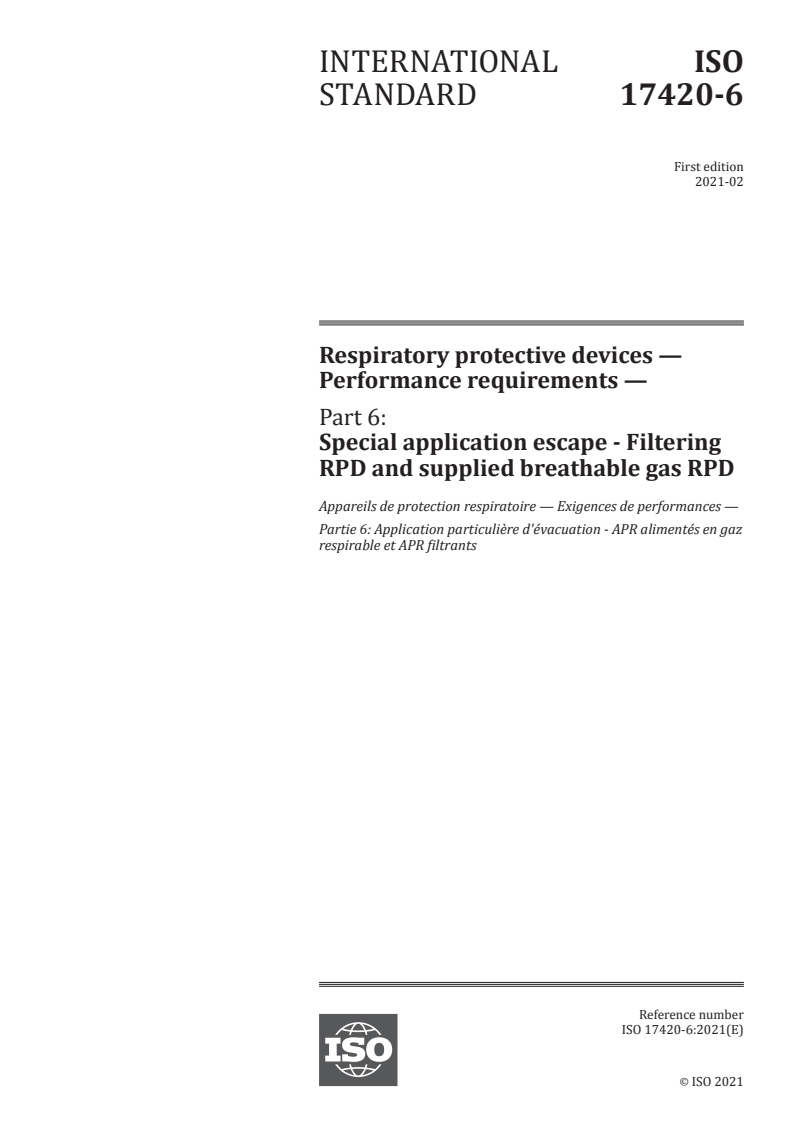

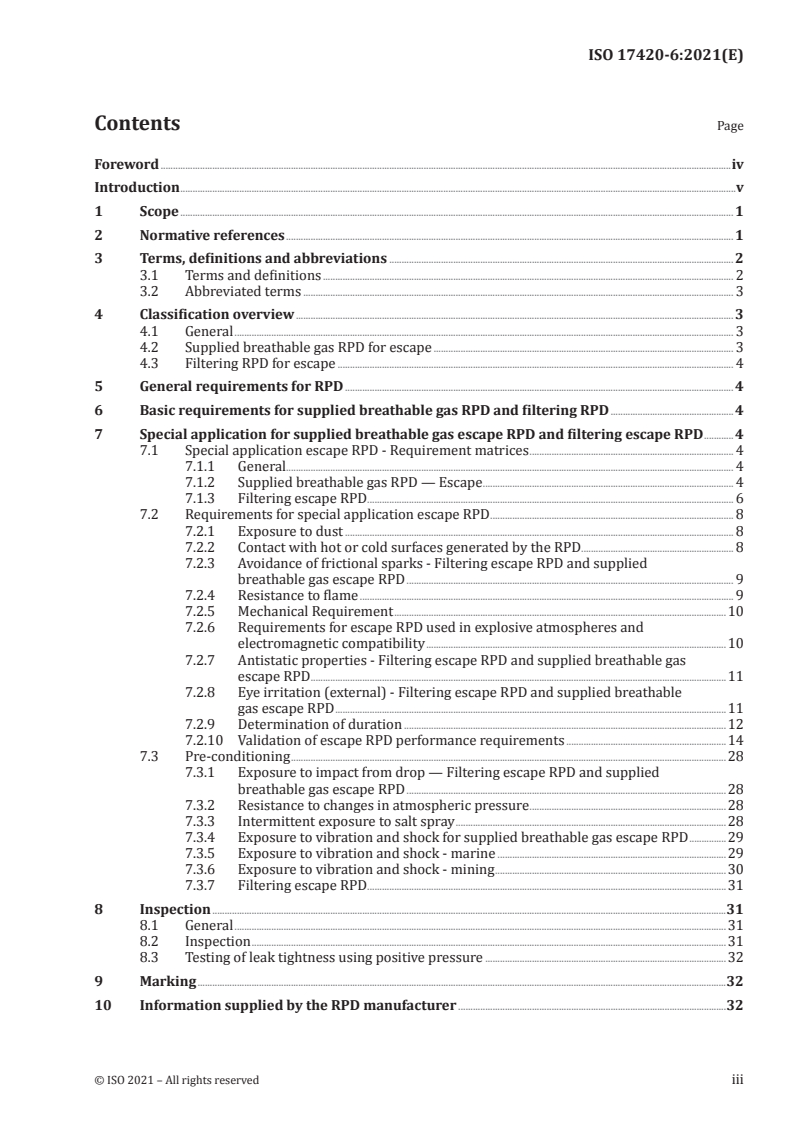

ISO 17420-6:2021 - Respiratory protective devices — Performance requirements — Part 6: Special application escape - Filtering RPD and supplied breathable gas RPD/8/2021




ISO 17420-6:2021 - Appareils de protection respiratoire -- Exigences de performances
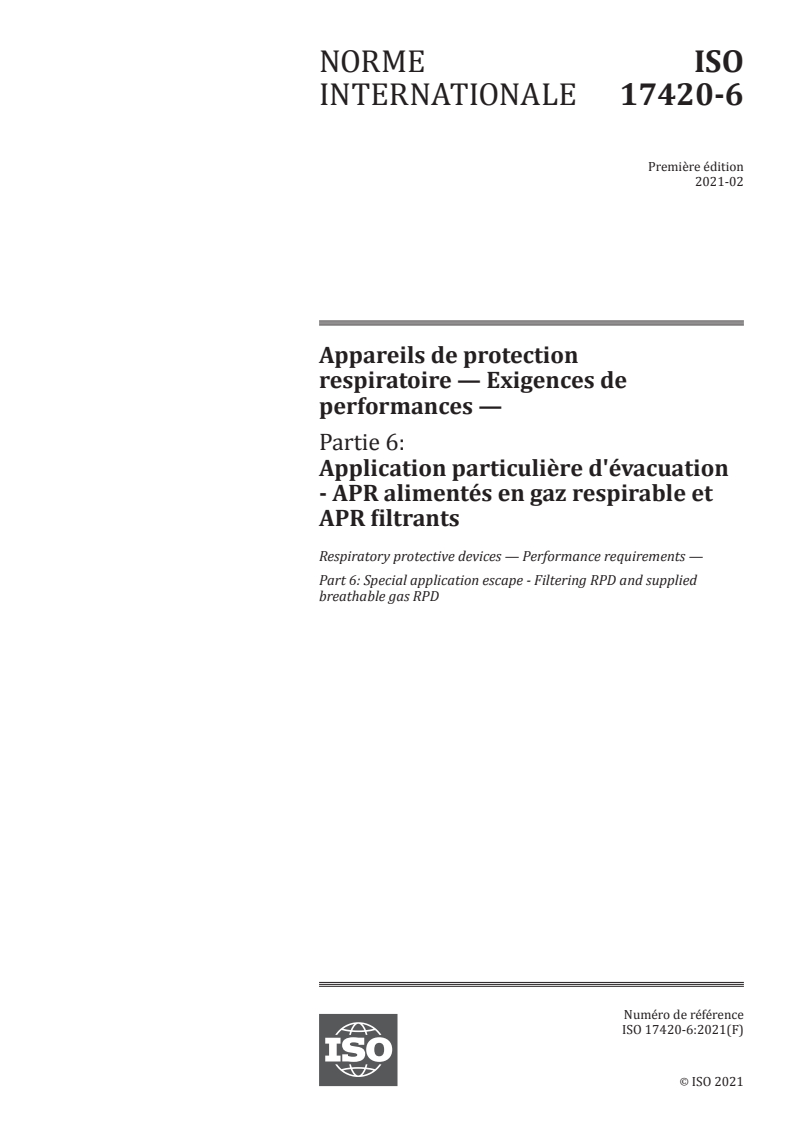


ISO 17420-6:2021 - Appareils de protection respiratoire — Exigences de performances — Partie 6: Application particulière d'évacuation - APR alimentés en gaz respirable et APR filtrants/8/2021
Overview
ISO 17420-6:2021 specifies performance requirements for special-application escape respiratory protective devices (RPD) - covering both filtering RPD (escape respirators) and supplied breathable gas RPD intended for workplace escape use. The standard defines classification, design and performance criteria, required tests and inspection/marking and information manufacturers must supply. It focuses on protecting the wearer during emergency escape scenarios and complements the general and product-specific parts of the ISO 17420 series.
Key topics and technical requirements
This part of ISO 17420 addresses technical areas essential to escape RPD performance:
- Classification and labelling for escape types (e.g., ES MN t for underground mining, ES MA t for marine, ES FF t for fire), including nominal service life (t minutes).
- General and basic requirements applicable to both filtering and supplied breathable gas escape RPD.
- Special application requirement matrices that identify which tests apply to each escape class.
- Performance tests and validation, including:
- Resistance to flame, heat and contact with hot/cold surfaces
- Mechanical strength and resistance to drop, vibration and shock
- Antistatic properties and avoidance of frictional sparks
- Eye irritation (external) and other wearer-safety criteria
- Determination of duration (nominal service life) and leak-tightness tests (positive pressure)
- Pre-conditioning procedures (salt spray, pressure changes, impact) to simulate realistic environmental exposure before performance testing.
- Inspection, marking and required manufacturer information for safe use and traceability.
- Test methods reference the ISO 16900 series and other ISO/IEC/EN standards for specific measurement procedures.
Practical applications and users
ISO 17420-6 is intended for:
- RPD manufacturers and designers developing escape respirators and supplied-air escape devices.
- Product conformity assessors and certification bodies validating performance claims.
- Occupational health & safety professionals, procurement teams and safety managers in industries with escape-critical risks (mining, marine, firefighting, confined spaces, industrial plants).
- Regulators and standardization committees harmonizing workplace escape device requirements.
Using ISO 17420-6 helps ensure escape RPD meet consistent performance, safety and labeling expectations for emergency egress scenarios.
Related standards
Key linked documents include:
- ISO 17420-1, -2, -4 (general, filtering and supplied breathable gas RPD requirements)
- ISO 16900 series (test methods)
- ISO 17420 series (other parts)
- IEC/EN standards referenced for explosive atmospheres, EMC and environmental testing
Keywords: ISO 17420-6, respiratory protective devices, escape RPD, filtering RPD, supplied breathable gas RPD, performance requirements, workplace safety, escape respirators.
Buy Documents
ISO 17420-6:2021 - Respiratory protective devices -- Performance requirements
ISO 17420-6:2021 - Respiratory protective devices — Performance requirements — Part 6: Special application escape - Filtering RPD and supplied breathable gas RPD/8/2021
ISO 17420-6:2021 - Appareils de protection respiratoire -- Exigences de performances
ISO 17420-6:2021 - Appareils de protection respiratoire — Exigences de performances — Partie 6: Application particulière d'évacuation - APR alimentés en gaz respirable et APR filtrants/8/2021
Get Certified
Connect with accredited certification bodies for this standard

CIS Institut d.o.o.
Personal Protective Equipment (PPE) certification body. Notified Body NB-2890 for EU Regulation 2016/425 PPE.

Kiwa BDA Testing
Building and construction product certification.
Kmetijski inštitut Slovenije
Agricultural Institute of Slovenia. Soil testing, plant health, agricultural product analysis.
Sponsored listings
Frequently Asked Questions
ISO 17420-6:2021 is a standard published by the International Organization for Standardization (ISO). Its full title is "Respiratory protective devices — Performance requirements — Part 6: Special application escape - Filtering RPD and supplied breathable gas RPD". This standard covers: This document specifies the requirements for supplied breathable gas RPD and for filtering RPD to be used for special application escape for use in the workplace to protect the wearer.
This document specifies the requirements for supplied breathable gas RPD and for filtering RPD to be used for special application escape for use in the workplace to protect the wearer.
ISO 17420-6:2021 is classified under the following ICS (International Classification for Standards) categories: 13.340.30 - Respiratory protective devices. The ICS classification helps identify the subject area and facilitates finding related standards.
ISO 17420-6:2021 is available in PDF format for immediate download after purchase. The document can be added to your cart and obtained through the secure checkout process. Digital delivery ensures instant access to the complete standard document.
Standards Content (Sample)
INTERNATIONAL ISO
STANDARD 17420-6
First edition
2021-02
Respiratory protective devices —
Performance requirements —
Part 6:
Special application escape - Filtering
RPD and supplied breathable gas RPD
Appareils de protection respiratoire — Exigences de performances —
Partie 6: Application particulière d'évacuation - APR alimentés en gaz
respirable et APR filtrants
Reference number
©
ISO 2021
© ISO 2021
All rights reserved. Unless otherwise specified, or required in the context of its implementation, no part of this publication may
be reproduced or utilized otherwise in any form or by any means, electronic or mechanical, including photocopying, or posting
on the internet or an intranet, without prior written permission. Permission can be requested from either ISO at the address
below or ISO’s member body in the country of the requester.
ISO copyright office
CP 401 • Ch. de Blandonnet 8
CH-1214 Vernier, Geneva
Phone: +41 22 749 01 11
Email: copyright@iso.org
Website: www.iso.org
Published in Switzerland
ii © ISO 2021 – All rights reserved
Contents Page
Foreword .iv
Introduction .v
1 Scope . 1
2 Normative references . 1
3 Terms, definitions and abbreviations . 2
3.1 Terms and definitions . 2
3.2 Abbreviated terms . 3
4 Classification overview . 3
4.1 General . 3
4.2 Supplied breathable gas RPD for escape . 3
4.3 Filtering RPD for escape . 4
5 General requirements for RPD . 4
6 Basic requirements for supplied breathable gas RPD and filtering RPD .4
7 Special application for supplied breathable gas escape RPD and filtering escape RPD .4
7.1 Special application escape RPD - Requirement matrices . 4
7.1.1 General. 4
7.1.2 Supplied breathable gas RPD — Escape . 4
7.1.3 Filtering escape RPD . . 6
7.2 Requirements for special application escape RPD . 8
7.2.1 Exposure to dust . 8
7.2.2 Contact with hot or cold surfaces generated by the RPD . 8
7.2.3 Avoidance of frictional sparks - Filtering escape RPD and supplied
breathable gas escape RPD . 9
7.2.4 Resistance to flame . 9
7.2.5 Mechanical Requirement .10
7.2.6 Requirements for escape RPD used in explosive atmospheres and
electromagnetic compatibility .10
7.2.7 Antistatic properties - Filtering escape RPD and supplied breathable gas
escape RPD . .11
7.2.8 Eye irritation (external) - Filtering escape RPD and supplied breathable
gas escape RPD .11
7.2.9 Determination of duration .12
7.2.10 Validation of escape RPD performance requirements .14
7.3 Pre-conditioning .28
7.3.1 Exposure to impact from drop — Filtering escape RPD and supplied
breathable gas escape RPD .28
7.3.2 Resistance to changes in atmospheric pressure .28
7.3.3 Intermittent exposure to salt spray .28
7.3.4 Exposure to vibration and shock for supplied breathable gas escape RPD .29
7.3.5 Exposure to vibration and shock - marine .29
7.3.6 Exposure to vibration and shock - mining .30
7.3.7 Filtering escape RPD . .31
8 Inspection .31
8.1 General .31
8.2 Inspection .31
8.3 Testing of leak tightness using positive pressure .32
9 Marking .32
10 Information supplied by the RPD manufacturer .32
Foreword
ISO (the International Organization for Standardization) is a worldwide federation of national standards
bodies (ISO member bodies). The work of preparing International Standards is normally carried out
through ISO technical committees. Each member body interested in a subject for which a technical
committee has been established has the right to be represented on that committee. International
organizations, governmental and non-governmental, in liaison with ISO, also take part in the work.
ISO collaborates closely with the International Electrotechnical Commission (IEC) on all matters of
electrotechnical standardization.
The procedures used to develop this document and those intended for its further maintenance are
described in the ISO/IEC Directives, Part 1. In particular, the different approval criteria needed for the
different types of ISO documents should be noted. This document was drafted in accordance with the
editorial rules of the ISO/IEC Directives, Part 2 (see www .iso .org/ directives).
Attention is drawn to the possibility that some of the elements of this document may be the subject of
patent rights. ISO shall not be held responsible for identifying any or all such patent rights. Details of
any patent rights identified during the development of the document will be in the Introduction and/or
on the ISO list of patent declarations received (see www .iso .org/ patents).
Any trade name used in this document is information given for the convenience of users and does not
constitute an endorsement.
For an explanation of the voluntary nature of standards, the meaning of ISO specific terms and
expressions related to conformity assessment, as well as information about ISO's adherence to the
World Trade Organization (WTO) principles in the Technical Barriers to Trade (TBT), see www .iso .org/
iso/ foreword .html.
This document was prepared by Technical Committee ISO/TC 94, Personal safety – Personal protective
equipment, Subcommittee SC 15, Respiratory protective devices.
A list of all parts in the ISO 17420 series can be found on the ISO website.
Any feedback or questions on this document should be directed to the user’s national standards body. A
complete listing of these bodies can be found at www .iso .org/ members .html.
iv © ISO 2021 – All rights reserved
Introduction
This document describes requirements for RPD including its elements and components used for special
applications for escape devices.
Some test methods are described. For other test methods references are given to the ISO 16900 series
"Methods of test and test equipment" or other test methods not developed by ISO/TC 94/SC 15.
The sequence of testing follows the principle to minimize the necessary number of samples by carrying
out destructive tests at the end. It also includes for safety reason that tests with test subjects are only
carried out after the test samples have shown their safe performance in other tests.
INTERNATIONAL STANDARD ISO 17420-6:2021(E)
Respiratory protective devices — Performance
requirements —
Part 6:
Special application escape - Filtering RPD and supplied
breathable gas RPD
1 Scope
This document specifies the requirements for supplied breathable gas RPD and for filtering RPD to be
used for special application escape for use in the workplace to protect the wearer.
2 Normative references
The following documents are referred to in the text in such a way that some or all of their content
constitutes requirements of this document. For dated references, only the edition cited applies. For
undated references, the latest edition of the referenced document (including any amendments) applies.
ISO 8031, Rubber and plastics hoses and hose assemblies — Determination of electrical resistance and
conductivity
ISO 9227, Corrosion tests in artificial atmospheres — Salt spray tests
ISO 16900-1:2019, Respiratory protective devices — Methods of test and test equipment — Part 1:
Determination of inward leakage
ISO 16900-4, Respiratory protective devices — Methods of test and test equipment — Part 4: Determination
of gas filter capacity and migration, desorption and carbon monoxide dynamic testing
ISO 16900-5, Respiratory protective devices — Methods of test and test equipment — Part 5: Breathing
machine, metabolic simulator, RPD headforms and torso, tools and verification tools
ISO 16900-6, Respiratory protective devices — Methods of test and test equipment — Part 6: Mechanical
resistance/strength of components and connections
ISO 16900-8, Respiratory protective devices — Methods of test and test equipment — Part 8: Measurement
of RPD air flow rates of assisted filtering RPD
ISO 16900-9, Respiratory protective devices — Methods of test and test equipment — Part 9: Determination
of carbon dioxide content of the inhaled gas
ISO 16900-10, Respiratory protective devices — Methods of test and test equipment — Part 10: Resistance
to ignition, flame, radiant heat and heat
ISO 16900-12, Respiratory protective devices — Methods of test and test equipment — Part 12:
Determination of volume-averaged work of breathing and peak respiratory pressures
ISO 16972, Respiratory protective devices — Vocabulary and graphical symbols
ISO 17420-1:2021, Respiratory protective devices — Performance requirements — Part 1: General
ISO 17420-2:2021, Respiratory protective devices — Performance requirements — Part 2: Requirements
for filtering RPD
ISO 17420-4:2021, Respiratory protective devices — Performance requirements — Part 4: Requirements
for supplied breathable gas RPD
ISO 23269-2:2011, Ships and marine technology — Breathing apparatus for ships — Part 2: Self-contained
breathing apparatus for shipboard firefighters
IEC 60068-2-27:2010, Environmental testing — Part 2-27: Tests — Test Ea and guidance: Shock
IEC 60068-2-64:2009, Environmental testing — Part 2-64: Tests — Test Fh: Vibration, broadband random
and guidance
IEC 60079-0, Explosive atmospheres — Part 0: Equipment — General requirements
IEC 60079-11, Explosive atmospheres — Part 11: Equipment protection by intrinsic safety “i”
IEC 60079-32-1:2013, Explosive atmospheres — Part 32-1: Electrostatics hazards — Guidance
IEC 60079-32-2:2015, Explosive atmospheres — Part 32-2: Electrostatics hazards — Tests
IEC 60721-1:2003, Classification of environmental conditions — Part 1: Environmental parameters and
their severities
IEC 60721-3-2:2018, Classification of environmental conditions — Part 3-2: Classification of groups of
environmental parameters and their severities — Transportation and Handling
IEC 61000-6-2, Electromagnetic compatibility (EMC) — Part 6-2: Generic standards — Immunity standard
for industrial environments
EN 50303, Group 1, category M1 equipment intended to remain functional in atmospheres endangered by
firedamp and/or coal dust
3 Terms, definitions and abbreviations
3.1 Terms and definitions
For the purposes of this document, the terms and definitions given in ISO 16972 and the following apply.
ISO and IEC maintain terminological databases for use in standardization at the following addresses:
— ISO Online browsing platform: available at https:// www .iso .org/ obp
— IEC Electropedia: available at http:// www .electropedia .org/
3.1.1
non pre-conditioned state
without pre-conditioning but possibly modified to carry out tests or already used in non-destructive tests
Note 1 to entry: This includes e.g. cleaning and disinfection.
3.1.2
RPD in as worn state
RPD where all components are connected and assembled in the way that it is intended to be used (e.g.
worn by the wearer, adapted to an RPD headform or RPD headform and torso or suitable holder).
Note 1 to entry: All of the various components (e.g. for an assisted filtering RPD: blower unit, battery, RI, filters,
etc.) have been completely assembled and then connected (RI connected to the hose of the blower unit) together
in accordance with the information supplied by the manufacturer.
3.1.3
component in ready for assembly state
component with seals, plugs, packaging or other environmental protective means, still in place
2 © ISO 2021 – All rights reserved
3.1.4
RPD in ready for assembly state
RPD with seals, plug, or other environmental protective means, still in place
Note 1 to entry: In line with the information supplied by the manufacturer for donning the RPD, further actions
can be necessary.
3.1.5
RPD in ready for use state
RPD ready to be donned as described by the manufacturer, but seals, plug, or other environmental
protective means are already removed
Note 1 to entry: In line with the information supplied by the manufacturer for donning the RPD, further actions
can be necessary.
Note 2 to entry: For escape devices this includes also the RPD in its container unopened.
3.2 Abbreviated terms
RI Respiratory Interface
RPD Respiratory Protective Devices
V Tidal volume
T
WoB Work of Breathing
4 Classification overview
ISO 17420-2:2021, Clause 4 or ISO 17420-4:2021, Clause 4 applies.
4.1 General
ISO 17420-1:2021, 4.1 applies.
The following subclause applies in addition to ISO 17420-2:2021, Clause 4:
4.2 Supplied breathable gas RPD for escape
In addition, supplied breathable gas RPD may be classified for one or more special applications, as given
in Table 1.
Table 1 — Special application classification supplied breathable gas RPD
Special application Classes
a
ES MN t (Underground mining escape)
a
ES MA t (Marine escape)
Escape
a
ES FF t (Escape from fire)
a
ES t (Escape general supplied breathable gas)
a
Nominal service life in t minutes, e.g. ES 15.
Example for a special application escape with Protection class (PC4), RI class (dL) and special application
class (ES 15).
EXAMPLE PC4 dL ES 15.
The following subclause applies in addition to ISO 17420-2:2021, Clause 4.
4.3 Filtering RPD for escape
In addition, filtering RPD may be classified for one or more special applications, as given in Table 2.
Table 2 — Special application classification of filtering RPD
Special application Classes
a
ES MN t (Underground Mining Escape)
a
Escape ES FF t (Escape from fire)
b a
ES XX t (Escape general filtering)
a
Nominal service life in "t" minutes, e.g. ES 10.
b
Gas type.
Example for a special application escape general with Protection class (PC3), RI class (bT) and special
application escape (ES), particle filter performance class (F3) and gas filter class (AC) and class t (10).
EXAMPLE PC3 bT ES F3 AC10.
Multi-functional filtering RPD have separate classifications for each function, i.e. one classification for
the unassisted mode and one classification for the assisted mode.
5 General requirements for RPD
ISO 17420-1:2021, Clause 5 and ISO 17420-2:2021, Clause 5 or ISO 17420-4:2021, Clause 5 apply.
6 Basic requirements for supplied breathable gas RPD and filtering RPD
All requirements of ISO 17420-2:2021, Clause 6 or ISO 17420-4:2021, Clause 6 apply unless superseded
by this document and indicated in the relevant clauses.
NOTE 1 Optional features are also given in ISO 17420-2 or ISO 17420-4.
NOTE 2 Where requirements are superseded by those in Clause 7 of this document test schedules given in
ISO 17420-2:2021, Annex C or ISO 17420-4:2021, Annex C can be used as a guideline.
7 Special application for supplied breathable gas escape RPD and filtering
escape RPD
7.1 Special application escape RPD - Requirement matrices
7.1.1 General
Supplied breathable gas escape RPD shall fulfil all requirements given in Table 3
Filtering escape RPD shall fulfil all requirements given in Table 4.
7.1.2 Supplied breathable gas RPD — Escape
Table 3 gives an overview about requirements and preconditioning of special application supplied
breathable gas RPD — Escape.
For each line in the table, at least one RPD shall be tested after the required preconditioning or set of
pre-conditionings where combined by “&”. Combined preconditioning shall be completed in the order
specified.
Table 3 shall be read as follows:
4 © ISO 2021 – All rights reserved
In the first column the clause numbers of the requirements are given. In the third to sixth column the
required pre-conditioning for different escape classes are given.
In the second column the requirement is titled.
For each pre-conditioning within one line of the cell different sample(s) shall be used.
For the requirement 7.2.10.1 and class marine escape the following applies:
At least one sample shall be pre-conditioned TH&VSS&IE (Exposure to temperature and humidity,
exposure to vibration and shock – marine and intermittend exposure).
At least one further sample shall be pre-conditioned DR (Exposure to impact from drop)
For the total number of samples see ISO 17420-1:2021, 5.1.
Table 3 — Special application requirement overview — Supplied breathable gas RPD — Escape
Supplied
breathable Escape Marine Underground
gas escape from fire escape mining escape
general
a a a a
ES t ES FF t ES MA t ES MN t
Requirement Title
Protection Protection Protection
Protection class
class class class
≥PC3
≥PC3 ≥PC3 ≥PC3
Pre-conditioning
b b b b
7.2.1 Exposure to dust X X X X
Contact with hot and cold
c
7.2.2.1 surfaces – Supplied breath- TH&VS&IE TH&VSF&IE TH&VSS&IE TH&VSM&PR&IE
able gas escape RPD
7.2.3 Avoidance of frictional sparks AR/NP AR/NP AR/NP AR/NP
d
7.2.4.1 Six burner dynamic — AR AR AR
d d d
7.2.6.2 Intrinsic Safety – Firefighting — AR/NP — —
d d d
7.2.6.3 Intrinsic Safety – Mining — — — AR/NP
d d
7.2.6.4 Intrinsic Safety – Marine — — AR/NP —
d
Antistatic properties - Gen- —
7.2.7.1 AR/NP AR/NP AR/NP
eral
a
Nominal service life in “t” min, see also 7.2.9.1.
b
X means exposure to dust has to be addressed by the FMEA (see 7.2.1).
c
Will be determined during the validation of escape RPD performance regime specified in 7.2.10.
d
— means that a test is not required for this combination of requirement and special application class.
AR as received.
AR/NP as received or in non pre-conditioned state.
TH&VS&IE Exposure to temperature and humidity (ISO 17420-4:2021, 6.11.1.1.2), exposure to vibration and shock
(ISO 17420-4:2021, 6.11.1.1.3) and intermittent exposure to salt spray (7.3.3).
TH&VSF&IE Exposure to temperature and humidity (ISO 17420-4:2021, 6.11.1.1.2), exposure to vibration and shock-fire
fighting (ISO 17420-5:—, 7.3.2) and intermittent exposure to salt spray (7.3.3).
TH&VSS&IE Exposure to temperature and humidity (ISO 17420-4:2021, 6.11.1.1.2), exposure to vibration and shock marine
(7.3.5) and intermittent exposure to salt spray (7.3.3).
TH&VSM&PR&IE Exposure to temperature and humidity (ISO 17420-4:2021, 6.11.1.1.2), exposure to vibration and shock
mining (7.3.6), resistance to changes in atmospheric pressure (7.3.2) and intermittent exposure to salt spray (7.3.3).
DR Exposure to impact from drop (7.3.1).
Table 3 (continued)
d d d
Antistatic properties – — — —
7.2.7.2 AR/NP
Fire-fighting
d d d
7.2.7.3 Antistatic properties - Mining — — — AR/NP
d
Antistatic properties - Ex- —
7.2.7.4 AR/NP AR/NP AR/NP
posed RPD hoses
7.2.8 Eye irritation (external) AR/NP AR/NP AR/NP AR/NP
TH&VS&IE TH&VSF&IE TH&VSS&IE TH&VSM&PR&IE
Determination of duration
7.2.9.2
(t) of Escape RPD
DR DR DR DR
TH&VS&IE TH&VSF&IE TH&VSS&IE TH&VSM&PR&IE
Validation of escape RPD
7.2.10.1
performance requirements
DR DR DR DR
7.2.10.4 Donning and doffing AR/NP AR/NP AR/NP AR/NP
a
Nominal service life in “t” min, see also 7.2.9.1.
b
X means exposure to dust has to be addressed by the FMEA (see 7.2.1).
c
Will be determined during the validation of escape RPD performance regime specified in 7.2.10.
d
— means that a test is not required for this combination of requirement and special application class.
AR as received.
AR/NP as received or in non pre-conditioned state.
TH&VS&IE Exposure to temperature and humidity (ISO 17420-4:2021, 6.11.1.1.2), exposure to vibration and shock
(ISO 17420-4:2021, 6.11.1.1.3) and intermittent exposure to salt spray (7.3.3).
TH&VSF&IE Exposure to temperature and humidity (ISO 17420-4:2021, 6.11.1.1.2), exposure to vibration and shock-fire
fighting (ISO 17420-5:—, 7.3.2) and intermittent exposure to salt spray (7.3.3).
TH&VSS&IE Exposure to temperature and humidity (ISO 17420-4:2021, 6.11.1.1.2), exposure to vibration and shock marine
(7.3.5) and intermittent exposure to salt spray (7.3.3).
TH&VSM&PR&IE Exposure to temperature and humidity (ISO 17420-4:2021, 6.11.1.1.2), exposure to vibration and shock
mining (7.3.6), resistance to changes in atmospheric pressure (7.3.2) and intermittent exposure to salt spray (7.3.3).
DR Exposure to impact from drop (7.3.1).
7.1.3 Filtering escape RPD
Table 4 gives an overview about requirements and preconditioning of filtering RPD.
At least one RPD shall be tested after each required preconditioning. Pre-conditionings shall not be
combined.
Table 4 shall be read as follows:
In the first column the requirements are given. In the third to fifth column the required pre-conditioning
for different escape classes are given.
In the second column the requirement is titled.
For each pre-conditioning within one line of the cell different sample(s) shall be used.
For the requirement 7.2.10.2.2 and class mining escape the following applies:
At least one sample shall be pre-conditioned TH&VSM&PR&IE (Exposure to temperature and humidity,
exposure to vibration and shock – mining, exposure to positive pressure and intermittent exposure).
At least one further sample shall be pre-conditioned DR (Exposure to impact from drop).
For the total number of samples see ISO 17420-1:2021, 5.1.
6 © ISO 2021 – All rights reserved
Table 4 — Special application requirement overview — Filtering RPD — Escape
Filtering es- Escape Underground
cape general from fire mining escape
a b b b
ES XX t ES FF t ES MN t
Requirement Title Protection Protection
Protection class
class class
≥PC3
≥PC3 ≥PC3
Pre-conditioning
c c c
7.2.1 Exposure to dust X X X
TH&MR
Contact with hot surfaces - Filtering
d
7.2.2.2 TH&VSF TH&VSM&PR&IE
escape RPD
DR
e
7.2.3 Avoidance of frictional sparks — AR AR
e
7.2.4.1 Six burner dynamic — AR AR
e e
7.2.6.2 Intrinsic Safety – Firefighting — AR —
e e
7.2.6.3 Intrinsic Safety – Mining — — AR
7.2.7.1 Antistatic properties - General AR AR AR
e e
7.2.7.2 Antistatic properties Firefighting — AR —
e e
7.2.7.3 Antistatic properties - Mining — — AR
e
7.2.7.4 Antistatic properties - Exposed RPD hoses — AR AR
7.2.8 Eye irritation (external) AR AR AR
TH&MR TH&VSF TH&VSM&PR
Determination of duration (t) of filtering
7.2.9.3
escape RPD
DR DR DR
TH&MR&IE TH&VSF&IE TH&VSM&PR&IE
Performance of work of breathing /
7.2.10.2.1
breathing resistance/ elastance for un-
DR DR DR
TH&MR&IE TH&VSF&IE TH&VSM&PR&IE
Performance of work of breathing/breath-
7.2.10.2.2
ing resistance/elastance for assisted
DR DR DR
7.2.10.3 CO concentration limits AR AR AR
7.2.10.4 Donning and doffing AR/NP AR/NP AR/NP
a
Gas type.
b
nominal service life in “t” min, see also 7.2.9.1.
c
X means exposure to dust has to be addressed by the FMEA (7.2.1).
d
Will be determined during the performance of work of breathing/breathing resistance/elastance for unassisted
(7.2.10.2.1) or assisted escape RPD (7.2.10.2.2).
e
— means that a test is not required for this combination of requirement and special application class.
AR as received (or in non pre-conditioned state).
DR Exposure to impact from drop (7.3.1).
TH&MR Exposure to temperature and humidity (ISO 17420-2:2021, 6.9.2.2), Mechanical resistance test (ISO 17420-2:2021,
6.9.2.3).
TH&MR&IE Exposure to temperature and humidity (ISO 17420-2:2021, 6.9.2.2), Mechanical resistance test (ISO 17420-
2:2021, 6.9.2.3) and intermittent exposure (7.3.3).
TH&VSF Exposure to temperature and humidity (ISO 17420-2:2021, 6.9.2.2), Vibration and shock–fire-fighting (ISO
17420-5:—, 7.3.2).
TH&VSF&IE Exposure to temperature and humidity (ISO 17420-2:2021, 6.9.2.2), Vibration and shock–fire-fighting
(ISO 17420-5:—, 7.3.2) and intermittent exposure (7.3.3).
TH&VSM&PR Exposure to temperature and humidity (ISO 17420-2:2021, 6.9.2.2), Vibration and shock–mining (7.3.6),
resistance to changes in atmospheric pressure (7.3.2).
TH&VSM&PR&IE Exposure to temperature and humidity (ISO 17420-2:2021, 6.9.2.2), Vibration and shock–mining (7.3.6),
resistance to changes in atmospheric pressure (7.3.2) and intermittent exposure (7.3.3).
Table 4 (continued)
TH&MR
e e
7.2.10.6 Class Escape filtering RPD — —
DR
TH&MR
e e
7.2.10.6.1 General filtering RPD — —
DR
TH&VSF
e e
7.2.10.6.2 Escape from fire — —
DR
TH&VSM&PR
e e
7.2.10.6.3 Escape Mining — —
DR
TH&MR TH&VSF TH&VSM&PR
Short time breakthrough test for gas
7.2.10.7
filter(s) other than type CO
DR DR DR
TH&MR TH&VSF TH&VSM&PR
Short time breakthrough test for gas
7.2.10.8
filter(s) type CO
DR DR DR
a
Gas type.
b
nominal service life in “t” min, see also 7.2.9.1.
c
X means exposure to dust has to be addressed by the FMEA (7.2.1).
d
Will be determined during the performance of work of breathing/breathing resistance/elastance for unassisted
(7.2.10.2.1) or assisted escape RPD (7.2.10.2.2).
e
— means that a test is not required for this combination of requirement and special application class.
AR as received (or in non pre-conditioned state).
DR Exposure to impact from drop (7.3.1).
TH&MR Exposure to temperature and humidity (ISO 17420-2:2021, 6.9.2.2), Mechanical resistance test (ISO 17420-2:2021,
6.9.2.3).
TH&MR&IE Exposure to temperature and humidity (ISO 17420-2:2021, 6.9.2.2), Mechanical resistance test (ISO 17420-
2:2021, 6.9.2.3) and intermittent exposure (7.3.3).
TH&VSF Exposure to temperature and humidity (ISO 17420-2:2021, 6.11.1.1.2), Vibration and shock –fire-fighting
(ISO 17420-5:—, 7.3.2).
TH&VSF&IE Exposure to temperature and humidity (ISO 17420-2:2021, 6.9.2.2), Vibration and shock –fire-fighting
(ISO 17420-5:—, 7.3.2) and intermittent exposure (7.3.3).
TH&VSM&PR Exposure to temperature and humidity (ISO 17420-2:2021, 6.9.2.2), Vibration and shock –mining (7.3.6),
resistance to changes in atmospheric pressure (7.3.2).
TH&VSM&PR&IE Exposure to temperature and humidity (ISO 17420-2:2021, 6.9.2.2), Vibration and shock –mining (7.3.6),
resistance to changes in atmospheric pressure (7.3.2) and intermittent exposure (7.3.3).
7.2 Requirements for special application escape RPD
7.2.1 Exposure to dust
RPD in ready for use state and component in ready for assembly state shall withstand the effects of dusty
environment. This has to be addressed by the FMEA. See ISO 17420-2:2021, 6.8, or ISO 17420-4:2021, 6.10.
7.2.2 Contact with hot or cold surfaces generated by the RPD
7.2.2.1 Contact with hot and cold surfaces – Supplied breathable gas escape RPD
This subclause supersedes ISO 17420-4:2021, 6.7.
Uncoated metal surface of the RPD that may come in contact with the dressed wearer’s body during
normal use shall not exceed 65° C or be less than -10° C. Other material surfaces of the RPD that may
come in contact with the dressed wearer’s body during normal use shall not exceed 70° C.
8 © ISO 2021 – All rights reserved
Surfaces that may come in contact with the wearer’s hands for the purpose of adjustment of the RPD
shall not exceed 60 °C.
The RPD surface temperatures shall be measured when tested for escape RPD in accordance with 7.2.10
and the temperatures shall be recorded in order to determine presence of hot or cold surfaces.
A warning concerning the potential for hot and/or cold surface temperatures shall be given in
information supplied by the manufacturer.
7.2.2.2 Contact with hot surfaces - Filtering escape RPD
There shall be no contact of hot surfaces exceeding 65 °C for uncoated metal surfaces and 70 °C for
other surface material, of RPD with the skin of the wearer during normal use, with the exception of the
wearer’s hands if adjustment can be necessary.
A warning concerning the potential danger for hot surface temperatures shall be given in information
supplied by the RPD manufacturer.
Check in accordance with 8.2.
7.2.3 Avoidance of frictional sparks - Filtering escape RPD and supplied breathable gas
escape RPD
RPD shall not have exposed unprotected metal components manufactured from Magnesium, Titanium,
Aluminium, or of their alloys, containing these metals which, on impact with rusted iron or steel, are
likely to produce sparks capable of igniting flammable gas/air mixtures. Protective surface finishes
include, but are not limited to, thermal spray, anodizing, powder coating, hard coating, and liquid paint.
Exposed components are those that can be touched, during use, by the exposed surface identification
probe as specified in ISO 16900-5.
Check in accordance with 8.2.
7.2.4 Resistance to flame
7.2.4.1 Six burner dynamic - Filtering escape RPD and supplied breathable gas escape RPD
This subclause supersedes ISO 17420-1:2021, 5.3 for the RI only.
One RI as received shall be tested for flame and heat resistance as specified in ISO 16900-10. Prior to
testing, all components and accessories, which are claimed by the manufacturer as part of the RPD,
shall be assembled with the RI. The components and accessories shall be in as received state. There
shall be no dripping at all, and the assembly under test shall not continue to burn for more than 5 s.
Deformation/decomposition is allowed, as long as it does not drip or burn through or present any other
hazard to the wearer.
The tip of each burner shall be set at 250 mm from the closest point upon which that flame will impinge,
following the contour of the RI and component contour.
The RPD or the RI does not need to fulfil any other requirement of this standard after this test.
Check in accordance with 8.2.
7.2.5 Mechanical Requirement
7.2.5.1 Connections
7.2.5.1.1 Connections to RI
ISO 17420-4:2021, 6.14.3.1 applies.
Table 5 supersedes ISO 17420-4:2021, 6.14.3.1, Table 9 and 10.
Table 5 — Pull forces — Special application
Pull Force Area/Direction F1 F2a F2b F3
N
Vectors
Special application (1 000 ± 50) (500 ± 25) (500 ± 25) (50 ± 2,5)
7.2.5.1.2 Connections other than to the RI
ISO 17420-4:2021, 6.14.3.2 applies.
Two samples shall be tested.
Table 5 in 7.2.5.1.1 supersedes ISO 17420-4:2021, 6.14.3.1, Table 9 and 10.
7.2.6 Requirements for escape RPD used in explosive atmospheres and electromagnetic
compatibility
7.2.6.1 General - Filtering escape RPD and supplied breathable gas escape RPD
If the RPD or components are equipped with an electric energy source or have electrically operating
parts these components shall comply with IEC 60079-0 at the temperature of operation specified
within the IEC standards or equivalent national standards.
If the information supplied by the manufacturer states that the RPD is electromagnetically compatible
(EMC), the RPD shall comply with the IEC 61000 EMC Publications or other equivalent national
programs.
7.2.6.2 Escape from fire - Filtering escape RPD and supplied breathable gas escape RPD
If the RPD or components are equipped with an electric energy source, exothermic source or has
electrically operating parts these components shall comply with the class 2G EEx ib IIB T4 in accordance
with IEC 60079-0.
7.2.6.3 Mining - Filtering escape RPD and supplied breathable gas escape RPD
If the RPD or components are equipped with an electric energy source, exothermic source or has
electrically operating parts these components shall comply with M1 EEx ia I, in accordance with
IEC 60079-0 in combination with the EN 50303 respectively.
NOTE EN 50303 specifically addresses mining conditions such as gas and dust threats.
7.2.6.4 Marine - Supplied breathable gas escape RPD
If the RPD or components are equipped with an electric energy source, exothermic source or has
electrically operating parts these components shall comply with the class 2G EEx ib IIB T4 in accordance
with IEC 60079-0.
10 © ISO 2021 – All rights reserved
7.2.7 Antistatic properties - Filtering escape RPD and supplied breathable gas escape RPD
7.2.7.1 General - Filtering escape RPD and supplied breathable gas escape RPD
Exposed parts, except RPD hoses, shall be tested according to the class as given in 7.2.6.2, 7.2.6.3 or
7.2.6.4, respectively. Testing shall be in accordance with ISO 80079-36: 2016. Testing by charging with
a DC high voltage power supply (ISO 80079-36:2016, D.4.2.3) can be excluded, as long as highly efficient
charge generating mechanisms (fast separation processes, e.g. films moving over rollers, drive belts,
loading arm operation and bulk hydrocarbon transfer) are unlikely to be present.
A warning shall be given in the information supplied by the manufacturer.
Exposed parts are those that can be touched, during use, by the exposed surface identification probe as
specified in ISO 16900-5.
Exposed RPD hoses shall meet the requirement in 7.2.7.5.
7.2.7.2 Escape from fire - Filtering escape RPD and supplied breathable gas escape RPD
Testing in accordance with 7.2.7.1 shall be conducted for class 2G, Group IIB requirements.
7.2.7.3 Mining - Filtering escape RPD and supplied breathable gas escape RPD
Testing in accordance with 7.2.7.1 shall be conducted for class M1, Group I requirements.
7.2.7.4 Marine - Supplied breathable gas escape RPD
Testing in accordance with 7.2.7.1 shall be conducted for class 2G, Group IIB requirements.
7.2.7.5 Exposed RPD hoses - Filtering escape RPD and supplied breathable gas escape RPD
3 8
Exposed RPD hoses shall have an insulation resistance that is greater than 10 Ω and less than 10 Ω.
Exposed RPD hoses are those that can be touched, during use, by the exposed surface identification
probe as specified in ISO 16900-5.
Testing shall be performed in accordance with ISO 8031.
7.2.8 Eye irritation (external) - Filtering escape RPD and supplied breathable gas escape RPD
RPD with RI covering the wearers' eyes but with ocular zone not being purged by inhalation air shall
provide eye protection against eye-irritating substances.
This shall be demonstrated by a maximum TIL of 20 % when sampling from the ocular area.
Exercises given in Table 6 shall be performed with crosswinds.
Table 6 — Crosswind testing — Exercises of ISO 16900-1:2019, Table B.1
Test subject
Air flow direction Exercises
1 2 3
6) x
Front 7) x
8) x
6) x
Side 7) x
8) x
Table 6 (continued)
Test subject
Air flow direction Exercises
1 2 3
6) x
Rear 7) x
8) x
Testing shall be performed with three test subjects.
Testing shall be performed in accordance with ISO 16900-1:2019, 11.3.
7.2.9 Determination of duration
7.2.9.1 General
All escape RPD in ready for use state shall be capable of being donned and doffed in the dark without
assistance.
Escape RPD are designated by the duration “t” in min, following the increments of:
— 5 min between 5 min and 30 min (5, 10, 15, 20, 25, 30);
— 10 min above 30 min to 60 min (40, 50, 60);
— 30 min above 60 min to 120 min (90, 120) and
— 60 min above 120 min (180, 240.)
7.2.9.2 Determination of duration, t, of supplied breathable gas escape RPD
7.2.9.2.1 Class T (tight fitting) RIs using compressed breathable gas
This subclause supersedes ISO 17420-4:2021, 6.4.2.
The duration of the Escape RPD shall be calculated as the capacity divided by the ventilation rate of 35 l/
min. Where the capacity, V , shall be calculated as the water capacity (volume) of the cylinder multiplied
c
by the working pressure, it shall be corrected to BTPS values and divided by the compressibility factor
for the breathable air or gas mixtures down to 1,0 MPa [see Formula (1)].
()pV−10, ×
w
V = ×f (1)
c BTPS
Zp×
atm
where
p is the working pressure, in MPa;
p is the atmospheric pressure in MPa = 0,1013 MPa;
atm
V is the water capacity of the cylinder in litres;
w
f is the constant correction factor to convert the capacity at 15 °C to the capacity at BTPS = 37 °C,
BTPS
which is 1,076;
Z is the compressibility factor at 15 °C or the air or gas mixtures at working pressur, p.
Compressibility factor for air is given in Table 7 and the compressibility factor for gas mixtures shall be
determined and rounded to two decimals.
12 © ISO 2021 – All rights reserved
Table 7 — Compressibility factor for air at 15 °C
Working pressure Compressibility Factor
p Z
MPa
10 0,98
15 1,00
20 1,02
25 1,05
30 1,10
40 1,20
EXAMPLE Cylinder with working pressure 300 bar and a water capacity of 2,0 l.
pV−10, ×
()
V = ×f
c BTPS
Zp×
atm
where
p = 300 bar = 30 MPa
V = 2,0 l
w
Z = 1,10
P = 0,1 MPa
atm
V = (p-1,0) × V × f /(Z × p )
c w BTPS atm
= (30 MPa − 1,0 MPa) × 2,0 l × 1,076/(1,1 × 0,1013 MPa) = 560 l
Calculation of duration
560l
= 16,0 min rounded to 15 min.
35l/min
7.2.9.2.2 Class L (loose fitting) RIs using compressed breathable gas
This subclause supersedes ISO 17420-4:2021, 6.4.3.
One Escape supplied breathable gas RPD shall be tested at ambient temperature at a flow rate of 35 l/
min with a tolerance of ±3 % (dynamic) and a breathing machine setting of tidal volume of 1,5 l at
BTPS and a frequency of 23,3 cycles per minute. The duration test terminates when the performance
requirements specified in 7.2.10.1.2 and 7.2.10.1.3 are no longer met.
Results need to be corrected in relation to the ambient pressure conditions in accordance with
Formula (2).
p
amb
tt=× (2)
BTPS meas
p
BTPS
where
t is the measured duration time;
meas
p is the ambient atmospheric pressure during the test in hPa;
amb
p is the atmospheric pressure at BTPS conditions in hPa = 1 013 hPa.
BTPS
EXAMPLE Measured duration, t , is 14,5 min ambient pressure is 1 005 hPa.
BTPS
t = 14,5 min × (1 005 hPa/1 013 hPa) = 14, 4 min
BTPS
t rounded to duration class 10 min
BTPS
7.2.9.2.3 Supplied breathable gas escape RPD not using compressed breathable gas
This subclause supersedes ISO 17420-4:2021, 6.4.4.
One RPD, in non pre-conditioned state, shall be tested at (22 ± 3) °C and (50 ± 25) % relative humidity
at a flow rate of 35 l/min with a tolerance of ±3 % (dynamic sinusoidal), a breathing simulator setting
of tidal volume of 1,5 l at BTPS, a frequency of 23,3 cycles per minute and a CO dosage of a volume
fraction of 2,6 %.
The duration test terminates when the performance requirements specified in 7.2.10.1.2, 7.2.10.1.3,
7.2.10.1.4 and 7.2.10.1.5, if applicable or 7.2.10.1.6 if applicable, are no longer met.
7.2.9.3 Determination of dur
...
INTERNATIONAL ISO
STANDARD 17420-6
First edition
2021-02
Respiratory protective devices —
Performance requirements —
Part 6:
Special application escape - Filtering
RPD and supplied breathable gas RPD
Appareils de protection respiratoire — Exigences de performances —
Partie 6: Application particulière d'évacuation - APR alimentés en gaz
respirable et APR filtrants
Reference number
©
ISO 2021
© ISO 2021
All rights reserved. Unless otherwise specified, or required in the context of its implementation, no part of this publication may
be reproduced or utilized otherwise in any form or by any means, electronic or mechanical, including photocopying, or posting
on the internet or an intranet, without prior written permission. Permission can be requested from either ISO at the address
below or ISO’s member body in the country of the requester.
ISO copyright office
CP 401 • Ch. de Blandonnet 8
CH-1214 Vernier, Geneva
Phone: +41 22 749 01 11
Email: copyright@iso.org
Website: www.iso.org
Published in Switzerland
ii © ISO 2021 – All rights reserved
Contents Page
Foreword .iv
Introduction .v
1 Scope . 1
2 Normative references . 1
3 Terms, definitions and abbreviations . 2
3.1 Terms and definitions . 2
3.2 Abbreviated terms . 3
4 Classification overview . 3
4.1 General . 3
4.2 Supplied breathable gas RPD for escape . 3
4.3 Filtering RPD for escape . 4
5 General requirements for RPD . 4
6 Basic requirements for supplied breathable gas RPD and filtering RPD .4
7 Special application for supplied breathable gas escape RPD and filtering escape RPD .4
7.1 Special application escape RPD - Requirement matrices . 4
7.1.1 General. 4
7.1.2 Supplied breathable gas RPD — Escape . 4
7.1.3 Filtering escape RPD . . 6
7.2 Requirements for special application escape RPD . 8
7.2.1 Exposure to dust . 8
7.2.2 Contact with hot or cold surfaces generated by the RPD . 8
7.2.3 Avoidance of frictional sparks - Filtering escape RPD and supplied
breathable gas escape RPD . 9
7.2.4 Resistance to flame . 9
7.2.5 Mechanical Requirement .10
7.2.6 Requirements for escape RPD used in explosive atmospheres and
electromagnetic compatibility .10
7.2.7 Antistatic properties - Filtering escape RPD and supplied breathable gas
escape RPD . .11
7.2.8 Eye irritation (external) - Filtering escape RPD and supplied breathable
gas escape RPD .11
7.2.9 Determination of duration .12
7.2.10 Validation of escape RPD performance requirements .14
7.3 Pre-conditioning .28
7.3.1 Exposure to impact from drop — Filtering escape RPD and supplied
breathable gas escape RPD .28
7.3.2 Resistance to changes in atmospheric pressure .28
7.3.3 Intermittent exposure to salt spray .28
7.3.4 Exposure to vibration and shock for supplied breathable gas escape RPD .29
7.3.5 Exposure to vibration and shock - marine .29
7.3.6 Exposure to vibration and shock - mining .30
7.3.7 Filtering escape RPD . .31
8 Inspection .31
8.1 General .31
8.2 Inspection .31
8.3 Testing of leak tightness using positive pressure .32
9 Marking .32
10 Information supplied by the RPD manufacturer .32
Foreword
ISO (the International Organization for Standardization) is a worldwide federation of national standards
bodies (ISO member bodies). The work of preparing International Standards is normally carried out
through ISO technical committees. Each member body interested in a subject for which a technical
committee has been established has the right to be represented on that committee. International
organizations, governmental and non-governmental, in liaison with ISO, also take part in the work.
ISO collaborates closely with the International Electrotechnical Commission (IEC) on all matters of
electrotechnical standardization.
The procedures used to develop this document and those intended for its further maintenance are
described in the ISO/IEC Directives, Part 1. In particular, the different approval criteria needed for the
different types of ISO documents should be noted. This document was drafted in accordance with the
editorial rules of the ISO/IEC Directives, Part 2 (see www .iso .org/ directives).
Attention is drawn to the possibility that some of the elements of this document may be the subject of
patent rights. ISO shall not be held responsible for identifying any or all such patent rights. Details of
any patent rights identified during the development of the document will be in the Introduction and/or
on the ISO list of patent declarations received (see www .iso .org/ patents).
Any trade name used in this document is information given for the convenience of users and does not
constitute an endorsement.
For an explanation of the voluntary nature of standards, the meaning of ISO specific terms and
expressions related to conformity assessment, as well as information about ISO's adherence to the
World Trade Organization (WTO) principles in the Technical Barriers to Trade (TBT), see www .iso .org/
iso/ foreword .html.
This document was prepared by Technical Committee ISO/TC 94, Personal safety – Personal protective
equipment, Subcommittee SC 15, Respiratory protective devices.
A list of all parts in the ISO 17420 series can be found on the ISO website.
Any feedback or questions on this document should be directed to the user’s national standards body. A
complete listing of these bodies can be found at www .iso .org/ members .html.
iv © ISO 2021 – All rights reserved
Introduction
This document describes requirements for RPD including its elements and components used for special
applications for escape devices.
Some test methods are described. For other test methods references are given to the ISO 16900 series
"Methods of test and test equipment" or other test methods not developed by ISO/TC 94/SC 15.
The sequence of testing follows the principle to minimize the necessary number of samples by carrying
out destructive tests at the end. It also includes for safety reason that tests with test subjects are only
carried out after the test samples have shown their safe performance in other tests.
INTERNATIONAL STANDARD ISO 17420-6:2021(E)
Respiratory protective devices — Performance
requirements —
Part 6:
Special application escape - Filtering RPD and supplied
breathable gas RPD
1 Scope
This document specifies the requirements for supplied breathable gas RPD and for filtering RPD to be
used for special application escape for use in the workplace to protect the wearer.
2 Normative references
The following documents are referred to in the text in such a way that some or all of their content
constitutes requirements of this document. For dated references, only the edition cited applies. For
undated references, the latest edition of the referenced document (including any amendments) applies.
ISO 8031, Rubber and plastics hoses and hose assemblies — Determination of electrical resistance and
conductivity
ISO 9227, Corrosion tests in artificial atmospheres — Salt spray tests
ISO 16900-1:2019, Respiratory protective devices — Methods of test and test equipment — Part 1:
Determination of inward leakage
ISO 16900-4, Respiratory protective devices — Methods of test and test equipment — Part 4: Determination
of gas filter capacity and migration, desorption and carbon monoxide dynamic testing
ISO 16900-5, Respiratory protective devices — Methods of test and test equipment — Part 5: Breathing
machine, metabolic simulator, RPD headforms and torso, tools and verification tools
ISO 16900-6, Respiratory protective devices — Methods of test and test equipment — Part 6: Mechanical
resistance/strength of components and connections
ISO 16900-8, Respiratory protective devices — Methods of test and test equipment — Part 8: Measurement
of RPD air flow rates of assisted filtering RPD
ISO 16900-9, Respiratory protective devices — Methods of test and test equipment — Part 9: Determination
of carbon dioxide content of the inhaled gas
ISO 16900-10, Respiratory protective devices — Methods of test and test equipment — Part 10: Resistance
to ignition, flame, radiant heat and heat
ISO 16900-12, Respiratory protective devices — Methods of test and test equipment — Part 12:
Determination of volume-averaged work of breathing and peak respiratory pressures
ISO 16972, Respiratory protective devices — Vocabulary and graphical symbols
ISO 17420-1:2021, Respiratory protective devices — Performance requirements — Part 1: General
ISO 17420-2:2021, Respiratory protective devices — Performance requirements — Part 2: Requirements
for filtering RPD
ISO 17420-4:2021, Respiratory protective devices — Performance requirements — Part 4: Requirements
for supplied breathable gas RPD
ISO 23269-2:2011, Ships and marine technology — Breathing apparatus for ships — Part 2: Self-contained
breathing apparatus for shipboard firefighters
IEC 60068-2-27:2010, Environmental testing — Part 2-27: Tests — Test Ea and guidance: Shock
IEC 60068-2-64:2009, Environmental testing — Part 2-64: Tests — Test Fh: Vibration, broadband random
and guidance
IEC 60079-0, Explosive atmospheres — Part 0: Equipment — General requirements
IEC 60079-11, Explosive atmospheres — Part 11: Equipment protection by intrinsic safety “i”
IEC 60079-32-1:2013, Explosive atmospheres — Part 32-1: Electrostatics hazards — Guidance
IEC 60079-32-2:2015, Explosive atmospheres — Part 32-2: Electrostatics hazards — Tests
IEC 60721-1:2003, Classification of environmental conditions — Part 1: Environmental parameters and
their severities
IEC 60721-3-2:2018, Classification of environmental conditions — Part 3-2: Classification of groups of
environmental parameters and their severities — Transportation and Handling
IEC 61000-6-2, Electromagnetic compatibility (EMC) — Part 6-2: Generic standards — Immunity standard
for industrial environments
EN 50303, Group 1, category M1 equipment intended to remain functional in atmospheres endangered by
firedamp and/or coal dust
3 Terms, definitions and abbreviations
3.1 Terms and definitions
For the purposes of this document, the terms and definitions given in ISO 16972 and the following apply.
ISO and IEC maintain terminological databases for use in standardization at the following addresses:
— ISO Online browsing platform: available at https:// www .iso .org/ obp
— IEC Electropedia: available at http:// www .electropedia .org/
3.1.1
non pre-conditioned state
without pre-conditioning but possibly modified to carry out tests or already used in non-destructive tests
Note 1 to entry: This includes e.g. cleaning and disinfection.
3.1.2
RPD in as worn state
RPD where all components are connected and assembled in the way that it is intended to be used (e.g.
worn by the wearer, adapted to an RPD headform or RPD headform and torso or suitable holder).
Note 1 to entry: All of the various components (e.g. for an assisted filtering RPD: blower unit, battery, RI, filters,
etc.) have been completely assembled and then connected (RI connected to the hose of the blower unit) together
in accordance with the information supplied by the manufacturer.
3.1.3
component in ready for assembly state
component with seals, plugs, packaging or other environmental protective means, still in place
2 © ISO 2021 – All rights reserved
3.1.4
RPD in ready for assembly state
RPD with seals, plug, or other environmental protective means, still in place
Note 1 to entry: In line with the information supplied by the manufacturer for donning the RPD, further actions
can be necessary.
3.1.5
RPD in ready for use state
RPD ready to be donned as described by the manufacturer, but seals, plug, or other environmental
protective means are already removed
Note 1 to entry: In line with the information supplied by the manufacturer for donning the RPD, further actions
can be necessary.
Note 2 to entry: For escape devices this includes also the RPD in its container unopened.
3.2 Abbreviated terms
RI Respiratory Interface
RPD Respiratory Protective Devices
V Tidal volume
T
WoB Work of Breathing
4 Classification overview
ISO 17420-2:2021, Clause 4 or ISO 17420-4:2021, Clause 4 applies.
4.1 General
ISO 17420-1:2021, 4.1 applies.
The following subclause applies in addition to ISO 17420-2:2021, Clause 4:
4.2 Supplied breathable gas RPD for escape
In addition, supplied breathable gas RPD may be classified for one or more special applications, as given
in Table 1.
Table 1 — Special application classification supplied breathable gas RPD
Special application Classes
a
ES MN t (Underground mining escape)
a
ES MA t (Marine escape)
Escape
a
ES FF t (Escape from fire)
a
ES t (Escape general supplied breathable gas)
a
Nominal service life in t minutes, e.g. ES 15.
Example for a special application escape with Protection class (PC4), RI class (dL) and special application
class (ES 15).
EXAMPLE PC4 dL ES 15.
The following subclause applies in addition to ISO 17420-2:2021, Clause 4.
4.3 Filtering RPD for escape
In addition, filtering RPD may be classified for one or more special applications, as given in Table 2.
Table 2 — Special application classification of filtering RPD
Special application Classes
a
ES MN t (Underground Mining Escape)
a
Escape ES FF t (Escape from fire)
b a
ES XX t (Escape general filtering)
a
Nominal service life in "t" minutes, e.g. ES 10.
b
Gas type.
Example for a special application escape general with Protection class (PC3), RI class (bT) and special
application escape (ES), particle filter performance class (F3) and gas filter class (AC) and class t (10).
EXAMPLE PC3 bT ES F3 AC10.
Multi-functional filtering RPD have separate classifications for each function, i.e. one classification for
the unassisted mode and one classification for the assisted mode.
5 General requirements for RPD
ISO 17420-1:2021, Clause 5 and ISO 17420-2:2021, Clause 5 or ISO 17420-4:2021, Clause 5 apply.
6 Basic requirements for supplied breathable gas RPD and filtering RPD
All requirements of ISO 17420-2:2021, Clause 6 or ISO 17420-4:2021, Clause 6 apply unless superseded
by this document and indicated in the relevant clauses.
NOTE 1 Optional features are also given in ISO 17420-2 or ISO 17420-4.
NOTE 2 Where requirements are superseded by those in Clause 7 of this document test schedules given in
ISO 17420-2:2021, Annex C or ISO 17420-4:2021, Annex C can be used as a guideline.
7 Special application for supplied breathable gas escape RPD and filtering
escape RPD
7.1 Special application escape RPD - Requirement matrices
7.1.1 General
Supplied breathable gas escape RPD shall fulfil all requirements given in Table 3
Filtering escape RPD shall fulfil all requirements given in Table 4.
7.1.2 Supplied breathable gas RPD — Escape
Table 3 gives an overview about requirements and preconditioning of special application supplied
breathable gas RPD — Escape.
For each line in the table, at least one RPD shall be tested after the required preconditioning or set of
pre-conditionings where combined by “&”. Combined preconditioning shall be completed in the order
specified.
Table 3 shall be read as follows:
4 © ISO 2021 – All rights reserved
In the first column the clause numbers of the requirements are given. In the third to sixth column the
required pre-conditioning for different escape classes are given.
In the second column the requirement is titled.
For each pre-conditioning within one line of the cell different sample(s) shall be used.
For the requirement 7.2.10.1 and class marine escape the following applies:
At least one sample shall be pre-conditioned TH&VSS&IE (Exposure to temperature and humidity,
exposure to vibration and shock – marine and intermittend exposure).
At least one further sample shall be pre-conditioned DR (Exposure to impact from drop)
For the total number of samples see ISO 17420-1:2021, 5.1.
Table 3 — Special application requirement overview — Supplied breathable gas RPD — Escape
Supplied
breathable Escape Marine Underground
gas escape from fire escape mining escape
general
a a a a
ES t ES FF t ES MA t ES MN t
Requirement Title
Protection Protection Protection
Protection class
class class class
≥PC3
≥PC3 ≥PC3 ≥PC3
Pre-conditioning
b b b b
7.2.1 Exposure to dust X X X X
Contact with hot and cold
c
7.2.2.1 surfaces – Supplied breath- TH&VS&IE TH&VSF&IE TH&VSS&IE TH&VSM&PR&IE
able gas escape RPD
7.2.3 Avoidance of frictional sparks AR/NP AR/NP AR/NP AR/NP
d
7.2.4.1 Six burner dynamic — AR AR AR
d d d
7.2.6.2 Intrinsic Safety – Firefighting — AR/NP — —
d d d
7.2.6.3 Intrinsic Safety – Mining — — — AR/NP
d d
7.2.6.4 Intrinsic Safety – Marine — — AR/NP —
d
Antistatic properties - Gen- —
7.2.7.1 AR/NP AR/NP AR/NP
eral
a
Nominal service life in “t” min, see also 7.2.9.1.
b
X means exposure to dust has to be addressed by the FMEA (see 7.2.1).
c
Will be determined during the validation of escape RPD performance regime specified in 7.2.10.
d
— means that a test is not required for this combination of requirement and special application class.
AR as received.
AR/NP as received or in non pre-conditioned state.
TH&VS&IE Exposure to temperature and humidity (ISO 17420-4:2021, 6.11.1.1.2), exposure to vibration and shock
(ISO 17420-4:2021, 6.11.1.1.3) and intermittent exposure to salt spray (7.3.3).
TH&VSF&IE Exposure to temperature and humidity (ISO 17420-4:2021, 6.11.1.1.2), exposure to vibration and shock-fire
fighting (ISO 17420-5:—, 7.3.2) and intermittent exposure to salt spray (7.3.3).
TH&VSS&IE Exposure to temperature and humidity (ISO 17420-4:2021, 6.11.1.1.2), exposure to vibration and shock marine
(7.3.5) and intermittent exposure to salt spray (7.3.3).
TH&VSM&PR&IE Exposure to temperature and humidity (ISO 17420-4:2021, 6.11.1.1.2), exposure to vibration and shock
mining (7.3.6), resistance to changes in atmospheric pressure (7.3.2) and intermittent exposure to salt spray (7.3.3).
DR Exposure to impact from drop (7.3.1).
Table 3 (continued)
d d d
Antistatic properties – — — —
7.2.7.2 AR/NP
Fire-fighting
d d d
7.2.7.3 Antistatic properties - Mining — — — AR/NP
d
Antistatic properties - Ex- —
7.2.7.4 AR/NP AR/NP AR/NP
posed RPD hoses
7.2.8 Eye irritation (external) AR/NP AR/NP AR/NP AR/NP
TH&VS&IE TH&VSF&IE TH&VSS&IE TH&VSM&PR&IE
Determination of duration
7.2.9.2
(t) of Escape RPD
DR DR DR DR
TH&VS&IE TH&VSF&IE TH&VSS&IE TH&VSM&PR&IE
Validation of escape RPD
7.2.10.1
performance requirements
DR DR DR DR
7.2.10.4 Donning and doffing AR/NP AR/NP AR/NP AR/NP
a
Nominal service life in “t” min, see also 7.2.9.1.
b
X means exposure to dust has to be addressed by the FMEA (see 7.2.1).
c
Will be determined during the validation of escape RPD performance regime specified in 7.2.10.
d
— means that a test is not required for this combination of requirement and special application class.
AR as received.
AR/NP as received or in non pre-conditioned state.
TH&VS&IE Exposure to temperature and humidity (ISO 17420-4:2021, 6.11.1.1.2), exposure to vibration and shock
(ISO 17420-4:2021, 6.11.1.1.3) and intermittent exposure to salt spray (7.3.3).
TH&VSF&IE Exposure to temperature and humidity (ISO 17420-4:2021, 6.11.1.1.2), exposure to vibration and shock-fire
fighting (ISO 17420-5:—, 7.3.2) and intermittent exposure to salt spray (7.3.3).
TH&VSS&IE Exposure to temperature and humidity (ISO 17420-4:2021, 6.11.1.1.2), exposure to vibration and shock marine
(7.3.5) and intermittent exposure to salt spray (7.3.3).
TH&VSM&PR&IE Exposure to temperature and humidity (ISO 17420-4:2021, 6.11.1.1.2), exposure to vibration and shock
mining (7.3.6), resistance to changes in atmospheric pressure (7.3.2) and intermittent exposure to salt spray (7.3.3).
DR Exposure to impact from drop (7.3.1).
7.1.3 Filtering escape RPD
Table 4 gives an overview about requirements and preconditioning of filtering RPD.
At least one RPD shall be tested after each required preconditioning. Pre-conditionings shall not be
combined.
Table 4 shall be read as follows:
In the first column the requirements are given. In the third to fifth column the required pre-conditioning
for different escape classes are given.
In the second column the requirement is titled.
For each pre-conditioning within one line of the cell different sample(s) shall be used.
For the requirement 7.2.10.2.2 and class mining escape the following applies:
At least one sample shall be pre-conditioned TH&VSM&PR&IE (Exposure to temperature and humidity,
exposure to vibration and shock – mining, exposure to positive pressure and intermittent exposure).
At least one further sample shall be pre-conditioned DR (Exposure to impact from drop).
For the total number of samples see ISO 17420-1:2021, 5.1.
6 © ISO 2021 – All rights reserved
Table 4 — Special application requirement overview — Filtering RPD — Escape
Filtering es- Escape Underground
cape general from fire mining escape
a b b b
ES XX t ES FF t ES MN t
Requirement Title Protection Protection
Protection class
class class
≥PC3
≥PC3 ≥PC3
Pre-conditioning
c c c
7.2.1 Exposure to dust X X X
TH&MR
Contact with hot surfaces - Filtering
d
7.2.2.2 TH&VSF TH&VSM&PR&IE
escape RPD
DR
e
7.2.3 Avoidance of frictional sparks — AR AR
e
7.2.4.1 Six burner dynamic — AR AR
e e
7.2.6.2 Intrinsic Safety – Firefighting — AR —
e e
7.2.6.3 Intrinsic Safety – Mining — — AR
7.2.7.1 Antistatic properties - General AR AR AR
e e
7.2.7.2 Antistatic properties Firefighting — AR —
e e
7.2.7.3 Antistatic properties - Mining — — AR
e
7.2.7.4 Antistatic properties - Exposed RPD hoses — AR AR
7.2.8 Eye irritation (external) AR AR AR
TH&MR TH&VSF TH&VSM&PR
Determination of duration (t) of filtering
7.2.9.3
escape RPD
DR DR DR
TH&MR&IE TH&VSF&IE TH&VSM&PR&IE
Performance of work of breathing /
7.2.10.2.1
breathing resistance/ elastance for un-
DR DR DR
TH&MR&IE TH&VSF&IE TH&VSM&PR&IE
Performance of work of breathing/breath-
7.2.10.2.2
ing resistance/elastance for assisted
DR DR DR
7.2.10.3 CO concentration limits AR AR AR
7.2.10.4 Donning and doffing AR/NP AR/NP AR/NP
a
Gas type.
b
nominal service life in “t” min, see also 7.2.9.1.
c
X means exposure to dust has to be addressed by the FMEA (7.2.1).
d
Will be determined during the performance of work of breathing/breathing resistance/elastance for unassisted
(7.2.10.2.1) or assisted escape RPD (7.2.10.2.2).
e
— means that a test is not required for this combination of requirement and special application class.
AR as received (or in non pre-conditioned state).
DR Exposure to impact from drop (7.3.1).
TH&MR Exposure to temperature and humidity (ISO 17420-2:2021, 6.9.2.2), Mechanical resistance test (ISO 17420-2:2021,
6.9.2.3).
TH&MR&IE Exposure to temperature and humidity (ISO 17420-2:2021, 6.9.2.2), Mechanical resistance test (ISO 17420-
2:2021, 6.9.2.3) and intermittent exposure (7.3.3).
TH&VSF Exposure to temperature and humidity (ISO 17420-2:2021, 6.9.2.2), Vibration and shock–fire-fighting (ISO
17420-5:—, 7.3.2).
TH&VSF&IE Exposure to temperature and humidity (ISO 17420-2:2021, 6.9.2.2), Vibration and shock–fire-fighting
(ISO 17420-5:—, 7.3.2) and intermittent exposure (7.3.3).
TH&VSM&PR Exposure to temperature and humidity (ISO 17420-2:2021, 6.9.2.2), Vibration and shock–mining (7.3.6),
resistance to changes in atmospheric pressure (7.3.2).
TH&VSM&PR&IE Exposure to temperature and humidity (ISO 17420-2:2021, 6.9.2.2), Vibration and shock–mining (7.3.6),
resistance to changes in atmospheric pressure (7.3.2) and intermittent exposure (7.3.3).
Table 4 (continued)
TH&MR
e e
7.2.10.6 Class Escape filtering RPD — —
DR
TH&MR
e e
7.2.10.6.1 General filtering RPD — —
DR
TH&VSF
e e
7.2.10.6.2 Escape from fire — —
DR
TH&VSM&PR
e e
7.2.10.6.3 Escape Mining — —
DR
TH&MR TH&VSF TH&VSM&PR
Short time breakthrough test for gas
7.2.10.7
filter(s) other than type CO
DR DR DR
TH&MR TH&VSF TH&VSM&PR
Short time breakthrough test for gas
7.2.10.8
filter(s) type CO
DR DR DR
a
Gas type.
b
nominal service life in “t” min, see also 7.2.9.1.
c
X means exposure to dust has to be addressed by the FMEA (7.2.1).
d
Will be determined during the performance of work of breathing/breathing resistance/elastance for unassisted
(7.2.10.2.1) or assisted escape RPD (7.2.10.2.2).
e
— means that a test is not required for this combination of requirement and special application class.
AR as received (or in non pre-conditioned state).
DR Exposure to impact from drop (7.3.1).
TH&MR Exposure to temperature and humidity (ISO 17420-2:2021, 6.9.2.2), Mechanical resistance test (ISO 17420-2:2021,
6.9.2.3).
TH&MR&IE Exposure to temperature and humidity (ISO 17420-2:2021, 6.9.2.2), Mechanical resistance test (ISO 17420-
2:2021, 6.9.2.3) and intermittent exposure (7.3.3).
TH&VSF Exposure to temperature and humidity (ISO 17420-2:2021, 6.11.1.1.2), Vibration and shock –fire-fighting
(ISO 17420-5:—, 7.3.2).
TH&VSF&IE Exposure to temperature and humidity (ISO 17420-2:2021, 6.9.2.2), Vibration and shock –fire-fighting
(ISO 17420-5:—, 7.3.2) and intermittent exposure (7.3.3).
TH&VSM&PR Exposure to temperature and humidity (ISO 17420-2:2021, 6.9.2.2), Vibration and shock –mining (7.3.6),
resistance to changes in atmospheric pressure (7.3.2).
TH&VSM&PR&IE Exposure to temperature and humidity (ISO 17420-2:2021, 6.9.2.2), Vibration and shock –mining (7.3.6),
resistance to changes in atmospheric pressure (7.3.2) and intermittent exposure (7.3.3).
7.2 Requirements for special application escape RPD
7.2.1 Exposure to dust
RPD in ready for use state and component in ready for assembly state shall withstand the effects of dusty
environment. This has to be addressed by the FMEA. See ISO 17420-2:2021, 6.8, or ISO 17420-4:2021, 6.10.
7.2.2 Contact with hot or cold surfaces generated by the RPD
7.2.2.1 Contact with hot and cold surfaces – Supplied breathable gas escape RPD
This subclause supersedes ISO 17420-4:2021, 6.7.
Uncoated metal surface of the RPD that may come in contact with the dressed wearer’s body during
normal use shall not exceed 65° C or be less than -10° C. Other material surfaces of the RPD that may
come in contact with the dressed wearer’s body during normal use shall not exceed 70° C.
8 © ISO 2021 – All rights reserved
Surfaces that may come in contact with the wearer’s hands for the purpose of adjustment of the RPD
shall not exceed 60 °C.
The RPD surface temperatures shall be measured when tested for escape RPD in accordance with 7.2.10
and the temperatures shall be recorded in order to determine presence of hot or cold surfaces.
A warning concerning the potential for hot and/or cold surface temperatures shall be given in
information supplied by the manufacturer.
7.2.2.2 Contact with hot surfaces - Filtering escape RPD
There shall be no contact of hot surfaces exceeding 65 °C for uncoated metal surfaces and 70 °C for
other surface material, of RPD with the skin of the wearer during normal use, with the exception of the
wearer’s hands if adjustment can be necessary.
A warning concerning the potential danger for hot surface temperatures shall be given in information
supplied by the RPD manufacturer.
Check in accordance with 8.2.
7.2.3 Avoidance of frictional sparks - Filtering escape RPD and supplied breathable gas
escape RPD
RPD shall not have exposed unprotected metal components manufactured from Magnesium, Titanium,
Aluminium, or of their alloys, containing these metals which, on impact with rusted iron or steel, are
likely to produce sparks capable of igniting flammable gas/air mixtures. Protective surface finishes
include, but are not limited to, thermal spray, anodizing, powder coating, hard coating, and liquid paint.
Exposed components are those that can be touched, during use, by the exposed surface identification
probe as specified in ISO 16900-5.
Check in accordance with 8.2.
7.2.4 Resistance to flame
7.2.4.1 Six burner dynamic - Filtering escape RPD and supplied breathable gas escape RPD
This subclause supersedes ISO 17420-1:2021, 5.3 for the RI only.
One RI as received shall be tested for flame and heat resistance as specified in ISO 16900-10. Prior to
testing, all components and accessories, which are claimed by the manufacturer as part of the RPD,
shall be assembled with the RI. The components and accessories shall be in as received state. There
shall be no dripping at all, and the assembly under test shall not continue to burn for more than 5 s.
Deformation/decomposition is allowed, as long as it does not drip or burn through or present any other
hazard to the wearer.
The tip of each burner shall be set at 250 mm from the closest point upon which that flame will impinge,
following the contour of the RI and component contour.
The RPD or the RI does not need to fulfil any other requirement of this standard after this test.
Check in accordance with 8.2.
7.2.5 Mechanical Requirement
7.2.5.1 Connections
7.2.5.1.1 Connections to RI
ISO 17420-4:2021, 6.14.3.1 applies.
Table 5 supersedes ISO 17420-4:2021, 6.14.3.1, Table 9 and 10.
Table 5 — Pull forces — Special application
Pull Force Area/Direction F1 F2a F2b F3
N
Vectors
Special application (1 000 ± 50) (500 ± 25) (500 ± 25) (50 ± 2,5)
7.2.5.1.2 Connections other than to the RI
ISO 17420-4:2021, 6.14.3.2 applies.
Two samples shall be tested.
Table 5 in 7.2.5.1.1 supersedes ISO 17420-4:2021, 6.14.3.1, Table 9 and 10.
7.2.6 Requirements for escape RPD used in explosive atmospheres and electromagnetic
compatibility
7.2.6.1 General - Filtering escape RPD and supplied breathable gas escape RPD
If the RPD or components are equipped with an electric energy source or have electrically operating
parts these components shall comply with IEC 60079-0 at the temperature of operation specified
within the IEC standards or equivalent national standards.
If the information supplied by the manufacturer states that the RPD is electromagnetically compatible
(EMC), the RPD shall comply with the IEC 61000 EMC Publications or other equivalent national
programs.
7.2.6.2 Escape from fire - Filtering escape RPD and supplied breathable gas escape RPD
If the RPD or components are equipped with an electric energy source, exothermic source or has
electrically operating parts these components shall comply with the class 2G EEx ib IIB T4 in accordance
with IEC 60079-0.
7.2.6.3 Mining - Filtering escape RPD and supplied breathable gas escape RPD
If the RPD or components are equipped with an electric energy source, exothermic source or has
electrically operating parts these components shall comply with M1 EEx ia I, in accordance with
IEC 60079-0 in combination with the EN 50303 respectively.
NOTE EN 50303 specifically addresses mining conditions such as gas and dust threats.
7.2.6.4 Marine - Supplied breathable gas escape RPD
If the RPD or components are equipped with an electric energy source, exothermic source or has
electrically operating parts these components shall comply with the class 2G EEx ib IIB T4 in accordance
with IEC 60079-0.
10 © ISO 2021 – All rights reserved
7.2.7 Antistatic properties - Filtering escape RPD and supplied breathable gas escape RPD
7.2.7.1 General - Filtering escape RPD and supplied breathable gas escape RPD
Exposed parts, except RPD hoses, shall be tested according to the class as given in 7.2.6.2, 7.2.6.3 or
7.2.6.4, respectively. Testing shall be in accordance with ISO 80079-36: 2016. Testing by charging with
a DC high voltage power supply (ISO 80079-36:2016, D.4.2.3) can be excluded, as long as highly efficient
charge generating mechanisms (fast separation processes, e.g. films moving over rollers, drive belts,
loading arm operation and bulk hydrocarbon transfer) are unlikely to be present.
A warning shall be given in the information supplied by the manufacturer.
Exposed parts are those that can be touched, during use, by the exposed surface identification probe as
specified in ISO 16900-5.
Exposed RPD hoses shall meet the requirement in 7.2.7.5.
7.2.7.2 Escape from fire - Filtering escape RPD and supplied breathable gas escape RPD
Testing in accordance with 7.2.7.1 shall be conducted for class 2G, Group IIB requirements.
7.2.7.3 Mining - Filtering escape RPD and supplied breathable gas escape RPD
Testing in accordance with 7.2.7.1 shall be conducted for class M1, Group I requirements.
7.2.7.4 Marine - Supplied breathable gas escape RPD
Testing in accordance with 7.2.7.1 shall be conducted for class 2G, Group IIB requirements.
7.2.7.5 Exposed RPD hoses - Filtering escape RPD and supplied breathable gas escape RPD
3 8
Exposed RPD hoses shall have an insulation resistance that is greater than 10 Ω and less than 10 Ω.
Exposed RPD hoses are those that can be touched, during use, by the exposed surface identification
probe as specified in ISO 16900-5.
Testing shall be performed in accordance with ISO 8031.
7.2.8 Eye irritation (external) - Filtering escape RPD and supplied breathable gas escape RPD
RPD with RI covering the wearers' eyes but with ocular zone not being purged by inhalation air shall
provide eye protection against eye-irritating substances.
This shall be demonstrated by a maximum TIL of 20 % when sampling from the ocular area.
Exercises given in Table 6 shall be performed with crosswinds.
Table 6 — Crosswind testing — Exercises of ISO 16900-1:2019, Table B.1
Test subject
Air flow direction Exercises
1 2 3
6) x
Front 7) x
8) x
6) x
Side 7) x
8) x
Table 6 (continued)
Test subject
Air flow direction Exercises
1 2 3
6) x
Rear 7) x
8) x
Testing shall be performed with three test subjects.
Testing shall be performed in accordance with ISO 16900-1:2019, 11.3.
7.2.9 Determination of duration
7.2.9.1 General
All escape RPD in ready for use state shall be capable of being donned and doffed in the dark without
assistance.
Escape RPD are designated by the duration “t” in min, following the increments of:
— 5 min between 5 min and 30 min (5, 10, 15, 20, 25, 30);
— 10 min above 30 min to 60 min (40, 50, 60);
— 30 min above 60 min to 120 min (90, 120) and
— 60 min above 120 min (180, 240.)
7.2.9.2 Determination of duration, t, of supplied breathable gas escape RPD
7.2.9.2.1 Class T (tight fitting) RIs using compressed breathable gas
This subclause supersedes ISO 17420-4:2021, 6.4.2.
The duration of the Escape RPD shall be calculated as the capacity divided by the ventilation rate of 35 l/
min. Where the capacity, V , shall be calculated as the water capacity (volume) of the cylinder multiplied
c
by the working pressure, it shall be corrected to BTPS values and divided by the compressibility factor
for the breathable air or gas mixtures down to 1,0 MPa [see Formula (1)].
()pV−10, ×
w
V = ×f (1)
c BTPS
Zp×
atm
where
p is the working pressure, in MPa;
p is the atmospheric pressure in MPa = 0,1013 MPa;
atm
V is the water capacity of the cylinder in litres;
w
f is the constant correction factor to convert the capacity at 15 °C to the capacity at BTPS = 37 °C,
BTPS
which is 1,076;
Z is the compressibility factor at 15 °C or the air or gas mixtures at working pressur, p.
Compressibility factor for air is given in Table 7 and the compressibility factor for gas mixtures shall be
determined and rounded to two decimals.
12 © ISO 2021 – All rights reserved
Table 7 — Compressibility factor for air at 15 °C
Working pressure Compressibility Factor
p Z
MPa
10 0,98
15 1,00
20 1,02
25 1,05
30 1,10
40 1,20
EXAMPLE Cylinder with working pressure 300 bar and a water capacity of 2,0 l.
pV−10, ×
()
V = ×f
c BTPS
Zp×
atm
where
p = 300 bar = 30 MPa
V = 2,0 l
w
Z = 1,10
P = 0,1 MPa
atm
V = (p-1,0) × V × f /(Z × p )
c w BTPS atm
= (30 MPa − 1,0 MPa) × 2,0 l × 1,076/(1,1 × 0,1013 MPa) = 560 l
Calculation of duration
560l
= 16,0 min rounded to 15 min.
35l/min
7.2.9.2.2 Class L (loose fitting) RIs using compressed breathable gas
This subclause supersedes ISO 17420-4:2021, 6.4.3.
One Escape supplied breathable gas RPD shall be tested at ambient temperature at a flow rate of 35 l/
min with a tolerance of ±3 % (dynamic) and a breathing machine setting of tidal volume of 1,5 l at
BTPS and a frequency of 23,3 cycles per minute. The duration test terminates when the performance
requirements specified in 7.2.10.1.2 and 7.2.10.1.3 are no longer met.
Results need to be corrected in relation to the ambient pressure conditions in accordance with
Formula (2).
p
amb
tt=× (2)
BTPS meas
p
BTPS
where
t is the measured duration time;
meas
p is the ambient atmospheric pressure during the test in hPa;
amb
p is the atmospheric pressure at BTPS conditions in hPa = 1 013 hPa.
BTPS
EXAMPLE Measured duration, t , is 14,5 min ambient pressure is 1 005 hPa.
BTPS
t = 14,5 min × (1 005 hPa/1 013 hPa) = 14, 4 min
BTPS
t rounded to duration class 10 min
BTPS
7.2.9.2.3 Supplied breathable gas escape RPD not using compressed breathable gas
This subclause supersedes ISO 17420-4:2021, 6.4.4.
One RPD, in non pre-conditioned state, shall be tested at (22 ± 3) °C and (50 ± 25) % relative humidity
at a flow rate of 35 l/min with a tolerance of ±3 % (dynamic sinusoidal), a breathing simulator setting
of tidal volume of 1,5 l at BTPS, a frequency of 23,3 cycles per minute and a CO dosage of a volume
fraction of 2,6 %.
The duration test terminates when the performance requirements specified in 7.2.10.1.2, 7.2.10.1.3,
7.2.10.1.4 and 7.2.10.1.5, if applicable or 7.2.10.1.6 if applicable, are no longer met.
7.2.9.3 Determination of dur
...
NORME ISO
INTERNATIONALE 17420-6
Première édition
2021-02
Appareils de protection
respiratoire — Exigences de
performances —
Partie 6:
Application particulière d'évacuation
- APR alimentés en gaz respirable et
APR filtrants
Respiratory protective devices — Performance requirements —
Part 6: Special application escape - Filtering RPD and supplied
breathable gas RPD
Numéro de référence
©
ISO 2021
DOCUMENT PROTÉGÉ PAR COPYRIGHT
© ISO 2021
Tous droits réservés. Sauf prescription différente ou nécessité dans le contexte de sa mise en œuvre, aucune partie de cette
publication ne peut être reproduite ni utilisée sous quelque forme que ce soit et par aucun procédé, électronique ou mécanique,
y compris la photocopie, ou la diffusion sur l’internet ou sur un intranet, sans autorisation écrite préalable. Une autorisation peut
être demandée à l’ISO à l’adresse ci-après ou au comité membre de l’ISO dans le pays du demandeur.
ISO copyright office
Case postale 401 • Ch. de Blandonnet 8
CH-1214 Vernier, Genève
Tél.: +41 22 749 01 11
E-mail: copyright@iso.org
Web: www.iso.org
Publié en Suisse
ii © ISO 2021 – Tous droits réservés
Sommaire Page
Avant-propos .iv
Introduction .v
1 Domaine d'application . 1
2 Références normatives . 1
3 Termes, définitions et abréviations . 2
3.1 Termes et définitions . 2
3.2 Abréviations . 3
4 Présentation des classifications . 3
4.1 Généralités . 3
4.2 APR alimentés en gaz respirable pour évacuation . 3
4.3 APR filtrants pour évacuation . 4
5 Exigences générales applicables aux APR . 4
6 Exigences de base pour APR alimentés en gaz respirable et APR filtrants .4
7 Application particulière pour APR d'évacuation alimentés en gaz respirable et APR
d'évacuation filtrants . 5
7.1 APR pour application particulière d'évacuation — Matrices d'exigences. 5
7.1.1 Généralités . 5
7.1.2 APR alimentés en gaz respirable — Évacuation . 5
7.1.3 APR d'évacuation filtrants . 7
7.2 Exigences pour les APR pour application particulière d'évacuation . 9
7.2.1 Exposition à la poussière . 9
7.2.2 Contact avec les surfaces chaudes ou froides générées par l'APR .10
7.2.3 Absence d'étincelles par frottement — APR d'évacuation filtrants et APR
d'évacuation alimentés en gaz respirable .10
7.2.4 Résistance à la flamme . .10
7.2.5 Exigences mécaniques .11
7.2.6 Exigences relatives aux APR d'évacuation utilisés dans des atmosphères
explosives et compatibilité électromagnétique . .11
7.2.7 Propriétés antistatiques — APR d'évacuation filtrants et APR
d'évacuation alimentés en gaz respirable .12
7.2.8 Irritation oculaire (externe) — APR d'évacuation filtrants et APR
d'évacuation alimentés en gaz respirable .13
7.2.9 Détermination de la durée de fonctionnement .13
7.2.10 Validation des exigences de performance de l'APR d'évacuation .16
7.3 Préconditionnement .29
7.3.1 Exposition aux chocs dus aux chutes — APR d'évacuation filtrants et APR
d'évacuation alimentés en gaz respirable .29
7.3.2 Résistance aux changements de pression atmosphérique .29
7.3.3 Exposition intermittente au brouillard salin .29
7.3.4 Exposition aux vibrations et aux chocs pour APR d'évacuation alimentés
en gaz respirable .30
7.3.5 Exposition aux vibrations et aux chocs — Environnement marins .30
7.3.6 Exposition aux vibrations et aux chocs — Exploitation minière .31
7.3.7 APR d'évacuation filtrants .32
8 Inspection .32
8.1 Généralités .32
8.2 Inspection .32
8.3 Essai d'étanchéité par pression positive.33
9 Marquage .33
10 Informations fournies par le fabricant d'APR .33
Avant-propos
L'ISO (Organisation internationale de normalisation) est une fédération mondiale d'organismes
nationaux de normalisation (comités membres de l'ISO). L'élaboration des Normes internationales est
en général confiée aux comités techniques de l'ISO. Chaque comité membre intéressé par une étude
a le droit de faire partie du comité technique créé à cet effet. Les organisations internationales,
gouvernementales et non gouvernementales, en liaison avec l'ISO participent également aux travaux.
L'ISO collabore étroitement avec la Commission électrotechnique internationale (IEC) en ce qui
concerne la normalisation électrotechnique.
Les procédures utilisées pour élaborer le présent document et celles destinées à sa mise à jour sont
décrites dans les Directives ISO/IEC, Partie 1. Il convient, en particulier de prendre note des différents
critères d'approbation requis pour les différents types de documents ISO. Le présent document a été
rédigé conformément aux règles de rédaction données dans les Directives ISO/IEC, Partie 2 (voir www
.iso .org/ directives).
L'attention est attirée sur le fait que certains des éléments du présent document peuvent faire l'objet de
droits de propriété intellectuelle ou de droits analogues. L'ISO ne saurait être tenue pour responsable
de ne pas avoir identifié de tels droits de propriété et averti de leur existence. Les détails concernant
les références aux droits de propriété intellectuelle ou autres droits analogues identifiés lors de
l'élaboration du document sont indiqués dans l'Introduction et/ou dans la liste des déclarations de
brevets reçues par l'ISO (voir www .iso .org/ brevets).
Les appellations commerciales éventuellement mentionnées dans le présent document sont données
pour information, par souci de commodité, à l'intention des utilisateurs et ne sauraient constituer un
engagement.
Pour une explication de la nature volontaire des normes, la signification des termes et expressions
spécifiques de l'ISO liés à l'évaluation de la conformité, ou pour toute information au sujet de l'adhésion
de l'ISO aux principes de l'Organisation mondiale du commerce (OMC) concernant les obstacles
techniques au commerce (OTC), voir le lien suivant: www .iso .org/ iso/ fr/ avant -propos.
Le présent document a été élaboré par le comité technique ISO/TC 94, Sécurité individuelle — Équipement
de protection individuelle, sous-comité SC 15, Appareils de protection respiratoire.
Une liste de toutes les parties de la série ISO 17420 se trouve sur le site web de l'ISO.
Il convient que l'utilisateur adresse tout retour d'information ou toute question concernant le présent
document à l'organisme national de normalisation de son pays. Une liste exhaustive desdits organismes
se trouve à l'adresse www .iso .org/ fr/ members .html.
iv © ISO 2021 – Tous droits réservés
Introduction
Le présent document décrit les exigences relatives aux APR, y compris ses éléments et composants,
utilisés pour des applications particulières de dispositifs d'évacuation.
Certaines méthodes d'essai sont décrites. Pour les autres méthodes d'essai, il est fait référence à la série
ISO 16900, «Méthodes d'essai et équipement d'essai» ou à d'autres méthodes d'essai non élaborées par
l'ISO/TC 94/SC 15.
Les séquences d'essais ont pour principe de réduire autant que possible le nombre d'échantillons
nécessaires en prévoyant des essais destructifs à la fin. Pour des raisons de sécurité, il est également
prévu que les essais faisant intervenir des sujets d'essai ne soient effectués qu'après que les échantillons
pour essai ont prouvé la sécurité de leur fonctionnement, lors d'autres essais.
NORME INTERNATIONALE ISO 17420-6:2021(F)
Appareils de protection respiratoire — Exigences de
performances —
Partie 6:
Application particulière d'évacuation - APR alimentés en
gaz respirable et APR filtrants
1 Domaine d'application
Le présent document spécifie les exigences pour les APR alimentés en gaz respirable et les APR filtrants
utilisés pour des applications particulières d'évacuation pour utilisation sur le lieu de travail afin de
protéger le porteur.
2 Références normatives
Les documents suivants sont cités dans le texte de sorte qu'ils constituent, pour tout ou partie de leur
contenu, des exigences du présent document. Pour les références datées, seule l'édition citée s'applique.
Pour les références non datées, la dernière édition du document de référence s'applique (y compris les
éventuels amendements).
ISO 8031, Tuyaux et flexibles en caoutchouc et en plastique — Détermination de la résistance et de la
conductivité électriques
ISO 9227, Essais de corrosion en atmosphères artificielles — Essais aux brouillards salins
ISO 16900-1:2019, Appareils de protection respiratoire — Méthodes d’essai et équipement d’essai —
Partie 1: Détermination des fuites vers l’intérieur
ISO 16900-4, Appareils de protection respiratoire — Méthodes d'essai et équipement d'essai — Partie
4: Détermination de la capacité d'un filtre à gaz et essais de migration, de désorption et dynamique au
monoxyde de carbone
ISO 16900-5, Appareils de protection respiratoire — Méthodes d'essai et équipement d'essai — Partie 5:
Machine respiratoire, simulateur métabolique, têtes factices et torses APR, outils et outils de vérification
ISO 16900-6, Appareils de protection respiratoire — Méthodes d’essai et équipement d’essai —
Partie 6: Résistance mécanique — Résistance des composants
ISO 16900-8, Appareils de protection respiratoire — Méthodes d'essai et équipement d'essai — Partie 8:
Mesurage des débit d'air des APR filtrants à ventilation assistée
ISO 16900-9, Appareils de protection respiratoire — Méthodes d'essai et équipement d'essai — Partie 9:
Détermination de la teneur en dioxyde de carbone du gaz inhalé
ISO 16900-10, Appareils de protection respiratoire — Méthodes d'essai et équipement d'essai — Partie 10:
Résistance à la combustion, à la flamme, à la chaleur radiante et à la chaleur
ISO 16900-12, Appareils de protection respiratoire — Méthodes d'essai et équipement d'essai — Partie
12: Détermination du travail respiratoire en fonction du volume respiratoire et détermination des pics de
pressions respiratoires
ISO 16972, Appareils de protection respiratoire — Vocabulaire et symboles graphiques
ISO 17420-1:2021, Appareils de protection respiratoire — Exigences de performances — Partie 1: Généralités
ISO 17420-2:2021, Appareils de protection respiratoire — Exigences de performances — Partie 2:
Dispositifs de filtration
ISO 17420-4:2021, Appareils de protection respiratoire — Exigences de performances — Partie 4:
Exigences pour les équipements de protection respiratoire alimentés en gaz respirable
ISO 23269-2:2011, Navires et technologie maritime — Appareils respiratoires pour les navires — Partie 2:
Appareils respiratoires autonomes pour les pompiers à bord de navires
IEC 60068-2-27:2010, Essais d’environnement — Partie 2-27: Essais — Essai Ea et guide: Chocs
IEC 60068-2-64:2009, Essais d’environnement — Partie 2-64: Essais — Essai Fh: Vibrations aléatoires à
large bande et guide
IEC 60079-0, Atmosphères explosives — Partie 0: Matériel — Exigences générales
IEC 60079-11, Atmosphères explosives — Partie 11: Protection de l’équipement par sécurité intrinsèque «i»
IEC 60079-32-1:2013, Atmosphères explosives — Partie 32-1: Dangers électrostatiques — Lignes directrices
IEC 60079-32-2:2015, Atmosphères explosives — Partie 32-2: Dangers électrostatiques — Essais
IEC 60721-1:2003, Classification des conditions d’environnement — Partie 1: Agents d’environnement et
leurs sévérités
IEC 60721-3-2:2018, Classification des conditions d’environnement — Partie 3-2: Classification des
groupements des agents d’environnement et de leurs sévérités — Transport et manutention
IEC 61000-6-2, Compatibilité électromagnétique (CEM) — Partie 6-2: Normes génériques — Immunité
pour les environnements industriels
EN 50303, Appareils du groupe I de catégorie M1 destinés à rester en opération dans les atmosphères
exposées au grisou et/ou à la poussière de charbon
3 Termes, définitions et abréviations
3.1 Termes et définitions
Pour les besoins du présent document, les termes et définitions donnés dans l'ISO 16972 ainsi que les
suivants s'appliquent.
L'ISO et l'IEC tiennent à jour des bases de données terminologiques destinées à être utilisées en
normalisation, consultables aux adresses suivantes:
— ISO Online browsing platform: disponible à l'adresse https:// www .iso .org/ obp
— IEC Electropedia: disponible à l'adresse http:// www .electropedia .org/
3.1.1
état non préconditionné
sans préconditionnement, mais éventuellement modifié pour effectuer des essais ou déjà utilisé dans
des essais non destructifs
Note 1 à l'article: Cela inclut, par exemple, le nettoyage et la désinfection.
2 © ISO 2021 – Tous droits réservés
3.1.2
APR tel qu'il est porté
APR où tous les composants sont connectés et assemblés de la manière dont ils sont destinés à être
utilisés (par exemple, porté par l'utilisateur, adapté à une tête factice pour APR ou à un ensemble tête
factice-torse pour APR, ou encore, à un support approprié)
Note 1 à l'article: Tous les différents composants (par exemple, pour un APR filtrant à ventilation assistée:
ventilateur, batterie, IR, filtres, etc.) sont entièrement assemblés, puis raccordés (IR raccordée au tuyau du
ventilateur) selon les informations fournies par le fabricant.
3.1.3
composant prêt à assembler
composant équipé de joints, d'obturateur, d'emballages ou d'autres moyens de protection contre
l'environnement toujours en place
3.1.4
APR prêt à assembler
APR équipé de joints, d'obturateurs ou d'autres moyens de protection contre l'environnement toujours
en place
Note 1 à l'article: En fonction des informations fournies par le fabricant concernant la mise en place de l'APR, des
actions complémentaires peuvent être nécessaires.
3.1.5
APR prêt à l'emploi
APR prêt à être mis en place comme décrit par le fabricant, mais avec les joints, obturateur ou autres
moyens de protection contre l'environnement déjà retirés
Note 1 à l'article: En fonction des informations fournies par le fabricant concernant la mise en place de l'APR, des
actions complémentaires peuvent être nécessaires.
Note 2 à l'article: Pour les dispositifs d'évacuation, cela comprend également l'APR dans son conteneur non ouvert.
3.2 Abréviations
IR Interface respiratoire
APR Appareil de protection respiratoire
V Volume courant
T
Travail respiratoire [Work of Brea-
WoB
thing]
4 Présentation des classifications
L'ISO 17420-2:2021, Article 4 ou l'ISO 17420-4:2021, Article 4 s'applique.
4.1 Généralités
L'ISO 17420-1:2021, 4.1 s'applique.
Le paragraphe suivant s'applique en plus de l'ISO 17420-2:2021, Article 4:
4.2 APR alimentés en gaz respirable pour évacuation
Les APR alimentés en gaz respirable peuvent également être classés pour une ou plusieurs applications
particulières, comme indiqué dans le Tableau 1.
Tableau 1 — Classification des applications particulières des APR alimentés en gaz respirable
Application particulière Classes
a
ES MN t (Évacuation en exploitation minière souterraine)
a
ES MA t (Évacuation en environnements maritimes)
Évacuation
a
ES FF t (Évacuation de lieux d'incendie)
a
ES t (Gaz respirable fourni pour évacuation générale)
a
Durée de fonctionnement nominale en t minutes, par exemple ES 15.
Exemple pour une application particulière d'évacuation avec classe de Protection (PC4), classe d'IR (dL)
et classe d'application particulière (ES 15).
EXEMPLE PC4 dL ES 15.
Le paragraphe suivant s'applique en plus de l'ISO 17420-2:2021, Article 4:
4.3 APR filtrants pour évacuation
Les APR filtrants peuvent également être classés pour une ou plusieurs applications particulières,
comme indiqué dans le Tableau 2.
Tableau 2 — Applications particulières des APR filtrants
Application particulière Classes
a
ES MN t (Évacuation en exploitation minière souterraine)
a
Évacuation ES FF t (Évacuation de lieux d'incendie)
b a
ES XX t (Filtration générale pour les évacuations)
a
Durée de fonctionnement nominale en «t» minutes, par exemple ES 10.
b
Type de gaz.
Exemple pour une application particulière d'évacuation générale avec classe de Protection (PC3), classe
d'IR (bT) et application particulière d'évacuation (ES), classe de performance de filtre à particules (F3)
classe de filtre anti-gaz (AC) et classe t (10).
EXEMPLE PC3 bT ES F3 AC10.
Les APR filtrants multi-fonctionnels ont une classification distincte pour chaque fonction, à savoir une
classification pour le mode sans assistance et une classification pour le mode assisté.
5 Exigences générales applicables aux APR
L'ISO 17420-1:2021, Article 5 et l'ISO 17420-2:2021, Article 5 ou l'ISO 17420-4:2021, Article 5
s'appliquent.
6 Exigences de base pour APR alimentés en gaz respirable et APR filtrants
Toutes les exigences de l'ISO 17420-2:2021, Article 6 ou de l'ISO 17420-4:2021, Article 6 s'appliquent à
moins d'être remplacées par le présent document et indiquées dans les articles pertinents.
NOTE 1 Des fonctionnalités optionnelles sont également indiquées dans l'ISO 17420-2 ou l'ISO 17420-4.
NOTE 2 Lorsque des exigences sont remplacées par celles de l'Article 7 du présent document, les programmes
d'essais donnés dans l'ISO 17420-2:2021, Annexe C ou l'ISO 17420-4:2021, Annexe C peuvent être utilisés comme
lignes directrices.
4 © ISO 2021 – Tous droits réservés
7 Application particulière pour APR d'évacuation alimentés en gaz respirable
et APR d'évacuation filtrants
7.1 APR pour application particulière d'évacuation — Matrices d'exigences
7.1.1 Généralités
Les APR d'évacuation alimentés en gaz respirable doivent satisfaire aux exigences spécifiées dans le
Tableau 3.
Les APR d'évacuation filtrants doivent satisfaire aux exigences données dans le Tableau 4.
7.1.2 APR alimentés en gaz respirable — Évacuation
Le Tableau 3 donne une vue d'ensemble des exigences et du préconditionnement des APR alimentés en
gaz respirable pour application particulière — Évacuation.
Pour chaque ligne du tableau, au moins un APR doit être soumis à essai après le préconditionnement ou
l'ensemble de préconditionnements requis en cas d'association par le signe «&». Les préconditionnements
combinés doivent être réalisés dans l'ordre spécifié.
Le Tableau 3 doit être interprété de la manière suivante:
Les exigences sont données dans la première colonne. Le préconditionnement requis pour différentes
classes d'évacuation est spécifié dans la troisième à la sixième colonne.
Les exigences sont intitulées dans la deuxième colonne.
Différents échantillons doivent être utilisés pour chaque préconditionnement dans une rangée de la
cellule.
Pour l'exigence 7.2.10.1 et la classe d'évacuation en environnements maritimes, les exigences suivantes
s'appliquent:
Au moins un échantillon doit être préconditionné TH&VSS&IE (Exposition à la température et
à l'humidité, exposition aux vibrations et aux chocs — environnements marins et exposition
intermittente).
Au moins un échantillon supplémentaire doit être préconditionné DR (Exposition aux chocs dus aux
chutes).
Pour le nombre total d'échantillon, voir l'ISO 17420-1:2021, 5.1.
Tableau 3 — Vue d'ensemble des exigences d'applications particulières — APR alimentés en gaz
respirable — Évacuation
APR alimen-
tés en gaz Évacuation en
Évacuation Évacuation en
respirable exploitation
de lieux environnements
pour éva- minière souter-
d'incendie maritimes
cuation raine
générale
Exigence Titre
a a a a
ES t ES FF t ES MA t ES MN t
Classe de Classe de Classe de protec- Classe de protec-
protection protection tion tion
≥PC3 ≥PC3 ≥PC3 ≥PC3
Préconditionnement
Exposition à la pous-
b b b b
7.2.1 X X X X
sière
Contact avec les
surfaces chaudes et
c
7.2.2.1 froides — APR d'éva- TH&VS&IE TH&VSF&IE TH&VSS&IE TH&VSM&PR&IE
cuation alimentés en
gaz respirable
Absence d'étincelles par
7.2.3 AR/NP AR/NP AR/NP AR/NP
frottement
Essai dynamique à six
d
7.2.4.1 — AR AR AR
brûleurs
d d
Sécurité intrinsèque – — —
d
7.2.6.2 AR/NP —
Lutte contre les feux
d d d
Sécurité intrinsèque – — — —
7.2.6.3 AR/NP
Exploitation minière
d d
Sécurité intrinsèque – — —
7.2.6.4 AR/NP —
Environnements marins
d
Propriétés antista- —
7.2.7.1 AR/NP AR/NP AR/NP
tiques - Généralités
d d d
Propriétés antistatiques — — —
7.2.7.2 AR/NP
- Lutte contre les feux
d d d
Propriétés antistatiques — — —
7.2.7.3 AR/NP
- Exploitation minière
a
Durée de fonctionnement nominale en «t» min, voir également 7.2.9.1.
b
X signifie que l'exposition à la poussière doit être traitée via l'AMDEC (voir 7.2.1).
c
Sera déterminée durant la validation du programme de performance de l'APR d'évacuation spécifié en 7.2.10.
d
— signifie qu'un essai n'est pas nécessaire pour cette combinaison d'exigence et de classe d'application particulière.
AR tel que reçu.
AR/NP tel que reçu ou à l'état non préconditionné.
TH&VS&IE Exposition à la température et à l'humidité (ISO 17420-4:2021, 6.11.1.1.2), exposition aux vibrations et aux
chocs (ISO 17420-4:2021, 6.11.1.1.3) et exposition intermittente au brouillard salin (7.3.3).
TH&VSF&IE Exposition à la température et à l'humidité (ISO 17420-4:2021, 6.11.1.1.2), exposition aux vibrations et aux
chocs-lutte contre les feux (ISO 17420-5:—, 7.3.2) et exposition intermittente au brouillard salin (7.3.3).
TH&VSS&IE Exposition à la température et à l'humidité (ISO 17420-4:2021, 6.11.1.1.2), exposition aux vibrations et aux
chocs-environnements marins (7.3.5) et exposition intermittente au brouillard salin (7.3.3).
TH&VSM&PR&IE Exposition à la température et à l'humidité (ISO 17420-4:2021, 6.11.1.1.2), exposition aux vibrations
et aux chocs-exploitation minière (7.3.6), résistance aux changements de pression atmosphérique (7.3.2) et exposition
intermittente au brouillard salin (7.3.3).
DR Exposition aux chocs dus aux chutes (7.3.1).
6 © ISO 2021 – Tous droits réservés
Tableau 3 (suite)
d
Propriétés antista- —
7.2.7.4 tiques – Flexibles AR/NP AR/NP AR/NP
d'APR exposés
Irritation oculaire
7.2.8 AR/NP AR/NP AR/NP AR/NP
(externe)
TH&VS&IE TH&VSF&IE TH&VSS&IE TH&VSM&PR&IE
Détermination de la
7.2.9.2
durée de fonction-
DR DR DR DR
TH&VS&IE TH&VSF&IE TH&VSS&IE TH&VSM&PR&IE
Validation des exi-
7.2.10.1
gences de performance
DR DR DR DR
7.2.10.4 Mise en place et retrait AR/NP AR/NP AR/NP AR/NP
a
Durée de fonctionnement nominale en «t» min, voir également 7.2.9.1.
b
X signifie que l'exposition à la poussière doit être traitée via l'AMDEC (voir 7.2.1).
c
Sera déterminée durant la validation du programme de performance de l'APR d'évacuation spécifié en 7.2.10.
d
— signifie qu'un essai n'est pas nécessaire pour cette combinaison d'exigence et de classe d'application particulière.
AR tel que reçu.
AR/NP tel que reçu ou à l'état non préconditionné.
TH&VS&IE Exposition à la température et à l'humidité (ISO 17420-4:2021, 6.11.1.1.2), exposition aux vibrations et aux
chocs (ISO 17420-4:2021, 6.11.1.1.3) et exposition intermittente au brouillard salin (7.3.3).
TH&VSF&IE Exposition à la température et à l'humidité (ISO 17420-4:2021, 6.11.1.1.2), exposition aux vibrations et aux
chocs-lutte contre les feux (ISO 17420-5:—, 7.3.2) et exposition intermittente au brouillard salin (7.3.3).
TH&VSS&IE Exposition à la température et à l'humidité (ISO 17420-4:2021, 6.11.1.1.2), exposition aux vibrations et aux
chocs-environnements marins (7.3.5) et exposition intermittente au brouillard salin (7.3.3).
TH&VSM&PR&IE Exposition à la température et à l'humidité (ISO 17420-4:2021, 6.11.1.1.2), exposition aux vibrations
et aux chocs-exploitation minière (7.3.6), résistance aux changements de pression atmosphérique (7.3.2) et exposition
intermittente au brouillard salin (7.3.3).
DR Exposition aux chocs dus aux chutes (7.3.1).
7.1.3 APR d'évacuation filtrants
Le Tableau 4 donne une vue d'ensemble des exigences et du préconditionnement des APR filtrants.
Au moins un APR doit être soumis à essai après chaque préconditionnement requis. Les
préconditionnements ne doivent pas être combinés.
Le Tableau 4 doit être interprété de la manière suivante:
Les exigences sont données dans la première colonne. Le préconditionnement requis pour différentes
classes d'évacuation est spécifié dans la troisième à la cinquième colonne.
Les exigences sont intitulées dans la deuxième colonne.
Différents échantillons doivent être utilisés pour chaque préconditionnement dans une rangée de la
cellule.
Pour l'exigence 7.2.10.2.2 et la classe d'évacuation en exploitation minière, les exigences suivantes
s'appliquent:
Au moins un échantillon doit être préconditionné TH&VSM&PR&IE (Exposition à la température et à
l'humidité, exposition aux vibrations et chocs – exploitation minière, exposition à une pression positive
et exposition intermittente).
Au moins un échantillon supplémentaire doit être préconditionné DR (Exposition aux chocs dus aux
chutes).
Pour le nombre total d'échantillons, voir l'ISO 17420-1:2021, 5.1.
Tableau 4 — Vue d'ensemble des exigences d'applications particulières — APR filtrants —
Évacuation
Évacuation en
Filtrants, Évacuation
exploitation
d'évacuation de lieux
minière souter-
générale d'incendie
raine
a b b b
ES XX t ES FF t ES MN t
Exigence Titre
Classe de pro- Classe de Classe de protec-
tection protection tion
≥PC3 ≥PC3 ≥PC3
Préconditionnement
c c c
7.2.1 Exposition à la poussière X X X
TH&MR
Contact avec les surfaces chaudes —
d
7.2.2.2 TH&VSF TH&VSM&PR&IE
APR d'évacuation filtrants
DR
e
7.2.3 Absence d'étincelles par frottement — AR AR
e
7.2.4.1 Essai dynamique à six brûleurs — AR AR
Sécurité intrinsèque – Lutte contre
e e
7.2.6.2 — AR —
les feux
Sécurité intrinsèque – Exploitation
e e
7.2.6.3 — — AR
minière
7.2.7.1 Propriétés antistatiques - Généralités AR AR AR
Propriétés antistatiques - Lutte contre
e e
7.2.7.2 — AR —
l'incendie
Propriétés antistatiques - Exploita-
e e
7.2.7.3 — — AR
tion minière
Propriétés antistatiques – Flexibles
e
7.2.7.4 — AR AR
d'APR exposés
7.2.8 Irritation oculaire (externe) AR AR AR
TH&MR TH&VSF TH&VSM&PR
Détermination de la durée de fonc-
7.2.9.3
tionnement (t) de l'APR d'évacuation
DR DR DR
a
Type de gaz.
b
Durée de fonctionnement nominale en «t» min, voir également 7.2.9.1.
c
X signifie que l'exposition à la poussière doit être traitée via l'AMDEC (7.2.1).
d
Sera déterminé durant la performance de travail respiratoire/résistance respiratoire/élastance pour APR d'évacuation
non assistés (7.2.10.2.1) ou assistés (7.2.10.2.2).
e
— signifie qu'un essai n'est pas nécessaire pour cette combinaison d'exigence et de classe d'application particulière.
AR tel que reçu (ou à l'état non préconditionné).
DR Exposition aux chocs dus aux chutes (7.3.1).
TH&MR Exposition à la température et à l'humidité (ISO 17420-2:2021, 6.9.2.2), Essai de résistance mécanique (ISO 17420-
2:2021, 6.9.2.3).
TH&MR&IE Exposition à la température et à l'humidité (ISO 17420-2:2021, 6.9.2.2), Essai de résistance mécanique
(ISO 17420-2:2021, 6.9.2.3) et exposition intermittente (7.3.3).
TH&VSF Exposition à la température et à l'humidité (ISO 17420-2:2021, 6.9.2.2), Vibrations et chocs – lutte contre les feux
(ISO 17420-5: —, 7.3.2).
TH&VSF&IE Exposition à la température et à l'humidité (ISO 17420-2:2021, 6.9.2.2), Vibrations et chocs – lutte contre les
feux (ISO 17420-5:—, 7.3.2) et exposition intermittente (7.3.3).
TH&VSM&PR Exposition à la température et à l'humidité (ISO 17420-2:2021, 6.9.2.2), Vibrations et chocs – exploitation
minière (7.3.6), résistance aux changements de pression atmosphérique (7.3.2).
TH&VSM&PR&IE Exposition à la température et à l'humidité (ISO 17420-2:2021, 6.9.2.2), Vibrations et chocs – exploitation
minière (7.3.6), résistance aux changements de pression atmosphérique (7.3.2) et exposition intermittente (7.3.3).
8 © ISO 2021 – Tous droits réservés
Tableau 4 (suite)
TH&MR&IE TH&VSF&IE TH&VSM&PR&IE
Performance de travail respiratoire/
7.2.10.2.1
résistance respiratoire/élastance pour
DR DR DR
TH&MR&IE TH&VSF&IE TH&VSM&PR&IE
Performance de travail respiratoire/
7.2.10.2.2
résistance respiratoire/élastance pour
DR DR DR
7.2.10.3 Limites de concentration en CO AR AR AR
7.2.10.4 Mise en place et retrait AR/NP AR/NP AR/NP
TH&MR
e e
7.2.10.6 Classe APR d'évacuation filtrant — —
DR
TH&MR
e e
7.2.10.6.1 APR filtrants généraux — —
DR
TH&VSF
e e
7.2.10.6.2 Évacuation de lieux d'incendie — —
DR
TH&VSM&PR
e e
7.2.10.6.3 Évacuation d'exploitation minière — —
DR
TH&MR TH&VSF TH&VSM&PR
Essai de claquage courte durée pour
7.2.10.7
un ou plusieurs filtres anti-gaz autres
DR DR DR
TH&MR TH&VSF TH&VSM&PR
Essai de claquage courte durée pour un
7.2.10.8
ou plusieurs filtres anti-gaz de type CO
DR DR DR
a
Type de gaz.
b
Durée de fonctionnement nominale en «t» min, voir également 7.2.9.1.
c
X signifie que l'exposition à la poussière doit être traitée via l'AMDEC (7.2.1).
d
Sera déterminé durant la performance de travail respiratoire/résistance respiratoire/élastance pour APR d'évacuation
non assistés (7.2.10.2.1) ou assistés (7.2.10.2.2).
e
— signifie qu'un essai n'est pas nécessaire pour cette combinaison d'exigence et de classe d'application particulière.
AR tel que reçu (ou à l'état non préconditionné).
DR Exposition aux chocs dus aux chutes (7.3.1).
TH&MR Exposition à la température et à l'humidité (ISO 17420-2:2021, 6.9.2.2), Essai de résistance mécanique (ISO 17420-
2:2021, 6.9.2.3).
TH&MR&IE Exposition à la température et à l'humidité (ISO 17420-2:2021, 6.9.2.2), Essai de résistance mécanique
(ISO 17420-2:2021, 6.9.2.3) et exposition intermittente (7.3.3).
TH&VSF Exposition à la température et à l'humidité (ISO 17420-2:2021, 6.9.2.2), Vibrations et chocs – lutte contre les feux
(ISO 17420-5: —, 7.3.2).
TH&VSF&IE Exposition à la température et à l'humidité (ISO 17420-2:2021, 6.9.2.2), Vibrations et chocs – lutte contre les
feux (ISO 17420-5:—, 7.3.2) et exposition intermittente (7.3.3).
TH&VSM&PR Exposition à la température et à l'humidité (ISO 17420-2:2021, 6.9.2.2), Vibrations et chocs – exploitation
minière (7.3.6), résistance aux changements de pression atmosphérique (7.3.2).
TH&VSM&PR&IE Exposition à la température et à l'humidité (ISO 17420-2:2021, 6.9.2.2), Vibrations et chocs – exploitation
minière (7.3.6), résistance aux changements de pression atmosphérique (7.3.2) et exposition intermittente (7.3.3).
7.2 Exigences pour les APR pour application particulière d'évacuation
7.2.1 Exposition à la poussière
Les APR prêts à l'emploi ou les composants prêts à assembler doivent résister aux effets d'un
environnement poussiéreux. Cet aspect doit être traité via l'AMDEC. Voir l'ISO 17420-2:2021, 6.8, ou
l'ISO 17420-4:2021, 6.10.
7.2.2 Contact avec les surfaces chaudes ou froides générées par l'APR
7.2.2.1 Contact avec les surfaces chaudes et froides — APR d'évacuation alimentés en gaz
respirable
Le présent paragraphe annule et remplace l'ISO 17420-4:2021, 6.7.
Une surface métallique brute de l'APR pouvant entrer en contact avec le corps du porteur habillé en
utilisation normale ne doit pas être à une température supérieure à 65 °C ou inférieure à −10 °C. Les
surfaces de l'APR faites d'autres matériaux pouvant entrer en contact avec le corps du porteur habillé
en utilisation normale ne doivent pas être à une température supérieure à 70 °C.
Les surfaces pouvant entrer en contact avec les mains du porteur lors du réglage de l'APR ne doivent
pas être à une température supérieure à 60 °C.
Les températures de surface de l'APR doivent être mesurées lors de l'essai pour APR d'évacuation
conformément à 7.2.10, et les températures doivent être enregistrées afin de déterminer la présence de
surfaces chaudes ou froides.
Un avertissement concernant les risques de températures de surface chaudes et/ou froides doit figurer
dans les informations fournies par le fabricant.
7.2.2.2 Contact avec les surfaces chaudes — APR d'évacuation filtrants
La peau du porteur ne doit pas entrer en contact avec des surfaces chaudes à plus de 65 °C pour les
surfaces métalliques brutes et 70 °C pour les surfaces de l'APR faites d'autres matériaux en utilisation
normale, à l'exception des mains du porteur si des ajustements s'avèrent nécessaires.
Un avertissement concernant le danger potentiel pour températures de surface chaude doit figurer
dans les informations fournies par le fabricant de l'APR.
Procéder aux vérifications nécessaires conformément à 8.2.
7.2.3 Absence d'étincelles par frottement — APR d'évacuation filtrants et APR d'évacuation
alimentés en gaz respirable
Les APR ne doivent pas comporter de composants métalliques non protégés fabriqués en magnésium,
en titane ou en aluminium ou en alliages contenant ces métaux qui, au contact de fer ou d'acier oxydé,
peuvent former des étincelles susceptibles d'enflammer les mélanges gaz/air inflammables. Les
finitions de la surface protectrice comprennent entre autres la pulvérisation thermique, l'anodisation,
le revêtement en poudre, le revêtement dur et la peinture liquide. Les composants exposés sont ceux
qui, en utilisation, peuvent être touchés par la sonde d'identification de la surface exposée, tel que
spécifié dans l'ISO 16900-5.
Procéder aux vérifications nécessaires conformément à 8.2.
7.2.4 Résistance à la flamme
7.2.4.1 Essai dynamique à six brûleurs — APR d'évacuation filtrants et APR d'évacuation
alimentés en gaz respirable
Le présent paragraphe annule et remplace l'ISO 17420-1:2021, 5.3 pour l'IR uniquement.
Une IR telle que reçue, doit être soumise à essai de résistance thermique et à la flamme comme spécifié
dans l'ISO 16900-10. Avant l'essai, tous les composants et accessoires, revendiqués par le fabriquant
comme étant des parties optionnelles de l'APR doivent être assemblés avec l'IR. Les composants et
accessoires doivent être tels que reçus. Ils ne doivent pas goutter du tout, et le montage à l'essai ne doit
pas continuer à brûler pendant plus de 5 s.
10 © ISO 2021 – Tous droits réservés
La déformation/décomposition est autorisée, tant qu'elle ne goutte pas et ne brûle pas complètement, ni
ne présente tout autre danger pour le porteur.
L'extrémité de chaque brûleur doit être positionnée à 250 mm du point le plus proche avec lequel la
flamme entrera en contact, suivant le contour de l'IR et du composant.
Il n'est pas nécessaire que l'APR ou l'IR satisfasse à d'autres exigences de la présente norme après cet essai.
Procéder aux vérifications nécessaires conformément à 8.2.
7.2.5 Exigences mécaniques
7.2.5.1 Raccordements
7.2.5.1.1 Raccordements aux IR
L'ISO 17420-4:2021, 6.14.3.1 s'applique.
Le Tableau 5 annule et remplace l'ISO 17420-4:2021, 6.14.3.1, Tableaux 9 et 10.
Tableau 5 — Forces de traction — Applications particulières
Surface/Direction de la force de traction F1 F2a F2b F3
N
Vecteurs
Application particulière (1 000 ± 50) (500 ± 25) (500 ± 25) (50 ± 2,5)
7.2.5.1.2 Raccordements autres que ceux des IR
L'ISO 17420-4:2021, 6.14.3.2 s'applique.
Deux échantillons doivent être soumis à essai.
Le Tableau 5 du 7.2.5.1.1 annule et remplace l'ISO 17420-4:2021, 6.14.3.1, Tableaux 9 et 10.
7.2.6 Exigences relatives aux APR d'évacuation utilisés dans des atmosphères explosives et
compatibilité électromagnétique
7.2.6.1 Généralités — APR d'évacuation filtrants et APR d'évacuation alimentés en gaz
respirable
Si les APR ou les composants sont équipés d'une source d'énergie électrique ou comportent des pièces à
fonctionnement électrique, ces composants doivent être conformes à l'IEC 60079-0 à la température de
fonctionnement spécifiée dans les normes IEC ou normes nationales équivalentes.
Si les informations fournies par le fabricant indiquent que l'APR est compatible au plan électromagnétique,
il doit être conforme à l'IEC 61000, aux publications de l'EMC ou à d'autres programmes nationaux
équivalents.
7.2.6.2 Évacuation de lieux d'incendie — APR d'évacuation filtrants et APR d'évacuation
alimentés en gaz respirable
Si les APR ou les composants sont équipés d'une source d'énergie électrique, d'une source exothermique,
ou comportent des pièces à fonctionnement électrique, ces composants doivent être conformes à la
classe 2G EEx ib IIB T4 conformément à l'IEC 60079-0.
7.2.6.3 Exploitation minière — APR d'évacuation filtrants et APR d'évacuation alimentés en gaz
respirable
Si les APR ou les composants sont équipés d'une source d'énergie électrique, d'une source exothermique,
ou comportent des pièces à fonctionnement électrique, ces composants doivent être conformes au M1
EEx ia I, conformément à l'IEC 60079-0 en combinaison avec l'EN 50303, respectivement.
NOTE L'EN 50303 traite spécifiquement des conditions minières telles que les menaces dues aux gaz et aux
poussières.
7.2.6.4 Environnements marins — APR d'évacuation alimentés en gaz respirable
Si les APR ou les composants sont équipés d'une source d'énergie électrique, d'une source exothermique,
ou comportent des pièces à fonctionnement électrique, ces composants doivent être conformes à la
classe 2G EEx ib IIB T4 conformément à l'IEC 60079-0.
7.2.7 Propriétés antistatiques — APR d'évacuation filtrants et APR d'évacuation alimentés en
gaz respirable
7.2.7.1 Généralités — APR d'évacuation filtrants et APR d'évacuation alimentés en gaz
respirable
Les parties exposées, à l'exception des flexibles d'APR, doivent être soumises à essai conformément à
la classe, comme indiqué dans 7.2.6.2, 7.2.6.3 ou 7.2.6.4, respectivement. Les essais doivent être menés
conformément à l'ISO 80079-36: 2016. Les essais par charge avec une alimentation électrique haute
tension en courant continu (ISO 80079-36:2016, D.4.2.3) peuvent être exclus dans la mesure où des
mécanismes générateurs de charges à haut rendement (processus de séparation rapides, par exemple,
déplacement de films sur des rouleaux, courroies d'entraînement, opération avec bras de chargement et
transfert d'hydrocarbures en vrac) sont peu susceptibles d'être présents.
Un avertissement doit figurer dans la notice d'information du fabricant.
Les parties exposées sont celles qui, en utilisation, peuvent être touchées par la sonde d'identification
de la surface exposée spécifiée dans l'ISO 16900-5.
Les flexibles d'APR exposés doivent satisfaire aux exigences du 7.2.7.5.
7.2.7.2 Évacuation de lieux d'incendie — APR d'évacuation filtrants et APR d'évacuation
alimentés en gaz respirable
Un essai suivant le 7.2.7.1 doit être réalisé pour les exigences de la classe 2G, Groupe IIB.
7.2.7.3 Exploit
...
NORME ISO
INTERNATIONALE 17420-6
Première édition
2021-02
Appareils de protection
respiratoire — Exigences de
performances —
Partie 6:
Application particulière d'évacuation
- APR alimentés en gaz respirable et
APR filtrants
Respiratory protective devices — Performance requirements —
Part 6: Special application escape - Filtering RPD and supplied
breathable gas RPD
Numéro de référence
©
ISO 2021
DOCUMENT PROTÉGÉ PAR COPYRIGHT
© ISO 2021
Tous droits réservés. Sauf prescription différente ou nécessité dans le contexte de sa mise en œuvre, aucune partie de cette
publication ne peut être reproduite ni utilisée sous quelque forme que ce soit et par aucun procédé, électronique ou mécanique,
y compris la photocopie, ou la diffusion sur l’internet ou sur un intranet, sans autorisation écrite préalable. Une autorisation peut
être demandée à l’ISO à l’adresse ci-après ou au comité membre de l’ISO dans le pays du demandeur.
ISO copyright office
Case postale 401 • Ch. de Blandonnet 8
CH-1214 Vernier, Genève
Tél.: +41 22 749 01 11
E-mail: copyright@iso.org
Web: www.iso.org
Publié en Suisse
ii © ISO 2021 – Tous droits réservés
Sommaire Page
Avant-propos .iv
Introduction .v
1 Domaine d'application . 1
2 Références normatives . 1
3 Termes, définitions et abréviations . 2
3.1 Termes et définitions . 2
3.2 Abréviations . 3
4 Présentation des classifications . 3
4.1 Généralités . 3
4.2 APR alimentés en gaz respirable pour évacuation . 3
4.3 APR filtrants pour évacuation . 4
5 Exigences générales applicables aux APR . 4
6 Exigences de base pour APR alimentés en gaz respirable et APR filtrants .4
7 Application particulière pour APR d'évacuation alimentés en gaz respirable et APR
d'évacuation filtrants . 5
7.1 APR pour application particulière d'évacuation — Matrices d'exigences. 5
7.1.1 Généralités . 5
7.1.2 APR alimentés en gaz respirable — Évacuation . 5
7.1.3 APR d'évacuation filtrants . 7
7.2 Exigences pour les APR pour application particulière d'évacuation . 9
7.2.1 Exposition à la poussière . 9
7.2.2 Contact avec les surfaces chaudes ou froides générées par l'APR .10
7.2.3 Absence d'étincelles par frottement — APR d'évacuation filtrants et APR
d'évacuation alimentés en gaz respirable .10
7.2.4 Résistance à la flamme . .10
7.2.5 Exigences mécaniques .11
7.2.6 Exigences relatives aux APR d'évacuation utilisés dans des atmosphères
explosives et compatibilité électromagnétique . .11
7.2.7 Propriétés antistatiques — APR d'évacuation filtrants et APR
d'évacuation alimentés en gaz respirable .12
7.2.8 Irritation oculaire (externe) — APR d'évacuation filtrants et APR
d'évacuation alimentés en gaz respirable .13
7.2.9 Détermination de la durée de fonctionnement .13
7.2.10 Validation des exigences de performance de l'APR d'évacuation .16
7.3 Préconditionnement .29
7.3.1 Exposition aux chocs dus aux chutes — APR d'évacuation filtrants et APR
d'évacuation alimentés en gaz respirable .29
7.3.2 Résistance aux changements de pression atmosphérique .29
7.3.3 Exposition intermittente au brouillard salin .29
7.3.4 Exposition aux vibrations et aux chocs pour APR d'évacuation alimentés
en gaz respirable .30
7.3.5 Exposition aux vibrations et aux chocs — Environnement marins .30
7.3.6 Exposition aux vibrations et aux chocs — Exploitation minière .31
7.3.7 APR d'évacuation filtrants .32
8 Inspection .32
8.1 Généralités .32
8.2 Inspection .32
8.3 Essai d'étanchéité par pression positive.33
9 Marquage .33
10 Informations fournies par le fabricant d'APR .33
Avant-propos
L'ISO (Organisation internationale de normalisation) est une fédération mondiale d'organismes
nationaux de normalisation (comités membres de l'ISO). L'élaboration des Normes internationales est
en général confiée aux comités techniques de l'ISO. Chaque comité membre intéressé par une étude
a le droit de faire partie du comité technique créé à cet effet. Les organisations internationales,
gouvernementales et non gouvernementales, en liaison avec l'ISO participent également aux travaux.
L'ISO collabore étroitement avec la Commission électrotechnique internationale (IEC) en ce qui
concerne la normalisation électrotechnique.
Les procédures utilisées pour élaborer le présent document et celles destinées à sa mise à jour sont
décrites dans les Directives ISO/IEC, Partie 1. Il convient, en particulier de prendre note des différents
critères d'approbation requis pour les différents types de documents ISO. Le présent document a été
rédigé conformément aux règles de rédaction données dans les Directives ISO/IEC, Partie 2 (voir www
.iso .org/ directives).
L'attention est attirée sur le fait que certains des éléments du présent document peuvent faire l'objet de
droits de propriété intellectuelle ou de droits analogues. L'ISO ne saurait être tenue pour responsable
de ne pas avoir identifié de tels droits de propriété et averti de leur existence. Les détails concernant
les références aux droits de propriété intellectuelle ou autres droits analogues identifiés lors de
l'élaboration du document sont indiqués dans l'Introduction et/ou dans la liste des déclarations de
brevets reçues par l'ISO (voir www .iso .org/ brevets).
Les appellations commerciales éventuellement mentionnées dans le présent document sont données
pour information, par souci de commodité, à l'intention des utilisateurs et ne sauraient constituer un
engagement.
Pour une explication de la nature volontaire des normes, la signification des termes et expressions
spécifiques de l'ISO liés à l'évaluation de la conformité, ou pour toute information au sujet de l'adhésion
de l'ISO aux principes de l'Organisation mondiale du commerce (OMC) concernant les obstacles
techniques au commerce (OTC), voir le lien suivant: www .iso .org/ iso/ fr/ avant -propos.
Le présent document a été élaboré par le comité technique ISO/TC 94, Sécurité individuelle — Équipement
de protection individuelle, sous-comité SC 15, Appareils de protection respiratoire.
Une liste de toutes les parties de la série ISO 17420 se trouve sur le site web de l'ISO.
Il convient que l'utilisateur adresse tout retour d'information ou toute question concernant le présent
document à l'organisme national de normalisation de son pays. Une liste exhaustive desdits organismes
se trouve à l'adresse www .iso .org/ fr/ members .html.
iv © ISO 2021 – Tous droits réservés
Introduction
Le présent document décrit les exigences relatives aux APR, y compris ses éléments et composants,
utilisés pour des applications particulières de dispositifs d'évacuation.
Certaines méthodes d'essai sont décrites. Pour les autres méthodes d'essai, il est fait référence à la série
ISO 16900, «Méthodes d'essai et équipement d'essai» ou à d'autres méthodes d'essai non élaborées par
l'ISO/TC 94/SC 15.
Les séquences d'essais ont pour principe de réduire autant que possible le nombre d'échantillons
nécessaires en prévoyant des essais destructifs à la fin. Pour des raisons de sécurité, il est également
prévu que les essais faisant intervenir des sujets d'essai ne soient effectués qu'après que les échantillons
pour essai ont prouvé la sécurité de leur fonctionnement, lors d'autres essais.
NORME INTERNATIONALE ISO 17420-6:2021(F)
Appareils de protection respiratoire — Exigences de
performances —
Partie 6:
Application particulière d'évacuation - APR alimentés en
gaz respirable et APR filtrants
1 Domaine d'application
Le présent document spécifie les exigences pour les APR alimentés en gaz respirable et les APR filtrants
utilisés pour des applications particulières d'évacuation pour utilisation sur le lieu de travail afin de
protéger le porteur.
2 Références normatives
Les documents suivants sont cités dans le texte de sorte qu'ils constituent, pour tout ou partie de leur
contenu, des exigences du présent document. Pour les références datées, seule l'édition citée s'applique.
Pour les références non datées, la dernière édition du document de référence s'applique (y compris les
éventuels amendements).
ISO 8031, Tuyaux et flexibles en caoutchouc et en plastique — Détermination de la résistance et de la
conductivité électriques
ISO 9227, Essais de corrosion en atmosphères artificielles — Essais aux brouillards salins
ISO 16900-1:2019, Appareils de protection respiratoire — Méthodes d’essai et équipement d’essai —
Partie 1: Détermination des fuites vers l’intérieur
ISO 16900-4, Appareils de protection respiratoire — Méthodes d'essai et équipement d'essai — Partie
4: Détermination de la capacité d'un filtre à gaz et essais de migration, de désorption et dynamique au
monoxyde de carbone
ISO 16900-5, Appareils de protection respiratoire — Méthodes d'essai et équipement d'essai — Partie 5:
Machine respiratoire, simulateur métabolique, têtes factices et torses APR, outils et outils de vérification
ISO 16900-6, Appareils de protection respiratoire — Méthodes d’essai et équipement d’essai —
Partie 6: Résistance mécanique — Résistance des composants
ISO 16900-8, Appareils de protection respiratoire — Méthodes d'essai et équipement d'essai — Partie 8:
Mesurage des débit d'air des APR filtrants à ventilation assistée
ISO 16900-9, Appareils de protection respiratoire — Méthodes d'essai et équipement d'essai — Partie 9:
Détermination de la teneur en dioxyde de carbone du gaz inhalé
ISO 16900-10, Appareils de protection respiratoire — Méthodes d'essai et équipement d'essai — Partie 10:
Résistance à la combustion, à la flamme, à la chaleur radiante et à la chaleur
ISO 16900-12, Appareils de protection respiratoire — Méthodes d'essai et équipement d'essai — Partie
12: Détermination du travail respiratoire en fonction du volume respiratoire et détermination des pics de
pressions respiratoires
ISO 16972, Appareils de protection respiratoire — Vocabulaire et symboles graphiques
ISO 17420-1:2021, Appareils de protection respiratoire — Exigences de performances — Partie 1: Généralités
ISO 17420-2:2021, Appareils de protection respiratoire — Exigences de performances — Partie 2:
Dispositifs de filtration
ISO 17420-4:2021, Appareils de protection respiratoire — Exigences de performances — Partie 4:
Exigences pour les équipements de protection respiratoire alimentés en gaz respirable
ISO 23269-2:2011, Navires et technologie maritime — Appareils respiratoires pour les navires — Partie 2:
Appareils respiratoires autonomes pour les pompiers à bord de navires
IEC 60068-2-27:2010, Essais d’environnement — Partie 2-27: Essais — Essai Ea et guide: Chocs
IEC 60068-2-64:2009, Essais d’environnement — Partie 2-64: Essais — Essai Fh: Vibrations aléatoires à
large bande et guide
IEC 60079-0, Atmosphères explosives — Partie 0: Matériel — Exigences générales
IEC 60079-11, Atmosphères explosives — Partie 11: Protection de l’équipement par sécurité intrinsèque «i»
IEC 60079-32-1:2013, Atmosphères explosives — Partie 32-1: Dangers électrostatiques — Lignes directrices
IEC 60079-32-2:2015, Atmosphères explosives — Partie 32-2: Dangers électrostatiques — Essais
IEC 60721-1:2003, Classification des conditions d’environnement — Partie 1: Agents d’environnement et
leurs sévérités
IEC 60721-3-2:2018, Classification des conditions d’environnement — Partie 3-2: Classification des
groupements des agents d’environnement et de leurs sévérités — Transport et manutention
IEC 61000-6-2, Compatibilité électromagnétique (CEM) — Partie 6-2: Normes génériques — Immunité
pour les environnements industriels
EN 50303, Appareils du groupe I de catégorie M1 destinés à rester en opération dans les atmosphères
exposées au grisou et/ou à la poussière de charbon
3 Termes, définitions et abréviations
3.1 Termes et définitions
Pour les besoins du présent document, les termes et définitions donnés dans l'ISO 16972 ainsi que les
suivants s'appliquent.
L'ISO et l'IEC tiennent à jour des bases de données terminologiques destinées à être utilisées en
normalisation, consultables aux adresses suivantes:
— ISO Online browsing platform: disponible à l'adresse https:// www .iso .org/ obp
— IEC Electropedia: disponible à l'adresse http:// www .electropedia .org/
3.1.1
état non préconditionné
sans préconditionnement, mais éventuellement modifié pour effectuer des essais ou déjà utilisé dans
des essais non destructifs
Note 1 à l'article: Cela inclut, par exemple, le nettoyage et la désinfection.
2 © ISO 2021 – Tous droits réservés
3.1.2
APR tel qu'il est porté
APR où tous les composants sont connectés et assemblés de la manière dont ils sont destinés à être
utilisés (par exemple, porté par l'utilisateur, adapté à une tête factice pour APR ou à un ensemble tête
factice-torse pour APR, ou encore, à un support approprié)
Note 1 à l'article: Tous les différents composants (par exemple, pour un APR filtrant à ventilation assistée:
ventilateur, batterie, IR, filtres, etc.) sont entièrement assemblés, puis raccordés (IR raccordée au tuyau du
ventilateur) selon les informations fournies par le fabricant.
3.1.3
composant prêt à assembler
composant équipé de joints, d'obturateur, d'emballages ou d'autres moyens de protection contre
l'environnement toujours en place
3.1.4
APR prêt à assembler
APR équipé de joints, d'obturateurs ou d'autres moyens de protection contre l'environnement toujours
en place
Note 1 à l'article: En fonction des informations fournies par le fabricant concernant la mise en place de l'APR, des
actions complémentaires peuvent être nécessaires.
3.1.5
APR prêt à l'emploi
APR prêt à être mis en place comme décrit par le fabricant, mais avec les joints, obturateur ou autres
moyens de protection contre l'environnement déjà retirés
Note 1 à l'article: En fonction des informations fournies par le fabricant concernant la mise en place de l'APR, des
actions complémentaires peuvent être nécessaires.
Note 2 à l'article: Pour les dispositifs d'évacuation, cela comprend également l'APR dans son conteneur non ouvert.
3.2 Abréviations
IR Interface respiratoire
APR Appareil de protection respiratoire
V Volume courant
T
Travail respiratoire [Work of Brea-
WoB
thing]
4 Présentation des classifications
L'ISO 17420-2:2021, Article 4 ou l'ISO 17420-4:2021, Article 4 s'applique.
4.1 Généralités
L'ISO 17420-1:2021, 4.1 s'applique.
Le paragraphe suivant s'applique en plus de l'ISO 17420-2:2021, Article 4:
4.2 APR alimentés en gaz respirable pour évacuation
Les APR alimentés en gaz respirable peuvent également être classés pour une ou plusieurs applications
particulières, comme indiqué dans le Tableau 1.
Tableau 1 — Classification des applications particulières des APR alimentés en gaz respirable
Application particulière Classes
a
ES MN t (Évacuation en exploitation minière souterraine)
a
ES MA t (Évacuation en environnements maritimes)
Évacuation
a
ES FF t (Évacuation de lieux d'incendie)
a
ES t (Gaz respirable fourni pour évacuation générale)
a
Durée de fonctionnement nominale en t minutes, par exemple ES 15.
Exemple pour une application particulière d'évacuation avec classe de Protection (PC4), classe d'IR (dL)
et classe d'application particulière (ES 15).
EXEMPLE PC4 dL ES 15.
Le paragraphe suivant s'applique en plus de l'ISO 17420-2:2021, Article 4:
4.3 APR filtrants pour évacuation
Les APR filtrants peuvent également être classés pour une ou plusieurs applications particulières,
comme indiqué dans le Tableau 2.
Tableau 2 — Applications particulières des APR filtrants
Application particulière Classes
a
ES MN t (Évacuation en exploitation minière souterraine)
a
Évacuation ES FF t (Évacuation de lieux d'incendie)
b a
ES XX t (Filtration générale pour les évacuations)
a
Durée de fonctionnement nominale en «t» minutes, par exemple ES 10.
b
Type de gaz.
Exemple pour une application particulière d'évacuation générale avec classe de Protection (PC3), classe
d'IR (bT) et application particulière d'évacuation (ES), classe de performance de filtre à particules (F3)
classe de filtre anti-gaz (AC) et classe t (10).
EXEMPLE PC3 bT ES F3 AC10.
Les APR filtrants multi-fonctionnels ont une classification distincte pour chaque fonction, à savoir une
classification pour le mode sans assistance et une classification pour le mode assisté.
5 Exigences générales applicables aux APR
L'ISO 17420-1:2021, Article 5 et l'ISO 17420-2:2021, Article 5 ou l'ISO 17420-4:2021, Article 5
s'appliquent.
6 Exigences de base pour APR alimentés en gaz respirable et APR filtrants
Toutes les exigences de l'ISO 17420-2:2021, Article 6 ou de l'ISO 17420-4:2021, Article 6 s'appliquent à
moins d'être remplacées par le présent document et indiquées dans les articles pertinents.
NOTE 1 Des fonctionnalités optionnelles sont également indiquées dans l'ISO 17420-2 ou l'ISO 17420-4.
NOTE 2 Lorsque des exigences sont remplacées par celles de l'Article 7 du présent document, les programmes
d'essais donnés dans l'ISO 17420-2:2021, Annexe C ou l'ISO 17420-4:2021, Annexe C peuvent être utilisés comme
lignes directrices.
4 © ISO 2021 – Tous droits réservés
7 Application particulière pour APR d'évacuation alimentés en gaz respirable
et APR d'évacuation filtrants
7.1 APR pour application particulière d'évacuation — Matrices d'exigences
7.1.1 Généralités
Les APR d'évacuation alimentés en gaz respirable doivent satisfaire aux exigences spécifiées dans le
Tableau 3.
Les APR d'évacuation filtrants doivent satisfaire aux exigences données dans le Tableau 4.
7.1.2 APR alimentés en gaz respirable — Évacuation
Le Tableau 3 donne une vue d'ensemble des exigences et du préconditionnement des APR alimentés en
gaz respirable pour application particulière — Évacuation.
Pour chaque ligne du tableau, au moins un APR doit être soumis à essai après le préconditionnement ou
l'ensemble de préconditionnements requis en cas d'association par le signe «&». Les préconditionnements
combinés doivent être réalisés dans l'ordre spécifié.
Le Tableau 3 doit être interprété de la manière suivante:
Les exigences sont données dans la première colonne. Le préconditionnement requis pour différentes
classes d'évacuation est spécifié dans la troisième à la sixième colonne.
Les exigences sont intitulées dans la deuxième colonne.
Différents échantillons doivent être utilisés pour chaque préconditionnement dans une rangée de la
cellule.
Pour l'exigence 7.2.10.1 et la classe d'évacuation en environnements maritimes, les exigences suivantes
s'appliquent:
Au moins un échantillon doit être préconditionné TH&VSS&IE (Exposition à la température et
à l'humidité, exposition aux vibrations et aux chocs — environnements marins et exposition
intermittente).
Au moins un échantillon supplémentaire doit être préconditionné DR (Exposition aux chocs dus aux
chutes).
Pour le nombre total d'échantillon, voir l'ISO 17420-1:2021, 5.1.
Tableau 3 — Vue d'ensemble des exigences d'applications particulières — APR alimentés en gaz
respirable — Évacuation
APR alimen-
tés en gaz Évacuation en
Évacuation Évacuation en
respirable exploitation
de lieux environnements
pour éva- minière souter-
d'incendie maritimes
cuation raine
générale
Exigence Titre
a a a a
ES t ES FF t ES MA t ES MN t
Classe de Classe de Classe de protec- Classe de protec-
protection protection tion tion
≥PC3 ≥PC3 ≥PC3 ≥PC3
Préconditionnement
Exposition à la pous-
b b b b
7.2.1 X X X X
sière
Contact avec les
surfaces chaudes et
c
7.2.2.1 froides — APR d'éva- TH&VS&IE TH&VSF&IE TH&VSS&IE TH&VSM&PR&IE
cuation alimentés en
gaz respirable
Absence d'étincelles par
7.2.3 AR/NP AR/NP AR/NP AR/NP
frottement
Essai dynamique à six
d
7.2.4.1 — AR AR AR
brûleurs
d d
Sécurité intrinsèque – — —
d
7.2.6.2 AR/NP —
Lutte contre les feux
d d d
Sécurité intrinsèque – — — —
7.2.6.3 AR/NP
Exploitation minière
d d
Sécurité intrinsèque – — —
7.2.6.4 AR/NP —
Environnements marins
d
Propriétés antista- —
7.2.7.1 AR/NP AR/NP AR/NP
tiques - Généralités
d d d
Propriétés antistatiques — — —
7.2.7.2 AR/NP
- Lutte contre les feux
d d d
Propriétés antistatiques — — —
7.2.7.3 AR/NP
- Exploitation minière
a
Durée de fonctionnement nominale en «t» min, voir également 7.2.9.1.
b
X signifie que l'exposition à la poussière doit être traitée via l'AMDEC (voir 7.2.1).
c
Sera déterminée durant la validation du programme de performance de l'APR d'évacuation spécifié en 7.2.10.
d
— signifie qu'un essai n'est pas nécessaire pour cette combinaison d'exigence et de classe d'application particulière.
AR tel que reçu.
AR/NP tel que reçu ou à l'état non préconditionné.
TH&VS&IE Exposition à la température et à l'humidité (ISO 17420-4:2021, 6.11.1.1.2), exposition aux vibrations et aux
chocs (ISO 17420-4:2021, 6.11.1.1.3) et exposition intermittente au brouillard salin (7.3.3).
TH&VSF&IE Exposition à la température et à l'humidité (ISO 17420-4:2021, 6.11.1.1.2), exposition aux vibrations et aux
chocs-lutte contre les feux (ISO 17420-5:—, 7.3.2) et exposition intermittente au brouillard salin (7.3.3).
TH&VSS&IE Exposition à la température et à l'humidité (ISO 17420-4:2021, 6.11.1.1.2), exposition aux vibrations et aux
chocs-environnements marins (7.3.5) et exposition intermittente au brouillard salin (7.3.3).
TH&VSM&PR&IE Exposition à la température et à l'humidité (ISO 17420-4:2021, 6.11.1.1.2), exposition aux vibrations
et aux chocs-exploitation minière (7.3.6), résistance aux changements de pression atmosphérique (7.3.2) et exposition
intermittente au brouillard salin (7.3.3).
DR Exposition aux chocs dus aux chutes (7.3.1).
6 © ISO 2021 – Tous droits réservés
Tableau 3 (suite)
d
Propriétés antista- —
7.2.7.4 tiques – Flexibles AR/NP AR/NP AR/NP
d'APR exposés
Irritation oculaire
7.2.8 AR/NP AR/NP AR/NP AR/NP
(externe)
TH&VS&IE TH&VSF&IE TH&VSS&IE TH&VSM&PR&IE
Détermination de la
7.2.9.2
durée de fonction-
DR DR DR DR
TH&VS&IE TH&VSF&IE TH&VSS&IE TH&VSM&PR&IE
Validation des exi-
7.2.10.1
gences de performance
DR DR DR DR
7.2.10.4 Mise en place et retrait AR/NP AR/NP AR/NP AR/NP
a
Durée de fonctionnement nominale en «t» min, voir également 7.2.9.1.
b
X signifie que l'exposition à la poussière doit être traitée via l'AMDEC (voir 7.2.1).
c
Sera déterminée durant la validation du programme de performance de l'APR d'évacuation spécifié en 7.2.10.
d
— signifie qu'un essai n'est pas nécessaire pour cette combinaison d'exigence et de classe d'application particulière.
AR tel que reçu.
AR/NP tel que reçu ou à l'état non préconditionné.
TH&VS&IE Exposition à la température et à l'humidité (ISO 17420-4:2021, 6.11.1.1.2), exposition aux vibrations et aux
chocs (ISO 17420-4:2021, 6.11.1.1.3) et exposition intermittente au brouillard salin (7.3.3).
TH&VSF&IE Exposition à la température et à l'humidité (ISO 17420-4:2021, 6.11.1.1.2), exposition aux vibrations et aux
chocs-lutte contre les feux (ISO 17420-5:—, 7.3.2) et exposition intermittente au brouillard salin (7.3.3).
TH&VSS&IE Exposition à la température et à l'humidité (ISO 17420-4:2021, 6.11.1.1.2), exposition aux vibrations et aux
chocs-environnements marins (7.3.5) et exposition intermittente au brouillard salin (7.3.3).
TH&VSM&PR&IE Exposition à la température et à l'humidité (ISO 17420-4:2021, 6.11.1.1.2), exposition aux vibrations
et aux chocs-exploitation minière (7.3.6), résistance aux changements de pression atmosphérique (7.3.2) et exposition
intermittente au brouillard salin (7.3.3).
DR Exposition aux chocs dus aux chutes (7.3.1).
7.1.3 APR d'évacuation filtrants
Le Tableau 4 donne une vue d'ensemble des exigences et du préconditionnement des APR filtrants.
Au moins un APR doit être soumis à essai après chaque préconditionnement requis. Les
préconditionnements ne doivent pas être combinés.
Le Tableau 4 doit être interprété de la manière suivante:
Les exigences sont données dans la première colonne. Le préconditionnement requis pour différentes
classes d'évacuation est spécifié dans la troisième à la cinquième colonne.
Les exigences sont intitulées dans la deuxième colonne.
Différents échantillons doivent être utilisés pour chaque préconditionnement dans une rangée de la
cellule.
Pour l'exigence 7.2.10.2.2 et la classe d'évacuation en exploitation minière, les exigences suivantes
s'appliquent:
Au moins un échantillon doit être préconditionné TH&VSM&PR&IE (Exposition à la température et à
l'humidité, exposition aux vibrations et chocs – exploitation minière, exposition à une pression positive
et exposition intermittente).
Au moins un échantillon supplémentaire doit être préconditionné DR (Exposition aux chocs dus aux
chutes).
Pour le nombre total d'échantillons, voir l'ISO 17420-1:2021, 5.1.
Tableau 4 — Vue d'ensemble des exigences d'applications particulières — APR filtrants —
Évacuation
Évacuation en
Filtrants, Évacuation
exploitation
d'évacuation de lieux
minière souter-
générale d'incendie
raine
a b b b
ES XX t ES FF t ES MN t
Exigence Titre
Classe de pro- Classe de Classe de protec-
tection protection tion
≥PC3 ≥PC3 ≥PC3
Préconditionnement
c c c
7.2.1 Exposition à la poussière X X X
TH&MR
Contact avec les surfaces chaudes —
d
7.2.2.2 TH&VSF TH&VSM&PR&IE
APR d'évacuation filtrants
DR
e
7.2.3 Absence d'étincelles par frottement — AR AR
e
7.2.4.1 Essai dynamique à six brûleurs — AR AR
Sécurité intrinsèque – Lutte contre
e e
7.2.6.2 — AR —
les feux
Sécurité intrinsèque – Exploitation
e e
7.2.6.3 — — AR
minière
7.2.7.1 Propriétés antistatiques - Généralités AR AR AR
Propriétés antistatiques - Lutte contre
e e
7.2.7.2 — AR —
l'incendie
Propriétés antistatiques - Exploita-
e e
7.2.7.3 — — AR
tion minière
Propriétés antistatiques – Flexibles
e
7.2.7.4 — AR AR
d'APR exposés
7.2.8 Irritation oculaire (externe) AR AR AR
TH&MR TH&VSF TH&VSM&PR
Détermination de la durée de fonc-
7.2.9.3
tionnement (t) de l'APR d'évacuation
DR DR DR
a
Type de gaz.
b
Durée de fonctionnement nominale en «t» min, voir également 7.2.9.1.
c
X signifie que l'exposition à la poussière doit être traitée via l'AMDEC (7.2.1).
d
Sera déterminé durant la performance de travail respiratoire/résistance respiratoire/élastance pour APR d'évacuation
non assistés (7.2.10.2.1) ou assistés (7.2.10.2.2).
e
— signifie qu'un essai n'est pas nécessaire pour cette combinaison d'exigence et de classe d'application particulière.
AR tel que reçu (ou à l'état non préconditionné).
DR Exposition aux chocs dus aux chutes (7.3.1).
TH&MR Exposition à la température et à l'humidité (ISO 17420-2:2021, 6.9.2.2), Essai de résistance mécanique (ISO 17420-
2:2021, 6.9.2.3).
TH&MR&IE Exposition à la température et à l'humidité (ISO 17420-2:2021, 6.9.2.2), Essai de résistance mécanique
(ISO 17420-2:2021, 6.9.2.3) et exposition intermittente (7.3.3).
TH&VSF Exposition à la température et à l'humidité (ISO 17420-2:2021, 6.9.2.2), Vibrations et chocs – lutte contre les feux
(ISO 17420-5: —, 7.3.2).
TH&VSF&IE Exposition à la température et à l'humidité (ISO 17420-2:2021, 6.9.2.2), Vibrations et chocs – lutte contre les
feux (ISO 17420-5:—, 7.3.2) et exposition intermittente (7.3.3).
TH&VSM&PR Exposition à la température et à l'humidité (ISO 17420-2:2021, 6.9.2.2), Vibrations et chocs – exploitation
minière (7.3.6), résistance aux changements de pression atmosphérique (7.3.2).
TH&VSM&PR&IE Exposition à la température et à l'humidité (ISO 17420-2:2021, 6.9.2.2), Vibrations et chocs – exploitation
minière (7.3.6), résistance aux changements de pression atmosphérique (7.3.2) et exposition intermittente (7.3.3).
8 © ISO 2021 – Tous droits réservés
Tableau 4 (suite)
TH&MR&IE TH&VSF&IE TH&VSM&PR&IE
Performance de travail respiratoire/
7.2.10.2.1
résistance respiratoire/élastance pour
DR DR DR
TH&MR&IE TH&VSF&IE TH&VSM&PR&IE
Performance de travail respiratoire/
7.2.10.2.2
résistance respiratoire/élastance pour
DR DR DR
7.2.10.3 Limites de concentration en CO AR AR AR
7.2.10.4 Mise en place et retrait AR/NP AR/NP AR/NP
TH&MR
e e
7.2.10.6 Classe APR d'évacuation filtrant — —
DR
TH&MR
e e
7.2.10.6.1 APR filtrants généraux — —
DR
TH&VSF
e e
7.2.10.6.2 Évacuation de lieux d'incendie — —
DR
TH&VSM&PR
e e
7.2.10.6.3 Évacuation d'exploitation minière — —
DR
TH&MR TH&VSF TH&VSM&PR
Essai de claquage courte durée pour
7.2.10.7
un ou plusieurs filtres anti-gaz autres
DR DR DR
TH&MR TH&VSF TH&VSM&PR
Essai de claquage courte durée pour un
7.2.10.8
ou plusieurs filtres anti-gaz de type CO
DR DR DR
a
Type de gaz.
b
Durée de fonctionnement nominale en «t» min, voir également 7.2.9.1.
c
X signifie que l'exposition à la poussière doit être traitée via l'AMDEC (7.2.1).
d
Sera déterminé durant la performance de travail respiratoire/résistance respiratoire/élastance pour APR d'évacuation
non assistés (7.2.10.2.1) ou assistés (7.2.10.2.2).
e
— signifie qu'un essai n'est pas nécessaire pour cette combinaison d'exigence et de classe d'application particulière.
AR tel que reçu (ou à l'état non préconditionné).
DR Exposition aux chocs dus aux chutes (7.3.1).
TH&MR Exposition à la température et à l'humidité (ISO 17420-2:2021, 6.9.2.2), Essai de résistance mécanique (ISO 17420-
2:2021, 6.9.2.3).
TH&MR&IE Exposition à la température et à l'humidité (ISO 17420-2:2021, 6.9.2.2), Essai de résistance mécanique
(ISO 17420-2:2021, 6.9.2.3) et exposition intermittente (7.3.3).
TH&VSF Exposition à la température et à l'humidité (ISO 17420-2:2021, 6.9.2.2), Vibrations et chocs – lutte contre les feux
(ISO 17420-5: —, 7.3.2).
TH&VSF&IE Exposition à la température et à l'humidité (ISO 17420-2:2021, 6.9.2.2), Vibrations et chocs – lutte contre les
feux (ISO 17420-5:—, 7.3.2) et exposition intermittente (7.3.3).
TH&VSM&PR Exposition à la température et à l'humidité (ISO 17420-2:2021, 6.9.2.2), Vibrations et chocs – exploitation
minière (7.3.6), résistance aux changements de pression atmosphérique (7.3.2).
TH&VSM&PR&IE Exposition à la température et à l'humidité (ISO 17420-2:2021, 6.9.2.2), Vibrations et chocs – exploitation
minière (7.3.6), résistance aux changements de pression atmosphérique (7.3.2) et exposition intermittente (7.3.3).
7.2 Exigences pour les APR pour application particulière d'évacuation
7.2.1 Exposition à la poussière
Les APR prêts à l'emploi ou les composants prêts à assembler doivent résister aux effets d'un
environnement poussiéreux. Cet aspect doit être traité via l'AMDEC. Voir l'ISO 17420-2:2021, 6.8, ou
l'ISO 17420-4:2021, 6.10.
7.2.2 Contact avec les surfaces chaudes ou froides générées par l'APR
7.2.2.1 Contact avec les surfaces chaudes et froides — APR d'évacuation alimentés en gaz
respirable
Le présent paragraphe annule et remplace l'ISO 17420-4:2021, 6.7.
Une surface métallique brute de l'APR pouvant entrer en contact avec le corps du porteur habillé en
utilisation normale ne doit pas être à une température supérieure à 65 °C ou inférieure à −10 °C. Les
surfaces de l'APR faites d'autres matériaux pouvant entrer en contact avec le corps du porteur habillé
en utilisation normale ne doivent pas être à une température supérieure à 70 °C.
Les surfaces pouvant entrer en contact avec les mains du porteur lors du réglage de l'APR ne doivent
pas être à une température supérieure à 60 °C.
Les températures de surface de l'APR doivent être mesurées lors de l'essai pour APR d'évacuation
conformément à 7.2.10, et les températures doivent être enregistrées afin de déterminer la présence de
surfaces chaudes ou froides.
Un avertissement concernant les risques de températures de surface chaudes et/ou froides doit figurer
dans les informations fournies par le fabricant.
7.2.2.2 Contact avec les surfaces chaudes — APR d'évacuation filtrants
La peau du porteur ne doit pas entrer en contact avec des surfaces chaudes à plus de 65 °C pour les
surfaces métalliques brutes et 70 °C pour les surfaces de l'APR faites d'autres matériaux en utilisation
normale, à l'exception des mains du porteur si des ajustements s'avèrent nécessaires.
Un avertissement concernant le danger potentiel pour températures de surface chaude doit figurer
dans les informations fournies par le fabricant de l'APR.
Procéder aux vérifications nécessaires conformément à 8.2.
7.2.3 Absence d'étincelles par frottement — APR d'évacuation filtrants et APR d'évacuation
alimentés en gaz respirable
Les APR ne doivent pas comporter de composants métalliques non protégés fabriqués en magnésium,
en titane ou en aluminium ou en alliages contenant ces métaux qui, au contact de fer ou d'acier oxydé,
peuvent former des étincelles susceptibles d'enflammer les mélanges gaz/air inflammables. Les
finitions de la surface protectrice comprennent entre autres la pulvérisation thermique, l'anodisation,
le revêtement en poudre, le revêtement dur et la peinture liquide. Les composants exposés sont ceux
qui, en utilisation, peuvent être touchés par la sonde d'identification de la surface exposée, tel que
spécifié dans l'ISO 16900-5.
Procéder aux vérifications nécessaires conformément à 8.2.
7.2.4 Résistance à la flamme
7.2.4.1 Essai dynamique à six brûleurs — APR d'évacuation filtrants et APR d'évacuation
alimentés en gaz respirable
Le présent paragraphe annule et remplace l'ISO 17420-1:2021, 5.3 pour l'IR uniquement.
Une IR telle que reçue, doit être soumise à essai de résistance thermique et à la flamme comme spécifié
dans l'ISO 16900-10. Avant l'essai, tous les composants et accessoires, revendiqués par le fabriquant
comme étant des parties optionnelles de l'APR doivent être assemblés avec l'IR. Les composants et
accessoires doivent être tels que reçus. Ils ne doivent pas goutter du tout, et le montage à l'essai ne doit
pas continuer à brûler pendant plus de 5 s.
10 © ISO 2021 – Tous droits réservés
La déformation/décomposition est autorisée, tant qu'elle ne goutte pas et ne brûle pas complètement, ni
ne présente tout autre danger pour le porteur.
L'extrémité de chaque brûleur doit être positionnée à 250 mm du point le plus proche avec lequel la
flamme entrera en contact, suivant le contour de l'IR et du composant.
Il n'est pas nécessaire que l'APR ou l'IR satisfasse à d'autres exigences de la présente norme après cet essai.
Procéder aux vérifications nécessaires conformément à 8.2.
7.2.5 Exigences mécaniques
7.2.5.1 Raccordements
7.2.5.1.1 Raccordements aux IR
L'ISO 17420-4:2021, 6.14.3.1 s'applique.
Le Tableau 5 annule et remplace l'ISO 17420-4:2021, 6.14.3.1, Tableaux 9 et 10.
Tableau 5 — Forces de traction — Applications particulières
Surface/Direction de la force de traction F1 F2a F2b F3
N
Vecteurs
Application particulière (1 000 ± 50) (500 ± 25) (500 ± 25) (50 ± 2,5)
7.2.5.1.2 Raccordements autres que ceux des IR
L'ISO 17420-4:2021, 6.14.3.2 s'applique.
Deux échantillons doivent être soumis à essai.
Le Tableau 5 du 7.2.5.1.1 annule et remplace l'ISO 17420-4:2021, 6.14.3.1, Tableaux 9 et 10.
7.2.6 Exigences relatives aux APR d'évacuation utilisés dans des atmosphères explosives et
compatibilité électromagnétique
7.2.6.1 Généralités — APR d'évacuation filtrants et APR d'évacuation alimentés en gaz
respirable
Si les APR ou les composants sont équipés d'une source d'énergie électrique ou comportent des pièces à
fonctionnement électrique, ces composants doivent être conformes à l'IEC 60079-0 à la température de
fonctionnement spécifiée dans les normes IEC ou normes nationales équivalentes.
Si les informations fournies par le fabricant indiquent que l'APR est compatible au plan électromagnétique,
il doit être conforme à l'IEC 61000, aux publications de l'EMC ou à d'autres programmes nationaux
équivalents.
7.2.6.2 Évacuation de lieux d'incendie — APR d'évacuation filtrants et APR d'évacuation
alimentés en gaz respirable
Si les APR ou les composants sont équipés d'une source d'énergie électrique, d'une source exothermique,
ou comportent des pièces à fonctionnement électrique, ces composants doivent être conformes à la
classe 2G EEx ib IIB T4 conformément à l'IEC 60079-0.
7.2.6.3 Exploitation minière — APR d'évacuation filtrants et APR d'évacuation alimentés en gaz
respirable
Si les APR ou les composants sont équipés d'une source d'énergie électrique, d'une source exothermique,
ou comportent des pièces à fonctionnement électrique, ces composants doivent être conformes au M1
EEx ia I, conformément à l'IEC 60079-0 en combinaison avec l'EN 50303, respectivement.
NOTE L'EN 50303 traite spécifiquement des conditions minières telles que les menaces dues aux gaz et aux
poussières.
7.2.6.4 Environnements marins — APR d'évacuation alimentés en gaz respirable
Si les APR ou les composants sont équipés d'une source d'énergie électrique, d'une source exothermique,
ou comportent des pièces à fonctionnement électrique, ces composants doivent être conformes à la
classe 2G EEx ib IIB T4 conformément à l'IEC 60079-0.
7.2.7 Propriétés antistatiques — APR d'évacuation filtrants et APR d'évacuation alimentés en
gaz respirable
7.2.7.1 Généralités — APR d'évacuation filtrants et APR d'évacuation alimentés en gaz
respirable
Les parties exposées, à l'exception des flexibles d'APR, doivent être soumises à essai conformément à
la classe, comme indiqué dans 7.2.6.2, 7.2.6.3 ou 7.2.6.4, respectivement. Les essais doivent être menés
conformément à l'ISO 80079-36: 2016. Les essais par charge avec une alimentation électrique haute
tension en courant continu (ISO 80079-36:2016, D.4.2.3) peuvent être exclus dans la mesure où des
mécanismes générateurs de charges à haut rendement (processus de séparation rapides, par exemple,
déplacement de films sur des rouleaux, courroies d'entraînement, opération avec bras de chargement et
transfert d'hydrocarbures en vrac) sont peu susceptibles d'être présents.
Un avertissement doit figurer dans la notice d'information du fabricant.
Les parties exposées sont celles qui, en utilisation, peuvent être touchées par la sonde d'identification
de la surface exposée spécifiée dans l'ISO 16900-5.
Les flexibles d'APR exposés doivent satisfaire aux exigences du 7.2.7.5.
7.2.7.2 Évacuation de lieux d'incendie — APR d'évacuation filtrants et APR d'évacuation
alimentés en gaz respirable
Un essai suivant le 7.2.7.1 doit être réalisé pour les exigences de la classe 2G, Groupe IIB.
7.2.7.3 Exploit
...