

ISO/IEC 20071-23:2018
(Main)Information technology — User interface component accessibility — Part 23: Visual presentation of audio information (including captions and subtitles)
General Information
- Abstract
This document provides guidance for producers, exhibitors, and distributors on the visual presentation of alternatives to audio information in audiovisual content, such as captions/subtitles. This document provides requirements and recommendations that are intended to support users who are not able to use the audio information, prefer to use a visual representation of audio information, or prefer both audio and visual presentations. NOTE Many users do not have a choice, for instance, when in a noisy environment (e.g. bar, restaurant, etc.). In these situations, the user does not select a visual presentation of audio information but is offered the content with captions/subtitles. This document acknowledges the various needs and preferences of viewers (end users) as well as the different approaches to visual presentation of audio information. It applies to all presentations of visual alternatives to audio information intended to be presented as captions/subtitles. This document does not apply to the presentation devices or transmission mechanisms used to deliver the content or visual presentations of audio information. These devices could include, but are not limited to: televisions, computers, wireless devices, projection equipment, DVD and home cinema equipment, video game consoles, and other forms of user interfaces technology. This document does not apply to transcoding files and formats for the various video outputs. This document gives guidance on visual presentations which are delivered in the same language as in the audio (i.e., intra-lingual captions/subtitles) and visual presentations which are translated into a different language (i.e., inter-lingual captions/subtitles). This document does not apply to the specific process of language translation. This document helps to improve accessibility. This document does not establish requirements on specific industries (e.g. television broadcasting, motion pictures) nor is it intended to supersede specific international standards within their domain.
- Status
- Published
- Publication Date
- 24-Sep-2018
- Technical Committee
- ISO/IEC JTC 1/SC 35 - User interfaces
- Drafting Committee
- ISO/IEC JTC 1/SC 35/WG 6 - User interfaces accessibility
- Current Stage
- 9060 - Close of review
- Completion Date
- 02-Sep-2031
Buy Documents


ISO/IEC 20071-23:2018 - Information technology -- User interface component accessibility

ISO/IEC 20071-23:2018 - Information technology — User interface component accessibility — Part 23: Visual presentation of audio information (including captions and subtitles)/25/2018
Overview
ISO/IEC 20071-23:2018 - Information technology - User interface component accessibility - Part 23: Visual presentation of audio information (including captions and subtitles) - provides guidance, requirements and recommendations for producing accessible visual alternatives to audio in audiovisual content. The standard helps content producers, exhibitors and distributors present captions and subtitles that support users who cannot use audio (e.g., people who are deaf or hard of hearing), prefer visual presentation, or need both audio and visual formats (for example in noisy environments).
This part of the ISO/IEC 20071 family focuses on the visual presentation of audio information (intra‑lingual captions and inter‑lingual subtitles), and clarifies scope and boundaries: it does not govern delivery devices, transmission mechanisms, transcoding formats, or the specific process of language translation.
Key topics and technical requirements
ISO/IEC 20071-23 organizes requirements and recommendations into actionable topics that inform production and quality assurance:
- Framework and scope: definitions, presentation modes and access modes, and levels of information importance (essential, significant, helpful).
- Production guidance: workflow, linking caption/subtitle data with content, combining multiple visual presentations, updates and verification with intended output devices.
- Visual design: layout principles, font type/face/size, case usage, contrast and color, line length/number of lines, spacing (kerning & leading), punctuation, speed and synchronization.
- Visual Alternative Container (VAC): recommendations on positioning and area allocation for captions/subtitles on screen.
- Describing speech and non‑speech information (NSI): guidance for transcribing dialogue, foreign accents, homophones, indiscernible audio, sound‑effects descriptions, music, lyrics and paralinguistic cues.
- Special topics: handling of long speech, simultaneous sounds, emotions, intentional silence, and verification/confirmation by content producers.
- Evaluation: recommending user testing including typical users to validate accessibility and comprehension.
Note: the standard provides guidance rather than prescriptive device specifications.
Practical applications and who uses it
ISO/IEC 20071-23 is intended for:
- Content creators and post‑production teams preparing captions and subtitles.
- Streaming platforms, broadcasters and distributors implementing on‑screen presentation rules.
- Accessibility specialists, user experience (UX) designers and localization teams ensuring readable, synchronized captions/subtitles.
- Quality assurance and compliance officers verifying accessible delivery of audiovisual content.
Adopting this standard improves accessibility, viewer comprehension and UX for diverse conditions (noisy public spaces, multilingual audiences, assistive‑technology users).
Related standards
- Other parts of ISO/IEC 20071 (user interface component accessibility) for broader UI accessibility guidance.
- Domain‑specific standards and broadcast or film accessibility guidelines (note: this document does not supersede industry‑specific standards).
Keywords: ISO/IEC 20071-23:2018, captions, subtitles, visual presentation of audio information, accessibility, audiovisual content, intra‑lingual captions, inter‑lingual subtitles, Visual Alternative Container (VAC).
Buy Documents
ISO/IEC 20071-23:2018 - Information technology -- User interface component accessibility
ISO/IEC 20071-23:2018 - Information technology — User interface component accessibility — Part 23: Visual presentation of audio information (including captions and subtitles)/25/2018
Get Certified
Connect with accredited certification bodies for this standard

BSI Group
BSI (British Standards Institution) is the business standards company that helps organizations make excellence a habit.

NYCE
Mexican standards and certification body.
Sponsored listings
Frequently Asked Questions
ISO/IEC 20071-23:2018 is a standard published by the International Organization for Standardization (ISO). Its full title is "Information technology — User interface component accessibility — Part 23: Visual presentation of audio information (including captions and subtitles)". This standard covers: This document provides guidance for producers, exhibitors, and distributors on the visual presentation of alternatives to audio information in audiovisual content, such as captions/subtitles. This document provides requirements and recommendations that are intended to support users who are not able to use the audio information, prefer to use a visual representation of audio information, or prefer both audio and visual presentations. NOTE Many users do not have a choice, for instance, when in a noisy environment (e.g. bar, restaurant, etc.). In these situations, the user does not select a visual presentation of audio information but is offered the content with captions/subtitles. This document acknowledges the various needs and preferences of viewers (end users) as well as the different approaches to visual presentation of audio information. It applies to all presentations of visual alternatives to audio information intended to be presented as captions/subtitles. This document does not apply to the presentation devices or transmission mechanisms used to deliver the content or visual presentations of audio information. These devices could include, but are not limited to: televisions, computers, wireless devices, projection equipment, DVD and home cinema equipment, video game consoles, and other forms of user interfaces technology. This document does not apply to transcoding files and formats for the various video outputs. This document gives guidance on visual presentations which are delivered in the same language as in the audio (i.e., intra-lingual captions/subtitles) and visual presentations which are translated into a different language (i.e., inter-lingual captions/subtitles). This document does not apply to the specific process of language translation. This document helps to improve accessibility. This document does not establish requirements on specific industries (e.g. television broadcasting, motion pictures) nor is it intended to supersede specific international standards within their domain.
This document provides guidance for producers, exhibitors, and distributors on the visual presentation of alternatives to audio information in audiovisual content, such as captions/subtitles. This document provides requirements and recommendations that are intended to support users who are not able to use the audio information, prefer to use a visual representation of audio information, or prefer both audio and visual presentations. NOTE Many users do not have a choice, for instance, when in a noisy environment (e.g. bar, restaurant, etc.). In these situations, the user does not select a visual presentation of audio information but is offered the content with captions/subtitles. This document acknowledges the various needs and preferences of viewers (end users) as well as the different approaches to visual presentation of audio information. It applies to all presentations of visual alternatives to audio information intended to be presented as captions/subtitles. This document does not apply to the presentation devices or transmission mechanisms used to deliver the content or visual presentations of audio information. These devices could include, but are not limited to: televisions, computers, wireless devices, projection equipment, DVD and home cinema equipment, video game consoles, and other forms of user interfaces technology. This document does not apply to transcoding files and formats for the various video outputs. This document gives guidance on visual presentations which are delivered in the same language as in the audio (i.e., intra-lingual captions/subtitles) and visual presentations which are translated into a different language (i.e., inter-lingual captions/subtitles). This document does not apply to the specific process of language translation. This document helps to improve accessibility. This document does not establish requirements on specific industries (e.g. television broadcasting, motion pictures) nor is it intended to supersede specific international standards within their domain.
ISO/IEC 20071-23:2018 is classified under the following ICS (International Classification for Standards) categories: 35.240.20 - IT applications in office work. The ICS classification helps identify the subject area and facilitates finding related standards.
ISO/IEC 20071-23:2018 is available in PDF format for immediate download after purchase. The document can be added to your cart and obtained through the secure checkout process. Digital delivery ensures instant access to the complete standard document.
Standards Content (Sample)
INTERNATIONAL ISO/IEC
STANDARD 20071-23
First edition
2018-09
Information technology — User
interface component accessibility —
Part 23:
Visual presentation of audio
information (including captions and
subtitles)
Technologies de l'information — Accessibilité du composant interface
utilisateur —
Partie 23: Présentation visuelle d’informations sonores
Reference number
©
ISO/IEC 2018
© ISO/IEC 2018
All rights reserved. Unless otherwise specified, or required in the context of its implementation, no part of this publication may
be reproduced or utilized otherwise in any form or by any means, electronic or mechanical, including photocopying, or posting
on the internet or an intranet, without prior written permission. Permission can be requested from either ISO at the address
below or ISO’s member body in the country of the requester.
ISO copyright office
CP 401 • Ch. de Blandonnet 8
CH-1214 Vernier, Geneva
Phone: +41 22 749 01 11
Fax: +41 22 749 09 47
Email: copyright@iso.org
Website: www.iso.org
Published in Switzerland
ii © ISO/IEC 2018 – All rights reserved
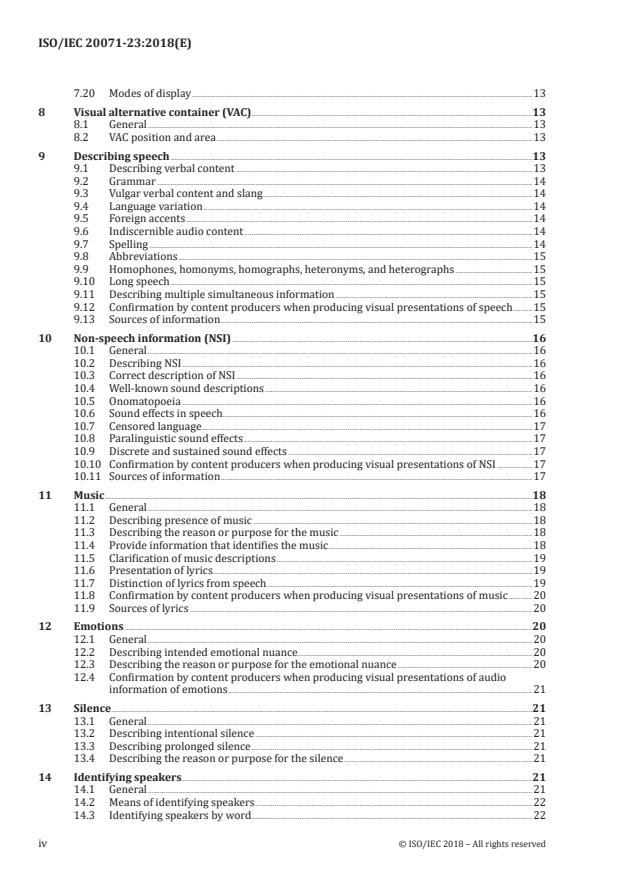
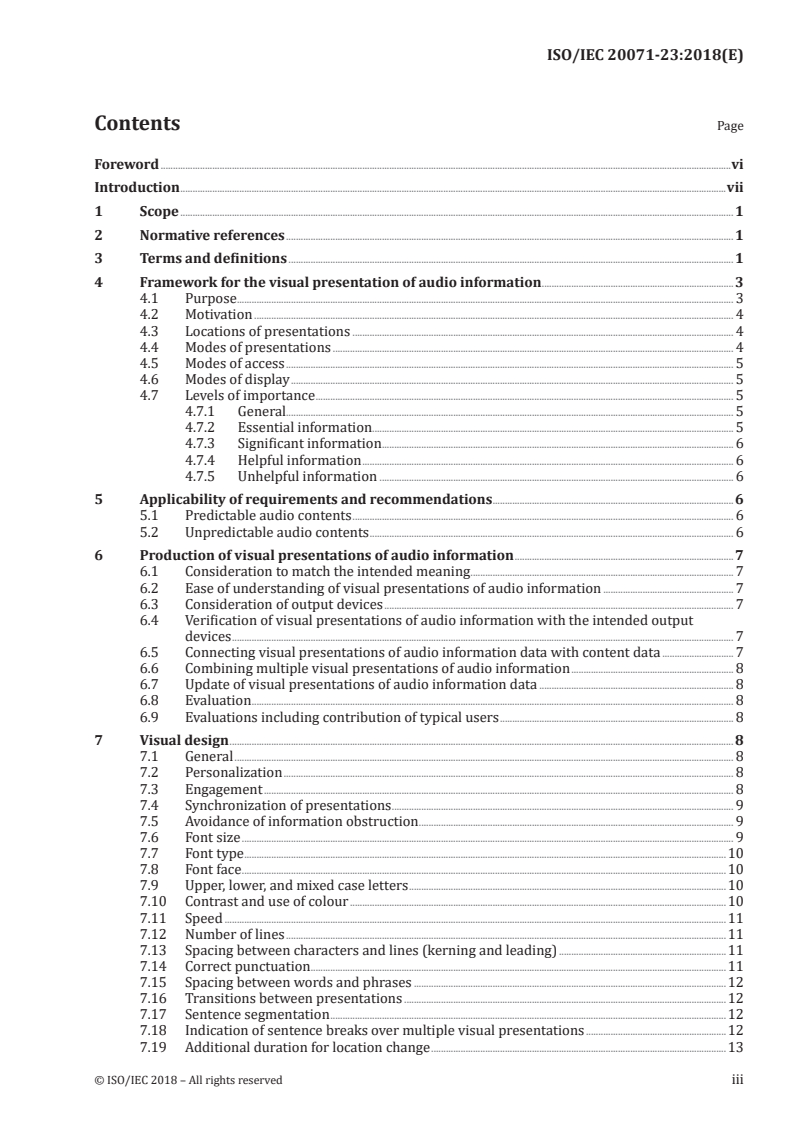
Contents Page
Foreword .vi
Introduction .vii
1 Scope . 1
2 Normative references . 1
3 Terms and definitions . 1
4 Framework for the visual presentation of audio information . 3
4.1 Purpose . 3
4.2 Motivation . 4
4.3 Locations of presentations . 4
4.4 Modes of presentations . 4
4.5 Modes of access . 5
4.6 Modes of display . 5
4.7 Levels of importance . 5
4.7.1 General. 5
4.7.2 Essential information. 5
4.7.3 Significant information . . 6
4.7.4 Helpful information . 6
4.7.5 Unhelpful information . 6
5 Applicability of requirements and recommendations . 6
5.1 Predictable audio contents . 6
5.2 Unpredictable audio contents . 6
6 Production of visual presentations of audio information . 7
6.1 Consideration to match the intended meaning . 7
6.2 Ease of understanding of visual presentations of audio information . 7
6.3 Consideration of output devices . 7
6.4 Verification of visual presentations of audio information with the intended output
devices . 7
6.5 Connecting visual presentations of audio information data with content data . 7
6.6 Combining multiple visual presentations of audio information . 8
6.7 Update of visual presentations of audio information data . 8
6.8 Evaluation . 8
6.9 Evaluations including contribution of typical users . 8
7 Visual design . 8
7.1 General . 8
7.2 Personalization . 8
7.3 Engagement . 8
7.4 Synchronization of presentations . 9
7.5 Avoidance of information obstruction . 9
7.6 Font size . 9
7.7 Font type .10
7.8 Font face .10
7.9 Upper, lower, and mixed case letters .10
7.10 Contrast and use of colour .10
7.11 Speed .11
7.12 Number of lines .11
7.13 Spacing between characters and lines (kerning and leading) .11
7.14 Correct punctuation.11
7.15 Spacing between words and phrases .12
7.16 Transitions between presentations .12
7.17 Sentence segmentation .12
7.18 Indication of sentence breaks over multiple visual presentations .12
7.19 Additional duration for location change .13
© ISO/IEC 2018 – All rights reserved iii
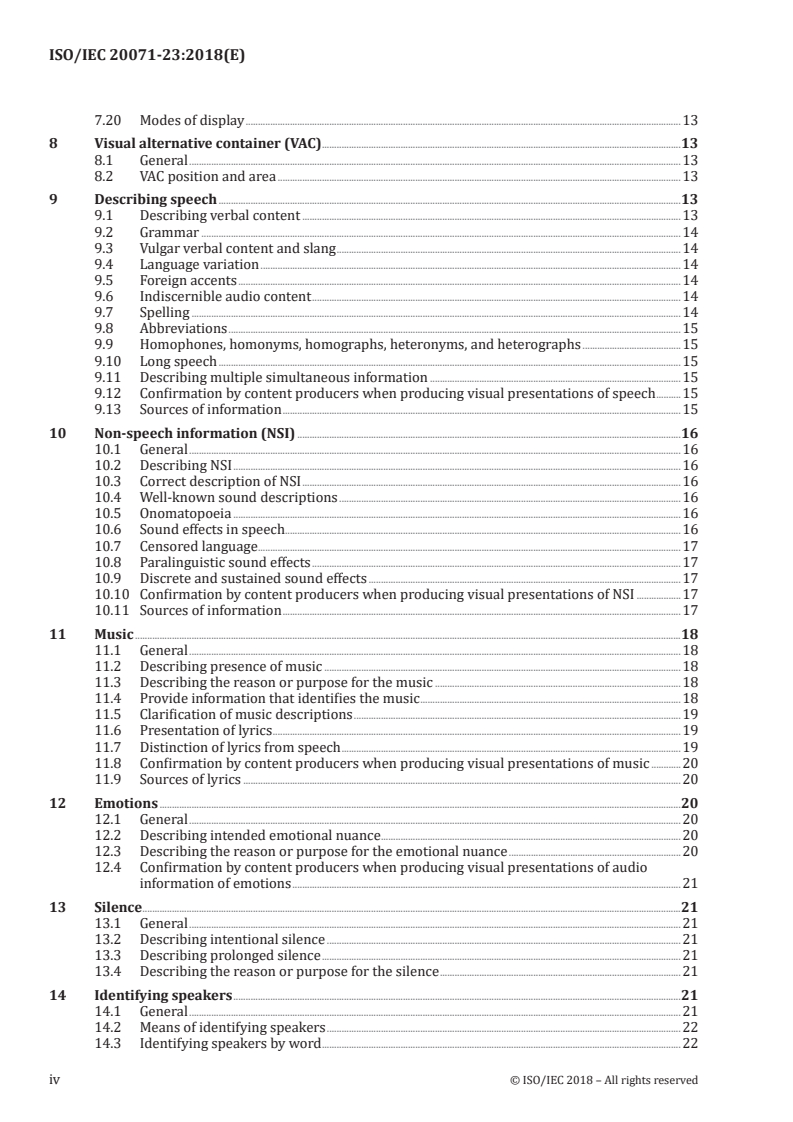
7.20 Modes of display .13
8 Visual alternative container (VAC) .13
8.1 General .13
8.2 VAC position and area .13
9 Describing speech .13
9.1 Describing verbal content .13
9.2 Grammar .14
9.3 Vulgar verbal content and slang .14
9.4 Language variation .14
9.5 Foreign accents .14
9.6 Indiscernible audio content .14
9.7 Spelling .14
9.8 Abbreviations .15
9.9 Homophones, homonyms, homographs, heteronyms, and heterographs .15
9.10 Long speech .15
9.11 Describing multiple simultaneous information .15
9.12 Confirmation by content producers when producing visual presentations of speech .15
9.13 Sources of information .15
10 Non-speech information (NSI) .16
10.1 General .16
10.2 Describing NSI .16
10.3 Correct description of NSI .16
10.4 Well-known sound descriptions .16
10.5 Onomatopoeia .16
10.6 Sound effects in speech .16
10.7 Censored language .17
10.8 Paralinguistic sound effects .17
10.9 Discrete and sustained sound effects .17
10.10 Confirmation by content producers when producing visual presentations of NSI .17
10.11 Sources of information .17
11 Music .18
11.1 General .18
11.2 Describing presence of music .18
11.3 Describing the reason or purpose for the music .18
11.4 Provide information that identifies the music .18
11.5 Clarification of music descriptions .19
11.6 Presentation of lyrics .19
11.7 Distinction of lyrics from speech .19
11.8 Confirmation by content producers when producing visual presentations of music .20
11.9 Sources of lyrics .20
12 Emotions .20
12.1 General .20
12.2 Describing intended emotional nuance .20
12.3 Describing the reason or purpose for the emotional nuance .20
12.4 Confirmation by content producers when producing visual presentations of audio
information of emotions .21
13 Silence .21
13.1 General .21
13.2 Describing intentional silence .21
13.3 Describing prolonged silence .21
13.4 Describing the reason or purpose for the silence .21
14 Identifying speakers .21
14.1 General .21
14.2 Means of identifying speakers .22
14.3 Identifying speakers by word .22
iv © ISO/IEC 2018 – All rights reserved
14.4 Identifying speakers by pictogram .22
14.5 Identifying speakers by colour .22
14.6 Identifying speakers by position .22
14.7 Identifying change of speakers by changing position .22
14.8 Multiple visual presentations of audio information .23
15 Evaluating quality of visual presentations of audio information .23
15.1 General .23
15.2 Quality review process .23
Annex A (informative) Evaluation index and references of guidelines and reports for
accessibility .24
Bibliography .26
© ISO/IEC 2018 – All rights reserved v
Foreword
ISO (the International Organization for Standardization) and IEC (the International Electrotechnical
Commission) form the specialized system for worldwide standardization. National bodies that are
members of ISO or IEC participate in the development of International Standards through technical
committees established by the respective organization to deal with particular fields of technical
activity. ISO and IEC technical committees collaborate in fields of mutual interest. Other international
organizations, governmental and non-governmental, in liaison with ISO and IEC, also take part in the
work. In the field of information technology, ISO and IEC have established a joint technical committee,
ISO/IEC JTC 1.
The procedures used to develop this document and those intended for its further maintenance are
described in the ISO/IEC Directives, Part 1. In particular the different approval criteria needed for
the different types of document should be noted. This document was drafted in accordance with the
editorial rules of the ISO/IEC Directives, Part 2 (see www .iso .org/directives).
Attention is drawn to the possibility that some of the elements of this document may be the subject
of patent rights. ISO and IEC shall not be held responsible for identifying any or all such patent
rights. Details of any patent rights identified during the development of the document will be in the
Introduction and/or on the ISO list of patent declarations received (see www .iso .org/patents).
Any trade name used in this document is information given for the convenience of users and does not
constitute an endorsement.
For an explanation on the voluntary nature of standards, the meaning of ISO specific terms and
expressions related to conformity assessment, as well as information about ISO's adherence to the
World Trade Organization (WTO) principles in the Technical Barriers to Trade (TBT) see the following
URL www .iso .org/iso/foreword .html.
This document was prepared by Technical Committee ISO/IEC JTC 1, Information technology,
Subcommittee SC 35, User interfaces.
A list of all parts in the ISO/IEC 20071 series can be found on the ISO website.
Any feedback or questions on this document should be directed to the user’s national standards body. A
complete listing of these bodies can be found at www .iso .org/members .html.
vi © ISO/IEC 2018 – All rights reserved
Introduction
Captions and/or subtitles for audio content provide visual alternatives for audio information in
audiovisual content. This document provides requirements and recommendations on the production
and design of the visual presentation of audio information (including captions and subtitles) that
supports users who cannot make use of the audio content.
The use of this document helps to support universal and inclusive media content production practices.
It provides guidance for producers, exhibitors, or distributors of audio content (including the medium of
distribution and the medium of delivery) to support the accessibility and usability of visual alternatives
of audio content.
Different jurisdictions have different expectations of what belongs in a caption or a subtitle. From the
point of view of the user, what is important is receiving the information in an accessible design, not
the technological means of its delivery. This information can include text conveying speech, sound
information, verbatim transcription of the spoken word content, translations of the spoken word
content, etc. This document uses “visual presentations of audio information” to include all audio
information needed to be made accessible for some users.
Standardized guidance for producing visual presentations of audio information is important to meet a
variety of needs. For example, it is important to recognize acceptable values for specifying typography
variables such as the letter size and/or number of characters in visual alternatives that rely on text.
Providing visual presentations of audio information (including captions and subtitles) can be
beneficial to all, and in particular to diverse users who cannot hear or understand the audio content
in diverse contexts, including: persons with hearing loss, persons who are deaf or hard of hearing,
persons with learning difficulties or cognitive disabilities, persons watching a movie in a non-native
language, persons who need the content to be in another language, persons who cannot hear the audio
content due to environmental conditions, or circumstances where the sound is not accessible (e.g.
noisy surroundings), the sound is not available (e.g. muted, no working speakers), or the sound is not
appropriate (e.g. a quiet library). Although this guidance acknowledges the need of visual presentations
of audio information to provide non-visual presentations for diverse users, it does not include guidance
for producing non-visual presentations, such as spoken captions/subtitles (see ISO/IEC TS 20071-25 for
further reference) and tactile displays (e.g. Braille). The production, delivery, and exhibition of visual
presentations of audio information based on this standard are not intended to interfere with or change
the meaning of the audio content.
The production, delivery and exhibition of visual presentations of audio information vary according to
the time and methodology of production, the technology used for its production, the system of delivery,
and the display (including the brand and model of the display).
© ISO/IEC 2018 – All rights reserved vii
INTERNATIONAL STANDARD ISO/IEC 20071-23:2018(E)
Information technology — User interface component
accessibility —
Part 23:
Visual presentation of audio information (including
captions and subtitles)
1 Scope
This document provides guidance for producers, exhibitors, and distributors on the visual presentation
of alternatives to audio information in audiovisual content, such as captions/subtitles.
This document provides requirements and recommendations that are intended to support users who
are not able to use the audio information, prefer to use a visual representation of audio information, or
prefer both audio and visual presentations.
NOTE Many users do not have a choice, for instance, when in a noisy environment (e.g. bar, restaurant, etc.).
In these situations, the user does not select a visual presentation of audio information but is offered the content
with captions/subtitles.
This document acknowledges the various needs and preferences of viewers (end users) as well as the
different approaches to visual presentation of audio information. It applies to all presentations of visual
alternatives to audio information intended to be presented as captions/subtitles.
This document does not apply to the presentation devices or transmission mechanisms used to deliver
the content or visual presentations of audio information. These devices could include, but are not limited
to: televisions, computers, wireless devices, projection equipment, DVD and home cinema equipment,
video game consoles, and other forms of user interfaces technology. This document does not apply to
transcoding files and formats for the various video outputs.
This document gives guidance on visual presentations which are delivered in the same language as in
the audio (i.e., intra-lingual captions/subtitles) and visual presentations which are translated into a
different language (i.e., inter-lingual captions/subtitles). This document does not apply to the specific
process of language translation.
This document helps to improve accessibility. This document does not establish requirements on
specific industries (e.g. television broadcasting, motion pictures) nor is it intended to supersede specific
international standards within their domain.
2 Normative references
There are no normative references in this document.
3 Terms and definitions
For the purposes of this document, the following terms and definitions apply.
ISO and IEC maintain terminological databases for use in standardization at the following addresses:
— IEC Electropedia: available at http: //www .electropedia .org/
— ISO Online browsing platform: available at https: //www .iso .org/obp
© ISO/IEC 2018 – All rights reserved 1
3.1
information
knowledge concerning objects, such as facts, events, things, processes, or ideas, including concepts, that
within a certain context has a particular meaning
Note 1 to entry: Although information will necessarily have a representation form to make it communicable, it is
the interpretation of this representation (the meaning) that is relevant in the first place.
[SOURCE: ISO/IEC 2382:2015, 2121271]
3.2
content
interactive or non-interactive object containing information represented by text, image, video, sound,
or other media
[SOURCE: ISO/IEC/IEEE 23026:2015, 4.6]
3.3
caption/subtitle
transcription or translation of audio content, visually presented together with the content
Note 1 to entry: Transcriptions or translations include speech and/or non-speech information.
Note 2 to entry: Transcriptions or translations are often suitable for use as an alternative or a complement to the
audio content.
3.4
open caption
open subtitle
caption/subtitle visually presented regardless of user preference
Note 1 to entry: Open captions/subtitles do not include visual elements that are a part of the original video
contents.
3.5
closed caption
closed subtitle
caption/subtitle visually presented only in response to user preference
Note 1 to entry: Closed captions/subtitles are usually presented by a specialised device or decoder.
3.6
non-speech information
NSI
part of the audio content, other than spoken words
Note 1 to entry: NSI can convey information about: plot, humour, mood, or meaning of a spoken passage.
EXAMPLE Speaker identification information (e.g. off-screen speakers and multiple on-screen speakers),
sound effects, music (e.g. singing, background music, instrumentation), manner of speaking (e.g. whispering,
emotion, word emphasis), audience reaction (e.g. laughing, groaning, booing).
3.7
visual alternative container
VAC
opaque or translucent area visually presenting alternative content
Note 1 to entry: While VACs are largely used to provide alternatives to audio content, they can also be used to
provide alternatives to other content.
Note 2 to entry: There can be multiple VACs presented at the same time.
2 © ISO/IEC 2018 – All rights reserved
Note 3 to entry: VACs can be displayed to indicate where the visual presentation of content will appear in the
future or has appeared in the past.
EXAMPLE Caption/subtitle-boxes, -stripes or –lines are common examples of VACs.
3.8
audiovisual content
content that includes audio and visual components
Note 1 to entry: Only the audio or the visual components might be active at some times within the presentation
of audiovisual content.
3.9
video
combination of audio and visual content presented together in a synchronized manner via Information
and Communication Technology
Note 1 to entry: While the visual content is often presented using a screen, it might also be presented via other
technologies e.g. a projected hologram.
[SOURCE: ISO/IEC TS 20071-25:2015, 2.1.2, modified – Note 1 to entry has been added.]
3.10
content category
classification of audiovisual content
Note 1 to entry: Content categories are not necessarily mutually exclusive.
Note 2 to entry: When content category is considered from an artistic perspective, it is often referred to as genre.
EXAMPLE Content categories include: dramas, museum and art gallery exhibits, heritage tours, comedies,
documentaries, video users’ guides and manuals, university lectures, meetings, sporting events, etc.
3.11
importance
level of need for users to know information in the content
3.12
essential (information)
information that is necessary for users to understand the content and/or its function
3.13
significant (information)
information that provides a more detailed understanding of the content for most users
most of the time
3.14
helpful (information)
information that provides a thorough understanding of the content for some users
3.15
unhelpful (information)
information that does not help users understand the content and/or might interfere with
that understanding
4 Framework for the visual presentation of audio information
4.1 Purpose
Visual presentations of audio information should aim at providing viewers with alternative or
complementary visual information that meets users’ needs and contexts of use (e.g. noisy environments).
© ISO/IEC 2018 – All rights reserved 3
It is important that visual presentations of audio information present information contained in speech
and other audio content.
4.2 Motivation
Audio content conveys information through verbal and non-verbal sounds. People who might not be
able to fully access the content include those who cannot access the audio components such as:
a) persons with sensory disabilities such as the deaf or hard of hearing;
b) persons who cannot hear the sound for other reasons (for instance, not having the sound on, or
having difficulty to hear the sound in a noisy environment);
c) persons with difficulties to access the oral verbal content.
NOTE Persons with difficulties understanding oral language include those with cognitive diversity as well
as people learning a new language.
Not being able to access the meaning of sound used in the audio content has a direct impact on the
understanding and enjoyment of the content. It also implies that certain people are excluded from
educational, cultural and social contexts (e.g. when an audio content is discussed by colleagues in
informal contexts).
A visual presentation of audio information should be perceived as equitably as possible to the auditory
perception of the content.
Facilitating access to the sounds used in the audio content improves the experience in terms of
comprehension and enjoyment, and guarantees access in critical emergency situations where
information is provided auditorily.
Providing visual presentations of the audio information enhances access to audio content.
4.3 Locations of presentations
There are three locations of visual presentations of audio information; they can be:
a) superimposed onto the visual content;
b) displayed on the same screen but outside the visual content;
c) displayed on a separate (second) screen or display device.
4.4 Modes of presentations
There are two modes of visual presentations of audio information which can be presented alone or in
combination:
a) Text presentations are visual presentations of audio information that rely on text to represent
audio content. They are encoded separately from the audio content and presented to the viewer
with the content (e.g. closed captions).
b) Figure/graphic presentations are visual presentations of audio information that rely on static or
dynamic graphics to represent audio content. They are encoded as a figure and presented to the
viewer with the content (e.g. emoticons, avatars, animations, pictures, etc.).
4 © ISO/IEC 2018 – All rights reserved
4.5 Modes of access
There are two ways to access visual presentations of audio information:
a) Visual presentations of audio information prepared separately from the content. The viewer needs
to use some device or software to access the visual presentation of audio information (e.g. closed
captions/subtitles, a display device at live contents such as theatre or opera).
b) Visual presentations of audio information included together with the content. The presentation is
independent from the characteristics of modes of presentation (e.g. open captions/subtitles).
NOTE Multiple channels might be made available to the viewer, one or more with visual presentations
of audio information and one or more without any visual presentations of audio information. Viewers select
a channel according to their needs.
4.6 Modes of display
There are four modes to display text-based visual presentations of audio information, based on how
they are cued-in (appear) and cued-out (disappear):
a) Pop-on (or “block”): Visual presentation of audio information where all information appears at
once (as a block), remains for a period of time, and then disappears at once (as a block).
b) Scrolling (or "roll-up"): Visual presentation of audio information rolls onto and off the screen in a
continuous motion. Usually two or three lines of text appear at one time. The presentation appears
to “roll”; as a new line of text appears on the bottom of the VAC, the other lines on the screen move
up and the line at the top is removed.
c) Word-by-word: Visual presentation of audio information is displayed on the screen according to
the writing direction of the language used (i.e., in a left-to-right or right-to-left manner). The words
appear one after the next. Word-by-word can be cued-out as a block or by scrolling.
d) Line-by-line: Visual presentation of audio information is displayed on the screen according to
the writing direction of the language used (i.e., in a left-to-right or right-to-left manner). The text
appears one line after the next. Line-by-line can be cued-out as a block or by scrolling.
4.7 Levels of importance
4.7.1 General
There are four levels of importance of audiovisual content (i.e., essential, significant, helpful, unhelpful)
to support the understanding of the visual components of the audiovisual content.
Levels of importance depend on the context of use of the audiovisual content, including the use, purpose,
and content category of the audiovisual content.
NOTE 1 Level of importance largely changes whether audiovisual content is consumed for entertainment
purposes or information purposes. To have an engaging entertainment experience, information about audio
content such as sound effects, music, an actor’s tone of voice, and so on needs to be available in a non-audio
modality that supports those who cannot access the audio content.
NOTE 2 Determine the levels of importance from the perspective of consideration to match the intended
meaning (see 6.1), consideration of output devices (see 6.3), evaluation by viewers (see 6.8 and 6.9), and other
specific evaluation methods (see Clause 15 and Annex A).
4.7.2 Essential information
Essential information shall be displayed in visual presentations of audio information.
NOTE 1 Essential information in visual presentation of audio information ensures that all viewers will have
access to this information.
© ISO/IEC 2018 – All rights reserved 5
NOTE 2 Viewers might be confused as to what the audiovisual content is presenting without essential
information.
NOTE 3 Viewers have no idea why the audio content is there or what the audio content is for without essential
information.
NOTE 4 Essential information might include the essence, purpose, function, or intent of the audiovisual
content.
4.7.3 Significant information
Significant information should be displayed in visual presentations of audio information. Significant
information goes into more details about the essential information.
NOTE The amount of significant information to be displayed depends on the amount of essential information
that is already available.
4.7.4 Helpful information
Helpful information may be displayed in visual presentations of audio information.
NOTE 1 Helpful information is specific details that might be of interest to some who are the viewers of the
audiovisual content.
NOTE 2 Helpful information can provide the viewer with a better understanding of audiovisual content when
the viewer is not familiar with the content.
NOTE 3 Helpful information might reassure the viewers that they have not missed something of greater
importance.
NOTE 4 Without helpful information, viewers have a fairly complete understanding of what the audiovisual
content is about but might have some things that they still want to know.
4.7.5 Unhelpful information
Unhelpful information should be avoided in visual presentations of audio information.
NOTE 1 Unhelpful information is not important enough to mention.
NOTE 2 Unhelpful information might result in unintended confusion or misunderstanding of the audiovisual
content.
EXAMPLE In a video of a tennis match, the sound of the ball being hit is unhelpful information.
5 Applicability of requirements and recommendations
5.1 Predictable audio contents
When audio content is predictable (e.g. content was recorded, or live but planned, or scripted), all the
requirements and recommendations in Clauses 6 - 15 should be evaluated for their applicability to
visual presentation of audio information.
5.2 Unpredictable audio contents
When audio content is unpredictable (e.g. content is spontaneous, unscripted, or live without plan or
script, and unexpected during the production of visual presentations of audio information), particular
requirements and recommendati
...
INTERNATIONAL ISO/IEC
STANDARD 20071-23
First edition
2018-09
Information technology — User
interface component accessibility —
Part 23:
Visual presentation of audio
information (including captions and
subtitles)
Technologies de l'information — Accessibilité du composant interface
utilisateur —
Partie 23: Présentation visuelle d’informations sonores
Reference number
©
ISO/IEC 2018
© ISO/IEC 2018
All rights reserved. Unless otherwise specified, or required in the context of its implementation, no part of this publication may
be reproduced or utilized otherwise in any form or by any means, electronic or mechanical, including photocopying, or posting
on the internet or an intranet, without prior written permission. Permission can be requested from either ISO at the address
below or ISO’s member body in the country of the requester.
ISO copyright office
CP 401 • Ch. de Blandonnet 8
CH-1214 Vernier, Geneva
Phone: +41 22 749 01 11
Fax: +41 22 749 09 47
Email: copyright@iso.org
Website: www.iso.org
Published in Switzerland
ii © ISO/IEC 2018 – All rights reserved
Contents Page
Foreword .vi
Introduction .vii
1 Scope . 1
2 Normative references . 1
3 Terms and definitions . 1
4 Framework for the visual presentation of audio information . 3
4.1 Purpose . 3
4.2 Motivation . 4
4.3 Locations of presentations . 4
4.4 Modes of presentations . 4
4.5 Modes of access . 5
4.6 Modes of display . 5
4.7 Levels of importance . 5
4.7.1 General. 5
4.7.2 Essential information. 5
4.7.3 Significant information . . 6
4.7.4 Helpful information . 6
4.7.5 Unhelpful information . 6
5 Applicability of requirements and recommendations . 6
5.1 Predictable audio contents . 6
5.2 Unpredictable audio contents . 6
6 Production of visual presentations of audio information . 7
6.1 Consideration to match the intended meaning . 7
6.2 Ease of understanding of visual presentations of audio information . 7
6.3 Consideration of output devices . 7
6.4 Verification of visual presentations of audio information with the intended output
devices . 7
6.5 Connecting visual presentations of audio information data with content data . 7
6.6 Combining multiple visual presentations of audio information . 8
6.7 Update of visual presentations of audio information data . 8
6.8 Evaluation . 8
6.9 Evaluations including contribution of typical users . 8
7 Visual design . 8
7.1 General . 8
7.2 Personalization . 8
7.3 Engagement . 8
7.4 Synchronization of presentations . 9
7.5 Avoidance of information obstruction . 9
7.6 Font size . 9
7.7 Font type .10
7.8 Font face .10
7.9 Upper, lower, and mixed case letters .10
7.10 Contrast and use of colour .10
7.11 Speed .11
7.12 Number of lines .11
7.13 Spacing between characters and lines (kerning and leading) .11
7.14 Correct punctuation.11
7.15 Spacing between words and phrases .12
7.16 Transitions between presentations .12
7.17 Sentence segmentation .12
7.18 Indication of sentence breaks over multiple visual presentations .12
7.19 Additional duration for location change .13
© ISO/IEC 2018 – All rights reserved iii
7.20 Modes of display .13
8 Visual alternative container (VAC) .13
8.1 General .13
8.2 VAC position and area .13
9 Describing speech .13
9.1 Describing verbal content .13
9.2 Grammar .14
9.3 Vulgar verbal content and slang .14
9.4 Language variation .14
9.5 Foreign accents .14
9.6 Indiscernible audio content .14
9.7 Spelling .14
9.8 Abbreviations .15
9.9 Homophones, homonyms, homographs, heteronyms, and heterographs .15
9.10 Long speech .15
9.11 Describing multiple simultaneous information .15
9.12 Confirmation by content producers when producing visual presentations of speech .15
9.13 Sources of information .15
10 Non-speech information (NSI) .16
10.1 General .16
10.2 Describing NSI .16
10.3 Correct description of NSI .16
10.4 Well-known sound descriptions .16
10.5 Onomatopoeia .16
10.6 Sound effects in speech .16
10.7 Censored language .17
10.8 Paralinguistic sound effects .17
10.9 Discrete and sustained sound effects .17
10.10 Confirmation by content producers when producing visual presentations of NSI .17
10.11 Sources of information .17
11 Music .18
11.1 General .18
11.2 Describing presence of music .18
11.3 Describing the reason or purpose for the music .18
11.4 Provide information that identifies the music .18
11.5 Clarification of music descriptions .19
11.6 Presentation of lyrics .19
11.7 Distinction of lyrics from speech .19
11.8 Confirmation by content producers when producing visual presentations of music .20
11.9 Sources of lyrics .20
12 Emotions .20
12.1 General .20
12.2 Describing intended emotional nuance .20
12.3 Describing the reason or purpose for the emotional nuance .20
12.4 Confirmation by content producers when producing visual presentations of audio
information of emotions .21
13 Silence .21
13.1 General .21
13.2 Describing intentional silence .21
13.3 Describing prolonged silence .21
13.4 Describing the reason or purpose for the silence .21
14 Identifying speakers .21
14.1 General .21
14.2 Means of identifying speakers .22
14.3 Identifying speakers by word .22
iv © ISO/IEC 2018 – All rights reserved
14.4 Identifying speakers by pictogram .22
14.5 Identifying speakers by colour .22
14.6 Identifying speakers by position .22
14.7 Identifying change of speakers by changing position .22
14.8 Multiple visual presentations of audio information .23
15 Evaluating quality of visual presentations of audio information .23
15.1 General .23
15.2 Quality review process .23
Annex A (informative) Evaluation index and references of guidelines and reports for
accessibility .24
Bibliography .26
© ISO/IEC 2018 – All rights reserved v
Foreword
ISO (the International Organization for Standardization) and IEC (the International Electrotechnical
Commission) form the specialized system for worldwide standardization. National bodies that are
members of ISO or IEC participate in the development of International Standards through technical
committees established by the respective organization to deal with particular fields of technical
activity. ISO and IEC technical committees collaborate in fields of mutual interest. Other international
organizations, governmental and non-governmental, in liaison with ISO and IEC, also take part in the
work. In the field of information technology, ISO and IEC have established a joint technical committee,
ISO/IEC JTC 1.
The procedures used to develop this document and those intended for its further maintenance are
described in the ISO/IEC Directives, Part 1. In particular the different approval criteria needed for
the different types of document should be noted. This document was drafted in accordance with the
editorial rules of the ISO/IEC Directives, Part 2 (see www .iso .org/directives).
Attention is drawn to the possibility that some of the elements of this document may be the subject
of patent rights. ISO and IEC shall not be held responsible for identifying any or all such patent
rights. Details of any patent rights identified during the development of the document will be in the
Introduction and/or on the ISO list of patent declarations received (see www .iso .org/patents).
Any trade name used in this document is information given for the convenience of users and does not
constitute an endorsement.
For an explanation on the voluntary nature of standards, the meaning of ISO specific terms and
expressions related to conformity assessment, as well as information about ISO's adherence to the
World Trade Organization (WTO) principles in the Technical Barriers to Trade (TBT) see the following
URL www .iso .org/iso/foreword .html.
This document was prepared by Technical Committee ISO/IEC JTC 1, Information technology,
Subcommittee SC 35, User interfaces.
A list of all parts in the ISO/IEC 20071 series can be found on the ISO website.
Any feedback or questions on this document should be directed to the user’s national standards body. A
complete listing of these bodies can be found at www .iso .org/members .html.
vi © ISO/IEC 2018 – All rights reserved
Introduction
Captions and/or subtitles for audio content provide visual alternatives for audio information in
audiovisual content. This document provides requirements and recommendations on the production
and design of the visual presentation of audio information (including captions and subtitles) that
supports users who cannot make use of the audio content.
The use of this document helps to support universal and inclusive media content production practices.
It provides guidance for producers, exhibitors, or distributors of audio content (including the medium of
distribution and the medium of delivery) to support the accessibility and usability of visual alternatives
of audio content.
Different jurisdictions have different expectations of what belongs in a caption or a subtitle. From the
point of view of the user, what is important is receiving the information in an accessible design, not
the technological means of its delivery. This information can include text conveying speech, sound
information, verbatim transcription of the spoken word content, translations of the spoken word
content, etc. This document uses “visual presentations of audio information” to include all audio
information needed to be made accessible for some users.
Standardized guidance for producing visual presentations of audio information is important to meet a
variety of needs. For example, it is important to recognize acceptable values for specifying typography
variables such as the letter size and/or number of characters in visual alternatives that rely on text.
Providing visual presentations of audio information (including captions and subtitles) can be
beneficial to all, and in particular to diverse users who cannot hear or understand the audio content
in diverse contexts, including: persons with hearing loss, persons who are deaf or hard of hearing,
persons with learning difficulties or cognitive disabilities, persons watching a movie in a non-native
language, persons who need the content to be in another language, persons who cannot hear the audio
content due to environmental conditions, or circumstances where the sound is not accessible (e.g.
noisy surroundings), the sound is not available (e.g. muted, no working speakers), or the sound is not
appropriate (e.g. a quiet library). Although this guidance acknowledges the need of visual presentations
of audio information to provide non-visual presentations for diverse users, it does not include guidance
for producing non-visual presentations, such as spoken captions/subtitles (see ISO/IEC TS 20071-25 for
further reference) and tactile displays (e.g. Braille). The production, delivery, and exhibition of visual
presentations of audio information based on this standard are not intended to interfere with or change
the meaning of the audio content.
The production, delivery and exhibition of visual presentations of audio information vary according to
the time and methodology of production, the technology used for its production, the system of delivery,
and the display (including the brand and model of the display).
© ISO/IEC 2018 – All rights reserved vii
INTERNATIONAL STANDARD ISO/IEC 20071-23:2018(E)
Information technology — User interface component
accessibility —
Part 23:
Visual presentation of audio information (including
captions and subtitles)
1 Scope
This document provides guidance for producers, exhibitors, and distributors on the visual presentation
of alternatives to audio information in audiovisual content, such as captions/subtitles.
This document provides requirements and recommendations that are intended to support users who
are not able to use the audio information, prefer to use a visual representation of audio information, or
prefer both audio and visual presentations.
NOTE Many users do not have a choice, for instance, when in a noisy environment (e.g. bar, restaurant, etc.).
In these situations, the user does not select a visual presentation of audio information but is offered the content
with captions/subtitles.
This document acknowledges the various needs and preferences of viewers (end users) as well as the
different approaches to visual presentation of audio information. It applies to all presentations of visual
alternatives to audio information intended to be presented as captions/subtitles.
This document does not apply to the presentation devices or transmission mechanisms used to deliver
the content or visual presentations of audio information. These devices could include, but are not limited
to: televisions, computers, wireless devices, projection equipment, DVD and home cinema equipment,
video game consoles, and other forms of user interfaces technology. This document does not apply to
transcoding files and formats for the various video outputs.
This document gives guidance on visual presentations which are delivered in the same language as in
the audio (i.e., intra-lingual captions/subtitles) and visual presentations which are translated into a
different language (i.e., inter-lingual captions/subtitles). This document does not apply to the specific
process of language translation.
This document helps to improve accessibility. This document does not establish requirements on
specific industries (e.g. television broadcasting, motion pictures) nor is it intended to supersede specific
international standards within their domain.
2 Normative references
There are no normative references in this document.
3 Terms and definitions
For the purposes of this document, the following terms and definitions apply.
ISO and IEC maintain terminological databases for use in standardization at the following addresses:
— IEC Electropedia: available at http: //www .electropedia .org/
— ISO Online browsing platform: available at https: //www .iso .org/obp
© ISO/IEC 2018 – All rights reserved 1
3.1
information
knowledge concerning objects, such as facts, events, things, processes, or ideas, including concepts, that
within a certain context has a particular meaning
Note 1 to entry: Although information will necessarily have a representation form to make it communicable, it is
the interpretation of this representation (the meaning) that is relevant in the first place.
[SOURCE: ISO/IEC 2382:2015, 2121271]
3.2
content
interactive or non-interactive object containing information represented by text, image, video, sound,
or other media
[SOURCE: ISO/IEC/IEEE 23026:2015, 4.6]
3.3
caption/subtitle
transcription or translation of audio content, visually presented together with the content
Note 1 to entry: Transcriptions or translations include speech and/or non-speech information.
Note 2 to entry: Transcriptions or translations are often suitable for use as an alternative or a complement to the
audio content.
3.4
open caption
open subtitle
caption/subtitle visually presented regardless of user preference
Note 1 to entry: Open captions/subtitles do not include visual elements that are a part of the original video
contents.
3.5
closed caption
closed subtitle
caption/subtitle visually presented only in response to user preference
Note 1 to entry: Closed captions/subtitles are usually presented by a specialised device or decoder.
3.6
non-speech information
NSI
part of the audio content, other than spoken words
Note 1 to entry: NSI can convey information about: plot, humour, mood, or meaning of a spoken passage.
EXAMPLE Speaker identification information (e.g. off-screen speakers and multiple on-screen speakers),
sound effects, music (e.g. singing, background music, instrumentation), manner of speaking (e.g. whispering,
emotion, word emphasis), audience reaction (e.g. laughing, groaning, booing).
3.7
visual alternative container
VAC
opaque or translucent area visually presenting alternative content
Note 1 to entry: While VACs are largely used to provide alternatives to audio content, they can also be used to
provide alternatives to other content.
Note 2 to entry: There can be multiple VACs presented at the same time.
2 © ISO/IEC 2018 – All rights reserved
Note 3 to entry: VACs can be displayed to indicate where the visual presentation of content will appear in the
future or has appeared in the past.
EXAMPLE Caption/subtitle-boxes, -stripes or –lines are common examples of VACs.
3.8
audiovisual content
content that includes audio and visual components
Note 1 to entry: Only the audio or the visual components might be active at some times within the presentation
of audiovisual content.
3.9
video
combination of audio and visual content presented together in a synchronized manner via Information
and Communication Technology
Note 1 to entry: While the visual content is often presented using a screen, it might also be presented via other
technologies e.g. a projected hologram.
[SOURCE: ISO/IEC TS 20071-25:2015, 2.1.2, modified – Note 1 to entry has been added.]
3.10
content category
classification of audiovisual content
Note 1 to entry: Content categories are not necessarily mutually exclusive.
Note 2 to entry: When content category is considered from an artistic perspective, it is often referred to as genre.
EXAMPLE Content categories include: dramas, museum and art gallery exhibits, heritage tours, comedies,
documentaries, video users’ guides and manuals, university lectures, meetings, sporting events, etc.
3.11
importance
level of need for users to know information in the content
3.12
essential (information)
information that is necessary for users to understand the content and/or its function
3.13
significant (information)
information that provides a more detailed understanding of the content for most users
most of the time
3.14
helpful (information)
information that provides a thorough understanding of the content for some users
3.15
unhelpful (information)
information that does not help users understand the content and/or might interfere with
that understanding
4 Framework for the visual presentation of audio information
4.1 Purpose
Visual presentations of audio information should aim at providing viewers with alternative or
complementary visual information that meets users’ needs and contexts of use (e.g. noisy environments).
© ISO/IEC 2018 – All rights reserved 3
It is important that visual presentations of audio information present information contained in speech
and other audio content.
4.2 Motivation
Audio content conveys information through verbal and non-verbal sounds. People who might not be
able to fully access the content include those who cannot access the audio components such as:
a) persons with sensory disabilities such as the deaf or hard of hearing;
b) persons who cannot hear the sound for other reasons (for instance, not having the sound on, or
having difficulty to hear the sound in a noisy environment);
c) persons with difficulties to access the oral verbal content.
NOTE Persons with difficulties understanding oral language include those with cognitive diversity as well
as people learning a new language.
Not being able to access the meaning of sound used in the audio content has a direct impact on the
understanding and enjoyment of the content. It also implies that certain people are excluded from
educational, cultural and social contexts (e.g. when an audio content is discussed by colleagues in
informal contexts).
A visual presentation of audio information should be perceived as equitably as possible to the auditory
perception of the content.
Facilitating access to the sounds used in the audio content improves the experience in terms of
comprehension and enjoyment, and guarantees access in critical emergency situations where
information is provided auditorily.
Providing visual presentations of the audio information enhances access to audio content.
4.3 Locations of presentations
There are three locations of visual presentations of audio information; they can be:
a) superimposed onto the visual content;
b) displayed on the same screen but outside the visual content;
c) displayed on a separate (second) screen or display device.
4.4 Modes of presentations
There are two modes of visual presentations of audio information which can be presented alone or in
combination:
a) Text presentations are visual presentations of audio information that rely on text to represent
audio content. They are encoded separately from the audio content and presented to the viewer
with the content (e.g. closed captions).
b) Figure/graphic presentations are visual presentations of audio information that rely on static or
dynamic graphics to represent audio content. They are encoded as a figure and presented to the
viewer with the content (e.g. emoticons, avatars, animations, pictures, etc.).
4 © ISO/IEC 2018 – All rights reserved
4.5 Modes of access
There are two ways to access visual presentations of audio information:
a) Visual presentations of audio information prepared separately from the content. The viewer needs
to use some device or software to access the visual presentation of audio information (e.g. closed
captions/subtitles, a display device at live contents such as theatre or opera).
b) Visual presentations of audio information included together with the content. The presentation is
independent from the characteristics of modes of presentation (e.g. open captions/subtitles).
NOTE Multiple channels might be made available to the viewer, one or more with visual presentations
of audio information and one or more without any visual presentations of audio information. Viewers select
a channel according to their needs.
4.6 Modes of display
There are four modes to display text-based visual presentations of audio information, based on how
they are cued-in (appear) and cued-out (disappear):
a) Pop-on (or “block”): Visual presentation of audio information where all information appears at
once (as a block), remains for a period of time, and then disappears at once (as a block).
b) Scrolling (or "roll-up"): Visual presentation of audio information rolls onto and off the screen in a
continuous motion. Usually two or three lines of text appear at one time. The presentation appears
to “roll”; as a new line of text appears on the bottom of the VAC, the other lines on the screen move
up and the line at the top is removed.
c) Word-by-word: Visual presentation of audio information is displayed on the screen according to
the writing direction of the language used (i.e., in a left-to-right or right-to-left manner). The words
appear one after the next. Word-by-word can be cued-out as a block or by scrolling.
d) Line-by-line: Visual presentation of audio information is displayed on the screen according to
the writing direction of the language used (i.e., in a left-to-right or right-to-left manner). The text
appears one line after the next. Line-by-line can be cued-out as a block or by scrolling.
4.7 Levels of importance
4.7.1 General
There are four levels of importance of audiovisual content (i.e., essential, significant, helpful, unhelpful)
to support the understanding of the visual components of the audiovisual content.
Levels of importance depend on the context of use of the audiovisual content, including the use, purpose,
and content category of the audiovisual content.
NOTE 1 Level of importance largely changes whether audiovisual content is consumed for entertainment
purposes or information purposes. To have an engaging entertainment experience, information about audio
content such as sound effects, music, an actor’s tone of voice, and so on needs to be available in a non-audio
modality that supports those who cannot access the audio content.
NOTE 2 Determine the levels of importance from the perspective of consideration to match the intended
meaning (see 6.1), consideration of output devices (see 6.3), evaluation by viewers (see 6.8 and 6.9), and other
specific evaluation methods (see Clause 15 and Annex A).
4.7.2 Essential information
Essential information shall be displayed in visual presentations of audio information.
NOTE 1 Essential information in visual presentation of audio information ensures that all viewers will have
access to this information.
© ISO/IEC 2018 – All rights reserved 5
NOTE 2 Viewers might be confused as to what the audiovisual content is presenting without essential
information.
NOTE 3 Viewers have no idea why the audio content is there or what the audio content is for without essential
information.
NOTE 4 Essential information might include the essence, purpose, function, or intent of the audiovisual
content.
4.7.3 Significant information
Significant information should be displayed in visual presentations of audio information. Significant
information goes into more details about the essential information.
NOTE The amount of significant information to be displayed depends on the amount of essential information
that is already available.
4.7.4 Helpful information
Helpful information may be displayed in visual presentations of audio information.
NOTE 1 Helpful information is specific details that might be of interest to some who are the viewers of the
audiovisual content.
NOTE 2 Helpful information can provide the viewer with a better understanding of audiovisual content when
the viewer is not familiar with the content.
NOTE 3 Helpful information might reassure the viewers that they have not missed something of greater
importance.
NOTE 4 Without helpful information, viewers have a fairly complete understanding of what the audiovisual
content is about but might have some things that they still want to know.
4.7.5 Unhelpful information
Unhelpful information should be avoided in visual presentations of audio information.
NOTE 1 Unhelpful information is not important enough to mention.
NOTE 2 Unhelpful information might result in unintended confusion or misunderstanding of the audiovisual
content.
EXAMPLE In a video of a tennis match, the sound of the ball being hit is unhelpful information.
5 Applicability of requirements and recommendations
5.1 Predictable audio contents
When audio content is predictable (e.g. content was recorded, or live but planned, or scripted), all the
requirements and recommendations in Clauses 6 - 15 should be evaluated for their applicability to
visual presentation of audio information.
5.2 Unpredictable audio contents
When audio content is unpredictable (e.g. content is spontaneous, unscripted, or live without plan or
script, and unexpected during the production of visual presentations of audio information), particular
requirements and recommendati
...