


ISO 4007:2012
(Main)Personal protective equipment — Eye and face protection — Vocabulary
Personal protective equipment — Eye and face protection — Vocabulary
ISO 4007:2012 defines and explains the principal terms used in the field of personal eye and face protection.
Équipement de protection individuelle — Protection du visage et des yeux — Vocabulaire
L'ISO 4007:2012 définit et explique les principaux termes utilisés dans le domaine de la protection du visage et de l'oeil.
General Information
- Status
- Withdrawn
- Publication Date
- 08-May-2012
- Withdrawal Date
- 08-May-2012
- Technical Committee
- ISO/TC 94/SC 6 - Eye and face protection
- Drafting Committee
- ISO/TC 94/SC 6 - Eye and face protection
- Current Stage
- 9599 - Withdrawal of International Standard
- Start Date
- 25-Oct-2018
- Completion Date
- 12-Feb-2026
Relations
- Effective Date
- 09-Feb-2026
- Effective Date
- 09-Feb-2026
- Effective Date
- 09-Feb-2026
- Effective Date
- 09-Feb-2026
- Consolidates
EN ISO 4007:2012 - Personal protective equipment - Eye and face protection - Vocabulary (ISO 4007:2012) - Effective Date
- 12-Feb-2026
- Effective Date
- 06-Jun-2022
- Effective Date
- 05-Nov-2015
- Effective Date
- 15-Apr-2008
Get Certified
Connect with accredited certification bodies for this standard

NSF International
Global independent organization facilitating standards development and certification.

CIS Institut d.o.o.
Personal Protective Equipment (PPE) certification body. Notified Body NB-2890 for EU Regulation 2016/425 PPE.

Kiwa BDA Testing
Building and construction product certification.
Sponsored listings
Frequently Asked Questions
ISO 4007:2012 is a standard published by the International Organization for Standardization (ISO). Its full title is "Personal protective equipment — Eye and face protection — Vocabulary". This standard covers: ISO 4007:2012 defines and explains the principal terms used in the field of personal eye and face protection.
ISO 4007:2012 defines and explains the principal terms used in the field of personal eye and face protection.
ISO 4007:2012 is classified under the following ICS (International Classification for Standards) categories: 01.040.13 - Environment. Health protection. Safety (Vocabularies); 13.340.20 - Head protective equipment. The ICS classification helps identify the subject area and facilitates finding related standards.
ISO 4007:2012 has the following relationships with other standards: It is inter standard links to EN ISO 25980:2014, EN ISO 12311:2013, EN ISO 12312-2:2015, EN ISO 12312-1:2013, EN ISO 4007:2012, ISO 16246:2005, ISO 4007:2018, ISO 4007:1977. Understanding these relationships helps ensure you are using the most current and applicable version of the standard.
ISO 4007:2012 is available in PDF format for immediate download after purchase. The document can be added to your cart and obtained through the secure checkout process. Digital delivery ensures instant access to the complete standard document.
Standards Content (Sample)
INTERNATIONAL ISO
STANDARD 4007
NORME
Second edition
Deuxième édition
INTERNATIONALE
2012-05-15
Personal protective equipment — Eye
and face protection — Vocabulary
Équipement de protection individuelle —
Protection du visage et des yeux —
Vocabulaire
Persönliche Schutzausrüstung — Augen-
und Gesichtsschutz — Wörterbuch
Reference number
Numéro de référence
©
ISO 2012
DOCUMENT PROTÉGÉ PAR COPYRIGHT
© ISO 2012
The reproduction of the terms and definitions contained in this International Standard is permitted in teaching manuals, instruction
booklets, technical publications and journals for strictly educational or implementation purposes. The conditions for such reproduction are:
that no modifications are made to the terms and definitions; that such reproduction is not permitted for dictionaries or similar publications
offered for sale; and that this International Standard is referenced as the source document.
With the sole exceptions noted above, no other part of this publication may be reproduced or utilized in any form or by any means,
electronic or mechanical, including photocopying and microfilm, without permission in writing from either ISO at the address below or
ISO's member body in the country of the requester.
La reproduction des termes et des définitions contenus dans la présente Norme internationale est autorisée dans les manuels
d'enseignement, les modes d'emploi, les publications et revues techniques destinés exclusivement à l'enseignement ou à la mise en
application. Les conditions d'une telle reproduction sont les suivantes: aucune modification n'est apportée aux termes et définitions; la
reproduction n'est pas autorisée dans des dictionnaires ou publications similaires destinés à la vente; la présente Norme internationale
est citée comme document source.
À la seule exception mentionnée ci-dessus, aucune partie de cette publication ne peut être reproduite ni utilisée sous quelque forme que
ce soit et par aucun procédé, électronique ou mécanique, y compris la photocopie et les microfilms, sans l'accord écrit de l'ISO à
l'adresse ci-après ou du comité membre de l'ISO dans le pays du demandeur.
ISO copyright office
Case postale 56 CH-1211 Geneva 20
Tel. + 41 22 749 01 11
Fax + 41 22 749 09 47
E-mail copyright@iso.org
Web www.iso.org
Published in Switzerland/Publié en Suisse
ii © ISO 2012 – All rights reserved/Tous droits réservés
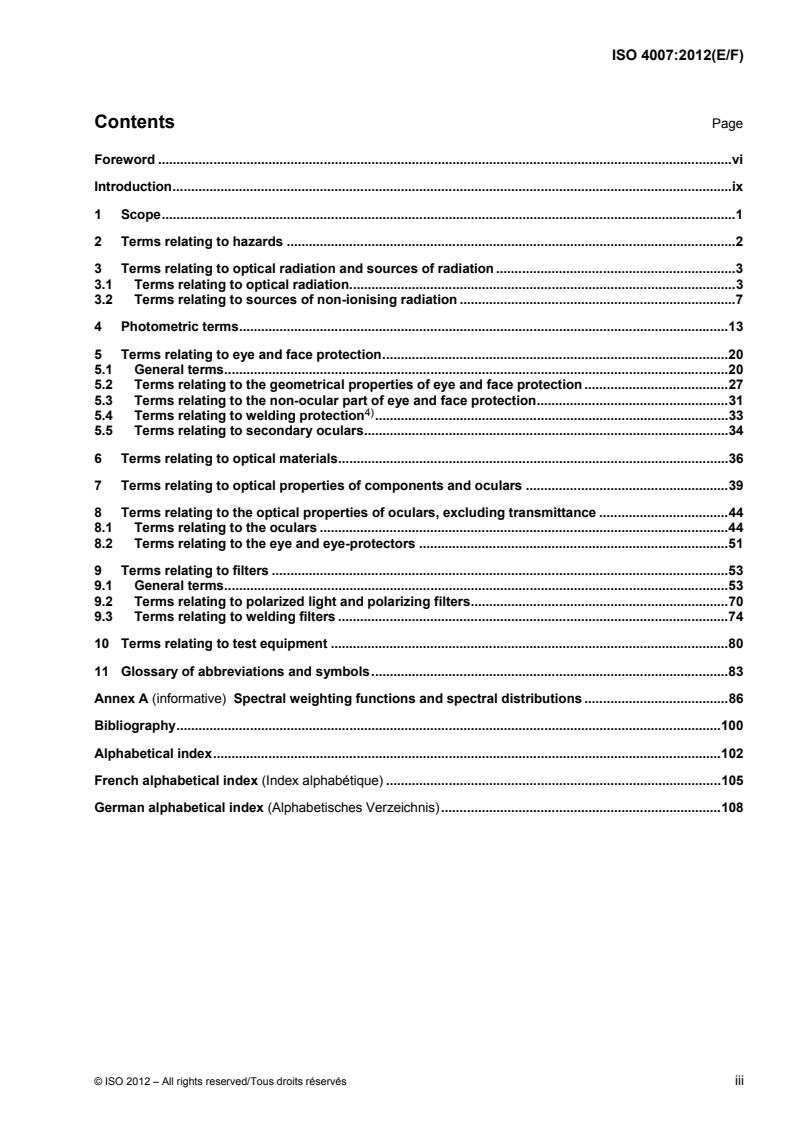
Contents Page
Foreword . vi
Introduction . ix
1 Scope . 1
2 Terms relating to hazards . 2
3 Terms relating to optical radiation and sources of radiation . 3
3.1 Terms relating to optical radiation . 3
3.2 Terms relating to sources of non-ionising radiation . 7
4 Photometric terms . 13
5 Terms relating to eye and face protection . 20
5.1 General terms . 20
5.2 Terms relating to the geometrical properties of eye and face protection . 27
5.3 Terms relating to the non-ocular part of eye and face protection . 31
4)
5.4 Terms relating to welding protection . 33
5.5 Terms relating to secondary oculars . 34
6 Terms relating to optical materials . 36
7 Terms relating to optical properties of components and oculars . 39
8 Terms relating to the optical properties of oculars, excluding transmittance . 44
8.1 Terms relating to the oculars . 44
8.2 Terms relating to the eye and eye-protectors . 51
9 Terms relating to filters . 53
9.1 General terms . 53
9.2 Terms relating to polarized light and polarizing filters . 70
9.3 Terms relating to welding filters . 74
10 Terms relating to test equipment . 80
11 Glossary of abbreviations and symbols . 83
Annex A (informative) Spectral weighting functions and spectral distributions . 86
Bibliography . 100
Alphabetical index . 102
French alphabetical index (Index alphabétique) . 105
German alphabetical index (Alphabetisches Verzeichnis) . 108
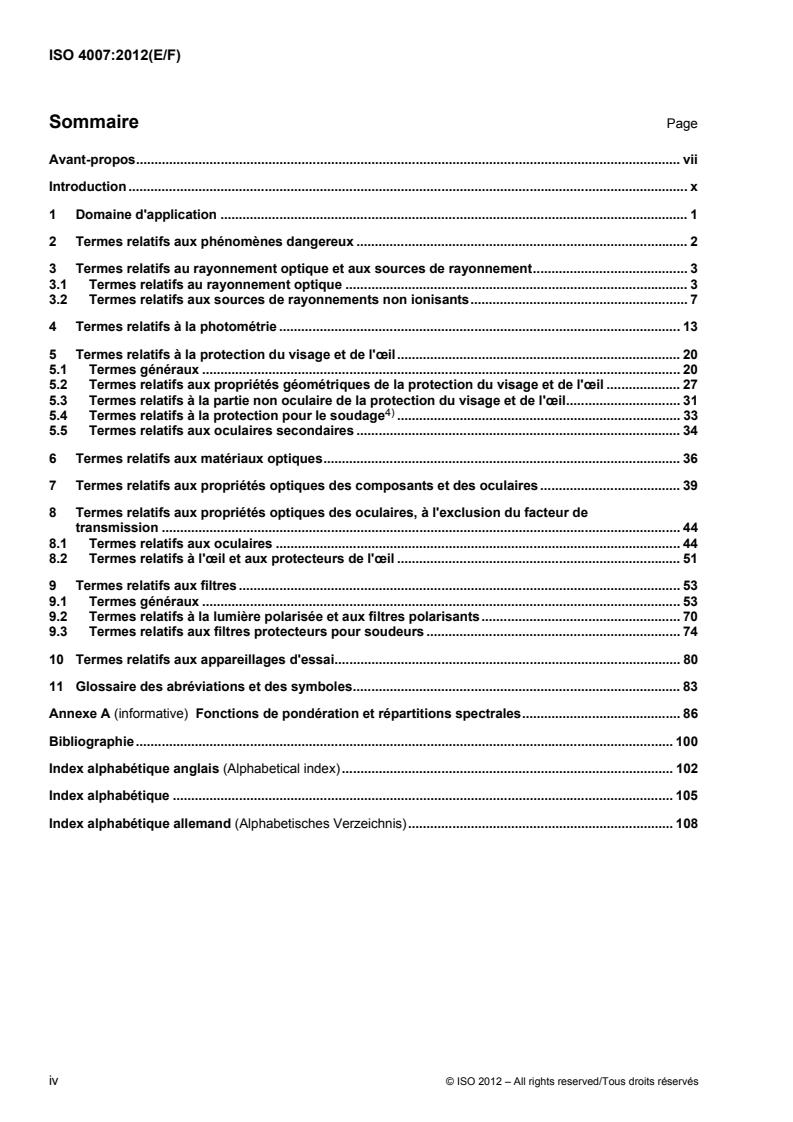
Sommaire Page
Avant-propos . vii
Introduction . x
1 Domaine d'application . 1
2 Termes relatifs aux phénomènes dangereux . 2
3 Termes relatifs au rayonnement optique et aux sources de rayonnement . 3
3.1 Termes relatifs au rayonnement optique . 3
3.2 Termes relatifs aux sources de rayonnements non ionisants . 7
4 Termes relatifs à la photométrie . 13
5 Termes relatifs à la protection du visage et de l'œil . 20
5.1 Termes généraux . 20
5.2 Termes relatifs aux propriétés géométriques de la protection du visage et de l'œil . 27
5.3 Termes relatifs à la partie non oculaire de la protection du visage et de l'œil . 31
4)
5.4 Termes relatifs à la protection pour le soudage . 33
5.5 Termes relatifs aux oculaires secondaires . 34
6 Termes relatifs aux matériaux optiques . 36
7 Termes relatifs aux propriétés optiques des composants et des oculaires . 39
8 Termes relatifs aux propriétés optiques des oculaires, à l'exclusion du facteur de
transmission . 44
8.1 Termes relatifs aux oculaires . 44
8.2 Termes relatifs à l'œil et aux protecteurs de l'œil . 51
9 Termes relatifs aux filtres . 53
9.1 Termes généraux . 53
9.2 Termes relatifs à la lumière polarisée et aux filtres polarisants . 70
9.3 Termes relatifs aux filtres protecteurs pour soudeurs . 74
10 Termes relatifs aux appareillages d'essai . 80
11 Glossaire des abréviations et des symboles . 83
Annexe A (informative) Fonctions de pondération et répartitions spectrales . 86
Bibliographie . 100
Index alphabétique anglais (Alphabetical index) . 102
Index alphabétique . 105
Index alphabétique allemand (Alphabetisches Verzeichnis) . 108
iv © ISO 2012 – All rights reserved/Tous droits réservés
Inhalt Seite
Vorwort . viii
Einleitung . xi
1 Anwendungsbereich . 1
2 Begriffe im Zusammenhang mit Gefährdungen . 2
3 Begriffe im Zusammenhang mit optischer Strahlung und Strahlungsquellen . 3
3.1 Begriffe im Zusammenhang mit optischer Strahlung . 3
3.2 Begriffe im Zusammenhang mit Quellen nichtionisierender Strahlung . 7
4 Photometrische Begriffe. 13
5 Begriffe im Zusammenhang mit Augen- und Gesichtschutz. 20
5.1 Allgemeine Begriffe . 20
5.2 Bergriffe im Zusammenhang mit den geometrischen Eigenschaften des Augen- und
Gesichtsschutzes . 27
5.3 Begriffe im Zusammenhang mit dem nicht durch die Sichtscheibe gebildeten Teil des
Augen- und Gesichtsschutzes . 31
4)
5.4 Begriffe im Zusammenhang mit dem Schweißerschutz . 33
5.5 Begriffe im Zusammenhang mit Sekundärsichtscheiben . 34
6 Begriffe im Zusammenhang mit optischen Materialien . 36
7 Begriffe im Zusammenhang mit optischen Eigenschaften von Bauelementen und
Sichtscheiben . 39
8 Begriffe im Zusammenhang mit den optischen Eigenschaften von Sichtscheiben,
ausgenommen den Transmissionsgrad . 44
8.1 Begriffe im Zusammenhang mit den Sichtscheiben . 44
8.2 Begriffe im Zusammenhang mit Augen und Augenschutzgeräten . 51
9 Begriffe im Zusammenhang mit Filtern . 53
9.1 Allgemeine Begriffe . 53
9.2 Begriffe im Zusammenhang mit polarisiertem Licht und Polarisationsfiltern . 70
9.3 Begriffe im Zusammenhang mit Schweißerschutzfiltern . 74
10 Begriffe im Zusammenhang mit der Prüfausrüstung . 80
11 Glossar der Abkürzungen und Formelzeichen . 83
Anhang A (informativ) Spektrale Gewichtungsfunktionen und spektrale Verteilungen . 86
Englisches alphabetisches Verzeichnis (Alphabetical index). 102
Französisches alphabetisches Verzeichnis (Index alphabétique) . 105
Alphabetisches Verzeichnis . 108
Foreword
ISO (the International Organization for Standardization) is a worldwide federation of national standards bodies
(ISO member bodies). The work of preparing International Standards is normally carried out through ISO
technical committees. Each member body interested in a subject for which a technical committee has been
established has the right to be represented on that committee. International organizations, governmental and
non-governmental, in liaison with ISO, also take part in the work. ISO collaborates closely with the
International Electrotechnical Commission (IEC) on all matters of electrotechnical standardization.
International Standards are drafted in accordance with the rules given in the ISO/IEC Directives, Part 2.
The main task of technical committees is to prepare International Standards. Draft International Standards
adopted by the technical committees are circulated to the member bodies for voting. Publication as an
International Standard requires approval by at least 75 % of the member bodies casting a vote.
Attention is drawn to the possibility that some of the elements of this document may be the subject of patent
rights. ISO shall not be held responsible for identifying any or all such patent rights.
ISO 4007 was prepared by Technical Committee ISO/TC 94, Personal safety — Protective clothing and
equipment, Subcommittee SC 6, Eye and face protection.
This second edition cancels and replaces the first edition (ISO 4007:1977), which has been technically
revised.
vi © ISO 2012 – All rights reserved/Tous droits réservés
Avant-propos
L'ISO (Organisation internationale de normalisation) est une fédération mondiale d'organismes nationaux de
normalisation (comités membres de l'ISO). L'élaboration des Normes internationales est en général confiée
aux comités techniques de l'ISO. Chaque comité membre intéressé par une étude a le droit de faire partie du
comité technique créé à cet effet. Les organisations internationales, gouvernementales et non
gouvernementales, en liaison avec l'ISO participent également aux travaux. L'ISO collabore étroitement avec
la Commission électrotechnique internationale (CEI) en ce qui concerne la normalisation électrotechnique.
Les Normes internationales sont rédigées conformément aux règles données dans les Directives ISO/CEI,
Partie 2.
La tâche principale des comités techniques est d'élaborer les Normes internationales. Les projets de Normes
internationales adoptés par les comités techniques sont soumis aux comités membres pour vote. Leur
publication comme Normes internationales requiert l'approbation de 75 % au moins des comités membres
votants.
L'attention est appelée sur le fait que certains des éléments du présent document peuvent faire l'objet de
droits de propriété intellectuelle ou de droits analogues. L'ISO ne saurait être tenue pour responsable de ne
pas avoir identifié de tels droits de propriété et averti de leur existence.
L'ISO 4007 a été élaborée par le comité technique ISO/TC 94, Sécurité individuelle — Vêtements et
équipements de protection, sous-comité SC 6, Protection des yeux et du visage.
Cette deuxième édition annule et remplace la première édition (ISO 4007:1977), qui a fait l'objet d'une
révision technique.
Vorwort
Die ISO (Internationale Organisation für Normung) ist die weltweite Vereinigung nationaler Normungsinstitute
(ISO-Mitgliedskörperschaften). Die Erarbeitung Internationaler Normen obliegt den Technischen Komitees der
ISO. Jede Mitgliedskörperschaft, die sich für ein Thema interessiert, für das ein Technisches Komitee
eingesetzt wurde, ist berechtigt, in diesem Komitee mitzuarbeiten. Internationale (staatliche und
nichtstaatliche) Organisationen, die mit der ISO in Verbindung stehen, sind an den Arbeiten ebenfalls beteiligt.
Die ISO arbeitet bei allen Angelegenheiten der elektrotechnischen Normung eng mit der Internationalen
Elektrotechnischen Kommission (IEC) zusammen.
Internationale Normen werden in Übereinstimmung mit den Gestaltungsregeln der ISO/IEC-Direktiven, Teil 2,
erarbeitet.
Die Hauptaufgabe von Technischen Komitees ist die Erarbeitung Internationaler Normen. Die von den
Technischen Komitees verabschiedeten internationalen Norm-Entwürfe werden den Mitgliedskörperschaften
zur Abstimmung vorgelegt. Die Veröffentlichung als Internationale Norm erfordert Zustimmung von
mindestens 75 % der abstimmenden Mitgliedskörperschaften.
Es wird auf die Möglichkeit aufmerksam gemacht, dass einige der Festlegungen in diesem Dokument
Gegenstand von Patentrechten sein können. Die ISO ist nicht dafür verantwortlich, einzelne oder alle solcher
Patentrechte zu kennzeichnen.
ISO 4007 wurde vom Technischen Komitee ISO/TC 94, Persönaliche Sicherheit — Schutzkleidung und
-ausrüstung, Unterkomitee SC 6, Augen- und Gesichtsschutz.
Diese zweite Ausgabe ersetzt die erste Ausgabe (ISO 4007:1977), die technisch überarbeitet wurde.
viii © ISO 2012 – All rights reserved/Tous droits réservés
Introduction
This International Standard is based on EN 165, Personal eye-protection — Vocabulary, which has been
withdrawn.
Although considered, there is no definition describing transmittance or absorptance properties of filters in the
short-wavelength range from 380 nm to around 400 nm because there is no agreement at present on what the
definition or requirement should be.
Terms relating to mesh visors and additional oculars have been omitted until required for the appropriate
standards.
Words in bold within descriptions or notes refer to terms defined within this International Standard.
Introduction
La présente Norme internationale se fonde sur l'EN 165, Protection individuelle de l'œil — Vocabulaire, qui a
été annulée.
Il n'y a pas de terme ni de définition décrivant les propriétés de transmission ou d'absorption des filtres dans le
domaine des courtes longueurs d'onde de 380 nm à 400 nm environ, du fait de l'absence de consensus sur la
définition ou l'exigence.
Les termes relatifs aux visières-écrans en mailles et aux oculaires supplémentaires sont omis tant qu'ils ne
sont pas requis pour les normes appropriées.
Les termes donnés en gras dans les définitions ou les notes font référence aux termes définis tout au long de
la présente Norme internationale.
x © ISO 2012 – All rights reserved/Tous droits réservés
Einleitung
Dieser Normentwurf lehnt sich stark an die nun zurückgezogene EN 165, Persönlicher Augenschutz —
Wörterbuch und weitere Europäische Normen zum Augenschutz an. ISO/TC 94/SC 6 ist CEN/TC 85 sehr
dankbar für die Erlaubnis, die europäischen Normen als Grundlage für diese Norm zu verwenden.
Sofern Begriffe aus anderen ISO-Normen übernommen wurden, wurde das Datum der Norm aufgenommen,
sodass es im Falle der späteren Überarbeitung der ursprünglichen Norm nicht zu Verwirrungen dahingehend
kommt, welche Definition im Zusammenhang mit dem Augen- und Gesichtsschutz anzuwenden ist.
Die Begriffe in dieser Norm wurden nach Themengruppen sortiert, soweit nötig wurden weitere Untergruppen
gebildet. Am Ende dieser Norm findet sich eine alphabetische Auflistung aller Begriffe. Eine Erklärung der
wichtigsten in dieser Norm verwendeten Abkürzungen und Symbole sowie ihrer Suffixe ist in Abschnitt 12
gegeben.
Die Norm beinhaltet keinen Begriff und keine Definition zur Beschreibung der Transmission oder Absorption
von Filtern im kurzwelligen Bereich von 380 nm bis 400 nm, da derzeit keine Übereinstimmung dahingehend
besteht, wie die entsprechende Definition oder Anforderung aussehen sollte.
Begriffe mit Bezug auf Schutzschilde aus Geflecht und zusätzliche Sichtscheiben wurden weggelassen, so
lange sie nicht von den entsprechenden Normen benötigt werden.
INTERNATIONAL STANDARD
NORME INTERNATIONALE
Personal protective equipment — Eye and face protection —
Vocabulary
Équipement de protection individuelle — Protection du visage et
des yeux — Vocabulaire
Persönliche Schutzausrüstung — Augen- und Gesichtsschutz —
Wörterbuch
1 Scope 1 Domaine d'application 1 Anwendungsbereich
This International Standard defines La présente Norme internationale Diese Internationale Norm definiert
and explains the principal terms définit et explique les principaux und erläutert die grundlegenden
used in the field of personal eye termes utilisés dans le domaine de Begriffe aus dem Bereich des
and face protection. la protection du visage et de l'œil. persönlichen Augen- und
Gesichtsschutzes.
NOTE This International Standard NOTE La présente Norme
includes terms reproduced from the internationale comprend des termes
ANMERKUNG Diese Internationale
standards cited in Clause 2. At the time extraits des normes mentionnées dans
Norm enthält Begriffe, die aus den unter
of publication of this International l'Article 2. À la date de publication de la
Abschnitt 2 angeführten Normen
Standard, the quoted terms are présente Norme internationale, les
übernommen wurden. Zum Zeitpunkt der
identical to those in ISO 8624:2011, termes concernés sont identiques à
Veröffentlichung dieser Norm sind die
1)
ISO 13666:— , CIE 17.4:1987 and ceux contenus dans l'ISO 8624:2011,
übernommenen Begriffe mit denen
1)
1)
ISO/IEC Guide 51:1999. If, due to l'ISO 13666:— , la CIE 17.4:1987 et
in ISO 8624:2011, ISO 13666:— ,
future revision of the aforementioned l'ISO/CEI Guide 51:1999. Si, en raison
CIE 17.4:1987 und ISO/IEC Guide 51:1999
standards, there should be a d'une révision future de ces normes, il y
identisch. Sollte es im Zuge der
disagreement between ISO 4007 and avait un désaccord entre l'ISO 4007 et
künftigen Überarbeitung der genannten
ISO 8624, ISO 13666, CIE 17.4 or l'ISO 8624, l'ISO 13666, la CIE 17.4 ou
Normen zu einer fehlenden
ISO/IEC Guide 51, then the definitions l'ISO/CEI Guide 51, les définitions
Übereinstimmung zwischen ISO 4007
in the latest version of ISO 8624, fournies dans la dernière version de
einerseits und ISO 8624, ISO 13666,
ISO 13666, CIE 17.4 or ISO/IEC Guide 51 l'ISO 8624, l'ISO 13666, la CIE 17.4 ou
CIE 17.4 oder ISO/IEC Guide 51
take precedence. l'ISO/CEI Guide 51 prendraient le pas
andererseits kommen, haben die
sur celles de l'ISO 4007.
Definitionen in der jeweils neuesten
Version von ISO 8624, ISO 13666,
CIE 17.4 oder ISO/IEC Guide 51
Vorrang.
1) To be published. 1) À publier. 1) Wird veröffentlicht.
2 Terms relating to 2 Termes relatifs 2 Begriffe im
hazards aux phénomènes Zusammenhang mit
dangereux Gefährdungen
2.1 2.1 2.1
safety sécurité Sicherheit
freedom from unacceptable risk absence de risque (2.4) Freiheit von unvertretbaren Risiken
(2.4) inacceptable (2.4)
[ISO/IEC Guide 51:1999] [ISO/CEI Guide 51:1999] [ISO/IEC Guide 51:1999]
NOTE The use of the words “safety” NOTE Il convient d'éviter l'emploi des ANMERKUNG Die Verwendung der
and “safe” as descriptive words should termes «sécurité» et «sûr» comme Wörter „Sicherheit“ und „sicher“ als
be avoided because they convey no termes descriptifs car ils ne fournissent beschreibende Adjektive sollte
useful extra information. In addition, aucune information supplémentaire. De vermieden werden, da sie keine
they are likely to be interpreted as an plus, ils risquent d'être interprétés sinnvollen Zusatzinformationen ent-
assurance of guaranteed freedom from comme une assurance d'absence de halten. Darüber hinaus ist es
risk. The recommended approach is to risque garantie. La méthode wahrscheinlich, dass sie dahingehend
replace, wherever possible, the words recommandée consiste à remplacer, ausgelegt werden, dass vollständige
“safety” and “safe” by an indication of chaque fois que cela est possible, les Risikofreiheit sichergestellt ist. Die
the objective. termes «sécurité» et «sûr» par une empfohlene Herangehensweise besteht
indication de l'objectif. darin, wann immer dies möglich ist, die
EXAMPLE Use “protective helmet”
Wörter „Sicherheit“ und „sicher“ durch
instead of “safety helmet”. EXEMPLE Utiliser «casque de
Angabe des Ziels zu ersetzen.
protection» plutôt que «casque de
sécurité». BEISPIEL Anstelle von „Sicher-
heitshelm“ ist „Schutzhelm“ zu
verwenden.
2.2 2.2 2.2
harm dommage Schaden
physical injury or damage to the blessure physique ou atteinte à la physische Verletzung oder
health of people, or damage to santé des personnes, ou atteinte Schädigung der Gesundheit von
property or the environment aux biens ou à l'environnement Menschen oder Schädigung von
Gütern oder der Umwelt
[ISO/IEC Guide 51:1999] [ISO/CEI Guide 51:1999]
[ISO/IEC Guide 51:1999]
2.3 2.3 2.3
hazard phénomène dangereux Gefährdung
potential source of harm (2.2) danger potenzielle Schadensquelle (2.2)
source potentielle de dommage
NOTE The term hazard can be ANMERKUNG Der Begriff Gefähr-
(2.2)
qualified in order to define its origin or dung kann qualitativ näher bestimmt
the nature of the expected harm (e.g. werden, um seinen Ursprung oder die
NOTE Le terme «phénomène
electric shock hazard, crushing hazard, Art des erwarteten Schadens zu
dangereux» peut être qualifié par son
cutting hazard, toxic hazard, fire definieren (z. B. Gefährdung durch
origine ou la nature du dommage
hazard, drowning hazard). elektrischen Schlag, Gefährdung durch
causé. Par ailleurs, en français, le
Quetschen, Gefährdung durch
terme risque est très souvent employé
[ISO/IEC Guide 51:1999]
Schneiden, Gefährdung durch
au lieu de phénomène dangereux, par
Vergiftung, Gefährdung durch Feuer,
exemple risque de choc électrique,
Gefährdung durch Ertrinken).
risque d'écrasement, risque de
coupure, risque toxique, risque
[ISO/IEC Guide 51:1999]
d'incendie, risque de noyade.
[ISO/CEI Guide 51:1999]
2 © ISO 2012 – All rights reserved/Tous droits réservés
2.4 2.4 2.4
risk risque Risiko
combination of the probability of combinaison de la probabilité d'un Kombination aus der Wahrschein-
occurrence of harm (2.2) and the dommage (2.2) et de sa gravité lichkeit des Auftretens eines
severity of that harm Schadens (2.2) und der Schwere
[ISO/CEI Guide 51:1999]
dieses Schadens
[ISO/IEC Guide 51:1999]
[ISO/IEC Guide 51:1999]
2.5 2.5 2.5
reasonably foreseeable mauvais usage vernünftigerweise
misuse raisonnablement prévisible vorhersehbare
use of a product, process or service utilisation d'un produit, procédé ou Fehlanwendung
in a way not intended by the service dans des conditions ou à Verwendung eines Erzeugnisses,
supplier, but which may result from des fins non prévues par le eines Verfahrens oder einer
readily predictable human fournisseur, mais qui peut provenir Dienstleistung in einer Weise, die
behaviour d'un comportement humain vom Lieferer nicht vorgesehen ist,
envisageable aber aus leicht vorhersehbaren
[ISO/IEC Guide 51:1999]
menschlichen Verhaltensweisen
[ISO/CEI Guide 51:1999]
resultieren kann
[ISO/IEC Guide 51:1999]
3 Terms relating to 3 Termes relatifs 3 Begriffe im
optical radiation and au rayonnement optique Zusammenhang mit
sources of radiation et aux sources de optischer Strahlung und
rayonnement Strahlungsquellen
3.1 Terms relating to optical 3.1 Termes relatifs 3.1 Begriffe im
radiation au rayonnement optique Zusammenhang mit optischer
Strahlung
3.1.1 3.1.1 3.1.1
optical radiation rayonnement optique optische Strahlung
electromagnetic radiation at rayonnement électromagnétique elektromagnetische Strahlung,
wavelengths between the region of dont les longueurs d'onde sont deren Wellenlängen zwischen dem
transition to X-rays ( 1 nm) and comprises entre le domaine de Übergangsbereich zu den Röntgen-
the region of transition to radio transition vers les rayons X strahlen ( 1 nm) und dem
waves ( 1 mm) ( 1 nm) et le domaine de Übergangsbereich zu den
transition vers les ondes Radiowellen ( 1 mm) liegen
[CIE DS 017.1:2009]
radioélectriques ( 1 mm)
[CIE DS 017.1:2009]
NOTE This is usually subdivided into
[CIE DS 017.1:2009]
the following spectral ranges, with a
ANMERKUNG Sie wird üblicherweise
possible overlap at the longer
in die folgenden Spektralbereiche
NOTE Il est généralement divisé en
wavelength limit of the UV spectrum:
unterteilt, wobei an der oberen Wellen-
différents domaines spectraux, comme
längengrenze der UV-Strahlung
suit, avec un chevauchement possible
— ultraviolet radiation
Überlappungen auftreten können:
au niveau de la limite de grandes
UV 1 nm to 380 nm or 400 nm;
longueurs d'onde du domaine UV:
— ultraviolette Strahlung
— visible radiation
UV 1 nm bis 380 nm oder 400 nm;
— rayonnement ultraviolet
VIS 380 nm to 780 nm;
UV 1 nm à 380 nm ou 400 nm;
— sichtbare Strahlung
— infrared radiation
VIS 380 nm bis 780 nm;
— rayonnement visible
IR 780 nm to 1 mm.
VIS 380 nm à 780 nm;
— infrarote Strahlung
IR 780 nm bis 1 mm.
— rayonnement infrarouge
IR 780 nm à 1 mm.
3.1.2 3.1.2 3.1.2
ultraviolet radiation rayonnement ultraviolet ultraviolette Strahlung
UV radiation rayonnement UV UV-Strahlung
radiation for which the wavelengths rayonnement optique (3.1.1) dont optische Strahlung (3.1.1), deren
are shorter than those for visible les longueurs d'onde sont infé- Wellenlängen kleiner sind als die
radiation rieures à celles du rayonnement der sichtbaren Strahlung
visible
NOTE 1 The range between 100 nm ANMERKUNG 1 Der Bereich
and 400 nm is commonly subdivided zwischen 100 nm und 400 nm wird
NOTE 1 Le domaine entre 100 nm et
into: üblicherweise unterteilt in:
400 nm est généralement divisé en
— UV-A 315 nm to 400 nm; — UV-A 315 nm bis 400 nm;
— UV-A de 315 nm à 400 nm;
— UV-B 280 nm to 315 nm; — UV-B 280 nm bis 315 nm;
— UV-B de 280 nm à 315 nm;
— UV-C 100 nm to 280 nm. — UV-C 100 nm bis 280 nm.
— UV-C de 100 nm à 280 nm.
[CIE DS 017.1:2009] [CIE DS 017.1:2009]
[CIE DS 017.1:2009]
NOTE 2 A precise border between ANMERKUNG 2 Eine genaue
NOTE 2 Une limite précise entre
“ultraviolet” and “visible” cannot be Grenze zwischen „ultraviolett“ und
ultraviolet et visible ne peut pas être
defined, because visual sensation at „sichtbar“ kann nicht definiert werden,
définie, parce que la sensation visuelle
wavelengths shorter than 400 nm is da bei sehr hellen Quellen auch eine
à des longueurs d'onde plus courtes
noted for very high energy sources. optische Wahrnehmung von
que 400 nm est notée pour des sources
Wellenlängen kürzer als 400 nm
à énergie élevée.
NOTE 3 For sunglasses for general
festgestellt wurde.
use, the upper limit of UV-A is taken as
NOTE 3 Pour les besoins des
380 nm. ANMERKUNG 3 Für Sonnenbrillen
lunettes de soleil d'usage général, la
für den allgemeinen Gebrauch wird die
limite supérieure d'UV-A est prise à
NOTE 4 This limit of 380 nm
Obergrenze von UV-A mit 380 nm
380 nm.
coincides with that taken in ophthalmic
angesetzt.
optics and in ISO 20473. Many of the
NOTE 4 Cette limite de 380 nm
medical, health and safety guidelines ANMERKUNG 4 Diese Grenze von
coïncide avec celle prise en optique
and standards that require taking UV 380 nm fällt mit der in der Augenoptik
ophtalmique et dans l'ISO 20473. Il
radiation hazard exposure into und in ISO 20473 angesetzten
convient de noter qu'un grand nombre
consideration regard UV-A as extending zusammen. Viele Medizin-,
des lignes directrices et normes dans
up to 400 nm, as in NOTE 1. Gesundheits- und Sicherheitsrichtlinien,
les domaines de la médecine, de la
nach welchen die Gefährdung einer
santé et de la sécurité qui exigent la
NOTE 5 The UV-C range is defined
Strahlenbelastung durch UV-Strahlung
prise en considération d'une exposition
as:
zu berücksichtigen ist, betrachten UV-A
au phénomène dangereux associé au
als bis zu 400 nm reichend, siehe
rayonnement UV, considèrent que l'UV-
— Far UV (FUV)
Anmerkung 1.
A s'étend jusqu'à 400 nm comme dans
190 nm to 280 nm;
la NOTE 1.
ANMERKUNG 5 Der UV-C-Bereich
— Vacuum UV (VUV)
ist wie folgt definiert:
NOTE 5 Le domaine UV-C est défini
100 nm to 190 nm (see
en tant que
ISO 20473).
— Fernes UV (FUV)
190 nm bis 280 nm;
— UV lointains (FUV)
NOTE 6 For eye protection, only the
de 190 nm à 280 nm;
longer wavelength part of the UV-C
— Vakuum-UV (VUV)
range from 190 nm to 280 nm is of
100 nm bis 190 nm
— UV sous vide (VUV)
importance. This range is not contained
(ISO 20473:2007).
de 100 nm à 190 nm
in solar radiation and occurs from only
(ISO 20473:2007).
a few artificial radiation sources. ANMERKUNG 6 Für den Augen-
schutz ist nur der längerwellige Teil des
NOTE 6 Pour la protection de l'œil,
NOTE 7 Ultraviolet radiation is
UV-C-Bereichs von Bedeutung, der sich
seule la partie de grandes longueurs
sometimes considered to extend down
von 190 nm bis 280 nm erstreckt.
d'onde du domaine UV-C de 190 nm à
to wavelengths of 1 nm (see
Dieser Bereich ist nicht in der
280 nm est importante. Ce domaine
ISO 20473). The zone, 1 nm to 100 nm,
Sonnenstrahlung enthalten und tritt nur
n'est pas contenu dans le rayonnement
termed extreme UV, exists in vacuum
bei einigen künstlichen Strahlungs-
solaire et n'apparaît que dans quelques
only and is not applicable to eye and
quellen auf.
sources de rayonnement artificielles.
face protection.
4 © ISO 2012 – All rights reserved/Tous droits réservés
NOTE 7 Le rayonnement ultraviolet ANMERKUNG 7 Manchmal wird die
est parfois considéré comme s'étendant ultraviolette Strahlung als bis zu
vers le bas à des longueurs d'onde de Wellenlängen von 1 nm reichend
1 nm (voir l'ISO 20473). Cette zone de betrachtet (vgl. ISO 20473). Strahlung
1 nm à 100 nm, appelée UV extrême, im Bereich von 1 nm bis 100 nm,
n'existe que dans le vide et n'est pas extremes UV genannt, existiert nur im
applicable à la protection du visage et Vakuum, weshalb dieser Bereich für
de l'œil. Augen- und Gesichtsschutz nicht
anwendbar ist.
3.1.3 3.1.3 3.1.3
visible radiation rayonnement visible sichtbare Strahlung
light lumière visible Licht
any optical radiation (3.1.1) rayonnement optique (3.1.1) sus- jegliche optische Strahlung (3.1.1),
capable of causing a visual ceptible de produire directement die unmittelbar eine Sehempfindung
sensation directly une sensation visuelle hervorzurufen vermag
NOTE 1 There are no precise limits NOTE 1 Il n'y a pas de limites ANMERKUNG 1 Es gibt keine
for the spectral range of visible précises pour le domaine spectral du genauen Grenzen für den
radiation since they depend upon the rayonnement visible; ces limites Spektralbereich der sichtbaren
amount of radiant power reaching the dépendent du flux énergétique qui Strahlung, da dieser von der
retina and the responsiveness of the atteint la rétine et de la sensibilité de Strahlungsleistung, die die Netzhaut
observer. The lower limit is generally l'observateur. La limite inférieure est erreicht, und von der Augen-
taken between 360 nm and 400 nm and prise généralement entre 360 nm et empfindlichkeit des Beobachters
the upper limit between 760 nm and 400 nm et la limite supérieure entre abhängt. Die untere Grenze wird im
830 nm. 760 nm et 830 nm. Allgemeinen zwischen 360 nm und
400 nm, die obere Grenze zwischen
[CIE DS 017.1:2009] [CIE DS 017.1:2009]
760 nm und 830 nm angenommen.
NOTE 2 The CIE gives a definition NOTE 2 La CIE donne une définition
[CIE DS 017.1:2009]
for light that is different, being based on de la lumière différente fondée sur la
perception. For purposes of eye and perception. Pour les besoins d'un EPI ANMERKUNG 2 Die CIE gibt eine
face PPE, light is regarded as du visage et de l'œil, la lumière est von der Wahrnehmung abhängige
synonymous with visible radiation. considérée comme étant synonyme du Definition für Licht. In Bezug auf die
rayonnement visible. Persönliche Schutzausrüstung für
NOTE 3 The wavelength range is
Augen und Gesicht wird „Licht“ als
taken to be between 380 nm and NOTE 3 Le domaine de longueurs
Synonym zu „sichtbarer Strahlung“
780 nm. d'onde est pris entre 380 nm et 780 nm
verwendet.
ANMERKUNG 3 Der Wellenlängen-
bereich wird zwischen 380 nm und
780 nm angesetzt.
3.1.4 3.1.4 3.1.4
infrared radiation rayonnement infrarouge infrarote Strahlung
IR radiation rayonnement IR IR-Strahlung
optical radiation (3.1.1) for which rayonnement optique (3.1.1) dont optische Strahlung (3.1.1), deren
the wavelengths are longer than les longueurs d'onde sont supé- Wellenlängen größer sind als die
those for visible radiation, from rieures à celles du rayonnement der sichtbaren Strahlung
700 nm to 1 mm visible
ANMERKUNG 1 Der Bereich der
infraroten Strahlung zwischen 780 nm
NOTE 1 For infrared radiation, the NOTE 1 Pour le rayonnement
und 1 mm wird gewöhnlich unterteilt in:
range between 780 nm and 1 mm is infrarouge, le domaine entre 780 nm et
commonly subdivided into: 1 mm est généralement divisé en
— IR-A 780 nm bis 1 400 nm;
— IR-A 780 nm to 1 400 nm; — IR-A de 780 nm à 1 400 nm;
— IR-B 1 400 nm bis 3 000 nm;
— IR-B 1 400 nm to 3 000 nm; — IR-B de 1 400 nm à 3 000 nm;
— IR-C 3 000 nm bis 1 mm.
— IR-C 3 000 nm to 1 mm. — IR-C de 3 000 nm à 1 mm.
[CIE DS 017.1:2009] [CIE DS 017.1:2009] [CIE DS 017.1:2009]
NOTE 2 A precise border between NOTE 2 Une limite précise entre ANMERKUNG 2 Eine genaue
“visible” and “infrared” cannot be «visible» et «infrarouge» ne peut pas Grenze zwischen „sichtbar“ und
defined because visual sensation at être définie parce que la sensation „infrarot“ kann nicht definiert werden, da
wavelengths greater than 780 nm is visuelle à des longueurs d'onde bei sehr hellen Quellen auch eine
noted for very high energy sources at supérieures à 780 nm est notée pour optische Wahrnehmung von
longer wavelengths. les sources à énergie élevée à des Wellenlängen länger als 780 nm
longueurs d'onde plus longues. festgestellt wurde.
3.1.5 3.1.5 3.1.5
monochromatic radiation rayonnement monochromatische
monochromatic light monochromatique Strahlung
radiation characterized by a single lumière monochromatique monochromatisches Licht
frequency rayonnement caractérisé par une Strahlung, die durch eine einzige
seule fréquence Frequenz gekennzeichnet ist
[CIE DS 017.1:2009]
[CIE DS 017.1:2009] [CIE DS 017.1:2009]
NOTE 1 Although frequency is the
more fundamental property, the
NOTE 1 Bien que la fréquence soit la ANMERKUNG 1 Obwohl die Fre-
wavelength in air (or in vacuum) is
propriété fondamentale, la longueur quenz die grundlegendere Eigenschaft
more commonly used to characterize a
d'onde dans l'air (ou dans le vide) est darstellt, wird häufiger die Wellenlänge
monochromatic radiation.
plus couramment utilisée pour in Luft (oder im Vakuum) verwendet, um
caractériser un rayonnement die monochromatische Strahlung zu
NOTE 2 Optical radiation extending
monochromatique. charakterisieren.
over a very narrow range of
wavelengths (e.g. such as that emitted
NOTE 2 Un rayonnement optique ANMERKUNG 2 Optische Strah-
by a laser) that can be characterized by
s'étendant sur un très petit domaine de lung, die sich über einen sehr
a single wavelength value (usually the
longueurs d'onde (par exemple tel que schmalen Wellenlängenbereich er-
mean) is regarded as monochromatic.
celui émis par un laser) et pouvant être streckt (z. B. Laserstrahlung) und
caractérisé par une seule valeur de durch einen einzelnen Wellenlängen-
longueur d'onde (généralement la wert (üblicherweise den Mittelwert)
moyenne) est considéré comme charakterisiert werden kann, wird als
monochromatique. monochromatisch angesehen.
3.1.6 3.1.6 3.1.6
illuminant illuminant Lichtart
radiation with a rela
...
Questions, Comments and Discussion
Ask us and Technical Secretary will try to provide an answer. You can facilitate discussion about the standard in here.
Loading comments...