

ISO 22466:2021
(Main)Traditional Chinese medicine — Laser acupoint devices
General Information
- Abstract
This document specifies requirements and test methods for laser acupoint devices. This document is not applicable to carbon-dioxide-type lasers. In the case of combined devices, it is applicable only to the laser features.
- Status
- Published
- Publication Date
- 26-May-2021
- Technical Committee
- ISO/TC 249 - Traditional Chinese medicine
- Current Stage
- 9060 - Close of review
- Completion Date
- 02-Dec-2031
Buy Documents


ISO 22466:2021 - Traditional Chinese medicine -- Laser acupoint devices
ISO 22466:2021 - Traditional Chinese medicine — Laser acupoint devices/27/2021
Overview
ISO 22466:2021 - "Traditional Chinese medicine - Laser acupoint devices" specifies requirements and test methods for laser acupoint (laser acupuncture) devices. The standard covers device configuration and classification, key optical and electrical performance limits, safety and biological evaluation, electromagnetic compatibility, and required instructions for use. It is not applicable to carbon‑dioxide (CO2) lasers, and for combined devices it applies only to the laser features.
Key topics and technical requirements
- Configuration & classification
- Describes single‑probe vs multi‑probe devices and single‑beam vs cluster‑beam probes.
- Optical parameters
- Wavelength: peak wavelength required in the range 400–1 400 nm.
- Spot size: manufacturer‑specified maximum; tolerance ±10% (per ISO 11146‑1).
- Pulse repetition rate: pulsed lasers must meet manufacturer specification within ±10%.
- Output power: single‑beam maximum accumulated output power ≤ 200 mW (per ISO 11554).
- Energy density: cumulative maximum energy density during treatment ≤ 10 J/cm² for each beam (measurement per ISO 11554).
- Output independency: in multi‑probe devices each probe’s output energy density must be independent.
- Stability & indicators
- Power stability (CW) and energy stability (pulsed) tolerances ≤ 10%.
- Devices must provide visible or audible emission indicators (individual indicators for multi‑probe units).
- Target/aiming function
- For invisible infrared beams or non‑contact probes, an aiming/target‑indicating function is required with concentricity and diameter limits; the aiming light AEL must be < 5 mW.
- Safety & usability
- Eye protection (shields or eyewear) required; hazards must be described in the IFU.
- Probe fixing unit required if continuous application exceeds 2 minutes.
- IFU must include warnings (eye irradiation, ulceration treatment, eyewear recommendations), fixation instructions, and technical specifications.
- Biological & electrical compliance
- Biocompatibility of skin‑contact parts per ISO 10993‑1.
- Electrical safety per IEC 60601‑1 and electromagnetic compatibility per IEC 60601‑1‑2.
Applications and users
ISO 22466 is valuable for:
- Manufacturers designing and certifying laser acupuncture devices.
- Test laboratories performing conformity testing (optical, electrical, EMC, biocompatibility).
- Regulatory bodies and conformity assessors evaluating medical device safety and labeling.
- Clinicians and TCM practitioners seeking devices that meet recognized safety and performance criteria.
- Procurement and compliance officers specifying safe laser acupoint equipment.
Related standards
- ISO 10993‑1 (biological evaluation)
- ISO 11145 / ISO 11146‑1 / ISO 11554 (laser optics and test methods)
- IEC 60601‑1 and IEC 60601‑1‑2 (medical electrical safety and EMC)
- IEC 60825‑1 (laser product classification)
Keywords: ISO 22466, laser acupoint devices, laser acupuncture, traditional Chinese medicine, safety requirements, test methods, wavelength, energy density, IEC 60601, ISO 10993.
Buy Documents
ISO 22466:2021 - Traditional Chinese medicine -- Laser acupoint devices
ISO 22466:2021 - Traditional Chinese medicine — Laser acupoint devices/27/2021
Get Certified
Connect with accredited certification bodies for this standard

BSI Group
BSI (British Standards Institution) is the business standards company that helps organizations make excellence a habit.

TÜV Rheinland
TÜV Rheinland is a leading international provider of technical services.

TÜV SÜD
TÜV SÜD is a trusted partner of choice for safety, security and sustainability solutions.
Sponsored listings
Frequently Asked Questions
ISO 22466:2021 is a standard published by the International Organization for Standardization (ISO). Its full title is "Traditional Chinese medicine — Laser acupoint devices". This standard covers: This document specifies requirements and test methods for laser acupoint devices. This document is not applicable to carbon-dioxide-type lasers. In the case of combined devices, it is applicable only to the laser features.
This document specifies requirements and test methods for laser acupoint devices. This document is not applicable to carbon-dioxide-type lasers. In the case of combined devices, it is applicable only to the laser features.
ISO 22466:2021 is classified under the following ICS (International Classification for Standards) categories: 11.040.60 - Therapy equipment. The ICS classification helps identify the subject area and facilitates finding related standards.
ISO 22466:2021 is available in PDF format for immediate download after purchase. The document can be added to your cart and obtained through the secure checkout process. Digital delivery ensures instant access to the complete standard document.
Standards Content (Sample)
INTERNATIONAL ISO
STANDARD 22466
First edition
2021-05
Traditional Chinese medicine — Laser
acupoint devices
Médecine traditionnelle chinoise — Dispositifs laser pour traitement
par acuponcture
Reference number
©
ISO 2021
© ISO 2021
All rights reserved. Unless otherwise specified, or required in the context of its implementation, no part of this publication may
be reproduced or utilized otherwise in any form or by any means, electronic or mechanical, including photocopying, or posting
on the internet or an intranet, without prior written permission. Permission can be requested from either ISO at the address
below or ISO’s member body in the country of the requester.
ISO copyright office
CP 401 • Ch. de Blandonnet 8
CH-1214 Vernier, Geneva
Phone: +41 22 749 01 11
Email: copyright@iso.org
Website: www.iso.org
Published in Switzerland
ii © ISO 2021 – All rights reserved
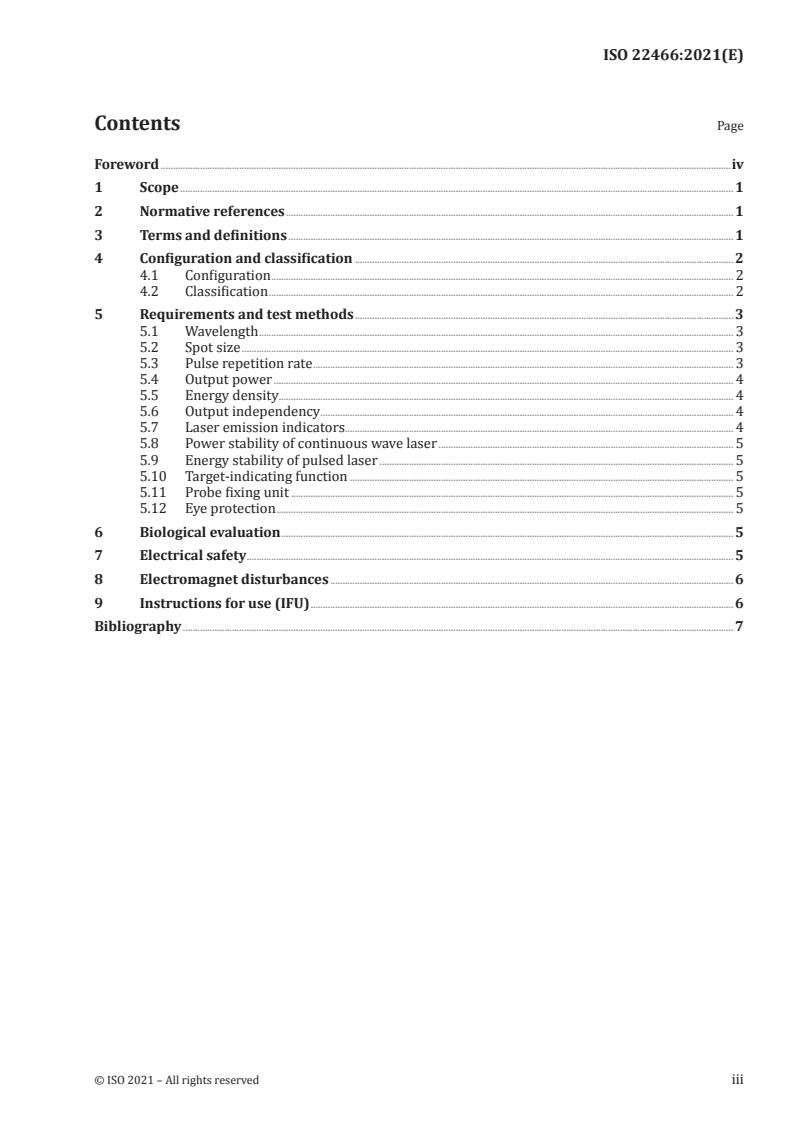
Contents Page
Foreword .iv
1 Scope . 1
2 Normative references . 1
3 Terms and definitions . 1
4 Configuration and classification . 2
4.1 Configuration . 2
4.2 Classification . 2
5 Requirements and test methods . 3
5.1 Wavelength . 3
5.2 Spot size . 3
5.3 Pulse repetition rate . 3
5.4 Output power . 4
5.5 Energy density . 4
5.6 Output independency . 4
5.7 Laser emission indicators . 4
5.8 Power stability of continuous wave laser . 5
5.9 Energy stability of pulsed laser . 5
5.10 Target-indicating function . 5
5.11 Probe fixing unit . 5
5.12 Eye protection . 5
6 Biological evaluation . 5
7 Electrical safety . 5
8 Electromagnet disturbances . 6
9 Instructions for use (IFU) . 6
Bibliography . 7
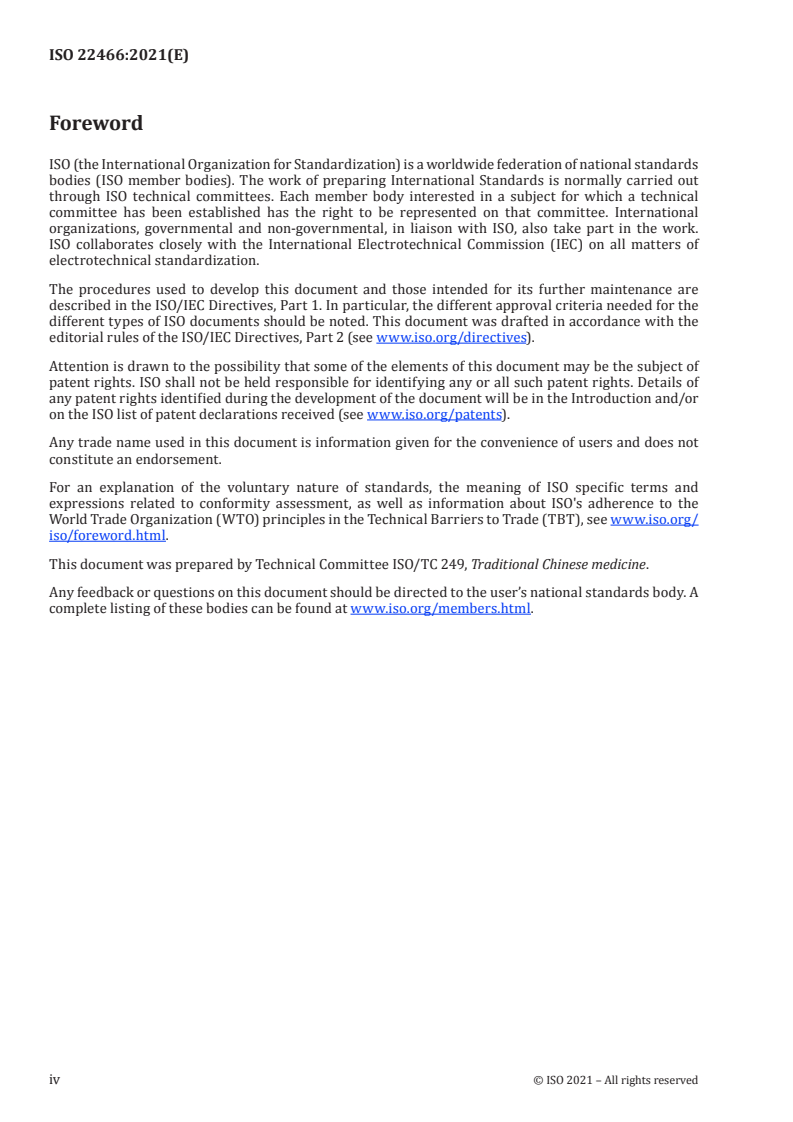
Foreword
ISO (the International Organization for Standardization) is a worldwide federation of national standards
bodies (ISO member bodies). The work of preparing International Standards is normally carried out
through ISO technical committees. Each member body interested in a subject for which a technical
committee has been established has the right to be represented on that committee. International
organizations, governmental and non-governmental, in liaison with ISO, also take part in the work.
ISO collaborates closely with the International Electrotechnical Commission (IEC) on all matters of
electrotechnical standardization.
The procedures used to develop this document and those intended for its further maintenance are
described in the ISO/IEC Directives, Part 1. In particular, the different approval criteria needed for the
different types of ISO documents should be noted. This document was drafted in accordance with the
editorial rules of the ISO/IEC Directives, Part 2 (see www .iso .org/ directives).
Attention is drawn to the possibility that some of the elements of this document may be the subject of
patent rights. ISO shall not be held responsible for identifying any or all such patent rights. Details of
any patent rights identified during the development of the document will be in the Introduction and/or
on the ISO list of patent declarations received (see www .iso .org/ patents).
Any trade name used in this document is information given for the convenience of users and does not
constitute an endorsement.
For an explanation of the voluntary nature of standards, the meaning of ISO specific terms and
expressions related to conformity assessment, as well as information about ISO's adherence to the
World Trade Organization (WTO) principles in the Technical Barriers to Trade (TBT), see www .iso .org/
iso/ foreword .html.
This document was prepared by Technical Committee ISO/TC 249, Traditional Chinese medicine.
Any feedback or questions on this document should be directed to the user’s national standards body. A
complete listing of these bodies can be found at www .iso .org/ members .html.
iv © ISO 2021 – All rights reserved
INTERNATIONAL STANDARD ISO 22466:2021(E)
Traditional Chinese medicine — Laser acupoint devices
1 Scope
This document specifies requirements and test methods for laser acupoint devices. This document is
not applicable to carbon-dioxide-type lasers. In the case of combined devices, it is applicable only to the
laser features.
2 Normative references
The following documents are referred to in the text in such a way that some or all of their content
constitutes requirements of this document. For dated references, only the edition cited applies. For
undated references, the latest edition of the referenced document (including any amendments) applies.
ISO 10993-1, Biological evaluation of medical devices — Part 1: Evaluation and testing within a risk
management process
ISO 11145, Optics and photonics — Lasers and laser-related equipment — Vocabulary and symbols
ISO 11146-1, Lasers and laser-related equipment — Test methods for laser beam widths, divergence angles
and beam propagation ratios — Part 1: Stigmatic and simple astigmatic beams
ISO 11554, Optics and photonics — Lasers and laser-related equipment — Test methods for laser beam
power, energy and temporal characteristics
IEC 60601-1, Medical electrical equipment — Part 1: General requirements for basic safety and essential
performance
IEC 60601-1-2
...
INTERNATIONAL ISO
STANDARD 22466
First edition
2021-05
Traditional Chinese medicine — Laser
acupoint devices
Médecine traditionnelle chinoise — Dispositifs laser pour traitement
par acuponcture
Reference number
©
ISO 2021
© ISO 2021
All rights reserved. Unless otherwise specified, or required in the context of its implementation, no part of this publication may
be reproduced or utilized otherwise in any form or by any means, electronic or mechanical, including photocopying, or posting
on the internet or an intranet, without prior written permission. Permission can be requested from either ISO at the address
below or ISO’s member body in the country of the requester.
ISO copyright office
CP 401 • Ch. de Blandonnet 8
CH-1214 Vernier, Geneva
Phone: +41 22 749 01 11
Email: copyright@iso.org
Website: www.iso.org
Published in Switzerland
ii © ISO 2021 – All rights reserved
Contents Page
Foreword .iv
1 Scope . 1
2 Normative references . 1
3 Terms and definitions . 1
4 Configuration and classification . 2
4.1 Configuration . 2
4.2 Classification . 2
5 Requirements and test methods . 3
5.1 Wavelength . 3
5.2 Spot size . 3
5.3 Pulse repetition rate . 3
5.4 Output power . 4
5.5 Energy density . 4
5.6 Output independency . 4
5.7 Laser emission indicators . 4
5.8 Power stability of continuous wave laser . 5
5.9 Energy stability of pulsed laser . 5
5.10 Target-indicating function . 5
5.11 Probe fixing unit . 5
5.12 Eye protection . 5
6 Biological evaluation . 5
7 Electrical safety . 5
8 Electromagnet disturbances . 6
9 Instructions for use (IFU) . 6
Bibliography . 7
Foreword
ISO (the International Organization for Standardization) is a worldwide federation of national standards
bodies (ISO member bodies). The work of preparing International Standards is normally carried out
through ISO technical committees. Each member body interested in a subject for which a technical
committee has been established has the right to be represented on that committee. International
organizations, governmental and non-governmental, in liaison with ISO, also take part in the work.
ISO collaborates closely with the International Electrotechnical Commission (IEC) on all matters of
electrotechnical standardization.
The procedures used to develop this document and those intended for its further maintenance are
described in the ISO/IEC Directives, Part 1. In particular, the different approval criteria needed for the
different types of ISO documents should be noted. This document was drafted in accordance with the
editorial rules of the ISO/IEC Directives, Part 2 (see www .iso .org/ directives).
Attention is drawn to the possibility that some of the elements of this document may be the subject of
patent rights. ISO shall not be held responsible for identifying any or all such patent rights. Details of
any patent rights identified during the development of the document will be in the Introduction and/or
on the ISO list of patent declarations received (see www .iso .org/ patents).
Any trade name used in this document is information given for the convenience of users and does not
constitute an endorsement.
For an explanation of the voluntary nature of standards, the meaning of ISO specific terms and
expressions related to conformity assessment, as well as information about ISO's adherence to the
World Trade Organization (WTO) principles in the Technical Barriers to Trade (TBT), see www .iso .org/
iso/ foreword .html.
This document was prepared by Technical Committee ISO/TC 249, Traditional Chinese medicine.
Any feedback or questions on this document should be directed to the user’s national standards body. A
complete listing of these bodies can be found at www .iso .org/ members .html.
iv © ISO 2021 – All rights reserved
INTERNATIONAL STANDARD ISO 22466:2021(E)
Traditional Chinese medicine — Laser acupoint devices
1 Scope
This document specifies requirements and test methods for laser acupoint devices. This document is
not applicable to carbon-dioxide-type lasers. In the case of combined devices, it is applicable only to the
laser features.
2 Normative references
The following documents are referred to in the text in such a way that some or all of their content
constitutes requirements of this document. For dated references, only the edition cited applies. For
undated references, the latest edition of the referenced document (including any amendments) applies.
ISO 10993-1, Biological evaluation of medical devices — Part 1: Evaluation and testing within a risk
management process
ISO 11145, Optics and photonics — Lasers and laser-related equipment — Vocabulary and symbols
ISO 11146-1, Lasers and laser-related equipment — Test methods for laser beam widths, divergence angles
and beam propagation ratios — Part 1: Stigmatic and simple astigmatic beams
ISO 11554, Optics and photonics — Lasers and laser-related equipment — Test methods for laser beam
power, energy and temporal characteristics
IEC 60601-1, Medical electrical equipment — Part 1: General requirements for basic safety and essential
performance
IEC 60601-1-2
...