

ISO 16759:2013
(Main)Graphic technology — Quantification and communication for calculating the carbon footprint of print media products
General Information
- Abstract
ISO 16759:2013 specifies the requirements for quantifying the carbon footprint of those processes, materials and technologies required to produce print media products using any form of printing technology and that are within the user's knowledge and control. It is based on a Life Cycle Assessment (LCA) approach, using defined system boundaries and a specified functional unit as the basis for complete or partial carbon footprinting studies. This data can be referenced throughout supply chains for individual print media products. ISO 16759:2013 defines standards of completeness to be followed when communicating the results of a carbon footprint study for print media products to business and consumers. ISO 16759:2013 provides a framework for carbon calculators that organisations can follow, and that can be used as the structure for market or sector-specific carbon footprinting tools. Studies and tools constructed within this framework methodology provide carbon footprint quantifications of print media products that can be validated and verified.
- Status
- Published
- Publication Date
- 02-Jul-2013
- Technical Committee
- ISO/TC 130 - Graphic technology
- Drafting Committee
- ISO/TC 130/WG 11 - Environmental impact of graphic technology
- Current Stage
- 9093 - International Standard confirmed
- Start Date
- 11-Mar-2024
- Completion Date
- 29-Aug-2026



Overview
ISO 16759:2013 - "Graphic technology - Quantification and communication for calculating the carbon footprint of print media products" - provides a standardized framework for measuring, reporting and communicating the carbon footprint (expressed as CO2e) of print media products. Built on a Life Cycle Assessment (LCA) approach, the standard defines how to set system boundaries, select a functional unit, and perform full or partial carbon-footprinting studies for print processes and materials that are within a user's knowledge and control.
Key technical topics and requirements
- Goal and scope definition: establish purpose, system boundaries and the functional unit to ensure comparability.
- Life cycle perspective: permit whole-product or partial life-cycle carbon footprint calculations (prepress, press, postpress, paper and related services).
- Data and inventory: requirements for process inventory, data quality, time boundaries and transparency.
- Quantification principles: relevance, completeness, consistency, accuracy, transparency and avoidance of double counting.
- Reporting and documentation: standardized reporting requirements and interpretation guidance so results can be validated and verified.
- Communication rules: guidance on how to present results to business stakeholders and consumers, including product definitions and Product Category Rules (PCRs).
- Framework for carbon calculators: structure for market- or sector-specific carbon-footprinting tools and calculators that produce verifiable results.
- Annexes: informative and normative guidance (e.g., inventory analysis, operations and materials lists, calculation samples, and comparison guidelines).
Practical applications and who uses it
ISO 16759:2013 is used across the printing value chain to support credible carbon measurement and transparently communicate climate impacts:
- Who uses it
- Printers, prepress/postpress suppliers and print service providers
- Media companies, publishers and print buyers
- Carbon calculator developers and software providers
- Industry associations, sustainability officers and regulatory bodies
- Auditors and verification bodies
- What it enables
- Consistent carbon-footprint calculators tailored to print media
- Supply-chain data exchange of partial footprint values
- Benchmarking, performance tracking and GHG reduction monitoring
- Informing procurement and media-buying decisions
- Inputs for verified carbon-offsetting programs and sustainability claims
Related standards
- ISO 14044 - Life cycle assessment - requirements and guidelines
- ISO/TS 14067 - Carbon footprint of products - requirements and guidelines
- PAS 2050 - (reference methodology that influenced the standard)
ISO 16759:2013 helps the printing industry produce comparable, transparent and verifiable carbon-footprint data for print media products, supporting better environmental decision-making across supply chains.
Get Certified
Connect with accredited certification bodies for this standard

BSI Group
BSI (British Standards Institution) is the business standards company that helps organizations make excellence a habit.

Bureau Veritas
Bureau Veritas is a world leader in laboratory testing, inspection and certification services.

DNV
DNV is an independent assurance and risk management provider.
Sponsored listings
Frequently Asked Questions
ISO 16759:2013 is a standard published by the International Organization for Standardization (ISO). Its full title is "Graphic technology — Quantification and communication for calculating the carbon footprint of print media products". This standard covers: ISO 16759:2013 specifies the requirements for quantifying the carbon footprint of those processes, materials and technologies required to produce print media products using any form of printing technology and that are within the user's knowledge and control. It is based on a Life Cycle Assessment (LCA) approach, using defined system boundaries and a specified functional unit as the basis for complete or partial carbon footprinting studies. This data can be referenced throughout supply chains for individual print media products. ISO 16759:2013 defines standards of completeness to be followed when communicating the results of a carbon footprint study for print media products to business and consumers. ISO 16759:2013 provides a framework for carbon calculators that organisations can follow, and that can be used as the structure for market or sector-specific carbon footprinting tools. Studies and tools constructed within this framework methodology provide carbon footprint quantifications of print media products that can be validated and verified.
ISO 16759:2013 specifies the requirements for quantifying the carbon footprint of those processes, materials and technologies required to produce print media products using any form of printing technology and that are within the user's knowledge and control. It is based on a Life Cycle Assessment (LCA) approach, using defined system boundaries and a specified functional unit as the basis for complete or partial carbon footprinting studies. This data can be referenced throughout supply chains for individual print media products. ISO 16759:2013 defines standards of completeness to be followed when communicating the results of a carbon footprint study for print media products to business and consumers. ISO 16759:2013 provides a framework for carbon calculators that organisations can follow, and that can be used as the structure for market or sector-specific carbon footprinting tools. Studies and tools constructed within this framework methodology provide carbon footprint quantifications of print media products that can be validated and verified.
ISO 16759:2013 is classified under the following ICS (International Classification for Standards) categories: 13.020.40 - Pollution, pollution control and conservation; 13.020.60 - Product life-cycles; 37.100.01 - Graphic technology in general. The ICS classification helps identify the subject area and facilitates finding related standards.
ISO 16759:2013 is available in PDF format for immediate download after purchase. The document can be added to your cart and obtained through the secure checkout process. Digital delivery ensures instant access to the complete standard document.
Standards Content (Sample)
INTERNATIONAL ISO
STANDARD 16759
First edition
2013-07-01
Graphic technology — Quantification
and communication for calculating
the carbon footprint of print media
products
Technologie graphique — Quantification et communication relatives
au calcul de l’empreinte carbone des produits imprimés
Reference number
©
ISO 2013
© ISO 2013
All rights reserved. Unless otherwise specified, no part of this publication may be reproduced or utilized otherwise in any form
or by any means, electronic or mechanical, including photocopying, or posting on the internet or an intranet, without prior
written permission. Permission can be requested from either ISO at the address below or ISO’s member body in the country of
the requester.
ISO copyright office
Case postale 56 • CH-1211 Geneva 20
Tel. + 41 22 749 01 11
Fax + 41 22 749 09 47
E-mail copyright@iso.org
Web www.iso.org
Published in Switzerland
ii © ISO 2013 – All rights reserved
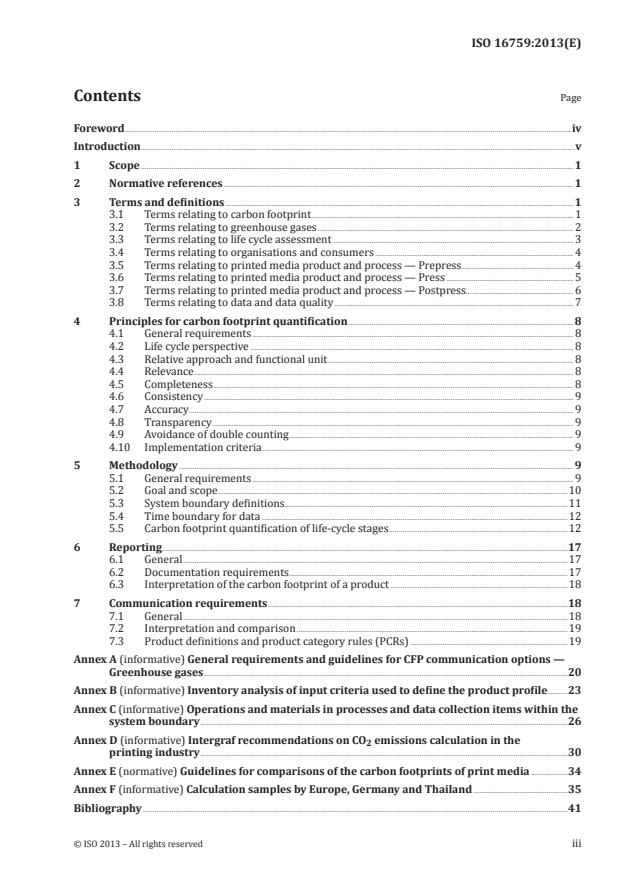
Contents Page
Foreword .iv
Introduction .v
1 Scope . 1
2 Normative references . 1
3 Terms and definitions . 1
3.1 Terms relating to carbon footprint . 1
3.2 Terms relating to greenhouse gases . 2
3.3 Terms relating to life cycle assessment . 3
3.4 Terms relating to organisations and consumers . 4
3.5 Terms relating to printed media product and process — Prepress . 4
3.6 Terms relating to printed media product and process — Press . 5
3.7 Terms relating to printed media product and process — Postpress. 6
3.8 Terms relating to data and data quality . 7
4 Principles for carbon footprint quantification . 8
4.1 General requirements . 8
4.2 Life cycle perspective . 8
4.3 Relative approach and functional unit . 8
4.4 Relevance . 8
4.5 Completeness . 8
4.6 Consistency . 9
4.7 Accuracy . 9
4.8 Transparency . 9
4.9 Avoidance of double counting . 9
4.10 Implementation criteria . 9
5 Methodology . 9
5.1 General requirements . 9
5.2 Goal and scope .10
5.3 System boundary definitions .11
5.4 Time boundary for data .12
5.5 Carbon footprint quantification of life-cycle stages .12
6 Reporting .17
6.1 General .17
6.2 Documentation requirements.17
6.3 Interpretation of the carbon footprint of a product .18
7 Communication requirements .18
7.1 General .18
7.2 Interpretation and comparison .19
7.3 Product definitions and product category rules (PCRs) .19
Annex A (informative) General requirements and guidelines for CFP communication options —
Greenhouse gases .20
Annex B (informative) Inventory analysis of input criteria used to define the product profile .23
Annex C (informative) Operations and materials in processes and data collection items within the
system boundary .26
Annex D (informative) Intergraf recommendations on CO emissions calculation in the
printing industry .30
Annex E (normative) Guidelines for comparisons of the carbon footprints of print media .34
Annex F (informative) Calculation samples by Europe, Germany and Thailand .35
Bibliography .41
Foreword
ISO (the International Organization for Standardization) is a worldwide federation of national standards
bodies (ISO member bodies). The work of preparing International Standards is normally carried out
through ISO technical committees. Each member body interested in a subject for which a technical
committee has been established has the right to be represented on that committee. International
organizations, governmental and non-governmental, in liaison with ISO, also take part in the work.
ISO collaborates closely with the International Electrotechnical Commission (IEC) on all matters of
electrotechnical standardization.
The procedures used to develop this document and those intended for its further maintenance are
described in the ISO/IEC Directives, Part 1. In particular the different approval criteria needed for the
different types of ISO documents should be noted. This document was drafted in accordance with the
editorial rules of the ISO/IEC Directives, Part 2. www.iso.org/directives
Attention is drawn to the possibility that some of the elements of this document may be the subject of
patent rights. ISO shall not be held responsible for identifying any or all such patent rights. Details of
any patent rights identified during the development of the document will be in the Introduction and/or
on the ISO list of patent declarations received. www.iso.org/patents
Any trade name used in this document is information given for the convenience of users and does not
constitute an endorsement.
The committee responsible for this document is ISO/TC 130, Graphic technology.
iv © ISO 2013 – All rights reserved
Introduction
Reduction of worldwide greenhouse gas (GHGs) emissions is central to the mitigation of climate
change (see Annex A), considered to be arising from natural and anthropogenic activities. Industry and
governments are already aware of the importance of contributing to this reduction, both nationally and
internationally. The printing and associated industries (prepress, finishing, postpress, paper making
and related services) have substantially reduced their GHG emissions in recent years. Although this
data reduction can be formally captured and measured, it is difficult to compare without a common
reference methodology.
This International Standard has been developed to provide a consistent framework methodology
for carbon footprint calculation. It is written for prepress, print service providers, printers, media
companies, other print content publishers, related industry associations and providers of carbon
footprinting tools. It offers a program-neutral method for calculating and communicating the life cycle
GHG emissions of print media products, based on calculated CO e values, for the single impact category
of climate change. This single criteria approach provides the foundation for future work addressing
multicriteria impacts which assess all potential impacts that a print media product can have on the
environment. This International Standard is based on work done for ISO/TS 14067 and PAS 2050 to
provide a specific implementation for the graphic arts industry. Multicriteria calculations based on all
four phases of Life Cycle Assessment (LCA), as outlined in ISO 14040, are not within the scope of this
International Standard. Further information for conducting LCA are outlined in ISO 14044.
According to this International Standard, quantification of the carbon footprint of a print media product
requires a defined goal and scope for the carbon footprinting study. This International Standard also
requires a specification of the system boundaries and process inventory as the basis for calculations. It
allows for calculations of the whole or part life cycle of print media products.
This International Standard provides consistency, transparency, flexibility and accountability for print
media carbon footprint quantifications and their communication. It may provide the following benefits
to companies, public bodies and consumers, industry and regulatory bodies:
— consistency in carbon footprint calculator design, to aid relevance and applicability for different
print media product sectors and geographies;
— provide print buyers and consumers with a means of quantifying and communicating the carbon
footprint of print media products using a common methodology and defined boundaries;
— provide the printing industry with a framework for quantifying and communicating the carbon
footprint of print media products using a common methodology and defined boundaries;
— encourage media buyers and consumers of print media products to make informed media investment,
purchase and usage decisions, using information validated with calculation, communication and
reporting tools that are consistent with this International Standard;
— facilitate the continuous monitoring of the carbon footprint of print as part of its overall
environmental impact, and encourage constant improvement within all print sectors;
— enhance the credibility of the printing industry’s efforts to quantify, communicate and reduce the
carbon footprints of print media products and their raw materials;
— be used as part of GHG emissions management; and
— facilitate performance tracking and progress in GHG emissions reduction for the printing industry.
This International Standard provides a framework methodology for calculating the life cycle GHG
emissions of print media products. It aids the print customer’s contribution to national and international
CO e reduction targets, via government schemes or through industry associations. A common framework
for calculation and parameter requirements minimizes ambiguity and enables the comparison of
the carbon footprints of print media products, based on the goals and scopes of individual carbon
footprinting studies (see Annex E). This framework allows contributors to print media supply chains to
calculate partial carbon footprints for use in the supply chain. This International Standard can also be
used to calculate carbon footprint values for use in carbon offsetting programs.
A print media product’s carbon footprint calculated in compliance with this International Standard can
be benchmarked against similar products. This, over time, may provide the following benefits:
— reduced environmental impact of print media products;
— assistance for print buyers making media purchase decisions;
— a framework for comparative estimates of average carbon footprints in different print media
sectors, such as newspapers, magazines, books, signs and displays, etc.;
— greater appreciation of the differences in media carbon footprints, and more informed process and
supply chain choice for print buyers, printers, service providers, customers and other interested parties;
— enhanced market awareness of print’s sustainability and environmental impact;
— criteria for selecting a carbon footprinting tool to calculate the carbon footprint or partial carbon
footprint of print media products; and
— comparable preliminary estimations of the carbon footprint of a print media product, based on a
pre-existing study.
This International Standard includes examples of carbon footprinting studies and guidance for
communicating and verifying carbon footprint information to printers, print buyers, consumers,
industry and any other interested parties.
Use of this International Standard facilitates the comparison of the carbon footprint of cross media
content and media products delivered digitally, for instance to websites, in emails, on DVDs, mobile
devices and so on. However the carbon footprint of specific digital media is outside the scope of this
International Standard.
vi © ISO 2013 – All rights reserved
INTERNATIONAL STANDARD ISO 16759:2013(E)
Graphic technology — Quantification and communication
for calculating the carbon footprint of print media products
1 Scope
This International Standard specifies the requirements for quantifying the carbon footprint of those
processes, materials and technologies required to produce print media products using any form of
printing technology and that are within the user’s knowledge and control. It is based on a Life Cycle
Assessment (LCA) approach, using defined system boundaries and a specified functional unit as the
basis for complete or partial carbon footprinting studies. This data can be referenced throughout supply
chains for individual print media products.
Together with ISO 14020 and other ISO standards, this International Standard defines standards of
completeness to be followed when communicating the results of a carbon footprint study for print media
products to business and consumers.
This International Standard provides a framework for carbon calculators that organisations can follow,
and that can be used as the structure for market or sector-specific carbon footprinting tools. Studies
and tools constructed within this framework methodology provide carbon footprint quantifications of
print media products that can be validated and verified.
2 Normative references
The following documents, in whole or in part, are normatively referenced in this document and are
indispensable for its application. For dated references, only the edition cited applies. For undated
references, the latest edition of the referenced document (including any amendments) applies.
ISO 14044, Environmental management — Life cycle assessment — Requirements and guidelines
ISO/TS 14067, Carbon footprint of products — Requirements and guidelines for quantification and
communication
3 Terms and definitions
For the purposes of this document, the following terms and definitions apply.
3.1 Terms relating to carbon footprint
3.1.1
carbon footprint (CF)
net amount of GHG emissions and GHG removals, expressed in CO equivalents
3.1.2
carbon footprint of a product
CFP
carbon footprint of a product system
3.1.3
carbon footprinting tool
means of calculating the carbon footprint of an object or process
3.1.4
carbon storage
carbon removed from the atmosphere and stored as carbon
3.1.5
product system
collection of processes with elementary and product flows performing one or more defined functions
and which models the life cycle of a product
3.1.6
product category rules
set of specific rules, requirements and guidelines for one or more product categories
3.2 Terms relating to greenhouse gases
3.2.1
carbon dioxide equivalent
CO e
CO equivalent
unit for comparing the radiative forcing of a GHG to carbon dioxide
Note 1 to entry: The carbon dioxide equivalent is calculated using the mass of a given GHG multiplied by its global
warming potential.
[SOURCE: ISO 14064-1:2006; 2.19, without Note 2]
3.2.2
global warming potential
GWP
factor describing the radiative forcing impact of one mass-based unit of a given GHG relative to an
equivalent unit of carbon dioxide over a given period of time
Note 1 to entry: Annex A contains a list of GHGs and their global warming potentials published by the
Intergovernmental Panel on Climate Change.
[SOURCE: ISO 14064-1:2006; 2.18, modified]
3.2.3
greenhouse gas
GHG
gaseous constituent of the atmosphere, both natural and anthropogenic, that absorbs and emits radiation
at specific wavelengths within the spectrum of infrared radiation emitted by the earth’s surface, the
atmosphere, and clouds
Note 1 to entry: See Annex A for a list of GHGs and their CO e values, per Kyoto.
Note 2 to entry: Water vapour and ozone are also anthropogenic as well as natural GHGs but are not included as
recognized GHGs due to difficulties in calculating their global warming potentials.
[SOURCE: ISO 14064-1:2006; 2.1, modified]
3.2.4
greenhouse gas emission
mass of a GHG released to the atmosphere
[SOURCE: SOURCE: ISO 14064-1:2006, 2.5, modified]
3.2.5
greenhouse gas emission factor
mass of a GHG emitted relative to an input or an output of a unit process or a combination of unit processes
3.2.6
greenhouse gas removal
mass of a GHG removed from the atmosphere
2 © ISO 2013 – All rights reserved
3.2.7
greenhouse gas sink
process that removes a GHG from the atmosphere
3.2.8
greenhouse gas source
mechanical or natural process that releases a GHG into the atmosphere
EXAMPLE Electrical energy use where the electrical energy has been created from fossil fuel resources.
3.3 Terms relating to life cycle assessment
3.3.1
allocation method
method by which inputs and outputs are allocated to different print media products
3.3.2
cumulative method
method by which values for inputs and outputs for print media products are accumulated throughout
the supply chain
3.3.3
end-of-life
stage which begins when the used product is ready for disposal, recycling, reuse, etc. and ends when the
product is returned to nature (combustion, deterioration), or is recycled or reused
3.3.4
energy
sources of GHG emissions used for the provision and use of the product
3.3.5
functional unit
quantified and defined single iteration of a printed product, used as a reference unit in a carbon
footprinting study
Note 1 to entry: to entry See Figure B.1.
EXAMPLE An A4 page, one square metre printed, a single iteration of a printed product or a complete print run.
[SOURCE: ISO 14040:2006; 3.20, modified to be specific to ISO 16759]
3.3.6
interpretation
process of explaining the results of a life cycle assessment such that it is relevant to the goal and scope
of a CFP study
3.3.7
life cycle
consecutive and interlinked stages of a product system, from raw material acquisition or generation
from natural resources to final disposal
[SOURCE: SOURCE: ISO 14044:2006; 3.1]
3.3.8
life cycle assessment
LCA
compilation and evaluation of the inputs, outputs and the potential environmental impacts of a product
system throughout its life cycle
3.3.9
life cycle impact assessment
LCIA
phase of life cycle assessment aimed at understanding and evaluating the magnitude and significance of
the potential environmental impacts for a product system throughout the life cycle of the product
3.3.10
life cycle inventory
LCI
phase of life cycle assessment involving the compilation and qualification of inputs and outputs for a
product throughout its life cycle
3.3.11
process
set of interrelated or interacting activities transforming inputs into outputs
[SOURCE: SOURCE: ISO 14044:2006; 3.11, modified to be specific to ISO 16759]
3.3.12
product group
collection of print media products that share common physical characteristics
3.4 Terms relating to organisations and consumers
3.4.1
consumer
individual purchasing products or services for personal or private use
3.4.2
organization
company, corporation, firm, business, authority or institution with its own administration and purpose
3.4.3
supply chain
linked and interdependent processes that result in the delivery of print media products to consumers
3.4.4
unit process
smallest element considered in the life cycle inventory analysis for which input and output data are quantified
[SOURCE: SOURCE: ISO 14040:2006, 3.34]
3.4.5
user
individual using print media products
3.5 Terms relating to printed media product and process — Prepress
3.5.1
prepress
preparation of data files in analogue or digital format for printing
EXAMPLE Separating RGB files into CMYK.
3.5.2
prepress consumables
materials used as part of the prepress process, including materials which can be recycled or otherwise reused
3.5.3
data
information known or assumed as fact
4 © ISO 2013 – All rights reserved
3.5.4
data management
process of keeping track of all data and/or information related to the creation, production and distribution
of a print media product, and associated processes
3.5.5
colour management
process of managing all data in a colour production workflow, such that the colours are accurate and
consistent in appearance across substrates and imaging processes, including print and electronic rendering
3.5.6
file preparation
readying data files for subsequent production in the print media product supply chain
3.5.7
preflight checking
file inspection to determine that the digital data contained therein will process such that all data can be
accurately imaged to a image carrier or substrate
3.5.8
file delivery
delivery of print media data files within the supply chain
3.5.9
proofing
process of evaluation of pre-production files used to check the accuracy of content and colour reproduction
3.5.10
imposition
arrangement of pages on the image carrier such that when cut, trimmed and finished the pages are in
the correct reading sequence
3.5.11
raster image processing
conversion of content data into a bitmap file including screening, trapping, imposition and all other
process data, relevant to the output constraints
3.5.12
screening
predominantly electronic process to create the printing and nonprinting elements of a page to mimic the
halftone values of an original contone
3.5.13
trapping
process of how overprinted colours should be defined so that on press the positioning of separations
disguises any misregistration
3.5.14
workflow management
process of managing all tasks in the print media supply chain
3.6 Terms relating to printed media product and process — Press
3.6.1
press consumables
materials used as part of the printing process, including materials which can be recycled or otherwise reused
3.6.2
image carrier
surface prepared such that some parts of it transfer printing ink whereas other parts do not
3.6.3
ink
substance containing pigment(s) or dye(s), resin(s) and carrier fluid(s)
3.6.4
toner
solid material, which might or might not include colorant, capable of taking on an electrostatic charge,
designed for deposition onto a substrate under the control of electrostatic forces in conjunction with a
surface having a controlled distributed charge
3.6.5
plastic
synthetic or semi-synthetic organic material used to produce certain categories of print media products
3.6.6
substrate
material onto which inks, coatings and varnishes are printed or laid down
3.6.7
print
material onto the surface of which a mark or impression has been made
EXAMPLE Printed documents, sign and display material, magazines, newspapers.
3.6.8
printing
process of transferring text, line art and graphic content in one or more colours to a substrate
3.6.9
printing process
technology used to produce print, including analogue and digital methods
3.6.10
coating
process of applying an additional layer on top of printed inks
3.6.11
coatings and varnishes
substances applied to a substrate in addition to printed inks
3.6.12
drying
process of removing moisture, solvents or co-solvents from a substrate, localized environment or film
formation by resins
3.6.13
laminating
process of applying a transparent layer to protect a printed substrate
3.6.14
oxidation
process resulting from the combination of a substance with oxygen
3.7 Terms relating to printed media product and process — Postpress
3.7.1
postpress consumables
materials consumed as part of the finishing process, including materials which can be recycled or
otherwise reused
6 © ISO 2013 – All rights reserved
3.7.2
binding
process of holding materials together by means of staples, adhesives, thread, wire or other means
3.7.3
stitching
process of securing printed, folded and gathered pages in their folds
3.7.4
finishing
process associated with manipulating printed materials into a final product
EXAMPLE Cutting, slitting, binding.
3.7.5
stacking
piling up printed media as it comes off the press
3.7.6
cleaning materials
materials used to clean machinery and equipment used to create, produce and distribute print
media products
3.7.7
distribution
process of ensuring that print media products can be made available to consumers
3.7.8
print media product
product created using printing and/or finishing processes
3.7.9
colorant
substance added in order to change colour appearance
3.8 Terms relating to data and data quality
3.8.1
primary data
directly measured, calculated or obtained quantified value of a unit process or activity and related
information within a product system or company, based on specific original source measurements
Note 1 to entry: Primary data can be emissions factors from recognized reference sources.
3.8.2
secondary data
indirectly measured, calculated or obtained quantified value of a unit process or activity and related
information within a product system or company, not based on specific original source measurements
3.8.3
site-specific data
data obtained from a direct measurement or a calculation based on direct measurement at its original
source within the product system
3.8.4
transparency
open, comprehensive, accessible, clear and understandable presentation of information
[SOURCE: SOURCE: ISO 14040:2006; 3.7, modified to be specific to ISO 16759]
3.8.5
uncertainty
parameter associated with the result of quantification which characterises the variability of the values
that could be reasonably attributed to the quantified amount
Note 1 to entry: Uncertainty information typically specifies quantitative estimates of the likely dispersion of
values and a qualitative description of the likely causes of the dispersion.
[2]
[SOURCE: ISO 14064-1:2006 ; 2.37, modified to be specific to ISO 16759]
4 Principles for carbon footprint quantification
4.1 General requirements
The following principles are the basis for and shall be used to guide the application of the requirements
of this International Standard.
4.2 Life cycle perspective
In the assessment of the carbon footprint of a print media product and its communication, all stages
defined in the goal and scope of the study shall be included. The goal and scope defines the parameters
of the system boundary and is the basis for the study’s inventory of calculations. This allows for partial
carbon footprint calculations, relating to defined parts of a print media supply chain. A partial CFP shall
as a minimum, represent the cradle-to-gate emissions and removals arising from all stages relating to
print media product manufacture, up to the point where the product leaves the production site. The goal
and scope may include everything from raw material acquisition to end of life including collection, sorting
and recycling, or only those parts of the print media product’s life cycle for which data are available.
NOTE This may include separate disclosure of GHG emissions and storage or removal in order to demonstrate
and clarify GHG emissions values (see Annex D).
4.3 Relative approach and functional unit
The carbon footprint study shall be structured around a single defined functional unit of a print media
product and the results calculated relative to it. The functional unit shall be defined as specifically as
possible, including all criteria relating to its raw materials and components, as determined in the goal
and scope of the study. A functional unit is a reference to which input and output data are normalized and
represents the performance of a product system for use as a reference in a carbon footprinting study. As
such it can refer to individual instances of print media products, or complete print runs. Comparisons
of different carbon footprints can only be made if the functional units are the same, i.e. normalized to
the same functional unit (see Annex E). Examples of functional units and their determinant criteria are
available in Annex B.
4.4 Relevance
According to the goal and scope of the carbon footprinting study, GHG sources and sinks together with
carbon storage, data and methods selected, shall be suitable for the assessment of the GHG emissions,
storage and removals arising from print media products.
NOTE This may include separate disclosure of GHG emissions and storage or removal in order to demonstrate
and clarify GHG emissions values (see Annex D).
4.5 Completeness
According to the goal and scope of the carbon footprinting study, all relevant GHG sources and sinks
together with carbon storage that provide a direct and meaningful contribution to the assessment of
GHG emissions, storage and removals arising from print media products, shall be included.
8 © ISO 2013 – All rights reserved
4.6 Consistency
According to the goal and scope of the carbon footprinting study, assumptions, methods and data shall
be applied and gathered in the same way throughout the carbon footprint of a print media product study.
4.7 Accuracy
According to the goal and scope of the carbon footprinting study, bias and uncertainties shall be reduced
as far as is practical; inaccuracies and influencers shall be stated as part of the CFP study.
4.8 Transparency
All relevant issues shall be addressed within the goal and scope of the carbon footprinting study and
documented accurately, with full disclosure and a clear audit trail. Assumptions, reference methodologies and
data sources used shall be disclosed. Estimates and areas of possible bias shall be explained and highlighted.
4.9 Avoidance of double counting
4.9.1 General
Double counting of GHG emissions and removals shall be avoided.
EXAMPLE Content creation and calculations done by a publisher and subsequently repeated by a prepress house.
4.9.2 Option to separate carbon dioxide emissions of by-products
If during the printing process second, third or multiple by-products are produced (for example recovered
toluene in publication rotogravure) there is the option to separate the carbon dioxide emissions value
caused by the by-products.
4.10 Implementation criteria
Calculations shall be based on the following unit processes:
a) those which are expected to make a measurable contribution to the carbon footprint;
b) those for which emissions data are not expected to make a measurable contribution to the carbon
footprint and which can therefore be estimated; and
c) those for which several unit processes can be merged, for instance content proofing.
NOTE As a minimum this includes energy, transportation, paper and may include other factors.
5 Methodology
5.1 General requirements
For the calculation of the carbon footprint of a printed product to conform to this International
Standard, its life cycle GHG emissions shall be calculated using the methodological framework outlined
here or a carbon footprinting tool that is consistent with this International Standard. The study shall be
based on goal and scope definition, inventory analysis, impact assessment and interpretation, and the
communication of the results.
Assessments of product GHG emissions shall be carried out using the principles of LCA. Unless otherwise
indicated, the assessment of a print media product’s life cycle GHG emissions shall be made based on the
product’s attributes and the functional unit, as defined in the goal and scope.
The functional unit for a print media product is defined according to its physical characteristics (see
Annex B for suggested criteria).
Assessment of the GHG emissions based on a product’s life cycle or partial life cycle shall be done so
that the mass of CO e is reported for each functional unit, as defined in the goal and scope of the carbon
footprinting study.
Assessments shall perform the following functions:
a) define the goal and scope of the study, the processes measured in order to calculate a print media
product’s life cycle or partial life cycle GHG emissions based on the defined system boundary and
inventory as defined in the goal and scope;
b) determine the sequence and interaction of these processes based on the production workflow and
unit process definitions;
c) identify the criteria to be included in a carbon footprint calculation for the measurement of the print
media product’s life cycle or partial life cycle GHG emissions;
d) avoid double counting;
e) provide resources and data required for calculation of the print media product’s life cycle or partial
life cycle GHG emissions; and
f) for outsourced processes, the organization shall ensure that GHG emissions measurements are
transparent and that they are consistent with recognized standards applied throughout the
supply chain.
5.2 Goal and scope
5.2.1 General
The goal of a print media product carbon footprint study is to quantify the GHG emissions of a print
media product over its life cycle, or partial life cycle, based on either LCA, or over that part of its life cycle
for which the criteria for calculating the carbon footprint are known and within control of the entity
conducting the carbon footprinting study.
5.2.2 LCA partial carbon footprint
LCA partial carbon footprint studies shall include the following mandatory elements:
a) why the study is being done;
b) for and by whom and on what date;
c) the intended use of the study;
d) a definition of the functional unit;
e) the start and completion dates for the study’s data collection period;
f) the calculation techniques to be used;
g) reporting processes; and
h) the location of where the study including data collection, compilation and calculation, is conducted.
10 © ISO 2013 – All rights reserved
5.2.3 System boundary
A definition of the system boundary for the carbon footprinting study shall include the following
mandatory elements:
a) an explanation of how the system boundaries have been drawn;
b) an explanation of why the system boundaries are drawn as they are;
c) an inventory analysis listing all processes, materials, life cycle stages, to be addressed in the
calculation (examples of processes to consider are listed in Annex C);
d) definitions of the relationships between LCA and LCI phases and how the study can be used for
subsequent calculations;
e) a statement to account for what is excluded from the study and why;
f) an explanation of any uncertainties, ambiguities or assumptions; and
g) conditions for use of value choices and optional elements.
5.2.4 Scope of print media product carbon footprint study
The scope of a print media product carbon footprint study shall be consistent with the goal of the study.
In defining its scope, the following criteria shall be considered:
a) the functional unit;
b) assumptions for lifecycle;
c) the system boundary;
d) the inventory of processes which are the basis of calculations;
e) allocation procedures;
f) data and data quality requirements and expectations;
g) limitations;
h) uncertainties; and
i) reporting.
The scope of the study may be revised due to unforeseen limitations, constraints or additional
information. Modifications and explanations shall be documented.
NOTE A summary of processes which may be considered for inclusion in the inventory of processes is included
in Annex C.
5.2.5 Life cycle stages
The life cycle stages and the inventory of processes to be included in the carbon footprinting study of a
print media product shall be defined in the goal and scope of the study. Each life-cycle stage and process
shall be individually quantified.
5.3 System boundary definitions
The system boundary determines which unit processes shall be included in the carbon footprinting
study, based on its goal and scope. A production workflow schematic shall be determined specific to
the functional unit under study as the basis for calculating the input and output data of each process
in the flow. The goal and scope and therefore the system boundary setting shall be consistent with the
objectives for the intended use of the study.
In defining the system boundary, the unit processes in Annex C shall be considered. Where processes are
iterative the number of iterations shall be stated alongside the emissions. This number can be estimated
unless the impact on the overall assessment is likely to be more than 5 %.
The examples of operations and materials in processes may include, but are not limited to, the processes
listed in Annex C which also shows mandatory items for the calculation.
Calculations done in accordance with this International Standard shall include all emissions of those
unit processes within the defined system boundary that contribute to a total of at least 95 % of the total
carbon footprint. The 5 % of GHG emission remaining means cut-off criteria. Care shall be taken to avoid
double counting, and to take into account accumulative numbers. Any unit process with a contribution of
more than 1 % of the total carbon footprint shall be included in the calculations and shall be considered
as a contribution as required in ISO 14044.
NOTE An example of the impact of raw materials, energy and of system boundaries applicable to print
products is provided in the Intergraf recommendations in Annex D.
5.4 Time boundary for data
The time boundary shall be representative of the life cycle of the specified functional unit of a print media
product, as defined in the goal and scope of the study. Its assumptions shall be accurately specified and
justified according to the life cycle for the print product, as defined in the goal and scope of the carbon
footprinting study.
5.5 Carbon footprint quantification of life-cycle stages
5.5.1 Inventory analysis
Following description of the goal and scope, inventory analysis is the second step in calculating the
carbon footprint of print media products. It consists of several stages (see ISO 14044): data collection,
data validation and checking, relation of data to unit processes and functional units, refining the
system boundary (for instance, excluding processes that make no significant contribution, or including
previously excluded data that do have an impact), and allocation (so that shared processes are not double
counted, including for recycling).
The inventory analysis shall begin with an inventory of all stages necessary to produce and distribute a
print media pro
...