

ISO 23551-4:2018
(Main)Safety and control devices for gas burners and gas-burning appliances — Particular requirements — Part 4: Valve-proving systems for automatic shut-off valves
General Information
- Abstract
ISO 23551-4:2018 specifies safety, constructional and performance requirements of valve-proving systems (VPS), intended for use with gas burners and gas-burning appliances. It also describes the test procedures for checking compliance with these requirements and provides information necessary for the purchaser and user. ISO 23551-4:2018 is applicable to all types of VPS which are used for the automatic detection of leakage in a gas burner section having at least two valves designed in accordance with ISO 23551‑1 and which give a signal if the leakage of one of the valves exceeds the detection limit. ISO 23551-4:2018 is applicable to VPS with a maximum working pressure up to and including 500 kPa for use in systems using fuel gases. ISO 23551-4:2018 is not applicable to VPSs for use in explosive atmospheres. NOTE Provisions for production control are not part of the ISO 23551 series.
- Status
- Published
- Publication Date
- 24-Apr-2018
- Technical Committee
- ISO/TC 161 - Controls and protective devices for gas and/or oil
- Drafting Committee
- ISO/TC 161/WG 3 - Controls
- Current Stage
- 9093 - International Standard confirmed
- Start Date
- 13-Nov-2023
- Completion Date
- 29-Aug-2026
Buy Documents


ISO 23551-4:2018 - Safety and control devices for gas burners and gas-burning appliances -- Particular requirements
ISO 23551-4:2018 - Safety and control devices for gas burners and gas-burning appliances — Particular requirements — Part 4: Valve-proving systems for automatic shut-off valves/25/2018
Overview
ISO 23551-4:2018 - "Safety and control devices for gas burners and gas‑burning appliances - Part 4: Valve‑proving systems for automatic shut‑off valves" specifies safety, constructional and performance requirements for valve‑proving systems (VPS) used to automatically detect leakage in gas burner sections. The standard defines test procedures to verify compliance and supplies information for purchasers and users. ISO 23551-4:2018 applies to VPS for fuel‑gas systems up to 500 kPa working pressure and is not for use in explosive atmospheres. (Production control provisions are outside the ISO 23551 series.)
Key topics and technical requirements
- Scope & applicability: VPS used with gas burners/appliances having at least two shut‑off valves designed per ISO 23551‑1; max working pressure 500 kPa.
- Classification: Classes of control, groups, and function classes for VPS behaviour and safety integrity.
- Construction requirements: Materials, gas connections, electronic components in the gas way, enclosure and mechanical robustness.
- Leak‑tightness & detection: Mandatory leak‑tightness tests (volumetric and pressure‑loss methods in Annexes A/B), detection limit requirements and conversion methods (Annex C).
- Performance & functional tests: Rated flow, torsion/bending resistance, durability, programme sequence, timing, self‑checking, lock‑out function, endurance and vibration testing.
- Electrical & EMC: Electrical equipment requirements, protection by enclosure, internal‑fault protection related to functional safety, and comprehensive electromagnetic compatibility tests (immunity, surges, ESD).
- Marking & documentation: Required marking, installation and operating instructions, and warning notices for safe installation and use.
- Regional guidance: Normative annexes cover specific regional requirements (Europe, USA/Canada, Japan) and material resistance (elastomers).
Applications
ISO 23551-4:2018 is used to design, test and certify VPS for:
- Commercial and industrial gas burners, boilers and packaged gas‑burning appliances
- Safety systems that require automatic leak detection and shut‑off
- Procurement specifications and acceptance testing of gas safety controls
- Integration with HVAC, process heating and building gas safety systems
Who should use this standard
- Manufacturers of valve‑proving systems and gas appliance controls
- Design engineers and system integrators specifying safety controls
- Testing laboratories performing compliance and type testing
- Installers, facility managers and procurement officers assessing product suitability
- Regulatory bodies and safety auditors verifying compliance
Related standards
- ISO 23551‑1 (referenced for valve design and compatibility)
- Other parts of the ISO 23551 series addressing gas control device requirements
Keywords: ISO 23551-4:2018, valve-proving system, VPS, gas burners, automatic shut-off valves, leak detection, leak‑tightness test, gas safety standards.
Relations
- Consolidated By
ISO 80000-1:2022 - Quantities and units — Part 1: General - Effective Date
- 06-Jun-2022
- Effective Date
- 23-Apr-2020
- Effective Date
- 04-Nov-2015
Buy Documents
ISO 23551-4:2018 - Safety and control devices for gas burners and gas-burning appliances -- Particular requirements
ISO 23551-4:2018 - Safety and control devices for gas burners and gas-burning appliances — Particular requirements — Part 4: Valve-proving systems for automatic shut-off valves/25/2018
Get Certified
Connect with accredited certification bodies for this standard

DNV
DNV is an independent assurance and risk management provider.

Lloyd's Register
Lloyd's Register is a global professional services organisation specialising in engineering and technology.
DNV Energy Systems
Energy and renewable energy certification.
Sponsored listings
Frequently Asked Questions
ISO 23551-4:2018 is a standard published by the International Organization for Standardization (ISO). Its full title is "Safety and control devices for gas burners and gas-burning appliances — Particular requirements — Part 4: Valve-proving systems for automatic shut-off valves". This standard covers: ISO 23551-4:2018 specifies safety, constructional and performance requirements of valve-proving systems (VPS), intended for use with gas burners and gas-burning appliances. It also describes the test procedures for checking compliance with these requirements and provides information necessary for the purchaser and user. ISO 23551-4:2018 is applicable to all types of VPS which are used for the automatic detection of leakage in a gas burner section having at least two valves designed in accordance with ISO 23551‑1 and which give a signal if the leakage of one of the valves exceeds the detection limit. ISO 23551-4:2018 is applicable to VPS with a maximum working pressure up to and including 500 kPa for use in systems using fuel gases. ISO 23551-4:2018 is not applicable to VPSs for use in explosive atmospheres. NOTE Provisions for production control are not part of the ISO 23551 series.
ISO 23551-4:2018 specifies safety, constructional and performance requirements of valve-proving systems (VPS), intended for use with gas burners and gas-burning appliances. It also describes the test procedures for checking compliance with these requirements and provides information necessary for the purchaser and user. ISO 23551-4:2018 is applicable to all types of VPS which are used for the automatic detection of leakage in a gas burner section having at least two valves designed in accordance with ISO 23551‑1 and which give a signal if the leakage of one of the valves exceeds the detection limit. ISO 23551-4:2018 is applicable to VPS with a maximum working pressure up to and including 500 kPa for use in systems using fuel gases. ISO 23551-4:2018 is not applicable to VPSs for use in explosive atmospheres. NOTE Provisions for production control are not part of the ISO 23551 series.
ISO 23551-4:2018 is classified under the following ICS (International Classification for Standards) categories: 27.060.20 - Gas fuel burners. The ICS classification helps identify the subject area and facilitates finding related standards.
ISO 23551-4:2018 has the following relationships with other standards: It is inter standard links to ISO 80000-1:2022, ISO 23551-4:2005/Amd 1:2010, ISO 23551-4:2005. Understanding these relationships helps ensure you are using the most current and applicable version of the standard.
ISO 23551-4:2018 is available in PDF format for immediate download after purchase. The document can be added to your cart and obtained through the secure checkout process. Digital delivery ensures instant access to the complete standard document.
Standards Content (Sample)
INTERNATIONAL ISO
STANDARD 23551-4
Second edition
2018-04
Safety and control devices for gas
burners and gas-burning appliances —
Particular requirements —
Part 4:
Valve-proving systems for automatic
shut-off valves
Dispositifs de contrôle et de sécurité pour les brûleurs à gaz et pour
les appareils utilisant le gaz — Exigences particulières —
Partie 4: Systèmes de contrôle d'étanchéité pour robinets
automatiques de sectionnement
Reference number
©
ISO 2018
© ISO 2018
All rights reserved. Unless otherwise specified, or required in the context of its implementation, no part of this publication may
be reproduced or utilized otherwise in any form or by any means, electronic or mechanical, including photocopying, or posting
on the internet or an intranet, without prior written permission. Permission can be requested from either ISO at the address
below or ISO’s member body in the country of the requester.
ISO copyright office
CP 401 • Ch. de Blandonnet 8
CH-1214 Vernier, Geneva
Phone: +41 22 749 01 11
Fax: +41 22 749 09 47
Email: copyright@iso.org
Website: www.iso.org
Published in Switzerland
ii © ISO 2018 – All rights reserved
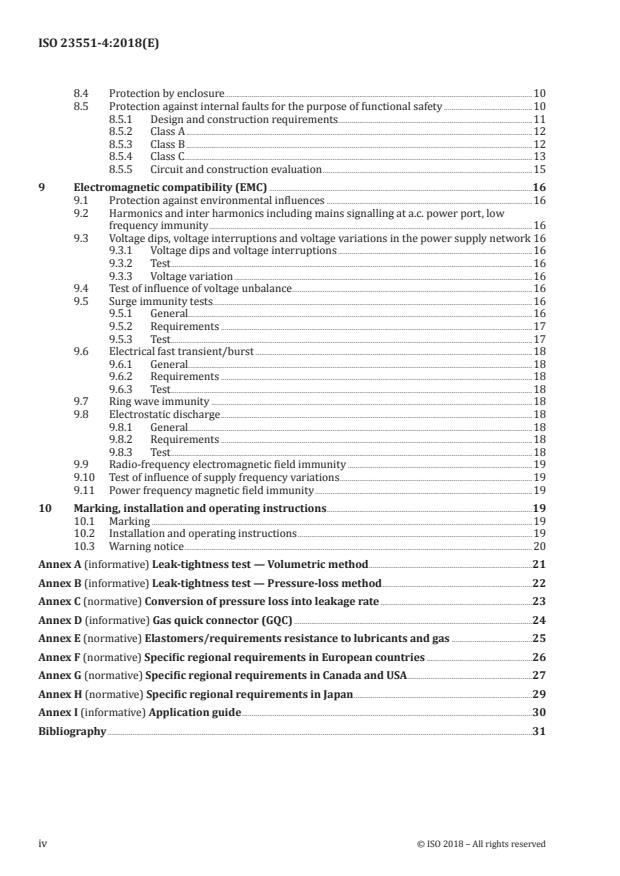
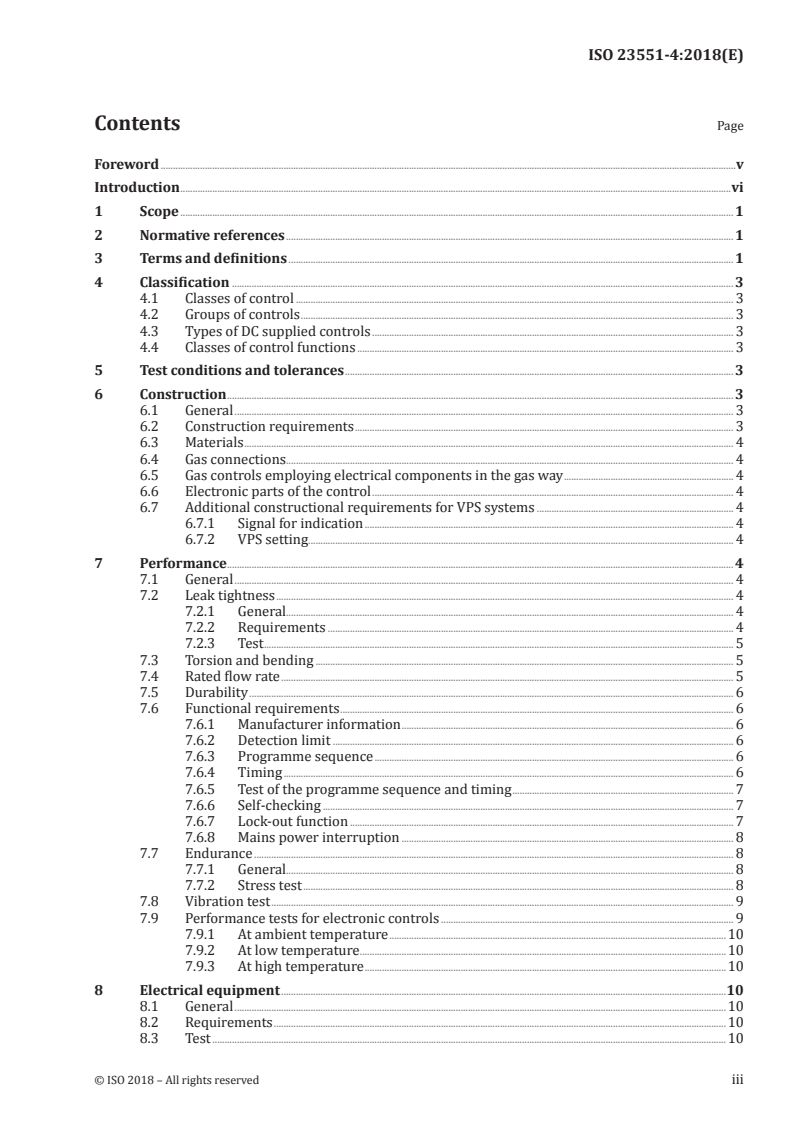
Contents Page
Foreword .v
Introduction .vi
1 Scope . 1
2 Normative references . 1
3 Terms and definitions . 1
4 Classification . 3
4.1 Classes of control . 3
4.2 Groups of controls . 3
4.3 Types of DC supplied controls . 3
4.4 Classes of control functions . 3
5 Test conditions and tolerances . 3
6 Construction . 3
6.1 General . 3
6.2 Construction requirements . 3
6.3 Materials . 4
6.4 Gas connections . 4
6.5 Gas controls employing electrical components in the gas way . 4
6.6 Electronic parts of the control . 4
6.7 Additional constructional requirements for VPS systems . 4
6.7.1 Signal for indication . 4
6.7.2 VPS setting. 4
7 Performance . 4
7.1 General . 4
7.2 Leak tightness . 4
7.2.1 General. 4
7.2.2 Requirements . 4
7.2.3 Test . 5
7.3 Torsion and bending . 5
7.4 Rated flow rate . 5
7.5 Durability . 6
7.6 Functional requirements . 6
7.6.1 Manufacturer information . 6
7.6.2 Detection limit . 6
7.6.3 Programme sequence . 6
7.6.4 Timing . 6
7.6.5 Test of the programme sequence and timing . 7
7.6.6 Self-checking . 7
7.6.7 Lock-out function . 7
7.6.8 Mains power interruption . 8
7.7 Endurance . 8
7.7.1 General. 8
7.7.2 Stress test . 8
7.8 Vibration test . 9
7.9 Performance tests for electronic controls . 9
7.9.1 At ambient temperature .10
7.9.2 At low temperature . .10
7.9.3 At high temperature .10
8 Electrical equipment .10
8.1 General .10
8.2 Requirements .10
8.3 Test .10
8.4 Protection by enclosure.10
8.5 Protection against internal faults for the purpose of functional safety .10
8.5.1 Design and construction requirements .11
8.5.2 Class A .12
8.5.3 Class B .12
8.5.4 Class C.13
8.5.5 Circuit and construction evaluation .15
9 Electromagnetic compatibility (EMC) .16
9.1 Protection against environmental influences .16
9.2 Harmonics and inter harmonics including mains signalling at a.c. power port, low
frequency immunity .16
9.3 Voltage dips, voltage interruptions and voltage variations in the power supply network 16
9.3.1 Voltage dips and voltage interruptions .16
9.3.2 Test .16
9.3.3 Voltage variation .16
9.4 Test of influence of voltage unbalance .16
9.5 Surge immunity tests .16
9.5.1 General.16
9.5.2 Requirements .17
9.5.3 Test .17
9.6 Electrical fast transient/burst .18
9.6.1 General.18
9.6.2 Requirements .18
9.6.3 Test .18
9.7 Ring wave immunity .18
9.8 Electrostatic discharge .18
9.8.1 General.18
9.8.2 Requirements .18
9.8.3 Test .18
9.9 Radio-frequency electromagnetic field immunity .19
9.10 Test of influence of supply frequency variations .19
9.11 Power frequency magnetic field immunity .19
10 Marking, installation and operating instructions .19
10.1 Marking .19
10.2 Installation and operating instructions .19
10.3 Warning notice .20
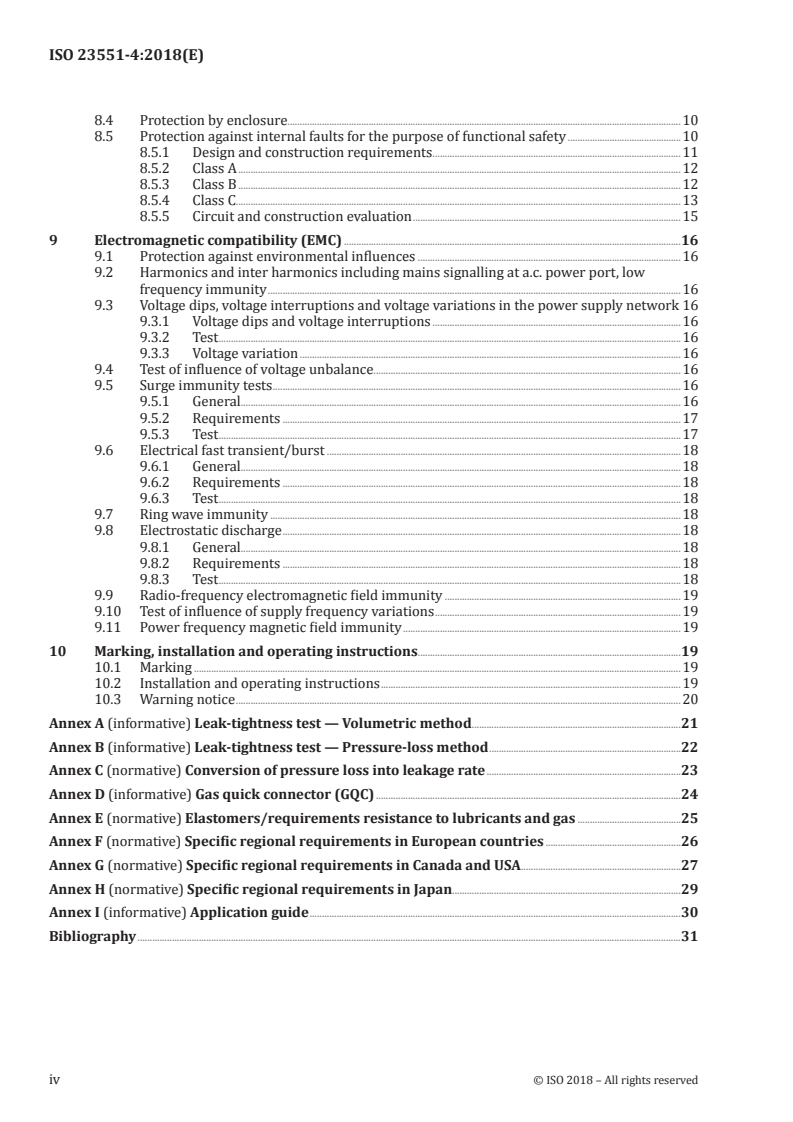
Annex A (informative) Leak-tightness test — Volumetric method .21
Annex B (informative) Leak-tightness test — Pressure-loss method .22
Annex C (normative) Conversion of pressure loss into leakage rate .23
Annex D (informative) Gas quick connector (GQC) .24
Annex E (normative) Elastomers/requirements resistance to lubricants and gas .25
Annex F (normative) Specific regional requirements in European countries .26
Annex G (normative) Specific regional requirements in Canada and USA .27
Annex H (normative) Specific regional requirements in Japan .29
Annex I (informative) Application guide .30
Bibliography .31
iv © ISO 2018 – All rights reserved
Foreword
ISO (the International Organization for Standardization) is a worldwide federation of national standards
bodies (ISO member bodies). The work of preparing International Standards is normally carried out
through ISO technical committees. Each member body interested in a subject for which a technical
committee has been established has the right to be represented on that committee. International
organizations, governmental and non-governmental, in liaison with ISO, also take part in the work.
ISO collaborates closely with the International Electrotechnical Commission (IEC) on all matters of
electrotechnical standardization.
The procedures used to develop this document and those intended for its further maintenance are
described in the ISO/IEC Directives, Part 1. In particular the different approval criteria needed for the
different types of ISO documents should be noted. This document was drafted in accordance with the
editorial rules of the ISO/IEC Directives, Part 2 (see www .iso .org/directives).
Attention is drawn to the possibility that some of the elements of this document may be the subject of
patent rights. ISO shall not be held responsible for identifying any or all such patent rights. Details of
any patent rights identified during the development of the document will be in the Introduction and/or
on the ISO list of patent declarations received (see www .iso .org/patents).
Any trade name used in this document is information given for the convenience of users and does not
constitute an endorsement.
For an explanation on the voluntary nature of standards, the meaning of ISO specific terms and
expressions related to conformity assessment, as well as information about ISO's adherence to the
World Trade Organization (WTO) principles in the Technical Barriers to Trade (TBT) see the following
URL: www .iso .org/iso/foreword .html.
This document was prepared by Technical Committee ISO/TC 161, Controls and protective devices for
gas and/or oil.
This second edition cancels and replaces the first edition (ISO 23551-4:2005), which has been
technically revised. The main changes compared to the previous edition are as follows:
— alignment to the structure of ISO 23550:2018;
— inclusion of updated references to IEC 60730-1:2013+AMD1: 2015;
— inclusion of requirements for “faults during lockout or safety shutdown”;
— inclusion of software and hardware design requirements;
— inclusion of requirements for reset devices;
— updated EMC immunity requirements.
Introduction
This document is designed to be used in combination with ISO 23550. Together with ISO 23550, this
document establishes the full requirements for valve-proving systems for automatic shut-off valves.
Where needed, this document adapts ISO 23550 by stating in the corresponding clause:
— “with the following modification”;
— “with the following addition”;
— “is replaced by the following”; or
— “is not applicable”.
In order to identify specific requirements that are particular to this document, that are not already
covered by ISO 23550, this document may contain clauses or subclauses that are additional to the
structure of ISO 23550. These subclauses are indicated by the introductory sentence: “Subclause (or
Annex) specific to this document.”.
To ensure global relevance of this document, the differing requirements resulting from practical
experience and installation practices in various regions of the world have been taken into account. The
variations in basic infrastructure associated with gas and/or oil controls and appliances have also been
recognized, some of which are addressed in Annexes F, G and H. This document intends to provide a
basic framework of requirements that recognize these differences.
vi © ISO 2018 – All rights reserved
INTERNATIONAL STANDARD ISO 23551-4:2018(E)
Safety and control devices for gas burners and gas-burning
appliances — Particular requirements —
Part 4:
Valve-proving systems for automatic shut-off valves
1 Scope
This document specifies safety, constructional and performance requirements of valve-proving
systems (VPS), intended for use with gas burners and gas-burning appliances. It also describes the test
procedures for checking compliance with these requirements and provides information necessary for
the purchaser and user.
This document is applicable to all types of VPS which are used for the automatic detection of leakage in
a gas burner section having at least two valves designed in accordance with ISO 23551-1 and which give
a signal if the leakage of one of the valves exceeds the detection limit.
This document is applicable to VPS with a maximum working pressure up to and including 500 kPa for
use in systems using fuel gases.
This document is not applicable to VPSs for use in explosive atmospheres.
NOTE Provisions for production control are not part of the ISO 23551 series.
2 Normative references
The following documents, in whole or in part, are normatively referenced in this document and are
indispensable for its application. For dated references, only the edition cited applies. For undated
references, the latest edition of the referenced document (including any amendments) applies.
ISO 23550, Safety and control devices for gas burners and gas-burning appliances — General requirements
IEC 60730-1:2013+AMD1: 2015, Automatic electrical controls — Part 1: General requirements
IEC 61000-4-5, Electromagnetic compatibility (EMC) — Part 4-5: Testing and measurement techniques —
Surge immunity test
3 Terms and definitions
For the purposes of this document, the terms and definitions given in ISO 23550 and the following apply.
ISO and IEC maintain terminological databases for use in standardization at the following addresses:
— ISO Online browsing platform: available at https: //www .iso .org/obp
— IEC Electropedia: available at http: //www .electropedia .org/
3.1
valve proving system
VPS
system to check the closure of automatic shut-off valves by detecting leakage, that often consists of a
programming unit, a measuring device, valves and other functional assemblies
3.2
detecting device
device for direct or inferential detection of leakage, i.e. by measuring flow or pressure
3.3
VPS operational time
time taken by the VPS to perform its entire cycle of operation
3.4
detection limit
maximum amount of leakage that can occur before the VPS is required to give a signal
Note 1 to entry: See Figure 1.
3.5
detection setting
actual leakage rate at which the VPS gives a signal
Note 1 to entry: See Figure 1.
Key
X burner heat, gas flow, expressed in m /h
Y detected leakage rate, expressed in dm /h
1 detection limit, 3.4
2 detection setting, see 3.5
Figure 1 — Illustration of detection limit and detection setting
3.6
leakage testing time
time in which the VPS monitors a gas valve for leakage
3.7
safety shut-down
process which is effected immediately following the detection of a leakage exceeding the detection
limit, or detection of an internal fault, disabling energization of the ignition and of the automatic shut-
off valves
2 © ISO 2018 – All rights reserved
3.8
volatile lock-out
safety shut-down condition of the system where a restart can only be accomplished by either the
manual reset of the system, or an interruption of the main power and its subsequent restoration
3.9
non-volatile lock-out
safety shut-down condition of the system, where a restart can only be accomplished by the manual
reset of the system and by no other means
4 Classification
4.1 Classes of control
Shall be according ISO 23550:2018, 4.1.
4.2 Groups of controls
Shall be according ISO 23550:2018, 4.2.
4.3 Types of DC supplied controls
Shall be according ISO 23550:2018, 4.3.
4.4 Classes of control functions
Shall be according ISO 23550:2018, 4.4 with the following addition:
VPS is a class C control function.
5 Test conditions and tolerances
Shall be according ISO 23550:2018, Clause 5.
6 Construction
6.1 General
Shall be according to ISO 23550:2018, 6.1 with the following addition.
The VPS shall be designed such that changes in critical circuit component values (such as those affecting
timing or sequence) within the component manufacturer's declared worst case tolerances, including the
long-term stability, shall result in the system continuing to function in accordance with this document.
Compliance shall be checked by worst-case analysis.
The construction of any additional functions included in the VPS for which no provisions exist in this
document shall be such that they do not degrade the safe and correct operation.
Where components are used to complete the VPS, these components shall comply with the relevant
component International Standard.
6.2 Construction requirements
Shall be according to ISO 23550:2018, 6.2.
6.3 Materials
Shall be according to ISO 23550:2018, 6.3.
6.4 Gas connections
Shall be according to ISO 23550:2018, 6.4.
6.5 Gas controls employing electrical components in the gas way
Shall be according to ISO 23550:2018, 6.5.
6.6 Electronic parts of the control
Subclause specific to this document.
Shall be according to IEC 60730-1:2013/AMD1: 2015.
6.7 Additional constructional requirements for VPS systems
Subclause specific to this document.
6.7.1 Signal for indication
A signal for indication, e.g. optical indication, shall be given when the leakage exceeds the detection limit.
6.7.2 VPS setting
The setting of a detecting device shall require the use of tools. If the VPS is adjustable, the installation
and operating instructions shall provide information for this setting, e.g. detection setting.
7 Performance
7.1 General
Shall be according to ISO 23550:2018, 7.1 with the following addition:
Where components are used to complete the VPS, these components shall comply with the relevant
component International Standard.
7.2 Leak tightness
7.2.1 General
Shall be according to ISO 23550:2018, 7.2.1.
7.2.2 Requirements
Shall be according to ISO 23550:2018, 7.2.2 with the following modification.
The external leak-tightness requirements are replaced by the following:
A VPS according to Figure 2 a) is considered to be externally leak tight, if no single component of a VPS
3 –1
has an external leakage rate higher than 60 cm × h .
4 © ISO 2018 – All rights reserved
A VPS with integrated or partly integrated actuators (e.g. valves, pumps), according to Figure 2 b)
and c) is considered to be a single component and shall have an external leakage rate not higher than
3 –1
120 cm · h .
a) External valves supervised by a VPS
b) VPS with integrated valves
c) VPS with partly integrated valves
Figure 2 — Examples of VPS configurations
7.2.3 Test
Shall be according to ISO 23550:2018, 7.2.3.
7.3 Torsion and bending
Shall be according to ISO 23550:2018, 7.3.
7.4 Rated flow rate
Shall be according to ISO 23550:2018, 7.4.
7.5 Durability
Shall be according to ISO 23550:2018, 7.5.
7.6 Functional requirements
Shall be according to ISO 23550:2018, 7.6 with the following addition.
NOTE Specific regional requirements are given in G.2.3.
7.6.1 Manufacturer information
The manufacturer shall declare the maximum detection limit, programme sequence and any other
relevant information. The VPS shall be capable of meeting the functional tests detailed in 7.6.2 to 7.6.5.
7.6.2 Detection limit
The VPS shall prevent ignition and the opening of the burner valves at a leakage-rate limit depending on
the burner heat input, starting over 50 dm /h and up to a minimum value of 0,1 % of the burner heat input.
Conformity is checked by measuring the actual or inferred detection limit at three values; at 50 dm /h,
at the maximum value and at the midpoint and/or the minimum value declared by the manufacturer.
7.6.3 Programme sequence
The VPS programme sequence shall allow the gas valves to open when detection limit is at or below the
manufacturers declared value, or the maximum specified in 7.6.2.
The VPS programme sequence shall prevent the gas valves to open when detection limit exceeds the
manufacturers declared value, or the maximum specified in 7.6.2 followed by a lock-out.
The lock-out may be executed on the system application directly or by the VPS itself. An automatic start-
up attempt by a separate control function shall not override the lock-out conditions.
Any gas necessary for the operation of the VPS may be discharged into the combustion chamber during
the programme sequence if the maximum release volume, expressed in volume per switching sequence,
does not exceed 0,083 % of the burner heat input referred to the nominal volume flow, expressed in
cubic metres per hour.
NOTE 0,083 % is based on the quantity within 3 s.
However, when the VPS is used as an alternative for pre-purge or post-purge, the discharge of the gas
necessary for the operation of the VPS into the combustion chamber shall not be allowed. The gas shall
be safely vented.
If the actuating energy in the safety circuit fails, the VPS shall close the main gas valves and any ignition
gas valve or give a shut-down signal to the automatic gas-burner control system.
7.6.4 Timing
The leakage testing time and the pressure pump time shall be declared by the manufacturer.
Adjustment of safety critical timing is permitted but shall be possible only by means of tools.
Where these times can be adjusted using an existing scale on the component, the scale shall be accurate
to ±10 % of the indicated value. The means of adjustment shall be readily identifiable (e.g. colour-coded).
Shortening of leakage testing time, causing conflict with these requirements, shall not be allowed due
to internal failures such as wear and tear, drop in accuracy of adjustments and similar causes.
Leakage testing time shall not be less than the value declared by the manufacturer.
6 © ISO 2018 – All rights reserved
Lengthening of valve energization time or pumping time, causing conflict with these requirements
shall not be allowed due to internal failures such as wear and tear, drop in accuracy of adjustments and
similar causes.
During the programme sequence, the valve shall not be energized longer than 3 s. Bypass-valves may
be energized longer than 3 s, as long as the limit of 0,083 % (see 7.6.2) is not exceeded.
Pressure pump time shall not be greater than the time declared by the manufacturer.
The response time to achieve safety shut down shall not exceed 1 s after a functional failure has been
detected.
The reaction time to achieve volatile lock-out or non-volatile lock-out, whenever required, shall be in
accordance with the application standard. However, this time shall be achieved within 30 s of the safety
shut-down.
The VPS operational time shall not change by more than ±50 % under test conditions specified in
Clause 5.
7.6.5 Test of the programme sequence and timing
The test is performed on one VPS. The VPS is tested in a suitable testing unit.
With the VPS in the delivered state, the entire program sequence (7.6.2 and 7.6.3) of the VPS is started
at the rated voltage and at ambient temperature.
The programme sequence shall be tested over the voltage and temperature ranges in accordance with
Clause 5.
If appropriate, the programme sequence of the VPS shall be assessed with the automatic burner
control system.
7.6.6 Self-checking
The VPS shall have an automatic internal self-checking function for each cycle. Where gas pressure
switches are used, the contact position shall be checked. If internal faults simulate a correct function,
the signal for ignition and the opening of the valves (see 8.5) shall not be given.
7.6.7 Lock-out function
A lock-out may be executed at a system-application level or by the VPS itself.
The lock-out function shall be checked for correct operation during each start-up sequence.
A lock-out caused by the VPS can be either a non-volatile or a volatile lock-out action (depending on the
requirements of the application standard).
The capability of the valve proving system to store the non-volatile lock-out status shall be checked at
least during each main power restoration.
The failure modes as described in IEC 60730-1:2013+AMD1: 2015, Table H24 shall be taken into
consideration during the analysis of the electronic circuit.
In case of a mechanical actuator, a test sequence up to the point at which switching contacts close or
open is sufficient.
If the test of the lockout function fails, the system shall proceed to safety shut down.
NOTE Internal faults on components of the checking circuit are not considered.
7.6.8 Mains power interruption
Interruption of the mains supply and its restoration shall not affect the safety of the programme
sequence. If mains interruption and its restoration result in automatic recycling and overriding of any
interlock, the VPS shall restart from the beginning of the programme sequence.
7.7 Endurance
Shall be according ISO 23550:2018, 7.7 with the following addition.
7.7.1 General
All components of the control shall be able to withstand the tests as detailed in 7.7.2.1 and 7.7.2.2. If the
control function is an integral part of an apparatus the long-term performance tests can be combined.
The tests of 7.7.2.1 and 7.7.2.2 shall not be carried out on the same test sample.
In the case of the control not having a clear operating cycle, the long-term performance test shall be
carried out for the minimum specified amount of time.
7.7.2 Stress test
7.7.2.1 Thermal stress test
The thermal stress test shall be carried out with the terminals loaded with the loads and power factors
as declared by the manufacturer.
The purpose of the test is to expose the electronic components of the control to temperature cycles
between limits likely to be reached in normal use owing to fluctuations in ambient temperature,
temperature variations in the component itself, power supply fluctuation and temperature changes like
from standby to operation and vice versa.
The control shall be tested as listed below:
a) 14 days at the following electrical and thermal conditions and rate of operation:
1) Electrical conditions: The system is loaded according to the ratings declared by the
manufacturer, the voltage then being increased to 110 % of maximum declared rated voltage
except that for 30 min during each 24 h period of the test the voltage is reduced to 90 % of
minimum declared rated voltage. The change of voltage shall not be synchronized with the
change of temperature. Each 24 h period shall also include at least one period in the order of
30 s during which the supply voltage is switched off.
2) Thermal conditions: The ambient temperature and/or the mounting surface temperature are
varied between the maximum declared ambient temperature or 55 °C, whichever is higher,
and the minimum declared ambient temperature or 0 °C, whichever is lower, to cause the
temperature of the components of the electronic circuit to be cycled between the resulting
extremes. The rate of ambient and/or mounting surface temperature change shall be in the
order of 1 °K/min and the extremes of temperature maintained for approximately 1 h.Care
should be taken to avoid the occurrence of condensation during this test.
3) Rate of operation: During the test the control shall be cycled through all of its normal
operational modes (e.g. stand-by, start-up, running) up to a maximum of 6 cycles per minute.
The number of cycles completed during this test shall be recorded and if this number is less
than 45 000 the remaining cycles shall be executed at the declared rated voltage and at ambient
temperature.
b) 2 500 cycles performed, but at least 24 h through all of its normal operational modes (e.g. stand-by,
start-up, running) at the maximum declared ambient temperature or 55 °C whichever is higher, and
at 110 % of the maximum declared rated voltage.
8 © ISO 2018 – All rights reserved
c) 2 500 cycles performed, but at least 24 h through all of its normal operational modes (e.g. stand-by,
start-up, running) at the minimum declared ambient temperature or 0 °C whichever is lower, and at
85 % of the minimum declared rated voltage.
d) If a control is provided with a safety relevant function that on the basis of a sensor or switch is
able to initiate a safety action, 5 000 cycles of such safety actions or the number as specified in the
specific control standard shall be performed for each safety relevant function individually at the
ambient temperature and nominal rated voltage, by simulating the sensor or switch to initiate such
safety action.
Where possible the testing of the safety relevant functions may be combined.
During the tests a), b), c) and d) as described above, the system shall be operated in such a way that the
normal start-up sequence is performed. The time that the system is held in the running position and
the time that the control loop is interrupted before the cycle is repeated shall be agreed between the
manufacturer and the test authority.
By agreement between the manufacturer and the test authority any safety relevant times used during
the above tests may be chosen to be as short as practicable so that the thermal stress test is not
unnecessarily prolonged.
On completion of the thermal stress test, the test of 7.9.1 shall be repeated at rated voltage only.
NOTE Specific regional requirements are given in G.2.4.
7.7.2.2 Long-term performance test
The manufacturer shall declare that the control has completed the required duration as specified in
the specific control standard or a minimum of 250 000 cycles performed through all of its normal
operational modes (e.g. stand-by, start-up, running), with the terminals loaded with the loads and
power factors as declared, without failure.
The control shall have been tested under the following conditions:
a) 90 % of the total number of cycles or duration of time shall be performed at the declared rated
voltage and at ambient temperature.
b) 5 % of the total number of cycles or duration of time shall be performed at the maximum declared
ambient temperature or 55 °C, whichever is higher, and at 110 % of the maximum declared rated
voltage.
c) 5 % of the total number of cycles or duration of time shall be performed at the minimum declared
ambient temperature or 0 °C, whichever is lower, and at 85 % of the minimum declared rated
voltage.
On completion of this test, the test sample shall still comply with IEC 60730-1:2013+AMD1: 2015, 13.2.2
to 13.2.4.
7.8 Vibration test
Shall be according to ISO 23550:2018, 7.8.
7.9 Performance tests for electronic controls
Subclause specific to this document.
7.9.1 At ambient temperature
The safety related functions (e.g. switching times and sequence of a complete programme) shall be
measured in the delivered state. The system is connected and installed according to the manufacturer's
instructions.
These tests shall be performed under test conditions (see Clause 5):
— at the manufacturer's declared rated voltage(s), or if this is a range, at the lowest and highest rated
voltages;
— at 85 % of the lowest declared rated voltage;
— at 110 % of the highest declared rated voltage.
The results of the above measured safety related functions shall comply with the specific control
standard.
7.9.2 At low temperature
The tests according to 7.9.1 shall be repeated at 0 °C or at the lowest declared ambient temperature
where this is lower than 0 °C.
7.9.3 At high temperature
The tests according to 7.9.1 shall be repeated at 55 °C or at the highest declared ambient temperature
where this is higher than 55 °C.
8 Electrical equipment
8.1 General
Shall be according to ISO 23550:2018, 8.1.
8.2 Requirements
Shall be according to ISO 23550:2018, 8.2.
8.3 Test
Shall be according to ISO 23550:2018, 8.3.
8.4 Protection by enclosure
Shall be according to ISO 23550:2018, 8.4.
8.5 Protection against internal faults for the purpose of functional safety
Subclause specific to this document.
10 © ISO 2018 – All rights reserved
8.5.1 Design and construction requirements
8.5.1.1 Fault avoidance and fault tolerance
8.5.1.1.1 General
Controls shall be designed in accordance with 6.7 (taking into account the failure modes described
in IEC 60730-1:2013+AMD1: 2015, Table H24) and in accordance with IEC 60730-1:2013+AMD1: 2015,
Annex H.11.12 for comple
...
INTERNATIONAL ISO
STANDARD 23551-4
Second edition
2018-04
Safety and control devices for gas
burners and gas-burning appliances —
Particular requirements —
Part 4:
Valve-proving systems for automatic
shut-off valves
Dispositifs de contrôle et de sécurité pour les brûleurs à gaz et pour
les appareils utilisant le gaz — Exigences particulières —
Partie 4: Systèmes de contrôle d'étanchéité pour robinets
automatiques de sectionnement
Reference number
©
ISO 2018
© ISO 2018
All rights reserved. Unless otherwise specified, or required in the context of its implementation, no part of this publication may
be reproduced or utilized otherwise in any form or by any means, electronic or mechanical, including photocopying, or posting
on the internet or an intranet, without prior written permission. Permission can be requested from either ISO at the address
below or ISO’s member body in the country of the requester.
ISO copyright office
CP 401 • Ch. de Blandonnet 8
CH-1214 Vernier, Geneva
Phone: +41 22 749 01 11
Fax: +41 22 749 09 47
Email: copyright@iso.org
Website: www.iso.org
Published in Switzerland
ii © ISO 2018 – All rights reserved
Contents Page
Foreword .v
Introduction .vi
1 Scope . 1
2 Normative references . 1
3 Terms and definitions . 1
4 Classification . 3
4.1 Classes of control . 3
4.2 Groups of controls . 3
4.3 Types of DC supplied controls . 3
4.4 Classes of control functions . 3
5 Test conditions and tolerances . 3
6 Construction . 3
6.1 General . 3
6.2 Construction requirements . 3
6.3 Materials . 4
6.4 Gas connections . 4
6.5 Gas controls employing electrical components in the gas way . 4
6.6 Electronic parts of the control . 4
6.7 Additional constructional requirements for VPS systems . 4
6.7.1 Signal for indication . 4
6.7.2 VPS setting. 4
7 Performance . 4
7.1 General . 4
7.2 Leak tightness . 4
7.2.1 General. 4
7.2.2 Requirements . 4
7.2.3 Test . 5
7.3 Torsion and bending . 5
7.4 Rated flow rate . 5
7.5 Durability . 6
7.6 Functional requirements . 6
7.6.1 Manufacturer information . 6
7.6.2 Detection limit . 6
7.6.3 Programme sequence . 6
7.6.4 Timing . 6
7.6.5 Test of the programme sequence and timing . 7
7.6.6 Self-checking . 7
7.6.7 Lock-out function . 7
7.6.8 Mains power interruption . 8
7.7 Endurance . 8
7.7.1 General. 8
7.7.2 Stress test . 8
7.8 Vibration test . 9
7.9 Performance tests for electronic controls . 9
7.9.1 At ambient temperature .10
7.9.2 At low temperature . .10
7.9.3 At high temperature .10
8 Electrical equipment .10
8.1 General .10
8.2 Requirements .10
8.3 Test .10
8.4 Protection by enclosure.10
8.5 Protection against internal faults for the purpose of functional safety .10
8.5.1 Design and construction requirements .11
8.5.2 Class A .12
8.5.3 Class B .12
8.5.4 Class C.13
8.5.5 Circuit and construction evaluation .15
9 Electromagnetic compatibility (EMC) .16
9.1 Protection against environmental influences .16
9.2 Harmonics and inter harmonics including mains signalling at a.c. power port, low
frequency immunity .16
9.3 Voltage dips, voltage interruptions and voltage variations in the power supply network 16
9.3.1 Voltage dips and voltage interruptions .16
9.3.2 Test .16
9.3.3 Voltage variation .16
9.4 Test of influence of voltage unbalance .16
9.5 Surge immunity tests .16
9.5.1 General.16
9.5.2 Requirements .17
9.5.3 Test .17
9.6 Electrical fast transient/burst .18
9.6.1 General.18
9.6.2 Requirements .18
9.6.3 Test .18
9.7 Ring wave immunity .18
9.8 Electrostatic discharge .18
9.8.1 General.18
9.8.2 Requirements .18
9.8.3 Test .18
9.9 Radio-frequency electromagnetic field immunity .19
9.10 Test of influence of supply frequency variations .19
9.11 Power frequency magnetic field immunity .19
10 Marking, installation and operating instructions .19
10.1 Marking .19
10.2 Installation and operating instructions .19
10.3 Warning notice .20
Annex A (informative) Leak-tightness test — Volumetric method .21
Annex B (informative) Leak-tightness test — Pressure-loss method .22
Annex C (normative) Conversion of pressure loss into leakage rate .23
Annex D (informative) Gas quick connector (GQC) .24
Annex E (normative) Elastomers/requirements resistance to lubricants and gas .25
Annex F (normative) Specific regional requirements in European countries .26
Annex G (normative) Specific regional requirements in Canada and USA .27
Annex H (normative) Specific regional requirements in Japan .29
Annex I (informative) Application guide .30
Bibliography .31
iv © ISO 2018 – All rights reserved
Foreword
ISO (the International Organization for Standardization) is a worldwide federation of national standards
bodies (ISO member bodies). The work of preparing International Standards is normally carried out
through ISO technical committees. Each member body interested in a subject for which a technical
committee has been established has the right to be represented on that committee. International
organizations, governmental and non-governmental, in liaison with ISO, also take part in the work.
ISO collaborates closely with the International Electrotechnical Commission (IEC) on all matters of
electrotechnical standardization.
The procedures used to develop this document and those intended for its further maintenance are
described in the ISO/IEC Directives, Part 1. In particular the different approval criteria needed for the
different types of ISO documents should be noted. This document was drafted in accordance with the
editorial rules of the ISO/IEC Directives, Part 2 (see www .iso .org/directives).
Attention is drawn to the possibility that some of the elements of this document may be the subject of
patent rights. ISO shall not be held responsible for identifying any or all such patent rights. Details of
any patent rights identified during the development of the document will be in the Introduction and/or
on the ISO list of patent declarations received (see www .iso .org/patents).
Any trade name used in this document is information given for the convenience of users and does not
constitute an endorsement.
For an explanation on the voluntary nature of standards, the meaning of ISO specific terms and
expressions related to conformity assessment, as well as information about ISO's adherence to the
World Trade Organization (WTO) principles in the Technical Barriers to Trade (TBT) see the following
URL: www .iso .org/iso/foreword .html.
This document was prepared by Technical Committee ISO/TC 161, Controls and protective devices for
gas and/or oil.
This second edition cancels and replaces the first edition (ISO 23551-4:2005), which has been
technically revised. The main changes compared to the previous edition are as follows:
— alignment to the structure of ISO 23550:2018;
— inclusion of updated references to IEC 60730-1:2013+AMD1: 2015;
— inclusion of requirements for “faults during lockout or safety shutdown”;
— inclusion of software and hardware design requirements;
— inclusion of requirements for reset devices;
— updated EMC immunity requirements.
Introduction
This document is designed to be used in combination with ISO 23550. Together with ISO 23550, this
document establishes the full requirements for valve-proving systems for automatic shut-off valves.
Where needed, this document adapts ISO 23550 by stating in the corresponding clause:
— “with the following modification”;
— “with the following addition”;
— “is replaced by the following”; or
— “is not applicable”.
In order to identify specific requirements that are particular to this document, that are not already
covered by ISO 23550, this document may contain clauses or subclauses that are additional to the
structure of ISO 23550. These subclauses are indicated by the introductory sentence: “Subclause (or
Annex) specific to this document.”.
To ensure global relevance of this document, the differing requirements resulting from practical
experience and installation practices in various regions of the world have been taken into account. The
variations in basic infrastructure associated with gas and/or oil controls and appliances have also been
recognized, some of which are addressed in Annexes F, G and H. This document intends to provide a
basic framework of requirements that recognize these differences.
vi © ISO 2018 – All rights reserved
INTERNATIONAL STANDARD ISO 23551-4:2018(E)
Safety and control devices for gas burners and gas-burning
appliances — Particular requirements —
Part 4:
Valve-proving systems for automatic shut-off valves
1 Scope
This document specifies safety, constructional and performance requirements of valve-proving
systems (VPS), intended for use with gas burners and gas-burning appliances. It also describes the test
procedures for checking compliance with these requirements and provides information necessary for
the purchaser and user.
This document is applicable to all types of VPS which are used for the automatic detection of leakage in
a gas burner section having at least two valves designed in accordance with ISO 23551-1 and which give
a signal if the leakage of one of the valves exceeds the detection limit.
This document is applicable to VPS with a maximum working pressure up to and including 500 kPa for
use in systems using fuel gases.
This document is not applicable to VPSs for use in explosive atmospheres.
NOTE Provisions for production control are not part of the ISO 23551 series.
2 Normative references
The following documents, in whole or in part, are normatively referenced in this document and are
indispensable for its application. For dated references, only the edition cited applies. For undated
references, the latest edition of the referenced document (including any amendments) applies.
ISO 23550, Safety and control devices for gas burners and gas-burning appliances — General requirements
IEC 60730-1:2013+AMD1: 2015, Automatic electrical controls — Part 1: General requirements
IEC 61000-4-5, Electromagnetic compatibility (EMC) — Part 4-5: Testing and measurement techniques —
Surge immunity test
3 Terms and definitions
For the purposes of this document, the terms and definitions given in ISO 23550 and the following apply.
ISO and IEC maintain terminological databases for use in standardization at the following addresses:
— ISO Online browsing platform: available at https: //www .iso .org/obp
— IEC Electropedia: available at http: //www .electropedia .org/
3.1
valve proving system
VPS
system to check the closure of automatic shut-off valves by detecting leakage, that often consists of a
programming unit, a measuring device, valves and other functional assemblies
3.2
detecting device
device for direct or inferential detection of leakage, i.e. by measuring flow or pressure
3.3
VPS operational time
time taken by the VPS to perform its entire cycle of operation
3.4
detection limit
maximum amount of leakage that can occur before the VPS is required to give a signal
Note 1 to entry: See Figure 1.
3.5
detection setting
actual leakage rate at which the VPS gives a signal
Note 1 to entry: See Figure 1.
Key
X burner heat, gas flow, expressed in m /h
Y detected leakage rate, expressed in dm /h
1 detection limit, 3.4
2 detection setting, see 3.5
Figure 1 — Illustration of detection limit and detection setting
3.6
leakage testing time
time in which the VPS monitors a gas valve for leakage
3.7
safety shut-down
process which is effected immediately following the detection of a leakage exceeding the detection
limit, or detection of an internal fault, disabling energization of the ignition and of the automatic shut-
off valves
2 © ISO 2018 – All rights reserved
3.8
volatile lock-out
safety shut-down condition of the system where a restart can only be accomplished by either the
manual reset of the system, or an interruption of the main power and its subsequent restoration
3.9
non-volatile lock-out
safety shut-down condition of the system, where a restart can only be accomplished by the manual
reset of the system and by no other means
4 Classification
4.1 Classes of control
Shall be according ISO 23550:2018, 4.1.
4.2 Groups of controls
Shall be according ISO 23550:2018, 4.2.
4.3 Types of DC supplied controls
Shall be according ISO 23550:2018, 4.3.
4.4 Classes of control functions
Shall be according ISO 23550:2018, 4.4 with the following addition:
VPS is a class C control function.
5 Test conditions and tolerances
Shall be according ISO 23550:2018, Clause 5.
6 Construction
6.1 General
Shall be according to ISO 23550:2018, 6.1 with the following addition.
The VPS shall be designed such that changes in critical circuit component values (such as those affecting
timing or sequence) within the component manufacturer's declared worst case tolerances, including the
long-term stability, shall result in the system continuing to function in accordance with this document.
Compliance shall be checked by worst-case analysis.
The construction of any additional functions included in the VPS for which no provisions exist in this
document shall be such that they do not degrade the safe and correct operation.
Where components are used to complete the VPS, these components shall comply with the relevant
component International Standard.
6.2 Construction requirements
Shall be according to ISO 23550:2018, 6.2.
6.3 Materials
Shall be according to ISO 23550:2018, 6.3.
6.4 Gas connections
Shall be according to ISO 23550:2018, 6.4.
6.5 Gas controls employing electrical components in the gas way
Shall be according to ISO 23550:2018, 6.5.
6.6 Electronic parts of the control
Subclause specific to this document.
Shall be according to IEC 60730-1:2013/AMD1: 2015.
6.7 Additional constructional requirements for VPS systems
Subclause specific to this document.
6.7.1 Signal for indication
A signal for indication, e.g. optical indication, shall be given when the leakage exceeds the detection limit.
6.7.2 VPS setting
The setting of a detecting device shall require the use of tools. If the VPS is adjustable, the installation
and operating instructions shall provide information for this setting, e.g. detection setting.
7 Performance
7.1 General
Shall be according to ISO 23550:2018, 7.1 with the following addition:
Where components are used to complete the VPS, these components shall comply with the relevant
component International Standard.
7.2 Leak tightness
7.2.1 General
Shall be according to ISO 23550:2018, 7.2.1.
7.2.2 Requirements
Shall be according to ISO 23550:2018, 7.2.2 with the following modification.
The external leak-tightness requirements are replaced by the following:
A VPS according to Figure 2 a) is considered to be externally leak tight, if no single component of a VPS
3 –1
has an external leakage rate higher than 60 cm × h .
4 © ISO 2018 – All rights reserved
A VPS with integrated or partly integrated actuators (e.g. valves, pumps), according to Figure 2 b)
and c) is considered to be a single component and shall have an external leakage rate not higher than
3 –1
120 cm · h .
a) External valves supervised by a VPS
b) VPS with integrated valves
c) VPS with partly integrated valves
Figure 2 — Examples of VPS configurations
7.2.3 Test
Shall be according to ISO 23550:2018, 7.2.3.
7.3 Torsion and bending
Shall be according to ISO 23550:2018, 7.3.
7.4 Rated flow rate
Shall be according to ISO 23550:2018, 7.4.
7.5 Durability
Shall be according to ISO 23550:2018, 7.5.
7.6 Functional requirements
Shall be according to ISO 23550:2018, 7.6 with the following addition.
NOTE Specific regional requirements are given in G.2.3.
7.6.1 Manufacturer information
The manufacturer shall declare the maximum detection limit, programme sequence and any other
relevant information. The VPS shall be capable of meeting the functional tests detailed in 7.6.2 to 7.6.5.
7.6.2 Detection limit
The VPS shall prevent ignition and the opening of the burner valves at a leakage-rate limit depending on
the burner heat input, starting over 50 dm /h and up to a minimum value of 0,1 % of the burner heat input.
Conformity is checked by measuring the actual or inferred detection limit at three values; at 50 dm /h,
at the maximum value and at the midpoint and/or the minimum value declared by the manufacturer.
7.6.3 Programme sequence
The VPS programme sequence shall allow the gas valves to open when detection limit is at or below the
manufacturers declared value, or the maximum specified in 7.6.2.
The VPS programme sequence shall prevent the gas valves to open when detection limit exceeds the
manufacturers declared value, or the maximum specified in 7.6.2 followed by a lock-out.
The lock-out may be executed on the system application directly or by the VPS itself. An automatic start-
up attempt by a separate control function shall not override the lock-out conditions.
Any gas necessary for the operation of the VPS may be discharged into the combustion chamber during
the programme sequence if the maximum release volume, expressed in volume per switching sequence,
does not exceed 0,083 % of the burner heat input referred to the nominal volume flow, expressed in
cubic metres per hour.
NOTE 0,083 % is based on the quantity within 3 s.
However, when the VPS is used as an alternative for pre-purge or post-purge, the discharge of the gas
necessary for the operation of the VPS into the combustion chamber shall not be allowed. The gas shall
be safely vented.
If the actuating energy in the safety circuit fails, the VPS shall close the main gas valves and any ignition
gas valve or give a shut-down signal to the automatic gas-burner control system.
7.6.4 Timing
The leakage testing time and the pressure pump time shall be declared by the manufacturer.
Adjustment of safety critical timing is permitted but shall be possible only by means of tools.
Where these times can be adjusted using an existing scale on the component, the scale shall be accurate
to ±10 % of the indicated value. The means of adjustment shall be readily identifiable (e.g. colour-coded).
Shortening of leakage testing time, causing conflict with these requirements, shall not be allowed due
to internal failures such as wear and tear, drop in accuracy of adjustments and similar causes.
Leakage testing time shall not be less than the value declared by the manufacturer.
6 © ISO 2018 – All rights reserved
Lengthening of valve energization time or pumping time, causing conflict with these requirements
shall not be allowed due to internal failures such as wear and tear, drop in accuracy of adjustments and
similar causes.
During the programme sequence, the valve shall not be energized longer than 3 s. Bypass-valves may
be energized longer than 3 s, as long as the limit of 0,083 % (see 7.6.2) is not exceeded.
Pressure pump time shall not be greater than the time declared by the manufacturer.
The response time to achieve safety shut down shall not exceed 1 s after a functional failure has been
detected.
The reaction time to achieve volatile lock-out or non-volatile lock-out, whenever required, shall be in
accordance with the application standard. However, this time shall be achieved within 30 s of the safety
shut-down.
The VPS operational time shall not change by more than ±50 % under test conditions specified in
Clause 5.
7.6.5 Test of the programme sequence and timing
The test is performed on one VPS. The VPS is tested in a suitable testing unit.
With the VPS in the delivered state, the entire program sequence (7.6.2 and 7.6.3) of the VPS is started
at the rated voltage and at ambient temperature.
The programme sequence shall be tested over the voltage and temperature ranges in accordance with
Clause 5.
If appropriate, the programme sequence of the VPS shall be assessed with the automatic burner
control system.
7.6.6 Self-checking
The VPS shall have an automatic internal self-checking function for each cycle. Where gas pressure
switches are used, the contact position shall be checked. If internal faults simulate a correct function,
the signal for ignition and the opening of the valves (see 8.5) shall not be given.
7.6.7 Lock-out function
A lock-out may be executed at a system-application level or by the VPS itself.
The lock-out function shall be checked for correct operation during each start-up sequence.
A lock-out caused by the VPS can be either a non-volatile or a volatile lock-out action (depending on the
requirements of the application standard).
The capability of the valve proving system to store the non-volatile lock-out status shall be checked at
least during each main power restoration.
The failure modes as described in IEC 60730-1:2013+AMD1: 2015, Table H24 shall be taken into
consideration during the analysis of the electronic circuit.
In case of a mechanical actuator, a test sequence up to the point at which switching contacts close or
open is sufficient.
If the test of the lockout function fails, the system shall proceed to safety shut down.
NOTE Internal faults on components of the checking circuit are not considered.
7.6.8 Mains power interruption
Interruption of the mains supply and its restoration shall not affect the safety of the programme
sequence. If mains interruption and its restoration result in automatic recycling and overriding of any
interlock, the VPS shall restart from the beginning of the programme sequence.
7.7 Endurance
Shall be according ISO 23550:2018, 7.7 with the following addition.
7.7.1 General
All components of the control shall be able to withstand the tests as detailed in 7.7.2.1 and 7.7.2.2. If the
control function is an integral part of an apparatus the long-term performance tests can be combined.
The tests of 7.7.2.1 and 7.7.2.2 shall not be carried out on the same test sample.
In the case of the control not having a clear operating cycle, the long-term performance test shall be
carried out for the minimum specified amount of time.
7.7.2 Stress test
7.7.2.1 Thermal stress test
The thermal stress test shall be carried out with the terminals loaded with the loads and power factors
as declared by the manufacturer.
The purpose of the test is to expose the electronic components of the control to temperature cycles
between limits likely to be reached in normal use owing to fluctuations in ambient temperature,
temperature variations in the component itself, power supply fluctuation and temperature changes like
from standby to operation and vice versa.
The control shall be tested as listed below:
a) 14 days at the following electrical and thermal conditions and rate of operation:
1) Electrical conditions: The system is loaded according to the ratings declared by the
manufacturer, the voltage then being increased to 110 % of maximum declared rated voltage
except that for 30 min during each 24 h period of the test the voltage is reduced to 90 % of
minimum declared rated voltage. The change of voltage shall not be synchronized with the
change of temperature. Each 24 h period shall also include at least one period in the order of
30 s during which the supply voltage is switched off.
2) Thermal conditions: The ambient temperature and/or the mounting surface temperature are
varied between the maximum declared ambient temperature or 55 °C, whichever is higher,
and the minimum declared ambient temperature or 0 °C, whichever is lower, to cause the
temperature of the components of the electronic circuit to be cycled between the resulting
extremes. The rate of ambient and/or mounting surface temperature change shall be in the
order of 1 °K/min and the extremes of temperature maintained for approximately 1 h.Care
should be taken to avoid the occurrence of condensation during this test.
3) Rate of operation: During the test the control shall be cycled through all of its normal
operational modes (e.g. stand-by, start-up, running) up to a maximum of 6 cycles per minute.
The number of cycles completed during this test shall be recorded and if this number is less
than 45 000 the remaining cycles shall be executed at the declared rated voltage and at ambient
temperature.
b) 2 500 cycles performed, but at least 24 h through all of its normal operational modes (e.g. stand-by,
start-up, running) at the maximum declared ambient temperature or 55 °C whichever is higher, and
at 110 % of the maximum declared rated voltage.
8 © ISO 2018 – All rights reserved
c) 2 500 cycles performed, but at least 24 h through all of its normal operational modes (e.g. stand-by,
start-up, running) at the minimum declared ambient temperature or 0 °C whichever is lower, and at
85 % of the minimum declared rated voltage.
d) If a control is provided with a safety relevant function that on the basis of a sensor or switch is
able to initiate a safety action, 5 000 cycles of such safety actions or the number as specified in the
specific control standard shall be performed for each safety relevant function individually at the
ambient temperature and nominal rated voltage, by simulating the sensor or switch to initiate such
safety action.
Where possible the testing of the safety relevant functions may be combined.
During the tests a), b), c) and d) as described above, the system shall be operated in such a way that the
normal start-up sequence is performed. The time that the system is held in the running position and
the time that the control loop is interrupted before the cycle is repeated shall be agreed between the
manufacturer and the test authority.
By agreement between the manufacturer and the test authority any safety relevant times used during
the above tests may be chosen to be as short as practicable so that the thermal stress test is not
unnecessarily prolonged.
On completion of the thermal stress test, the test of 7.9.1 shall be repeated at rated voltage only.
NOTE Specific regional requirements are given in G.2.4.
7.7.2.2 Long-term performance test
The manufacturer shall declare that the control has completed the required duration as specified in
the specific control standard or a minimum of 250 000 cycles performed through all of its normal
operational modes (e.g. stand-by, start-up, running), with the terminals loaded with the loads and
power factors as declared, without failure.
The control shall have been tested under the following conditions:
a) 90 % of the total number of cycles or duration of time shall be performed at the declared rated
voltage and at ambient temperature.
b) 5 % of the total number of cycles or duration of time shall be performed at the maximum declared
ambient temperature or 55 °C, whichever is higher, and at 110 % of the maximum declared rated
voltage.
c) 5 % of the total number of cycles or duration of time shall be performed at the minimum declared
ambient temperature or 0 °C, whichever is lower, and at 85 % of the minimum declared rated
voltage.
On completion of this test, the test sample shall still comply with IEC 60730-1:2013+AMD1: 2015, 13.2.2
to 13.2.4.
7.8 Vibration test
Shall be according to ISO 23550:2018, 7.8.
7.9 Performance tests for electronic controls
Subclause specific to this document.
7.9.1 At ambient temperature
The safety related functions (e.g. switching times and sequence of a complete programme) shall be
measured in the delivered state. The system is connected and installed according to the manufacturer's
instructions.
These tests shall be performed under test conditions (see Clause 5):
— at the manufacturer's declared rated voltage(s), or if this is a range, at the lowest and highest rated
voltages;
— at 85 % of the lowest declared rated voltage;
— at 110 % of the highest declared rated voltage.
The results of the above measured safety related functions shall comply with the specific control
standard.
7.9.2 At low temperature
The tests according to 7.9.1 shall be repeated at 0 °C or at the lowest declared ambient temperature
where this is lower than 0 °C.
7.9.3 At high temperature
The tests according to 7.9.1 shall be repeated at 55 °C or at the highest declared ambient temperature
where this is higher than 55 °C.
8 Electrical equipment
8.1 General
Shall be according to ISO 23550:2018, 8.1.
8.2 Requirements
Shall be according to ISO 23550:2018, 8.2.
8.3 Test
Shall be according to ISO 23550:2018, 8.3.
8.4 Protection by enclosure
Shall be according to ISO 23550:2018, 8.4.
8.5 Protection against internal faults for the purpose of functional safety
Subclause specific to this document.
10 © ISO 2018 – All rights reserved
8.5.1 Design and construction requirements
8.5.1.1 Fault avoidance and fault tolerance
8.5.1.1.1 General
Controls shall be designed in accordance with 6.7 (taking into account the failure modes described
in IEC 60730-1:2013+AMD1: 2015, Table H24) and in accordance with IEC 60730-1:2013+AMD1: 2015,
Annex H.11.12 for comple
...