


ISO/TR 14799-2:2005
(Main)Comparison of worldwide escalator and moving walk safety standards — Part 2: Abbreviated comparison and comments
Comparison of worldwide escalator and moving walk safety standards — Part 2: Abbreviated comparison and comments
ISO TR 14799-2:2005 consists of a comparison of the requirements of selected topics as covered by the following world-wide safety standards (excluding local deviations): a) Europe (CEN) -- EN 115; Safety rules for the construction and installation of escalators and passenger conveyors (Edition January 1995 and Amendment A1: 1998); b) USA -- ASME A 17.1-1996; Safety Code for Elevators and Escalators (The requirements for Canada (B 44) are generally the same as for the USA. Any differences are stated in the text.) c) Australia -- AS 1735 parts 5 and 6 for escalators and moving walks (Edition 1996); d) Japan -- Safety requirements mainly comprised of Building Standard Law Enforcement Order (BSLJ-EO), Notifications of Ministry of Construction (MOC-N, No. 1110-1981) and draft of Japan Elevator Association Standard (JEAS); e) Russia -- PUBEE 10-77-94, Regulations for the installation and safe use of escalators (Edition 1995); f) Korea -- The Elevator Inspection Standards, KATS 2001-414 Edition according to the Korea Elevator Law 4482, both cover the safety requirements on the escalator and moving walk. In addition to the above listed standards and other regulations, escalators and moving walks may be required to conform to the requirements of other standards as appropriate. Where ISO/TC 178/WG 5 was aware of these standards they are mentioned in the Bibliography.
Comparaison des normes mondiales de sécurité des escaliers mécaniques et trottoirs roulants — Partie 2: Comparaison abrégée et commentaires
General Information
- Status
- Withdrawn
- Publication Date
- 22-Sep-2005
- Withdrawal Date
- 22-Sep-2005
- Technical Committee
- ISO/TC 178 - Lifts, escalators and moving walks
- Drafting Committee
- ISO/TC 178 - Lifts, escalators and moving walks
- Current Stage
- 9599 - Withdrawal of International Standard
- Start Date
- 01-Dec-2015
- Completion Date
- 12-Feb-2026
Relations
- Effective Date
- 17-Mar-2009
Get Certified
Connect with accredited certification bodies for this standard

ICC Evaluation Service
Building products evaluation and certification.

QAI Laboratories
Building and construction product testing and certification.

Aboma Certification B.V.
Specialized in construction, metal, and transport sectors.
Sponsored listings
Frequently Asked Questions
ISO/TR 14799-2:2005 is a technical report published by the International Organization for Standardization (ISO). Its full title is "Comparison of worldwide escalator and moving walk safety standards — Part 2: Abbreviated comparison and comments". This standard covers: ISO TR 14799-2:2005 consists of a comparison of the requirements of selected topics as covered by the following world-wide safety standards (excluding local deviations): a) Europe (CEN) -- EN 115; Safety rules for the construction and installation of escalators and passenger conveyors (Edition January 1995 and Amendment A1: 1998); b) USA -- ASME A 17.1-1996; Safety Code for Elevators and Escalators (The requirements for Canada (B 44) are generally the same as for the USA. Any differences are stated in the text.) c) Australia -- AS 1735 parts 5 and 6 for escalators and moving walks (Edition 1996); d) Japan -- Safety requirements mainly comprised of Building Standard Law Enforcement Order (BSLJ-EO), Notifications of Ministry of Construction (MOC-N, No. 1110-1981) and draft of Japan Elevator Association Standard (JEAS); e) Russia -- PUBEE 10-77-94, Regulations for the installation and safe use of escalators (Edition 1995); f) Korea -- The Elevator Inspection Standards, KATS 2001-414 Edition according to the Korea Elevator Law 4482, both cover the safety requirements on the escalator and moving walk. In addition to the above listed standards and other regulations, escalators and moving walks may be required to conform to the requirements of other standards as appropriate. Where ISO/TC 178/WG 5 was aware of these standards they are mentioned in the Bibliography.
ISO TR 14799-2:2005 consists of a comparison of the requirements of selected topics as covered by the following world-wide safety standards (excluding local deviations): a) Europe (CEN) -- EN 115; Safety rules for the construction and installation of escalators and passenger conveyors (Edition January 1995 and Amendment A1: 1998); b) USA -- ASME A 17.1-1996; Safety Code for Elevators and Escalators (The requirements for Canada (B 44) are generally the same as for the USA. Any differences are stated in the text.) c) Australia -- AS 1735 parts 5 and 6 for escalators and moving walks (Edition 1996); d) Japan -- Safety requirements mainly comprised of Building Standard Law Enforcement Order (BSLJ-EO), Notifications of Ministry of Construction (MOC-N, No. 1110-1981) and draft of Japan Elevator Association Standard (JEAS); e) Russia -- PUBEE 10-77-94, Regulations for the installation and safe use of escalators (Edition 1995); f) Korea -- The Elevator Inspection Standards, KATS 2001-414 Edition according to the Korea Elevator Law 4482, both cover the safety requirements on the escalator and moving walk. In addition to the above listed standards and other regulations, escalators and moving walks may be required to conform to the requirements of other standards as appropriate. Where ISO/TC 178/WG 5 was aware of these standards they are mentioned in the Bibliography.
ISO/TR 14799-2:2005 is classified under the following ICS (International Classification for Standards) categories: 91.140.90 - Lifts. Escalators. The ICS classification helps identify the subject area and facilitates finding related standards.
ISO/TR 14799-2:2005 has the following relationships with other standards: It is inter standard links to ISO/TR 14799-2:2015. Understanding these relationships helps ensure you are using the most current and applicable version of the standard.
ISO/TR 14799-2:2005 is available in PDF format for immediate download after purchase. The document can be added to your cart and obtained through the secure checkout process. Digital delivery ensures instant access to the complete standard document.
Standards Content (Sample)
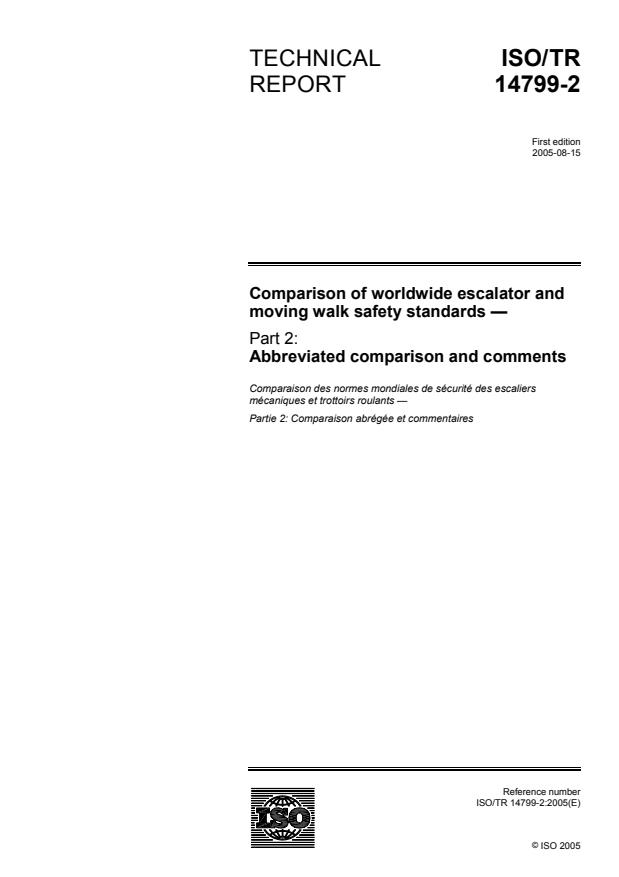
TECHNICAL ISO/TR
REPORT 14799-2
First edition
2005-08-15
Comparison of worldwide escalator and
moving walk safety standards —
Part 2:
Abbreviated comparison and comments
Comparaison des normes mondiales de sécurité des escaliers
mécaniques et trottoirs roulants —
Partie 2: Comparaison abrégée et commentaires
Reference number
©
ISO 2005
PDF disclaimer
This PDF file may contain embedded typefaces. In accordance with Adobe's licensing policy, this file may be printed or viewed but
shall not be edited unless the typefaces which are embedded are licensed to and installed on the computer performing the editing. In
downloading this file, parties accept therein the responsibility of not infringing Adobe's licensing policy. The ISO Central Secretariat
accepts no liability in this area.
Adobe is a trademark of Adobe Systems Incorporated.
Details of the software products used to create this PDF file can be found in the General Info relative to the file; the PDF-creation
parameters were optimized for printing. Every care has been taken to ensure that the file is suitable for use by ISO member bodies. In
the unlikely event that a problem relating to it is found, please inform the Central Secretariat at the address given below.
© ISO 2005
All rights reserved. Unless otherwise specified, no part of this publication may be reproduced or utilized in any form or by any means,
electronic or mechanical, including photocopying and microfilm, without permission in writing from either ISO at the address below or
ISO's member body in the country of the requester.
ISO copyright office
Case postale 56 • CH-1211 Geneva 20
Tel. + 41 22 749 01 11
Fax + 41 22 749 09 47
E-mail copyright@iso.org
Web www.iso.org
Published in Switzerland
ii © ISO 2005 – All rights reserved
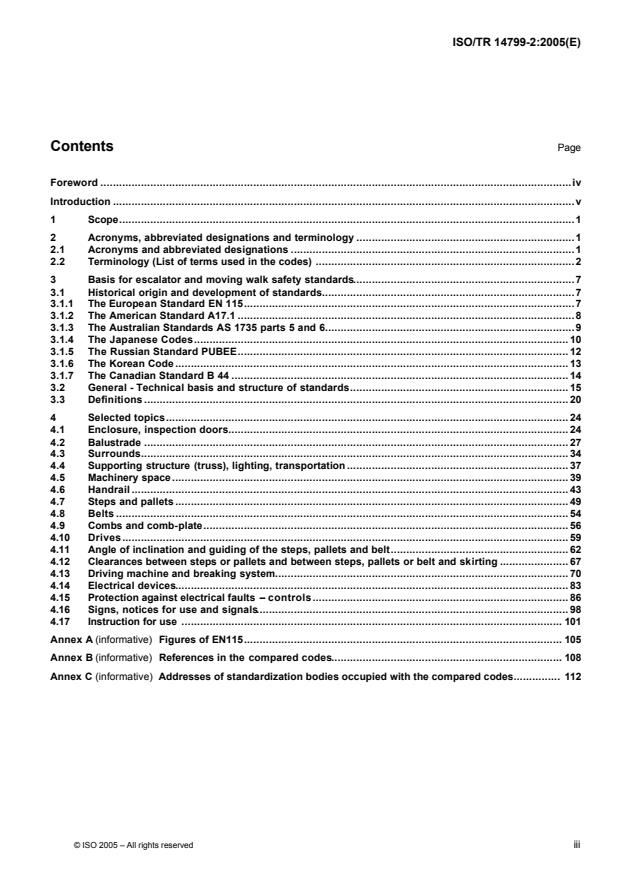
Contents Page
Foreword .iv
Introduction .v
1 Scope.1
2 Acronyms, abbreviated designations and terminology .1
2.1 Acronyms and abbreviated designations .1
2.2 Terminology (List of terms used in the codes) .2
3 Basis for escalator and moving walk safety standards.7
3.1 Historical origin and development of standards.7
3.1.1 The European Standard EN 115.7
3.1.2 The American Standard A17.1 .8
3.1.3 The Australian Standards AS 1735 parts 5 and 6.9
3.1.4 The Japanese Codes. 10
3.1.5 The Russian Standard PUBEE. 12
3.1.6 The Korean Code . 13
3.1.7 The Canadian Standard B 44 . 14
3.2 General - Technical basis and structure of standards. 15
3.3 Definitions . 20
4 Selected topics. 24
4.1 Enclosure, inspection doors. 24
4.2 Balustrade . 27
4.3 Surrounds. 34
4.4 Supporting structure (truss), lighting, transportation . 37
4.5 Machinery space . 39
4.6 Handrail . 43
4.7 Steps and pallets . 49
4.8 Belts . 54
4.9 Combs and comb-plate. 56
4.10 Drives. 59
4.11 Angle of inclination and guiding of the steps, pallets and belt. 62
4.12 Clearances between steps or pallets and between steps, pallets or belt and skirting . 67
4.13 Driving machine and breaking system. 70
4.14 Electrical devices. 83
4.15 Protection against electrical faults – controls. 86
4.16 Signs, notices for use and signals. 98
4.17 Instruction for use . 101
Annex A (informative) Figures of EN115. 105
Annex B (informative) References in the compared codes. 108
Annex C (informative) Addresses of standardization bodies occupied with the compared codes. 112
Foreword
ISO (the International Organization for Standardization) is a worldwide federation of national standards bodies
(ISO member bodies). The work of preparing International Standards is normally carried out through ISO
technical committees. Each member body interested in a subject for which a technical committee has been
established has the right to be represented on that committee. International organizations, governmental and
non-governmental, in liaison with ISO, also take part in the work. ISO collaborates closely with the
International Electrotechnical Commission (IEC) on all matters of electrotechnical standardization.
International Standards are drafted in accordance with the rules given in the ISO/IEC Directives, Part 2.
The main task of technical committees is to prepare International Standards. Draft International Standards
adopted by the technical committees are circulated to the member bodies for voting. Publication as an
International Standard requires approval by at least 75 % of the member bodies casting a vote.
In exceptional circumstances, when a technical committee has collected data of a different kind from that
which is normally published as an International Standard (“state of the art”, for example), it may decide by a
simple majority vote of its participating members to publish a Technical Report. A Technical Report is entirely
informative in nature and does not have to be reviewed until the data it provides are considered to be no
longer valid or useful.
Attention is drawn to the possibility that some of the elements of this document may be the subject of patent
rights. ISO shall not be held responsible for identifying any or all such patent rights.
ISO/TR 14799-2 was prepared by Technical Committee ISO/TC 178, Lifts, escalators and moving walks.
ISO/TR 14799 consists of the following parts, under the general title Comparison of worldwide escalator and
moving walk safety standards:
— Part 1: Rule by rule comparison
— Part 2: Abbreviated comparison and comments
iv © ISO 2005 – All rights reserved
Introduction
At the 1995 Plenary Meeting of ISO/TC 178, the work on a comparison of world-wide standards which includes the
American, Australian, European, Russian, and Japanese escalator and moving walk safety code was passed to
ISO/TC 178 WG 5 (Resolution Singapore 1995/114). In October 1995, Working Group 5 was officially formed to
carry out the task of preparing a cross reference between the relevant sections of these standards and to analyse
the differences on selected subjects. The goal at that time was to prepare a technical report which would provide
reference information to assist national committees when reviewing and revising individual standards which may
initiate a gradual convergence of the technical requirements. In 1996 the study was expanded to include the
Korean safety standard.
The content of this report is based on the information provided by the WG 5 members acting in personal capacity.
This Technical Report is intended to aid standards writers in developing their safety requirements, and to help
standards users understand the basis for the requirements as they are applied throughout the world.
This Technical Report is not intended to replace existing safety standards which may have been updated.
Conclusions are arrived at in some cases, but only where is unanimity amongst the various experts. In other cases,
the reasons for the divergent views are expressed.
This Technical Report must be read in conjunction with the various safety standards. Unless approved by the
relevant standard writing organisations the information contained in this report does not necessarily represent the
opinions of these standards writing organizations (see bibliography for references).
The Technical Report was done with the European Standard EN 115: 1995 and its amendment A1: 1998 as a
reference document shown as the only one in its normal sequence. All other codes are not in their normal
sequence and logical order. They are structured differently to EN 115. The result incorrectly leaves the impression
of incompleteness of these standards. These standards in their original structure inclusive of their references to
other standards and requirements are however complete.
TECHNICAL REPORT ISO/TR 14799-2:2005(E)
Comparison of worldwide escalator and moving walk safety
standards —
Part 2:
Abbreviated comparison and comments
1 Scope
This Technical Report consists of a comparison of the requirements of selected topics as covered by the following
world-wide safety standards (excluding local deviations):
a) Europe (CEN) – EN 115; Safety rules for the construction and installation of escalators and passenger
conveyors (Edition January 1995 and amendment A1: 1998);
b) USA - ASME A 17.1-1996; Safety Code for Elevators and Escalators
NOTE The requirements for Canada (B 44) are generally the same as for the USA. Any differences are stated in the text.
c) Australia - AS 1735 parts 5 and 6 for escalators and moving walks (Edition 1996);
d) Japan – Safety requirements mainly comprised of Building Standard Law Enforcement Order (BSLJ-EO),
Notifications of Ministry of Construction (MOC-N, No. 1110-1981) and draft of Japan Elevator Association
Standard (JEAS);
e) Russia – PUBEE 10-77-94, Regulations for the installation and safe use of escalators (Edition 1995);
f) Korea –The Elevator Inspection Standards, KATS 2001-414 Edition according to the Korea Elevator Law
4482, both cover the safety requirements on the escalator and moving walk.
It should be noted that in addition to the above listed standards and other regulations, escalators and moving walks
may be required to conform to the requirements of other standards as appropriate. Where ISO/TC 178/WG 5 was
aware of these standards they are mentioned in the bibliography.
2 Acronyms, abbreviated designations and terminology
2.1 Acronyms and abbreviated designations
The following acronyms and abbreviated designations are used by the codes compared when making reference to
regulations and organisations:
¾ ANSI American National Standards Institute
¾ AS Australian Standard
¾ ASME American Society of Mechanical Engineers
¾ BSLJ The Building Standard Law of Japan
¾ BSLJ-EO The Building Standard Law Enforcement Order (Japan)
¾ CEN/CENELEC Comité Européen de Normalisation (European Committee for Standardisation)
¾ CIRA Commission Internationale pour la Réglementation des Ascenseurs et Monte-charge
¾ CSA Canadian Standards Association
¾ EIS The Elevator Inspection Standard (Korea)
¾ EMSIS Elevator Manufacturing, Safety and Inspection Standard under KOSHA (Korea)
¾ EN European Norm (Standard)
¾ EUIL-MO Electrical Utilities Industry Law - Ministerial Ordinance of technical standards for electrical
equipment
¾ EXP. Explanation/ interpretation of BSLJ-EO, MOC-N (Japan)
¾ IEC International Electrotechnical Commission
¾ ISO International Organization for Standardization
¾ JEAC Japan Electrical Association Code
¾ JEAS Japan Elevator Association Standard
¾ JIS Japanese Industrial Standard
¾ KATS Korean agency for technology and standards
¾ KEL Korea Elevator Law
¾ KOSHA Korean Occupational Safety and Health Act
¾ MINR Ministry of Industry and Natural Resources (Korea)
¾ MITI Ministry of Trade and Industry (Korea)
¾ MOC-N Notifications of the Ministry of Construction (Japan)
¾ NEC National Electrical Code
¾ NFPA National Fire Protection Association (USA)
¾ OSHA Occupational Safety and Health Administration (USA)
¾ PUBEE Regulations for Installation and Safe Operation of Escalators (Russia)
2.2 Terminology (List of terms used in the codes)
Table 1 shows those terms which are used differently for the same item in the standards dealt with. Definitions in
the Russian, Japanese and Korean standard are based on unofficial translation whereas the terms in European,
American and Australian codes are official language.
The items in parenthesis reference the clauses where the terms are used in the various standards.
2 © ISO 2005 – All rights reserved
Table 1 — Differences in terminology (List of terms used in the codes)
AS 1735 parts 5 & 6
EN 115 (Europe) A 17.1 (USA) Japanese Regulations PUBEE (Russia) Korean Code
(Australia)
brake (additional) (5.5.2) main drive shaft brake emergency brake (5.2.6)
auxiliary brake (12.3.1, main drive shaft brake
12.4.1, 12.6) (804.3b)
deck board balustrade cornice
balustrade decking high deck balustrades
(5.1.5.1.4) (802.3g, 802.3h, 805.1b)
balustrade exterior exterior panel exterior panel
panelling (5.1.5.1.5)
interior panel
balustrade interior panelling interior panel 802.3a,
(5.1.5.1.3) 802.3d)
brake load (3.9b))
brake rated load (802.9c, brake rated load (5.5.1
804.3a, 904.3b, 805.1h) (parts 5 and 6), same as
rated load)
criss-cross (5.2.4, 7.3.1) crossed-trusses (3.3.6) criss-cross
factor of safety (9.1.2, design factor of safety factor of safety (2.7, 3.7, safety factor
9.2.1) (802.10) 5.2)
head-room (802.12) head-room (3.6.9) height above the steps
height above the steps height from the step (EIS
(7.3.1, 7.6) 4.3.2 (10))
inclination (10) 3.3.1 (2), (4)
slope/inclination (802.1, slope (2.157.19 (part 1),
802.9b, 802.9c) 2.3)
hatch cover (4.2)
inspection doors and trap access door/plate (US)
door (5.3) (806.1a, 806.1b, 806.3);
access (Can)
interior profile (5.1.5.1.2) low-deck interior (802.3d) transition (3.3.1.2, Fig. 2.2)
4 © ISO 2005 – All rights reserved
Table 1 (continued)
AS 1735 parts 5 & 6
EN 115 (Europe) A 17.1 (USA) Japanese Regulations PUBEE (Russia) Korean Code
(Australia)
multiplex chain (12.3.1) multi-strand chain
newel (5.1.5.1.6) handrail inlet
newel (802.3a, 802.6d, newel (2.157.15 (part 1),
805.1b, 805.1t,805.2b) 3.4.5)
not easy to ignite (0.5.1) non/limited combustible not combustible (3.1, 3.6) non/limited combustible
(801.1)
passenger conveyor moving walk moving walk moving (side) walk moving walk
a a
a a
rated load rated load
rated load (802.9, 802.9a, rated load (2.119 (part 1), rated load (4.3.1 (2) and
802.9b, 802.9c, 804.3a(2), 2.6 (parts 5 and 6)) (3))
804.3b, 805.1b
a a a
a
- speed of stepping plates
rated speed (3.6) rated speed (2.4) rated speed
rated speed (803, 803.1,
(3.3.1 (4))
805.1c)
- rated speed (EIS
Inspection Report)
skirting (3.5, 5.1.5.1.1) skirt guard (panel) skirting
skirt (panel) (802.3d, skirting (2.157.18 (part 1), skirt guard (4.3.1 (11) and
802.3e, 802.3f, 802.5d, 3.3.7 (part 5) (12))
805.1h)
structural load
structural rated load structural rated load (2.6.1
(802.9a) (part 6)
supporting structure (5.3) truss
truss 801, 801.1, 802.7, truss (2.157.21 (part 1),
802.9a, 802.10, 806.1, 3.2)
806.1b, 806.3)
comb plate (3.5) comb plate
supporting structure (of the comb plate (805.1h, 805.1k,
combs) (8.3.2.4, 8.3.2.6, 805.1s, 805.1u, 802.4b,
16.2.1.1.1) 802.6a, 807.3), access
plate (806.1b, 806.3)
Table 1 (continued)
AS 1735 parts 5 & 6
EN 115 (Europe) A 17.1 (USA) Japanese Regulations PUBEE (Russia) Korean Code
(Australia)
theoretical capacity (3.8) full capacity (2.1.1) carrying capacity
transport capacity (EIS
Inspection Report)
underside enclosure
(5.1.1.3)
machinery rated load machine rated load (same
(802.9b) as rated load in part 5),
2.6.2 (part 6)
conventional/modular
moving walk (802.9b,
802.9c, 802.10)
skirt obstruction device skirt pressure switch (6.16) skirt guard switch (JEAS-
(805.3f) 406G (draft), 2.1)
skirtless balustrade
(902.3e)
end plate (8.3, part 6)
stepping plate (generic
term for step, pallet,
rubber belt) (3.3.1 (2),
3.3.1 (3), 3.3.1 (4)
- fixed type handrail (3.3.1
(3), 4.3.2 (7))
- moving type handrail
(4.3.2 (4), 4.3.2 (5))
surface of stepping plate
(3.3.1 (2))
6 © ISO 2005 – All rights reserved
Table 1 (continued)
AS 1735 parts 5 & 6
EN 115 (Europe) A 17.1 (USA) Japanese Regulations PUBEE (Russia) Korean Code
(Australia)
non-reversal device
and/or braking device
(3.3.2 (7), 4.3.1 (4), 4.3.1
(5))
(diff. definition) flat step (802.6e) (diff. definition) (flat step)
a
definitions vary from code to code ( see annexes); terms in European, American and Australian code are official language
3 Basis for escalator and moving walk safety standards
3.1 Historical origin and development of standards
3.1.1 The European Standard EN 115
3.1.1.1 Why do we have EN 115?
The ever increasing number of escalators put in operation in Europe after the Second World War required the
drawing up of guidelines for models and safety for escalators, especially as not all European countries had their
own standard or National Regulation for escalators.
So, in the early 1960s specialists/experts from 7 European countries joined together and founded the “Commission
Internationale pour la Réglementation des Ascenseurs et Monte-charge“ (CIRA). The CIRA draft for escalators was
produced in June 1972, containing safety guidelines for escalators to protect persons and objects against possible
accidents and injury.
The Technical Committee CEN/TC10 “lifts“ established the group WG2 in June 1974 with the request to prepare a
draft European Standard for escalators and moving walks.
The convenorship of this work group was initially given to a member of the German delegation. In December 1974
the German convenor distributed a first proposal for the construction and installation of escalators founded on the
CIRA guidelines, which after careful examination through the “CEN/TC10 WG2“ was submitted to all member
countries of the CEN for consideration in June 1977.
It should be noted that the EC Committee BTS2 gave the CEN a mandate for drawing up this standard in 1976.
Finally following a second and a third draft the final edition of the European Standard EN 115 was prepared and
accepted by CEN on 3rd January, 1995 (firstly amended January 1998).
According to the Internal Regulations of CEN/ CENELEC, the CEN Members are bound to give this EN 115 the
status of a National Standard without any national deviations.
The following countries are CEN Members:
Austria, Belgium, Czech Republic, Denmark, Germany, Finland, France, Greece, Ireland, Italy, Luxembourg, the
Netherlands, Norway, Portugal, Sweden, Switzerland, Spain and the United Kingdom.
3.1.1.2 How did we get EN 115?
The drawing up of the harmonised European Standard removed the technical trade restraints on the escalators and
moving walks within the CEN countries listed above. The safety level of the CIRA Directives Edition June 1972 and
the existing national regulations or standards of the CEN Member States essentially became reference documents
which illustrate how the new standard was derived.
Therefore all CEN members are bound to follow the CEN/ CENELEC requirements and all national standards for
escalators and moving walks are superseded by the harmonised EN 115 standard.
3.1.1.3 What is the code (law, standard, requirement)?
The purpose of the EN 115 is to define minimum safety requirements in order to reduce the possibility of accidents
on escalators and moving walks.
The harmonised standard is essentially a method of demonstrating compliance with the essential safety
requirements of the machinery directive which is embodied in the laws of each country member of CEN/CENELEC
and therefore demonstrates compliance with the laws of the member states.
3.1.1.4 Is EN 115 a compulsory standard?
Some exceptions are possible (such as sections 0.3 and 1.3).
3.1.1.5 Is EN 115 a technical description, a requirement or a recommendation?
Compliance with EN 115 is one way to satisfy the requirements of the European Machinery Directive.
3.1.1.6 Is EN 115 a performance or a design standard?
EN 115 has to be considered as a minimum requirement for safe operation of escalators and moving walks.
3.1.2 The American Standard A17.1
3.1.2.1 Why do we have A17.1?
A17.1 is intended to enhance public health and safety. It serves as the basis for state, municipal, and other
jurisdictional authorities in drafting regulations governing the installation, testing, inspection, maintenance,
alteration, and repair of elevators, dumbwaiters, escalators, moving walks, material lifts with automatic transfer
devices, wheelchair lifts, and stairway chair lifts. It is also intended as a standard reference of safety requirements
for the guidance of architects, engineers, insurance companies, manufacturers, and contractors, and as a standard
of safety practices for owners and managements of structures where equipment covered in the Scope of the Code
is used.
3.1.2.2 How did we get A17.1?
The use of elevators and escalators began to rapidly expand in the early 1900’s, as larger and taller buildings were
transforming American cities into high rise population centers. With the growth of the elevator industry, came a
proliferation of new manufacturers and maintenance organizations that lacked the knowledge and background of
the industry developers. They often, because of this lack of experience, failed to understand or enforce safe
practices in the work they performed.
It became apparent that in order for these cities with their high rise buildings to remain viable, the public had to
have unwavering faith in the safety of the elevators that made these buildings usable. A safety code developed by
experts in the field of vertical transportation would help develop this public confidence.
In 1915, ASME assembled a committee of engineers who were knowledgeable about elevators and charged them
with developing a set of standards for elevator manufacturers, architects, consulting engineers, insurance
inspectors, and building owners. The committee recognized the harmful influence of wear, rough usage, and
atmospheric conditions under which elevator apparatus must operate, particularly on door locks, interlocks, and
electrical contacts.
This effort resulted in the first edition of the A17.1 code being developed in 1921. New editions are periodically
published, which in recent years has been every third year. An addenda is published annually between editions.
The 16th edition is now in the process of being finalized and published.
3.1.2.3 What is the code (law, standard, requirement)?
The A17.1 Safety Code for Elevators and Escalators is a voluntary reference standard that is used by people and
organizations involved in the industry. Developed by a consensus of experts in the industry, it is used to guide them
in maintaining a high level of safety in their respective functions.
After it is developed by the ASME under the auspices and consensus procedures established by ANSI, it becomes
an American National Standard.
3.1.2.4 Is A17.1 a compulsory standard?
As published, A17.1 is a voluntary standard. It is used by authorities having jurisdiction as a basis for the code they
enforce and becomes law when the governing legislative body over their jurisdiction, adopts it.
8 © ISO 2005 – All rights reserved
3.1.2.5 Is A17.1 a technical description, a requirement or a recommendation?
A17.1 presents most of its requirements as mandatory when following the standard. However, some rules may be
in the form of a permissive recommendation.
3.1.2.6 Is A17.1 a performance or a design standard?
The A17.1 code is developed as a performance standard under the procedures established by the ASME. Because
of the unique nature of the industry, some rules are of a design nature, but efforts are continually underway to
replace them with performance language.
3.1.3 The Australian Standards AS 1735 parts 5 and 6
3.1.3.1 Why do we have AS 1735 parts 5 and 6?
The mission statement of Standards Australia (The body writing the above mentioned standards in Australia) states
the general position relative to having appropriate standards namely:
"To excel in meeting the needs of Australia's technical infrastructure for contemporary, internationally aligned
Standards and related services which enhance the nation's economic efficiency, international competitiveness, and
fulfil community desire for a safe and sustainable environment"
In the specific case of escalators and moving walks, the accent is on writing standards that provide for a minimum
level of safety for the users of these units and for the mechanics servicing the equipment.
All state government safety relevant acts provide for public and employee safety.
The "Occupational Health and Safety Acts", through their regulations and code of practices, require escalators and
moving walks comply with the provisions in AS 1735 parts 5 and 6. (In the case of Victoria the requirement is to
employ "published technical standards" in the hazard control process and AS 1735 is the example shown in the
code of practice tables).
AS 1735 parts 5 and 6 are the "reference tools" employed by the various state inspectorates of lifts, escalators and
moving walks and they form the basis of the newly emerging self regulatory legislative frame work.
3.1.3.2 How did we get AS 1735 parts 5 and 6?
Standards Australia was founded in 1922. Its original name was the Australian Commonwealth Engineering
Standards Association. It became the Standards Association of Australia in 1929 and in 1950, it was granted a
Royal Charter. In 1988 its trading name was changed to Standards Australia.
The workings of the original Australian Commonwealth Engineering Standards Association was to produce hand-
written minutes of all meetings in minute books.
The first reference to escalator installations can be found in a record dated 18 July 1932.
The first reference to glass is in the 1935 edition of the standard ASCA3. (ASCA 3 is the predecessor to AS 1735).
In a 1944 minute book there is a reference to A.S.A. 17.1 1937.
Standards were and are produced under the umbrella of Standards Australia and its predecessors by an open
process of consultation and consensus in which all interested parties are invited to participate.
Specifically the interested parties in AS 1735 parts 5 and 6 are the lift companies, governmental institutions,
consultants, architects and, through an owners association, the users.
3.1.3.3 What is the code (law, standard, requirement)?
The intent and purpose of AS 1735 Parts 5 and 6 is to prescribe uniform requirements for use within Australia and
Australian territories that will provide for the safety of the users and mechanics of escalators and moving walks.
3.1.3.4 Are AS 1735 parts 5 and 6 compulsory?
AS 1735 parts 5 and 6 on their own have no legal standing however the standards are cited in all state government
safety relevant acts.
The "Occupational Health and Safety Acts" in force in all states and territories with the exception of Victoria make
AS 1735 parts 5 and 6, through their regulations and code of practices, compulsory.
(In the case of Victoria the requirement is to employ "published technical standards" in the hazard control process.
AS 1735 is an example shown in the Victoria code of practice tables as one standard that may be employed as a
specification for hazard control with the design and manufacture of escalators and moving walks)
3.1.3.5 Are AS 1735 parts 5 and 6 technical descriptions, requirements or recommendations?
AS 1735 parts 5 and 6 contain all of the above to form a standard for escalators and moving walks.
Technical descriptions show up in the nomenclature as well as in the clauses. The contents of the clauses are,
when the standards are called up, compulsory requirements and the notes may be read as recommendations or as
one example of satisfying a particular requirement.
3.1.3.6 Are AS 1735 parts 5 and 6 performance or design standards?
AS 1735 parts 5 and 6 are prescriptive design standards.
NOTE At this point in time (May 1999) a change over to adopting EN 115 as the basis for AS 1735 parts 5 & 6 is nearly
complete. The amended standard AS 1735 part 5 will contain both escalators and moving walks.
Part 6 is being reserved for accelerating moving walks and will be revisited in the last quarter of the year 2000.
The next version of AS 1735 part 5 will contain as a basis the content of EN 115.
The EN 115 content will be amended to reflect Australian requirements. To indicate a change or an additional requirement to EN
115, appropriate markings are being inserting alongside the EN 115 text. The substance of an amendment of an item indicated
will be contained in an amendment section appended at the rear of the publication.
3.1.4 The Japanese Codes
3.1.4.1 Why do we have Japanese Codes?
3.1.4.2 How did we get Japanese Codes?
Japanese codes are comprised of the following laws and standards.
3.1.4.2.1 The Building Standard law of Japan (BSLJ)
3.1.4.2.1.1 Enactment of the law
This law was enacted in May 1950 and has been revised several times.
3.1.4.2.1.2 Purpose of this law
The purpose of the law is to safeguard the life, health, and property of people by providing minimum standards
concerning the site, construction, equipment, and, use of buildings and thereby to contribute to the furtherance of
the public welfare.
3.1.4.2.1.3 Equipment of buildings
Equipment of buildings are electricity, gas, water supply, drain, ventilation, heating, air-conditioning, fire
extinguishing, smoke removal or equipment of dirt disposal, chimneys, elevatory equipments, lightning conductors.
10 © ISO 2005 – All rights reserved
3.1.4.2.1.4 Elevatory equipment (Article 36)
Concerning elevatory equipments, technical standards which are required for safety, fire prevention, appropriate
sanitation are specified by Cabinet Order.
3.1.4.2.2 The Building Standard Law Enforcement Order (BSLJ-EO)
3.1.4.2.2.1 This order was established in November 1950 and has been revised several times.
3.1.4.2.2.2 Construction of escalators is described in Article 129-11.
3.1.4.2.2.3 Structural calculation for escalators is described in Article 129-13.
3.1.4.2.3 Notifications of the Ministry of Construction (MOC-N)
The notifications describe an indistinct part of BSLJ and BSLJ-EO.
The following notifications relate to the escalators and moving walks:
¾ No.1110: Case establishing construction standards for escalators of special construction
¾ No.1825: Case specifying persons, etc. having qualifications for periodical inspection of special buildings
3.1.4.2.4 Japanese Industrial Standard (JIS)
3.1.4.2.4.1 This standard was established by Ministry of International Trade and Industry in 1949. JIS A 4302
(Inspection Standard of Elevator, Escalator and Dumbwaiter) has been published in 1964 as the first edition and
revised several times.
3.1.4.2.4.2 This standard stipulates inspection items, inspection apparatus method and standard of judgement
in order to inspect the safety concerning traction type elevator, escalator, moving walk and electrical dumbwaiter
installed in building, structure, etc.
NOTE Moving walk is treated therein as escalator of special construction.
3.1.4.2.4.3 Escalators and moving walks are described in item 4.4.
3.1.4.2.5 Japan Elevator Association Standard (JEAS)
3.1.4.2.5.1 This standard was established in June 1974 and has been revised several times.
3.1.4.2.5.2 The purpose of this standard is to stipulate the universal standard for elevator and escalator
industry unifying the correct application and method of laws, JIS, etc. and thereby to facilitate to the negotiation
with the competent authorities.
3.1.4.2.5.3 It is recommended that some of the content stipulated be enacted as law or incorporated into JIS.
3.1.4.2.6 Electrical Utilities Industry Law Ministerial Ordinance of technical standards for Electrical
Equipment (EUIL-MO)
3.1.4.2.6.1 The standard was established in July 1965 as the Ministerial Ordinance of the Ministry of
International Trade and Industry, and shall be revised if deemed necessary.
3.1.4.2.6.2 The purpose of the standard is to safeguard the applicable electrical apparatus.
3.1.4.2.6.3 This stipulates the facility standard where enclosed electrical apparatus both for commercial and
home use.
3.1.4.2.7 Japan Electrical Association Code (JEAC)
3.1.4.2.7.1 This code was established in November 1963 and shall be revised if deemed necessary.
3.1.4.2.7.2 The purpose of this code is to safeguard the applicable electrical apparatus and contribute to the
convenient electricity use.
3.1.4.2.7.3 The code shall to electrical apparatus both for commercial and home use. Provided it shall not
stipulate anything concerning facilities of vessels, vehicles or air planes.
3.1.4.2.7.4 The code stipulates the technical matters subjected to follow, so that no humans or animals may
be exposed to any hazard by electrical apparatus or products.
3.1.4.3 What is the code (law, standard, requirement)?
The codes consist of four kinds of laws (BSLJ, BSLJ-EO, MOC-N, and EUIL-MO) and three kinds of standards
(JIS, JEAS and JEAC).
3.1.4.4 Are the Japanese Codes compulsory standards?
The Japanese codes are compulsory standards.
3.1.4.5 Are the Japanese Codes a technical description, a requirement or a recommendation?
The Japanese codes are technical descriptions, requirements, and recommendations.
3.1.4.6 Are the Japanese codes performance or design standards?
The Japanese codes are considered as performances and design standards.
3.1.5 The Russian Standard PUBEE
3.1.5.1 Why do we have the Russian Code?
The Regulations for Installation and Safe Operation of Escalators (PUBEE) of Russia set safety requirements to the
design and manufacture, installation and modernisation, repairs and operation of escalators.
PUBEE is compulsory for all organisations and companies independently of forms of property.
3.1.5.2 How did we get PUBEE?
Escalators began to be widely used in the former USSR in the 1930s and the 1940, in the period of construction of
the Moscow Metropolitan.
As a result, for the first time during those years there were made effective safety rules for escalators, which were
periodically reviewed. The latest edition of PUBEE was released in 1995 to replace the 1977 edition of the
document.
Within the whole effective period, PUBEE has been updated and its fulfilment controlled by a special technical
service - the technical supervision body. This supervision body changed its official name more than once. Now it is
called the Federal Mining and Industrial Supervision Body of Russia (Gosgortekhnadzor of Russia).
3.1.5.3 What is the code (law, standard, requirement)?
PUBEE's level is that of a standard.
3.1.5.4 Is PUBEE a compulsory standard?
PUBEE is the standard obligatory for the application during design and manufacture, installation and operation,
repairs and modernisation of escalators.
12 © ISO 2005 – All rights reserved
PUBEE is compulsory for all organisations and companies independently of forms of property.
3.1.5.5 Is PUBEE a technical description, a requirement or a recommendation?
Safety requirements are the main content of PUBEE.
3.1.5.6 Is PUBEE a performance or a design standard?
As far as design requirements are concerned, the latest edition of PUBEE is certainly a design standard.
3.1.6 The Korean Code
3.1.6.1 Why do we have the Korean Code?
In the middle of 1980 the total number of elevators has been increased quite fast. The number of accident has
been increasing while the local market restriction was abolished in 1985, so that the necessity to control the
elevators and escalators safety had been recognised.
KOSHA, Korean Occupational Safety and Health Act expanded its scope to the elevators and escalators in 1986 in
order to secure the occupational safety at the work place.
KEL (Korea Elevator Law) 4482, formulated in 1991, defines its purpose in article 1 that "to improve quality of
elevators (including escalators) and ensure the users' safety."
3.1.6.2 How did we get the Korean Code?
The Korean elevator market had been protected by the Korean Government from 1970 to 1985. Through out the
period only few suppliers got the business license with the condition to submit technology transfer plan.
Before 1985 the necessity for an elevator code was not so high. But since the market became free and everyone
could import or make elevator components or products. It was obvious that a certain elevator code had to be
developed in Korea.
The KOSHA expanded the scope into the elevator safety in 1986 led by industrial safety people and developed a
system. But the system did not work well.
From 1988 to 1991 the industry had campaigned to develop a special law on elevator. Eventually the efforts made
successful results so that KEL 4482 was formulated in December 1991 which became the one of five laws related
to industrial standardisation and quality.
3.1.6.3 What is the code (law, standard, requirement)?
3.1.6.4 Is the Korean Code a compulsory standard?
KEL 4482 is the law having mandatory regulations. The technical standards comprise the parts of the law.
3.1.6.5 Is the Korean Code a technical description, a requirement or a recommendation?
3.1.6.6 Is the Korean Code a performance or a design standard?
The law likely prescribes performance requirement rather than design requirement. But for the major components
the law addresses the type approval and registration. The type approval standards are technical requirement
specifying the detail of components so that non-compliant parts or components cannot be used in Korea.
In case of escalator inspection standard, non-compatible area between A 17.1 and EN 115 was excluded in order
to avoid the trade conflict. As the results the standard has been loosely shaped excluding critical contents.
NOTE The total number of escalator installation shows 5200 units in July 1998. The accident rates are relatively lower that
one fatality and 3 injuries were reported since the last 5 years. The accident rates are almost double to the elevators and the
higher rates are expected in the future.
The Korean situation shows that the design standard is not preferable because it has mandatory legal system to retrospectively
effective to the all escalators even some are exempted by the tenor clauses.
3.1.7 The Canadian Standard B 44
Harmonisation efforts between A 17 and B44 were being made during the time when this report was being
produced.
References to B44 were made where B44 differed from A 17.1.
14 © ISO 2005 – All rights reserved
3.2 General - Technical basis and structure of standards
NOTE Committee's comments are shown in italics.
Table 2 — Technical basis and structure of standards
EN 115 (Europe) * A 17.1 (USA) AS 1735 (Australia) Japanese Codes PUBEE (Russia) Korean Code
Foreword Preface
3.2-Foreword: A 17.1 and EN 115 have the same intent of safety. Furthermore, A 17.1 serves as a reference standard for other authorities to draft regulations. The Australian
standard sets out uniform requirements for escalators and moving walks. It is not a legal paper in its own right. The Japanese code is a law. The Russian standard is part of the law
and applies to escalators only. The Korean code is part of a law (Health and Safety Act). Even when it is not written down in anyone of the above mentioned documents, it is always
the intention to deal with safety.
0 Introduction
0: safety and construction construction, testing, design, new equipment described in BSLJ-EO tunnel and floor
standard; safe use alteration; operation, repair, 129-3 for escalators escalators, not for
inspec
...
Questions, Comments and Discussion
Ask us and Technical Secretary will try to provide an answer. You can facilitate discussion about the standard in here.
Loading comments...