


ISO/IEEE 11073-10407:2010
(Main)Health informatics — Personal health device communication — Part 10407: Device specialization — Blood pressure monitor
Health informatics — Personal health device communication — Part 10407: Device specialization — Blood pressure monitor
ISO/IEEE 11073-10407:2010 establishes a normative definition of communication between personal telehealth blood pressure monitor devices and computer engines (e.g., cell phones, personal computers, personal health appliances, and set top boxes) in a manner that enables plug-and-play interoperability. It leverages appropriate portions of existing standards including ISO/IEEE 11073 terminology, information models, application profile standards, and transport standards. It specifies the use of specific term codes, formats, and behaviours in telehealth environments restricting optionality in base frameworks in favour of interoperability. This International Standard defines a common core of communication functionality for personal telehealth blood pressure monitors. ISO/IEEE 11073-10407:2010 addresses a need for an openly defined, independent standard for controlling information exchange to and from personal health devices and computer engines.
Informatique de santé — Communication entre dispositifs de santé personnels — Partie 10407: Spécialisation des dispositifs — Moniteur de pression sanguine
L'ISO/IEEE 11073-10407:2010 établit une définition normative de la communication entre des dispositifs de moniteurs de pression sanguine personnels de télésanté et des moteurs informatiques (par exemple des téléphones cellulaires, des ordinateurs personnels, des équipements personnels de santé et des boîtiers décodeurs) d'une manière qui permet une interopérabilité du type prêt à l'emploi. Elle s'appuie sur les parties appropriées de normes existantes, y compris la terminologie, des modèles d'informations, des normes de profils d'applications et des normes de transport de l'ISO/IEEE 11073. Elle spécifie l'utilisation de codes, de formats et de comportements en termes spécifiques dans les environnements de télésanté, en limitant les choix à des cadres de travail de base en faveur de l'interopérabilité. Elle définit un noyau commun de fonctionnalités de communication pour les moniteurs de pression sanguine personnels de télésanté. L'ISO/IEEE 11073-10407:2010 répond au besoin d'une norme indépendante définie de manière ouverte portant sur la commande de l'échange d'informations entre des dispositifs personnels de santé et des moteurs informatiques.
General Information
- Status
- Withdrawn
- Publication Date
- 18-Apr-2010
- Technical Committee
- ISO/TC 215 - Health informatics
- Drafting Committee
- ISO/TC 215 - Health informatics
- Current Stage
- 9599 - Withdrawal of International Standard
- Start Date
- 15-Dec-2022
- Completion Date
- 12-Feb-2026
Relations
- Effective Date
- 12-Feb-2026
- Effective Date
- 06-Jun-2022
- Effective Date
- 06-Jun-2022


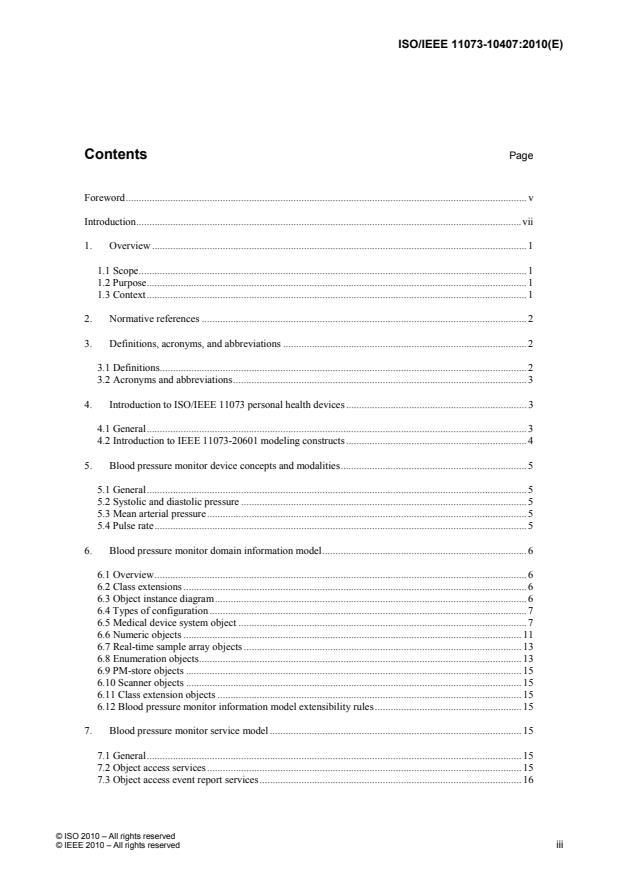
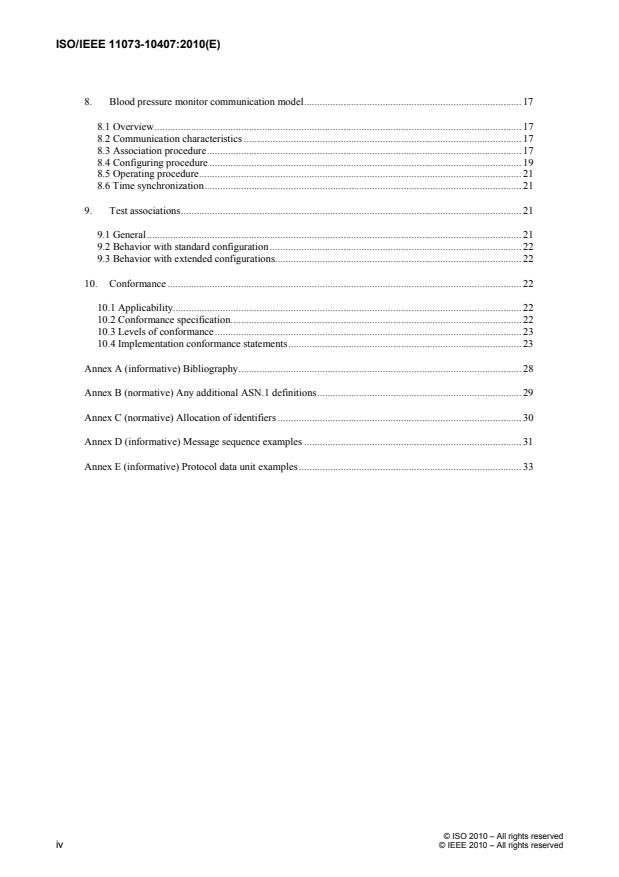
ISO/IEEE 11073-10407:2010 - Health informatics -- Personal health device communication
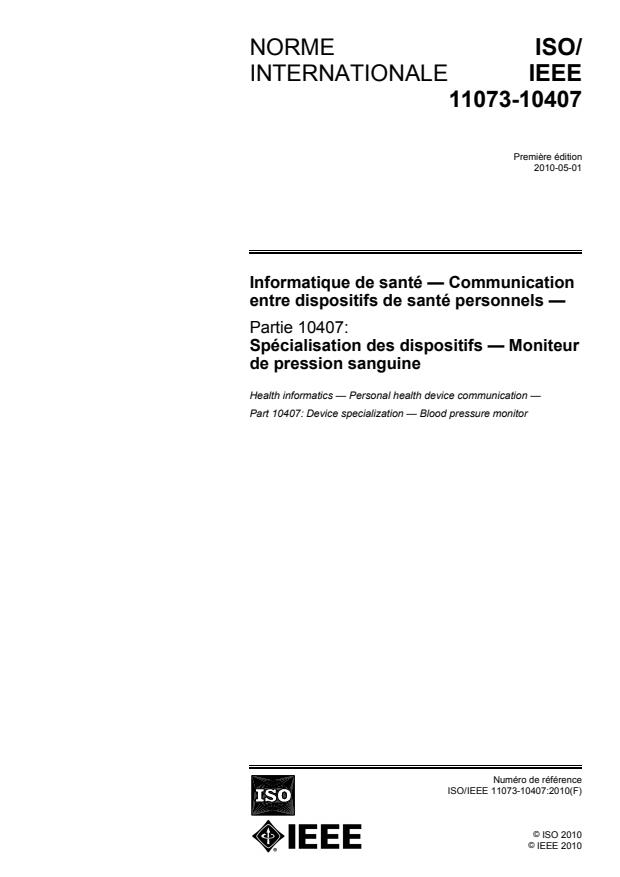

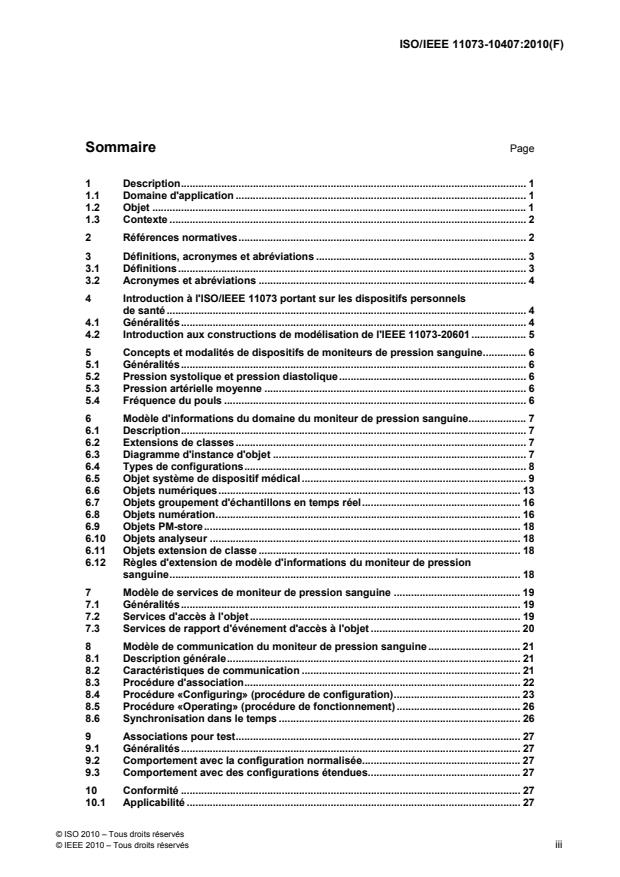

ISO/IEEE 11073-10407:2010 - Informatique de santé -- Communication entre dispositifs de santé personnels
Get Certified
Connect with accredited certification bodies for this standard

BSI Group
BSI (British Standards Institution) is the business standards company that helps organizations make excellence a habit.

NYCE
Mexican standards and certification body.
Sponsored listings
Frequently Asked Questions
ISO/IEEE 11073-10407:2010 is a standard published by the International Organization for Standardization (ISO). Its full title is "Health informatics — Personal health device communication — Part 10407: Device specialization — Blood pressure monitor". This standard covers: ISO/IEEE 11073-10407:2010 establishes a normative definition of communication between personal telehealth blood pressure monitor devices and computer engines (e.g., cell phones, personal computers, personal health appliances, and set top boxes) in a manner that enables plug-and-play interoperability. It leverages appropriate portions of existing standards including ISO/IEEE 11073 terminology, information models, application profile standards, and transport standards. It specifies the use of specific term codes, formats, and behaviours in telehealth environments restricting optionality in base frameworks in favour of interoperability. This International Standard defines a common core of communication functionality for personal telehealth blood pressure monitors. ISO/IEEE 11073-10407:2010 addresses a need for an openly defined, independent standard for controlling information exchange to and from personal health devices and computer engines.
ISO/IEEE 11073-10407:2010 establishes a normative definition of communication between personal telehealth blood pressure monitor devices and computer engines (e.g., cell phones, personal computers, personal health appliances, and set top boxes) in a manner that enables plug-and-play interoperability. It leverages appropriate portions of existing standards including ISO/IEEE 11073 terminology, information models, application profile standards, and transport standards. It specifies the use of specific term codes, formats, and behaviours in telehealth environments restricting optionality in base frameworks in favour of interoperability. This International Standard defines a common core of communication functionality for personal telehealth blood pressure monitors. ISO/IEEE 11073-10407:2010 addresses a need for an openly defined, independent standard for controlling information exchange to and from personal health devices and computer engines.
ISO/IEEE 11073-10407:2010 is classified under the following ICS (International Classification for Standards) categories: 35.240.80 - IT applications in health care technology. The ICS classification helps identify the subject area and facilitates finding related standards.
ISO/IEEE 11073-10407:2010 has the following relationships with other standards: It is inter standard links to EN ISO 11073-10407:2011, ISO 11140-4:2001, ISO/IEEE 11073-10407:2022. Understanding these relationships helps ensure you are using the most current and applicable version of the standard.
ISO/IEEE 11073-10407:2010 is available in PDF format for immediate download after purchase. The document can be added to your cart and obtained through the secure checkout process. Digital delivery ensures instant access to the complete standard document.
Standards Content (Sample)
INTERNATIONAL ISO/IEEE
STANDARD 11073-10407
First edition
2010-05-01
Health informatics — Personal health
device communication —
Part 10407:
Device specialization — Blood pressure
monitor
Informatique de santé — Communication entre dispositifs de santé
personnels —
Partie 10407: Spécialisation des dispositifs — Moniteur de pression
sanguine
Reference number
©
ISO 2010
©
IEEE 2010
PDF disclaimer
This PDF file may contain embedded typefaces. In accordance with Adobe's licensing policy, this file may be printed or viewed but
shall not be edited unless the typefaces which are embedded are licensed to and installed on the computer performing the editing. In
downloading this file, parties accept therein the responsibility of not infringing Adobe's licensing policy. Neither the ISO Central
Secretariat nor IEEE accepts any liability in this area.
Adobe is a trademark of Adobe Systems Incorporated.
Details of the software products used to create this PDF file can be found in the General Info relative to the file; the PDF-creation
parameters were optimized for printing. Every care has been taken to ensure that the file is suitable for use by ISO member bodies
and IEEE members. In the unlikely event that a problem relating to it is found, please inform the ISO Central Secretariat or IEEE at the
address given below.
© ISO 2010
© IEEE 2010
All rights reserved. Unless otherwise specified, no part of this publication may be reproduced or utilized in any form or by any means,
electronic or mechanical, including photocopying and microfilm, without permission in writing from either ISO or IEEE at the respective
address below.
ISO copyright office Institute of Electrical and Electronics Engineers, Inc.
Case postale 56 • CH-1211 Geneva 20 3 Park Avenue, New York • NY 10016-5997, USA
Tel. + 41 22 749 01 11 E-mail stds.ipr@ieee.org
Fax + 41 22 749 09 47 Web www.ieee.org
E-mail copyright@iso.org
Web www.iso.org
Published in Switzerland
ii © IEEE 2010 – All rights reserved
Contents Page
Foreword. v
Introduction.vii
1. Overview . 1
1.1 Scope. 1
1.2 Purpose. 1
1.3 Context. 1
2. Normative references . 2
3. Definitions, acronyms, and abbreviations . 2
3.1 Definitions. 2
3.2 Acronyms and abbreviations. 3
4. Introduction to ISO/IEEE 11073 personal health devices . 3
4.1 General. 3
4.2 Introduction to IEEE 11073-20601 modeling constructs. 4
5. Blood pressure monitor device concepts and modalities. 5
5.1 General. 5
5.2 Systolic and diastolic pressure . 5
5.3 Mean arterial pressure. 5
5.4 Pulse rate. 5
6. Blood pressure monitor domain information model. 6
6.1 Overview. 6
6.2 Class extensions . 6
6.3 Object instance diagram. 6
6.4 Types of configuration . 7
6.5 Medical device system object . 7
6.6 Numeric objects . 11
6.7 Real-time sample array objects . 13
6.8 Enumeration objects. 13
6.9 PM-store objects . 15
6.10 Scanner objects . 15
6.11 Class extension objects . 15
6.12 Blood pressure monitor information model extensibility rules. 15
7. Blood pressure monitor service model . 15
7.1 General. 15
7.2 Object access services. 15
7.3 Object access event report services. 16
© IEEE 2010 – All rights reserved iii
8. Blood pressure monitor communication model. 17
8.1 Overview. 17
8.2 Communication characteristics . 17
8.3 Association procedure. 17
8.4 Configuring procedure . 19
8.5 Operating procedure. 21
8.6 Time synchronization. 21
9. Test associations. 21
9.1 General. 21
9.2 Behavior with standard configuration . 22
9.3 Behavior with extended configurations. 22
10. Conformance . 22
10.1 Applicability. 22
10.2 Conformance specification. 22
10.3 Levels of conformance. 23
10.4 Implementation conformance statements. 23
Annex A (informative) Bibliography. 28
Annex B (normative) Any additional ASN.1 definitions. 29
Annex C (normative) Allocation of identifiers . 30
Annex D (informative) Message sequence examples . 31
Annex E (informative) Protocol data unit examples. 33
iv © IEEE 2010 – All rights reserved
Foreword
ISO (the International Organization for Standardization) is a worldwide federation of national
standards bodies (ISO member bodies). The work of preparing International Standards is
normally carried out through ISO technical committees. Each member body interested in a
subject for which a technical committee has been established has the right to be represented on
that committee. International organizations, governmental and non-governmental, in liaison with
ISO, also take part in the work. ISO collaborates closely with the International Electrotechnical
Commission (IEC) on all matters of electrotechnical standardization.
IEEE Standards documents are developed within the IEEE Societies and the Standards
Coordinating Committees of the IEEE Standards Association (IEEE-SA) Standards Board. The
IEEE develops its standards through a consensus development process, approved by the
American National Standards Institute, which brings together volunteers representing varied
viewpoints and interests to achieve the final product. Volunteers are not necessarily members of
the Institute and serve without compensation. While the IEEE administers the process and
establishes rules to promote fairness in the consensus development process, the IEEE does not
independently evaluate, test, or verify the accuracy of any of the information contained in its
standards.
The main task of technical committees is to prepare International Standards. Draft International
Standards adopted by the technical committees are circulated to the member bodies for voting.
Publication as an International Standard requires approval by at least 75 % of the member bodies
casting a vote.
Attention is called to the possibility that implementation of this standard may require the use of
subject matter covered by patent rights. By publication of this standard, no position is taken with
respect to the existence or validity of any patent rights in connection therewith. ISO/IEEE is not
responsible for identifying essential patents or patent claims for which a license may be required,
for conducting inquiries into the legal validity or scope of patents or patent claims or determining
whether any licensing terms or conditions provided in connection with submission of a Letter of
Assurance or a Patent Statement and Licensing Declaration Form, if any, or in any licensing
agreements are reasonable or non-discriminatory. Users of this standard are expressly advised that
determination of the validity of any patent rights, and the risk of infringement of such rights, is
entirely their own responsibility. Further information may be obtained from ISO or the IEEE
Standards Association.
ISO/IEEE 11073-10407 was prepared by the 11073 Committee of the Engineering in Medicine
and Biology Society of the IEEE (as IEEE Std 11073-10407-2008). It was adopted by Technical
Committee ISO/TC 215, Health informatics, in parallel with its approval by the ISO member
bodies, under the “fast-track procedure” defined in the Partner Standards Development
Organization cooperation agreement between ISO and IEEE. Both parties are responsible for the
maintenance of this document.
ISO/IEEE 11073 consists of the following parts, under the general title Health informatics —
Personal health device communication (text in parentheses gives a variant of subtitle):
— Part 10101: (Point-of-care medical device communication) Nomenclature
— Part 10201: Domain information model
— Part 10404: Device specialization — Pulse oximeter
© IEEE 2010 – All rights reserved v
— Part 10407: Device specialization — Blood pressure monitor
— Part 10408: (Point-of-care medical device communication) Device specialization —
Thermometer
— Part 10415: (Point-of-care medical device communication) Device specialization — Weighing
scale
— Part 10417: Device specialization — Glucose meter
— Part 10471: (Point-of-care medical device communication) Device Specialization —
Independant living activity hub
— Part 20101: (Point-of-care medical device communication) Application profiles — Base
standard
— Part 20601: (Point-of-care medical device communication) Application profile — Optimized
exchange protocol
— Part 30200: (Point-of-care medical device communication) Transport profile — Cable
connected
— Part 30300: (Point-of-care medical device communication) Transport profile — Infrared
wireless
vi © IEEE 2010 – All rights reserved
Introduction
ISO/IEEE 11073 standards enable communication between medical devices and external computer systems.
a
This document uses the optimized framework created in IEEE Std 11073-20601 and describes a specific,
interoperable communication approach for blood pressure monitors. These standards align with and draw
on the existing clinically focused standards to provide support for communication of data from personal
health devices.
a
Information on references can be found in Clause 2.
© IEEE 2010 – All rights reserved vii
INTERNATIONAL STANDARD ISO/IEEE 11073-10407:2010(E)
Health informatics — Personal health device
communication —
Part 10407:
Device specialization — Blood pressure monitor
IMPORTANT NOTICE: This standard is not intended to ensure safety, security, health, or
environmental protection in all circumstances. Implementers of the standard are responsible for
determining appropriate safety, security, environmental, and health practices or regulatory
requirements.
This IEEE document is made available for use subject to important notices and legal disclaimers. These
notices and disclaimers appear in all publications containing this document and may be found under the
heading “Important Notice” or “Important Notices and Disclaimers Concerning IEEE Documents.”
They can also be obtained on request from IEEE or viewed at http://standards.ieee.org/IPR/disclaimers.html.
1. Overview
1.1 Scope
Within the context of the ISO/IEEE 11073 family of standards for device communication, this standard
establishes a normative definition of communication between personal telehealth blood pressure monitor
devices and compute engines (e.g., cell phones, personal computers, personal health appliances, and set top
boxes) in a manner that enables plug-and-play interoperability. It leverages appropriate portions of existing
standards including ISO/IEEE 11073 terminology, information models, application profile standards, and
transport standards. It specifies the use of specific term codes, formats, and behaviors in telehealth
environments restricting optionality in base frameworks in favor of interoperability. This standard defines a
common core of communication functionality for personal telehealth blood pressure monitors.
1.2 Purpose
This standard addresses a need for an openly defined, independent standard for controlling information
exchange to and from personal health devices and compute engines (e.g., cell phones, personal computers,
personal health appliances, and set top boxes). Interoperability is the key to growing the potential market
for these devices and to enabling people to be better informed participants in the management of their
health.
1.3 Context
TM
See IEEE Std 11073-20601 for an overview of the environment within which this standard is written.
This document, IEEE Std 11073-10407, defines the device specialization for the blood pressure monitor,
being a specific agent type, and provides a description of the device concepts, its capabilities, and its
implementation according to this standard.
© IEEE 2010 – All rights reserved
This standard is based on IEEE Std 11073-20601, which in turn draws information from both
ISO/IEEE 11073-10201:2004 [B5] and ISO/IEEE 11073-20101:2004 [B6]. The medical device encoding
rules (MDERs) used within this standard are fully described in IEEE Std 11073-20601.
This standard reproduces relevant portions of the nomenclature found in ISO/IEEE 11073-10101:2004 [B4]
and adds new nomenclature codes for the purposes of this standard. Between this standard and
IEEE Std 11073-20601, all required nomenclature codes for implementation are documented.
NOTE—In this standard, IEEE Std 11073-104zz is used to refer to the collection of device specialization standards that
utilize IEEE Std 11073-20601, where zz can be any number from 01 to 99, inclusive.
2. Normative references
The following referenced documents are indispensable for the application of this document (i.e., they must
be understood and used, so that each referenced document is cited in text and its relationship to this
document is explained). For dated references, only the edition cited applies. For undated references, the
latest edition of the referenced document (including any amendments or corrigenda) applies.
TM
IEEE Std 11073-20601 -2008, Health informatics—Personal health device communication—Part 20601:
3,4
Application profile—Optimized Exchange Protocol.
See Annex A for all informative material referenced by this standard.
3. Definitions, acronyms, and abbreviations
3.1 Definitions
For the purposes of this standard, the following terms and definitions apply. The Authoritative Dictionary of
IEEE Standards Terms [B2] should be referenced for terms not defined in this clause.
3.1.1 agent: A node that collects and transmits personal health data to an associated manager.
3.1.2 blood pressure: The cyclic pressure (i.e., amount of force applied over a given area divided by the
size of this area) exerted by blood against the walls of blood vessels. Noninvasive blood pressure
measurement is typically performed at the brachial artery (arm) or radial artery (wrist). There are usually
two numbers reported for blood pressure, and with the home monitors, a third number is typically available.
The first, and higher, number is produced by the contraction of the heart (See: systolic pressure). The
second, lower number is produced by relaxation of the heart (See: diastolic pressure). The third number is
the mean arterial pressure.
3.1.3 class: In object-oriented modeling, a class describes the attributes, methods, and events that objects
instantiated from the class utilize.
3.1.4 compute engine: See: manager.
3.1.5 device: A term used to refer to a physical apparatus implementing either an agent or a manager role.
3.1.6 diastolic pressure: This is minimum pressure achieved during the cardiac cycle. It is typically the
second and the lower of the readings given as the blood pressure.
The numbers in brackets correspond to those of the bibliography in Annex A.
Notes in text, tables, and figures are given for information only and do not contain requirements needed to implement the standard.
The IEEE standards or products referred to in this clause are trademarks of the Institute of Electrical and Electronics Engineers, Inc.
IEEE publications are available from the Institute of Electrical and Electronics Engineers, 445 Hoes Lane, Piscataway, NJ 08854,
USA (http://standards.ieee.org/).
© IEEE 2010 – All rights reserved
3.1.7 handle: An unsigned 16-bit number that is locally unique and identifies one of the object instances
within an agent.
3.1.8 manager: A node receiving data from one or more agent systems. Some examples of managers
include a cellular phone, health appliance, set top box, or a computer system.
3.1.9 mean arterial pressure: value of the integral of one cycle of the blood pressure curve divided by the
period between successive heart beats.
3.1.10 obj-handle: See: handle.
3.1.11 object: In object-oriented modeling, a particular instantiation of a class. The instantiation realizes
attributes, methods, and events from the class.
3.1.12 personal health device: A device used in personal health applications.
3.1.13 personal telehealth device: See: personal health device.
3.1.14 pulse: The frequency of the cardiac cycle as reported by the blood pressure monitor.
3.1.15 pulse pressure: The systolic pressure minus the diastolic pressure.
3.1.16 systolic pressure: This maximum value of the arterial blood pressure as a result of the contraction
of the left ventricle. It is typically the first and the higher of the readings given as the blood pressure.
3.2 Acronyms and abbreviations
APDU application protocol data unit
ASN.1 Abstract Syntax Notation One
BPM beats per minute
DIM domain information model
EUI-64 extended unique identifier (64 bits)
ICS implementation conformance statement
MAP mean arterial pressure
MDC medical device communication
MDER medical device encoding rules
MDS medical device system
MOC managed object class
RT-SA real-time sample array
PDU protocol data unit
PHD personal health device
VMO virtual medical object
VMS virtual medical system
4. Introduction to ISO/IEEE 11073 personal health devices
4.1 General
This standard and the remainder of the series of ISO/IEEE 11073 personal health device (PHD) standards
fit in the larger context of the ISO/IEEE 11073 series of standards. The full suite of standards enables
agents to interconnect and interoperate with managers and with computerized health-care information
systems. See IEEE Std 11073-20601 for a description of the guiding principles for this series of
ISO/IEEE 11073 Personal Health Device standards.
© IEEE 2010 – All rights reserved
IEEE Std 11073-20601 supports the modeling and implementation of an extensive set of personal health
devices. This standard defines aspects of the blood pressure monitor device. It describes all aspects
necessary to implement the application layer services and data exchange protocol between an ISO/IEEE
11073 PHD blood pressure monitor agent and a manager. This standard defines a subset of the objects and
functionality contained in IEEE Std 11073-20601 and extends and adds definitions where appropriate. All
new definitions are given in Annex B in Abstract Syntax Notation One (ASN.1) [B7]. Nomenclature codes
referenced in this standard, which are not defined in IEEE Std 11073-20601, are normatively defined in
Annex C.
4.2 Introduction to IEEE 11073-20601 modeling constructs
4.2.1 General
The ISO/IEEE 11073 series of standards, and in particular the IEEE Std 11073-20601, is based on an
object-oriented systems management paradigm. The overall system model is divided into three principal
components: the domain information model (DIM), the service model, and the communication model. See
IEEE Std 11073-20601 for a detailed description of the modeling constructs.
4.2.2 Domain information model
The DIM is a hierarchical model that describes an agent as a set of objects. These objects and their
attributes represent the elements that control behavior and report on the status of the agent and data that an
agent can communicate to a manager. Communication between the agent and the manager is defined by the
application protocol in IEEE Std 11073-20601.
4.2.3 Service model
The service model defines the conceptual mechanisms for the data exchange services. Such services are
mapped to messages that are exchanged between the agent and the manager. Protocol messages within the
ISO/IEEE 11073 series of standards are defined in ASN.1. The messages defined in IEEE Std 11073-20601
can coexist with messages defined in other standard application profiles defined in the ISO/IEEE 11073
series of standards.
4.2.4 Communication model
In general, the communication model supports the topology of one or more agents communicating over
logical point-to-point connections to a single manager. For each logical point-to-point connection, the
dynamic system behavior is defined by a connection state machine as specified in IEEE Std 11073-20601.
4.2.5 Implementing the models
An agent implementing this standard shall implement all mandatory elements of the information, service,
and communication models as well as all conditional elements where the condition is met. The agent should
implement the recommended elements, and it may implement any combination of the optional elements. A
manager implementing this standard shall utilize at least one of the mandatory, conditional, recommended,
or optional elements. In this context, “utilize” means use the element as part of the primary function of the
manager device. For example, a manager whose primary function is to display data would need to display a
piece of data in the element in order to utilize it.
© IEEE 2010 – All rights reserved
5. Blood pressure monitor device concepts and modalities
5.1 General
This clause presents the general concepts of blood pressure monitor devices. In the context of personal
health devices in this family of standards, a blood pressure monitor is a device that measures blood pressure
[i.e., systolic, diastolic, and mean arterial pressure (MAP)] and, optionally, pulse noninvasively. Blood
pressure monitor devices considered in this standard typically inflate a cuff to occlude an artery and then to
measure the reaction of the artery while the pressure is released with the results being converted into
systolic, diastolic, and MAP values. Optionally, pulse rate may be determined at the same time.
Blood pressure monitor devices may use a variety of techniques for measuring blood pressure and pulse
rate. One typical method is the oscillometric method where oscillations in cuff pressure are analyzed to
obtain blood pressure values. Another technique is the automated auscultatory method where the device
uses a microphone to detect Korotkoff sounds during cuff deflation. Auscultatory devices measure the
systolic and diastolic values and estimates the MAP.
In home monitors, the oscillometric method is typically used, allowing the measurement to be done
electronically. On the oscillometric method, small pressure changes (oscillations) occur in the cuff as a
result of blood pressure pulses during the inflation or deflation of the cuff and are detected. These
oscillations, which first increase and then decrease, are stored together with the corresponding cuff pressure
values in the automated sphygmomanometer. With these stored values, the systolic, diastolic, and mean
blood pressure values can be mathematically derived using an appropriate algorithm.
Blood pressure is historically most frequently measured using the units of millimeters of mercury (mmHg).
Kilopascals (kPa) may also be used. This standard supports both mmHg and kPa.
5.2 Systolic and diastolic pressure
The systolic and diastolic blood pressure measurements indicate the highest and lowest blood pressures
during the cardiac cycle. Normally, a single measurement is insufficient to provide the complete
information regarding the state of the heart and vascular system, and so both systolic and diastolic blood
pressure measurements are provided. According to this standard, both systolic and diastolic blood pressures
are always reported together.
5.3 Mean arterial pressure
Mean arterial pressure is reported in the same units as systolic and diastolic blood pressure. It is reported at
the same time as systolic and diastolic blood pressure. It is required for this standard.
5.4 Pulse rate
Pulse rate is measured in beats per minute (BPM). Reporting a pulse rate is supported by this standard, but
it is optional in some configurations.
© IEEE 2010 – All rights reserved
6. Blood pressure monitor domain information model
6.1 Overview
This clause describes the domain information model of the blood pressure monitor.
6.2 Class extensions
In this standard, no class extensions are defined with respect to IEEE Std 11073-20601.
6.3 Object instance diagram
The object instance diagram of the blood pressure monitor domain information model, which is defined for
the purposes of this standard, is shown in Figure 1.
The objects of the DIM, as shown in Figure 1, are described in 6.4 to 6.12. This includes the medical device
system (MDS) object (see 6.5), the numeric objects (see 6.6), the real-time sample array (RT-SA) objects
(see 1.1), the enumeration objects (see 1.1), the PM-store objects (see 6.9), and the scanner objects (see
6.10). See 6.11 for rules for extending the blood pressure monitor information model beyond elements as
described in this standard. Each clause that describes an object of the blood pressure monitor contains the
following information:
⎯ The nomenclature code used to identify the class of the object. One example of where this code
is used is the configuration event, where the object class is reported for each object. This allows
the manager to determine whether the class of the object being specified is a numeric, real-time
sample array, enumeration, scanner, or PM-store class.
⎯ The attributes of the object. Each object has attributes that represent and convey information on
the physical device and its data sources. Each object has a Handle attribute that identifies the
object instance within an agent. Attribute values are accessed and modified using methods such
as GET and SET. Attribute types are defined using an ASN.1. The ASN.1 definitions for new
attribute types specific to this standard are in Annex B, and the ASN.1 definitions for existing
attribute types referenced in this standard are in IEEE Std 11073-20601.
⎯ The methods available on the object.
⎯ The potential events generated by the object. Data are sent to the manager using events.
⎯ The available services such as getting or setting attributes.
The attributes for each class are defined in tables that specify the name of the attribute, its value, and its
qualifier. The qualifiers mean M — Attribute is Mandatory, C — Attribute is Conditional and depends on
the condition stated in the Remark or Value column (if IEEE Std 11073-20601 is referenced, then it
contains the conditions), R — Attribute is Recommended, NR — Attribute is Not Recommended, and O —
Attribute is Optional. Mandatory attributes shall be implemented by an agent. Conditional attributes shall
be implemented if the condition applies and may be implemented otherwise. Recommended attributes
should be implemented by the agent. Not recommended attributes should not be implemented by the agent.
Optional attributes may be implemented on an agent.
The attributes can be either static, meaning that they shall remain unchanged after the configuration is
agreed upon, or dynamic, meaning that the attribute may change at some point after configuration.
© IEEE 2010 – All rights reserved
PHD-Blood Pressure Monitor object instances
MDS
0.1
Compound Numeric Numeric
Systolic,
Pulse
Diastolic,
MAP
Figure 1 —Blood pressure monitor—domain information model
6.4 Types of configuration
6.4.1 General
As specified in IEEE Std 11073-20601, there are two styles of configuration available. Subclauses 6.4.2
and 6.4.3 briefly introduce standard and extended configurations.
6.4.2 Standard configuration
Standard configurations are defined in the IEEE 11073-104zz specializations (such as this standard) and are
assigned a well-known identifier (Dev-Configuration-Id). The usage of a standard configuration is
negotiated at association time between the agent and the manager. If the manager acknowledges that it
recognizes and wants to operate using the configuration, then the agent can begin sending measurements
immediately. If the manager does not recognize the configuration, the agent provides the configuration
prior to transmitting measurement information.
6.4.3 Extended configuration
In extended configurations, the agent’s configuration is not predefined in a standard. The agent determines
which objects, attributes, and values that it wants to use in a configuration and assigns a configuration
identifier. When the agent associates with a manager, it negotiates an acceptable configuration. Typically,
the manager does not recognize the agent’s configuration on the first connection, so the manager responds
that the agent needs to send the configuration information as a configuration event report. If, however, the
manager already understands the configuration, either because it was preloaded in some way or the agent
had previously associated with the manager, then the manager responds that the configuration is known and
no further configuration information needs to be sent.
6.5 Medical device system object
6.5.1 MDS object attributes
Table 1 summarizes the attributes of the blood pressure monitor MDS object. The nomenclature code to
identify the MDS class is MDC_MOC_VMS_MDS_SIMP.
© IEEE 2010 – All rights reserved
Table 1 —MDS object attributes
Attribute name Value Qual.
Handle 0 M
System-Type Attribute not present. See IEEE Std 11073-20601. C
System-Type-Spec-List {MDC_DEV_SPEC_PROFILE_BP, 1}. M
System-Model {“Manufacturer”,”Model”}. M
System-Id extended unique identifier (64 bits) (EUI-64). M
Dev-Configuration-Id Standard config: 0x02BC (700) M
Extended configs: 0x4000–0x7FFF.
Attribute-Value-Map See IEEE Std 11073-20601. C
Production-Specification See IEEE Std 11073-20601. O
Mds-Time-Info See IEEE Std 11073-20601. C
Date-and-Time See IEEE Std 11073-20601. C
Relative-Time See IEEE Std 11073-20601. C
HiRes-Relative-Time See IEEE Std 11073-20601. C
Date-and-Time- See IEEE Std 11073-20601. C
Adjustment
Power-Status onBattery or onMains. R
Battery-Level See IEEE Std 11073-20601. R
Remaining-Battery- See IEEE Std 11073-20601. R
Time
Reg-Cert-Data-List See IEEE Std 11073-20601. O
Confirm-Timeout See IEEE Std 11073-20601. O
NOTE—See IEEE Std 11073-20601 for information on whether an attribute is static or dynamic.
In the response to a Get MDS Object command, only implemented attributes and their corresponding
values are returned.
See IEEE Std 11073-20601 for descriptive explanations of the individual attributes as well as for
information on attribute ID and attribute type.
The Dev-Configuration-Id attribute holds a locally unique 16-bit identifier that identifies the device
configuration. For a blood pressure monitor agent with extended configuration, this identifier is chosen in
the range of extended-config-start to extended-config-end (see IEEE Std 11073-20601) as shown in
Table 1.
The agent sends the Dev-Configuration-Id during the Associating state (see 8.3) to identify its configuration
for the duration of the association. If the manager already holds the configuration information relating to
the Dev-Configuration-Id, it recognizes the Dev-Configuration-Id. Then the Configuring state (see 8.4) is
skipped, and the agent and manager then enter the Operating state. If the manager does not recognize the
Dev-Configuration-Id, the agent and manager enter the Configuring state.
If an agent implements multiple IEEE 11073-104zz specializations, System-Type-Spec-List is a list of
type/version pairs, each referencing the respective device specialization and version of that specialization.
6.5.2 MDS object methods
Table 2 defines the methods (actions) of the MDS object. These methods are invoked using the Action
service. In Table 2, the Subservice type name column defines the name of the method; the Mode column
defines whether the method is invoked as an unconfirmed action (i.e., roiv-cmip-action from
IEEE Std 11073-20601) or a confirmed action (i.e., roiv-cmip-confirmed-action); the Subservice type
(action-type) column defines the nomenclature code to use in the action-type field of an action request and
response (see IEEE Std 11073-20601); the Parameters (action-info-args) column defines the associated
ASN.1 data structure (see IEEE Std 11073-20601 for ASN.1 definitions) to use in the action message for
the action-info-args field of the request; and the Results (action-info-args) column defines the structure to
use in the action-info-args of the response.
© IEEE 2010 – All rights reserved
Table 2 —MDS object methods
Service Subservice Mode Subservice type Parameters Results
type name (action-type) (action-info- (action-info-args)
args)
ACTION Set-Time Confirmed MDC_ACT_SET_TIME SetTimeInvoke —
Set-Time
This method allows the manager to set a real-time clock in the agent with the absolute time. The agent
indicates whether the Set-Time command is valid using the mds-time-capab-set-clock bit in the Mds-Time-
Info attribute (see IEEE Std 11073-20601). Agents with an internal real-time clock (RTC) should indicate
this capability by setting the mds-time-capab-real-time-clock bit in the Mds-Time-Info attribute.
If the agent supports the Absolute-Time-Stamp attribute, this method should be implemented.
6.5.3 MDS object events
Agents following only this device specialization and no others shall send event reports (see 6.5.3) using
agent-initiated measurement data transmission. During the association procedure (see 8.3), data-req-mode-
capab shall be set to the appropriate value for the event report style. As a result, the manager shall assume
the blood pressure monitor agent does not support any of the MDS-Data-Request features (see
IEEE Std 11073-20601 for additional information). The data-req-init-manager-count shall be set to zero,
and the data-req-init-agent-count shall be set to 1.
Agents following this device specialization as well as others shall send event reports in the appropriate
fashion. During the association procedure (see 8.3), data-req-mode-capab shall be set to the appropriate
value for the event report style.
Table 3 defines the events that can be sent by the blood pressure monitor MDS object.
Table 3 —Blood pressure monitor MDS object events
Service Subservice Mode Subservice type Parameters Results
type name (event-type) (event-info) (event-reply-info)
MDS- Confirmed MDC_NOTI_CONFIG ConfigReport ConfigReportRsp
Configurati
on-Event
MDS- Confirmed MDC_NOTI_SCAN_R ScanReportInfoVar —
Dynamic- EPORT_VAR
Data-
Update-Var
MDS- Confirmed MDC_NOTI_SCAN_R ScanReportInfoFix —
Dynamic- EPORT_FIXED ed
Data-
EVENT
Update-
REPORT Fixed
MDS- Confirmed MDC_NOTI_SCAN_R ScanReportInfoMP —
Dynamic- EPORT_MP_VAR Var
Data-
Update-
MP-Var
MDS- Confirmed MDC_NOTI_SCAN_R ScanReportInfoMP —
Dynamic- EPORT_MP_FIXED Fixed
Data-
Update-
MP-Fixed
© IEEE 2010 – All rights reserved
⎯ MDS-Configuration-Event:
This event is sent by the blood pressure monitor agent during the configuring procedure if the
manager does not already know the blood pressure monitor agent’s configuration from past
associations or because the manager has not been implemented to recognize the configuration
according to the blood pressure monitor device specialization. The event provides static
information about the supported measurement capabilities of the blood pressure monitor agent.
⎯ MDS-Dynamic-Data-Update-Var:
This event provides dynamic measurement data from the blood pressure monitor agent for the
diastolic, systolic, pulse, and optionally, the MAP numeric object(s). These data are reported
using a generic attribute list variable format. The event is sent as an unsolicited message by the
agent (i.e., an agent-initiated measurement data transmission). See 8.5.3 for more information on
unsolicited event reporting.
⎯ MDS-Dynamic-Data-Update-Fixed:
This event provides dynamic measurement data from the blood pressure monitor agent for the
diastolic, systolic, pulse, and optionally, the MAP numeric object(s). These data are reported in
the fixed format defined by the Attribute-Value-Map attribute of the object(s). The event is sent
as an unsolicited message by the agent (i.e., an agent-initiated measurement data transmission).
See 8.5.3 for more information on unsolicited event reporting.
⎯ MDS-Dynamic-Data-Update-MP-Var:
This is the same as MDS-Dynamic-Data-Update-Var but allows inclusion of data from multiple
people.
⎯ MDS-Dynamic-Data-Update-MP-Fixed:
This is the same as MDS-Dynamic-Data-Update-Fixed but allows inclusion of data from
multiple people.
NOTE—IEEE Std 11073-20601 requires that managers support all of the MDS object events listed above.
6.5.4 Other MDS services
6.5.4.1 GET service
A blood pressure monitor agent shall support the GET service, which is provided by the MDS object to
retrieve the values of all implemented MDS object attributes. The GET service can be invoked as soon as
the blood pressure monitor agent receives the Association Res
...
NORME ISO/
INTERNATIONALE IEEE
11073-10407
Première édition
2010-05-01
Informatique de santé — Communication
entre dispositifs de santé personnels —
Partie 10407:
Spécialisation des dispositifs — Moniteur
de pression sanguine
Health informatics — Personal health device communication —
Part 10407: Device specialization — Blood pressure monitor
Numéro de référence
©
ISO 2010
©
IEEE 2010
PDF – Exonération de responsabilité
Le présent fichier PDF peut contenir des polices de caractères intégrées. Conformément aux conditions de licence d'Adobe, ce fichier
peut être imprimé ou visualisé, mais ne doit pas être modifié à moins que l'ordinateur employé à cet effet ne bénéficie d'une licence
autorisant l'utilisation de ces polices et que celles-ci y soient installées. Lors du téléchargement de ce fichier, les parties concernées
acceptent de fait la responsabilité de ne pas enfreindre les conditions de licence d'Adobe. Le Secrétariat central de l'ISO et l'IEEE
déclinent toute responsabilité en la matière.
Adobe est une marque déposée d'Adobe Systems Incorporated.
Les détails relatifs aux produits logiciels utilisés pour la création du présent fichier PDF sont disponibles dans la rubrique General Info
du fichier; les paramètres de création PDF ont été optimisés pour l'impression. Toutes les mesures ont été prises pour garantir
l'exploitation de ce fichier par les comités membres de l'ISO et de l'IEEE. Dans le cas peu probable où surviendrait un problème
d'utilisation, veuillez en informer le Secrétariat central de l'ISO ou l'IEEE à l'une des adresses ci-dessous.
DOCUMENT PROTÉGÉ PAR COPYRIGHT
© ISO 2010
© IEEE 2010
Droits de reproduction réservés. Sauf prescription différente, aucune partie de cette publication ne peut être reproduite ni utilisée sous
quelque forme que ce soit et par aucun procédé, électronique ou mécanique, y compris la photocopie et les microfilms, sans l'accord écrit
soit de l'ISO soit de l'IEEE, à l'une ou l'autre des adresses ci-après.
ISO copyright office Institute of Electrical and Electronics Engineers, Inc.
Case postale 56 • CH-1211 Geneva 20 3 Park Avenue, New York • NY 10016-5997, USA
Tel. + 41 22 749 01 11 E-mail stds.ipr@ieee.org
Fax + 41 22 749 09 47 Web www.ieee.org
E-mail copyright@iso.org
Web www.iso.org
Publié en Suisse
ii © IEEE 2010 – Tous droits réservés
Sommaire Page
1 Description. 1
1.1 Domaine d'application . 1
1.2 Objet . 1
1.3 Contexte . 2
2 Références normatives. 2
3 Définitions, acronymes et abréviations . 3
3.1 Définitions. 3
3.2 Acronymes et abréviations . 4
4 Introduction à l'ISO/IEEE 11073 portant sur les dispositifs personnels
de santé. 4
4.1 Généralités. 4
4.2 Introduction aux constructions de modélisation de l'IEEE 11073-20601 . 5
5 Concepts et modalités de dispositifs de moniteurs de pression sanguine. 6
5.1 Généralités. 6
5.2 Pression systolique et pression diastolique. 6
5.3 Pression artérielle moyenne . 6
5.4 Fréquence du pouls . 6
6 Modèle d'informations du domaine du moniteur de pression sanguine. 7
6.1 Description. 7
6.2 Extensions de classes . 7
6.3 Diagramme d'instance d'objet . 7
6.4 Types de configurations. 8
6.5 Objet système de dispositif médical . 9
6.6 Objets numériques. 13
6.7 Objets groupement d'échantillons en temps réel. 16
6.8 Objets numération. 16
6.9 Objets PM-store. 18
6.10 Objets analyseur . 18
6.11 Objets extension de classe . 18
6.12 Règles d'extension de modèle d'informations du moniteur de pression
sanguine. 18
7 Modèle de services de moniteur de pression sanguine . 19
7.1 Généralités. 19
7.2 Services d'accès à l'objet . 19
7.3 Services de rapport d'événement d'accès à l'objet . 20
8 Modèle de communication du moniteur de pression sanguine . 21
8.1 Description générale. 21
8.2 Caractéristiques de communication . 21
8.3 Procédure d'association. 22
8.4 Procédure «Configuring» (procédure de configuration). 23
8.5 Procédure «Operating» (procédure de fonctionnement) . 26
8.6 Synchronisation dans le temps . 26
9 Associations pour test. 27
9.1 Généralités. 27
9.2 Comportement avec la configuration normalisée. 27
9.3 Comportement avec des configurations étendues. 27
10 Conformité . 27
10.1 Applicabilité . 27
© IEEE 2010 – Tous droits réservés iii
10.2 Spécification de conformité . 28
10.3 Niveaux de conformité. 28
10.4 Déclarations de conformité de la réalisation. 28
Annexe A (informative) Bibliographie. 34
Annexe B (normative) Toutes les définitions supplémentaires de l'ASN.1. 35
Annexe C (normative) Allocation d'identificateurs . 36
Annexe D (informative) Exemples de séquences de messages . 37
Annexe E (informative) Exemples d'unités de données de protocole . 39
iv © IEEE 2010 – Tous droits réservés
Avant-propos
L'ISO (Organisation internationale de normalisation) est une fédération mondiale d'organismes
nationaux de normalisation (comités membres de l'ISO). L'élaboration des normes internationales
est en général confiée aux comités techniques de l'ISO. Chaque comité membre intéressé par une
étude a le droit de faire partie du comité technique créé à cet effet. Les organisations
internationales, gouvernementales et non gouvernementales, en liaison avec l'ISO participent
également aux travaux. L'ISO collabore étroitement avec la Commission électrotechnique
internationale (CEI) en ce qui concerne la normalisation électrotechnique.
Les documents normatifs de l'IEEE sont développés au sein des sociétés de l'IEEE et des Comités
de Coordination des normes du Conseil des normes de l'Association des normes IEEE (IEEE-SA).
L'IEEE développe ses normes par le biais d'un processus de développement de consensus
approuvé par l'American National Standard Institute, qui rassemble des volontaires représentant
divers points de vue et divers intérêts pour parvenir au produit final. Les volontaires ne sont pas
nécessairement des membres de l'Institut et aucune compensation ne leur est attribuée. Bien que
l'IEEE administre le processus et établisse des règles pour favoriser l'équité au cours du processus
de développement du consensus, l'IEEE n'évalue pas, ne teste pas ou ne vérifie pas de manière
indépendante l'exactitude des informations contenues dans ses normes.
La tâche principale des comités techniques est d'élaborer les normes internationales. Les projets de
normes internationales adoptés par les comités techniques sont soumis aux comités membres pour
vote. Leur publication comme normes internationales requiert l'approbation de 75 % au moins des
comités membres votants.
L'attention est appelée sur le fait que certains des éléments du présent document peuvent faire
l'objet de droits de propriété intellectuelle ou de droits analogues. Du fait de la publication de la
présente norme, aucune position n'est adoptée en ce qui concerne l'existence ou la validité de droit
quelconque de brevet en rapport avec celle-ci. Il n'incombe pas à l'ISO/IEEE d'identifier des brevets
essentiels ou des revendications de brevet pour lesquels une licence peut être requise, ni de
conduire des enquêtes en ce qui concerne la validité légale ou la portée des brevets ou des
revendications de brevet ou de déterminer si des termes ou conditions d'attribution de licence
fournis en rapport avec la soumission d'une lettre d'assurance ou d'une déclaration de brevet et du
formulaire de déclaration d'attribution de licence, s'il y en a, ou dans des accords d'attribution de
licence quelconques sont raisonnables ou non discriminatoires. Les utilisateurs de la présente
norme sont expressément avisés que la détermination de la validité de tout droit de brevet et le
risque de violation de ces droits leur incombent entièrement. Des informations supplémentaires
peuvent être obtenues auprès de l'ISO ou de l'Association des normes IEEE.
L'ISO/IEEE 11073-10407 a été élaborée par le Comité 11073 de la Société d'Ingénierie en
Médecine et Biologie de l'IEEE (en tant que norme IEEE 11073-10407-2008). Elle a été adoptée
par le comité technique ISO/TC 215, Informatique de santé, parallèlement à son approbation par
les organismes membres de l'ISO dans le cadre de la « procédure rapide » définie par l'accord de
coopération entre les Organisations Partenaires de Développement de normes que sont l'ISO et
l'IEEE. Les deux parties sont responsables de la tenue à jour du présent document.
L'ISO/IEEE 11073 comprend les parties suivantes, présentées sous le titre général Informatique de
santé — Communication entre dispositifs de santé personnels (le texte entre parenthèses donne
une variante du sous-titre):
⎯ Partie 10101: (Communication entre dispositifs médicaux sur le site des soins) Nomenclature
⎯ Partie 10201: (Communication entre dispositifs médicaux sur le site des soins) Modèle
d'informations du domaine
© IEEE 2010 – Tous droits réservés v
⎯ Partie 10404: Spécialisation des dispositifs — Oxymètre de pouls
⎯ Partie 10407: Spécialisation des dispositifs — Moniteur de pression sanguine
⎯ Partie 10408: (Communication entre dispositifs de santé personnels) Spécialisation des
dispositifs — Thermomètre
⎯ Partie 10415: (Communication entre dispositifs de santé personnels) Spécialisation des
dispositifs — Plateau de balance
⎯ Partie 10417: Spécialisation des dispositifs — Glucomètre
⎯ Partie 10471: (Communication entre dispositifs de santé personnels) Spécialisation des
dispositifs — Concentrateur d'activités pour une vie autonome
⎯ Partie 20101: (Communication entre dispositifs médicaux sur le site des soins) Profils
d'applications — Norme de base
⎯ Partie 20601: (Communication entre dispositifs de santé personnels) Profil d'application —
Protocole d'échange optimisé
⎯ Partie 30200: (Communication entre dispositifs médicaux sur le site des soins) Profil de
transport — Connexion par câble
⎯ Partie 30300: (Communication entre dispositifs médicaux sur le site des soins) Profil de
transport — Faisceau infrarouge
vi © IEEE 2010 – Tous droits réservés
Introduction
Les normes ISO/IEEE 11073 permettent des communications entre des dispositifs médicaux et des systèmes
1)
informatiques externes. Le présent document utilise le cadre optimisé créé dans l'IEEE 11073-20601 et
décrit une approche de communication interopérable spécifique pour les moniteurs de pression sanguine. Ces
normes s'alignent sur et s'inspirent des normes existantes focalisées sur les sujets cliniques pour fournir un
support de communication de données depuis les dispositifs de santé cliniques ou personnels.
1)
Pour des informations sur les références, se reporter à l'Article 2.
© IEEE 2010 – Tous droits réservés vii
NORME INTERNATIONALE ISO/IEEE 11073-10407:2010(F)
Informatique de santé — Communication entre dispositifs
de santé personnels —
Partie 10407:
Spécialisation des dispositifs — Moniteur de pression
sanguine
NOTE IMPORTANTE: La présente norme n'a pas pour but d'assurer la sécurité, la sûreté,
la santé ou la protection de l'environnement dans toutes les circonstances. Il incombe aux
personnes ou organismes mettant en œuvre la norme de déterminer les exigences
appropriées en matière de sécurité, de sûreté, d'environnement et de pratiques de santé
ou d'exigences réglementaires.
Le présent document de l'IEEE est mis à disposition afin d'être utilisé sous réserve de
notes importantes et de rejets de responsabilité légale. Ces notes et rejets de
responsabilité apparaissent dans toutes les publications mentionnant le présent
document et peuvent être trouvés sous l'en-tête «Note importante» ou «Notes importantes
et rejets de responsabilité concernant les documents de l'IEEE». Ils peuvent également
être obtenus sur demande auprès de l'IEEE ou visualisés sur le site:
http://standards.ieee.org/IPR/disclaimers.html.
1 Description
1.1 Domaine d'application
Dans le contexte de la famille de normes ISO/IEEE 11073 relatives à la communication entre des
dispositifs, la présente norme établit une définition normative de la communication entre des
dispositifs de moniteurs de pression sanguine personnels de télésanté et des moteurs
informatiques (par exemple des téléphones cellulaires, des ordinateurs personnels, des
équipements personnels de santé et des boîtiers décodeurs) d'une manière qui permet une
interopérabilité du type prêt à l'emploi. Elle s'appuie sur les parties appropriées de normes
existantes, y compris la terminologie, des modèles d'informations, des normes de profils
d'applications et des normes de transport de l'ISO/IEEE 11073. Elle spécifie l'utilisation de codes,
de formats et de comportements en termes spécifiques dans les environnements de télésanté, en
limitant les choix à des cadres de travail de base en faveur de l'interopérabilité. La présente norme
définit un noyau commun de fonctionnalités de communication pour les moniteurs de pression
sanguine personnels de télésanté.
1.2 Objet
La présente norme répond au besoin d'une norme indépendante définie de manière ouverte portant
sur la commande de l'échange d'informations entre des dispositifs personnels de santé et des
moteurs informatiques (par exemple des téléphones cellulaires, des ordinateurs personnels, des
équipements personnels de santé et des boîtiers décodeurs). L'interopérabilité est la clé de la
croissance du marché potentiel de ces dispositifs et pour permettre aux personnes d'être des
acteurs mieux informés dans la gestion de leur santé.
© IEEE 2010 – Tous droits réservés 1
1.3 Contexte
Voir l'IEEE 11073-20601 pour une description générale de l'environnement dans lequel la présente
norme s'inscrit.
Le présent document, l'IEEE 11073-10407, définit la spécialisation des dispositifs comme le
moniteur de pression sanguine qui est un type d'agent spécifique, et elle fournit une description des
concepts du dispositif, de ses capacités et de sa mise en œuvre conformément à la présente
norme.
La présente norme est fondée sur l'IEEE 11073-20601, qui à son tour tire ses informations de
2 )
l'ISO/IEEE 11073-10201:2004 [B5] et de l'ISO/IEEE 11073-20101:2004 [B6]. Les règles de
codage des dispositifs médicaux (MDER) utilisées dans la présente norme sont décrites en totalité
dans l'IEEE 11073-20601.
La présente norme reproduit les parties appropriées de la nomenclature qui se trouve dans
l'ISO/IEEE 11073-10101:2004 [B4] et ajoute de nouveaux codes de nomenclature pour les besoins
de la présente norme. Entre la présente norme et l'IEEE 11073-20601, tous les codes de
nomenclature requis pour la mise en œuvre font l'objet de documents.
NOTE Dans la présente norme, le terme IEEE 11073-104zz est utilisé pour faire référence à l'ensemble de
normes relatives à la spécialisation des dispositifs qui utilisent l'IEEE 11073-20601 et zz peut être tout nombre
3)
de 01 à 99 inclus .
2 Références normatives
Les documents de référence suivants sont indispensables pour l'application du présent document
(c'est-à-dire qu'ils doivent être compris et utilisés de sorte que chaque document de référence soit
cité dans le texte et que sa relation avec le présent document soit expliquée). Pour les références
datées, seule l'édition citée s'applique. Pour les références non datées, la dernière édition du
document de référence s'applique (y compris les éventuels amendements).
IEEE 11073-20601:2008, Informatique de santé — Communication entre des dispositifs de santé
4) 5)
personnels — Partie 20601: Profil d'application — Protocole d'échange optimisé .
Voir l'Annexe A pour tous les documents informatifs référencés par la présente norme.
2)
Les références numérotées indiquées entre crochets correspondent à celles indiquées dans la
bibliographie à l'Annexe A.
3)
Les notes dans le texte, les tableaux et les figures sont données pour informations seulement et ne
contiennent pas les exigences nécessaires à l'utilisation de la norme.
4)
Les normes ou les produits IEEE auxquels il est fait référence dans le présent article sont des marques
commerciales de l'Institute of Electrical and Electronics Engineers, Inc.
5)
Les publications de l'IEEE sont disponibles auprès de l'Institute of Electrical and Electronics Engineers,
445 Hoes Lane, Piscataway, NJ 08854, USA (http://standards.ieee.org).
2 © IEEE 2010 – Tous droits réservés
3 Définitions, acronymes et abréviations
3.1 Définitions
Pour les besoins du présent document, les termes et définitions suivants s'appliquent. Il convient de
faire référence à «The Authoritative Dictionary of IEEE Standards Terms [B2]» pour les termes qui
ne sont pas définis dans le présent article.
3.1.1 agent: nœud qui collecte et transmet des données personnelles de santé à un gestionnaire
associé
3.1.2 pression sanguine: pression cyclique (c'est-à-dire la valeur de la force appliquée sur une
aire donnée divisée par la taille de cette aire) exercée par le sang sur les parois des vaisseaux
sanguins. Un mesurage non invasif de la pression sanguine est habituellement exécuté au niveau
de l'artère brachiale (bras) ou de l'artère radiale (poignet). Habituellement, deux nombres sont
indiqués pour la pression sanguine et, avec les moniteurs domestiques, habituellement un
troisième nombre est disponible. Le premier nombre, qui est le plus élevé, est produit par la
contraction du cœur (voir pression systolique). Le deuxième nombre, qui est inférieur, est
produit par la relaxation du cœur (voir pression diastolique). Le troisième nombre est la pression
artérielle moyenne.
3.1.3 classe: dans une modélisation orientée objet, elle décrit les attributs, les méthodes et les
événements que les objets instanciés à partir de la classe utilisent
3.1.4 moteur informatique: voir gestionnaire.
3.1.5 dispositif: terme utilisé pour désigner un appareil physique mettant en œuvre un agent ou
ayant un rôle de gestionnaire
3.1.6 pression diastolique:
il s'agit de la pression minimale obtenue au cours du cycle cardiaque.
Il s'agit habituellement de la deuxième mesure, la mesure la plus basse, donnée pour exprimer la
pression sanguine
3.1.7 poignée: nombre de 16 bits sans signe qui est unique localement et identifie l'une des
instances d'objet dans un agent
3.1.8 gestionnaire: nœud recevant des données d'un ou de plusieurs systèmes d'agents. Certains
exemples de gestionnaires incluent un téléphone cellulaire, un appareil de santé, un boîtier
décodeur ou un système informatique.
3.1.9 pression artérielle moyenne: valeur de l'intégrale sur un cycle de la courbe de la pression
sanguine divisée par la période entre des battements de cœur successifs
3.1.10 poignée – objet (obj-handle): voir poignée.
3.1.11 objet: dans une modélisation orientée objet, instanciation particulière d'une classe.
L'instanciation réalise des attributs, des méthodes et des événements à partir de la classe.
3.1.12 dispositif personnel de santé: dispositif utilisé dans des applications personnelles de santé
3.1.13 dispositif personnel de télésanté: voir dispositif personnel de santé.
3.1.14 pouls: fréquence du cycle cardiaque qui est indiquée par le moniteur de pression sanguine
3.1.15 pression différentielle: pression systolique moins la pression diastolique
© IEEE 2010 – Tous droits réservés 3
3.1.16 pression systolique: valeur maximale de la pression sanguine artérielle qui résulte de la
contraction du ventricule gauche. Habituellement, il s'agit de la première des mesures, la mesure la
plus élevée, relevée comme exprimant la pression sanguine.
3.2 Acronymes et abréviations
APDU application protocol data unit (unité de données de protocole d'application)
ASN.1 Abstract Syntax Notation One (notation à syntaxe abstraite un)
BPM beats per minute (battements par minute)
DIM domain information model (modèle d'informations du domaine)
EUI-64 extended unique identifier (64 bits) [identificateur unique étendu (64 bits)]
ICS implementation conformance statement (mention de conformité pour la mise
en œuvre)
MAP mean arterial pressure (pression artérielle moyenne)
MDC medical device communication (communication entre dispositifs médicaux)
MDER medical device encoding rules (règles de codage de dispositif médical)
MDS medical device system (système de dispositif médical)
MOC managed object class (classe d'objet géré)
RT-SA real-time sample array (groupement d'échantillons en temps réel)
PDU protocol data unit (unité de données de protocole)
PHD personal health device (dispositif personnel de santé)
VMO virtual medical object (objet médical virtuel)
VMS virtual medical system (système médical virtuel)
4 Introduction à l'ISO/IEEE 11073 portant sur les dispositifs personnels
de santé
4.1 Généralités
La présente norme et le reste de la série des normes ISO/IEEE 11073 portant sur les dispositifs
personnels de santé (PHD) s'intègrent dans le contexte plus large de la série des normes
ISO/IEEE 11073. La suite complète de normes permet aux agents de s'interconnecter et
d'interopérer avec les gestionnaires et avec les systèmes d'informations informatisés de soins. Voir
l'IEEE 11073-20601 pour une description des principes directeurs pour cette série de normes
ISO/IEEE 11073 portant sur les dispositifs personnels de santé.
4 © IEEE 2010 – Tous droits réservés
L'IEEE 11073-20601 prend en charge la modélisation et la mise en œuvre d'un ensemble important
de dispositifs personnels de santé. La présente norme définit des aspects du dispositif de moniteur
de pression sanguine. Elle décrit tous les aspects nécessaires à la mise en œuvre des services de
la couche d'application et du protocole d'échange de données entre un agent de moniteur de
pression sanguine PHD de l'ISO/IEEE 11073 et un gestionnaire. La présente norme définit un
sous-ensemble des objets et la fonctionnalité présents dans l'IEEE 11073-20601, avec le
développement et l'ajout de définitions lorsque cela est approprié. Toutes les nouvelles définitions
sont données à l'Annexe B en notation à syntaxe abstraite un (ASN.1) [B7]. Les codes de
nomenclature auxquels il est fait référence dans la présente norme, qui ne sont pas définis dans
l'IEEE 11073-20601, sont définis de manière normative à l'Annexe C.
4.2 Introduction aux constructions de modélisation de l'IEEE 11073-20601
4.2.1 Généralités
La série de normes ISO/IEEE 11073, et en particulier l'IEEE 11073-20601, est fondée sur un
paradigme de gestion de systèmes orientée objet. Le modèle de système global est divisé en trois
principales composantes: le modèle d'informations du domaine (DIM), le modèle de service et le
modèle de communication. Voir l'IEEE 11073-20601 pour une description détaillée des
constructions de la modélisation.
4.2.2 Modèle d'informations du domaine
Le DIM est un modèle hiérarchique qui décrit un agent sous la forme d'un ensemble d'objets. Ces
objets et leurs attributs représentent les éléments qui déterminent le comportement et signalent le
statut de l'agent et les données qu'un agent peut communiquer à un gestionnaire. La
communication entre l'agent et le gestionnaire est définie par le protocole d'application dans l'IEEE
11073-20601.
4.2.3 Modèle de service
Le modèle de service définit les mécanismes conceptuels pour les services d'échange de données.
De tels services sont mappés sur des messages qui sont échangés entre l'agent et le gestionnaire.
Les messages de protocole dans la série de normes ISO/IEEE 11073 sont définis en ASN.1. Les
messages définis dans l'IEEE 11073-20601 peuvent coexister avec les messages définis dans les
autres profils d'application de normes définis dans la série de normes ISO/IEEE 11073.
4.2.4 Modèle de communication
D'une manière générale, le modèle de communication prend en charge la topologie d'un ou de
plusieurs agents qui communiquent sur des connexions logiques de point à point avec un seul
gestionnaire. Pour chaque connexion logique de point à point, le comportement dynamique du
système est défini par une machine à états finis de connexion, telle que spécifiée dans
l'IEEE 11073-20601.
4.2.5 Mise en œuvre des modèles
Un agent mettant en œuvre la présente norme doit mettre en œuvre tous les éléments obligatoires
des modèles d'informations, de service et de communication, de même que tous les éléments
conditionnels où la condition est satisfaite. Il convient que l'agent mette en œuvre les éléments
recommandés et il peut mettre en œuvre toute combinaison des éléments facultatifs. Un
gestionnaire mettant en œuvre la présente norme doit utiliser au moins l'un des éléments
obligatoires, conditionnels, recommandés ou facultatifs. Dans ce contexte, «utiliser» signifie utiliser
l'élément en tant que partie de la fonction primaire du dispositif gestionnaire. Par exemple, un
gestionnaire dont la fonction primaire consiste à afficher des données devrait afficher un élément de
données dans l'élément pour l'utiliser.
© IEEE 2010 – Tous droits réservés 5
5 Concepts et modalités de dispositifs de moniteurs de pression sanguine
5.1 Généralités
Le présent article présente les concepts généraux des dispositifs de moniteurs de pression
sanguine. Dans le contexte des dispositifs personnels de santé dans la présente famille de normes,
un moniteur de pression sanguine est un dispositif qui mesure la pression sanguine [c'est-à-dire les
pressions systolique, diastolique et artérielle moyenne (MAP)] et, optionnellement, le pouls de
manière non invasive. Habituellement, les dispositifs de moniteurs de pression sanguine considérés
dans la présente norme gonflent un brassard pour obturer une artère et ensuite pour mesurer la
réaction de l'artère alors que la pression est relâchée, les résultats étant convertis en valeurs
systolique, diastolique et MAP. Optionnellement, la fréquence du pouls peut être déterminée en
même temps.
Les dispositifs de moniteurs de pression sanguine peuvent utiliser diverses techniques pour mesurer
la pression sanguine et la fréquence du pouls. Une méthode caractéristique est la méthode
oscillométrique où les oscillations de la pression du brassard sont analysées pour obtenir des
valeurs de la pression sanguine. Une autre technique est la méthode sthétacoustique automatisée
où le dispositif utilise un microphone pour détecter les sons de Korotoff au cours du dégonflage du
brassard. Les dispositifs sthétacoustiques mesurent les valeurs systolique et diastolique et estiment
la pression MAP.
Dans les moniteurs domestiques, la méthode oscillométrique est habituellement utilisée. Elle permet
que le mesurage soit fait électroniquement. Dans la méthode oscillométrique, de petites variations
de pression (oscillations) se produisent dans le brassard du fait des impulsions de la pression
sanguine au cours du gonflage et du dégonflage du brassard et elles sont détectées. Ces
oscillations, qui augmentent tout d'abord et ensuite diminuent, sont mémorisées avec les valeurs
correspondantes de la pression du brassard dans le sphygmomanomètre automatisé. Grâce à ces
valeurs mémorisées, les valeurs de la pression systolique, de la pression diastolique et de la
pression sanguine moyenne peuvent être mathématiquement déduites en utilisant un algorithme
approprié.
La pression sanguine est historiquement mesurée le plus fréquemment en utilisant les unités de
millimètres de mercure (mmHg). Les kilopascals (kPa) peuvent également être utilisés. La présente
norme prend en charge à la fois les millimètres de mercure (mmHg) et les kilopascals (kPa).
5.2 Pression systolique et pression diastolique
Les mesures de la pression sanguine systolique et de la pression sanguine diastolique indiquent la
pression sanguine la plus haute et la pression sanguine la plus faible au cours du cycle cardiaque.
Normalement, un seul mesurage est insuffisant pour fournir des informations complètes en ce qui
concerne l'état du cœur et du système vasculaire. Par conséquent, les mesures de la pression
sanguine systolique et de la pression sanguine diastolique sont fournies. Conformément à la
présente norme, la pression sanguine systolique et la pression sanguine diastolique sont toujours
indiquées ensemble.
5.3 Pression artérielle moyenne
La pression artérielle moyenne est indiquée dans les mêmes unités que la pression sanguine
systolique et la pression sanguine diastolique. Elle est indiquée en même temps que la pression
sanguine systolique et la pression sanguine diastolique. Elle est requise pour la présente norme.
5.4 Fréquence du pouls
La fréquence du pouls est mesurée en battements par minute (BPM). L'indication de la fréquence du
pouls est prise en charge par la présente norme mais elle est facultative dans certaines
configurations.
6 © IEEE 2010 – Tous droits réservés
6 Modèle d'informations du domaine du moniteur de pression sanguine
6.1 Description
Le présent article décrit le modèle d'informations du domaine du moniteur de pression sanguine.
6.2 Extensions de classes
Dans la présente norme, aucune extension de classe n'est définie en ce qui concerne
l'IEEE 11073-20601.
6.3 Diagramme d'instance d'objet
Le diagramme d'instance d'objet du modèle d'informations du domaine du moniteur de pression
sanguine, défini pour les besoins de la présente norme, est représenté à la Figure 1.
Les objets du DIM, tels qu'ils sont représentés à la Figure 1, sont décrits de 6.4 à 6.12. Ceci inclut
l'objet système de dispositif médical (MDS) (voir 6.5), les objets numériques (voir 6.6), le
groupement d'échantillons en temps réel (RT-SA) (voir 1.1), les objets numération (voir 1.1), les
objets PM-store (voir 6.9) et les objets analyseur (voir 6.10). Voir 6.11 pour les règles d'extension du
modèle d'informations du moniteur de pression sanguine au-delà des éléments tels que décrits
dans la présente norme. Chaque paragraphe qui décrit un objet du moniteur de pression sanguine
contient les informations suivantes.
⎯ Le code de nomenclature utilisé pour identifier la classe de l'objet. Un exemple de l'endroit où
ce code est utilisé est l'événement de configuration, où la classe d'objet est signalée pour
chaque objet. Cela permet au gestionnaire de déterminer si la classe de l'objet qui est spécifiée
est une classe numérique, une classe de groupement d'échantillons en temps réel, une classe
numération, une classe d'analyseur ou une classe PM-store.
⎯ Les attributs de l'objet. Chaque objet a des attributs qui représentent et acheminent des
informations sur le dispositif physique et ses sources de données. Chaque objet a un attribut
Poignée qui identifie l'instance d'objet dans un agent. Les valeurs des attributs font l'objet d'un
accès et elles sont modifiées en utilisant des méthodes telles que GET (obtention) et SET
(fixation). Les types d'attributs sont définis en utilisant une notation ASN.1. Les définitions de la
notation ASN.1 pour de nouveaux types d'attributs spécifiques de la présente norme se
trouvent à l'Annexe B et les définitions de l'ASN.1 pour les types d'attributs existants auxquels il
est fait référence dans la présente norme se trouvent dans l'IEEE 11073-20601.
⎯ Les méthodes disponibles sur l'objet.
⎯ Les événements potentiels générés par l'objet. Les données sont envoyées au gestionnaire en
utilisant des événements.
⎯ Les services disponibles tels que l'obtention ou la fixation des attributs.
Les attributs pour chaque classe sont définis dans des tables qui spécifient le nom de l'attribut, sa
valeur et son qualificateur. Les qualificateurs sont des lettres qui signifient: M – l'attribut est
obligatoire, C – l'attribut est conditionnel et dépend de la condition mentionnée dans la colonne
Remarque ou Valeur (s'il est fait référence à l'IEEE 11073-20601, alors elle contient les conditions),
R — l'attribut est recommandé, NR — l'attribut n'est pas recommandé et O — l'attribut est optionnel.
Les attributs obligatoires doivent être mis en œuvre par un agent. Les attributs conditionnels doivent
être mis en œuvre si la condition s'applique et peuvent être mis en œuvre d'une autre manière. Il
convient que l'agent mette en œuvre les attributs recommandés. Il convient que l'agent ne mette pas
en œuvre les attributs non recommandés. Les attributs optionnels peuvent être mis en œuvre par
l'agent.
© IEEE 2010 – Tous droits réservés 7
Les attributs peuvent être soit statiques, ce qui signifie qu'ils doivent rester inchangés après que la
configuration a fait l'objet d'un accord, soit dynamiques, ce qui signifie que l'attribut peut changer à
un certain instant après la configuration.
Figure 1 — Moniteur de pression sanguine — Modèle d'informations du domaine
6.4 Types de configurations
6.4.1 Généralités
Comme spécifié dans l'IEEE 11073-20601, il existe deux styles de configuration disponibles. Les
paragraphes 6.4.2 et 6.4.3 introduisent brièvement la configuration normalisée et la configuration
étendue.
6.4.2 Configuration normalisée
Les configurations normalisées sont définies dans les parties IEEE 11073-104zz relatives à la
spécialisation des dispositifs (par exemple la présente norme) et se voient affecter un identificateur
bien connu (Dev-Configuration-Id). L'utilisation de la configuration normalisée est négociée à l'instant
de l'association entre l'agent et le gestionnaire. Si le gestionnaire reconnaît la configuration et choisit
de fonctionner en utilisant la configuration, alors l'agent peut envoyer les mesures immédiatement.
Si le gestionnaire ne reconnaît pas la configuration, l'agent fournit la configuration avant de
transmettre les informations de mesure.
6.4.3 Configuration étendue
Dans les configurations étendues, la configuration de l'agent n'est pas prédéfinie dans une norme.
L'agent détermine les objets, les attributs et les valeurs qu'il souhaite utiliser dans une configuration
et affecte un identificateur de configuration. Lorsque l'agent s'associe à un gestionnaire, il négocie
une configuration acceptable. Habituellement, le gestionnaire ne reconnaît pas la configuration de
l'agent à la première connexion, de sorte que le gestionnaire répond que l'agent doit envoyer ses
informations de configuration sous la forme d'un rapport d'événement de configuration. Cependant,
si le gestionnaire reconnaît la configuration, soit du fait qu'elle est préchargée d'une certaine
8 © IEEE 2010 – Tous droits réservés
manière, soit du fait que l'agent s'est précédemment associé avec le gestionnaire, alors le
gestionnaire répond que la configuration est connue et qu'aucune information de configuration
supplémentaire ne doit être envoyée.
6.5 Objet système de dispositif médical
6.5.1 Attributs d'objet MDS
Le Tableau 1 constitue un récapitulatif des attributs de l'objet MDS moniteur de pression sanguine.
Le code de nomenclature pour identifier la classe MDS est MDC_MOC_VMS_MDS_SIMP.
Tableau 1 — Attributs d'objet MDS
Nom de l'attribut Valeur Qual.
Handle (Poignée) 0 M
System-Type (Type de système) Attribut non présent. Voir l'IEEE 11073-20601. C
System-Type-Spec-List (Liste de {MDC_DEV_SPEC_PROFILE_BP, 1} M
spécification de types de système)
System Model (Modèle de système) {« Fabricant », « Modèle »}. M
System-Id (Identificateur du système) Identificateur unique étendu (64 bits) (EUI-64). M
Dev-Configuration-Id (Identificateur Configuration normalisée: 0x02BC (700) M
de configuration-Dev)
Configurations étendues: 0x4000-0x7FFF.
Attribute-Value-Map (Mappe de Voir l'IEEE 11073-20601. C
valeurs d'attributs)
Production-Specification Voir l'IEEE 11073-20601. O
(Spécification de fabrication)
Mds-Time-Info (Informations de Voir l'IEEE 11073-20601. C
temps du Mds)
Date-And-Time (Date et heure) Voir l'IEEE 11073-20601. C
Relative-Time (Heure relative) Voir l'IEEE 11073-20601. C
HiRes-Relative-Time (Temps relatif Voir l'IEEE 11073-20601. C
HiRes)
Date-And-Time-Adjustment (Réglage Voir l'IEEE 11073-20601. C
de la date et de l'heure)
Power-Status (Statut de Sur batterie ou sur secteur R
l'alimentation)
Battery-Level (Niveau de la batterie) Voir l'IEEE 11073-20601. R
Remaining-Battery-Time (Temps Voir l'IEEE 11073-20601. R
restant pour la batterie)
Reg-Cert-Data-List (Liste de données Voir l'IEEE 11073-20601. O
Cert-Reg)
Confirm-Timeout (Expiration du Voir l' IEEE 11073-20601. O
temps imparti pour la confirmation)
NOTE Voir l'IEEE 11073-20601 pour des informations pour déterminer si un attribut est statique ou
dynamique.
Dans la réponse à une commande Get de l'objet MDS, seuls les attributs mis en œuvre et leurs
valeurs correspondantes sont renvoyés.
© IEEE 2010 – Tous droits réservés 9
Voir l'IEEE 11073-20601 pour une description explicative relative aux attributs individuels de même
que pour des informations sur l'identificateur d'attribut et sur le type d'attribut.
L'attribut Dev-Configuration-Id contient un identificateur localement unique de 16 bits qui identifie la
configuration du dispositif. Pour un agent moniteur de pression sanguine doté d'une configuration
étendue, cet identificateur est choisi dans la plage de extended-config-start (début de configuration
étendue) à extended-config-end (fin de configuration étendue) (voir l'IEEE 11073-20601) comme
indiqué dans le Tableau 1.
L'agent envoie l'attribut Dev-Configuration-Id au cours de l'état Associating (association) (voir 8.3)
pour identifier sa configuration pendant la durée de l'association. Si le gestionnaire possède déjà les
informations de configuration se rapportant à l'attribut Dev-Configuration-Id, il reconnaît l'attribut
Dev-Configuration-Id. L'état Configuring (configuration) (voir 8.4) est alors sauté et l'agent et le
gestionnaire entrent alors dans l'état Operating (fonctionnement). Si le gestionnaire ne reconnaît
pas l'attribut Dev-Configuration-Id, l'agent et le gestionnaire entrent dans l'état Configuring
(configuration).
Si un agent met en œuvre de multiples spécialisations selon l'IEEE 11073-104zz, l'attribut System-
Type-Spec-List est une liste de paires type/version, chacune faisant référence à la spécialisation du
dispositif respectif et à la version de cette norme.
6.5.2 Méthodes de l'objet MDS
Le Tableau 2 définit les méthodes (actions) de l'objet MDS. Ces méthodes sont appelées en
utilisant le service ACTION. Dans le Tableau 2, la colonne Subservice type name (nom de type de
sous-service) définit le nom de la méthode, la colonne Mode définit si la
...
Questions, Comments and Discussion
Ask us and Technical Secretary will try to provide an answer. You can facilitate discussion about the standard in here.
Loading comments...