

ISO 20696:2018
(Main)Sterile urethral catheters for single use
General Information
- Abstract
This document specifies requirements and test methods for sterile urethral catheters for single use, with or without a balloon. This document does not include drainage catheters covered by ISO 20697, e.g. ureteral catheters, nephrostomy catheters, and suprapubic catheters. This document also excludes ureteral stents. NOTE Ureteral stents are covered in ASTM F1828‑97.
- Status
- Published
- Publication Date
- 04-Jun-2018
- Technical Committee
- ISO/TC 84 - Devices for administration of medicinal products and catheters
- Drafting Committee
- ISO/TC 84/WG 9 - Catheters
- Current Stage
- 9092 - International Standard to be revised
- Start Date
- 25-Sep-2026
- Completion Date
- 03-Oct-2026
Buy Documents


ISO 20696:2018 - Sterile urethral catheters for single use


ISO 20696:2018 - Sterile urethral catheters for single use/4/2019

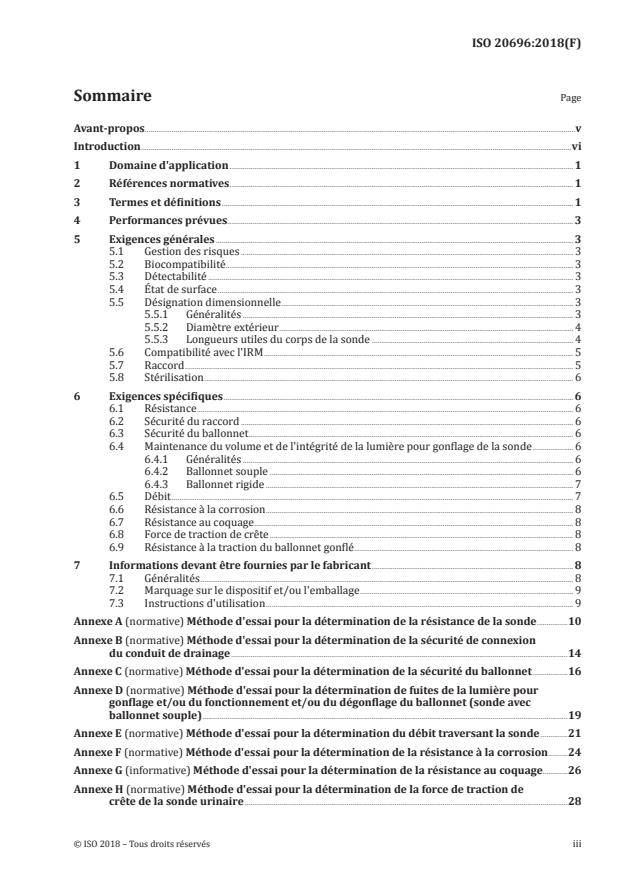
ISO 20696:2018 - Sondes urinaires stériles non réutilisables

ISO 20696:2018 - Sondes urinaires stériles non réutilisables/4/2019
Overview
ISO 20696:2018 specifies requirements and test methods for sterile urethral catheters for single use, with or without a balloon. It covers design, performance and safety expectations for urethral catheters intended to access the urinary bladder through the urethra for drainage, drug delivery or bladder flushing. The standard excludes drainage catheters covered by ISO 20697 (e.g., ureteral, nephrostomy, suprapubic catheters) and ureteral stents (see ASTM F1828‑97).
Key topics and technical requirements
ISO 20696 defines both general and specific requirements and includes normative test methods (Annexes A–J). Major technical topics include:
- Intended performance - device must safely and accurately access the intended anatomical location.
- Risk management - application of an established process (e.g., ISO 14971) and maintenance of a risk management file.
- Biocompatibility - evaluation in accordance with ISO 10993‑1 to ensure absence of biological hazard.
- Detectability - catheter (or effective length) should be detectable by X‑ray or other imaging if required by risk assessment.
- Surface finish - external effective length must be free from extraneous matter and process defects; inspection criteria defined.
- Size designation - outer diameter expressed in millimetres (rounded up to 0.1 mm) with tolerances (±0.33 mm); balloon capacity in mL; effective shaft length reporting.
- MRI compatibility, connectors, sterilization - general requirements for safe use and compatibility with clinical environments.
- Specific mechanical and functional tests - strength, connector and balloon security, inflation lumen integrity, balloon volume maintenance (compliant vs non‑compliant balloons), flow rate, corrosion resistance, kink stability, peak tensile force, and inflated balloon resistance to traction.
- Labelling and IFU - mandatory markings and instructions for use to support safe application.
Annexes provide test methods for each performance requirement (e.g., flow rate, kink stability, balloon deflation reliability).
Applications and users
ISO 20696 is intended for:
- Medical device manufacturers designing and producing single‑use sterile urethral catheters
- Regulatory and quality engineers preparing technical documentation and compliance evidence
- Clinical procurement specialists and hospitals verifying device safety and specifications
- Test laboratories performing conformity and performance testing
This standard supports product development, regulatory submissions, quality control and clinical risk assessments.
Related standards
- ISO 20697 - Sterile drainage catheters for single use (different catheter types)
- ASTM F1828‑97 - Ureteral stents
- ISO 14971 - Risk management for medical devices
- ISO 10993‑1 - Biological evaluation of medical devices
- ISO 14155 - Clinical investigation of medical devices
- ISO 15223‑1, ISO 80369‑1 - Labelling and connector standards
- ISO/TR 19244 - Guidance on transition periods for ISO/TC 84 standards
Keywords: ISO 20696, sterile urethral catheters, single‑use catheters, catheter test methods, biocompatibility, risk management, medical device standards.
Relations
- Consolidates
EN ISO 20696:2018 - Sterile urethral catheters for single use (ISO 20696:2018, Corrected version 2019-12) - Effective Date
- 12-Feb-2026
- Effective Date
- 06-Jun-2022
Buy Documents
ISO 20696:2018 - Sterile urethral catheters for single use
ISO 20696:2018 - Sterile urethral catheters for single use/4/2019
ISO 20696:2018 - Sondes urinaires stériles non réutilisables
ISO 20696:2018 - Sondes urinaires stériles non réutilisables/4/2019
Get Certified
Connect with accredited certification bodies for this standard

BSI Group
BSI (British Standards Institution) is the business standards company that helps organizations make excellence a habit.

TÜV Rheinland
TÜV Rheinland is a leading international provider of technical services.

TÜV SÜD
TÜV SÜD is a trusted partner of choice for safety, security and sustainability solutions.
Sponsored listings
Frequently Asked Questions
ISO 20696:2018 is a standard published by the International Organization for Standardization (ISO). Its full title is "Sterile urethral catheters for single use". This standard covers: This document specifies requirements and test methods for sterile urethral catheters for single use, with or without a balloon. This document does not include drainage catheters covered by ISO 20697, e.g. ureteral catheters, nephrostomy catheters, and suprapubic catheters. This document also excludes ureteral stents. NOTE Ureteral stents are covered in ASTM F1828‑97.
This document specifies requirements and test methods for sterile urethral catheters for single use, with or without a balloon. This document does not include drainage catheters covered by ISO 20697, e.g. ureteral catheters, nephrostomy catheters, and suprapubic catheters. This document also excludes ureteral stents. NOTE Ureteral stents are covered in ASTM F1828‑97.
ISO 20696:2018 is classified under the following ICS (International Classification for Standards) categories: 11.040.25 - Syringes, needles an catheters. The ICS classification helps identify the subject area and facilitates finding related standards.
ISO 20696:2018 has the following relationships with other standards: It is inter standard links to EN ISO 20696:2018, ISO 25649-3:2017. Understanding these relationships helps ensure you are using the most current and applicable version of the standard.
ISO 20696:2018 is available in PDF format for immediate download after purchase. The document can be added to your cart and obtained through the secure checkout process. Digital delivery ensures instant access to the complete standard document.
Standards Content (Sample)
INTERNATIONAL ISO
STANDARD 20696
First edition
2018-06
Corrected version
2019-12
Sterile urethral catheters for single use
Sondes urinaires stériles non réutilisables
Reference number
©
ISO 2018
© ISO 2018
All rights reserved. Unless otherwise specified, or required in the context of its implementation, no part of this publication may
be reproduced or utilized otherwise in any form or by any means, electronic or mechanical, including photocopying, or posting
on the internet or an intranet, without prior written permission. Permission can be requested from either ISO at the address
below or ISO’s member body in the country of the requester.
ISO copyright office
CP 401 • Ch. de Blandonnet 8
CH-1214 Vernier, Geneva
Phone: +41 22 749 01 11
Fax: +41 22 749 09 47
Email: copyright@iso.org
Website: www.iso.org
Published in Switzerland
ii © ISO 2018 – All rights reserved
Contents Page
Foreword .v
Introduction .vi
1 Scope . 1
2 Normative references . 1
3 Terms and definitions . 1
4 Intended performance . 3
5 General requirements . 3
5.1 Risk management . 3
5.2 Biocompatibility . 3
5.3 Detectability . 3
5.4 Surface finish . 3
5.5 Size designation . 3
5.5.1 General. 3
5.5.2 Outer diameter . 3
5.5.3 Effective shaft lengths . 4
5.6 MRI compatibility . 5
5.7 Connector . 5
5.8 Sterilization . 5
6 Specific requirements . 5
6.1 Strength . 5
6.2 Connector security . . 5
6.3 Balloon safety . 5
6.4 Catheter inflation lumen integrity and volume maintenance . 5
6.4.1 General. 5
6.4.2 Compliant balloon. 6
6.4.3 Non-compliant balloon . 6
6.5 Flow rate . 6
6.6 Corrosion resistance . 7
6.7 Kink stability . 7
6.8 Peak tensile force . 7
6.9 Inflated balloon resistance to traction . . 7
7 Information to be supplied by the manufacturer . 8
7.1 General . 8
7.2 Marking on the device and/or packaging . 8
7.3 Instructions for use . 8
Annex A (normative) Test method for determining the strength of the catheter .10
Annex B (normative) Test method for determining the security of fit of the drainage funnel .14
Annex C (normative) Test method for determining balloon safety .16
Annex D (normative) Test method for determining inflation lumen leakage and/or function
and/or balloon deflation (catheter with compliant balloon) .18
Annex E (normative) Test method for determination of flow rate through catheter .20
Annex F (normative) Test method for corrosion resistance .22
Annex G (informative) Test method for determining kink stability .23
Annex H (normative) Test method for determining peak tensile force of urethral catheter .25
Annex I (normative) Test method for determining balloon size deflation reliability
(catheter with non-compliant balloon) .27
Annex J (normative) Test method for determining inflated balloon resistance to traction .29
Bibliography .33
iv © ISO 2018 – All rights reserved
Foreword
ISO (the International Organization for Standardization) is a worldwide federation of national standards
bodies (ISO member bodies). The work of preparing International Standards is normally carried out
through ISO technical committees. Each member body interested in a subject for which a technical
committee has been established has the right to be represented on that committee. International
organizations, governmental and non-governmental, in liaison with ISO, also take part in the work.
ISO collaborates closely with the International Electrotechnical Commission (IEC) on all matters of
electrotechnical standardization.
The procedures used to develop this document and those intended for its further maintenance are
described in the ISO/IEC Directives, Part 1. In particular the different approval criteria needed for the
different types of ISO documents should be noted. This document was drafted in accordance with the
editorial rules of the ISO/IEC Directives, Part 2 (see www .iso .org/ directives).
Attention is drawn to the possibility that some of the elements of this document may be the subject of
patent rights. ISO shall not be held responsible for identifying any or all such patent rights. Details of
any patent rights identified during the development of the document will be in the Introduction and/or
on the ISO list of patent declarations received (see www .iso .org/ patents).
Any trade name used in this document is information given for the convenience of users and does not
constitute an endorsement.
For an explanation on the voluntary nature of standards, the meaning of ISO specific terms and
expressions related to conformity assessment, as well as information about ISO's adherence to the
World Trade Organization (WTO) principles in the Technical Barriers to Trade (TBT) see the following
URL: www .iso .org/ iso/ foreword .html.
This document was prepared by Technical Committee ISO/TC 84, Devices for administration of medicinal
products and catheters.
This document is based on EN 1616, Sterile urethral catheters for single use.
This corrected version of ISO 20696:2018 incorporates the following corrections:
— in Figure A.1, key items 1 and 2 were inverted.
Introduction
Guidance on transition periods for implementing the requirements of this document is given in
ISO/TR 19244.
vi © ISO 2018 – All rights reserved
INTERNATIONAL STANDARD ISO 20696:2018(E)
Sterile urethral catheters for single use
1 Scope
This document specifies requirements and test methods for sterile urethral catheters for single use,
with or without a balloon.
This document does not include drainage catheters covered by ISO 20697, e.g. ureteral catheters,
nephrostomy catheters, and suprapubic catheters. This document also excludes ureteral stents.
NOTE Ureteral stents are covered in ASTM F1828-97.
2 Normative references
The following documents are referred to in the text in such a way that some or all of their content
constitutes requirements of this document. For dated references, only the edition cited applies. For
undated references, the latest edition of the referenced document (including any amendments) applies.
1)
ISO 14971:— , Medical devices — Application of risk management to medical devices
ISO 10993-1, Biological evaluation of medical devices — Part 1: Evaluation and testing within a risk
management process
ISO 80369-1, Small bore connectors for liquids and gases in healthcare applications — Part 1: General
requirements
3 Terms and definitions
For the purposes of this document, the following terms and definitions apply.
ISO and IEC maintain terminological databases for use in standardization at the following addresses:
— ISO Online browsing platform: available at https:// www .iso .org/ obp
— IEC Electropedia: available at https:// www .electropedia .org/
3.1
balloon capacity
volume of liquid to be introduced into the catheter in order to fill the inflation channel and inflate
the balloon
3.2
coating
substance applied to the surface of the catheter
3.3
compliant balloon
balloon that continues to expand in size as internal pressure increases
3.4
effective length
L
length of the catheter that can be inserted into the body
1) To be published (revises ISO 14971:2007). Stage at time of publication ISO/DIS 14971:2018.
3.5
effective shaft length
L
length of non-perforated portion of the catheter excluding the tip, balloon(s), funnel(s) (3.6), protective
sleeves and/or access port(s)
3.6
funnel
proximal portion of the catheter, which may be connected to a drainage system
Note 1 to entry: See Figures J.1 and J.2.
3.7
intermittent
intended to be removed immediately after emptying the bladder
3.8
non-compliant balloon
balloon that expands to one specific size or size range, even as internal pressure increases
3.9
outer diameter
maximum dimension measured across the cylindrical portion of the shaft
3.10
overall length
L
total length from the tip of the catheter to the end of the funnel (3.6)
3.11
risk
combination of the probability of occurrence of harm and the severity of that harm
[SOURCE: ISO 14971:—, 3.18]
3.12
risk analysis
systematic use of available information to identify hazards and to estimate the risk (3.11)
[SOURCE: ISO 14971:—, 3.19]
3.13
risk assessment
overall process comprising a risk analysis (3.12) and a risk evaluation
[SOURCE: ISO 14971:—, 3.20]
3.14
risk management file
set of records and other documents that are produced by risk management
[SOURCE: ISO 14971:—, 3.25]
3.15
urethral catheter
tubular device intended for being introduced into the urinary bladder through the urethra in order to
provide drainage, drug delivery and/or flushing of the bladder
2 © ISO 2018 – All rights reserved
4 Intended performance
The urethral catheter shall demonstrate the ability to accurately and safely access the intended location.
The urethral catheter shall demonstrate the ability to drain urine.
5 General requirements
5.1 Risk management
An established risk management process shall be applied to the design of the device.
Compliance shall be checked by inspection of the risk management file verifying compliance to
ISO 14971.
5.2 Biocompatibility
The device shall be free from biological hazard in accordance with appropriate testing under
ISO 10993-1.
5.3 Detectability
The catheter or at least its effective length shall be detectable by X-ray or by other means (ultra-sound,
MRI, etc.), if required by the risk assessment.
NOTE Such as ASTM F640 or DIN 13273-7.
5.4 Surface finish
When examined by normal or corrected to normal vision, the external surface of the effective length of
the catheter shall appear free from:
— extraneous matter;
— process and surface defects that may present an unacceptable risk of patient harm.
If deemed necessary based on risk assessment, inspection shall be conducted under a minimum 2,5×
magnification.
5.5 Size designation
5.5.1 General
The nominal size of the catheter shall be designated as specified in 5.5.2.
5.5.2 Outer diameter
Unless otherwise specified in another clause of this document for a particular type of catheter, the
outer diameter shall be expressed as the nominal dimension in millimetres, rounded upwards to the
nearest 0,1 mm. Tolerances on this stated size shall be ±1 French.
NOTE Additional units can also be given. French size (Fr, Ch, FG) is a nominal dimensional identification of
the outer size of urethral catheters; calculated as three times the diameter (in millimetres): Fr = 3 × D (mm).
For devices which are not round by design, the size shall be designated by the dimension of the largest
axis. Where relevant, manufacturers may choose to report additional information regarding the device
profile, such as the dimension of the second axis for an oval shape.
The balloon capacity shall be expressed in millilitres.
5.5.3 Effective shaft lengths
The minimum effective shaft lengths (L ) shall be as given in Table 1 (see also Figure 1).
The nominal effective shaft length (L ) shall be expressed in millimetres, rounded to the nearest
millimetre.
NOTE 1 Additional units can also be given.
NOTE 2 Tolerances to the effective length are not specified.
Table 1 — Effective shaft length
Catheter type L (minimum) mm
Paediatric male 150
Paediatric female 45
Female 60
Male 275
NOTE Shaft dimensions: Shorter sizes can be produced using appropriate risk based clinical justification.
Key
1 drainage funnel L effective length
2 inflation access port L overall length
3 valve L effective shaft length
4 irrigation access port
Figure 1 — Typical urethral catheters with and without balloon
4 © ISO 2018 – All rights reserved
5.6 MRI compatibility
If applicable, the hazards of urethral catheters in the magnetic resonance environment shall be
evaluated by an appropriate method.
NOTE Such as ASTM F2052, F2213, F2182, and F2119.
5.7 Connector
There is no standardized connector. However, risk of misconnection shall be avoided. This shall be
determined by the manufacturer based on risk assessment according to the general requirements of
ISO 80369-1.
NOTE 1 A future part of ISO 80369 will address connectors for urethral and urinary applications.
NOTE 2 The funnel is a connecting part, but does not comply with the requirements of ISO 80369-1.
5.8 Sterilization
Urethral catheters and accessories that are sterile shall comply with international, national or regional
standards and shall have a sterility assurance level (SAL) of 10- .
NOTE See applicable parts of ISO 17665, ISO 11135 and ISO 11137 (all parts) for appropriate methods of
sterilization.
6 Specific requirements
6.1 Strength
When tested the tip/shaft union and lateral drainage holes shall not show any sign of breaking and
neither the tip nor the funnel shall become detached from the shaft.
Compliance shall be checked by the test method in Annex A.
6.2 Connector security
When tested the drainage funnel shall not part from the test connector.
Compliance shall be checked by the test method in Annex B.
6.3 Balloon safety
If present, the balloon shall not leak and shall not occlude the lateral drainage holes.
Compliance shall be checked by the test method in Annex C.
The change in profile at each end of the uninflated balloon should have a smooth transition to the shaft.
The balloon should be capable of approximately symmetrical expansion when filled with water at
ambient temperature to its specified balloon capacity.
6.4 Catheter inflation lumen integrity and volume maintenance
6.4.1 General
If a balloon is present, choose the appropriate requirement from 6.4.2 and 6.4.3.
6.4.2 Compliant balloon
When deflating the balloon, the percentage of water recovered shall not be lower than the value given
in Table 2.
Table 2 — Balloon test volume percentage recovery
Balloon capacity Minimum percentage of volume recovered
ml %
5 55
10 75
20 80
30 80
This document does not specify requirements for balloon capacity of less than 5 ml. These values should be
determined by the manufacturer based on risk assessment.
Intermediate cases are recommended to comply with the next higher value.
Compliance shall be checked by using the test method in Annex D.
6.4.3 Non-compliant balloon
For 4,0 mm (12 French) and larger catheters, the balloon shall pass through a French size scale no
greater than four (4) French larger than the label French size.
This document does not specify requirements for catheter sizes less than 4,0 mm (12 French). These
values should be determined by the manufacturer based on risk assessment.
Compliance shall be checked by using the test method in Annex I.
6.5 Flow rate
The minimum average flow rates shall be as given in Table 3.
Table 3 — Average flow rates
Designated size Average flow rate (minimum)
a
Outer diameter Charrière equivalent Drainage lumen Irrigation lumen
mm FG/Ch/Fr ml/min ml/min
b
2,0 6 10 n.a.
2,7 8 15 n.a.
3,3 10 30 n.a.
4,0 12 50 n.a.
4,7 14 70 25
5,3 16 100 25
6,0 18 100 25
6,7 20 100 25
7,3 22 100 30
8,0 24 100 30
8,7 26 100 30
9,3 28 100 n.a.
NOTE The listed flow rate values are a minimum requirement; clinical flow rate values may be higher.
a
The Charrière equivalent is given for information.
b
n.a. = not applicable
6 © ISO 2018 – All rights reserved
Table 3 (continued)
Designated size Average flow rate (minimum)
a
Outer diameter Charrière equivalent Drainage lumen Irrigation lumen
mm FG/Ch/Fr ml/min ml/min
10,0 30 100 n.a.
NOTE The listed flow rate values are a minimum requirement; clinical flow rate values may be higher.
a
The Charrière equivalent is given for information.
b
n.a. = not applicable
Compliance shall be checked using the flow rate test method in Annex E.
6.6 Corrosion resistance
If exposed metallic components of the device could develop visible signs of corrosion that can affect
functional performance, the level of corrosion shall be evaluated, with respect to intended use and risk
assessment, by subjecting the catheter to the corrosion test described in Annex F.
6.7 Kink stability
During placement, the urethral catheter shall demonstrate the ability to safely access the intended
location. This document does not specify requirements for kink stability testing. Clinically relevant
placement value is determined by the manufacturer based on intended use and risk assessment.
NOTE Such as kink stability test method in Annex G.
6.8 Peak tensile force
The minimum peak tensile force of the urethral catheter tubular portion, each junction between
catheter component and tubing, and each junction between tubular portions shall be as given in Table 4.
Table 4 — Peak tensile force of urethral catheters
Smallest outer diameter of tubular Minimum peak tensile force
portion of test piece
mm N
≥2 and ≤4 10
>4 20
This document does not specify requirements for peak tensile force for tubing of less than 2 mm outer
diameter. These values should be determined by the manufacturer based on risk assessment.
Compliance shall be checked using the test method in Annex H.
6.9 Inflated balloon resistance to traction
For 4,66 mm to 8,66 mm (14 French to 26 French) urethral catheters, the balloon shall not pass into
or through a funnel-like apparatus, with a size 28 French lumen, representing the bladder outlet and
urethra.
This document does not specify requirements for catheter sizes less than 14 French. These values
should be determined by the manufacturer based on risk assessment.
Compliance shall be checked using the test method in Annex J.
7 Information to be supplied by the manufacturer
7.1 General
Units of measurement systems other than those specified may additionally be used.
Marking on all devices shall be durable and legible. Compliance shall be checked by inspection of
markings and durability assessed by use of suitable test method.
NOTE Such as ASTM F1842-09 or ASTM F2252-13.
Where appropriate, ISO 11607 (all parts) and EN 1041 should be used and symbols should be made
according to ISO 15223-1.
7.2 Marking on the device and/or packaging
NOTE The primary packaging is often transparent. Therefore, for the purposes of this subclause, the
combination of marking of the device which is visible through the package and the primary packaging itself are
to be considered.
If not practicable on the device itself then marking shall be displayed on the primary (individual)
packaging, secondary (case) packaging or in the instructions for use (IFU).
The primary and/or secondary packaging shall be labelled with the following information at a minimum.
a) Any special storage or handling conditions.
b) An indication that the device is for single use or single patient use. A manufacturer's indication of
single use shall be consistent across its range, where appropriate.
c) Where appropriate, detectability.
d) Where appropriate, the manufacturer’s stated nominal balloon inflation volume.
e) The manufacturer’s stated effective length.
7.3 Instructions for use
When a separate instruction for use is provided, it shall at least contain information on the following.
a) If the intended purpose of the device is not obvious to the user, the manufacturer shall clearly state
it. Where a device is provided with separate instructions for use, this requirement may be omitted
from the primary packaging.
b) If the device is intended to be connected to other devices or accessories in order to operate as
required for its intended purpose, sufficient details of its characteristics to identify the correct
devices in order to obtain a safe combination.
c) Any warnings or precautions to take.
d) Date of issue or the revision level of the instructions for use.
e) Where appropriate, an indication that the device is for single use or single patient use. A
manufacturer's indication of single use shall be consistent across its range.
f) Where appropriate, the method of cleaning, disinfecting or sterilization necessary prior to use.
g) Where appropriate, known reactions between the catheter and magnetic resonance imaging (MRI)
environment.
8 © ISO 2018 – All rights reserved
h) Where appropriate, description of additives or coatings:
— any contra-indications, warnings and precautions based on the additive or coating material(s).
Annex A
(normative)
Test method for determining the strength of the catheter
A.1 Principle
Catheters fitted with balloons may be in position for prolonged periods. Such catheters are therefore
immersed for 14 d in simulated urine prior to testing. This step is omitted for catheters without balloons
and intermittent catheters. A tensile force is applied to the union of the tip and shaft of the catheter. For
catheters with lateral drainage holes, the tensile force is to be applied to the lateral drainage holes. For
catheters with no lateral drainage holes, the tensile force is applied between the shaft of the catheter
and the drainage funnel. On removal of this force, the catheter is examined for signs of failure.
A.2 Reagents
Simulated urine, pH approximately 6,6, of the following composition, the reagents being of recognized
analytical grade:
— Urea 25,0 g;
— Sodium chloride 9,0 g;
— Disodium hydrogen orthophosphate anhydrous 2,5 g;
— Potassium dihydrogen orthophosphate 2,5 g;
— Ammonium chloride 3,0 g;
— Creatinine 2,0 g;
— Sodium sulfite, hydrated 3,0 g;
— Distilled water to 1,0 l.
WARNING — This solution can su
...
INTERNATIONAL ISO
STANDARD 20696
First edition
2018-06
Corrected version
2019-12
Sterile urethral catheters for single use
Sondes urinaires stériles non réutilisables
Reference number
©
ISO 2018
© ISO 2018
All rights reserved. Unless otherwise specified, or required in the context of its implementation, no part of this publication may
be reproduced or utilized otherwise in any form or by any means, electronic or mechanical, including photocopying, or posting
on the internet or an intranet, without prior written permission. Permission can be requested from either ISO at the address
below or ISO’s member body in the country of the requester.
ISO copyright office
CP 401 • Ch. de Blandonnet 8
CH-1214 Vernier, Geneva
Phone: +41 22 749 01 11
Fax: +41 22 749 09 47
Email: copyright@iso.org
Website: www.iso.org
Published in Switzerland
ii © ISO 2018 – All rights reserved
Contents Page
Foreword .v
Introduction .vi
1 Scope . 1
2 Normative references . 1
3 Terms and definitions . 1
4 Intended performance . 3
5 General requirements . 3
5.1 Risk management . 3
5.2 Biocompatibility . 3
5.3 Detectability . 3
5.4 Surface finish . 3
5.5 Size designation . 3
5.5.1 General. 3
5.5.2 Outer diameter . 3
5.5.3 Effective shaft lengths . 4
5.6 MRI compatibility . 5
5.7 Connector . 5
5.8 Sterilization . 5
6 Specific requirements . 5
6.1 Strength . 5
6.2 Connector security . . 5
6.3 Balloon safety . 5
6.4 Catheter inflation lumen integrity and volume maintenance . 5
6.4.1 General. 5
6.4.2 Compliant balloon. 6
6.4.3 Non-compliant balloon . 6
6.5 Flow rate . 6
6.6 Corrosion resistance . 7
6.7 Kink stability . 7
6.8 Peak tensile force . 7
6.9 Inflated balloon resistance to traction . . 7
7 Information to be supplied by the manufacturer . 8
7.1 General . 8
7.2 Marking on the device and/or packaging . 8
7.3 Instructions for use . 8
Annex A (normative) Test method for determining the strength of the catheter .10
Annex B (normative) Test method for determining the security of fit of the drainage funnel .14
Annex C (normative) Test method for determining balloon safety .16
Annex D (normative) Test method for determining inflation lumen leakage and/or function
and/or balloon deflation (catheter with compliant balloon) .18
Annex E (normative) Test method for determination of flow rate through catheter .20
Annex F (normative) Test method for corrosion resistance .22
Annex G (informative) Test method for determining kink stability .23
Annex H (normative) Test method for determining peak tensile force of urethral catheter .25
Annex I (normative) Test method for determining balloon size deflation reliability
(catheter with non-compliant balloon) .27
Annex J (normative) Test method for determining inflated balloon resistance to traction .29
Bibliography .33
iv © ISO 2018 – All rights reserved
Foreword
ISO (the International Organization for Standardization) is a worldwide federation of national standards
bodies (ISO member bodies). The work of preparing International Standards is normally carried out
through ISO technical committees. Each member body interested in a subject for which a technical
committee has been established has the right to be represented on that committee. International
organizations, governmental and non-governmental, in liaison with ISO, also take part in the work.
ISO collaborates closely with the International Electrotechnical Commission (IEC) on all matters of
electrotechnical standardization.
The procedures used to develop this document and those intended for its further maintenance are
described in the ISO/IEC Directives, Part 1. In particular the different approval criteria needed for the
different types of ISO documents should be noted. This document was drafted in accordance with the
editorial rules of the ISO/IEC Directives, Part 2 (see www .iso .org/ directives).
Attention is drawn to the possibility that some of the elements of this document may be the subject of
patent rights. ISO shall not be held responsible for identifying any or all such patent rights. Details of
any patent rights identified during the development of the document will be in the Introduction and/or
on the ISO list of patent declarations received (see www .iso .org/ patents).
Any trade name used in this document is information given for the convenience of users and does not
constitute an endorsement.
For an explanation on the voluntary nature of standards, the meaning of ISO specific terms and
expressions related to conformity assessment, as well as information about ISO's adherence to the
World Trade Organization (WTO) principles in the Technical Barriers to Trade (TBT) see the following
URL: www .iso .org/ iso/ foreword .html.
This document was prepared by Technical Committee ISO/TC 84, Devices for administration of medicinal
products and catheters.
This document is based on EN 1616, Sterile urethral catheters for single use.
This corrected version of ISO 20696:2018 incorporates the following corrections:
— in Figure A.1, key items 1 and 2 were inverted.
Introduction
Guidance on transition periods for implementing the requirements of this document is given in
ISO/TR 19244.
vi © ISO 2018 – All rights reserved
INTERNATIONAL STANDARD ISO 20696:2018(E)
Sterile urethral catheters for single use
1 Scope
This document specifies requirements and test methods for sterile urethral catheters for single use,
with or without a balloon.
This document does not include drainage catheters covered by ISO 20697, e.g. ureteral catheters,
nephrostomy catheters, and suprapubic catheters. This document also excludes ureteral stents.
NOTE Ureteral stents are covered in ASTM F1828-97.
2 Normative references
The following documents are referred to in the text in such a way that some or all of their content
constitutes requirements of this document. For dated references, only the edition cited applies. For
undated references, the latest edition of the referenced document (including any amendments) applies.
1)
ISO 14971:— , Medical devices — Application of risk management to medical devices
ISO 10993-1, Biological evaluation of medical devices — Part 1: Evaluation and testing within a risk
management process
ISO 80369-1, Small bore connectors for liquids and gases in healthcare applications — Part 1: General
requirements
3 Terms and definitions
For the purposes of this document, the following terms and definitions apply.
ISO and IEC maintain terminological databases for use in standardization at the following addresses:
— ISO Online browsing platform: available at https:// www .iso .org/ obp
— IEC Electropedia: available at https:// www .electropedia .org/
3.1
balloon capacity
volume of liquid to be introduced into the catheter in order to fill the inflation channel and inflate
the balloon
3.2
coating
substance applied to the surface of the catheter
3.3
compliant balloon
balloon that continues to expand in size as internal pressure increases
3.4
effective length
L
length of the catheter that can be inserted into the body
1) To be published (revises ISO 14971:2007). Stage at time of publication ISO/DIS 14971:2018.
3.5
effective shaft length
L
length of non-perforated portion of the catheter excluding the tip, balloon(s), funnel(s) (3.6), protective
sleeves and/or access port(s)
3.6
funnel
proximal portion of the catheter, which may be connected to a drainage system
Note 1 to entry: See Figures J.1 and J.2.
3.7
intermittent
intended to be removed immediately after emptying the bladder
3.8
non-compliant balloon
balloon that expands to one specific size or size range, even as internal pressure increases
3.9
outer diameter
maximum dimension measured across the cylindrical portion of the shaft
3.10
overall length
L
total length from the tip of the catheter to the end of the funnel (3.6)
3.11
risk
combination of the probability of occurrence of harm and the severity of that harm
[SOURCE: ISO 14971:—, 3.18]
3.12
risk analysis
systematic use of available information to identify hazards and to estimate the risk (3.11)
[SOURCE: ISO 14971:—, 3.19]
3.13
risk assessment
overall process comprising a risk analysis (3.12) and a risk evaluation
[SOURCE: ISO 14971:—, 3.20]
3.14
risk management file
set of records and other documents that are produced by risk management
[SOURCE: ISO 14971:—, 3.25]
3.15
urethral catheter
tubular device intended for being introduced into the urinary bladder through the urethra in order to
provide drainage, drug delivery and/or flushing of the bladder
2 © ISO 2018 – All rights reserved
4 Intended performance
The urethral catheter shall demonstrate the ability to accurately and safely access the intended location.
The urethral catheter shall demonstrate the ability to drain urine.
5 General requirements
5.1 Risk management
An established risk management process shall be applied to the design of the device.
Compliance shall be checked by inspection of the risk management file verifying compliance to
ISO 14971.
5.2 Biocompatibility
The device shall be free from biological hazard in accordance with appropriate testing under
ISO 10993-1.
5.3 Detectability
The catheter or at least its effective length shall be detectable by X-ray or by other means (ultra-sound,
MRI, etc.), if required by the risk assessment.
NOTE Such as ASTM F640 or DIN 13273-7.
5.4 Surface finish
When examined by normal or corrected to normal vision, the external surface of the effective length of
the catheter shall appear free from:
— extraneous matter;
— process and surface defects that may present an unacceptable risk of patient harm.
If deemed necessary based on risk assessment, inspection shall be conducted under a minimum 2,5×
magnification.
5.5 Size designation
5.5.1 General
The nominal size of the catheter shall be designated as specified in 5.5.2.
5.5.2 Outer diameter
Unless otherwise specified in another clause of this document for a particular type of catheter, the
outer diameter shall be expressed as the nominal dimension in millimetres, rounded upwards to the
nearest 0,1 mm. Tolerances on this stated size shall be ±1 French.
NOTE Additional units can also be given. French size (Fr, Ch, FG) is a nominal dimensional identification of
the outer size of urethral catheters; calculated as three times the diameter (in millimetres): Fr = 3 × D (mm).
For devices which are not round by design, the size shall be designated by the dimension of the largest
axis. Where relevant, manufacturers may choose to report additional information regarding the device
profile, such as the dimension of the second axis for an oval shape.
The balloon capacity shall be expressed in millilitres.
5.5.3 Effective shaft lengths
The minimum effective shaft lengths (L ) shall be as given in Table 1 (see also Figure 1).
The nominal effective shaft length (L ) shall be expressed in millimetres, rounded to the nearest
millimetre.
NOTE 1 Additional units can also be given.
NOTE 2 Tolerances to the effective length are not specified.
Table 1 — Effective shaft length
Catheter type L (minimum) mm
Paediatric male 150
Paediatric female 45
Female 60
Male 275
NOTE Shaft dimensions: Shorter sizes can be produced using appropriate risk based clinical justification.
Key
1 drainage funnel L effective length
2 inflation access port L overall length
3 valve L effective shaft length
4 irrigation access port
Figure 1 — Typical urethral catheters with and without balloon
4 © ISO 2018 – All rights reserved
5.6 MRI compatibility
If applicable, the hazards of urethral catheters in the magnetic resonance environment shall be
evaluated by an appropriate method.
NOTE Such as ASTM F2052, F2213, F2182, and F2119.
5.7 Connector
There is no standardized connector. However, risk of misconnection shall be avoided. This shall be
determined by the manufacturer based on risk assessment according to the general requirements of
ISO 80369-1.
NOTE 1 A future part of ISO 80369 will address connectors for urethral and urinary applications.
NOTE 2 The funnel is a connecting part, but does not comply with the requirements of ISO 80369-1.
5.8 Sterilization
Urethral catheters and accessories that are sterile shall comply with international, national or regional
standards and shall have a sterility assurance level (SAL) of 10- .
NOTE See applicable parts of ISO 17665, ISO 11135 and ISO 11137 (all parts) for appropriate methods of
sterilization.
6 Specific requirements
6.1 Strength
When tested the tip/shaft union and lateral drainage holes shall not show any sign of breaking and
neither the tip nor the funnel shall become detached from the shaft.
Compliance shall be checked by the test method in Annex A.
6.2 Connector security
When tested the drainage funnel shall not part from the test connector.
Compliance shall be checked by the test method in Annex B.
6.3 Balloon safety
If present, the balloon shall not leak and shall not occlude the lateral drainage holes.
Compliance shall be checked by the test method in Annex C.
The change in profile at each end of the uninflated balloon should have a smooth transition to the shaft.
The balloon should be capable of approximately symmetrical expansion when filled with water at
ambient temperature to its specified balloon capacity.
6.4 Catheter inflation lumen integrity and volume maintenance
6.4.1 General
If a balloon is present, choose the appropriate requirement from 6.4.2 and 6.4.3.
6.4.2 Compliant balloon
When deflating the balloon, the percentage of water recovered shall not be lower than the value given
in Table 2.
Table 2 — Balloon test volume percentage recovery
Balloon capacity Minimum percentage of volume recovered
ml %
5 55
10 75
20 80
30 80
This document does not specify requirements for balloon capacity of less than 5 ml. These values should be
determined by the manufacturer based on risk assessment.
Intermediate cases are recommended to comply with the next higher value.
Compliance shall be checked by using the test method in Annex D.
6.4.3 Non-compliant balloon
For 4,0 mm (12 French) and larger catheters, the balloon shall pass through a French size scale no
greater than four (4) French larger than the label French size.
This document does not specify requirements for catheter sizes less than 4,0 mm (12 French). These
values should be determined by the manufacturer based on risk assessment.
Compliance shall be checked by using the test method in Annex I.
6.5 Flow rate
The minimum average flow rates shall be as given in Table 3.
Table 3 — Average flow rates
Designated size Average flow rate (minimum)
a
Outer diameter Charrière equivalent Drainage lumen Irrigation lumen
mm FG/Ch/Fr ml/min ml/min
b
2,0 6 10 n.a.
2,7 8 15 n.a.
3,3 10 30 n.a.
4,0 12 50 n.a.
4,7 14 70 25
5,3 16 100 25
6,0 18 100 25
6,7 20 100 25
7,3 22 100 30
8,0 24 100 30
8,7 26 100 30
9,3 28 100 n.a.
NOTE The listed flow rate values are a minimum requirement; clinical flow rate values may be higher.
a
The Charrière equivalent is given for information.
b
n.a. = not applicable
6 © ISO 2018 – All rights reserved
Table 3 (continued)
Designated size Average flow rate (minimum)
a
Outer diameter Charrière equivalent Drainage lumen Irrigation lumen
mm FG/Ch/Fr ml/min ml/min
10,0 30 100 n.a.
NOTE The listed flow rate values are a minimum requirement; clinical flow rate values may be higher.
a
The Charrière equivalent is given for information.
b
n.a. = not applicable
Compliance shall be checked using the flow rate test method in Annex E.
6.6 Corrosion resistance
If exposed metallic components of the device could develop visible signs of corrosion that can affect
functional performance, the level of corrosion shall be evaluated, with respect to intended use and risk
assessment, by subjecting the catheter to the corrosion test described in Annex F.
6.7 Kink stability
During placement, the urethral catheter shall demonstrate the ability to safely access the intended
location. This document does not specify requirements for kink stability testing. Clinically relevant
placement value is determined by the manufacturer based on intended use and risk assessment.
NOTE Such as kink stability test method in Annex G.
6.8 Peak tensile force
The minimum peak tensile force of the urethral catheter tubular portion, each junction between
catheter component and tubing, and each junction between tubular portions shall be as given in Table 4.
Table 4 — Peak tensile force of urethral catheters
Smallest outer diameter of tubular Minimum peak tensile force
portion of test piece
mm N
≥2 and ≤4 10
>4 20
This document does not specify requirements for peak tensile force for tubing of less than 2 mm outer
diameter. These values should be determined by the manufacturer based on risk assessment.
Compliance shall be checked using the test method in Annex H.
6.9 Inflated balloon resistance to traction
For 4,66 mm to 8,66 mm (14 French to 26 French) urethral catheters, the balloon shall not pass into
or through a funnel-like apparatus, with a size 28 French lumen, representing the bladder outlet and
urethra.
This document does not specify requirements for catheter sizes less than 14 French. These values
should be determined by the manufacturer based on risk assessment.
Compliance shall be checked using the test method in Annex J.
7 Information to be supplied by the manufacturer
7.1 General
Units of measurement systems other than those specified may additionally be used.
Marking on all devices shall be durable and legible. Compliance shall be checked by inspection of
markings and durability assessed by use of suitable test method.
NOTE Such as ASTM F1842-09 or ASTM F2252-13.
Where appropriate, ISO 11607 (all parts) and EN 1041 should be used and symbols should be made
according to ISO 15223-1.
7.2 Marking on the device and/or packaging
NOTE The primary packaging is often transparent. Therefore, for the purposes of this subclause, the
combination of marking of the device which is visible through the package and the primary packaging itself are
to be considered.
If not practicable on the device itself then marking shall be displayed on the primary (individual)
packaging, secondary (case) packaging or in the instructions for use (IFU).
The primary and/or secondary packaging shall be labelled with the following information at a minimum.
a) Any special storage or handling conditions.
b) An indication that the device is for single use or single patient use. A manufacturer's indication of
single use shall be consistent across its range, where appropriate.
c) Where appropriate, detectability.
d) Where appropriate, the manufacturer’s stated nominal balloon inflation volume.
e) The manufacturer’s stated effective length.
7.3 Instructions for use
When a separate instruction for use is provided, it shall at least contain information on the following.
a) If the intended purpose of the device is not obvious to the user, the manufacturer shall clearly state
it. Where a device is provided with separate instructions for use, this requirement may be omitted
from the primary packaging.
b) If the device is intended to be connected to other devices or accessories in order to operate as
required for its intended purpose, sufficient details of its characteristics to identify the correct
devices in order to obtain a safe combination.
c) Any warnings or precautions to take.
d) Date of issue or the revision level of the instructions for use.
e) Where appropriate, an indication that the device is for single use or single patient use. A
manufacturer's indication of single use shall be consistent across its range.
f) Where appropriate, the method of cleaning, disinfecting or sterilization necessary prior to use.
g) Where appropriate, known reactions between the catheter and magnetic resonance imaging (MRI)
environment.
8 © ISO 2018 – All rights reserved
h) Where appropriate, description of additives or coatings:
— any contra-indications, warnings and precautions based on the additive or coating material(s).
Annex A
(normative)
Test method for determining the strength of the catheter
A.1 Principle
Catheters fitted with balloons may be in position for prolonged periods. Such catheters are therefore
immersed for 14 d in simulated urine prior to testing. This step is omitted for catheters without balloons
and intermittent catheters. A tensile force is applied to the union of the tip and shaft of the catheter. For
catheters with lateral drainage holes, the tensile force is to be applied to the lateral drainage holes. For
catheters with no lateral drainage holes, the tensile force is applied between the shaft of the catheter
and the drainage funnel. On removal of this force, the catheter is examined for signs of failure.
A.2 Reagents
Simulated urine, pH approximately 6,6, of the following composition, the reagents being of recognized
analytical grade:
— Urea 25,0 g;
— Sodium chloride 9,0 g;
— Disodium hydrogen orthophosphate anhydrous 2,5 g;
— Potassium dihydrogen orthophosphate 2,5 g;
— Ammonium chloride 3,0 g;
— Creatinine 2,0 g;
— Sodium sulfite, hydrated 3,0 g;
— Distilled water to 1,0 l.
WARNING — This solution can su
...
NORME ISO
INTERNATIONALE 20696
Première édition
2018-06
Version corrigée
2019-12
Sondes urinaires stériles non
réutilisables
Sterile urethral catheters for single use
Numéro de référence
©
ISO 2018
DOCUMENT PROTÉGÉ PAR COPYRIGHT
© ISO 2018
Tous droits réservés. Sauf prescription différente ou nécessité dans le contexte de sa mise en œuvre, aucune partie de cette
publication ne peut être reproduite ni utilisée sous quelque forme que ce soit et par aucun procédé, électronique ou mécanique,
y compris la photocopie, ou la diffusion sur l’internet ou sur un intranet, sans autorisation écrite préalable. Une autorisation peut
être demandée à l’ISO à l’adresse ci-après ou au comité membre de l’ISO dans le pays du demandeur.
ISO copyright office
Case postale 401 • Ch. de Blandonnet 8
CH-1214 Vernier, Genève
Tél.: +41 22 749 01 11
Fax: +41 22 749 09 47
E-mail: copyright@iso.org
Web: www.iso.org
Publié en Suisse
ii © ISO 2018 – Tous droits réservés
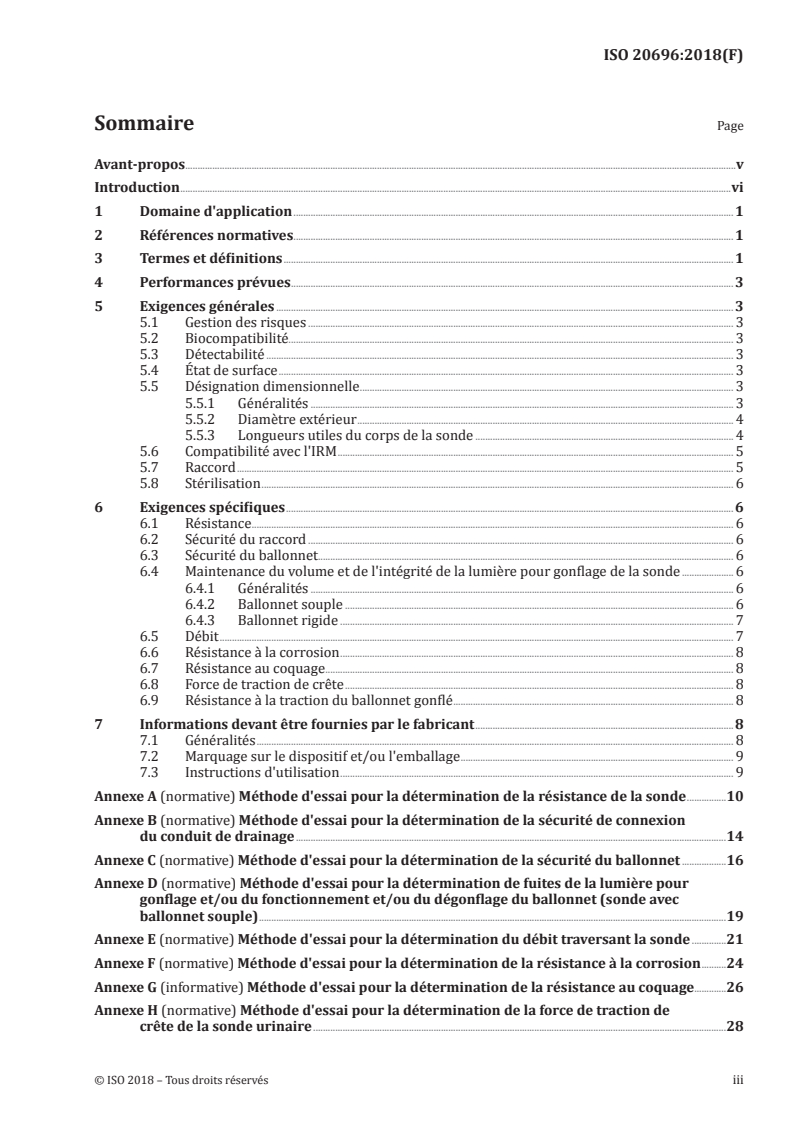
Sommaire Page
Avant-propos .v
Introduction .vi
1 Domaine d'application . 1
2 Références normatives . 1
3 Termes et définitions . 1
4 Performances prévues . 3
5 Exigences générales . 3
5.1 Gestion des risques . 3
5.2 Biocompatibilité. 3
5.3 Détectabilité . 3
5.4 État de surface . 3
5.5 Désignation dimensionnelle . 3
5.5.1 Généralités . 3
5.5.2 Diamètre extérieur . 4
5.5.3 Longueurs utiles du corps de la sonde . 4
5.6 Compatibilité avec l'IRM . 5
5.7 Raccord . 5
5.8 Stérilisation . 6
6 Exigences spécifiques . 6
6.1 Résistance . 6
6.2 Sécurité du raccord . 6
6.3 Sécurité du ballonnet. 6
6.4 Maintenance du volume et de l'intégrité de la lumière pour gonflage de la sonde . 6
6.4.1 Généralités . 6
6.4.2 Ballonnet souple . 6
6.4.3 Ballonnet rigide . 7
6.5 Débit . 7
6.6 Résistance à la corrosion . 8
6.7 Résistance au coquage . 8
6.8 Force de traction de crête . 8
6.9 Résistance à la traction du ballonnet gonflé . 8
7 Informations devant être fournies par le fabricant . 8
7.1 Généralités . 8
7.2 Marquage sur le dispositif et/ou l'emballage . 9
7.3 Instructions d'utilisation . 9
Annexe A (normative) Méthode d'essai pour la détermination de la résistance de la sonde .10
Annexe B (normative) Méthode d'essai pour la détermination de la sécurité de connexion
du conduit de drainage .14
Annexe C (normative) Méthode d'essai pour la détermination de la sécurité du ballonnet .16
Annexe D (normative) Méthode d'essai pour la détermination de fuites de la lumière pour
gonflage et/ou du fonctionnement et/ou du dégonflage du ballonnet (sonde avec
ballonnet souple) .19
Annexe E (normative) Méthode d'essai pour la détermination du débit traversant la sonde .21
Annexe F (normative) Méthode d'essai pour la détermination de la résistance à la corrosion .24
Annexe G (informative) Méthode d'essai pour la détermination de la résistance au coquage.26
Annexe H (normative) Méthode d'essai pour la détermination de la force de traction de
crête de la sonde urinaire .28
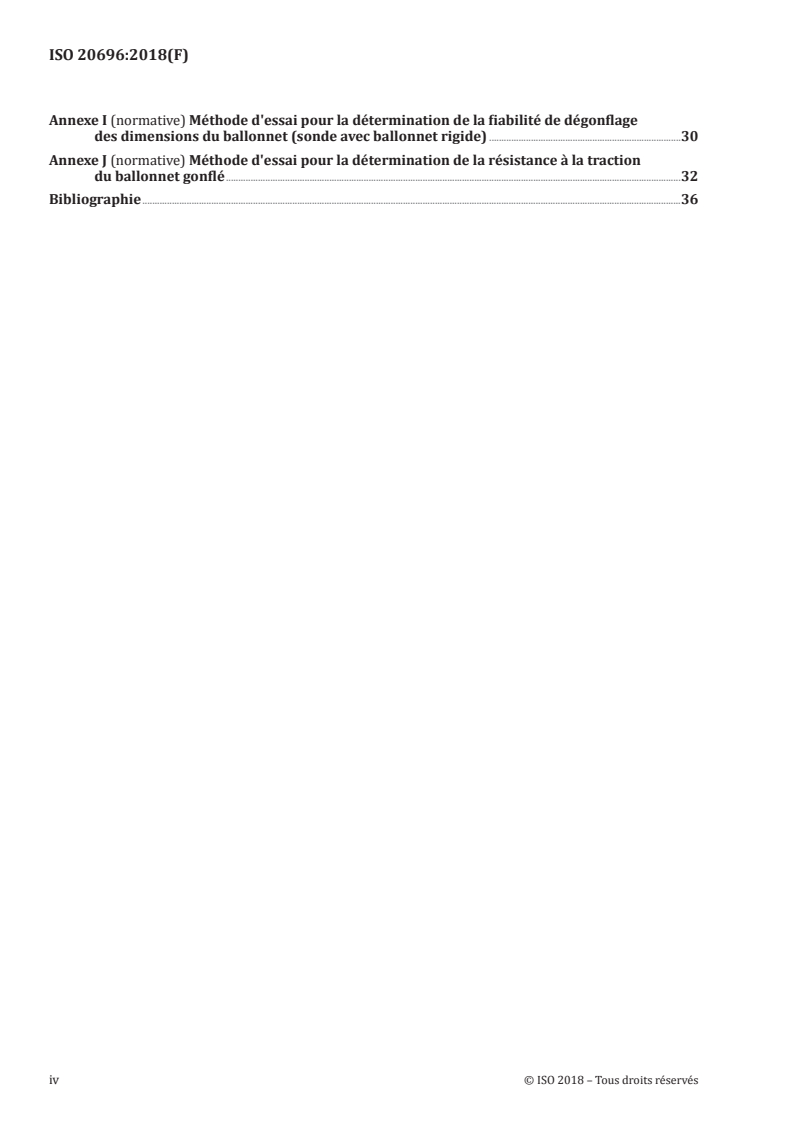
Annexe I (normative) Méthode d'essai pour la détermination de la fiabilité de dégonflage
des dimensions du ballonnet (sonde avec ballonnet rigide) .30
Annexe J (normative) Méthode d'essai pour la détermination de la résistance à la traction
du ballonnet gonflé .32
Bibliographie .36
iv © ISO 2018 – Tous droits réservés
Avant-propos
L'ISO (Organisation internationale de normalisation) est une fédération mondiale d'organismes
nationaux de normalisation (comités membres de l'ISO). L'élaboration des Normes internationales est
en général confiée aux comités techniques de l'ISO. Chaque comité membre intéressé par une étude
a le droit de faire partie du comité technique créé à cet effet. Les organisations internationales,
gouvernementales et non gouvernementales, en liaison avec l'ISO participent également aux travaux.
L'ISO collabore étroitement avec la Commission électrotechnique internationale (IEC) en ce qui
concerne la normalisation électrotechnique.
Les procédures utilisées pour élaborer le présent document et celles destinées à sa mise à jour sont
décrites dans les Directives ISO/IEC, Partie 1. Il convient, en particulier de prendre note des différents
critères d'approbation requis pour les différents types de documents ISO. Le présent document a été
rédigé conformément aux règles de rédaction données dans les Directives ISO/IEC, Partie 2 (voir www
.iso .org/ directives).
L'attention est attirée sur le fait que certains des éléments du présent document peuvent faire l'objet de
droits de propriété intellectuelle ou de droits analogues. L'ISO ne saurait être tenue pour responsable
de ne pas avoir identifié de tels droits de propriété et averti de leur existence. Les détails concernant
les références aux droits de propriété intellectuelle ou autres droits analogues identifiés lors de
l'élaboration du document sont indiqués dans l'Introduction et/ou dans la liste des déclarations de
brevets reçues par l'ISO (voir www .iso .org/ brevets).
Les appellations commerciales éventuellement mentionnées dans le présent document sont données
pour information, par souci de commodité, à l’intention des utilisateurs et ne sauraient constituer un
engagement.
Pour une explication de la nature volontaire des normes, la signification des termes et expressions
spécifiques de l'ISO liés à l'évaluation de la conformité, ou pour toute information au sujet de l'adhésion
de l'ISO aux principes de l’Organisation mondiale du commerce (OMC) concernant les obstacles
techniques au commerce (OTC), voir le lien suivant: www .iso .org/ avant -propos.
Le présent document a été élaboré par le comité technique ISO/TC 84, Dispositifs pour administration
des produits médicaux et cathéters.
Le présent document est basé sur l'EN 1616, Sondes urinaires stériles non réutilisables.
La présente version corrigée de l'ISO 20696:2018 inclut les corrections suivantes:
— dans la Figure A.1, les légendes 1 et 2 ont été inversées.
Introduction
Des recommandations relatives aux périodes de transition pour la mise en œuvre des exigences du
présent document sont fournies dans l'ISO/TR 19244.
vi © ISO 2018 – Tous droits réservés
NORME INTERNATIONALE ISO 20696:2018(F)
Sondes urinaires stériles non réutilisables
1 Domaine d'application
Le présent document spécifie les exigences et les méthodes d'essai pour les sondes urinaires stériles
non réutilisables, avec ou sans ballonnet.
Le présent document n'inclut pas les sondes de drainage couvertes par l'ISO 20697, telles que les
sondes urinaires, les sondes de néphrostomie et les cathéters sus-pubiens. Le présent document exclut
également les endoprothèses urétérales.
NOTE Les endoprothèses urétérales sont couvertes par l'ASTM F1828-97.
2 Références normatives
Les documents suivants cités dans le texte constituent, pour tout ou partie de leur contenu, des
exigences du présent document. Pour les références datées, seule l'édition citée s'applique. Pour les
références non datées, la dernière édition du document de référence s'applique (y compris les éventuels
amendements).
1)
ISO 14971:— , Dispositifs médicaux — Application de la gestion des risques aux dispositifs médicaux
ISO 10993-1, Évaluation biologique des dispositifs médicaux — Partie 1: Évaluation et essais au sein d’un
processus de gestion du risque
ISO 80369-1, Raccords de petite taille pour liquides et gaz utilisés dans le domaine de la santé — Partie 1:
Exigences générales
3 Termes et définitions
Pour les besoins du présent document, les termes et définitions suivants s'appliquent.
L'ISO et l'IEC tiennent à jour des bases de données terminologiques destinées à être utilisées en
normalisation, consultables aux adresses suivantes:
— ISO Online browsing platform: disponible à l’adresse https:// www .iso .org/ obp
— IEC Electropedia: disponible à l’adresse http:// www .electropedia .org/
3.1
capacité du ballonnet
volume de liquide à introduire dans la sonde afin de remplir le canal de gonflage et de gonfler le
ballonnet
3.2
revêtement
substance appliquée à la surface de la sonde
3.3
ballonnet souple
ballonnet dont la taille continue d'augmenter à mesure que la pression interne augmente
1) À publier (révise l’ISO 14971:2007). Stade au moment de la publication ISO/DIS 14971:2018.
3.4
longueur utile
L
longueur de la sonde pouvant être insérée dans le corps
3.5
longueur utile du corps de la sonde
L
longueur de la partie non perforée de la sonde, à l'exclusion de l'extrémité, du ou des ballonnet(s), du ou
des conduit(s) (3.6), des manchons protecteurs et/ou du ou des site(s) d'accès
3.6
conduit
partie proximale de la sonde, qui peut être reliée à un système de drainage
Note 1 à l'article: Voir Figures J.1 et J.2.
3.7
temporaire
destiné(e) à être retiré(e) immédiatement après le vidage de la vessie
3.8
ballonnet rigide
ballonnet dont la taille n'augmente pas au-delà d'une dimension ou d'une plage de dimensions spécifique,
même si la pression interne augmente
3.9
diamètre extérieur
dimension maximale mesurée sur la partie cylindrique du corps de la sonde
3.10
longueur totale
L
longueur totale, de l'extrémité de la sonde jusqu'à l'extrémité du conduit (3.6)
3.11
risque
combinaison de la probabilité d'un dommage et de sa gravité
[SOURCE: ISO 14971:—, 3.18]
3.12
analyse du risque
utilisation des informations disponibles pour identifier les phénomènes dangereux et estimer le
risque (3.11)
[SOURCE: ISO 14971:—, 3.19]
3.13
appréciation du risque
processus englobant une analyse du risque (3.12) et une évaluation du risque
[SOURCE: ISO 14971:—, 3.20]
3.14
dossier de gestion des risques
ensemble des enregistrements et d'autres documents produits par la gestion des risques
[SOURCE: ISO 14971:—, 3.25]
2 © ISO 2018 – Tous droits réservés
3.15
sonde urinaire
dispositif tubulaire destiné à être introduit dans la vessie urinaire par l'urètre pour permettre le
drainage, l'administration de médicaments et/ou l'irrigation de la vessie
4 Performances prévues
La sonde urinaire doit démontrer sa capacité à atteindre, avec précision et en toute sécurité,
l'emplacement prévu. La sonde urinaire doit démontrer sa capacité à évacuer l'urine.
5 Exigences générales
5.1 Gestion des risques
Un processus établi de gestion des risques doit être appliqué à la conception du dispositif.
La conformité doit être vérifiée par contrôle du dossier de gestion des risques, vérifiant la conformité à
l'ISO 14971.
5.2 Biocompatibilité
Le dispositif ne doit présenter aucun risque biologique conformément aux essais appropriés aux termes
de l'ISO 10993-1.
5.3 Détectabilité
La sonde, ou au moins sa longueur utile, doit être détectable par rayons X ou par d'autres moyens
(échographie, IRM, etc.) si l'appréciation du risque l'exige.
NOTE Par exemple ASTM F640 ou DIN 13273-7.
5.4 État de surface
Lorsqu'elle est examinée en vision normale ou corrigée, la surface extérieure de la longueur utile de la
sonde doit apparaître exempte:
— de substances étrangères;
— de défauts de processus et de surface pouvant présenter un risque inacceptable de dommage pour
le patient.
Le contrôle, s'il a été jugé nécessaire sur la base de l'appréciation du risque, doit être effectué avec un
grossissement minimal de 2,5.
5.5 Désignation dimensionnelle
5.5.1 Généralités
La dimension nominale de la sonde doit être désignée tel que spécifié en 5.5.2.
5.5.2 Diamètre extérieur
Sauf spécification contraire dans un autre paragraphe du présent document pour un type particulier
de sonde, le diamètre extérieur doit être exprimé comme étant la dimension nominale en millimètres,
arrondie au 0,1 mm supérieur. Les tolérances relatives à cette dimension déclarée doivent être de ±1 Ch.
NOTE D'autres unités peuvent également être indiquées. Le calibre Charrière (Fr, Ch, FG) est une
identification dimensionnelle nominale de la dimension extérieure des sondes urinaires; elle est calculée comme
étant trois fois le diamètre (en millimètres): Fr = 3 × D (mm).
Pour les dispositifs qui, de par leur conception, ne sont pas ronds, la dimension doit être désignée par
celle de l'axe le plus grand. Le cas échéant, les fabricants peuvent choisir de fournir des informations
complémentaires relatives au profil du dispositif, telles que la dimension du second axe d'une forme ovale.
La capacité du ballonnet doit être exprimée en millilitres.
5.5.3 Longueurs utiles du corps de la sonde
Les longueurs utiles minimales du corps de la sonde (L ) doivent être conformes aux valeurs indiquées
au Tableau 1 (voir également la Figure 1).
La longueur utile nominale du corps de la sonde (L ) doit être exprimée en millimètres, et être arrondie
au millimètre le plus proche.
NOTE 1 D'autres unités peuvent également être indiquées.
NOTE 2 Les tolérances relatives à la longueur utile ne sont pas spécifiées.
Tableau 1 — Longueur utile du corps de la sonde
Type de sonde L (minimale) en mm
Garçon 150
Fille 45
Femme 60
Homme 275
NOTE Dimensions du corps de la sonde: Des dimensions plus petites peuvent être
produites en apportant une justification clinique appropriée fondée sur les risques.
4 © ISO 2018 – Tous droits réservés
Légende
1 conduit de drainage L longueur utile
2 site d'accès de gonflage L longueur totale
3 valve L longueur utile du corps de la sonde
4 site d'accès d'irrigation
Figure 1 — Sondes urinaires classiques avec et sans ballonnet
5.6 Compatibilité avec l'IRM
Le cas échéant, les risques que posent les sondes urinaires dans l'environnement de résonance
magnétique doivent être évalués par une méthode appropriée.
NOTE Les normes ASTM F2052, F2213, F2182 et F2119 fournissent des méthodes appropriées.
5.7 Raccord
Il n'existe pas de raccord normalisé. Le risque de mauvaise connexion doit toutefois être évité. Celui-
ci doit être déterminé par le fabricant sur la base d'une appréciation du risque conformément aux
exigences générales de l'ISO 80369-1.
NOTE 1 Une future partie de l'ISO 80369 sera consacrée aux raccords relatifs aux applications urétrales et
urinaires.
NOTE 2 Le conduit est une partie de raccordement, mais n'est pas conforme aux exigences de l'ISO 80369-1.
5.8 Stérilisation
Les sondes urinaires et les accessoires qui sont stériles doivent être conformes aux Normes internationales,
nationales ou régionales et doivent avoir un niveau d'assurance de stérilité (NAS) de 10- .
NOTE Voir les parties applicables de l'ISO 17665, l'ISO 11135 et l'ISO 11137 (toutes les parties) pour connaître
les méthodes de stérilisation appropriées.
6 Exigences spécifiques
6.1 Résistance
Lorsqu'ils sont soumis à essai, la jonction extrémité/corps et les orifices de drainage latéraux ne doivent
présenter aucun signe de rupture et ni l'extrémité ni le conduit ne doivent se détacher du corps.
La conformité doit être vérifiée à l'aide de la méthode d'essai décrite à l'Annexe A.
6.2 Sécurité du raccord
Lorsqu'il est soumis à essai, le conduit de drainage ne doit pas se séparer du raccord d'essai.
La conformité doit être vérifiée à l'aide de la méthode d'essai décrite à l'Annexe B.
6.3 Sécurité du ballonnet
S'il existe, le ballonnet ne doit pas présenter de fuite et ne doit pas boucher les orifices de drainage
latéraux.
La conformité doit être vérifiée à l'aide de la méthode d'essai décrite à l'Annexe C.
Il convient que la modification de profil à chaque extrémité du ballonnet non gonflé soit en continuité
avec le corps. Il convient que le ballonnet soit capable de se dilater de façon approximativement
symétrique lorsqu'il est rempli d'eau à température ambiante, jusqu'à sa capacité spécifiée.
6.4 Maintenance du volume et de l'intégrité de la lumière pour gonflage de la sonde
6.4.1 Généralités
S'il existe un ballonnet, choisir l'exigence appropriée dans les paragraphes 6.4.2 et 6.4.3.
6.4.2 Ballonnet souple
Lors du dégonflage du ballonnet, le pourcentage d'eau récupérée ne doit pas être inférieur à la valeur
indiquée au Tableau 2.
Tableau 2 — Pourcentage de récupération du volume d'essai du ballonnet
Capacité du ballonnet Pourcentage minimal de volume récu-
ml péré
%
5 55
10 75
Le présent document ne spécifie pas les exigences applicables aux ballonnets d'une
capacité inférieure à 5 ml. Il convient que ces valeurs soient déterminées par le fabricant
sur la base d'une appréciation du risque.
Il est recommandé que les cas intermédiaires soient conformes à la valeur supérieure
suivante.
6 © ISO 2018 – Tous droits réservés
Tableau 2 (suite)
Capacité du ballonnet Pourcentage minimal de volume récu-
ml péré
%
20 80
30 80
Le présent document ne spécifie pas les exigences applicables aux ballonnets d'une
capacité inférieure à 5 ml. Il convient que ces valeurs soient déterminées par le fabricant
sur la base d'une appréciation du risque.
Il est recommandé que les cas intermédiaires soient conformes à la valeur supérieure
suivante.
La conformité doit être vérifiée à l'aide de la méthode d'essai décrite à l'Annexe D.
6.4.3 Ballonnet rigide
Pour les sondes de 4,0 mm (12 Ch) et plus, le ballonnet doit traverser une échelle du calibre Charrière
dont les dimensions ne doivent pas excéder quatre (4) Ch de plus que l’étiquette du calibre Charrière.
Le présent document ne spécifie pas les exigences pour les sondes de calibre inférieur à 4,0 mm (12 Ch).
Il convient que ces valeurs soient déterminées par le fabricant sur la base d'une appréciation du risque.
La conformité doit être vérifiée à l'aide de la méthode d'essai décrite à l'Annexe I.
6.5 Débit
Les débits moyens minimaux doivent être conformes aux valeurs indiquées dans le Tableau 3.
Tableau 3 — Débits moyens
Désignation dimensionnelle Débit moyen (minimal)
a
Diamètre extérieur Équivalent Charrière Lumière pour drainage Lumière pour irrigation
mm FG/Ch/Fr ml/min ml/min
b
2,0 6 10 n.a.
2,7 8 15 n.a.
3,3 10 30 n.a.
4,0 12 50 n.a.
4,7 14 70 25
5,3 16 100 25
6,0 18 100 25
6,7 20 100 25
7,3 22 100 30
8,0 24 100 30
8,7 26 100 30
9,3 28 100 n.a.
10,0 30 100 n.a.
NOTE Les valeurs de débit indiquées représentent des exigences minimales; les valeurs de débit clinique peuvent être
supérieures.
a
L'équivalent Charrière est fourni à titre indicatif.
b
n.a. = non applicable
La conformité doit être vérifiée à l'aide de la méthode d'essai du débit décrite à l'Annexe E.
6.6 Résistance à la corrosion
Si les composants métalliques exposés du dispositif sont susceptibles de développer des signes visibles
de corrosion qui peuvent affecter la performance fonctionnelle, le niveau de corrosion doit être évalué,
selon l'utilisation prévue et l'appréciation du risque, en soumettant la sonde à l'essai de corrosion décrit
à l'Annexe F.
6.7 Résistance au coquage
Lors de la pose, la sonde urinaire doit démontrer sa capacité à atteindre en toute sécurité l'emplacement
prévu. Le présent document ne spécifie pas les exigences relatives à l'essai de la résistance au coquage.
La valeur de pose pertinente du point de vue clinique est déterminée par le fabricant sur la base de
l'utilisation prévue et de l'appréciation du risque.
NOTE Par exemple, méthode d'essai de résistance au coquage décrite à l'Annexe G.
6.8 Force de traction de crête
La force de traction de crête minimale de la partie tuyauterie de la sonde urinaire, de chaque jonction
entre un tuyau et un composant de la sonde, et de chaque jonction entre les parties tuyauterie doit être
telle qu'indiquée au Tableau 4.
Tableau 4 — Force de traction de crête des sondes urinaires
Plus petit diamètre extérieur de la partie Force de traction de crête minimale
tuyauterie de l'éprouvette
mm N
≥ 2 et ≤ 4 10
> 4 20
Le présent document ne spécifie pas les exigences applicables à la force de traction de crête des tuyaux dont le diamètre
extérieur est inférieur à 2 mm. Il convient que ces valeurs soient déterminées par le fabricant sur la base d'une appréciation
du risque.
La conformité doit être vérifiée à l'aide de la méthode d'essai décrite à l'Annexe H.
6.9 Résistance à la traction du ballonnet gonflé
Pour les sondes urinaires de 4,66 mm à 8,66 mm (14 Ch à 26 Ch), le ballonnet ne doit pas pénétrer ou
traverser un dispositif de forme cylindrique, avec un calibre de lumière de 28 Ch, représentant la sortie
de la vessie et l’urètre.
Le présent document ne spécifie pas les exigences pour les sondes de calibre inférieur à 14 Ch. Il
convient que ces valeurs soient déterminées par le fabricant sur la base d'une appréciation du risque.
La conformité doit être vérifiée à l'aide de la méthode d'essai décrite à l'Annexe J.
7 Informations devant être fournies par le fabricant
7.1 Généralités
Les unités de systèmes de mesure autres que ceux spécifiés peuvent également être utilisées.
Les marquages apposés sur tous les dispositifs doivent être durables et lisibles. La conformité doit être
vérifiée par contrôle des marquages et la durabilité doit être évaluée à l'aide d'une méthode d'essai
appropriée.
NOTE Par exemple ASTM F1842-09 ou ASTM F2252-13.
8 © ISO 2018 – Tous droits réservés
Le cas échéant, il convient d'utiliser l'ISO 11607 (toutes les parties) et l'EN 1041, et il convient de réaliser
les symboles conformément à l'ISO 15223-1.
7.2 Marquage sur le dispositif et/ou l'emballage
NOTE L'emballage primaire est souvent transparent. Par conséquent, aux fins du présent paragraphe,
l'ensemble du marquage apposé sur le dispositif, qui est visible à travers l'emballage, et sur l'emballage primaire
lui-même, doit être pris en compte.
Si le marquage sur le dispositif lui-même n'est pas possible, il doit être affiché sur l'emballage primaire
(individuel), sur l'emballage secondaire (boîtier) ou dans les instructions d'utilisation (IFU).
L'emballage primaire et/ou secondaire doit(doivent) comporter des étiquettes fournissant au moins les
informations suivantes:
a) toute condition de stockage ou de manutention particulière;
b) une indication spécifiant que le dispositif est non réutilisable ou prévu pour l'usage d'un seul patient.
L'indication par un fabricant du caractère non réutilisable doit être homogène sur l'ensemble de sa
gamme, le cas échéant;
c) le cas échéant, la détectabilité;
d) le cas échéant, le volume nominal de gonflage du ballonnet déclaré par le fabricant;
e) la longueur utile déclarée par le fabricant.
7.3 Instructions d'utilisation
Lorsque des instructions d'utilisation séparées sont fournies, elles doivent au moins contenir des
informations relatives aux aspects suivants:
a) si la fonction à laquelle est destiné le dispositif n'est pas évidente pour l'utilisateur, le fabricant doit
l'indiquer clairement. Lorsqu'un dispositif est fourni avec des instructions d'utilisation séparées,
cette exigence peut être omise de l'emballage primaire;
b) si le dispositif est destiné à être raccordé à d'autres dispositifs ou accessoires pour pouvoir
fonctionner tel qu'exigé pour son utilisation prévue, une liste de ses caractéristiques suffisamment
détaillée pour identifier les bons dispositifs permettant d'obtenir une combinaison sûre;
c) tout avertissement ou toute précaution à prendre;
d) la date de publication ou le niveau de révision des instructions d'utilisation;
e) le cas échéant, une indication spécifiant que le dispositif est non réutilisable ou prévu pour l'usage
d'un seul patient. L'indication par un fabricant du caractère non réutilisable doit être homogène sur
l'ensemble de sa gamme;
f) le cas échéant, la méthode de nettoyage, de désinfection ou de stérilisation nécessaire avant
l'utilisation;
g) le cas échéant, les réactions connues entre la sonde et l'environnement d'imagerie par résonance
magnétique (IRM);
h) le cas échéant, une description des additifs ou des revêtements:
— toute contre-indication, avertissement et précaution relatif(-tive) aux additifs ou matériaux de
revêtement.
Annexe A
(normative)
Méthode d'essai pour la détermination de la résistance de la sonde
A.1 Principe
Les sondes équipées de ballonnets peuvent rester en place pendant des périodes prolongées. Par
conséquent, ces sondes sont immergées avant l'essai dans de l'urine artificielle, pendant 14 jours. Cette
étape ne concerne pas les sondes sans ballonnet et les sondes temporaires. Une force de traction est
appliquée à la jonction entre l'extrémité et le corps de la sonde. Pour les sondes comportant des orifices
de drainage latéraux, la force de traction doit être appliquée à ces orifices. Pour les sondes dépourvues
d'orifices de drainage latéraux, la force de traction est appliquée entre le corps de la sonde et le conduit
de drainage. Lorsque la force n'est plus appliquée, la sonde est examinée pour déceler la présence de
traces de rupture.
A.2 Réactifs
Urine artificielle, d'un pH d'environ 6,6 et composée des éléments indiqués ci-dessous, les réactifs étant
de qualité analytique reconnue:
— urée 25,0 g;
— chlorure de sodium 9,0 g;
— orthophosphate d'hydrogène disodique anhydre 2,5 g;
— orthophosphate de potassium dihydrogénique 2,5 g;
— chlorure d'ammonium 3,0 g;
— créatinine 2,0 g;
— sulfite de sodium hydraté 3,0 g;
— eau distillée à 1,0 l.
AVERTISSEMENT — Cette solution peut faciliter la croissance microbienne. Il est très probable
qu'un nombre important de micro-organismes soient présents dans la solution à la fin des essais
décrits en A.4 et C.4. Il convient que ces modes opératoires soient effectués par des personnes
ex
...
NORME ISO
INTERNATIONALE 20696
Première édition
2018-06
Version corrigée
2019-12
Sondes urinaires stériles non
réutilisables
Sterile urethral catheters for single use
Numéro de référence
©
ISO 2018
DOCUMENT PROTÉGÉ PAR COPYRIGHT
© ISO 2018
Tous droits réservés. Sauf prescription différente ou nécessité dans le contexte de sa mise en œuvre, aucune partie de cette
publication ne peut être reproduite ni utilisée sous quelque forme que ce soit et par aucun procédé, électronique ou mécanique,
y compris la photocopie, ou la diffusion sur l’internet ou sur un intranet, sans autorisation écrite préalable. Une autorisation peut
être demandée à l’ISO à l’adresse ci-après ou au comité membre de l’ISO dans le pays du demandeur.
ISO copyright office
Case postale 401 • Ch. de Blandonnet 8
CH-1214 Vernier, Genève
Tél.: +41 22 749 01 11
Fax: +41 22 749 09 47
E-mail: copyright@iso.org
Web: www.iso.org
Publié en Suisse
ii © ISO 2018 – Tous droits réservés
Sommaire Page
Avant-propos .v
Introduction .vi
1 Domaine d'application . 1
2 Références normatives . 1
3 Termes et définitions . 1
4 Performances prévues . 3
5 Exigences générales . 3
5.1 Gestion des risques . 3
5.2 Biocompatibilité. 3
5.3 Détectabilité . 3
5.4 État de surface . 3
5.5 Désignation dimensionnelle . 3
5.5.1 Généralités . 3
5.5.2 Diamètre extérieur . 4
5.5.3 Longueurs utiles du corps de la sonde . 4
5.6 Compatibilité avec l'IRM . 5
5.7 Raccord . 5
5.8 Stérilisation . 6
6 Exigences spécifiques . 6
6.1 Résistance . 6
6.2 Sécurité du raccord . 6
6.3 Sécurité du ballonnet. 6
6.4 Maintenance du volume et de l'intégrité de la lumière pour gonflage de la sonde . 6
6.4.1 Généralités . 6
6.4.2 Ballonnet souple . 6
6.4.3 Ballonnet rigide . 7
6.5 Débit . 7
6.6 Résistance à la corrosion . 8
6.7 Résistance au coquage . 8
6.8 Force de traction de crête . 8
6.9 Résistance à la traction du ballonnet gonflé . 8
7 Informations devant être fournies par le fabricant . 8
7.1 Généralités . 8
7.2 Marquage sur le dispositif et/ou l'emballage . 9
7.3 Instructions d'utilisation . 9
Annexe A (normative) Méthode d'essai pour la détermination de la résistance de la sonde .10
Annexe B (normative) Méthode d'essai pour la détermination de la sécurité de connexion
du conduit de drainage .14
Annexe C (normative) Méthode d'essai pour la détermination de la sécurité du ballonnet .16
Annexe D (normative) Méthode d'essai pour la détermination de fuites de la lumière pour
gonflage et/ou du fonctionnement et/ou du dégonflage du ballonnet (sonde avec
ballonnet souple) .19
Annexe E (normative) Méthode d'essai pour la détermination du débit traversant la sonde .21
Annexe F (normative) Méthode d'essai pour la détermination de la résistance à la corrosion .24
Annexe G (informative) Méthode d'essai pour la détermination de la résistance au coquage.26
Annexe H (normative) Méthode d'essai pour la détermination de la force de traction de
crête de la sonde urinaire .28
Annexe I (normative) Méthode d'essai pour la détermination de la fiabilité de dégonflage
des dimensions du ballonnet (sonde avec ballonnet rigide) .30
Annexe J (normative) Méthode d'essai pour la détermination de la résistance à la traction
du ballonnet gonflé .32
Bibliographie .36
iv © ISO 2018 – Tous droits réservés
Avant-propos
L'ISO (Organisation internationale de normalisation) est une fédération mondiale d'organismes
nationaux de normalisation (comités membres de l'ISO). L'élaboration des Normes internationales est
en général confiée aux comités techniques de l'ISO. Chaque comité membre intéressé par une étude
a le droit de faire partie du comité technique créé à cet effet. Les organisations internationales,
gouvernementales et non gouvernementales, en liaison avec l'ISO participent également aux travaux.
L'ISO collabore étroitement avec la Commission électrotechnique internationale (IEC) en ce qui
concerne la normalisation électrotechnique.
Les procédures utilisées pour élaborer le présent document et celles destinées à sa mise à jour sont
décrites dans les Directives ISO/IEC, Partie 1. Il convient, en particulier de prendre note des différents
critères d'approbation requis pour les différents types de documents ISO. Le présent document a été
rédigé conformément aux règles de rédaction données dans les Directives ISO/IEC, Partie 2 (voir www
.iso .org/ directives).
L'attention est attirée sur le fait que certains des éléments du présent document peuvent faire l'objet de
droits de propriété intellectuelle ou de droits analogues. L'ISO ne saurait être tenue pour responsable
de ne pas avoir identifié de tels droits de propriété et averti de leur existence. Les détails concernant
les références aux droits de propriété intellectuelle ou autres droits analogues identifiés lors de
l'élaboration du document sont indiqués dans l'Introduction et/ou dans la liste des déclarations de
brevets reçues par l'ISO (voir www .iso .org/ brevets).
Les appellations commerciales éventuellement mentionnées dans le présent document sont données
pour information, par souci de commodité, à l’intention des utilisateurs et ne sauraient constituer un
engagement.
Pour une explication de la nature volontaire des normes, la signification des termes et expressions
spécifiques de l'ISO liés à l'évaluation de la conformité, ou pour toute information au sujet de l'adhésion
de l'ISO aux principes de l’Organisation mondiale du commerce (OMC) concernant les obstacles
techniques au commerce (OTC), voir le lien suivant: www .iso .org/ avant -propos.
Le présent document a été élaboré par le comité technique ISO/TC 84, Dispositifs pour administration
des produits médicaux et cathéters.
Le présent document est basé sur l'EN 1616, Sondes urinaires stériles non réutilisables.
La présente version corrigée de l'ISO 20696:2018 inclut les corrections suivantes:
— dans la Figure A.1, les légendes 1 et 2 ont été inversées.
Introduction
Des recommandations relatives aux périodes de transition pour la mise en œuvre des exigences du
présent document sont fournies dans l'ISO/TR 19244.
vi © ISO 2018 – Tous droits réservés
NORME INTERNATIONALE ISO 20696:2018(F)
Sondes urinaires stériles non réutilisables
1 Domaine d'application
Le présent document spécifie les exigences et les méthodes d'essai pour les sondes urinaires stériles
non réutilisables, avec ou sans ballonnet.
Le présent document n'inclut pas les sondes de drainage couvertes par l'ISO 20697, telles que les
sondes urinaires, les sondes de néphrostomie et les cathéters sus-pubiens. Le présent document exclut
également les endoprothèses urétérales.
NOTE Les endoprothèses urétérales sont couvertes par l'ASTM F1828-97.
2 Références normatives
Les documents suivants cités dans le texte constituent, pour tout ou partie de leur contenu, des
exigences du présent document. Pour les références datées, seule l'édition citée s'applique. Pour les
références non datées, la dernière édition du document de référence s'applique (y compris les éventuels
amendements).
1)
ISO 14971:— , Dispositifs médicaux — Application de la gestion des risques aux dispositifs médicaux
ISO 10993-1, Évaluation biologique des dispositifs médicaux — Partie 1: Évaluation et essais au sein d’un
processus de gestion du risque
ISO 80369-1, Raccords de petite taille pour liquides et gaz utilisés dans le domaine de la santé — Partie 1:
Exigences générales
3 Termes et définitions
Pour les besoins du présent document, les termes et définitions suivants s'appliquent.
L'ISO et l'IEC tiennent à jour des bases de données terminologiques destinées à être utilisées en
normalisation, consultables aux adresses suivantes:
— ISO Online browsing platform: disponible à l’adresse https:// www .iso .org/ obp
— IEC Electropedia: disponible à l’adresse http:// www .electropedia .org/
3.1
capacité du ballonnet
volume de liquide à introduire dans la sonde afin de remplir le canal de gonflage et de gonfler le
ballonnet
3.2
revêtement
substance appliquée à la surface de la sonde
3.3
ballonnet souple
ballonnet dont la taille continue d'augmenter à mesure que la pression interne augmente
1) À publier (révise l’ISO 14971:2007). Stade au moment de la publication ISO/DIS 14971:2018.
3.4
longueur utile
L
longueur de la sonde pouvant être insérée dans le corps
3.5
longueur utile du corps de la sonde
L
longueur de la partie non perforée de la sonde, à l'exclusion de l'extrémité, du ou des ballonnet(s), du ou
des conduit(s) (3.6), des manchons protecteurs et/ou du ou des site(s) d'accès
3.6
conduit
partie proximale de la sonde, qui peut être reliée à un système de drainage
Note 1 à l'article: Voir Figures J.1 et J.2.
3.7
temporaire
destiné(e) à être retiré(e) immédiatement après le vidage de la vessie
3.8
ballonnet rigide
ballonnet dont la taille n'augmente pas au-delà d'une dimension ou d'une plage de dimensions spécifique,
même si la pression interne augmente
3.9
diamètre extérieur
dimension maximale mesurée sur la partie cylindrique du corps de la sonde
3.10
longueur totale
L
longueur totale, de l'extrémité de la sonde jusqu'à l'extrémité du conduit (3.6)
3.11
risque
combinaison de la probabilité d'un dommage et de sa gravité
[SOURCE: ISO 14971:—, 3.18]
3.12
analyse du risque
utilisation des informations disponibles pour identifier les phénomènes dangereux et estimer le
risque (3.11)
[SOURCE: ISO 14971:—, 3.19]
3.13
appréciation du risque
processus englobant une analyse du risque (3.12) et une évaluation du risque
[SOURCE: ISO 14971:—, 3.20]
3.14
dossier de gestion des risques
ensemble des enregistrements et d'autres documents produits par la gestion des risques
[SOURCE: ISO 14971:—, 3.25]
2 © ISO 2018 – Tous droits réservés
3.15
sonde urinaire
dispositif tubulaire destiné à être introduit dans la vessie urinaire par l'urètre pour permettre le
drainage, l'administration de médicaments et/ou l'irrigation de la vessie
4 Performances prévues
La sonde urinaire doit démontrer sa capacité à atteindre, avec précision et en toute sécurité,
l'emplacement prévu. La sonde urinaire doit démontrer sa capacité à évacuer l'urine.
5 Exigences générales
5.1 Gestion des risques
Un processus établi de gestion des risques doit être appliqué à la conception du dispositif.
La conformité doit être vérifiée par contrôle du dossier de gestion des risques, vérifiant la conformité à
l'ISO 14971.
5.2 Biocompatibilité
Le dispositif ne doit présenter aucun risque biologique conformément aux essais appropriés aux termes
de l'ISO 10993-1.
5.3 Détectabilité
La sonde, ou au moins sa longueur utile, doit être détectable par rayons X ou par d'autres moyens
(échographie, IRM, etc.) si l'appréciation du risque l'exige.
NOTE Par exemple ASTM F640 ou DIN 13273-7.
5.4 État de surface
Lorsqu'elle est examinée en vision normale ou corrigée, la surface extérieure de la longueur utile de la
sonde doit apparaître exempte:
— de substances étrangères;
— de défauts de processus et de surface pouvant présenter un risque inacceptable de dommage pour
le patient.
Le contrôle, s'il a été jugé nécessaire sur la base de l'appréciation du risque, doit être effectué avec un
grossissement minimal de 2,5.
5.5 Désignation dimensionnelle
5.5.1 Généralités
La dimension nominale de la sonde doit être désignée tel que spécifié en 5.5.2.
5.5.2 Diamètre extérieur
Sauf spécification contraire dans un autre paragraphe du présent document pour un type particulier
de sonde, le diamètre extérieur doit être exprimé comme étant la dimension nominale en millimètres,
arrondie au 0,1 mm supérieur. Les tolérances relatives à cette dimension déclarée doivent être de ±1 Ch.
NOTE D'autres unités peuvent également être indiquées. Le calibre Charrière (Fr, Ch, FG) est une
identification dimensionnelle nominale de la dimension extérieure des sondes urinaires; elle est calculée comme
étant trois fois le diamètre (en millimètres): Fr = 3 × D (mm).
Pour les dispositifs qui, de par leur conception, ne sont pas ronds, la dimension doit être désignée par
celle de l'axe le plus grand. Le cas échéant, les fabricants peuvent choisir de fournir des informations
complémentaires relatives au profil du dispositif, telles que la dimension du second axe d'une forme ovale.
La capacité du ballonnet doit être exprimée en millilitres.
5.5.3 Longueurs utiles du corps de la sonde
Les longueurs utiles minimales du corps de la sonde (L ) doivent être conformes aux valeurs indiquées
au Tableau 1 (voir également la Figure 1).
La longueur utile nominale du corps de la sonde (L ) doit être exprimée en millimètres, et être arrondie
au millimètre le plus proche.
NOTE 1 D'autres unités peuvent également être indiquées.
NOTE 2 Les tolérances relatives à la longueur utile ne sont pas spécifiées.
Tableau 1 — Longueur utile du corps de la sonde
Type de sonde L (minimale) en mm
Garçon 150
Fille 45
Femme 60
Homme 275
NOTE Dimensions du corps de la sonde: Des dimensions plus petites peuvent être
produites en apportant une justification clinique appropriée fondée sur les risques.
4 © ISO 2018 – Tous droits réservés
Légende
1 conduit de drainage L longueur utile
2 site d'accès de gonflage L longueur totale
3 valve L longueur utile du corps de la sonde
4 site d'accès d'irrigation
Figure 1 — Sondes urinaires classiques avec et sans ballonnet
5.6 Compatibilité avec l'IRM
Le cas échéant, les risques que posent les sondes urinaires dans l'environnement de résonance
magnétique doivent être évalués par une méthode appropriée.
NOTE Les normes ASTM F2052, F2213, F2182 et F2119 fournissent des méthodes appropriées.
5.7 Raccord
Il n'existe pas de raccord normalisé. Le risque de mauvaise connexion doit toutefois être évité. Celui-
ci doit être déterminé par le fabricant sur la base d'une appréciation du risque conformément aux
exigences générales de l'ISO 80369-1.
NOTE 1 Une future partie de l'ISO 80369 sera consacrée aux raccords relatifs aux applications urétrales et
urinaires.
NOTE 2 Le conduit est une partie de raccordement, mais n'est pas conforme aux exigences de l'ISO 80369-1.
5.8 Stérilisation
Les sondes urinaires et les accessoires qui sont stériles doivent être conformes aux Normes internationales,
nationales ou régionales et doivent avoir un niveau d'assurance de stérilité (NAS) de 10- .
NOTE Voir les parties applicables de l'ISO 17665, l'ISO 11135 et l'ISO 11137 (toutes les parties) pour connaître
les méthodes de stérilisation appropriées.
6 Exigences spécifiques
6.1 Résistance
Lorsqu'ils sont soumis à essai, la jonction extrémité/corps et les orifices de drainage latéraux ne doivent
présenter aucun signe de rupture et ni l'extrémité ni le conduit ne doivent se détacher du corps.
La conformité doit être vérifiée à l'aide de la méthode d'essai décrite à l'Annexe A.
6.2 Sécurité du raccord
Lorsqu'il est soumis à essai, le conduit de drainage ne doit pas se séparer du raccord d'essai.
La conformité doit être vérifiée à l'aide de la méthode d'essai décrite à l'Annexe B.
6.3 Sécurité du ballonnet
S'il existe, le ballonnet ne doit pas présenter de fuite et ne doit pas boucher les orifices de drainage
latéraux.
La conformité doit être vérifiée à l'aide de la méthode d'essai décrite à l'Annexe C.
Il convient que la modification de profil à chaque extrémité du ballonnet non gonflé soit en continuité
avec le corps. Il convient que le ballonnet soit capable de se dilater de façon approximativement
symétrique lorsqu'il est rempli d'eau à température ambiante, jusqu'à sa capacité spécifiée.
6.4 Maintenance du volume et de l'intégrité de la lumière pour gonflage de la sonde
6.4.1 Généralités
S'il existe un ballonnet, choisir l'exigence appropriée dans les paragraphes 6.4.2 et 6.4.3.
6.4.2 Ballonnet souple
Lors du dégonflage du ballonnet, le pourcentage d'eau récupérée ne doit pas être inférieur à la valeur
indiquée au Tableau 2.
Tableau 2 — Pourcentage de récupération du volume d'essai du ballonnet
Capacité du ballonnet Pourcentage minimal de volume récu-
ml péré
%
5 55
10 75
Le présent document ne spécifie pas les exigences applicables aux ballonnets d'une
capacité inférieure à 5 ml. Il convient que ces valeurs soient déterminées par le fabricant
sur la base d'une appréciation du risque.
Il est recommandé que les cas intermédiaires soient conformes à la valeur supérieure
suivante.
6 © ISO 2018 – Tous droits réservés
Tableau 2 (suite)
Capacité du ballonnet Pourcentage minimal de volume récu-
ml péré
%
20 80
30 80
Le présent document ne spécifie pas les exigences applicables aux ballonnets d'une
capacité inférieure à 5 ml. Il convient que ces valeurs soient déterminées par le fabricant
sur la base d'une appréciation du risque.
Il est recommandé que les cas intermédiaires soient conformes à la valeur supérieure
suivante.
La conformité doit être vérifiée à l'aide de la méthode d'essai décrite à l'Annexe D.
6.4.3 Ballonnet rigide
Pour les sondes de 4,0 mm (12 Ch) et plus, le ballonnet doit traverser une échelle du calibre Charrière
dont les dimensions ne doivent pas excéder quatre (4) Ch de plus que l’étiquette du calibre Charrière.
Le présent document ne spécifie pas les exigences pour les sondes de calibre inférieur à 4,0 mm (12 Ch).
Il convient que ces valeurs soient déterminées par le fabricant sur la base d'une appréciation du risque.
La conformité doit être vérifiée à l'aide de la méthode d'essai décrite à l'Annexe I.
6.5 Débit
Les débits moyens minimaux doivent être conformes aux valeurs indiquées dans le Tableau 3.
Tableau 3 — Débits moyens
Désignation dimensionnelle Débit moyen (minimal)
a
Diamètre extérieur Équivalent Charrière Lumière pour drainage Lumière pour irrigation
mm FG/Ch/Fr ml/min ml/min
b
2,0 6 10 n.a.
2,7 8 15 n.a.
3,3 10 30 n.a.
4,0 12 50 n.a.
4,7 14 70 25
5,3 16 100 25
6,0 18 100 25
6,7 20 100 25
7,3 22 100 30
8,0 24 100 30
8,7 26 100 30
9,3 28 100 n.a.
10,0 30 100 n.a.
NOTE Les valeurs de débit indiquées représentent des exigences minimales; les valeurs de débit clinique peuvent être
supérieures.
a
L'équivalent Charrière est fourni à titre indicatif.
b
n.a. = non applicable
La conformité doit être vérifiée à l'aide de la méthode d'essai du débit décrite à l'Annexe E.
6.6 Résistance à la corrosion
Si les composants métalliques exposés du dispositif sont susceptibles de développer des signes visibles
de corrosion qui peuvent affecter la performance fonctionnelle, le niveau de corrosion doit être évalué,
selon l'utilisation prévue et l'appréciation du risque, en soumettant la sonde à l'essai de corrosion décrit
à l'Annexe F.
6.7 Résistance au coquage
Lors de la pose, la sonde urinaire doit démontrer sa capacité à atteindre en toute sécurité l'emplacement
prévu. Le présent document ne spécifie pas les exigences relatives à l'essai de la résistance au coquage.
La valeur de pose pertinente du point de vue clinique est déterminée par le fabricant sur la base de
l'utilisation prévue et de l'appréciation du risque.
NOTE Par exemple, méthode d'essai de résistance au coquage décrite à l'Annexe G.
6.8 Force de traction de crête
La force de traction de crête minimale de la partie tuyauterie de la sonde urinaire, de chaque jonction
entre un tuyau et un composant de la sonde, et de chaque jonction entre les parties tuyauterie doit être
telle qu'indiquée au Tableau 4.
Tableau 4 — Force de traction de crête des sondes urinaires
Plus petit diamètre extérieur de la partie Force de traction de crête minimale
tuyauterie de l'éprouvette
mm N
≥ 2 et ≤ 4 10
> 4 20
Le présent document ne spécifie pas les exigences applicables à la force de traction de crête des tuyaux dont le diamètre
extérieur est inférieur à 2 mm. Il convient que ces valeurs soient déterminées par le fabricant sur la base d'une appréciation
du risque.
La conformité doit être vérifiée à l'aide de la méthode d'essai décrite à l'Annexe H.
6.9 Résistance à la traction du ballonnet gonflé
Pour les sondes urinaires de 4,66 mm à 8,66 mm (14 Ch à 26 Ch), le ballonnet ne doit pas pénétrer ou
traverser un dispositif de forme cylindrique, avec un calibre de lumière de 28 Ch, représentant la sortie
de la vessie et l’urètre.
Le présent document ne spécifie pas les exigences pour les sondes de calibre inférieur à 14 Ch. Il
convient que ces valeurs soient déterminées par le fabricant sur la base d'une appréciation du risque.
La conformité doit être vérifiée à l'aide de la méthode d'essai décrite à l'Annexe J.
7 Informations devant être fournies par le fabricant
7.1 Généralités
Les unités de systèmes de mesure autres que ceux spécifiés peuvent également être utilisées.
Les marquages apposés sur tous les dispositifs doivent être durables et lisibles. La conformité doit être
vérifiée par contrôle des marquages et la durabilité doit être évaluée à l'aide d'une méthode d'essai
appropriée.
NOTE Par exemple ASTM F1842-09 ou ASTM F2252-13.
8 © ISO 2018 – Tous droits réservés
Le cas échéant, il convient d'utiliser l'ISO 11607 (toutes les parties) et l'EN 1041, et il convient de réaliser
les symboles conformément à l'ISO 15223-1.
7.2 Marquage sur le dispositif et/ou l'emballage
NOTE L'emballage primaire est souvent transparent. Par conséquent, aux fins du présent paragraphe,
l'ensemble du marquage apposé sur le dispositif, qui est visible à travers l'emballage, et sur l'emballage primaire
lui-même, doit être pris en compte.
Si le marquage sur le dispositif lui-même n'est pas possible, il doit être affiché sur l'emballage primaire
(individuel), sur l'emballage secondaire (boîtier) ou dans les instructions d'utilisation (IFU).
L'emballage primaire et/ou secondaire doit(doivent) comporter des étiquettes fournissant au moins les
informations suivantes:
a) toute condition de stockage ou de manutention particulière;
b) une indication spécifiant que le dispositif est non réutilisable ou prévu pour l'usage d'un seul patient.
L'indication par un fabricant du caractère non réutilisable doit être homogène sur l'ensemble de sa
gamme, le cas échéant;
c) le cas échéant, la détectabilité;
d) le cas échéant, le volume nominal de gonflage du ballonnet déclaré par le fabricant;
e) la longueur utile déclarée par le fabricant.
7.3 Instructions d'utilisation
Lorsque des instructions d'utilisation séparées sont fournies, elles doivent au moins contenir des
informations relatives aux aspects suivants:
a) si la fonction à laquelle est destiné le dispositif n'est pas évidente pour l'utilisateur, le fabricant doit
l'indiquer clairement. Lorsqu'un dispositif est fourni avec des instructions d'utilisation séparées,
cette exigence peut être omise de l'emballage primaire;
b) si le dispositif est destiné à être raccordé à d'autres dispositifs ou accessoires pour pouvoir
fonctionner tel qu'exigé pour son utilisation prévue, une liste de ses caractéristiques suffisamment
détaillée pour identifier les bons dispositifs permettant d'obtenir une combinaison sûre;
c) tout avertissement ou toute précaution à prendre;
d) la date de publication ou le niveau de révision des instructions d'utilisation;
e) le cas échéant, une indication spécifiant que le dispositif est non réutilisable ou prévu pour l'usage
d'un seul patient. L'indication par un fabricant du caractère non réutilisable doit être homogène sur
l'ensemble de sa gamme;
f) le cas échéant, la méthode de nettoyage, de désinfection ou de stérilisation nécessaire avant
l'utilisation;
g) le cas échéant, les réactions connues entre la sonde et l'environnement d'imagerie par résonance
magnétique (IRM);
h) le cas échéant, une description des additifs ou des revêtements:
— toute contre-indication, avertissement et précaution relatif(-tive) aux additifs ou matériaux de
revêtement.
Annexe A
(normative)
Méthode d'essai pour la détermination de la résistance de la sonde
A.1 Principe
Les sondes équipées de ballonnets peuvent rester en place pendant des périodes prolongées. Par
conséquent, ces sondes sont immergées avant l'essai dans de l'urine artificielle, pendant 14 jours. Cette
étape ne concerne pas les sondes sans ballonnet et les sondes temporaires. Une force de traction est
appliquée à la jonction entre l'extrémité et le corps de la sonde. Pour les sondes comportant des orifices
de drainage latéraux, la force de traction doit être appliquée à ces orifices. Pour les sondes dépourvues
d'orifices de drainage latéraux, la force de traction est appliquée entre le corps de la sonde et le conduit
de drainage. Lorsque la force n'est plus appliquée, la sonde est examinée pour déceler la présence de
traces de rupture.
A.2 Réactifs
Urine artificielle, d'un pH d'environ 6,6 et composée des éléments indiqués ci-dessous, les réactifs étant
de qualité analytique reconnue:
— urée 25,0 g;
— chlorure de sodium 9,0 g;
— orthophosphate d'hydrogène disodique anhydre 2,5 g;
— orthophosphate de potassium dihydrogénique 2,5 g;
— chlorure d'ammonium 3,0 g;
— créatinine 2,0 g;
— sulfite de sodium hydraté 3,0 g;
— eau distillée à 1,0 l.
AVERTISSEMENT — Cette solution peut faciliter la croissance microbienne. Il est très probable
qu'un nombre important de micro-organismes soient présents dans la solution à la fin des essais
décrits en A.4 et C.4. Il convient que ces modes opératoires soient effectués par des personnes
ex
...