

ISO/IEC 30108-2:2023
(Main)Biometrics — Identity attributes verification services — Part 2: RESTful specification
General Information
- Abstract
The ISO/IEC 30108 series defines biometric services used for identity assurance that are invoked over a services-based framework. It provides a generic set of biometric and identity-related functions and associated data definitions to allow remote access to biometric services. Although focused on biometrics, the ISO/IEC 30108 series includes support for other related identity assurance mechanisms such as biographic and document capabilities. Identity attributes verification services (IAVSs) are intended to be compatible with and used in conjunction with other biometric standards as described in ISO/IEC 30108-1. This document implements the specification provided in ISO/IEC 30108-1 using representational state transfer (REST). Specification of biometric functionality is limited to remote (backend) services. Services between a client-side application and biometric capture devices are not within the scope of this document. Integration of biometric services as part of an authentication service or protocol is not within the scope of this document.
- Status
- Published
- Publication Date
- 25-Oct-2023
- Technical Committee
- ISO/IEC JTC 1/SC 37 - Biometrics
- Drafting Committee
- ISO/IEC JTC 1/SC 37/WG 2 - Biometric technical interfaces
- Current Stage
- 6060 - International Standard published
- Start Date
- 26-Oct-2023
- Due Date
- 23-Jul-2023
- Completion Date
- 26-Oct-2023

Overview
ISO/IEC 30108-2:2023 - Biometrics - Identity attributes verification services - Part 2: RESTful specification defines how identity attributes verification services (IAVSs) are implemented using a RESTful API model. It translates the generic service and data model of ISO/IEC 30108-1 into concrete REST endpoints, data types and behaviors for remote (backend) biometric services. The standard focuses on server-side biometric and identity assurance functions and explicitly excludes client-side capture device protocols and embedding biometric services directly into authentication protocols.
Key technical topics and requirements
- RESTful service model: A full mapping of ISO/IEC 30108-1 functionality into REST semantics, including request/response formats and endpoint behaviors.
- Primitive and aggregated services: Detailed primitive operations (examples include Add Subject To Gallery, Identify Subject, Verify Subject, Create Subject, Delete Biometric Data, Check Quality, Perform Fusion) and higher-level aggregated workflows (Enrol, Identify, Verify, Delete, Update).
- Data elements and types: Standardized definitions for biographic data, biometric data (including CBEFF BIR support), document data, candidate lists, fusion information, and capability descriptions.
- Error handling and notifications: HTTP response mappings, error condition codes and guidance for REST error semantics.
- Security and conformance: Security considerations for backend biometric services and conformance rules for implementing compliant IAVSs.
- Normative machine-readable artifacts: Annexes include an OpenAPI™ (YAML) specification and CBEFF Patron Format (YAML) to accelerate implementation and interoperability.
Practical applications and target users
ISO/IEC 30108-2 is designed for organizations building server-side biometric identity services and APIs, such as:
- Biometric system architects and backend developers implementing identity verification and enrolment services
- Identity assurance and eKYC solution providers integrating biometric matching and document checks
- Government agencies and border control systems that require standardized biometric verification APIs
- Vendors offering biometric-as-a-service, galleries and candidate-matching services
- Integrators who need a standards-based REST API for interoperability between capture/front-end systems and backend matching engines
Practical use cases include identity verification for digital onboarding, multi-modal biometric fusion services, centralized biometric galleries, audit-able enrolment and deletion workflows, and scalable candidate identification.
Related standards
- ISO/IEC 30108-1 - conceptual service model and functional definitions (foundation for Part 2)
- CBEFF (Common Biometric Exchange Formats Framework) - referenced for biometric record formats and patrONs
ISO/IEC 30108-2:2023 provides a prescriptive, REST-focused roadmap to deploy interoperable backend biometric services-complete with data models, error handling, security guidance, and OpenAPI artifacts for rapid implementation. Keywords: ISO/IEC 30108-2, biometrics, RESTful specification, identity attributes verification, biometric APIs, identity assurance, OpenAPI, CBEFF.
Relations
- Effective Date
- 02-Sep-2026
Get Certified
Connect with accredited certification bodies for this standard

BSI Group
BSI (British Standards Institution) is the business standards company that helps organizations make excellence a habit.

NYCE
Mexican standards and certification body.
Sponsored listings
Frequently Asked Questions
ISO/IEC 30108-2:2023 is a standard published by the International Organization for Standardization (ISO). Its full title is "Biometrics — Identity attributes verification services — Part 2: RESTful specification". This standard covers: The ISO/IEC 30108 series defines biometric services used for identity assurance that are invoked over a services-based framework. It provides a generic set of biometric and identity-related functions and associated data definitions to allow remote access to biometric services. Although focused on biometrics, the ISO/IEC 30108 series includes support for other related identity assurance mechanisms such as biographic and document capabilities. Identity attributes verification services (IAVSs) are intended to be compatible with and used in conjunction with other biometric standards as described in ISO/IEC 30108-1. This document implements the specification provided in ISO/IEC 30108-1 using representational state transfer (REST). Specification of biometric functionality is limited to remote (backend) services. Services between a client-side application and biometric capture devices are not within the scope of this document. Integration of biometric services as part of an authentication service or protocol is not within the scope of this document.
The ISO/IEC 30108 series defines biometric services used for identity assurance that are invoked over a services-based framework. It provides a generic set of biometric and identity-related functions and associated data definitions to allow remote access to biometric services. Although focused on biometrics, the ISO/IEC 30108 series includes support for other related identity assurance mechanisms such as biographic and document capabilities. Identity attributes verification services (IAVSs) are intended to be compatible with and used in conjunction with other biometric standards as described in ISO/IEC 30108-1. This document implements the specification provided in ISO/IEC 30108-1 using representational state transfer (REST). Specification of biometric functionality is limited to remote (backend) services. Services between a client-side application and biometric capture devices are not within the scope of this document. Integration of biometric services as part of an authentication service or protocol is not within the scope of this document.
ISO/IEC 30108-2:2023 is classified under the following ICS (International Classification for Standards) categories: 35.240.15 - Identification cards. Chip cards. Biometrics. The ICS classification helps identify the subject area and facilitates finding related standards.
ISO/IEC 30108-2:2023 has the following relationships with other standards: It is inter standard links to CEN/TS 18212-3:2026. Understanding these relationships helps ensure you are using the most current and applicable version of the standard.
ISO/IEC 30108-2:2023 is available in PDF format for immediate download after purchase. The document can be added to your cart and obtained through the secure checkout process. Digital delivery ensures instant access to the complete standard document.
Standards Content (Sample)
INTERNATIONAL ISO/IEC
STANDARD 30108-2
First edition
2023-10
Biometrics — Identity attributes
verification services —
Part 2:
RESTful specification
Biométrique — Services de vérification des attributs d’identité —
Partie 2: Spécification RESTful
Reference number
© ISO/IEC 2023
© ISO/IEC 2023
All rights reserved. Unless otherwise specified, or required in the context of its implementation, no part of this publication may
be reproduced or utilized otherwise in any form or by any means, electronic or mechanical, including photocopying, or posting on
the internet or an intranet, without prior written permission. Permission can be requested from either ISO at the address below
or ISO’s member body in the country of the requester.
ISO copyright office
CP 401 • Ch. de Blandonnet 8
CH-1214 Vernier, Geneva
Phone: +41 22 749 01 11
Email: copyright@iso.org
Website: www.iso.org
Published in Switzerland
ii
© ISO/IEC 2023 – All rights reserved
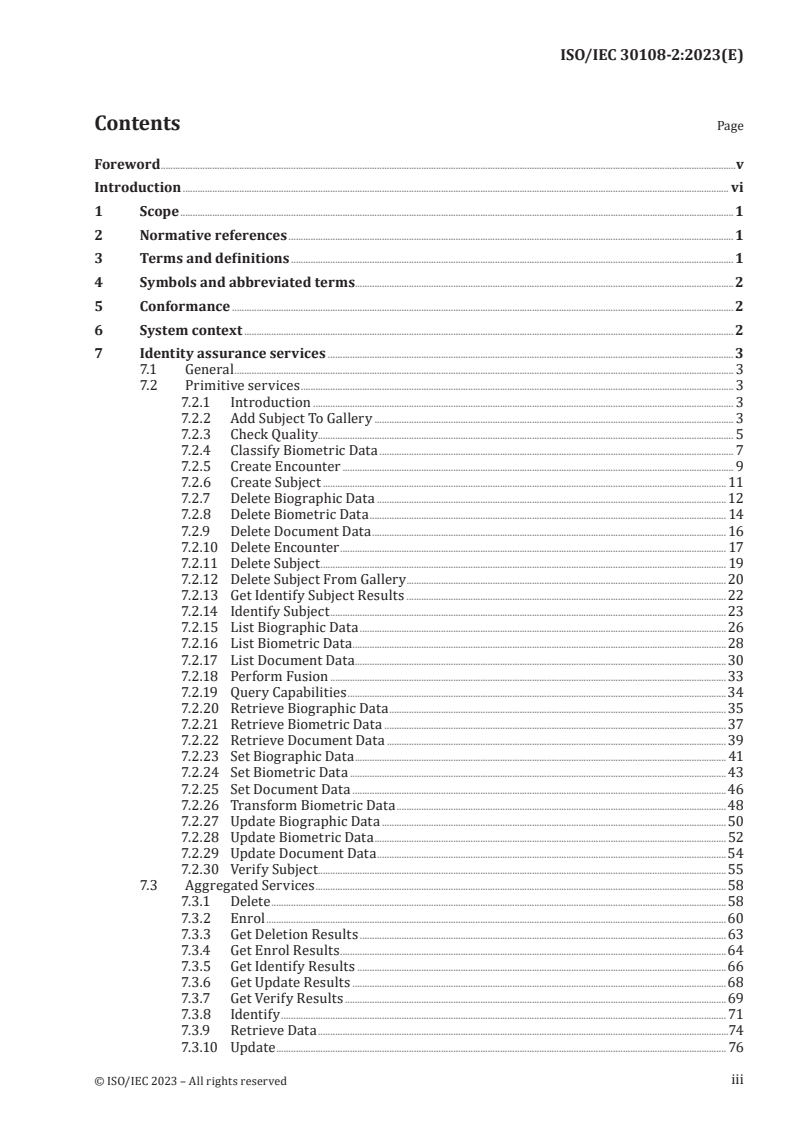
Contents Page
Foreword .v
Introduction . vi
1 Scope . 1
2 Normative references . 1
3 Terms and definitions . 1
4 Symbols and abbreviated terms.2
5 Conformance . 2
6 System context . 2
7 Identity assurance services . 3
7.1 General . 3
7.2 Primitive services . 3
7.2.1 Introduction . 3
7.2.2 Add Subject To Gallery . 3
7.2.3 Check Quality. 5
7.2.4 Classify Biometric Data . 7
7.2.5 Create Encounter . 9
7.2.6 Create Subject . 11
7.2.7 Delete Biographic Data .12
7.2.8 Delete Biometric Data . 14
7.2.9 Delete Document Data . 16
7.2.10 Delete Encounter . 17
7.2.11 Delete Subject . 19
7.2.12 Delete Subject From Gallery . 20
7.2.13 Get Identify Subject Results . 22
7.2.14 Identify Subject . 23
7.2.15 List Biographic Data .26
7.2.16 List Biometric Data . .28
7.2.17 List Document Data.30
7.2.18 Perform Fusion . 33
7.2.19 Query Capabilities .34
7.2.20 Retrieve Biographic Data . 35
7.2.21 Retrieve Biometric Data . 37
7.2.22 Retrieve Document Data . 39
7.2.23 Set Biographic Data . 41
7.2.24 Set Biometric Data . 43
7.2.25 Set Document Data .46
7.2.26 Transform Biometric Data .48
7.2.27 Update Biographic Data .50
7.2.28 Update Biometric Data . 52
7.2.29 Update Document Data .54
7.2.30 Verify Subject . . .55
7.3 Aggregated Services .58
7.3.1 Delete .58
7.3.2 Enrol .60
7.3.3 Get Deletion Results .63
7.3.4 Get Enrol Results .64
7.3.5 Get Identify Results .66
7.3.6 Get Update Results .68
7.3.7 Get Verify Results .69
7.3.8 Identify . 71
7.3.9 Retrieve Data .74
7.3.10 Update . 76
iii
© ISO/IEC 2023 – All rights reserved
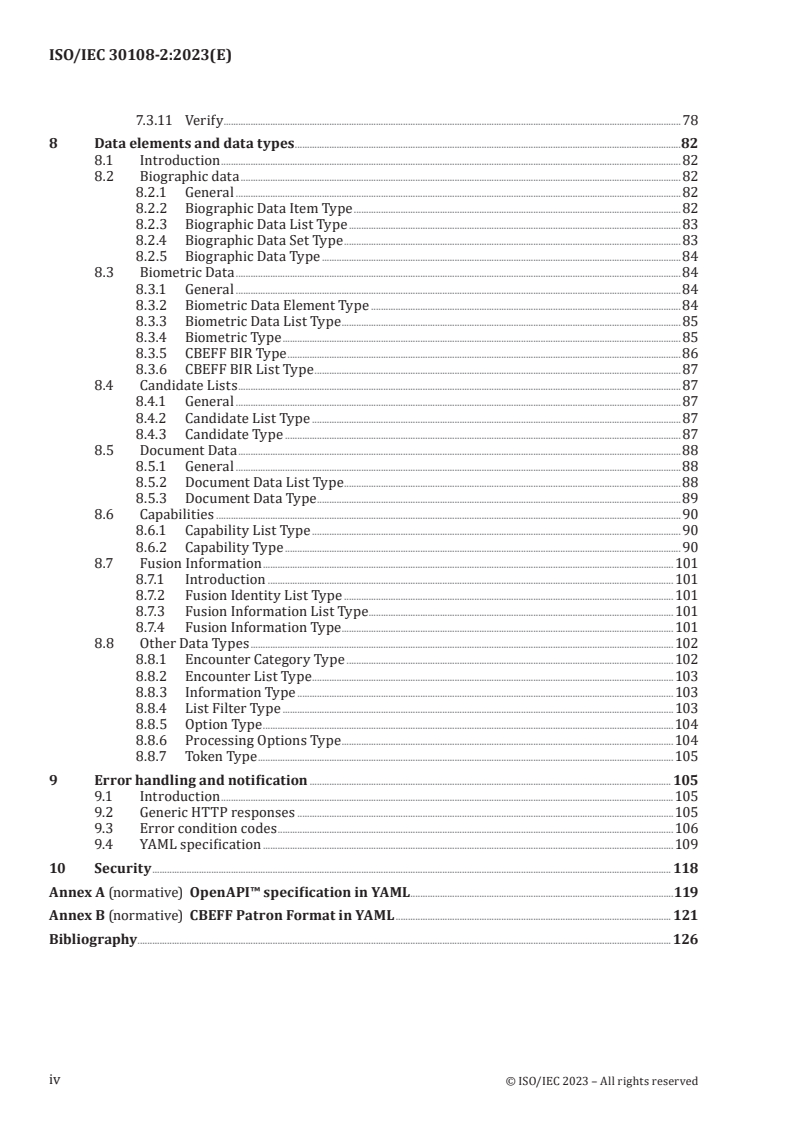
7.3.11 Verify . . 78
8 Data elements and data types .82
8.1 Introduction . 82
8.2 Biographic data .82
8.2.1 General .82
8.2.2 Biographic Data Item Type .82
8.2.3 Biographic Data List Type .83
8.2.4 Biographic Data Set Type .83
8.2.5 Biographic Data Type .84
8.3 Biometric Data .84
8.3.1 General .84
8.3.2 Biometric Data Element Type .84
8.3.3 Biometric Data List Type .85
8.3.4 Biometric Type .85
8.3.5 CBEFF BIR Type .86
8.3.6 CBEFF BIR List Type .87
8.4 Candidate Lists .87
8.4.1 General .87
8.4.2 Candidate List Type .87
8.4.3 Candidate Type .87
8.5 Document Data .88
8.5.1 General .88
8.5.2 Document Data List Type .88
8.5.3 Document Data Type .89
8.6 Capabilities .90
8.6.1 Capability List Type .90
8.6.2 Capability Type .90
8.7 Fusion Information . 101
8.7.1 Introduction . 101
8.7.2 Fusion Identity List Type . 101
8.7.3 Fusion Information List Type . 101
8.7.4 Fusion Information Type . 101
8.8 Other Data Types .102
8.8.1 Encounter Category Type .102
8.8.2 Encounter List Type .103
8.8.3 Information Type .103
8.8.4 List Filter Type .103
8.8.5 Option Type .104
8.8.6 Processing Options Type .104
8.8.7 Token Type .105
9 Error handling and notification . 105
9.1 Introduction .105
9.2 Generic HTTP responses .105
9.3 Error condition codes .106
9.4 YAML specification .109
10 Security . 118
Annex A (normative) OpenAPI™ specification in YAML .119
Annex B (normative) CBEFF Patron Format in YAML . 121
Bibliography . 126
iv
© ISO/IEC 2023 – All rights reserved
Foreword
ISO (the International Organization for Standardization) and IEC (the International Electrotechnical
Commission) form the specialized system for worldwide standardization. National bodies that are
members of ISO or IEC participate in the development of International Standards through technical
committees established by the respective organization to deal with particular fields of technical
activity. ISO and IEC technical committees collaborate in fields of mutual interest. Other international
organizations, governmental and non-governmental, in liaison with ISO and IEC, also take part in the
work.
The procedures used to develop this document and those intended for its further maintenance
are described in the ISO/IEC Directives, Part 1. In particular, the different approval criteria
needed for the different types of document should be noted. This document was drafted in
accordance with the editorial rules of the ISO/IEC Directives, Part 2 (see www.iso.org/directives or
www.iec.ch/members_experts/refdocs).
ISO and IEC draw attention to the possibility that the implementation of this document may involve the
use of (a) patent(s). ISO and IEC take no position concerning the evidence, validity or applicability of
any claimed patent rights in respect thereof. As of the date of publication of this document, ISO and IEC
had not received notice of (a) patent(s) which may be required to implement this document. However,
implementers are cautioned that this may not represent the latest information, which may be obtained
from the patent database available at www.iso.org/patents and https://patents.iec.ch. ISO and IEC shall
not be held responsible for identifying any or all such patent rights.
Any trade name used in this document is information given for the convenience of users and does not
constitute an endorsement.
For an explanation of the voluntary nature of standards, the meaning of ISO specific terms and
expressions related to conformity assessment, as well as information about ISO's adherence to
the World Trade Organization (WTO) principles in the Technical Barriers to Trade (TBT) see
www.iso.org/iso/foreword.html. In the IEC, see www.iec.ch/understanding-standards.
This document was prepared by Joint Technical Committee ISO/IEC JTC 1, Information technology,
Subcommittee SC 37, Biometrics.
A list of all parts in the ISO/IEC 30108 series can be found on the ISO and IEC websites.
Any feedback or questions on this document should be directed to the user’s national standards
body. A complete listing of these bodies can be found at www.iso.org/members.html and
www.iec.ch/national-committees.
v
© ISO/IEC 2023 – All rights reserved
Introduction
This document defines the architecture, operations, data elements and basic requirements for Identity
Attributes Verification Services (IAVSs), thereby providing a framework for the implementation of
generic identity services within a service-oriented environment. An identity in the context of IAVS
comprises a subject, biographic data and biometric data. Other parts of the ISO/IEC 30108 series are
intended to define specific IAVS implementations (or bindings) within specific environments, for
example, Simple Object Access Protocol (SOAP) web services.
IAVS services are generic in nature, being modality-neutral and not targeted at any particular business
application. These services include those related to the management, transformation and biometric
comparison identity data. Services are invoked by an IAVS requester and implemented by an IAVS
service provider (responder). IAVS does not prescribe the architecture or business logic of either the
requester or service provider.
In IAVS two categories of identity services are defined: primitive and aggregate. Primitive services are
more atomic and well-defined, whereas the aggregate services tend to be higher level and enable more
flexibility on the part of the IAVS service provider.
In IAVS two identity models are also defined: person-centric and encounter-based. Person-centric
systems maintain a single up-to-date record (set of data) for a given person, whereas an encounter-
based system retains data related to each interaction the person has with the system.
This document represents a version of IAVS defined in ISO/IEC 30108-1, but using a representational
state transfer (RESTful) approach.
vi
© ISO/IEC 2023 – All rights reserved
INTERNATIONAL STANDARD ISO/IEC 30108-2:2023(E)
Biometrics — Identity attributes verification services —
Part 2:
RESTful specification
1 Scope
The ISO/IEC 30108 series defines biometric services used for identity assurance that are invoked over
a services-based framework. It provides a generic set of biometric and identity-related functions and
associated data definitions to allow remote access to biometric services.
Although focused on biometrics, the ISO/IEC 30108 series includes support for other related identity
assurance mechanisms such as biographic and document capabilities. Identity attributes verification
services (IAVSs) are intended to be compatible with and used in conjunction with other biometric
standards as described in ISO/IEC 30108-1.
This document implements the specification provided in ISO/IEC 30108-1 using representational state
transfer (REST).
Specification of biometric functionality is limited to remote (backend) services. Services between a
client-side application and biometric capture devices are not within the scope of this document.
Integration of biometric services as part of an authentication service or protocol is not within the scope
of this document.
2 Normative references
The following documents are referred to in the text in such a way that some or all of their content
constitutes requirements of this document. For dated references, only the edition cited applies. For
undated references, the latest edition of the referenced document (including any amendments) applies.
ISO/IEC 2382-37, Information technology — Vocabulary — Part 37: Biometrics
ISO/IEC 19785-1, Information technology — Common Biometric Exchange Formats Framework — Part 1:
Data element specification
1)
ISO/IEC 30108-1:2015 , Information technology — Biometric Identity Assurance Services — Part 1: BIAS
services
3 Terms and definitions
For the purposes of this document, the terms and definitions given in ISO/IEC 30108-1 and
ISO/IEC 2382-37 apply.
ISO and IEC maintain terminology databases for use in standardization at the following addresses:
— ISO Online browsing platform: available at https:// www .iso .org/ obp
— IEC Electropedia: available at https:// www .electropedia .org/
1) Under revision.
© ISO/IEC 2023 – All rights reserved
4 Symbols and abbreviated terms
For the purposes of this document, the symbols and abbreviated terms given in ISO/IEC 30108-1 and
the following apply.
BIR biometric information record
BRA ISO Biometric Registration Authority
CBEFF Common Biometric Exchange Formats Framework (defined in ISO/IEC 19785 series)
EFTS electronic fingerprint transmission specification
ID identity / identification / identifier
IAVS identity attributes verification services
JSON JavaScript Object Notation
REST representational state transfer
SOAP Simple Object Access Protocol
UUID universally unique identifier
[3]
YAML Yet Another Markup Language
5 Conformance
ISO/IEC 30108-1:2015, Annex A specifies the conformance requirements for systems/components
claiming conformance to this document.
6 System context
This clause provides an overview of representational state transfer (REST), in the scope of IAVS.
2)
The specification included in this document has been written in OpenAPI™, using YAML™ (Yet Another
3)
Markup Language) as the specification language. OpenAPI is an extended way to specify RESTful
services, allowing a variety of tools to develop client and server applications, as well as using data in
any of the data formats typically used in RESTful services, e.g. JSON (JavaScript Object Notation) or
XML (eXtensible Markup Language).
A goal for this document is to be as open as possible. To that end, this specification is also available in an
electronic OpenAPI file, available at https:// standards .iso .org/ iso -iec/ 30108/ -2/ ed -1.
The specification is written according to the following references:
— ECMA Standard ECMA-404 (2017 2nd Edition) The JSON Data Interchange Format ISO\IEC 21778
— Hyper Text Transfer Protocol (HTTP/1.1) RFC 7230 [https:// httpwg .org/ specs/ rfc7230 .html]
— Hypertext Transfer Protocol (HTTP/1.1): Semantics and Content RFC 7231
— JSON Schema: A Media Type for Describing JSON Documents [http:// json -schema .org/ draft/ 2019
-09/ json -schema -core .html]
2) This trademark is provided for reasons of public interest or public safety. This information is given for the
convenience of users of this document and does not constitute an endorsement by ISO or IEC.
3) This trademark is provided for reasons of public interest or public safety. This information is given for the
convenience of users of this document and does not constitute an endorsement by ISO or IEC.
© ISO/IEC 2023 – All rights reserved
— YAML Ain’t Markup Language (YAML™) Version 1.2: 3rd Edition, Patched at 2009-10-01 [https://
yaml .org/ spec/ 1 .2/ spec .html]
All subclauses within Clause 7 entitled "REST method" (numbered 7.x.x.2) indicate the HTTP method
used, among the various possibilities: GET, POST, DELETE, PUT and PATCH.
Within this document, when a YAML specification is given (e.g. all subclauses numbered 7.x.x.5), it shall
be placed within an OpenAPI file, in the section indicated, taking into account the template provided in
Annex A.
7 Identity assurance services
7.1 General
This clause defines two categories of IAVS services: primitive and aggregate. Primitive services are
lower-level operations that are used to request a specific capability. Aggregate services operate at a
higher-level, performing a sequence of primitive operations in a single request. (An example of such
a sequence would be a negative search where a 1:N identification which results in no matches being
found is immediately followed by the addition of the biometric sample into that search population.)
Implementers are not restricted to one or the other but they may provide (and requesters may use) a
mixture of both primitive and aggregate types.
Aggregate services do not have to utilize primitive services.
Each service is identified by an tag and must include a name attribute. Service parameters
are identified by a tag and must include a name, type and direction attribute. The direction
attribute specifies whether the parameter is an input parameter (in), an output parameter (out)
or an input/output parameter (inout). Parameters may also include a use attribute to indicate if the
parameter is required, optional or conditional. If the parameter is conditional, the service description
must identify the conditions.
7.2 Primitive services
7.2.1 Introduction
IAVS specifies the following set of primitive services.
7.2.2 Add Subject To Gallery
7.2.2.1 Description
The Add Subject To Gallery service shall register a subject to a given gallery or population group. As
an optional parameter, the value of the claim to identity by which the subject is known to the gallery
may be specified. This claim to identity shall be unique across the gallery. If no claim to identity is
specified, the subject ID (assigned with the Create Subject service) shall be used as the claim to identity.
Additionally, in the encounter-centric model, the encounter ID associated with the subject’s biometric
sample that will be added to the gallery shall be specified.
NOTE In the IAVS model, the creation and management of galleries are the responsibility of the service
provider implementation. Services are not exposed to the requester for this purpose.
7.2.2.2 REST method
POST
© ISO/IEC 2023 – All rights reserved
7.2.2.3 Parameters
— Gallery ID — the identifier of the gallery or population group to which the subject will be added.
— Subject ID — the identifier of the subject.
— Identity Claim (optional) — the identifier by which the subject is known to the gallery.
— Encounter ID (conditional) — the identifier of the encounter, required for encounter-centric models.
7.2.2.4 Responses
In addition to the generic HTTP responses defined in 9.2, the execution of this service shall provide one
of the responses listed in Table 1 (see 9.3 for the definitions of each error condition code).
Table 1 — Particular responses for Add Subject To Gallery service
HTTP
HTTP status
status Error condition code Description
code meaning
code
200 OK SUCCESS
INVALID_IDENTITY_CLAIM
400 Bad Request INVALID_SUBJECT_ID
INVALID_ENCOUNTER_ID
UNKNOWN_GALLERY
UNKNOWN_SUBJECT
404 Not Found
UNKNOWN_IDENTITY_CLAIM
UNKNOWN_ENCOUNTER
CANNOT_STORE_DATA
Internal Server
Error
INTERNAL_DATABASE_ERROR
7.2.2.5 YAML specification
To be placed in section #/paths:
/addSubjectToGallery:
post:
summary: Add Subject To Gallery
parameters:
- name: galleryID
in: query
required: true
schema:
type: string
- name: subjectID
in: query
required: true
schema:
type: string
- name: identityClaim
in: query
required: false
schema:
type: string
- name: encounterID
in: query
required: false #conditional
schema:
type: string
responses:
200:
$ref: '#/components/responses/success'
© ISO/IEC 2023 – All rights reserved
400:
description: Bad Request
content:
application/json:
schema:
oneOf:
- $ref: '#/components/schemas/invalidIdentityClaim'
- $ref: '#/components/schemas/invalidSubjectId'
- $ref: '#/components/schemas/invalidEncounterId'
404:
description: Not Found
content:
application/json:
schema:
oneOf:
- $ref: '#/components/schemas/unknownGallery'
- $ref: '#/components/schemas/unknownSubject'
- $ref: '#/components/schemas/unknownIdentityClaim'
- $ref: '#/components/schemas/unknownEncounter'
500:
description: Internal Server Error
content:
application/json:
schema:
oneOf:
- $ref: '#/components/schemas/cannotStoreData'
- $ref: '#/components/schemas/internalDatabaseError'
- $ref: '#/components/schemas/unknownError'
503:
$ref: '#/components/responses/x503'
7.2.3 Check Quality
7.2.3.1 Description
The Check Quality service shall return a quality score for a given biometric sample or a specified subject.
Either a biometric sample or a subject identifier (ID) shall be provided. The biometric input is provided
in a Common Biometric Exchange Formats Framework (CBEFF, as defined in ISO/IEC 19785 series)
basic structure or CBEFF record, which in this document is called a CBEFF-BIR (Biometric Information
Record). The algorithm vendor and algorithm vendor product ID may be optionally provided in order
to request a particular algorithm’s use in calculating the biometric quality. If an algorithm vendor is
provided, then the algorithm vendor product ID is required. If no algorithm vendor is provided, the
implementing system shall provide the algorithm vendor and algorithm vendor product ID that were
used to calculate the biometric quality as output parameters.
NOTE Algorithm vendors are registered with the ISO Biometric Registration Authority (BRA) and assigned
unique identifiers as defined in ISO/IEC 19785-2. Algorithm Product IDs are assigned by the registered algorithm
vendor.
7.2.3.2 REST method
GET
7.2.3.3 Parameters
— BIR (conditional) — data structure containing a single biometric sample for which a quality score is
to be determined; required if no Subject ID is provided.
— Subject ID (conditional) — the identifier of the subject; required if no BIR is provided.
— Algorithm Vendor (optional) — the identifier of the vendor of the quality algorithm used to determine
the quality.
© ISO/IEC 2023 – All rights reserved
— Algorithm Vendor Product ID (conditional) — the vendor-assigned ID for the algorithm used to
determine the quality; required as input if algorithm vendor is provided.
7.2.3.4 Responses
In addition to the generic HTTP responses defined in 9.2, the execution of this service shall provide one
of the responses listed in Table 2 (see 9.3 for the definitions of each error condition code).
Table 2 — Particular responses for Check Quality service
HTTP
HTTP status
status Error condition code Description
code meaning
code
Adding also
— Quality Score
200 OK SUCCESS
— Algorithm Version
as seen below table.
INVALID_BIR
INVALID_SUBJECT_ID
400 Bad Request INVALID_INPUT
BIOMETRIC_TYPE_NOT_SUPPORTED
UNKNOWN_FORMAT
BIR_DECRYPTION_FAILURE
403 Forbidden BIR_QUALITY_ERROR
BIR_SIGNATURE_FAILURE
404 Not Found UNKNOWN_SUBJECT
Internal Server
500 CANNOT_CHECK_QUALITY
Error
A successful execution of this service will provide:
— Quality Score — the quality of the biometric, as defined by the Quality type in one of the JSON-coded
patron formats ISO/IEC 19785-3.
— Algorithm Version — the version of the algorithm used to determine the quality
7.2.3.5 YAML specification
To be placed in section #/paths:
/checkQuality:
get:
summary: Check Quality
parameters:
- name: bir
in: query
required: false #conditional
schema:
$ref: '#/components/schemas/CBEFF_BIR_Type'
- name: subjectID
in: query
required: false #conditional
schema:
type: string
- name: algorithmVendor
in: query #inout
required: false
schema:
type: string
© ISO/IEC 2023 – All rights reserved
- name: algorithmVendorProductID
in: query #inout
required: false #conditional
schema:
type: string
responses:
200:
description: Success. Returns quality score and algorithm version
content:
application/json:
schema:
type: object
properties:
qualityScore:
type: string #RAUL: CBEFF-3 JSON
description: >
The quality of the biometric, as defined by the Quality
type in one of the JSON-coded patron formats ISO/IEC
19785-3
algorithmVersion:
type: string
description: >
The version of the algorithm used to determine the
quality
400:
description: Bad Request
content:
application/json:
schema:
oneOf:
- $ref: '#/components/schemas/invalidBir'
- $ref: '#/components/schemas/invalidSubjectId'
- $ref: '#/components/schemas/invalidInput'
- $ref: '#/components/schemas/biometricTypeNotSupported'
- $ref: '#/components/schemas/unknownFormat'
403:
description: Forbidden
content:
application/json:
schema:
oneOf:
- $ref: '#/components/schemas/birDecryptionFailure'
- $ref: '#/components/schemas/birQualityError'
- $ref: '#/components/schemas/birSignatureFailure'
404:
description: Unknown Subject
content:
application/json:
schema:
$ref: '#/components/schemas/unknownSubject'
500:
description: Internal Server Error
content:
application/json:
schema:
oneOf:
- $ref: '#/components/schemas/cannotCheckQuality'
- $ref: '#/components/schemas/unknownError'
503:
$ref: '#/components/responses/x503'
7.2.4 Classify Biometric Data
7.2.4.1 Description
The Classify Biometric Data service shall attempt to classify a biometric sample. For example, a
fingerprint biometric sample may be classified as a whorl, loop or arch (or other classification classes
and sub-classes). The types of classification algorithms and classes are not specified here. Instead, they
© ISO/IEC 2023 – All rights reserved
are left for the implementing system to define. If no classification algorithm is input, then the IAVS
service provider will make the selection.
7.2.4.2 REST method
GET
7.2.4.3 Parameters
— BIR — data structure containing a single biometric sample for which the classification is to be
determined.
— Classification Algorithm Type (optional/output) — identifies the type of classification algorithm to be
used (input) and that was used (output) to perform the classification (e.g. for fingerprints, Henry
classification).
7.2.4.4 Responses
In addition to the generic HTTP responses defined in 9.2, the execution of this service shall provide one
of the responses listed in Table 3 (see 9.3 for the definitions of each error condition code).
Table 3 — Particular responses for Classify Biometric Data service
HTTP
HTTP status
status Error condition code Description
code meaning
code
Adding also Classification, as seen
200 OK SUCCESS
below table.
INVALID_BIR
INVALID_INPUT
400 Bad Request
BIOMETRIC_TYPE_NOT_SUPPORTED
UNKNOWN_FORMAT
BIR_DECRYPTION_FAILURE
403 Forbidden BIR_QUALITY_ERROR
BIR_SIGNATURE_FAILURE
Internal Server
500 CANNOT_PROCESS_DATA
Error
A successful execution of this service will provide:
— Classification — the result of the classification.
7.2.4.5 YAML specification
To be placed in section #/paths:
/classifyBiometricData:
get:
summary: Classify Biometric Data
parameters:
- name: bir
in: query
required: true
schema:
$ref: '#/components/schemas/CBEFF_BIR_Type'
- name: classificationAlgorithmType
in: query
required: false
schema:
© ISO/IEC 2023 – All rights reserved
type: string
responses:
200:
description: Success. Returns classification
content:
application/json:
schema:
type: object
properties:
classification:
type: string
description: The result of the classification
400:
description: Bad Request
content:
application/json:
schema:
oneOf:
- $ref: '#/components/schemas/invalidBir'
- $ref: '#/components/schemas/invalidInput'
- $ref: '#/components/schemas/biometricTypeNotSupported'
- $ref: '#/components/schemas/unknownFormat'
403:
description: Forbidden
content:
application/json:
schema:
oneOf:
- $ref: '#/components/schemas/birDecryptionFail
...