


ISO/IEC 9834-1:2005
(Main)Information technology — Open Systems Interconnection — Procedures for the operation of OSI Registration Authorities: General procedures and top arcs of the ASN.1 Object Identifier tree — Part 1:
Information technology — Open Systems Interconnection — Procedures for the operation of OSI Registration Authorities: General procedures and top arcs of the ASN.1 Object Identifier tree — Part 1:
ISO/IEC 9834-1:2005: specifies a Registration-Hierarchical-name-tree (RH-name-tree), which is a generic tree structure for allocations made by Registration Authorities, and the ASN.1 object identifier tree, which is a specific instance of the RH-name-tree; registers the three top-level arcs of the ASN.1 object identifier tree; specifies procedures which are generally applicable to registration in the context of an RH-name-tree; provides guidelines for the establishment and operation of International Registration Authorities; provides guidelines for additional International Standards which reference the procedures in ISO/IEC 9834-1:2005. ISO/IEC 9834-1:2005 does not exclude or disallow the use of any syntactic forms of names or any naming domains for registration purposes provided that the domains ensure non-ambiguity within their scope. It is intended to cover those cases in which the registration-hierarchical-name is appropriate. Information about registration for specific objects is contained in separate International Standards. ISO/IEC 9834-1:2005 applies to registration by International Standards, by International Registration Authorities, and by any other Registration Authority.
Technologies de l'information — Interconnexion de systèmes ouverts (OSI) — Procédures opérationnelles pour les organismes d'enregistrement de l'OSI: Procédures générales et arcs sommitaux de l'arborescence des identificateurs d'objet ASN.1 — Partie 1:
L'ISO/CEI 9834-1:2005 spécifie un arbre de noms résultant d'un enregistrement hiérarchisé (arbres de noms RH) qui est une structure arborescente générique pour les attributions faites par les autorités d'enregistrement, et l'arbre des identificateurs d'objet de la notation de syntaxe abstraite numéro un (ASN.1) qui est une instance spécifique de l'arbre de noms RH, enregistre les trois arcs sommitaux de l'arborescence des identificateurs d'objet ASN.1, spécifie les procédures générales applicables à l'enregistrement dans le contexte d'un arbre de noms RH, fournit des règles pour l'établissement et le fonctionnement des autorités d'enregistrement internationales, et fournit des règles pour le développement d'autres Normes internationales qui choisissent de faire référence aux procédures contenues dans l'ISO/CEI 9834-1:2005. L'ISO/CEI 9834-1:2005 n'exclut pas et n'interdit pas l'utilisation de toute forme syntaxique de nom ou de tout domaine de dénomination à des fins d'enregistrement, pourvu que la non-ambiguïté soit assurée. Elle couvre les cas où l'utilisation d'une forme de nom résultant d'un enregistrement hiérarchisé est appropriée. On trouvera dans d'autres Normes internationales des informations relatives à l'enregistrement d'objets spécifiques. L'ISO/CEI 9834-1:2005 s'applique à l'enregistrement par des Normes internationales, par des autorités d'enregistrement internationales et par toute autre autorité d'enregistrement.
General Information
- Status
- Withdrawn
- Publication Date
- 28-Jul-2005
- Withdrawal Date
- 28-Jul-2005
- Current Stage
- 9599 - Withdrawal of International Standard
- Start Date
- 14-Aug-2009
- Completion Date
- 12-Feb-2026
Relations
- Consolidated By
ISO/IEEE 11073-10102:2014 - Health informatics — Point-of-care medical device communication — Part 10102: Nomenclature — Annotated ECG - Effective Date
- 06-Jun-2022
- Effective Date
- 15-Apr-2008
- Effective Date
- 15-Apr-2008
- Effective Date
- 15-Apr-2008
- Effective Date
- 15-Apr-2008
ISO/IEC 9834-1:2005 - Information technology -- Open Systems Interconnection -- Procedures for the operation of OSI Registration Authorities: General procedures and top arcs of the ASN.1 Object Identifier tree
ISO/IEC 9834-1:2005 - Technologies de l'information -- Interconnexion de systemes ouverts (OSI) -- Procédures opérationnelles pour les organismes d'enregistrement de l'OSI: Procédures générales et arcs sommitaux de l'arborescence des identificateurs d'objet ASN.1
Get Certified
Connect with accredited certification bodies for this standard

BSI Group
BSI (British Standards Institution) is the business standards company that helps organizations make excellence a habit.

NYCE
Mexican standards and certification body.
Sponsored listings
Frequently Asked Questions
ISO/IEC 9834-1:2005 is a standard published by the International Organization for Standardization (ISO). Its full title is "Information technology — Open Systems Interconnection — Procedures for the operation of OSI Registration Authorities: General procedures and top arcs of the ASN.1 Object Identifier tree — Part 1:". This standard covers: ISO/IEC 9834-1:2005: specifies a Registration-Hierarchical-name-tree (RH-name-tree), which is a generic tree structure for allocations made by Registration Authorities, and the ASN.1 object identifier tree, which is a specific instance of the RH-name-tree; registers the three top-level arcs of the ASN.1 object identifier tree; specifies procedures which are generally applicable to registration in the context of an RH-name-tree; provides guidelines for the establishment and operation of International Registration Authorities; provides guidelines for additional International Standards which reference the procedures in ISO/IEC 9834-1:2005. ISO/IEC 9834-1:2005 does not exclude or disallow the use of any syntactic forms of names or any naming domains for registration purposes provided that the domains ensure non-ambiguity within their scope. It is intended to cover those cases in which the registration-hierarchical-name is appropriate. Information about registration for specific objects is contained in separate International Standards. ISO/IEC 9834-1:2005 applies to registration by International Standards, by International Registration Authorities, and by any other Registration Authority.
ISO/IEC 9834-1:2005: specifies a Registration-Hierarchical-name-tree (RH-name-tree), which is a generic tree structure for allocations made by Registration Authorities, and the ASN.1 object identifier tree, which is a specific instance of the RH-name-tree; registers the three top-level arcs of the ASN.1 object identifier tree; specifies procedures which are generally applicable to registration in the context of an RH-name-tree; provides guidelines for the establishment and operation of International Registration Authorities; provides guidelines for additional International Standards which reference the procedures in ISO/IEC 9834-1:2005. ISO/IEC 9834-1:2005 does not exclude or disallow the use of any syntactic forms of names or any naming domains for registration purposes provided that the domains ensure non-ambiguity within their scope. It is intended to cover those cases in which the registration-hierarchical-name is appropriate. Information about registration for specific objects is contained in separate International Standards. ISO/IEC 9834-1:2005 applies to registration by International Standards, by International Registration Authorities, and by any other Registration Authority.
ISO/IEC 9834-1:2005 is classified under the following ICS (International Classification for Standards) categories: 35.100.01 - Open systems interconnection in general. The ICS classification helps identify the subject area and facilitates finding related standards.
ISO/IEC 9834-1:2005 has the following relationships with other standards: It is inter standard links to ISO/IEEE 11073-10102:2014, ISO/IEC 9834-1:2008, ISO/IEC 9834-1:1993/Amd 1:1997, ISO/IEC 9834-1:1993/Amd 2:1998, ISO/IEC 9834-1:1993. Understanding these relationships helps ensure you are using the most current and applicable version of the standard.
ISO/IEC 9834-1:2005 is available in PDF format for immediate download after purchase. The document can be added to your cart and obtained through the secure checkout process. Digital delivery ensures instant access to the complete standard document.
Standards Content (Sample)
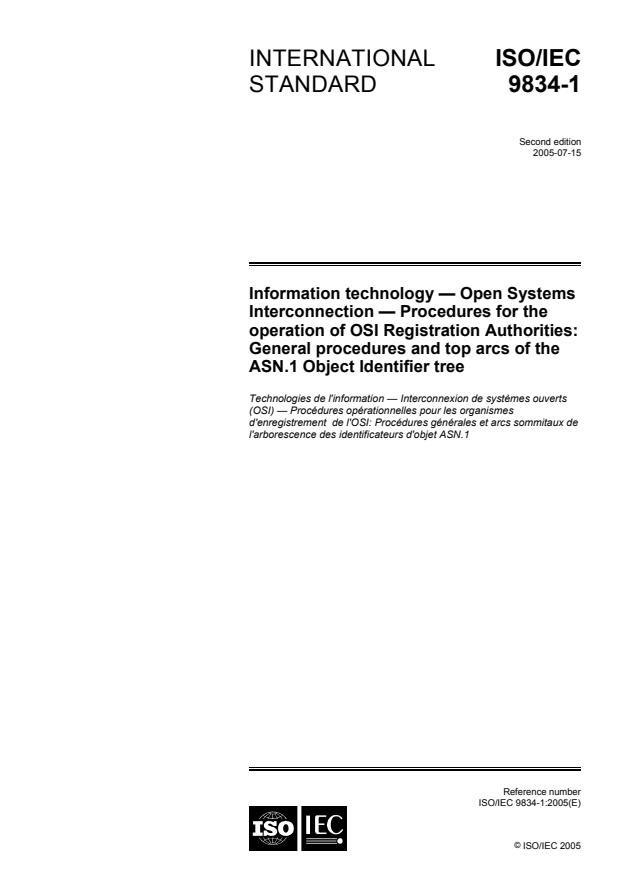
INTERNATIONAL ISO/IEC
STANDARD 9834-1
Second edition
2005-07-15
Information technology — Open Systems
Interconnection — Procedures for the
operation of OSI Registration Authorities:
General procedures and top arcs of the
ASN.1 Object Identifier tree
Technologies de l'information — Interconnexion de systèmes ouverts
(OSI) — Procédures opérationnelles pour les organismes
d'enregistrement de l'OSI: Procédures générales et arcs sommitaux de
l'arborescence des identificateurs d'objet ASN.1
Reference number
©
ISO/IEC 2005
PDF disclaimer
This PDF file may contain embedded typefaces. In accordance with Adobe's licensing policy, this file may be printed or viewed but
shall not be edited unless the typefaces which are embedded are licensed to and installed on the computer performing the editing. In
downloading this file, parties accept therein the responsibility of not infringing Adobe's licensing policy. The ISO Central Secretariat
accepts no liability in this area.
Adobe is a trademark of Adobe Systems Incorporated.
Details of the software products used to create this PDF file can be found in the General Info relative to the file; the PDF-creation
parameters were optimized for printing. Every care has been taken to ensure that the file is suitable for use by ISO member bodies. In
the unlikely event that a problem relating to it is found, please inform the Central Secretariat at the address given below.
© ISO/IEC 2005
All rights reserved. Unless otherwise specified, no part of this publication may be reproduced or utilized in any form or by any means,
electronic or mechanical, including photocopying and microfilm, without permission in writing from either ISO at the address below or
ISO's member body in the country of the requester.
ISO copyright office
Case postale 56 • CH-1211 Geneva 20
Tel. + 41 22 749 01 11
Fax + 41 22 749 09 47
E-mail copyright@iso.org
Web www.iso.org
Published in Switzerland
ii © ISO/IEC 2005 — All rights reserved
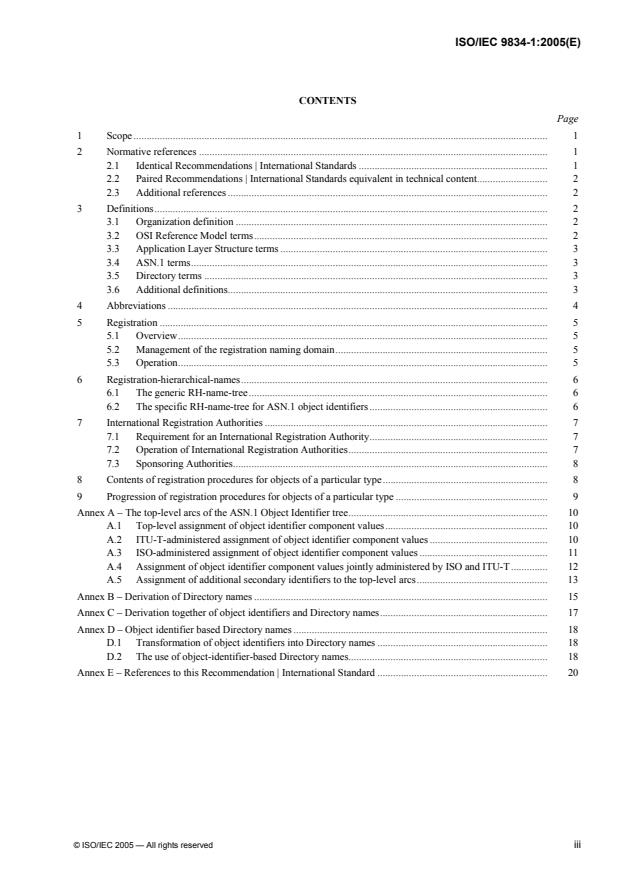
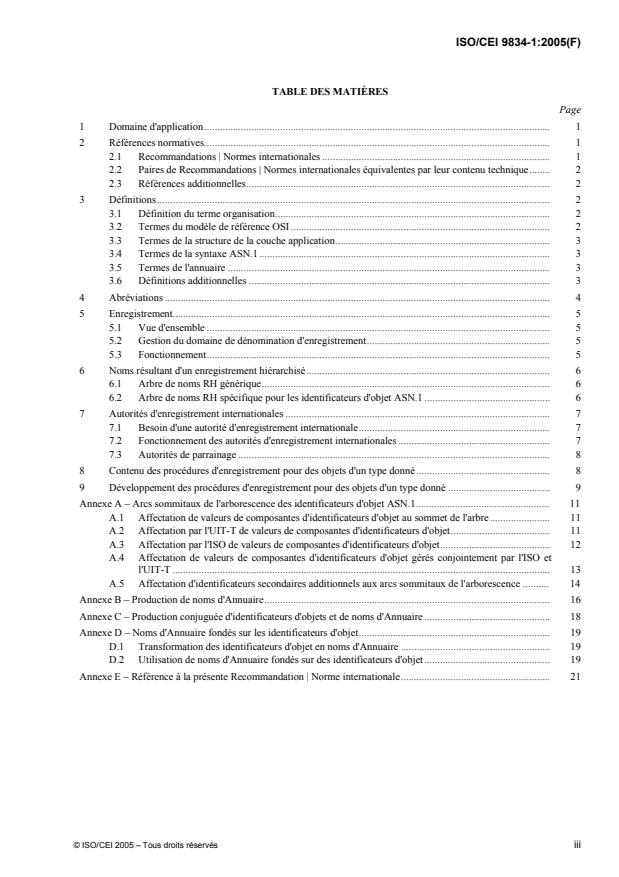
CONTENTS
Page
1 Scope . 1
2 Normative references . 1
2.1 Identical Recommendations | International Standards. 1
2.2 Paired Recommendations | International Standards equivalent in technical content. 2
2.3 Additional references . 2
3 Definitions. 2
3.1 Organization definition . 2
3.2 OSI Reference Model terms. 2
3.3 Application Layer Structure terms . 3
3.4 ASN.1 terms. 3
3.5 Directory terms . 3
3.6 Additional definitions. 3
4 Abbreviations . 4
5 Registration . 5
5.1 Overview. 5
5.2 Management of the registration naming domain. 5
5.3 Operation. 5
6 Registration-hierarchical-names. 6
6.1 The generic RH-name-tree. 6
6.2 The specific RH-name-tree for ASN.1 object identifiers. 6
7 International Registration Authorities . 7
7.1 Requirement for an International Registration Authority. 7
7.2 Operation of International Registration Authorities. 7
7.3 Sponsoring Authorities. 8
8 Contents of registration procedures for objects of a particular type. 8
9 Progression of registration procedures for objects of a particular type . 9
Annex A – The top-level arcs of the ASN.1 Object Identifier tree. 10
A.1 Top-level assignment of object identifier component values. 10
A.2 ITU-T-administered assignment of object identifier component values . 10
A.3 ISO-administered assignment of object identifier component values . 11
A.4 Assignment of object identifier component values jointly administered by ISO and ITU-T. 12
A.5 Assignment of additional secondary identifiers to the top-level arcs. 13
Annex B – Derivation of Directory names . 15
Annex C – Derivation together of object identifiers and Directory names. 17
Annex D – Object identifier based Directory names . 18
D.1 Transformation of object identifiers into Directory names . 18
D.2 The use of object-identifier-based Directory names. 18
Annex E – References to this Recommendation | International Standard . 20
© ISO/IEC 2005 — All rights reserved iii
Foreword
ISO (the International Organization for Standardization) and IEC (the International Electrotechnical
Commission) form the specialized system for worldwide standardization. National bodies that are members of
ISO or IEC participate in the development of International Standards through technical committees
established by the respective organization to deal with particular fields of technical activity. ISO and IEC
technical committees collaborate in fields of mutual interest. Other international organizations, governmental
and non-governmental, in liaison with ISO and IEC, also take part in the work. In the field of information
technology, ISO and IEC have established a joint technical committee, ISO/IEC JTC 1.
International Standards are drafted in accordance with the rules given in the ISO/IEC Directives, Part 2.
The main task of the joint technical committee is to prepare International Standards. Draft International
Standards adopted by the joint technical committee are circulated to national bodies for voting. Publication as
an International Standard requires approval by at least 75 % of the national bodies casting a vote.
Attention is drawn to the possibility that some of the elements of this document may be the subject of patent
rights. ISO and IEC shall not be held responsible for identifying any or all such patent rights.
ISO/IEC 9834-1 was prepared by Joint Technical Committee ISO/IEC JTC 1, Information technology,
Subcommittee SC 6, Telecommunications and information exchange between systems in collaboration with
ITU-T. The identical text is published as ITU-T Rec. X.660.
This second edition cancels and replaces the first edition (ISO/IEC 9834-1:1993), which has been technically
revised. It also incorporates the Amendments ISO/IEC 9834-1:1993/Amd.1:1997 and
ISO/IEC 9834-1:1993/Amd.2:1998.
ISO/IEC 9834 consists of the following parts, under the general title Information technology — Open Systems
Interconnection — Procedures for the operation of OSI Registration Authorities:
⎯ Part 1: General procedures and top arcs of the ASN.1 Object Identifier tree
⎯ Part 2: Registration procedures for OSI document types
⎯ Part 3: Registration of Object Identifier arcs beneath the top-level arc jointly administered by ISO and ITU-T
⎯ Part 4: Register of VTE Profiles
⎯ Part 5: Register of VT Control Object Definitions
⎯ Part 6: Registration of application processes and application entities
⎯ Part 7: Joint ISO and ITU-T Registration of International Organizations
⎯ Part 8: Generation and registration of Universally Unique Identifiers (UUIDs) and their use as ASN.1
Object Identifier components
iv © ISO/IEC 2005 — All rights reserved
INTERNATIONAL STANDARD
ITU-T RECOMMENDATION
Information technology –
Open Systems Interconnection –
Procedures for the operation of OSI Registration Authorities:
General procedures and top arcs of the ASN.1 Object Identifier tree
1 Scope
This Recommendation | International Standard:
a) specifies a Registration-Hierarchical-name-tree (RH-name-tree) which is a generic tree structure for
allocations made by Registration Authorities, and the ASN.1 object identifier tree which is a specific
instance of the RH-name-tree;
b) registers the three top-level arcs of the ASN.1 object identifier tree;
c) specifies procedures which are generally applicable to registration in the context of an RH-name-tree;
d) provides guidelines for the establishment and operation of International Registration Authorities;
e) provides guidelines for additional Recommendations | International Standards which choose to reference
the procedures in this Recommendation | International Standard.
NOTE 1 – This Recommendation | International Standard does not exclude or disallow the use of any syntactic forms of names
or any naming domains for registration purposes provided that the domains ensure non-ambiguity within their scope. This
Recommendation | International Standard is intended to cover those cases where the registration-hierarchical-name is
appropriate.
NOTE 2 – Information about registration for specific objects is contained in separate Recommendations | International Standards.
This Recommendation | International Standard applies to registration by Recommendations | International Standards, by
International Registration Authorities, and by any other Registration Authority.
2 Normative references
The following Recommendations and International Standards contain provisions which, through reference in this text,
constitute provisions of this Recommendation | International Standard. At the time of publication, the editions indicated
were valid. All Recommendations and Standards are subject to revision, and parties to agreements based on this
Recommendation | International Standard are encouraged to investigate the possibility of applying the most recent
edition of the Recommendations and Standards listed below. Members of IEC and ISO maintain registers of currently
valid International Standards. The Telecommunication Standardization Bureau of the ITU maintains a list of currently
valid ITU-T Recommendations.
2.1 Identical Recommendations | International Standards
– ITU-T Recommendation X.207 (1993) | ISO/IEC 9545:1994, Information technology – Open Systems
Interconnection – Application layer structure.
– ITU-T Recommendation X.501 (2001) | ISO/IEC 9594-2:2001, Information technology – Open Systems
Interconnection – The Directory: Models.
– ITU-T Recommendation X.520 (2001) | ISO/IEC 9594-6:2001, Information technology – Open Systems
Interconnection – The Directory: Selected attribute types.
– ITU-T Recommendation X.650 (1996) | ISO/IEC 7498-3:1997, Information technology – Open Systems
Interconnection – Basic Reference Model: Naming and addressing.
– ITU-T Recommendation X.662 (2004) | ISO/IEC 9834-3:2005, Information technology – Open Systems
Interconnection – Procedures for the operation of OSI Registration Authorities: Registration of Object
Identifier arcs beneath the top-level arc jointly administered by ISO and ITU-T.
ITU-T Rec. X.660 (08/2004) 1
– ITU-T Recommendation X.680 (2002) | ISO/IEC 8824-1:2002, Information technology – Abstract
Syntax Notation One (ASN.1): Specification of basic notation.
– ITU-T Recommendation X.681 (2002) | ISO/IEC 8824-2:2002, Information technology – Abstract
Syntax Notation One (ASN.1): Information object specification.
– ITU-T Recommendation X.690 (2002) | ISO/IEC 8825-1:2002, Information technology – ASN.1
encoding rules: Specification of Basic Encoding Rules (BER), Canonical Encoding Rules (CER), and
Distinguished Encoding Rules (DER).
– ITU-T Recommendation X.691 (2002) | ISO/IEC 8825-2:2002, Information technology – ASN.1
encoding rules: Specification of Packed Encoding Rules (PER).
– ITU-T Recommendation X.693 (2001) | ISO/IEC 8825-4:2002, Information technology – ASN.1
encoding rules: XML Encoding Rules (XER).
– ITU-T Recommendation X.722 (1992) | ISO/IEC 10165-4:1992, Information technology – Open Systems
Interconnection – Structure of management information: Guidelines for the definition of managed
objects.
2.2 Paired Recommendations | International Standards equivalent in technical content
– ITU-T Recommendation F.400/X.400 (1999), Message handling system and service overview.
ISO/IEC 10021-1:2003, Information technology – Message Handling Systems (MHS) – Part 1: System
and service overview.
2.3 Additional references
– ITU-T Recommendation X.121 (2000), International numbering plan for public data networks.
– ISO 3166-1:1997, Codes for the representation of names of countries and their subdivisions – Part 1:
Country codes.
– ISO 3166-2:1998, Codes for the representation of names of countries and their subdivisions – Part 2:
Country subdivision code.
– ISO 3166-3:1999, Codes for the representation of names of countries and their subdivisions – Part 3:
Code for formerly used names of countries.
– ISO/IEC 6523-1:1998, Information technology – Structure for the identification of organizations and
organization parts – Part 1: Identification of organization identification schemes.
– ISO/IEC 6523-2:1998, Information technology – Structure for the identification of organizations and
organization parts – Part 2: Registration of organization identification schemes.
– ISO 8571-1:1988, Information processing system – Open Systems Interconnection – File transfer, access
and management – Part 1: General introduction.
3 Definitions
For the purposes of this Recommendation | International Standard, the following definitions apply.
3.1 Organization definition
This Recommendation | International Standard uses the following term defined in ISO/IEC 6523-1:
a) organization.
3.2 OSI Reference Model terms
This Recommendation | International Standard uses the following terms defined in ITU-T Rec. X.650 |
ISO/IEC 7498-3:
a) name;
b) naming authority;
c) naming domain;
d) synonym.
2 ITU-T Rec. X.660 (08/2004)
3.3 Application Layer Structure terms
This Recommendation | International Standard uses the following terms defined in ITU-T Rec. X.207 | ISO/IEC 9545:
a) application-entity-title;
b) application-process-title.
3.4 ASN.1 terms
This Recommendation | International Standard uses the following terms defined in ITU-T Rec. X.680 |
ISO/IEC 8824-1:
a) object;
b) object descriptor type;
c) object identifier type.
This Recommendation | International Standard uses the following term defined in ITU-T Rec. X.681 | ISO/IEC 8824-2:
a) information object.
3.5 Directory terms
This Recommendation | International Standard uses the following terms defined in ITU-T Rec. X.500 |
ISO/IEC 9594-1:
a) Directory;
b) Directory name.
This Recommendation | International Standard uses the following terms defined in ITU-T Rec. X.501 |
ISO/IEC 9594-2:
a) attribute;
b) attribute type;
c) attribute value;
d) attribute value assertion;
e) object class;
f) relative distinguished name.
3.6 Additional definitions
3.6.1 additional secondary identifier: A secondary identifier for an arc of the ASN.1 OID tree that is assigned
from time-to-time by a simple Resolution of the relevant ITU-T Study Group and ISO/IEC JTC 1 Subcommittee
without requiring any change to this or any other International Standard (see A.5.5).
3.6.2 administrative role (of a registration authority): Assigning and making available unambiguous names
according to the Recommendation | International Standard defining the procedures for the authority.
3.6.3 international registration authority: A Registration Authority (see 3.6.8) acting at the international level
according to the procedures for its operation defined in the relevant Recommendation | International Standard (see
clause 7).
3.6.4 object (of interest): Anything in some world, generally the world of telecommunications and information
processing or some part thereof,
a) which is identifiable (can be named); and
b) which may be registered.
NOTE – Examples of objects are ASN.1 modules (see ITU-T Rec. X.680 | ISO/IEC 8824-1), information objects (see ITU-T
Rec. X.681 | ISO/IEC 8824-2) and managed objects (see ITU-T Rec. X.722 | ISO/IEC 10165-4).
3.6.5 object identifier tree: A specific form of an RH-name-tree whose root corresponds to this Recommendation |
International Standard and whose nodes correspond to registration authorities responsible for allocating arcs from a
parent node.
3.6.6 primary value: A value of a specified type (integer, in the case of the ASN.1 OID tree) assigned to an arc of
the RH-name-tree that can be used to provide an unambiguous identification of that arc.
NOTE – For the ASN.1 OID tree, the primary value of an arc is referred to as a primary integer value.
ITU-T Rec. X.660 (08/2004) 3
3.6.7 registration: The assignment of an unambiguous name to an object in a way which makes the assignment
available to interested parties.
3.6.8 registration authority: An entity such as an organization, a standard or an automated facility that performs
registration of one or more types of objects (see also International Registration Authority).
NOTE – For this Recommendation | International Standard, the above definition of registration authority extends the term to
cover registration by organizations acting at international, regional and national levels and by other means. For clarity, the term
International Registration Authority is used in this Recommendation | International Standard to refer to an organization
performing registration at the international level.
3.6.9 registration-hierarchical-name: A name which is unambiguous within the registration-hierarchical-
name-tree and which is assigned by registration. The semantic form of this name is structured according to the rules in
clause 6.
3.6.10 registration-hierarchical-name-tree: A tree whose nodes correspond to objects that are registered and
whose non-leaf nodes may be registration authorities.
3.6.11 registration procedures: The specified procedures for performing registration and amending (or deleting)
existing registrations.
3.6.12 secondary value: A value of some type (an ASN.1 "identifier" in the case of the ASN.1 OID tree) associated
with an arc that provides additional identification useful for human readers, but that does not in general unambiguously
identify that arc, and is not normally included in computer communications.
NOTE – In the case of the ASN.1 OID tree, the secondary value of an arc is referred to as a secondary identifier.
3.6.13 sponsoring authority: An organization recognized by the requirements of this Recommendation |
International Standard to receive proposals for registration and to submit applications accordingly to an International
Registration Authority (see 7.2).
3.6.14 technical role (of a registration authority): Recording definitions of the objects to which names are
assigned and verifying that these definitions are in accordance with the Recommendation | International Standard
defining the form of the definition.
4 Abbreviations
For the purposes of this Recommendation | International Standard, the following abbreviations apply:
ACSE Association Control Service Element
ASN.1 Abstract Syntax Notation One
DCC Data Country Code
DIT Directory Information Tree
DNIC Data Network Identification Code
DSA Directory System Agent
DUA Directory User Agent
FTAM File Transfer, Access and Management
ISP International Standardized Profile
ITU-R International Telecommunication Union – Radiocommunication Sector
MHS Message Handling System
OID Object Identifier
OSI Open Systems Interconnection
RDN Relative Distinguished Name
RH-name Registration-Hierarchical-name
RH-name-tree Registration-Hierarchical-name-tree
ROA Recognized Operating Agency
TSB Telecommunication Standardization Bureau
4 ITU-T Rec. X.660 (08/2004)
5 Registration
5.1 Overview
5.1.1 Many Recommendations | International Standards define certain objects for which unambiguous identification
is required. This is achieved by registration.
NOTE – Examples of these objects are given in 3.6.4.
5.1.2 Registration is the assignment of a name to an object in a way which makes the assignment available to
interested parties. It is carried out by a registration authority.
5.1.3 Registration can be effected by a Recommendation | International Standard, by publishing in the
Recommendation | International Standard the names and the corresponding definitions of object. Such a mechanism
requires amendment of the Recommendation | International Standard for each registration, and hence is not appropriate
in cases where the registration activity is high.
5.1.4 Alternatively, registration can be effected by permitting one or more organizations to act as registration
authorities to perform registration on a flexible basis.
5.1.5 The form of name used (see 6.1.5) and the management of the registration naming domain ensure independent
assignment of unambiguous names by different registration authorities.
5.2 Management of the registration naming domain
5.2.1 The management of the entire registration naming domain is accomplished by a process of delegation of
authority. In this process the registration authority responsible for a given naming domain may partition that naming
domain. In doing so, it may or may not delegate the registration responsibility for the naming domain formed by each
partition to a subordinate registration authority. The naming of a partition does not necessarily imply authority to
register objects under that partition. This delegation of registration responsibility can be applied repeatedly with a
subordinate registration authority partitioning further the naming domain for which it is responsible and delegating
responsibility for those partitions to registration authorities subordinate to it.
5.2.2 The registration authority responsible for a given naming domain must assign a name to the partition of that
naming domain that a given sub-authority will manage. The name assigned shall be globally unambiguous, and shall be
concatenated as a prefix to all names assigned by that sub-authority. The repeated application of this process through a
hierarchy of registration agents ensures the generation of unambiguous names. The generation of names for registration
purposes is discussed further in clause 6.
NOTE – An organization, a Recommendation | International Standard or an automated facility can be the registration authority
for more than one partition of a naming domain.
5.3 Operation
5.3.1 A registration authority may concern itself only with unambiguous assignment of names (the administrative
role) or may in addition need to concern itself with recording definitions of objects and verifying that these definitions
are in accordance with the Recommendation | International Standard defining the form of the definition (the technical
role).
5.3.2 The criteria for registering an object may vary among registration authorities. It is the responsibility of each
authority to establish those criteria. A registration authority may also choose to define criteria for any authorities which
are subordinate to it.
NOTE – Among the criteria to be considered in the registration of an object is the level at which registration is appropriate. For
example it may be that the definition of an object registered by a particular registration authority may find wide use beyond the
community serviced by that registration authority. Although the assigned name is globally unambiguous and can be used outside
that community, it may be desirable to restate the definition in the style acceptable to the larger community of interest. If so, the
restated definition should be registered with the registration authority appropriate for that larger community.
5.3.3 Synonyms are created when an instance of a type of object is registered more than once. There may be valid
reasons for creating synonyms, e.g., the Directory aliases. It is difficult to detect occurrences of synonyms. In case
where synonyms are undesirable it may be possible to reduce the number by such means as technical review or
administrative fees (in the case of registration authorities). It must be decided in each case whether this is necessary and
practical.
NOTE – There is no practical way to ensure that the same object has not been registered by multiple registration authorities and
the procedures in this Recommendation | International Standard do not ensure that only a single name is assigned to an object.
ITU-T Rec. X.660 (08/2004) 5
6 Registration-hierarchical-names
6.1 The generic RH-name-tree
6.1.1 The RH-name-tree is a generic concept that applies to any form of hierarchical naming in which a name is
constructed by the concatenation of values of arcs starting from the root of a tree and proceeding to one of its leaves.
RH-name-trees differ in the sort of values assigned to arcs (typically names or numbers or attribute type-value pairs).
All of Directory names, MHS names, and ASN.1 object identifiers are hierarchical names that are supported by a
specific form of RH-name-tree.
6.1.2 The introduction here of the RH-name-tree concept is intended to make it possible to specify procedures that
are applicable to registration authorities related to all three naming conventions. The use of this term should be
restricted to standards that address at least two of the specific naming structures that the term RH-name-tree
encompasses.
6.1.3 The RH-name-tree is a tree whose root corresponds to this Recommendation | International Standard and
whose leaf and non-leaf nodes correspond to objects that are registered. Non-leaf nodes correspond to registration
authorities where registration responsibility has been delegated to them by a superior node.
6.1.4 The arcs from a given node to its immediate subordinates are unambiguously identified within the scope of
the node by each of one or more primary values of different types. These primary values are assigned by the registration
authority corresponding to the superior node. Thus, any path from the root to a node provides an unambiguous name for
that node by concatenating (in order) the primary values of a given type for the arcs on the path. An arc may also have
secondary values associated with it that are not necessary for the unambiguous identification of the arc, but that can
appear in human-readable notation (in addition to the primary values) in order to describe more clearly the nature of an
object identified by a path through the RH-name-tree.
NOTE – If any arc is not assigned a primary value of a given type, then the node identified by the arc and all of its subordinates
can only be referenced using names constructed with primary values of a different type.
6.1.5 The types of values assigned by a registration authority can include integer values, alphanumeric values and
other types of values. The contents of character sets and composition rules for values formed at subordinate arcs should
be defined in registration authority procedure standards. The contents of character sets and composition rules may be
further constrained or extended by subordinate registration authorities taking into consideration the expected use of the
resulting values in different forms of name.
NOTE – To keep to a minimum the number of values assigned to top-level arcs in the RH-name-tree, it is desirable that the types
of values assigned to arcs be generic, i.e., applicable to many name forms.
6.1.6 Where a given set of registration authorities assigns values of more than one type, the significance, if any, of
the relationship between the resultant names (generated as defined in 6.1.4) is outside the scope of this
Recommendation | International Standard.
6.1.7 The generation of some specific forms of name for registration purposes is defined in the annexes. The
generation of other forms of name is also defined in other registration authority documents or in relevant
Recommendations | International Standards.
6.2 The specific RH-name-tree for ASN.1 object identifiers
6.2.1 An object identifier type, as specified in ITU-T Rec. X.680 | ISO/IEC 8824-1, is an ASN.1 type whose
abstract values are associated with a specific form of RH-name. The semantics of an object identifier value are defined
by reference to an object identifier tree. Each arc of the tree is labelled with a primary value that is a non-negative
integer value. The integer value is unbounded except that:
a) the top-level arcs are restricted to three arcs numbered 0 to 2; and
b) the arcs beneath root arcs 0 and 1 are restricted to forty arcs numbered 0 to 39.
NOTE – This enables optimized encodings to be used in which the values of the top two arcs for all arcs under top-level arcs 0
and 1, and arcs 0 to 47 under top-level arc 2 encode in a single octet in an object identifier encoding (see the ITU-T Rec. X.690
series | ISO/IEC 8825 multi-part Standard).
6.2.2 An arc may (but need not) also have associated with it one or more secondary values that are identifiers that
are human-readable values. The identifiers of an arc are required to commence with a lowercase letter, and to contain
only letters, digits, and hyphens. The last character shall not be a hyphen, nor shall there be two consecutive hyphens in
the name (see ITU-T Rec. X.680 | ISO/IEC 8824-1, 11.3).
6.2.3 From any given vertex, the primary integer values for arcs from that vertex are all required to be distinct.
NOTE – No requirement is placed on the secondary identifiers (but see 6.2.6).
6 ITU-T Rec. X.660 (08/2004)
6.2.4 Each object to be identified is allocated precisely one vertex (normally, but not necessarily, a leaf), and no
other object (of the same or a different type) is allocated to that same vertex. Thus, an object is uniquely and
unambiguously identified by the sequence of primary integer values (object identifier component values) labelling the
arcs in a path from the root to the vertex allocated to the object.
NOTE – The authorities allocating integer values and identifiers to object identifier components for the top-level arcs are
identified in Annex A.
6.2.5 An object identifier value is semantically an ordered list of object identifier component values. Starting with
the root of the object identifier tree, each object identifier component value identifies an arc in the object identifier tree.
The last object identifier component value identifies an arc leading to a vertex to which an object has been assigned. It
is this object that is identified by the object identifier value.
6.2.6 The significant part of an object identifier component is the primary integer value of the arc. The secondary
identifiers (if present) aid human readability but are not used in computer communication. It is not recommended that
the same identifier be used for two objects that are registered under the same node.
NOTE 1 – In general, an object is a class of information (for example, a file format), rather than an instance of such a class (for
example, an individual file). It is thus the class of information (defined by some referenceable specification), rather than the piece
of information itself, that is assigned a place in the tree.
NOTE 2 – It is recommended that, whenever a Recommendation, International Standard or other document assigns object
identifier values to identify objects, there should be an appendix or annex which summarizes the assignments made therein. It is
also recommended that an authority assigning an object identifier value to identify an object should also assign a value of ASN.1
type ObjectDescriptor (see ITU-T Rec. X.680 | ISO/IEC 8824-1, clause 44) to describe that object.
NOTE 3 – ITU-T Rec. X.680 | ISO/IEC 8824-1, clause 31, defines a number of syntactic forms for the specification of object
identifier values within an ASN.1 module. Where these syntactic forms make no use of ASN.1 value references, they are
independent of the ASN.1 environment and can be used to specify object identifier values outside of ASN.1 modules. Examples
of the ASN.1 syntactic forms for the specification of object identifier values are given in ITU-T Rec. X.680 | ISO/IEC 8824-1,
clause 31. There are also defined representations for an object identifier value specified relative to a given position in the object
identifier tree.
NOTE 4 – ITU-T Rec. X.690 series | ISO/IEC 8825 multi-part standard defines encodings of object identifier values that can be
used in computer communication.
7 International Registration Authorities
NOTE – Although this clause applies only to International Registration Authorities, other registration authorities may wish to
implement similar rules for their operation.
7.1 Requirement for an International Registration Authority
The identification of, and formal agreement on the need for, an International Registration Authority is established in the
Recommendation | International Standard which defines the type of object. Procedures which are generally applicable to
the operation of International Registration Authorities are defined in this clause. Procedures which are specific to the
type of object are defined in a separate Recommendation | International Standard developed for that purpose.
NOTE – The identity of the organization operating any specific International Registration Authority can be obtained from the
ITU-T TSB or ISO Central Secretariat.
7.2 Operation of International Registration Authorities
7.2.1 Each International Registration Authority shall maintain a register of the names assigned to objects and
(where the registration authority performs a technical role) the associated definitions of the objects. The form of name
to be used and the form of register entry are defined in a separate Recommendation | International Standard.
7.2.2 With regard to the initial assignment of names and definitions to objects and of subsequent additions to the
register, the responsibilities of an International Registration Authority shall be as follows:
a) to receive from Sponsoring Authorities (see 7.3) proposals for register entries;
b) to process proposals for entries according to the procedures specified in the applicable Recommen-
dation | International Standard;
c) to record names for each register entry that is accepted, in accordance with the procedures specified in
the applicable Recommendation | International Standard;
d) to promulgate the register entries according to the procedures specified in the applicable
Recommendation | International Standard; and
e) to convey the results in a specified form to the appropriate Sponsoring Authority when the processing of
a proposal has been completed.
ITU-T Rec. X.660 (08/2004) 7
7.2.3 With regard to deletions from the register, the responsibilities of an international Registration Authority shall
be as follows:
a) to receive proposals from Sponsoring Authorities (see 7.3);
b) to process the proposals for deletion, according to the procedures specified in the applicable
Recommendation | International Standard;
c) to promulgate the register deletions according to the procedures specified in the applicable
Recommendation | International Standard; and
d) to convey the results in a specified form to the appropriate Sponsoring Authority when the processing of
a proposal has been completed.
NOTE – The name of a deleted object should not be reused.
7.3 Sponsoring Authorities
7.3.1 A Sponsoring Authority is the ITU-T TSB | any ISO/IEC JTC 1 Subcommittee or ISO Technical Committee,
an Administration | National Body, or a liaison organization.
7.3.2 The responsibilities of a Sponsoring Authority shall be as follows:
a) to receive proposals concerning objects from within their respective countries or organization;
b) to effect any necessary rationalizations or coordination of these proposals and to forward them to the
International Registration Authority; and
c) to make known within their respective countries or organizations the decisions taken on their proposals
as transmitted to them by the International Registration Authority.
8 Contents of registration procedures for objects of a particular type
8.1 Registration procedures for objects of a particular type may be specified in a separate Recommendation |
International Standard. A clear distinction shall be made in these registration procedures between those procedures
which apply in general to registration for the type of object, and those which apply to the specific International
Registration Authority (if any) established by the Recommendation | International Standard.
8.2 The contents of each Recommendation | International Standard shall include:
a) the justification of the need for the registration;
b) a statement of the scope of objects to be registered;
c) references to the Recommendation | International Standard in which the type of object is defined and to
any other applicable Recommendations | International Standards, together with identification of the
ITU-T Study Group | ISO/IEC JTC 1 Subcommittee responsible for the definition of the type of object;
d) definitions and abbreviations used in the registration procedures;
e) a statement whether the registration requires a registration authority to perform a technical role;
f) a specification of the contents of register entries, including at least:
1) the name assigned to the object;
2) the name of the organization that proposed the entry;
3) the dates of submission/registration;
4) the definition of the object (where the registration authority performs a technical role);
g) identification of those clauses of this Recommendation | International Standard which apply together
with the specification of any necessary amendments to be applied to those clauses for the purposes of the
specific registration;
h) for an International Registration Authority, a complete specification of the procedures (manual or
automated) to be applied to create, interrogate, modify, delete or audit registered items. This includes any
access restrictions imposed on these operations. In particular, the following are specified:
1) the method used to determine whether a request for registration or deletion should be accepted;
NOTE 1 – This may include (but it is not limited to) Administration approval | National Body vote or National
Body exception (where silence means tacit acceptance), or automated processes. The following criteria for
rejection of a proposal may be relevant:
a) incomplete or incomprehensible definition;
b) existence of an identical or similar entry in the register;
8 ITU-T Rec. X.660 (08/2004)
c) the proposed entry is not one of the permitted entries;
d) the proposed entry does not conform to a Recommendation | International Standard listed in the
References of the appropriate Recommendation | International Standard;
e) the justification for inclusion in the register is not adequate.
2) how rejections shall be resolved;
3) whether modification of register entries or reuse of the names of register entries is allowed and (if
so) a specification of mechanisms to allow this to happen; and
4) the procedures to be applied to determine whether and how the register shall be updated to include
relationships to further Recommendations | International Standards;
i) identification of any propagation/notification requirements associated with registered items.
NOTE 2 – For example, there should be a statement on whether the registered information is to be made
available to users through a Recommendation | International Standard or an International Standardized
Profile (ISP), or by application to the International Registration Authority; and, in the case of application to the
International Registration Authority, a description of the procedure to be followed by people or organizations
which need to obtain registered information.
j) examples of register entries (in one or more annexes to the Recommendation | International Standard).
8.3 Each Recommendation | International Standard shall specify the form of RH-name to which it applies.
NOTE – Some individual Recommendations | International Standards apply to the registration of objects that are to be accessible
using the Directory Service (see Annexes B and C). In order for this to be possible, in some cases it may be necessary to identify,
and possibly specify, an appropriate object class to define what information is held in the Directory entry for an instance of each
object class.
9 Progression of registration procedures for objects of a particular type
The registration procedures for objects of a particular type may be specified in a separate Recommendation |
International Standard. The progression of such a Recommendation | International Standard follows the procedures
defined below:
a) identification and formal agreement that a new Recommendation | International Standard is required, and
identification and agreement on the requirements for registration shall be stated in any International
Standard or prospective Recommendation | International Standard which gives rise to the need for
registration.
NOTE 1 – A Recommendation | International Standard is normally ap
...
NORME ISO/CEI
INTERNATIONALE 9834-1
Deuxième édition
2005-07-15
Technologies de l'information —
Interconnexion de systèmes ouverts
(OSI) — Procédures opérationnelles pour
les organismes d'enregistrement de l'OSI:
Procédures générales et arcs sommitaux
de l'arborescence des identificateurs
d'objet ASN.1
Information technology — Open Systems Interconnection —
Procedures for the operation of OSI Registration Authorities: General
procedures and top arcs of the ASN.1 Object Identifier tree
Numéro de référence
ISO/CEI 9834-1:2005(F)
©
ISO/CEI 2005
ISO/CEI 9834-1:2005(F)
PDF – Exonération de responsabilité
Le présent fichier PDF peut contenir des polices de caractères intégrées. Conformément aux conditions de licence d'Adobe, ce fichier
peut être imprimé ou visualisé, mais ne doit pas être modifié à moins que l'ordinateur employé à cet effet ne bénéficie d'une licence
autorisant l'utilisation de ces polices et que celles-ci y soient installées. Lors du téléchargement de ce fichier, les parties concernées
acceptent de fait la responsabilité de ne pas enfreindre les conditions de licence d'Adobe. Le Secrétariat central de l'ISO décline toute
responsabilité en la matière.
Adobe est une marque déposée d'Adobe Systems Incorporated.
Les détails relatifs aux produits logiciels utilisés pour la création du présent fichier PDF sont disponibles dans la rubrique General Info
du fichier; les paramètres de création PDF ont été optimisés pour l'impression. Toutes les mesures ont été prises pour garantir
l'exploitation de ce fichier par les comités membres de l'ISO. Dans le cas peu probable où surviendrait un problème d'utilisation,
veuillez en informer le Secrétariat central à l'adresse donnée ci-dessous.
© ISO/CEI 2005
Droits de reproduction réservés. Sauf prescription différente, aucune partie de cette publication ne peut être reproduite ni utilisée sous
quelque forme que ce soit et par aucun procédé, électronique ou mécanique, y compris la photocopie et les microfilms, sans l'accord écrit
de l'ISO à l'adresse ci-après ou du comité membre de l'ISO dans le pays du demandeur.
ISO copyright office
Case postale 56 • CH-1211 Geneva 20
Tel. + 41 22 749 01 11
Fax. + 41 22 749 09 47
E-mail copyright@iso.org
Web www.iso.org
Publié en Suisse
ii © ISO/CEI 2005 – Tous droits réservés
ISO/CEI 9834-1:2005(F)
TABLE DES MATIÈRES
Page
1 Domaine d'application. 1
2 Références normatives. 1
2.1 Recommandations | Normes internationales . 1
2.2 Paires de Recommandations | Normes internationales équivalentes par leur contenu technique. 2
2.3 Références additionnelles. 2
3 Définitions. 2
3.1 Définition du terme organisation. 2
3.2 Termes du modèle de référence OSI . 2
3.3 Termes de la structure de la couche application. 3
3.4 Termes de la syntaxe ASN.1. 3
3.5 Termes de l'annuaire . 3
3.6 Définitions additionnelles . 3
4 Abréviations . 4
5 Enregistrement. 5
5.1 Vue d'ensemble . 5
5.2 Gestion du domaine de dénomination d'enregistrement. 5
5.3 Fonctionnement. 5
6 Noms résultant d'un enregistrement hiérarchisé. 6
6.1 Arbre de noms RH générique. 6
6.2 Arbre de noms RH spécifique pour les identificateurs d'objet ASN.1 . 6
7 Autorités d'enregistrement internationales . 7
7.1 Besoin d'une autorité d'enregistrement internationale. 7
7.2 Fonctionnement des autorités d'enregistrement internationales. 7
7.3 Autorités de parrainage . 8
8 Contenu des procédures d'enregistrement pour des objets d'un type donné . 8
9 Développement des procédures d'enregistrement pour des objets d'un type donné . 9
Annexe A – Arcs sommitaux de l'arborescence des identificateurs d'objet ASN.1. 11
A.1 Affectation de valeurs de composantes d'identificateurs d'objet au sommet de l'arbre. 11
A.2 Affectation par l'UIT-T de valeurs de composantes d'identificateurs d'objet. 11
A.3 Affectation par l'ISO de valeurs de composantes d'identificateurs d'objet. 12
A.4 Affectation de valeurs de composantes d'identificateurs d'objet gérés conjointement par l'ISO et
l'UIT-T . 13
A.5 Affectation d'identificateurs secondaires additionnels aux arcs sommitaux de l'arborescence . 14
Annexe B – Production de noms d'Annuaire. 16
Annexe C – Production conjuguée d'identificateurs d'objets et de noms d'Annuaire . 18
Annexe D – Noms d'Annuaire fondés sur les identificateurs d'objet. 19
D.1 Transformation des identificateurs d'objet en noms d'Annuaire . 19
D.2 Utilisation de noms d'Annuaire fondés sur des identificateurs d'objet. 19
Annexe E – Référence à la présente Recommandation | Norme internationale. 21
© ISO/CEI 2005 – Tous droits réservés iii
ISO/CEI 9834-1:2005(F)
Avant-propos
L'ISO (Organisation internationale de normalisation) et la CEI (Commission électrotechnique internationale)
forment le système spécialisé de la normalisation mondiale. Les organismes nationaux membres de l'ISO ou
de la CEI participent au développement de Normes internationales par l'intermédiaire des comités techniques
créés par l'organisation concernée afin de s'occuper des domaines particuliers de l'activité technique. Les
comités techniques de l'ISO et de la CEI collaborent dans des domaines d'intérêt commun. D'autres
organisations internationales, gouvernementales et non gouvernementales, en liaison avec l'ISO et la CEI
participent également aux travaux. Dans le domaine des technologies de l'information, l'ISO et la CEI ont créé
un comité technique mixte, l'ISO/CEI JTC 1.
Les Normes internationales sont rédigées conformément aux règles données dans les Directives ISO/CEI,
Partie 2.
La tâche principale du comité technique mixte est d'élaborer les Normes internationales. Les projets de
Normes internationales adoptés par le comité technique mixte sont soumis aux organismes nationaux pour
vote. Leur publication comme Normes internationales requiert l'approbation de 75 % au moins des
organismes nationaux votants.
L'attention est appelée sur le fait que certains des éléments du présent document peuvent faire l'objet de
droits de propriété intellectuelle ou de droits analogues. L'ISO et la CEI ne sauraient être tenues pour
responsables de ne pas avoir identifié de tels droits de propriété et averti de leur existence.
L'ISO/CEI 9834-1 a été élaborée par le comité technique mixte ISO/CEI JTC 1, Technologies de l'information,
sous-comité SC 6, Téléinformatique, en collaboration avec l'UIT-T. Le texte identique est publié en tant que
Rec. UIT-T X.660.
Cette deuxième édition annule et remplace la première édition (ISO/CEI 9834-1:1993), qui a fait l'objet d'une
révision technique. Elle incorpore aussi les Amendements ISO/CEI 9834-1:1993/Amd.1:1997 et
ISO/CEI 9834-1:1993/Amd.2:1998.
L'ISO/CEI 9834 comprend les parties suivantes, présentées sous le titre général Technologies de
l'information — Interconnexion de systèmes ouverts (OSI) — Procédures opérationnelles pour les organismes
d'enregistrement de l'OSI:
⎯ Partie 1: Procédures générales et arcs sommitaux de l'arborescence des identificateurs d'objet ASN.1
⎯ Partie 2: Procédures d'enregistrement pour les types de documents OSI
⎯ Partie 3: Enregistrement des arcs d'identificateur d'objet au-dessous de l'arc de niveau supérieur
administré conjointement par l'ISO et l'UIT-T
⎯ Partie 4: Enregistrement des profils de terminaux virtuels VTE
⎯ Partie 5: Enregistrement des définitions des objets de contrôle VT
⎯ Partie 6: Enregistrement des processus d'application et des entités d'application
⎯ Partie 7: Enregistrement conjoint par l'ISO et l'UIT-T d'organisations internationales
⎯ Partie 8: Génération et enregistrement des identificateurs uniques universels (UUID) et utilisation de ces
identificateurs comme composants d'identificateurs d'objets ASN.1
iv © ISO/CEI 2005 – Tous droits réservés
ISO/CEI 9834-1:2005 (F)
NORME INTERNATIONALE
RECOMMANDATION UIT-T
Technologies de l'information – Interconnexion des systèmes ouverts –
Procédures opérationnelles des organismes d'enregistrement de l'OSI:
procédures générales et arcs sommitaux de l'arborescence
des identificateurs d'objet ASN.1
1 Domaine d'application
La présente Recommandation | Norme internationale:
a) spécifie un arbre de noms résultant d'un enregistrement hiérarchisé (arbres de noms RH) qui est une
structure arborescente générique pour les attributions faites par les autorités d'enregistrement, et l'arbre
des identificateurs d'objet de la notation de syntaxe abstraite numéro un (ASN.1) qui est une instance
spécifique de l'arbre de noms RH;
b) enregistre les trois arcs sommitaux de l'arborescence des identificateurs d'objet ASN.1;
c) spécifie les procédures générales applicables à l'enregistrement dans le contexte d'un arbre de noms RH;
d) fournit des règles pour l'établissement et le fonctionnement des autorités d'enregistrement internationales;
e) fournit des règles pour le développement d'autres Recommandations | Normes internationales qui
choisissent de faire référence aux procédures contenues dans la présente Recommandation | Norme
internationale.
NOTE 1 – La présente Recommandation | Norme internationale n'exclut pas et n'interdit pas l'utilisation de toute forme
syntaxique de nom ou de tout domaine de dénomination à des fins d'enregistrement, pourvu que la non-ambiguïté soit assurée. La
présente Recommandation | Norme internationale couvre les cas où l'utilisation d'une forme de nom résultant d'un enregistrement
hiérarchisé est appropriée.
NOTE 2 – On trouvera dans d'autres Recommandations | Normes internationales des informations relatives à l'enregistrement
d'objets spécifiques.
La présente Recommandation | Norme internationale s'applique à l'enregistrement par des Recommandations | Normes
internationales, par des autorités d'enregistrement internationales et par toute autre autorité d'enregistrement.
2 Références normatives
Les Recommandations et Normes internationales suivantes contiennent des dispositions qui, par suite de la référence
qui y est faite, constituent des dispositions valables pour la présente Recommandation | Norme internationale. Au
moment de la publication, les éditions indiquées étaient en vigueur. Toutes Recommandations et Normes sont sujettes à
révision et les parties prenantes aux accords fondés sur la présente Recommandation | Norme internationale sont
invitées à rechercher la possibilité d'appliquer les éditions les plus récentes des Recommandations et Normes indiquées
ci-après. Les membres de la CEI et de l'ISO possèdent le registre des Normes internationales en vigueur. Le Bureau de
la normalisation des télécommunications de l'UIT tient à jour une liste des Recommandations de l'UIT-T en vigueur.
2.1 Recommandations | Normes internationales identiques
– Recommandation UIT-T X.207 (1993) | ISO/CEI 9545:1994, Technologies de l'information –
Interconnexion des systèmes ouverts – Structure de la couche application.
– Recommandation UIT-T X.501 (2001) | ISO/CEI 9594-2:2001, Technologies de l'information –
Interconnexion des systèmes ouverts – L'annuaire: les modèles.
– Recommandation UIT-T X.520 (2001) | ISO/CEI 9594-6:2001, Technologies de l'information –
Interconnexion des systèmes ouverts – L'annuaire: types d'attributs sélectionnés.
– Recommandation UIT-T X.650 (1996) | ISO/CEI 7498-3:1997, Technologies de l'information –
Interconnexion des systèmes ouverts – Modèle de référence de base: dénomination et adressage.
– Recommandation UIT-T X.662 (2004) | ISO/CEI 9834-3:2005, Technologies de l'information –
Interconnexion des systèmes ouverts – Procédures opérationnelles des organismes d'enregistrement de
l'OSI – Enregistrement des arcs d'identificateurs d'objets sous l'arc de niveau supérieur administré
conjointement par l'ISO et l'UIT-T.
– Recommandation UIT-T X.680 (2002) | ISO/CEI 8824-1:2002, Technologies de l'information – Notation
de syntaxe abstraite numéro un: spécification de la notation de base.
Rec. UIT-T X.660 (08/2004) 1
ISO/CEI 9834-1:2005 (F)
– Recommandation UIT-T X.681 (2002) | ISO/CEI 8824-2:2002, Technologies de l'information – Notation
de syntaxe abstraite numéro un: spécification des objets informationnels.
– Recommandation UIT-T X.690 (2002) | ISO/CEI 8825-1:2002, Technologies de l'information – Règles
de codage ASN.1: spécification des règles de codage de base, des règles de codage canoniques et des
règles de codage distinctives.
– Recommandation UIT-T X.691 (2002) | ISO/CEI 8825-2:2002, Technologies de l'information – Règles
de codage ASN.1: spécification des règles de codage compact.
– Recommandation UIT-T X.693 (2001) | ISO/CEI 8825-4:2002, Technologies de l'information – Règles
de codage ASN.1: règles de codage XML (XER).
– Recommandation UIT-T X.722 (1992) | ISO/CEI 10165-4:1992, Technologies de l'information –
Interconnexion des systèmes ouverts – Structure des informations de gestion: directives pour la
définition des objets gérés.
2.2 Paires de Recommandations | Normes internationales équivalentes par leur contenu technique
– Recommandation UIT-T F.400/X.400 (1999), Services de messagerie: aperçu général du système et du
service de messagerie.
ISO/CEI 10021-1:2003, Technologies de l'information – Systèmes de messagerie (MHS) – Partie 1:
Présentation générale du système et des services.
2.3 Références additionnelles
– Recommandation UIT-T X.121 (2000), Plan de numérotage international pour les réseaux publics de
données.
– ISO 3166-1:1997, Codes pour la représentation des noms de pays et de leurs subdivisions – Partie 1:
Codes pays.
– ISO 3166-2:1998, Codes pour la représentation des noms de pays et de leurs subdivisions – Partie 2:
Code pour les subdivisions de pays.
– ISO 3166-3:1999, Codes pour la représentation des noms de pays et de leurs subdivisions – Partie 3:
Code pour les noms de pays antérieurement utilisés.
– ISO/CEI 6523-1:1998, Technologies de l'information – Structure pour l'identification des organisations
et des parties d'organisations – Partie 1: Identification des systèmes d'identification d'organisations.
– ISO/CEI 6523-2:1998, Technologies de l'information – Structure pour l'identification des organisations
et des parties d'organisations – Partie 2: Enregistrement des systèmes d'identification d'organisations.
– ISO 8571-1:1988, Systèmes de traitement de l'information – Interconnexion de systèmes ouverts –
Transfert, accès et gestion de fichiers – Partie 1: Introduction générale.
3 Définitions
Pour les besoins de la présente Recommandation | Norme internationale, les définitions suivantes s'appliquent.
3.1 Définition du terme organisation
La présente Recommandation | Norme internationale utilise le terme suivant défini dans l'ISO/CEI 6523-1:
a) organisation.
3.2 Termes du modèle de référence OSI
La présente Recommandation | Norme internationale utilise les termes suivants, définis dans la Rec. UIT-T X.650 |
ISO/CEI 7498-3:
a) nom;
b) autorité de dénomination;
c) domaine de dénomination;
d) synonyme.
2 Rec. UIT-T X.660 (08/2004)
ISO/CEI 9834-1:2005 (F)
3.3 Termes de la structure de la couche application
La présente Recommandation | Norme internationale utilise les termes suivants, définis dans la Rec. UIT T X.207 |
ISO/CEI 9545:
a) titre d'entité d'application;
b) titre de processus d'application.
3.4 Termes de la syntaxe ASN.1
La présente Recommandation | Norme internationale utilise les termes suivants, définis dans la Rec. UIT-T X.680 |
ISO/CEI 8824-1:
a) objet;
b) type descripteur d'objet;
c) type identificateur d'objet.
La présente Recommandation | Norme internationale utilise le terme suivant, défini dans la Rec. UIT-T X.681 |
ISO/CEI 8824-2:
a) objet informationnel.
3.5 Termes de l'annuaire
La présente Recommandation | Norme internationale utilise les termes suivants, définis dans la Rec. UIT-T X.500 |
ISO/CEI 9594-1:
a) annuaire;
b) nom d'annuaire.
La présente Recommandation | Norme internationale utilise les termes suivants, définis dans la Rec. UIT-T X.501 |
ISO/CEI 9594-2:
a) attribut;
b) type d'attribut;
c) valeur d'attribut;
d) assertion de valeur d'attribut;
e) classe d'objets;
f) nom distinctif relatif.
3.6 Définitions additionnelles
3.6.1 identificateur secondaire additionnel: identificateur secondaire, pour un arc de l'arbre OID ASN.1, qui est
affecté périodiquement par une simple Résolution de la Commission d'études compétente de l'UIT-T ou du Sous-
Comité compétent de l'ISO/CEI JTC 1 sans qu'il soit nécessaire de modifier la présente Norme internationale ou une
autre (voir le § A.5.5).
3.6.2 rôle administratif (d'une autorité d'enregistrement): attribuer des noms non ambigus et les rendre
disponibles, conformément à la Recommandation | Norme internationale qui définit les procédures de fonctionnement
de l'autorité.
3.6.3 autorité d'enregistrement internationale: autorité d'enregistrement (voir le § 3.6.8) agissant au niveau
international suivant les procédures de fonctionnement définies dans la Recommandation | Norme internationale
appropriée (voir le § 7).
3.6.4 objet (d'intérêt): toute chose appartenant à un monde, en général le monde des télécommunications et du
traitement de l'information,
a) qui peut être identifiée (nommée); et
b) qui peut être enregistrée.
NOTE – Des modules ASN.1 (voir la Rec. UIT-T X.680 | ISO/CEI 8824-1), des objets informationnels (voir la Rec. UIT-T
X.681 | ISO/CEI 8824-2) et des objets gérés (voir la Rec. UIT-T X.722 | ISO/CEI 10165-4) sont des exemples d'objets.
Rec. UIT-T X.660 (08/2004) 3
ISO/CEI 9834-1:2005 (F)
3.6.5 arbre des identificateurs d'objet: forme spécifique d'un arbre de noms RH dont la racine correspond à la
présente Recommandation | Norme internationale et dont les sommets correspondent aux autorités d'enregistrement
responsables de l'affectation des arcs à partir d'un sommet parent.
3.6.6 valeur primaire: valeur d'un type spécifié (entière, dans le cas de l'arbre OID ASN.1) attribuée à un arc de
l'arbre de noms RH qui peut être utilisée pour fournir une identification non ambiguë de cet arc.
NOTE – Pour l'arbre OID ASN.1, la valeur primaire d'un arc est appelée valeur entière primaire.
3.6.7 enregistrement: attribution d'un nom non ambigu à un objet, de façon que le nom attribué soit disponible
pour les parties intéressées.
3.6.8 autorité d'enregistrement: organisation, norme ou automate qui réalise l'enregistrement d'un ou plusieurs
types d'objets (voir aussi le terme autorité d'enregistrement internationale).
NOTE – Dans le cadre de la présente Recommandation | Norme internationale, la définition de l'autorité d'enregistrement donnée
ci-dessus couvre l'enregistrement par des organisations agissant aux niveaux international, régional et national et l'enregistrement
réalisé par d'autres moyens. Pour plus de précision, dans la présente Recommandation | Norme internationale, le terme autorité
d'enregistrement internationale désigne une organisation qui réalise l'enregistrement au niveau international.
3.6.9 nom résultant d'un enregistrement hiérarchisé: nom non ambigu dans l'arbre de noms résultant d'un
enregistrement hiérarchisé qui est attribué par l'enregistrement. La forme sémantique de ce nom est structurée
conformément aux règles du § 6.
3.6.10 arbre de noms résultant d'un enregistrement hiérarchisé: arbre dont les sommets correspondent aux objets
enregistrés et dont les sommets non-feuilles peuvent être des autorités d'enregistrement.
3.6.11 procédures d'enregistrement: procédures spécifiées pour réaliser l'enregistrement et l'amendement (ou la
suppression) d'enregistrements existants.
3.6.12 valeur secondaire: valeur d'un type quelconque (un "identificateur" ASN.1 dans le cas de l'arbre OID ASN.1)
associée à un arc qui fournit une identification additionnelle utile pour les lecteurs, mais qui ne permet pas, en général,
d'identifier de manière non ambiguë cet arc, et qui n'est normalement pas utilisée en télématique.
NOTE – Dans le cas de l'arbre OID ASN.1, la valeur secondaire d'un arc est appelée identificateur secondaire.
3.6.13 autorité de parrainage: organisation dont le besoin est identifié dans la présente Recommandation | Norme
internationale et dont le rôle est de recevoir des propositions d'enregistrement et de déposer des demandes
d'enregistrement conformément aux procédures de fonctionnement d'une autorité d'enregistrement internationale (voir
§ 7.2).
3.6.14 rôle technique (d'une autorité d'enregistrement): enregistrer des définitions d'objets auxquels des noms
sont attribués et vérifier que ces définitions sont conformes à la Recommandation | Norme internationale qui spécifie la
forme de la définition d'objet.
4 Abréviations
Pour les besoins de la présente Recommandation | Norme internationale, les abréviations suivantes s'appliquent:
ACSE élément de service de contrôle d'association (association control service element)
ASN.1 notation de syntaxe abstraite numéro un (abstract syntax notation one)
DCC indicatif de pays pour transmission de données (data country code)
DIT arbre d'informations d'annuaire (directory information tree)
DNIC code d'identification de réseau pour données (data network identification code)
DSA agent de système d'annuaire (directory system agent)
DUA agent d'utilisateur d'annuaire (directory user agent)
ER exploitation reconnue
FTAM transfert, accès et gestion de fichiers (file transfer, access and management)
ISP profil normalisé international (international standardized profile)
UIT-R Union internationale des télécommunications – Secteur des radiocommunications
MHS systèmes de messagerie (message handling systems)
OID identificateur d'objet (object identifier)
OSI interconnexion de systèmes ouverts (open systems interconnection)
RDN nom distinctif relatif (relative distinguished name)
4 Rec. UIT-T X.660 (08/2004)
ISO/CEI 9834-1:2005 (F)
RH-name nom résultant d'un enregistrement hiérarchisé (registration-hierarchical-name)
RH-name-tree arbre de noms résultant d'un enregistrement hiérarchisé (registration-hierarchical-name-tree)
TSB Bureau de la normalisation des télécommunications
5 Enregistrement
5.1 Aperçu général
5.1.1 De nombreuses Recommandations | Normes internationales définissent des objets qui doivent être identifiés.
La non-ambiguïté est obtenue par l'enregistrement.
NOTE – Des exemples d'objets sont indiqués au § 3.6.4.
5.1.2 L'enregistrement est l'attribution d'un nom à un objet de façon que le nom attribué soit disponible pour les
parties intéressées. L'enregistrement est réalisé par une autorité d'enregistrement.
5.1.3 L'enregistrement peut être réalisé par une Recommandation | Norme internationale, moyennant la publication
dans la Recommandation | Norme internationale des noms et des définitions d'objets correspondantes. Avec ce
mécanisme, la Recommandation | Norme internationale doit être amendée pour chaque nouvel enregistrement; il n'est
donc pas approprié quand l'activité d'enregistrement est importante.
5.1.4 Pour plus de souplesse, l'enregistrement peut aussi être réalisé par une ou plusieurs organisations autorisées à
agir en tant qu'autorités d'enregistrement.
5.1.5 La forme de nom utilisée (voir le § 6.1.5) et la gestion du domaine de dénomination d'enregistrement
garantissent l'attribution indépendante de noms non ambigus par différentes autorités d'enregistrement.
5.2 Gestion du domaine de dénomination d'enregistrement
5.2.1 Le domaine de dénomination d'enregistrement est géré par délégation d'autorité; par cette délégation, l'autorité
d'enregistrement responsable d'un domaine donné peut le partager; elle peut déléguer ou non la responsabilité de
l'enregistrement pour chaque sous-domaine résultant du partage à une autorité de dénomination subordonnée. La
désignation d'un sous-domaine n'entraîne pas nécessairement le droit d'enregistrer des objets dans ce sous-domaine. La
délégation d'autorité peut être répétée; la sous-autorité d'enregistrement peut à son tour partager le sous-domaine dont
elle est responsable et déléguer à des autorités qui lui sont subordonnées la responsabilité d'enregistrer pour ces portions
de son sous-domaine.
5.2.2 L'autorité d'enregistrement d'un domaine de dénomination donné doit attribuer un nom à la portion du
domaine qui sera gérée par une sous-autorité. Le nom attribué doit être universellement non ambigu et doit être accolé,
en tant que préfixe, à tous les noms attribués par la sous-autorité. L'application répétée de ce processus à travers une
hiérarchie d'autorités d'enregistrement garantit la production de noms non ambigus. La production de noms aux fins
d'enregistrement est examinée au § 6.
NOTE – Une organisation, une Recommandation | Norme internationale ou un automate peuvent être responsables de plus d'une
portion d'un domaine de dénomination.
5.3 Fonctionnement
5.3.1 Le rôle d'une autorité d'enregistrement peut se limiter à attribuer des noms non ambigus (rôle administratif) ou
bien, ce rôle peut être aussi d'enregistrer des définitions d'objets et de vérifier que ces définitions sont conformes à la
Recommandation | Norme internationale qui spécifie la forme des définitions d'objets (rôle technique).
5.3.2 Les critères d'enregistrement d'un objet peuvent varier d'une autorité à l'autre. La définition de ces critères
relève des autorités d'enregistrement. Une autorité d'enregistrement peut définir les critères d'enregistrement pour tout
ou parties des sous-autorités qui lui sont subordonnées.
NOTE – Le niveau d'enregistrement est un des critères à prendre en compte pour enregistrer un objet. Par exemple, il se peut que
la définition d'un objet, enregistré par une autorité d'enregistrement, soit largement utilisée au-delà de la communauté servie par
cette autorité. Bien que le nom attribué soit universellement non ambigu et puisse être utile en dehors de cette communauté, il est
préférable de redéfinir l'objet d'une manière acceptable par la communauté élargie; il faut alors faire enregistrer la nouvelle
définition par une autorité d'enregistrement appropriée pour cette communauté élargie.
5.3.3 Quand une instance d'un type d'objet est enregistrée plusieurs fois, il y a création de synonymes. Il peut y
avoir de bonnes raisons de créer des synonymes, par exemple les entrées-alias d'Annuaire. Il est difficile de détecter les
synonymes. Si les synonymes sont indésirables, on peut arriver à en réduire le nombre grâce à une étude technique ou,
dans le cas d'autorités d'enregistrement, en imposant des droits d'enregistrement. Il faut décider cas par cas si cela est
nécessaire et faisable.
Rec. UIT-T X.660 (08/2004) 5
ISO/CEI 9834-1:2005 (F)
NOTE – Il n'y a aucun moyen de garantir que le même objet n'a pas été enregistré par plusieurs autorités d'enregistrement et les
procédures définies dans la présente Recommandation | Norme internationale ne garantissent pas qu'un seul nom est attribué au
même objet.
6 Noms résultant d'un enregistrement hiérarchisé
6.1 Arbre de noms RH générique
6.1.1 L'arbre de noms RH est un concept générique qui s'applique à toute forme de dénomination hiérarchisée dans
laquelle un nom est construit par la concaténation des valeurs des arcs allant de la racine d'un arbre à une de ses feuilles.
Les arbres de noms RH diffèrent par le type de valeurs attribuées aux arcs (généralement des noms, des numéros ou des
paires de valeurs types d'attribut). Tous les noms d'Annuaire, les noms de service de messagerie (MHS) et les
identificateurs d'objet ASN.1 sont des noms hiérarchisés qui sont pris en charge par une forme spécifique d'arbre de
noms RH.
6.1.2 L'introduction ici du concept d'arbre de noms RH vise à permettre la spécification de procédures qui soient
applicables aux autorités d'enregistrement dans le cadre des trois conventions de dénomination. L'utilisation de ce terme
doit être limitée aux normes relatives à au moins deux des structures de dénomination spécifiques que le terme arbre de
noms RH englobe.
6.1.3 L'arbre de noms RH est un arbre dont la racine correspond à la présente Recommandation | Norme
internationale et dont les sommets feuilles et les sommets non-feuilles correspondent aux objets enregistrés. Les
sommets non-feuilles correspondent aux autorités d'enregistrement auxquelles un supérieur a délégué la responsabilité
d'enregistrement.
6.1.4 Les arcs partant d'un sommet donné vers les subordonnés immédiats du sommet sont identifiés sans
ambiguïté, dans le domaine d'application du sommet, par une ou plusieurs valeurs primaires, chacune de ces valeurs
étant de type différent. Ces valeurs primaires sont attribuées par l'autorité d'enregistrement correspondant au sommet
supérieur. Ainsi, tout chemin allant de la racine à un sommet donne, à ce sommet, un nom non ambigu obtenu en
accolant (dans l'ordre) les valeurs primaires d'un type donné attribuées aux arcs rencontrés sur le chemin. Peuvent en
outre être associées à un arc des valeurs secondaires qui ne sont pas nécessaires pour identifier sans ambiguïté celui-ci,
mais qui peuvent figurer en notation lisible par l'homme (en plus des valeurs primaires) afin de décrire plus clairement
la nature d'un objet identifié par un conduit traversant l'arbre de noms RH.
NOTE – Si un arc n'a pas de valeur primaire d'un type donné, le sommet identifié par l'arc et tous ses subordonnés ne peuvent
être désignés que par des noms construits avec des valeurs primaires d'un type différent.
6.1.5 Les valeurs attribuées par une autorité d'enregistrement peuvent être de différents types: entiers, valeurs
alphanumériques, autres types. Les normes définissant les procédures de fonctionnement des autorités d'enregistrement
devront spécifier les jeux de caractères utilisés et les règles de composition des valeurs formées au niveau des arcs
subordonnés. Afin de prendre en compte l'utilisation attendue des valeurs dans les différentes formes de nom, les auto-
rités d'enregistrement subordonnées peuvent restreindre ou étendre ces jeux de caractères et ces règles de composition.
NOTE – Pour limiter le nombre de valeurs attribuées aux arcs du haut de l'arbre, il est souhaitable que les types de valeurs soient
génériques, c'est-à-dire qu'ils s'appliquent à de nombreuses formes de nom.
6.1.6 La présente Recommandation | Norme internationale n'explique pas la signification éventuelle des relations
existant entre les noms (produits comme indiqué en 6.1.4) résultant de l'attribution de valeurs de plus d'un type par un
ensemble donné d'autorités d'enregistrement.
6.1.7 Les annexes de la présente Recommandation | Norme internationale définissent la production de formes de
nom spécifiques aux fins d'enregistrement. D'autres documents relatifs aux autorités d'enregistrement ou d'autres
Recommandations | Normes internationales définissent aussi la production d'autres formes de nom.
6.2 Arbre de noms RH spécifique pour les identificateurs d'objet ASN.1
6.2.1 Un type d'identificateur d'objet, tel qu'il est spécifié dans la Rec. UIT-T X.680 | ISO/CEI 8824-1, est un type
de notation de syntaxe abstraite numéro un (ASN.1) dont les valeurs abstraites sont associées à une forme spécifique de
nom RH (RH-name). La sémantique d'une valeur d'identificateurs d'objet est définie par référence à un arbre
d'identificateurs d'objet. Chaque arc de l'arbre est étiqueté avec une valeur primaire qui est une valeur entière non
négative. Cette valeur entière est soumise aux seules limitations suivantes:
a) les arcs sommitaux de l'arborescence sont limités à trois arcs, numérotés de 0 à 2;
b) les arcs issus des arcs 0 et 1 sont limités à quarante arcs, numérotés de 0 à 39.
NOTE – Cela permet d'utiliser des modes de codage optimisés dans lesquels les valeurs des deux arcs sommitaux de
l'arborescence pour tous les arcs dérivés des arcs sommitaux de l'arborescence 0 et 1, et les arcs 0 à 47 dérivés de l'arc sommital
6 Rec. UIT-T X.660 (08/2004)
ISO/CEI 9834-1:2005 (F)
de l'arborescence 2, tiennent dans un seul octet pour le codage des identificateurs d'objet (voir la Rec. UIT-T X.690 | Norme
ISO/CEI 8825 qui comporte plusieurs parties).
6.2.2 Un arc peut aussi avoir (mais pas nécessairement) une ou plusieurs valeurs secondaires, lesquelles sont des
identificateurs, lesquels sont des valeurs lisibles par l'homme, qui lui sont associées. Ces identificateurs doivent
commencer par une minuscule et contenir uniquement des lettres, des chiffres et des traits d'union. Le dernier caractère
ne sera pas un trait d'union et le nom ne comportera pas deux traits d'union consécutifs (voir la Rec. UIT-T X.680 |
ISO/CEI 8824-1, § 11.3).
6.2.3 Au départ d'un sommet donné, les valeurs entières primaires des arcs partant de ce sommet doivent toutes être
différentes.
NOTE – Les identificateurs secondaires ne sont soumis à aucune condition (voir toutefois le § 6.2.6).
6.2.4 Chaque objet à identifier est affecté à un sommet (en principe une feuille, mais pas nécessairement) et aucun
autre objet (de type identique ou différent) n'est affecté à ce même sommet. Un objet est ainsi identifié d'une façon
unique et non ambiguë par la séquence des valeurs entières primaires (composantes d'identificateurs d'objet) étiquetant
les arcs du chemin allant de la racine jusqu'au sommet attribué à cet objet.
NOTE – Les autorités affectant des valeurs entières et des identificateurs aux composantes d'identificateurs d'objet pour les arcs
sommitaux de l'arborescence sont indiquées dans l'Annexe A.
6.2.5 Sémantiquement, une valeur d'identificateurs d'objet est une liste ordonnée de valeurs de composantes
d'identificateurs d'objet. Chaque valeur de composante d'identificateurs d'objet identifie un arc de l'arbre
d'identificateurs d'objet à partir de la racine. La dernière valeur de composante d'identificateurs d'objet identifie un arc
allant à un sommet auquel un objet a été affecté. C'est cet objet qui est identifié par la valeur d'identificateurs d'objet.
6.2.6 La partie significative de la composante d'identificateurs d'objet est la valeur entière primaire de l'arc. Les
identificateurs secondaires (s'ils sont présents) rendent la lecture plus facile pour l'homme mais ne sont pas utilisés en
télématique. Il n'est pas recommandé d'utiliser le même identificateur pour deux objets enregistrés sous le même
sommet.
NOTE 1 – En général, un objet est une classe d'information (par exemple, un format de fichier), plutôt qu'une instance d'une telle
classe (par exemple, un fichier particulier). C'est donc à la classe d'information (définie par une spécification quelconque à
laquelle il peut être fait référence), plutôt qu'à l'élément d'information lui-même qu'est affecté un emplacement dans l'arbre.
NOTE 2 – Chaque fois qu'une Recommandation, Norme internationale ou un autre document affecte des valeurs d'identificateurs
d'objet destinées à identifier des objets, il est recommandé d'établir un appendice ou une annexe résumant les affectations qui y
sont faites. Il est également recommandé que l'autorité qui affecte une valeur d'identificateurs d'objet destinée à identifier un objet
affecte également une valeur ObjectDescriptor de type ASN.1 (voir la Rec. UIT-T X.680 | ISO/CEI 8824-1, § 44) pour décrire
cet objet.
NOTE 3 – La Rec. UIT-T X.680 | ISO/CEI 8824-1, § 31, définit un certain nombre de formes syntaxiques pour la spécification
des valeurs d'identificateurs d'objet dans un module ASN.1. Lorsqu'elles n'utilisent pas de références de valeur ASN.1, ces
formes syntaxiques sont indépendantes de l'environnement ASN.1 et peuvent servir à spécifier des valeurs d'identificateurs
d'objet en dehors des modules ASN.1. Des exemples des formes syntaxiques ASN.1 utilisées pour la spécification de valeurs
d'identificateurs d'objet sont donnés au § 31 de la Rec. UIT-T X.680 | ISO/CEI 8824-1. Il existe également des représentations
définies pour une valeur d'identificateur d'objet spécifiée par rapport à une position donnée dans l'arbre des identificateurs d'objet.
NOTE 4 – La Rec. UIT-T X.690 | ISO/CEI 8825 en plusieurs parties définit des modes de codage des valeurs d'identificateurs
d'objet qui peuvent être utilisés en télématique.
7 Autorités d'enregistrement internationales
NOTE – Bien que ce paragraphe ne concerne que les autorités d'enregistrement internationales, les autres autorités
d'enregistrement peuvent souhaiter adopter des règles de fonctionnement semblables.
7.1 Besoin d'une autorité d'enregistrement internationale
L'identification et l'acceptation formelle de la nécessité d'une autorité d'enregistrement internationale sont établies dans
la Recommandation | Norme internationale qui définit le type d'objet. Le présent paragraphe définit les procédures
générales applicables au fonctionnement des autorités d'enregistrement internationales. Les procédures spécifiques au
type d'objet sont définies dans une Recommandation | Norme internationale séparée élaborée à cette fin.
NOTE – Le Secrétariat central du TSB de l'UIT-T ou de l'ISO fournit les identités des organisations agissant comme autorités
d'enregistrement internationales.
7.2 Fonctionnement des autorités d'enregistrement internationales
7.2.1 Chaque autorité d'enregistrement internationale doit établir et mettre à jour un registre de noms attribués aux
objets et (quand l'autorité d'enregistrement a un rôle technique) des définitions associées aux objets. La forme de nom à
utiliser ainsi que la forme des entrées du registre sont définies dans une Recommandation | Norme internationale
séparée.
Rec. UIT-T X.660 (08/2004) 7
ISO/CEI 9834-1:2005 (F)
7.2.2 En ce qui concerne l'attribution initiale des noms et des définitions et les mises à jour du registre, les
responsabilités de l'autorité d'enregistrement internationale sont les suivantes:
a) réceptionner les demandes d'enregistrement présentées par des autorités de parrainage (voir § 7.3);
b) traiter les demandes d'enregistrement suivant les procédures définies dans la Recommandation | Norme
internationale applicable;
c) enregistrer des noms pour chaque entrée du registre acceptée, suivant les procédures définies dans la
Recommandation | Norme internationale applicable;
d) publier les entrées du registre suivant les procédures définies dans la Recommandation | Norme
internationale applicable; et
e) transmettre les résultats, sous une forme spécifiée, à l'autorité de parrainage, à la fin du processus de
traitement de la demande d'enregistrement.
7.2.3 En ce qui concerne les suppressions du registre, les responsabilités d'une autorité d'enregistrement sont les
suivantes:
a) réceptionner les demandes présentées par des autorités de parrainage (voir § 7.3);
b) traiter les demandes de suppression suivant les procédures définies dans la Recommandation | Norme
internationale applicable;
c) faire connaître les suppressions du registre suivant les procédures définies dans la Recommandation |
Norme internationale applicable; et
d) transmettre les résultats, sous une forme spécifiée, à l'autorité de parrainage, à la fin du processus de
traitement de la demande.
NOTE – Le nom d'un objet supprimé ne doit pas être réutilisé.
7.3 Autorités de parrainage
7.3.1 Le TSB de l'UIT-T, le Comité technique de l'ISO ou Sous-Comité de l'ISO/CEI JTC 1, une Administration |
Instance nationale, ou une organisation de liaison peut être une autorité de parrainage.
7.3.2 Les responsabilités d'une autorité de parrainage sont les suivantes:
a) collecter, dans son pays ou organisation respectif, les demandes d'enregistrement concernant des objets;
b) effectuer toute tâche nécessaire pour rationaliser et coordonner ces propositions et les transmettre à
l'autorité d'enregistrement internationale; et
c) faire connaître, dans son pays ou organisation respectif, les décisions prises suite aux demandes
d'enregistrement et transmises par l'autorité d'enregistrement internationale.
8 Contenu des procédures d'enregistrement pour des objets d'un type donné
8.1 Les procédures d'enregistrement pour des objets d'un type donné peuvent être spécifiées dans une
Recommandation | Norme internationale séparée. Il faut faire une nette distinction entre les procédures qui s'appliquent
en général à l'enregistrement pour le type d'objet et celles qui s'appliquent à l'autorité d'enregistrement internationale (le
cas échéant) établie par la Recommandation | Norme internationale.
8.2 Chaque Recommandation | Norme internationale doit contenir:
a) la justification du besoin d'enregistrement;
b) une définition du domaine d'application des objets à enregistrer;
c) les références à la Recommandation | Norme internationale dans laquelle le type d'objet est défini et à
toute autre Recommandation | Norme internationale applicable, ainsi que le nom de la Commission
d'études de l'UIT-T ou du Sous-Comité de l'ISO/CEI JTC 1 responsable de la définition du type d'objet;
d) les définitions et les abréviations utilisées dans les procédures d'enregistrement;
e) un texte indiquant si l'enregistrement exige qu'une autorité d'enregistrement ait un rôle techn
...
Questions, Comments and Discussion
Ask us and Technical Secretary will try to provide an answer. You can facilitate discussion about the standard in here.
Loading comments...