


ISO 9506-2:2000
(Main)Industrial automation systems — Manufacturing Message Specification — Part 2: Protocol specification
Industrial automation systems — Manufacturing Message Specification — Part 2: Protocol specification
Systèmes d'automatisation industrielle — Spécification de messagerie industrielle — Partie 2: Spécification de protocole
General Information
- Status
- Withdrawn
- Publication Date
- 30-Aug-2000
- Withdrawal Date
- 30-Aug-2000
- Current Stage
- 9599 - Withdrawal of International Standard
- Start Date
- 07-Jul-2003
- Completion Date
- 12-Feb-2026
Relations
- Effective Date
- 15-Apr-2008
- Effective Date
- 15-Apr-2008
- Effective Date
- 15-Apr-2008
- Effective Date
- 15-Apr-2008
- Effective Date
- 15-Apr-2008
- Effective Date
- 15-Apr-2008
Get Certified
Connect with accredited certification bodies for this standard

National Aerospace and Defense Contractors Accreditation Program (NADCAP)
Global cooperative program for special process quality in aerospace.
CARES (UK Certification Authority for Reinforcing Steels)
UK certification for reinforcing steels and construction.
DVS-ZERT GmbH
German welding certification society.
Sponsored listings
Frequently Asked Questions
ISO 9506-2:2000 is a standard published by the International Organization for Standardization (ISO). Its full title is "Industrial automation systems — Manufacturing Message Specification — Part 2: Protocol specification". This standard covers: Industrial automation systems — Manufacturing Message Specification — Part 2: Protocol specification
Industrial automation systems — Manufacturing Message Specification — Part 2: Protocol specification
ISO 9506-2:2000 is classified under the following ICS (International Classification for Standards) categories: 25.040.40 - Industrial process measurement and control. The ICS classification helps identify the subject area and facilitates finding related standards.
ISO 9506-2:2000 has the following relationships with other standards: It is inter standard links to ISO/IEC 9506-2:1990/Amd 1:1993, ISO 9506-2:2003, ISO/IEC 9506-2:1990/Cor 1:1995, ISO/IEC 9506-2:1990, ISO/IEC 9506-2:1990/Amd 2:1995, ISO/IEC 9506-2:1990/Cor 2:1995. Understanding these relationships helps ensure you are using the most current and applicable version of the standard.
ISO 9506-2:2000 is available in PDF format for immediate download after purchase. The document can be added to your cart and obtained through the secure checkout process. Digital delivery ensures instant access to the complete standard document.
Standards Content (Sample)
INTERNATIONAL ISO
STANDARD 9506-2
First edition
2000-08-15
Corrected and reprinted
2000-12-15
Industrial automation systems —
Manufacturing Message Specification —
Part 2:
Protocol specification
Systèmes d'automatisation industrielle — Spécification de messagerie
industrielle —
Partie 2: Spécification de protocole
Reference number
©
ISO 2000
PDF disclaimer
This PDF file may contain embedded typefaces. In accordance with Adobe's licensing policy, this file may be printed or viewed but shall not
be edited unless the typefaces which are embedded are licensed to and installed on the computer performing the editing. In downloading this
file, parties accept therein the responsibility of not infringing Adobe's licensing policy. The ISO Central Secretariat accepts no liability in this
area.
Adobe is a trademark of Adobe Systems Incorporated.
Details of the software products used to create this PDF file can be found in the General Info relative to the file; the PDF-creation parameters
were optimized for printing. Every care has been taken to ensure that the file is suitable for use by ISO member bodies. In the unlikely event
that a problem relating to it is found, please inform the Central Secretariat at the address given below.
All rights reserved. Unless otherwise specified, no part of this publication may be reproduced or utilized in any form or by any means, electronic
or mechanical, including photocopying and microfilm, without permission in writing from either ISO at the address below or ISO's member body
in the country of the requester.
ISO copyright office
Case postale 56 � CH-1211 Geneva 20
Tel. + 41 22 749 01 11
Fax + 41 22 749 09 47
E-mail copyright@iso.ch
Web www.iso.ch
Printed in Switzerland
ii © ISO 2000 – All rights reserved
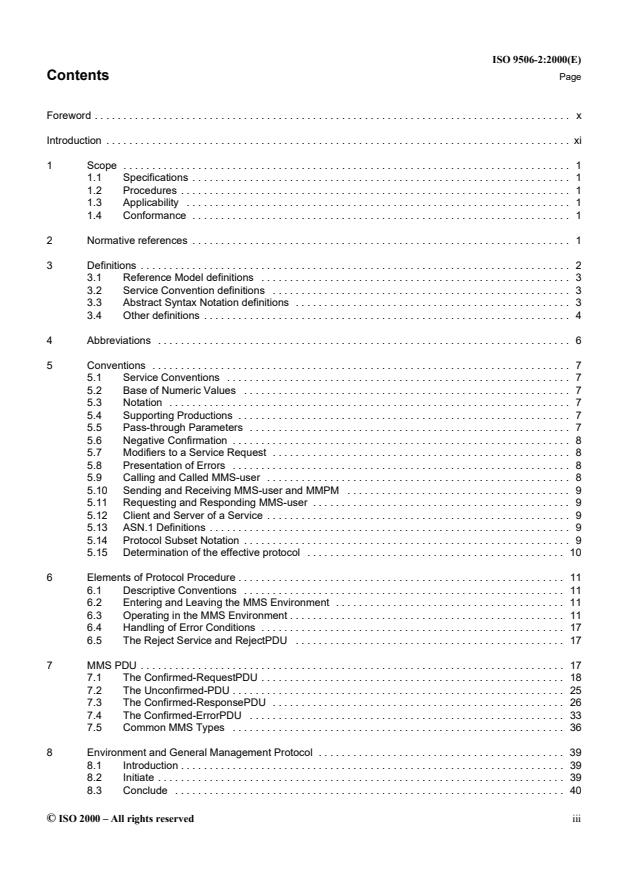
Contents Page
Foreword . x
Introduction . xi
1 Scope . 1
1.1 Specifications . 1
1.2 Procedures . 1
1.3 Applicability . 1
1.4 Conformance . 1
2 Normative references . 1
3 Definitions . 2
3.1 Reference Model definitions . 3
3.2 Service Convention definitions . 3
3.3 Abstract Syntax Notation definitions . 3
3.4 Other definitions . 4
4 Abbreviations . 6
5 Conventions . 7
5.1 Service Conventions . 7
5.2 Base of Numeric Values . 7
5.3 Notation . 7
5.4 Supporting Productions . 7
5.5 Pass-through Parameters . 7
5.6 Negative Confirmation . 8
5.7 Modifiers to a Service Request . 8
5.8 Presentation of Errors . 8
5.9 Calling and Called MMS-user . 8
5.10 Sending and Receiving MMS-user and MMPM . 9
5.11 Requesting and Responding MMS-user . 9
5.12 Client and Server of a Service . 9
5.13 ASN.1 Definitions . 9
5.14 Protocol Subset Notation . 9
5.15 Determination of the effective protocol . 10
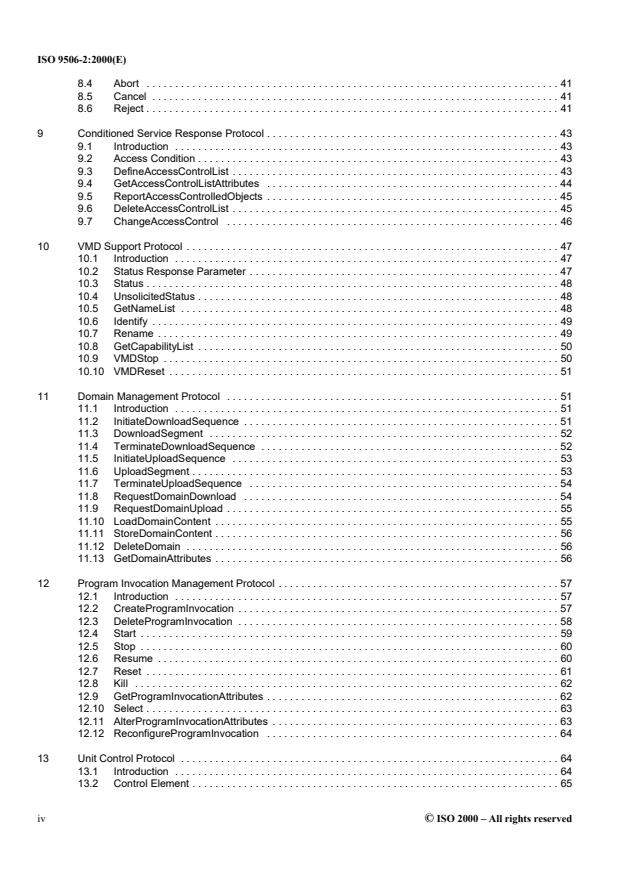
6 Elements of Protocol Procedure. 11
6.1 Descriptive Conventions . 11
6.2 Entering and Leaving the MMS Environment . 11
6.3 Operating in the MMS Environment. 11
6.4 Handling of Error Conditions . 17
6.5 The Reject Service and RejectPDU . 17
7 MMS PDU . 17
7.1 The Confirmed-RequestPDU . 18
7.2 The Unconfirmed-PDU . 25
7.3 The Confirmed-ResponsePDU . 26
7.4 The Confirmed-ErrorPDU . 33
7.5 Common MMS Types . 36
8 Environment and General Management Protocol . 39
8.1 Introduction . 39
8.2 Initiate . 39
8.3 Conclude . 40
8.4 Abort . 41
8.5 Cancel . 41
8.6 Reject. 41
9 Conditioned Service Response Protocol . 43
9.1 Introduction . 43
9.2 Access Condition . 43
9.3 DefineAccessControlList . 43
9.4 GetAccessControlListAttributes . 44
9.5 ReportAccessControlledObjects . 45
9.6 DeleteAccessControlList . 45
9.7 ChangeAccessControl . 46
10 VMD Support Protocol . 47
10.1 Introduction . 47
10.2 Status Response Parameter . 47
10.3 Status . 48
10.4 UnsolicitedStatus . 48
10.5 GetNameList . 48
10.6 Identify . 49
10.7 Rename . 49
10.8 GetCapabilityList . 50
10.9 VMDStop . 50
10.10 VMDReset . 51
11 Domain Management Protocol . 51
11.1 Introduction . 51
11.2 InitiateDownloadSequence . 51
11.3 DownloadSegment . 52
11.4 TerminateDownloadSequence . 52
11.5 InitiateUploadSequence . 53
11.6 UploadSegment . 53
11.7 TerminateUploadSequence . 54
11.8 RequestDomainDownload . 54
11.9 RequestDomainUpload . 55
11.10 LoadDomainContent . 55
11.11 StoreDomainContent . 56
11.12 DeleteDomain . 56
11.13 GetDomainAttributes . 56
12 Program Invocation Management Protocol . 57
12.1 Introduction . 57
12.2 CreateProgramInvocation . 57
12.3 DeleteProgramInvocation . 58
12.4 Start . 59
12.5 Stop . 60
12.6 Resume . 60
12.7 Reset . 61
12.8 Kill . 62
12.9 GetProgramInvocationAttributes . 62
12.10 Select . 63
12.11 AlterProgramInvocationAttributes . 63
12.12 ReconfigureProgramInvocation . 64
13 Unit Control Protocol . 64
13.1 Introduction . 64
13.2 Control Element . 65
iv © ISO 2000 – All rights reserved
13.3 InitiateUnitControlLoad service . 65
13.4 UnitControlLoadSegment service . 66
13.5 UnitControlUpload service . 66
13.6 StartUnitControl service . 67
13.7 StopUnitControl service . 67
13.8 CreateUnitControl service . 68
13.9 AddToUnitControl service . 68
13.10 RemoveFromUnitControl service. 68
13.11 GetUnitControlAttributes service . 69
13.12 LoadUnitControlFromFile service . 69
13.13 StoreUnitControlToFile service . 70
13.14 DeleteUnitControl service . 70
14 Variable Access Protocol . 71
14.1 Conventions . 71
14.2 Protocol For Specifying Types . 71
14.3 Protocol For Specifying Alternate Access . 72
14.4 Protocol For Specifying Data Values . 73
14.5 Protocol for Specifying Access To Variables . 76
14.6 Read . 77
14.7 Write . 77
14.8 InformationReport . 78
14.9 GetVariableAccessAttributes . 78
14.10 DefineNamedVariable . 79
14.11 DeleteVariableAccess . 79
14.12 DefineNamedVariableList . 80
14.13 GetNamedVariableListAttributes . 80
14.14 DeleteNamedVariableList . 81
14.15 DefineNamedType . 81
14.16 GetNamedTypeAttributes . 82
14.17 DeleteNamedType . 82
15 Data Exchange Protocol . 83
15.1 Introduction . 83
15.2 ExchangeData . 83
15.3 GetDataExchangeAttributes . 83
16 Semaphore Management Protocol . 84
16.1 Introduction . 84
16.2 TakeControl . 84
16.3 RelinquishControl . 85
16.4 DefineSemaphore . 85
16.5 DeleteSemaphore . 86
16.6 ReportSemaphoreStatus . 86
16.7 ReportPoolSemaphoreStatus . 87
16.8 ReportSemaphoreEntryStatus . 87
16.9 AttachToSemaphore Modifier . 88
17 Operator Communication Protocol . 88
17.1 Introduction . 88
17.2 Input . 88
17.3 Output . 89
18 Event Management Protocol . 89
18.1 Introduction . 89
18.2 TriggerEvent . 89
18.3 EventNotification . 90
18.4 AcknowledgeEventNotification . 91
18.5 GetAlarmSummary . 91
18.6 GetAlarmEnrollmentSummary . 93
18.7 AttachToEventCondition . 94
19 Event Condition Protocol . 94
19.1 Introduction . 94
19.2 DefineEventCondition . 94
19.3 DeleteEventCondition . 95
19.4 GetEventConditionAttributes . 95
19.5 ReportEventConditionStatus . 97
19.6 AlterEventConditionMonitoring . 97
20 Event Action Protocol . 98
20.1 Introduction . 98
20.2 DefineEventAction . 98
20.3 DeleteEventAction . 99
20.4 GetEventActionAttributes . 99
20.5 ReportEventActionStatus . 100
21 Event Enrollment Protocol . 100
21.1 Introduction . 100
21.2 DefineEventEnrollment . 101
21.3 DeleteEventEnrollment . 101
21.4 GetEventEnrollmentAttributes . 102
21.5 ReportEventEnrollmentStatus . 104
21.6 AlterEventEnrollment . 105
21.7 Supporting Productions . 105
22 Event Condition List Protocol . 106
22.1 Introduction . 106
22.2 DefineEventConditionList protocol . 106
22.3 DeleteEventConditionList protocol . 107
22.4 AddEventConditionListReference protocol . 107
22.5 RemoveEventConditionListReference protocol . 108
22.6 GetEventConditionListAttributes protocol . 108
22.7 ReportEventConditionListStatus protocol . 109
22.8 AlterEventConditionListMonitoring protocol . 109
23 Journal Management Protocol . 110
23.1 Introduction . 110
23.2 ReadJournal . 110
23.3 WriteJournal . 111
23.4 InitializeJournal . 111
23.5 ReportJournalStatus . 111
23.6 CreateJournal . 112
23.7 DeleteJournal . 112
23.8 Supporting Productions . 113
24 Mapping to Underlying Communication Services . 113
24.1 Mapping of PDUs . 114
24.2 M-ASSOCIATE Data . 114
24.3 Termination of Application Association . 114
24.4 Directly-Mapped Abort Service . 114
24.5 Construction of MMS PDUs . 115
24.6 Delivery of Service Primitives to an MMS-user. 115
24.7 Right to Send Data . 115
vi © ISO 2000 – All rights reserved
24.8 Reliable Underlying Service . 115
24.9 Flow Control . 115
24.10 Use of Presentation Contexts . 116
24.11 Abstract Syntax Definition . 116
25 Configuration and Initialization Statement . 116
25.1 Introduction . 116
25.2 CIS Part One: Initialization of the VMD . 116
25.3 CIS Part Two: Service and Parameter CBBs . 130
Annex ARelation of M-Services to ACSE and Presentation Services . 145
A.1 Mapping of M-services . 145
A.2 M-DATA service . 146
A.3 M-U-ABORT service . 146
A.4 M-P-ABORT service . 147
A.5 Use of Presentation Contexts . 147
A.6 Transfer Syntax Definition . 147
A.7 Application Context Name . 147
Annex BAbstract format for Configuration and Initialization . 149
B.1 SCI Part One: Initialization of the VMD . 149
B.2 Services and parameter CBBs . 157
Annex CFile Access Protocol . 160
C.1 Introduction . 160
C.2 ObtainFile . 160
Annex D File Management Protocol . 161
D.1 Overview . 161
D.2 FileOpen . 161
D.3 FileRead . 161
D.4 FileClose . 162
D.5 FileRename . 162
D.6 FileDelete . 163
D.7 FileDirectory . 163
D.8 FileAttributes . 164
Annex EScattered Access . 165
E.1 Introduction. 165
E.2 DefineScatteredAccess . 165
E.3 GetScatteredAccessAttributes . 166
Annex FREAL Data Type . 167
F.1 Introduction . 167
F.2 REAL Data . 167
F.3 End of Module . 167
Figures
Figure 1 - Confirmed Service Request as seen by the Service Requester . 12
Figure 2 - Confirmed Service Request as seen by the Service Responder . 14
Figure 3 - Unconfirmed Service as seen by the Service Requester . 15
Figure 4 - Unconfirmed Service as seen by the Service Responder . 16
Tables
Table 1 - CIS Implementation Information . 117
Table 2 - Capability Description . 118
Table 3 - Predefined Access Control object . 120
Table 4 - Predefined Domain object . 121
Table 5 - Predefined Program Invocation object . 122
Table 6 - Predefined Unit Control object . 122
Table 7 - Unnamed Variable objects . 123
Table 8 - Predefined Named Variable object . 123
Table 9 - Predefined Named Variable List object . 124
Table 10 - Predefined Named Type object . 124
Table 11 - Predefined Data Exchange object . 125
Table 12 - Predefined Semaphore object . 125
Table 13 - Predefined Operator Station object . 126
Table 14 - Predefined Event Condition object . 126
Table 15 - Predefined Event Action object . 127
Table 16 - Predefined Event Enrollment object . 128
Table 17 - Predefined Event Condition List object . 128
Table 18 - Predefined Journal object . 129
Table 19 - Predefined Journal Entry object . 129
Table 20 - Environment & General Management services . 130
Table 21 - Environment & General Management parameters . 131
Table 22 - Access Control services . 131
Table 23 - Access Control parameter . 131
Table 24 - VMD Support services . 132
Table 25 - VMD Support parameters . 132
Table 26 - Domain Management services . 133
Table 27 - Domain Management parameters . 133
Table 28 - Program Invocation Management services . 134
Table 29 - Program Invocation Management parameters . 135
Table 30 - Unit Control services . 135
Table 31 - Variable Access services . 136
Table 32 - Variable Access parameters . 137
Table 33 - Data parameters . 137
Table 34 - Data Exchange services . 138
Table 35 - Semaphore Management services . 138
Table 36 - Semaphore Management parameter . 138
Table 37 - Operator Communication services . 139
Table 38 - Operator Communication parameter . 139
Table 39 - Event Management services . 139
Table 40 - Event Condition services . 140
Table 41 - Event Condition parameters . 140
Table 42 - Event Action services . 140
Table 43 - Event Enrollment services . 141
Table 44 - Event Condition List services . 141
Table 45 - Event Condition List parameter . 141
Table 46 - Journal Management services . 142
Table 47 - Errors parameters . 142
Table 48 - File Access service . 142
Table 49 - File Management services . 143
Table 50 - File Management parameter . 143
Table 51 - Scattered Access services . 143
Table 52 - Scattered Access parameter . 144
viii © ISO 2000 – All rights reserved
Foreword
ISO (the International Organization for Standardization) is a worldwide federation of national standards bodies (ISO member
bodies). The work of preparing International Standards is normally carried out through ISO technical committees. Each member
body interested in a subject for which a technical commmittee has been established has the right to be represented on that
committee. International organizations, governmental and non-governmental, in liaison with ISO, also take part in the work.
ISO collaborates closely with the International Electrotechnical Commission (IEC) on all matters of electrotechnical
standardization.
International Standards are drafted in accordance with the rules given in the ISO/IEC Directives, Part 3.
Draft International Standards adopted by the technical committees are circulated to the member bodies for voting. Publication
as an International Standard requires approval by at least 75 % of the member bodies casting a vote.
Attention is drawn to the possibility that some of the elements of this part of ISO 9506 may be the subject of patent rights.
ISO shall not be held responsible for identifying any or all such patent rights.
International Standard ISO 9506-2 was prepared by Technical Committee ISO/TC 184, Industrial automation systems and
integration, Subcommittee SC 5, Architecture, communications and integration frameworks.
This first edition of ISO 9506-2 cancels and replaces ISO/IEC 9506-2:1990, of which it constitutes a technical revision.
ISO 9506 consists of the following parts, under the general title Industrial automation systems — Manufacturing Message
Specification :
— Part 1: Service definition
— Part 2: Protocol specification
Annexes A to C form a normative part of this part of ISO 9506. Annexes D to F are for information only.
Introduction
This part of ISO 9506 provides a wide variety of services useful for various manufacturing and process control devices. It
is designed to be used both by itself and in conjunction with Companion Standards that describe the application of subsets of these
services to particular device types.
The services provided by the Manufacturing Message Specification (MMS) range from simple to highly complex. It is not
expected that all of these services will be supported by all devices. The subset to be supported is limited in some cases by
Companion Standards, and in all cases may be limited by the implementor. Characteristics important in selection of a subset of
services to be supported include:
a) applicability of the service to the device;
b) the complexity of services and requirements;
c) the complexity of provision of a particular class of service via the network versus the complexity of the device.
Security Considerations
When implementing MMS in secure or safety critical applications, features of the OSI security architecture may need to be
implemented. This International Standard provides simple facilities for authentication (passwords) and access control. Systems
requiring a higher degree of security will have to consider features beyond the scope of this International Standard. This
International Standard does not provides facilities for non-repudiation.
Complexity of Services and Requirements
Some MMS services are quite complex and should be considered advanced functions. Devices used in very simple applications
often will not require such advanced functions, and hence will not support such MMS services.
Keywords
Application Interworking OSI Reference Model
Application Layer Protocol Process Control System
Information Processing Systems Programmable Controller
Manufacturing Communications Network Programmable Device
Manufacturing Message Specification Robotics Control System
Numerical Control System Virtual Manufacturing Device
Open Systems Interconnection
General
This part of ISO 9506 is one of a set of standards produced to facilitate the interconnection of information processing
systems. It is positioned within the application layer of the Open Systems Interconnection Environment as an Application Service
Element (ASE) with respect to other standards by the Basic Reference Model for Open Systems Interconnection (ISO 7498).
The aim of Open Systems Interconnection is to allow, with a minimum of technical agreement outside the interconnection
standards, the interconnection of information processing systems:
a) from different manufacturers;
b) under different managements;
c) of different levels of complexity;
d) of different ages.
x © ISO 2000 – All rights reserved
Purpose
The purpose of this part of ISO 9506 is to define the Manufacturing Message Specification Protocol. It is most closely related
to and lies within the field of application of the Manufacturing Message Specification Service Definition, ISO 9506-1. It
uses services provided by the communication system that it employs for transferring its PDUs.
The MMS protocol is structured so that subsets of protocol can be defined. The variations and options available within this part
of ISO 9506 are essential to enable a Manufacturing Message Specification to be provided for a wide variety of applications.
Thus, a minimally conforming implementation will not be suitable for use in all possible circumstances. It is important, therefore,
to qualify all references to this part of ISO 9506 with statements of the options provided or required with statements of the
intended purpose of provision or use.
NOTE The services of this part of ISO 9506 are generic, and intended to be referenced by Companion Standards, each of which is
directed to a more specific class of application. The services of this part of ISO 9506 may also be used in a stand-alone manner
(without the use of Companion Standards).
It should be noted that, as the number of valid protocol sequences is very large, it is not possible with current technology to verify
that an implementation will operate the protocol defined in this part of ISO 9506 correctly under all circumstances. It is
possible by means of testing to establish confidence that an implementation correctly operates the protocol in a representative
sample of circumstances.
Edition
This part of ISO 9506 differs from ISO/IEC 9506-2:1990 in the following ways:
a) The material in ISO/IEC TR 13345 to specify subsets of protocol for MMS has been incorporated into this part of
ISO 9506.
b) All the material of Amendments 1 and 2 have been incorporated into the document, as well as the Technical Corrigenda.
c) The formal object model used in ISO 9506-1 provides some type definitions for the protocol specified in this part of
ISO 9506. Hence, an IMPORT statement occurs in the ASN.1 module.
d) The services and protocol present in the Companion Standards already published, ISO/IEC 9506-3, ISO/IEC 9506-4,
ISO/IEC 9506-5 and ISO/IEC 9506-6, have been incorporated into the base standard.
As a result of this incorporation, the need for separate abstract syntaxes for each of the Companion Standards has been
removed. All Companion Standards can now operate in the single abstract syntax of the base standard, although using
other abstract syntaxes remains a possibility for backward compatibility. The separate definition of a module in Clause
19 of ISO/IEC 9506-2:1990 is no longer needed and this clause has been removed.
e) The communication requirements of MMS have been generalized so that MMS is described with respect to an abstract
set of services needed for its support. The relation between this abstract set of services and the services provided by the
suite of OSI communication protocols is specified in an annex. This opens the possibility of having MMS operating
correctly over alternate communication systems (such as reduced stack implementations) as long as the equivalent of
these abstract services are provided.
f) The restrictions on the characters that can be used as an Identifier have been relaxed to allow an Identifier to begin with
a numeric character and, by extension, to consist solely of numeric characters.
g) Many (but not all) occurrences of VisibleString have been replaced by a new production MMSString that provides the
option of using an extended latin alphabet, suitable for western Europe, and an option to use an arbitrary string of
characters taken from ISO/IEC 10646 or from elsewhere.
h) A new service, ReconfigureProgramInvocation, has been introduced into the clause on Program Invocation management.
This service provides a technique of dynamically changing the constituent Domains of a running Program Invocation.
i) A new field was added to the object model of the Named Variable and the Named Type. This field may be used to
describe the semantics associated with the Named Variable or Named Type. The field is either predefined or it has its
value established as the name of the Named Type used to construct it in the DefineNamedVariable or DefineNamedType
service. This field can be reported with the GetVariableAccessAttributes or GetNamedTypeAttributes service if sem,
a new parameter CBB, has been negotiated.
j) The material of the document has been reorganized to provide more and shorter clauses.
k) Scattered Access and the Real Data type have been removed from the base document and placed in informative annexes.
l) In accordance with the recommendations in ISO/IEC 8824-1, all occurrences of EXTERNAL in the protocol have been
replaced with CHOICE { EXTERNAL, EMBEDDED PDV }.
m) The PICS of the first edition has been replaced by a clause providing configuration and initialization information. This
clause provides initialization prescriptions for some fields (relatively few) of the VMD and subordinate objects, and
provides a tabular report for initialization values of other fields as supplied by the implementor. A new annex (annex
B) has been added that provides an ASN.1 module suitable for communicating the information contained in these tables.
Because of the use of the ASN.1 object modeling technique, the protocol now exists in two separate modules, one that is part of
the object model contained in ISO 9506-1, and a second module defined in this part of ISO 9506 that describes the content
and structure of all valid PDUs. Despite the fact that the ASN.1 formulation appears different in some cases, nevertheless the
PDUs produced through application of ISO/IEC 9506:1990 are identical with those produced by this edition. For this reason,
this edition continues to be identified by the major version number one. (The minor version number has been changed to
reflect all the new additions to the document.)
There are two exceptions to this statement that should be noted.
a) Syntactic extensions defined by the companion standards are now identified by new parameter CBBs instead of a
separate abstract syntax. Therefore, for any use of MMS involving companion standard facilities, there is a change in
the Initiate PDU. However, if the companion standard facilities are not used, the Initiate PDU remains the same as that
defined by the first edition.
b) Some small changes have been made to the tagging in the ChangeAccessControl service (part of Amendment 2) to bring
it into alignment with corresponding protocol in the GetNameList and Rename services.
ASN.1 Modules
The ASN.1 modules defined in ISO 9506 may be obtained from the SC 4 Secretariat in computer readable format. The
modules are available in two forms: as published and with the IF - ENDIF brackets removed.
To obtain these files use the Internet location:
xii © ISO 2000 – All rights reserved
INTERNATIONAL STANDARD ISO 9506-2:2000(E)
Industrial automation systems -
Manufacturing Message Specification -
Part 2: Protocol specification
1 Scope
The Manufacturing Message Specification is an application layer standard designed to support messaging communications to and
from programmable devices in a Computer Integrated Manufacturing (CIM) environment.
1.1 Specifications
This part of ISO 9506 specifies:
a) procedures for a single protocol for the transfer of data and control information from one application entity to a peer
application entity in the MMS-context;
b) the means of selecting the services to be used by the application entities while communicating in the MMS-context;
c) the structure of the Manufacturing Messaging Specification Protocol Data Units used for the transfer of data and control
information.
1.2 Procedures
The procedures are defined in terms of
a) the interactions between peer application entities through the exchange of Manufacturing Message Specification
Application Protocol Data Units;
b) the interactions between an MMS-provider and the MMS-user in the same system through the exchange of MMS
primitives;
c) the interactions between an MMS-provider and the abstract services provided by the underlying communication system.
1.3 Applicability
These procedures are applicable to instances of communication between systems that support MMS within the application layer
of the OSI Reference Model, and that require the ability to interconnect in an open systems interconnection environment.
1.4 Conformance
This part of ISO 9506 also specifies conformance requirements for systems implementing these procedures. This part of
ISO 9506 does not contain tests to demonstrate compliance with such requirements.
2 Normative references
The following normative documents contain provisions which, through reference in this text, constitute provisions of this part
of ISO 9506. For dated references, subsequent amendments to, or revisions of, any of these publications do not apply.
However, parties to agreements based on this part of ISO 9506 are encouraged to investigate the possibility of applying the
most recent editions of the normative documents indicated below. For undated references, the latest eidition of the normative
document referred to applies. Members of IEC and ISO maintain registers of currently valid International Standards.
ISO/IEC 646:1991, Information technology - ISO 7-bit coded character set for information interchange.
ISO 7498:1984, Information processing systems - Open Systems Interconnection - Basic Reference Model.
ISO 7498-2:1989, Information processing systems - Open Systems Interconnection - Basic Reference Model -
Part 2: Security Architecture.
ISO 7498-3:1989, Information processing systems - Open Systems Interconnection - Basic Reference Model -
Part 3: Naming and addressing.
ISO/TR 8509:1987, Information processing systems - Open Systems Interconnection - Service conventions.
ISO 8571 (all parts), Information processing systems - Open Systems Interconnection - File Transfer, Access and
Management.
ISO/IEC 8649-1:1996, Information technolgy - Op
...
Questions, Comments and Discussion
Ask us and Technical Secretary will try to provide an answer. You can facilitate discussion about the standard in here.
Loading comments...