

ISO 22055:2019
(Main)Switch and crossing rails
General Information
- Abstract
This document specifies switch and crossing rails that carry railway wheels as specified in ISO 5003. These are used in conjunction with flat bottom (vignole) railway rails. After switch and crossing rails are produced, in order to be ready for railway track use, secondary processing (forging, grinding and heat treatment etc.) is carried out. This document does not include secondary processing. Secondary processing is specified in other standards or through agreements between manufacturer and purchaser. Sixteen pearlitic steel grades are specified, covering a hardness range of 200 HBW to 440 HBW, and include non-heat-treated carbon manganese steels, non-heat-treated alloy steels, heat-treated carbon manganese and heat-treated low
- Status
- Published
- Publication Date
- 25-Nov-2019
- Technical Committee
- ISO/TC 17/SC 15 - Railway rails, rails fasteners, wheels and wheelsets
- Drafting Committee
- ISO/TC 17/SC 15 - Railway rails, rails fasteners, wheels and wheelsets
- Current Stage
- 9060 - Close of review
- Completion Date
- 04-Jun-2030
Buy Documents



ISO 22055:2019 - Switch and crossing rails/26/2019



ISO 22055:2019 - Rails pour appareils de voie/26/2019
Overview
ISO 22055:2019 - "Switch and crossing rails" - is an ISO international standard that specifies the requirements for switch and crossing rails used to carry railway wheels in conjunction with flat bottom (vignole) rails (see ISO 5003). The standard covers material grades, testing methods, dimensional and surface tolerances, inspection, identification and certification for rails as produced (excluding secondary processing such as forging, grinding or heat treatment, which are covered by other standards or contractual agreement). It defines sixteen pearlitic steel grades with a hardness range of 200 HBW to 440 HBW.
Key topics and technical requirements
ISO 22055:2019 addresses the full production-acceptance envelope for switch and crossing rails, including:
- Material grades: Sixteen pearlitic steel grades (non-heat-treated and heat-treated variants) covering a wide hardness range.
- Testing methods and frequencies: Requirements for chemical composition, hydrogen content, total oxygen, tensile tests, Brinell hardness, microstructure, decarburization, non‑metallic inclusions, macrostructure and ultrasonic testing. Sampling and frequency are specified (e.g., per heat, per sequence or per tonne as applicable).
- Mechanical and metallurgical checks: Tensile and hardness tests, microstructure and inclusion evaluation, and requirements for decarburization depth and macrostructure.
- Ultrasonic inspection: Whole-length ultrasonic testing requirements, calibration and sensitivity criteria for detecting internal defects.
- Dimensional and geometric tolerances: Length, profile dimensions, straightness, surface flatness, twist and weight tolerances for ready-for-track rails.
- Surface quality and identification: Surface finish requirements, branding, hot and cold stamping methods and other marking/traceability details.
- Inspection and certification: Acceptance criteria, retest procedures and certificate content required for delivery.
Practical applications and users
ISO 22055:2019 is directly relevant to:
- Rail manufacturers and steelmakers - for material specification, process control and acceptance testing of as‑produced switch and crossing rails.
- Railway infrastructure owners and asset managers - to specify procurement requirements and verify delivered rails meet safety and performance needs.
- Track component suppliers and fabricators - when supplying or processing switch & crossing rails (noting secondary processing is out of scope).
- Inspection bodies and test laboratories - for conducting the standardized mechanical, metallurgical and ultrasonic tests.
- Procurement and quality engineers - to define contract parameters such as rail profile, steel grade, inclusion class, lengths, drilled ends and paint codes.
Purchaser-supplied information required by the standard includes the rail profile, steel grade, inclusion determination method/class, macrostructure requirement, rail lengths, drilled/undrilled ends and paint code.
Related standards
Key referenced standards include:
- ISO 5003 (flat bottom / vignole railway rails)
- ISO 6892-1 (tensile testing)
- ISO 6506-1 (Brinell hardness)
- ISO 3887, ISO 4967, ISO 4968, ISO 4969 (metallographic and inclusion/macrostructure methods)
ISO 22055:2019 is essential for ensuring consistent quality, traceability and fitness-for-service of switch and crossing rails in rail track systems.
Buy Documents
ISO 22055:2019 - Switch and crossing rails/26/2019
ISO 22055:2019 - Rails pour appareils de voie/26/2019
Get Certified
Connect with accredited certification bodies for this standard

Element Materials Technology
Materials testing and product certification.

IRIS Certification (UNIFE)
International Railway Industry Standard certification.

TÜV SÜD Rail GmbH
TÜV SÜD railway certification services.
Sponsored listings
Frequently Asked Questions
ISO 22055:2019 is a standard published by the International Organization for Standardization (ISO). Its full title is "Switch and crossing rails". This standard covers: This document specifies switch and crossing rails that carry railway wheels as specified in ISO 5003. These are used in conjunction with flat bottom (vignole) railway rails. After switch and crossing rails are produced, in order to be ready for railway track use, secondary processing (forging, grinding and heat treatment etc.) is carried out. This document does not include secondary processing. Secondary processing is specified in other standards or through agreements between manufacturer and purchaser. Sixteen pearlitic steel grades are specified, covering a hardness range of 200 HBW to 440 HBW, and include non-heat-treated carbon manganese steels, non-heat-treated alloy steels, heat-treated carbon manganese and heat-treated low
This document specifies switch and crossing rails that carry railway wheels as specified in ISO 5003. These are used in conjunction with flat bottom (vignole) railway rails. After switch and crossing rails are produced, in order to be ready for railway track use, secondary processing (forging, grinding and heat treatment etc.) is carried out. This document does not include secondary processing. Secondary processing is specified in other standards or through agreements between manufacturer and purchaser. Sixteen pearlitic steel grades are specified, covering a hardness range of 200 HBW to 440 HBW, and include non-heat-treated carbon manganese steels, non-heat-treated alloy steels, heat-treated carbon manganese and heat-treated low
ISO 22055:2019 is classified under the following ICS (International Classification for Standards) categories: 45.080 - Rails and railway components; 77.140.99 - Other iron and steel products. The ICS classification helps identify the subject area and facilitates finding related standards.
ISO 22055:2019 is available in PDF format for immediate download after purchase. The document can be added to your cart and obtained through the secure checkout process. Digital delivery ensures instant access to the complete standard document.
Standards Content (Sample)
INTERNATIONAL ISO
STANDARD 22055
First edition
2019-11
Switch and crossing rails
Rails pour appareils de voie
Reference number
©
ISO 2019
© ISO 2019
All rights reserved. Unless otherwise specified, or required in the context of its implementation, no part of this publication may
be reproduced or utilized otherwise in any form or by any means, electronic or mechanical, including photocopying, or posting
on the internet or an intranet, without prior written permission. Permission can be requested from either ISO at the address
below or ISO’s member body in the country of the requester.
ISO copyright office
CP 401 • Ch. de Blandonnet 8
CH-1214 Vernier, Geneva
Phone: +41 22 749 01 11
Fax: +41 22 749 09 47
Email: copyright@iso.org
Website: www.iso.org
Published in Switzerland
ii © ISO 2019 – All rights reserved
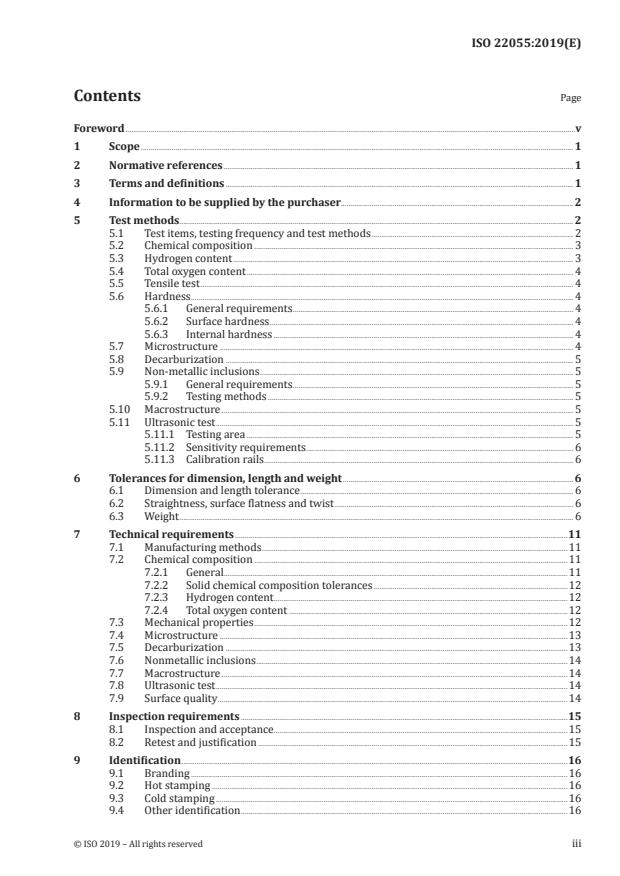
Contents Page
Foreword .v
1 Scope . 1
2 Normative references . 1
3 Terms and definitions . 1
4 Information to be supplied by the purchaser. 2
5 Test methods . 2
5.1 Test items, testing frequency and test methods . 2
5.2 Chemical composition . 3
5.3 Hydrogen content . 3
5.4 Total oxygen content . 4
5.5 Tensile test . 4
5.6 Hardness . 4
5.6.1 General requirements . 4
5.6.2 Surface hardness . 4
5.6.3 Internal hardness . 4
5.7 Microstructure . 4
5.8 Decarburization . 5
5.9 Non-metallic inclusions . 5
5.9.1 General requirements . 5
5.9.2 Testing methods . 5
5.10 Macrostructure . 5
5.11 Ultrasonic test . 5
5.11.1 Testing area . 5
5.11.2 Sensitivity requirements . 6
5.11.3 Calibration rails. 6
6 Tolerances for dimension, length and weight . 6
6.1 Dimension and length tolerance . 6
6.2 Straightness, surface flatness and twist . 6
6.3 Weight . 6
7 Technical requirements .11
7.1 Manufacturing methods .11
7.2 Chemical composition .11
7.2.1 General.11
7.2.2 Solid chemical composition tolerances .12
7.2.3 Hydrogen content.12
7.2.4 Total oxygen content .12
7.3 Mechanical properties .12
7.4 Microstructure .13
7.5 Decarburization .13
7.6 Nonmetallic inclusions .14
7.7 Macrostructure .14
7.8 Ultrasonic test .14
7.9 Surface quality .14
8 Inspection requirements .15
8.1 Inspection and acceptance.15
8.2 Retest and justification .15
9 Identification .16
9.1 Branding .16
9.2 Hot stamping .16
9.3 Cold stamping .16
9.4 Other identification .16
10 Certificate .17
Bibliography .26
iv © ISO 2019 – All rights reserved
Foreword
ISO (the International Organization for Standardization) is a worldwide federation of national standards
bodies (ISO member bodies). The work of preparing International Standards is normally carried out
through ISO technical committees. Each member body interested in a subject for which a technical
committee has been established has the right to be represented on that committee. International
organizations, governmental and non-governmental, in liaison with ISO, also take part in the work.
ISO collaborates closely with the International Electrotechnical Commission (IEC) on all matters of
electrotechnical standardization.
The procedures used to develop this document and those intended for its further maintenance are
described in the ISO/IEC Directives, Part 1. In particular, the different approval criteria needed for the
different types of ISO documents should be noted. This document was drafted in accordance with the
editorial rules of the ISO/IEC Directives, Part 2 (see www .iso .org/ directives).
Attention is drawn to the possibility that some of the elements of this document may be the subject of
patent rights. ISO shall not be held responsible for identifying any or all such patent rights. Details of
any patent rights identified during the development of the document will be in the Introduction and/or
on the ISO list of patent declarations received (see www .iso .org/ patents).
Any trade name used in this document is information given for the convenience of users and does not
constitute an endorsement.
For an explanation of the voluntary nature of standards, the meaning of ISO specific terms and
expressions related to conformity assessment, as well as information about ISO's adherence to the
World Trade Organization (WTO) principles in the Technical Barriers to Trade (TBT), see www .iso .org/
iso/ foreword .html.
This document was prepared by Technical Committee ISO/TC 17, Steel, Subcommittee SC 15, Railway
rails, rails fasteners, wheels and wheelsets.
Any feedback or questions on this document should be directed to the user’s national standards body. A
complete listing of these bodies can be found at www .iso .org/ members .html.
INTERNATIONAL STANDARD ISO 22055:2019(E)
Switch and crossing rails
1 Scope
This document specifies switch and crossing rails that carry railway wheels as specified in ISO 5003.
These are used in conjunction with flat bottom (vignole) railway rails. After switch and crossing rails
are produced, in order to be ready for railway track use, secondary processing (forging, grinding and
heat treatment etc.) is carried out. This document does not include secondary processing. Secondary
processing is specified in other standards or through agreements between manufacturer and purchaser.
Sixteen pearlitic steel grades are specified, covering a hardness range of 200 HBW to 440 HBW, and
include non-heat-treated carbon manganese steels, non-heat-treated alloy steels, heat-treated carbon
manganese and heat-treated low alloy steels.
2 Normative references
The following documents are referred to in the text in such a way that some or all of their content
constitutes requirements of this document. For dated references, only the edition cited applies. For
undated references, the latest edition of the referenced document (including any amendments) applies.
ISO 3887, Steels — Determination of the depth of decarburization
ISO 4967, Steel — Determination of content of non-metallic inclusions — Micrographic method using
standard diagrams
ISO 4968, Steel — Macrographic examination by sulfur print (Baumann method)
ISO 4969, Steel — Etching method for macroscopic examination
ISO 5003:2016, Flat bottom (Vignole) railway rails 43 kg/m and above
ISO 6506-1, Metallic materials — Brinell hardness test — Part 1: Test method
ISO 6892-1, Metallic materials — Tensile testing — Part 1: Method of test at room temperature
3 Terms and definitions
For the purposes of this document, the following terms and definitions apply.
ISO and IEC maintain terminological databases for use in standardization at the following addresses:
— ISO Online browsing platform: available at https:// www .iso .org/ obp
— IEC Electropedia: available at http:// www .electropedia .org/
3.1
heat
melt tapped out of a converter or electric arc furnace which includes after continuous
casting a given number of blooms relating to the weight of the heat and the extension of the mixing zone
Note 1 to entry: In the case of sequence casting the blooms belonging to the mixing zone should be clearly defined.
3.2
sequence
any number of heats (3.1), of the same steel grade, which undergo continuous casting in tundishes
Note 1 to entry: Tundishes can be used in parallel if the caster has many strands.
3.3
heat-treated rail
rail that has undergone accelerated cooling from austenitizing temperature during the metallurgical
transformation period
3.4
rolling process
process between the blooms leaving the heating furnace and exiting the finishing pass
3.5
isothermal treatment process
process whereby blooms are held for a period of time at an elevated temperature for reducing the
hydrogen content
Note 1 to entry: For maximum efficiency this is as near to (but below) the pearlite to austenite transformation
temperature as is practically possible.
Note 2 to entry: This process is sometimes referred to as sub-critical diffusion annealing.
3.6
rail running surface
curved surface of the rail head
Note 1 to entry: It may also refer to any area between both gauge corners (transition points of the head inclination
and the first head radius).
4 Information to be supplied by the purchaser
The purchaser shall provide the supplier with the following information at the time of enquiry or order:
a) the rail profile (by submitting a drawing);
b) the steel grade (see 7.2);
c) the non-metallic inclusion determination method and if applicable: the class “1” or “2” of rail
(see Table 12);
d) the determination of the macrostructure (see 5.10);
e) the lengths of rail (see 6.1 and Table 3);
f) undrilled or drilled rail ends to take fish bolts, and location and dimensions of holes when required
(see 6.1 and Table 3);
g) paint code requirements (see 9.4.4).
5 Test methods
5.1 Test items, testing frequency and test methods
Test items, sampling position, sampling numbers and test methods shall be as given in Table 1.
2 © ISO 2019 – All rights reserved
Table 1 — Testing frequency for acceptance testing
Relevant
Test items As-rolled rails Heat-treated rails
subclause
Chemical
One per heat One per heat 5.2
composition
One per heat One per heat
Hydrogen 5.3
(2 tests from first heat in sequence) (2 tests from first heat in sequence)
a a
Total oxygen One per sequence One per sequence 5.4
a,b,d a,c
Tensile One per heat One per heat 5.5
a,b a,c
Hardness One per heat One per heat 5.6
Not required for grades
HR200, HR220, HR235 and HR260A
One per 100 tonnes
Microstructure 5.7
One per 1 000 tonnes a,c
of heat-treated rail
or part thereof for grades
a,b
HR260B, HR310C and HR320
One per 1 000 tonnes One per 500 tonnes
Decarburization 5.8
a,b a,c
or part thereof or part thereof
Nonmetallic
b b or c
One per sequence One per sequence 5.9
inclusions
One per 500 tonnes One per 500 tonnes
Macrostructure 5.10
a,b a,b or c
or part thereof or part thereof
Dimension Whole length Whole length 6.1
Straightness Whole length Whole length 6.2
Surface quality Whole length Whole length 7.9
Ultrasonic test Whole length Whole length 5.11
a
Samples shall be taken at random. When different rail grades are cast in the same sequence, the samples shall be taken
outside the mixing zone.
b
Samples shall be cut after rolling.
c
Samples shall be cut after heat-treating for heat-treated rails.
d
One calculation per heat and one testing per 2 000 tonnes if agreed between purchaser and manufacturer.
5.2 Chemical composition
The chemical composition shall be determined on the liquid.
When the solid chemical composition is to be checked as a requirement of the purchaser, this shall be
carried out at the position of the tensile test piece shown in Figure 1.
5.3 Hydrogen content
The hydrogen content of the liquid steel shall be measured by determining the pressure of hydrogen
in the steel using an on-line immersion probe system or a method agreed between the purchaser and
manufacturer.
At least two liquid samples shall be taken from the first heat of any sequence using a new tundish and
one from each of the remaining heats and analysed for hydrogen content (see Table 1). The first sample
from the first heat in a sequence shall be taken from the tundish at the time of the maximum hydrogen
concentration.
When testing of rails is required rail samples shall be taken at the hot saw at a frequency of one per heat
at random. However, on the first heat in a sequence, the rail sample shall be from the last part of a first
bloom teemed on any strand. Hydrogen determination shall be carried out on samples taken from the
centre of the rail head and determined by automatic machine.
5.4 Total oxygen content
The total oxygen content can be determined in the liquid or solid.
If the total oxygen content is determined from the solid rail head, the testing positions are shown in
Figure 2.
5.5 Tensile test
Test samples shall be taken from the rail head as shown in Figure 1.
The tensile properties shall be determined in accordance with ISO 6892-1 by using a round tensile test
piece with the dimensions as follows:
— diameter 10 mm;
— gauge length 50 mm.
In the case of dispute, the tensile test pieces shall be maintained at a temperature of 200 °C for 6 h
before testing.
For as-rolled rails, the tensile strength and elongation may be determined as agreed between purchaser
and manufacturer by a correlation to the chemical composition based on the statistical data analysis.
The method to be applied is shown in ISO 5003:2016, Annex B.
5.6 Hardness
5.6.1 General requirements
Brinell hardness tests (HBW) shall be carried out in accordance with ISO 6506-1. The method used is at
the discretion of the manufacturer.
In case of dispute, the test shall be done using HBW 2,5/187,5.
5.6.2 Surface hardness
The surface hardness shall be tested at position RS as shown in Figure 3.
The surface hardness shall be tested on the centre line of the rail head crown. 0,5 mm shall be removed
from the running surface before a hardness impression is made. Surface quality shall be in accordance
with ISO 6506-1.
5.6.3 Internal hardness
For heat-treated rails the internal hardness shall be tested in accordance with ISO 6506-1 at the testing
positions shown in Figure 3.
The internal hardness of heat-treated rails of any steel grade shall be determined on a transverse
specimen cut from the end of the rail. The specimen shall be ground or milled so that the transverse
surfaces are parallel.
5.7 Microstructure
The microstructure testing position in the rail head shall be as shown in Figure 1 and shall be
determined at a magnification of ×500.
4 © ISO 2019 – All rights reserved
5.8 Decarburization
Decarburisation depth shall be assessed by means of a hardness test using HBW 2,5/187,5 indentation.
The test shall be performed at three points in the centre of the rail crown after minimal preparation
of the rail head surface (less than 0,2 mm material removed). None of the hardness test results shall
be more than 7 points lower than the minimum hardness of the specified grade (e.g. 253 HBW for 260
grade rail). If the test fails to meet the requirements, decarburization shall be measured at the same
sample location metallographically.
As an alternative or in the case of dispute decarburisation depth shall be measured metallographically.
The testing position in the surface of the rail head shall be as shown in Figure 4. The test shall measure
the depth of closed ferrite network in accordance with ISO 3887. Photomicrographs showing examples
of how to determine the depth of decarburization are shown in Figure 5.
5.9 Non-metallic inclusions
5.9.1 General requirements
Samples shall be taken from one of the last blooms of the last heat of the sequence. From each sample 2
specimens shall be tested.
The non-metallic inclusions testing position in the rail head is shown in Figure 6.
5.9.2 Testing methods
The test shall conform with the method shown in ISO 5003:2016, Annex C.
If agreed between purchaser and manufacturer [see Clause 4 c)], alternative methods may be used:
— ISO 4967:2013, Method A.
— ASTM E45, Method A.
5.10 Macrostructure
Macrostructure of transverse rail sections shall be tested in accordance with ISO 4969 or ISO 4968, as
agreed between purchaser and manufacturer [information given by the purchaser in Clause 4 d)].
5.11 Ultrasonic test
5.11.1 Testing area
The minimum cross-sectional area examined by the ultrasonic technique shall be:
— at least 70 % of the head;
— at least 60 % of the web;
— and the area of the foot to be tested shall be as shown in Figure 7.
In the case of a web width exceeding 16,5 mm or an asymmetrical rail geometry, the area on the foot to
be tested can be determined by agreement between the purchaser and the manufacturer.
By convention these areas are based on projecting the nominal crystal size of the probe. The head shall
be tested from both sides and from the running surface.
5.11.2 Sensitivity requirements
The sensitivity levels of the automated equipment used shall be a minimum of 4 dB greater than the
level required to detect the reference reflectors described in 5.11.3. A rail giving an echo referring
to a possible defect shall be separated by means of an automatic trigger/alarm level combined with a
marking and/or sorting system. For possible retesting, the test sensitivity shall be increased to 6 dB
instead of 4 dB.
The system shall incorporate continuous monitoring of interface signals an
...
INTERNATIONAL ISO
STANDARD 22055
First edition
2019-11
Switch and crossing rails
Rails pour appareils de voie
Reference number
©
ISO 2019
© ISO 2019
All rights reserved. Unless otherwise specified, or required in the context of its implementation, no part of this publication may
be reproduced or utilized otherwise in any form or by any means, electronic or mechanical, including photocopying, or posting
on the internet or an intranet, without prior written permission. Permission can be requested from either ISO at the address
below or ISO’s member body in the country of the requester.
ISO copyright office
CP 401 • Ch. de Blandonnet 8
CH-1214 Vernier, Geneva
Phone: +41 22 749 01 11
Fax: +41 22 749 09 47
Email: copyright@iso.org
Website: www.iso.org
Published in Switzerland
ii © ISO 2019 – All rights reserved
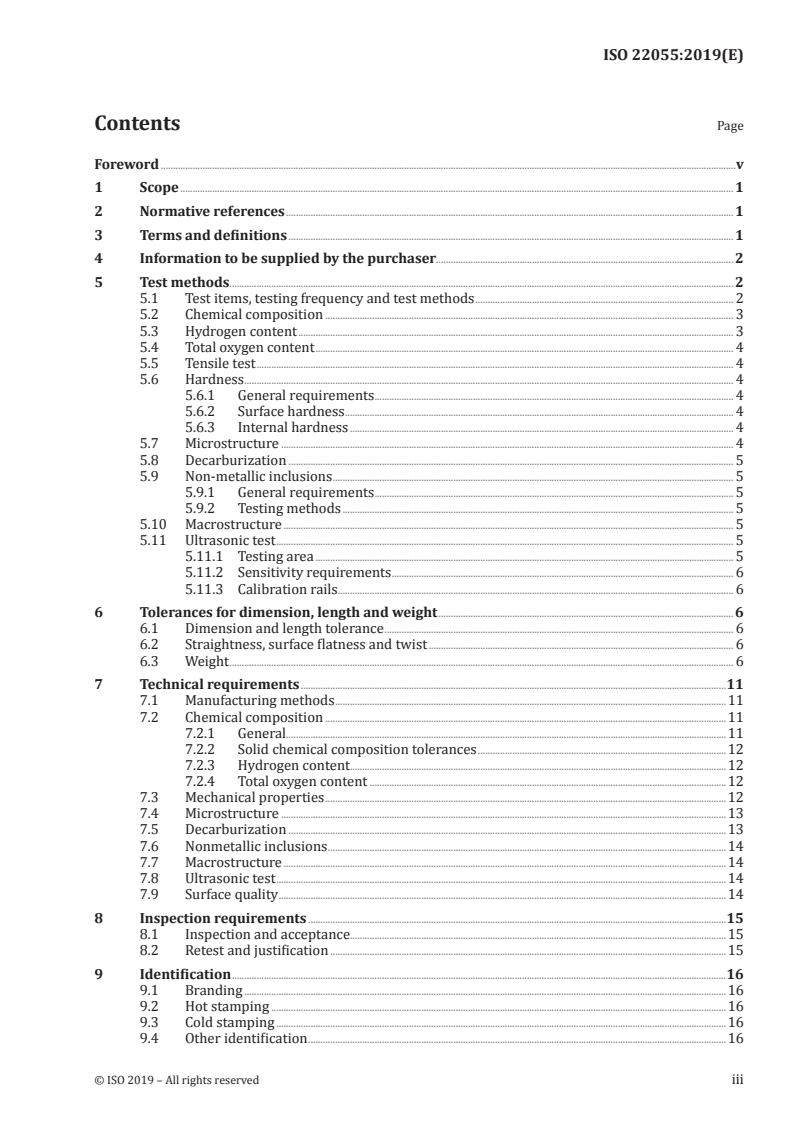
Contents Page
Foreword .v
1 Scope . 1
2 Normative references . 1
3 Terms and definitions . 1
4 Information to be supplied by the purchaser. 2
5 Test methods . 2
5.1 Test items, testing frequency and test methods . 2
5.2 Chemical composition . 3
5.3 Hydrogen content . 3
5.4 Total oxygen content . 4
5.5 Tensile test . 4
5.6 Hardness . 4
5.6.1 General requirements . 4
5.6.2 Surface hardness . 4
5.6.3 Internal hardness . 4
5.7 Microstructure . 4
5.8 Decarburization . 5
5.9 Non-metallic inclusions . 5
5.9.1 General requirements . 5
5.9.2 Testing methods . 5
5.10 Macrostructure . 5
5.11 Ultrasonic test . 5
5.11.1 Testing area . 5
5.11.2 Sensitivity requirements . 6
5.11.3 Calibration rails. 6
6 Tolerances for dimension, length and weight . 6
6.1 Dimension and length tolerance . 6
6.2 Straightness, surface flatness and twist . 6
6.3 Weight . 6
7 Technical requirements .11
7.1 Manufacturing methods .11
7.2 Chemical composition .11
7.2.1 General.11
7.2.2 Solid chemical composition tolerances .12
7.2.3 Hydrogen content.12
7.2.4 Total oxygen content .12
7.3 Mechanical properties .12
7.4 Microstructure .13
7.5 Decarburization .13
7.6 Nonmetallic inclusions .14
7.7 Macrostructure .14
7.8 Ultrasonic test .14
7.9 Surface quality .14
8 Inspection requirements .15
8.1 Inspection and acceptance.15
8.2 Retest and justification .15
9 Identification .16
9.1 Branding .16
9.2 Hot stamping .16
9.3 Cold stamping .16
9.4 Other identification .16
10 Certificate .17
Bibliography .26
iv © ISO 2019 – All rights reserved
Foreword
ISO (the International Organization for Standardization) is a worldwide federation of national standards
bodies (ISO member bodies). The work of preparing International Standards is normally carried out
through ISO technical committees. Each member body interested in a subject for which a technical
committee has been established has the right to be represented on that committee. International
organizations, governmental and non-governmental, in liaison with ISO, also take part in the work.
ISO collaborates closely with the International Electrotechnical Commission (IEC) on all matters of
electrotechnical standardization.
The procedures used to develop this document and those intended for its further maintenance are
described in the ISO/IEC Directives, Part 1. In particular, the different approval criteria needed for the
different types of ISO documents should be noted. This document was drafted in accordance with the
editorial rules of the ISO/IEC Directives, Part 2 (see www .iso .org/ directives).
Attention is drawn to the possibility that some of the elements of this document may be the subject of
patent rights. ISO shall not be held responsible for identifying any or all such patent rights. Details of
any patent rights identified during the development of the document will be in the Introduction and/or
on the ISO list of patent declarations received (see www .iso .org/ patents).
Any trade name used in this document is information given for the convenience of users and does not
constitute an endorsement.
For an explanation of the voluntary nature of standards, the meaning of ISO specific terms and
expressions related to conformity assessment, as well as information about ISO's adherence to the
World Trade Organization (WTO) principles in the Technical Barriers to Trade (TBT), see www .iso .org/
iso/ foreword .html.
This document was prepared by Technical Committee ISO/TC 17, Steel, Subcommittee SC 15, Railway
rails, rails fasteners, wheels and wheelsets.
Any feedback or questions on this document should be directed to the user’s national standards body. A
complete listing of these bodies can be found at www .iso .org/ members .html.
INTERNATIONAL STANDARD ISO 22055:2019(E)
Switch and crossing rails
1 Scope
This document specifies switch and crossing rails that carry railway wheels as specified in ISO 5003.
These are used in conjunction with flat bottom (vignole) railway rails. After switch and crossing rails
are produced, in order to be ready for railway track use, secondary processing (forging, grinding and
heat treatment etc.) is carried out. This document does not include secondary processing. Secondary
processing is specified in other standards or through agreements between manufacturer and purchaser.
Sixteen pearlitic steel grades are specified, covering a hardness range of 200 HBW to 440 HBW, and
include non-heat-treated carbon manganese steels, non-heat-treated alloy steels, heat-treated carbon
manganese and heat-treated low alloy steels.
2 Normative references
The following documents are referred to in the text in such a way that some or all of their content
constitutes requirements of this document. For dated references, only the edition cited applies. For
undated references, the latest edition of the referenced document (including any amendments) applies.
ISO 3887, Steels — Determination of the depth of decarburization
ISO 4967, Steel — Determination of content of non-metallic inclusions — Micrographic method using
standard diagrams
ISO 4968, Steel — Macrographic examination by sulfur print (Baumann method)
ISO 4969, Steel — Etching method for macroscopic examination
ISO 5003:2016, Flat bottom (Vignole) railway rails 43 kg/m and above
ISO 6506-1, Metallic materials — Brinell hardness test — Part 1: Test method
ISO 6892-1, Metallic materials — Tensile testing — Part 1: Method of test at room temperature
3 Terms and definitions
For the purposes of this document, the following terms and definitions apply.
ISO and IEC maintain terminological databases for use in standardization at the following addresses:
— ISO Online browsing platform: available at https:// www .iso .org/ obp
— IEC Electropedia: available at http:// www .electropedia .org/
3.1
heat
melt tapped out of a converter or electric arc furnace which includes after continuous
casting a given number of blooms relating to the weight of the heat and the extension of the mixing zone
Note 1 to entry: In the case of sequence casting the blooms belonging to the mixing zone should be clearly defined.
3.2
sequence
any number of heats (3.1), of the same steel grade, which undergo continuous casting in tundishes
Note 1 to entry: Tundishes can be used in parallel if the caster has many strands.
3.3
heat-treated rail
rail that has undergone accelerated cooling from austenitizing temperature during the metallurgical
transformation period
3.4
rolling process
process between the blooms leaving the heating furnace and exiting the finishing pass
3.5
isothermal treatment process
process whereby blooms are held for a period of time at an elevated temperature for reducing the
hydrogen content
Note 1 to entry: For maximum efficiency this is as near to (but below) the pearlite to austenite transformation
temperature as is practically possible.
Note 2 to entry: This process is sometimes referred to as sub-critical diffusion annealing.
3.6
rail running surface
curved surface of the rail head
Note 1 to entry: It may also refer to any area between both gauge corners (transition points of the head inclination
and the first head radius).
4 Information to be supplied by the purchaser
The purchaser shall provide the supplier with the following information at the time of enquiry or order:
a) the rail profile (by submitting a drawing);
b) the steel grade (see 7.2);
c) the non-metallic inclusion determination method and if applicable: the class “1” or “2” of rail
(see Table 12);
d) the determination of the macrostructure (see 5.10);
e) the lengths of rail (see 6.1 and Table 3);
f) undrilled or drilled rail ends to take fish bolts, and location and dimensions of holes when required
(see 6.1 and Table 3);
g) paint code requirements (see 9.4.4).
5 Test methods
5.1 Test items, testing frequency and test methods
Test items, sampling position, sampling numbers and test methods shall be as given in Table 1.
2 © ISO 2019 – All rights reserved
Table 1 — Testing frequency for acceptance testing
Relevant
Test items As-rolled rails Heat-treated rails
subclause
Chemical
One per heat One per heat 5.2
composition
One per heat One per heat
Hydrogen 5.3
(2 tests from first heat in sequence) (2 tests from first heat in sequence)
a a
Total oxygen One per sequence One per sequence 5.4
a,b,d a,c
Tensile One per heat One per heat 5.5
a,b a,c
Hardness One per heat One per heat 5.6
Not required for grades
HR200, HR220, HR235 and HR260A
One per 100 tonnes
Microstructure 5.7
One per 1 000 tonnes a,c
of heat-treated rail
or part thereof for grades
a,b
HR260B, HR310C and HR320
One per 1 000 tonnes One per 500 tonnes
Decarburization 5.8
a,b a,c
or part thereof or part thereof
Nonmetallic
b b or c
One per sequence One per sequence 5.9
inclusions
One per 500 tonnes One per 500 tonnes
Macrostructure 5.10
a,b a,b or c
or part thereof or part thereof
Dimension Whole length Whole length 6.1
Straightness Whole length Whole length 6.2
Surface quality Whole length Whole length 7.9
Ultrasonic test Whole length Whole length 5.11
a
Samples shall be taken at random. When different rail grades are cast in the same sequence, the samples shall be taken
outside the mixing zone.
b
Samples shall be cut after rolling.
c
Samples shall be cut after heat-treating for heat-treated rails.
d
One calculation per heat and one testing per 2 000 tonnes if agreed between purchaser and manufacturer.
5.2 Chemical composition
The chemical composition shall be determined on the liquid.
When the solid chemical composition is to be checked as a requirement of the purchaser, this shall be
carried out at the position of the tensile test piece shown in Figure 1.
5.3 Hydrogen content
The hydrogen content of the liquid steel shall be measured by determining the pressure of hydrogen
in the steel using an on-line immersion probe system or a method agreed between the purchaser and
manufacturer.
At least two liquid samples shall be taken from the first heat of any sequence using a new tundish and
one from each of the remaining heats and analysed for hydrogen content (see Table 1). The first sample
from the first heat in a sequence shall be taken from the tundish at the time of the maximum hydrogen
concentration.
When testing of rails is required rail samples shall be taken at the hot saw at a frequency of one per heat
at random. However, on the first heat in a sequence, the rail sample shall be from the last part of a first
bloom teemed on any strand. Hydrogen determination shall be carried out on samples taken from the
centre of the rail head and determined by automatic machine.
5.4 Total oxygen content
The total oxygen content can be determined in the liquid or solid.
If the total oxygen content is determined from the solid rail head, the testing positions are shown in
Figure 2.
5.5 Tensile test
Test samples shall be taken from the rail head as shown in Figure 1.
The tensile properties shall be determined in accordance with ISO 6892-1 by using a round tensile test
piece with the dimensions as follows:
— diameter 10 mm;
— gauge length 50 mm.
In the case of dispute, the tensile test pieces shall be maintained at a temperature of 200 °C for 6 h
before testing.
For as-rolled rails, the tensile strength and elongation may be determined as agreed between purchaser
and manufacturer by a correlation to the chemical composition based on the statistical data analysis.
The method to be applied is shown in ISO 5003:2016, Annex B.
5.6 Hardness
5.6.1 General requirements
Brinell hardness tests (HBW) shall be carried out in accordance with ISO 6506-1. The method used is at
the discretion of the manufacturer.
In case of dispute, the test shall be done using HBW 2,5/187,5.
5.6.2 Surface hardness
The surface hardness shall be tested at position RS as shown in Figure 3.
The surface hardness shall be tested on the centre line of the rail head crown. 0,5 mm shall be removed
from the running surface before a hardness impression is made. Surface quality shall be in accordance
with ISO 6506-1.
5.6.3 Internal hardness
For heat-treated rails the internal hardness shall be tested in accordance with ISO 6506-1 at the testing
positions shown in Figure 3.
The internal hardness of heat-treated rails of any steel grade shall be determined on a transverse
specimen cut from the end of the rail. The specimen shall be ground or milled so that the transverse
surfaces are parallel.
5.7 Microstructure
The microstructure testing position in the rail head shall be as shown in Figure 1 and shall be
determined at a magnification of ×500.
4 © ISO 2019 – All rights reserved
5.8 Decarburization
Decarburisation depth shall be assessed by means of a hardness test using HBW 2,5/187,5 indentation.
The test shall be performed at three points in the centre of the rail crown after minimal preparation
of the rail head surface (less than 0,2 mm material removed). None of the hardness test results shall
be more than 7 points lower than the minimum hardness of the specified grade (e.g. 253 HBW for 260
grade rail). If the test fails to meet the requirements, decarburization shall be measured at the same
sample location metallographically.
As an alternative or in the case of dispute decarburisation depth shall be measured metallographically.
The testing position in the surface of the rail head shall be as shown in Figure 4. The test shall measure
the depth of closed ferrite network in accordance with ISO 3887. Photomicrographs showing examples
of how to determine the depth of decarburization are shown in Figure 5.
5.9 Non-metallic inclusions
5.9.1 General requirements
Samples shall be taken from one of the last blooms of the last heat of the sequence. From each sample 2
specimens shall be tested.
The non-metallic inclusions testing position in the rail head is shown in Figure 6.
5.9.2 Testing methods
The test shall conform with the method shown in ISO 5003:2016, Annex C.
If agreed between purchaser and manufacturer [see Clause 4 c)], alternative methods may be used:
— ISO 4967:2013, Method A.
— ASTM E45, Method A.
5.10 Macrostructure
Macrostructure of transverse rail sections shall be tested in accordance with ISO 4969 or ISO 4968, as
agreed between purchaser and manufacturer [information given by the purchaser in Clause 4 d)].
5.11 Ultrasonic test
5.11.1 Testing area
The minimum cross-sectional area examined by the ultrasonic technique shall be:
— at least 70 % of the head;
— at least 60 % of the web;
— and the area of the foot to be tested shall be as shown in Figure 7.
In the case of a web width exceeding 16,5 mm or an asymmetrical rail geometry, the area on the foot to
be tested can be determined by agreement between the purchaser and the manufacturer.
By convention these areas are based on projecting the nominal crystal size of the probe. The head shall
be tested from both sides and from the running surface.
5.11.2 Sensitivity requirements
The sensitivity levels of the automated equipment used shall be a minimum of 4 dB greater than the
level required to detect the reference reflectors described in 5.11.3. A rail giving an echo referring
to a possible defect shall be separated by means of an automatic trigger/alarm level combined with a
marking and/or sorting system. For possible retesting, the test sensitivity shall be increased to 6 dB
instead of 4 dB.
The system shall incorporate continuous monitoring of interface signals an
...
NORME ISO
INTERNATIONALE 22055
Première édition
2019-11
Rails pour appareils de voie
Switch and crossing rails
Numéro de référence
©
ISO 2019
DOCUMENT PROTÉGÉ PAR COPYRIGHT
© ISO 2019
Tous droits réservés. Sauf prescription différente ou nécessité dans le contexte de sa mise en œuvre, aucune partie de cette
publication ne peut être reproduite ni utilisée sous quelque forme que ce soit et par aucun procédé, électronique ou mécanique,
y compris la photocopie, ou la diffusion sur l’internet ou sur un intranet, sans autorisation écrite préalable. Une autorisation peut
être demandée à l’ISO à l’adresse ci-après ou au comité membre de l’ISO dans le pays du demandeur.
ISO copyright office
Case postale 401 • Ch. de Blandonnet 8
CH-1214 Vernier, Genève
Tél.: +41 22 749 01 11
Fax: +41 22 749 09 47
E-mail: copyright@iso.org
Web: www.iso.org
Publié en Suisse
ii © ISO 2019 – Tous droits réservés
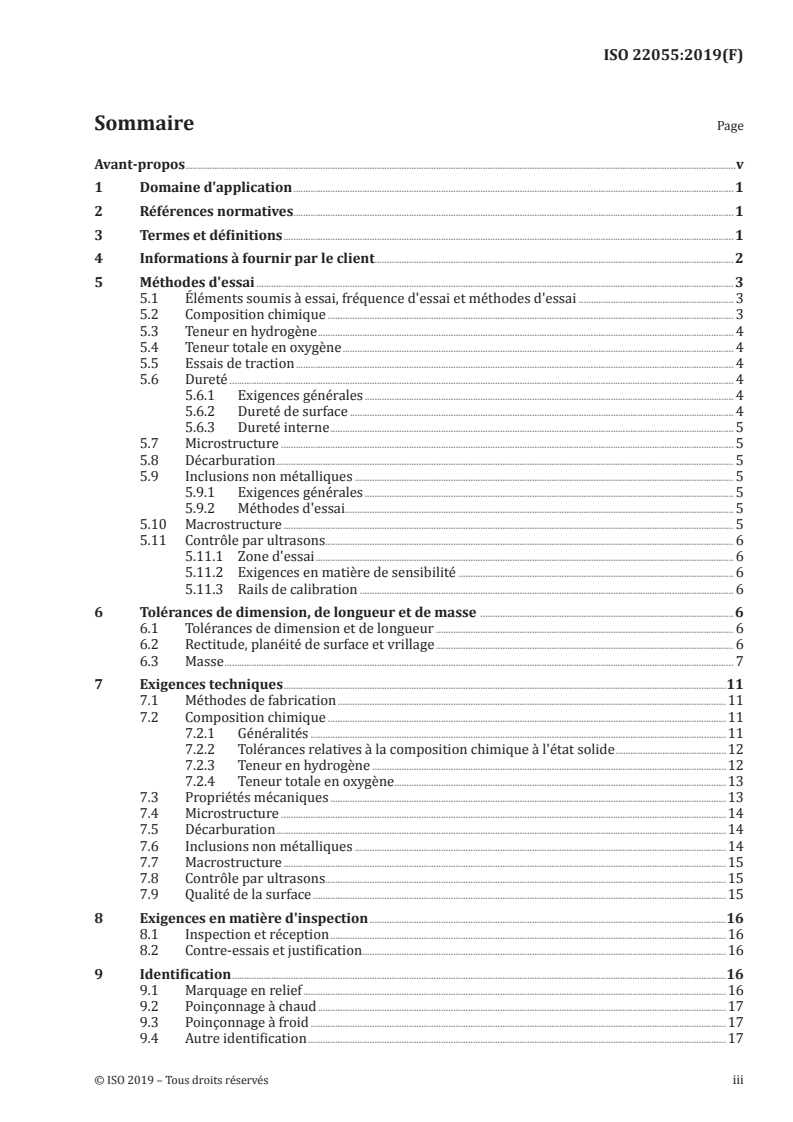
Sommaire Page
Avant-propos .v
1 Domaine d'application . 1
2 Références normatives . 1
3 Termes et définitions . 1
4 Informations à fournir par le client. 2
5 Méthodes d'essai . 3
5.1 Éléments soumis à essai, fréquence d'essai et méthodes d'essai . 3
5.2 Composition chimique . 3
5.3 Teneur en hydrogène . 4
5.4 Teneur totale en oxygène . 4
5.5 Essais de traction . 4
5.6 Dureté . 4
5.6.1 Exigences générales . 4
5.6.2 Dureté de surface . 4
5.6.3 Dureté interne . 5
5.7 Microstructure . 5
5.8 Décarburation . 5
5.9 Inclusions non métalliques . 5
5.9.1 Exigences générales . 5
5.9.2 Méthodes d'essai . . . 5
5.10 Macrostructure . 5
5.11 Contrôle par ultrasons . 6
5.11.1 Zone d'essai . 6
5.11.2 Exigences en matière de sensibilité . 6
5.11.3 Rails de calibration . 6
6 Tolérances de dimension, de longueur et de masse . 6
6.1 Tolérances de dimension et de longueur . 6
6.2 Rectitude, planéité de surface et vrillage . 6
6.3 Masse . 7
7 Exigences techniques .11
7.1 Méthodes de fabrication .11
7.2 Composition chimique .11
7.2.1 Généralités .11
7.2.2 Tolérances relatives à la composition chimique à l'état solide .12
7.2.3 Teneur en hydrogène .12
7.2.4 Teneur totale en oxygène.13
7.3 Propriétés mécaniques .13
7.4 Microstructure .14
7.5 Décarburation .14
7.6 Inclusions non métalliques .14
7.7 Macrostructure .15
7.8 Contrôle par ultrasons .15
7.9 Qualité de la surface .15
8 Exigences en matière d'inspection .16
8.1 Inspection et réception .16
8.2 Contre-essais et justification .16
9 Identification .16
9.1 Marquage en relief .16
9.2 Poinçonnage à chaud .17
9.3 Poinçonnage à froid .17
9.4 Autre identification .17
10 Certificat .17
Bibliographie .27
iv © ISO 2019 – Tous droits réservés
Avant-propos
L'ISO (Organisation internationale de normalisation) est une fédération mondiale d'organismes
nationaux de normalisation (comités membres de l'ISO). L'élaboration des Normes internationales est
en général confiée aux comités techniques de l'ISO. Chaque comité membre intéressé par une étude
a le droit de faire partie du comité technique créé à cet effet. Les organisations internationales,
gouvernementales et non gouvernementales, en liaison avec l'ISO participent également aux travaux.
L'ISO collabore étroitement avec la Commission électrotechnique internationale (IEC) en ce qui
concerne la normalisation électrotechnique.
Les procédures utilisées pour élaborer le présent document et celles destinées à sa mise à jour sont
décrites dans les Directives ISO/IEC, Partie 1. Il convient, en particulier, de prendre note des différents
critères d'approbation requis pour les différents types de documents ISO. Le présent document a été
rédigé conformément aux règles de rédaction données dans les Directives ISO/IEC, Partie 2 (voir www
.iso .org/ directives).
L'attention est attirée sur le fait que certains des éléments du présent document peuvent faire l'objet de
droits de propriété intellectuelle ou de droits analogues. L'ISO ne saurait être tenue pour responsable
de ne pas avoir identifié de tels droits de propriété et averti de leur existence. Les détails concernant
les références aux droits de propriété intellectuelle ou autres droits analogues identifiés lors de
l'élaboration du document sont indiqués dans l'Introduction et/ou dans la liste des déclarations de
brevets reçues par l'ISO (voir www .iso .org/ brevets).
Les appellations commerciales éventuellement mentionnées dans le présent document sont données
pour information, par souci de commodité, à l’intention des utilisateurs et ne sauraient constituer un
engagement.
Pour une explication de la nature volontaire des normes, la signification des termes et expressions
spécifiques de l'ISO liés à l'évaluation de la conformité, ou pour toute information au sujet de l'adhésion
de l'ISO aux principes de l’Organisation mondiale du commerce (OMC) concernant les obstacles
techniques au commerce (OTC), voir www .iso .org/ avant -propos.
Le présent document a été élaboré par le comité technique ISO/TC 17, Acier, sous-comité SC 15 Rails de
chemins de fer, attaches de rail, roues et essieux.
Il convient que l’utilisateur adresse tout retour d’information ou toute question concernant le présent
document à l’organisme national de normalisation de son pays. Une liste exhaustive desdits organismes
se trouve à l’adresse www .iso .org/ fr/ members .html.
NORME INTERNATIONALE ISO 22055:2019(F)
Rails pour appareils de voie
1 Domaine d'application
Le présent document spécifie les rails d'appareils de voie qui supportent les roues ferroviaires, comme
spécifié dans l'ISO 5003. Ils sont utilisés en association avec des rails Vignole. Après fabrication, les
rails pour appareils de voie sont soumis à un traitement secondaire (forgeage, meulage, traitement
thermique, etc.) pour les rendre aptes à une utilisation sur voie ferroviaire. Le présent document ne
couvre pas les traitements secondaires, qui sont spécifiés par d'autres normes ou définis dans le cadre
d'accords entre le fabricant et le client.
Seize nuances d'aciers perlitiques sont spécifiées, couvrant une plage de duretés comprises entre
200 HBW et 440 HBW. Ces nuances d'acier comprennent les aciers au carbone-manganèse non traités
thermiquement, les aciers alliés non traités thermiquement, les aciers au carbone-manganèse traités
thermiquement et les aciers faiblement alliés traités thermiquement.
2 Références normatives
Les documents suivants sont cités dans le texte de sorte qu’ils constituent, pour tout ou partie de leur
contenu, des exigences du présent document. Pour les références datées, seule l’édition citée s’applique.
Pour les références non datées, la dernière édition du document de référence s'applique (y compris les
éventuels amendements).
ISO 3887, Aciers — Détermination de la profondeur de décarburation
ISO 4967, Aciers — Détermination de la teneur en inclusions non métalliques — Méthode micrographique à
l'aide d'images types
ISO 4968, Acier — Examen macrographique par empreinte au soufre (méthode Baumann)
ISO 4969, Acier — Méthode d'attaque pour examen macroscopique
ISO 5003:2016, Rails Vignole de masse supérieure ou égale à 43 kg/m
ISO 6506-1, Matériaux métalliques — Essai de dureté Brinell — Partie 1: Méthode d'essai
ISO 6892-1, Matériaux métalliques — Essai de traction — Partie 1: Méthode d’essai à température ambiante
3 Termes et définitions
Pour les besoins du présent document, les termes et définitions suivants s’appliquent.
L’ISO et l’IEC tiennent à jour des bases de données terminologiques destinées à être utilisées en
normalisation, consultables aux adresses suivantes:
— ISO Online browsing platform: disponible à l’adresse https:// www .iso .org/ obp
— IEC Electropedia: disponible à l’adresse http:// www .electropedia .org/
3.1
coulée
quantité de métal liquide issue d'un convertisseur ou d'un four électrique à arc et qui, après coulée
continue, produit des blooms dont le nombre dépend du poids de la coulée et de l’étendue de la zone de
transition
Note 1 à l'article: Dans le cas de coulée en séquence, il convient d'identifier clairement les blooms de la zone de
transition.
3.2
séquence
succession d'un certain nombre de coulées (3.1) d'une même nuance d'acier, en répartiteur
Note 1 à l'article: Plusieurs répartiteurs peuvent être utilisés en parallèle si l'installation de coulée a
plusieurs veines.
3.3
rail traité thermiquement
rail soumis à un refroidissement accéléré depuis la température d'austénitisation, et au cours de la
phase de transformation métallurgique
3.4
procédé de laminage
phases de fabrication entre le moment où le bloom est extrait du four de préchauffage et le moment où
le rail quitte la dernière cage finisseuse
3.5
procédé de traitement isotherme
procédé par lequel les blooms sont maintenus à température élevée pendant une certaine période afin
de réduire le niveau d'hydrogène
Note 1 à l'article: Pour une efficacité maximale, et dans la mesure du possible, ce maintien est effectué à des
températures les plus proches possible de (mais inférieures à) la température de transformation de la perlite en
austénite.
Note 2 à l'article: Ce procédé est parfois connu sous le nom de recuit de diffusion sous-critique.
3.6
surface de roulement du rail
surface incurvée du champignon du rail
Note 1 à l'article: Ce terme peut également désigner toute surface située entre les deux côtés (entre les deux points
de transition définissant le contact entre les surfaces inclinées et le premier rayon de courbure du champignon).
4 Informations à fournir par le client
Lors d'une consultation ou d'une commande, le client doit fournir les informations suivantes au
fabricant:
a) le profil de rail (en soumettant un plan);
b) la nuance d'acier (voir 7.2);
c) la méthode de cotation des inclusions non métalliques et, le cas échéant, la classe « 1 » ou « 2 » du
rail (voir Tableau 12);
d) la détermination de la macrostructure (voir 5.10);
e) les longueurs de rails (voir 6.1 et Tableau 3);
f) les extrémités de rails non percés, ou percés pour éclissage, ainsi que l'emplacement et les
dimensions des trous le cas échéant (voir 6.1 et Tableau 3);
2 © ISO 2019 – Tous droits réservés
g) les exigences de repérage à la peinture (voir 9.4.4).
5 Méthodes d'essai
5.1 Éléments soumis à essai, fréquence d'essai et méthodes d'essai
Les éléments soumis à essai, la position et le nombre des échantillons ainsi que les méthodes d'essai
doivent répondre aux exigences du Tableau 1.
Tableau 1 — Fréquence d'essai pour les essais de réception
Éléments soumis Rails traités thermique- Paragraphe
Rails laminés
à essai ment applicable
Composition
Un essai par coulée Un essai par coulée 5.2
chimique
Un essai par coulée
Un essai par coulée
Hydrogène 5.3
(2 essais sur la première
(2 essais sur la première coulée de séquence)
coulée de séquence)
a a
Oxygène total Un essai par séquence Un essai par séquence 5.4
a,b, d a,c
Traction Un essai par coulée Un essai par coulée 5.5
a,b a,c
Dureté Un essai par coulée Un essai par coulée 5.6
Essai non exigé pour les nuances HR200,
HR220, HR235 et HR260A.
Un essai par 100 t de rails
Microstructure 5.7
a,c
traités thermiquement
Un essai par 1 000 t ou fraction de 1 000 t pour
a, b
les nuances HR260B, HR310Cet HR320
Un essai pour 500 t ou
a,b
Décarburation Un essai par 1 000 t ou fraction de 1 000 t 5.8
a,c
fraction de 500 t
Inclusions non
b b ou c
Un essai par séquence Un essai par séquence 5.9
métalliques
Un essai pour 500 t ou
a,b
Macrostructure Un essai pour 500 t ou fraction de 500 t 5.10
a, b ou c
fraction de 500 t
Dimension Sur toute la longueur Sur toute la longueur 6.1
Rectitude Sur toute la longueur Sur toute la longueur 6.2
Qualité de surface Sur toute la longueur Sur toute la longueur 7.9
Contrôle par
Sur toute la longueur Sur toute la longueur 5.11
ultrasons
a
Les échantillons peuvent être prélevés de manière aléatoire. Lorsque différentes nuances d'acier de rail sont coulées au
cours de la même séquence, les échantillons doivent être prélevés en dehors de la zone de transition.
b
Les échantillons doivent être découpés après laminage.
c
Lorsque les rails sont traités thermiquement, les échantillons doivent être découpés après traitement thermique.
d
Lorsqu'il en est convenu entre le client et le fabricant, un calcul par coulée et un essai par 2 000 t.
5.2 Composition chimique
La composition chimique doit être déterminée sur liquide.
Lorsque le client exige que la composition chimique soit déterminée sur produit fini, la vérification doit
être réalisée à la position de l'éprouvette de traction représentée à la Figure 1.
5.3 Teneur en hydrogène
La teneur en hydrogène de l'acier liquide doit être mesurée en déterminant la pression de l'hydrogène
dans l'acier au moyen d'un système de mesure in situ à sonde immergée, ou selon une méthode convenue
entre le client et le fabricant.
Au moins deux échantillons doivent être prélevés dans l'acier liquide sur la première coulée de toute
séquence utilisant un nouveau répartiteur, puis un échantillon sur chacune des coulées restantes.
Chacun de ces échantillons est ensuite analysé pour déterminer sa teneur en hydrogène (voir
Tableau 1). Le premier échantillon prélevé sur la première coulée d'une séquence doit être prélevé dans
le répartiteur durant la phase de concentration maximale en hydrogène.
Lorsqu'un essai sur rail est requis, les échantillons de rail doivent être prélevés à la scie à chaud, à
raison d'un échantillon prélevé aléatoirement par coulée. Cependant, pour la première coulée d'une
séquence, l'échantillon de rail doit être prélevé sur la dernière partie du premier bloom d'une veine
quelconque. La détermination de la teneur en hydrogène doit être réalisée sur des échantillons prélevés
au centre du champignon du rail, et au moyen d'une machine automatisée.
5.4 Teneur totale en oxygène
La teneur totale en oxygène peut être déterminée à l'état liquide ou solide.
Lorsque la teneur totale en oxygène est déterminée à partir d'un échantillon solide prélevé à partir du
champignon du rail, les positions d'essai sont représentées à la Figure 2.
5.5 Essais de traction
Les éprouvettes d'essai doivent être prélevées sur le champignon du rail, comme défini à la Figure 1.
Conformément à l'ISO 6892-1, les propriétés en traction doivent être déterminées sur une éprouvette
cylindrique de traction présentant les dimensions suivantes:
— 10 mm de diamètre;
— longueur utile de 50 mm.
En cas de litige, les éprouvettes de traction doivent être maintenues à une température de 200 °C
pendant 6 h avant essai.
Pour les rails naturellement durs (non traités thermiquement), et dans le cadre d'un accord entre le
fournisseur et le client, la résistance à la rupture et l'allongement à rupture peuvent être déterminés
par corrélation avec la composition chimique, sur la base d'une analyse statistique de résultats. La
méthode à appliquer est présentée dans l'Annexe B de l'ISO 5003:2016.
5.6 Dureté
5.6.1 Exigences générales
Les essais de dureté Brinell (HBW) doivent être réalisés conformément à l'ISO 6506-1. La méthode
utilisée est laissée à la discrétion du fabricant.
En cas de litige, l'essai doit être effectué suivant la méthode HBW 2,5/187,5.
5.6.2 Dureté de surface
La dureté de surface doit être contrôlée à la position RS représentée à la Figure 3.
La dureté de surface doit être contrôlée dans l'axe de la surface de roulement du rail. Une épaisseur de
0,5 mm doit être retirée de la surface de roulement avant de réaliser l'empreinte de dureté. La qualité
de surface doit être conforme à l'ISO 6506-1.
4 © ISO 2019 – Tous droits réservés
5.6.3 Dureté interne
Pour les rails traités thermiquement, la dureté interne doit être contrôlée conformément à l'ISO 6506-1
aux positions d'essai représentées à la Figure 3.
La dureté interne des rails traités thermiquement, quelle que soit la nuance d'acier, doit être déterminée
sur une éprouvette découpée dans le sens transversal sur l'extrémité du rail. L'éprouvette doit être
meulée ou fraisée de manière que les surfaces transversales soient parallèles.
5.7 Microstructure
L'essai de la microstructure dans le champignon du rail doit être effectué à la position indiquée à la
Figure 1. Il doit être réalisé au grossissement de 500.
5.8 Décarburation
La profondeur décarburée doit être évaluée au moyen d'un essai de dureté HBW 2,5/187,5. L'essai doit
être effectué en trois points, dans l'axe du champignon du rail et après une préparation de surface
minimale (retrait d'une épaisseur de moins de 0,2 mm). Aucun des résultats de dureté ne doit être
inférieur de plus de 7 points à la dureté minimale de la nuance spécifiée (par exemple, 253 HBW pour
un rail de nuance 260). Si l'essai ne satisfait pas aux exigences, la décarburation doit être mesurée par
métallographie, sur le même échantillon.
Comme alternative ou en cas de litige, la profondeur de décarburation doit être mesurée par examens
métallographiques à des positions, au niveau de la surface du champignon du rail, conformes à celles
définies à la Figure 4. Conformément à l'ISO 3887, l'essai doit s'attacher à mesurer la profondeur des
réseaux ferritiques fermés. Les micrographies de la Figure 5 donnent des exemples de détermination de
la profondeur décarburée.
5.9 Inclusions non métalliques
5.9.1 Exigences générales
Les échantillons doivent être prélevés sur l'un des derniers blooms de la dernière coulée de la séquence.
2 examens doivent être réalisés sur chaque échantillon.
La position des examens, sur le champignon du rail, est représentée à la Figure 6.
5.9.2 Méthodes d'essai
L'essai doit être conforme à la méthode décrite dans l'Annexe C de l'ISO 5003:2016.
D'autres méthodes peuvent être utilisées sur accord entre le client et le fabricant [voir Article 4, c)]:
— ISO 4967:2013, Méthode A;
— ASTM E45, Méthode A.
5.10 Macrostructure
La macrostructure des sections transversales de rails doit être soumise à essai conformément à
l'ISO 4969 ou à l'ISO 4968, selon ce qui est convenu entre le client et le fabricant [informations fournies
par le client à l'Article 4, d)].
5.11 Contrôle par ultrasons
5.11.1 Zone d'essai
La section transversale minimale examinée par ultrasons doit être égale:
à 70 % au moins du champignon;
à 60 % au moins de l'âme;
et la surface du patin à soumettre à essai doit être conforme à la Figure 7.
Lorsque l'épaisseur de l'âme est supérieure à 16,5 mm, ou que le rail est asymétrique, la surface du
patin à soumettre à essai peut être déterminée par accord entre le client et le fabricant.
Par convention, ces surfaces sont basées sur la projection de la dimension nominale des cristaux des
sondes. Le champignon doit être contrôlé sur ses 2 faces latérales et à partir de la surface de roulement.
5.11.2 Exigences en matière de sensibilité
Les niveaux de sensibilité de l'équipement automatique utilisé doivent être au minimum de 4 dB
supérieurs au niveau exigé pour détecter les réflecteurs de référence décrits en 5.11.3. Un rail donnant
un écho indiquant un défaut possible doit être isolé par un système d'alarme automatique combiné à
un système de marquage et/ou un système de tri. Préalablement à un contre-essai, la sensibilité d'essai
doit être augmentée de 6 dB au lieu de 4 dB.
Le système doit intégrer un contrôle continu des échos d'entrée et, s'ils sont présents, des échos de fond.
5.11.3 Rails de calibration
Pour chaque profil à soumettre au contrôle par ultrasons, il doit exister un rail de calibration. Les
positions des défauts de référence placés dans le champignon, l'âme et le patin sont donnés, pour le
profil 60E1, respectivement aux Figures 8, 9 et 10 (voir l'Annexe D de l'ISO 5003:2016). Pour les autres
profils, des rails de calibration présentant des défauts similaires à ceux des Figures 8, 9 et 10 établies
pour le profil 60E1, doivent également être disponibles.
D'autres méthodes de calibration peuvent être appliquées, mais ces méthodes doivent être
...
NORME ISO
INTERNATIONALE 22055
Première édition
2019-11
Rails pour appareils de voie
Switch and crossing rails
Numéro de référence
©
ISO 2019
DOCUMENT PROTÉGÉ PAR COPYRIGHT
© ISO 2019
Tous droits réservés. Sauf prescription différente ou nécessité dans le contexte de sa mise en œuvre, aucune partie de cette
publication ne peut être reproduite ni utilisée sous quelque forme que ce soit et par aucun procédé, électronique ou mécanique,
y compris la photocopie, ou la diffusion sur l’internet ou sur un intranet, sans autorisation écrite préalable. Une autorisation peut
être demandée à l’ISO à l’adresse ci-après ou au comité membre de l’ISO dans le pays du demandeur.
ISO copyright office
Case postale 401 • Ch. de Blandonnet 8
CH-1214 Vernier, Genève
Tél.: +41 22 749 01 11
Fax: +41 22 749 09 47
E-mail: copyright@iso.org
Web: www.iso.org
Publié en Suisse
ii © ISO 2019 – Tous droits réservés
Sommaire Page
Avant-propos .v
1 Domaine d'application . 1
2 Références normatives . 1
3 Termes et définitions . 1
4 Informations à fournir par le client. 2
5 Méthodes d'essai . 3
5.1 Éléments soumis à essai, fréquence d'essai et méthodes d'essai . 3
5.2 Composition chimique . 3
5.3 Teneur en hydrogène . 4
5.4 Teneur totale en oxygène . 4
5.5 Essais de traction . 4
5.6 Dureté . 4
5.6.1 Exigences générales . 4
5.6.2 Dureté de surface . 4
5.6.3 Dureté interne . 5
5.7 Microstructure . 5
5.8 Décarburation . 5
5.9 Inclusions non métalliques . 5
5.9.1 Exigences générales . 5
5.9.2 Méthodes d'essai . . . 5
5.10 Macrostructure . 5
5.11 Contrôle par ultrasons . 6
5.11.1 Zone d'essai . 6
5.11.2 Exigences en matière de sensibilité . 6
5.11.3 Rails de calibration . 6
6 Tolérances de dimension, de longueur et de masse . 6
6.1 Tolérances de dimension et de longueur . 6
6.2 Rectitude, planéité de surface et vrillage . 6
6.3 Masse . 7
7 Exigences techniques .11
7.1 Méthodes de fabrication .11
7.2 Composition chimique .11
7.2.1 Généralités .11
7.2.2 Tolérances relatives à la composition chimique à l'état solide .12
7.2.3 Teneur en hydrogène .12
7.2.4 Teneur totale en oxygène.13
7.3 Propriétés mécaniques .13
7.4 Microstructure .14
7.5 Décarburation .14
7.6 Inclusions non métalliques .14
7.7 Macrostructure .15
7.8 Contrôle par ultrasons .15
7.9 Qualité de la surface .15
8 Exigences en matière d'inspection .16
8.1 Inspection et réception .16
8.2 Contre-essais et justification .16
9 Identification .16
9.1 Marquage en relief .16
9.2 Poinçonnage à chaud .17
9.3 Poinçonnage à froid .17
9.4 Autre identification .17
10 Certificat .17
Bibliographie .27
iv © ISO 2019 – Tous droits réservés
Avant-propos
L'ISO (Organisation internationale de normalisation) est une fédération mondiale d'organismes
nationaux de normalisation (comités membres de l'ISO). L'élaboration des Normes internationales est
en général confiée aux comités techniques de l'ISO. Chaque comité membre intéressé par une étude
a le droit de faire partie du comité technique créé à cet effet. Les organisations internationales,
gouvernementales et non gouvernementales, en liaison avec l'ISO participent également aux travaux.
L'ISO collabore étroitement avec la Commission électrotechnique internationale (IEC) en ce qui
concerne la normalisation électrotechnique.
Les procédures utilisées pour élaborer le présent document et celles destinées à sa mise à jour sont
décrites dans les Directives ISO/IEC, Partie 1. Il convient, en particulier, de prendre note des différents
critères d'approbation requis pour les différents types de documents ISO. Le présent document a été
rédigé conformément aux règles de rédaction données dans les Directives ISO/IEC, Partie 2 (voir www
.iso .org/ directives).
L'attention est attirée sur le fait que certains des éléments du présent document peuvent faire l'objet de
droits de propriété intellectuelle ou de droits analogues. L'ISO ne saurait être tenue pour responsable
de ne pas avoir identifié de tels droits de propriété et averti de leur existence. Les détails concernant
les références aux droits de propriété intellectuelle ou autres droits analogues identifiés lors de
l'élaboration du document sont indiqués dans l'Introduction et/ou dans la liste des déclarations de
brevets reçues par l'ISO (voir www .iso .org/ brevets).
Les appellations commerciales éventuellement mentionnées dans le présent document sont données
pour information, par souci de commodité, à l’intention des utilisateurs et ne sauraient constituer un
engagement.
Pour une explication de la nature volontaire des normes, la signification des termes et expressions
spécifiques de l'ISO liés à l'évaluation de la conformité, ou pour toute information au sujet de l'adhésion
de l'ISO aux principes de l’Organisation mondiale du commerce (OMC) concernant les obstacles
techniques au commerce (OTC), voir www .iso .org/ avant -propos.
Le présent document a été élaboré par le comité technique ISO/TC 17, Acier, sous-comité SC 15 Rails de
chemins de fer, attaches de rail, roues et essieux.
Il convient que l’utilisateur adresse tout retour d’information ou toute question concernant le présent
document à l’organisme national de normalisation de son pays. Une liste exhaustive desdits organismes
se trouve à l’adresse www .iso .org/ fr/ members .html.
NORME INTERNATIONALE ISO 22055:2019(F)
Rails pour appareils de voie
1 Domaine d'application
Le présent document spécifie les rails d'appareils de voie qui supportent les roues ferroviaires, comme
spécifié dans l'ISO 5003. Ils sont utilisés en association avec des rails Vignole. Après fabrication, les
rails pour appareils de voie sont soumis à un traitement secondaire (forgeage, meulage, traitement
thermique, etc.) pour les rendre aptes à une utilisation sur voie ferroviaire. Le présent document ne
couvre pas les traitements secondaires, qui sont spécifiés par d'autres normes ou définis dans le cadre
d'accords entre le fabricant et le client.
Seize nuances d'aciers perlitiques sont spécifiées, couvrant une plage de duretés comprises entre
200 HBW et 440 HBW. Ces nuances d'acier comprennent les aciers au carbone-manganèse non traités
thermiquement, les aciers alliés non traités thermiquement, les aciers au carbone-manganèse traités
thermiquement et les aciers faiblement alliés traités thermiquement.
2 Références normatives
Les documents suivants sont cités dans le texte de sorte qu’ils constituent, pour tout ou partie de leur
contenu, des exigences du présent document. Pour les références datées, seule l’édition citée s’applique.
Pour les références non datées, la dernière édition du document de référence s'applique (y compris les
éventuels amendements).
ISO 3887, Aciers — Détermination de la profondeur de décarburation
ISO 4967, Aciers — Détermination de la teneur en inclusions non métalliques — Méthode micrographique à
l'aide d'images types
ISO 4968, Acier — Examen macrographique par empreinte au soufre (méthode Baumann)
ISO 4969, Acier — Méthode d'attaque pour examen macroscopique
ISO 5003:2016, Rails Vignole de masse supérieure ou égale à 43 kg/m
ISO 6506-1, Matériaux métalliques — Essai de dureté Brinell — Partie 1: Méthode d'essai
ISO 6892-1, Matériaux métalliques — Essai de traction — Partie 1: Méthode d’essai à température ambiante
3 Termes et définitions
Pour les besoins du présent document, les termes et définitions suivants s’appliquent.
L’ISO et l’IEC tiennent à jour des bases de données terminologiques destinées à être utilisées en
normalisation, consultables aux adresses suivantes:
— ISO Online browsing platform: disponible à l’adresse https:// www .iso .org/ obp
— IEC Electropedia: disponible à l’adresse http:// www .electropedia .org/
3.1
coulée
quantité de métal liquide issue d'un convertisseur ou d'un four électrique à arc et qui, après coulée
continue, produit des blooms dont le nombre dépend du poids de la coulée et de l’étendue de la zone de
transition
Note 1 à l'article: Dans le cas de coulée en séquence, il convient d'identifier clairement les blooms de la zone de
transition.
3.2
séquence
succession d'un certain nombre de coulées (3.1) d'une même nuance d'acier, en répartiteur
Note 1 à l'article: Plusieurs répartiteurs peuvent être utilisés en parallèle si l'installation de coulée a
plusieurs veines.
3.3
rail traité thermiquement
rail soumis à un refroidissement accéléré depuis la température d'austénitisation, et au cours de la
phase de transformation métallurgique
3.4
procédé de laminage
phases de fabrication entre le moment où le bloom est extrait du four de préchauffage et le moment où
le rail quitte la dernière cage finisseuse
3.5
procédé de traitement isotherme
procédé par lequel les blooms sont maintenus à température élevée pendant une certaine période afin
de réduire le niveau d'hydrogène
Note 1 à l'article: Pour une efficacité maximale, et dans la mesure du possible, ce maintien est effectué à des
températures les plus proches possible de (mais inférieures à) la température de transformation de la perlite en
austénite.
Note 2 à l'article: Ce procédé est parfois connu sous le nom de recuit de diffusion sous-critique.
3.6
surface de roulement du rail
surface incurvée du champignon du rail
Note 1 à l'article: Ce terme peut également désigner toute surface située entre les deux côtés (entre les deux points
de transition définissant le contact entre les surfaces inclinées et le premier rayon de courbure du champignon).
4 Informations à fournir par le client
Lors d'une consultation ou d'une commande, le client doit fournir les informations suivantes au
fabricant:
a) le profil de rail (en soumettant un plan);
b) la nuance d'acier (voir 7.2);
c) la méthode de cotation des inclusions non métalliques et, le cas échéant, la classe « 1 » ou « 2 » du
rail (voir Tableau 12);
d) la détermination de la macrostructure (voir 5.10);
e) les longueurs de rails (voir 6.1 et Tableau 3);
f) les extrémités de rails non percés, ou percés pour éclissage, ainsi que l'emplacement et les
dimensions des trous le cas échéant (voir 6.1 et Tableau 3);
2 © ISO 2019 – Tous droits réservés
g) les exigences de repérage à la peinture (voir 9.4.4).
5 Méthodes d'essai
5.1 Éléments soumis à essai, fréquence d'essai et méthodes d'essai
Les éléments soumis à essai, la position et le nombre des échantillons ainsi que les méthodes d'essai
doivent répondre aux exigences du Tableau 1.
Tableau 1 — Fréquence d'essai pour les essais de réception
Éléments soumis Rails traités thermique- Paragraphe
Rails laminés
à essai ment applicable
Composition
Un essai par coulée Un essai par coulée 5.2
chimique
Un essai par coulée
Un essai par coulée
Hydrogène 5.3
(2 essais sur la première
(2 essais sur la première coulée de séquence)
coulée de séquence)
a a
Oxygène total Un essai par séquence Un essai par séquence 5.4
a,b, d a,c
Traction Un essai par coulée Un essai par coulée 5.5
a,b a,c
Dureté Un essai par coulée Un essai par coulée 5.6
Essai non exigé pour les nuances HR200,
HR220, HR235 et HR260A.
Un essai par 100 t de rails
Microstructure 5.7
a,c
traités thermiquement
Un essai par 1 000 t ou fraction de 1 000 t pour
a, b
les nuances HR260B, HR310Cet HR320
Un essai pour 500 t ou
a,b
Décarburation Un essai par 1 000 t ou fraction de 1 000 t 5.8
a,c
fraction de 500 t
Inclusions non
b b ou c
Un essai par séquence Un essai par séquence 5.9
métalliques
Un essai pour 500 t ou
a,b
Macrostructure Un essai pour 500 t ou fraction de 500 t 5.10
a, b ou c
fraction de 500 t
Dimension Sur toute la longueur Sur toute la longueur 6.1
Rectitude Sur toute la longueur Sur toute la longueur 6.2
Qualité de surface Sur toute la longueur Sur toute la longueur 7.9
Contrôle par
Sur toute la longueur Sur toute la longueur 5.11
ultrasons
a
Les échantillons peuvent être prélevés de manière aléatoire. Lorsque différentes nuances d'acier de rail sont coulées au
cours de la même séquence, les échantillons doivent être prélevés en dehors de la zone de transition.
b
Les échantillons doivent être découpés après laminage.
c
Lorsque les rails sont traités thermiquement, les échantillons doivent être découpés après traitement thermique.
d
Lorsqu'il en est convenu entre le client et le fabricant, un calcul par coulée et un essai par 2 000 t.
5.2 Composition chimique
La composition chimique doit être déterminée sur liquide.
Lorsque le client exige que la composition chimique soit déterminée sur produit fini, la vérification doit
être réalisée à la position de l'éprouvette de traction représentée à la Figure 1.
5.3 Teneur en hydrogène
La teneur en hydrogène de l'acier liquide doit être mesurée en déterminant la pression de l'hydrogène
dans l'acier au moyen d'un système de mesure in situ à sonde immergée, ou selon une méthode convenue
entre le client et le fabricant.
Au moins deux échantillons doivent être prélevés dans l'acier liquide sur la première coulée de toute
séquence utilisant un nouveau répartiteur, puis un échantillon sur chacune des coulées restantes.
Chacun de ces échantillons est ensuite analysé pour déterminer sa teneur en hydrogène (voir
Tableau 1). Le premier échantillon prélevé sur la première coulée d'une séquence doit être prélevé dans
le répartiteur durant la phase de concentration maximale en hydrogène.
Lorsqu'un essai sur rail est requis, les échantillons de rail doivent être prélevés à la scie à chaud, à
raison d'un échantillon prélevé aléatoirement par coulée. Cependant, pour la première coulée d'une
séquence, l'échantillon de rail doit être prélevé sur la dernière partie du premier bloom d'une veine
quelconque. La détermination de la teneur en hydrogène doit être réalisée sur des échantillons prélevés
au centre du champignon du rail, et au moyen d'une machine automatisée.
5.4 Teneur totale en oxygène
La teneur totale en oxygène peut être déterminée à l'état liquide ou solide.
Lorsque la teneur totale en oxygène est déterminée à partir d'un échantillon solide prélevé à partir du
champignon du rail, les positions d'essai sont représentées à la Figure 2.
5.5 Essais de traction
Les éprouvettes d'essai doivent être prélevées sur le champignon du rail, comme défini à la Figure 1.
Conformément à l'ISO 6892-1, les propriétés en traction doivent être déterminées sur une éprouvette
cylindrique de traction présentant les dimensions suivantes:
— 10 mm de diamètre;
— longueur utile de 50 mm.
En cas de litige, les éprouvettes de traction doivent être maintenues à une température de 200 °C
pendant 6 h avant essai.
Pour les rails naturellement durs (non traités thermiquement), et dans le cadre d'un accord entre le
fournisseur et le client, la résistance à la rupture et l'allongement à rupture peuvent être déterminés
par corrélation avec la composition chimique, sur la base d'une analyse statistique de résultats. La
méthode à appliquer est présentée dans l'Annexe B de l'ISO 5003:2016.
5.6 Dureté
5.6.1 Exigences générales
Les essais de dureté Brinell (HBW) doivent être réalisés conformément à l'ISO 6506-1. La méthode
utilisée est laissée à la discrétion du fabricant.
En cas de litige, l'essai doit être effectué suivant la méthode HBW 2,5/187,5.
5.6.2 Dureté de surface
La dureté de surface doit être contrôlée à la position RS représentée à la Figure 3.
La dureté de surface doit être contrôlée dans l'axe de la surface de roulement du rail. Une épaisseur de
0,5 mm doit être retirée de la surface de roulement avant de réaliser l'empreinte de dureté. La qualité
de surface doit être conforme à l'ISO 6506-1.
4 © ISO 2019 – Tous droits réservés
5.6.3 Dureté interne
Pour les rails traités thermiquement, la dureté interne doit être contrôlée conformément à l'ISO 6506-1
aux positions d'essai représentées à la Figure 3.
La dureté interne des rails traités thermiquement, quelle que soit la nuance d'acier, doit être déterminée
sur une éprouvette découpée dans le sens transversal sur l'extrémité du rail. L'éprouvette doit être
meulée ou fraisée de manière que les surfaces transversales soient parallèles.
5.7 Microstructure
L'essai de la microstructure dans le champignon du rail doit être effectué à la position indiquée à la
Figure 1. Il doit être réalisé au grossissement de 500.
5.8 Décarburation
La profondeur décarburée doit être évaluée au moyen d'un essai de dureté HBW 2,5/187,5. L'essai doit
être effectué en trois points, dans l'axe du champignon du rail et après une préparation de surface
minimale (retrait d'une épaisseur de moins de 0,2 mm). Aucun des résultats de dureté ne doit être
inférieur de plus de 7 points à la dureté minimale de la nuance spécifiée (par exemple, 253 HBW pour
un rail de nuance 260). Si l'essai ne satisfait pas aux exigences, la décarburation doit être mesurée par
métallographie, sur le même échantillon.
Comme alternative ou en cas de litige, la profondeur de décarburation doit être mesurée par examens
métallographiques à des positions, au niveau de la surface du champignon du rail, conformes à celles
définies à la Figure 4. Conformément à l'ISO 3887, l'essai doit s'attacher à mesurer la profondeur des
réseaux ferritiques fermés. Les micrographies de la Figure 5 donnent des exemples de détermination de
la profondeur décarburée.
5.9 Inclusions non métalliques
5.9.1 Exigences générales
Les échantillons doivent être prélevés sur l'un des derniers blooms de la dernière coulée de la séquence.
2 examens doivent être réalisés sur chaque échantillon.
La position des examens, sur le champignon du rail, est représentée à la Figure 6.
5.9.2 Méthodes d'essai
L'essai doit être conforme à la méthode décrite dans l'Annexe C de l'ISO 5003:2016.
D'autres méthodes peuvent être utilisées sur accord entre le client et le fabricant [voir Article 4, c)]:
— ISO 4967:2013, Méthode A;
— ASTM E45, Méthode A.
5.10 Macrostructure
La macrostructure des sections transversales de rails doit être soumise à essai conformément à
l'ISO 4969 ou à l'ISO 4968, selon ce qui est convenu entre le client et le fabricant [informations fournies
par le client à l'Article 4, d)].
5.11 Contrôle par ultrasons
5.11.1 Zone d'essai
La section transversale minimale examinée par ultrasons doit être égale:
à 70 % au moins du champignon;
à 60 % au moins de l'âme;
et la surface du patin à soumettre à essai doit être conforme à la Figure 7.
Lorsque l'épaisseur de l'âme est supérieure à 16,5 mm, ou que le rail est asymétrique, la surface du
patin à soumettre à essai peut être déterminée par accord entre le client et le fabricant.
Par convention, ces surfaces sont basées sur la projection de la dimension nominale des cristaux des
sondes. Le champignon doit être contrôlé sur ses 2 faces latérales et à partir de la surface de roulement.
5.11.2 Exigences en matière de sensibilité
Les niveaux de sensibilité de l'équipement automatique utilisé doivent être au minimum de 4 dB
supérieurs au niveau exigé pour détecter les réflecteurs de référence décrits en 5.11.3. Un rail donnant
un écho indiquant un défaut possible doit être isolé par un système d'alarme automatique combiné à
un système de marquage et/ou un système de tri. Préalablement à un contre-essai, la sensibilité d'essai
doit être augmentée de 6 dB au lieu de 4 dB.
Le système doit intégrer un contrôle continu des échos d'entrée et, s'ils sont présents, des échos de fond.
5.11.3 Rails de calibration
Pour chaque profil à soumettre au contrôle par ultrasons, il doit exister un rail de calibration. Les
positions des défauts de référence placés dans le champignon, l'âme et le patin sont donnés, pour le
profil 60E1, respectivement aux Figures 8, 9 et 10 (voir l'Annexe D de l'ISO 5003:2016). Pour les autres
profils, des rails de calibration présentant des défauts similaires à ceux des Figures 8, 9 et 10 établies
pour le profil 60E1, doivent également être disponibles.
D'autres méthodes de calibration peuvent être appliquées, mais ces méthodes doivent être
...