

ISO 14811:2025
(Main)Ultra-low carbon high boron steel wire rod for copper cladded wire
General Information
- Abstract
This document specifies requirements for ultra-low carbon high boron steel wire rod for copper cladded wire, mainly used in telecommunication cable (hereinafter referred to as wire rods). This document applies to wire rods with circular cross-sections and diameters of 5 mm to 20 mm.
- Status
- Published
- Publication Date
- 25-Feb-2025
- Technical Committee
- ISO/TC 17/SC 17 - Steel wire rod and wire products
- Drafting Committee
- ISO/TC 17/SC 17 - Steel wire rod and wire products
- Current Stage
- 6060 - International Standard published
- Start Date
- 26-Feb-2025
- Due Date
- 21-Feb-2026
- Completion Date
- 26-Feb-2025
Overview
ISO 14811:2025 specifies requirements for ultra‑low carbon high boron steel wire rod for copper cladded wire, primarily intended for telecommunication cable cores. The standard covers wire rods with circular cross‑sections and diameters from 5 mm to 20 mm, defining designation, production, delivery condition, inspection and marking requirements for continuous hot‑rolled or heat‑treated coils.
Key topics and technical requirements
- Scope and designation
- Applies to steel wire rod used as a steel core with continuous copper cladding (copper cladded wire).
- Special designation format: CH#B (C = carbon, H = high, # = max C × 10 000, B = boron).
- Dimensions and tolerances
- Diameter range 5–20 mm with four standardized tolerance classes T1–T4 (per ISO 16124); out‑of‑roundness limits are specified for each class.
- Chemical composition
- Defines heat analysis ranges for grades CH1B, CH3B, CH5B, CH6B (ultra‑low carbon, controlled Si, Mn, P, S, Al, B, N per Table 2).
- Mechanical properties
- Tensile strength and elongation requirements are given by grade. Example:
- CH1B: Rm ≤ 320 MPa, A ≥ 40%
- CH3B: Rm 320–360 MPa, A 30–40%
- CH5B: Rm 360–400 MPa, A 25–30%
- CH6B: Rm 400–450 MPa, A 20–25%
- Tensile strength and elongation requirements are given by grade. Example:
- Conductivity
- Conductivity (% IACS) specified by grade (e.g., CH1B 17.5–19.0% IACS down to CH6B 12.0–14.0% IACS), measured per IEC 60468.
- Quality, inspection and testing
- Requirements for internal soundness, surface discontinuities, non‑metallic inclusion (optional) and allowable discontinuity depth (ref. ISO 16120‑4).
- Test methods and sampling reference ISO 377, ISO 6892‑1 (tensile), ISO 14284 (chemical analysis), IEC 60468 (conductivity).
- Production & delivery
- Steelmaking by BOF or EAF with refining (supplier discretion unless agreed).
- Supplied in single‑length coils, marking to include dimensions, grade, heat number, supplier, conductivity.
Applications and intended users
- Practical use: production of copper cladded wire for telecommunication cables, where a steel core provides strength and copper cladding provides conductivity and corrosion protection.
- Primary users:
- Steel mills and wire‑rod producers manufacturing CH#B grades.
- Cable manufacturers specifying core material for telecom and specialty wiring.
- Quality and inspection engineers ensuring conformity to mechanical, chemical and electrical requirements.
- Procurement and compliance teams referencing ISO 14811:2025 in purchase specifications.
Related standards
- ISO 16124, ISO 16120‑4, ISO 16120‑1 (wire rod dimensions, tolerances, special applications)
- ISO 404, ISO 10474 (delivery & inspection documents)
- ISO 377, ISO 6892‑1, ISO 14284 (sampling and test methods)
- IEC 60468 (conductivity measurement)
Keywords: ISO 14811:2025, ultra‑low carbon high boron steel, wire rod, copper cladded wire, telecommunication cable, conductivity, tensile strength, chemical composition, ISO standards.
Get Certified
Connect with accredited certification bodies for this standard

Element Materials Technology
Materials testing and product certification.

Inštitut za kovinske materiale in tehnologije
Institute of Metals and Technology. Materials testing, metallurgical analysis, NDT.
Sponsored listings
Frequently Asked Questions
ISO 14811:2025 is a standard published by the International Organization for Standardization (ISO). Its full title is "Ultra-low carbon high boron steel wire rod for copper cladded wire". This standard covers: This document specifies requirements for ultra-low carbon high boron steel wire rod for copper cladded wire, mainly used in telecommunication cable (hereinafter referred to as wire rods). This document applies to wire rods with circular cross-sections and diameters of 5 mm to 20 mm.
This document specifies requirements for ultra-low carbon high boron steel wire rod for copper cladded wire, mainly used in telecommunication cable (hereinafter referred to as wire rods). This document applies to wire rods with circular cross-sections and diameters of 5 mm to 20 mm.
ISO 14811:2025 is classified under the following ICS (International Classification for Standards) categories: 77.140.65 - Steel wire, wire ropes and link chains. The ICS classification helps identify the subject area and facilitates finding related standards.
ISO 14811:2025 is available in PDF format for immediate download after purchase. The document can be added to your cart and obtained through the secure checkout process. Digital delivery ensures instant access to the complete standard document.
Standards Content (Sample)
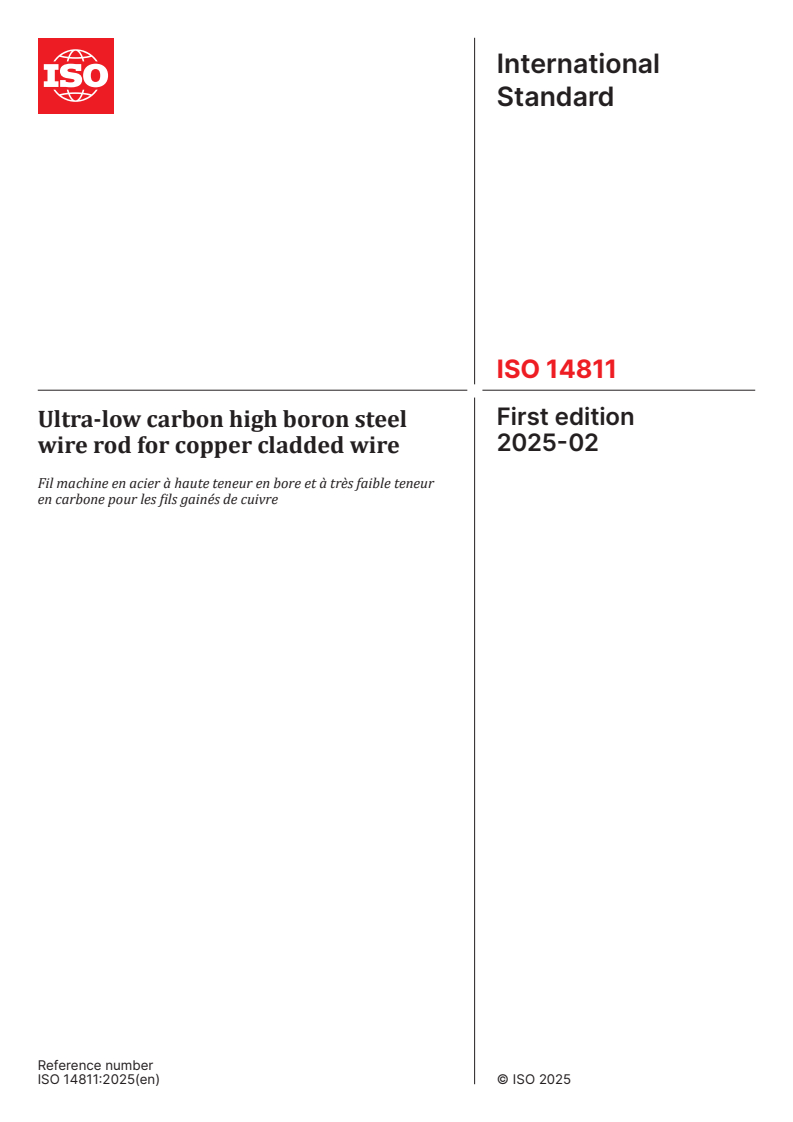
International
Standard
ISO 14811
First edition
Ultra-low carbon high boron steel
2025-02
wire rod for copper cladded wire
Fil machine en acier à haute teneur en bore et à très faible teneur
en carbone pour les fils gainés de cuivre
Reference number
© ISO 2025
All rights reserved. Unless otherwise specified, or required in the context of its implementation, no part of this publication may
be reproduced or utilized otherwise in any form or by any means, electronic or mechanical, including photocopying, or posting on
the internet or an intranet, without prior written permission. Permission can be requested from either ISO at the address below
or ISO’s member body in the country of the requester.
ISO copyright office
CP 401 • Ch. de Blandonnet 8
CH-1214 Vernier, Geneva
Phone: +41 22 749 01 11
Email: copyright@iso.org
Website: www.iso.org
Published in Switzerland
ii
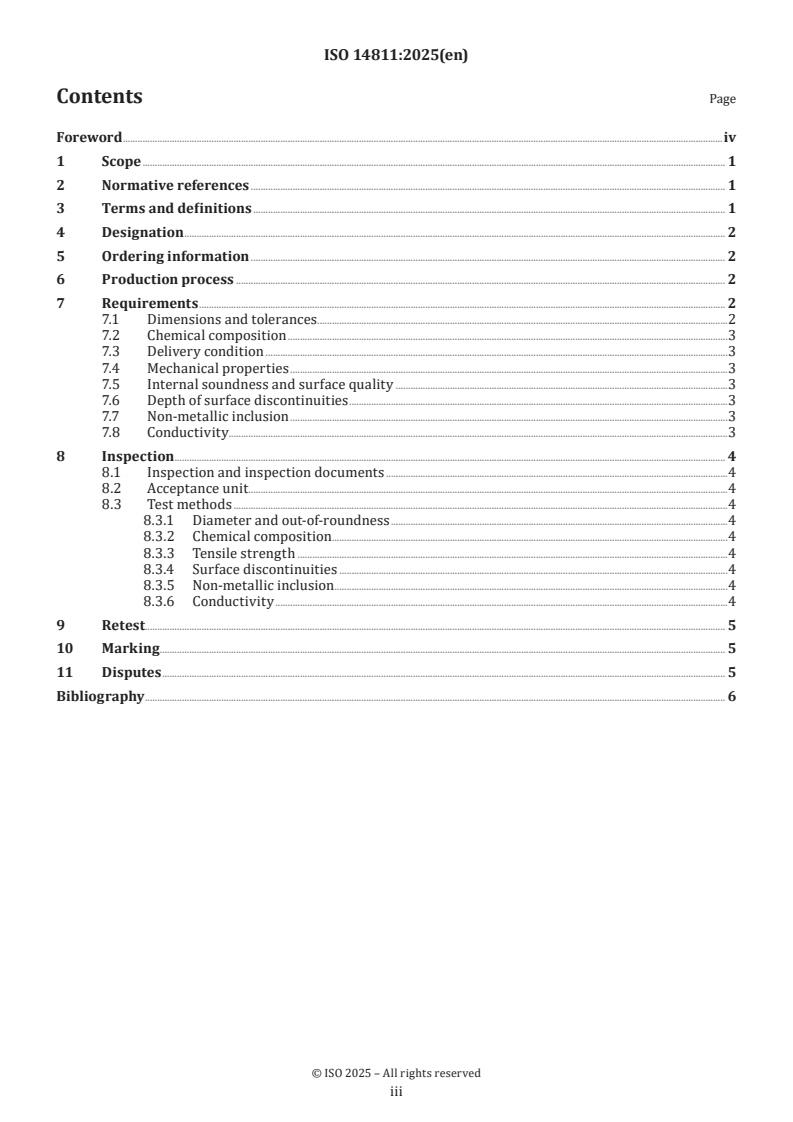
Contents Page
Foreword .iv
1 Scope . 1
2 Normative references . 1
3 Terms and definitions . 1
4 Designation . 2
5 Ordering information . 2
6 Production process . 2
7 Requirements . 2
7.1 Dimensions and tolerances . .2
7.2 Chemical composition .3
7.3 Delivery condition .3
7.4 Mechanical properties .3
7.5 Internal soundness and surface quality .3
7.6 Depth of surface discontinuities .3
7.7 Non-metallic inclusion .3
7.8 Conductivity.3
8 Inspection . 4
8.1 Inspection and inspection documents .4
8.2 Acceptance unit .4
8.3 Test methods .4
8.3.1 Diameter and out-of-roundness .4
8.3.2 Chemical composition . .4
8.3.3 Tensile strength .4
8.3.4 Surface discontinuities .4
8.3.5 Non-metallic inclusion . .4
8.3.6 Conductivity .4
9 Retest. 5
10 Marking . . 5
11 Disputes . 5
Bibliography . 6
iii
Foreword
ISO (the International Organization for Standardization) is a worldwide federation of national standards
bodies (ISO member bodies). The work of preparing International Standards is normally carried out through
ISO technical committees. Each member body interested in a subject for which a technical committee
has been established has the right to be represented on that committee. International organizations,
governmental and non-governmental, in liaison with ISO, also take part in the work. ISO collaborates closely
with the International Electrotechnical Commission (IEC) on all matters of electrotechnical standardization.
The procedures used to develop this document and those intended for its further maintenance are described
in the ISO/IEC Directives, Part 1. In particular, the different approval criteria needed for the different types
of ISO document should be noted. This document was drafted in accordance with the editorial rules of the
ISO/IEC Directives, Part 2 (see www.iso.org/directives).
ISO draws attention to the possibility that the implementation of this document may involve the use of (a)
patent(s). ISO takes no position concerning the evidence, validity or applicability of any claimed patent
rights in respect thereof. As of the date of publication of this document, ISO had not received notice of (a)
patent(s) which may be required to implement this document. However, implementers are cautioned that
this may not represent the latest information, which may be obtained from the patent database available at
www.iso.org/patents. ISO shall not be held responsible for identifying any or all such patent rights.
Any trade name used in this document is information given for the convenience of users and does not
constitute an endorsement.
For an explanation of the voluntary nature of standards, the meaning of ISO specific terms and expressions
related to conformity assessment, as well as information about ISO's adherence to the World Trade
Organization (WTO) principles in the Technical Barriers to Trade (TBT), see www.iso.org/iso/foreword.html.
This document was prepared by Technical Committee ISO/TC 17, Steel, Subcommittee SC 17, Steel wire rod
and wire products.
Any feedback or questions on this document should be directed to the user’s national standards body. A
complete listing of these bodies can be found at ww
...