

ISO 22007-6:2014
(Main)Plastics — Determination of thermal conductivity and thermal diffusivity — Part 6: Comparative method for low thermal conductivities using a temperature-modulation technique
General Information
- Abstract
ISO 22007-6:2014 specifies a modulated temperature method realizing the measurement of thermal conductivity. An input of temperature deviation is less than 1 K, and a double lock-in method is applied to amplify the small temperature modulation. ISO 22007-6:2014 specifies the method to determine the thermal conductivity in the range from 0,026 W/mK to 0,6 W/mK.
- Status
- Published
- Publication Date
- 20-May-2014
- Technical Committee
- ISO/TC 61/SC 5 - Physical-chemical properties
- Drafting Committee
- ISO/TC 61/SC 5/WG 8 - Thermal analysis
- Current Stage
- 9093 - International Standard confirmed
- Start Date
- 06-Jun-2024
- Completion Date
- 29-Aug-2026
Buy Documents

ISO 22007-6:2014 - Plastics — Determination of thermal conductivity and thermal diffusivity — Part 6: Comparative method for low thermal conductivities using a temperature-modulation technique Released:5/21/2014

ISO 22007-6:2014 - Plastiques — Détermination de la conductivité thermique et de la diffusivité thermique — Partie 6: Méthode comparative pour faibles conductivités thermiques utilisant une technique de modulation de la température Released:9/5/2014
Overview
ISO 22007-6:2014 specifies a comparative modulated-temperature method for measuring the thermal conductivity of plastics with low thermal conductivities. The standard defines a temperature-modulation technique using a Peltier-type heat source and a double lock-in amplification to measure very small temperature oscillations (input deviation < 1 K). It is intended for low-conductivity materials in the approximate range 0.026 W·m⁻¹·K⁻¹ to 0.6 W·m⁻¹·K⁻¹, minimizing radiation and convection errors and allowing measurements on small specimens.
Key topics and technical requirements
- Principle: A thin probe material (sheet) is placed between a modulated heat source and the sample. Two sensors measure amplitude of temperature modulation at x = 0 and x = d; the decay ratio (gain) is used to infer thermal conductivity in a thermally thin condition (kd << 1).
- Temperature modulation: Small amplitude oscillation (typically less than ±1 K) with the average temperature kept constant using a Peltier thermo-module.
- Signal detection: Use of thermopile sensors and a double lock‑in amplifier system to amplify and extract small temperature signals from noise.
- Apparatus requirements:
- Large heat sink to stabilize baseline temperature.
- Peltier thermoelectric module as a modulated heat source (example size 30 mm × 30 mm).
- Two sensors (example thermopile area ~5 mm × 2 mm) placed at front and rear of the probe.
- Heating and measurement electronics sized to obtain high signal-to-noise ratio.
- Probe and specimen geometry:
- Probe thickness chosen relative to the thermal diffusion length (k = (ω/2α)1/2).
- Probe materials with similar thermal properties to samples are preferred (e.g., cast PMMA sheet 0.5 mm).
- Specimen area comparable to the Peltier module for near one-dimensional heat flow.
- Calibration/comparison: Thermal conductivity is determined by correlation between thermal impedance and amplitude decay using two reference materials measured at the same frequency and temperature.
Applications and users
- Practical for measuring low thermal conductivity plastics and cellular foams where traditional steady-state methods are impractical.
- Ideal for small or micro-scale specimens: packaging trays, thin films, gelling sheets, adhesives, thermal interface materials, electronic component substrates.
- Primary users: materials testing laboratories, plastics manufacturers, thermal characterization and R&D teams, quality control engineers, and certification bodies involved in insulation and thermal management.
Related standards
- ISO 22007-1 - General principles (Plastics - thermal conductivity/diffusivity)
- ISO 22007-3 - Temperature wave analysis method
- ISO 22007-4 - Laser flash method
- ISO/TR 22007-5 - Interlaboratory test results (PMMA)
- ISO 472, ISO 80000-5 (terminology and units)
Keywords: ISO 22007-6:2014, thermal conductivity measurement, temperature-modulation technique, plastics testing, low thermal conductivities, Peltier module, lock-in amplifier.
Buy Documents
ISO 22007-6:2014 - Plastics — Determination of thermal conductivity and thermal diffusivity — Part 6: Comparative method for low thermal conductivities using a temperature-modulation technique Released:5/21/2014
ISO 22007-6:2014 - Plastiques — Détermination de la conductivité thermique et de la diffusivité thermique — Partie 6: Méthode comparative pour faibles conductivités thermiques utilisant une technique de modulation de la température Released:9/5/2014
Get Certified
Connect with accredited certification bodies for this standard

DIN CERTCO
DIN Group product certification.

Smithers Quality Assessments
US management systems and product certification.
Sponsored listings
Frequently Asked Questions
ISO 22007-6:2014 is a standard published by the International Organization for Standardization (ISO). Its full title is "Plastics — Determination of thermal conductivity and thermal diffusivity — Part 6: Comparative method for low thermal conductivities using a temperature-modulation technique". This standard covers: ISO 22007-6:2014 specifies a modulated temperature method realizing the measurement of thermal conductivity. An input of temperature deviation is less than 1 K, and a double lock-in method is applied to amplify the small temperature modulation. ISO 22007-6:2014 specifies the method to determine the thermal conductivity in the range from 0,026 W/mK to 0,6 W/mK.
ISO 22007-6:2014 specifies a modulated temperature method realizing the measurement of thermal conductivity. An input of temperature deviation is less than 1 K, and a double lock-in method is applied to amplify the small temperature modulation. ISO 22007-6:2014 specifies the method to determine the thermal conductivity in the range from 0,026 W/mK to 0,6 W/mK.
ISO 22007-6:2014 is classified under the following ICS (International Classification for Standards) categories: 83.080.01 - Plastics in general. The ICS classification helps identify the subject area and facilitates finding related standards.
ISO 22007-6:2014 is available in PDF format for immediate download after purchase. The document can be added to your cart and obtained through the secure checkout process. Digital delivery ensures instant access to the complete standard document.
Standards Content (Sample)
INTERNATIONAL ISO
STANDARD 22007-6
First edition
2014-06-01
Plastics — Determination of thermal
conductivity and thermal diffusivity —
Part 6:
Comparative method for low thermal
conductivities using a temperature-
modulation technique
Plastiques — Détermination de la conductivité thermique et de la
diffusivité thermique —
Partie 6: Méthode comparative pour faibles conductivités thermiques
utilisant une technique de modulation de la température
Reference number
©
ISO 2014
© ISO 2014
All rights reserved. Unless otherwise specified, no part of this publication may be reproduced or utilized otherwise in any form
or by any means, electronic or mechanical, including photocopying, or posting on the internet or an intranet, without prior
written permission. Permission can be requested from either ISO at the address below or ISO’s member body in the country of
the requester.
ISO copyright office
Case postale 56 • CH-1211 Geneva 20
Tel. + 41 22 749 01 11
Fax + 41 22 749 09 47
E-mail copyright@iso.org
Web www.iso.org
Published in Switzerland
ii © ISO 2014 – All rights reserved
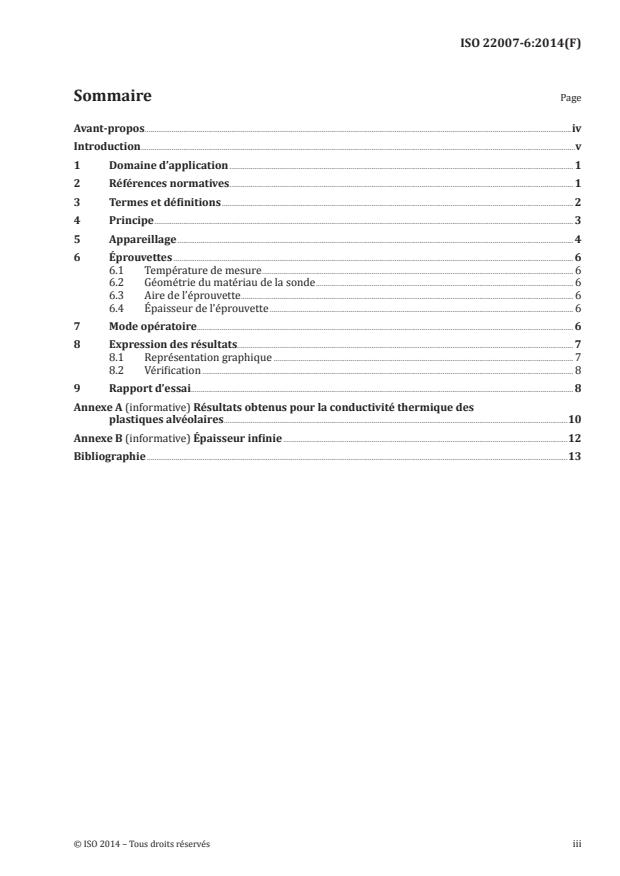
Contents Page
Foreword .iv
Introduction .v
1 Scope . 1
2 Normative references . 1
3 Terms and definitions . 2
4 Principle . 3
5 Apparatus . 4
6 Test specimens. 5
6.1 Measuring temperature. 5
6.2 Geometry of the probe material . 5
6.3 Specimen area size . 6
6.4 Specimen thickness . 6
7 Procedure. 6
8 Expression of results . 6
8.1 Graphical presentation . 6
8.2 Verification . 7
9 Test report . 7
Annex A (informative) Results of thermal conductivity of cellular plastics .9
Annex B (informative) Infinite thickness .11
Bibliography .12
Foreword
ISO (the International Organization for Standardization) is a worldwide federation of national standards
bodies (ISO member bodies). The work of preparing International Standards is normally carried out
through ISO technical committees. Each member body interested in a subject for which a technical
committee has been established has the right to be represented on that committee. International
organizations, governmental and non-governmental, in liaison with ISO, also take part in the work.
ISO collaborates closely with the International Electrotechnical Commission (IEC) on all matters of
electrotechnical standardization.
The procedures used to develop this document and those intended for its further maintenance are
described in the ISO/IEC Directives, Part 1. In particular the different approval criteria needed for the
different types of ISO documents should be noted. This document was drafted in accordance with the
editorial rules of the ISO/IEC Directives, Part 2 (see www.iso.org/directives).
Attention is drawn to the possibility that some of the elements of this document may be the subject of
patent rights. ISO shall not be held responsible for identifying any or all such patent rights. Details of any
patent rights identified during the development of the document will be in the Introduction and/or on
the ISO list of patent declarations received (see www.iso.org/patents).
Any trade name used in this document is information given for the convenience of users and does not
constitute an endorsement.
For an explanation on the meaning of ISO specific terms and expressions related to conformity
assessment, as well as information about ISO’s adherence to the WTO principles in the Technical Barriers
to Trade (TBT) see the following URL: Foreword - Supplementary information
The committee responsible for this document is ISO/TC 61, Plastics, Subcommittee SC 5, Physical-
chemical properties.
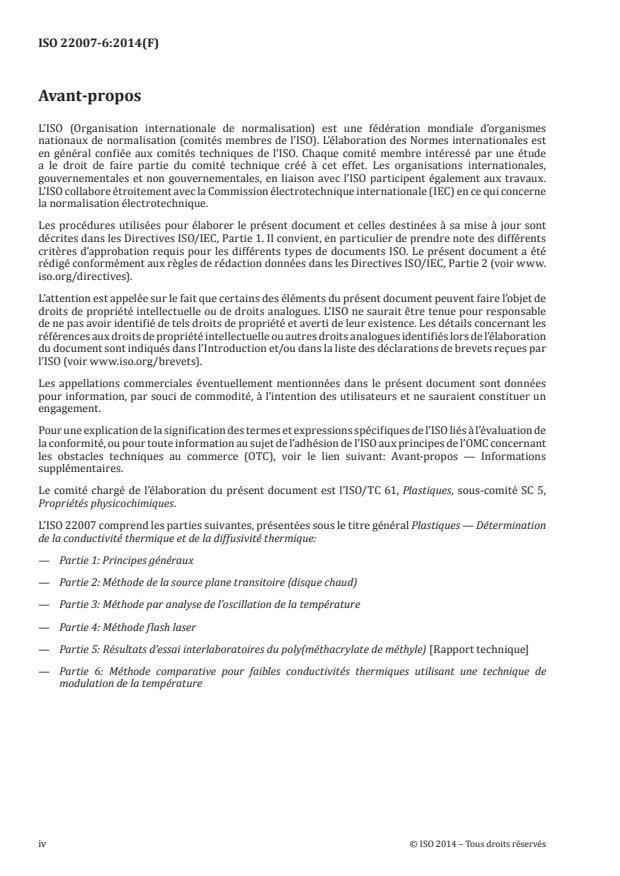
ISO 22007 consists of the following parts, under the general title Plastics — Determination of thermal
conductivity and thermal diffusivity:
— Part 1: General principles
— Part 2: Transient plane heat source (hot disc) method
— Part 3: Temperature wave analysis method
— Part 4: Laser flash method
— Part 5: Results of interlaboratory testing of poly(methyl methacrylate) samples [Technical Report]
— Part 6: Comparative method for low thermal conductivities using a temperature-modulation technique
iv © ISO 2014 – All rights reserved
Introduction
Thermal insulating properties have become more important in view of power-saving technology. The
method which is applicable to measure the lower thermal conductivity in smaller scale with a small
amount of a specimen, such as a tray for food, a thermal printing film, a gelled sheet for the electric parts
inside laptop PC, an adhesive paste, etc., is required for the micro-scale thermal design of plastics. A
double-sensor system of high-sensitivity thermopile located in the different distances in the modulated
temperature field, which is controlled by the Peltier thermo-module, is proposed for the determination
of thermal conductivity of plastics. A decay parameter is utilized to determine the thermal conductivity
of the sample. This method is applied to the measurement of low thermal conductivity in the range
below 1,0 W/mK.
In contrast to a pulse or a transient method, high sensitivity and high-temperature resolution are
characteristic of temperature modulated technique, in which employment of a lock-in amplifier reduces
any influence of noise and interference.
The thermal conductivity of materials that are poor conductors of heat is usually determined by
measuring the larger temperature gradients in the sample produced by a steady flow of heat in one-
dimensional geometry. In order to reduce the errors of radiation and convection, it often requires large,
precisely shaped samples and extreme care to be used successfully.
This part of ISO 22007 specifies a modulated temperature method to determine the thermal conductivity
with a small temperature variation, minimizing the influence of radiation and convection.
INTERNATIONAL STANDARD ISO 22007-6:2014(E)
Plastics — Determination of thermal conductivity and
thermal diffusivity —
Part 6:
Comparative method for low thermal conductivities using
a temperature-modulation technique
1 Scope
This part of ISO 22007 specifies a modulated temperature method realizing the measurement of thermal
conductivity. An input of temperature deviation is less than 1 K, and a double lock-in method is applied
to amplify the small temperature modulation.
ISO 22007-3 specifies one of the modulated temperature methods where the phase shift is measured
1/2
in the thermally thick condition, kd >> 1 [k = (ω/2α) , ω: angular frequency of temperature wave, α:
thermal diffusivity, and d: thickness of the specimen]. In this condition, the backing material does not
affect on the phase shift results on the sensor, on which temperature wave decays exponentially.
On the other hand, if kd << 1, the decay of temperature modulation is influenced by the backing
materials. Based on this principle, this part of ISO 22007 specifies the method to determine the thermal
conductivity of the sample (as a backing material), comparing the decay of temperature wave detected
on both surfaces of the probe material.
Thermal conductivity is determined from the correlation between the thermal impedance and the decay
ratio of amplitude using two reference materials measured at the same frequency and temperature.
The covering thermal conductivity range is adjusted with the reference materials and the probe
materials. Basically, thermal conductivity is determined in the range from 0,026 W/mK to 0,6 W/mK.
In the case applying the method to inhomogeneous materials, cares must be taken to choose the
appropriate measurement conditions in accordance with the thermal penetration depth.
2 Normative references
The following documents, in whole or in part, are normatively referenced in this document and are
indispensable for its application. For dated references, only the edition cited applies. For undated
references, the latest edition of the referenced document (including any amendments) applies.
ISO 472, Plastics — Vocabulary
ISO 22007-1, Plastics — Determination of thermal conductivity and thermal diffusivity — Part 1: General
principles
ISO 22007-3, Plastics — Determination of thermal conductivity and thermal diffusivity — Part 3:
Temperature wave analysis method
ISO/TR 22007-5, Plastics — Determination of thermal conductivity and thermal diffusivity — Part 5:
Results of interlaboratory testing of poly(methyl methacrylate) samples
ISO 80000-5, Quantities and units — Part 5: Thermodynamics
3 Terms and definitions
For the purposes of this document, the terms and definitions given in ISO 472, ISO 22007-1, ISO 22007-3,
ISO 80000-5, and the following apply.
3.1
amplitude of temperature modulation
Amp
amplitude of the temperature oscillation produced by a modulated-power heat source
Note 1 to entry: It is expressed in Kelvin.
3.2
gain
ζ
ratio of Amp at x = d to x = 0; amplitude ratio of the front (x = 0) and rear (x = d) surfaces of the probe
material
T Amp
dx=d
ζ ==
T Amp
00x=
where
T and T are the amplitude of modulated temperature measured on the sensor 1 (at x = 0) and
0 d
the sensor 2 (x = d), respectively.
3.3
thermal penetration depth
D
p
periodic oscillations in temperature can only be observed for the depths less than D , defined as
p
2α
D =2π
p
ω
where
α is thermal diffusivity;
ω is angular frequency;
D is the depth at which the amplitude of the temperature oscillation has been attenuated to
p
ω
0,19 % as derived from expe− D =−xp 20π ≅ ,0019 .
()
p
2α
Note 1 to entry: The thermal penetration depth is expressed in metres.
3.4
thermal diffusion length
1/k
where
ω
is defined as
k
2α
Note 1 to entry: The thermal diffusion length is expressed in metres. k is expressed in reciprocal metres.
2 © ISO 2014 – All rights reserved
4 Principle
As depicted in Figure 1, the probe material in a flat sheet shap
...
NORME ISO
INTERNATIONALE 22007-6
Première édition
2014-06-01
Plastiques — Détermination de
la conductivité thermique et de la
diffusivité thermique —
Partie 6:
Méthode comparative pour faibles
conductivités thermiques utilisant
une technique de modulation de la
température
Plastics — Determination of thermal conductivity and thermal
diffusivity —
Part 6: Comparative method for low thermal conductivities using a
temperature-modulation technique
Numéro de référence
©
ISO 2014
DOCUMENT PROTÉGÉ PAR COPYRIGHT
© ISO 2014
Droits de reproduction réservés. Sauf indication contraire, aucune partie de cette publication ne peut être reproduite ni utilisée
sous quelque forme que ce soit et par aucun procédé, électronique ou mécanique, y compris la photocopie, l’affichage sur
l’internet ou sur un Intranet, sans autorisation écrite préalable. Les demandes d’autorisation peuvent être adressées à l’ISO à
l’adresse ci-après ou au comité membre de l’ISO dans le pays du demandeur.
ISO copyright office
Case postale 56 • CH-1211 Geneva 20
Tel. + 41 22 749 01 11
Fax + 41 22 749 09 47
E-mail copyright@iso.org
Web www.iso.org
Publié en Suisse
ii © ISO 2014 – Tous droits réservés
Sommaire Page
Avant-propos .iv
Introduction .v
1 Domaine d’application . 1
2 Références normatives . 1
3 Termes et définitions . 2
4 Principe . 3
5 Appareillage . 4
6 Éprouvettes . 6
6.1 Température de mesure . 6
6.2 Géométrie du matériau de la sonde . 6
6.3 Aire de l’éprouvette . 6
6.4 Épaisseur de l’éprouvette . 6
7 Mode opératoire. 6
8 Expression des résultats. 7
8.1 Représentation graphique . 7
8.2 Vérification . 8
9 Rapport d’essai . 8
Annexe A (informative) Résultats obtenus pour la conductivité thermique des
plastiques alvéolaires .10
Annexe B (informative) Épaisseur infinie .12
Bibliographie .13
Avant-propos
L’ISO (Organisation internationale de normalisation) est une fédération mondiale d’organismes
nationaux de normalisation (comités membres de l’ISO). L’élaboration des Normes internationales est
en général confiée aux comités techniques de l’ISO. Chaque comité membre intéressé par une étude
a le droit de faire partie du comité technique créé à cet effet. Les organisations internationales,
gouvernementales et non gouvernementales, en liaison avec l’ISO participent également aux travaux.
L’ISO collabore étroitement avec la Commission électrotechnique internationale (IEC) en ce qui concerne
la normalisation électrotechnique.
Les procédures utilisées pour élaborer le présent document et celles destinées à sa mise à jour sont
décrites dans les Directives ISO/IEC, Partie 1. Il convient, en particulier de prendre note des différents
critères d’approbation requis pour les différents types de documents ISO. Le présent document a été
rédigé conformément aux règles de rédaction données dans les Directives ISO/IEC, Partie 2 (voir www.
iso.org/directives).
L’attention est appelée sur le fait que certains des éléments du présent document peuvent faire l’objet de
droits de propriété intellectuelle ou de droits analogues. L’ISO ne saurait être tenue pour responsable
de ne pas avoir identifié de tels droits de propriété et averti de leur existence. Les détails concernant les
références aux droits de propriété intellectuelle ou autres droits analogues identifiés lors de l’élaboration
du document sont indiqués dans l’Introduction et/ou dans la liste des déclarations de brevets reçues par
l’ISO (voir www.iso.org/brevets).
Les appellations commerciales éventuellement mentionnées dans le présent document sont données
pour information, par souci de commodité, à l’intention des utilisateurs et ne sauraient constituer un
engagement.
Pour une explication de la signification des termes et expressions spécifiques de l’ISO liés à l’évaluation de
la conformité, ou pour toute information au sujet de l’adhésion de l’ISO aux principes de l’OMC concernant
les obstacles techniques au commerce (OTC), voir le lien suivant: Avant-propos — Informations
supplémentaires.
Le comité chargé de l’élaboration du présent document est l’ISO/TC 61, Plastiques, sous-comité SC 5,
Propriétés physicochimiques.
L’ISO 22007 comprend les parties suivantes, présentées sous le titre général Plastiques — Détermination
de la conductivité thermique et de la diffusivité thermique:
— Partie 1: Principes généraux
— Partie 2: Méthode de la source plane transitoire (disque chaud)
— Partie 3: Méthode par analyse de l’oscillation de la température
— Partie 4: Méthode flash laser
— Partie 5: Résultats d’essai interlaboratoires du poly(méthacrylate de méthyle) [Rapport technique]
— Partie 6: Méthode comparative pour faibles conductivités thermiques utilisant une technique de
modulation de la température
iv © ISO 2014 – Tous droits réservés
Introduction
Avec les économies d’énergie, les propriétés d’isolation thermique ont pris de l’importance. Pour
la conception thermique des plastiques à l’échelle microscopique, il est nécessaire de disposer d’une
méthode permettant de mesurer la conductivité thermique plus faible et à plus petite échelle avec une
petite quantité d’éprouvette, par exemple un plateau pour aliments, un film d’impression thermique,
une feuille gélifiée pour les composants électriques à l’intérieur d’un ordinateur portable, une pâte
adhésive, etc. Un système à double détecteur avec une thermopile de haute sensibilité, placé à des
distances différentes dans le champ de température modulée et commandé par un thermo-module
Peltier, est proposé pour la détermination de la conductivité thermique des plastiques. Un paramètre de
décroissance est utilisé pour déterminer la conductivité thermique de l’échantillon. Cette méthode est
appliquée pour mesurer la faible conductivité thermique dans la plage en dessous de 1,0 W/mK.
Contrairement à une méthode par choc ou transitoire, la technique de modulation de la température se
caractérise par une résolution à haute sensibilité et à haute température, dans laquelle l’utilisation d’un
amplificateur de blocage réduit toute influence éventuelle du bruit et des interférences.
La conductivité thermique des matériaux faiblement conducteurs de chaleur est généralement
déterminée en mesurant les gradients de température plus importants qui sont produits par un flux de
chaleur constant dans l’échantillon selon une géométrie unidimensionnelle. Afin de réduire les erreurs
dues au rayonnement et à la convection, il est souvent nécessaire d’utiliser des échantillons de grande
taille et de forme précise, et de procéder avec le plus grand soin pour que cette technique fonctionne.
La présente partie de l’ISO 22007 spécifie une méthode de modulation de la température permettant de
déterminer la conductivité thermique avec une faible variation de la température, en réduisant le plus
possible l’influence du rayonnement et de la convection.
NORME INTERNATIONALE ISO 22007-6:2014(F)
Plastiques — Détermination de la conductivité thermique
et de la diffusivité thermique —
Partie 6:
Méthode comparative pour faibles conductivités
thermiques utilisant une technique de modulation de la
température
1 Domaine d’application
La présente partie de l’ISO 22007 spécifie une méthode de modulation de la température permettant de
mesurer la conductivité thermique. L’écart de température d’entrée est inférieur à 1 K et une méthode à
double blocage est appliquée pour amplifier la faible modulation de température.
L’ISO 22007-3 spécifie une méthode de modulation de la température dans laquelle le décalage de phase
1/2
est mesuré à l’état épais thermiquement, kd >> 1 [avec k = (ω/2α) , ω étant la fréquence angulaire de
l’oscillation de température, α la diffusivité thermique et d l’épaisseur de l’éprouvette]. Dans cet état,
le matériau du support n’influence pas les résultats de décalage de phase sur le détecteur, sur lequel
l’oscillation de température décroît de manière exponentielle.
En revanche, si kd << 1, la décroissance de la modulation de la température est influencée par les
matériaux du support. Partant de ce principe, la présente partie de l’ISO 22007 spécifie la méthode
permettant de déterminer la conductivité thermique de l’échantillon (par exemple un matériau de
support), en comparant la décroissance de l’oscillation de température détectée sur les deux surfaces du
matériau de la sonde.
La conductivité thermique est déterminée à partir de la corrélation entre l’impédance thermique et
le rapport de décroissance de l’amplitude à l’aide de deux matériaux de référence mesurés à la même
fréquence et à la même température.
La plage de conductivité thermique couverte est ajustée en fonction des matériaux de référence et des
matériaux de la sonde. En principe, la conductivité thermique est déterminée dans la plage allant de
0,026 W/mK à 0,6 W/mK.
En cas d’application de la méthode à des matériaux non homogènes, il faut veiller à choisir les conditions
de mesure appropriées en fonction de la profondeur de pénétration thermique.
2 Références normatives
Les documents suivants, en tout ou partie, sont référencés de façon normative dans le présent document
et sont indispensables pour son application. Pour les références datées, seule l’édition citée s’applique.
Pour les références non datées, la dernière édition du document de référence s’applique (y compris les
éventuels amendements).
ISO 472, Plastiques — Vocabulaire
ISO 22007-1, Plastiques — Détermination de la conductivité thermique et de la diffusivité thermique —
Partie 1: Principes généraux
ISO 22007-3, Plastiques — Détermination de la conductivité thermique et de la diffusivité thermique —
Partie 3: Méthode par analyse de l’oscillation de la température
ISO/TR 22007-5, Plastiques — Détermination de la conductivité thermique et de la diffusivité thermique —
Partie 5: Résultats d’essais interlaboratoires du poly(méthacrylate de méthyle)
ISO 80000-5, Grandeurs et unités — Partie 5: Thermodynamique
3 Termes et définitions
Pour les besoins du présent document, les termes et définitions donnés dans l’ISO 472, l’ISO 22007-1,
l’ISO 22007-3 et l’ISO 80000-5 ainsi que les suivants s’appliquent.
3.1
amplitude de la modulation de température
Amp
amplitude de l’oscillation de température générée par une source de chaleur à puissance modulée
Note 1 à l’article: Elle est exprimée en Kelvin.
3.2
gain
ζ
rapport de l’Amp entre x = d et x = 0; rapport de l’amplitude entre les surfaces avant (x = 0) et arrière
(x = d) du matériau de la sonde
T Amp
dx=d
ζ ==
T Amp
00x=
où
T et T sont respectivement l’amplitude de la modulation de température mesurée sur le détec-
0 d
teur 1 (à x = 0) et sur le détecteur 2 (x = d).
3.3
profondeur de pénétration thermique
D
p
les oscillations périodiques de la température ne peuvent être observées que pour des profondeurs
inférieures à D , cette dernière étant définie comme suit:
p
2α
D =2π
p
ω
où
α est la diffusivité thermique;
ω est la fréquence angulaire;
D est la profondeur à laquelle l’amplitude de l’oscillation de température a été atténuée jusqu’à
p
ω
0,19 %, cette valeur étant calculée à partir de la formule expe− D =−xp 20π ≅ ,0019
()
p
2α
Note 1 à l’article: La profondeur de pénétration thermique est exprimée en mètres.
3.4
longueur de diffusion thermique
1/k
où
2 © ISO 2014 – Tous droits réservés
ω
k est définie comme étant
2α
Note 1 à l’article: La longueur de diffusion thermique est exprimée en mètres. k est exprimée par l’inverse du
mètre.
4 Principe
Comme illustré à la Figure 1, le matériau de la sonde, qui se présente sous la forme d’une feuille plane,
est placé entre la source d
...