

ISO 19901-1:2015
(Main)Petroleum and natural gas industries — Specific requirements for offshore structures — Part 1: Metocean design and operating considerations
General Information
- Abstract
ISO 19901-1:2015 gives general requirements for the determination and use of meteorological and oceanographic (metocean) conditions for the design, construction and operation of offshore structures of all types used in the petroleum and natural gas industries. The requirements are divided into two broad types: - those that relate to the determination of environmental conditions in general, together with the metocean parameters that are required to adequately describe them; - those that relate to the characterization and use of metocean parameters for the design, the construction activities or the operation of offshore structures. The environmental conditions and metocean parameters discussed are: - extreme and abnormal values of metocean parameters that recur with given return periods that are considerably longer than the design service life of the structure, - long-term distributions of metocean parameters, in the form of cumulative, conditional, marginal or joint statistics of metocean parameters, and - normal environmental conditions that are expected to occur frequently during the design service life of the structure. Metocean parameters are applicable to: - the determination of actions for the design of new structures, - the determination of actions for the assessment of existing structures, - the site-specific assessment of mobile offshore units, - the determination of limiting environmental conditions, weather windows, actions and action effects for pre-service and post-service situations (i.e. fabrication, transportation and installation or decommissioning and removal of a structure), and - the operation of the platform, where appropriate. NOTE Specific metocean requirements for site-specific assessment of jack-ups are contained in ISO 19905‑1, for arctic offshore structures in ISO 19906 and for topside structures in ISO 19901‑3.
- Status
- Withdrawn
- Publication Date
- 13-Oct-2015
- Technical Committee
- ISO/TC 67/SC 7 - Offshore structures
- Drafting Committee
- ISO/TC 67/SC 7/WG 3 - Fixed steel structures
- Current Stage
- 9599 - Withdrawal of International Standard
- Start Date
- 11-Aug-2026
- Completion Date
- 29-Aug-2026
Buy Documents
ISO 19901-1:2015 - Petroleum and natural gas industries — Specific requirements for offshore structures — Part 1: Metocean design and operating considerations Released:10/14/2015
ISO 19901-1:2015 - Industries du pétrole et du gaz naturel — Exigences spécifiques relatives aux structures en mer — Partie 1: Dispositions océano-météorologiques pour la conception et l'exploitation Released:3/29/2016
Overview
ISO 19901-1:2015 - "Petroleum and natural gas industries - Specific requirements for offshore structures - Part 1: Metocean design and operating considerations" provides general requirements for determining and using meteorological and oceanographic (metocean) conditions in the design, construction and operation of offshore structures. This second edition (2015) updates the 2005 version and applies to fixed and floating platforms, mobile offshore units and other offshore infrastructure used in the petroleum and natural gas industries.
Key topics and technical requirements
ISO 19901-1:2015 defines the metocean parameters, data practices and characterization methods needed to support structural and operational decisions. Major technical topics include:
- Determination of relevant metocean parameters (extreme, long‑term statistical distributions, and normal conditions)
- Return periods and extreme/extrapolated conditions for design and assessment
- Wind, including profiles, spectra and wind‑induced actions and effects
- Waves, spectral sea states, directional spreading, wave kinematics and maximum individual wave heights
- Currents, profiles, blockage and velocity characterization
- Water levels, tides, storm surge and extreme water levels
- Other environmental factors: marine growth, tsunamis, seiches, sea ice/icebergs, snow/ice accretion
- Metocean data collection and quality control, instrumentation and reporting requirements for meteorology and oceanography
- Parameters for different activity durations: short‑term operations (e.g., lifts/installation), medium‑term activities and long‑term fatigue/operational assessments
- Regional guidance via informative annexes (Northwest Europe, West Africa, Offshore Canada, Sakhalin/Sea of Okhotsk, Caspian Sea, Southern East Asian Sea)
Practical applications - who uses this standard
ISO 19901-1:2015 is used by:
- Offshore structural and marine engineers for design load definition and fatigue assessments
- Metocean specialists and oceanographers for site resource characterization and data analysis
- Asset owners, operators and project managers for site-specific assessments, weather windows and operational limits
- Contractors and installation teams to plan fabrication, transportation and installation activities
- Regulators and certifying bodies evaluating design integrity and safety cases
Practical uses include defining limiting environmental conditions, selecting design environmental cases, determining weather windows for lifts and tow operations, and specifying data collection and QC protocols.
Related standards
- ISO 19901 series (other parts cover seismic, topsides, geotechnical, weight control, stationkeeping)
- Referenced related documents: ISO 19905‑1 (jack‑up site assessment), ISO 19906 (arctic offshore structures), ISO 19901‑3 (topside structures)
ISO 19901-1:2015 is essential for projects that require robust, consistent metocean criteria for offshore petroleum and natural gas structures, supporting safer design and more reliable operations.
Relations
- Effective Date
- 09-Feb-2026
- Effective Date
- 09-Feb-2026
- Effective Date
- 09-Feb-2026
- Effective Date
- 09-Feb-2026
- Effective Date
- 09-Feb-2026
- Effective Date
- 09-Feb-2026
- Effective Date
- 09-Feb-2026
- Effective Date
- 09-Feb-2026
- Effective Date
- 09-Feb-2026
- Effective Date
- 09-Feb-2026
- Effective Date
- 09-Feb-2026
- Effective Date
- 09-Feb-2026
- Effective Date
- 09-Feb-2026
- Effective Date
- 09-Feb-2026
- Effective Date
- 09-Feb-2026
Buy Documents
ISO 19901-1:2015 - Petroleum and natural gas industries — Specific requirements for offshore structures — Part 1: Metocean design and operating considerations Released:10/14/2015
ISO 19901-1:2015 - Industries du pétrole et du gaz naturel — Exigences spécifiques relatives aux structures en mer — Partie 1: Dispositions océano-météorologiques pour la conception et l'exploitation Released:3/29/2016
Get Certified
Connect with accredited certification bodies for this standard

Element Materials Technology
Materials testing and product certification.

ABS Group Brazil
ABS Group certification services in Brazil.

ABS Quality Evaluations Inc.
American Bureau of Shipping quality certification.
Sponsored listings
Frequently Asked Questions
ISO 19901-1:2015 is a standard published by the International Organization for Standardization (ISO). Its full title is "Petroleum and natural gas industries — Specific requirements for offshore structures — Part 1: Metocean design and operating considerations". This standard covers: ISO 19901-1:2015 gives general requirements for the determination and use of meteorological and oceanographic (metocean) conditions for the design, construction and operation of offshore structures of all types used in the petroleum and natural gas industries. The requirements are divided into two broad types: - those that relate to the determination of environmental conditions in general, together with the metocean parameters that are required to adequately describe them; - those that relate to the characterization and use of metocean parameters for the design, the construction activities or the operation of offshore structures. The environmental conditions and metocean parameters discussed are: - extreme and abnormal values of metocean parameters that recur with given return periods that are considerably longer than the design service life of the structure, - long-term distributions of metocean parameters, in the form of cumulative, conditional, marginal or joint statistics of metocean parameters, and - normal environmental conditions that are expected to occur frequently during the design service life of the structure. Metocean parameters are applicable to: - the determination of actions for the design of new structures, - the determination of actions for the assessment of existing structures, - the site-specific assessment of mobile offshore units, - the determination of limiting environmental conditions, weather windows, actions and action effects for pre-service and post-service situations (i.e. fabrication, transportation and installation or decommissioning and removal of a structure), and - the operation of the platform, where appropriate. NOTE Specific metocean requirements for site-specific assessment of jack-ups are contained in ISO 19905‑1, for arctic offshore structures in ISO 19906 and for topside structures in ISO 19901‑3.
ISO 19901-1:2015 gives general requirements for the determination and use of meteorological and oceanographic (metocean) conditions for the design, construction and operation of offshore structures of all types used in the petroleum and natural gas industries. The requirements are divided into two broad types: - those that relate to the determination of environmental conditions in general, together with the metocean parameters that are required to adequately describe them; - those that relate to the characterization and use of metocean parameters for the design, the construction activities or the operation of offshore structures. The environmental conditions and metocean parameters discussed are: - extreme and abnormal values of metocean parameters that recur with given return periods that are considerably longer than the design service life of the structure, - long-term distributions of metocean parameters, in the form of cumulative, conditional, marginal or joint statistics of metocean parameters, and - normal environmental conditions that are expected to occur frequently during the design service life of the structure. Metocean parameters are applicable to: - the determination of actions for the design of new structures, - the determination of actions for the assessment of existing structures, - the site-specific assessment of mobile offshore units, - the determination of limiting environmental conditions, weather windows, actions and action effects for pre-service and post-service situations (i.e. fabrication, transportation and installation or decommissioning and removal of a structure), and - the operation of the platform, where appropriate. NOTE Specific metocean requirements for site-specific assessment of jack-ups are contained in ISO 19905‑1, for arctic offshore structures in ISO 19906 and for topside structures in ISO 19901‑3.
ISO 19901-1:2015 is classified under the following ICS (International Classification for Standards) categories: 75.180.10 - Exploratory, drilling and extraction equipment. The ICS classification helps identify the subject area and facilitates finding related standards.
ISO 19901-1:2015 has the following relationships with other standards: It is inter standard links to EN ISO 35106:2019, EN ISO 19900:2019, EN ISO 19901-4:2016, EN ISO 19906:2019, EN ISO 19905-3:2022, EN ISO 35104:2020, EN ISO 20257-1:2020, EN ISO 19905-3:2019, EN ISO 19901-1:2015, EN ISO 35101:2019, CEN ISO/TS 35105:2019, EN ISO 19902:2020, EN ISO 19903:2019, EN ISO 19901-3:2024, EN ISO 19901-9:2019. Understanding these relationships helps ensure you are using the most current and applicable version of the standard.
ISO 19901-1:2015 is available in PDF format for immediate download after purchase. The document can be added to your cart and obtained through the secure checkout process. Digital delivery ensures instant access to the complete standard document.
Standards Content (Sample)
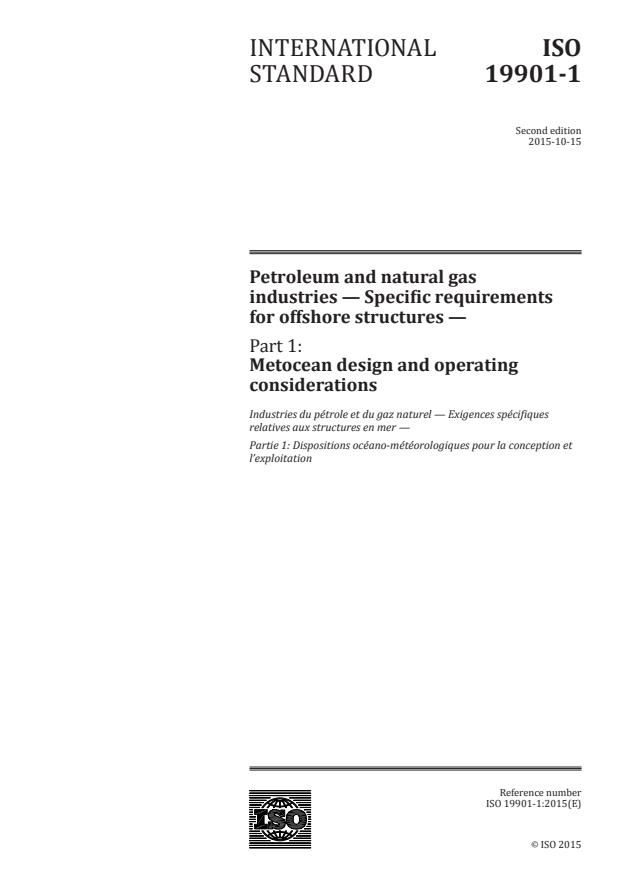
INTERNATIONAL ISO
STANDARD 19901-1
Second edition
2015-10-15
Petroleum and natural gas
industries — Specific requirements
for offshore structures —
Part 1:
Metocean design and operating
considerations
Industries du pétrole et du gaz naturel — Exigences spécifiques
relatives aux structures en mer —
Partie 1: Dispositions océano-météorologiques pour la conception et
l’exploitation
Reference number
©
ISO 2015
© ISO 2015, Published in Switzerland
All rights reserved. Unless otherwise specified, no part of this publication may be reproduced or utilized otherwise in any form
or by any means, electronic or mechanical, including photocopying, or posting on the internet or an intranet, without prior
written permission. Permission can be requested from either ISO at the address below or ISO’s member body in the country of
the requester.
ISO copyright office
Ch. de Blandonnet 8 • CP 401
CH-1214 Vernier, Geneva, Switzerland
Tel. +41 22 749 01 11
Fax +41 22 749 09 47
copyright@iso.org
www.iso.org
ii © ISO 2015 – All rights reserved
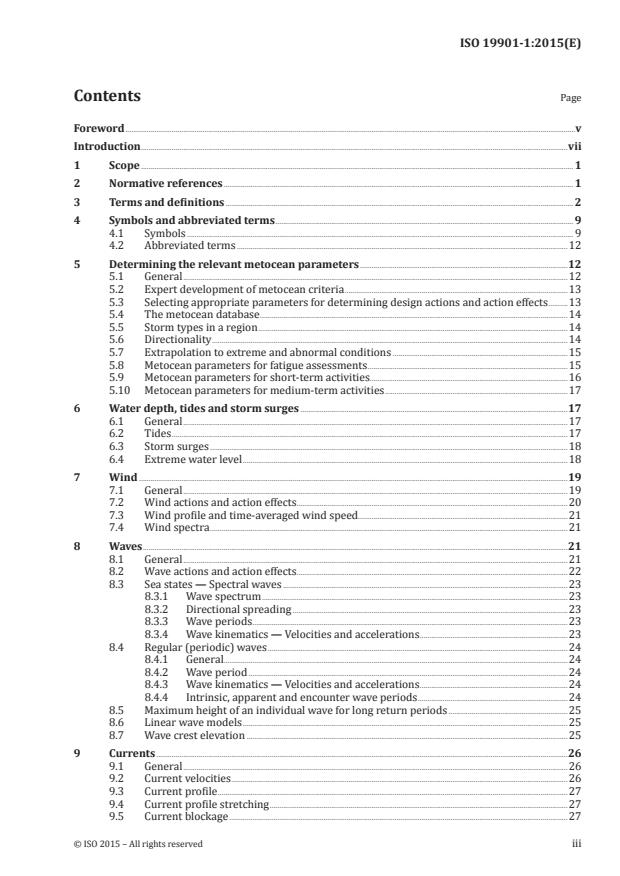
Contents Page
Foreword .v
Introduction .vii
1 Scope . 1
2 Normative references . 1
3 Terms and definitions . 2
4 Symbols and abbreviated terms . 9
4.1 Symbols . 9
4.2 Abbreviated terms .12
5 Determining the relevant metocean parameters .12
5.1 General .12
5.2 Expert development of metocean criteria .13
5.3 Selecting appropriate parameters for determining design actions and action effects .13
5.4 The metocean database .14
5.5 Storm types in a region .14
5.6 Directionality .14
5.7 Extrapolation to extreme and abnormal conditions .15
5.8 Metocean parameters for fatigue assessments .15
5.9 Metocean parameters for short-term activities.16
5.10 Metocean parameters for medium-term activities .17
6 Water depth, tides and storm surges .17
6.1 General .17
6.2 Tides .17
6.3 Storm surges .18
6.4 Extreme water level .18
7 Wind .19
7.1 General .19
7.2 Wind actions and action effects .20
7.3 Wind profile and time-averaged wind speed.21
7.4 Wind spectra .21
8 Waves .21
8.1 General .21
8.2 Wave actions and action effects .22
8.3 Sea states — Spectral waves .23
8.3.1 Wave spectrum .23
8.3.2 Directional spreading .23
8.3.3 Wave periods .23
8.3.4 Wave kinematics — Velocities and accelerations .23
8.4 Regular (periodic) waves .24
8.4.1 General.24
8.4.2 Wave period .24
8.4.3 Wave kinematics — Velocities and accelerations .24
8.4.4 Intrinsic, apparent and encounter wave periods .24
8.5 Maximum height of an individual wave for long return periods .25
8.6 Linear wave models .25
8.7 Wave crest elevation .25
9 Currents .26
9.1 General .26
9.2 Current velocities .26
9.3 Current profile .27
9.4 Current profile stretching .27
9.5 Current blockage .27
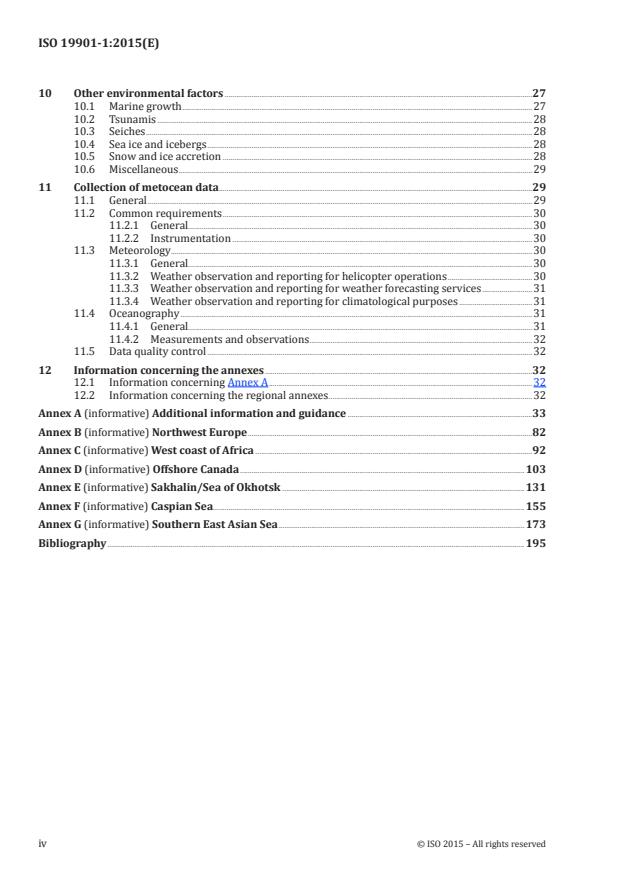
10 Other environmental factors .27
10.1 Marine growth .27
10.2 Tsunamis .28
10.3 Seiches .28
10.4 Sea ice and icebergs .28
10.5 Snow and ice accretion .28
10.6 Miscellaneous .29
11 Collection of metocean data .29
11.1 General .29
11.2 Common requirements .30
11.2.1 General.30
11.2.2 Instrumentation .30
11.3 Meteorology .30
11.3.1 General.30
11.3.2 Weather observation and reporting for helicopter operations .30
11.3.3 Weather observation and reporting for weather forecasting services .31
11.3.4 Weather observation and reporting for climatological purposes .31
11.4 Oceanography .31
11.4.1 General.31
11.4.2 Measurements and observations .32
11.5 Data quality control .32
12 Information concerning the annexes .32
12.1 Information concerning Annex A .32
12.2 Information concerning the regional annexes .32
Annex A (informative) Additional information and guidance .33
Annex B (informative) Northwest Europe .82
Annex C (informative) West coast of Africa .92
Annex D (informative) Offshore Canada .103
Annex E (informative) Sakhalin/Sea of Okhotsk .131
Annex F (informative) Caspian Sea .155
Annex G (informative) Southern East Asian Sea .173
Bibliography .195
iv © ISO 2015 – All rights reserved
Foreword
ISO (the International Organization for Standardization) is a worldwide federation of national standards
bodies (ISO member bodies). The work of preparing International Standards is normally carried out
through ISO technical committees. Each member body interested in a subject for which a technical
committee has been established has the right to be represented on that committee. International
organizations, governmental and non-governmental, in liaison with ISO, also take part in the work.
ISO collaborates closely with the International Electrotechnical Commission (IEC) on all matters of
electrotechnical standardization.
The procedures used to develop this document and those intended for its further maintenance are
described in the ISO/IEC Directives, Part 1. In particular the different approval criteria needed for the
different types of ISO documents should be noted. This document was drafted in accordance with the
editorial rules of the ISO/IEC Directives, Part 2 (see www.iso.org/directives).
Attention is drawn to the possibility that some of the elements of this document may be the subject of
patent rights. ISO shall not be held responsible for identifying any or all such patent rights. Details of
any patent rights identified during the development of the document will be in the Introduction and/or
on the ISO list of patent declarations received (see www.iso.org/patents).
Any trade name used in this document is information given for the convenience of users and does not
constitute an endorsement.
For an explanation on the meaning of ISO specific terms and expressions related to conformity
assessment, as well as information about ISO’s adherence to the WTO principles in the Technical
Barriers to Trade (TBT) see the following URL: Foreword - Supplementary information
The committee responsible for this document is ISO/TC 67, Materials, equipment and offshore structures
for petroleum, petrochemical and natural gas industries, Subcommittee SC 7, Offshore structures.
This second edition cancels and replaces the first edition (ISO 19901-1:2005), which has been
technically revised.
ISO 19901 consists of the following parts, under the general title Petroleum and natural gas industries —
Specific requirements for offshore structures:
— Part 1: Metocean design and operating considerations
— Part 2: Seismic design procedures and criteria
— Part 3: Topsides structure
— Part 4: Geotechnical and foundation design considerations
— Part 5: Weight control during engineering and construction
— Part 7: Stationkeeping systems for floating offshore structures and mobile offshore units
— Part 8: Marine soil investigations
The following parts are under preparation:
— Part 6: Marine operations
— Part 9: Structural integrity management
ISO 19901 is one of a series of standards for offshore structures. The full series consists of the following
International Standards:
— ISO 19900, Petroleum and natural gas industries — General requirements for offshore structures
— ISO 19901 (all parts), Petroleum and natural gas industries — Specific requirements for offshore
structures
— ISO 19902, Petroleum and natural gas industries — Fixed steel offshore structures
— ISO 19903, Petroleum and natural gas industries — Fixed concrete offshore structures
— ISO 19904-1, Petroleum and natural gas industries — Floating offshore structures — Part 1: Monohulls,
semi-submersibles and spars
— ISO 19905-1, Petroleum and natural gas industries — Site-specific assessment of mobile offshore units
— Part 1: Jack-ups
— ISO/TR 19905-2, Petroleum and natural gas industries — Site-specific assessment of mobile offshore
units — Part 2: Jack-ups commentary
1)
— ISO 19905-3 , Petroleum and natural gas industries — Site-specific assessment of mobile offshore
units — Part 3: Floating unit
— ISO 19906, Petroleum and natural gas industries — Arctic offshore structures
1) In preparation.
vi © ISO 2015 – All rights reserved
Introduction
The series of International Standards applicable to types of offshore structure, ISO 19900 to ISO 19906,
constitutes a common basis covering those aspects that address design requirements and assessments
of all offshore structures used by the petroleum and natural gas industries worldwide. Through their
application the intention is to achieve reliability levels appropriate for manned and unmanned offshore
structures, whatever the type of structure and the nature or combination of the materials used.
It is important to recognize that structural integrity is an overall concept comprising models for
describing actions, structural analyses, design rules, safety elements, workmanship, quality control
procedures and national requirements, all of which are mutually dependent. The modification of one
aspect of design in isolation can disturb the balance of reliability inherent in the overall concept or
structural system. The implications involved in modifications, therefore, need to be considered in
relation to the overall reliability of all offshore structural systems.
The series of International Standards applicable to types of offshore structure is intended to provide a wide
latitude in the choice of structural configurations, materials and techniques without hindering innovation.
Sound engineering judgement is therefore necessary in the use of these International Standards.
The overall concept of structural integrity is described above. Some additional considerations apply
for metocean design and operating conditions. The term “metocean” is short for “meteorological and
oceanographic” and refers to the discipline concerned with the establishment of relevant environmental
conditions for the design and operation of offshore structures. A major consideration in the design and
operation of such a structure is the determination of actions on, and the behaviour of, the structure as a
result of winds, waves and currents.
Environmental conditions vary widely around the world. For the majority of offshore locations there
are little numerical data from historic conditions; comprehensive data often only start being collected
when there is a specific need, for example, when exploration for hydrocarbons is being considered.
Despite the usually short duration for which data are available, designers of offshore structures need
estimates of extreme and abnormal environmental conditions (with an individual or joint probability of
−2 −3 −4
the order of 1 × 10 /year and 1 × 10 to 1 × 10 /year, respectively).
Even for areas like the Gulf of Mexico, offshore Indonesia and the North Sea, where there are up to 30 years
of fairly reliable measurements available, the data are insufficient for rigorous statistical determination
of appropriate extreme and abnormal environmental conditions. The determination of relevant design
parameters has therefore to rely on the interpretation of the available data by experts, together with
an assessment of any other information, such as prevailing weather systems, ocean wave creation
and regional and local bathymetry, coupled with consideration of data from comparable locations. In
particular, due account needs to be taken of the uncertainties that arise from the analyses of limited data
sets. It is hence important to employ experts from both the metocean and structural communities in
the determination of design parameters for offshore structures, particularly since setting of appropriate
environmental conditions depends on the chosen option for the offshore structure.
This part of ISO 19901 provides procedures and guidance for the determination of environmental
conditions and their relevant parameters. Requirements for the determination of the actions on, and
the behaviour of, a structure in these environmental conditions are given in ISO 19901-3, ISO 19901-6,
ISO 19901-7, ISO 19902, ISO 19903, ISO 19904-1, ISO 19905-1 and ISO 19906.
Some background to, and guidance on, the use of this part of ISO 19901 is provided in informative
Annex A. The clause numbering in Annex A is the same as in the main text to facilitate cross-referencing.
Regional information, where available, is provided in the Regional Annexes B to G. This information has
been developed by experts from the region or country concerned to supplement the guidance provided
in this part of ISO 19901. Each Regional Annex provides regional or national data on environmental
conditions for the area concerned.
INTERNATIONAL STANDARD ISO 19901-1:2015(E)
Petroleum and natural gas industries — Specific
requirements for offshore structures —
Part 1:
Metocean design and operating considerations
1 Scope
This part of ISO 19901 gives general requirements for the determination and use of meteorological and
oceanographic (metocean) conditions for the design, construction and operation of offshore structures
of all types used in the petroleum and natural gas industries.
The requirements are divided into two broad types:
— those that relate to the determination of environmental conditions in general, together with the
metocean parameters that are required to adequately describe them;
— those that relate to the characterization and use of metocean parameters for the design, the
construction activities or the operation of offshore structures.
The environmental conditions and metocean parameters discussed are:
— extreme and abnormal values of metocean parameters that recur with given return periods that are
considerably longer than the design service life of the structure,
— long-term distributions of metocean parameters, in the form of cumulative, conditional, marginal or
joint statistics of metocean parameters, and
— normal environmental conditions that are expected to occur frequently during the design service
life of the structure.
Metocean parameters are applicable to:
— the determination of actions for the design of new structures,
— the determination of actions for the assessment of existing structures,
— the site-specific assessment of mobile offshore units,
— the determination of limiting environmental conditions, weather windows, actions and action
effects for pre-service and post-service situations (i.e. fabrication, transportation and installation
or decommissioning and removal of a structure), and
— the operation of the platform, where appropriate.
NOTE Specific metocean requirements for site-specific assessment of jack-ups are contained in ISO 19905-1,
for arctic offshore structures in ISO 19906 and for topside structures in ISO 19901-3.
2 Normative references
The following documents, in whole or in part, are normatively referenced in this document and are
indispensable for its application. For dated references, only the edition cited applies. For undated
references, the latest edition of the referenced document (including any amendments) applies.
ISO 19900, Petroleum and natural gas industries — General requirements for offshore structures
ISO 19901 (all parts), Petroleum and natural gas industries — Specific requirements for offshore structures
ISO 19902, Petroleum and natural gas industries — Fixed steel offshore structures
ISO 19903, Petroleum and natural gas industries — Fixed concrete offshore structures
ISO 19904-1, Petroleum and natural gas industries — Floating offshore structures — Part 1: Monohulls,
semi-submersibles and spars
ISO 19905-1, Petroleum and natural gas industries — Site-specific assessment of mobile offshore units —
Part 1: Jack-ups
ISO 19906, Petroleum and natural gas industries — Arctic offshore structures
WMO-No. 306, Manual on Codes
3 Terms and definitions
For the purpose of this document, the terms and definitions given in ISO 19900 and the following apply.
3.1
abnormal value
design value of a parameter of abnormal severity used in accidental limit state checks in which a
structure is intended not to suffer complete loss of integrity
Note 1 to entry: Abnormal events are typically accidental and environmental (including seismic) events having
−3 −4
probabilities of exceedance of the order of 10 to 10 per annum.
3.2
chart datum
local datum used to fix water depths on a chart or tidal heights over an area
Note 1 to entry: Chart datum is usually an approximation to the level of the lowest astronomical tide.
3.3
conditional probability
conditional distribution
statistical distribution (probability) of the occurrence of a variable A, given that other variables B, C, …
have certain assigned values
Note 1 to entry: The conditional probability of A given that B, C, … occur is written as P(A|B,C,…). The concept is
applicable to metocean parameters, as well as to actions and action effects.
EXAMPLE When considering wave parameters, A can be the individual crest elevation, B the water depth
and C the significant wave height, and so on.
3.4
design crest elevation
extreme crest elevation measured relative to still water level
Note 1 to entry: The design crest elevation is used in combination with information on astronomical tide, storm
surge, platform settlement, reservoir subsidence and water depth uncertainty and is derived using extreme
value analysis. Where simplified models are used to estimate the kinematics of the design wave, the design crest
elevation can be different from (usually somewhat greater than) the crest elevation of the design wave used to
calculate actions on the structure. In reality, the wave with the greatest trough-to-crest height and the wave with
the highest crest will be different waves.
2 © ISO 2015 – All rights reserved
3.5
design wave
deterministic wave used for the design of an offshore structure
Note 1 to entry: The design wave is an engineering abstraction. Most often it is a periodic wave with suitable
characteristics (e.g. height H, period T, steepness, crest elevation). The choice of a design wave depends on:
— the design purpose(s) considered,
— the wave environment,
— the geometry of the structure,
— the type of action(s) or action effect(s) pursued.
Note 2 to entry: Normally, a design wave is only compatible with design situations in which the action effect(s)
are quasi-statically related to the associated wave actions on the structure.
3.6
expert
individual who through training and experience is competent to provide metocean advice
specific to the area or topic in question
3.7
extreme water level
EWL
combination of design crest elevation, astronomical tide and storm surge referenced to either LAT or MSL
3.8
extreme value
representative value of a parameter used in ultimate limit state checks
−2
Note 1 to entry: Extreme events have probabilities of the order of 10 per annum.
3.9
gravity wave
wave in a fluid or in the interface between two fluids for which the predominant restoring forces are
gravity and buoyancy
Note 1 to entry: Wind-generated surface waves are an example of gravity waves.
3.10
gust
brief rise and fall in wind speed lasting less than 1 min
Note 1 to entry: In some countries, gusts are reported in meteorological observations if the maximum wind
speed exceeds approximately 8 m/s.
3.11
gust wind speed
maximum value of the wind speed of a gust averaged over a short (3 s to 60 s) specified duration within
a longer (1 min to 1 h) specified duration
Note 1 to entry: For design purposes, the specified duration depends on the dimensions and natural period of
(part of) the structure being designed such that the structure is designed for the most onerous conditions; thus,
a small part of a structure is designed for a shorter gust wind speed duration (and hence a higher gust wind
speed) than a larger (part of a) structure.
Note 2 to entry: The elevation of the measured gust should also be specified.
3.12
highest astronomical tide
HAT
level of high tide when all harmonic components causing the tides are in phase
Note 1 to entry: The harmonic components are in phase approximately once every 19 years, but these conditions
are approached several times each year.
3.13
hindcasting
method of simulating historical (metocean) data for a region through numerical modelling
3.14
infra-gravity wave
surface gravity wave with a period in the range of approximately 25 s to 300 s
Note 1 to entry: In principle an infra-gravity wave is generated by different physical processes but is most
commonly associated with waves generated by nonlinear second-order difference frequency interactions
between different swell wave components.
3.15
internal wave
gravity wave which propagates within a stratified water column
3.16
long-term distribution
probability distribution of a variable over a long time scale
Note 1 to entry: The time scale exceeds the duration of a sea state, in which the statistics are assumed constant
(see 3.34 short-term distribution). The time scale is hence comparable to a season or to the design service life
of a structure.
EXAMPLE Long-term distributions of:
— significant wave height (based on, for example, storm peaks or all sea states),
— significant wave height in the months May to September,
— individual wave heights,
— current speeds (such as for use in assessing vortex-induced vibrations of drilling risers),
— scatter diagrams with the joint distribution of significant wave height and wave period (such as for
use in a fatigue analysis),
— a particular action effect,
— sea ice types and thickness,
— iceberg mass and velocity,
— storm maximum significant wave height.
3.17
lowest astronomical tide
LAT
level of low tide when all harmonic components causing the tides are in phase
Note 1 to entry: The harmonic components are in phase approximately once every 19 years, but these conditions
are approached several times each year.
4 © ISO 2015 – All rights reserved
3.18
marginal distribution
marginal probability
statistical distribution (probability) of the occurrence of a variable A independent of any other variable
Note 1 to entry: The marginal distribution is obtained by integrating the full distribution over all values of the
other variables B, C, … and is written as P(A). The concept is applicable to metocean parameters, as well as to
actions and action effects.
EXAMPLE When considering wave conditions, A can be the individual crest elevation for all mean zero-
crossing periods B and all significant wave heights C, occurring at a particular site.
3.19
marine growth
living organisms attached to an offshore structure
3.20
mean sea level
MSL
arithmetic mean of all sea levels measured over a long period
Note 1 to entry: Seasonal changes in mean level can be expected in some regions and over many years the mean
sea level can change.
3.21
mean wind speed
time-averaged wind speed, averaged over a specified time interval and at a specified elevation
Note 1 to entry: The mean wind speed varies with elevation above mean sea level and the averaging time interval;
a standard reference elevation is 10 m and a standard time interval is 1 h. See also 3.11 gust wind speed and
3.43 sustained wind speed.
3.22
mean zero-crossing period
average period between (up or down) zero-crossing waves in a sea state
Note 1 to entry: In practice the mean zero-crossing period is often estimated from the zeroth and second
moments of the wave spectrum asTT== mf()/(mf)(=2π mmωω)/ () .
z 20 20 2
3.23
monsoon
seasonally reversing wind pattern, with associated pattern of rainfall
Note 1 to entry: The term was first applied to the winds over the Arabian Sea which blow for six months from
northeast and for six months from southwest, but it has been extended to similar winds in other parts of the world.
3.24
most probable maximum
value of the maximum of a variable with the highest probability of occurring
Note 1 to entry: The most probable maximum is the value for which the probability density function of the
maxima of the variable has its peak. It is also called the mode or modus of the statistical distribution.
3.25
operating conditions
most severe combination of environmental conditions under which a given operation is permitted to
proceed
Note 1 to entry: Operating conditions are determined for operations that exert a significant action on the structure.
Operating conditions are usually a compromise: they are sufficiently severe that the operation can generally be
performed without excessive downtime, but they are not so severe that they have an undue impact on design.
3.26
polar low
depression that forms in polar air, often near a boundary between ice and sea
3.27
residual current
part of the total current that is not constituted from harmonic tidal components (i.e. the tidal stream)
Note 1 to entry: Residual currents are caused by a variety of physical mechanisms and comprise a large range of
natural frequencies and magnitudes in different parts of the world.
3.28
return period
average period between occurrences of an event or of a particular value being exceeded
Note 1 to entry: The offshore industry commonly uses a return period measured in years for environmental
events. For a rare event, the return period in years is equal to the reciprocal of the annual probability of
exceedance of the event.
3.29
scatter diagram
joint probability of two or more (metocean) parameters
Note 1 to entry: A scatter diagram is especially used with wave parameters in the metocean context (for example
in fatigue assessments). The wave scatter diagram is commonly understood to be the probability of the joint
occurrence of the significant wave height (H ) and a representative period (T or T ).
s z p
3.30
sea floor
interface between the sea and the seabed and referring to the upper surface of all unconsolidated material
3.31
sea state
condition of the sea during a period in which its statistics remain approximately stationary
Note 1 to entry: In a statistical sense the sea state does not change markedly within the period. The period during
which this condition exists is often assumed to be three hours, although it depends on the particular weather
situation at any given time.
3.32
seabed
materials below the sea in which a structure is founded, whether of soils such as sand, silt or clay,
cemented material or of rock
3.33
seiche
oscillation of a body of water at its natural period
3.34
short-term distribution
probability distribution of a variable within a short interval of time during which conditions are
assumed to be statistically stationary
Note 1 to entry: The interval chosen is most often the duration of a sea state.
6 © ISO 2015 – All rights reserved
3.35
significant wave height
statistical measure of the height of waves in a sea state
Note 1 to entry: The significant wave height was originally defined as the mean height of the highest one-third of
the zero up-crossing waves in a sea state. In most offshore data acquisition systems the significant wave height is
currently taken as 4 m , (where m is the zeroth spectral moment, see 3.37 spectral moment) or 4σ, where σ is
the standard deviation of the time series of water surface elevation over the duration of the measurement,
typically a period of approximately 30 min.
3.36
soliton
solitary wave or wave packet travelling on an internal density discontinuity which, as a result of the
cancellation of nonlinear and dispersive effects, maintains its shape and speed over extended distances
EXAMPLE Internal tides which form on the density gradient within the water column can interact with
the continental slope and form internal solitary wave packets. Offshore Northwest Australia breaking internal
solitons have been noted to generate elevated seabed currents.
3.37
spectral moment
th
n spectral moment
integral over frequency of the spectral density function multiplied by the nth power of the frequency,
∞
n
either expressed in hertz (cycles per second) as mf()= fS()ffd or expressed in circular
n
∫
∞
n
frequency (radians/second) as mS()ωω= ()ωωd
n
∫
n
Note 1 to entry: As ω = 2 π f, the relationship between the two moment expressions is: m (ω ) = (2π) m ( f ).
n n
Note 2 to entry: The integration extends over the entire frequency range from zero to infinity. In practice the
integration is often truncated at a frequency beyond which the contribution to the integral is negligible and/or
the sensor no longer responds accurately. Care should be taken when utilizing moments of order higher than 2, as
for standard spectral models, the 4th moment will not converge; the value is in effect determined by the choice
of truncation.
3.38
spectral peak period
period of the maximum (peak) energy density in the spectrum
Note 1 to entry: In practice there is often more than one peak in a spectrum.
3.39
spectral density function
energy density function
spectrum
measure of the variance associated with a time-varying variable per unit frequency band and per unit
directional sector
Note 1 to entry: Spectrum is a shorter expression for the full and formal name of spectral density function or
energy density function.
Note 2 to entry: The spectral density function is the variance (the mean square) of the time-varying variable
concerned in each frequency band and directional sector. Therefore the spectrum is in general written with two
arguments: one for the frequency variable and one for a direction variable.
Note 3 to entry: Within this part of ISO 19901, the concept of a spectrum applies to waves, wind turbulence and
action effects (responses) that are caused by waves or wind turbulence. For waves, the spectrum is a measure of
the energy traversing a given space.
3.40
squall
strong wind event characterized by a sudden onset, a duration of the order of minutes and a rather
sudden decrease in speed
Note 1 to entry: A squall is often accompanied by a change in wind direction, a drop in air temperature and heavy
precipitation.
Note 2 to entry: The WMO classification of a squall requires the wind speed to increase by at least 8m/s and
attain a top speed of at least 11m/s, lasting at least one minute in duration.
3.41
still water level
abstract water level used in the calculation of elevations at which actions are applied.
Note 1 to entry: still water level is typically used for the calculation of:
— wave kinematics for global actions,
— wave crest elevation for minimum deck elevations,
— maximum elevation of ice actions.
Note 2 to entry: Still water level, also referred to as storm water level, is an engineering abstraction calculated
by adding the effects of tides and storm surge to the water depth but excluding variations due to waves (see
Figure 1). It can be above or below mean sea level.
3.42
storm surge
change in sea level (either positive or negative) that is due to meteorological (rather than tidal) forcing
3.43
sustained wind speed
time averaged wind speed with an averaging duration of 10 min or longer at a specified elevation
3.44
swell
wave that was wind-generated but has travelled out of its generation area and has no relationship with
the local wind
3.4
...
NORME ISO
INTERNATIONALE 19901-1
Deuxième édition
2015-10-15
Industries du pétrole et du gaz
naturel — Exigences spécifiques
relatives aux structures en mer —
Partie 1:
Dispositions océano-météorologiques
pour la conception et l’exploitation
Petroleum and natural gas industries — Specific requirements for
offshore structures —
Part 1: Metocean design and operating considerations
Numéro de référence
©
ISO 2015
DOCUMENT PROTÉGÉ PAR COPYRIGHT
© ISO 2015, Publié en Suisse
Droits de reproduction réservés. Sauf indication contraire, aucune partie de cette publication ne peut être reproduite ni utilisée
sous quelque forme que ce soit et par aucun procédé, électronique ou mécanique, y compris la photocopie, l’affichage sur
l’internet ou sur un Intranet, sans autorisation écrite préalable. Les demandes d’autorisation peuvent être adressées à l’ISO à
l’adresse ci-après ou au comité membre de l’ISO dans le pays du demandeur.
ISO copyright office
Ch. de Blandonnet 8 • CP 401
CH-1214 Vernier, Geneva, Switzerland
Tel. +41 22 749 01 11
Fax +41 22 749 09 47
copyright@iso.org
www.iso.org
ii © ISO 2015 – Tous droits réservés
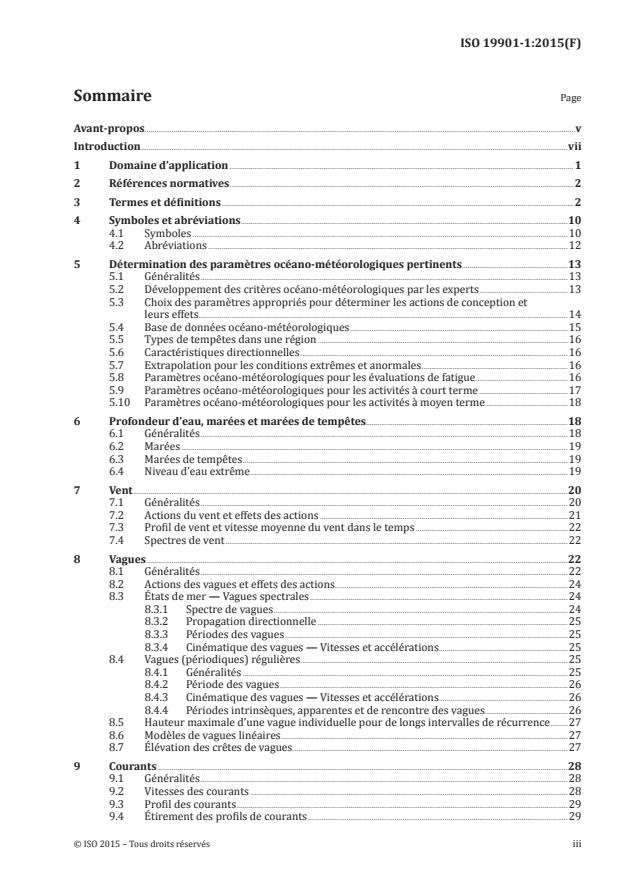
Sommaire Page
Avant-propos .v
Introduction .vii
1 Domaine d’application . 1
2 Références normatives . 2
3 Termes et définitions . 2
4 Symboles et abréviations .10
4.1 Symboles .10
4.2 Abréviations .12
5 Détermination des paramètres océano-météorologiques pertinents .13
5.1 Généralités .13
5.2 Développement des critères océano-météorologiques par les experts .13
5.3 Choix des paramètres appropriés pour déterminer les actions de conception et
leurs effets .14
5.4 Base de données océano-météorologiques .15
5.5 Types de tempêtes dans une région .16
5.6 Caractéristiques directionnelles .16
5.7 Extrapolation pour les conditions extrêmes et anormales .16
5.8 Paramètres océano-météorologiques pour les évaluations de fatigue.16
5.9 Paramètres océano-météorologiques pour les activités à court terme .17
5.10 Paramètres océano-météorologiques pour les activités à moyen terme .18
6 Profondeur d’eau, marées et marées de tempêtes.18
6.1 Généralités .18
6.2 Marées .19
6.3 Marées de tempêtes .19
6.4 Niveau d’eau extrême .19
7 Vent .20
7.1 Généralités .20
7.2 Actions du vent et effets des actions .21
7.3 Profil de vent et vitesse moyenne du vent dans le temps .22
7.4 Spectres de vent .22
8 Vagues .22
8.1 Généralités .22
8.2 Actions des vagues et effets des actions .24
8.3 États de mer — Vagues spectrales .24
8.3.1 Spectre de vagues .24
8.3.2 Propagation directionnelle .25
8.3.3 Périodes des vagues .25
8.3.4 Cinématique des vagues — Vitesses et accélérations .25
8.4 Vagues (périodiques) régulières .25
8.4.1 Généralités .25
8.4.2 Période des vagues . .26
8.4.3 Cinématique des vagues — Vitesses et accélérations .26
8.4.4 Périodes intrinsèques, apparentes et de rencontre des vagues .26
8.5 Hauteur maximale d’une vague individuelle pour de longs intervalles de récurrence .27
8.6 Modèles de vagues linéaires .27
8.7 Élévation des crêtes de vagues .27
9 Courants .28
9.1 Généralités .28
9.2 Vitesses des courants .28
9.3 Profil des courants .29
9.4 Étirement des profils de courants .29
9.5 Blocage par les courants .29
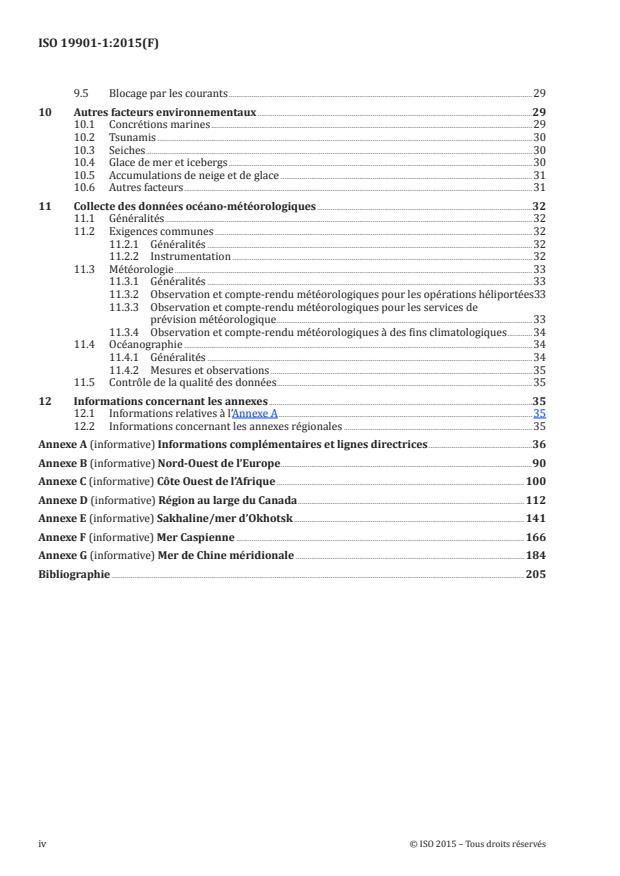
10 Autres facteurs environnementaux .29
10.1 Concrétions marines .29
10.2 Tsunamis .30
10.3 Seiches .30
10.4 Glace de mer et icebergs .30
10.5 Accumulations de neige et de glace .31
10.6 Autres facteurs .31
11 Collecte des données océano-météorologiques .32
11.1 Généralités .32
11.2 Exigences communes .32
11.2.1 Généralités .32
11.2.2 Instrumentation .32
11.3 Météorologie .33
11.3.1 Généralités .33
11.3.2 Observation et compte-rendu météorologiques pour les opérations héliportées 33
11.3.3 Observation et compte-rendu météorologiques pour les services de
prévision météorologique .33
11.3.4 Observation et compte-rendu météorologiques à des fins climatologiques .34
11.4 Océanographie .34
11.4.1 Généralités .34
11.4.2 Mesures et observations .35
11.5 Contrôle de la qualité des données .35
12 Informations concernant les annexes .35
12.1 Informations relatives à l’Annexe A .35
12.2 Informations concernant les annexes régionales .35
Annexe A (informative) Informations complémentaires et lignes directrices .36
Annexe B (informative) Nord-Ouest de l’Europe .90
Annexe C (informative) Côte Ouest de l’Afrique .100
Annexe D (informative) Région au large du Canada .112
Annexe E (informative) Sakhaline/mer d’Okhotsk .141
Annexe F (informative) Mer Caspienne .166
Annexe G (informative) Mer de Chine méridionale .184
Bibliographie .205
iv © ISO 2015 – Tous droits réservés
Avant-propos
L’ISO (Organisation internationale de normalisation) est une fédération mondiale d’organismes
nationaux de normalisation (comités membres de l’ISO). L’élaboration des Normes internationales est
en général confiée aux comités techniques de l’ISO. Chaque comité membre intéressé par une étude
a le droit de faire partie du comité technique créé à cet effet. Les organisations internationales,
gouvernementales et non gouvernementales, en liaison avec l’ISO participent également aux travaux.
L’ISO collabore étroitement avec la Commission électrotechnique internationale (IEC) en ce qui
concerne la normalisation électrotechnique.
Les procédures utilisées pour élaborer le présent document et celles destinées à sa mise à jour sont
décrites dans les Directives ISO/IEC, Partie 1. Il convient, en particulier de prendre note des différents
critères d’approbation requis pour les différents types de documents ISO. Le présent document a été
rédigé conformément aux règles de rédaction données dans les Directives ISO/IEC, Partie 2 (voir www.
iso.org/directives).
L’attention est appelée sur le fait que certains des éléments du présent document peuvent faire l’objet de
droits de propriété intellectuelle ou de droits analogues. L’ISO ne saurait être tenue pour responsable
de ne pas avoir identifié de tels droits de propriété et averti de leur existence. Les détails concernant
les références aux droits de propriété intellectuelle ou autres droits analogues identifiés lors de
l’élaboration du document sont indiqués dans l’Introduction et/ou dans la liste des déclarations de
brevets reçues par l’ISO (voir www.iso.org/brevets).
Les appellations commerciales éventuellement mentionnées dans le présent document sont données
pour information, par souci de commodité, à l’intention des utilisateurs et ne sauraient constituer un
engagement.
Pour une explication de la signification des termes et expressions spécifiques de l’ISO liés à
l’évaluation de la conformité, ou pour toute information au sujet de l’adhésion de l’ISO aux principes
de l’OMC concernant les obstacles techniques au commerce (OTC), voir le lien suivant: Avant-propos —
Informations supplémentaires.
Le comité chargé de l’élaboration du présent document est l’ISO/TC 67 Matériel, équipement et structures
en mer pour les industries pétrolière, pétrochimique et du gaz naturel, sous-comité SC 7, Structures en mer.
Cette seconde édition annule et remplace la première édition (ISO 19901-1:2005), qui a fait l’objet d’une
révision technique.
L’ISO 19901 comprend les parties suivantes, présentées sous le titre général Industries du pétrole et du
gaz naturel — Exigences spécifiques relatives aux structures en mer:
— Partie 1: Dispositions océano-météorologiques pour la conception et l’exploitation
— Partie 2: Procédures de conception et critères sismiques
— Partie 3: Superstructures
— Partie 4: Bases conceptuelles des fondations
— Partie 5: Contrôles des poids durant la conception et la fabrication
— Partie 7: Systèmes de maintien en position des structures en mer flottantes et des unités marines
mobiles en mer
— Partie 8: Investigations des sols en mer
Les parties suivantes sont en cours d’élaboration:
— Partie 6: Opérations maritimes
— Partie 9: Gestion de l’intégrité structurelle
L’ISO 19901 fait partie d’une série de normes portant sur les structures en mer. La série complète
comprend les Normes internationales suivantes:
— ISO 19900, Industries du pétrole et du gaz naturel — Exigences générales pour les structures en mer
— ISO 19901 (toutes les parties), Industries du pétrole et du gaz naturel — Exigences spécifiques relatives
aux structures en mer
— ISO 19902, Industries du pétrole et du gaz naturel — Structures en mer fixes en acier
— ISO 19903, Industries du pétrole et du gaz naturel — Structures en mer fixes en béton
— ISO 19904-1, Industries du pétrole et du gaz naturel — Structures en mer flottantes — Partie 1: Unités
monocoques, unités semi-submersibles et unités spars
— ISO 19905-1, Industries du pétrole et du gaz naturel — Évaluation spécifique au site d’unités mobiles en
mer — Partie 1: Plates-formes auto-élévatrices
— ISO/TR 19905-2, Industries du pétrole et du gaz naturel — Évaluation spécifique au site d’unités
mobiles en mer — Partie 2: Compléments sur les plates-formes auto-élévatrices
1)
— ISO 19905-3 , Industries du pétrole et du gaz naturel — Évaluation spécifique au site d’unités mobiles
en mer — Partie 3: Unité flottante
— ISO 19906, Industries du pétrole et du gaz naturel — Structures arctiques en mer
1) En cours d’élaboration.
vi © ISO 2015 – Tous droits réservés
Introduction
La série de Normes internationales applicables aux différents types de structures en mer, ISO 19900 à
ISO 19906, constitue une base commune couvrant les aspects qui concernent les exigences relatives à
la conception et les évaluations de toutes les structures en mer utilisées par les industries du pétrole et
du gaz naturel dans le monde entier. À travers leur application, l’intention est de parvenir à des niveaux
de fiabilité appropriés pour les structures en mer habitées et non habitées, quels que soient le type de
structure et la nature ou la combinaison des matériaux utilisés.
Il est important de reconnaître que l’intégrité structurale est un concept global comprenant des
modèles pour décrire des actions, des analyses structurales, des règles de conception, des éléments de
sécurité, une qualité d’exécution, des procédures de contrôle de la qualité et des exigences nationales,
tous ces éléments étant mutuellement dépendants. La modification isolée d’un aspect de conception
peut perturber l’équilibre de la fiabilité inhérent au concept global ou au système structurel. Par
conséquent, les implications des modifications doivent être considérées par rapport à la fiabilité globale
de l’ensemble des systèmes de structures en mer.
La série de Normes internationales applicables aux types de structures en mer a pour objectif de
donner toute latitude en ce qui concerne le choix des configurations structurelles, des matériaux et des
techniques sans entraver l’innovation. Une solide capacité de jugement en termes d’ingénierie est donc
nécessaire pour l’utilisation de ces Normes internationales.
Le concept global d’intégrité structurelle est décrit ci-dessus. Certains facteurs supplémentaires doivent
également être pris en compte dans les conditions océano-météorologiques appliquées à la conception
et à l’exploitation. Le terme «océano-météorologique» est la contraction de «océanographique
et météorologique» et se rapporte à la discipline concernée par l’établissement de conditions
environnementales pertinentes pour la conception et l’exploitation des structures en mer. Un facteur
important à prendre en compte lors de la conception et de l’exploitation d’une telle structure est la
détermination des actions que les vents, les vagues et les courants exercent sur cette structure, ainsi
que le comportement de cette dernière.
Les conditions environnementales varient fortement en fonction de la situation géographique. Pour la
majorité des emplacements en mer, peu de données numériques relatives à l’historique des conditions
locales sont disponibles. Souvent, la collecte d’un important volume de données ne débute que lorsqu’il
existe un besoin spécifique (lorsqu’une exploration de recherche d’hydrocarbures est envisagée,
par exemple). Malgré la période généralement courte pour laquelle des données sont disponibles, les
concepteurs de structures en mer ont besoin d’estimations de conditions environnementales extrêmes
−2 −3
et anormales (avec une probabilité individuelle ou conjointe de l’ordre de 1 × 10 /an et 1 × 10 à
−4
1 × 10 /an, respectivement).
Même pour des zones telles que le golfe du Mexique, les eaux indonésiennes et la mer du Nord, pour
lesquelles près de 30 années de mesures relativement fiables sont disponibles, les données sont
insuffisantes pour une détermination statistique rigoureuse des conditions environnementales
extrêmes et anormales appropriées. La détermination de paramètres de conception pertinents doit donc
reposer sur l’interprétation des données disponibles par des experts, ainsi que sur une évaluation de
toutes les autres informations telles que les systèmes météorologiques dominants, la formation d’ondes
océaniques et la bathymétrie régionale et locale, en tenant également compte des données concernant
des emplacements comparables. Il est notamment essentiel de tenir dûment compte des incertitudes
découlant des analyses d’ensembles de données limités. Lors de la détermination des paramètres de
conception des structures en mer, il est donc important de recourir à des experts issus des communautés
de l’océano-météorologie et de l’analyse des structures, notamment du fait que l’utilisation de conditions
environnementales appropriées dépend de l’option choisie pour la structure en mer.
La présente partie de l’ISO 19901 fournit des procédures et des lignes directrices pour la détermination
des conditions environnementales et des paramètres pertinents associés. Les exigences relatives à la
détermination des actions et du comportement d’une structure dans ces conditions environnementales
sont exposées dans les ISO 19901-3, ISO 19901-6, ISO 19901-7, ISO 19902, ISO 19903, ISO 19904-1,
ISO 19905-1 et ISO 19906.
L’Annexe A (informative) fournit un contexte et des lignes directrices pour l’utilisation de la présente
partie de l’ISO 19901. La numérotation des paragraphes de l’Annexe A est identique à celle du corps
principal afin de faciliter le repérage.
Lorsqu’elles sont disponibles, des informations à caractère régional sont fournies dans les Annexes
régionales B à G. Ces informations ont été transmises par des experts de la région ou du pays concerné
afin de compléter les lignes directrices de la présente partie de l’ISO 19901. Chaque Annexe régionale
contient des données nationales ou régionales sur les conditions environnementales de la zone
concernée.
viii © ISO 2015 – Tous droits réservés
NORME INTERNATIONALE ISO 19901-1:2015(F)
Industries du pétrole et du gaz naturel — Exigences
spécifiques relatives aux structures en mer —
Partie 1:
Dispositions océano-météorologiques pour la conception
et l’exploitation
1 Domaine d’application
La présente partie de l’ISO 19901 fournit des exigences générales relatives à la détermination et à
l’utilisation des conditions océanographiques et météorologiques («océano-météorologiques») pour la
conception, la construction et l’exploitation des structures en mer de tous les types utilisés dans les
industries du pétrole et du gaz naturel.
Les exigences sont scindées en deux grandes catégories:
— celles liées à la détermination des conditions environnementales en général, associées aux
paramètres océano-météorologiques requis pour les décrire de manière appropriée;
— celles liées à la caractérisation et à l’utilisation des paramètres océano-météorologiques pour la
conception, les activités de construction ou l’exploitation des structures en mer.
Les conditions environnementales et les paramètres océano-météorologiques examinés sont:
— les valeurs extrêmes et anormales des paramètres océano-météorologiques qui réapparaissent
à des intervalles de récurrence donnés nettement plus longs que la durée de vie en service de la
structure;
— les distributions à long terme des paramètres océano-météorologiques, sous forme de statistiques
cumulées, conditionnelles, marginales ou conjointes; et
— les conditions environnementales normales dont l’occurrence fréquente est attendue tout au long de
la durée de vie en service de la structure.
Les paramètres océano-météorologiques sont applicables à:
— la détermination des actions pour la conception des nouvelles structures;
— la détermination des actions pour l’évaluation des structures existantes;
— l’évaluation spécifique au site des unités mobiles en mer;
— la détermination des conditions environnementales restrictives, des fenêtres météorologiques, des
actions et de leurs effets pour les situations de pré- et post-service (c’est-à-dire la fabrication, le
transport et l’installation ou la mise hors service et l’enlèvement d’une structure); et
— l’exploitation de la plate-forme, le cas échéant.
NOTE Des exigences océano-météorologiques particulières relatives à l’évaluation spécifique au site sont
contenues dans l’ISO 19905-1 pour les plates-formes auto-élévatrices, dans l’ISO 19906 pour les structures
arctiques en mer et dans l’ISO 19901-3 pour les superstructures.
2 Références normatives
Les documents ci-après, dans leur intégralité ou non, sont des références normatives indispensables à
l’application du présent document. Pour les références datées, seule l’édition citée s’applique. Pour les
références non datées, la dernière édition du document de référence s’applique (y compris les éventuels
amendements).
ISO 19900, Industries du pétrole et du gaz naturel — Exigences générales pour les structures en mer.
ISO 19901 (toutes les parties), Industries du pétrole et du gaz naturel — Exigences spécifiques relatives
aux structures en mer.
ISO 19902, Industries du pétrole et du gaz naturel — Structures en mer fixes en acier.
ISO 19903, Industries du pétrole et du gaz naturel — Structures en mer fixes en béton.
ISO 19904-1, Industries du pétrole et du gaz naturel — Structures en mer flottantes — Partie 1: Unités
monocoques, unités semi-submersibles et unités spars.
ISO 19905-1, Industries du pétrole et du gaz naturel — Évaluation spécifique au site d’unités mobiles en
mer — Partie 1: Plates-formes auto-élévatrices.
ISO 19906, Industries du pétrole et du gaz naturel — Structures arctiques en mer.
OMM no 306, Manuel des codes.
3 Termes et définitions
Pour les besoins du présent document, les termes et définitions donnés dans l’ISO 19900 ainsi que les
suivants s’appliquent.
3.1
valeur anormale
valeur de calcul d’un paramètre de sévérité anormale, utilisée dans les vérifications d’états limites
accidentels dans lesquels une structure ne doit pas subir de perte d’intégrité totale
Note 1 à l’article: Les événements anormaux sont généralement les événements accidentels et environnementaux
−3 −4
(y compris sismiques) ayant des probabilités de dépassement de l’ordre de 10 à 10 par an.
3.2
zéro d’une carte marine
point de référence local utilisé pour fixer les profondeurs d’eau sur une carte ou les hauteurs de marée
sur une zone
Note 1 à l’article: En général, le zéro d’une carte marine correspond approximativement au niveau de la marée
astronomique la plus basse.
3.3
probabilité conditionnelle
distribution conditionnelle
distribution (probabilité) statistique d’occurrence d’une variable A, en tenant compte du fait que
certaines valeurs ont été affectées aux autres variables B, C,.
Note 1 à l’article: La probabilité conditionnelle de A compte tenu de l’existence de B, C, … s’écrit sous la forme
P(A|B,C,…). Ce concept est applicable aux paramètres océano-météorologiques, ainsi qu’aux actions et à leurs effets.
EXEMPLE En considérant les paramètres des vagues, A peut être l’élévation de crête individuelle, B la
profondeur de l’eau et C la hauteur des vagues significatives, et ainsi de suite.
2 © ISO 2015 – Tous droits réservés
3.4
élévation de crête de calcul
élévation de crête extrême mesurée par rapport au niveau d’eau au repos
Note 1 à l’article: L’élévation de crête de calcul est combinée aux informations sur les marées astronomiques,
les marées de tempête, les installations de plates-formes, les subsidences de réservoirs et l’incertitude sur les
profondeurs d’eau, et est établie à l’aide d’une analyse des valeurs extrêmes. Lorsque des modèles simplifiés
sont utilisés pour estimer la cinématique de la vague de calcul, l’élévation de crête de calcul peut être différente
de (généralement légèrement supérieure à) l’élévation de crête de la vague de calcul utilisée pour calculer les
actions exercées sur la structure. En réalité, la vague présentant la plus grande hauteur entre le creux et la crête
sera différente de la vague présentant la plus haute crête.
3.5
vague de calcul
onde déterministe utilisée pour la conception d’une structure en mer
Note 1 à l’article: La vague de calcul est un terme technique abstrait qui désigne le plus souvent une vague
périodique ayant des caractéristiques appropriées (hauteur H, période T, cambrure, élévation de crête, par
exemple). Le choix d’une vague de calcul dépend:
— du (des) but(s) de la conception;
— de l’environnement des vagues;
— de la géométrie de la structure;
— du type d’actions ou de leurs effets recherchés.
Note 2 à l’article: Normalement, une vague de calcul est uniquement compatible avec les situations de conception
où les effets des actions sont quasi statistiquement liés aux actions des vagues associées sur la structure.
3.6
expert
personne qui, de par sa formation et son expérience, dispose des compétences
requises pour donner des conseils océano-météorologiques spécifiques à la zone ou au sujet en question
3.7
niveau d’eau extrême
EWL
combinaison de l’élévation de crête de calcul, de la marée astronomique et de la marée de tempête,
basée sur la marée astronomique la plus basse (LAT) ou le niveau moyen de la mer (MSL)
3.8
valeur extrême
valeur représentative d’un paramètre utilisée pour la vérification des états limites ultimes
−2
Note 1 à l’article: Les événements extrêmes ont une probabilité de l’ordre de 10 par an.
3.9
onde de gravité
onde se propageant dans un fluide ou à l’interface de deux fluides où les forces antagonistes
prédominantes sont la gravité et la poussée d’Archimède
Note 1 à l’article: Les vagues de surface produites par le vent sont un exemple d’ondes de gravité.
3.10
rafale
brusques augmentation et diminution de la vitesse du vent, d’une durée inférieure à 1 min
Note 1 à l’article: Dans certains pays, les rafales sont mentionnées dans les observations météorologiques si la
vitesse maximale du vent dépasse 8 m/s environ.
3.11
vitesse d’une rafale de vent
valeur maximale de la vitesse d’une rafale de vent dont la moyenne est calculée sur une courte durée
spécifiée (3 s à 60 s) sur une période spécifiée plus longue (1 min à 1 h)
Note 1 à l’article: Pour la conception, la durée spécifiée dépend des dimensions et de la période propre (d’une
partie) de la structure en étude de sorte que cette dernière est conçue pour les conditions les plus sévères. Ainsi,
une petite partie de la structure est conçue pour une durée de rafale plus courte (et donc une rafale de plus forte
intensité) qu’une (partie d’une) structure plus grande.
Note 2 à l’article: Il convient également de spécifier l’élévation de la rafale mesurée.
3.12
marée astronomique la plus haute
HAT
niveau de marée haute atteint lorsque toutes les composantes harmoniques entraînant les marées sont
en phase
Note 1 à l’article: Les composantes harmoniques sont en phase environ tous les 19 ans, mais ces conditions sont
approchées plusieurs fois par an.
3.13
rétrosimulation
méthode de simulation des données (océano-météorologiques) historiques d’une région, par
modélisation numérique
3.14
infra-vague
onde de gravité de surface dont la période est comprise entre 25 s et 300 s environ
Note 1 à l’article: En principe, une infra-vague est générée par différents processus physiques, mais elle est le
plus souvent produite par des interactions de fréquences différentielles de second ordre, non linéaires, entre les
différentes composantes des vagues dues à la houle.
3.15
onde interne
onde de gravité qui se propage dans une colonne d’eau stratifiée
3.16
distribution à long terme
distribution de probabilité d’une variable sur une échelle de temps étendue
Note 1 à l’article: L’échelle de temps dépasse la durée d’un état de mer, pendant laquelle les statistiques sont
supposées constantes (voir 3.34 distribution à court terme). L’échelle de temps est donc comparable à une
saison ou à la durée de vie en service d’une structure.
EXEMPLE Distributions à long terme:
— de la hauteur des vagues significatives (basée, par exemple, sur les pics de tempête ou tous les états
de mer);
— de la hauteur des vagues significatives de mai à septembre;
— des hauteurs de vagues individuelles;
— des vitesses des courants (pour l’évaluation des vibrations induites par les vortex dans les tubes
prolongateurs, par exemple);
— des diagrammes de dispersion avec la distribution combinée de la hauteur des vagues significatives
et de la période des vagues (pour une analyse de fatigue, par exemple);
— d’un effet particulier d’une action;
4 © ISO 2015 – Tous droits réservés
— des types et de l’épaisseur de la glace de mer;
— de la masse et de la vitesse de déplacement des icebergs;
— d’une hauteur maximale des vagues significatives pendant une tempête.
3.17
marée astronomique la plus basse
LAT
niveau de marée basse atteint lorsque toutes les composantes harmoniques entraînant les marées sont
en phase
Note 1 à l’article: Les composantes harmoniques sont en phase environ tous les 19 ans, mais ces conditions sont
approchées plusieurs fois par an.
3.18
distribution marginale
probabilité marginale
distribution (probabilité) statistique d’occurrence d’une variable A indépendante de toute autre
variable
Note 1 à l’article: La distribution marginale s’obtient en intégrant la distribution totale de toutes les
valeurs des autres variables B, C, … et s’écrit sous la forme P(A). Ce concept est applicable aux paramètres
océano-météorologiques, ainsi qu’aux actions et à leurs effets.
EXEMPLE En considérant les conditions des vagues, A peut être l’élévation de crête individuelle pour toutes
les périodes moyennes au niveau zéro B et toutes les hauteurs des vagues significatives C, apparaissant sur un
site particulier.
3.19
concrétions marines
organismes vivants fixés sur une structure en mer
3.20
niveau moyen de la mer
MSL
moyenne arithmétique de tous les niveaux de la mer mesurés sur une longue période
Note 1 à l’article: Dans certaines régions, des variations saisonnières du niveau moyen peuvent être attendues. Le
niveau moyen de la mer peut également varier sur plusieurs années.
3.21
vitesse moyenne du vent
vitesse de vent moyenne calculée sur un intervalle de temps et à une hauteur spécifiés
Note 1 à l’article: La vitesse moyenne du vent varie en fonction de la hauteur au-dessus du niveau moyen de la mer
et de l’intervalle de calcul de la moyenne. Une hauteur de référence de 10 m et un intervalle de temps de 1 h sont
généralement utilisés. Voir aussi 3.11 vitesse d’une rafale de vent et 3.43 vitesse du vent soutenu.
3.22
période moyenne au niveau zéro
période moyenne entre les passages de vagues par zéro (par le haut ou le bas) dans un état de mer
spécifique
Note 1 à l’article: Dans la pratique, la période moyenne au niveau zéro est souvent estimée à partir des moments
d’ordre 0 et 2 du spectre des vagues: TT== mf()/(mf )(= 2πωmm)/ ()ω .
z 20 20 2
3.23
mousson
régime de vents saisonniers accompagnés de pluies abondantes
Note 1 à l’article: Ce terme a tout d’abord été appliqué aux vents de la mer d’Oman qui soufflent à partir du
nord-est pendant 6 mois et du sud-ouest pendant 6 mois, puis son utilisation a été étendue aux vents similaires
dans les autres parties du monde.
3.24
maximum le plus probable
valeur du maximum d’une variable dont la probabilité d’occurrence est la plus élevée
Note 1 à l’article: Le maximum le plus probable est la valeur pour laquelle la fonction de densité de probabilité des
maxima de la variable est à son pic. Il est également appelé « mode de distribution statistique ».
3.25
conditions de service
combinaison de conditions environnementales les plus sévères dans lesquelles l’exécution d’une
opération spécifique est autorisée
Note 1 à l’article: Les conditions de service sont déterminées pour les opérations qui exercent une action
significative sur la structure. Elles établissent généralement un compris: elles sont suffisamment strictes pour
que l’opération puisse être exécutée sans temps d’arrêt excessif, sans être trop strictes pour ne pas avoir d’impact
négatif sur la conception.
3.26
dépression polaire
dépression qui se forme dans l’air polaire, souvent près de la frontière entre la glace et la mer
3.27
courant résiduel
partie du courant total qui n’est pas formée à partir des composantes harmoniques de la marée
(c’est-à-dire le courant de marée)
Note 1 à l’article: Les courants résiduels sont dus à une grande diversité de mécanismes physiques et comprennent
un large éventail de fréquences et d’amplitudes dans les différentes parties du monde.
3.28
intervalle de récurrence
période moyenne entre les occurrences d’un événement ou d’une valeur particulière dépassée
Note 1 à l’article: L’industrie offshore utilise généralement un intervalle de récurrence mesuré en années pour les
événements environnementaux. Pour un événement rare, l’intervalle de récurrence en année est égal à l’inverse
de la probabilité annuelle pour que l’événement soit dépassé.
3.29
diagramme de dispersion
diagramme illustrant la probabilité conjointe d’au moins deux paramètres (océano-météorologiques)
Note 1 à l’article: Les diagrammes de dispersion sont notamment utilisés avec les paramètres des vagues dans
le contexte océano-météorologique (pour les évaluations de fatigue, par exemple). Le diagramme de dispersion
des vagues représente généralement la probabilité d’occurrence conjointe de la hauteur des vagues significatives
(H ) et d’une période représentative (T ou T ).
s z p
3.30
fond océanique
interface entre la mer et le plancher océanique et se référant à la surface supérieure de tous les
matériaux meubles
6 © ISO 2015 – Tous droits réservés
3.31
état de mer
état de mer sur une période où ses statistiques restent sensiblement stables
Note 1 à l’article: Au sens statistique, l’état de mer ne varie pas considérablement au cours de la période. La
période où cet état existe est souvent supposée être de 3 h, bien qu’elle dépende de la situation météorologique
particulière à un instant donné.
3.32
plancher océanique
matériaux sous-marins dans lesquels reposent les fondations de la structure (sols de type sable, limon
ou argile, matériau aggloméré ou roche)
3.33
seiche
oscillation d’un plan d’eau à sa période propre
3.34
distribution à court terme
distribution de probabilité d’une variable sur un court intervalle de temps au cours duquel les conditions
sont supposées stables d’un point de vue statistique
Note 1 à l’article: L’intervalle choisi est souvent la durée d’un état de mer.
3.35
hauteur des vagues significatives
mesure statistique de la hauteur des vagues dans un état de mer
Note 1 à l’article: La hauteur des vagues significatives était initialement définie comme la hauteur moyenne du
tiers supérieur des vagues passant par zéro dans un état de mer. Dans la plupart des systèmes d’acquisition de
données offshore, la hauteur des vagues significatives est actuellement prise comme égale à 4 m (où m est le
moment spectral d’ordre 0, voir 3.37 moment spectral) ou 4σ, où σ est l’écart-type de la série temporelle des
hauteurs de la surface de l’eau sur la durée de la mesure, généralement une période de 30 min environ.
3.36
soliton
onde ou paquet d’ondes solitaires se propageant sur une discontinuité de densi
...