

ISO 9846:2025
(Main)Solar energy — Calibration of a pyranometer using a pyrheliometer
General Information
- Abstract
This document specifies calibration methods for a pyranometer using a pyrheliometer as a reference instrument. Three methods are specified in this document. a) Alternating sun and shade method. This method uses a shading disc to alternately shade and unshade a pyranometer to compare with the tracking pyrheliometer. The test pyranometer can be horizontal, on a fixed tilt or tracking alongside the pyrheliometer. b) Continuous sun and shade method. In this method, a shaded calibrated reference pyranometer is used in addition to the reference pyrheliometer. The test pyranometer can be horizontal, on a fixed tilt or tracking alongside the reference pyrheliometer, but the reference pyranometer must be mounted in the same plane as the test pyranometer (most often on the horizontal). c) Collimation tube method. In this method, the test pyranometer is mounted on a solar tracker and is equipped with a collimation tube designed to allow the test pyranometer to have the same geometric view as the reference pyrheliometer for a direct comparison of the two instruments. The methods in this document are applicable for calibration of all pyranometers provided that a proper uncertainty evaluation is performed. Unlike spectrally flat pyranometers, non-spectrally flat pyranometers have a sensitivity that strongly depends on the solar spectrum. Therefore, the calibration result can be valid under a more limited range of conditions. The result of a calibration is the instrument sensitivity accompanied by an uncertainty. This document includes suggestions for uncertainty evaluation.
- Status
- Published
- Publication Date
- 07-Aug-2025
- Technical Committee
- ISO/TC 180/SC 1 - Climate - Measurement and data
- Drafting Committee
- ISO/TC 180/SC 1 - Climate - Measurement and data
- Current Stage
- 6060 - International Standard published
- Start Date
- 08-Aug-2025
- Due Date
- 17-Aug-2025
- Completion Date
- 08-Aug-2025

Overview
ISO 9846:2025 - Solar energy - Calibration of a pyranometer using a pyrheliometer - defines standardized laboratory and field procedures to calibrate a pyranometer by direct comparison to a reference pyrheliometer. This second edition updates ISO 9846:1993, adds a collimation tube method, refines data-treatment recommendations, and aligns terminology with related ISO guidance. The outcome of a calibration is the instrument sensitivity (responsivity) of the test pyranometer accompanied by an evaluated uncertainty.
Key topics and requirements
- Three approved calibration methods
- Alternating sun-and-shade method: uses a shading disc to alternately expose and shade the test pyranometer while comparing to a tracking pyrheliometer. The test instrument may be horizontal, fixed-tilt or tracker-mounted.
- Continuous sun-and-shade method: employs a shaded calibrated reference pyranometer in addition to the reference pyrheliometer; the reference pyranometer must lie in the same plane as the test device.
- Collimation tube method: mounts the test pyranometer on a solar tracker with a collimation tube so both instruments share equivalent geometric fields of view for direct comparison.
- Apparatus and installation: specifies use of pyranometers, pyrheliometers, solar trackers, shade devices/collars, collimation tubes and data-acquisition systems, plus site and alignment requirements.
- Measurement procedures: preparatory steps, measurement sequencing, sampling and data-filtering approaches, and calculation of individual and combined sensitivity values.
- Uncertainty evaluation: guidance and suggestions for estimating calibration uncertainty; special attention to spectral effects for non‑spectrally‑flat pyranometers, where sensitivity depends on solar spectrum and limits calibration validity.
- Reporting: requirement to provide the sensitivity value with its uncertainty on the calibration certificate.
Applications and users
- Practical uses:
- Calibration services and test laboratories validating pyranometers for PV performance testing, meteorology, climate monitoring and solar resource assessment.
- Manufacturers performing production or reference calibrations.
- Research institutions and solar project developers ensuring accurate irradiance measurements for system design, yield modelling and performance monitoring.
- Typical users: metrology labs, solar instrumentation manufacturers, renewable-energy test centers, and national laboratories.
Related standards
- ISO 9847 - calibration of pyranometers using a reference pyranometer
- ISO 9060, ISO 9488 - instrument classification and vocabulary for solar radiation sensors
- ISO/IEC Guide 98-3 - uncertainty evaluation (GUM)
- ASTM G213 - reference for uncertainty considerations in solar measurements
ISO 9846:2025 is essential for anyone needing traceable, reproducible pyranometer calibration by comparison to a pyrheliometer and for maintaining high-quality solar irradiance measurements.
Relations
- Effective Date
- 06-Jun-2022
Get Certified
Connect with accredited certification bodies for this standard

DNV
DNV is an independent assurance and risk management provider.

Lloyd's Register
Lloyd's Register is a global professional services organisation specialising in engineering and technology.
DNV Energy Systems
Energy and renewable energy certification.
Sponsored listings
Frequently Asked Questions
ISO 9846:2025 is a standard published by the International Organization for Standardization (ISO). Its full title is "Solar energy — Calibration of a pyranometer using a pyrheliometer". This standard covers: This document specifies calibration methods for a pyranometer using a pyrheliometer as a reference instrument. Three methods are specified in this document. a) Alternating sun and shade method. This method uses a shading disc to alternately shade and unshade a pyranometer to compare with the tracking pyrheliometer. The test pyranometer can be horizontal, on a fixed tilt or tracking alongside the pyrheliometer. b) Continuous sun and shade method. In this method, a shaded calibrated reference pyranometer is used in addition to the reference pyrheliometer. The test pyranometer can be horizontal, on a fixed tilt or tracking alongside the reference pyrheliometer, but the reference pyranometer must be mounted in the same plane as the test pyranometer (most often on the horizontal). c) Collimation tube method. In this method, the test pyranometer is mounted on a solar tracker and is equipped with a collimation tube designed to allow the test pyranometer to have the same geometric view as the reference pyrheliometer for a direct comparison of the two instruments. The methods in this document are applicable for calibration of all pyranometers provided that a proper uncertainty evaluation is performed. Unlike spectrally flat pyranometers, non-spectrally flat pyranometers have a sensitivity that strongly depends on the solar spectrum. Therefore, the calibration result can be valid under a more limited range of conditions. The result of a calibration is the instrument sensitivity accompanied by an uncertainty. This document includes suggestions for uncertainty evaluation.
This document specifies calibration methods for a pyranometer using a pyrheliometer as a reference instrument. Three methods are specified in this document. a) Alternating sun and shade method. This method uses a shading disc to alternately shade and unshade a pyranometer to compare with the tracking pyrheliometer. The test pyranometer can be horizontal, on a fixed tilt or tracking alongside the pyrheliometer. b) Continuous sun and shade method. In this method, a shaded calibrated reference pyranometer is used in addition to the reference pyrheliometer. The test pyranometer can be horizontal, on a fixed tilt or tracking alongside the reference pyrheliometer, but the reference pyranometer must be mounted in the same plane as the test pyranometer (most often on the horizontal). c) Collimation tube method. In this method, the test pyranometer is mounted on a solar tracker and is equipped with a collimation tube designed to allow the test pyranometer to have the same geometric view as the reference pyrheliometer for a direct comparison of the two instruments. The methods in this document are applicable for calibration of all pyranometers provided that a proper uncertainty evaluation is performed. Unlike spectrally flat pyranometers, non-spectrally flat pyranometers have a sensitivity that strongly depends on the solar spectrum. Therefore, the calibration result can be valid under a more limited range of conditions. The result of a calibration is the instrument sensitivity accompanied by an uncertainty. This document includes suggestions for uncertainty evaluation.
ISO 9846:2025 is classified under the following ICS (International Classification for Standards) categories: 27.160 - Solar energy engineering. The ICS classification helps identify the subject area and facilitates finding related standards.
ISO 9846:2025 has the following relationships with other standards: It is inter standard links to ISO 9846:1993. Understanding these relationships helps ensure you are using the most current and applicable version of the standard.
ISO 9846:2025 is available in PDF format for immediate download after purchase. The document can be added to your cart and obtained through the secure checkout process. Digital delivery ensures instant access to the complete standard document.
Standards Content (Sample)
International
Standard
ISO 9846
Second edition
Solar energy — Calibration of a
2025-08
pyranometer using a pyrheliometer
Énergie solaire — Étalonnage d'un pyranomètre utilisant un
pyrhéliomètre
Reference number
© ISO 2025
All rights reserved. Unless otherwise specified, or required in the context of its implementation, no part of this publication may
be reproduced or utilized otherwise in any form or by any means, electronic or mechanical, including photocopying, or posting on
the internet or an intranet, without prior written permission. Permission can be requested from either ISO at the address below
or ISO’s member body in the country of the requester.
ISO copyright office
CP 401 • Ch. de Blandonnet 8
CH-1214 Vernier, Geneva
Phone: +41 22 749 01 11
Email: copyright@iso.org
Website: www.iso.org
Published in Switzerland
ii
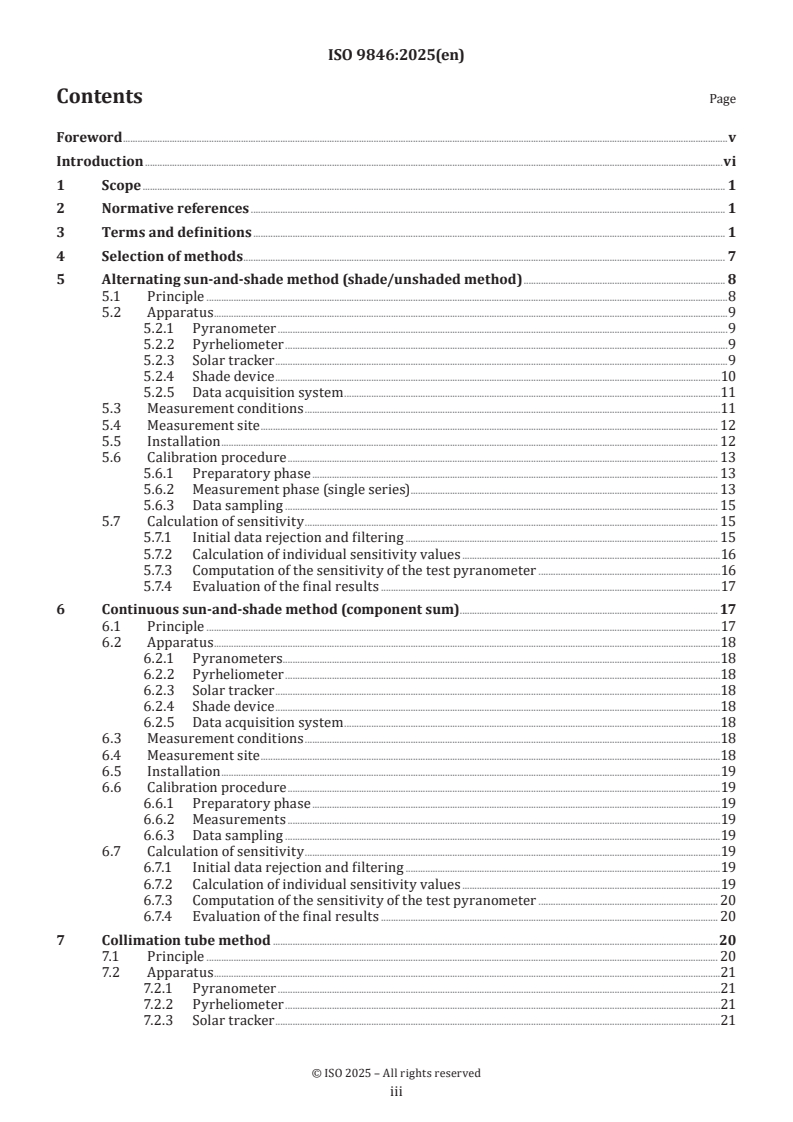
Contents Page
Foreword .v
Introduction .vi
1 Scope . 1
2 Normative references . 1
3 Terms and definitions . 1
4 Selection of methods . 7
5 Alternating sun-and-shade method (shade/unshaded method) . 8
5.1 Principle .8
5.2 Apparatus .9
5.2.1 Pyranometer .9
5.2.2 Pyrheliometer .9
5.2.3 Solar tracker .9
5.2.4 Shade device .10
5.2.5 Data acquisition system .11
5.3 Measurement conditions .11
5.4 Measurement site . 12
5.5 Installation . 12
5.6 Calibration procedure . 13
5.6.1 Preparatory phase . 13
5.6.2 Measurement phase (single series) . 13
5.6.3 Data sampling . 15
5.7 Calculation of sensitivity . 15
5.7.1 Initial data rejection and filtering . 15
5.7.2 Calculation of individual sensitivity values .16
5.7.3 Computation of the sensitivity of the test pyranometer .16
5.7.4 Evaluation of the final results .17
6 Continuous sun-and-shade method (component sum) . 17
6.1 Principle .17
6.2 Apparatus .18
6.2.1 Pyranometers.18
6.2.2 Pyrheliometer .18
6.2.3 Solar tracker .18
6.2.4 Shade device .18
6.2.5 Data acquisition system .18
6.3 Measurement conditions .18
6.4 Measurement site .18
6.5 Installation .19
6.6 Calibration procedure .19
6.6.1 Preparatory phase .19
6.6.2 Measurements .19
6.6.3 Data sampling .19
6.7 Calculation of sensitivity .19
6.7.1 Initial data rejection and filtering .19
6.7.2 Calculation of individual sensitivity values .19
6.7.3 Computation of the sensitivity of the test pyranometer . 20
6.7.4 Evaluation of the final results . 20
7 Collimation tube method .20
7.1 Principle . 20
7.2 Apparatus .21
7.2.1 Pyranometer .21
7.2.2 Pyrheliometer .21
7.2.3 Solar tracker .21
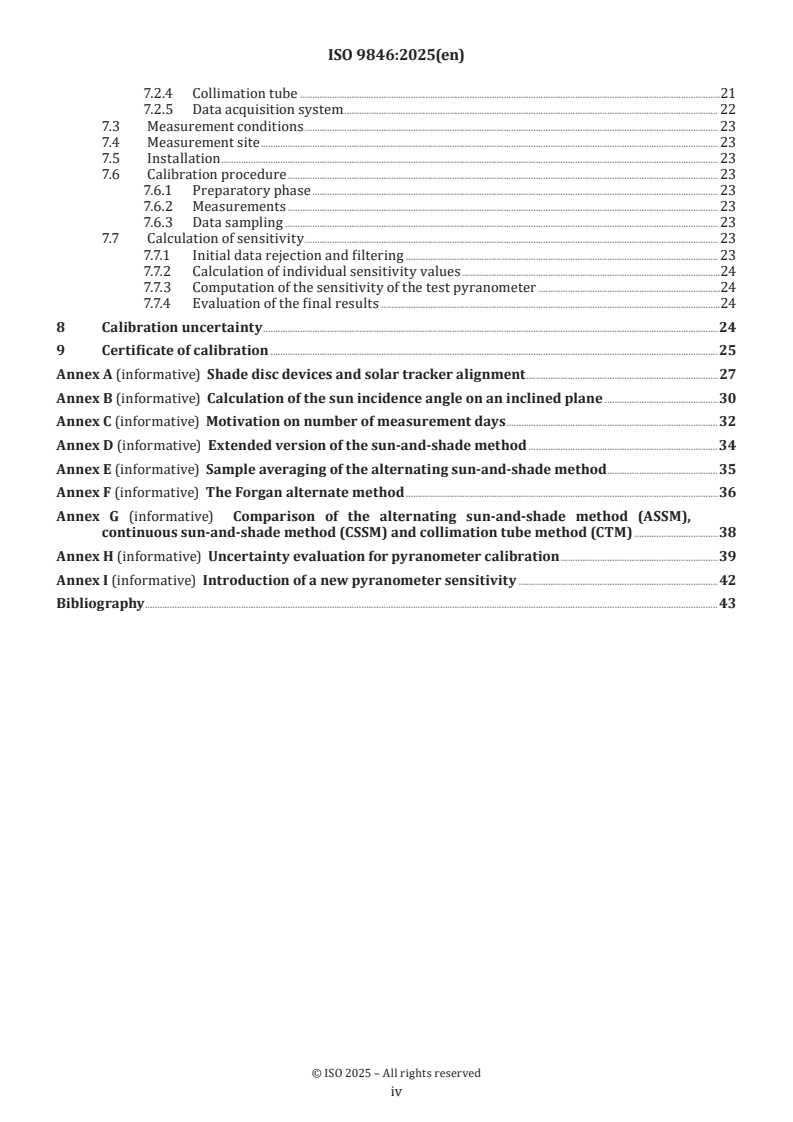
iii
7.2.4 Collimation tube .21
7.2.5 Data acquisition system . 22
7.3 Measurement conditions . 23
7.4 Measurement site . 23
7.5 Installation . 23
7.6 Calibration procedure . 23
7.6.1 Preparatory phase . 23
7.6.2 Measurements . 23
7.6.3 Data sampling . 23
7.7 Calculation of sensitivity . 23
7.7.1 Initial data rejection and filtering . 23
7.7.2 Calculation of individual sensitivity values .24
7.7.3 Computation of the sensitivity of the test pyranometer .24
7.7.4 Evaluation of the final results .24
8 Calibration uncertainty .24
9 Certificate of calibration .25
Annex A (informative) Shade disc devices and solar tracker alignment .27
Annex B (informative) Calculation of the sun incidence angle on an inclined plane .30
Annex C (informative) Motivation on number of measurement days .32
Annex D (informative) Extended version of the sun-and-shade method .34
Annex E (informative) Sample averaging of the alternating sun-and-shade method .35
Annex F (informative) The Forgan alternate method .36
Annex G (informative) Comparison of the alternating sun-and-shade method (ASSM),
continuous sun-and-shade method (CSSM) and collimation tube method (CTM) .38
Annex H (informative) Uncertainty evaluation for pyranometer calibration .39
Annex I (informative) Introduction of a new pyranometer sensitivity .42
Bibliography .43
iv
Foreword
ISO (the International Organization for Standardization) is a worldwide federation of national standards
bodies (ISO member bodies). The work of preparing International Standards is normally carried out through
ISO technical committees. Each member body interested in a subject for which a technical committee
has been established has the right to be represented on that committee. International organizations,
governmental and non-governmental, in liaison with ISO, also take part in the work. ISO collaborates closely
with the International Electrotechnical Commission (IEC) on all matters of electrotechnical standardization.
The procedures used to develop this document and those intended for its further maintenance are described
in the ISO/IEC Directives, Part 1. In particular, the different approval criteria needed for the different types
of ISO document should be noted. This document was drafted in accordance with the editorial rules of the
ISO/IEC Directives, Part 2 (see www.iso.org/directives).
ISO draws attention to the possibility that the implementation of this document may involve the use of (a)
patent(s). ISO takes no position concerning the evidence, validity or applicability of any claimed patent
rights in respect thereof. As of the date of publication of this document, ISO had not received notice of (a)
patent(s) which may be required to implement this document. However, implementers are cautioned that
this may not represent the latest information, which may be obtained from the patent database available at
www.iso.org/patents. ISO shall not be held responsible for identifying any or all such patent rights.
Any trade name used in this document is information given for the convenience of users and does not
constitute an endorsement.
For an explanation of the voluntary nature of standards, the meaning of ISO specific terms and expressions
related to conformity assessment, as well as information about ISO's adherence to the World Trade
Organization (WTO) principles in the Technical Barriers to Trade (TBT), see www.iso.org/iso/foreword.html.
This document was prepared by Technical Committee ISO/TC 180, Solar energy, Sub-Committee SC 1, Climate
– Measurement and data.
This second edition cancels and replaces the first edition (ISO 9846:1993) which has been technically
revised.
The main changes are as follows:
— focus on current calibration practices
— addition of a collimation tube calibration method;
— adapted recommendations for mathematical treatment of data;
— revised terminology in line with ISO 9060, ISO 9488 and ISO Guide 99;
[3]
— added comments on uncertainty evaluation of the calibration with reference to ASTM G213 and
ISO/IEC Guide 98-3.
Any feedback or questions on this document should be directed to the user’s national standards body. A
complete listing of these bodies can be found at www.iso.org/members.html.
v
Introduction
This document aims to promote the uniform application of reliable methods to calibrate pyranometers by
comparison to a reference pyrheliometer. Calibration methods for pyranometers using a pyranometer as a
reference are described in ISO 9847.
Calibration of measuring instruments is essential for accurate and reliable measurements. Accurate
measurements of the solar irradiance are required for:
a) determination of the energy input to solar energy systems such as photovoltaic (PV), and solar thermal
systems, as a basis for performance assessment;
b) testing and assessment of solar technologies;
c) geographic mapping of solar energy resources;
d) understanding climate change and extreme weather through the surface radiation budget;
e) applications such as agriculture, building efficiency, material degradation and reliability, health.
Current solar energy performance assessment demands high-accuracy measurements and low measurement
uncertainties. To meet this demand, reliable and accurate solar irradiance measurements with synchronized
time stamps (see Reference [4]) and a correct uncertainty evaluation are required.
The World Meteorological Organization (WMO) World Radiometric Reference (WRR), which represents
the SI units of solar irradiance, is determined by a group of selected pyrheliometers. For hemispherical
irradiance measurements, transfer of this scale to pyranometers has to be accomplished. In order to
calibrate pyranometers, which have a field-of-view angle of 2π, with pyrheliometers that have a limited field
of view (typically only 5 degrees) requires additional equipment such as shading discs or collimation tubes.
The pyranometer calibration procedures described in this document are traceable to the International
System of Units (SI) through the WRR according to the WMO guidelines Reference [5]. The classification and
specification used are prescribed in ISO 9060 Reference [6].
Due to the relatively high accuracy of pyrheliometers, the methods in this document may lead to lower
uncertainties than those obtained by calibration of a pyranometer using a reference pyranometer as given
in ISO 9847.
Unless otherwise specified, uncertainties mentioned in this document are expanded uncertainties with a
coverage factor k = 2.
vi
International Standard ISO 9846:2025(en)
Solar energy — Calibration of a pyranometer using a
pyrheliometer
1 Scope
This document specifies calibration methods for a pyranometer using a pyrheliometer as a reference
instrument. Three methods are specified in this document.
a) Alternating sun and shade method. This method uses a shading disc to alternately shade and unshade a
pyranometer to compare with the tracking pyrheliometer. The test pyranometer can be horizontal, on a
fixed tilt or tracking alongside the pyrheliometer.
b) Continuous sun and shade method. In this method, a shaded calibrated reference pyranometer is used
in addition to the reference pyrheliometer. The test pyranometer can be horizontal, on a fixed tilt or
tracking alongside the reference pyrheliometer, but the reference pyranometer must be mounted in the
same plane as the test pyranometer (most often on the horizontal).
c) Collimation tube method. In this method, the test pyranometer is mounted on a solar tracker and is
equipped with a collimation tube designed to allow the test pyranometer to have the same geometric
view as the reference pyrheliometer for a direct comparison of the two instruments.
The methods in this document are applicable for calibration of all pyranometers provided that a proper
uncertainty evaluation is performed. Unlike spectrally flat pyranometers, non-spectrally flat pyranometers
have a sensitivity that strongly depends on the solar spectrum. Therefore, the calibration result can be valid
under a more limited range of conditions.
The result of a calibration is the instrument sensitivity accompanied by an uncertainty. This document
includes suggestions for uncertainty evaluation.
2 Normative references
The following documents are referred to in the text in such a way that some or all of their content constitutes
requirements of this document. For dated references, only the edition cited applies. For undated references,
the latest edition of the referenced document (including any amendments) applies.
ISO 9059, Solar energy — Calibration of pyrheliometers by comparison to a reference pyrheliometer
ISO 9060, Solar energy — Specification and classification of instruments for measuring hemispherical solar and
direct solar radiation
ISO 9488, Solar energy — Vocabulary
ISO/IEC Guide 98-3, Uncertainty of measurement — Part 3: Guide to the expression of uncertainty in
measurement (GUM:1995)
3 Terms and definitions
For the purposes of this document, the terms and definitions given in ISO 9060, ISO 9488, ISO 9059 and the
following apply.
ISO and IEC maintain terminology databases for use in standardization at the following addresses:
— ISO Online browsing platform: available at https:// www .iso .org/ obp
— IEC Electropedia: available at https:// www .electropedia .org/
3.1
pyranometer
radiometer using a hemispherical field of view for measuring the solar irradiance within the wavelength
range from approximately 0,3 µm to 3 µm
3.2
pyrheliometer
radiometer using a collimated detector for measuring the direct solar irradiance under normal incidence
[5]
Note 1 to entry: Typical opening half angles of common and historical pyrheliometers range from 2,5° to 7,5°
recommends that the opening half-angle (half field-of -view-angle) is 2,5° (6 x10⁻³ sr) and the slope angle 1° for all
new designs of direct solar radiation instruments. The slope angle is the angle defined by the edges of the apertures at
the ends of the collimating tube (see Figure 2). For mathematical definitions of the angles see ISO 9060:2018, 5.1 b) and
Figure 2 of this document. For a detailed description of the influence of circumsolar radiation on the pyrheliometers
[6-8]
refer to and Annex A.
Note 2 to entry: The spectral responsivity of pyrheliometers is often limited by the use of a glass window to the range
of approximately 0,3 µm to near 3 µm, depending on the window transmittance properties. The spectral range (50 %
points) given is only nominal. Depending on the radiometer design, the spectral limits of its responsivity can be
different from the limits mentioned above.
[SOURCE: ISO 9488:2022, 3.3.5, modified — Notes 1 and 2 to entry added.]
3.3
instrument classification
pyranometers and pyrheliometers are classified on the basis of the measuring specifications of the
instruments
Note 1 to entry: Additional information can be found in ISO 9060:2018, 4.3.1 and 5.3.1.
3.4
test pyranometer
pyranometer being calibrated
[SOURCE: ISO 9847:2023, 3.7, modified — term changed from "field pyranometer"]
3.5
reference radiometer
radiometer (pyranometer or pyrheliometer), that is well-characterized and well-maintained, to be used to
measure the (input) irradiance when calibrating a test pyranometer (3.4)
Note 1 to entry: It is recommended that an instrument used as a reference is selected based on quality, stability and
accuracy and is specifically tested for the better characterization of it's properties.
Note 2 to entry: Use of the reference radiometer should be restricted to comparisons and calibration activities. The
instrument should be stored carefully in a laboratory under moderate ambient conditions when not used.
3.6
absolute cavity radiometer
absolute pyrheliometer
pyrheliometer that offers a primary reference measurement procedure for irradiance, i.e., traceable to other
physical quantities, in this case electrical power and surface area
Note 1 to entry: Additional information on absolute pyrheliometers is given in ISO 9060:2018, 5.2.1.
3.7
field-of-view angle
FOV
opening angle
full angle of the geometrical cone which is defined by the centre of the receiver radiometer surface and the
edge of its view-limiting optical aperture
[SOURCE: ISO 9488:2022, 3.3.6, modified — Opening angle has been added as an accepted term and
definition has been revised.]
3.8
solar tracker
sun tracker
mechanical device capable of following the arc or path of the sun across the sky
[SOURCE: ISO 9059:2025, 3.7]
3.9
equatorial tracker
sun-following device having an axis of rotation parallel to the Earth's axis
Note 1 to entry: The parameters of motion are the hour angle and the declination of the sun (see ISO 9488).
[SOURCE: ISO 9488:2022, 3.1.13]
3.10
altazimuth tracker
sun-following device which uses the solar elevation angle and the azimuth angle the sun as coordinates of
movement
[SOURCE: ISO 9488:2022, 3.1.14]
3.11
shading disc
shading ball
disc (or ball) positioned in such a way that the receiver of the pyranometer is shaded from the direct solar
beam so that only the diffuse solar component is measured
Note 1 to entry: For calibration purposes, particularly those described in Clause 5, quick removal of the disc is
mandatory. Further details on shade disc devices used in calibrating pyranometers are given in 5.2.4.
3.12
collimation tube
device used to limit the field of view of a pyranometer to match the field of view (3.7) and slope angle (3.2,
Note 1 to entry) of a pyrheliometer
3.13
direct solar irradiance
G
b
beam solar irradiance
radiation received from a small solid angle centred on the sun's disc, on a given plane
-2
Note 1 to entry: The SI units are W∙m .
Note 2 to entry: Approximately 97 % to 99 % of the direct solar irradiance received at the ground is contained within
the wavelength range from 0,3 μm to 3 μm. Reference [9] (see 3.2, Note 2 to entry).
[SOURCE: ISO 9060:2018, 3.3]
3.14
direct normal incidence solar irradiance
G
bn
direct normal irradiance
DNI
direct solar radiation received by a plane at normal incidence
-2
Note 1 to entry: The SI units are W∙m .
Note 2 to entry: In general, direct normal radiation is measured by instruments with field-of-view angles (3.7) of
up to 6°. Therefore, a part of the scattered radiation around the sun’s disc (circumsolar radiation or aureole) is also
included. For a more detailed definition of circumsolar radiation and related parameters see Reference [8] and see
ISO 9059:2025, Annex A.
3.15
hemispherical solar radiation
solar radiation received by a plane surface from a solid angle of 2π sr
Note 1 to entry: The tilt angle and the azimuth of the surface should be specified, e.g. horizontal.
Note 2 to entry: Hemispherical solar radiation is composed of direct solar radiation and diffuse solar radiation (solar
energy scattered in the atmosphere as well as solar radiation reflected by the ground).
Note 3 to entry: Solar engineers commonly use the term global radiation in place of hemispherical radiation. This use
is a source of confusion if the referenced surface is not horizontal.
Note 4 to entry: Approximately 97 % to 99 % of the hemispherical solar radiation incident at the Earth's surface is
contained within the wavelength range from 0,3 μm to 3 μm Reference [9].
-2
Note 5 to entry: The SI units are W∙m .
[SOURCE: ISO 9488:2022, 3.2.22, modified — Note 5 to entry added.]
3.16
global solar irradiance
G
GHI
global horizontal irradiance
hemispherical solar irradiance on a horizontal plane
-2
Note 1 to entry: The SI units are W∙m .
Note 2 to entry: Global irradiance always refers to a horizontal plane and should not be confused with global tilted
irradiance, see hemispherical irradiance
3.17
diffuse solar irradiance
G
d
hemispherical solar radiation minus direct solar radiation
Note 1 to entry: For meteorological purposes, the solid angle from which the scattered radiative fluxes are measured
shall be the whole hemisphere above the sensor surface, excluding a small solid angle around the sun's disc.
Note 2 to entry: The tilt angle and the azimuth of the receiving surface should be specified, e.g., horizontal.
-2
Note 3 to entry: The SI units are W∙m .
[SOURCE: ISO 9488:2022, 3.2.24, modified — Notes 1 and 3 to entry added.]
3.18
sensitivity
S
responsivity
quotient of the change in an indication of a measuring system and the corresponding change in a value of a
quantity being measured
Note 1 to entry: In the previous edition of this document, calibration factor was also used which is the inverse of
sensitivity.
Note 2 to entry: This term is often used interchangeably with responsivity denoted by R.
[SOURCE: ISO 9059:2025, 3.10, modified — Note 1 to entry revised.]
3.19
calibration
determination of the sensitivity of a test pyranometer to irradiance, with associated measurement
uncertainties, under well-defined measurement conditions
Note 1 to entry: For most pyranometers, the output varies linearly with the irradiance and the calibration result is
expressed as a single sensitivity value.
[SOURCE: ISO 9059:2025, 3.11, modified — Note 1 to entry revised and deleted Note 2 to entry.]
3.20
calibration conditions
conditions, ambient or instrument, during the calibration process
[SOURCE: ISO 9059:2025, 3.12]
3.21
reference operating conditions
operating conditions prescribed for evaluating the performance of a measuring instrument or measuring
system or for comparison of measurement results
Note 1 to entry: For practical purposes, these typically are the conditions specified for the reported sensitivity.
[SOURCE: ISO 9847:2023, 3.9, modified — Note 2 to entry deleted.]
3.22
world radiation reference
WRR
primary measurement standard representing SI unit of solar irradiance
Note 1 to entry: The reference was adopted by the World Meteorological Organization (WMO) and has been in effect
since 1 July 1980. One of the distinguishing features of the WRR is that reference operating conditions include the full
spectrum of direct solar radiation. This is achieved using open cavity radiometers that do not have glass windows that
can introduce a spectral response attenuation (see 3.2, Note 2 to entry). Currently, the uncertainty of the WRR is 0,3 %
(coverage factor k = 3) References [5], [10].
[SOURCE: ISO 9488:2022, 3.3.1, modified — Notes 1 to 3 to entry were revised and combined in to Note 1
to entry.]
3.23
sample
data acquired from a sensor or measuring device at a given time
[SOURCE: ISO 9847:2023, 3.11]
3.24
sampling interval
time interval between sequential samples (3.23)
[SOURCE: ISO 9847:2023, 3.12, modified — Note 1 to entry removed.]
3.25
record
data recorded with the same timestamp and stored in data set, based on acquired samples (3.23)
[SOURCE: ISO 9847:2023, 3.13, modified — Note 1 to entry removed and "with the same timestamp" added
to definition.]
3.26
data series
set of consecutive records (3.25) measured over a limited period of time
3.27
data set
collection of all data recorded during calibration period
3.28
offset correction
value added algebraically to a reading (voltage, current, irradiance, etc.) to compensate for a deviation from
zero (in respective units) when input excitation is null
Note 1 to entry: The offset correction is equal to the negative of the deviation found. Offsets are usually considered as
systematic errors generated by different sources.
3.29
correction factor
numerical factor by which the uncorrected result of a measurement is multiplied to compensate for each
systematic error
Note 1 to entry: since the systematic error cannot be known with absolute certainty, the compensation is not perfect.
[SOURCE: ISO/IEC GUIDE 98-3:2008, B.2.24, modified — added "each" to the definition and modified Note 1
to entry.]
3.30
response time
measure of the stabilization period of the radiometer output signal
Note 1 to entry: The stabilization time of the radiometer signal output is at least three times the radiometer’s 95 %
response time.
Note 2 to entry: Definition based on ISO 9060:2018, 4.3.2.
3.31
zero offset-A
instrument response to net thermal radiation
Note 1 to entry: Definition based on ISO 9060:2018, 4.3.2.
3.32
zero offset-B
measurement error due to a temperature gradient caused by differences in thermal time constants of
various parts of the radiometer
Note 1 to entry: For example, the temperature gradient can be 5 K/hour.
Note 2 to entry: Definition based on ISO 9060:2018, 4.3.2.
3.33
non-stability
annual percentage change in the instrument sensitivity
Note 1 to entry: Definition based on ISO 9060:2018, 4.3.2.
3.34
non-linearity
−2
percentage deviation from the responsivity at 500 W·m due to the change in irradiance within the range of
−2 −2
100 W·m to 1 000 W·m
Note 1 to entry: Definition based on ISO 9060:2018, 4.3.2.
3.35
directional response
range of errors caused by assuming that the normal incidence responsivity is valid for all directions when
measuring irradiance from any other directions
Note 1 to entry: Other directions include the zenith, azimuth, etc.
Note 2 to entry: Definition based on ISO 9060:2018, 4.3.2.
3.36
spectral error
error observed for a set of global horizontal irradiance clear sky spectra
Note 1 to entry: Definition based on ISO 9060:2018, 4.3.2.
3.37
temperature response
relative change in instrument sensitivity due to a change in ambient temperature
Note 1 to entry: Definition based on ISO 9060:2018, 4.3.2.
3.38
tilt response
percentage deviation of the instrument sensitivity at 0° tilt (horizontal) due to change in tilt from 0° to 180°
−2
at 1 000 W·m irradiance
Note 1 to entry: Definition based on ISO 9060:2018, 4.3.2.
3.39
signal processing errors
additional errors that can be caused by internal electronics (digital instruments) or electronic noise in the
cables and data acquisition system
Note 1 to entry: Definition based on ISO 9060:2018, 4.3.2.
4 Selection of methods
Three calibration methods have been selected for standardization (see Table 1) because they are widely
used and are reliable. The first two methods (see Clause 5 and 6) use a shading disc for measuring diffuse
solar radiation and are based on the hemispherical solar radiation being equal to the sum of direct and
diffuse components. The third method uses a collimated tube to remove the diffuse component.
The derived instrument sensitivities are representative of cloudless or scattered cloud conditions (see
Clause 8 for uncertainties). A modification of the calibration method in Clause 5 for application during less
stable sky conditions is briefly described in Annex D.
Annex F contains a short description of an extended version of the calibration method in Clause 6 to
determine the dependence of the calibration factors on incidence angles.
In the alternating method (see Clause 5), if the pyranometer is mounted on a tracker at normal incidence,
there are no directional response errors, and a lower calibration uncertainty may be obtained. In this
method, the zero offset-A of the pyranometer is taken out, since the diffuse reading is subtracted from the
global reading. The result is a pyranometer calibration which is valid for condition where longwave (net)
–2
radiation is 0 W·m or for a well-ventilated pyranometer. Moreover, the irradiance varies in time due to
switching between the shaded and un-shaded state. This can have effects on the temperature of the
instrument and can therefore induce an uncertainty caused by zero offset-B. Unfortunately, this effect does
not cancel out.
Table 1 — Comparison of the three methods
Alternating sun-and- Continuous sun-and-shade Collimation tube
shade method method method
Reference instrument(s) Pyrheliometer Pyrheliometer Pyrheliometer
needed
and pyranometer
Specific apparatus needed Tracker with automatic Tracker with regular shading Tracker with collima-
shutter (shading disc) disc for diffuse reference tion tube
Irradiance for which test Direct irradiance Hemispherical irradiance Direct irradiance
pyranometer is calibrated
Zero offset-A included in No, drops out Included in calibration No, dome is covered by
Sensitivity tube
Zero offset-B included in Yes, dynamic process; there No, or small contribution No, or small contribu-
Sensitivity could be a zero B tion
Directional response includ- No, if tracked No, if tracked No
ed in Sensitivity
Yes, if horizontal or if fixed Yes, if horizontal or if fixed tilt
tilt
Tilt response included in Yes, if tracked Yes, if tracked yes
Sensitivity
No, if horizontal or if fixed No, if horizontal or if fixed tilt
tilt
Number of datapoints Due to required stabiliza- Easier to collect more data Easiest to collect many
tion time, it takes long to points, although clouds could usable datapoints
collect data points influence global readings and
datapoints may be unusable.
Additional remarks Only method for non-spectrally
flat pyranometers
While each method has advantages and disadvantages, one should use the method that most resembles
the conditions expected for field use of the test pyranometer to achieve the lowest field measurement
uncertainties (which are different from the calibration uncertainties), see Reference [4] and Annex G for
details.
The calibration methods for non-tracking pyranometers rely on the sun incidence angle for the calculation
of the sensitivity. It is therefore of critical importance that the time for the incidence angle calculation is
accurately recorded (and that the time does not include daylight saving time shifts, see Reference [4] for
more detail).
NOTE Conditions that vary over the course of the calibration period (e.g., temperature variation) can lead to
measurement errors increasing the standard deviation. On the other hand, systematic errors can lead to a shift in
sensitivity, and can be corrected for.
5 Alternating sun-and-shade method (shade/unshaded method)
5.1 Principle
The test pyranometer is alternatively shaded and unshaded by means of a movable sun shade disc, the
difference of these two measurements corresponds to the response of the pyranometer to the direct sun
irradiance. In order to calibrate the pyranometer, the response to the direct component is evaluated against
the reading from a reference pyrheliometer, allowing the sensitivity to be determined by:
VV−
unshaded shaded
S = (1)
G ×cos θ
()
bn,ref
where
–2
S is the sensitivity in units of output signal per W·m for the test pyranometer to be calibrated;
V is the output signal of the test pyranometer without shade disc;
unshaded
V is the output signal of the test pyranometer with shade disc;
shaded
–2
G is the direct (beam) normal irradiance measured by reference pyrheliometer in W·m ;
bn,ref
θ is the incidence angle relative to the normal on the pyranometer sensor plane.
If the pyranometer is tracked then the sun incidence angle is zero (see Annex B).
V and V in Formula (1) refer to a generic electrical output, interchangeably a voltage or current
unshaded shaded
signal, for any of the unshaded and shaded instruments.
For digital sensors, the signal reading can be substituted by the irradiance measurement. In that case, the
result of Formula (1) would be a correction multiplier instead of a sensitivity, See also 5.2.5.
If any offset correction term or a modified measuring formula is used for calculating the G reference
bn,ref
irradiance (e.g., by using a temperature coefficient, by subtracting a measured output signal offset, etc.),
then this should be taken into account for computation of the uncertainty (see Annex H).
NOTE The test pyranometer can be placed in fixed horizontal or tilted positions, or installed on a tracker to have
its receiving surface normal to the Sun's beam.
In the following subclauses (5.2, 5.3, 5.4, 5.5, 5.6, 5.7), the basic method is described. Modifications of this
method, which can improve the accuracy of the sensitivities but require more operational experience, are
mentioned in Annex D and Annex E.
5.2 Apparatus
5.2.1 Pyranometer
This method can be applied to any type of pyranometer.
5.2.2 Pyrheliometer
The choice of pyrheliometer used as the reference should be made according to the required accuracy and the
operational conditions. Generally, absolute cavity radiometers or Class A instruments (see ISO 9060:2018,
Table 2) which are regularly compared with primary standards represent a satisfactory level of accuracy
(see also Clause 8). The pyrheliometer should produce at least one reference value every 120 s.
The general pyrheliometer geometry is shown in Figure A.2 .
5.2.3 Solar tracker
The tracker is used to allow the pyrheliometer to continuously point at the sun and may also be used to
position the shade device (see Annex A for more detail). The admissible misalign
...